𝗙𝗨𝗟𝗟 𝗦𝗧𝗢𝗥𝗬 The Smoke From My Grill Wasn’t What Made the Neighborhood Go Silent
𝗙𝗨𝗟𝗟 𝗦𝗧𝗢𝗥𝗬
The first sign was Amy’s face changing.
She had been standing near the check-in table, talking to a resident, when she looked over my shoulder and stiffened. The smile stayed on her mouth for a second too long, then disappeared. I followed her eyes and saw a woman approaching from the clubhouse walkway.
I knew who she was before anyone said her name.
Some people carry authority lightly. They know they have it, so they do not need to perform it.
Karen Whitmore was not one of those people.
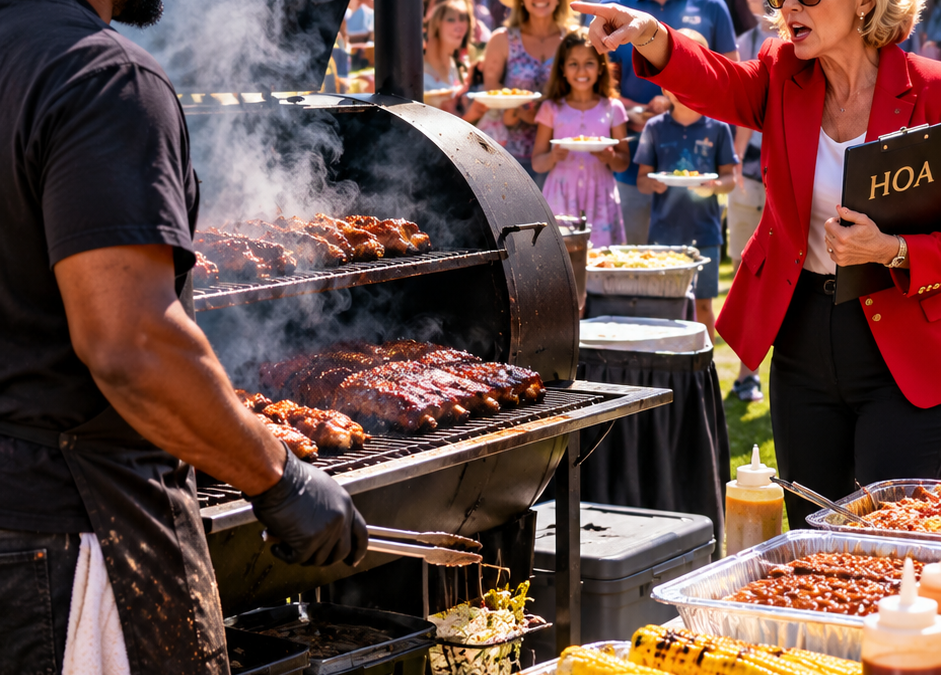
She walked across the grass like the event had been arranged incorrectly around her. Mid-fifties, pearl earrings, white linen blouse, sunglasses pushed up onto perfectly styled hair, and a thin folder tucked under one arm. Her expression was not angry yet. It was worse than angry. It was administrative.
The kind of face people make when they have already decided the facts will eventually agree with them.
Amy murmured, “Oh no.”
I kept turning chicken.
Karen stopped several feet from my grill and stared at it.
Not at me.
At the grill.
As if it were an illegal structure someone had built in her dining room.
I waited.
When she still did not speak, I said, “Good afternoon.”
Her eyes shifted to me.
“Are you responsible for this setup?”
“I’m the caterer.”
“This grill needs to be shut down.”
The sentence landed so sharply that Elena stopped moving.
Darius looked up from the prep table.
I set the tongs down.
“I’m sorry?”
“You heard me,” Karen said. “Shut it down.”
A few people nearby turned their heads.
I kept my voice calm because experience had taught me that the first person to raise their voice usually loses control of the room.
“Can I ask what the problem is?”
“The smoke,” she said, gesturing toward the smoker as if smoke at a barbecue were a shocking development. “It is violating community standards.”
For a moment, I thought I had misunderstood.
“The smoke.”
“Yes.”
“At the approved neighborhood barbecue.”
Her eyes narrowed.
“Do not take that tone with me.”
“I’m trying to understand what you’re asking.”
“I am not asking. I am telling you that this equipment is not compliant and must be shut down immediately.”
Amy hurried over.
“Karen, we approved this setup weeks ago.”
Karen did not look at her.
“I approved the event, Amy. I did not approve a commercial cooking operation producing smoke across the community lawn.”
Amy blinked.
“The event permit says outdoor cooking is allowed.”
Karen opened her folder.
“The HOA handbook prohibits commercial cooking at community events.”
That caught my attention.
“May I see the section you’re referring to?” I asked.
She gave me a look that said she was not used to vendors asking for documents.
Then she removed a printed handbook and flipped to a marked page.
“There,” she said, tapping the paragraph with one manicured finger.
I wiped my hands on a towel before touching the page.
The section was under Community Event Use Restrictions.
I read it carefully.
No open commercial cooking operations may be conducted on common areas without prior written authorization from the Association or designated event committee. All vendors must comply with applicable safety, sanitation, and equipment placement requirements.
I read it again.
Then I looked at Karen.
“This doesn’t prohibit commercial cooking.”
Her chin lifted.
“It clearly does.”
“No. It says no commercial cooking without prior written authorization.”
“That authorization comes from the Association.”
“And the designated event committee.”
Karen’s eyes flicked toward Amy.
Amy immediately lifted her clipboard.
“The social committee approved the vendor. The event permit approved outdoor cooking. We submitted everything.”
Karen’s voice hardened.
“My approval is what matters.”
That sentence changed the mood around us.
Before that, people had been curious. A few amused. Some irritated by the delay. But when Karen said her approval was all that mattered, several residents looked at one another.
The barbecue had stopped being about smoke.
I said, “I have the written authorization in my vendor packet.”
Karen ignored me.
“This grill is affecting neighboring homes. We have standards for nuisance smoke, odors, and commercial activity.”
“It’s a barbecue,” Darius muttered under his breath.
Karen heard him.
“Excuse me?”
I gave him a look, and he lowered his eyes.
“I’m happy to show you the event authorization,” I said.
Karen folded the handbook shut.
“I do not need to review paperwork from a vendor.”
“I think you do if you’re telling me to shut down a contracted service.”
“I am the HOA president.”
“I understand.”
“Then you understand that I have authority over this event.”
“I understand you have a title. I’m asking what rule I’m violating.”
Several people had now gathered within earshot.
Karen seemed aware of them and did not like it.
“This is not a public debate,” she said.
An elderly woman sitting beneath a nearby canopy spoke before anyone else could.
“It’s a community barbecue, Karen. That makes it fairly public.”
A few people laughed softly.
Karen turned toward her.
The woman was small, white-haired, and dressed in a blue floral blouse. She sat in a folding chair with a cane resting beside her knee and a paper fan in one hand. I had noticed her earlier because she had been the first person to tell me the sauce smelled like something her husband used to make.
Her name, I later learned, was Mrs. Eleanor Price.
Karen’s mouth tightened.
“Eleanor, this is HOA business.”
Mrs. Price did not flinch.
“I’ve lived here twenty years. I’ve been coming to these events since before the clubhouse had a proper roof. We’ve had barbecue, chili cookouts, pancake breakfasts, fish fries, and one terrible seafood boil nobody should speak of again. I have never seen the HOA stop a cook for cooking.”
A few residents laughed again, louder this time.
Karen’s face changed.
It was small, but I saw it.
Embarrassment becoming anger.
“I suggest you stay out of HOA business,” Karen said.
The backyard went silent.
Not quieter.
Silent.
Even the kids seemed to feel something shift, because the shrieking near the sprinklers faded.
Mrs. Price’s hand tightened around her paper fan.
Amy looked horrified.
I stared at Karen, trying to understand how someone could speak to an elderly resident that way in front of half the neighborhood and think it made her look stronger.
Darius whispered, “Oh, she messed up.”
He was right.
Karen had not just challenged me. She had insulted someone the residents clearly loved.
That was the moment I decided the argument needed a record.
Not because I wanted to embarrass Karen.
Not because I wanted to escalate.
Because I had been in enough disputes to know that when someone with authority starts changing the meaning of documents in public, they will often change the story later in private.
I reached for my phone, opened the camera, and started recording.
I kept it low, angled enough to capture the conversation without shoving it in anyone’s face.
Karen turned back to me.
“This is your final instruction. Shut down the grill and smoker immediately.”
I kept my voice steady.
“For the record, I am here under written authorization from the event committee and the approved event permit. I have complied with the designated setup location, safety clearance, and food service requirements. You have not shown me a rule that prohibits this barbecue.”
Her eyes dropped to my phone.
“Are you recording me?”
“Yes.”
“You do not have my permission.”
“We’re standing at a community event, and you’re giving me instructions that affect my business. I’m documenting the interaction.”
“You need to stop recording.”
“I’m going to keep documenting.”
Her face flushed.
“This is exactly the kind of unprofessional conduct I expected.”
That sentence hit harder than I wanted it to.
I had spent my entire career fighting for professional respect. Catering work can look casual from the outside. People see smoke, coolers, gloves, aprons, and paper plates. They do not see the licenses, insurance, training, prep schedules, sanitation logs, temperature controls, equipment maintenance, invoices, and early mornings. They do not see the stress of knowing one mistake can ruin someone’s event or damage a reputation built over years.
I looked Karen directly in the eye.
“Nothing about my conduct has been unprofessional.”
“You are refusing to follow an HOA directive.”
“I am refusing to shut down an approved food service without a valid rule or written cancellation from the event organizer.”
“I am the HOA president.”
“You’ve said that.”
A few people murmured.
Karen heard them and turned sharply.
“This event is suspended until further notice.”
Amy stepped forward.
“You can’t just suspend the whole barbecue.”
“I absolutely can.”
“The board approved it.”
“I am acting to enforce community standards.”
Mrs. Price spoke again, quieter this time but clear enough for everyone to hear.
“You are acting like a bully.”
The words hung in the humid air.
Karen turned toward her slowly.
“Eleanor, I will not warn you again.”
Mrs. Price lifted her chin.
“I’m eighty-one years old. You don’t scare me.”
Someone clapped once, then stopped quickly.
Karen looked around at the faces watching her.
That was when she made her next mistake.
She pulled out her phone.
“I’m calling for assistance.”
Amy’s eyes widened.
“Karen, don’t.”
But Karen had already stepped away, phone pressed to her ear.
I could not hear every word, but I heard enough.
“Yes, we have a vendor refusing to leave the premises… No, he is not authorized… He is operating commercial cooking equipment on HOA property… I need officers dispatched… Yes, trespassing.”
Trespassing.
I felt Elena go still beside me.
Darius whispered, “Marcus.”
“I know.”
My first instinct was anger.
My second was caution.
I was a Black man standing behind a large grill at a wealthy HOA event while the HOA president called the police and described me as an unauthorized vendor refusing to leave. That reality settled in my body before I could reason it away.
I had done nothing wrong.
That did not mean nothing could go wrong.
I kept recording.
Amy stepped closer to me, her voice low.
“I’m so sorry. I have the permit. I’ll show them.”
“Thank you.”
“She’s out of line.”
“I know.”
“No, I mean completely out of line. The committee approved you. The board approved the event. We voted on the vendor list.”
“Then say that when they ask.”
“I will.”
Darius leaned toward me.
“You want me to shut the smoker?”
“No.”
“You sure?”
I looked at the temperature gauge, the food, the waiting crowd, the children watching us, the elderly woman sitting straighter than anyone else in the yard, and Karen standing near the walkway pretending she had restored order by summoning police.
“Keep cooking,” I said.
Darius nodded once.
Elena resumed wrapping corn, but her hands were tighter than before.
For the next few minutes, the barbecue existed in a strange half-life.
The grill still hissed.
The smoker still breathed.
But conversation had thinned. People stood in clusters, whispering. Some watched Karen. Others watched me. A few residents drifted closer to Amy, asking whether the food would still be served.
Amy kept saying, “The event is authorized. Please be patient.”
Karen paced near the clubhouse.
Every now and then, she looked back at me like she expected to see fear.
I will not pretend I felt none.
Fear is not always panic. Sometimes it is calculation. It is checking where your hands are. It is making sure your phone is recording. It is reminding yourself not to move quickly, not to speak sharply, not to let righteous anger hand someone else a weapon.
When the police vehicles appeared at the end of the street, a few people gasped.
Two cruisers rolled slowly toward the community lawn and parked near the curb. Four officers stepped out, scanning the event, the crowd, the tents, the grill, and Karen walking toward them before their doors were fully closed.
She reached them first, of course.
I could not hear everything, but I saw her gestures.
She pointed at me.
She pointed at the grill.
She pointed at the handbook.
Her posture was urgent, offended, theatrical.
The officers listened.
That mattered.
They did not rush toward me. They did not put hands on weapons. They did not bark commands. They listened, asked questions, and looked around.
One officer, a tall man with close-cropped hair, walked toward me while another stayed with Karen. His nameplate read Alvarez.
I set my tongs down where he could see my hands.
“Good afternoon,” he said.
“Good afternoon, officer.”
“Are you Marcus Bennett?”
“Yes.”
“Can you tell me what’s going on?”
“Yes, sir.”
I kept my voice level and pointed to the folder on my prep table.
“I’m the hired caterer for this approved community barbecue. I have the event authorization, vendor approval, insurance certificate, and food service documents right here. The HOA president told me to shut down because she claimed smoke from the grill violates community standards. I asked her to show me the rule. The section she showed me allows commercial cooking with prior authorization. I have that authorization.”
He nodded.
“You’re recording?”
“Yes. I started recording after she demanded I shut down and after she told an elderly resident to stay out of HOA business. I wanted a record of the instructions being given.”
“May I see the authorization?”
“Yes.”
I opened the folder and handed him the event packet.
Amy came over immediately.
“Officer, I’m Amy Caldwell. I chair the social committee. We hired Mr. Bennett. The event was approved weeks ago. Outdoor cooking was specifically included.”
Officer Alvarez took the permit and read it.
He did not skim.
He actually read it.
That helped me breathe.
“This says food vendors and outdoor cooking are permitted in the designated event area,” he said.
“Yes,” Amy replied. “This is the designated area.”
“Was he asked to leave by the event organizer?”
“No.”
“Was his contract canceled?”
“No.”
“Is he creating a hazard?”
“No. We reviewed the setup. Fire extinguisher is there, water access is there, and the grill is clear of tents and structures.”
He looked at me.
“Any issues before Ms. Whitmore approached you?”
“No, officer.”
“Any threats? Arguments? Physical contact?”
“No.”
Karen approached with another officer beside her.
“This is not accurate,” she said sharply.
Officer Alvarez turned.
“Ms. Whitmore, I’m gathering information.”
“He is refusing a lawful order to shut down an unauthorized commercial operation.”
Alvarez held up the permit.
“I’m looking at an authorization that appears to allow food vendors and outdoor cooking.”
Karen snatched her handbook open.
“The HOA handbook prohibits commercial cooking at community events.”
“Please show me the exact section.”
She handed it over quickly, like she had been waiting for that moment.
He read the paragraph.
Then he read it again.
His expression changed only slightly, but I saw it.
So did Karen.
“This section says commercial cooking may not occur without prior written authorization from the Association or designated event committee,” he said.
Karen’s voice sharpened.
“That means me.”
“It says Association or designated event committee.”
“The president oversees the Association.”
“Maybe so. But the document does not say only the president can authorize it.”
Karen pointed toward Amy.
“The social committee does not have authority to override community standards.”
Amy lifted her clipboard.
“We didn’t override anything. We followed the event approval process.”
Karen turned on her.
“Amy, not now.”
Officer Alvarez said, “Ms. Whitmore.”
Karen looked back at him.
He kept his tone calm.
“I’m not here to interpret HOA governance beyond determining whether there is a criminal issue. Right now, I see an approved event, an authorized vendor, and a disagreement about internal HOA rules.”
Karen stared at him.
“He is trespassing.”
“Who invited him onto the property?”
Amy said, “The event committee did.”
Karen snapped, “They did not have final authority.”
Alvarez looked at her.
“Has he been formally trespassed by someone with clear authority to remove an approved vendor from an approved event?”
Karen hesitated.
“The HOA president has that authority.”
“Do you have documentation showing that authority applies here despite the event authorization?”
She opened her mouth.
No words came.
The other officer, a woman named Brooks, had been speaking quietly with residents nearby. She returned with a small notebook.
“Several witnesses say the vendor was cooking normally when Ms. Whitmore approached and ordered him to shut down,” Brooks said. “They say he asked for the rule and showed paperwork. They also confirm Mrs. Price objected and Ms. Whitmore told her to stay out of HOA business.”
Karen turned red.
“That is not relevant.”
Mrs. Price’s voice came from behind the officers.
“It is relevant to me.”
Everyone looked over.
She stood slowly with her cane.
A younger woman tried to help, but Mrs. Price waved her off and walked toward us with the dignity of a judge entering her own courtroom.
Officer Brooks turned to her.
“Ma’am, are you Mrs. Price?”
“I am.”
“Would you like to tell me what you saw?”
“Yes.”
Karen looked like she wanted to object.
She did not.
Mrs. Price stopped beside Amy.
“I was sitting over there under the canopy. Mr. Bennett and his team were cooking. People were happy. The food smelled wonderful. Karen came over and told him to shut it all down because of smoke. He was polite. He asked what rule he had violated. She showed him a handbook, but the words did not say what she claimed. Amy tried to explain that the event was approved. Karen would not listen.”
Officer Brooks wrote quickly.
Mrs. Price continued.
“I told Karen we had held barbecues here for years. That is true. She told me to stay out of HOA business. That is also true.”
Karen said, “Eleanor—”
Mrs. Price turned toward her.
“No, Karen. You wanted officers here. Let them hear it.”
That silence returned, deeper this time.
Mrs. Price looked back at Officer Brooks.
“Then Mr. Bennett started recording. I was glad he did. Because people forget their own tone when they think they are important.”
A sound moved through the crowd. Not laughter. Not exactly. More like recognition.
Officer Alvarez turned to me.
“May I see the recording?”
“Yes.”
I handed him my phone.
The video began with Karen demanding that I shut down the grill. It captured my request for the rule, Karen pointing to the handbook, Amy mentioning approval, Mrs. Price speaking up, Karen telling her to stay out of HOA business, and Karen later calling the police and using the word trespassing.
Alvarez watched without expression.
Then he handed the phone to Brooks.
She watched too.
Karen stood rigidly beside them.
When Brooks finished, she handed the phone back.
Alvarez looked at Karen.
“Ms. Whitmore, based on what we have here, this does not appear to be a criminal trespass matter.”
Karen’s eyes widened.
“He is refusing to comply.”
“With what lawful order?”
“My order.”
There it was.
The sentence that said everything.
Officer Alvarez did not smile. I respected him for that.
“Your HOA instruction is not automatically a lawful police order,” he said.
Karen’s face went pale with anger.
“I am the president of this association.”
“I understand.”
“This is private property.”
“I understand that too.”
“Then remove him.”
“At this time, I do not have a clear legal basis to remove an approved vendor from an approved event because of an internal dispute over HOA rules.”
Karen’s voice rose.
“He is deliberately refusing authority.”
Alvarez’s tone stayed even.
“Ms. Whitmore, you may need to resolve that through the HOA process or civil counsel. You cannot convert every disagreement into an arrest.”
The words spread through the crowd like a wind shift.
Karen heard it.
Everyone did.
For a few seconds, she just stared at him.
Then she said, “So you’re taking his side.”
“No,” Alvarez said. “I’m taking the facts as they’re presented.”
“He’s violating community standards.”
“That may be an HOA issue.”
“He’s operating a commercial business.”
“With written authorization.”
“He’s creating smoke.”
“At a barbecue.”
The last three words slipped out so dryly that even Officer Brooks looked down for half a second.
A few residents laughed.
Karen turned toward them.
The laughter stopped, but the damage was done.
She no longer controlled the room.
Or the lawn.
Or the story.
Officer Brooks stepped in.
“Ms. Whitmore, here is what we can do. We will document the call. We will note that there is an approved event permit, a vendor authorization, witness statements, and a recording. We will also note your concern about HOA rules. But unless something changes, this is not an arrest situation.”
Karen’s voice dropped.
“I want a report.”
“You can request the incident number.”
“I want it documented that I demanded he leave.”
“It will be documented.”
“And that he refused.”
“It will be documented in context.”
Karen did not like that phrase.
Context is a dangerous thing when someone is depending on a title to do all the work.
Officer Alvarez turned to me.
“Mr. Bennett, as long as the event organizer wants you here and there is no safety issue, we are not instructing you to leave. Keep the area safe. Avoid engaging further.”
“Yes, officer.”
He looked at Amy.
“Ms. Caldwell, you may want to keep the event paperwork available.”
“I will.”
He looked toward the crowd.
“Everyone else, please give them space to work.”
Then the officers stepped aside and continued taking brief statements.
The whole interaction had taken maybe twenty minutes.
It felt longer.
When the officers finally returned to their vehicles, Karen followed them halfway.
Alvarez said something to her quietly. She stopped walking.
The cruisers pulled away.
For several seconds, nobody moved.
Then Darius leaned toward me and whispered, “So… ribs?”
I looked at him.
He shrugged.
“People are hungry.”
A laugh broke out near the front of the line.
Then another.
Then Amy clapped her hands and announced, too brightly at first, “Food service will begin in five minutes.”
The yard erupted.
Not wild cheering, not exactly, but relief. Applause scattered across the lawn. Someone whistled. A group of kids shouted because they understood only that food had survived. Mrs. Price sat back down beneath her canopy like a queen returning to her throne.
I turned back to the grill.
My hands shook slightly when I picked up the tongs.
Elena noticed.
“You okay?” she asked quietly.
“Yes.”
It was not entirely true.
But it was true enough to keep working.
The first tray of chicken came off the grill with skin lacquered dark and crisp at the edges. Darius pulled pork into steaming strands, mixing it with just enough sauce to shine without drowning it. Elena lined up corn, beans, and slaw. The buffet opened, and the line formed almost instantly.
People came through differently than they had before.
Not just hungry.
Intentional.
The elderly man in the straw hat took his plate and said, “Best-smelling evidence I’ve ever seen.”
I laughed despite myself.
A woman with two children said, “We’re glad you stayed.”
Another resident leaned in and whispered, “Karen has been waiting to pick a fight with the social committee all year. Sorry you got dragged into it.”
Mrs. Price came through with Amy helping carry her plate.
When she reached me, I said, “Ma’am, thank you.”
She looked at me over the top of her glasses.
“For telling the truth?”
“For speaking up.”
She accepted a serving of pulled pork.
“My late husband used to say silence is how bullies rent space in decent people’s lives.”
“That’s a good line.”
“He had three good lines. I married him before I heard the other two.”
I laughed so hard I almost dropped the serving tongs.
She smiled and moved down the line.
Across the lawn, Karen stood near the clubhouse doors.
She had not left.
That surprised me at first. Then I understood. Leaving would have looked like defeat. Staying allowed her to pretend she was supervising something.
But nobody gathered around her.
Nobody asked her what to do.
Residents passed her carefully, like walking around a puddle.
The barbecue continued without her permission.
That was the part that seemed to bother her most.
For the next two hours, we served food nonstop.
The band started playing again. The kids returned to the sprinklers. People sat in folding chairs with plates balanced on their knees, talking louder now, laughing more freely, as if the confrontation had broken some invisible pressure that had been sitting over the neighborhood long before I arrived.
I heard pieces of conversations while working.
“She talked to Eleanor like that?”
“I told you she’s been out of control.”
“The handbook clearly said authorization.”
“Why call the police?”
“Because she thought they’d scare him.”
“Did you see the officer’s face?”
“Someone needs to bring this up at the next meeting.”
I kept my head down and worked.
Not because I did not care.
Because my job was still my job.
Food had to be served hot. Surfaces had to stay clean. Gloves had to be changed. Temperatures had to be monitored. Trash had to be managed. Leftovers had to be handled correctly. A crisis did not excuse sloppy work.
If anything, it made professionalism more important.
Near the end of service, Amy came behind the table with tears in her eyes.
“Marcus, I am so sorry.”
“You already said that.”
“I know, but I need to say it again.”
“You didn’t cause it.”
“I brought you here.”
“You hired me for a job. I did the job.”
“She humiliated herself, but she also put you in a terrible position.”
I looked across the lawn.
Karen was speaking to one of the board members now, her gestures tight and angry.
“Yes,” I said. “She did.”
Amy lowered her voice.
“I’m going to file a formal complaint.”
“You should.”
“Several residents already said they’ll sign statements.”
“That’s their decision.”
“We have the permit. We have the announcement. We have the board minutes.”
“Keep all of it.”
She nodded.
Then she said, “Would you be willing to send me a copy of the video?”
I hesitated.
Not because I wanted to protect Karen.
Because videos have a way of leaving your control once they leave your phone.
“I’ll send it to my attorney first,” I said. “Then I can provide it through the proper channel if needed.”
Amy looked embarrassed.
“Of course. Sorry. That makes sense.”
“It’s okay.”
She wiped one eye quickly.
“I hate that this happened at what was supposed to be a happy event.”
I looked at the crowd.
A boy was trying to carry three cookies in one hand. Mrs. Price was laughing with two women under the canopy. Darius was explaining sauce levels to a man who seemed to be taking the subject very seriously. Elena was packing extra cobbler for volunteers.
“It still is a happy event,” I said. “Just not the way you planned.”
Amy followed my gaze.
Then she smiled faintly.
“No. Not the way I planned.”
By late afternoon, the food was gone.
That is always the best review.
Empty trays. Sauce smears. People asking whether there is any more chicken hiding somewhere. Someone trying to buy leftover beans that no longer exist. A line of residents thanking my team as we cleaned up.
Karen finally approached as we were loading the smoker.
I saw her coming and felt Darius tense beside me.
“Don’t,” I said quietly.
He stepped back.
Karen stopped a few feet away.
Her posture had returned to its formal version. Shoulders straight. Chin lifted. Folder under one arm.
“Mr. Bennett.”
“Ms. Whitmore.”
“I want to be clear that today’s situation is not over.”
I wiped my hands on a towel.
“I assumed it wasn’t.”
“The HOA will be reviewing vendor procedures.”
“That’s your right.”
“And whether future commercial cooking operations require stricter oversight.”
“That may be wise, as long as the rules are clear and applied before vendors arrive.”
Her eyes narrowed.
“You seem to think you won something today.”
“No.”
“Good.”
“I think the paperwork said what it said.”
Her face tightened.
“That is a very narrow view.”
“It was enough.”
She looked past me toward the smoker.
“You embarrassed me in front of the community.”
I stared at her.
“I did not call the police.”
“You recorded me.”
“After you ordered me to shut down without showing a valid rule.”
“You challenged my authority.”
“I asked you to identify it.”
For a moment, neither of us spoke.
Then I said, “You could have spoken to Amy privately. You could have reviewed the permit. You could have asked about smoke management. You could have given a written concern for future events. Instead, you tried to shut down a barbecue in front of everyone and told an elderly resident to stay out of HOA business.”
Karen’s mouth hardened.
“She inserted herself.”
“She lives here.”
“That does not give her authority.”
“No. But it gives her standing.”
The word seemed to irritate her because it sounded like something that belonged in a meeting where she could not simply wave people away.
She shifted the folder against her side.
“You should be careful how you conduct yourself with communities like this.”
There it was again.
That phrase.
Communities like this.
I had heard versions of it before.
Venues like this.
Clients like this.
Neighborhoods like this.
It always sounded polite until you listened closely enough.
I stepped closer, keeping my voice calm.
“Ms. Whitmore, I conducted myself exactly like a licensed vendor hired to do a job. I arrived with authorization. I followed the approved plan. I kept cooking when you tried to turn a paperwork disagreement into a police matter. And I served every guest who came through that line.”
Her jaw worked.
“If there are future events—”
“There may not be future events for me here. That’s fine. My reputation will survive Willow Creek.”
That seemed to surprise her.
Maybe she expected me to plead for future work.
I did not.
No contract was worth letting someone rewrite my dignity.
Amy appeared behind Karen before the conversation could go further.
“Karen,” she said, voice controlled, “the board members are waiting near the clubhouse.”
Karen turned.
Amy’s face had changed since the morning. She still looked tired, but no longer uncertain.
“We need to discuss what happened,” Amy said.
Karen replied, “This is not the time.”
“It is exactly the time.”
Several residents nearby stopped pretending not to listen.
Karen looked around, saw them, and realized she had no private corner left.
Without another word to me, she walked toward the clubhouse.
Amy watched her go, then turned back.
“I’m sorry,” she said again.
“You can stop apologizing now.”
“I’ll try.”
She smiled weakly.
I finished loading the equipment.
When we pulled away from Willow Creek, the sun was low and gold across the lawns. The neighborhood looked peaceful again from the road, but I knew better. Something had shifted there. Maybe small. Maybe temporary. But real.
A week later, Amy called.
I was prepping for a wedding tasting when her name appeared on my phone.
“Marcus,” she said, “I wanted you to hear this from me.”
“That sounds serious.”
“It was a long board meeting.”
“I imagine.”
“Residents packed the room.”
I set down my knife.
“Because of the barbecue?”
“Because of Karen.”
Amy told me what happened.
Mrs. Price spoke first.
That did not surprise me.
She stood with her cane in front of the board and read a statement describing the event, Karen’s conduct, and the police call. Several residents followed. One brought the original event announcement. Another brought the approved permit. Amy presented the committee authorization and vendor paperwork.
Then the officers’ incident report came up.
It stated that the responding officers found no clear criminal issue, that the event appeared authorized, and that the matter was primarily an internal HOA dispute.
My recording was not played publicly. Amy said that was deliberate. Their attorney advised against turning the meeting into a spectacle. But written descriptions of the recording were submitted to the board.
By the end of the meeting, Karen had agreed to step back from direct event oversight pending review.
“She didn’t resign,” Amy said. “But she lost the room.”
That phrase stayed with me.
Lost the room.
Authority can survive disagreement.
It cannot survive everyone seeing the difference between leadership and control.
“What happens now?” I asked.
“The board is rewriting event procedures so approvals can’t be reversed on one person’s whim. They’re also adding a rule that police are not to be called for vendor disputes unless there’s an actual safety issue or legal threat.”
“That sounds useful.”
“And they voted to reimburse your full invoice with a written apology.”
“They already paid the invoice.”
“I know. The apology is separate.”
Two days later, the letter arrived.
Not taped to anything.
Mailed properly.
Dear Mr. Bennett,
On behalf of the Willow Creek Estates event committee, we apologize for the disruption you and your staff experienced during the summer barbecue. You were present as an approved vendor under the event authorization issued by the committee. We appreciate your professionalism, patience, and continued service under difficult circumstances.
It was signed by Amy and two board members.
Karen’s name was not on it.
I did not need it to be.
I placed the letter in my business file, behind the contract and the permit.
Not because I wanted to remember the conflict.
Because I wanted to remember what protected me.
Not anger.
Not pride.
Not shouting louder than Karen.
Paperwork.
Witnesses.
Calm.
The truth, documented before someone else could bend it.
A month after the barbecue, I catered a retirement party three neighborhoods away.
Halfway through service, a woman came through the line and looked at my logo.
“You’re the Willow Creek barbecue guy,” she said.
I braced myself.
Then she grinned.
“My sister lives there. She said your pulled pork survived a police investigation.”
I laughed harder than I expected.
“That’s one way to describe it.”
“She said it was the best barbecue they ever had.”
“I’ll take that part.”
Word traveled after that.
Not all of it was accurate. Stories never stay clean once they pass through enough mouths. Some people said Karen tried to have me arrested over ribs. Some said Mrs. Price threatened the HOA with her cane. Some said the officers ate plates before leaving, which was not true, though Darius insisted we should have offered.
What mattered was that my business did not suffer.
It grew.
People respected that I had stayed professional. They respected that I had kept serving. They respected, maybe most of all, that when someone tried to turn a title into a weapon, I had not handed her the reaction she wanted.
Sometimes, people ask whether I regret not shutting down for a few minutes just to avoid the trouble.
I always say no.
Not because barbecue is more important than peace.
Because the peace Karen wanted was not real peace.
It was compliance.
There is a difference.
Real peace would have been reviewing the permit, addressing any genuine safety concern, and letting the event continue. Compliance would have been me shutting down an approved service because someone with a folder decided her authority mattered more than the words on the page.
I have too much respect for my work to accept that.
I have too much respect for myself.
I still think about Mrs. Price.
She sent me a card weeks later.
Inside, in careful handwriting, she wrote:
Mr. Bennett, my husband would have loved your sauce and your backbone. Thank you for feeding us and for not letting one person ruin what belonged to the whole neighborhood.
I kept that card too.
Not in the business file.
In my kitchen.
Some things belong closer than contracts.
The summer moved on. There were other events, other grills, other crowds, other problems. A generator failed at a graduation party. A bride’s cousin dropped an entire tray of rolls into a koi pond. A corporate client asked whether I could make ribs “less rib-like.” Life returned to its usual rhythm.
But Willow Creek stayed with me.
Not because it was the hardest job I ever worked.
Because it reminded me how quickly ordinary work can become a test of whether people see you as a professional or as someone they can order around.
Karen saw smoke and decided she had found a violation.
She saw a grill and decided she had found weakness.
She saw a caterer and decided she had found someone easier to intimidate than a board member, easier to dismiss than a resident, easier to remove than a rule she did not want to read correctly.
But she forgot something.
I had paperwork too.
I had witnesses.
I had a phone in my hand and enough discipline not to turn her mistake into mine.
And most importantly, I had a job to do.
So I did it.
I cooked the food.
I served the guests.
I let the facts speak in a place where her title had been speaking too loudly for too long.
By the end of that day, the smoke from my grill had faded into the summer air.
The sauce stains washed out of the serving pans.
The tents came down.
The police report was filed.
The board minutes were written.
And the neighborhood remembered exactly what happened.
Not because I shouted.
Not because I fought.
Because when Karen Whitmore tried to shut down the biggest barbecue of the summer with a paragraph that did not say what she claimed, the whole community watched the truth come off the grill hotter than anything I cooked that day.
𝗧𝗛𝗘 𝗘𝗡𝗗
The Smoke From My Grill Wasn’t What Made the Neighborhood Go Silent
The first thing Karen noticed was not the food, the families, or the line of people waiting with paper plates in their hands.
It was the smoke rising from my grill, curling above the backyard like evidence she had been waiting to use.
By the time she told me to shut everything down, I already knew she was not really talking about barbecue.
My name is Marcus Bennett, and I had spent twelve years building my catering business one neighborhood event at a time.
I did not come from restaurant money. I did not inherit a kitchen, a food truck, a client list, or a family name people recognized. I started with one secondhand smoker, two folding tables, a borrowed pickup, and a stubborn belief that if I showed up early, worked clean, treated people right, and made food good enough to quiet a crowd, I could build something honest.
For years, that was exactly what I did.
Weddings. Church picnics. Graduation parties. Fundraisers. Company lunches in parking lots. Backyard birthdays where children ran barefoot through the grass while parents argued about whether brisket or ribs were better. I had catered in August heat, March rain, winter wind, and one thunderstorm so bad that I finished a rack of ribs under a tarp while the bride’s uncle held the corner down with both hands and shouted, “This is the best wedding I’ve ever been to.”
I loved the work because food told the truth quickly.
People could pretend about a lot of things. They could praise decorations they hated, smile through speeches that went too long, or clap politely for music nobody enjoyed. But when someone took a bite of food and their shoulders dropped, when they closed their eyes for half a second, when they turned to the person beside them and said, “You have to try this,” that was real.
That was why I was proud of my business.
Bennett Smokehouse Catering was not the biggest outfit in the county. I had no billboard, no investor, no flashy branding beyond a clean logo my niece designed for me in college. But people called me back. That mattered more than anything.
So when I was hired to cater the biggest neighborhood barbecue of the summer at Willow Creek Estates, I treated it like a serious contract.
Willow Creek was one of those neighborhoods that looked like it had been assembled from a brochure. Wide streets, stone entrances, trimmed lawns, matching mailboxes, and houses with front porches nobody seemed to sit on unless someone was taking pictures. The neighborhood had a homeowners association with committees for landscaping, events, architecture, seasonal décor, community safety, and, apparently, anything else that could be turned into a rule.
I had catered there twice before for private homeowners.
Both jobs had gone smoothly.
This barbecue, though, was different.
It was the annual summer community event. More than two hundred residents were expected. There would be games for kids, a raffle, a small band, folding tables under white tents, and a long buffet line beside the community lawn. The organizers wanted pulled pork, smoked chicken, grilled corn, sausage, baked beans, coleslaw, and peach cobbler.
The kind of food people remembered.
The booking came through a resident named Amy Caldwell, who chaired the social committee. Amy was efficient, friendly, and precise in the way people are when they are responsible for something that can go wrong in front of everyone. She sent me the event authorization, vendor approval, setup instructions, parking directions, and a copy of the HOA event permit.
I read all of it.
That was not unusual for me. When you run a catering business, you learn that the food is only half the job. The other half is paperwork. Permits, invoices, insurance certificates, location approvals, fire safety rules, food handling documents, and local regulations. I kept everything organized because one missing certificate could turn a perfect job into a disaster.
Amy told me outdoor cooking was approved.
The event permit said the same thing.
Food vendors and outdoor cooking were specifically allowed for the barbecue as long as equipment stayed within the designated event area and safety clearances were maintained.
That was easy.
I arrived at Willow Creek just after eight that morning.
The air was already warming, and the sky had the pale brightness that promised a long, hot afternoon. The community lawn sat behind the clubhouse, bordered by maple trees and a low stone wall. Beyond it, rows of houses curved around the green like an audience waiting for a show.
I backed my trailer into the designated spot near the service lane. Two volunteers waved me in, and Amy came jogging over with a clipboard.
“Marcus, you made it,” she said, sounding relieved.
“I said I would.”
“I know. I just get nervous until every vendor is standing where they’re supposed to be.”
“That makes two of us.”
She laughed and pointed toward the setup area.
“You’ve got that whole section. We measured yesterday. Fire extinguisher station is over there, water access is behind the clubhouse, and we’ll keep the guest line from crowding your prep space.”
“Perfect.”
“I have your paperwork inside if anyone asks.”
“I brought copies too.”
“Of course you did.”
She said it like she appreciated that about me.
By nine, my team and I had the smoker positioned, the grill leveled, the prep table sanitized, the canopy secured, and the first trays staged. I worked with two assistants that day: my cousin Darius, who could wrap smoked meat faster than anyone I knew, and Elena, a culinary student who had started helping me on weekends and quickly became one of the most dependable people I had.
The smoker began working before most residents arrived.
The scent moved slowly at first. Hickory. Char. Seasoned meat warming through. Then the grill caught, and the air changed in that way only barbecue can make it change. People started drifting over before the event officially began, smiling like they were trying not to look too eager.
An older man in a straw hat stopped near the rope line.
“That brisket?” he asked.
“Pulled pork and chicken today,” I said. “Brisket costs extra and causes arguments.”
He grinned.
“Good barbecue should cause arguments.”
“That’s what I keep telling people.”
By noon, the place was alive.
Children ran through sprinklers someone had set up near the far edge of the lawn. A teenager adjusted speakers under a tent while his father gave unnecessary advice. Residents carried lawn chairs, coolers, and desserts toward the tables. The band warmed up with an old country song nobody sang correctly but everyone seemed to know.
The food was on schedule.
The pork had bark exactly where I wanted it. The chicken was holding temperature. The corn was ready to finish over flame. The beans were covered, hot, and already making Darius hover over them like a man guarding treasure.
“Don’t eat the product,” I told him.
He looked offended.
“I’m checking quality.”
“You’ve checked quality three times.”
“Quality changes.”
Elena laughed from the prep table.
It was going perfectly.
That is the part I remember most clearly.
Not because perfection is rare, although it is.
I remember it because trouble walked in after everything had already gone right.
The first sign was Amy’s face changing.
She had been standing near the check-in table, talking to a resident, when she looked over my shoulder and stiffened. The smile stayed on her mouth for a second too long, then disappeared. I followed her eyes and saw a woman approaching from the clubhouse walkway.
I knew who she was before anyone said her name.
Some people carry authority lightly. They know they have it, so they do not need to perform it.
Karen Whitmore was not one of those people.
She walked across the grass like the event had been arranged incorrectly around her. Mid-fifties, pearl earrings, white linen blouse, sunglasses pushed up onto perfectly styled hair, and a thin folder tucked under one arm. Her expression was not angry yet. It was worse than angry. It was administrative.
The kind of face people make when they have already decided the facts will eventually agree with them.
Amy murmured, “Oh no.”
I kept turning chicken.
Karen stopped several feet from my grill and stared at it.
Not at me.
At the grill.
As if it were an illegal structure someone had built in her dining room.
I waited.
When she still did not speak, I said, “Good afternoon.”
Her eyes shifted to me.
“Are you responsible for this setup?”
“I’m the caterer.”
“This grill needs to be shut down.”
The sentence landed so sharply that Elena stopped moving.
Darius looked up from the prep table.
I set the tongs down.
“I’m sorry?”
“You heard me,” Karen said. “Shut it down.”
A few people nearby turned their heads.
I kept my voice calm because experience had taught me that the first person to raise their voice usually loses control of the room.
“Can I ask what the problem is?”
“The smoke,” she said, gesturing toward the smoker as if smoke at a barbecue were a shocking development. “It is violating community standards.”
For a moment, I thought I had misunderstood.
“The smoke.”
“Yes.”
“At the approved neighborhood barbecue.”
Her eyes narrowed.
“Do not take that tone with me.”
“I’m trying to understand what you’re asking.”
“I am not asking. I am telling you that this equipment is not compliant and must be shut down immediately.”
Amy hurried over.
“Karen, we approved this setup weeks ago.”
Karen did not look at her.
“I approved the event, Amy. I did not approve a commercial cooking operation producing smoke across the community lawn.”
Amy blinked.
“The event permit says outdoor cooking is allowed.”
Karen opened her folder.
“The HOA handbook prohibits commercial cooking at community events.”
That caught my attention.
“May I see the section you’re referring to?” I asked.
She gave me a look that said she was not used to vendors asking for documents.
Then she removed a printed handbook and flipped to a marked page.
“There,” she said, tapping the paragraph with one manicured finger.
I wiped my hands on a towel before touching the page.
The section was under Community Event Use Restrictions.
I read it carefully.
No open commercial cooking operations may be conducted on common areas without prior written authorization from the Association or designated event committee. All vendors must comply with applicable safety, sanitation, and equipment placement requirements.
I read it again.
Then I looked at Karen.
“This doesn’t prohibit commercial cooking.”
Her chin lifted.
“It clearly does.”
“No. It says no commercial cooking without prior written authorization.”
“That authorization comes from the Association.”
“And the designated event committee.”
Karen’s eyes flicked toward Amy.
Amy immediately lifted her clipboard.
“The social committee approved the vendor. The event permit approved outdoor cooking. We submitted everything.”
Karen’s voice hardened.
“My approval is what matters.”
That sentence changed the mood around us.
Before that, people had been curious. A few amused. Some irritated by the delay. But when Karen said her approval was all that mattered, several residents looked at one another.
The barbecue had stopped being about smoke.
I said, “I have the written authorization in my vendor packet.”
Karen ignored me.
“This grill is affecting neighboring homes. We have standards for nuisance smoke, odors, and commercial activity.”
“It’s a barbecue,” Darius muttered under his breath.
Karen heard him.
“Excuse me?”
I gave him a look, and he lowered his eyes.
“I’m happy to show you the event authorization,” I said.
Karen folded the handbook shut.
“I do not need to review paperwork from a vendor.”
“I think you do if you’re telling me to shut down a contracted service.”
“I am the HOA president.”
“I understand.”
“Then you understand that I have authority over this event.”
“I understand you have a title. I’m asking what rule I’m violating.”
Several people had now gathered within earshot.
Karen seemed aware of them and did not like it.
“This is not a public debate,” she said.
An elderly woman sitting beneath a nearby canopy spoke before anyone else could.
“It’s a community barbecue, Karen. That makes it fairly public.”
A few people laughed softly.
Karen turned toward her.
The woman was small, white-haired, and dressed in a blue floral blouse. She sat in a folding chair with a cane resting beside her knee and a paper fan in one hand. I had noticed her earlier because she had been the first person to tell me the sauce smelled like something her husband used to make.
Her name, I later learned, was Mrs. Eleanor Price.
Karen’s mouth tightened.
“Eleanor, this is HOA business.”
Mrs. Price did not flinch.
“I’ve lived here twenty years. I’ve been coming to these events since before the clubhouse had a proper roof. We’ve had barbecue, chili cookouts, pancake breakfasts, fish fries, and one terrible seafood boil nobody should speak of again. I have never seen the HOA stop a cook for cooking.”
A few residents laughed again, louder this time.
Karen’s face changed.
It was small, but I saw it.
Embarrassment becoming anger.
“I suggest you stay out of HOA business,” Karen said.
The backyard went silent.
Not quieter.
Silent.
Even the kids seemed to feel something shift, because the shrieking near the sprinklers faded.
Mrs. Price’s hand tightened around her paper fan.
Amy looked horrified.
I stared at Karen, trying to understand how someone could speak to an elderly resident that way in front of half the neighborhood and think it made her look stronger.
Darius whispered, “Oh, she messed up.”
He was right.
Karen had not just challenged me. She had insulted someone the residents clearly loved.
That was the moment I decided the argument needed a record.
Not because I wanted to embarrass Karen.
Not because I wanted to escalate.
Because I had been in enough disputes to know that when someone with authority starts changing the meaning of documents in public, they will often change the story later in private.
I reached for my phone, opened the camera, and started recording.
I kept it low, angled enough to capture the conversation without shoving it in anyone’s face.
Karen turned back to me.
“This is your final instruction. Shut down the grill and smoker immediately.”
I kept my voice steady.
“For the record, I am here under written authorization from the event committee and the approved event permit. I have complied with the designated setup location, safety clearance, and food service requirements. You have not shown me a rule that prohibits this barbecue.”
Her eyes dropped to my phone.
“Are you recording me?”
“Yes.”
“You do not have my permission.”
“We’re standing at a community event, and you’re giving me instructions that affect my business. I’m documenting the interaction.”
“You need to stop recording.”
“I’m going to keep documenting.”
Her face flushed.
“This is exactly the kind of unprofessional conduct I expected.”
That sentence hit harder than I wanted it to.
I had spent my entire career fighting for professional respect. Catering work can look casual from the outside. People see smoke, coolers, gloves, aprons, and paper plates. They do not see the licenses, insurance, training, prep schedules, sanitation logs, temperature controls, equipment maintenance, invoices, and early mornings. They do not see the stress of knowing one mistake can ruin someone’s event or damage a reputation built over years.
I looked Karen directly in the eye.
“Nothing about my conduct has been unprofessional.”
“You are refusing to follow an HOA directive.”
“I am refusing to shut down an approved food service without a valid rule or written cancellation from the event organizer.”
“I am the HOA president.”
“You’ve said that.”
A few people murmured.
Karen heard them and turned sharply.
“This event is suspended until further notice.”
Amy stepped forward.
“You can’t just suspend the whole barbecue.”
“I absolutely can.”
“The board approved it.”
“I am acting to enforce community standards.”
Mrs. Price spoke again, quieter this time but clear enough for everyone to hear.
“You are acting like a bully.”
The words hung in the humid air.
Karen turned toward her slowly.
“Eleanor, I will not warn you again.”
Mrs. Price lifted her chin.
“I’m eighty-one years old. You don’t scare me.”
Someone clapped once, then stopped quickly.
Karen looked around at the faces watching her.
That was when she made her next mistake.
She pulled out her phone.
“I’m calling for assistance.”
Amy’s eyes widened.
“Karen, don’t.”
But Karen had already stepped away, phone pressed to her ear.
I could not hear every word, but I heard enough.
“Yes, we have a vendor refusing to leave the premises… No, he is not authorized… He is operating commercial cooking equipment on HOA property… I need officers dispatched… Yes, trespassing.”
Trespassing.
I felt Elena go still beside me.
Darius whispered, “Marcus.”
“I know.”
My first instinct was anger.
My second was caution.
I was a Black man standing behind a large grill at a wealthy HOA event while the HOA president called the police and described me as an unauthorized vendor refusing to leave. That reality settled in my body before I could reason it away.
I had done nothing wrong.
That did not mean nothing could go wrong.
I kept recording.
Amy stepped closer to me, her voice low.
“I’m so sorry. I have the permit. I’ll show them.”
“Thank you.”
“She’s out of line.”
“I know.”
“No, I mean completely out of line. The committee approved you. The board approved the event. We voted on the vendor list.”
“Then say that when they ask.”
“I will.”
Darius leaned toward me.
“You want me to shut the smoker?”
“No.”
“You sure?”
I looked at the temperature gauge, the food, the waiting crowd, the children watching us, the elderly woman sitting straighter than anyone else in the yard, and Karen standing near the walkway pretending she had restored order by summoning police.
“Keep cooking,” I said.
Darius nodded once.
Elena resumed wrapping corn, but her hands were tighter than before.
For the next few minutes, the barbecue existed in a strange half-life.
The grill still hissed.
The smoker still breathed.
But conversation had thinned. People stood in clusters, whispering. Some watched Karen. Others watched me. A few residents drifted closer to Amy, asking whether the food would still be served.
Amy kept saying, “The event is authorized. Please be patient.”
Karen paced near the clubhouse.
Every now and then, she looked back at me like she expected to see fear.
I will not pretend I felt none.
Fear is not always panic. Sometimes it is calculation. It is checking where your hands are. It is making sure your phone is recording. It is reminding yourself not to move quickly, not to speak sharply, not to let righteous anger hand someone else a weapon.
When the police vehicles appeared at the end of the street, a few people gasped.
Two cruisers rolled slowly toward the community lawn and parked near the curb. Four officers stepped out, scanning the event, the crowd, the tents, the grill, and Karen walking toward them before their doors were fully closed.
She reached them first, of course.
I could not hear everything, but I saw her gestures.
She pointed at me.
She pointed at the grill.
She pointed at the handbook.
Her posture was urgent, offended, theatrical.
The officers listened.
That mattered.
They did not rush toward me. They did not put hands on weapons. They did not bark commands. They listened, asked questions, and looked around.
One officer, a tall man with close-cropped hair, walked toward me while another stayed with Karen. His nameplate read Alvarez.
I set my tongs down where he could see my hands.
“Good afternoon,” he said.
“Good afternoon, officer.”
“Are you Marcus Bennett?”
“Yes.”
“Can you tell me what’s going on?”
“Yes, sir.”
I kept my voice level and pointed to the folder on my prep table.
“I’m the hired caterer for this approved community barbecue. I have the event authorization, vendor approval, insurance certificate, and food service documents right here. The HOA president told me to shut down because she claimed smoke from the grill violates community standards. I asked her to show me the rule. The section she showed me allows commercial cooking with prior authorization. I have that authorization.”
He nodded.
“You’re recording?”
“Yes. I started recording after she demanded I shut down and after she told an elderly resident to stay out of HOA business. I wanted a record of the instructions being given.”
“May I see the authorization?”
“Yes.”
I opened the folder and handed him the event packet.
Amy came over immediately.
“Officer, I’m Amy Caldwell. I chair the social committee. We hired Mr. Bennett. The event was approved weeks ago. Outdoor cooking was specifically included.”
Officer Alvarez took the permit and read it.
He did not skim.
He actually read it.
That helped me breathe.
“This says food vendors and outdoor cooking are permitted in the designated event area,” he said.
“Yes,” Amy replied. “This is the designated area.”
“Was he asked to leave by the event organizer?”
“No.”
“Was his contract canceled?”
“No.”
“Is he creating a hazard?”
“No. We reviewed the setup. Fire extinguisher is there, water access is there, and the grill is clear of tents and structures.”
He looked at me.
“Any issues before Ms. Whitmore approached you?”
“No, officer.”
“Any threats? Arguments? Physical contact?”
“No.”
Karen approached with another officer beside her.
“This is not accurate,” she said sharply.
Officer Alvarez turned.
“Ms. Whitmore, I’m gathering information.”
“He is refusing a lawful order to shut down an unauthorized commercial operation.”
Alvarez held up the permit.
“I’m looking at an authorization that appears to allow food vendors and outdoor cooking.”
Karen snatched her handbook open.
“The HOA handbook prohibits commercial cooking at community events.”
“Please show me the exact section.”
She handed it over quickly, like she had been waiting for that moment.
He read the paragraph.
Then he read it again.
His expression changed only slightly, but I saw it.
So did Karen.
“This section says commercial cooking may not occur without prior written authorization from the Association or designated event committee,” he said.
Karen’s voice sharpened.
“That means me.”
“It says Association or designated event committee.”
“The president oversees the Association.”
“Maybe so. But the document does not say only the president can authorize it.”
Karen pointed toward Amy.
“The social committee does not have authority to override community standards.”
Amy lifted her clipboard.
“We didn’t override anything. We followed the event approval process.”
Karen turned on her.
“Amy, not now.”
Officer Alvarez said, “Ms. Whitmore.”
Karen looked back at him.
He kept his tone calm.
“I’m not here to interpret HOA governance beyond determining whether there is a criminal issue. Right now, I see an approved event, an authorized vendor, and a disagreement about internal HOA rules.”
Karen stared at him.
“He is trespassing.”
“Who invited him onto the property?”
Amy said, “The event committee did.”
Karen snapped, “They did not have final authority.”
Alvarez looked at her.
“Has he been formally trespassed by someone with clear authority to remove an approved vendor from an approved event?”
Karen hesitated.
“The HOA president has that authority.”
“Do you have documentation showing that authority applies here despite the event authorization?”
She opened her mouth.
No words came.
The other officer, a woman named Brooks, had been speaking quietly with residents nearby. She returned with a small notebook.
“Several witnesses say the vendor was cooking normally when Ms. Whitmore approached and ordered him to shut down,” Brooks said. “They say he asked for the rule and showed paperwork. They also confirm Mrs. Price objected and Ms. Whitmore told her to stay out of HOA business.”
Karen turned red.
“That is not relevant.”
Mrs. Price’s voice came from behind the officers.
“It is relevant to me.”
Everyone looked over.
She stood slowly with her cane.
A younger woman tried to help, but Mrs. Price waved her off and walked toward us with the dignity of a judge entering her own courtroom.
Officer Brooks turned to her.
“Ma’am, are you Mrs. Price?”
“I am.”
“Would you like to tell me what you saw?”
“Yes.”
Karen looked like she wanted to object.
She did not.
Mrs. Price stopped beside Amy.
“I was sitting over there under the canopy. Mr. Bennett and his team were cooking. People were happy. The food smelled wonderful. Karen came over and told him to shut it all down because of smoke. He was polite. He asked what rule he had violated. She showed him a handbook, but the words did not say what she claimed. Amy tried to explain that the event was approved. Karen would not listen.”
Officer Brooks wrote quickly.
Mrs. Price continued.
“I told Karen we had held barbecues here for years. That is true. She told me to stay out of HOA business. That is also true.”
Karen said, “Eleanor—”
Mrs. Price turned toward her.
“No, Karen. You wanted officers here. Let them hear it.”
That silence returned, deeper this time.
Mrs. Price looked back at Officer Brooks.
“Then Mr. Bennett started recording. I was glad he did. Because people forget their own tone when they think they are important.”
A sound moved through the crowd. Not laughter. Not exactly. More like recognition.
Officer Alvarez turned to me.
“May I see the recording?”
“Yes.”
I handed him my phone.
The video began with Karen demanding that I shut down the grill. It captured my request for the rule, Karen pointing to the handbook, Amy mentioning approval, Mrs. Price speaking up, Karen telling her to stay out of HOA business, and Karen later calling the police and using the word trespassing.
Alvarez watched without expression.
Then he handed the phone to Brooks.
She watched too.
Karen stood rigidly beside them.
When Brooks finished, she handed the phone back.
Alvarez looked at Karen.
“Ms. Whitmore, based on what we have here, this does not appear to be a criminal trespass matter.”
Karen’s eyes widened.
“He is refusing to comply.”
“With what lawful order?”
“My order.”
There it was.
The sentence that said everything.
Officer Alvarez did not smile. I respected him for that.
“Your HOA instruction is not automatically a lawful police order,” he said.
Karen’s face went pale with anger.
“I am the president of this association.”
“I understand.”
“This is private property.”
“I understand that too.”
“Then remove him.”
“At this time, I do not have a clear legal basis to remove an approved vendor from an approved event because of an internal dispute over HOA rules.”
Karen’s voice rose.
“He is deliberately refusing authority.”
Alvarez’s tone stayed even.
“Ms. Whitmore, you may need to resolve that through the HOA process or civil counsel. You cannot convert every disagreement into an arrest.”
The words spread through the crowd like a wind shift.
Karen heard it.
Everyone did.
For a few seconds, she just stared at him.
Then she said, “So you’re taking his side.”
“No,” Alvarez said. “I’m taking the facts as they’re presented.”
“He’s violating community standards.”
“That may be an HOA issue.”
“He’s operating a commercial business.”
“With written authorization.”
“He’s creating smoke.”
“At a barbecue.”
The last three words slipped out so dryly that even Officer Brooks looked down for half a second.
A few residents laughed.
Karen turned toward them.
The laughter stopped, but the damage was done.
She no longer controlled the room.
Or the lawn.
Or the story.
Officer Brooks stepped in.
“Ms. Whitmore, here is what we can do. We will document the call. We will note that there is an approved event permit, a vendor authorization, witness statements, and a recording. We will also note your concern about HOA rules. But unless something changes, this is not an arrest situation.”
Karen’s voice dropped.
“I want a report.”
“You can request the incident number.”
“I want it documented that I demanded he leave.”
“It will be documented.”
“And that he refused.”
“It will be documented in context.”
Karen did not like that phrase.
Context is a dangerous thing when someone is depending on a title to do all the work.
Officer Alvarez turned to me.
“Mr. Bennett, as long as the event organizer wants you here and there is no safety issue, we are not instructing you to leave. Keep the area safe. Avoid engaging further.”
“Yes, officer.”
He looked at Amy.
“Ms. Caldwell, you may want to keep the event paperwork available.”
“I will.”
He looked toward the crowd.
“Everyone else, please give them space to work.”
Then the officers stepped aside and continued taking brief statements.
The whole interaction had taken maybe twenty minutes.
It felt longer.
When the officers finally returned to their vehicles, Karen followed them halfway.
Alvarez said something to her quietly. She stopped walking.
The cruisers pulled away.
For several seconds, nobody moved.
Then Darius leaned toward me and whispered, “So… ribs?”
I looked at him.
He shrugged.
“People are hungry.”
A laugh broke out near the front of the line.
Then another.
Then Amy clapped her hands and announced, too brightly at first, “Food service will begin in five minutes.”
The yard erupted.
Not wild cheering, not exactly, but relief. Applause scattered across the lawn. Someone whistled. A group of kids shouted because they understood only that food had survived. Mrs. Price sat back down beneath her canopy like a queen returning to her throne.
I turned back to the grill.
My hands shook slightly when I picked up the tongs.
Elena noticed.
“You okay?” she asked quietly.
“Yes.”
It was not entirely true.
But it was true enough to keep working.
The first tray of chicken came off the grill with skin lacquered dark and crisp at the edges. Darius pulled pork into steaming strands, mixing it with just enough sauce to shine without drowning it. Elena lined up corn, beans, and slaw. The buffet opened, and the line formed almost instantly.
People came through differently than they had before.
Not just hungry.
Intentional.
The elderly man in the straw hat took his plate and said, “Best-smelling evidence I’ve ever seen.”
I laughed despite myself.
A woman with two children said, “We’re glad you stayed.”
Another resident leaned in and whispered, “Karen has been waiting to pick a fight with the social committee all year. Sorry you got dragged into it.”
Mrs. Price came through with Amy helping carry her plate.
When she reached me, I said, “Ma’am, thank you.”
She looked at me over the top of her glasses.
“For telling the truth?”
“For speaking up.”
She accepted a serving of pulled pork.
“My late husband used to say silence is how bullies rent space in decent people’s lives.”
“That’s a good line.”
“He had three good lines. I married him before I heard the other two.”
I laughed so hard I almost dropped the serving tongs.
She smiled and moved down the line.
Across the lawn, Karen stood near the clubhouse doors.
She had not left.
That surprised me at first. Then I understood. Leaving would have looked like defeat. Staying allowed her to pretend she was supervising something.
But nobody gathered around her.
Nobody asked her what to do.
Residents passed her carefully, like walking around a puddle.
The barbecue continued without her permission.
That was the part that seemed to bother her most.
For the next two hours, we served food nonstop.
The band started playing again. The kids returned to the sprinklers. People sat in folding chairs with plates balanced on their knees, talking louder now, laughing more freely, as if the confrontation had broken some invisible pressure that had been sitting over the neighborhood long before I arrived.
I heard pieces of conversations while working.
“She talked to Eleanor like that?”
“I told you she’s been out of control.”
“The handbook clearly said authorization.”
“Why call the police?”
“Because she thought they’d scare him.”
“Did you see the officer’s face?”
“Someone needs to bring this up at the next meeting.”
I kept my head down and worked.
Not because I did not care.
Because my job was still my job.
Food had to be served hot. Surfaces had to stay clean. Gloves had to be changed. Temperatures had to be monitored. Trash had to be managed. Leftovers had to be handled correctly. A crisis did not excuse sloppy work.
If anything, it made professionalism more important.
Near the end of service, Amy came behind the table with tears in her eyes.
“Marcus, I am so sorry.”
“You already said that.”
“I know, but I need to say it again.”
“You didn’t cause it.”
“I brought you here.”
“You hired me for a job. I did the job.”
“She humiliated herself, but she also put you in a terrible position.”
I looked across the lawn.
Karen was speaking to one of the board members now, her gestures tight and angry.
“Yes,” I said. “She did.”
Amy lowered her voice.
“I’m going to file a formal complaint.”
“You should.”
“Several residents already said they’ll sign statements.”
“That’s their decision.”
“We have the permit. We have the announcement. We have the board minutes.”
“Keep all of it.”
She nodded.
Then she said, “Would you be willing to send me a copy of the video?”
I hesitated.
Not because I wanted to protect Karen.
Because videos have a way of leaving your control once they leave your phone.
“I’ll send it to my attorney first,” I said. “Then I can provide it through the proper channel if needed.”
Amy looked embarrassed.
“Of course. Sorry. That makes sense.”
“It’s okay.”
She wiped one eye quickly.
“I hate that this happened at what was supposed to be a happy event.”
I looked at the crowd.
A boy was trying to carry three cookies in one hand. Mrs. Price was laughing with two women under the canopy. Darius was explaining sauce levels to a man who seemed to be taking the subject very seriously. Elena was packing extra cobbler for volunteers.
“It still is a happy event,” I said. “Just not the way you planned.”
Amy followed my gaze.
Then she smiled faintly.
“No. Not the way I planned.”
By late afternoon, the food was gone.
That is always the best review.
Empty trays. Sauce smears. People asking whether there is any more chicken hiding somewhere. Someone trying to buy leftover beans that no longer exist. A line of residents thanking my team as we cleaned up.
Karen finally approached as we were loading the smoker.
I saw her coming and felt Darius tense beside me.
“Don’t,” I said quietly.
He stepped back.
Karen stopped a few feet away.
Her posture had returned to its formal version. Shoulders straight. Chin lifted. Folder under one arm.
“Mr. Bennett.”
“Ms. Whitmore.”
“I want to be clear that today’s situation is not over.”
I wiped my hands on a towel.
“I assumed it wasn’t.”
“The HOA will be reviewing vendor procedures.”
“That’s your right.”
“And whether future commercial cooking operations require stricter oversight.”
“That may be wise, as long as the rules are clear and applied before vendors arrive.”
Her eyes narrowed.
“You seem to think you won something today.”
“No.”
“Good.”
“I think the paperwork said what it said.”
Her face tightened.
“That is a very narrow view.”
“It was enough.”
She looked past me toward the smoker.
“You embarrassed me in front of the community.”
I stared at her.
“I did not call the police.”
“You recorded me.”
“After you ordered me to shut down without showing a valid rule.”
“You challenged my authority.”
“I asked you to identify it.”
For a moment, neither of us spoke.
Then I said, “You could have spoken to Amy privately. You could have reviewed the permit. You could have asked about smoke management. You could have given a written concern for future events. Instead, you tried to shut down a barbecue in front of everyone and told an elderly resident to stay out of HOA business.”
Karen’s mouth hardened.
“She inserted herself.”
“She lives here.”
“That does not give her authority.”
“No. But it gives her standing.”
The word seemed to irritate her because it sounded like something that belonged in a meeting where she could not simply wave people away.
She shifted the folder against her side.
“You should be careful how you conduct yourself with communities like this.”
There it was again.
That phrase.
Communities like this.
I had heard versions of it before.
Venues like this.
Clients like this.
Neighborhoods like this.
It always sounded polite until you listened closely enough.
I stepped closer, keeping my voice calm.
“Ms. Whitmore, I conducted myself exactly like a licensed vendor hired to do a job. I arrived with authorization. I followed the approved plan. I kept cooking when you tried to turn a paperwork disagreement into a police matter. And I served every guest who came through that line.”
Her jaw worked.
“If there are future events—”
“There may not be future events for me here. That’s fine. My reputation will survive Willow Creek.”
That seemed to surprise her.
Maybe she expected me to plead for future work.
I did not.
No contract was worth letting someone rewrite my dignity.
Amy appeared behind Karen before the conversation could go further.
“Karen,” she said, voice controlled, “the board members are waiting near the clubhouse.”
Karen turned.
Amy’s face had changed since the morning. She still looked tired, but no longer uncertain.
“We need to discuss what happened,” Amy said.
Karen replied, “This is not the time.”
“It is exactly the time.”
Several residents nearby stopped pretending not to listen.
Karen looked around, saw them, and realized she had no private corner left.
Without another word to me, she walked toward the clubhouse.
Amy watched her go, then turned back.
“I’m sorry,” she said again.
“You can stop apologizing now.”
“I’ll try.”
She smiled weakly.
I finished loading the equipment.
When we pulled away from Willow Creek, the sun was low and gold across the lawns. The neighborhood looked peaceful again from the road, but I knew better. Something had shifted there. Maybe small. Maybe temporary. But real.
A week later, Amy called.
I was prepping for a wedding tasting when her name appeared on my phone.
“Marcus,” she said, “I wanted you to hear this from me.”
“That sounds serious.”
“It was a long board meeting.”
“I imagine.”
“Residents packed the room.”
I set down my knife.
“Because of the barbecue?”
“Because of Karen.”
Amy told me what happened.
Mrs. Price spoke first.
That did not surprise me.
She stood with her cane in front of the board and read a statement describing the event, Karen’s conduct, and the police call. Several residents followed. One brought the original event announcement. Another brought the approved permit. Amy presented the committee authorization and vendor paperwork.
Then the officers’ incident report came up.
It stated that the responding officers found no clear criminal issue, that the event appeared authorized, and that the matter was primarily an internal HOA dispute.
My recording was not played publicly. Amy said that was deliberate. Their attorney advised against turning the meeting into a spectacle. But written descriptions of the recording were submitted to the board.
By the end of the meeting, Karen had agreed to step back from direct event oversight pending review.
“She didn’t resign,” Amy said. “But she lost the room.”
That phrase stayed with me.
Lost the room.
Authority can survive disagreement.
It cannot survive everyone seeing the difference between leadership and control.
“What happens now?” I asked.
“The board is rewriting event procedures so approvals can’t be reversed on one person’s whim. They’re also adding a rule that police are not to be called for vendor disputes unless there’s an actual safety issue or legal threat.”
“That sounds useful.”
“And they voted to reimburse your full invoice with a written apology.”
“They already paid the invoice.”
“I know. The apology is separate.”
Two days later, the letter arrived.
Not taped to anything.
Mailed properly.
Dear Mr. Bennett,
On behalf of the Willow Creek Estates event committee, we apologize for the disruption you and your staff experienced during the summer barbecue. You were present as an approved vendor under the event authorization issued by the committee. We appreciate your professionalism, patience, and continued service under difficult circumstances.
It was signed by Amy and two board members.
Karen’s name was not on it.
I did not need it to be.
I placed the letter in my business file, behind the contract and the permit.
Not because I wanted to remember the conflict.
Because I wanted to remember what protected me.
Not anger.
Not pride.
Not shouting louder than Karen.
Paperwork.
Witnesses.
Calm.
The truth, documented before someone else could bend it.
A month after the barbecue, I catered a retirement party three neighborhoods away.
Halfway through service, a woman came through the line and looked at my logo.
“You’re the Willow Creek barbecue guy,” she said.
I braced myself.
Then she grinned.
“My sister lives there. She said your pulled pork survived a police investigation.”
I laughed harder than I expected.
“That’s one way to describe it.”
“She said it was the best barbecue they ever had.”
“I’ll take that part.”
Word traveled after that.
Not all of it was accurate. Stories never stay clean once they pass through enough mouths. Some people said Karen tried to have me arrested over ribs. Some said Mrs. Price threatened the HOA with her cane. Some said the officers ate plates before leaving, which was not true, though Darius insisted we should have offered.
What mattered was that my business did not suffer.
It grew.
People respected that I had stayed professional. They respected that I had kept serving. They respected, maybe most of all, that when someone tried to turn a title into a weapon, I had not handed her the reaction she wanted.
Sometimes, people ask whether I regret not shutting down for a few minutes just to avoid the trouble.
I always say no.
Not because barbecue is more important than peace.
Because the peace Karen wanted was not real peace.
It was compliance.
There is a difference.
Real peace would have been reviewing the permit, addressing any genuine safety concern, and letting the event continue. Compliance would have been me shutting down an approved service because someone with a folder decided her authority mattered more than the words on the page.
I have too much respect for my work to accept that.
I have too much respect for myself.
I still think about Mrs. Price.
She sent me a card weeks later.
Inside, in careful handwriting, she wrote:
Mr. Bennett, my husband would have loved your sauce and your backbone. Thank you for feeding us and for not letting one person ruin what belonged to the whole neighborhood.
I kept that card too.
Not in the business file.
In my kitchen.
Some things belong closer than contracts.
The summer moved on. There were other events, other grills, other crowds, other problems. A generator failed at a graduation party. A bride’s cousin dropped an entire tray of rolls into a koi pond. A corporate client asked whether I could make ribs “less rib-like.” Life returned to its usual rhythm.
But Willow Creek stayed with me.
Not because it was the hardest job I ever worked.
Because it reminded me how quickly ordinary work can become a test of whether people see you as a professional or as someone they can order around.
Karen saw smoke and decided she had found a violation.
She saw a grill and decided she had found weakness.
She saw a caterer and decided she had found someone easier to intimidate than a board member, easier to dismiss than a resident, easier to remove than a rule she did not want to read correctly.
But she forgot something.
I had paperwork too.
I had witnesses.
I had a phone in my hand and enough discipline not to turn her mistake into mine.
And most importantly, I had a job to do.
So I did it.
I cooked the food.
I served the guests.
I let the facts speak in a place where her title had been speaking too loudly for too long.
By the end of that day, the smoke from my grill had faded into the summer air.
The sauce stains washed out of the serving pans.
The tents came down.
The police report was filed.
The board minutes were written.
And the neighborhood remembered exactly what happened.
Not because I shouted.
Not because I fought.
Because when Karen Whitmore tried to shut down the biggest barbecue of the summer with a paragraph that did not say what she claimed, the whole community watched the truth come off the grill hotter than anything I cooked that day.








