𝗙𝗨𝗟𝗟 𝗦𝗧𝗢𝗥𝗬 The Six Men Who Cornered Me Never Asked Why I Kept Coming Back
𝗙𝗨𝗟𝗟 𝗦𝗧𝗢𝗥𝗬
After the parking-lot assault, she arrived at my apartment carrying antiseptic, bandages, and a plastic container filled with homemade chicken soup.
When I opened the door, she immediately began crying.
“Grace, look at your face.”
“I’m okay.”
“No, you’re not.”
She stepped inside and placed the food on my kitchen counter.
“That man could have killed you.”
I lowered myself onto the couch.
Denise crouched in front of me and carefully examined the abrasion along my cheek.
“Why won’t you report him?”
“I have.”
“Then report him again.”
I had to look away.
There were questions I couldn’t answer truthfully, and Denise deserved answers more than almost anyone else in town.
Instead, I gave her another version of the story we had rehearsed.
“I don’t think another police report will change anything.”
She sat beside me.
“Then somebody needs to make it change.”
Her anger frightened me almost as much as Todd’s violence.
Because Denise didn’t have federal agents monitoring her movements. She didn’t know how dangerous Carolyn’s organization really was.
And unlike me, she couldn’t simply abandon her identity and disappear when the assignment ended.
“Please don’t confront him,” I said.
She looked at my bandaged hands.
“Somebody has to.”
I reached for her fingers.
“Promise me you won’t.”
After a long silence, she nodded.
But I could tell she hated making that promise.
Three days after the parking-lot incident, Carolyn filed a petition seeking to remove our legal aid office from its building on Wittman Avenue.
The petition described the property as an underutilized commercial parcel and proposed transferring it to a redevelopment partnership.
That was a particularly revealing choice.
Our office had spent years helping low-income residents challenge unlawful evictions, discriminatory housing practices, and questionable property transactions.
Removing us would deprive many of Carolyn’s preferred targets of the only affordable legal assistance available nearby.
It also brought the proposed redevelopment directly into contact with Anderson’s office.
I photographed the petition, obtained copies of the supporting property documents, and transmitted everything to Raymond.
He called that night.
“We’ve got a problem,” he said.
“Only one?”
“Headquarters wants this operation concluded.”
I put my phone on speaker and opened the financial records on my laptop.
“How long?”
“Two weeks.”
I stopped typing.
“Raymond, we’re close.”
“I know.”
“The Southside transfers are almost finished. If Anderson approves the final contract, we’ll have the direct financial connection.”
“We’ve been waiting for that connection for months.”
“And Carolyn knows it. That’s why she’s accelerating.”
Raymond went quiet.
Then he asked the question I had been avoiding.
“How much longer can you keep doing this?”
I looked at the bruises on my forearm.
“Long enough.”
He didn’t argue.
But before ending the call, he said something that remained with me throughout the next two weeks.
“Don’t confuse surviving the assignment with being required to suffer everything they do to you.”
I wanted to tell him I understood.
Instead, I asked him to keep the extraction team available.
The following Tuesday, Todd intercepted me while I was walking to work.
It was just after eight in the morning. The air was humid, and the sidewalks were still damp from rain during the night.
I was approaching Wittman Avenue when three men stepped out from behind a parked pickup.
Todd stood directly in front of me.
Derek moved to my left.
Shane remained several feet behind them with his phone already raised.
“Morning, sweetheart,” Todd said.
I stopped.
“Please let me pass.”
He placed a hand against my upper chest and pushed me backward.
“Where’s the enthusiasm? I thought we were friends.”
“Todd, I have to get to work.”
Derek grabbed my cane.
I tightened my grip, allowing him to struggle just enough to become irritated.
Then I released it.
He stumbled backward, laughing.
“Look at this. She can’t even keep hold of her own stick.”
Todd took the cane and examined it.
For one terrible second, I thought he might notice the unusual construction.
Instead, he walked to the curb and dropped it through a storm-drain grate.
The cane struck the bottom with a hollow metallic sound.
“There you go,” he said. “Go fetch.”
Shane burst into laughter.
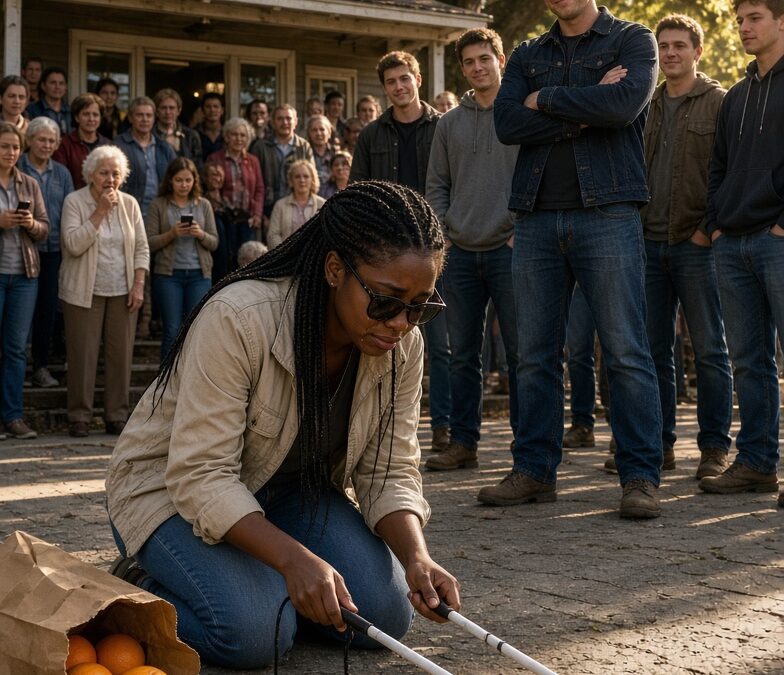
I knelt beside the drain and carefully extended my fingers between the iron bars.
The cane was resting in shallow water, just beyond my reach.
Derek kicked a puddle toward me.
Dirty water splashed across my glasses and ran down my face.
I didn’t move.
My fingertips eventually found the handle.
I scraped my knuckles against the grate while slowly maneuvering the cane into position.
Behind me, Todd was laughing hard enough to cough.
I could have stood up and broken his wrist before he understood what was happening.
Instead, I retrieved my cane, wiped it against my skirt, and continued walking.
Before I reached the next corner, my receiver activated.
Todd had entered his truck and called Carolyn.
A recording device installed during an earlier operation captured the conversation.
“We got her good this morning,” he said.
Carolyn sounded impatient.
“Did she agree to leave?”
“Not yet.”
“Then you’re wasting my time.”
Todd stopped laughing.
“She’ll go.”
“I want that woman out of the neighborhood before the end of the month. Am I making myself clear?”
“Yeah.”
“Then make sure she understands.”
The call ended.
I crossed the intersection without changing my pace.
My hands were shaking, but the recording was exactly what we needed.
Carolyn had now given a direct instruction connecting her to the intimidation.
I should have felt victorious.
Instead, I found myself thinking about Mrs. Patterson, the elderly woman who lived two doors down from me.
She was seventy-six and had owned her house for more than thirty years.
She had begun keeping her curtains closed during the day because Todd and his friends regularly drove past her property.
For months, she had warned me that the neighborhood wasn’t safe.
Now I knew why.
That night, I listened to the recording repeatedly.
Each time Carolyn ordered Todd to force me out, I imagined her giving the same instruction about Mrs. Patterson.
Or the Henderson family.
Or the Carters.
People whose names appeared in our case files as property transfers and financial losses, but whose lives contained things no spreadsheet could measure.
The next week was worse.
Kyle Brown attacked me while I was crossing Elm Street.
I heard his footsteps accelerating behind me and caught his reflection in the window of a parked car.
He lowered his shoulder and struck me hard enough to send me off the curb.
My knees hit the asphalt.
A vehicle braked sharply.
Someone screamed.
Before I could retrieve my cane, Kyle stepped on it.
Another crack.
Another ruined piece of equipment.
“Watch where you’re going,” he said.
He walked away while I struggled to stand.
The driver who had nearly hit me rolled down her window.
“Are you hurt?”
I nodded.
“Do you need me to call somebody?”
I glanced toward Kyle, who was already disappearing around the corner.
“Did you see what happened?”
She hesitated.
Then she rolled up the window and drove away.
I stood beside the road for several seconds, blood trickling down my shins.
The pain wasn’t what nearly broke me.
It was her hesitation.
She had watched him attack me. She had seen the cane break beneath his boot.
And she had made a decision about how much trouble telling the truth might cause her.
I returned home, documented my injuries, and requested another replacement cane.
Raymond delivered it through our usual secure arrangement the following day.
When I called to confirm receipt, he sounded furious.
“That’s another assault, Grace.”
“I know.”
“We have enough to arrest Kyle.”
“And if we arrest Kyle, Todd calls Carolyn, Carolyn calls Anderson, and they destroy whatever records we haven’t recovered.”
“There are other ways.”
“Not with two weeks left.”
He sighed.
“You’ve got to stop treating yourself like disposable evidence.”
I couldn’t think of an answer that would satisfy either of us.
Three days later, Shane posted a video of me on TikTok.
He had secretly followed me around town for a week, recording ordinary moments while I was maintaining my cover.
The video showed me searching for a door handle, stumbling near a sidewalk, and asking someone for directions.
He edited the clips together with music and captions mocking my blindness.
Within forty-eight hours, it had received more than fifty thousand views.
Derek commented with a joke about putting me on a leash.
Todd responded with laughing emojis.
Carolyn shared the video through an anonymous account connected to her business network.
I saved the original recording, every comment, and the account information.
Then I sat at my kitchen table and watched myself being humiliated by strangers who didn’t even know my name.
I had spent years learning to tolerate discomfort.
Training had taught me to remain functional under pressure, manage pain, and make rational decisions when exhausted or frightened.
Nothing had prepared me for the peculiar exhaustion of becoming entertainment.
I wondered how many people had shared videos of other vulnerable residents being harassed.
How many had laughed.
How many had recognized someone they knew and kept scrolling.
The thought remained with me when I went to work the next morning.
Denise was waiting beside my desk.
She had her arms crossed.
“Don’t tell me you haven’t seen that video.”
“I know about it.”
“I’m reporting every account that shared it.”
“Denise—”
“And I’m calling the police.”
“Please.”
She stared at me.
“Why are you always asking me to do nothing?”
I opened my mouth, then closed it again.
Because the real answer was sitting inside classified files hundreds of miles beyond her reach.
Because every time she stepped forward, I risked drawing Carolyn’s attention toward her.
Because I had knowingly allowed her to become attached to someone who wasn’t telling her the truth.
“I don’t want you getting hurt,” I finally said.
Her expression softened, but only slightly.
“Then stop acting like you’re the only person who gets to decide what happens.”
I carried those words home with me.
The following Thursday, Todd and his crew surrounded me outside the grocery store.
There were five of them that afternoon.
Todd took my grocery bag and emptied it onto the pavement.
A carton of eggs burst against the asphalt. A bottle of milk split open. Apples rolled beneath a parked car.
Kyle seized my arms from behind.
His grip tightened until my shoulders burned.
Derek stepped in front of me.
“Can you see me now?”
He flicked my forehead.
I kept my face still.
He did it again.
“How about now?”
Todd watched, smiling.
Shane filmed everything.
I could hear the store’s automatic doors opening and closing. Customers were coming and going only a few yards away.
Nobody intervened.
When Derek struck me a third time, I tasted blood where my teeth caught my lip.
I began counting backward from one hundred.
It was an old technique I used when emotion threatened to overwhelm my judgment.
Ninety-nine.
Ninety-eight.
Ninety-seven.
Kyle’s grip was beginning to weaken.
I could have broken free with a sudden movement and sent Derek sprawling.
Instead, I remained still.
When Todd finally told them to release me, my arms felt numb.
He nudged the spilled milk with his shoe.
“Clean up your mess.”
They walked away.
I crouched beside the broken eggs and began picking up the groceries.
Through the store window, I saw the owner watching.
For a moment, our eyes almost met.
Then he lowered the blinds.
That evening, Mrs. Patterson knocked on my apartment door carrying a plate of cornbread wrapped in aluminum foil.
She waited until I invited her inside before speaking.
“Baby, you need to get out of here.”
Her voice trembled.
“Those boys aren’t going to stop.”
“I’m trying to handle it.”
She shook her head.
“That’s what the Hendersons said.”
She lowered herself into one of my kitchen chairs.
“They lived on Birch Street for almost twenty years. Good people. Worked hard. Raised three beautiful children.”
I sat opposite her.
“What happened?”
“First, somebody broke their windows. Then their tires kept getting slashed. One night, somebody threw a brick through the bedroom window while their youngest was sleeping.”
She stared down at her hands.
“Two months later, they sold the house.”
“To Peach Tree Holdings?”
Her head rose.
“How did you know?”
I gripped the edge of the table.
“I heard people talking.”
She nodded sadly.
“The Carters went the same way.”
For several minutes, she described families I already knew from the case files.
But hearing their stories from someone who had watched them leave was different.
She remembered children crying as furniture disappeared into moving trucks.
She remembered an elderly husband standing in his empty driveway, staring at the house his father had built.
She remembered neighbors who wanted to help but were terrified that Todd would come for them next.
When she finished, she reached across the table and took my hand.
“Sometimes, baby, surviving means leaving.”
I looked at her.
“Did they threaten you, too?”
She hesitated.
Then she nodded.
Three nights of slashed tires. A broken porch light. Threatening telephone calls.
She hadn’t told the police because she didn’t believe anyone would protect her.
When she left, I locked the door and stood motionless in my kitchen.
Then I removed my glasses.
I could still feel her hand trembling against mine.
That night, for the first time since arriving in Mon, I cried.
Not because Todd had hurt me.
Because Mrs. Patterson had accepted the destruction of her home as something inevitable.
I hated Carolyn Davis for teaching her to believe that.
Meanwhile, Denise was becoming suspicious.
The first incident happened at the office when a stapler rolled off my desk.
Without thinking, I caught it before it struck the floor.
Denise stared at my hand.
“Girl, how did you do that?”
I placed the stapler back on the desk.
“Heard it falling.”
“That fast?”
I smiled.
“You learn to react.”
She accepted the explanation, but her eyes lingered on me.
Several days later, a child riding a bicycle came around a corner while we were walking together.
I saw him approaching before he reached us.
Instinctively, I stepped out of his path.
Denise stopped.
The child raced past.
“Grace?”
“Yeah?”
“How did you know he was coming?”
“I heard the wheels.”
She didn’t answer.
That evening, she reviewed Shane’s parking-lot video frame by frame.
She noticed something that almost nobody else would have recognized.
A fraction of a second before Todd reached toward my cane, my head had moved.
Not randomly.
Directly toward his hand.
Denise saved the frame.
She didn’t confront me immediately, but our conversations changed.
She began studying my movements.
Sometimes, when we walked together, I caught her watching my eyes behind the dark glasses.
Her suspicion frightened me more than Todd’s insults.
Todd only threatened my body.
Denise could expose the entire investigation without intending to.
Across town, Carolyn was beginning to feel pressure.
Our surveillance captured a private dinner between her and Councilman Anderson.
Anderson was visibly nervous.
Shane’s video had attracted far more attention than either of them expected.
“People are starting to ask questions,” he complained.
Carolyn continued cutting her steak.
“People have been asking questions for six years.”
“This is different.”
“Why?”
“Because now they’re recording everything.”
Carolyn put down her fork.
“Brad, the people who matter in this town know exactly who controls what.”
He leaned forward.
“What if somebody investigates?”
She smiled.
“Who is going to investigate? That blind girl?”
Anderson didn’t laugh.
Carolyn continued.
“Finish the Southside approval. I’ll take care of the rest.”
Those final words told me everything I needed to know.
The Southside transaction was approaching completion, and Carolyn intended to remove me before anyone could interfere.
The following morning, Todd assembled his entire crew inside his garage.
By then, our surveillance had established enough of their communications to monitor their planning.
The meeting included Derek, Kyle, Shane, Jimmy, and Briggs, a large man who had joined them only recently.
Todd stood beside his truck while the others gathered around him.
“Saturday night,” he announced. “The block party.”
Carolyn had organized a neighborhood celebration outside the community center. There would be food, music, speeches, and dozens of residents.
According to the promotional materials, it was supposed to demonstrate Mon’s renewed commitment to community unity.
Todd intended to use it for something entirely different.
“She’s going to be there,” he told the others.
Derek grinned.
“All of us?”
“Every one of us.”
“What do you want us to do?”
Todd looked around.
“I want everybody in that neighborhood to understand what happens when somebody refuses to leave.”
My receiver transmitted every word.
I was sitting on my apartment floor with a notebook open across my knees.
For eight months, I had waited for the organization to make a mistake large enough to connect its members through direct evidence.
Now Todd was planning to bring six men to a public event and attack me in front of witnesses.
I reached for my secure phone.
Raymond answered immediately.
“I’ve got something.”
I told him about the meeting.
He listened without interrupting.
Then he said, “Absolutely not.”
“You haven’t even heard my plan.”
“I know exactly what your plan is.”
“Raymond, they’re handing us the opportunity.”
“They’re handing you six men who have already hospitalized people.”
“I’ve studied them for eight months.”
“And they have no idea who they’re dealing with. That doesn’t make them harmless.”
I closed my notebook.
“I need a tactical team nearby. Plainclothes agents on Wittman and Fifth. Medical support within reach. Nobody intervenes unless I’m in immediate danger or I give the signal.”
He was silent for a long time.
Finally, he said, “This isn’t a training exercise, Grace.”
“I know.”
“If one of them pulls a gun, everything changes.”
“Then your people move.”
“And if six of them attack simultaneously?”
“Then I’ll do everything necessary to stay alive.”
Raymond exhaled.
“I hate this.”
“So do I.”
He eventually agreed to submit the operational plan for approval, subject to strict limits on how long I could remain exposed.
Before ending the call, he gave me one final instruction.
“Evidence isn’t worth your life.”
I promised I understood.
Then I called Denise.
“Are you going to Carolyn’s block party Saturday?”
“Of course. Free barbecue.”
I laughed.
“Bring your camera.”
“Girl, you know I never go anywhere without it.”
Friday evening, I locked my apartment door, closed every curtain, and turned on all the lights.
For eight months, I had avoided doing that whenever there was any chance a neighbor could see through my windows.
That night, I needed the room illuminated.
I placed six padded training targets around my living room.
Todd.
Derek.
Kyle.
Jimmy.
Briggs.
Shane.
I stood in the center holding my cane.
Then I began to move.
I practiced controlling distance, breaking contact, recovering the cane if someone seized it, and creating an escape when several attackers converged.
I knew Todd favored his right hand.
Derek lunged when he became angry.
Kyle depended on forward momentum.
Jimmy telegraphed his punches.
Briggs hesitated when confronted with unexpected resistance.
Shane had almost no fighting experience, but his phone gave him an audience, and that made him reckless.
I trained until sweat ran down my back.
Then I sat on the floor, exhausted, and stared at the white cane lying across my knees.
Saturday was coming.
For the first time in eight months, I wasn’t afraid of what Todd might do to me.
I was afraid of what would happen if I underestimated how far Carolyn was willing to go.
Saturday evening arrived beneath a sky the color of warm honey.
The community center parking lot had been transformed with folding tables, barbecue grills, colored streamers, and strings of inexpensive lights.
Children ran between the tables while their parents argued cheerfully about football.
Someone had set up speakers near the entrance, and gospel music drifted over the crowd.
I arrived at 6:30 wearing a yellow sundress, dark glasses, and my replacement cane.
Denise had helped me choose the dress that morning.
She was waiting near the food tables when I arrived.
“There she is!” she called. “Looking beautiful!”
She pointed her phone toward me.
I smiled.
“You’re recording already?”
“Somebody has to preserve history.”
I laughed, allowing her to guide me through the crowd.
Behind my glasses, I surveyed the entire area.
The plainclothes surveillance vehicle was exactly where Raymond had promised.
Two agents were positioned near Wittman Avenue.
Another pair stood beside the community center entrance, pretending to discuss the evening’s food.
I knew they were watching.
Their presence made my breathing easier, but it didn’t eliminate the knot forming beneath my ribs.
Carolyn stood on a small stage near the entrance.
She wore a cream-colored jacket and greeted every arriving resident as though she had personally invited them into her home.
At seven, she took the microphone.
“This neighborhood has always been special because of the people who live here.”
Applause.
“We believe in looking after one another.”
More applause.
I looked toward Mrs. Patterson, who was standing alone beside a folding table.
She wasn’t clapping.
Carolyn continued speaking about safety, belonging, and building a community where every family could thrive.
I knew the names of twenty-six families she had helped drive out.
Listening to her talk about belonging made me feel physically sick.
Todd was leaning against a pickup near the far edge of the parking lot.
Derek stood beside him.
Kyle waited near the dumpsters.
Jimmy and Briggs were close to the alley behind the community center.
Shane was filming the crowd.
All six were present.
At 7:15, I touched Denise’s arm.
“I’m going to find the restroom.”
“Want me to come?”
“No, I’m fine.”
She hesitated.
“Grace, stay where people can see you.”
I squeezed her hand.
“I’ll be right back.”
Then I walked toward the narrow passage behind the building.
I could hear music behind me and traffic on the distant road.
The alley was shaded by two brick walls. A single exterior light glowed above a metal service door.
I stopped near the middle.
For several seconds, nothing happened.
Then I heard footsteps.
Todd appeared in front of me.
Derek and Kyle spread out on either side.
Jimmy and Briggs approached from behind.
Shane followed them with his phone raised.
“Well, look who’s wandered away from her babysitter,” Todd said.
I tightened my fingers around my cane.
“Please leave me alone.”
He laughed.
“You’ve been told to leave town. You don’t listen.”
“I live here.”
“Not for much longer.”
Derek moved closer.
I heard Briggs laughing behind me.
Todd extended his hand.
“Give me that cane.”
“No.”
He grabbed it.
I resisted just enough to make him furious.
Then he twisted sharply and ripped it from my grip.
He tossed it to Derek.
Kyle shoved me forward.
I struck Todd’s chest, and he pushed me backward against the brick wall.
Pain shot through my shoulder.
My glasses cracked against the masonry.
I heard Shane laughing from the entrance.
Todd stepped closer.
“You think somebody’s going to come save you?”
I didn’t answer.
He raised his hand.
I saw the muscles tighten across his shoulder.
I saw Derek shifting his weight.
I saw Kyle preparing to grab me again.
For eight months, I had practiced looking through people rather than directly at them.
Now I watched everything.
Todd swung.
I caught his wrist before his hand reached my face.
The expression that crossed his face was almost comical.
For the first time since meeting him, I saw genuine confusion.
“What the—”
I moved before he finished speaking.
I redirected his momentum, twisted free, and drove him to one knee.
With my other hand, I seized the cane Derek was holding.
He stared at me.
I pulled it from his grip.
Then he rushed forward.
I stepped aside and struck him across the ribs with enough force to stop his advance.
He folded, gasping.
Before he could recover, I knocked his balance out from beneath him.
He struck the gravel face-first.
Kyle roared and charged.
I shifted away from his path, using his forward momentum against him.
He stumbled, collided with the dumpster, and crashed onto the pavement.
The noise echoed between the brick walls.
Jimmy came at me next.
His fist swept past my head as I ducked.
I struck him once in the abdomen, then disrupted his footing before he could swing again.
He collapsed beside Derek.
Briggs grabbed my shoulder from behind.
I drove backward into him, broke his hold, and turned sharply.
A controlled strike to his leg sent him staggering onto the ground.
Shane lowered his phone and rushed toward me, apparently deciding that helping Todd was more important than recording.
He tried to seize the cane.
I pulled it free, swept him off balance, and sent him backward into a pile of cardboard boxes.
His phone skidded across the concrete.
Then I heard a metallic click.
Todd was back on his feet.
He had pulled a folding knife from his pocket.
Its blade caught the light above the service door.
For a moment, the entire alley went quiet.
I felt my heartbeat slow into the rhythm I recognized from training.
Todd was breathing heavily.
Blood ran from his lower lip.
“You think you’re tough?” he snarled.
I held my cane in front of me.
“Todd, put the knife down.”
He took another step.
“I’m going to kill you.”
He lunged.
I moved off the line of his attack, knocked his weapon arm away with the cane, and forced him off balance.
The knife fell.
It struck the pavement and slid beneath a parked maintenance cart.
Todd tried to recover.
I didn’t give him the opportunity.
I brought him down, moved out of reach of the blade, and kept him pinned until he stopped struggling.
The entire exchange had taken only seconds.
The other men were scattered around the alley.
Derek groaned beside the wall.
Kyle sat against the dumpster clutching his knee.
Jimmy was curled on his side.
Briggs was trying unsuccessfully to stand.
Shane scrambled to his feet, snatched up his phone, and stumbled toward the parking lot.
He looked back once.
Our eyes met.
Whatever he saw behind my cracked glasses frightened him more than anything I could have said.
He ran.
I heard the distant music continuing beyond the alley.
Somewhere nearby, a child was laughing.
For a moment, those ordinary sounds seemed impossibly far away.
I looked down at Todd.
His face had lost all its confidence.
He was staring at me as though I had transformed into someone else.
“Who are you?” he whispered.
I adjusted my broken glasses.
“The woman you should have left alone.”
Then I stepped away from him and activated the emergency signal concealed in my equipment.
Raymond’s team began moving.
By the time I returned toward the parking lot, my hands were shaking.
Not from fear.
From the violent release of eight months of restraint.
Denise met me near the corner of the building.
She had heard the commotion and followed the noise with her phone recording.
When she saw me, she stopped.
“Grace?”
I tried to smile.
“Hey.”
Her gaze traveled over my cracked glasses and dusty dress.
Then she looked past me.
Five men were still on the ground. Todd had rolled onto his side, clutching his wrist.
The knife lay where it had fallen.
Denise covered her mouth.
“What happened?”
“They attacked me.”
She looked at the cane in my hand.
Then back toward the alley.
“All of them?”
I nodded.
“I defended myself.”
She stared at me.
I could see the questions forming.
But before she could ask them, Raymond’s agents entered the alley and secured the attackers.
Uniformed officers arrived shortly afterward.
Emergency medical personnel began examining the injured men.
Raymond approached me from behind the community center.
He wore ordinary clothes and didn’t identify himself to Denise.
“Ma’am, are you injured?”
I recognized his voice immediately.
“My shoulder hurts. I think I’m okay.”
His eyes moved toward my cracked glasses.
“We should have you examined.”
I nodded.
He lowered his voice.
“Stay in character.”
Then he disappeared into the activity surrounding the alley.
I returned to the block party with Denise.
Carolyn was standing near the stage, watching the emergency vehicles arrive.
Her eyes settled on my cane.
Then my glasses.
Then the alley behind me.
For the first time, her expression lost its polished warmth.
She looked afraid.
I pretended not to notice.
That night, Denise’s recording appeared online.
She had captured the final seconds of the confrontation, including Todd’s knife on the pavement and my movements as I broke away from the attackers.
Her footage wasn’t the only recording.
Shane had filmed most of the encounter, and security cameras at the community center had recorded the wider area.
But Denise’s video was the first to circulate widely.
By midnight, it had more than half a million views.
By Sunday morning, more than two million people had watched it.
By Monday, the total had passed five million.
Some viewers called me courageous.
Others called the entire story impossible.
Martial arts instructors examined the footage and discussed the techniques visible in the recording.
People with disabilities reminded viewers that blindness did not prevent someone from learning self-defense.
But one question appeared repeatedly.
How had I reacted so precisely to everything happening around me?
Denise wanted an answer, too.
She called me Sunday morning.
“Grace, I watched the video again.”
“Okay.”
“Those men never had a chance.”
I sat on my bed, staring at the bruises spreading across my shoulder.
“They were trying to hurt me.”
“I know. I’m not saying they didn’t deserve to be stopped.”
She hesitated.
“But you moved before they moved.”
I closed my eyes.
“Denise, I don’t know what you want me to say.”
“I want you to trust me.”
Those words hurt more than anything Todd had done.
After we hung up, Raymond called.
“Headquarters wants you extracted.”
“The operation isn’t finished.”
“Your face is on every news channel.”
“Carolyn still hasn’t completed the Southside deal.”
“Your cover is hanging by a thread.”
“Then give me seventy-two hours.”
He didn’t answer immediately.
Finally, he said, “I’ll discuss it with Washington.”
Carolyn moved faster than either of us expected.
Monday morning, she met with her attorney, Richard Foster, and presented him with an edited version of Shane’s recording.
The video began after Todd had attacked me.
There was no footage of him taking my cane.
No footage of Kyle shoving me into the wall.
No knife.
Only a young woman using a cane to put several men on the ground.
Foster helped Todd and the others prepare formal complaints alleging that I had attacked them without provocation.
By afternoon, all six had provided statements supporting the same account.
Todd wore a wrist brace.
Derek had his arm in a sling.
Kyle arrived at the police station using crutches.
They described themselves as innocent men assaulted by a violent woman who had deceived the entire community.
The edited recording reached local television before dinner.
Within hours, it was appearing on national broadcasts.
One anchor introduced it by asking whether I was actually blind or had merely pretended to be disabled to gain sympathy.
Another wondered aloud whether I had planned the confrontation.
Carolyn held a press conference outside the courthouse.
She wore black and carried a tissue.
“My brother could have been killed,” she told reporters.
She paused as her eyes filled with tears.
“Six innocent men were viciously attacked by someone with extensive combat training. My family deserves justice.”
I watched from my apartment.
Carolyn’s performance was extraordinary.
She spoke about compassion while avoiding any mention of the people her organization had terrorized.
She condemned violence without acknowledging the orders she had given Todd.
And she appealed to the community’s sense of fairness while deliberately concealing the evidence that would establish what had actually happened.
When the conference ended, I turned off the television.
I was more frightened by Carolyn’s confidence than I had been by Todd’s knife.
He had tried to injure my body.
She was attempting to destroy my credibility.
Tuesday morning, two police officers knocked on my door shortly after seven.
“Grace Underwood?”
“Yes.”
“We have a warrant for your arrest.”
I didn’t resist.
I allowed them to handcuff me, guide me into a patrol car, and take me to the station.
My legal cover had been prepared for that possibility, although I had hoped never to use it.
For three hours, I sat through the booking process.
They took my fingerprints and photograph.
An officer placed my cane on a nearby counter.
I heard someone mutter that I didn’t need it anyway.
I said nothing.
By noon, I had been released on bond with instructions to attend a court hearing.
When I stepped outside, the news cameras were waiting.
Reporters shouted questions.
“Grace, are you really blind?”
“Did you deliberately attack those men?”
“Who trained you?”
I kept my glasses on and walked past them.
Denise was waiting in her car.
She opened the passenger door without speaking.
We drove six blocks before she finally broke the silence.
“Reverend Moore called.”
My stomach tightened.
Reverend James Moore chaired the board of our legal aid organization.
“What did he say?”
“The board voted to suspend you while the criminal charges are pending.”
I looked out the window.
Eight months of sitting at that desk, helping people complete paperwork, listening to frightened tenants explain what their landlords were doing to them.
Eight months of pretending my life was ordinary.
And now the people I had been trying to protect had decided I was too dangerous to keep around.
Denise gripped the steering wheel.
“They’re scared, Grace.”
“I know.”
“I argued with them.”
“You shouldn’t have had to.”
She was quiet for another moment.
Then she asked the question I had been dreading.
“Can you actually see?”
I felt every muscle in my body tighten.
“What?”
“Please don’t make me ask again.”
I turned toward her voice but kept my glasses in place.
“Denise, I can’t explain everything.”
She looked at me.
“That’s not what I asked.”
I said nothing.
She swallowed.
“I’ve watched you for months. I’ve seen you do things you shouldn’t have known to do. I’ve seen your eyes move toward people before they speak.”
I reached toward her.
She pulled her hand away.
“I defended you when everybody else was calling you a liar.”
“I know.”
“Then tell me the truth.”
I wanted to.
More than anything in that moment, I wanted to remove my glasses and explain the entire operation.
I wanted to tell her that the woman she had been protecting was an FBI agent, that the injuries were real, and that every bruise had become evidence against the organization destroying her neighborhood.
But Carolyn was still free.
And Denise was still vulnerable.
“I’m sorry,” I whispered.
She stared at the road.
When we reached my apartment, she stopped beside the curb.
I opened the door.
“Denise—”
“I don’t know who you are anymore.”
Then she drove away.
I stood on the sidewalk holding my cane until her car disappeared.
Inside my apartment, I locked the door and removed my glasses.
I pressed my palms against my eyes.
For eight months, I had accepted physical pain as part of the assignment.
Losing Denise was something I hadn’t prepared for.
My secure phone rang.
Raymond.
“Extraction tonight,” he said.
“Not yet.”
“Grace, headquarters has already approved it.”
“Carolyn just called Anderson.”
I opened the latest surveillance transcript.
“She’s pushing him to sign the Southside contract Thursday morning. Nine o’clock. That’s the final transaction.”
Raymond read the information on his end.
I continued.
“If we leave now, she’ll transfer the properties and start moving the proceeds. We’ve got almost everything, but that contract ties Anderson’s official approvals directly to her payments.”
“She’s already exposed you.”
“She suspects I’m hiding something. That’s different.”
He was silent.
Then he said, “Forty-eight hours.”
“Thank you.”
“This is the final extension.”
“I understand.”
I spent Wednesday reviewing every piece of evidence we had collected.
Financial statements.
Property records.
Recorded conversations.
Todd’s instructions.
Carolyn’s payments.
Photographs of damaged houses.
Statements from residents who had been frightened into leaving town.
There were twenty-six displaced families whose losses we had documented in sufficient detail to connect them to the operation.
Twenty-six families.
I wrote their names on a sheet of paper and placed it beside my bed.
Whenever I felt myself growing tired or discouraged, I looked at that list.
Then I called Patricia Taylor.
Patricia was a civil rights attorney with a reputation for taking difficult cases involving housing discrimination and abuses of authority.
She had agreed to represent me publicly after seeing the footage Denise had recorded.
Patricia knew I was being targeted.
She didn’t know about the FBI operation.
“Grace, how are you holding up?” she asked.
“I’m managing.”
“I’ve seen the edited video they’re showing on television. It’s misleading.”
“I need you to obtain the complete footage.”
“Already working on it.”
“And Carolyn’s financial records. Peach Tree Holdings. Any payments connected to Todd.”
Patricia paused.
“Why her finances?”
“Because this isn’t just about what happened in that alley.”
I told her about the residents who had been driven from their homes and the connections I had discovered while working at the legal aid office.
She listened carefully.
When I finished, she said, “I’ve suspected something like this for years.”
“Then Thursday’s hearing is our chance to put it on the record.”
“Grace, a preliminary hearing isn’t going to resolve every allegation against Carolyn Davis.”
“I know.”
“But it can establish that those men attacked you.”
“That’s all I need it to do.”
Thursday morning, the courthouse was overflowing.
Reporters crowded the hallway.
Several television crews waited outside.
People had traveled from nearby towns hoping to see the blind woman whose extraordinary fight had divided the internet.
I arrived in a plain gray blazer and white blouse.
My white cane tapped steadily against the polished floor.
Patricia met me outside the courtroom.
“You ready?”
“As much as I can be.”
She placed her hand lightly on my elbow.
“Whatever happens in there, we’re going to tell the truth.”
For a moment, I couldn’t speak.
Then I nodded.
“Yes, we are.”
The courtroom smelled of old wood, paper, and floor polish.
Todd sat across the aisle wearing an expensive-looking neck brace.
Derek had his arm in a sling.
Kyle leaned heavily on his crutches.
Jimmy and Briggs sat behind them.
Shane wasn’t there.
Carolyn occupied the front row wearing another black dress.
Her attorney sat beside her.
Denise was four rows behind them, holding her phone in her lap.
She didn’t smile when I entered.
I looked away before she could notice the tears forming behind my glasses.
The preliminary hearing began shortly after nine.
Assistant District Attorney Lawrence Coleman presented the prosecution’s allegations.
He described me as a trained fighter who had attacked six men during a community event.
Then he played the edited video.
I watched myself move across the screen.
Without the preceding assault, the footage looked disturbing.
A woman holding a cane.
Men falling around her.
No visible explanation for why the fight had begun.
Coleman argued that the injuries demonstrated a level of force inconsistent with an ordinary dispute.
Todd lowered his head while Carolyn dabbed her eyes.
I recognized every movement.
They were still performing.
When Patricia stood, she walked slowly toward the screen.
“Your Honor, before the court draws conclusions about the defendant’s actions, we need to examine what the prosecution’s recording excludes.”
She played Denise’s original footage.
The courtroom watched Todd taking my cane.
Kyle pushing me against the wall.
Derek blocking my escape.
Then Todd drawing the knife.
Patricia paused the recording.
The blade was clearly visible.
She allowed the image to remain on the screen for several seconds.
“Six men surrounded my client in an enclosed space,” she said. “They physically assaulted her, seized her mobility aid, prevented her from leaving, and threatened her with a knife.”
The courtroom grew quiet.
Patricia then presented the community center’s security footage.
A wider camera angle showed the men approaching me together and confirmed the sequence preceding the fight.
It also showed Shane recording the encounter.
By the time the second video ended, several people in the gallery were openly whispering.
Todd was no longer looking at the screen.
Carolyn leaned toward her attorney and began speaking urgently.
But Patricia had another witness.
“Your Honor, the defense requests permission to call Shane Taylor.”
Todd’s head snapped toward the courtroom entrance.
The side door opened.
Shane walked inside wearing a plain white shirt.
He looked exhausted.
Gone was the swagger he had displayed throughout the previous eight months.
He took the witness stand and swore to tell the truth.
Patricia approached him.
“Mr. Taylor, were you present at the community center block party?”
“Yes, ma’am.”
“Did you record the confrontation involving Grace Underwood?”
“Yes.”
“Was the recording submitted to the police complete?”
Shane swallowed.
“No.”
Todd shifted in his chair.
Patricia continued.
“What was removed?”
“The part where we surrounded her. The part where Todd grabbed her cane.”
“And the knife?”
Shane lowered his eyes.
“That, too.”
A murmur spread through the courtroom.
Patricia placed several printed messages on the witness stand.
“Do you recognize these?”
Shane nodded.
“They’re from our group chat.”
“Who was involved in that group?”
He identified every member of Todd’s crew.
Then Patricia pointed to a message sent on the afternoon of the block party.
“Who sent this instruction?”
Shane stared at it.
“Carolyn Davis.”
“What did it say?”
His voice cracked.
“She told Todd to finish the blind girl that night. Make it loud. Make sure the whole neighborhood saw.”
The courtroom erupted.
Carolyn rose halfway from her chair.
Her attorney pulled her back down.
Patricia waited until the judge restored order.
Then she asked one final question.
“Mr. Taylor, were you and the others paid to harass residents targeted by Peach Tree Holdings?”
Shane looked directly at Todd.
For a moment, I thought he might change his mind.
Then he turned toward Patricia.
“Yes.”
He described payments made through Todd, instructions delivered by Carolyn, and repeated efforts to force residents into selling their properties.
He identified the financial transfers we had previously traced.
He also admitted that the attack on me had been planned.
I watched Carolyn’s expression change.
The woman who had spent years presenting herself as untouchable suddenly looked like someone trapped in a room where every exit was closing.
Patricia returned to our table.
She touched my shoulder.
“You okay?”
I nodded.
My throat was too tight to answer.
When I was called to testify, I stood and walked toward the witness box.
The room seemed unnaturally quiet.
I could hear my cane tapping against the floor.
I could feel Denise watching me.
I took the oath and sat down.
Patricia began by asking me about the months of harassment.
I described the broken canes, the threats, the assaults, and the people who had refused to intervene.
Then she asked about the block party.
I explained that Todd and his companions had surrounded me, seized my cane, shoved me against the wall, and prevented me from leaving.
I described the knife.
I described the instant when I realized I could no longer avoid defending myself.
When Coleman began questioning me, he returned immediately to the issue dominating the news.
“Miss Underwood, you’ve demonstrated an extraordinary degree of combat training.”
“I’ve had extensive training.”
“Enough to defeat six men?”
“Enough to survive an assault.”
He leaned against the prosecution’s table.
“How did you know precisely where those men were positioned?”
I paused.
For eight months, my identity had depended on carefully answering questions without exposing my mission.
But I was under oath now.
I wasn’t going to make a false statement.
Before Coleman could repeat the question, I said, “Those men believed I was unable to defend myself. They used that belief to corner me.”
“That doesn’t answer how you were able to react so precisely.”
“No,” I said. “It doesn’t.”
He looked toward the judge.
“Your Honor, I believe the defendant has been deliberately misleading this community about her condition.”
Patricia stood.
“Your Honor, there is information relevant to my client’s circumstances that may require confidential review.”
Coleman frowned.
“What information?”
Before Patricia could answer, the courtroom doors opened.
Four people entered wearing dark suits.
I recognized Raymond immediately.
He carried a federal credential and walked directly toward the bench.
Behind him were three agents holding sealed file boxes.
Raymond identified himself to the judge.
“Your Honor, I’m Senior Special Agent Raymond Brooks with the Federal Bureau of Investigation. We’re here in connection with a federal investigation involving Peach Tree Holdings, organized intimidation, suspected civil rights violations, and public corruption.”
The room fell silent.
Raymond continued.
“Federal warrants were executed this morning in connection with transactions involving Carolyn Davis and Councilman Brad Anderson. The court should also be aware that Grace Underwood is a special agent operating under an authorized undercover identity.”
For one extraordinary moment, nobody moved.
Coleman stared at Raymond.
Patricia turned slowly toward me.
Todd’s mouth fell open.
Carolyn gripped the edge of her chair.
Then I stood.
I reached up and removed my dark glasses.
For eight months, I had worn them in grocery stores, at work, on sidewalks, in my apartment hallway, and through every act of cruelty Todd and his friends had inflicted on me.
Removing them should have felt simple.
Instead, my fingers trembled.
I placed the glasses on the witness stand.
Then I looked directly at Carolyn Davis.
Her face drained of color.
“You can see?”
I held her gaze.
“Yes, Carolyn. I can see.”
I looked toward Todd.
“I saw everything.”
Raymond placed the file boxes on the prosecution’s table.
He explained that our investigation had uncovered evidence connecting Carolyn’s property acquisitions to organized harassment, fraudulent financial transactions, and payments associated with Anderson’s official actions.
The Southside contract had been signed that morning.
Federal agents had secured the relevant records while others executed the warrants.
Carolyn’s attorney stood and requested an opportunity to speak privately with his client.
But before they could leave, a federal agent approached her with an arrest warrant.
She looked at him as though he had committed an unforgivable insult.
“This is ridiculous.”
The agent remained calm.
“Carolyn Davis, please stand.”
Two other agents moved toward Todd and Derek.
Additional officers secured Kyle, Jimmy, and Briggs.
Shane, whose cooperation had been arranged as part of the final operation, remained seated under supervision.
At the back of the courtroom, Councilman Anderson attempted to slip through a side door.
An agent was already waiting.
Watching him stop was one of the most satisfying moments of my career.
Not because he looked frightened.
Because I thought about every family who had stood in front of a moving truck wondering how people like Anderson could allow their lives to be dismantled.
Now he would have to answer questions under oath.
The state prosecutor requested a recess to review the newly disclosed evidence.
By the end of the hearing, the state had withdrawn the assault charges against me.
The judge formally dismissed them.
I stepped down from the witness box while reporters shouted questions from every direction.
But there was only one person I wanted to reach.
Denise sat motionless in the fourth row.
I walked toward her without my glasses.
Without pretending to search for obstacles.
Without concealing my movements.
She watched me approach.
Tears were already running down her cheeks.
When I stopped in front of her, she shook her head.
“Eight months?”
I nodded.
“Eight months.”
“You watched me help you across streets.”
“I know.”
“You let me read things to you.”
“I know.”
“I cried because I thought those men were going to kill you.”
My own eyes filled.
“Denise, I’m sorry.”
She stood.
“Was any of it real?”
That question nearly destroyed me.
I reached for her hands.
She allowed me to take them.
“Every time we laughed together was real. Every lunch we shared. Every conversation. Every night you sat beside me when I was hurt.”
She looked away.
“The blindness wasn’t real.”
“No.”
“What else?”
I swallowed.
“I couldn’t tell you who I worked for. I couldn’t tell you why I came here. And I should never have let you believe I was simply enduring all of this without a reason.”
Her shoulders began shaking.
“You were getting hurt.”
“Yes.”
“Really hurt.”
“Yes.”
She pulled me toward her.
For several seconds, we held each other while the courtroom continued buzzing around us.
Then she whispered against my shoulder.
“I don’t know whether I want to hug you or slap you.”
I laughed through my tears.
“That’s fair.”
She tightened her arms.
“Don’t ever do that to me again.”
I couldn’t promise that my career would never require another undercover assignment.
But I could promise her something else.
“I won’t lie to you about what our friendship meant.”
She pulled away and looked directly into my eyes.
For the first time since we had met, there was nothing between us.
The arrests marked the end of my undercover assignment, but they were only the beginning of the larger case.
Federal prosecutors filed charges against Carolyn for wire fraud, conspiracy, racketeering, and violations arising from the campaign to intimidate Black residents.
Todd and his accomplices faced charges connected to assault, threats, and the coordinated harassment of multiple families.
Anderson resigned from the city council after his arrest.
The financial investigation established that the scheme had generated more than fourteen million dollars through fraudulent transactions, corrupt arrangements, and related property deals.
Federal authorities froze Peach Tree Holdings’ assets pending forfeiture proceedings.
Forty-two rental units and three commercial properties became part of the investigation.
Carolyn’s lawyers challenged the government’s allegations.
Todd insisted that he had merely been helping his sister manage difficult tenants.
Anderson initially denied accepting improper payments.
But the documents recovered from his office told a different story.
The Southside agreement connected city approvals, private transfers, and payments to accounts associated with Carolyn’s business network.
Shane provided detailed testimony about the intimidation campaign.
Briggs also agreed to cooperate.
He identified several residents whom Todd had threatened and described meetings where Carolyn had instructed the crew to intensify its harassment.
One by one, people who had previously been too frightened to speak came forward.
Mrs. Patterson was among them.
When federal investigators interviewed her, she brought photographs of her damaged property and records of the threatening calls she had received.
She also brought the plate she had once used to carry cornbread to my apartment.
I asked her why.
She smiled.
“Because I figured you might be hungry after all this.”
I hugged her.
She held me for a long time.
Then she whispered, “I knew there was something about you, baby.”
Several months later, the legal aid office reopened with a new board commitment to protecting residents from retaliation.
Reverend Moore personally apologized to me.
He stood beside my old desk and looked deeply uncomfortable.
“We should have done more,” he said.
“You didn’t know everything.”
“We knew enough to know somebody was hurting you.”
I couldn’t argue.
He lowered his head.
“I’ve been thinking about that ever since.”
The office eventually received additional funding that allowed it to hire attorneys, expand outreach, and reduce the waiting list for housing assistance.
For the first time in years, residents began approaching the office without looking over their shoulders.
They brought eviction notices, contracts, photographs of damaged homes, and stories they had been afraid to tell.
Some simply came because they wanted to know whether anyone would finally listen.
A year after the courtroom confrontation, Carolyn Davis was convicted on the federal charges arising from the scheme.
She received an eighteen-year prison sentence.
Todd Wilson received twelve years.
Derek Moore received eight.
Kyle Brown received six.
Jimmy and Briggs received four years each, with Briggs’s cooperation considered at sentencing.
Shane received a reduced sentence after testifying against the others.
Anderson entered a cooperation agreement, admitted his role in the corrupt transactions, and received five years in prison.
He was permanently barred from holding public office under the terms of the final disposition.
But the sentences were never the part of the investigation I remembered most clearly.
I remembered the families.
After the court approved restitution and the property claims were resolved, residents who had lost their homes began returning.
Some received their houses back through negotiated settlements.
Others recovered financial compensation sufficient to rebuild their lives elsewhere.
Mrs. Patterson eventually regained her home on Birch Street.
I was standing beside her when she unlocked the front door.
The house smelled stale from months of vacancy.
Dust coated the windowsills.
Someone had removed the curtains she had sewn herself.
But she stepped across the threshold with her chin lifted.
Then she reached back and took my hand.
“Well,” she said, “I guess I’ve got some cleaning to do.”
I laughed.
She laughed, too.
And then she began to cry.
She stood in the middle of her living room, surrounded by the home she had spent months believing she would never see again, and wept.
I held her until she was ready to move.
The Henderson family returned the following spring.
The Carters came back a month later.
Their youngest daughter, who had been terrified after someone threw a brick through her bedroom window, was now old enough to understand why her family had been forced to leave.
I met her during a neighborhood gathering.
She asked whether I had been scared when Todd attacked me.
“Yes,” I told her.
She seemed surprised.
“But you beat him.”
“Being frightened doesn’t mean you can’t defend yourself.”
She thought about that.
Then she asked, “Were you scared when you were pretending not to fight?”
I looked at her mother, who stood nearby listening.
“More than you can imagine.”
The little girl took my hand.
“I’m glad you stayed.”
I squeezed her fingers.
“So am I.”
After the federal case concluded, I participated in a national interview about the investigation.
I had agreed to speak because the public had become fascinated with the fight in the alley, and I wanted people to understand that those few seconds had been the least important part of what had happened.
The interviewer sat opposite me in a television studio.
I wore a navy blazer.
No glasses.
No cane.
She leaned forward.
“What was the hardest part of your assignment?”
I thought about the question.
I could have talked about the physical pain, the months of preparation, or the constant fear of exposure.
Instead, I remembered the grocery-store owner lowering his blinds.
I remembered Mrs. Patterson warning me to leave.
I remembered Denise crying over injuries I had deliberately allowed myself to suffer.
“The hardest part was watching people get hurt and knowing I couldn’t end it immediately,” I said.
The interviewer nodded.
“Even when they hurt you?”
“Especially then.”
I folded my hands.
“When Todd pushed me onto the pavement, I could have fought him. When Kyle broke my cane, I could have stopped him. But I knew they were part of something much larger.”
I looked toward the camera.
“There were families who had lost everything. If I reacted too soon, the people organizing those attacks might have escaped responsibility.”
The interviewer allowed the silence to settle.
Then she asked whether I regretted choosing the assignment.
I thought of Denise.
I thought of Mrs. Patterson.
I thought of the children whose families were finally returning home.
“I regret the pain my deception caused people who cared about me,” I answered. “And I wish we had been able to protect the victims sooner. But I don’t regret helping expose what was happening to those families.”
The interview led to broader discussions about housing discrimination, intimidation, and the ways vulnerable people can be targeted by organized groups.
Advocates also challenged the assumption that a person with a disability couldn’t learn sophisticated self-defense skills.
I welcomed that conversation.
My cover had depended on Todd underestimating me because he believed I was blind.
The truth was that blindness had never made any of the people I trained with weak.
Todd’s cruelty came from his own belief that someone with a disability would be easy to control.
That distinction mattered to me.
Several advocacy organizations invited me to participate in self-defense workshops.
Eventually, I began teaching classes designed for people who wanted practical skills and greater confidence in dangerous situations.
Some students were women who had survived domestic violence.
Some were older adults.
Others had disabilities and wanted instruction adapted to their abilities.
Whenever possible, I worked alongside qualified instructors who had lived experience with the disabilities represented in our classes.
I didn’t teach people that they could win every fight.
I taught them that preparation, awareness, escape planning, and the ability to seek help could make a difference.
And I told them that no amount of training made someone responsible for the violence another person chose to inflict.
Meanwhile, Denise and I were still working through the damage my assignment had caused.
Our embrace in the courtroom hadn’t repaired everything.
For several weeks afterward, she barely spoke to me.
I sent messages occasionally.
Sometimes she answered.
Sometimes she didn’t.
I respected her silence, even though it hurt.
One evening, I bought takeout from her favorite restaurant and knocked on her apartment door.
She opened it wearing sweatpants and an expression suggesting she was considering closing it again.
“What are you doing here?”
“I brought dinner.”
She glanced at the bag.
“You’re bribing me with barbecue?”
“Is it working?”
She tried not to smile.
Then she stepped aside.
We ate at her kitchen table.
For the first half hour, we talked about everything except Mon.
Her work.
My injuries.
The terrible television interviews Carolyn’s attorney continued giving.
Eventually, Denise set down her fork.
“I keep thinking about all those times I tried to protect you.”
I looked at her.
“You did protect me.”
She shook her head.
“You know what I mean.”
“No,” I said gently. “I don’t think you understand what you did.”
She folded her arms.
“Enlighten me, Special Agent.”
I smiled sadly.
“Every time you spoke up, every time you stayed beside me, every time you refused to pretend nothing was happening, you reminded me why I was there.”
Her expression changed.
“I didn’t know you were an FBI agent.”
“You didn’t have to.”
I reached across the table.
“You saw somebody getting hurt, and you cared. That was real. And it mattered more than you know.”
Denise stared at me for a long moment.
Then she began crying.
I stood, walked around the table, and held her.
“I’m still angry with you,” she whispered.
“I know.”
“Probably going to be angry for a while.”
“That’s okay.”
She pulled away.
“But you can bring barbecue again next week.”
I laughed.
It was the first time our friendship had felt ordinary since the courtroom.
A week later, Denise called me with an idea.
She wanted to create an organization that documented civil rights abuses and housing intimidation in smaller communities where victims often lacked access to legal representation or media attention.
She already had experience in community outreach.
I had investigative knowledge and professional contacts who could help connect vulnerable residents with legitimate legal and advocacy services.
We began planning what eventually became the Underwood-Holloway Project.
Denise managed daily operations.
I helped develop evidence-preservation training, investigative guidelines, and relationships with attorneys and community organizations.
We established strict rules protecting confidential information and safeguarding people who reported abuse.
Our first major project involved several Georgia communities where residents described intimidation connected to property development.
The work was difficult, expensive, and emotionally exhausting.
But whenever I visited Denise’s office, I saw the same determination that had made her stand beside a woman everyone else was afraid to help.
She remained incapable of going anywhere without her camera.
Some things never changed.
Six months after the original arrests, the neighborhood held another block party.
This time, Carolyn’s name wasn’t on the invitations.
There were no staged speeches about community unity.
Mrs. Patterson organized the food.
The Hendersons brought folding chairs.
The Carters helped string lights between the oak trees.
Children ran through sprinklers while someone played old rhythm-and-blues records from a speaker beside the community center.
I arrived carrying a tray of peach cobbler.
Denise was standing near the entrance.
She immediately lifted her phone.
“Look who’s here.”
I rolled my eyes.
“Do you ever stop filming?”
“Absolutely not.”
She came over and hugged me.
Mrs. Patterson waved from a nearby table.
“Grace, come over here, baby. I saved you a plate.”
I walked toward her.
No glasses.
No white cane.
No false identity.
Just me.
For the first time since arriving in Mon, I felt as though I belonged to the community without having to conceal why I was there.
Later that evening, I found myself standing near the alley behind the community center.
The exterior light had been replaced.
The dumpsters had been moved.
Someone had planted flowers beside the building.
I could still remember exactly where Todd had stood.
I remembered the knife flashing beneath the light.
The sound of bodies hitting gravel.
The sudden silence when six men realized the woman they had spent months terrorizing wasn’t going to allow them to hurt her again.
But I also remembered what had happened before that night.
The broken canes.
The bruises.
The laughter.
The neighbors lowering their blinds.
Eight months of walking through a town where cruelty had become so ordinary that people treated it like bad weather.
Denise approached from behind.
“What are you thinking about?”
I looked toward the alley.
“That night.”
She stood beside me.
“You know, when I first saw those men on the ground, I thought I’d lost my mind.”
I laughed.
“I can imagine.”
“Then you took off your glasses in court.”
She shook her head.
“I think my soul left my body.”
I smiled.
We remained quiet for several moments.
Then Denise looked toward the party.
“Funny, isn’t it?”
“What?”
“That whole thing started because people were afraid to speak up.”
I watched Mrs. Patterson laughing with the Henderson family.
The Carters’ daughter ran past carrying a plate of watermelon.
Someone called my name from across the grass.
“Yeah,” I said. “It is.”
Denise slipped her arm through mine.
“Come on. Mrs. Patterson is going to make you eat until you can’t stand.”
We turned back toward the music.
Months later, the FBI placed the cane from my final assignment in a display case at headquarters.
The small plaque identified it as the cane carried by Special Agent Grace Underwood during the Mon investigation.
It mentioned the undercover operation, the arrests, and the evidence that exposed an organized campaign of housing intimidation.
People sometimes asked whether I felt proud seeing it there.
I did.
But I never thought of that cane as a symbol of the ten seconds I spent fighting in an alley.
I thought of all the mornings I had carried it past houses where frightened families were packing their belongings.
I thought of the evenings I spent listening to people describe losing homes their parents had worked their entire lives to purchase.
And I thought of Denise, who had no badge, no surveillance team, and no secret mission, yet repeatedly chose to help someone everyone else was afraid to defend.
I still kept another cane in the trunk of my car.
Occasionally, when teaching a class, I would take it out and demonstrate a technique.
And sometimes, when a student asked me what I had learned from that assignment, I would tell them about Mrs. Patterson returning to her house on Birch Street.
I would describe her standing in the empty living room, holding her keys as though they were the most precious objects she owned.
Because that was the moment I finally understood what those eight months had accomplished.
Todd Wilson had broken my cane because he believed it represented everything that made me vulnerable.
He thought that destroying it would leave me frightened, helpless, and willing to disappear.
For a long time, he believed he had succeeded.
But when I thought about Mon, I no longer remembered the sound of that cane breaking as clearly as I once had.
I remembered the sound of Mrs. Patterson’s front door opening.
I remembered Denise laughing beside me.
I remembered the Henderson children running across their own front lawn again.
And whenever I passed a familiar neighborhood where somebody had once been too frightened to open their curtains, I remembered what it felt like to see those curtains drawn back and the afternoon sunlight pouring through.
That was the victory I had come to Mon for.
And it was finally ours.








