The Six-Hundred-Dollar Notice Was Still in My Folder When the Excavator Came for My Ranch
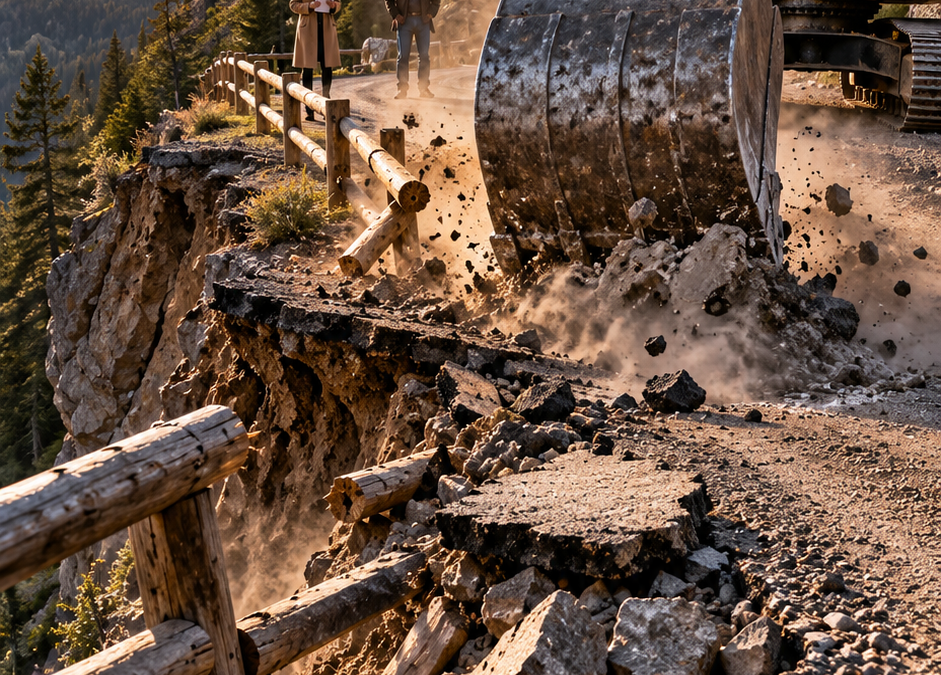
The Six-Hundred-Dollar Notice Was Still in My Folder When the Excavator Came for My Ranch
I used to think a man could protect his home by paying his bills, keeping his records, and staying out of other people’s business.
Then a six-hundred-dollar HOA notice turned into an excavator grinding up my mountain road before sunrise.
By the time Victoria stood in front of my house and told me the ranch would soon be gone, I already knew the most dangerous weapon on that mountain was not the machine behind her—it was the paperwork in her hand.
My name is Jack Morrison, and for twelve years, I built the mountain ranch I had once only imagined when I was too broke to buy more than coffee and too stubborn to stop dreaming.
The first time I saw the land, it was nothing like the photographs a real estate agent would use.
There was no perfect sunset over fresh cedar beams. No stone fireplace glowing through tall windows. No wide porch with polished railings and expensive outdoor furniture. There was only raw mountain ground, wind-bent grass, steep timber, exposed rock, and an old access road that looked like it had been scratched into the hillside by someone with more determination than equipment.
But I saw it.
I saw the house before it existed.
I saw the great room facing the valley, the horse barn tucked below the ridge, the pasture carved carefully without stripping the land bare, the long driveway curving through pines, and the kitchen window looking toward the peaks that turned purple at dusk. I saw a place where silence did not feel empty. I saw a place that could hold everything I had spent my life trying to earn.
I was not born into that kind of property.
My father fixed diesel engines behind a county repair shop. My mother cleaned cabins during ski season and worked front desk at a motel the rest of the year. We lived in a small house with thin walls, old carpet, and a furnace that coughed like it was negotiating every winter. Nobody in my family used the phrase “estate planning.” We planned around overtime, late fees, and whether the truck would start.
But my father taught me something that stayed with me longer than any inheritance could have.
“Own what you say you own,” he used to tell me. “And keep the paper that proves it.”
At the time, I thought he was talking about tools, trucks, and receipts.
Years later, standing in front of a fifteen-million-dollar ranch while an HOA president tried to use a six-hundred-dollar dispute to tear it apart, I finally understood the full weight of that lesson.
The ranch became valuable slowly, then all at once.
At first, it was land and debt. Then a foundation. Then framing. Then windows. Then stone hauled up a road that nearly ruined two delivery trucks. Every improvement cost more than planned. Every contractor found one more problem hiding under the mountain. I made money in commercial development, then poured an unreasonable amount of it back into that ranch because I wanted one place in my life that had nothing to do with boardrooms, negotiations, or people measuring value only in returns.
By the time the main house was finished, magazines wanted photographs.
I said no at first. Then my wife, Claire, told me refusing attention would not make the house invisible. She was right. People already talked about it. They called it “the glass house on the ridge,” though it was more stone and timber than glass. They called it “Morrison’s mountain palace,” usually with equal parts admiration and resentment. Real estate agents used nearby sales to estimate its value, and eventually someone told me the whole property could be worth nearly fifteen million dollars.
That number never felt real to me.
The ranch was not a number.
It was the sound of elk moving through the timber at dawn. It was frost on the pasture rails. It was the smell of cedar after rain and the hollow thud of my boots on the barn floor before sunrise. It was the one place where I did not have to perform success for anybody.
Then the neighborhood below us changed.
The development was called Alpine Crest Reserve, although most residents simply called it “the Reserve.” It began as a small cluster of luxury homes near the lower valley road and eventually grew into a gated community with paved lanes, architectural controls, landscaping committees, private security, and an HOA that behaved as if the mountain had been built around its bylaws.
My ranch sat outside the subdivision, but close enough to make me interesting to them.
Too close, apparently.
At first, the relationship was manageable. Some residents waved. Others ignored me. A few complained about construction traffic while I was still building, then later complained that my finished house made their own homes look smaller. The HOA sent letters about “visual consistency,” “exterior lighting,” and “impact on the surrounding community character.” My attorney responded each time with the same basic truth: my property was not part of their association.
That should have ended it.
It did not.
The real trouble started with a six-hundred-dollar charge.
The notice arrived in a cream-colored envelope with the Alpine Crest Reserve seal embossed on the front. I remember that detail because the envelope looked more expensive than the dispute it contained. Inside was a formal assessment notice claiming I owed six hundred dollars for “shared mountain access corridor maintenance.”
I read the first page twice, then the second.
The HOA claimed that because my private driveway connected near a road also used by Alpine Crest residents, I was responsible for a share of maintenance costs. There was no contract attached. No recorded agreement. No invoice from the county. No easement document requiring payment. Just a line item, a due date, and a warning that unpaid charges could lead to penalties.
Six hundred dollars.
I could have paid it without thinking.
That was probably what Victoria counted on.
Victoria Langford was the HOA president, and she had a reputation long before she ever came to my gate. She was not the kind of person who stumbled into power. She collected it. Every committee, every rule revision, every enforcement campaign seemed to bring her closer to the center of Alpine Crest. People described her as organized, firm, relentless, difficult, effective, and, depending on who was speaking, terrifying.
I met her face-to-face three days after I disputed the charge.
She arrived in a black SUV, alone, wearing a camel coat, dark sunglasses, and the kind of smile that did not ask permission to enter a conversation. She parked beside my gate and waited until I walked down from the house.
“Mr. Morrison,” she said, holding a folder against her chest.
“Victoria.”
“I’m here regarding your outstanding assessment.”
“It’s not outstanding. It’s disputed.”
“The board has reviewed the matter.”
“That was fast.”
Her smile tightened.
“The charge is valid.”
“Show me the legal basis.”
She opened the folder but did not hand me anything useful.
“The Reserve maintains shared access infrastructure that benefits neighboring properties, including yours.”
“My driveway is private. The road at the bottom is maintained under a separate agreement. My property is not in your HOA.”
“You benefit from the community’s maintenance efforts.”
“I benefit from gravity too. I don’t pay your board for that either.”
Her eyes cooled.
“This is not the tone I expected.”
“It’s the tone people use when they’re being billed by an organization they don’t belong to.”
She removed a notice and held it out.
“The association expects payment within ten days. Additional penalties may apply if you continue refusing cooperation.”
I took the notice.
Not because I accepted it.
Because I had already learned that when someone wants to intimidate you with paper, the smartest thing to do is keep every sheet.
“I’m asking again,” I said. “What document gives the HOA authority to charge me?”
“That discussion has already occurred internally.”
“Not with me.”
“You were notified.”
“Notification is not authority.”
Victoria’s smile vanished.
“Mr. Morrison, you have a beautiful property. It would be unfortunate for a minor assessment dispute to become something more serious.”
I looked up the hill toward the house I had built beam by beam, decision by decision, year by year.
Then I looked back at her.
“Are you threatening enforcement over six hundred dollars?”
“I’m explaining consequences.”
“No. You’re testing whether I scare easily.”
For the first time, her expression shifted.
Not much.
But enough.
“You should be careful,” she said.
“So should you.”
She got back in her SUV and left.
That evening, I started the folder.
It was a plain black legal folder at first. By the end, it would barely close. Every notice, every envelope, every email, every payment record, every delivery receipt, every certified letter, every photograph, every timeline entry went inside. I did not know then how important that folder would become.
I only knew my father’s rule.
Own what you say you own.
Keep the paper that proves it.
Victoria escalated faster than I expected.
The next notice added late fees, administrative charges, and a threat of “further enforcement proceedings.” I responded in writing and repeated my request for the legal basis of the assessment. No answer.
Then came another letter, this one from the HOA’s management company, claiming I had failed to cooperate with association requirements. Again, I responded. Again, I asked for authority. Again, no answer.
Then Victoria told the board I was refusing to comply.
I found that out because a neighbor in Alpine Crest, a retired engineer named Paul Ellison, called me one evening.
“Jack,” he said, “I thought you should know your name came up at the board meeting.”
“My name or my property?”
“Both.”
“What did Victoria say?”
He sighed.
“She said you were refusing to pay required access maintenance charges and challenging the association’s authority.”
“That’s accurate, except for the word required.”
“She made it sound bigger than six hundred dollars.”
“How much bigger?”
“She called it a serious violation affecting association control over shared infrastructure.”
I leaned back in my chair.
“There is no shared infrastructure agreement.”
“I know. Some of us asked. She said counsel had reviewed it.”
“Did counsel speak?”
“No. Victoria did.”
That told me enough.
A week later, the board voted to escalate.
I received a formal enforcement notice accusing me of nonpayment, refusal to comply, and interference with association rights. It referenced penalties, liens, legal action, and possible property-related remedies. The language was vague but aggressive.
I sent it to my attorney, Margaret Ellis.
Margaret had represented me through the ranch construction, several easement negotiations, and one ugly dispute with a contractor who poured a foundation wall four inches off specification and then tried to convince me mountains made straight lines unrealistic. She was precise, skeptical, and allergic to legal bullying.
She called me after reviewing the latest notice.
“This is strange,” she said.
“Strange bad or strange stupid?”
“Possibly both.”
“That’s encouraging.”
“The HOA is trying to frame your property as if it sits inside or is bound to association authority, but I don’t see a document supporting that. Their language keeps implying rights they haven’t proved.”
“Can they lien the ranch?”
“Not lawfully based on what I’ve seen. But anyone can file something improper if they’re reckless enough.”
“That’s comforting.”
“Jack.”
“I know. It isn’t.”
“Keep documenting everything. Do not ignore any notice. Do not speak with Victoria alone if you can avoid it. If she appears again, record the interaction if lawful and safe.”
“She already came once.”
“She’ll come again.”
Margaret was right.
Victoria came back the following Monday, this time with another board member and a man from the management company. She stood at my gate as if arriving with witnesses made her position stronger.
“I’m here to provide final notice,” she said.
“Final before what?”
“Enforcement.”
“Based on what authority?”
She held out another document.
I took it.
It referred to “continuing violation conditions,” “unpaid assessment obligations,” and “failure to acknowledge association jurisdiction.” That last phrase caught my attention.
I looked up.
“Failure to acknowledge association jurisdiction is not a violation. It’s a fact.”
Victoria’s nostrils flared.
“The board has determined otherwise.”
“The board cannot vote my ranch into your HOA.”
“The property benefits from Alpine Crest infrastructure.”
“You keep saying that. You still haven’t shown me the agreement.”
She leaned slightly closer.
“Mr. Morrison, a property of this value can attract complex enforcement consequences. You should not assume the size of your home protects you.”
There it was.
The lesson.
She wanted me to understand that beauty made the ranch a target. That value made it vulnerable. That if I had enough to lose, she could make a six-hundred-dollar charge feel like a loaded weapon.
I placed the notice in my folder.
“You should not assume the size of your folder protects you either.”
Her eyes dropped to the black folder in my hand.
For the first time, I saw uncertainty.
Only for a second.
Then she recovered.
“You will be hearing from the association.”
“I never seem to stop.”
After she left, I scanned the notice and sent it to Margaret.
Her reply came within an hour.
Call me.
I did.
“This one is worse,” she said.
“How?”
“They are no longer only demanding money. They are building a record that suggests your property is subject to association control. That phrase—failure to acknowledge jurisdiction—is not accidental.”
“What are they preparing?”
“I don’t know yet. But I want a full title pull, recorded instrument search, court docket search, and county building file review.”
“That sounds expensive.”
“Cheaper than being surprised.”
Those words proved prophetic.
A few days later, Margaret called again.
This time, she did not open with a joke.
“Jack, did you receive anything from the county regarding a demolition review?”
I stood in my kitchen, coffee halfway to my mouth.
“A what?”
“A demolition review, abatement order, unsafe structure notice, anything like that.”
“No. Why?”
“I found a filing referenced in the HOA’s packet language. It appears they may be asserting that part of your property improvements violate development conditions and may be subject to removal.”
“That’s insane.”
“I agree.”
“The house was permitted. Every inspection passed.”
“I know. I pulled the county file. That is why I’m concerned.”
“What did they file?”
“Not a demolition order exactly. More like a petition and internal enforcement packet dressed as if it authorizes property action.”
“What does that mean?”
“It means they may be bluffing with paperwork. Or they may be planning to act before anyone stops them.”
I went quiet.
Margaret did too.
Then she said, “Listen carefully. If any equipment shows up, do not physically block it. Call the sheriff. Call me. Record everything. Ask for the court order. Use those exact words.”
“What court order?”
“The one they would need before tearing anything down.”
My hand tightened around the phone.
“You really think they might try?”
“I think people who misuse vague paperwork often count on momentum. Machinery creates panic. Panic creates mistakes. Do not give them one.”
I barely slept that night.
For the first time since building the ranch, I looked at my own home and felt its vulnerability. Not structural vulnerability. The house was stone, steel, timber, engineered glass, concrete piers, fire-resistant roofing, and foundation work that had cost more than the first house I ever owned.
But legal vulnerability is different.
It does not come through the wall.
It comes through a letter.
A filing.
A signature.
A person who knows just enough procedure to make a lie look official for the first ten minutes.
The morning the excavator came, the sky was colorless.
I woke to a low metallic rumble moving up the access road.
At first, I thought it was a delivery truck. Then the sound grew heavier, slower, tracked. My stomach tightened before I reached the window.
An excavator was climbing toward the ranch.
Behind it came two pickups, a flatbed, and Victoria’s black SUV.
For a moment, I simply stood there.
The machine looked unreal against the mountain road, yellow arm folded like an animal’s neck, steel tracks chewing slowly over gravel. It was too large, too loud, too deliberate. It did not belong anywhere near my home.
Claire came to the doorway in her robe.
“What is that?”
“Get dressed,” I said. “Call Margaret.”
I was already moving.
By the time I reached the front drive, the excavator had stopped near the lower stone wall. The operator remained in the cab. Two workers stood beside the pickups, looking uncertain. Victoria stepped out of her SUV wearing a dark coat and holding a thick packet.
She looked triumphant.
That is the detail I remember most.
Not nervous.
Not reluctant.
Triumphant.
“Mr. Morrison,” she called. “This could have been avoided.”
I walked toward her with my phone already recording.
“Why is there an excavator on my property?”
She lifted the packet.
“The association is proceeding with enforcement action.”
“What enforcement action?”
“Removal of noncompliant improvements and related site correction.”
I stared at her.
“You are threatening demolition over six hundred dollars?”
“This is no longer merely about unpaid charges. Your refusal to comply has forced the board to act.”
My pulse hammered in my ears.
I looked toward the house, then back to the machine.
“Show me the court order.”
Victoria’s confidence flickered.
“The board has authorized this action.”
“I didn’t ask what the board authorized. Show me the court order.”
She held up the packet.
“This is the enforcement authorization.”
“Court order.”
“The HOA has jurisdiction.”
“Court order.”
Her eyes hardened.
“You keep repeating that as if it changes anything.”
“It changes everything.”
The workers looked at one another.
I turned the camera toward them.
“For the record, I am the owner of this property. I do not consent to entry, demolition, removal, or site work. I have requested a court order. None has been shown.”
Victoria stepped closer.
“You are interfering with authorized enforcement.”
“No. I’m documenting trespass.”
“That machine is here because you refused every reasonable opportunity to resolve the violation.”
“You refused to prove the violation exists.”
“This ranch falls under association authority.”
“No, it does not.”
“The board determined—”
“The board does not own a magic wand.”
Her face flushed.
The excavator engine idled behind her, a constant growl that made the entire confrontation feel unstable.
I wanted to stand in front of it.
Every instinct in me wanted to put my body between that machine and the house I had built. I wanted to grab the packet out of her hand, throw it into the mud, and tell the operator that if he moved another inch, he would be answering to me personally.
But Margaret’s voice was louder.
Do not physically block it.
Call the sheriff.
Call me.
Ask for the court order.
I stepped back, not because I was afraid of Victoria, but because I was afraid of what anger might cost me.
I called 911.
Then I called Margaret.
She answered on the first ring.
“Is there equipment there?”
“Yes.”
“Are you safe?”
“Yes.”
“Did you ask for the court order?”
“Yes. She doesn’t have one.”
“Good. Keep recording. Deputies?”
“On the way.”
“I’m coming. Do not touch anyone. Do not stand in front of the machine.”
“I know.”
“Jack.”
“I know.”
While we waited, Victoria tried to pressure the workers.
“The owner has been notified,” she told the foreman. “Proceed to the marked area.”
The foreman looked at me.
I lifted my phone.
“You heard me ask for a court order. You heard her fail to provide one.”
He looked back at Victoria.
“Ma’am, we were told this was legally cleared.”
“It is.”
“By a court?”
She hesitated.
“The association has authority.”
The foreman took a step away from the machine.
“I’m not moving that excavator until law enforcement gets here.”
Victoria turned cold.
“You are under contract.”
“And I’m not going to jail for your paperwork.”
That was the first sensible sentence anyone on her side had spoken.
Within minutes, sheriff’s deputies arrived.
Deputy Daniel Mitchell stepped out of the first vehicle. I knew him by sight from county meetings and a trespass call years earlier involving hunters on a neighbor’s land. He was calm, broad-shouldered, and had the steady expression of a man who preferred facts to volume.
Another deputy, Officer Reeves, came from the second vehicle and immediately started looking at the excavator, the pickups, and the property entrance.
Mitchell approached me first.
“Mr. Morrison?”
“Yes.”
“You called?”
“Yes. This crew entered my property with an excavator. The HOA president says they are here for enforcement and possible removal work. I have asked for a court order. None has been shown.”
“Do you have property documents?”
“Yes.”
I handed him my deed, survey, permits, and the black folder.
He looked at the folder.
“Prepared.”
“I’ve had practice.”
Victoria walked over before he could say more.
“Deputy, I’m Victoria Langford, president of Alpine Crest Reserve HOA. This matter involves association enforcement proceedings.”
Mitchell turned to her.
“Do you have documentation authorizing demolition or removal work on this property?”
She handed him her packet.
“Yes.”
He took it.
“Do you have a court order?”
She paused.
“The board has authorized enforcement.”
Mitchell looked up.
“That is not what I asked.”
“This property is subject to association jurisdiction.”
“Court order.”
Her mouth tightened.
“The legal basis is in the packet.”
Mitchell opened the packet and began reading.
I watched his face.
He did not react quickly, and that made Victoria nervous. She was used to people being impressed by thick paperwork. Deputy Mitchell was not impressed. He read the first page, checked the signature page, turned to the attachments, and then looked toward Reeves.
“Get photographs of the equipment position and plates.”
Reeves nodded and began documenting.
Mitchell turned back to Victoria.
“This appears to be an HOA enforcement authorization and related filing correspondence. I do not see a signed court order permitting demolition or forced entry.”
Victoria’s voice sharpened.
“It is not forced entry. The association has enforcement rights.”
“Over this property?”
“Yes.”
“Show me the recorded instrument.”
“It is referenced in the filing.”
“Show it to me.”
She flipped through the packet.
Then again.
Then a third time.
The document she needed was not there.
I saw the moment she realized it.
So did Mitchell.
He asked quietly, “Where is the underlying recorded authority?”
Victoria’s confidence thinned.
“Our counsel has those records.”
“Then they are not here.”
“They were reviewed.”
“By whom?”
“The board and legal counsel.”
“Is counsel present?”
“No.”
“Is there a judge’s order?”
“No.”
“Is there a county demolition order?”
“No.”
“Is there an unsafe structure determination?”
“No, but—”
Mitchell closed the packet.
“Then this equipment is not moving toward the house.”
Victoria stared at him.
“You don’t understand HOA law.”
Mitchell’s expression did not change.
“That may be. But I understand that you have a private contractor with an excavator on another person’s property and no court order authorizing demolition.”
The foreman looked relieved.
I nearly sat down on the gravel.
Margaret arrived ten minutes later.
She stepped out of her car in a navy suit, hair pulled back, briefcase in one hand and a stack of papers in the other. She looked at the excavator, then at Victoria, then at me.
“You okay?”
“Yes.”
“Good.”
She walked directly to Deputy Mitchell.
“I’m Margaret Ellis, counsel for Mr. Morrison. I sent notice yesterday disputing the HOA’s claimed jurisdiction and demanding proof of any recorded authority. None has been provided.”
Victoria said, “That is not accurate.”
Margaret turned to her.
“Then provide it.”
Victoria clutched her packet.
Margaret looked at Mitchell.
“I pulled the county court docket, the recorder’s index, the building file, the HOA declaration, and the recorded subdivision documents. There is no court order authorizing demolition. There is no recorded covenant binding this property to Alpine Crest. There is no county abatement order. There is no judgment. There is no lien foreclosure. There is no legal basis for this equipment to be here.”
Victoria’s face went pale with anger.
“You are mischaracterizing the dispute.”
“No,” Margaret said. “You are mischaracterizing paperwork as authority.”
Deputy Mitchell looked at Margaret.
“You mentioned inconsistencies.”
“Yes.”
She opened her stack.
“The HOA’s enforcement packet references a supposed shared access obligation tied to Alpine Crest Declaration Section 12.4. That section applies only to lots within the recorded subdivision. Mr. Morrison’s parcel is not listed. The packet also references a maintenance assessment ledger that includes his property, but the ledger appears to have been created internally and does not match recorded property obligations.”
Victoria tried to interrupt.
Margaret did not let her.
“More importantly, the demolition-related notice references county review number C-2187-B. That number belongs to an old exterior lighting review from a different property inside Alpine Crest. It has nothing to do with Mr. Morrison’s ranch.”
Deputy Mitchell’s eyes sharpened.
Victoria whispered, “That can’t be right.”
Margaret handed him copies.
“It is right.”
Mitchell read them.
The entire driveway went quiet except for the idling excavator.
Then Mitchell turned toward the foreman.
“Shut the machine off.”
The foreman did not hesitate.
The excavator engine died.
The silence that followed felt larger than the mountain.
Deputy Mitchell turned back to Victoria.
“Who ordered this crew onto the property?”
Victoria’s mouth opened.
No answer came quickly enough.
Mitchell waited.
Finally, she said, “The board authorized enforcement.”
“Who contacted the contractor?”
“I did.”
“Who provided the packet?”
“I did.”
“Who told them demolition or removal work was legally cleared?”
She looked toward Margaret.
Then at me.
Then down at the packet.
“I communicated the board’s position.”
Mitchell’s voice hardened slightly.
“That is not an answer.”
The foreman stepped forward.
“She told us the HOA had authority and that the property owner had exhausted his appeal. We were told there was legal clearance to proceed.”
Victoria turned sharply.
“I told you the association had authorized the work.”
“You said it was cleared,” the foreman replied. “I asked if there was going to be trouble. You said no.”
Margaret looked at Victoria.
“That was unfortunate.”
Victoria’s eyes flashed.
“This is a civil matter.”
Deputy Mitchell said, “It became more than a civil matter when heavy equipment entered private property for removal work without clear authority.”
Victoria looked stunned that the phrase did not rescue her.
For years, HOA boards had hidden behind those words.
Civil matter.
As if calling something civil made it harmless.
As if paperwork wrapped around coercion could not damage a life, a home, or a ranch.
Mitchell instructed Reeves to continue documenting the scene. The deputies photographed the excavator tracks, the gate entry, the machine’s position relative to the house, the contractor vehicles, the packet Victoria brought, the notices in my folder, and the lack of any posted court or county order.
Margaret stood beside me while they worked.
I realized my hands were shaking.
She noticed but said nothing about it.
Instead, she said, “You did exactly what you needed to do.”
“I wanted to stand in front of it.”
“I know.”
“I wanted to do more than that.”
“I know that too.”
I looked at the excavator sitting near my home.
“They were really going to try.”
“Yes,” she said. “They were.”
Victoria made several phone calls from her SUV.
The first sounded angry.
The second sounded frightened.
By the third, her voice had dropped low enough that I could no longer hear words, only tone.
The foreman gathered his crew and told them they were leaving as soon as deputies allowed it. He looked at me once and said, “Mr. Morrison, I’m sorry. We were given bad information.”
I believed him.
That did not excuse everything, but it mattered.
“You stopped when asked,” I said.
“Should’ve asked more before we came.”
“Yes.”
He nodded and looked away.
Deputy Mitchell eventually returned Victoria’s packet to her, but not before copying key pages.
“Ms. Langford,” he said, “this crew is leaving. They are not performing any work here today. If you or the HOA believe you have enforceable rights, take it to court and obtain proper documentation.”
Victoria said nothing.
Mitchell continued.
“If any person returns with equipment before that happens, this will be treated very differently.”
That sentence finally broke through whatever remained of her confidence.
She nodded once.
Not because she agreed.
Because she had no choice.
The excavator backed slowly down the drive under deputy supervision.
The sound of its tracks leaving was almost as unsettling as the sound of its arrival. I stood beside Margaret and watched it disappear around the bend, followed by the pickups, then the flatbed. Victoria’s SUV was last.
Before she left, she lowered her window.
“This is not over,” she said.
Margaret stepped forward.
“You are correct.”
Victoria’s window went back up.
By noon, the driveway was empty.
The ranch still stood.
The house still stood.
The stone walls caught the pale sun as if nothing had happened, but I knew better. Something had happened that could not be unseen. A line had been crossed—not just physically, but morally. Victoria had taken a disputed six-hundred-dollar charge and tried to turn it into a weapon against the most valuable thing I owned.
And she had almost counted on the noise of machinery to make the paperwork feel real.
That afternoon, Margaret filed for emergency relief.
By the next morning, the HOA received a temporary restraining order prohibiting entry, demolition activity, removal work, contractor access, or further enforcement action against my ranch without court authorization. Margaret also filed claims challenging the HOA’s jurisdiction, the assessment, the attempted enforcement, and the misleading documents used to bring heavy equipment onto my property.
Then the discovery process began.
That was where Victoria’s confidence truly unraveled.
The six-hundred-dollar fee had not come from a recorded obligation. It had started as an internal discussion about recovering private road maintenance costs from “adjacent benefiting properties.” Someone had added my ranch to a spreadsheet even though no agreement supported it. When I disputed the charge, Victoria pushed the board to treat my refusal as a challenge to HOA authority.
Emails showed the shift.
At first, the discussion was about collecting money.
Then it became about “setting precedent.”
Then “avoiding loss of control over neighboring parcels.”
Then “demonstrating enforcement capacity.”
Margaret read one of Victoria’s emails aloud in her office weeks later.
If Morrison is permitted to reject association authority, other adjacent owners may follow. We need to establish jurisdiction decisively.
Margaret lowered the page.
“There it is.”
I sat across from her, feeling cold.
“It was never about six hundred dollars.”
“No,” she said. “It was about control.”
The demolition-related paperwork was worse.
No judge had signed anything.
No county official had authorized removal.
The reference number in the notice belonged to another property. The internal packet mixed HOA enforcement language, unrelated county file numbers, and board authorization minutes in a way that made the document appear more official than it was.
Whether that was incompetence or design became the central question.
Victoria claimed she relied on management staff.
Management staff claimed they relied on Victoria and HOA counsel.
HOA counsel claimed they never authorized physical demolition, only “exploration of enforcement remedies.”
The contractor produced emails showing Victoria had written: Site correction approved. Owner has exhausted dispute options. Proceed as scheduled.
Margaret placed that email in front of me.
“This is why we keep folders,” she said.
I thought of my father then.
His rough hands.
His labeled boxes.
His insistence that receipts mattered even when nobody cared.
The court hearing happened six weeks after the excavator came.
Victoria arrived with two attorneys, three board members, and none of the confidence she had brought to my driveway. She wore a dark suit and kept her hands folded in front of her. The judge, a stern woman named Elaine Porter, had already reviewed the filings.
Margaret presented the case plainly.
My ranch was not part of the HOA.
The six-hundred-dollar charge had no recorded basis.
The HOA had failed to provide authority despite repeated requests.
The enforcement packet contained misleading references and serious inconsistencies.
No court order existed.
No county demolition order existed.
No legal instrument authorized the HOA to bring an excavator onto my property.
Then the judge asked Victoria’s attorney the simplest question in the room.
“What gave the association authority to enter Mr. Morrison’s property with demolition equipment?”
Her attorney began talking about disputed obligations, access benefits, board determinations, and enforcement history.
Judge Porter listened for less than a minute before interrupting.
“Counsel, I asked what gave the association authority.”
The attorney paused.
“There was a good-faith belief that the property was subject to association-related obligations.”
“A belief is not an order.”
“No, Your Honor.”
“Is there a recorded covenant binding this parcel to the HOA?”
“No, Your Honor.”
“A court judgment?”
“No.”
“A county abatement order?”
“No.”
“A signed access agreement permitting demolition or removal work?”
“No.”
Judge Porter looked down at the documents.
“Then I am struggling to understand why an excavator was present.”
The courtroom was silent.
That silence did more than any dramatic speech could have.
It took every polished phrase Victoria had used and reduced it to what it was.
Nothing.
The judge extended the injunction. She prohibited the HOA from imposing or collecting the disputed fee unless and until it proved a lawful basis. She barred any entry onto my property without written consent or court order. She ordered preservation of all records and allowed discovery into the HOA’s enforcement practices. She also made one comment that people in Alpine Crest repeated for months.
“An association’s confidence in its authority does not create authority.”
By the time we walked out of court, Victoria would not look at me.
The board moved quickly after that.
Not out of conscience, I suspect.
Out of fear.
They withdrew the six-hundred-dollar assessment. They rescinded every related penalty. They issued a written acknowledgment that my ranch was not part of Alpine Crest Reserve and not subject to its covenants, assessments, or enforcement procedures. They agreed to reimburse legal fees connected to the emergency injunction. They paid for damage caused by the contractor’s entry and funded additional gate controls to prevent future unauthorized access.
Victoria resigned as HOA president two days before the board vote.
Her resignation letter spoke of “miscommunication,” “stress,” and “the need to heal as a community.”
It did not mention the excavator.
It did not mention the false confidence.
It did not mention the six-hundred-dollar notice that began the entire chain of events.
But everyone knew.
The story spread through Alpine Crest faster than any official statement. Residents who had once trusted Victoria began asking questions about their own fines. Some demanded audits. Others requested legal review of enforcement practices. A few apologized to me privately, though most had never been involved.
Paul Ellison came up to the ranch one afternoon with a bottle of bourbon and an expression full of embarrassment.
“I should have pushed harder at the first meeting,” he said.
“You told me what happened.”
“I still should have pushed harder.”
“Probably.”
He accepted that.
We sat on the back terrace overlooking the valley, two glasses untouched between us for a while.
Finally, he said, “People believed her because she sounded certain.”
“That’s usually how it starts.”
“She made it seem like you were the unreasonable one.”
“I was asking for the document.”
He nodded.
“That was all, wasn’t it?”
“That was all.”
Show me the authority.
Those four words had become the spine of the whole conflict.
They were the words Victoria never answered because answering them honestly would have ended the dispute before it became dangerous.
Months later, the ranch felt peaceful again.
Mostly.
The house still caught the morning light. Elk still moved through the upper timber. Snow settled on the roof the way it always had. Guests still stopped mid-sentence when they saw the valley view from the great room. On paper, everything was restored.
But I changed after that.
I installed additional cameras along the access road. I updated gate controls. I kept certified copies of the injunction, deed, survey, and HOA acknowledgment in the truck, the house, and the barn office. I no longer treated official
𝗧𝗛𝗘 𝗘𝗡𝗗
The Six-Hundred-Dollar Notice Was Still in My Folder When the Excavator Came for My Ranch
I used to think a man could protect his home by paying his bills, keeping his records, and staying out of other people’s business.
Then a six-hundred-dollar HOA notice turned into an excavator grinding up my mountain road before sunrise.
By the time Victoria stood in front of my house and told me the ranch would soon be gone, I already knew the most dangerous weapon on that mountain was not the machine behind her—it was the paperwork in her hand.
My name is Jack Morrison, and for twelve years, I built the mountain ranch I had once only imagined when I was too broke to buy more than coffee and too stubborn to stop dreaming.
The first time I saw the land, it was nothing like the photographs a real estate agent would use.
There was no perfect sunset over fresh cedar beams. No stone fireplace glowing through tall windows. No wide porch with polished railings and expensive outdoor furniture. There was only raw mountain ground, wind-bent grass, steep timber, exposed rock, and an old access road that looked like it had been scratched into the hillside by someone with more determination than equipment.
But I saw it.
I saw the house before it existed.
I saw the great room facing the valley, the horse barn tucked below the ridge, the pasture carved carefully without stripping the land bare, the long driveway curving through pines, and the kitchen window looking toward the peaks that turned purple at dusk. I saw a place where silence did not feel empty. I saw a place that could hold everything I had spent my life trying to earn.
I was not born into that kind of property.
My father fixed diesel engines behind a county repair shop. My mother cleaned cabins during ski season and worked front desk at a motel the rest of the year. We lived in a small house with thin walls, old carpet, and a furnace that coughed like it was negotiating every winter. Nobody in my family used the phrase “estate planning.” We planned around overtime, late fees, and whether the truck would start.
But my father taught me something that stayed with me longer than any inheritance could have.
“Own what you say you own,” he used to tell me. “And keep the paper that proves it.”
At the time, I thought he was talking about tools, trucks, and receipts.
Years later, standing in front of a fifteen-million-dollar ranch while an HOA president tried to use a six-hundred-dollar dispute to tear it apart, I finally understood the full weight of that lesson.
The ranch became valuable slowly, then all at once.
At first, it was land and debt. Then a foundation. Then framing. Then windows. Then stone hauled up a road that nearly ruined two delivery trucks. Every improvement cost more than planned. Every contractor found one more problem hiding under the mountain. I made money in commercial development, then poured an unreasonable amount of it back into that ranch because I wanted one place in my life that had nothing to do with boardrooms, negotiations, or people measuring value only in returns.
By the time the main house was finished, magazines wanted photographs.
I said no at first. Then my wife, Claire, told me refusing attention would not make the house invisible. She was right. People already talked about it. They called it “the glass house on the ridge,” though it was more stone and timber than glass. They called it “Morrison’s mountain palace,” usually with equal parts admiration and resentment. Real estate agents used nearby sales to estimate its value, and eventually someone told me the whole property could be worth nearly fifteen million dollars.
That number never felt real to me.
The ranch was not a number.
It was the sound of elk moving through the timber at dawn. It was frost on the pasture rails. It was the smell of cedar after rain and the hollow thud of my boots on the barn floor before sunrise. It was the one place where I did not have to perform success for anybody.
Then the neighborhood below us changed.
The development was called Alpine Crest Reserve, although most residents simply called it “the Reserve.” It began as a small cluster of luxury homes near the lower valley road and eventually grew into a gated community with paved lanes, architectural controls, landscaping committees, private security, and an HOA that behaved as if the mountain had been built around its bylaws.
My ranch sat outside the subdivision, but close enough to make me interesting to them.
Too close, apparently.
At first, the relationship was manageable. Some residents waved. Others ignored me. A few complained about construction traffic while I was still building, then later complained that my finished house made their own homes look smaller. The HOA sent letters about “visual consistency,” “exterior lighting,” and “impact on the surrounding community character.” My attorney responded each time with the same basic truth: my property was not part of their association.
That should have ended it.
It did not.
The real trouble started with a six-hundred-dollar charge.
The notice arrived in a cream-colored envelope with the Alpine Crest Reserve seal embossed on the front. I remember that detail because the envelope looked more expensive than the dispute it contained. Inside was a formal assessment notice claiming I owed six hundred dollars for “shared mountain access corridor maintenance.”
I read the first page twice, then the second.
The HOA claimed that because my private driveway connected near a road also used by Alpine Crest residents, I was responsible for a share of maintenance costs. There was no contract attached. No recorded agreement. No invoice from the county. No easement document requiring payment. Just a line item, a due date, and a warning that unpaid charges could lead to penalties.
Six hundred dollars.
I could have paid it without thinking.
That was probably what Victoria counted on.
Victoria Langford was the HOA president, and she had a reputation long before she ever came to my gate. She was not the kind of person who stumbled into power. She collected it. Every committee, every rule revision, every enforcement campaign seemed to bring her closer to the center of Alpine Crest. People described her as organized, firm, relentless, difficult, effective, and, depending on who was speaking, terrifying.
I met her face-to-face three days after I disputed the charge.
She arrived in a black SUV, alone, wearing a camel coat, dark sunglasses, and the kind of smile that did not ask permission to enter a conversation. She parked beside my gate and waited until I walked down from the house.
“Mr. Morrison,” she said, holding a folder against her chest.
“Victoria.”
“I’m here regarding your outstanding assessment.”
“It’s not outstanding. It’s disputed.”
“The board has reviewed the matter.”
“That was fast.”
Her smile tightened.
“The charge is valid.”
“Show me the legal basis.”
She opened the folder but did not hand me anything useful.
“The Reserve maintains shared access infrastructure that benefits neighboring properties, including yours.”
“My driveway is private. The road at the bottom is maintained under a separate agreement. My property is not in your HOA.”
“You benefit from the community’s maintenance efforts.”
“I benefit from gravity too. I don’t pay your board for that either.”
Her eyes cooled.
“This is not the tone I expected.”
“It’s the tone people use when they’re being billed by an organization they don’t belong to.”
She removed a notice and held it out.
“The association expects payment within ten days. Additional penalties may apply if you continue refusing cooperation.”
I took the notice.
Not because I accepted it.
Because I had already learned that when someone wants to intimidate you with paper, the smartest thing to do is keep every sheet.
“I’m asking again,” I said. “What document gives the HOA authority to charge me?”
“That discussion has already occurred internally.”
“Not with me.”
“You were notified.”
“Notification is not authority.”
Victoria’s smile vanished.
“Mr. Morrison, you have a beautiful property. It would be unfortunate for a minor assessment dispute to become something more serious.”
I looked up the hill toward the house I had built beam by beam, decision by decision, year by year.
Then I looked back at her.
“Are you threatening enforcement over six hundred dollars?”
“I’m explaining consequences.”
“No. You’re testing whether I scare easily.”
For the first time, her expression shifted.
Not much.
But enough.
“You should be careful,” she said.
“So should you.”
She got back in her SUV and left.
That evening, I started the folder.
It was a plain black legal folder at first. By the end, it would barely close. Every notice, every envelope, every email, every payment record, every delivery receipt, every certified letter, every photograph, every timeline entry went inside. I did not know then how important that folder would become.
I only knew my father’s rule.
Own what you say you own.
Keep the paper that proves it.
Victoria escalated faster than I expected.
The next notice added late fees, administrative charges, and a threat of “further enforcement proceedings.” I responded in writing and repeated my request for the legal basis of the assessment. No answer.
Then came another letter, this one from the HOA’s management company, claiming I had failed to cooperate with association requirements. Again, I responded. Again, I asked for authority. Again, no answer.
Then Victoria told the board I was refusing to comply.
I found that out because a neighbor in Alpine Crest, a retired engineer named Paul Ellison, called me one evening.
“Jack,” he said, “I thought you should know your name came up at the board meeting.”
“My name or my property?”
“Both.”
“What did Victoria say?”
He sighed.
“She said you were refusing to pay required access maintenance charges and challenging the association’s authority.”
“That’s accurate, except for the word required.”
“She made it sound bigger than six hundred dollars.”
“How much bigger?”
“She called it a serious violation affecting association control over shared infrastructure.”
I leaned back in my chair.
“There is no shared infrastructure agreement.”
“I know. Some of us asked. She said counsel had reviewed it.”
“Did counsel speak?”
“No. Victoria did.”
That told me enough.
A week later, the board voted to escalate.
I received a formal enforcement notice accusing me of nonpayment, refusal to comply, and interference with association rights. It referenced penalties, liens, legal action, and possible property-related remedies. The language was vague but aggressive.
I sent it to my attorney, Margaret Ellis.
Margaret had represented me through the ranch construction, several easement negotiations, and one ugly dispute with a contractor who poured a foundation wall four inches off specification and then tried to convince me mountains made straight lines unrealistic. She was precise, skeptical, and allergic to legal bullying.
She called me after reviewing the latest notice.
“This is strange,” she said.
“Strange bad or strange stupid?”
“Possibly both.”
“That’s encouraging.”
“The HOA is trying to frame your property as if it sits inside or is bound to association authority, but I don’t see a document supporting that. Their language keeps implying rights they haven’t proved.”
“Can they lien the ranch?”
“Not lawfully based on what I’ve seen. But anyone can file something improper if they’re reckless enough.”
“That’s comforting.”
“Jack.”
“I know. It isn’t.”
“Keep documenting everything. Do not ignore any notice. Do not speak with Victoria alone if you can avoid it. If she appears again, record the interaction if lawful and safe.”
“She already came once.”
“She’ll come again.”
Margaret was right.
Victoria came back the following Monday, this time with another board member and a man from the management company. She stood at my gate as if arriving with witnesses made her position stronger.
“I’m here to provide final notice,” she said.
“Final before what?”
“Enforcement.”
“Based on what authority?”
She held out another document.
I took it.
It referred to “continuing violation conditions,” “unpaid assessment obligations,” and “failure to acknowledge association jurisdiction.” That last phrase caught my attention.
I looked up.
“Failure to acknowledge association jurisdiction is not a violation. It’s a fact.”
Victoria’s nostrils flared.
“The board has determined otherwise.”
“The board cannot vote my ranch into your HOA.”
“The property benefits from Alpine Crest infrastructure.”
“You keep saying that. You still haven’t shown me the agreement.”
She leaned slightly closer.
“Mr. Morrison, a property of this value can attract complex enforcement consequences. You should not assume the size of your home protects you.”
There it was.
The lesson.
She wanted me to understand that beauty made the ranch a target. That value made it vulnerable. That if I had enough to lose, she could make a six-hundred-dollar charge feel like a loaded weapon.
I placed the notice in my folder.
“You should not assume the size of your folder protects you either.”
Her eyes dropped to the black folder in my hand.
For the first time, I saw uncertainty.
Only for a second.
Then she recovered.
“You will be hearing from the association.”
“I never seem to stop.”
After she left, I scanned the notice and sent it to Margaret.
Her reply came within an hour.
Call me.
I did.
“This one is worse,” she said.
“How?”
“They are no longer only demanding money. They are building a record that suggests your property is subject to association control. That phrase—failure to acknowledge jurisdiction—is not accidental.”
“What are they preparing?”
“I don’t know yet. But I want a full title pull, recorded instrument search, court docket search, and county building file review.”
“That sounds expensive.”
“Cheaper than being surprised.”
Those words proved prophetic.
A few days later, Margaret called again.
This time, she did not open with a joke.
“Jack, did you receive anything from the county regarding a demolition review?”
I stood in my kitchen, coffee halfway to my mouth.
“A what?”
“A demolition review, abatement order, unsafe structure notice, anything like that.”
“No. Why?”
“I found a filing referenced in the HOA’s packet language. It appears they may be asserting that part of your property improvements violate development conditions and may be subject to removal.”
“That’s insane.”
“I agree.”
“The house was permitted. Every inspection passed.”
“I know. I pulled the county file. That is why I’m concerned.”
“What did they file?”
“Not a demolition order exactly. More like a petition and internal enforcement packet dressed as if it authorizes property action.”
“What does that mean?”
“It means they may be bluffing with paperwork. Or they may be planning to act before anyone stops them.”
I went quiet.
Margaret did too.
Then she said, “Listen carefully. If any equipment shows up, do not physically block it. Call the sheriff. Call me. Record everything. Ask for the court order. Use those exact words.”
“What court order?”
“The one they would need before tearing anything down.”
My hand tightened around the phone.
“You really think they might try?”
“I think people who misuse vague paperwork often count on momentum. Machinery creates panic. Panic creates mistakes. Do not give them one.”
I barely slept that night.
For the first time since building the ranch, I looked at my own home and felt its vulnerability. Not structural vulnerability. The house was stone, steel, timber, engineered glass, concrete piers, fire-resistant roofing, and foundation work that had cost more than the first house I ever owned.
But legal vulnerability is different.
It does not come through the wall.
It comes through a letter.
A filing.
A signature.
A person who knows just enough procedure to make a lie look official for the first ten minutes.
The morning the excavator came, the sky was colorless.
I woke to a low metallic rumble moving up the access road.
At first, I thought it was a delivery truck. Then the sound grew heavier, slower, tracked. My stomach tightened before I reached the window.
An excavator was climbing toward the ranch.
Behind it came two pickups, a flatbed, and Victoria’s black SUV.
For a moment, I simply stood there.
The machine looked unreal against the mountain road, yellow arm folded like an animal’s neck, steel tracks chewing slowly over gravel. It was too large, too loud, too deliberate. It did not belong anywhere near my home.
Claire came to the doorway in her robe.
“What is that?”
“Get dressed,” I said. “Call Margaret.”
I was already moving.
By the time I reached the front drive, the excavator had stopped near the lower stone wall. The operator remained in the cab. Two workers stood beside the pickups, looking uncertain. Victoria stepped out of her SUV wearing a dark coat and holding a thick packet.
She looked triumphant.
That is the detail I remember most.
Not nervous.
Not reluctant.
Triumphant.
“Mr. Morrison,” she called. “This could have been avoided.”
I walked toward her with my phone already recording.
“Why is there an excavator on my property?”
She lifted the packet.
“The association is proceeding with enforcement action.”
“What enforcement action?”
“Removal of noncompliant improvements and related site correction.”
I stared at her.
“You are threatening demolition over six hundred dollars?”
“This is no longer merely about unpaid charges. Your refusal to comply has forced the board to act.”
My pulse hammered in my ears.
I looked toward the house, then back to the machine.
“Show me the court order.”
Victoria’s confidence flickered.
“The board has authorized this action.”
“I didn’t ask what the board authorized. Show me the court order.”
She held up the packet.
“This is the enforcement authorization.”
“Court order.”
“The HOA has jurisdiction.”
“Court order.”
Her eyes hardened.
“You keep repeating that as if it changes anything.”
“It changes everything.”
The workers looked at one another.
I turned the camera toward them.
“For the record, I am the owner of this property. I do not consent to entry, demolition, removal, or site work. I have requested a court order. None has been shown.”
Victoria stepped closer.
“You are interfering with authorized enforcement.”
“No. I’m documenting trespass.”
“That machine is here because you refused every reasonable opportunity to resolve the violation.”
“You refused to prove the violation exists.”
“This ranch falls under association authority.”
“No, it does not.”
“The board determined—”
“The board does not own a magic wand.”
Her face flushed.
The excavator engine idled behind her, a constant growl that made the entire confrontation feel unstable.
I wanted to stand in front of it.
Every instinct in me wanted to put my body between that machine and the house I had built. I wanted to grab the packet out of her hand, throw it into the mud, and tell the operator that if he moved another inch, he would be answering to me personally.
But Margaret’s voice was louder.
Do not physically block it.
Call the sheriff.
Call me.
Ask for the court order.
I stepped back, not because I was afraid of Victoria, but because I was afraid of what anger might cost me.
I called 911.
Then I called Margaret.
She answered on the first ring.
“Is there equipment there?”
“Yes.”
“Are you safe?”
“Yes.”
“Did you ask for the court order?”
“Yes. She doesn’t have one.”
“Good. Keep recording. Deputies?”
“On the way.”
“I’m coming. Do not touch anyone. Do not stand in front of the machine.”
“I know.”
“Jack.”
“I know.”
While we waited, Victoria tried to pressure the workers.
“The owner has been notified,” she told the foreman. “Proceed to the marked area.”
The foreman looked at me.
I lifted my phone.
“You heard me ask for a court order. You heard her fail to provide one.”
He looked back at Victoria.
“Ma’am, we were told this was legally cleared.”
“It is.”
“By a court?”
She hesitated.
“The association has authority.”
The foreman took a step away from the machine.
“I’m not moving that excavator until law enforcement gets here.”
Victoria turned cold.
“You are under contract.”
“And I’m not going to jail for your paperwork.”
That was the first sensible sentence anyone on her side had spoken.
Within minutes, sheriff’s deputies arrived.
Deputy Daniel Mitchell stepped out of the first vehicle. I knew him by sight from county meetings and a trespass call years earlier involving hunters on a neighbor’s land. He was calm, broad-shouldered, and had the steady expression of a man who preferred facts to volume.
Another deputy, Officer Reeves, came from the second vehicle and immediately started looking at the excavator, the pickups, and the property entrance.
Mitchell approached me first.
“Mr. Morrison?”
“Yes.”
“You called?”
“Yes. This crew entered my property with an excavator. The HOA president says they are here for enforcement and possible removal work. I have asked for a court order. None has been shown.”
“Do you have property documents?”
“Yes.”
I handed him my deed, survey, permits, and the black folder.
He looked at the folder.
“Prepared.”
“I’ve had practice.”
Victoria walked over before he could say more.
“Deputy, I’m Victoria Langford, president of Alpine Crest Reserve HOA. This matter involves association enforcement proceedings.”
Mitchell turned to her.
“Do you have documentation authorizing demolition or removal work on this property?”
She handed him her packet.
“Yes.”
He took it.
“Do you have a court order?”
She paused.
“The board has authorized enforcement.”
Mitchell looked up.
“That is not what I asked.”
“This property is subject to association jurisdiction.”
“Court order.”
Her mouth tightened.
“The legal basis is in the packet.”
Mitchell opened the packet and began reading.
I watched his face.
He did not react quickly, and that made Victoria nervous. She was used to people being impressed by thick paperwork. Deputy Mitchell was not impressed. He read the first page, checked the signature page, turned to the attachments, and then looked toward Reeves.
“Get photographs of the equipment position and plates.”
Reeves nodded and began documenting.
Mitchell turned back to Victoria.
“This appears to be an HOA enforcement authorization and related filing correspondence. I do not see a signed court order permitting demolition or forced entry.”
Victoria’s voice sharpened.
“It is not forced entry. The association has enforcement rights.”
“Over this property?”
“Yes.”
“Show me the recorded instrument.”
“It is referenced in the filing.”
“Show it to me.”
She flipped through the packet.
Then again.
Then a third time.
The document she needed was not there.
I saw the moment she realized it.
So did Mitchell.
He asked quietly, “Where is the underlying recorded authority?”
Victoria’s confidence thinned.
“Our counsel has those records.”
“Then they are not here.”
“They were reviewed.”
“By whom?”
“The board and legal counsel.”
“Is counsel present?”
“No.”
“Is there a judge’s order?”
“No.”
“Is there a county demolition order?”
“No.”
“Is there an unsafe structure determination?”
“No, but—”
Mitchell closed the packet.
“Then this equipment is not moving toward the house.”
Victoria stared at him.
“You don’t understand HOA law.”
Mitchell’s expression did not change.
“That may be. But I understand that you have a private contractor with an excavator on another person’s property and no court order authorizing demolition.”
The foreman looked relieved.
I nearly sat down on the gravel.
Margaret arrived ten minutes later.
She stepped out of her car in a navy suit, hair pulled back, briefcase in one hand and a stack of papers in the other. She looked at the excavator, then at Victoria, then at me.
“You okay?”
“Yes.”
“Good.”
She walked directly to Deputy Mitchell.
“I’m Margaret Ellis, counsel for Mr. Morrison. I sent notice yesterday disputing the HOA’s claimed jurisdiction and demanding proof of any recorded authority. None has been provided.”
Victoria said, “That is not accurate.”
Margaret turned to her.
“Then provide it.”
Victoria clutched her packet.
Margaret looked at Mitchell.
“I pulled the county court docket, the recorder’s index, the building file, the HOA declaration, and the recorded subdivision documents. There is no court order authorizing demolition. There is no recorded covenant binding this property to Alpine Crest. There is no county abatement order. There is no judgment. There is no lien foreclosure. There is no legal basis for this equipment to be here.”
Victoria’s face went pale with anger.
“You are mischaracterizing the dispute.”
“No,” Margaret said. “You are mischaracterizing paperwork as authority.”
Deputy Mitchell looked at Margaret.
“You mentioned inconsistencies.”
“Yes.”
She opened her stack.
“The HOA’s enforcement packet references a supposed shared access obligation tied to Alpine Crest Declaration Section 12.4. That section applies only to lots within the recorded subdivision. Mr. Morrison’s parcel is not listed. The packet also references a maintenance assessment ledger that includes his property, but the ledger appears to have been created internally and does not match recorded property obligations.”
Victoria tried to interrupt.
Margaret did not let her.
“More importantly, the demolition-related notice references county review number C-2187-B. That number belongs to an old exterior lighting review from a different property inside Alpine Crest. It has nothing to do with Mr. Morrison’s ranch.”
Deputy Mitchell’s eyes sharpened.
Victoria whispered, “That can’t be right.”
Margaret handed him copies.
“It is right.”
Mitchell read them.
The entire driveway went quiet except for the idling excavator.
Then Mitchell turned toward the foreman.
“Shut the machine off.”
The foreman did not hesitate.
The excavator engine died.
The silence that followed felt larger than the mountain.
Deputy Mitchell turned back to Victoria.
“Who ordered this crew onto the property?”
Victoria’s mouth opened.
No answer came quickly enough.
Mitchell waited.
Finally, she said, “The board authorized enforcement.”
“Who contacted the contractor?”
“I did.”
“Who provided the packet?”
“I did.”
“Who told them demolition or removal work was legally cleared?”
She looked toward Margaret.
Then at me.
Then down at the packet.
“I communicated the board’s position.”
Mitchell’s voice hardened slightly.
“That is not an answer.”
The foreman stepped forward.
“She told us the HOA had authority and that the property owner had exhausted his appeal. We were told there was legal clearance to proceed.”
Victoria turned sharply.
“I told you the association had authorized the work.”
“You said it was cleared,” the foreman replied. “I asked if there was going to be trouble. You said no.”
Margaret looked at Victoria.
“That was unfortunate.”
Victoria’s eyes flashed.
“This is a civil matter.”
Deputy Mitchell said, “It became more than a civil matter when heavy equipment entered private property for removal work without clear authority.”
Victoria looked stunned that the phrase did not rescue her.
For years, HOA boards had hidden behind those words.
Civil matter.
As if calling something civil made it harmless.
As if paperwork wrapped around coercion could not damage a life, a home, or a ranch.
Mitchell instructed Reeves to continue documenting the scene. The deputies photographed the excavator tracks, the gate entry, the machine’s position relative to the house, the contractor vehicles, the packet Victoria brought, the notices in my folder, and the lack of any posted court or county order.
Margaret stood beside me while they worked.
I realized my hands were shaking.
She noticed but said nothing about it.
Instead, she said, “You did exactly what you needed to do.”
“I wanted to stand in front of it.”
“I know.”
“I wanted to do more than that.”
“I know that too.”
I looked at the excavator sitting near my home.
“They were really going to try.”
“Yes,” she said. “They were.”
Victoria made several phone calls from her SUV.
The first sounded angry.
The second sounded frightened.
By the third, her voice had dropped low enough that I could no longer hear words, only tone.
The foreman gathered his crew and told them they were leaving as soon as deputies allowed it. He looked at me once and said, “Mr. Morrison, I’m sorry. We were given bad information.”
I believed him.
That did not excuse everything, but it mattered.
“You stopped when asked,” I said.
“Should’ve asked more before we came.”
“Yes.”
He nodded and looked away.
Deputy Mitchell eventually returned Victoria’s packet to her, but not before copying key pages.
“Ms. Langford,” he said, “this crew is leaving. They are not performing any work here today. If you or the HOA believe you have enforceable rights, take it to court and obtain proper documentation.”
Victoria said nothing.
Mitchell continued.
“If any person returns with equipment before that happens, this will be treated very differently.”
That sentence finally broke through whatever remained of her confidence.
She nodded once.
Not because she agreed.
Because she had no choice.
The excavator backed slowly down the drive under deputy supervision.
The sound of its tracks leaving was almost as unsettling as the sound of its arrival. I stood beside Margaret and watched it disappear around the bend, followed by the pickups, then the flatbed. Victoria’s SUV was last.
Before she left, she lowered her window.
“This is not over,” she said.
Margaret stepped forward.
“You are correct.”
Victoria’s window went back up.
By noon, the driveway was empty.
The ranch still stood.
The house still stood.
The stone walls caught the pale sun as if nothing had happened, but I knew better. Something had happened that could not be unseen. A line had been crossed—not just physically, but morally. Victoria had taken a disputed six-hundred-dollar charge and tried to turn it into a weapon against the most valuable thing I owned.
And she had almost counted on the noise of machinery to make the paperwork feel real.
That afternoon, Margaret filed for emergency relief.
By the next morning, the HOA received a temporary restraining order prohibiting entry, demolition activity, removal work, contractor access, or further enforcement action against my ranch without court authorization. Margaret also filed claims challenging the HOA’s jurisdiction, the assessment, the attempted enforcement, and the misleading documents used to bring heavy equipment onto my property.
Then the discovery process began.
That was where Victoria’s confidence truly unraveled.
The six-hundred-dollar fee had not come from a recorded obligation. It had started as an internal discussion about recovering private road maintenance costs from “adjacent benefiting properties.” Someone had added my ranch to a spreadsheet even though no agreement supported it. When I disputed the charge, Victoria pushed the board to treat my refusal as a challenge to HOA authority.
Emails showed the shift.
At first, the discussion was about collecting money.
Then it became about “setting precedent.”
Then “avoiding loss of control over neighboring parcels.”
Then “demonstrating enforcement capacity.”
Margaret read one of Victoria’s emails aloud in her office weeks later.
If Morrison is permitted to reject association authority, other adjacent owners may follow. We need to establish jurisdiction decisively.
Margaret lowered the page.
“There it is.”
I sat across from her, feeling cold.
“It was never about six hundred dollars.”
“No,” she said. “It was about control.”
The demolition-related paperwork was worse.
No judge had signed anything.
No county official had authorized removal.
The reference number in the notice belonged to another property. The internal packet mixed HOA enforcement language, unrelated county file numbers, and board authorization minutes in a way that made the document appear more official than it was.
Whether that was incompetence or design became the central question.
Victoria claimed she relied on management staff.
Management staff claimed they relied on Victoria and HOA counsel.
HOA counsel claimed they never authorized physical demolition, only “exploration of enforcement remedies.”
The contractor produced emails showing Victoria had written: Site correction approved. Owner has exhausted dispute options. Proceed as scheduled.
Margaret placed that email in front of me.
“This is why we keep folders,” she said.
I thought of my father then.
His rough hands.
His labeled boxes.
His insistence that receipts mattered even when nobody cared.
The court hearing happened six weeks after the excavator came.
Victoria arrived with two attorneys, three board members, and none of the confidence she had brought to my driveway. She wore a dark suit and kept her hands folded in front of her. The judge, a stern woman named Elaine Porter, had already reviewed the filings.
Margaret presented the case plainly.
My ranch was not part of the HOA.
The six-hundred-dollar charge had no recorded basis.
The HOA had failed to provide authority despite repeated requests.
The enforcement packet contained misleading references and serious inconsistencies.
No court order existed.
No county demolition order existed.
No legal instrument authorized the HOA to bring an excavator onto my property.
Then the judge asked Victoria’s attorney the simplest question in the room.
“What gave the association authority to enter Mr. Morrison’s property with demolition equipment?”
Her attorney began talking about disputed obligations, access benefits, board determinations, and enforcement history.
Judge Porter listened for less than a minute before interrupting.
“Counsel, I asked what gave the association authority.”
The attorney paused.
“There was a good-faith belief that the property was subject to association-related obligations.”
“A belief is not an order.”
“No, Your Honor.”
“Is there a recorded covenant binding this parcel to the HOA?”
“No, Your Honor.”
“A court judgment?”
“No.”
“A county abatement order?”
“No.”
“A signed access agreement permitting demolition or removal work?”
“No.”
Judge Porter looked down at the documents.
“Then I am struggling to understand why an excavator was present.”
The courtroom was silent.
That silence did more than any dramatic speech could have.
It took every polished phrase Victoria had used and reduced it to what it was.
Nothing.
The judge extended the injunction. She prohibited the HOA from imposing or collecting the disputed fee unless and until it proved a lawful basis. She barred any entry onto my property without written consent or court order. She ordered preservation of all records and allowed discovery into the HOA’s enforcement practices. She also made one comment that people in Alpine Crest repeated for months.
“An association’s confidence in its authority does not create authority.”
By the time we walked out of court, Victoria would not look at me.
The board moved quickly after that.
Not out of conscience, I suspect.
Out of fear.
They withdrew the six-hundred-dollar assessment. They rescinded every related penalty. They issued a written acknowledgment that my ranch was not part of Alpine Crest Reserve and not subject to its covenants, assessments, or enforcement procedures. They agreed to reimburse legal fees connected to the emergency injunction. They paid for damage caused by the contractor’s entry and funded additional gate controls to prevent future unauthorized access.
Victoria resigned as HOA president two days before the board vote.
Her resignation letter spoke of “miscommunication,” “stress,” and “the need to heal as a community.”
It did not mention the excavator.
It did not mention the false confidence.
It did not mention the six-hundred-dollar notice that began the entire chain of events.
But everyone knew.
The story spread through Alpine Crest faster than any official statement. Residents who had once trusted Victoria began asking questions about their own fines. Some demanded audits. Others requested legal review of enforcement practices. A few apologized to me privately, though most had never been involved.
Paul Ellison came up to the ranch one afternoon with a bottle of bourbon and an expression full of embarrassment.
“I should have pushed harder at the first meeting,” he said.
“You told me what happened.”
“I still should have pushed harder.”
“Probably.”
He accepted that.
We sat on the back terrace overlooking the valley, two glasses untouched between us for a while.
Finally, he said, “People believed her because she sounded certain.”
“That’s usually how it starts.”
“She made it seem like you were the unreasonable one.”
“I was asking for the document.”
He nodded.
“That was all, wasn’t it?”
“That was all.”
Show me the authority.
Those four words had become the spine of the whole conflict.
They were the words Victoria never answered because answering them honestly would have ended the dispute before it became dangerous.
Months later, the ranch felt peaceful again.
Mostly.
The house still caught the morning light. Elk still moved through the upper timber. Snow settled on the roof the way it always had. Guests still stopped mid-sentence when they saw the valley view from the great room. On paper, everything was restored.
But I changed after that.
I installed additional cameras along the access road. I updated gate controls. I kept certified copies of the injunction, deed, survey, and HOA acknowledgment in the truck, the house, and the barn office. I no longer treated official








