𝗙𝗨𝗟𝗟 𝗦𝗧𝗢𝗥𝗬 The Sirens at My Gate Carried a Truth Karen Had Never Bothered to Check
𝗙𝗨𝗟𝗟 𝗦𝗧𝗢𝗥𝗬
“Yes. Wallet is in my back pocket. May I reach for it?”
“Slowly.”
I moved exactly as he told me. Two fingers, back pocket, wallet out, license removed. I handed it to him through the gate opening.
He read it.
“Address on this current?”
“Yes.”
“Do you own this property?”
“Yes.”
Karen burst in.
“He does not own this entrance. This is HOA-controlled property.”
The officer turned his head.
“Ma’am, I told you to wait.”
“He’s lying to you.”
I looked at the officer.
“My deed and property documents are in my truck. May I get them?”
The second officer said, “Where in the truck?”
“Blue folder on the passenger seat.”
“Stay here. I’ll retrieve it.”
I nodded.
Karen looked almost offended that they were listening to me.
“You don’t need his papers,” she said. “I have HOA documents.”
The lead officer finally faced her.
“Then you’ll have a chance to show them.”
The second officer walked carefully around the open gate, keeping distance from me as he moved to the truck. I did not blame him. He did not know me yet. He only knew what dispatch had told him, and Karen had made sure dispatch heard the worst possible version of a lie.
He opened the passenger door, found the blue folder, and brought it back.
Inside were copies of my deed, the county parcel map, the survey, a letter from the county road office confirming the road was privately maintained, and correspondence from my attorney addressing Cedar Grove’s repeated claims. I kept them there because Karen had already made it necessary. Living next to an aggressive HOA teaches a person to carry proof the way other people carry spare keys.
The lead officer opened the folder on the hood of his cruiser.
“What happened here this morning?” he asked.
“I was repairing my fence,” I said. “Karen came down the road and told me to stop. She claimed this gate and road belong to the HOA. I told her they don’t. She called 911 and reported me as an armed intruder.”
“Were you holding anything?”
“Fencing pliers. They’re on the tailgate. I set them down when she said I was armed.”
The officer glanced at the tailgate.
“Did you threaten her?”
“No.”
“Did you enter any HOA property?”
“No. She entered mine.”
Karen let out a sharp laugh.
“That is absurd.”
I looked at her.
“You walked through my gate onto my road.”
“This is not your road.”
The officer looked down at the deed.
Karen kept talking.
“This man has been harassing our neighborhood for months. He blocks access. He threatens residents. He refuses to recognize HOA authority. He has been warned repeatedly.”
I said nothing.
That was difficult.
Every part of me wanted to answer each accusation as it came. But I had learned something from dealing with Karen: when someone is unraveling their own story, sometimes the smartest thing you can do is let the thread keep pulling.
The officer studied the legal description, then the parcel map. He turned the survey slightly, tracing the boundary with one finger.
“Where are we standing on this map?” he asked me.
I stepped closer, slowly, and pointed without touching him.
“Here. Gate is at the eastern private road entrance. Property line runs beyond that ditch and along the tree line. HOA boundary is west of the drainage easement, here.”
The officer looked at the map, then at the land around us.
“And the road?”
“Private road through my parcel. No dedication to the HOA. No public access. No transfer.”
Karen said, “That is his interpretation.”
“No,” I said. “That is the recorded boundary.”
The officer looked at Karen.
“Do you have documentation showing HOA ownership of the road or gate?”
She lifted her clipboard as if it were enough.
“I have the Cedar Grove access plan.”
“Ownership documentation,” he said.
“This is the plan used by the community.”
“That’s not what I asked.”
Her face tightened.
The younger officer near the third cruiser radioed something quietly. The lead officer nodded, then pulled out his phone.
“We’re going to verify with county records.”
Karen crossed her arms.
“Fine.”
She said it like verification was a formality that would humiliate me.
I almost felt sorry for her then.
Almost.
The officer called the county records office directly. He gave them my parcel number from the deed. He read part of the legal description. He asked them to confirm ownership and boundary information. Then he listened.
The wind pushed dust across the road.
Karen stared at me.
I stared at the gate.
That gate had been built before I was born. My grandfather had set the original posts himself, long before the road was widened with crushed gravel. He used to tell me that land did not defend itself. He said lines on paper mattered, but only if living people respected them. Back then, I thought he was just an old man repeating old-man wisdom.
Standing there with police cruisers outside my gate because an HOA president had called me an armed intruder, I understood him better than I ever had.
The officer’s voice stayed even.
“Can you repeat that?”
He listened again.
Then he looked at Karen.
Her confidence faltered for the first time.
“Yes,” the officer said into the phone. “Thank you.”
He ended the call.
“The county record confirms Mr. Morrison is the owner of this parcel,” he said. “The gate and road area appear to be within his property boundary.”
Karen’s mouth opened.
“No. That cannot be right.”
“It’s what the record shows.”
“You must have given them the wrong parcel.”
“I read from the deed.”
She pointed toward me.
“He has manipulated this whole situation.”
The lead officer’s expression did not change, but I saw something harden behind his eyes. Police hear lies every day. They also hear panic, confusion, anger, fear, exaggeration. It takes time for them to sort one from another. But Karen’s problem was becoming obvious. She did not have a misunderstanding. She had a desired outcome, and every fact that failed to serve it became part of a conspiracy.
The second officer flipped through the folder and found the attorney letter.
“This says the HOA was notified previously that the road is private.”
Karen snapped, “That letter was disputed.”
“By whom?”
“By the board.”
“Based on what?”
“Based on our authority.”
The officer gave her a long look.
“That is not an answer.”
Then Karen made it worse.
She pointed toward my storage shed.
“There may be a weapon in there.”
Every officer turned.
My pulse changed.
The shed stood about forty yards past the gate, a weathered gray structure with a metal roof and double doors. It held feed buckets, spare fence wire, old tools, a wheelbarrow, paint cans, and the kind of forgotten hardware that accumulates on rural property. There was nothing illegal in it. But Karen knew exactly what she was doing. She was trying to revive the danger she had invented.
The lead officer asked, “Why do you believe there is a weapon in the shed?”
“He is always out here with tools.”
“Tools are not weapons, ma’am.”
“He could be hiding something.”
I spoke carefully.
“Officer, that shed is on my property. I do not consent to a search without proper legal procedure.”
Karen’s face lit with outrage.
“See? He’s hiding something.”
I kept my hands relaxed at my sides.
“I’m protecting my rights.”
The lead officer looked at me, then at the shed.
“Do you have any weapons in that shed?”
“No firearms. No illegal weapons. Tools, fencing supplies, storage.”
Karen cut in again.
“You don’t know that unless you search it.”
The officer turned to her.
“We need more than speculation.”
“He was reported as armed.”
“By you,” he said.
That landed hard.
Karen went silent.
For a moment, everything held still.
Then another vehicle came slowly up the gravel road behind the cruisers.
It was not moving fast. It did not need to. The dark county sheriff’s SUV rolled through the dust with steady authority, lights off, grille catching the sun. It stopped behind the lead cruiser, and the driver’s door opened.
Sheriff Daniel Reeves stepped out.
Karen’s expression changed before he even closed the door.
The sheriff was a tall man in his late fifties, broad through the shoulders, with gray at his temples and the kind of face that looked carved more by weather than age. He had been sheriff long enough that most people in the county knew him on sight. He walked with no hurry and no hesitation.
I had known him most of my life.
He had worked under my father when he was a young deputy. He had eaten at our kitchen table. He had helped search the back pasture the year one of our calves got loose during a thunderstorm. He had stood beside me at my parents’ funeral. He knew exactly where my family land began and ended because he had driven those boundaries before Cedar Grove Estates ever had a name.
Karen did not know any of that.
She only knew the sheriff had arrived, and she believed authority was finally about to tilt back toward her.
“Sheriff,” she said quickly. “Thank goodness you’re here. This man—”
The sheriff did not stop beside her.
He walked straight through the open gate toward me.
Then he smiled.
“Jack,” he said, extending his hand. “Good to see you again.”
I shook his hand.
“Sheriff.”
Karen looked from him to me as if the ground had shifted under her shoes.
“You know him?” she said.
The sheriff turned slowly.
“I do.”
“He is the intruder I reported.”
The sheriff looked at the gate, the truck, the fence wire, the open toolbox, the documents on the cruiser hood, and then back at Karen.
“Karen, did you check who actually owns this property before you called 911?”
She stiffened.
“This is HOA access property.”
“That’s not what I asked.”
Her mouth tightened.
“I know what the community records show.”
“I asked whether you checked the county record.”
She did not answer.
The sheriff looked at the lead officer.
“What have we got?”
The officer summarized calmly. Reported armed intruder. Property dispute. Owner produced deed and survey. County records confirmed ownership. No weapon observed. No threat confirmed. Caller alleging HOA control but no ownership documentation provided.
The sheriff listened without interrupting.
Then he looked at me.
“You all right?”
“I’m all right.”
“You carrying today?”
“No.”
“Anything in the truck we need to know about?”
“No.”
He nodded once, accepting not because he was careless, but because the scene around him matched the man he knew and the records already checked.
Karen could not stand it.
“Sheriff Reeves, with respect, your personal relationship with him should not influence this investigation.”
He turned to her fully.
“You’re right.”
That surprised her.
The sheriff continued, “That’s why we’re going to rely on the record.”
He motioned to the documents.
“Let me see the deed.”
The lead officer handed it to him.
The sheriff opened the page, read the legal description, then looked across the road toward the boundary markers.
“I’ve seen this before,” he said.
Karen frowned.
“What do you mean?”
“I mean I have personally seen county records concerning this property. The Morrison tract is not Cedar Grove property. Never has been.”
“That road serves our neighborhood.”
“It may have been used by your residents,” he said. “That does not make it yours.”
Her voice rose.
“You cannot expect an entire community to lose access because one man decided to be difficult.”
The sheriff’s face hardened.
“Be careful, Karen. This call was not about access. You reported an armed intruder.”
She faltered.
“He was behaving aggressively.”
“By repairing his fence?”
“He refused to leave.”
“His own property?”
“He was blocking the road.”
“His private road?”
She flushed.
The sheriff handed the deed back to the officer.
“Let’s walk the markers.”
Karen looked stunned.
“What?”
“If you’re claiming this is HOA property, we’re going to look at the boundaries.”
The sheriff did not wait for her approval.
We walked the property line together: the sheriff, two officers, Karen, and me. The third officer stayed near the cruisers, reviewing the call notes. I pointed out the first marker near the ditch, then the second by the old cedar stump, then the third farther up the slope. Each marker matched the survey. Each one placed the gate, road, and shed inside my land.
Karen followed behind us, her shoes collecting dust, her face growing tighter with every step.
The sheriff stopped at the marker closest to the HOA’s landscaped entrance.
“This is the subdivision line,” he said.
I nodded.
“Yes.”
He turned to Karen.
“Your property starts beyond this point.”
Karen looked toward the road.
“That cannot be. Our residents have always—”
“Used it,” the sheriff said. “Not owned it.”
“They were told it was an access road.”
“By whom?”
“The developer. The board. Everyone.”
“Do you have a recorded easement?”
Karen hesitated.
“We have HOA access documents.”
“Recorded easement,” he repeated.
She looked away.
I knew what she had. I had seen copies months earlier when her attorney sent them in a packet thick enough to look intimidating from a distance. There were community maps, meeting minutes, old references to “preferred emergency access,” and a developer presentation showing the road as a convenient route during early construction.
None of it granted ownership.
None of it created a permanent legal right across my land.
The sheriff knew that too.
We walked back to the gate.
The lead officer had finished reviewing the 911 call notes. His expression told me the situation had gotten worse for Karen while we were gone.
“Sheriff,” he said, “dispatch summary says caller reported the suspect entered through a locked gate by force.”
The sheriff looked at the gate.
The chain hung open. The lock was intact. No damage. No cut metal. No broken hinge. No pry marks.
“Gate looks fine to me,” the sheriff said.
The officer continued, “Caller also reported suspect threatened nearby residents.”
The sheriff looked at Karen.
“Which residents?”
Karen lifted her chin.
“People have complained about him.”
“Which residents did he threaten today?”
She did not answer.
“Names,” the sheriff said.
“I would have to check.”
“You told 911 he threatened residents.”
“I said he was threatening.”
“That’s not the same thing.”
Her voice sharpened.
“I was scared.”
The sheriff held her gaze.
“Were you scared because he threatened you, or because he told you no?”
Her face went red.
“That is insulting.”
“So was calling an armed response on a property owner without checking the property record.”
The words cut through the air.
Nobody spoke.
I felt the full weight of what could have happened settle over me then. It had been present from the moment the sirens started, but I had pushed it aside in order to stay calm. Now, standing there with the sheriff naming it plainly, I let myself feel it.
Karen had not just exaggerated.
She had created danger where there was none.
She had taken my work clothes, my tools, my truck, my gate, my land, and turned them into pieces of a false emergency. If the officers had arrived more afraid, if I had moved too quickly, if one of them had believed her tone more than my documents, the morning could have ended with me in handcuffs, on the ground, or worse.
All because Karen wanted a road.
All because she believed the HOA’s convenience mattered more than my life.
The sheriff asked the lead officer to play back the relevant dispatch summary. Not the audio for everyone to hear, but the written report relayed from her call. He read it quietly, then looked at Karen again.
“You stated he broke through a locked gate.”
“I believed he had.”
“You were standing at the gate when officers arrived. Did you see damage?”
“I didn’t inspect it.”
“You stated he was armed.”
“He had something in his hand.”
“What did he have?”
She looked toward the tailgate.
“Some kind of tool.”
“Did you tell dispatch it was a tool?”
“I said he appeared armed.”
“With fencing pliers?”
She did not respond.
“You stated he was on HOA property.”
“He was on property used by the HOA.”
“Not what you told dispatch.”
Karen’s composure cracked.
“You’re all taking his side because you know him.”
The sheriff’s voice went quiet.
“No. We’re taking the side of the facts.”
She laughed bitterly.
“Facts? He has been trying to cut our community off for months.”
I finally spoke.
“I closed my own gate.”
She turned on me.
“You closed an emergency access point.”
“There is no recorded emergency easement across my road.”
“You don’t care if people are trapped.”
“The county road is half a mile west and fully public. Your residents are not trapped. They just prefer my road because it’s shorter.”
“That road has been used for years.”
“And every time I allowed it, your board treated permission like ownership.”
The sheriff held up one hand.
“That’s enough. The civil access dispute is not being resolved at this gate today. But the criminal report is being addressed.”
Karen blinked.
“Criminal report?”
“Yes,” he said. “The one you made.”
Her confidence drained a little more.
The sheriff asked her for the HOA paperwork she claimed proved authority over the road. She handed him the clipboard with a stiff motion. He looked through the pages slowly.
There was a site map.
Meeting minutes.
A letter from the HOA board.
A printed newsletter.
A policy statement about “maintaining access corridors.”
The sheriff turned each page without comment.
Then he handed the clipboard back.
“None of this proves ownership.”
Karen looked trapped now, but still defiant.
“It proves the HOA has managed access.”
“No,” he said. “It proves the HOA has talked about access.”
“That is a distinction without a difference.”
“It is exactly the difference.”
The lead officer confirmed there was no basis to detain me. The second officer photographed the gate, the intact lock, the boundary markers, and the documents. The sheriff instructed them to document the false statements, the property verification, and the ongoing civil dispute.
Karen heard the phrase false statements and reacted immediately.
“I did not make false statements.”
The sheriff looked tired then. Not physically tired, but tired in the way public servants get when someone insists that intent should erase consequences.
“You reported a forced entry where there was no forced entry. You reported HOA property where the county record shows private property. You reported an armed intruder where the property owner was holding a fence tool on his own land.”
“I reported what I believed.”
“Then your belief needs to start checking records before it sends police to someone’s gate.”
That shut her down.
For a moment, I saw the woman beneath the title. Not a president. Not an authority figure. Just someone who had pushed too far and found, too late, that confidence was not the same thing as proof.
The sheriff turned to me.
“Jack, keep every document safe. Keep copies in your truck. If the HOA contacts you again about this road, have your attorney handle it.”
“I will.”
“If anyone comes through this gate without permission, document it. Don’t escalate. Call us.”
“I understand.”
He glanced at the fence line.
“And maybe install cameras.”
“I already ordered them.”
For the first time that morning, he smiled slightly.
“Good.”
Karen stood near her vehicle, staring at the gravel as if the road itself had betrayed her.
One by one, the officers returned to their cruisers. The lead officer handed my folder back to me.
“Sorry for the trouble, Mr. Morrison.”
“You were doing your job.”
He nodded, but his expression carried more than routine courtesy. He understood, at least partly, what her call could have caused.
The cruisers pulled away slowly, dust rising behind them.
The sheriff stayed a moment longer.
When the others were out of earshot, he looked at me.
“Your dad would have hated this.”
I let out a breath that felt like it had been sitting in my chest all morning.
“He would have had stronger words than I did.”
The sheriff chuckled once.
“Yes, he would’ve.”
Then his face grew serious again.
“Karen’s not used to being told no.”
“I noticed.”
“She’s been pushing that access issue at county meetings.”
“I figured.”
“She doesn’t have what she thinks she has.”
“I know.”
“Knowing and proving are different things.”
I looked down at the folder in my hands.
“I’m learning that.”
He nodded toward the gate.
“Your grandfather built this?”
“Yes.”
“Then keep it standing.”
“I intend to.”
He shook my hand again, got into his SUV, and drove away.
When the dust settled, only Karen and I remained.
She had not left yet.
For a while, she stood beside her vehicle with one hand on the open door. I thought she might try one more argument. One more accusation. One more speech about community, safety, access, standards, residents, emergencies, expectations, all the polished words she used when she meant control.
Instead, she looked at me with anger so bitter it almost seemed like pain.
“You embarrassed me,” she said.
I stared at her.
“You called 911 and told them I was an armed intruder on my own land.”
“You could have just worked with us.”
“I did. I gave you the records.”
“You refused to compromise.”
“You wanted my road.”
“We wanted reasonable access.”
“You wanted authority you didn’t have.”
Her eyes shone, but she did not cry. Karen did not seem like someone who allowed tears unless they served a purpose.
“You have no idea how many residents are upset about this.”
“I have no idea why they were promised something nobody owned.”
Her face hardened again.
“This isn’t over.”
For months, that sentence had worked on me. It had followed me home, sat with me at dinner, kept me awake, made me re-read documents under yellow kitchen light. But after the sirens, after the sheriff, after the county record, it sounded smaller.
I picked up my fencing pliers from the tailgate.
“For today,” I said, “it is.”
She got into her vehicle and reversed hard enough to spray gravel from under her tires. Then she drove back toward Cedar Grove Estates.
I watched until she passed the subdivision line.
Only then did I let myself sit on the tailgate.
My legs felt unsteady.
That surprised me. I had stayed calm while the officers questioned me. I had kept my voice level while Karen accused me. I had handed over my license, explained the deed, pointed to the boundary, protected my rights, and shaken the sheriff’s hand without letting anger take over.
But when it was over, my body understood what my mind had delayed.
I could have been arrested.
I could have been hurt.
A lie told with enough urgency can move armed men faster than the truth can put on its boots.
That was what Karen had done. She had not merely complained. She had activated force. She had pulled the emergency system into a private dispute and pointed it at me like a weapon.
I sat there until my coffee had gone completely cold.
Then I got back to work.
Not because I felt normal.
Because the fence still needed repair.
That was the strange thing about land. Drama comes and goes, but posts still lean, wire still loosens, gates still need oil, and storms do not care who yelled loudest at the property line. My grandfather would have understood that. My father too.
So I drove the new staple into the post. I tightened the wire. I checked the latch. I rehung the chain and locked it when I was finished.
Then I walked the road.
I started at the gate and followed the gravel all the way to the bend where Cedar Grove residents had been cutting through for years. I looked at the tire marks, the ruts near the ditch, the places where rainwater had started carving channels because too many vehicles had used a private road never built for neighborhood traffic.
I saw it differently now.
Before, the road had been an inconvenience, a dispute, a boundary problem. After Karen’s call, it became evidence of something larger. Every unauthorized tire track was a small assumption made visible. Every rut was a record of somebody believing my land was simply available because it was convenient.
That ended that day.
I did not block emergency services. I did not do anything reckless. I did not turn spiteful. I simply enforced what had always been true.
The road was private.
The gate stayed closed.
Access required permission.
Within a week, my attorney sent Cedar Grove Estates a formal notice. It cited the sheriff’s report, the county parcel records, the prior correspondence, and the false 911 claims. It demanded that the HOA stop representing my private road as community property, stop encouraging residents to use it, and direct all future communication through counsel.
The response came back polite, cool, and empty.
They denied wrongdoing.
They expressed concern.
They claimed Karen had acted out of an abundance of caution.
That phrase made me put the letter down and walk outside.
An abundance of caution.
That was what they called it when a woman told police I was an armed intruder because she wanted my gate opened.
I stood on the porch that evening as the sun dropped behind the tree line. The private road was quiet. For the first time in years, no golf cart cut through. No delivery driver followed bad directions from the HOA. No resident waved impatiently at the gate as if I were inconveniencing them by existing.
Quiet can feel unfamiliar when conflict has trained your nerves to listen for engines.
A month later, the sheriff’s department closed its report with no action against me and a documented warning attached to Karen’s complaint history. The civil dispute remained civil. The HOA did not get the road. They did not get the gate. They did not get to turn their map into my deed.
Karen stopped coming in person.
For a while, I still saw her vehicle slow near the subdivision line. Then even that stopped. The HOA eventually installed a sign directing residents to the public county road. It added less than four minutes to their drive.
Four minutes.
That was what all of it had been about.
Four minutes and the belief that convenience should outrank ownership.
The last time I saw Karen that season, she was standing near the Cedar Grove entrance while a contractor installed new landscaping around their stone sign. She looked across the distance toward my closed gate. I was checking the mailbox at the end of my drive.
For a second, our eyes met.
She did not wave.
Neither did I.
There was nothing left to perform.
I thought I would feel satisfaction in that moment, but what I felt was heavier and quieter. The kind of feeling a person has after surviving something that should never have happened in the first place. I had not won a game. I had defended a fact.
That is not the same kind of victory.
A game ends with applause.
A fact just remains standing.
That winter, I replaced the old gate with a stronger one.
I kept the original posts.
I could not bring myself to remove them. My grandfather’s hands had set them too deep into the story of that land. The wood was weathered and scarred, but still solid at the core. I sanded what I could, sealed what I could, and left the marks that belonged there.
On the inside of the new gate, where drivers from the road could not see it, I mounted a small metal plate with three words:
PRIVATE PROPERTY RECORDED.
Not angry words.
Not threatening words.
Just true ones.
Sometimes I think back to that morning and hear the sirens again.
I remember the dust rising behind the cruisers. I remember Karen pointing at me like I was dangerous. I remember the lead officer asking for my identification, the weight of my wallet in my hand, the deliberate slowness of every movement. I remember the sheriff stepping out of his SUV and saying my name with recognition instead of suspicion.
Most of all, I remember the moment Karen realized the county map was not going to bend for her.
That was the moment the whole thing changed.
She had believed one phone call could turn me into a criminal. She had believed her title could make my land seem uncertain. She had believed fear would do what her paperwork could not.
But fear is loud.
Facts are patient.
And on that morning, patience won.
I still work that fence line. I still drive through the same gate. I still keep copies of the deed in my truck, though I have not needed to pull them out in a long time. The road is quieter now. The gravel lasts longer. The ditch drains properly. The pasture feels like pasture again instead of disputed territory.
Every so often, someone new to Cedar Grove takes a wrong turn and stops at the gate. They see the sign. They reverse. They find the county road.
No sirens.
No shouting.
No clipboard.
Just a boundary finally being respected.
And every time I lock the gate behind me, I think of my grandfather, my father, and the simple truth Karen tried so hard to bury beneath panic and accusation.
Land does not defend itself.
But records, calm hands, and the truth can hold a line stronger than any fence.
h
The Sirens at My Gate Carried a Truth Karen Had Never Bothered to Check
The first thing I heard was Karen screaming my name like it belonged to a criminal.
The second thing I heard was her telling 911 I was armed, dangerous, and trespassing on HOA property.
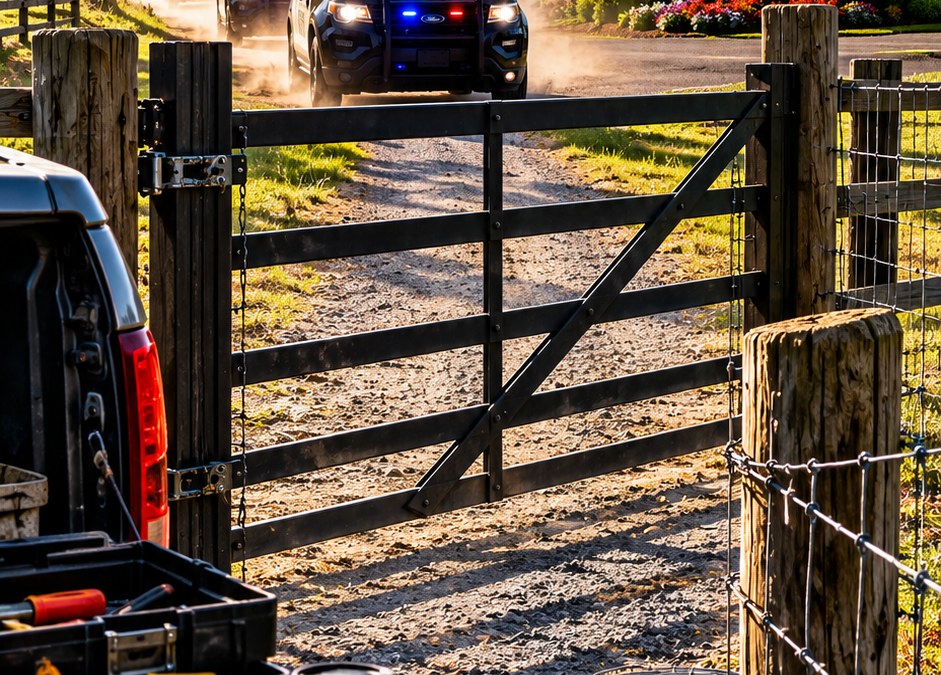
The third thing I heard was the sound of sirens coming down my private road toward a gate my grandfather had built with his own hands.
I had been working on the fence line that morning, doing the kind of quiet, ordinary work a man does when land has been in his family long enough to feel less like property and more like memory. The sun had barely cleared the trees, and the air still held that cool early-hour softness before the day turned hot. I had my gloves on, my boots sunk into the gravel, and a roll of wire leaning against the tailgate of my truck.
Nothing about the morning felt dangerous.
Nothing about me looked threatening.
I was on my land, beside my gate, repairing a section of fence that had sagged after the last rainstorm softened the soil near the post. My truck was parked ten feet behind me. My toolbox was open. My coffee sat on the bumper, already going cold. The only thing in my hand was a pair of fencing pliers.
Then Karen appeared on the other side of the gate.
She came fast, walking down the gravel road from the direction of the HOA neighborhood with her phone already raised. Her white blouse was too clean for the dust around her, and her face wore the same expression it always wore when she thought volume could become authority.
I knew Karen Whitfield well enough by then.
She was the president of the Cedar Grove Estates HOA, though she liked to say it as if the title carried more weight than the county records office, the sheriff’s department, and every deed ever recorded in the courthouse basement. She had spent the last year trying to convince me that the private road across my acreage somehow belonged to her neighborhood because their residents liked using it.
That was the whole problem.
They liked using it.
That did not mean they owned it.
My family had owned the land long before Cedar Grove Estates existed. Before the decorative stone entrance. Before the artificial pond. Before the identical mailboxes and security signs and newsletters printed on glossy paper. Before Karen moved in and decided that anything near her neighborhood must somehow answer to her clipboard.
The road she kept calling “HOA access” was not HOA access.
It was my road.
The gate was mine.
The land on both sides of it was mine.
The old oak beside the fence line was mine.
The drainage ditch, the gravel shoulder, the storage shed, the pasture beyond the bend, all of it sat inside the legal description recorded under my family name. My grandfather had bought the first piece in the 1950s. My father had added the adjoining tract years later. I had inherited the property after my parents died, and I had spent more weekends than I could count repairing what time, weather, and other people’s carelessness tried to wear down.
Karen knew that.
That was the part that still burned.
She was not confused. She had been told. She had been shown. She had seen the boundary markers. She had received letters from my attorney. She had stood three feet from the survey stakes and argued with me as though orange flags and recorded plats were personal insults.
Still, she came to the gate that morning shouting.
“You need to stop right now!” she yelled.
I straightened slowly, fencing pliers still in my hand.
“Good morning to you too, Karen.”
“Don’t you take that tone with me.”
“I’m fixing my fence.”
“You are interfering with HOA-controlled property.”
I looked around at the gravel, the gate, the fence line, the pasture, and the trees I had known since childhood.
“No,” I said. “I’m working on my land.”
Her mouth tightened.
“You cannot block this entrance.”
“It’s my gate.”
“It is the neighborhood’s emergency access.”
“It is not.”
“We have residents who use this road.”
“They use it because you keep telling them they can.”
Her eyes flashed.
“This road has served Cedar Grove for years.”
“That doesn’t make it yours.”
She lifted her phone higher.
“I am calling the police.”
“Go ahead.”
I said it calmly because I had nothing to hide. Maybe that was my mistake. I underestimated what she was willing to say once she had a dispatcher on the line.
Karen tapped her phone and turned slightly away from me, but not far enough that I couldn’t hear.
“Yes, I need police immediately,” she said. “There is a man on HOA property. He has broken through a locked access gate.”
I stared at her.
The gate was open because I had opened it.
The lock hung from the chain on my side, exactly where I had placed it thirty minutes earlier.
Karen kept going.
“He is trespassing, and he appears to be armed.”
My stomach went cold.
“Karen,” I said sharply.
She ignored me.
“Yes, he is acting aggressively. He is refusing to leave. I believe he may be dangerous.”
I looked down at the fencing pliers in my hand.
Then I set them slowly on the tailgate.
The movement was deliberate. Not because I had done anything wrong, but because I understood what she had just done. She had taken a property dispute and poured gasoline over it. She had used the word armed. She had used the word dangerous. She had told police I had broken into land that belonged to the HOA.
I was a middle-aged man in muddy boots standing beside my own truck on my own property.
But I also knew that once sirens were coming, truth did not always arrive first.
Fear did.
Assumption did.
A dispatcher’s warning did.
I stepped away from the toolbox and kept my hands visible.
Karen watched me like she had won something.
“That’s right,” she said into the phone. “He’s backing away now. Please hurry.”
I felt anger rise in me, hot and fast, but I swallowed it down.
My father’s voice came back to me as clearly as if he were standing beside the gate.
When people are trying to make you look wild, don’t give them movement they can describe as wild.
So I stood still.
The gravel road curved through the trees behind Karen before it reached the public county lane. From where I stood, I could see the bend but not beyond it. For a minute, the only sounds were Karen’s clipped voice, the wind through the grass, and the faint creak of the loose fence wire moving against the post.
Then the sirens started.
Far away at first.
Then closer.
Fast.
Karen’s posture changed when she heard them. Her shoulders squared. Her chin lifted. She stepped back from the gate, putting herself where the officers would see her first. She pointed at me before the first cruiser even came into view.
Three police cars came down the gravel road hard enough to throw dust behind them.
The lead cruiser stopped directly outside my gate. The second pulled behind it at an angle. The third blocked the road near the bend. Doors opened almost at once.
I kept my hands where they could see them.
Two officers moved toward me with the controlled caution of men responding to a call they had been told could turn bad. One rested his hand near his belt. Another looked past me toward the truck, the shed, the open toolbox.
Karen began talking before they reached us.
“That’s him,” she said. “That is the man I reported. He is trespassing on HOA property.”
The lead officer, a broad-shouldered man with a shaved head and calm eyes, held one hand toward her without looking away from me.
“Ma’am, stay back for a moment.”
“But he—”
“Stay back.”
That stopped her, at least for a second.
The officer turned to me.
“Sir, keep your hands visible.”
“They are visible,” I said.
“Do you have any weapons on you?”
“No.”
“Any firearms in the truck?”
“No.”
“What’s your name?”
“Jack Morrison.”
His eyes narrowed slightly, not in suspicion, but in recognition of the name. Around our county, the Morrison name still meant something to people who had grown up here. Not wealth. Not power. Just roots.
“Do you have identification?”
“Yes. Wallet is in my back pocket. May I reach for it?”
“Slowly.”
I moved exactly as he told me. Two fingers, back pocket, wallet out, license removed. I handed it to him through the gate opening.
He read it.
“Address on this current?”
“Yes.”
“Do you own this property?”
“Yes.”
Karen burst in.
“He does not own this entrance. This is HOA-controlled property.”
The officer turned his head.
“Ma’am, I told you to wait.”
“He’s lying to you.”
I looked at the officer.
“My deed and property documents are in my truck. May I get them?”
The second officer said, “Where in the truck?”
“Blue folder on the passenger seat.”
“Stay here. I’ll retrieve it.”
I nodded.
Karen looked almost offended that they were listening to me.
“You don’t need his papers,” she said. “I have HOA documents.”
The lead officer finally faced her.
“Then you’ll have a chance to show them.”
The second officer walked carefully around the open gate, keeping distance from me as he moved to the truck. I did not blame him. He did not know me yet. He only knew what dispatch had told him, and Karen had made sure dispatch heard the worst possible version of a lie.
He opened the passenger door, found the blue folder, and brought it back.
Inside were copies of my deed, the county parcel map, the survey, a letter from the county road office confirming the road was privately maintained, and correspondence from my attorney addressing Cedar Grove’s repeated claims. I kept them there because Karen had already made it necessary. Living next to an aggressive HOA teaches a person to carry proof the way other people carry spare keys.
The lead officer opened the folder on the hood of his cruiser.
“What happened here this morning?” he asked.
“I was repairing my fence,” I said. “Karen came down the road and told me to stop. She claimed this gate and road belong to the HOA. I told her they don’t. She called 911 and reported me as an armed intruder.”
“Were you holding anything?”
“Fencing pliers. They’re on the tailgate. I set them down when she said I was armed.”
The officer glanced at the tailgate.
“Did you threaten her?”
“No.”
“Did you enter any HOA property?”
“No. She entered mine.”
Karen let out a sharp laugh.
“That is absurd.”
I looked at her.
“You walked through my gate onto my road.”
“This is not your road.”
The officer looked down at the deed.
Karen kept talking.
“This man has been harassing our neighborhood for months. He blocks access. He threatens residents. He refuses to recognize HOA authority. He has been warned repeatedly.”
I said nothing.
That was difficult.
Every part of me wanted to answer each accusation as it came. But I had learned something from dealing with Karen: when someone is unraveling their own story, sometimes the smartest thing you can do is let the thread keep pulling.
The officer studied the legal description, then the parcel map. He turned the survey slightly, tracing the boundary with one finger.
“Where are we standing on this map?” he asked me.
I stepped closer, slowly, and pointed without touching him.
“Here. Gate is at the eastern private road entrance. Property line runs beyond that ditch and along the tree line. HOA boundary is west of the drainage easement, here.”
The officer looked at the map, then at the land around us.
“And the road?”
“Private road through my parcel. No dedication to the HOA. No public access. No transfer.”
Karen said, “That is his interpretation.”
“No,” I said. “That is the recorded boundary.”
The officer looked at Karen.
“Do you have documentation showing HOA ownership of the road or gate?”
She lifted her clipboard as if it were enough.
“I have the Cedar Grove access plan.”
“Ownership documentation,” he said.
“This is the plan used by the community.”
“That’s not what I asked.”
Her face tightened.
The younger officer near the third cruiser radioed something quietly. The lead officer nodded, then pulled out his phone.
“We’re going to verify with county records.”
Karen crossed her arms.
“Fine.”
She said it like verification was a formality that would humiliate me.
I almost felt sorry for her then.
Almost.
The officer called the county records office directly. He gave them my parcel number from the deed. He read part of the legal description. He asked them to confirm ownership and boundary information. Then he listened.
The wind pushed dust across the road.
Karen stared at me.
I stared at the gate.
That gate had been built before I was born. My grandfather had set the original posts himself, long before the road was widened with crushed gravel. He used to tell me that land did not defend itself. He said lines on paper mattered, but only if living people respected them. Back then, I thought he was just an old man repeating old-man wisdom.
Standing there with police cruisers outside my gate because an HOA president had called me an armed intruder, I understood him better than I ever had.
The officer’s voice stayed even.
“Can you repeat that?”
He listened again.
Then he looked at Karen.
Her confidence faltered for the first time.
“Yes,” the officer said into the phone. “Thank you.”
He ended the call.
“The county record confirms Mr. Morrison is the owner of this parcel,” he said. “The gate and road area appear to be within his property boundary.”
Karen’s mouth opened.
“No. That cannot be right.”
“It’s what the record shows.”
“You must have given them the wrong parcel.”
“I read from the deed.”
She pointed toward me.
“He has manipulated this whole situation.”
The lead officer’s expression did not change, but I saw something harden behind his eyes. Police hear lies every day. They also hear panic, confusion, anger, fear, exaggeration. It takes time for them to sort one from another. But Karen’s problem was becoming obvious. She did not have a misunderstanding. She had a desired outcome, and every fact that failed to serve it became part of a conspiracy.
The second officer flipped through the folder and found the attorney letter.
“This says the HOA was notified previously that the road is private.”
Karen snapped, “That letter was disputed.”
“By whom?”
“By the board.”
“Based on what?”
“Based on our authority.”
The officer gave her a long look.
“That is not an answer.”
Then Karen made it worse.
She pointed toward my storage shed.
“There may be a weapon in there.”
Every officer turned.
My pulse changed.
The shed stood about forty yards past the gate, a weathered gray structure with a metal roof and double doors. It held feed buckets, spare fence wire, old tools, a wheelbarrow, paint cans, and the kind of forgotten hardware that accumulates on rural property. There was nothing illegal in it. But Karen knew exactly what she was doing. She was trying to revive the danger she had invented.
The lead officer asked, “Why do you believe there is a weapon in the shed?”
“He is always out here with tools.”
“Tools are not weapons, ma’am.”
“He could be hiding something.”
I spoke carefully.
“Officer, that shed is on my property. I do not consent to a search without proper legal procedure.”
Karen’s face lit with outrage.
“See? He’s hiding something.”
I kept my hands relaxed at my sides.
“I’m protecting my rights.”
The lead officer looked at me, then at the shed.
“Do you have any weapons in that shed?”
“No firearms. No illegal weapons. Tools, fencing supplies, storage.”
Karen cut in again.
“You don’t know that unless you search it.”
The officer turned to her.
“We need more than speculation.”
“He was reported as armed.”
“By you,” he said.
That landed hard.
Karen went silent.
For a moment, everything held still.
Then another vehicle came slowly up the gravel road behind the cruisers.
It was not moving fast. It did not need to. The dark county sheriff’s SUV rolled through the dust with steady authority, lights off, grille catching the sun. It stopped behind the lead cruiser, and the driver’s door opened.
Sheriff Daniel Reeves stepped out.
Karen’s expression changed before he even closed the door.
The sheriff was a tall man in his late fifties, broad through the shoulders, with gray at his temples and the kind of face that looked carved more by weather than age. He had been sheriff long enough that most people in the county knew him on sight. He walked with no hurry and no hesitation.
I had known him most of my life.
He had worked under my father when he was a young deputy. He had eaten at our kitchen table. He had helped search the back pasture the year one of our calves got loose during a thunderstorm. He had stood beside me at my parents’ funeral. He knew exactly where my family land began and ended because he had driven those boundaries before Cedar Grove Estates ever had a name.
Karen did not know any of that.
She only knew the sheriff had arrived, and she believed authority was finally about to tilt back toward her.
“Sheriff,” she said quickly. “Thank goodness you’re here. This man—”
The sheriff did not stop beside her.
He walked straight through the open gate toward me.
Then he smiled.
“Jack,” he said, extending his hand. “Good to see you again.”
I shook his hand.
“Sheriff.”
Karen looked from him to me as if the ground had shifted under her shoes.
“You know him?” she said.
The sheriff turned slowly.
“I do.”
“He is the intruder I reported.”
The sheriff looked at the gate, the truck, the fence wire, the open toolbox, the documents on the cruiser hood, and then back at Karen.
“Karen, did you check who actually owns this property before you called 911?”
She stiffened.
“This is HOA access property.”
“That’s not what I asked.”
Her mouth tightened.
“I know what the community records show.”
“I asked whether you checked the county record.”
She did not answer.
The sheriff looked at the lead officer.
“What have we got?”
The officer summarized calmly. Reported armed intruder. Property dispute. Owner produced deed and survey. County records confirmed ownership. No weapon observed. No threat confirmed. Caller alleging HOA control but no ownership documentation provided.
The sheriff listened without interrupting.
Then he looked at me.
“You all right?”
“I’m all right.”
“You carrying today?”
“No.”
“Anything in the truck we need to know about?”
“No.”
He nodded once, accepting not because he was careless, but because the scene around him matched the man he knew and the records already checked.
Karen could not stand it.
“Sheriff Reeves, with respect, your personal relationship with him should not influence this investigation.”
He turned to her fully.
“You’re right.”
That surprised her.
The sheriff continued, “That’s why we’re going to rely on the record.”
He motioned to the documents.
“Let me see the deed.”
The lead officer handed it to him.
The sheriff opened the page, read the legal description, then looked across the road toward the boundary markers.
“I’ve seen this before,” he said.
Karen frowned.
“What do you mean?”
“I mean I have personally seen county records concerning this property. The Morrison tract is not Cedar Grove property. Never has been.”
“That road serves our neighborhood.”
“It may have been used by your residents,” he said. “That does not make it yours.”
Her voice rose.
“You cannot expect an entire community to lose access because one man decided to be difficult.”
The sheriff’s face hardened.
“Be careful, Karen. This call was not about access. You reported an armed intruder.”
She faltered.
“He was behaving aggressively.”
“By repairing his fence?”
“He refused to leave.”
“His own property?”
“He was blocking the road.”
“His private road?”
She flushed.
The sheriff handed the deed back to the officer.
“Let’s walk the markers.”
Karen looked stunned.
“What?”
“If you’re claiming this is HOA property, we’re going to look at the boundaries.”
The sheriff did not wait for her approval.
We walked the property line together: the sheriff, two officers, Karen, and me. The third officer stayed near the cruisers, reviewing the call notes. I pointed out the first marker near the ditch, then the second by the old cedar stump, then the third farther up the slope. Each marker matched the survey. Each one placed the gate, road, and shed inside my land.
Karen followed behind us, her shoes collecting dust, her face growing tighter with every step.
The sheriff stopped at the marker closest to the HOA’s landscaped entrance.
“This is the subdivision line,” he said.
I nodded.
“Yes.”
He turned to Karen.
“Your property starts beyond this point.”
Karen looked toward the road.
“That cannot be. Our residents have always—”
“Used it,” the sheriff said. “Not owned it.”
“They were told it was an access road.”
“By whom?”
“The developer. The board. Everyone.”
“Do you have a recorded easement?”
Karen hesitated.
“We have HOA access documents.”
“Recorded easement,” he repeated.
She looked away.
I knew what she had. I had seen copies months earlier when her attorney sent them in a packet thick enough to look intimidating from a distance. There were community maps, meeting minutes, old references to “preferred emergency access,” and a developer presentation showing the road as a convenient route during early construction.
None of it granted ownership.
None of it created a permanent legal right across my land.
The sheriff knew that too.
We walked back to the gate.
The lead officer had finished reviewing the 911 call notes. His expression told me the situation had gotten worse for Karen while we were gone.
“Sheriff,” he said, “dispatch summary says caller reported the suspect entered through a locked gate by force.”
The sheriff looked at the gate.
The chain hung open. The lock was intact. No damage. No cut metal. No broken hinge. No pry marks.
“Gate looks fine to me,” the sheriff said.
The officer continued, “Caller also reported suspect threatened nearby residents.”
The sheriff looked at Karen.
“Which residents?”
Karen lifted her chin.
“People have complained about him.”
“Which residents did he threaten today?”
She did not answer.
“Names,” the sheriff said.
“I would have to check.”
“You told 911 he threatened residents.”
“I said he was threatening.”
“That’s not the same thing.”
Her voice sharpened.
“I was scared.”
The sheriff held her gaze.
“Were you scared because he threatened you, or because he told you no?”
Her face went red.
“That is insulting.”
“So was calling an armed response on a property owner without checking the property record.”
The words cut through the air.
Nobody spoke.
I felt the full weight of what could have happened settle over me then. It had been present from the moment the sirens started, but I had pushed it aside in order to stay calm. Now, standing there with the sheriff naming it plainly, I let myself feel it.
Karen had not just exaggerated.
She had created danger where there was none.
She had taken my work clothes, my tools, my truck, my gate, my land, and turned them into pieces of a false emergency. If the officers had arrived more afraid, if I had moved too quickly, if one of them had believed her tone more than my documents, the morning could have ended with me in handcuffs, on the ground, or worse.
All because Karen wanted a road.
All because she believed the HOA’s convenience mattered more than my life.
The sheriff asked the lead officer to play back the relevant dispatch summary. Not the audio for everyone to hear, but the written report relayed from her call. He read it quietly, then looked at Karen again.
“You stated he broke through a locked gate.”
“I believed he had.”
“You were standing at the gate when officers arrived. Did you see damage?”
“I didn’t inspect it.”
“You stated he was armed.”
“He had something in his hand.”
“What did he have?”
She looked toward the tailgate.
“Some kind of tool.”
“Did you tell dispatch it was a tool?”
“I said he appeared armed.”
“With fencing pliers?”
She did not respond.
“You stated he was on HOA property.”
“He was on property used by the HOA.”
“Not what you told dispatch.”
Karen’s composure cracked.
“You’re all taking his side because you know him.”
The sheriff’s voice went quiet.
“No. We’re taking the side of the facts.”
She laughed bitterly.
“Facts? He has been trying to cut our community off for months.”
I finally spoke.
“I closed my own gate.”
She turned on me.
“You closed an emergency access point.”
“There is no recorded emergency easement across my road.”
“You don’t care if people are trapped.”
“The county road is half a mile west and fully public. Your residents are not trapped. They just prefer my road because it’s shorter.”
“That road has been used for years.”
“And every time I allowed it, your board treated permission like ownership.”
The sheriff held up one hand.
“That’s enough. The civil access dispute is not being resolved at this gate today. But the criminal report is being addressed.”
Karen blinked.
“Criminal report?”
“Yes,” he said. “The one you made.”
Her confidence drained a little more.
The sheriff asked her for the HOA paperwork she claimed proved authority over the road. She handed him the clipboard with a stiff motion. He looked through the pages slowly.
There was a site map.
Meeting minutes.
A letter from the HOA board.
A printed newsletter.
A policy statement about “maintaining access corridors.”
The sheriff turned each page without comment.
Then he handed the clipboard back.
“None of this proves ownership.”
Karen looked trapped now, but still defiant.
“It proves the HOA has managed access.”
“No,” he said. “It proves the HOA has talked about access.”
“That is a distinction without a difference.”
“It is exactly the difference.”
The lead officer confirmed there was no basis to detain me. The second officer photographed the gate, the intact lock, the boundary markers, and the documents. The sheriff instructed them to document the false statements, the property verification, and the ongoing civil dispute.
Karen heard the phrase false statements and reacted immediately.
“I did not make false statements.”
The sheriff looked tired then. Not physically tired, but tired in the way public servants get when someone insists that intent should erase consequences.
“You reported a forced entry where there was no forced entry. You reported HOA property where the county record shows private property. You reported an armed intruder where the property owner was holding a fence tool on his own land.”
“I reported what I believed.”
“Then your belief needs to start checking records before it sends police to someone’s gate.”
That shut her down.
For a moment, I saw the woman beneath the title. Not a president. Not an authority figure. Just someone who had pushed too far and found, too late, that confidence was not the same thing as proof.
The sheriff turned to me.
“Jack, keep every document safe. Keep copies in your truck. If the HOA contacts you again about this road, have your attorney handle it.”
“I will.”
“If anyone comes through this gate without permission, document it. Don’t escalate. Call us.”
“I understand.”
He glanced at the fence line.
“And maybe install cameras.”
“I already ordered them.”
For the first time that morning, he smiled slightly.
“Good.”
Karen stood near her vehicle, staring at the gravel as if the road itself had betrayed her.
One by one, the officers returned to their cruisers. The lead officer handed my folder back to me.
“Sorry for the trouble, Mr. Morrison.”
“You were doing your job.”
He nodded, but his expression carried more than routine courtesy. He understood, at least partly, what her call could have caused.
The cruisers pulled away slowly, dust rising behind them.
The sheriff stayed a moment longer.
When the others were out of earshot, he looked at me.
“Your dad would have hated this.”
I let out a breath that felt like it had been sitting in my chest all morning.
“He would have had stronger words than I did.”
The sheriff chuckled once.
“Yes, he would’ve.”
Then his face grew serious again.
“Karen’s not used to being told no.”
“I noticed.”
“She’s been pushing that access issue at county meetings.”
“I figured.”
“She doesn’t have what she thinks she has.”
“I know.”
“Knowing and proving are different things.”
I looked down at the folder in my hands.
“I’m learning that.”
He nodded toward the gate.
“Your grandfather built this?”
“Yes.”
“Then keep it standing.”
“I intend to.”
He shook my hand again, got into his SUV, and drove away.
When the dust settled, only Karen and I remained.
She had not left yet.
For a while, she stood beside her vehicle with one hand on the open door. I thought she might try one more argument. One more accusation. One more speech about community, safety, access, standards, residents, emergencies, expectations, all the polished words she used when she meant control.
Instead, she looked at me with anger so bitter it almost seemed like pain.
“You embarrassed me,” she said.
I stared at her.
“You called 911 and told them I was an armed intruder on my own land.”
“You could have just worked with us.”
“I did. I gave you the records.”
“You refused to compromise.”
“You wanted my road.”
“We wanted reasonable access.”
“You wanted authority you didn’t have.”
Her eyes shone, but she did not cry. Karen did not seem like someone who allowed tears unless they served a purpose.
“You have no idea how many residents are upset about this.”
“I have no idea why they were promised something nobody owned.”
Her face hardened again.
“This isn’t over.”
For months, that sentence had worked on me. It had followed me home, sat with me at dinner, kept me awake, made me re-read documents under yellow kitchen light. But after the sirens, after the sheriff, after the county record, it sounded smaller.
I picked up my fencing pliers from the tailgate.
“For today,” I said, “it is.”
She got into her vehicle and reversed hard enough to spray gravel from under her tires. Then she drove back toward Cedar Grove Estates.
I watched until she passed the subdivision line.
Only then did I let myself sit on the tailgate.
My legs felt unsteady.
That surprised me. I had stayed calm while the officers questioned me. I had kept my voice level while Karen accused me. I had handed over my license, explained the deed, pointed to the boundary, protected my rights, and shaken the sheriff’s hand without letting anger take over.
But when it was over, my body understood what my mind had delayed.
I could have been arrested.
I could have been hurt.
A lie told with enough urgency can move armed men faster than the truth can put on its boots.
That was what Karen had done. She had not merely complained. She had activated force. She had pulled the emergency system into a private dispute and pointed it at me like a weapon.
I sat there until my coffee had gone completely cold.
Then I got back to work.
Not because I felt normal.
Because the fence still needed repair.
That was the strange thing about land. Drama comes and goes, but posts still lean, wire still loosens, gates still need oil, and storms do not care who yelled loudest at the property line. My grandfather would have understood that. My father too.
So I drove the new staple into the post. I tightened the wire. I checked the latch. I rehung the chain and locked it when I was finished.
Then I walked the road.
I started at the gate and followed the gravel all the way to the bend where Cedar Grove residents had been cutting through for years. I looked at the tire marks, the ruts near the ditch, the places where rainwater had started carving channels because too many vehicles had used a private road never built for neighborhood traffic.
I saw it differently now.
Before, the road had been an inconvenience, a dispute, a boundary problem. After Karen’s call, it became evidence of something larger. Every unauthorized tire track was a small assumption made visible. Every rut was a record of somebody believing my land was simply available because it was convenient.
That ended that day.
I did not block emergency services. I did not do anything reckless. I did not turn spiteful. I simply enforced what had always been true.
The road was private.
The gate stayed closed.
Access required permission.
Within a week, my attorney sent Cedar Grove Estates a formal notice. It cited the sheriff’s report, the county parcel records, the prior correspondence, and the false 911 claims. It demanded that the HOA stop representing my private road as community property, stop encouraging residents to use it, and direct all future communication through counsel.
The response came back polite, cool, and empty.
They denied wrongdoing.
They expressed concern.
They claimed Karen had acted out of an abundance of caution.
That phrase made me put the letter down and walk outside.
An abundance of caution.
That was what they called it when a woman told police I was an armed intruder because she wanted my gate opened.
I stood on the porch that evening as the sun dropped behind the tree line. The private road was quiet. For the first time in years, no golf cart cut through. No delivery driver followed bad directions from the HOA. No resident waved impatiently at the gate as if I were inconveniencing them by existing.
Quiet can feel unfamiliar when conflict has trained your nerves to listen for engines.
A month later, the sheriff’s department closed its report with no action against me and a documented warning attached to Karen’s complaint history. The civil dispute remained civil. The HOA did not get the road. They did not get the gate. They did not get to turn their map into my deed.
Karen stopped coming in person.
For a while, I still saw her vehicle slow near the subdivision line. Then even that stopped. The HOA eventually installed a sign directing residents to the public county road. It added less than four minutes to their drive.
Four minutes.
That was what all of it had been about.
Four minutes and the belief that convenience should outrank ownership.
The last time I saw Karen that season, she was standing near the Cedar Grove entrance while a contractor installed new landscaping around their stone sign. She looked across the distance toward my closed gate. I was checking the mailbox at the end of my drive.
For a second, our eyes met.
She did not wave.
Neither did I.
There was nothing left to perform.
I thought I would feel satisfaction in that moment, but what I felt was heavier and quieter. The kind of feeling a person has after surviving something that should never have happened in the first place. I had not won a game. I had defended a fact.
That is not the same kind of victory.
A game ends with applause.
A fact just remains standing.
That winter, I replaced the old gate with a stronger one.
I kept the original posts.
I could not bring myself to remove them. My grandfather’s hands had set them too deep into the story of that land. The wood was weathered and scarred, but still solid at the core. I sanded what I could, sealed what I could, and left the marks that belonged there.
On the inside of the new gate, where drivers from the road could not see it, I mounted a small metal plate with three words:
PRIVATE PROPERTY RECORDED.
Not angry words.
Not threatening words.
Just true ones.
Sometimes I think back to that morning and hear the sirens again.
I remember the dust rising behind the cruisers. I remember Karen pointing at me like I was dangerous. I remember the lead officer asking for my identification, the weight of my wallet in my hand, the deliberate slowness of every movement. I remember the sheriff stepping out of his SUV and saying my name with recognition instead of suspicion.
Most of all, I remember the moment Karen realized the county map was not going to bend for her.
That was the moment the whole thing changed.
She had believed one phone call could turn me into a criminal. She had believed her title could make my land seem uncertain. She had believed fear would do what her paperwork could not.
But fear is loud.
Facts are patient.
And on that morning, patience won.
I still work that fence line. I still drive through the same gate. I still keep copies of the deed in my truck, though I have not needed to pull them out in a long time. The road is quieter now. The gravel lasts longer. The ditch drains properly. The pasture feels like pasture again instead of disputed territory.
Every so often, someone new to Cedar Grove takes a wrong turn and stops at the gate. They see the sign. They reverse. They find the county road.
No sirens.
No shouting.
No clipboard.
Just a boundary finally being respected.
And every time I lock the gate behind me, I think of my grandfather, my father, and the simple truth Karen tried so hard to bury beneath panic and accusation.
Land does not defend itself.
But records, calm hands, and the truth can hold a line stronger than any fence.








