𝗙𝗨𝗟𝗟 𝗦𝗧𝗢𝗥𝗬 The Silver Badge My Sister Mocked Was the One Thing Everyone in the Ballroom Should Have Feared
𝗙𝗨𝗟𝗟 𝗦𝗧𝗢𝗥𝗬
The lead investigator, Special Agent Marisol Vega, saw my face change.
“You know the address.”
“Yes.”
“How?”
“My sister lives there.”
No one spoke for three seconds.
Then the legal officer closed his folder with unusual care.
“Admiral Monroe, we can reassign you from operational oversight.”
“You can,” I said. “But you shouldn’t.”
Vega studied me.
“You understand the conflict.”
“I do.”
“And the risk.”
“I understand that if someone is using my sister’s home network and my brother-in-law’s credentials, removing me because I am related to them may cost you the one person in this room who can identify family behavior that doesn’t fit.”
The deputy assistant secretary leaned back.
“You believe your sister may be involved?”
“I believe my sister enjoys being important, dislikes being ignored, and has never been careful with access if attention is available.”
That was the most honest answer I could give.
It hurt to say it.
Not because Lauren had been kind to me.
Because family is still family, even when disappointment has built a permanent residence in your chest.
The evidence was not enough for an arrest.
It was enough for surveillance.
Ethan Whitaker’s secure credentials had been used in connection with the compromised procurement files, but not in a way that made sense. The pattern suggested credential theft, token cloning, or session piggybacking. Ethan himself was either compromised, negligent, or being framed.
My job was not to assume.
My job was to know.
The reunion at the Chesapeake Bay Club had been scheduled for months.
It was technically a hometown homecoming dinner, part fundraiser, part social event, part self-congratulatory parade for every family that had ever wanted to be seen near water, money, and uniforms.
Lauren was on the planning committee.
Of course she was.
She loved committees that ended in microphones.
She called me three days before the dinner.
“You’re coming, right?”
“I wasn’t planning on it.”
“Rachel.”
I could hear the performance beginning.
“This matters to Mom and Dad. Everyone will be there.”
“I’m sure everyone will survive without me.”
She laughed lightly.
“You always do that.”
“Do what?”
“Act like you’re above things.”
I was standing in a secure office reviewing a timeline of unauthorized data transmissions tied to her home router.
I almost said, No, Lauren, I act like I’m busy.
Instead, I said, “I’ll see what I can do.”
That night, Vega asked if I had a reason to attend.
“Yes,” I said. “Lauren just gave me one.”
The ballroom at the Chesapeake Bay Club looked exactly the way I expected.
Too much gold.
Too many flowers.
Too many people pretending they had not spent the drive over arguing.
Tall windows overlooked the marina. Boats rocked gently beneath strings of white lights. The air smelled of expensive perfume, polished wood, seafood, and old money trying to appear relaxed.
Across the street, a black SUV sat beneath a live oak tree.
No one else noticed it.
I did.
A surveillance team monitored the marina entrance.
Another covered the service corridor.
Two agents were inside posing as event staff.
I entered through the front doors wearing a dark navy jacket, black slacks, and the small silver badge I should have removed before arriving.
It was not decorative.
It was a restricted-access insignia tied to my current command authority. Small enough for civilians to ignore. Specific enough that anyone properly briefed would understand they were not looking at costume jewelry.
I had pinned it on before a morning meeting and forgotten about it.
That was unlike me.
But the last forty-eight hours had involved too little sleep, too much caffeine, and the unpleasant knowledge that my sister’s house sat at the center of a classified breach.
The hostess checked my name.
“Rachel Monroe?”
“Yes.”
She glanced at a seating chart.
“You’re at table nine.”
Of course I was.
My parents would be near the front.
Lauren would be wherever attention gathered most naturally.
I found table nine near the side of the ballroom, close enough to observe the room, far enough to avoid being trapped in the center of any family performance.
My mother spotted me before I sat down.
She waved with the bright, public smile she used when she wanted other people to see that we were close.
“Rachel!”
I walked over.
Mom hugged me quickly, then leaned back and inspected my jacket.
“You look very serious.”
“Hello to you too.”
Dad stood beside her holding a Scotch.
He kissed my cheek.
“Good to see you, Ray.”
He was one of three people still allowed to call me that.
The other two were dead.
“Dad.”
“You just get in?”
“Earlier.”
“Staying long?”
“No.”
He nodded, already comfortable with that. My family had turned my absences into personality. Rachel never stays. Rachel is always busy. Rachel has her secret Navy things.
It spared them from asking why I never felt welcome enough to linger.
Lauren appeared in a silver dress that caught every light in the room.
She kissed the air beside my cheek.
“Rachel. You came.”
“You invited me.”
“I know, but you don’t always do normal family things.”
There it was.
Normal again.
Ethan stood beside her in dress uniform, composed and courteous.
“Rachel.”
“Commander.”
His mouth twitched.
“Ethan, please. We’re off duty.”
“Are we?”
His eyes sharpened slightly.
He caught the tone.
Good.
Ethan was not careless.
Lauren slid her arm through his.
“Don’t let her make everything mysterious. She works in an office.”
Ethan looked at me, and for the briefest second I saw the question in his face.
What kind of office?
I gave him nothing.
He gave me the smallest nod.
We understood each other well enough for people who had never been allowed to speak honestly in the same room.
Dinner began at seven.
The Chesapeake Bay Club served crab cakes, filet, roasted vegetables, and rolls so glossy they looked painted. A string quartet played near the windows. Guests laughed too loudly and drank too quickly.
I ate little.
My attention stayed on the room.
Captain Jonathan Hale arrived late.
I recognized him immediately.
He was Ethan’s commanding officer, though not directly in every chain relevant to the investigation. He was handsome in the carefully maintained way of men who knew exactly how authority photographed. Silver at the temples. Perfect posture. Measured smile.
He greeted Ethan warmly.
Lauren kissed his cheek.
That caught my attention.
Not because it was improper by itself.
Lauren kissed half the county that way.
But Hale’s hand lingered at her elbow a second too long.
Ethan noticed.
Then looked away.
I filed that away with everything else.
At 2018, my phone vibrated once.
Vega.
Hale is present. Confirm visual.
I typed beneath the table.
Confirmed.
A second message arrived.
Passive scan detects active device in ballroom. Not yet isolated.
I looked around slowly.
Three hundred guests.
Dozens of phones.
Smartwatches.
Hearing aids.
Car key fobs.
Wireless microphones.
Security radios.
A nightmare of signals wrapped in formalwear.
Then Lauren stood.
The room immediately responded.
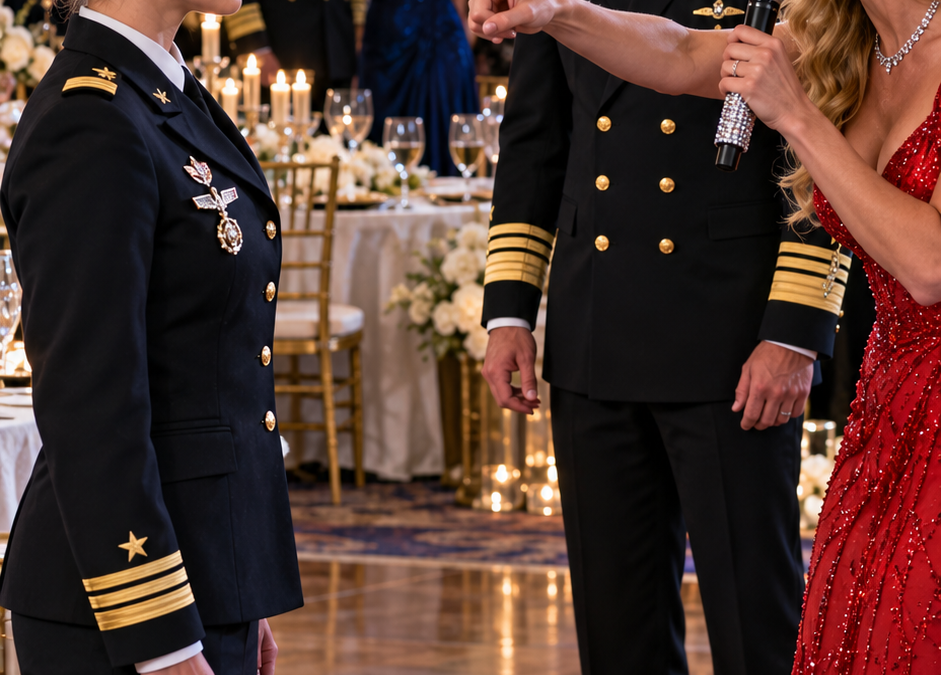
She picked up a rhinestone-covered microphone from the small stage near the dance floor.
Of course the microphone had rhinestones.
Lauren tapped it twice.
“Can everyone hear me?”
“Yes!” someone shouted.
She laughed.
“Perfect. You know I love a captive audience.”
The crowd laughed with her.
I looked down at my plate.
Here we go.
Lauren began with gratitude. The club. The committee. The donors. The families who came home, the veterans in the room, the local businesses that sponsored the event.
She was good.
I could admit that.
Lauren knew how to make people feel included while keeping herself at the center.
Then she began telling childhood stories.
Harmless ones at first.
The time Dad burned burgers at a Fourth of July picnic.
The time Mom accidentally entered the wrong church hall for a charity luncheon and stayed because the food was better.
Then her eyes found me.
I knew the look.
It was the glittering look she got before making me smaller for sport.
“Oh,” she said, smiling wider, “and then there’s my little sister, Rachel.”
Several guests turned toward me.
I made the mistake of smiling politely.
Lauren took it as encouragement.
“She’s always been the quiet one. You know, the type who sits behind a computer all day typing emails.”
Laughter spread across the room.
I folded my hands in my lap.
“Honestly,” she continued, pointing directly at me, “I’m still not exactly sure what she does.”
More laughter.
My mother gave a strained smile.
Dad looked into his Scotch.
Ethan did not laugh.
Lauren’s eyes landed on my jacket.
Specifically, the small silver badge attached to my lapel.
“Look at that thing,” she said. “Even her costume jewelry looks government-issued.”
The room laughed again.
Except for one person.
Ethan Whitaker.
The smile vanished from his face instantly.
I saw his eyes lock onto the badge.
Recognition moved through him like an electrical current.
His face went completely pale.
Then he shoved his chair backward so fast it screeched across the polished floor.
The sound cut through the ballroom.
One by one, conversations stopped.
Ethan stood at attention.
Perfectly straight.
Then, in a voice that echoed through the room like a rifle shot, he shouted, “Admiral on deck!”
Silence.
Absolute silence.
My mother froze with her wine glass halfway to her lips.
My father nearly dropped his Scotch.
Lauren stared at her husband in disbelief.
“What did you just say?”
Ethan ignored her.
His eyes never left me.
“Ma’am.”
Just one word.
But everyone heard it.
Not Rachel.
Not sister-in-law.
Not Lauren’s awkward little sister.
Ma’am.
A wave of confusion moved through the ballroom.
I sighed quietly.
I should have removed the badge.
But I had been distracted.
Distracted by the black SUV across the street.
Distracted by the surveillance team monitoring the marina entrance.
Distracted by the fact that two weeks earlier, someone had used my sister’s home Wi-Fi network to access a classified Navy procurement file.
Lauren looked from Ethan to me.
Then back again.
Her smile began to crack.
“Why are you calling her that?”
Ethan swallowed.
“Because that is Rear Admiral Rachel Monroe.”
The room exploded into whispers.
A tray crashed somewhere near the dessert table.
Nobody even looked.
All eyes were on me.
Lauren laughed nervously.
“No. No, she isn’t.”
I calmly folded my napkin.
“Yes, Lauren.”
Her face turned red.
“You told Mom you write briefings and answer emails.”
“I do.”
The room listened carefully.
“I write intelligence briefings.”
The silence deepened.
Lauren opened her mouth.
Closed it again.
For the first time in her life, she had nothing to say.
Then my phone vibrated.
A single message appeared on the screen.
TARGET CONFIRMED.
My pulse slowed.
Because the person responsible for the security breach was in that ballroom.
Very close.
I looked up.
Across the room, one guest suddenly stood and headed for the exit.
Captain Jonathan Hale.
At the exact same moment, the ballroom doors opened and three federal agents stepped inside.
The agents moved before anyone else understood what was happening.
One blocked the ballroom exit.
Another crossed toward the marina doors.
The third walked directly toward Ethan.
Lauren grabbed her husband’s arm.
“What is going on?”
Ethan did not answer.
He was staring at Hale.
Hale stopped beside the doorway and slowly raised both hands.
“You’ve made a mistake, Admiral.”
I stood.
“No, Captain. You did.”
Lauren looked at me as if I had become a stranger.
Maybe I had.
Maybe I had always been one, and she was only now noticing.
I took out my phone.
“For six months, classified procurement schedules have been copied and transmitted through civilian networks.”
Hale’s expression remained calm.
“Then arrest whoever did it.”
“That’s exactly what we’re doing.”
An agent approached him.
Then my phone vibrated again.
SECOND DEVICE ACTIVE.
My stomach tightened.
Wrong target.
Not entirely.
But incomplete.
I scanned the ballroom.
Two hundred frightened faces stared back.
Then I noticed Lauren.
Not her expression.
Her purse.
A tiny green light blinked inside it.
So small most people would have missed it.
I did not.
“Lauren,” I said quietly.
She frowned.
“What?”
“Put the purse down.”
Her face changed instantly.
Ethan saw it too.
“Lauren?”
She stepped backward.
“I don’t know what she’s talking about.”
I crossed the room.
“Someone has been using your home network, your devices, and Ethan’s access credentials.”
“That’s insane.”
“Then put down the purse.”
Instead, she clutched it tighter.
An agent reached her in three steps.
“Ma’am,” he said, “place the purse on the table.”
Lauren’s eyes filled with tears.
“Ethan?”
His voice was barely audible.
“Lauren. Do it.”
For once, she did not perform.
For once, she did not smile her way around consequence.
She set the purse down.
The agent opened it carefully and removed a small encrypted transmitter about the size of a lipstick tube.
Ethan looked like he had been struck.
“Lauren,” he whispered. “What is that?”
Tears spilled down her face.
“I didn’t know what it was.”
Hale laughed.
That was his mistake.
Everyone turned.
Lauren stared at him.
“You told me it was for financial transfers.”
Ethan went completely still.
“You know him?”
Lauren’s face crumpled.
Hale’s smile vanished.
The agents cuffed him.
But I was no longer watching Hale.
I was watching Ethan.
Because the transmitter had just finished uploading one final file.
My phone displayed its destination.
ETHAN WHITAKER — SECURE TERMINAL.
I looked at my brother-in-law.
He looked back at me.
The room seemed to tilt around us.
Then one agent leaned close and whispered into my ear.
“Admiral, we found the original authorization.”
“Whose signature?”
He hesitated.
“Your father’s.”
Across the room, Dad quietly set down his Scotch.
And started walking toward the marina doors.
For one heartbeat, I was no longer an admiral.
I was twelve years old again, sitting at the end of the dinner table while my father praised Lauren for smiling beautifully in a school photograph and told me I should help my mother clear the plates.
Dad had always been careful.
Not in the way I was careful.
His was a social kind of caution. He knew which people to flatter, which donors mattered, which neighbors could be useful, which reputations should be protected at all costs.
He had worked for years as a consultant in maritime contracting after leaving the family logistics business. Not high-level government work, but close enough to know the language. Close enough to understand procurement rumors. Close enough to recognize value when he saw it.
And close enough, apparently, to sign something that had no business carrying his name.
I looked toward Vega.
She nodded once.
The agent nearest the marina doors moved.
“Dad,” I said.
He stopped.
Not because the agent blocked him.
Because I had used the old voice.
The daughter voice.
The one he had not heard from me in years.
He turned slowly.
Every person in the ballroom watched him.
My mother stood beside her chair, one hand pressed to her throat.
Lauren was crying openly now, the transmitter sealed in an evidence bag on the table beside her purse.
Ethan looked as if the floor beneath his life had disappeared.
Dad’s face was gray.
“Rachel,” he said. “This is not what it looks like.”
I walked toward him.
“No one in the history of bad decisions has ever improved the situation by saying that.”
A few people stared at me.
I did not care.
“What did you sign?”
His mouth opened.
Closed.
I stopped six feet away from him.
“What did you sign?”
He looked past me toward Hale.
Hale said nothing.
His lawyer instincts had apparently arrived late but intact.
Dad swallowed.
“It was a consulting authorization.”
“For whom?”
“Chesapeake Strategic Advisory.”
I knew the name.
A shell vendor flagged during the investigation. Too small to justify its access attempts. Too clean on paper. Created eighteen months earlier.
“You authorized data handling on behalf of a shell company?”
“I didn’t know it was a shell company.”
“Who gave you the paperwork?”
Dad’s eyes shifted again.
To Hale.
Lauren made a sound somewhere behind me.
Hale’s face hardened.
“Robert,” he said sharply, “don’t.”
That was all I needed.
Vega heard it too.
She stepped beside me.
“Mr. Monroe, you need to stop talking unless you’re prepared to do so formally.”
Dad looked at her, then at me.
There was panic in his eyes now.
Not guilt alone.
Fear.
“Rachel, I thought it was business intelligence.”
I felt my jaw tighten.
“Classified procurement schedules are not business intelligence.”
“I didn’t know they were classified.”
“You didn’t ask.”
His face crumpled slightly.
For years, my father had spoken to me with distracted affection. He loved me, I think. In his limited, comfortable way. But he had always placed me in a category that required less attention.
Lauren needed support.
Lauren needed investment.
Lauren needed applause.
Rachel would be fine.
Rachel always handled herself.
Now, standing in a ballroom full of people, I saw the cost of that habit in a new shape.
Dad had not believed I was important enough to understand the world he had stepped into.
He had not believed my career was real enough to fear.
He had not believed the quiet daughter who “wrote emails” might be the person who would have to put the pieces together.
“What did Hale promise you?” I asked.
Dad’s eyes filled.
“Access.”
“To what?”
“Contract forecasts. Vendor movement. Upcoming bids.”
“Why?”
His silence answered before he did.
I looked toward Lauren.
She was shaking her head, as if rejecting a truth no one had spoken yet.
“Lauren’s lifestyle brand,” I said.
Dad closed his eyes.
My mother whispered, “Robert?”
Lauren stared at him.
“What does she mean?”
Dad said nothing.
So I answered.
“He was trying to help finance your expansion.”
“My what?”
“Your production deal,” I said. “The one with the coastal apparel line. The one that needed private capital before the brand would scale.”
Lauren’s face went white.
“How do you know about that?”
“Because your accounts were part of the investigation once the transmissions hit your network.”
She looked humiliated.
Good.
Then immediately, I hated myself for thinking it.
This was bigger than sibling resentment.
Bigger than every joke she had made at my expense.
Dad spoke then, quietly.
“You were always so independent.”
I turned back to him.
The words hit harder than they should have.
Not because they were new.
Because they were old.
“You thought that meant I didn’t need you?”
His face twisted.
“I thought you didn’t want us interfering.”
“No, Dad. You thought I didn’t require investment.”
He flinched.
The ballroom was silent enough that everyone heard it.
Lauren made a broken sound.
“Daddy.”
He looked at her.
“I was trying to help.”
“With stolen information?” Ethan asked.
His voice was controlled, but barely.
Dad looked at his son-in-law.
“I didn’t know it was stolen.”
Ethan’s expression sharpened.
“You are a grown man with contracting experience. You knew enough not to put your name on something you didn’t understand.”
Dad had no answer.
Hale decided to speak.
“Robert was a minor intermediary.”
I turned toward him.
“Captain Hale, if you are attempting to minimize your conspiracy in front of federal agents and three hundred witnesses, I recommend reconsidering your strategy.”
His mouth closed.
Vega’s eyes flicked toward me.
Not approval.
Not quite.
Something close.
Lauren suddenly grabbed the back of a chair to steady herself.
“Ethan, I swear I didn’t know.”
He looked at her.
“How did you know Hale?”
She sobbed.
“I met him through Dad.”
Ethan’s face changed again.
Dad looked away.
Lauren continued, words tumbling now.
“Dad said Captain Hale knew people who could help with investors. He said it was networking. Hale told me he handled secure financial transfers for people who didn’t want their accounts exposed before business deals closed.”
Ethan stared at her.
“And you believed him?”
“I wanted to.”
The honesty silenced him.
Lauren looked at me then.
For the first time that night, she did not look angry.
She looked young.
Frightened.
Stripped of every performance she had ever used to survive being adored.
“He said the device was safer than using my phone,” she whispered. “He told me it would protect the investor documents.”
I looked at the evidence bag.
“You carried it into your home.”
She nodded, crying harder.
“And near Ethan’s devices.”
Another nod.
Ethan turned away.
That hurt her more than any accusation.
I knew because I saw it land.
The agents moved Dad away from the marina doors.
He did not resist.
Neither did Hale.
The ballroom remained frozen, watching a family collapse inside a federal investigation.
My mother lowered herself into a chair.
No one went to comfort her.
Not because nobody cared.
Because nobody knew which part of the disaster belonged to emotion and which part belonged to evidence.
Vega approached me.
“We need to separate them.”
“Yes.”
“Whitaker too.”
I looked at Ethan.
He stood near the table, pale but composed.
“Commander Whitaker is a potential victim of credential compromise and a necessary witness,” I said. “Treat him accordingly unless evidence changes.”
Ethan looked at me.
There was gratitude in his eyes.
And devastation.
Lauren heard it too.
“Rachel,” she whispered.
I turned.
She wiped at her face with shaking hands.
“Am I going to prison?”
The room seemed to hold its breath.
I could have answered as her sister.
I could have answered as the woman she had mocked five minutes before.
I answered as the officer in charge.
“I don’t know.”
She began to cry again.
“But if you tell the truth now,” I said, “you may still be able to choose who you become after this.”
It was not comfort.
But it was all I could honestly offer.
The next hour unfolded in controlled fragments.
Agents escorted Hale out first.
Then my father.
My mother tried to follow him, but Vega stopped her gently and explained that she would be interviewed separately.
Lauren was taken to a side room with female agents and legal counsel present.
Ethan gave a preliminary statement in another room.
The guests were held long enough to identify witnesses, collect recordings, and preserve devices. Rumors formed in real time. Phones had captured enough that silence outside the investigation would be impossible.
My sister’s humiliation of me had become the least important part of the evening.
But it stayed with me.
Not because I cared what three hundred people thought of my career.
Because for one brief moment, before Ethan recognized the badge, Lauren had revealed exactly who she believed I was.
Small.
Harmless.
Mockable.
And my father, sitting nearby with stolen authorization tied to his name, had let her.
At 0115, I stood on the marina deck behind the Chesapeake Bay Club, looking out at dark water.
The lights reflected in long, broken lines across the surface.
Vega joined me.
“Hale is asking for counsel.”
“Expected.”
“Your father is asking for your mother.”
“Also expected.”
“Your sister is cooperating.”
I looked at her.
“Fully?”
“So far.”
“And Ethan?”
“Angry. Humiliated. But clean, based on what we have now.”
I nodded.
That mattered.
For Lauren’s sake, even if she did not yet understand it.
Vega leaned against the railing.
“You okay?”
I almost laughed.
“Is that an official question?”
“No.”
“Then no.”
She nodded.
We stood quietly.
After a while, she said, “You couldn’t have known about your father.”
“No.”
But the truth was more complicated.
I had not known.
But I had known my father was capable of seeing Lauren’s dreams as worthy of risk while seeing mine as self-sufficient.
That was not the same as predicting betrayal.
It was not evidence.
It was simply history.
And history, I had learned, rarely commits the crime itself.
It just shows people where the doors are.
By dawn, the first news alerts began circulating.
Navy officer arrested in procurement breach investigation.
Local businessman questioned.
Security incident at Chesapeake Bay Club.
Rear Admiral present during operation.
My name appeared faster than I wanted it to.
So did Lauren’s.
By morning, my mother had called me seventeen times.
I answered on the eighteenth.
“Rachel.”
Her voice sounded shredded.
“Mom.”
“What is happening?”
“I can’t discuss the investigation.”
“He’s your father.”
“I know.”
“Did he do this?”
I closed my eyes.
“He signed documents connected to it.”
“That’s not what I asked.”
“It’s the answer I can give.”
She began crying.
For most of my life, my mother’s tears had moved the house. If Mom cried, someone changed the subject, fixed the problem, apologized, or surrendered.
This time, I could not move toward her.
Not yet.
“She said she didn’t know,” Mom whispered.
“Lauren?”
“Yes.”
“She may not have understood the full scope.”
“But?”
“But she made choices.”
Mom cried harder.
“So did Dad.”
“Yes.”
A long silence followed.
Then she said, “I didn’t know who you were.”
The sentence struck me so unexpectedly that I sat down.
“What?”
“At that dinner,” she said. “When Ethan called you Admiral, I realized I didn’t know who my own daughter was.”
My throat tightened despite everything.
“You knew me, Mom. You just didn’t pay attention to the parts that didn’t fit.”
She inhaled sharply.
Not offended.
Wounded.
Good.
Some truths should wound.
“I’m sorry,” she said.
I stared at the wall of the temporary command office.
Sorry was too small for the night we had just lived through.
But perhaps all first words are too small.
“I have to go,” I said.
“Rachel—”
“I have to go.”
I ended the call.
The investigation continued for months.
Hale was the central architect.
He had used his position, social access, and knowledge of procurement timelines to cultivate intermediaries. My father had been one of them, though not the only one. He had signed advisory authorizations, introduced Hale to private-sector contacts, and accepted payments through consulting channels he claimed not to understand fully.
The claim did not survive scrutiny.
Dad understood enough.
That was what mattered.
Lauren’s role was more complicated.
She had been vain.
Reckless.
Flattered.
Hungry for investment and validation.
But the evidence supported her statement that she had not known the device was being used to transmit classified material. She had carried it. She had protected it. She had lied to Ethan about meetings with Hale because she liked feeling connected to important people.
Those choices nearly destroyed her marriage.
But they were not the same as espionage.
Ethan was cleared.
Professionally, at least.
Personally, clearance came slower.
He moved out of their house for three months.
Lauren stayed with my mother after Dad was formally charged.
That arrangement must have been its own punishment.
Two women who had built their lives around appearances now lived together inside a scandal neither could decorate.
I saw Lauren for the first time after the dinner in a federal building conference room.
Her attorney sat beside her.
Vega sat beside me.
Lauren looked smaller without makeup.
Not less beautiful.
Just less assembled.
She did not look at me at first.
When she finally did, her eyes filled.
“I’m sorry.”
I said nothing.
She swallowed.
“For the dinner. For the microphone. For the things I said before that. For making you into a joke because I didn’t know what else to do with you.”
That was the first honest sentence I had ever heard from my sister.
Not polished.
Not pretty.
Honest.
“What do you mean?” I asked.
Her attorney shifted slightly, but Lauren kept speaking.
“You scared me.”
I almost laughed.
“I scared you?”
“Yes.”
“How?”
“You never needed it.”
“What?”
She looked down at her hands.
“The attention. The applause. Mom and Dad watching. The room turning when you walked in.”
“That’s what you thought?”
“That’s what I told myself.”
Her voice broke.
“Because if you didn’t need it, then I could have all of it without feeling guilty.”
The room went quiet.
Vega looked down at her notes, giving us the mercy of pretending not to listen.
Lauren wiped her cheek.
“But then Ethan recognized you, and everyone looked at you, and I realized you had become someone enormous without any of us noticing.”
I held her gaze.
“I did need it, Lauren.”
Her face crumpled.
“I needed parents who asked about my life. I needed a sister who did not humiliate me to feel taller. I needed a family that understood quiet was not the same as empty.”
She covered her mouth.
I continued, because stopping would have protected the wrong person.
“You didn’t take all the attention because I didn’t need any. You took it because they gave it to you, and because I learned early that asking for some would only make me look bitter.”
Lauren nodded through tears.
“I know.”
“No,” I said. “You’re starting to know.”
She accepted that.
Months later, Dad pleaded guilty to conspiracy-related charges tied to unauthorized handling of protected procurement information and false statements during the investigation. Hale faced far more serious charges.
I attended one hearing.
Only one.
Dad looked older in court.
Men like my father often age suddenly when consequences stop being theoretical.
When he saw me, his face changed.
For a moment, I thought he might look away.
He did not.
After the hearing, through attorneys, he asked to speak with me.
I agreed.
We sat across from each other in a small interview room that smelled of coffee, paper, and institutional carpet.
No Scotch.
No ballroom.
No Lauren glowing beside him.
Just my father and me.
He looked at my uniform for a long time.
“I was proud of you,” he said.
I did not answer.
“I know you don’t believe that.”
“I believe you liked saying you were proud when it reflected well on you.”
He flinched.
“That’s harsh.”
“Yes.”
He looked down.
“I deserved that.”
“Yes.”
Silence.
Then he said, “I thought Lauren needed help more.”
“I know.”
“You were always so capable.”
“I know.”
He closed his eyes.
“That sounds uglier when you say it back.”
“It was ugly while we lived it too.”
His mouth trembled.
“I did not sell out my country for your sister.”
I looked at him.
“No. You sold out your judgment one compromise at a time and told yourself it was for family.”
He covered his face.
For the first time in my life, I watched my father cry.
Not loudly.
Not dramatically.
Just a broken, exhausted sound from a man who had finally run out of ways to rename his choices.
“I’m sorry, Rachel.”
I wanted those words to transform something.
They did not.
But I believed he meant them.
That was not forgiveness.
It was a fact.
“I hope you use whatever time comes next to become honest,” I said.
He lowered his hands.
“With you?”
“With yourself first.”
When I stood to leave, he whispered my name.
I paused.
He looked at me through wet eyes.
“You really are an admiral.”
I almost smiled.
Not because it was funny.
Because after everything, some part of him still sounded surprised.
“Yes, Dad,” I said. “I am.”
Lauren and Ethan did not divorce.
That surprised people.
It even surprised Lauren.
But Ethan made his terms clear. Full cooperation. Full disclosure. Marriage counseling. No private meetings disguised as networking. No devices, accounts, investors, or opportunities hidden behind charm.
Lauren agreed.
At first, I thought she agreed because she was afraid to lose him.
Later, I began to think she agreed because she was tired of performing a life that had nearly become evidence against her.
She sold part of her brand.
Not all of it.
Lauren would never become a monk.
But she changed what she measured.
Less spectacle.
More substance.
Less access.
More accountability.
Our relationship changed more slowly.
She called sometimes.
At first, I let most calls go to voicemail.
Then I answered one.
She did not begin with herself.
That was new.
“How are you?” she asked.
I waited for the second sentence, the one that would turn the conversation back toward her.
It did not come.
“I’m tired,” I said.
“Because of work?”
“Yes.”
“Can you talk about it?”
“No.”
“Okay.”
A pause.
Then she said, “Do you want me to talk about something normal for a while?”
I closed my eyes.
“Please.”
So she told me about burning soup.
Lauren had never cooked when we were growing up. That had usually been my job when Mom was busy and Dad was late.
The image of my sister standing in a kitchen, ruining soup in Ethan’s temporary apartment, was so unexpectedly ordinary that I laughed.
She gasped.
“Did Rear Admiral Rachel Monroe just laugh at my suffering?”
“Yes.”
“That feels historic.”
“Don’t get used to it.”
But I smiled after we hung up.
A year after the Chesapeake Bay dinner, I returned to the same club.
Not for a reunion.
For a closed security symposium.
The ballroom looked different in daylight.
Less dramatic.
Less powerful.
Without music and evening gowns, it was simply a large room with polished floors and a view of the marina.
I stood near the spot where Lauren had mocked my badge.
Vega joined me with coffee.
“Strange being back?”
“Yes.”
“Regret coming?”
“No.”
Outside, boats moved slowly through morning light.
I thought about the woman I had been that night, sitting at table nine, trying to remain still while my sister turned me into a punchline.
I thought about Ethan standing so fast his chair screamed across the floor.
Admiral on deck.
Three words that shattered the family story.
But the truth was, I had not become important when Ethan said my rank aloud.
I had been important before the room knew it.
Before Lauren knew it.
Before my parents knew it.
Before I knew how to stop measuring myself against the attention given to someone else.
My phone buzzed.
A message from Lauren.
I hesitated, then opened it.
Thinking about tonight last year. I’m sorry again. Not asking you to say it’s fine. It wasn’t. Just wanted to say I remember.
I read the message twice.
Then I typed back.
I remember too.
A minute later, she replied.
Dinner next week? Somewhere without microphones.
Despite myself, I smiled.
Maybe.
Vega glanced at me.
“Good news?”
“Complicated news.”
“That’s most news.”
She was right.
That evening, after the symposium, I walked alone along the marina.
The water was calm.
The club lights shimmered behind me.
For most of my life, I had believed my family’s failure to see me had shaped me into someone stronger.
That was partly true.
But it had also made me lonely.
Strength born from neglect is still strength.
It is also still neglect.
I no longer felt the need to pretend otherwise.
Lauren had been the star.
I had been the shadow.
My father had risked everything trying to keep her shining.
My mother had mistaken quiet for contentment.
And I had built an entire life around being underestimated because it was easier than admitting I wanted to be known.
But that night in the ballroom changed more than an investigation.
It ended a story none of us could afford to keep telling.
Lauren was not just the beautiful one.
I was not just the quiet one.
Dad was not just the proud father.
Mom was not just the woman caught between daughters.
Ethan was not just the decorated husband standing beside my sister.
We were all more complicated than the roles we had been assigned.
Some of us had committed crimes.
Some of us had committed cruelties.
Some of us had looked away too long.
And some of us had finally looked directly at the truth.
As I reached the end of the marina, I touched the small silver badge on my jacket.
This time, I had worn it deliberately.
Not for the room.
Not for Lauren.
Not for my parents.
For myself.
Because I no longer needed to hide the evidence of who I had become just to make other people comfortable with who they had decided I was.
Behind me, the Chesapeake Bay Club glowed against the darkening sky.
A year earlier, that ballroom had gone silent because a commander recognized my rank.
Now the silence around me was different.
Peaceful.
Chosen.
And for the first time in my life, I did not feel like the quiet sister waiting for someone else to define the room.
I walked forward under the marina lights, carrying my name, my work, and my truth with me.
No microphone.
No applause.
No permission.
Just enough.
𝗧𝗛𝗘 𝗘𝗡𝗗
The Silver Badge My Sister Mocked Was the One Thing Everyone in the Ballroom Should Have Feared
I attended a family homecoming dinner knowing someone in that ballroom might be connected to a classified Navy security breach.
What I did not expect was for my sister to grab a rhinestone-covered microphone in front of three hundred guests, point directly at me, and turn my life into a joke.
What I expected even less was for her Navy commander husband to recognize the small silver badge on my jacket and reveal the one secret Lauren had spent her entire life making sure nobody in our hometown ever believed.
That I was not the disappointing sister.
I was the one the Navy had sent to find the traitor.
For most of my life, my sister Lauren had been the star.
The beautiful one.
The popular one.
The one who could walk into a room and immediately become its center of gravity.
I was the opposite.
Quiet.
Reserved.
Careful.
The girl who preferred books over parties, chess over cheerleading, silence over performance.
In my family, that made me useful but not impressive.
My parents never said it that plainly. People rarely do. They said I was serious. Responsible. Mature for my age. They said Lauren had sparkle, and I had discipline, as though discipline were a consolation prize for not being adored.
By the time I was twelve, I understood the family system.
Lauren performed.
Everyone applauded.
I cleaned up afterward.
When she won a beauty pageant at eleven, my parents rented the back room of a seafood restaurant and invited half the neighborhood.
When I earned a statewide academic award, my mother asked if I could help address the envelopes for Lauren’s birthday invitations.
When Lauren cried because a boy did not ask her to homecoming, my father bought her a silver bracelet.
When I received a congressional nomination to the Naval Academy, he said, “That’s a hard life, Rachel. Are you sure you don’t want something more normal?”
Normal.
In our house, normal meant visible.
Normal meant smiling for photos.
Normal meant staying close enough to be admired by the people who already knew your name.
I did not want normal.
I wanted distance.
I wanted a life where performance mattered less than competence.
I wanted a place where no one cared whether I looked good in a summer dress if I could solve the problem in front of me.
So I left Maryland at eighteen and built a life the only way I knew how.
Quietly.
The Navy suited me in ways my family never had.
Not because it was easy.
It was not.
The Navy stripped away any romantic idea I had about discipline within the first month. It taught me that intelligence without endurance was fragile. That composure without humility became arrogance. That rank was not a decoration but a debt.
I learned to brief clearly, write precisely, listen carefully, and notice what other people missed.
Over time, that became my work.
I moved into intelligence, then cyber operations, then interagency security investigations that rarely made headlines because successful prevention almost never does.
My parents knew pieces of it.
At least, they knew the pieces they could simplify.
Rachel works for the Navy.
Rachel writes briefings.
Rachel does computer things.
Rachel is very busy.
They never understood why I could not discuss certain assignments. They turned confidentiality into dullness. If I could not share details, they assumed there were no details worth sharing.
Lauren preferred that version.
It allowed her to keep me exactly where she needed me.
The awkward little sister.
The quiet one.
The government mouse.
She married Commander Ethan Whitaker eight years before the Chesapeake Bay reunion. Ethan was not what I expected for her. Lauren usually liked men who applauded quickly and questioned slowly, but Ethan had a steady quality that made him difficult to manipulate. He was polite, disciplined, and more observant than my sister realized.
I liked him.
That was inconvenient.
He treated me with respect even before he knew my full rank. He asked thoughtful questions, never pushed when I could not answer, and seemed genuinely fond of Lauren despite the fact that she treated his career mostly as a beautiful accessory to her own social life.
“My husband, the commander,” she liked to say at parties.
Never Ethan.
Never my husband.
Always the title.
I did not blame him for loving her.
People often love the brightest thing in the room before they realize light and warmth are not the same.
Two weeks before the reunion, I was pulled into a secure conference room at Naval Support Activity Annapolis at 0430.
That alone told me the situation was ugly.
Admirals are not summoned before dawn for routine updates.
The room contained two agents from the Naval Criminal Investigative Service, a cyber forensics lead from Fort Meade, a senior legal officer, and a deputy assistant secretary whose face looked like it had forgotten sleep existed.
A classified Navy procurement schedule had been accessed through an unauthorized pathway.
Not once.
Repeatedly.
The targeted files involved pending contracts for maritime surveillance systems, autonomous logistics platforms, and secure communications upgrades. Not battlefield plans. Not troop movements. Nothing dramatic enough for a movie.
But valuable.
Extremely valuable.
Procurement schedules tell competitors what the Navy intends to buy, when, from whom, and under what constraints. In the wrong hands, that kind of information can shape bids, expose vulnerabilities, compromise suppliers, and quietly poison national security long before anyone fires a shot.
For six months, fragments had been copied and transmitted through civilian networks.
Whoever was behind it knew enough to avoid obvious channels.
They bounced data through home routers, marina Wi-Fi, small business networks, and unsecured devices that looked ordinary from a distance.
Then, two weeks before the reunion, one pathway lit up in a way that made my stomach tighten.
Lauren and Ethan Whitaker’s home Wi-Fi network.
At first, I said nothing.
The lead investigator, Special Agent Marisol Vega, saw my face change.
“You know the address.”
“Yes.”
“How?”
“My sister lives there.”
No one spoke for three seconds.
Then the legal officer closed his folder with unusual care.
“Admiral Monroe, we can reassign you from operational oversight.”
“You can,” I said. “But you shouldn’t.”
Vega studied me.
“You understand the conflict.”
“I do.”
“And the risk.”
“I understand that if someone is using my sister’s home network and my brother-in-law’s credentials, removing me because I am related to them may cost you the one person in this room who can identify family behavior that doesn’t fit.”
The deputy assistant secretary leaned back.
“You believe your sister may be involved?”
“I believe my sister enjoys being important, dislikes being ignored, and has never been careful with access if attention is available.”
That was the most honest answer I could give.
It hurt to say it.
Not because Lauren had been kind to me.
Because family is still family, even when disappointment has built a permanent residence in your chest.
The evidence was not enough for an arrest.
It was enough for surveillance.
Ethan Whitaker’s secure credentials had been used in connection with the compromised procurement files, but not in a way that made sense. The pattern suggested credential theft, token cloning, or session piggybacking. Ethan himself was either compromised, negligent, or being framed.
My job was not to assume.
My job was to know.
The reunion at the Chesapeake Bay Club had been scheduled for months.
It was technically a hometown homecoming dinner, part fundraiser, part social event, part self-congratulatory parade for every family that had ever wanted to be seen near water, money, and uniforms.
Lauren was on the planning committee.
Of course she was.
She loved committees that ended in microphones.
She called me three days before the dinner.
“You’re coming, right?”
“I wasn’t planning on it.”
“Rachel.”
I could hear the performance beginning.
“This matters to Mom and Dad. Everyone will be there.”
“I’m sure everyone will survive without me.”
She laughed lightly.
“You always do that.”
“Do what?”
“Act like you’re above things.”
I was standing in a secure office reviewing a timeline of unauthorized data transmissions tied to her home router.
I almost said, No, Lauren, I act like I’m busy.
Instead, I said, “I’ll see what I can do.”
That night, Vega asked if I had a reason to attend.
“Yes,” I said. “Lauren just gave me one.”
The ballroom at the Chesapeake Bay Club looked exactly the way I expected.
Too much gold.
Too many flowers.
Too many people pretending they had not spent the drive over arguing.
Tall windows overlooked the marina. Boats rocked gently beneath strings of white lights. The air smelled of expensive perfume, polished wood, seafood, and old money trying to appear relaxed.
Across the street, a black SUV sat beneath a live oak tree.
No one else noticed it.
I did.
A surveillance team monitored the marina entrance.
Another covered the service corridor.
Two agents were inside posing as event staff.
I entered through the front doors wearing a dark navy jacket, black slacks, and the small silver badge I should have removed before arriving.
It was not decorative.
It was a restricted-access insignia tied to my current command authority. Small enough for civilians to ignore. Specific enough that anyone properly briefed would understand they were not looking at costume jewelry.
I had pinned it on before a morning meeting and forgotten about it.
That was unlike me.
But the last forty-eight hours had involved too little sleep, too much caffeine, and the unpleasant knowledge that my sister’s house sat at the center of a classified breach.
The hostess checked my name.
“Rachel Monroe?”
“Yes.”
She glanced at a seating chart.
“You’re at table nine.”
Of course I was.
My parents would be near the front.
Lauren would be wherever attention gathered most naturally.
I found table nine near the side of the ballroom, close enough to observe the room, far enough to avoid being trapped in the center of any family performance.
My mother spotted me before I sat down.
She waved with the bright, public smile she used when she wanted other people to see that we were close.
“Rachel!”
I walked over.
Mom hugged me quickly, then leaned back and inspected my jacket.
“You look very serious.”
“Hello to you too.”
Dad stood beside her holding a Scotch.
He kissed my cheek.
“Good to see you, Ray.”
He was one of three people still allowed to call me that.
The other two were dead.
“Dad.”
“You just get in?”
“Earlier.”
“Staying long?”
“No.”
He nodded, already comfortable with that. My family had turned my absences into personality. Rachel never stays. Rachel is always busy. Rachel has her secret Navy things.
It spared them from asking why I never felt welcome enough to linger.
Lauren appeared in a silver dress that caught every light in the room.
She kissed the air beside my cheek.
“Rachel. You came.”
“You invited me.”
“I know, but you don’t always do normal family things.”
There it was.
Normal again.
Ethan stood beside her in dress uniform, composed and courteous.
“Rachel.”
“Commander.”
His mouth twitched.
“Ethan, please. We’re off duty.”
“Are we?”
His eyes sharpened slightly.
He caught the tone.
Good.
Ethan was not careless.
Lauren slid her arm through his.
“Don’t let her make everything mysterious. She works in an office.”
Ethan looked at me, and for the briefest second I saw the question in his face.
What kind of office?
I gave him nothing.
He gave me the smallest nod.
We understood each other well enough for people who had never been allowed to speak honestly in the same room.
Dinner began at seven.
The Chesapeake Bay Club served crab cakes, filet, roasted vegetables, and rolls so glossy they looked painted. A string quartet played near the windows. Guests laughed too loudly and drank too quickly.
I ate little.
My attention stayed on the room.
Captain Jonathan Hale arrived late.
I recognized him immediately.
He was Ethan’s commanding officer, though not directly in every chain relevant to the investigation. He was handsome in the carefully maintained way of men who knew exactly how authority photographed. Silver at the temples. Perfect posture. Measured smile.
He greeted Ethan warmly.
Lauren kissed his cheek.
That caught my attention.
Not because it was improper by itself.
Lauren kissed half the county that way.
But Hale’s hand lingered at her elbow a second too long.
Ethan noticed.
Then looked away.
I filed that away with everything else.
At 2018, my phone vibrated once.
Vega.
Hale is present. Confirm visual.
I typed beneath the table.
Confirmed.
A second message arrived.
Passive scan detects active device in ballroom. Not yet isolated.
I looked around slowly.
Three hundred guests.
Dozens of phones.
Smartwatches.
Hearing aids.
Car key fobs.
Wireless microphones.
Security radios.
A nightmare of signals wrapped in formalwear.
Then Lauren stood.
The room immediately responded.
She picked up a rhinestone-covered microphone from the small stage near the dance floor.
Of course the microphone had rhinestones.
Lauren tapped it twice.
“Can everyone hear me?”
“Yes!” someone shouted.
She laughed.
“Perfect. You know I love a captive audience.”
The crowd laughed with her.
I looked down at my plate.
Here we go.
Lauren began with gratitude. The club. The committee. The donors. The families who came home, the veterans in the room, the local businesses that sponsored the event.
She was good.
I could admit that.
Lauren knew how to make people feel included while keeping herself at the center.
Then she began telling childhood stories.
Harmless ones at first.
The time Dad burned burgers at a Fourth of July picnic.
The time Mom accidentally entered the wrong church hall for a charity luncheon and stayed because the food was better.
Then her eyes found me.
I knew the look.
It was the glittering look she got before making me smaller for sport.
“Oh,” she said, smiling wider, “and then there’s my little sister, Rachel.”
Several guests turned toward me.
I made the mistake of smiling politely.
Lauren took it as encouragement.
“She’s always been the quiet one. You know, the type who sits behind a computer all day typing emails.”
Laughter spread across the room.
I folded my hands in my lap.
“Honestly,” she continued, pointing directly at me, “I’m still not exactly sure what she does.”
More laughter.
My mother gave a strained smile.
Dad looked into his Scotch.
Ethan did not laugh.
Lauren’s eyes landed on my jacket.
Specifically, the small silver badge attached to my lapel.
“Look at that thing,” she said. “Even her costume jewelry looks government-issued.”
The room laughed again.
Except for one person.
Ethan Whitaker.
The smile vanished from his face instantly.
I saw his eyes lock onto the badge.
Recognition moved through him like an electrical current.
His face went completely pale.
Then he shoved his chair backward so fast it screeched across the polished floor.
The sound cut through the ballroom.
One by one, conversations stopped.
Ethan stood at attention.
Perfectly straight.
Then, in a voice that echoed through the room like a rifle shot, he shouted, “Admiral on deck!”
Silence.
Absolute silence.
My mother froze with her wine glass halfway to her lips.
My father nearly dropped his Scotch.
Lauren stared at her husband in disbelief.
“What did you just say?”
Ethan ignored her.
His eyes never left me.
“Ma’am.”
Just one word.
But everyone heard it.
Not Rachel.
Not sister-in-law.
Not Lauren’s awkward little sister.
Ma’am.
A wave of confusion moved through the ballroom.
I sighed quietly.
I should have removed the badge.
But I had been distracted.
Distracted by the black SUV across the street.
Distracted by the surveillance team monitoring the marina entrance.
Distracted by the fact that two weeks earlier, someone had used my sister’s home Wi-Fi network to access a classified Navy procurement file.
Lauren looked from Ethan to me.
Then back again.
Her smile began to crack.
“Why are you calling her that?”
Ethan swallowed.
“Because that is Rear Admiral Rachel Monroe.”
The room exploded into whispers.
A tray crashed somewhere near the dessert table.
Nobody even looked.
All eyes were on me.
Lauren laughed nervously.
“No. No, she isn’t.”
I calmly folded my napkin.
“Yes, Lauren.”
Her face turned red.
“You told Mom you write briefings and answer emails.”
“I do.”
The room listened carefully.
“I write intelligence briefings.”
The silence deepened.
Lauren opened her mouth.
Closed it again.
For the first time in her life, she had nothing to say.
Then my phone vibrated.
A single message appeared on the screen.
TARGET CONFIRMED.
My pulse slowed.
Because the person responsible for the security breach was in that ballroom.
Very close.
I looked up.
Across the room, one guest suddenly stood and headed for the exit.
Captain Jonathan Hale.
At the exact same moment, the ballroom doors opened and three federal agents stepped inside.
The agents moved before anyone else understood what was happening.
One blocked the ballroom exit.
Another crossed toward the marina doors.
The third walked directly toward Ethan.
Lauren grabbed her husband’s arm.
“What is going on?”
Ethan did not answer.
He was staring at Hale.
Hale stopped beside the doorway and slowly raised both hands.
“You’ve made a mistake, Admiral.”
I stood.
“No, Captain. You did.”
Lauren looked at me as if I had become a stranger.
Maybe I had.
Maybe I had always been one, and she was only now noticing.
I took out my phone.
“For six months, classified procurement schedules have been copied and transmitted through civilian networks.”
Hale’s expression remained calm.
“Then arrest whoever did it.”
“That’s exactly what we’re doing.”
An agent approached him.
Then my phone vibrated again.
SECOND DEVICE ACTIVE.
My stomach tightened.
Wrong target.
Not entirely.
But incomplete.
I scanned the ballroom.
Two hundred frightened faces stared back.
Then I noticed Lauren.
Not her expression.
Her purse.
A tiny green light blinked inside it.
So small most people would have missed it.
I did not.
“Lauren,” I said quietly.
She frowned.
“What?”
“Put the purse down.”
Her face changed instantly.
Ethan saw it too.
“Lauren?”
She stepped backward.
“I don’t know what she’s talking about.”
I crossed the room.
“Someone has been using your home network, your devices, and Ethan’s access credentials.”
“That’s insane.”
“Then put down the purse.”
Instead, she clutched it tighter.
An agent reached her in three steps.
“Ma’am,” he said, “place the purse on the table.”
Lauren’s eyes filled with tears.
“Ethan?”
His voice was barely audible.
“Lauren. Do it.”
For once, she did not perform.
For once, she did not smile her way around consequence.
She set the purse down.
The agent opened it carefully and removed a small encrypted transmitter about the size of a lipstick tube.
Ethan looked like he had been struck.
“Lauren,” he whispered. “What is that?”
Tears spilled down her face.
“I didn’t know what it was.”
Hale laughed.
That was his mistake.
Everyone turned.
Lauren stared at him.
“You told me it was for financial transfers.”
Ethan went completely still.
“You know him?”
Lauren’s face crumpled.
Hale’s smile vanished.
The agents cuffed him.
But I was no longer watching Hale.
I was watching Ethan.
Because the transmitter had just finished uploading one final file.
My phone displayed its destination.
ETHAN WHITAKER — SECURE TERMINAL.
I looked at my brother-in-law.
He looked back at me.
The room seemed to tilt around us.
Then one agent leaned close and whispered into my ear.
“Admiral, we found the original authorization.”
“Whose signature?”
He hesitated.
“Your father’s.”
Across the room, Dad quietly set down his Scotch.
And started walking toward the marina doors.
For one heartbeat, I was no longer an admiral.
I was twelve years old again, sitting at the end of the dinner table while my father praised Lauren for smiling beautifully in a school photograph and told me I should help my mother clear the plates.
Dad had always been careful.
Not in the way I was careful.
His was a social kind of caution. He knew which people to flatter, which donors mattered, which neighbors could be useful, which reputations should be protected at all costs.
He had worked for years as a consultant in maritime contracting after leaving the family logistics business. Not high-level government work, but close enough to know the language. Close enough to understand procurement rumors. Close enough to recognize value when he saw it.
And close enough, apparently, to sign something that had no business carrying his name.
I looked toward Vega.
She nodded once.
The agent nearest the marina doors moved.
“Dad,” I said.
He stopped.
Not because the agent blocked him.
Because I had used the old voice.
The daughter voice.
The one he had not heard from me in years.
He turned slowly.
Every person in the ballroom watched him.
My mother stood beside her chair, one hand pressed to her throat.
Lauren was crying openly now, the transmitter sealed in an evidence bag on the table beside her purse.
Ethan looked as if the floor beneath his life had disappeared.
Dad’s face was gray.
“Rachel,” he said. “This is not what it looks like.”
I walked toward him.
“No one in the history of bad decisions has ever improved the situation by saying that.”
A few people stared at me.
I did not care.
“What did you sign?”
His mouth opened.
Closed.
I stopped six feet away from him.
“What did you sign?”
He looked past me toward Hale.
Hale said nothing.
His lawyer instincts had apparently arrived late but intact.
Dad swallowed.
“It was a consulting authorization.”
“For whom?”
“Chesapeake Strategic Advisory.”
I knew the name.
A shell vendor flagged during the investigation. Too small to justify its access attempts. Too clean on paper. Created eighteen months earlier.
“You authorized data handling on behalf of a shell company?”
“I didn’t know it was a shell company.”
“Who gave you the paperwork?”
Dad’s eyes shifted again.
To Hale.
Lauren made a sound somewhere behind me.
Hale’s face hardened.
“Robert,” he said sharply, “don’t.”
That was all I needed.
Vega heard it too.
She stepped beside me.
“Mr. Monroe, you need to stop talking unless you’re prepared to do so formally.”
Dad looked at her, then at me.
There was panic in his eyes now.
Not guilt alone.
Fear.
“Rachel, I thought it was business intelligence.”
I felt my jaw tighten.
“Classified procurement schedules are not business intelligence.”
“I didn’t know they were classified.”
“You didn’t ask.”
His face crumpled slightly.
For years, my father had spoken to me with distracted affection. He loved me, I think. In his limited, comfortable way. But he had always placed me in a category that required less attention.
Lauren needed support.
Lauren needed investment.
Lauren needed applause.
Rachel would be fine.
Rachel always handled herself.
Now, standing in a ballroom full of people, I saw the cost of that habit in a new shape.
Dad had not believed I was important enough to understand the world he had stepped into.
He had not believed my career was real enough to fear.
He had not believed the quiet daughter who “wrote emails” might be the person who would have to put the pieces together.
“What did Hale promise you?” I asked.
Dad’s eyes filled.
“Access.”
“To what?”
“Contract forecasts. Vendor movement. Upcoming bids.”
“Why?”
His silence answered before he did.
I looked toward Lauren.
She was shaking her head, as if rejecting a truth no one had spoken yet.
“Lauren’s lifestyle brand,” I said.
Dad closed his eyes.
My mother whispered, “Robert?”
Lauren stared at him.
“What does she mean?”
Dad said nothing.
So I answered.
“He was trying to help finance your expansion.”
“My what?”
“Your production deal,” I said. “The one with the coastal apparel line. The one that needed private capital before the brand would scale.”
Lauren’s face went white.
“How do you know about that?”
“Because your accounts were part of the investigation once the transmissions hit your network.”
She looked humiliated.
Good.
Then immediately, I hated myself for thinking it.
This was bigger than sibling resentment.
Bigger than every joke she had made at my expense.
Dad spoke then, quietly.
“You were always so independent.”
I turned back to him.
The words hit harder than they should have.
Not because they were new.
Because they were old.
“You thought that meant I didn’t need you?”
His face twisted.
“I thought you didn’t want us interfering.”
“No, Dad. You thought I didn’t require investment.”
He flinched.
The ballroom was silent enough that everyone heard it.
Lauren made a broken sound.
“Daddy.”
He looked at her.
“I was trying to help.”
“With stolen information?” Ethan asked.
His voice was controlled, but barely.
Dad looked at his son-in-law.
“I didn’t know it was stolen.”
Ethan’s expression sharpened.
“You are a grown man with contracting experience. You knew enough not to put your name on something you didn’t understand.”
Dad had no answer.
Hale decided to speak.
“Robert was a minor intermediary.”
I turned toward him.
“Captain Hale, if you are attempting to minimize your conspiracy in front of federal agents and three hundred witnesses, I recommend reconsidering your strategy.”
His mouth closed.
Vega’s eyes flicked toward me.
Not approval.
Not quite.
Something close.
Lauren suddenly grabbed the back of a chair to steady herself.
“Ethan, I swear I didn’t know.”
He looked at her.
“How did you know Hale?”
She sobbed.
“I met him through Dad.”
Ethan’s face changed again.
Dad looked away.
Lauren continued, words tumbling now.
“Dad said Captain Hale knew people who could help with investors. He said it was networking. Hale told me he handled secure financial transfers for people who didn’t want their accounts exposed before business deals closed.”
Ethan stared at her.
“And you believed him?”
“I wanted to.”
The honesty silenced him.
Lauren looked at me then.
For the first time that night, she did not look angry.
She looked young.
Frightened.
Stripped of every performance she had ever used to survive being adored.
“He said the device was safer than using my phone,” she whispered. “He told me it would protect the investor documents.”
I looked at the evidence bag.
“You carried it into your home.”
She nodded, crying harder.
“And near Ethan’s devices.”
Another nod.
Ethan turned away.
That hurt her more than any accusation.
I knew because I saw it land.
The agents moved Dad away from the marina doors.
He did not resist.
Neither did Hale.
The ballroom remained frozen, watching a family collapse inside a federal investigation.
My mother lowered herself into a chair.
No one went to comfort her.
Not because nobody cared.
Because nobody knew which part of the disaster belonged to emotion and which part belonged to evidence.
Vega approached me.
“We need to separate them.”
“Yes.”
“Whitaker too.”
I looked at Ethan.
He stood near the table, pale but composed.
“Commander Whitaker is a potential victim of credential compromise and a necessary witness,” I said. “Treat him accordingly unless evidence changes.”
Ethan looked at me.
There was gratitude in his eyes.
And devastation.
Lauren heard it too.
“Rachel,” she whispered.
I turned.
She wiped at her face with shaking hands.
“Am I going to prison?”
The room seemed to hold its breath.
I could have answered as her sister.
I could have answered as the woman she had mocked five minutes before.
I answered as the officer in charge.
“I don’t know.”
She began to cry again.
“But if you tell the truth now,” I said, “you may still be able to choose who you become after this.”
It was not comfort.
But it was all I could honestly offer.
The next hour unfolded in controlled fragments.
Agents escorted Hale out first.
Then my father.
My mother tried to follow him, but Vega stopped her gently and explained that she would be interviewed separately.
Lauren was taken to a side room with female agents and legal counsel present.
Ethan gave a preliminary statement in another room.
The guests were held long enough to identify witnesses, collect recordings, and preserve devices. Rumors formed in real time. Phones had captured enough that silence outside the investigation would be impossible.
My sister’s humiliation of me had become the least important part of the evening.
But it stayed with me.
Not because I cared what three hundred people thought of my career.
Because for one brief moment, before Ethan recognized the badge, Lauren had revealed exactly who she believed I was.
Small.
Harmless.
Mockable.
And my father, sitting nearby with stolen authorization tied to his name, had let her.
At 0115, I stood on the marina deck behind the Chesapeake Bay Club, looking out at dark water.
The lights reflected in long, broken lines across the surface.
Vega joined me.
“Hale is asking for counsel.”
“Expected.”
“Your father is asking for your mother.”
“Also expected.”
“Your sister is cooperating.”
I looked at her.
“Fully?”
“So far.”
“And Ethan?”
“Angry. Humiliated. But clean, based on what we have now.”
I nodded.
That mattered.
For Lauren’s sake, even if she did not yet understand it.
Vega leaned against the railing.
“You okay?”
I almost laughed.
“Is that an official question?”
“No.”
“Then no.”
She nodded.
We stood quietly.
After a while, she said, “You couldn’t have known about your father.”
“No.”
But the truth was more complicated.
I had not known.
But I had known my father was capable of seeing Lauren’s dreams as worthy of risk while seeing mine as self-sufficient.
That was not the same as predicting betrayal.
It was not evidence.
It was simply history.
And history, I had learned, rarely commits the crime itself.
It just shows people where the doors are.
By dawn, the first news alerts began circulating.
Navy officer arrested in procurement breach investigation.
Local businessman questioned.
Security incident at Chesapeake Bay Club.
Rear Admiral present during operation.
My name appeared faster than I wanted it to.
So did Lauren’s.
By morning, my mother had called me seventeen times.
I answered on the eighteenth.
“Rachel.”
Her voice sounded shredded.
“Mom.”
“What is happening?”
“I can’t discuss the investigation.”
“He’s your father.”
“I know.”
“Did he do this?”
I closed my eyes.
“He signed documents connected to it.”
“That’s not what I asked.”
“It’s the answer I can give.”
She began crying.
For most of my life, my mother’s tears had moved the house. If Mom cried, someone changed the subject, fixed the problem, apologized, or surrendered.
This time, I could not move toward her.
Not yet.
“She said she didn’t know,” Mom whispered.
“Lauren?”
“Yes.”
“She may not have understood the full scope.”
“But?”
“But she made choices.”
Mom cried harder.
“So did Dad.”
“Yes.”
A long silence followed.
Then she said, “I didn’t know who you were.”
The sentence struck me so unexpectedly that I sat down.
“What?”
“At that dinner,” she said. “When Ethan called you Admiral, I realized I didn’t know who my own daughter was.”
My throat tightened despite everything.
“You knew me, Mom. You just didn’t pay attention to the parts that didn’t fit.”
She inhaled sharply.
Not offended.
Wounded.
Good.
Some truths should wound.
“I’m sorry,” she said.
I stared at the wall of the temporary command office.
Sorry was too small for the night we had just lived through.
But perhaps all first words are too small.
“I have to go,” I said.
“Rachel—”
“I have to go.”
I ended the call.
The investigation continued for months.
Hale was the central architect.
He had used his position, social access, and knowledge of procurement timelines to cultivate intermediaries. My father had been one of them, though not the only one. He had signed advisory authorizations, introduced Hale to private-sector contacts, and accepted payments through consulting channels he claimed not to understand fully.
The claim did not survive scrutiny.
Dad understood enough.
That was what mattered.
Lauren’s role was more complicated.
She had been vain.
Reckless.
Flattered.
Hungry for investment and validation.
But the evidence supported her statement that she had not known the device was being used to transmit classified material. She had carried it. She had protected it. She had lied to Ethan about meetings with Hale because she liked feeling connected to important people.
Those choices nearly destroyed her marriage.
But they were not the same as espionage.
Ethan was cleared.
Professionally, at least.
Personally, clearance came slower.
He moved out of their house for three months.
Lauren stayed with my mother after Dad was formally charged.
That arrangement must have been its own punishment.
Two women who had built their lives around appearances now lived together inside a scandal neither could decorate.
I saw Lauren for the first time after the dinner in a federal building conference room.
Her attorney sat beside her.
Vega sat beside me.
Lauren looked smaller without makeup.
Not less beautiful.
Just less assembled.
She did not look at me at first.
When she finally did, her eyes filled.
“I’m sorry.”
I said nothing.
She swallowed.
“For the dinner. For the microphone. For the things I said before that. For making you into a joke because I didn’t know what else to do with you.”
That was the first honest sentence I had ever heard from my sister.
Not polished.
Not pretty.
Honest.
“What do you mean?” I asked.
Her attorney shifted slightly, but Lauren kept speaking.
“You scared me.”
I almost laughed.
“I scared you?”
“Yes.”
“How?”
“You never needed it.”
“What?”
She looked down at her hands.
“The attention. The applause. Mom and Dad watching. The room turning when you walked in.”
“That’s what you thought?”
“That’s what I told myself.”
Her voice broke.
“Because if you didn’t need it, then I could have all of it without feeling guilty.”
The room went quiet.
Vega looked down at her notes, giving us the mercy of pretending not to listen.
Lauren wiped her cheek.
“But then Ethan recognized you, and everyone looked at you, and I realized you had become someone enormous without any of us noticing.”
I held her gaze.
“I did need it, Lauren.”
Her face crumpled.
“I needed parents who asked about my life. I needed a sister who did not humiliate me to feel taller. I needed a family that understood quiet was not the same as empty.”
She covered her mouth.
I continued, because stopping would have protected the wrong person.
“You didn’t take all the attention because I didn’t need any. You took it because they gave it to you, and because I learned early that asking for some would only make me look bitter.”
Lauren nodded through tears.
“I know.”
“No,” I said. “You’re starting to know.”
She accepted that.
Months later, Dad pleaded guilty to conspiracy-related charges tied to unauthorized handling of protected procurement information and false statements during the investigation. Hale faced far more serious charges.
I attended one hearing.
Only one.
Dad looked older in court.
Men like my father often age suddenly when consequences stop being theoretical.
When he saw me, his face changed.
For a moment, I thought he might look away.
He did not.
After the hearing, through attorneys, he asked to speak with me.
I agreed.
We sat across from each other in a small interview room that smelled of coffee, paper, and institutional carpet.
No Scotch.
No ballroom.
No Lauren glowing beside him.
Just my father and me.
He looked at my uniform for a long time.
“I was proud of you,” he said.
I did not answer.
“I know you don’t believe that.”
“I believe you liked saying you were proud when it reflected well on you.”
He flinched.
“That’s harsh.”
“Yes.”
He looked down.
“I deserved that.”
“Yes.”
Silence.
Then he said, “I thought Lauren needed help more.”
“I know.”
“You were always so capable.”
“I know.”
He closed his eyes.
“That sounds uglier when you say it back.”
“It was ugly while we lived it too.”
His mouth trembled.
“I did not sell out my country for your sister.”
I looked at him.
“No. You sold out your judgment one compromise at a time and told yourself it was for family.”
He covered his face.
For the first time in my life, I watched my father cry.
Not loudly.
Not dramatically.
Just a broken, exhausted sound from a man who had finally run out of ways to rename his choices.
“I’m sorry, Rachel.”
I wanted those words to transform something.
They did not.
But I believed he meant them.
That was not forgiveness.
It was a fact.
“I hope you use whatever time comes next to become honest,” I said.
He lowered his hands.
“With you?”
“With yourself first.”
When I stood to leave, he whispered my name.
I paused.
He looked at me through wet eyes.
“You really are an admiral.”
I almost smiled.
Not because it was funny.
Because after everything, some part of him still sounded surprised.
“Yes, Dad,” I said. “I am.”
Lauren and Ethan did not divorce.
That surprised people.
It even surprised Lauren.
But Ethan made his terms clear. Full cooperation. Full disclosure. Marriage counseling. No private meetings disguised as networking. No devices, accounts, investors, or opportunities hidden behind charm.
Lauren agreed.
At first, I thought she agreed because she was afraid to lose him.
Later, I began to think she agreed because she was tired of performing a life that had nearly become evidence against her.
She sold part of her brand.
Not all of it.
Lauren would never become a monk.
But she changed what she measured.
Less spectacle.
More substance.
Less access.
More accountability.
Our relationship changed more slowly.
She called sometimes.
At first, I let most calls go to voicemail.
Then I answered one.
She did not begin with herself.
That was new.
“How are you?” she asked.
I waited for the second sentence, the one that would turn the conversation back toward her.
It did not come.
“I’m tired,” I said.
“Because of work?”
“Yes.”
“Can you talk about it?”
“No.”
“Okay.”
A pause.
Then she said, “Do you want me to talk about something normal for a while?”
I closed my eyes.
“Please.”
So she told me about burning soup.
Lauren had never cooked when we were growing up. That had usually been my job when Mom was busy and Dad was late.
The image of my sister standing in a kitchen, ruining soup in Ethan’s temporary apartment, was so unexpectedly ordinary that I laughed.
She gasped.
“Did Rear Admiral Rachel Monroe just laugh at my suffering?”
“Yes.”
“That feels historic.”
“Don’t get used to it.”
But I smiled after we hung up.
A year after the Chesapeake Bay dinner, I returned to the same club.
Not for a reunion.
For a closed security symposium.
The ballroom looked different in daylight.
Less dramatic.
Less powerful.
Without music and evening gowns, it was simply a large room with polished floors and a view of the marina.
I stood near the spot where Lauren had mocked my badge.
Vega joined me with coffee.
“Strange being back?”
“Yes.”
“Regret coming?”
“No.”
Outside, boats moved slowly through morning light.
I thought about the woman I had been that night, sitting at table nine, trying to remain still while my sister turned me into a punchline.
I thought about Ethan standing so fast his chair screamed across the floor.
Admiral on deck.
Three words that shattered the family story.
But the truth was, I had not become important when Ethan said my rank aloud.
I had been important before the room knew it.
Before Lauren knew it.
Before my parents knew it.
Before I knew how to stop measuring myself against the attention given to someone else.
My phone buzzed.
A message from Lauren.
I hesitated, then opened it.
Thinking about tonight last year. I’m sorry again. Not asking you to say it’s fine. It wasn’t. Just wanted to say I remember.
I read the message twice.
Then I typed back.
I remember too.
A minute later, she replied.
Dinner next week? Somewhere without microphones.
Despite myself, I smiled.
Maybe.
Vega glanced at me.
“Good news?”
“Complicated news.”
“That’s most news.”
She was right.
That evening, after the symposium, I walked alone along the marina.
The water was calm.
The club lights shimmered behind me.
For most of my life, I had believed my family’s failure to see me had shaped me into someone stronger.
That was partly true.
But it had also made me lonely.
Strength born from neglect is still strength.
It is also still neglect.
I no longer felt the need to pretend otherwise.
Lauren had been the star.
I had been the shadow.
My father had risked everything trying to keep her shining.
My mother had mistaken quiet for contentment.
And I had built an entire life around being underestimated because it was easier than admitting I wanted to be known.
But that night in the ballroom changed more than an investigation.
It ended a story none of us could afford to keep telling.
Lauren was not just the beautiful one.
I was not just the quiet one.
Dad was not just the proud father.
Mom was not just the woman caught between daughters.
Ethan was not just the decorated husband standing beside my sister.
We were all more complicated than the roles we had been assigned.
Some of us had committed crimes.
Some of us had committed cruelties.
Some of us had looked away too long.
And some of us had finally looked directly at the truth.
As I reached the end of the marina, I touched the small silver badge on my jacket.
This time, I had worn it deliberately.
Not for the room.
Not for Lauren.
Not for my parents.
For myself.
Because I no longer needed to hide the evidence of who I had become just to make other people comfortable with who they had decided I was.
Behind me, the Chesapeake Bay Club glowed against the darkening sky.
A year earlier, that ballroom had gone silent because a commander recognized my rank.
Now the silence around me was different.
Peaceful.
Chosen.
And for the first time in my life, I did not feel like the quiet sister waiting for someone else to define the room.
I walked forward under the marina lights, carrying my name, my work, and my truth with me.
No microphone.
No applause.
No permission.
Just enough.








