𝗣𝗔𝗥𝗧 𝟮 The Sheriff Thought My Son Was Defenseless Until He Discovered Who Had Been Cleaning His Courthouse
𝗣𝗔𝗥𝗧 𝟮
When I reached Mercy General, I abandoned my truck in the parking garage and ran toward the emergency entrance.
Sarah was standing outside Trauma Bay Three.
She had one hand pressed against her mouth, and her face was so pale that I almost didn’t recognize her.
The moment she saw me, she collapsed into my arms.
“Dennis, they shot him.”
I held her.
“Where?”
“His legs. Both of them.”
“Who?”
She shook her head.
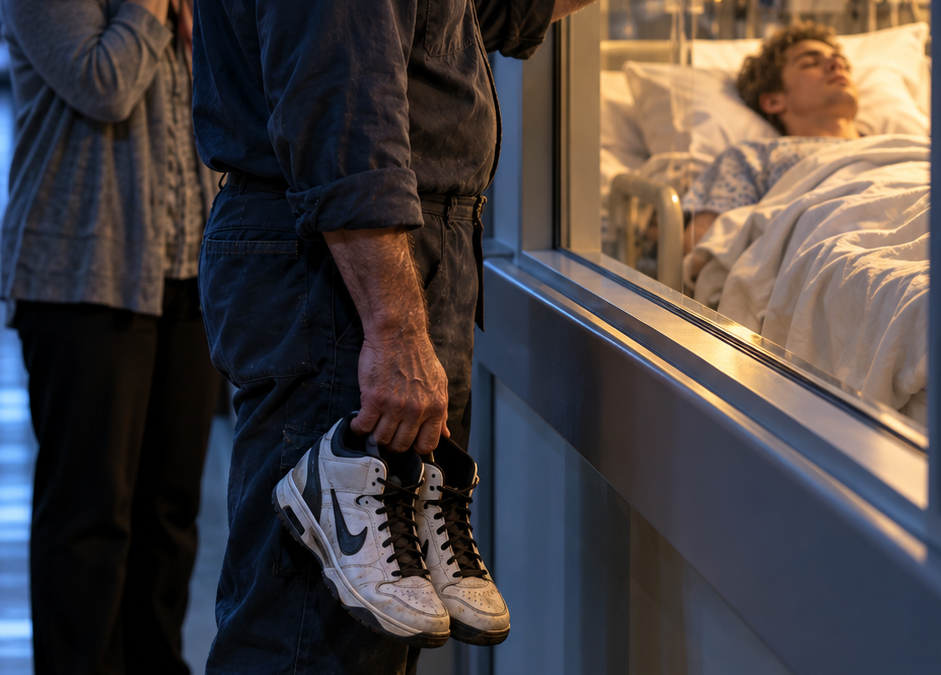
I pulled back and looked through the glass.
My son was lying on a narrow hospital bed.
Tyler.
The kid who used to fall asleep on the living room carpet while watching basketball. The boy who had grown six inches in a single summer and suddenly started borrowing my clothes. The seventeen-year-old who could make his mother laugh even when she’d had the worst day of her life.
He was captain of his high school basketball team.
His coach believed he might earn a college scholarship.
He had spent the previous weekend teaching a younger neighbor how to shoot free throws because, in Tyler’s words, nobody deserved to be embarrassed during recess.
Now his face was white with pain.
Both legs were wrapped in thick bandages.
There was blood on the sheets.
Machines surrounded him, and a nurse was adjusting medication while another checked the monitors.
I put my hand against the glass.
Then a doctor stepped out.
“Dennis?”
I turned.
“Harold?”
Dr. Harold Donnelly stopped in front of me.
For a moment, neither of us spoke.
We had served together overseas decades earlier. Back then, Harold had been the medical officer everyone wanted nearby when things went wrong.
He was older now, with silver hair and deep lines around his eyes.
But I recognized the same expression.
The one he wore when the news was bad and he was trying to decide how to tell someone.
“How bad?” I asked.
He looked toward Sarah.
Then back at me.
“Both knees sustained devastating injuries. There are multiple fractures and significant soft-tissue damage.”
“Can you fix them?”
“We’re going to do everything we can.”
I stared at him.
“Harold.”
He exhaled.
“He’s going to need more than one surgery. Recovery could take months. Possibly years.”
Sarah covered her mouth.
I reached for the wall.
“And walking?”
He hesitated.
That hesitation nearly destroyed me.
“It’s too early to know what his functional recovery will look like.”
I looked through the glass again.
My boy’s eyes were closed.
He was seventeen years old.
He had his entire life ahead of him.
And somebody had put two bullets through his knees.
“Who did this?”
Harold glanced down the hallway.
Then he leaned closer.
“Sheriff Rick Barnes.”
The name landed like a hammer.
Everyone in Livingston County knew Rick Barnes.
He had been sheriff long enough to develop the sort of political influence that made ordinary people lower their voices when they discussed him.
He attended charity dinners, posed for photographs with local officials, and spoke constantly about law, order, and protecting the community.
But I’d spent seventeen years cleaning the courthouse.
I had seen enough to understand that the public version of a powerful man wasn’t always the complete version.
Barnes had a reputation for losing his temper.
Complaints circulated, although I didn’t know which were substantiated.
He had friends in county government and a talent for making problems disappear from public conversation.
And now my son was lying in Trauma Bay Three because the sheriff had shot him.
I wanted to ask a thousand questions.
Instead, I walked into Tyler’s room.
His eyes opened when I approached.
“Dad?”
I had never heard him sound so young.
I took his hand.
“I’m here, buddy.”
His face crumpled.
“He shot me.”
“I know.”
Tyler began crying.
“Both times, Dad.”
I felt my stomach turn.
“He laughed.”
I stopped moving.
Tyler struggled to breathe.
“He told me I shouldn’t have looked at him wrong.”
Sarah made a broken sound behind me.
My son stared at his bandaged legs.
“Dad, I can’t feel them right.”
I brushed his hair away from his forehead.
“They’re taking care of you.”
He shook his head.
“What if I never walk again?”
I couldn’t answer immediately.
I had spent years making decisions when hesitation could cost lives.
But nothing in my old training had prepared me for the terror in my son’s eyes.
I bent forward and kissed his forehead.
“We’re going to take this one day at a time.”
He gripped my hand.
“Promise you won’t leave?”
My throat tightened.
“I’m not going anywhere.”
He closed his eyes.
I stayed beside him until the medical team came to prepare him for surgery.
Then I watched them wheel my boy away.
Sarah followed as far as the doors.
When they closed, she turned toward me.
“What are we going to do?”
I didn’t answer.
Not because I didn’t have an answer.
Because the first answer that came into my head was one I never wanted my wife to hear.
Hours later, I was sitting alone in the hospital parking lot.
The dashboard clock read 12:46 a.m.
I stared at the illuminated windows above me.
Somewhere inside that building, surgeons were trying to save my son’s ability to walk.
Somewhere else in the county, Sheriff Barnes was probably sleeping in his own bed.
I thought about finding him.
For a few terrible seconds, the idea felt almost comforting.
Then I imagined Sarah receiving another phone call.
I imagined Tyler waking up to discover that his father had disappeared from his life too.
And I understood that whatever I did next couldn’t be determined by the worst feeling I’d ever experienced.
I opened my contacts.
I scrolled past names I hadn’t touched in years until I found one number.
Raymond Cole.
For thirteen years, Ray had been the man I trusted when a plan collapsed, a situation turned dangerous, or somebody needed to make an impossible decision.
He had also been the best man at my wedding.
We hadn’t spoken in almost five years.
I pressed call.
He answered after one ring.
“Reaper?”
Hearing that name felt like opening a locked door in a house I’d spent seventeen years trying to forget.
“Ray.”
A long silence.
“Dennis?”
“I need you.”
His voice changed.
“What happened?”
I looked toward the hospital.
“My son was shot.”
Another silence.
“Is he alive?”
“Yes.”
“How bad?”
“Bad.”
Ray exhaled.
“Who did it?”
“The county sheriff.”
I heard movement on the other end.
“Where are you?”
“Mercy General.”
“What do you need?”
I closed my eyes.
“Get the team together.”
For three seconds, Ray said nothing.
Then he asked a question that might have saved my life.
“What kind of help are you asking for, Dennis?”
I looked down at my hands.
They were still rough from the courthouse cleaning chemicals.
But I remembered what those hands had once been trained to do.
“The kind that keeps me from doing something stupid.”
Ray exhaled.
“All right.”
I gripped the phone.
“I want everything legally available on Rick Barnes. Complaints, lawsuits, internal investigations, campaign money, business connections. Anything that might explain what happened.”
“Understood.”
“And nobody approaches him.”
“I said understood.”
“Ray—”
“Dennis.”
His voice softened.
“You called the right man.”
I lowered my head.
For the first time since Sarah’s phone call, I felt something other than terror.
Not relief.
Not yet.
But the faint possibility that I could find a way through this without becoming the man I had left behind.
When I returned to the surgical waiting room, Sarah was sitting alone with a paper cup between her hands.
She looked up immediately.
“Who were you talking to?”
I sat beside her.
“Ray.”
Her expression changed.
“Ray Cole?”
“Yes.”
“Why?”
I looked toward the closed operating room doors.
“I asked him to investigate Barnes.”
Her hands tightened around the cup.
“Investigate how?”
“Public records. Complaints. Lawsuits. Whatever he can obtain legally.”
“Dennis.”
I looked at her.
“That’s all.”
She studied my face.
“Is it?”
I wanted to tell her she should trust me.
But after everything we’d been through, I understood that trust wasn’t something I could demand simply because I needed it.
“I don’t know what I felt when Tyler told me Barnes laughed,” I admitted. “For a few minutes, I wanted to make that man suffer.”
Sarah’s eyes filled.
“I can’t lose both of you tonight.”
“You won’t.”
“You can’t promise that.”
She was right.
I couldn’t guarantee how the investigation would unfold or what consequences Barnes might face.
But I could decide what kind of man I intended to be.
I took her hand.
“I promise that whatever I do next will be something Tyler can live with.”
Sarah leaned against me.
“That’s all I need.”
We remained together until 3:17 a.m., when Harold emerged from surgery.
He had removed his surgical cap. His gray hair was damp, and exhaustion showed around his eyes.
Sarah and I stood immediately.
“How is he?”
Harold pulled up a chair.
“The initial surgery went as well as we could reasonably hope.”
Sarah covered her mouth.
Harold explained that Tyler had suffered severe fractures around both knees, extensive tissue damage, and swelling that complicated the repairs.
The surgical team had stabilized his injuries.
More procedures might be necessary.
Recovery would be long and difficult.
But walking again remained possible.
I held onto that word.
Possible.
Sarah began crying into my shoulder.
Harold gave us a moment.
Then, when she stepped away to telephone our families, he touched my arm.
“There’s something else.”
I looked at him.
“What?”
“I spoke with one of the paramedics who brought Tyler in.”
“And?”
“The original dispatch information doesn’t match what Barnes reportedly told hospital security.”
My exhaustion vanished.
“What do you mean?”
Harold lowered his voice.
“Barnes said Tyler charged toward him.”
I stared at him.
“The paramedic remembers Tyler sitting against a retaining wall near the old feed store when the ambulance arrived. His backpack was about fifteen feet away.”
“Was anyone else there?”
“An unidentified adult was speaking with a deputy.”
“Did the paramedic get a name?”
“No.”
“Where did the person go?”
“He doesn’t know. By the time the ambulance left, the person was gone.”
I stared down the hallway.
Two accounts of the same incident.
A missing witness.
A backpack whose location might matter.
For the first time, my old instincts stirred in a way that didn’t frighten me.
Not violence.
Analysis.
Something about the reported shooting didn’t fit.
“Can I speak to the paramedic?”
Harold shook his head.
“Not tonight.”
“Harold—”
“Dennis, you’ve been awake for nearly twenty-four hours. Your son needs you to be his father, not another investigator.”
I looked away.
He placed a hand on my shoulder.
“You don’t need to become your old self to help him.”
I nodded.
But as I watched Sarah return down the hallway, I realized the real question wasn’t whether I could investigate Barnes.
It was whether I could do it without allowing the investigation to consume everything my family had left.
By morning, half the town appeared to have heard about the shooting.
Livingston County was small enough that tragedies spread faster than official explanations.
Sarah’s phone filled with messages.
Tyler’s basketball coach.
His principal.
Parents from school.
Neighbors.
My courthouse supervisor, Marlene Ortiz.
People who hadn’t spoken to us in years suddenly wanted to know what had happened.
Unfortunately, some of them seemed to believe they already knew.
One message claimed Tyler had attacked a deputy.
Another said he’d been trespassing.
Someone suggested drugs had been involved.
There was even a rumor that Tyler had been part of a group vandalizing county property.
I stared at the messages in disbelief.
My son had spent the previous evening fighting for his life.
And people were already inventing reasons why he might have deserved to be shot.
At 8:12 a.m., the sheriff’s office released its official statement.
Sarah read it aloud.
“During an encounter involving suspected trespassing, a seventeen-year-old male behaved aggressively toward Sheriff Barnes, causing the sheriff to discharge his service weapon in defense of himself and others.”
She stopped.
“Others?”
I took the phone.
The statement didn’t identify any other person who had been threatened.
It didn’t explain why Barnes had personally responded to a suspected trespassing complaint.
It didn’t mention any weapon belonging to Tyler.
It didn’t provide body-camera footage or describe what had happened immediately before the shooting.
It simply announced the sheriff’s version of events.
And because it came from the sheriff’s office, some people accepted it immediately.
I had spent seventeen years cleaning courtrooms.
I knew what language could do.
Carefully selected words could shape the public’s understanding of an event long before anyone examined the evidence.
I also knew an official statement wasn’t a judicial finding.
If Barnes believed he had acted lawfully, an independent investigation could examine that claim.
But I would not allow his statement to become the only account of what happened to my boy.
At nine o’clock, Tyler woke fully.
Sarah and I were beside him.
His first question wasn’t about whether he’d walk again.
It was about his phone.
“Mom?”
“What is it, sweetheart?”
“Where’s my phone?”
Sarah looked at me.
“I don’t know.”
“It was in my backpack.”
“Your backpack wasn’t brought to the hospital.”
Tyler’s expression changed.
“I need it.”
I leaned forward.
“Why?”
His eyes moved toward the closed door.
Then he whispered, “Because I recorded something.”
Sarah stopped breathing.
I moved my chair closer.
“What did you record?”
Tyler swallowed.
“Barnes.”
“Before the shooting?”
He nodded.
For several seconds, neither of us spoke.
Then Sarah asked the question we’d been avoiding.
“Tyler, why were you there?”
He closed his eyes.
For the first time since I’d arrived at the hospital, I saw something on his face that wasn’t physical pain.
Guilt.
“I didn’t tell you because I knew you’d say no.”
“Tell us what?” Sarah asked.
“I was helping Mr. Harlan.”
Walter Harlan.
I knew the name immediately.
He’d taught civics at Livingston High School for thirty-one years before retiring.
Tyler had taken his government class the previous year and developed an unexpected interest in local politics.
Walter was the kind of teacher who believed students should understand how their own communities operated.
Apparently, Tyler had taken that lesson seriously.
“Helping him do what?” I asked.
“He’s been collecting information about county land sales.”
I stared at him.
“Why were you involved?”
“Because of the youth center.”
The old youth center stood near the abandoned feed store.
For months, people had been arguing about plans to sell the surrounding land to a private development company.
Some residents supported the sale because they believed it might bring jobs.
Others wanted the county to renovate the youth center rather than transfer the property to private ownership.
I knew the issue had become contentious.
What I hadn’t known was that my son had become involved.
Tyler shifted in bed and winced.
I immediately reached for him.
“Don’t move.”
He took a breath.
“Mr. Harlan thinks something’s wrong with the sale. Some of the appraisals were changed, and one of the companies bidding on the property is connected to Barnes’s brother-in-law.”
I stared at him.
“How do you know that?”
“Mr. Harlan found it in the public records.”
Sarah looked bewildered.
“What does that have to do with the shooting?”
Tyler’s face tightened.
“He asked me to photograph the public notices near the youth center. One had been replaced, and the hearing date was different.”
He’d ridden his bicycle there after basketball practice.
While taking photographs, he saw Barnes speaking with County Commissioner Lowell Pike beside the old feed store.
“They were arguing,” Tyler whispered.
“About what?”
“I couldn’t hear everything.”
“What could you hear?”
“Pike said something about not signing another one. Barnes told him he’d already gone too far to get nervous.”
I felt my pulse quicken.
“So you started recording?”
“Just audio. I didn’t think they’d notice me.”
“But Barnes did.”
Tyler nodded.
“He walked over and asked what I was doing.”
“What did you tell him?”
“That I was taking pictures for a school project.”
“What happened then?”
“He told me to give him my phone.”
“Did you?”
“No.”
“Why?”
Tyler looked at me.
“Because he didn’t have a reason.”
There was my stubbornness.
I had never been less happy about passing something to my son.
“I told him I wanted to call you,” Tyler continued. “Then another deputy showed up.”
He began trembling.
“Barnes said I was trespassing. I told him there weren’t any signs saying the property was closed.”
Sarah reached for his hand.
“Then what happened?”
Tyler looked down at his bandaged legs.
“Dad, I don’t want to talk about the rest.”
Every instinct I possessed demanded more information.
I wanted every second accounted for.
Every witness identified.
Every action explained.
But Tyler wasn’t an intelligence source or a witness I was entitled to interrogate.
He was my child.
He was frightened, exhausted, and recovering from major surgery.
“Then you don’t have to,” I said.
His eyes lifted.
“Not until you’re ready.”
Tears began rolling down his cheeks.
“I’m sorry.”
I frowned.
“For what?”
“If I’d just given him the phone—”
“No.”
The word came out sharply.
I softened my voice.
“Tyler, whatever mistakes you may have made, you’re not responsible for someone else’s decision to shoot you.”
He stared at me.
“I thought I was going to die.”
I felt something break inside my chest.
Sarah bent forward and kissed his forehead.
“You’re here now, baby.”
Tyler closed his eyes.
“I kept thinking about you guys.”
I held his hand until he fell asleep.
Then I stepped into the hallway and called Ray.
“There’s a missing phone,” I told him.
He listened while I explained.
When I finished, he said, “Don’t go looking for it.”
“I wasn’t going to.”
“You absolutely were.”
I remained silent.
Ray sighed.
“I’ve already contacted Elena Alvarez.”
I remembered her immediately.
Major Elena Alvarez had been one of the sharpest intelligence officers I’d ever worked with.
She now taught criminal justice at a university outside Denver.
“She knows someone in the state attorney general’s office,” Ray continued. “Not to pull strings. To make sure everything goes through the proper channels.”
“That could take time.”
“Then use the time.”
“For what?”
“Be Tyler’s father.”
I looked through the glass.
Sarah had fallen asleep beside Tyler’s bed, one hand resting near his.
My family needed me more than any investigation did.
“You’re an irritating old man,” I told Ray.
“I’ve improved considerably with age.”
Despite everything, I almost smiled.
By afternoon, Walter Harlan arrived at the hospital.
He was carrying a canvas satchel and wearing the same brown sport coat he’d probably worn throughout half his teaching career.
Sarah saw him first.
Her expression changed immediately.
“You involved my son in this?”
Walter stopped several feet away.
“Sarah, I’m so sorry.”
“My boy was shot!”
“I know.”
“Because you sent him there!”
He lowered his head.
“I asked him to photograph public notices. I never imagined anything like this would happen.”
Sarah turned away.
I understood her anger.
Part of me felt it too.
But Walter hadn’t fired the weapon.
And blaming him wouldn’t answer the questions surrounding Tyler’s injuries.
“What exactly were you investigating?” I asked.
Walter opened his satchel.
Inside were folders containing county meeting minutes, property filings, appraisal reports, tax records, and public notices.
Ordinary public documents.
The kind most people never bothered to examine.
We moved to an empty waiting-room table.
Walter spread out several pages.
“The county wants to sell thirty-eight acres surrounding the old youth center and feed store.”
He pointed toward a report.
“The initial appraisal valued the property at just over four million dollars.”
I examined the next page.
“The second says two-point-three million.”
“Exactly.”
Sarah folded her arms.
“Appraisals can change.”
“They can,” Walter agreed. “But substantial changes ordinarily need an explanation. I haven’t been able to locate one.”
He showed us a list of companies involved in the proposed transaction.
One was Front Range Civic Development.
Its registered agent was a Denver attorney.
Through additional corporate filings, Walter had identified a related company owned by Stephen Barnes.
Rick Barnes’s brother-in-law.
“That establishes a connection,” I said. “It doesn’t prove corruption.”
Walter nodded.
“I agree.”
His answer surprised me.
“I’ve been asking the county to explain the valuation and disclose the documents supporting the transaction. That’s all.”
“Did they respond?”
“Not directly.”
He handed me another page.
It was a copy of an email from Commissioner Lowell Pike.
The same commissioner Tyler had overheard arguing with Barnes.
The message was brief.
Walter, you are asking the right questions, but not in the right place. Some of the dates in the public file do not match the dates in the clerk’s original index.
It was signed L.P.
I read it twice.
“When did he send this?”
“Three weeks ago.”
“Have you spoken with him since?”
“He stopped answering my calls.”
Sarah sat down.
“What does any of this have to do with Tyler’s phone?”
Walter looked at me.
“I believe Tyler may have recorded a conversation that one or both men didn’t want made public.”
“Possibly,” I said.
Then I noticed Walter hesitate.
“You have something else.”
He reached into his satchel.
“This arrived at my house this morning.”
He handed me an envelope.
Inside was a handwritten note containing one sentence.
CHECK THE COURTHOUSE BASEMENT INDEX BEFORE IT DISAPPEARS.
I read it again.
Then I looked at Walter.
“Who sent this?”
“No return address.”
Sarah’s eyes moved toward me.
Because I worked at the courthouse.
Because I had keys.
Because I knew its basement better than almost anyone.
I knew exactly what she was thinking.
“No,” she said immediately.
“I haven’t said anything.”
“You were thinking it.”
Walter looked uncomfortable.
“She’s right, Dennis. You can’t use your employment to access restricted records.”
I folded the note.
“Then why show it to me?”
“Because you might know who has the legal authority to examine them.”
That answer mattered.
I did know.
The county clerk and authorized staff.
Investigators acting under appropriate legal authority.
Not janitors.
Not retired soldiers.
And certainly not frightened fathers who had begun believing every locked door concealed something important.
I handed the note back.
“I won’t touch the records.”
Sarah searched my face.
“You promise?”
“Yes.”
Walter gave me a tired smile.
“Tyler once told me you were the most stubborn honest man he’d ever met.”
I looked at him.
“He said that?”
“He was complaining about you at the time.”
For the first time since arriving at the hospital, Sarah laughed.
Only briefly.
But hearing it reminded me of the life we were fighting to preserve.
That evening, Ray arrived.
He was sixty now, broad through the shoulders, his hair almost completely silver.
For a moment, we simply stared at each other.
Then he hugged me.
Hard.
“You look terrible,” he said.
“You look ancient.”
“I am ancient.”
We sat in the hospital cafeteria drinking coffee that tasted like warm cardboard.
Ray had spent the day gathering legally available records concerning Barnes.
He found six civil complaints naming the sheriff over fourteen years.
None involved shootings.
Several had been dismissed or settled without an admission of wrongdoing.
Three described disputes about evidence handling.
Two mentioned missing or malfunctioning body-camera recordings.
Another involved a rancher who claimed Barnes had pressured him during a zoning disagreement.
“None of this proves what happened to Tyler,” Ray said.
“I know.”
“But it gives his attorney a reason to examine how evidence has been handled.”
He handed me another document.
Barnes’s campaign finance report.
Front Range Civic Development appeared among the contributors.
So did several businesses with the same Denver mailing address.
I studied the figures.
“How much?”
“Enough to justify asking questions. Not enough to prove anything improper by itself.”
Ray leaned forward.
“Dennis, this is where people get themselves into trouble. They see a pattern and decide the pattern must be proof.”
“I know.”
“Then don’t forget it.”
A few minutes later, Sarah joined us.
Ray embraced her.
“How’s our boy?”
“Sleeping.”
“And you?”
She gave him a tired look.
“That question seems unfair.”
He nodded.
“Fair enough.”
Then he told us Elena had spoken with a state investigator named Margaret Chen.
Because potentially missing digital evidence involved a minor and a county official, Chen had advised that Tyler’s attorney promptly issue preservation notices through the proper channels.
Sarah looked confused.
“His attorney?”
Ray glanced toward the cafeteria entrance.
A woman in her late forties approached carrying a leather folder.
She introduced herself as Julia Mercer.
She had previously worked as a federal prosecutor and now practiced civil-rights law in Denver.
“You’re under no obligation to retain me,” she said. “But your son should have legal representation before giving any formal statement about the shooting.”
I looked at her.
“Will you tell us when we’re wrong?”
She smiled slightly.
“Frequently.”
“Good.”
We retained her.
It was one of the most important decisions I made that week.
Julia didn’t treat Tyler like a case file.
She treated him like a seventeen-year-old who had just experienced something terrifying.
When she entered his room, she pulled a chair close to the bed.
“Tyler, your parents have explained some of what happened. I’m not asking you to repeat it tonight.”
Relief crossed his face.
“I have just one question. Is that okay?”
He nodded.
“Did you upload or send the recording anywhere before your phone went missing?”
Tyler frowned.
“I don’t think so.”
“Think carefully.”
“I was using a voice memo app.”
“Does it back up automatically?”
“I don’t know.”
“What kind of phone?”
He told her.
She nodded.
“We can find out.”
Then Tyler suddenly opened his eyes wider.
“Wait.”
Everyone turned.
“What is it?” I asked.
“The basketball team.”
“What about it?”
“We use an app for game clips and schedules. I sent Mason a picture of the notice because it had the wrong date.”
“Your friend Mason?”
“Yeah.”
“Did you send him anything else?”
Tyler stared at the ceiling.
“I don’t remember.”
His eyes closed.
He was exhausted.
Julia immediately stood.
“That’s enough for tonight.”
I wanted to ask another dozen questions.
She noticed.
“Tomorrow, Mr. Irwin.”
Her voice wasn’t harsh.
But it was firm.
And I realized Ray had chosen exactly the kind of attorney my family needed.
The following morning, Mason Reed arrived with his mother.
Mason was a lanky teenager who normally couldn’t remain quiet for more than thirty seconds.
That day, he barely spoke.
He stood beside Tyler’s bed, looking down at the floor.
“Hey,” Tyler whispered.
“Hey.”
“You miss practice?”
Mason shrugged.
“Coach canceled.”
“Because of me?”
“Because nobody felt like playing.”
Tyler swallowed.
Mason looked at his bandaged legs.
“We’ll play again when you’re ready.”
Nobody corrected him.
Not Harold.
Not Sarah.
Not me.
Sometimes hope needs a little room before facts catch up.
Then Mason took out his phone.
“You sent me something.”
Tyler frowned.
“What?”
“Tuesday night.”
Mason opened their messages.
There was a photograph of the public notice.
Underneath, Tyler had written that the county hearing date had changed from August 18 to August 25.
Then Mason scrolled further.
“And yesterday, you sent this.”
An audio file.
Forty-eight seconds long.
Tyler stared at it.
“I did?”
“Yeah. I didn’t listen until this morning.”
Every adult in the room became still.
Julia stepped forward.
“Mason, don’t play it yet.”
He froze.
“Why?”
“Because if that recording matters, we need to preserve the original file and its metadata properly.”
Mason’s mother nodded.
“Tell us what to do.”
For the first time since the shooting, I understood how powerful patience could be.
By noon, Julia had arranged for an independent digital-forensics examiner to make a documented copy.
Then, with Tyler’s permission, we listened.
The recording began with wind.
A truck passing.
Tyler breathing.
Then two men speaking.
Commissioner Pike spoke first.
“…didn’t agree to changing the index.”
Barnes answered.
“You agreed when you signed the transfer packet.”
“I signed what you put in front of me.”
“You signed because you wanted the project.”
“I wanted the youth center rebuilt.”
There was a pause.
Then Pike spoke again.
“This isn’t rebuilding anything.”
Barnes’s reply was quieter.
“You’ve known that for six months.”
Another gust of wind.
Tyler must have shifted position.
Then Pike said something that made everyone in the room stop moving.
“The original valuation is still downstairs.”
Barnes replied.
“Not after Friday.”
The recording ended.
Forty-eight seconds.
No complete explanation.
No explicit admission of a crime.
But enough to establish that the conversation Tyler described had occurred and that the original valuation was apparently a concern.
Julia replayed it once.
Then she closed the laptop.
“Nobody posts this anywhere.”
Tyler looked offended.
“I wasn’t going to.”
“I know. I’m saying it for everyone.”
She looked directly at me.
I raised both hands.
“I don’t even use social media.”
Ray coughed.
“He thinks Facebook is something you buy at a bookstore.”
For the first time since the shooting, Tyler laughed.
It hurt him enough to make him wince.
But he laughed.
And hearing that sound did something to me that no amount of investigative progress could have accomplished.
It reminded me that my son was still here.
He was still Tyler.
And I couldn’t let Barnes take away every ordinary moment we had left together.
Over the next two days, Tyler underwent another procedure.
Harold remained cautious about his recovery, but he told us there were encouraging signs.
Walking again was possible.
The extent of his eventual mobility remained uncertain.
Basketball was an entirely different question.
Tyler listened without interrupting.
Later, after Sarah went home to shower, I sat beside his bed.
“You scared?” I asked.
He nodded.
“Yeah.”
“Me too.”
He looked at me.
“You?”
“Constantly.”
“I thought Army guys weren’t scared.”
“Then Army guys have excellent public relations.”
He smiled.
For a few minutes, neither of us spoke.
Then he asked, “Were you really called Reaper?”
I stared at him.
“Who told you?”
“Uncle Ray.”
“I’m going to throw Uncle Ray out a window.”
Tyler’s smile widened.
“So you were?”
“Yes.”
“That’s kind of dramatic.”
“I didn’t choose it.”
“Still dramatic.”
I leaned back.
“Most nicknames sound stupid after thirty years.”
He looked down at his hands.
“What did you do before you met Mom?”
“I led people.”
“In combat?”
“Yes.”
He hesitated.
“Did you ever have to hurt somebody?”
I looked at my son.
“Yes.”
He was quiet for a moment.
“Do you miss it?”
“No.”
“Not any of it?”
“The people.”
I thought about Ray.
Elena.
Harold.
The men and women whose voices I could still remember in places I’d spent years trying to forget.
“I miss knowing exactly what my job was,” I admitted.
“What do you mean?”
“When you’re a father, sometimes you don’t know what the right answer is.”
Tyler studied me.
“You think this is harder?”
“By far.”
He considered that.
Then he said, “I’m glad you didn’t go after Barnes.”
My chest tightened.
“How did you know I wanted to?”
“Dad.”
He gave me the exhausted look only a teenager could give a parent.
“You broke a hospital vending machine.”
“I did not break it.”
“The chips came out without paying.”
“It was malfunctioning.”
“You hit it.”
“Technical maintenance.”
He laughed again.
Then his expression changed.
“I don’t want this to turn you into somebody else.”
I took his hand.
“It won’t.”
That evening, the state announced an independent review of the shooting.
Barnes was placed on administrative leave.
The county emphasized that the decision was procedural and didn’t constitute a finding of misconduct.
Julia approved of that distinction.
“Due process matters even when we’re angry,” she told Tyler.
He nodded.
I needed the reminder more than he did.
The following morning, a road-maintenance worker found Tyler’s backpack in tall grass behind the feed store.
Almost a hundred yards from where the shooting had occurred.
His phone was inside.
The screen was cracked, and the battery was dead.
But it was there.
That raised an immediate question.
Why was the backpack so far from the retaining wall?
Tyler didn’t remember throwing it.
The paramedic recalled seeing it much closer.
Then investigators recovered photographs that one deputy had taken on a county-issued tablet before the area was cleared.
In the earlier images, Tyler’s backpack was visible near the retaining wall.
In later photographs, it was gone.
Someone had moved it.
Whoever had done so might have been able to explain why the phone had disappeared from the initial scene.
Julia made sure the photographs and their metadata were preserved.
Meanwhile, state investigators began examining the county’s land-sale records.
By Friday, the courthouse felt like a different building.
I returned only to speak with my supervisor and arrange family leave.
For seventeen years, people had walked past me without looking up.
Now everyone seemed to notice me.
Some offered genuine sympathy.
Others watched with curiosity.
A few appeared uncomfortable, perhaps remembering rumors they’d repeated before anyone knew the facts.
My supervisor, Marlene Ortiz, hugged me the moment I entered her office.
“Take whatever time you need, Dennis.”
“Thank you.”
I was turning to leave when she called my name.
“Someone was asking about you yesterday.”
I stopped.
“Who?”
“A woman from the state.”
“What did she want?”
“Basement access logs.”
My heartbeat shifted.
“And?”
“I gave her the electronic records.”
“Good.”
Marlene hesitated.
Then she closed the office door.
“There’s something you should know.”
I waited.
“Three weeks ago, county administration changed the lock on the old records room.”
“Why?”
“They said water damage.”
I remembered Walter’s anonymous note.
CHECK THE COURTHOUSE BASEMENT INDEX BEFORE IT DISAPPEARS.
“What records room?”
“The appraisal archive.”
I stared at her.
Marlene looked frightened.
It was the first time I’d ever seen her that way.
That evening, Margaret Chen called Julia.
We gathered in a private consultation room at the hospital, and Julia placed the phone on speaker.
Chen spoke carefully.
Her team had reviewed the courthouse’s electronic access records.
The appraisal archive had been entered four times after normal business hours during the previous month.
One entry belonged to maintenance.
Another belonged to the county clerk.
The remaining two had been made using a temporary administrative credential.
“Whose credential?” Julia asked.
“That’s still being determined.”
Chen paused.
“But we recovered security footage corresponding to one of the entries.”
I leaned forward.
“Who was it?”
“Commissioner Lowell Pike.”
Walter, who had joined us, closed his eyes.
Chen continued.
“Pike remained inside approximately eleven minutes.”
“What did he take?” Sarah asked.
“We haven’t established that yet.”
Something in Chen’s voice made me pay closer attention.
“There’s more,” I said.
“Yes.”
“Pike wasn’t alone when he left.”
I immediately thought of Barnes.
“Who was with him?”
Chen hesitated.
Then she said a name none of us expected.
“Marlene Ortiz.”
My supervisor.
The woman who had hugged me that afternoon.
The woman who had worked at the courthouse for twenty-three years.
I stared at the phone.
Sarah looked at me.
Ray stopped moving.
Walter whispered, “Why would Marlene be involved?”
I had no answer.
Then my phone vibrated.
A message from Marlene.
Dennis, I need to tell you something about the basement records.
Another message arrived.
Please don’t assume what you’re going to hear means what it looks like.
Then a third.
I was trying to protect Tyler.
I stared at Marlene’s final message.
For seventeen years, we’d worked in the same building.
She knew how I liked my coffee, which cleaning supplies gave me headaches, and how often I checked my phone on Friday nights when Tyler had away games.
She’d attended his school fundraisers.
She’d sent Sarah flowers after her mother’s death.
I trusted her.
But trust didn’t explain why she’d been inside the appraisal archive with a county commissioner whose name had appeared in my son’s recording.
I showed the messages to Julia.
She read them carefully.
“Don’t reply yet.”
“She’s asking to talk.”
“And she may have relevant evidence in an active investigation. Let me contact Chen.”
I nodded.
It was becoming painfully clear that the most important contribution I could make to this case was sometimes to stop myself from interfering.
Julia called Chen back.
After a brief conversation, she asked whether Marlene would agree to meet investigators voluntarily with independent counsel present.
I sent Marlene a short message suggesting she speak directly with the investigators through her attorney.
Her reply came almost immediately.
I’ve been waiting for someone I could trust.
The next afternoon, Julia received permission to share a limited account of what Marlene had told investigators.
The explanation was considerably different from what I’d feared.
Three weeks earlier, Marlene had been working late when she noticed Commissioner Pike entering the courthouse through a side entrance.
That wasn’t unusual by itself.
County officials regularly worked outside normal business hours.
But Pike had asked her to open the old appraisal archive using a temporary administrative credential.
He said he needed to examine records connected to a pending land transaction.
Marlene had initially refused because she wasn’t authorized to provide unsupervised access.
Then Pike told her he believed records might be altered or removed before an upcoming hearing.
He showed her copies of two appraisal reports containing different figures.
According to Marlene, he appeared frightened.
She should have contacted the county clerk.
Instead, believing she was helping preserve potentially important records, she accompanied him to the archive.
Inside, Pike identified an original valuation report and several documents whose dates differed from their publicly available counterparts.
Marlene didn’t take any documents from the room.
But she made a written record of what she’d seen and later reported her concerns to someone she trusted in county administration.
That was when she began receiving warnings to stop asking questions.
She’d also learned that Tyler had been photographing notices for Walter Harlan.
When news of the shooting reached her, she became convinced that the altered records and the incident involving my son might be connected.
“She sent Walter the anonymous note,” Julia told me.
I closed my eyes.
Of course.
“Why didn’t she come forward immediately?”
“She was afraid of losing her job. She was also worried that whoever had access to the archive would know she had helped Pike.”
“Was she involved in changing the records?”
“Investigators haven’t established that. Her account is being checked against access logs, security footage, and the original documents.”
I sat back.
The answer wasn’t as emotionally satisfying as the conclusions I’d been tempted to draw.
But it was exactly the kind of answer I needed.
Marlene had information.
Investigators had a way to test it.
And my personal loyalty to her didn’t entitle me to decide whether her account was true.
That evening, I returned to Tyler’s bedside.
He was watching basketball highlights on his tablet.
The sight nearly brought me to tears.
His team had played its first game without him.
Someone had placed his jersey on an empty chair at the end of the bench.
“Hey, Dad.”
“Hey, buddy.”
He paused the video.
“Any news?”
“Some.”
I pulled up a chair.
“People are cooperating with the investigation. They’re looking into the land records and what happened to your backpack.”
He nodded slowly.
“Did they find out why Barnes shot me?”
“Not completely.”
Tyler stared at his legs.
“I keep remembering things.”
My stomach tightened.
“What kind of things?”
“The way he looked at me.”
I waited.
“He saw the recording app on my phone. I think that’s when he got really angry.”
I reached for his hand.
“You don’t have to tell me anything you’re not ready to discuss.”
He nodded.
Then he whispered, “I was trying to back away.”
I felt my chest tighten.
“I told him I wanted to call you. He said I wasn’t calling anybody.”
Tyler’s breathing quickened.
“He grabbed my backpack. I pulled away, and he started yelling. Then the deputy told him to calm down.”
I remained still.
“The deputy told Barnes to calm down?”
Tyler nodded.
“Then I heard the first shot.”
His face crumpled.
I moved closer.
He squeezed his eyes shut.
“I fell, Dad. I couldn’t stand up, and he was still pointing the gun at me.”
Tears ran down his cheeks.
“I thought he was going to kill me.”
I pulled him gently against my chest.
He sobbed into my shirt.
I wanted to promise him that the fear would disappear.
That the nightmares would end.
That someday he would remember what had happened without feeling as though he were back against that retaining wall.
But I had lived with enough memories of my own to know recovery didn’t work on anyone’s preferred schedule.
So I held him.
And when he finally stopped crying, I told him something I wished someone had told me years earlier.
“You don’t have to prove how strong you are by pretending this didn’t hurt.”
He nodded against my shoulder.
That night, with Julia’s guidance, Tyler agreed to speak with the independent investigators when his doctors considered him medically ready.
He would have an attorney present.
He would be able to take breaks.
And he wouldn’t be expected to manage the case simply because he had witnessed the shooting.
For the first time, I could see a path forward that didn’t require my son to carry the entire burden himself.
Over the following weeks, the investigation began producing results.
The state recovered original land-valuation documents from the courthouse archive after obtaining the necessary legal authority.
The original appraisal and the later valuation contained substantial differences that couldn’t be explained by the records initially produced to the public.
Investigators also examined communications among county officials and individuals associated with Front Range Civic Development.
The recording from Tyler’s phone became one piece of a much larger evidentiary record.
It wasn’t a confession.
It wasn’t proof of every allegation Walter had raised.
But it corroborated a disputed conversation and helped investigators establish which documents required further examination.
Then the deputy who had responded to the shooting agreed to provide a formal statement.
His account contradicted important portions of Barnes’s original report.
According to the deputy, Tyler hadn’t charged toward the sheriff immediately before the shots were fired.
The deputy described Tyler moving backward during the confrontation.
Investigators also examined the physical evidence, the location of the recovered backpack, the available photographs, and the medical findings.
The deputy acknowledged moving Tyler’s backpack after the shooting, saying he’d acted on Barnes’s instructions to clear the immediate scene. He hadn’t properly documented the movement.
That explanation answered one question.
But it raised others concerning evidence handling.
The state continued reviewing whether the deputy’s actions had violated departmental procedures or criminal law.
For my family, the most important development came when Julia called to say the independent investigation had established sufficient grounds for prosecutors to pursue charges against Barnes arising from the shooting.
I was sitting in the hospital cafeteria when she told me.
For several seconds, I couldn’t speak.
“What happens now?”
“The legal process,” she said. “Charges, hearings, disclosure of evidence, and potentially a trial.”
I looked down at the coffee cooling between my hands.
After everything my family had endured, I had expected the news to feel like victory.
Instead, I felt exhausted.
Barnes would have the opportunity to defend himself.
The prosecution would have to prove its case.
There would be difficult hearings, disputed testimony, and months of uncertainty.
But the case would no longer depend entirely on the sheriff’s explanation of his own conduct.
And my son wouldn’t be facing him alone.
Separate proceedings concerning the county land transaction also moved forward.
Commissioner Pike cooperated with investigators, and prosecutors examined the discrepancies in the appraisal documents and related financial records.
The investigation revealed that the reduced valuation had been used to support the proposed sale, while records supporting the original appraisal had been improperly withheld from the public file.
The sale was suspended.
County officials were required to preserve the underlying records while the matter underwent further review.
I didn’t celebrate anyone’s arrest or pretend that every person connected to the transaction was equally responsible.
I had spent too many years watching people draw conclusions before understanding the evidence.
But I was relieved that the documents Walter had spent months examining were finally receiving the independent scrutiny they deserved.
Marlene eventually returned to work after investigators completed the portions of their inquiry involving her.
She had acknowledged mistakes in how she’d handled Pike’s request and had cooperated in reconstructing what happened.
When I saw her again, she stood in the courthouse hallway holding two paper cups of coffee.
“One sugar, no cream,” she said.
I accepted the cup.
“Still remember.”
“Seventeen years, Dennis. I’d hope so.”
We sat on the bench outside Courtroom Three.
For a while, neither of us spoke.
Then she said, “I’m sorry I didn’t come to you sooner.”
I looked at her.
“You were scared.”
“Yes.”
“I was too.”
She stared at me.
“You?”
I nodded.
“Terrified.”
She laughed softly.
“I think that’s the first time I’ve ever heard you admit it.”
I looked down at my hands.
“I spent a lot of years pretending fear was something you could train yourself out of.”
“And?”
“It isn’t.”
She wiped her eyes.
“How’s Tyler?”
“Still fighting.”
She smiled.
“Sounds like his father.”
I shook my head.
“No. He gets that from his mother.”
And for the first time in weeks, we both laughed.
Tyler spent months in rehabilitation.
Those were harder than anything I’d imagined.
Surgeries were frightening, but at least they had a defined beginning and end. Rehabilitation demanded that my son face his injuries again every morning without knowing precisely what progress the day would bring.
Some days he managed movements that had seemed impossible the previous week.
Other days, pain and exhaustion forced him to stop before he’d accomplished what he hoped.
He grew frustrated.
He missed basketball.
He hated needing help with things he’d once done without thinking.
There were mornings when he refused to look at his teammates’ messages because he couldn’t bear to hear about games he wasn’t playing.
One afternoon, I found him crying in the rehabilitation center after a particularly difficult session.
“I used to be able to run five miles,” he said bitterly. “Now everybody celebrates because I can stand up.”
I sat beside him.
“I know.”
“No, Dad. You don’t.”
He was right.
I understood pain.
I understood fear.
But I didn’t know what it felt like to be seventeen and suddenly uncertain whether the future I’d imagined was still possible.
“You’re right,” I admitted.
He wiped his face.
“I hate this.”
“I know.”
“I hate him.”
I looked at my son.
For a moment, I saw myself sitting in the hospital parking lot with Ray’s number on my phone.
“I understand that too.”
Tyler lowered his head.
“Does it ever stop?”
I thought carefully before answering.
“I don’t know when the anger will stop. But I know you deserve a life with more room for happiness than for the man who hurt you.”
He stared at me.
Then he leaned against my shoulder.
We sat together until he was ready to try again.
Sarah was the one who held our family together during those months.
She organized appointments, kept track of medication, encouraged Tyler when he wanted to quit, and reminded me to sleep whenever I began treating exhaustion like a professional obligation.
She also knew when to leave us alone.
Sometimes Tyler needed his mother.
Sometimes he needed his father.
And sometimes he needed nobody hovering over him while he struggled to accomplish something he was determined to do independently.
We learned to respect all three.
Nearly a year after the shooting, the criminal case against Barnes reached its conclusion.
The prosecution presented the medical evidence, the independent investigation’s findings, photographs from the scene, relevant witness testimony, and the accounts of what happened before and after the shots were fired.
The defense challenged the interpretation of the encounter and argued that Barnes had perceived a threat.
It was a difficult process.
Tyler’s testimony was especially painful.
I sat beside Sarah while our son described the moment he realized he couldn’t stand.
He cried once.
Then he asked for a short break.
When he returned, he finished answering the questions.
I had never been prouder of him.
Not because he’d managed to speak without fear.
Because he’d spoken despite it.
The jury ultimately convicted Barnes on charges arising from the unlawful shooting. His sentence was determined in subsequent proceedings.
The civil case concerning Tyler’s injuries followed its own course, addressing medical costs, future care, and the long-term consequences of what had happened.
Separate investigations into the land transaction resulted in criminal proceedings and administrative changes affecting the county’s handling of public records and property sales.
Walter Harlan attended nearly every public hearing.
He sat quietly with his battered canvas satchel beside him.
When the county eventually abandoned the disputed sale and reopened consideration of the youth center’s future, Walter called me.
“Tyler should know,” he said.
“Know what?”
“That people are finally listening.”
I looked across the living room.
My son was sitting on the couch, arguing with Sarah about whether he was allowed to order pizza for dinner.
For a moment, I simply watched them.
“I’ll tell him.”
By then, Tyler could walk short distances with assistance.
He still had pain.
He still faced additional rehabilitation, and his doctors were careful not to promise the return of every ability he’d once taken for granted.
Competitive basketball remained uncertain.
But one afternoon, almost fourteen months after the shooting, his coach invited him back to the school gym.
The team was practicing when we arrived.
The moment Tyler entered, every player stopped.
Mason was the first to approach.
“About time, man.”
Tyler laughed.
“Some of us have actual excuses for missing practice.”
His teammates gathered around him.
Nobody made a speech.
Nobody treated him like a tragedy.
They simply welcomed him back.
After practice, the coach handed Tyler a basketball.
“Want to take a shot?”
Tyler looked at me.
I smiled.
“Your call.”
He moved carefully toward the free-throw line.
Mason stood nearby in case he needed assistance.
For a few seconds, Tyler stared at the basket.
Then he raised the ball.
His first shot missed badly.
He grimaced.
Mason retrieved it.
“Man, you got worse.”
Tyler laughed.
“Shut up.”
His second shot struck the rim.
His third went through.
The gym erupted.
His teammates cheered.
His coach clapped.
Sarah covered her mouth, and I felt tears running down my face before I could stop them.
Tyler looked toward me.
“Dad!”
I raised both hands.
“That’s my boy!”
He rolled his eyes.
For one beautiful second, he looked exactly like the teenager who used to complain that I embarrassed him at games.
I knew his recovery wasn’t complete.
I knew there would still be painful days, difficult appointments, and questions nobody could answer yet.
But standing in that gym, watching my son smile with a basketball in his hands, I finally understood what I’d been fighting to protect.
It wasn’t revenge.
It wasn’t my reputation.
It wasn’t the opportunity to prove that the old man cleaning the courthouse had once commanded soldiers.
It was this.
My son’s future.
His laughter.
His ability to wake up every morning believing there was still something wonderful waiting for him.
I eventually returned to my night shift at the courthouse.
People treated me differently for a while.
Some wanted to hear stories about my military service.
Others asked about Ray and the investigation.
A few seemed almost disappointed that I hadn’t personally confronted Barnes or performed some dramatic act of retaliation.
I never had much to say to them.
Ray returned to his consulting business.
Elena resumed teaching.
Harold continued treating patients.
Julia helped our family navigate the remaining legal matters.
And I went back to cleaning floors.
One evening, my supervisor found me polishing the hallway outside Courtroom Three.
“You know,” Marlene said, “after everything that’s happened, you could probably find something more interesting to do.”
I leaned against my mop.
“More interesting than cleaning up after lawyers?”
She laughed.
“Fair point.”
I looked down the empty hallway.
Seventeen years earlier, I’d taken this job because I wanted to disappear into an ordinary life.
I had spent so long being responsible for extraordinary things that I thought peace meant never having to make another difficult decision.
But peace wasn’t something I could guarantee by hiding.
It was something I had to protect through the choices I made when life became difficult again.
I thought about the night Sarah called me.
The sound of my mop striking the marble floor.
The drive to the hospital.
The terrible sight of my son lying behind the glass.
And the moment I sat in my truck, staring at Ray’s number, trying to decide what kind of man I was going to become.
Barnes had seen an aging courthouse janitor and assumed I was powerless.
He hadn’t known about my military career.
He hadn’t known the people I once served beside.
And he hadn’t known how much experience I’d spent seventeen years trying to leave behind.
But in the end, none of those things determined what happened.
The evidence did.
The witnesses did.
The people who preserved records, examined the facts, and refused to let intimidation replace accountability did.
I had called my old team because I was afraid of what I might do alone.
They helped me remember that strength wasn’t the ability to hurt someone who had hurt my family.
Sometimes strength meant handing the evidence to someone else.
Sometimes it meant waiting for a judge.
Sometimes it meant holding your seventeen-year-old son’s hand while he cried because he couldn’t stand up.
And sometimes it meant returning to an empty gym, retrieving a basketball, and passing it back to your boy until he was ready to take another shot.
That night, I finished mopping the courthouse hallway and switched off the lights.
When I got home, Tyler’s sneakers were sitting beside the front door again.
Sarah had apparently told him three times to put them away.
I stared at them for a moment.
Then I smiled.
I left them exactly where they were.








