𝗙𝗨𝗟𝗟 𝗦𝗧𝗢𝗥𝗬 The Sheriff Decided I Was Dangerous Before I Could Finish Saying My Name
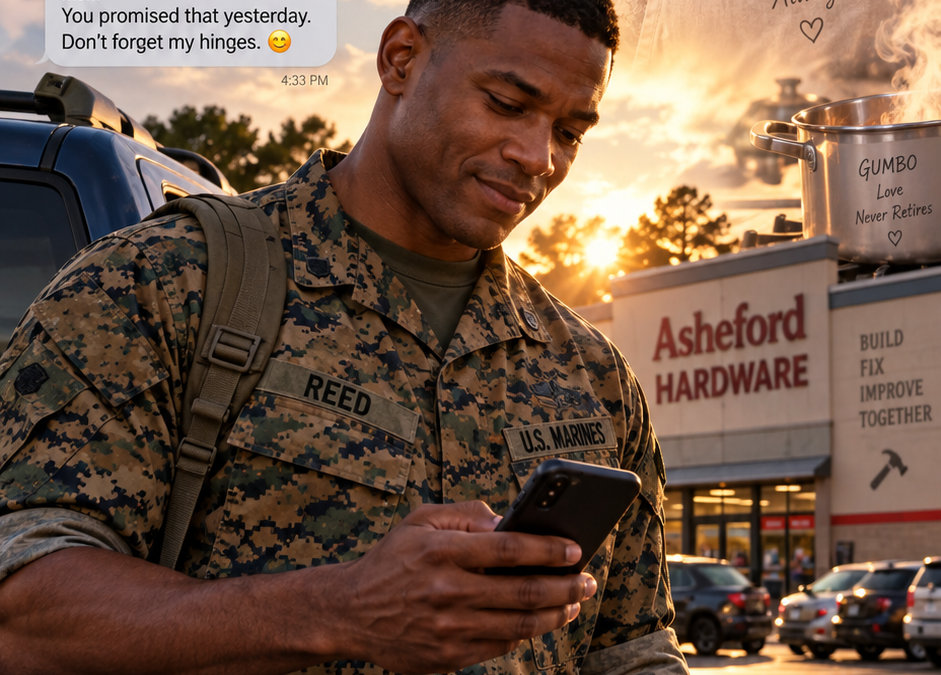
𝗙𝗨𝗟𝗟 𝗦𝗧𝗢𝗥𝗬
I turned toward him.
“Is there a problem, Sheriff?”
“Put the bag down!”
I lowered the hardware bag onto the pavement.
My mother’s cabinet hinges were visible through the thin plastic.
I raised both hands.
“They’re up.”
“Step away from the truck!”
I moved two steps away.
His right hand closed around his pistol.
Then he drew it.
For a moment, I couldn’t quite believe what I was seeing.
I had faced armed men before. I knew what a weapon looked like when someone intended to use it.
But I was standing in a shopping center parking lot, wearing my Marine Corps uniform, with nothing more dangerous than cabinet screws inside a plastic bag.
“Sheriff, what’s going on?”
“We’ve got a robbery call. Don’t make any sudden movements.”
I immediately understood the confusion.
“The man you’re looking for ran toward the south exit. White male, gray hoodie. Store security was chasing him.”
“On your knees!”
I kept my hands raised.
“I’m Staff Sergeant Marcus Reed, United States Marine Corps. I was at the high school this afternoon. I came here to buy hardware for my mother’s house.”
“I didn’t ask for your life story!”
His pistol remained pointed at my chest.
“Get down!”
I had no intention of arguing with an armed officer.
“I’m complying.”
I began lowering myself.
My left knee bent first.
Both hands remained open and raised near shoulder level.
Then I heard a vehicle reversing behind me.
A sharp electronic warning sounded.
I turned my head instinctively.
A white crossover was backing out of a parking space directly behind me. The driver appeared distracted by the flashing emergency lights and was moving faster than she realized.
I twisted my upper body just enough to see how close the vehicle was.
That was all I did.
I didn’t reach for my waistband.
I didn’t move toward the sheriff.
I didn’t put my hands down.
But when I turned, I saw Harland’s expression change.
“Don’t!”
The gunshot cracked across the parking lot.
I felt the impact before I fully understood the sound.
Something struck high in my left shoulder with enough force to spin me sideways.
I stumbled against a parked car.
Then my knees buckled.
I hit the pavement hard.
For one strange second, there was no pain.
Only enormous pressure beneath my collarbone and a spreading sensation of heat.
Then the burning began.
I pressed my right hand against my shoulder.
Blood immediately pushed between my fingers.
“I’m hit.”
My voice sounded distant, almost unfamiliar.
I looked toward Harland.
He was still pointing his pistol at me.
“Stay down!”
I stared at him.
“I am down.”
“Keep your hands where I can see them!”
My right hand was covered in blood.
My left arm had gone nearly useless.
I slowly lifted my right hand away from the wound.
“There’s nothing in my hands.”
Blood ran down my forearm and dripped onto the asphalt.
Harland didn’t lower his weapon.
A woman shouted from the next parking row.
“Jesus Christ! He didn’t do anything!”
I turned my head toward the voice.
An elderly woman with short white hair was standing beside a shopping cart.
I later learned her name was Margaret Ellis, a retired librarian who had witnessed the entire encounter.
She had seen Caleb run past.
She had seen the security guard chasing him.
And she had seen me point the guard toward the exit.
“Sheriff, you shot the wrong man!”
“Ma’am, back away!”
“He never threatened you!”
“Back away now!”
She stopped moving, but she didn’t look away.
I was losing blood onto the pavement while two teenagers recorded from beside the coffee shop.
The sheriff stood over me with his gun still drawn.
I remember thinking how absurd it was that I had survived sixteen years in the Marine Corps only to be shot while carrying a bag of cabinet hinges.
Then I thought about my mother.
Her gumbo.
Her unanswered text.
The promise that I would be home in twenty minutes.
My phone lay on the pavement near my leg.
The screen lit up.
Mom.
I tried to reach for it.
Harland shouted.
“Don’t move!”
I stopped.
The phone continued ringing.
A few seconds later, another patrol vehicle entered the parking lot.
Deputy Ethan Cole arrived less than half a minute after the gunshot.
He was twenty-seven and had been with the Asheford County Sheriff’s Office for just over two years.
He later told me that when he first stepped out of his cruiser, he saw Harland standing with his gun drawn.
Then he saw me.
A man in camouflage lying on the pavement.
Blood spreading across my shoulder.
My right hand open and empty.
My left arm hanging awkwardly against my body.
There was no weapon beside me.
No knife.
No pistol.
Nothing except the hardware bag, my shopping list, and my cellphone.
“Sheriff, what happened?”
“Suspect made a move.”
“Where’s the weapon?”
Harland’s expression hardened.
“Secure him.”
I looked toward the younger deputy.
“I’m Staff Sergeant Marcus Reed. I’m unarmed.”
Ethan looked at the blood spreading across my uniform.
“Sir, he needs medical attention.”
“Cole, cuff him!”
For several seconds, the deputy stood motionless.
I could see him looking between the sheriff and me.
I knew that expression.
I had seen it on the faces of young Marines when a superior officer gave an instruction that didn’t match what they believed was happening.
Ethan had a decision to make.
He could follow the sheriff’s order and handcuff a wounded man.
Or he could recognize that I was bleeding heavily and needed immediate care.
He reached for his radio.
“County, send EMS to Asheford Commons. One gunshot victim, conscious, bleeding from the left shoulder.”
Harland turned sharply toward him.
“I told you to cuff him!”
Ethan met his eyes.
“Sir, he needs medical attention.”
I remember that sentence more clearly than almost anything else that happened in the parking lot.
I didn’t know Ethan.
He didn’t know me.
But he was the first person wearing a badge who treated me like someone whose life mattered.
Within minutes, paramedics arrived.
A former Army medic named Troy Mason knelt beside me and immediately began examining the wound.
“Sir, look at me. Can you tell me your name?”
“Marcus Reed.”
“You know where you are?”
“Asheford Commons.”
“Good. Stay with me.”
He carefully cut the fabric around my left shoulder while his partner prepared gauze and intravenous fluids.
The bullet had entered high through my shoulder and exited through the rear muscle.
I could feel blood soaking through the dressing they pressed against the wound.
Troy kept talking.
“You’re doing fine, Sergeant. Keep looking at me.”
I tried to answer.
My mouth was dry.
I could hear people speaking somewhere beyond the ambulance crew.
The sheriff.
The deputy.
Someone telling bystanders to move back.
I remember hearing Ethan ask another question.
“Where’s the weapon?”
Harland didn’t answer.
My phone rang again.
I turned my head toward the pavement.
“My phone.”
Ethan spotted it.
He picked it up and looked at the screen.
Seven missed calls from Mom.
“I’ll make sure it gets to you,” he promised.
I nodded.
Then the paramedics lifted me onto the stretcher.
As they rolled me toward the ambulance, I caught one last glimpse of my mother’s truck.
It was parked exactly where I had left it.
The little hardware bag was still lying on the pavement.
And somewhere across town, my mother was probably looking at the clock, wondering why her son hadn’t come home.
At Asheford Regional Medical Center, the emergency physicians confirmed that the bullet had passed through the muscle of my upper shoulder without striking a major artery or shattering bone.
I had lost considerable blood.
But I was alive.
The physician explained that the immediate danger had passed and that I would need extensive rehabilitation.
What nobody could tell me was whether my left shoulder would ever recover enough for me to return to full military duty.
I had spent sixteen years building my career around strength, endurance, and the ability to perform under physical pressure.
Now I was lying in a hospital bed, unable to lift my left arm.
I tried moving my fingers.
They responded.
I tried raising my arm.
Pain shot through my shoulder so violently that I stopped immediately.
The doctor placed it in a sling.
“We’ll take this one step at a time.”
I nodded.
But the truth was that I had no idea how to imagine a future in which I might no longer be able to do the job that had defined my entire adult life.
Two sheriff’s deputies were stationed outside my hospital room.
Initially, I assumed they were there because someone had shot me.
Then I discovered I was still officially classified as a person of interest in the robbery investigation.
I almost laughed.
The actual thief had run past me.
I had helped the security guard find him.
And somehow I was lying in a hospital bed with a bullet wound while the sheriff’s department still treated me as a possible criminal.
My mother arrived shortly after six.
I heard her voice before I saw her.
“Where is my son?”
A deputy answered something I couldn’t make out.
Then the door opened.
Mom stepped inside wearing the dark green blouse she had been cooking in.
Her silver-streaked curls were disheveled.
She still had my cellphone in one hand after Ethan had arranged for it to be delivered from the scene.
She stopped when she saw me.
For a moment, the woman who had spent thirty-seven years working in emergency rooms disappeared.
She wasn’t a nurse anymore.
She was a mother staring at her wounded child.
“Marcus?”
I tried to smile.
“I’m okay, Mom.”
She crossed the room and touched my uninjured arm.
“No, you’re not.”
Her eyes moved over the bandages, the intravenous line, the sling, and the dried blood beneath my fingernails.
Then she turned toward the deputy at the door.
“What did he do?”
The deputy hesitated.
“Ma’am, the incident is under investigation.”
“That isn’t what I asked.”
He said nothing.
My mother took one step toward him.
“What did my son do that made your sheriff shoot him?”
Again, no answer.
I had seen my mother angry before.
But I had never heard her voice become so quiet.
Finally, I reached for her hand.
“Mom.”
She turned back toward me.
“Please sit down.”
She sat.
And for the first time since arriving, she began to cry.
I squeezed her fingers.
“I’m still here.”
She nodded.
But her eyes kept returning to the blood beneath my nails.
Twenty-seven minutes after I reached the hospital, police arrested the actual thief nearly two miles from the shopping center.
Caleb Price had hidden behind a closed tire shop after running through a drainage ditch.
He was still wearing the gray hoodie and blue jeans described by store security.
He still had the stolen cellphone.
And he looked nothing like me.
I learned later that Detective Samuel Grant interviewed the security guard, Raymond Ortiz, shortly afterward.
Raymond was shocked when the detective asked whether I had been involved in the theft.
“The Marine?”
“Yes.”
“No. He helped me.”
The detective stopped writing.
“Explain that.”
“The kid ran past him. The Marine stepped aside. When I caught up, he pointed me toward the south exit.”
“Did you identify Sergeant Reed as a suspect?”
“No.”
“Did anyone at the store?”
“Not to me.”
That statement should have ended any suggestion that I had been involved in the theft.
Instead, the sheriff’s account began changing.
At the scene, Harland had reportedly said I failed to comply.
Later, he told a supervisor I had made a sudden movement.
By the time he completed his initial written statement, the description had become more specific.
He claimed I moved my hand toward my waistband, causing him to believe I was reaching for a weapon.
I hadn’t reached toward my waistband.
I hadn’t reached toward anything.
The only reason I turned was that a vehicle had started reversing toward me.
But I didn’t yet know what evidence existed to prove that.
At the sheriff’s substation that evening, Ethan Cole was writing his report when Lieutenant Harold Vance entered the room.
I would later read Ethan’s account of their conversation.
Vance had served in the department for thirty-one years.
He was experienced, politically cautious, and skilled at surviving changes in leadership without making enemies.
He looked at Ethan’s report.
“Long night?”
Ethan kept typing.
“It needs to be accurate.”
Vance closed the door.
“Of course.”
Then he added, “Just remember that reports have consequences.”
Ethan looked up.
“So do shootings.”
Vance didn’t smile.
“Don’t write anything that puts the sheriff in a bad position unless you’re absolutely certain.”
Ethan looked down at the words on his screen.
He had described arriving to find me bleeding on the pavement with both hands empty.
He had also recorded that Harland could not identify a weapon.
“I’m sure about what I saw,” Ethan said.
Vance left without replying.
I didn’t learn about that exchange until much later.
At the time, I was trying to answer a question from my twelve-year-old niece.
Her name was Nia.
She was my sister’s daughter, and she had spent most of her life telling everyone that her uncle was a Marine.
Whenever I came home on leave, she wanted stories about helicopters, military dogs, and the places I had visited.
She believed I could fix almost anything.
That evening, she came into my hospital room holding Mom’s hand.
Her braids hung over the shoulders of a bright pink sweater.
She stopped beside my bed and stared at the bandage.
“Uncle Marcus?”
“Hey, troublemaker.”
She didn’t smile.
“Does it hurt?”
“A little.”
“Are you going to be okay?”
“Yeah, sweetheart. I’m going to be okay.”
She looked at my sling.
Then she asked the question I had been hoping she wouldn’t ask.
“Why did the police shoot you?”
I stared at her.
I had explained combat to young Marines.
I had spoken to families after training accidents.
I had delivered difficult news to people who deserved answers nobody wanted to give.
But I had no explanation for a twelve-year-old girl asking why a sheriff had shot her uncle while he was trying to obey.
I looked toward my mother.
She was watching me.
Finally, I turned back to Nia.
“I don’t know yet.”
Nia’s face changed.
She stepped closer and carefully placed her hand over mine.
“Are you still a Marine?”
My throat tightened.
“Always.”
She nodded as though that settled the matter.
But after she left, I lay awake for hours wondering whether I had told her the truth.
Two days after the shooting, the Asheford County Sheriff’s Office released its first formal statement.
Sheriff Wade Harland had discharged his service weapon after perceiving an imminent threat from an individual believed to be involved in a reported robbery.
The incident remained under administrative review.
I read the statement from my hospital bed.
Then I read it again.
Imminent threat.
I looked at my left arm resting motionless in the sling.
I remembered every second.
The shopping bag on the pavement.
My hands raised.
My knees bending.
The white crossover reversing.
My head turning.
The gunshot.
There had been no weapon.
No attack.
No aggressive movement.
But those two words made it sound as though I had forced Harland to shoot me.
Mom was sitting beside the window with a cup of hospital coffee she had allowed to go cold.
She watched me reading.
“What are they saying now?”
I handed her the phone.
She read the statement.
Then she gave a short, humorless laugh.
“They always find words that make the person holding the gun sound helpless.”
I looked toward the hallway.
“What happens now?”
She set the phone down.
“That depends on what you want.”
“I want the truth.”
“No, Marcus. I’m asking what you want after the truth comes out.”
I didn’t understand.
She leaned forward.
“If this ends with a check and the next person still gets shot, what really changed?”
I stared at her.
For thirty-seven years, she had watched hospitals, insurance companies, employers, and public institutions attempt to resolve terrible mistakes.
She knew that money could compensate for losses without addressing the decisions that caused them.
“You don’t need revenge,” she said. “But you need to make sure they can’t just do this again.”
I looked down at my bandaged shoulder.
“Then that’s what we’re going to fight for.”
While I was recovering, three people began uncovering evidence that would eventually destroy the sheriff’s version of events.
The first was Clare Bennett, an investigative reporter for the Asheford Ledger.
She had been working on an unrelated story about commercial rents when the shooting occurred.
The sheriff’s statement immediately bothered her.
It described me as a suspected robber.
But the hospital confirmed that I had arrived with a gunshot wound and no recovered weapon had been reported.
Clare requested public records involving Wade Harland’s disciplinary history.
What she discovered went back more than a decade.
Nine citizen complaints.
Different years.
Different neighborhoods.
Different circumstances.
But similar allegations appeared repeatedly.
Unnecessary detention.
Aggressive questioning without adequate justification.
Weapons displayed during encounters that did not involve confirmed threats.
Allegations of racially selective enforcement.
Seven of the complainants were Black.
One was Latino.
The ninth complaint came from a white witness who alleged that Harland had treated a Black motorist differently from everyone else involved in a traffic dispute.
Three complaints had been officially sustained.
The consequences consisted of a written counseling notice and mandatory training.
No suspension.
No demotion.
No meaningful restriction on his authority.
One complaint particularly disturbed Clare.
Six years earlier, Harland had stopped a Black high-school history teacher named Dr. Leonard Hayes outside a country club.
Leonard had been leaving a charity dinner in his own Mercedes.
Harland suspected the vehicle was stolen.
The registration matched Leonard’s identification.
The insurance was valid.
Everything established that Leonard owned the car.
But Harland had ordered him out at gunpoint.
Leonard filed a complaint.
The allegations were sustained.
Harland received counseling.
Six years later, he pointed another weapon at another Black man and made another assumption about a crime that man hadn’t committed.
Clare contacted Leonard.
Initially, he refused to speak.
“I filed that complaint six years ago,” he told her. “Nothing happened.”
Clare asked him to reconsider.
“Why would this time be different?” he demanded.
She looked down at my name written across her notebook.
“Because this time, somebody got shot.”
Leonard didn’t agree to an interview immediately.
But he didn’t hang up either.
The second person gathering evidence was Lena Brooks.
She was nineteen, a first-year college student working part-time at Harbor Bean to help cover tuition.
She had accidentally recorded eight seconds of the original theft while filming something through the coffee shop window.
Her video showed Caleb running across the parking lot.
It showed me stepping out of his path.
It showed Raymond Ortiz chasing him.
And it showed me pointing toward the southern exit.
Later, after hearing the gunshot, Lena had begun recording again.
Her second video showed me lying on the pavement with blood spreading across my uniform.
It showed Harland standing several yards away with his pistol still aimed at me.
Her first recording established what happened before the sheriff arrived.
The second captured what happened after he shot me.
Lena was frightened.
Her father owned a small plumbing business, and he knew the sheriff had been in power for many years.
He worried that releasing the videos would expose his daughter to harassment.
At first, she kept them private.
But after reading the sheriff’s official statement, she could no longer remain silent.
“They’re calling him a robbery suspect,” she told her father.
He nodded.
“I saw.”
“He wasn’t.”
“I know.”
“Then I can’t just keep this on my phone.”
Her father sat beside her.
“I told you not to rush into something you don’t understand. I didn’t tell you to hide the truth.”
The next morning, Lena contacted my attorney.
She sent both original videos directly to his office.
When my attorney showed me the first recording, I felt something I hadn’t experienced since the shooting.
Relief.
For the first time, I could see independent evidence showing exactly how the entire misunderstanding began.
There was Caleb.
There was the security guard.
There I was, standing beside Mom’s pickup, doing absolutely nothing wrong.
Eight seconds.
That was all it took to contradict the foundation of the sheriff’s story.
But the third person gathering evidence was the one whose decision carried the greatest personal risk.
Deputy Ethan Cole.
Ethan had arrived seconds after the shooting, so his body camera had not captured the actual gunshot.
But it had recorded the immediate aftermath.
It showed me bleeding on the ground.
It showed my empty hands.
It showed Harland still holding his pistol.
And it captured Harland saying he thought I had been reaching for something.
Not that he saw a gun.
Not that I attacked him.
He thought.
Ethan watched the footage repeatedly.
Then he noticed something about the sheriff’s SUV.
Harland had entered the parking lot facing almost directly toward me.
The vehicle’s forward-facing camera should have recorded the entire encounter.
Ethan checked the evidence inventory.
His own body camera recording was listed.
The dispatch audio was listed.
Scene photographs were listed.
Harland’s body camera was marked as pending technical review.
But the sheriff’s dash camera footage was missing.
Ethan went to Digital Evidence and asked a technician named Mason Pike where the recording was.
Mason hesitated.
“It exists.”
“Then why isn’t it in the inventory?”
“It’s being reviewed.”
“By who?”
Mason glanced toward a closed office.
“Command.”
Ethan lowered his voice.
“Did the camera record the shooting?”
Mason looked away.
“I’m not supposed to discuss evidence under review.”
That answer told Ethan enough to make him worried.
He submitted a formal preservation request and copied it to Internal Affairs.
The timestamped request documented that the recording existed before anyone could quietly remove it from the system.
By Monday morning, Harland knew Ethan was asking questions.
He summoned him to his office.
I later learned the details from the independent investigation.
Harland stood behind his desk, a copy of Ethan’s report in his hand.
“Close the door.”
Ethan complied.
The sheriff tapped the report.
“You wrote that Reed was lowering himself when I fired.”
Ethan nodded.
“That’s what the information available to me indicates.”
“You arrived after the shot.”
“Seconds after.”
Harland leaned forward.
“You’re young, Cole. You’ve got an entire career ahead of you.”
Ethan remained silent.
“You know how departments survive?”
Harland slid the report across the desk.
“People protect each other.”
Then he pointed to a sentence.
“Change this. Write that Reed made a sudden threatening movement.”
Ethan looked down.
“I didn’t see a threatening movement.”
“You didn’t see the shooting.”
“Then I shouldn’t write that I did.”
Harland’s face hardened.
“This isn’t the academy. Real policing is complicated.”
Ethan pushed the report back across the desk.
“Reports are supposed to say what happened.”
For several seconds, neither man moved.
Then Ethan stood.
“I’m not changing it.”
He left the office knowing that his career might already be in trouble.
By noon, he was sitting across from Captain Laura Mercer, the Internal Affairs commander.
He brought the preserved dash camera recording.
The video lasted less than three minutes.
It changed everything.
When Mercer opened it, she saw me standing beside Mom’s pickup with both hands visible.
She heard Harland order me to the ground.
She watched my knees bend.
Then the white crossover began reversing behind me.
I turned my head and upper body.
My hands remained raised.
I never reached toward my waistband.
I never moved toward the sheriff.
Then Harland fired.
Mercer replayed the shooting twice.
“No weapon?”
“No.”
“No aggressive movement?”
“No.”
“And he was complying?”
“Yes.”
She stopped the recording.
For the first time since the shooting, the truth was no longer dependent on my word against the sheriff’s.
It was preserved in images.
Within days, the investigation widened.
Lena provided formal statements and the original recordings from her phone.
Raymond Ortiz confirmed that store security had never identified me as the theft suspect.
The dispatch records established that the original caller had not reported seeing a weapon.
Investigators began examining how an uncertain witness account had become a report suggesting a dangerous robbery suspect.
There wasn’t one simple answer.
Instead, each person who repeated the information appeared to have added certainty to details that had never been verified.
By the time Harland arrived at Asheford Commons, he believed he was looking for an armed Black man in military-style clothing.
And because he had already made up his mind, he interpreted everything I did as confirmation of that belief.
Clare published the first installment of her investigation on Tuesday.
The headline focused on the nine previous complaints against Harland.
Her second article examined Dr. Leonard Hayes and other residents who had experienced similar encounters.
The third asked why previous warnings had produced so little meaningful accountability.
The stories spread beyond Asheford County.
Then the dash camera footage became public.
No one admitted leaking it.
But by Wednesday evening, television stations were showing the same few seconds repeatedly.
Me lowering myself.
The crossover reversing.
My head turning.
Harland firing.
People argued about what they saw.
Some defended the sheriff, describing the situation as a difficult split-second decision.
Others pointed to my visible hands, the absence of a weapon, and the fact that I was following the instructions I had been given.
I watched the recording once.
That was enough.
I didn’t need to see the bullet strike my shoulder again.
I already remembered it every night.
Physical therapy began while the investigation was still unfolding.
My therapist was Rachel Kim, a thirty-two-year-old specialist who worked with injured firefighters, police officers, and military veterans.
She was patient, but she had absolutely no interest in allowing me to compensate for weakness by using other muscles.
The first time I tried raising my left arm, I made it only a short distance before pain tightened across my shoulder.
“Keep going,” she said.
I clenched my teeth.
I pushed a little farther.
Then the arm stopped.
“That’s enough for today.”
I stared at the wall.
Sixteen years as a Marine.
Thousands of hours of physical training.
Deployments.
Combat readiness exercises.
Leadership courses.
And now raising my arm became a victory measured in inches.
Rachel noticed my expression.
“Marcus.”
I looked at her.
“Progress isn’t always dramatic.”
I swallowed.
“What if it doesn’t come back?”
She knew I wasn’t only talking about my shoulder.
I was talking about my career.
My identity.
The future I had expected to have.
She sat beside me.
“I can tell you what your shoulder can do today. I can’t tell you where it’ll be six months from now.”
I looked down at the scar forming beneath my collarbone.
For the first time since the shooting, I allowed myself to consider the possibility that I might never return to my previous assignment.
I had survived.
But survival didn’t automatically restore everything that had been taken from me.
That realization frightened me more than I wanted to admit.
Mom was the first person I told.
We were sitting in my hospital room that evening when I finally asked the question.
“What happens if the Marine Corps doesn’t clear me?”
She set down her coffee.
“Then you’ll find another way to serve.”
“It’s not that simple.”
“I know.”
I shook my head.
“This has been my entire adult life.”
She reached for my hand.
“Your father worked on city buses for twenty-three years. He loved those engines. You remember that?”
I nodded.
“He used to say he could tell what was wrong with a bus just by listening to it.”
She smiled.
“But being a mechanic wasn’t the most important thing about him.”
I looked at her.
“He was your father. He was my husband. He was the man who fixed bicycles for children whose parents couldn’t afford repairs.”
Her expression softened.
“The Marines helped make you who you are. But they aren’t the only thing you are.”
I looked toward the window.
For the first time, I understood that recovering from the shooting would mean more than rebuilding muscle.
I would have to discover who I could be if my life no longer followed the plan I had spent sixteen years creating.
Several days later, I agreed to my first television interview.
The reporter asked whether I wanted Sheriff Harland punished.
I thought about it carefully.
“I want accountability,” I said. “That’s different from revenge.”
She asked what I thought about Ethan Cole.
I shifted in my chair, careful not to disturb my shoulder.
“Deputy Cole told the truth when telling the truth could damage his own career.”
I looked directly toward the camera.
“If that makes him unusually brave, then maybe we should ask why telling the truth was dangerous in the first place.”
The interview reached people throughout Asheford County.
Some residents contacted Clare with additional complaints.
Others offered statements about things they had seen but previously been afraid to report.
Inside the sheriff’s department, the reaction was less welcoming.
Ethan told investigators that some colleagues stopped speaking when he entered a room.
Others questioned his loyalty.
One anonymous note appeared inside his locker.
Loyalty matters.
He kept working.
Meanwhile, I continued physical therapy.
I measured my life in small improvements.
The first time I could lift my arm without assistance.
The first time I could button a shirt without asking my mother for help.
The first time I carried a grocery bag in my left hand.
Every ordinary movement seemed to carry a significance I had never noticed before.
Nia celebrated each improvement as though I had won a championship.
When I managed to raise my arm above shoulder height, she insisted on taking a photograph.
“Uncle Marcus, you’re almost normal again!”
I laughed.
“Almost?”
She grinned.
“You were never completely normal.”
I wrapped my good arm around her.
“Fair enough.”
Four months after the shooting, the independent investigation reached its conclusion.
The outside review team was led by Elena Ward, a former state prosecutor with extensive experience examining police shootings.
Her report ran 186 pages.
I read it slowly.
The investigators had examined the dash camera footage, Lena’s recordings, dispatch audio, witness testimony, physical evidence, Harland’s statements, and the department’s earlier disciplinary records.
Their central conclusion was direct.
I had presented no objectively identifiable imminent threat when Sheriff Wade Harland discharged his weapon.
The report found that I had been complying with his commands.
It also established that his later claim about my hand moving toward my waistband was contradicted by the video evidence.
I sat at Mom’s kitchen table holding the report.
For months, I had known what happened.
But seeing the finding in an official document made something inside me finally loosen.
Not disappear.
Not heal.
Just loosen enough that I could breathe.
Within forty-eight hours of the report’s release, Harland was removed from office.
A special prosecutor continued reviewing whether his conduct met the legal standard for criminal charges.
I understood that process could take time.
And I refused to build the rest of my life around waiting for it.
Soon afterward, county attorneys approached me about resolving my civil claims.
The first settlement proposal focused almost entirely on financial compensation.
My attorney presented the numbers.
I looked at them.
Then I pushed the document back.
“That’s not enough.”
He studied me.
“You want a larger amount?”
“No.”
I pointed toward the settlement agreement.
“I want changes.”
He leaned back.
“What kind?”
I had spent months thinking about that question.
The shooting itself had lasted only seconds.
But the records Clare uncovered showed that the warning signs had existed for years.
If earlier complaints had been examined as a pattern instead of isolated incidents, perhaps someone would have recognized the danger before I became another name on the list.
I wanted that failure addressed.
I wanted officer-involved shootings independently reviewed outside the normal chain of command.
I wanted body camera and dash camera footage automatically preserved whenever officers used serious force.
I wanted factual reports protected against improper alterations after officers compared accounts.
And I wanted formal protections for deputies who reported misconduct.
My attorney listened while I explained.
Then he nodded.
“You’re asking for institutional reform.”
“I’m asking them to make sure the next deputy doesn’t have to choose between telling the truth and keeping his job.”
The negotiations were difficult.
County representatives initially resisted several provisions.
But the independent findings, the public evidence, and the broader investigation had changed the situation.
Eventually, we reached an agreement that included financial compensation and substantial reforms.
Citizen complaints would be examined for patterns across an officer’s disciplinary history.
Serious uses of force would receive independent review.
Relevant camera recordings would be automatically preserved.
Initial factual reports would be safeguarded against improper revision.
And employees reporting misconduct would receive formal protection against retaliation.
When the agreement became final, Mom sat beside me and read the reform provisions before looking at the financial terms.
She reached the last page.
Then she nodded.
“Now it means something.”
I looked at her.
For thirty-seven years, she had worked in emergency rooms where a few seconds could determine whether somebody lived or died.
She understood better than most people that the real measure of an institution was what it did after something went terribly wrong.
I leaned over and kissed her cheek.
“Thanks, Mom.”
She smiled.
“Now, when are you fixing those cabinets?”
I laughed so hard that my shoulder hurt.
Recovery continued.
Three times a week, I returned to physical therapy.
Rachel pushed me through exercises that made me question every decision I had ever made about joining the Marine Corps.
At first, lifting my arm above shoulder height required enormous effort.
I kept compensating by leaning sideways.
Rachel caught me every time.
“No leaning.”
“I’m not leaning.”
“You’re absolutely leaning.”
I glared at her.
She smiled.
“Marines complain more than firefighters.”
“That is medically inaccurate.”
“Raise your arm, Sergeant.”
Month by month, my range of motion improved.
Sixty degrees became ninety.
Ninety became one hundred and twenty.
Eventually, I began lifting small weights again.
Five pounds.
Ten.
Twenty.
The scar remained.
A pale line across my upper shoulder.
Sometimes, when I woke during the night, the joint ached badly enough to remind me exactly where the bullet had passed.
But the arm slowly began to feel like mine again.
The Marine Corps medical board eventually cleared me to return to duty.
I had expected that decision to be the end of my uncertainty.
Instead, I discovered that surviving the shooting had changed what I wanted from the years ahead.
I still loved the Corps.
I still believed in the work.
But I no longer wanted every future assignment to take me far away from the family that had spent months wondering whether I would fully recover.
When an opportunity opened at a military education center in North Carolina, I applied.
The position involved training young service members preparing for leadership responsibilities.
It required experience, discipline, and the ability to explain difficult decisions under pressure.
I accepted.
For sixteen years, I had assumed that if the Marine Corps allowed me to continue on my previous path, I always would.
Now I understood that choosing a different path didn’t mean abandoning the institution that had shaped me.
It meant recognizing that my life had changed.
Mom finally sold the house she had spent months preparing to leave.
She moved into a smaller brick home fifteen minutes from me.
It had a narrow front porch, a vegetable garden she immediately complained was too small, and considerably fewer rooms requiring repairs.
Nia considered the arrangement excellent.
It meant more Sunday dinners.
It also meant she could visit me whenever she had school assignments involving the military.
She became particularly interested in the legal reforms that followed the shooting.
One afternoon, she asked me whether I hated Sheriff Harland.
I thought about it.
I could still remember the moment his gun fired.
I could still remember lying on the pavement while he kept the weapon aimed at me.
And I would always remember the fear in Mom’s eyes when she entered my hospital room.
But I didn’t want to teach Nia that hatred was the only possible response to being wronged.
“I don’t spend much time thinking about him anymore,” I told her.
She looked surprised.
“Why not?”
“Because I have better things to do with the life I almost lost.”
She considered that.
Then she asked whether we could go get ice cream.
I told her that sounded like an excellent use of our afternoon.
Ethan remained with the sheriff’s department.
For several months, his decision to report misconduct made his work uncomfortable.
Some deputies avoided him.
Others stopped inviting him to social gatherings.
One colleague quietly told him he had made everyone look bad.
Ethan responded that he had reported what he knew and preserved evidence.
The independent investigation ultimately found that his refusal to handcuff me before medical treatment was appropriate and may have prevented a dangerous delay in care.
One year after the shooting, he was promoted to detective.
He later told me that the promotion mattered less than finally being able to look back at the incident without wondering whether he had betrayed his own conscience.
Clare Bennett’s investigation received statewide recognition for investigative reporting.
When she accepted the award, she refused to describe the story as a victory for herself.
She talked instead about public records, witnesses, and the people who had spent years reporting misconduct without being heard.
Lena Brooks returned to college that fall.
She changed her major from business administration to journalism.
Her father pretended to be shocked.
He wasn’t.
He simply asked her to consider investigating somebody less powerful next time.
She laughed.
“No promises.”
A year after the shooting, I received an invitation to speak at a community fundraiser held at Asheford Commons.
The event was raising money for scholarships benefiting children of veterans and emergency responders.
I almost declined.
For months, I had avoided driving through the shopping center.
Every time I imagined returning, I saw the pavement beneath my knees.
I heard the gunshot.
I felt blood running through my fingers.
But eventually, I realized I didn’t want that parking lot to remain nothing more than the place where I had nearly died.
I wanted to stand there again for a different reason.
So I accepted the invitation.
The fundraiser took place on a warm Saturday afternoon.
Tables and tents filled one section of the parking lot.
Children carried balloons between the booths.
Families gathered near a small stage while volunteers distributed food and drinks.
Harbor Bean was still selling overpriced coffee.
The hardware store was still open.
And my mother’s old pickup had long since been replaced by a more reliable vehicle she insisted she didn’t actually need.
When I arrived, Ethan was standing near the event tent.
He was wearing a suit rather than a patrol uniform.
For a moment, neither of us knew how formal the greeting should be.
We weren’t close friends.
We hadn’t transformed what happened into some artificial brotherhood.
But we respected each other.
Ethan extended his hand.
I looked at it.
Then I deliberately raised my left arm.
The injured one.
A year earlier, I could barely move it.
Now I reached forward and shook his hand firmly.
“Detective,” I said.
“Staff Sergeant.”
I smiled.
“Not for much longer.”
He glanced toward the stage.
“Glad you came.”
“So am I.”
We stood together for a few moments, watching families move through the parking lot.
Then someone shouted my name.
“UNCLE MARCUS!”
I turned just in time to see Nia running toward me.
Her braids bounced against her shoulders as she charged across the pavement.
She threw both arms around me.
I caught her.
With both arms.
No sling.
No sudden pain stopping me.
No sheriff ordering me to the ground.
I hugged her tightly enough that she laughed and complained I was squeezing the life out of her.
Across the parking lot, I could see the place where I had fallen.
The asphalt had been resurfaced.
The parking spaces repainted.
There was nothing left to show that I had once lain there bleeding beside my mother’s truck.
For a moment, I remembered the fear.
Then I looked down at Nia.
She was smiling.
Mom was waiting near the stage, talking animatedly with a volunteer about the food.
Ethan was greeting another family.
And hundreds of people had gathered for an event that had nothing to do with the shooting.
That was when I realized the memory no longer owned that place.
I still carried the scar.
I still lived with the knowledge that a terrible assumption had nearly taken away my future.
The investigation, the settlement, the reforms, and Harland’s removal all mattered.
But as I stood there holding my niece, I understood that the part of the story I cared about most was much simpler.
I had recovered enough to return to meaningful work.
My mother had her son back.
Nia could run toward me without worrying that a bandaged shoulder would stop me from picking her up.
And the deputy who refused to falsify what happened had helped ensure that the truth survived long enough to be heard.
When the organizers called me toward the stage, I gave Nia one last hug.
Then I walked across the parking lot.
I passed the spot where my mother’s shopping bag had fallen a year earlier.
I thought about those cabinet hinges, the dinner I never reached, and the phone ringing on the pavement while I waited for an ambulance.
For a long time, those memories had brought back the helplessness of that afternoon.
Now they reminded me how much had changed.
I climbed the steps and looked out at the families gathered in front of me.
Mom waved.
Nia waved both arms.
I smiled and lifted my left hand to wave back.
The movement was smooth.
Steady.
Mine again.
And for the first time since that Friday afternoon, I was standing in Asheford Commons without wondering what might happen if someone mistook me for somebody else.
I was simply Marcus Reed.
A son.
An uncle.
A Marine.
And a man who had finally come home.
Have you finished reading the story and want to read it again?
The Sheriff Decided I Was Dangerous Before I Could Finish Saying My Name
I was following the sheriff’s orders when I saw his finger tighten on the trigger.
My hands were empty, and the man he was supposed to arrest had already run past me.
I had no idea that the next few seconds would force an entire sheriff’s department to choose between loyalty and the truth.
My name is Marcus Reed, and for sixteen years, the United States Marine Corps had taught me how to survive dangerous situations. I had served overseas, led young Marines through emergencies, and learned to recognize the difference between someone who was frightened and someone who intended to hurt me.
None of that training prepared me for the afternoon I was shot in a North Carolina shopping center while trying to buy cabinet hinges for my mother.
It happened on a Friday, shortly before five o’clock, in the parking lot of Asheford Commons.
I was thirty-eight years old, home on leave, and wearing my camouflage utilities because I had spent most of the afternoon speaking at a career event at Asheford Central High School.
The students had asked the usual questions about military life. Some wanted to know about deployments. Others asked about the hardest part of boot camp or whether I had ever been afraid.
One young man asked me what courage meant.
I told him that courage wasn’t the absence of fear. It was making a responsible decision while fear was trying to make that decision for you.
I had no idea how soon I would be forced to remember my own words.
My mother, Denise Reed, had been waiting for me to come home.
She was sixty-three, a recently retired emergency room nurse who had spent thirty-seven years caring for people during some of the worst moments of their lives.
She had raised me to believe that remaining calm was a responsibility, not a personality trait.
When my father died of a heart attack while repairing a city bus, I was twenty-one. I remembered standing in the hospital corridor, watching my mother speak to the physicians who had tried to save him.
Her voice never broke while she asked her questions.
Only after we returned home did I hear her crying behind her bedroom door.
That night taught me something I carried through every deployment.
People could be terrified and still find the strength to do what needed to be done.
Now, seventeen years later, my mother was preparing to leave the house where she and my father had raised our family.
She had decided the place was too large for one person.
I had taken leave to help her pack, repair several things around the house, and spend time with her before returning to duty.
That Friday, she was making gumbo.
Her text arrived while I was parking her aging dark blue pickup outside the hardware store.
How much longer? Dinner’s almost ready.
I smiled and typed back.
Twenty minutes. I promise.
Her response appeared almost immediately.
You promised that yesterday. Don’t forget my hinges.
I laughed.
Mom had been asking me to repair the kitchen cabinets for three days. The hinges were worn, two doors were hanging crookedly, and one drawer had begun sticking badly enough that she threatened to remove it herself.
I was determined to finish the repairs before dinner.
My shopping list was short.
Cabinet screws.
Wood filler.
Two replacement hinges.
I locked the truck, folded the handwritten list into my pocket, and headed toward the store.
At almost the same moment, a young man named Caleb Price was running out of the electronics store on the opposite side of the parking lot.
I didn’t know his name then.
I only saw a skinny white guy in a gray hoodie sprinting between two parked vehicles with a boxed cellphone under his arm.
A security guard was chasing him.
The young man nearly collided with me.
I stepped aside.
He stumbled against a parked sedan, recovered, and kept running toward the southern exit.
A few seconds later, the security guard reached me.
“Which way?”
I pointed.
“South exit. Gray hoodie.”
“Thanks!”
He continued after the fleeing man.
I watched for another second, then went inside the hardware store.
As far as I was concerned, the incident was over.
I had no reason to believe that a woman standing seventy yards away had just called 911 and identified me as the person involved.
Her name was Elaine Parker.
I later learned that she had witnessed a robbery two years earlier and had become particularly anxious whenever she saw someone running through a parking lot.
That afternoon, she noticed the commotion near the electronics store but failed to get a clear look at the person fleeing.
She did, however, see me.
A tall Black man wearing camouflage.
She told the dispatcher there was trouble at Asheford Commons and described the person who had caught her attention.
When asked whether she saw a weapon, she said she couldn’t tell.
That uncertainty should have remained part of the information given to responding officers.
Instead, by the time the call reached Sheriff Wade Harland, he believed he was responding to a possible robbery involving a Black man wearing military-style clothing.
Harland had been in Asheford County law enforcement for more than twenty years.
At fifty-one, he had accumulated enough experience and political influence that few deputies were willing to question him openly.
He was known for making quick decisions.
Some people considered that a strength.
Others had learned that his confidence could become dangerous when it prevented him from reconsidering an assumption.
I knew none of this as I stood in the hardware store examining a package of cabinet hinges.
I chose the correct size, picked up screws and wood filler, and walked to the checkout.
Outside, the afternoon was bright and warm.
Families pushed shopping carts toward their vehicles. Contractors were loading lumber into pickup trucks. A few teenagers were gathered near Harbor Bean, the coffee shop at the far end of the lot.
I was carrying my small shopping bag toward Mom’s truck when I heard an engine accelerating.
A sheriff’s SUV turned sharply into the parking lot.
Its emergency lights flashed across the windshields of nearby cars.
I stopped walking.
The SUV crossed diagonally through the parking lanes and braked about twenty yards away.
The driver’s door flew open.
A large uniformed man stepped out with his right hand near his weapon.
“Stop right there!”
I looked behind me, assuming he was addressing someone else.
“Sir! Hands where I can see them!”
I turned toward him.
“Is there a problem, Sheriff?”
“Put the bag down!”
I lowered the hardware bag onto the pavement.
My mother’s cabinet hinges were visible through the thin plastic.
I raised both hands.
“They’re up.”
“Step away from the truck!”
I moved two steps away.
His right hand closed around his pistol.
Then he drew it.
For a moment, I couldn’t quite believe what I was seeing.
I had faced armed men before. I knew what a weapon looked like when someone intended to use it.
But I was standing in a shopping center parking lot, wearing my Marine Corps uniform, with nothing more dangerous than cabinet screws inside a plastic bag.
“Sheriff, what’s going on?”
“We’ve got a robbery call. Don’t make any sudden movements.”
I immediately understood the confusion.
“The man you’re looking for ran toward the south exit. White male, gray hoodie. Store security was chasing him.”
“On your knees!”
I kept my hands raised.
“I’m Staff Sergeant Marcus Reed, United States Marine Corps. I was at the high school this afternoon. I came here to buy hardware for my mother’s house.”
“I didn’t ask for your life story!”
His pistol remained pointed at my chest.
“Get down!”
I had no intention of arguing with an armed officer.
“I’m complying.”
I began lowering myself.
My left knee bent first.
Both hands remained open and raised near shoulder level.
Then I heard a vehicle reversing behind me.
A sharp electronic warning sounded.
I turned my head instinctively.
A white crossover was backing out of a parking space directly behind me. The driver appeared distracted by the flashing emergency lights and was moving faster than she realized.
I twisted my upper body just enough to see how close the vehicle was.
That was all I did.
I didn’t reach for my waistband.
I didn’t move toward the sheriff.
I didn’t put my hands down.
But when I turned, I saw Harland’s expression change.
“Don’t!”
The gunshot cracked across the parking lot.
I felt the impact before I fully understood the sound.
Something struck high in my left shoulder with enough force to spin me sideways.
I stumbled against a parked car.
Then my knees buckled.
I hit the pavement hard.
For one strange second, there was no pain.
Only enormous pressure beneath my collarbone and a spreading sensation of heat.
Then the burning began.
I pressed my right hand against my shoulder.
Blood immediately pushed between my fingers.
“I’m hit.”
My voice sounded distant, almost unfamiliar.
I looked toward Harland.
He was still pointing his pistol at me.
“Stay down!”
I stared at him.
“I am down.”
“Keep your hands where I can see them!”
My right hand was covered in blood.
My left arm had gone nearly useless.
I slowly lifted my right hand away from the wound.
“There’s nothing in my hands.”
Blood ran down my forearm and dripped onto the asphalt.
Harland didn’t lower his weapon.
A woman shouted from the next parking row.
“Jesus Christ! He didn’t do anything!”
I turned my head toward the voice.
An elderly woman with short white hair was standing beside a shopping cart.
I later learned her name was Margaret Ellis, a retired librarian who had witnessed the entire encounter.
She had seen Caleb run past.
She had seen the security guard chasing him.
And she had seen me point the guard toward the exit.
“Sheriff, you shot the wrong man!”
“Ma’am, back away!”
“He never threatened you!”
“Back away now!”
She stopped moving, but she didn’t look away.
I was losing blood onto the pavement while two teenagers recorded from beside the coffee shop.
The sheriff stood over me with his gun still drawn.
I remember thinking how absurd it was that I had survived sixteen years in the Marine Corps only to be shot while carrying a bag of cabinet hinges.
Then I thought about my mother.
Her gumbo.
Her unanswered text.
The promise that I would be home in twenty minutes.
My phone lay on the pavement near my leg.
The screen lit up.
Mom.
I tried to reach for it.
Harland shouted.
“Don’t move!”
I stopped.
The phone continued ringing.
A few seconds later, another patrol vehicle entered the parking lot.
Deputy Ethan Cole arrived less than half a minute after the gunshot.
He was twenty-seven and had been with the Asheford County Sheriff’s Office for just over two years.
He later told me that when he first stepped out of his cruiser, he saw Harland standing with his gun drawn.
Then he saw me.
A man in camouflage lying on the pavement.
Blood spreading across my shoulder.
My right hand open and empty.
My left arm hanging awkwardly against my body.
There was no weapon beside me.
No knife.
No pistol.
Nothing except the hardware bag, my shopping list, and my cellphone.
“Sheriff, what happened?”
“Suspect made a move.”
“Where’s the weapon?”
Harland’s expression hardened.
“Secure him.”
I looked toward the younger deputy.
“I’m Staff Sergeant Marcus Reed. I’m unarmed.”
Ethan looked at the blood spreading across my uniform.
“Sir, he needs medical attention.”
“Cole, cuff him!”
For several seconds, the deputy stood motionless.
I could see him looking between the sheriff and me.
I knew that expression.
I had seen it on the faces of young Marines when a superior officer gave an instruction that didn’t match what they believed was happening.
Ethan had a decision to make.
He could follow the sheriff’s order and handcuff a wounded man.
Or he could recognize that I was bleeding heavily and needed immediate care.
He reached for his radio.
“County, send EMS to Asheford Commons. One gunshot victim, conscious, bleeding from the left shoulder.”
Harland turned sharply toward him.
“I told you to cuff him!”
Ethan met his eyes.
“Sir, he needs medical attention.”
I remember that sentence more clearly than almost anything else that happened in the parking lot.
I didn’t know Ethan.
He didn’t know me.
But he was the first person wearing a badge who treated me like someone whose life mattered.
Within minutes, paramedics arrived.
A former Army medic named Troy Mason knelt beside me and immediately began examining the wound.
“Sir, look at me. Can you tell me your name?”
“Marcus Reed.”
“You know where you are?”
“Asheford Commons.”
“Good. Stay with me.”
He carefully cut the fabric around my left shoulder while his partner prepared gauze and intravenous fluids.
The bullet had entered high through my shoulder and exited through the rear muscle.
I could feel blood soaking through the dressing they pressed against the wound.
Troy kept talking.
“You’re doing fine, Sergeant. Keep looking at me.”
I tried to answer.
My mouth was dry.
I could hear people speaking somewhere beyond the ambulance crew.
The sheriff.
The deputy.
Someone telling bystanders to move back.
I remember hearing Ethan ask another question.
“Where’s the weapon?”
Harland didn’t answer.
My phone rang again.
I turned my head toward the pavement.
“My phone.”
Ethan spotted it.
He picked it up and looked at the screen.
Seven missed calls from Mom.
“I’ll make sure it gets to you,” he promised.
I nodded.
Then the paramedics lifted me onto the stretcher.
As they rolled me toward the ambulance, I caught one last glimpse of my mother’s truck.
It was parked exactly where I had left it.
The little hardware bag was still lying on the pavement.
And somewhere across town, my mother was probably looking at the clock, wondering why her son hadn’t come home.
At Asheford Regional Medical Center, the emergency physicians confirmed that the bullet had passed through the muscle of my upper shoulder without striking a major artery or shattering bone.
I had lost considerable blood.
But I was alive.
The physician explained that the immediate danger had passed and that I would need extensive rehabilitation.
What nobody could tell me was whether my left shoulder would ever recover enough for me to return to full military duty.
I had spent sixteen years building my career around strength, endurance, and the ability to perform under physical pressure.
Now I was lying in a hospital bed, unable to lift my left arm.
I tried moving my fingers.
They responded.
I tried raising my arm.
Pain shot through my shoulder so violently that I stopped immediately.
The doctor placed it in a sling.
“We’ll take this one step at a time.”
I nodded.
But the truth was that I had no idea how to imagine a future in which I might no longer be able to do the job that had defined my entire adult life.
Two sheriff’s deputies were stationed outside my hospital room.
Initially, I assumed they were there because someone had shot me.
Then I discovered I was still officially classified as a person of interest in the robbery investigation.
I almost laughed.
The actual thief had run past me.
I had helped the security guard find him.
And somehow I was lying in a hospital bed with a bullet wound while the sheriff’s department still treated me as a possible criminal.
My mother arrived shortly after six.
I heard her voice before I saw her.
“Where is my son?”
A deputy answered something I couldn’t make out.
Then the door opened.
Mom stepped inside wearing the dark green blouse she had been cooking in.
Her silver-streaked curls were disheveled.
She still had my cellphone in one hand after Ethan had arranged for it to be delivered from the scene.
She stopped when she saw me.
For a moment, the woman who had spent thirty-seven years working in emergency rooms disappeared.
She wasn’t a nurse anymore.
She was a mother staring at her wounded child.
“Marcus?”
I tried to smile.
“I’m okay, Mom.”
She crossed the room and touched my uninjured arm.
“No, you’re not.”
Her eyes moved over the bandages, the intravenous line, the sling, and the dried blood beneath my fingernails.
Then she turned toward the deputy at the door.
“What did he do?”
The deputy hesitated.
“Ma’am, the incident is under investigation.”
“That isn’t what I asked.”
He said nothing.
My mother took one step toward him.
“What did my son do that made your sheriff shoot him?”
Again, no answer.
I had seen my mother angry before.
But I had never heard her voice become so quiet.
Finally, I reached for her hand.
“Mom.”
She turned back toward me.
“Please sit down.”
She sat.
And for the first time since arriving, she began to cry.
I squeezed her fingers.
“I’m still here.”
She nodded.
But her eyes kept returning to the blood beneath my nails.
Twenty-seven minutes after I reached the hospital, police arrested the actual thief nearly two miles from the shopping center.
Caleb Price had hidden behind a closed tire shop after running through a drainage ditch.
He was still wearing the gray hoodie and blue jeans described by store security.
He still had the stolen cellphone.
And he looked nothing like me.
I learned later that Detective Samuel Grant interviewed the security guard, Raymond Ortiz, shortly afterward.
Raymond was shocked when the detective asked whether I had been involved in the theft.
“The Marine?”
“Yes.”
“No. He helped me.”
The detective stopped writing.
“Explain that.”
“The kid ran past him. The Marine stepped aside. When I caught up, he pointed me toward the south exit.”
“Did you identify Sergeant Reed as a suspect?”
“No.”
“Did anyone at the store?”
“Not to me.”
That statement should have ended any suggestion that I had been involved in the theft.
Instead, the sheriff’s account began changing.
At the scene, Harland had reportedly said I failed to comply.
Later, he told a supervisor I had made a sudden movement.
By the time he completed his initial written statement, the description had become more specific.
He claimed I moved my hand toward my waistband, causing him to believe I was reaching for a weapon.
I hadn’t reached toward my waistband.
I hadn’t reached toward anything.
The only reason I turned was that a vehicle had started reversing toward me.
But I didn’t yet know what evidence existed to prove that.
At the sheriff’s substation that evening, Ethan Cole was writing his report when Lieutenant Harold Vance entered the room.
I would later read Ethan’s account of their conversation.
Vance had served in the department for thirty-one years.
He was experienced, politically cautious, and skilled at surviving changes in leadership without making enemies.
He looked at Ethan’s report.
“Long night?”
Ethan kept typing.
“It needs to be accurate.”
Vance closed the door.
“Of course.”
Then he added, “Just remember that reports have consequences.”
Ethan looked up.
“So do shootings.”
Vance didn’t smile.
“Don’t write anything that puts the sheriff in a bad position unless you’re absolutely certain.”
Ethan looked down at the words on his screen.
He had described arriving to find me bleeding on the pavement with both hands empty.
He had also recorded that Harland could not identify a weapon.
“I’m sure about what I saw,” Ethan said.
Vance left without replying.
I didn’t learn about that exchange until much later.
At the time, I was trying to answer a question from my twelve-year-old niece.
Her name was Nia.
She was my sister’s daughter, and she had spent most of her life telling everyone that her uncle was a Marine.
Whenever I came home on leave, she wanted stories about helicopters, military dogs, and the places I had visited.
She believed I could fix almost anything.
That evening, she came into my hospital room holding Mom’s hand.
Her braids hung over the shoulders of a bright pink sweater.
She stopped beside my bed and stared at the bandage.
“Uncle Marcus?”
“Hey, troublemaker.”
She didn’t smile.
“Does it hurt?”
“A little.”
“Are you going to be okay?”
“Yeah, sweetheart. I’m going to be okay.”
She looked at my sling.
Then she asked the question I had been hoping she wouldn’t ask.
“Why did the police shoot you?”
I stared at her.
I had explained combat to young Marines.
I had spoken to families after training accidents.
I had delivered difficult news to people who deserved answers nobody wanted to give.
But I had no explanation for a twelve-year-old girl asking why a sheriff had shot her uncle while he was trying to obey.
I looked toward my mother.
She was watching me.
Finally, I turned back to Nia.
“I don’t know yet.”
Nia’s face changed.
She stepped closer and carefully placed her hand over mine.
“Are you still a Marine?”
My throat tightened.
“Always.”
She nodded as though that settled the matter.
But after she left, I lay awake for hours wondering whether I had told her the truth.
Two days after the shooting, the Asheford County Sheriff’s Office released its first formal statement.
Sheriff Wade Harland had discharged his service weapon after perceiving an imminent threat from an individual believed to be involved in a reported robbery.
The incident remained under administrative review.
I read the statement from my hospital bed.
Then I read it again.
Imminent threat.
I looked at my left arm resting motionless in the sling.
I remembered every second.
The shopping bag on the pavement.
My hands raised.
My knees bending.
The white crossover reversing.
My head turning.
The gunshot.
There had been no weapon.
No attack.
No aggressive movement.
But those two words made it sound as though I had forced Harland to shoot me.
Mom was sitting beside the window with a cup of hospital coffee she had allowed to go cold.
She watched me reading.
“What are they saying now?”
I handed her the phone.
She read the statement.
Then she gave a short, humorless laugh.
“They always find words that make the person holding the gun sound helpless.”
I looked toward the hallway.
“What happens now?”
She set the phone down.
“That depends on what you want.”
“I want the truth.”
“No, Marcus. I’m asking what you want after the truth comes out.”
I didn’t understand.
She leaned forward.
“If this ends with a check and the next person still gets shot, what really changed?”
I stared at her.
For thirty-seven years, she had watched hospitals, insurance companies, employers, and public institutions attempt to resolve terrible mistakes.
She knew that money could compensate for losses without addressing the decisions that caused them.
“You don’t need revenge,” she said. “But you need to make sure they can’t just do this again.”
I looked down at my bandaged shoulder.
“Then that’s what we’re going to fight for.”
While I was recovering, three people began uncovering evidence that would eventually destroy the sheriff’s version of events.
The first was Clare Bennett, an investigative reporter for the Asheford Ledger.
She had been working on an unrelated story about commercial rents when the shooting occurred.
The sheriff’s statement immediately bothered her.
It described me as a suspected robber.
But the hospital confirmed that I had arrived with a gunshot wound and no recovered weapon had been reported.
Clare requested public records involving Wade Harland’s disciplinary history.
What she discovered went back more than a decade.
Nine citizen complaints.
Different years.
Different neighborhoods.
Different circumstances.
But similar allegations appeared repeatedly.
Unnecessary detention.
Aggressive questioning without adequate justification.
Weapons displayed during encounters that did not involve confirmed threats.
Allegations of racially selective enforcement.
Seven of the complainants were Black.
One was Latino.
The ninth complaint came from a white witness who alleged that Harland had treated a Black motorist differently from everyone else involved in a traffic dispute.
Three complaints had been officially sustained.
The consequences consisted of a written counseling notice and mandatory training.
No suspension.
No demotion.
No meaningful restriction on his authority.
One complaint particularly disturbed Clare.
Six years earlier, Harland had stopped a Black high-school history teacher named Dr. Leonard Hayes outside a country club.
Leonard had been leaving a charity dinner in his own Mercedes.
Harland suspected the vehicle was stolen.
The registration matched Leonard’s identification.
The insurance was valid.
Everything established that Leonard owned the car.
But Harland had ordered him out at gunpoint.
Leonard filed a complaint.
The allegations were sustained.
Harland received counseling.
Six years later, he pointed another weapon at another Black man and made another assumption about a crime that man hadn’t committed.
Clare contacted Leonard.
Initially, he refused to speak.
“I filed that complaint six years ago,” he told her. “Nothing happened.”
Clare asked him to reconsider.
“Why would this time be different?” he demanded.
She looked down at my name written across her notebook.
“Because this time, somebody got shot.”
Leonard didn’t agree to an interview immediately.
But he didn’t hang up either.
The second person gathering evidence was Lena Brooks.
She was nineteen, a first-year college student working part-time at Harbor Bean to help cover tuition.
She had accidentally recorded eight seconds of the original theft while filming something through the coffee shop window.
Her video showed Caleb running across the parking lot.
It showed me stepping out of his path.
It showed Raymond Ortiz chasing him.
And it showed me pointing toward the southern exit.
Later, after hearing the gunshot, Lena had begun recording again.
Her second video showed me lying on the pavement with blood spreading across my uniform.
It showed Harland standing several yards away with his pistol still aimed at me.
Her first recording established what happened before the sheriff arrived.
The second captured what happened after he shot me.
Lena was frightened.
Her father owned a small plumbing business, and he knew the sheriff had been in power for many years.
He worried that releasing the videos would expose his daughter to harassment.
At first, she kept them private.
But after reading the sheriff’s official statement, she could no longer remain silent.
“They’re calling him a robbery suspect,” she told her father.
He nodded.
“I saw.”
“He wasn’t.”
“I know.”
“Then I can’t just keep this on my phone.”
Her father sat beside her.
“I told you not to rush into something you don’t understand. I didn’t tell you to hide the truth.”
The next morning, Lena contacted my attorney.
She sent both original videos directly to his office.
When my attorney showed me the first recording, I felt something I hadn’t experienced since the shooting.
Relief.
For the first time, I could see independent evidence showing exactly how the entire misunderstanding began.
There was Caleb.
There was the security guard.
There I was, standing beside Mom’s pickup, doing absolutely nothing wrong.
Eight seconds.
That was all it took to contradict the foundation of the sheriff’s story.
But the third person gathering evidence was the one whose decision carried the greatest personal risk.
Deputy Ethan Cole.
Ethan had arrived seconds after the shooting, so his body camera had not captured the actual gunshot.
But it had recorded the immediate aftermath.
It showed me bleeding on the ground.
It showed my empty hands.
It showed Harland still holding his pistol.
And it captured Harland saying he thought I had been reaching for something.
Not that he saw a gun.
Not that I attacked him.
He thought.
Ethan watched the footage repeatedly.
Then he noticed something about the sheriff’s SUV.
Harland had entered the parking lot facing almost directly toward me.
The vehicle’s forward-facing camera should have recorded the entire encounter.
Ethan checked the evidence inventory.
His own body camera recording was listed.
The dispatch audio was listed.
Scene photographs were listed.
Harland’s body camera was marked as pending technical review.
But the sheriff’s dash camera footage was missing.
Ethan went to Digital Evidence and asked a technician named Mason Pike where the recording was.
Mason hesitated.
“It exists.”
“Then why isn’t it in the inventory?”
“It’s being reviewed.”
“By who?”
Mason glanced toward a closed office.
“Command.”
Ethan lowered his voice.
“Did the camera record the shooting?”
Mason looked away.
“I’m not supposed to discuss evidence under review.”
That answer told Ethan enough to make him worried.
He submitted a formal preservation request and copied it to Internal Affairs.
The timestamped request documented that the recording existed before anyone could quietly remove it from the system.
By Monday morning, Harland knew Ethan was asking questions.
He summoned him to his office.
I later learned the details from the independent investigation.
Harland stood behind his desk, a copy of Ethan’s report in his hand.
“Close the door.”
Ethan complied.
The sheriff tapped the report.
“You wrote that Reed was lowering himself when I fired.”
Ethan nodded.
“That’s what the information available to me indicates.”
“You arrived after the shot.”
“Seconds after.”
Harland leaned forward.
“You’re young, Cole. You’ve got an entire career ahead of you.”
Ethan remained silent.
“You know how departments survive?”
Harland slid the report across the desk.
“People protect each other.”
Then he pointed to a sentence.
“Change this. Write that Reed made a sudden threatening movement.”
Ethan looked down.
“I didn’t see a threatening movement.”
“You didn’t see the shooting.”
“Then I shouldn’t write that I did.”
Harland’s face hardened.
“This isn’t the academy. Real policing is complicated.”
Ethan pushed the report back across the desk.
“Reports are supposed to say what happened.”
For several seconds, neither man moved.
Then Ethan stood.
“I’m not changing it.”
He left the office knowing that his career might already be in trouble.
By noon, he was sitting across from Captain Laura Mercer, the Internal Affairs commander.
He brought the preserved dash camera recording.
The video lasted less than three minutes.
It changed everything.
When Mercer opened it, she saw me standing beside Mom’s pickup with both hands visible.
She heard Harland order me to the ground.
She watched my knees bend.
Then the white crossover began reversing behind me.
I turned my head and upper body.
My hands remained raised.
I never reached toward my waistband.
I never moved toward the sheriff.
Then Harland fired.
Mercer replayed the shooting twice.
“No weapon?”
“No.”
“No aggressive movement?”
“No.”
“And he was complying?”
“Yes.”
She stopped the recording.
For the first time since the shooting, the truth was no longer dependent on my word against the sheriff’s.
It was preserved in images.
Within days, the investigation widened.
Lena provided formal statements and the original recordings from her phone.
Raymond Ortiz confirmed that store security had never identified me as the theft suspect.
The dispatch records established that the original caller had not reported seeing a weapon.
Investigators began examining how an uncertain witness account had become a report suggesting a dangerous robbery suspect.
There wasn’t one simple answer.
Instead, each person who repeated the information appeared to have added certainty to details that had never been verified.
By the time Harland arrived at Asheford Commons, he believed he was looking for an armed Black man in military-style clothing.
And because he had already made up his mind, he interpreted everything I did as confirmation of that belief.
Clare published the first installment of her investigation on Tuesday.
The headline focused on the nine previous complaints against Harland.
Her second article examined Dr. Leonard Hayes and other residents who had experienced similar encounters.
The third asked why previous warnings had produced so little meaningful accountability.
The stories spread beyond Asheford County.
Then the dash camera footage became public.
No one admitted leaking it.
But by Wednesday evening, television stations were showing the same few seconds repeatedly.
Me lowering myself.
The crossover reversing.
My head turning.
Harland firing.
People argued about what they saw.
Some defended the sheriff, describing the situation as a difficult split-second decision.
Others pointed to my visible hands, the absence of a weapon, and the fact that I was following the instructions I had been given.
I watched the recording once.
That was enough.
I didn’t need to see the bullet strike my shoulder again.
I already remembered it every night.
Physical therapy began while the investigation was still unfolding.
My therapist was Rachel Kim, a thirty-two-year-old specialist who worked with injured firefighters, police officers, and military veterans.
She was patient, but she had absolutely no interest in allowing me to compensate for weakness by using other muscles.
The first time I tried raising my left arm, I made it only a short distance before pain tightened across my shoulder.
“Keep going,” she said.
I clenched my teeth.
I pushed a little farther.
Then the arm stopped.
“That’s enough for today.”
I stared at the wall.
Sixteen years as a Marine.
Thousands of hours of physical training.
Deployments.
Combat readiness exercises.
Leadership courses.
And now raising my arm became a victory measured in inches.
Rachel noticed my expression.
“Marcus.”
I looked at her.
“Progress isn’t always dramatic.”
I swallowed.
“What if it doesn’t come back?”
She knew I wasn’t only talking about my shoulder.
I was talking about my career.
My identity.
The future I had expected to have.
She sat beside me.
“I can tell you what your shoulder can do today. I can’t tell you where it’ll be six months from now.”
I looked down at the scar forming beneath my collarbone.
For the first time since the shooting, I allowed myself to consider the possibility that I might never return to my previous assignment.
I had survived.
But survival didn’t automatically restore everything that had been taken from me.
That realization frightened me more than I wanted to admit.
Mom was the first person I told.
We were sitting in my hospital room that evening when I finally asked the question.
“What happens if the Marine Corps doesn’t clear me?”
She set down her coffee.
“Then you’ll find another way to serve.”
“It’s not that simple.”
“I know.”
I shook my head.
“This has been my entire adult life.”
She reached for my hand.
“Your father worked on city buses for twenty-three years. He loved those engines. You remember that?”
I nodded.
“He used to say he could tell what was wrong with a bus just by listening to it.”
She smiled.
“But being a mechanic wasn’t the most important thing about him.”
I looked at her.
“He was your father. He was my husband. He was the man who fixed bicycles for children whose parents couldn’t afford repairs.”
Her expression softened.
“The Marines helped make you who you are. But they aren’t the only thing you are.”
I looked toward the window.
For the first time, I understood that recovering from the shooting would mean more than rebuilding muscle.
I would have to discover who I could be if my life no longer followed the plan I had spent sixteen years creating.
Several days later, I agreed to my first television interview.
The reporter asked whether I wanted Sheriff Harland punished.
I thought about it carefully.
“I want accountability,” I said. “That’s different from revenge.”
She asked what I thought about Ethan Cole.
I shifted in my chair, careful not to disturb my shoulder.
“Deputy Cole told the truth when telling the truth could damage his own career.”
I looked directly toward the camera.
“If that makes him unusually brave, then maybe we should ask why telling the truth was dangerous in the first place.”
The interview reached people throughout Asheford County.
Some residents contacted Clare with additional complaints.
Others offered statements about things they had seen but previously been afraid to report.
Inside the sheriff’s department, the reaction was less welcoming.
Ethan told investigators that some colleagues stopped speaking when he entered a room.
Others questioned his loyalty.
One anonymous note appeared inside his locker.
Loyalty matters.
He kept working.
Meanwhile, I continued physical therapy.
I measured my life in small improvements.
The first time I could lift my arm without assistance.
The first time I could button a shirt without asking my mother for help.
The first time I carried a grocery bag in my left hand.
Every ordinary movement seemed to carry a significance I had never noticed before.
Nia celebrated each improvement as though I had won a championship.
When I managed to raise my arm above shoulder height, she insisted on taking a photograph.
“Uncle Marcus, you’re almost normal again!”
I laughed.
“Almost?”
She grinned.
“You were never completely normal.”
I wrapped my good arm around her.
“Fair enough.”
Four months after the shooting, the independent investigation reached its conclusion.
The outside review team was led by Elena Ward, a former state prosecutor with extensive experience examining police shootings.
Her report ran 186 pages.
I read it slowly.
The investigators had examined the dash camera footage, Lena’s recordings, dispatch audio, witness testimony, physical evidence, Harland’s statements, and the department’s earlier disciplinary records.
Their central conclusion was direct.
I had presented no objectively identifiable imminent threat when Sheriff Wade Harland discharged his weapon.
The report found that I had been complying with his commands.
It also established that his later claim about my hand moving toward my waistband was contradicted by the video evidence.
I sat at Mom’s kitchen table holding the report.
For months, I had known what happened.
But seeing the finding in an official document made something inside me finally loosen.
Not disappear.
Not heal.
Just loosen enough that I could breathe.
Within forty-eight hours of the report’s release, Harland was removed from office.
A special prosecutor continued reviewing whether his conduct met the legal standard for criminal charges.
I understood that process could take time.
And I refused to build the rest of my life around waiting for it.
Soon afterward, county attorneys approached me about resolving my civil claims.
The first settlement proposal focused almost entirely on financial compensation.
My attorney presented the numbers.
I looked at them.
Then I pushed the document back.
“That’s not enough.”
He studied me.
“You want a larger amount?”
“No.”
I pointed toward the settlement agreement.
“I want changes.”
He leaned back.
“What kind?”
I had spent months thinking about that question.
The shooting itself had lasted only seconds.
But the records Clare uncovered showed that the warning signs had existed for years.
If earlier complaints had been examined as a pattern instead of isolated incidents, perhaps someone would have recognized the danger before I became another name on the list.
I wanted that failure addressed.
I wanted officer-involved shootings independently reviewed outside the normal chain of command.
I wanted body camera and dash camera footage automatically preserved whenever officers used serious force.
I wanted factual reports protected against improper alterations after officers compared accounts.
And I wanted formal protections for deputies who reported misconduct.
My attorney listened while I explained.
Then he nodded.
“You’re asking for institutional reform.”
“I’m asking them to make sure the next deputy doesn’t have to choose between telling the truth and keeping his job.”
The negotiations were difficult.
County representatives initially resisted several provisions.
But the independent findings, the public evidence, and the broader investigation had changed the situation.
Eventually, we reached an agreement that included financial compensation and substantial reforms.
Citizen complaints would be examined for patterns across an officer’s disciplinary history.
Serious uses of force would receive independent review.
Relevant camera recordings would be automatically preserved.
Initial factual reports would be safeguarded against improper revision.
And employees reporting misconduct would receive formal protection against retaliation.
When the agreement became final, Mom sat beside me and read the reform provisions before looking at the financial terms.
She reached the last page.
Then she nodded.
“Now it means something.”
I looked at her.
For thirty-seven years, she had worked in emergency rooms where a few seconds could determine whether somebody lived or died.
She understood better than most people that the real measure of an institution was what it did after something went terribly wrong.
I leaned over and kissed her cheek.
“Thanks, Mom.”
She smiled.
“Now, when are you fixing those cabinets?”
I laughed so hard that my shoulder hurt.
Recovery continued.
Three times a week, I returned to physical therapy.
Rachel pushed me through exercises that made me question every decision I had ever made about joining the Marine Corps.
At first, lifting my arm above shoulder height required enormous effort.
I kept compensating by leaning sideways.
Rachel caught me every time.
“No leaning.”
“I’m not leaning.”
“You’re absolutely leaning.”
I glared at her.
She smiled.
“Marines complain more than firefighters.”
“That is medically inaccurate.”
“Raise your arm, Sergeant.”
Month by month, my range of motion improved.
Sixty degrees became ninety.
Ninety became one hundred and twenty.
Eventually, I began lifting small weights again.
Five pounds.
Ten.
Twenty.
The scar remained.
A pale line across my upper shoulder.
Sometimes, when I woke during the night, the joint ached badly enough to remind me exactly where the bullet had passed.
But the arm slowly began to feel like mine again.
The Marine Corps medical board eventually cleared me to return to duty.
I had expected that decision to be the end of my uncertainty.
Instead, I discovered that surviving the shooting had changed what I wanted from the years ahead.
I still loved the Corps.
I still believed in the work.
But I no longer wanted every future assignment to take me far away from the family that had spent months wondering whether I would fully recover.
When an opportunity opened at a military education center in North Carolina, I applied.
The position involved training young service members preparing for leadership responsibilities.
It required experience, discipline, and the ability to explain difficult decisions under pressure.
I accepted.
For sixteen years, I had assumed that if the Marine Corps allowed me to continue on my previous path, I always would.
Now I understood that choosing a different path didn’t mean abandoning the institution that had shaped me.
It meant recognizing that my life had changed.
Mom finally sold the house she had spent months preparing to leave.
She moved into a smaller brick home fifteen minutes from me.
It had a narrow front porch, a vegetable garden she immediately complained was too small, and considerably fewer rooms requiring repairs.
Nia considered the arrangement excellent.
It meant more Sunday dinners.
It also meant she could visit me whenever she had school assignments involving the military.
She became particularly interested in the legal reforms that followed the shooting.
One afternoon, she asked me whether I hated Sheriff Harland.
I thought about it.
I could still remember the moment his gun fired.
I could still remember lying on the pavement while he kept the weapon aimed at me.
And I would always remember the fear in Mom’s eyes when she entered my hospital room.
But I didn’t want to teach Nia that hatred was the only possible response to being wronged.
“I don’t spend much time thinking about him anymore,” I told her.
She looked surprised.
“Why not?”
“Because I have better things to do with the life I almost lost.”
She considered that.
Then she asked whether we could go get ice cream.
I told her that sounded like an excellent use of our afternoon.
Ethan remained with the sheriff’s department.
For several months, his decision to report misconduct made his work uncomfortable.
Some deputies avoided him.
Others stopped inviting him to social gatherings.
One colleague quietly told him he had made everyone look bad.
Ethan responded that he had reported what he knew and preserved evidence.
The independent investigation ultimately found that his refusal to handcuff me before medical treatment was appropriate and may have prevented a dangerous delay in care.
One year after the shooting, he was promoted to detective.
He later told me that the promotion mattered less than finally being able to look back at the incident without wondering whether he had betrayed his own conscience.
Clare Bennett’s investigation received statewide recognition for investigative reporting.
When she accepted the award, she refused to describe the story as a victory for herself.
She talked instead about public records, witnesses, and the people who had spent years reporting misconduct without being heard.
Lena Brooks returned to college that fall.
She changed her major from business administration to journalism.
Her father pretended to be shocked.
He wasn’t.
He simply asked her to consider investigating somebody less powerful next time.
She laughed.
“No promises.”
A year after the shooting, I received an invitation to speak at a community fundraiser held at Asheford Commons.
The event was raising money for scholarships benefiting children of veterans and emergency responders.
I almost declined.
For months, I had avoided driving through the shopping center.
Every time I imagined returning, I saw the pavement beneath my knees.
I heard the gunshot.
I felt blood running through my fingers.
But eventually, I realized I didn’t want that parking lot to remain nothing more than the place where I had nearly died.
I wanted to stand there again for a different reason.
So I accepted the invitation.
The fundraiser took place on a warm Saturday afternoon.
Tables and tents filled one section of the parking lot.
Children carried balloons between the booths.
Families gathered near a small stage while volunteers distributed food and drinks.
Harbor Bean was still selling overpriced coffee.
The hardware store was still open.
And my mother’s old pickup had long since been replaced by a more reliable vehicle she insisted she didn’t actually need.
When I arrived, Ethan was standing near the event tent.
He was wearing a suit rather than a patrol uniform.
For a moment, neither of us knew how formal the greeting should be.
We weren’t close friends.
We hadn’t transformed what happened into some artificial brotherhood.
But we respected each other.
Ethan extended his hand.
I looked at it.
Then I deliberately raised my left arm.
The injured one.
A year earlier, I could barely move it.
Now I reached forward and shook his hand firmly.
“Detective,” I said.
“Staff Sergeant.”
I smiled.
“Not for much longer.”
He glanced toward the stage.
“Glad you came.”
“So am I.”
We stood together for a few moments, watching families move through the parking lot.
Then someone shouted my name.
“UNCLE MARCUS!”
I turned just in time to see Nia running toward me.
Her braids bounced against her shoulders as she charged across the pavement.
She threw both arms around me.
I caught her.
With both arms.
No sling.
No sudden pain stopping me.
No sheriff ordering me to the ground.
I hugged her tightly enough that she laughed and complained I was squeezing the life out of her.
Across the parking lot, I could see the place where I had fallen.
The asphalt had been resurfaced.
The parking spaces repainted.
There was nothing left to show that I had once lain there bleeding beside my mother’s truck.
For a moment, I remembered the fear.
Then I looked down at Nia.
She was smiling.
Mom was waiting near the stage, talking animatedly with a volunteer about the food.
Ethan was greeting another family.
And hundreds of people had gathered for an event that had nothing to do with the shooting.
That was when I realized the memory no longer owned that place.
I still carried the scar.
I still lived with the knowledge that a terrible assumption had nearly taken away my future.
The investigation, the settlement, the reforms, and Harland’s removal all mattered.
But as I stood there holding my niece, I understood that the part of the story I cared about most was much simpler.
I had recovered enough to return to meaningful work.
My mother had her son back.
Nia could run toward me without worrying that a bandaged shoulder would stop me from picking her up.
And the deputy who refused to falsify what happened had helped ensure that the truth survived long enough to be heard.
When the organizers called me toward the stage, I gave Nia one last hug.
Then I walked across the parking lot.
I passed the spot where my mother’s shopping bag had fallen a year earlier.
I thought about those cabinet hinges, the dinner I never reached, and the phone ringing on the pavement while I waited for an ambulance.
For a long time, those memories had brought back the helplessness of that afternoon.
Now they reminded me how much had changed.
I climbed the steps and looked out at the families gathered in front of me.
Mom waved.
Nia waved both arms.
I smiled and lifted my left hand to wave back.
The movement was smooth.
Steady.
Mine again.
And for the first time since that Friday afternoon, I was standing in Asheford Commons without wondering what might happen if someone mistook me for somebody else.
I was simply Marcus Reed.
A son.
An uncle.
A Marine.
And a man who had finally come home.








