𝗙𝗨𝗟𝗟 𝗦𝗧𝗢𝗥𝗬 The Sergeant Who Slammed My Face Into a Wall Had No Idea Why I Would Remember Every Word He Said
𝗙𝗨𝗟𝗟 𝗦𝗧𝗢𝗥𝗬
That was the moment I realized something was seriously wrong.
I had no idea there had been a robbery.
I hadn’t seen anyone running.
I hadn’t heard a police radio announcement.
I had simply been walking toward my car when an officer decided I needed to be stopped.
The younger officer tried again.
“The suspect’s about thirty. Red hoodie under a black jacket. This man doesn’t match.”
Keller turned toward him.
“Did I ask for your opinion, Parker?”
Silence.
I would later learn that Officer Ethan Parker was twenty-eight years old and had been on the force for four years.
That afternoon, he was watching his supervisor do something he already knew was wrong.
Across the street, a delivery driver had stopped carrying two cardboard cartons into an office building.
I noticed him only because one of his boxes fell against the sidewalk with a dull thud.
Then I heard him ask someone to move out of the way.
His name was Darren Cole.
He had taken out his phone and begun recording.
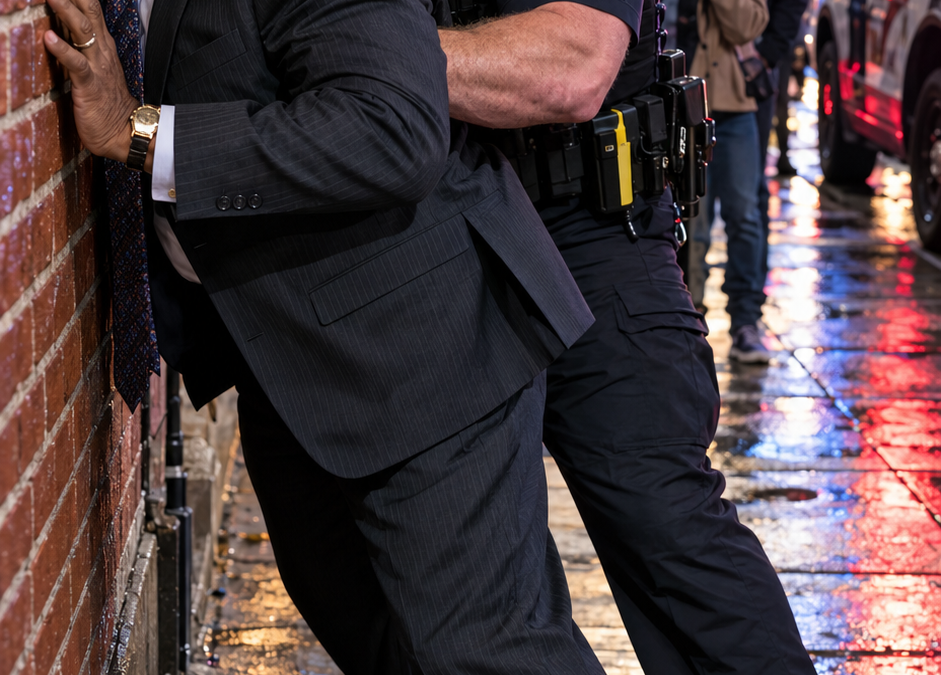
Keller pulled me away from the wall and started searching my jacket.
“What have we got here?”
He removed my black leather credential wallet from the inside pocket.
I said nothing.
He opened it.
For approximately two seconds, the sidewalk seemed to become completely silent.
Keller stared at the identification card.
Then at me.
Then back at the card.
It identified me as Marcus Holloway, Senior Civil Rights Counsel with the United States Department of Justice.
I watched the color leave his face.
“You’re a federal attorney?”
“Yes.”
He looked toward Parker.
The younger officer stared back at him.
Keller unlocked my handcuffs without another word.
I slowly brought my arms forward and rubbed my wrists.
My lower lip was swelling. Blood had stained my collar, and my left cheek felt as though someone had pressed a hot iron against it.
Keller returned my credentials.
For a brief moment, I thought he might apologize.
Instead, he straightened his shoulders.
“You should have identified yourself.”
I looked at him.
“You didn’t ask.”
His jaw tightened.
“We had a robbery in the area.”
“Then your report should explain why you stopped me.”
He glanced toward Darren, who was still recording from across the street.
I followed his gaze.
“And, Sergeant, make sure your report matches what the cameras recorded.”
I didn’t threaten him.
I didn’t announce that I would destroy his career.
I didn’t mention lawsuits, federal investigations, or supervisors.
I picked up my phone and walked toward the parking garage.
Behind me, Parker was standing beside the patrol SUV.
Keller had already turned away.
What I didn’t know until much later was that Keller made a telephone call shortly after I left.
Parker would eventually describe hearing the first words.
“We’ve got a problem.”
At the time, I thought the problem was simply that Keller had assaulted the wrong man.
By the following morning, I would understand how badly I had underestimated what those words meant.
At 9:14 that night, I was sitting inside Mercy Medical Center while an emergency physician stitched the inside of my lower lip.
Her name was Dr. Lena Walsh.
She was direct, thorough, and clearly unimpressed by my repeated insistence that I was fine.
“Mr. Holloway, you’ve got a facial contusion, a laceration requiring four stitches, and significant swelling.”
“I’ve had worse.”
She raised one eyebrow.
“I’m sure you have. That doesn’t make this good.”
I almost smiled.
The attempt hurt badly enough that I immediately abandoned it.
She finished the final stitch.
“No solid food tonight. Follow the discharge instructions, and come back if you develop worsening pain, severe headache, dizziness, or anything that concerns you.”
I nodded.
“Please document everything you observed.”
She looked at me over her glasses.
“I already have.”
My phone vibrated.
Baltimore Police had released an official statement about the incident.
I opened it.
The department claimed that an individual matching the general description of a robbery suspect had refused repeated lawful commands, become physically confrontational, and required temporary restraint.
I read the statement twice.
Then I opened the preliminary incident report.
One sentence made me forget about the pain in my face.
Sergeant Keller claimed I had made a sudden movement toward my waistband, causing him to believe I might have been reaching for a weapon.
I stared at those words.
I had never reached toward my waistband.
Not once.
I had kept both hands visible from the moment Keller approached.
He knew that.
Parker knew that.
And the man across the street with the phone probably knew it, too.
Yet Keller had written the statement as though the cameras didn’t exist.
The examination-room curtain suddenly opened.
Sophie stood in the doorway, breathing hard.
She was wearing the black dress she had selected for her exhibition beneath a tan coat. Her architecture department badge was still clipped near her collar, and her portfolio tube hung from one shoulder.
The moment she saw me, her face changed.
“Oh my God.”
“I’m okay, sweetheart.”
She came closer.
“You have stitches in your face.”
“Four.”
“Dad!”
I tried to smile again.
Another terrible idea.
She gently touched my uninjured cheek.
“What happened?”
I explained as much as I could.
She listened without interrupting, but I could see her anger building with every sentence.
When I finished, she held up her phone.
“Have you seen this?”
Darren Cole’s video was already circulating online.
A local television producer had obtained the footage after another pedestrian recognized the confrontation.
I watched myself standing on the sidewalk with both hands visible.
Keller approached.
He grabbed my arm.
He drove my face against the wall.
My mouth opened as I protested.
The video captured the entire sequence clearly enough that I could identify the exact moment my lip split.
Sophie replayed it.
Then she looked at me.
“We release everything. Tonight.”
“Not yet.”
Her eyes widened.
“What?”
“Give me a little time.”
“He assaulted you.”
“I know.”
“And then he lied about it.”
“I know that, too.”
She stared at me.
“Why are you protecting him?”
“I’m not protecting Keller.”
I opened the police report and enlarged the sentence about my supposed movement toward my waistband.
“He knew who I was before he wrote this. He knew people witnessed the stop. He had another officer standing beside him.”
“So?”
“So why would he put something so easily disproved into an official report?”
Sophie slowly lowered her phone.
I looked toward the examination-room curtain.
“Either he made an extraordinarily reckless decision, or he’s accustomed to having someone protect him when he lies.”
She was silent for several seconds.
Then she whispered, “You think this is bigger than what happened to you.”
“I don’t know yet.”
That was the truth.
But I intended to find out.
I was discharged later that evening.
By the time we reached my apartment, it was after ten.
Sophie helped me inside, insisted I sit down, and brought an ice pack from the freezer.
I opened my laptop.
“Dad, seriously?”
“Just one thing.”
She folded her arms.
“You’ve been saying that my entire life.”
The words hurt because they were true.
I should have closed the computer.
I should have asked about her exhibition.
Instead, I entered Wade Keller’s name into a legal records database.
Within fifteen minutes, I had found thirty-one complaints filed against him over the preceding five years.
Several involved allegations of excessive force.
Others described questionable vehicle searches or the seizure of cash from motorists.
I opened the related records.
Seventeen vehicle searches.
Twelve documented cash seizures.
Only a small number of the underlying encounters had produced criminal charges.
I leaned forward despite the pain in my face.
In several cases, people whose money had been confiscated had never been arrested at all.
Sophie moved her chair beside mine.
“That doesn’t seem right.”
“No.”
“Can you get the rest of the complaints?”
“Some of them.”
I opened another file.
Then another.
Again and again, I found the same name.
Sergeant Wade Keller.
At some point, Sophie fell asleep on the couch.
I placed a blanket over her and returned to the computer.
I didn’t know then that another officer was sitting awake across Baltimore, wrestling with a decision that would eventually change both our lives.
Ethan Parker later told me he hadn’t eaten that evening.
He had gone home, removed his uniform, and sat on the edge of his bed staring at the body camera he had worn during my arrest.
His girlfriend, Rachel Kim, worked as an emergency room nurse.
She knew something was wrong almost immediately.
“Did something happen today?” she asked.
Ethan told her it had been a difficult shift.
She didn’t believe him.
Finally, she asked, “Did you do the right thing?”
He couldn’t answer.
After Rachel fell asleep, Ethan opened his department laptop and accessed the digital evidence portal.
He searched for the recording from my encounter with Keller.
The file appeared.
Its timestamp matched the stop.
Then he noticed a yellow administrative notice beneath it.
Scheduled for administrative deletion: 6:00 a.m.
Ethan checked the clock.
The recording would disappear in just a few hours.
At 2:11 that morning, he inserted a blank USB drive into his laptop.
He watched the body camera footage twice.
He saw Keller grab me while my hands were visible.
He heard me say I wasn’t resisting.
And he heard something he hadn’t fully processed during the confusion on the sidewalk.
After Keller discovered my credentials, he had leaned toward Parker and quietly said, “We’ll say he reached first.”
Ethan copied the recording and the associated information.
Then he removed the USB drive, wrapped it inside an old receipt, and concealed it beneath the spare tire in his car.
He had preserved the footage.
But he still had no idea whether he was brave enough to reveal what he had done.
Saturday morning, I met an old colleague named Nina Patel at a municipal records office.
Nina was forty-two, an exceptionally meticulous auditor, and one of the few people I knew who genuinely enjoyed examining financial records other professionals considered unbearably tedious.
We had worked together during a federal civil rights review four years earlier.
She had helped expose a contractor billing the city for repairs to buildings that no longer existed.
When I called and explained what had happened to me, she agreed to meet immediately.
She examined my face as soon as I entered.
“Please tell me the other guy looks worse.”
“I haven’t seen him since.”
“Disappointing.”
I laughed and immediately regretted it.
Then I placed Keller’s complaint history in front of her.
Nina read without speaking.
After several minutes, she looked up.
“You’re looking at the wrong part of this.”
“What do you mean?”
“You keep looking at Keller.”
“He appears in nearly every suspicious incident.”
“Exactly. So let’s stop asking what Keller did and start asking where everything went after he did it.”
She turned toward her computer.
For the next six hours, we followed the paper trail.
Vehicle seizure reports.
Tow authorizations.
Storage invoices.
Administrative penalties.
Cash forfeiture notices.
Police discretionary spending.
The records initially appeared ordinary.
A vehicle stopped.
An officer suspected criminal activity.
A search occurred.
Property was seized or the vehicle was impounded.
But when Nina organized the transactions chronologically, a pattern emerged.
Vehicles involved in stops connected to Keller were disproportionately transported to the same private company.
Harbor Crown Towing.
Nina opened its corporate registration.
The owner was Frank Slater.
She searched further.
Then she stopped typing.
“Marcus, do you know who Frank Slater’s younger brother is?”
I looked at the screen.
Captain Raymond Slater.
Keller’s supervising officer.
I leaned back.
“That could be a coincidence.”
“Of course.”
Nina’s expression suggested she didn’t believe it for a second.
She opened another file.
One impounded Honda had remained at Harbor Crown for thirty-eight days after prosecutors declined to bring charges against its owner.
The company charged $145 per day in storage fees.
Another vehicle remained for twenty-six days.
Another for forty-three.
Several owners were unable to pay the accumulated fees.
Their vehicles were eventually sold through lien proceedings.
“Look at this,” Nina said.
Harbor Crown had made repeated donations to a nonprofit called the Baltimore Public Safety Partnership.
According to its public materials, the organization supported youth programs, police wellness initiatives, and community safety projects.
Those activities were legitimate purposes for a nonprofit.
But the subsequent transactions raised questions.
Money left the organization through consulting contracts.
One company had received $186,000 over three years.
RS Community Strategies LLC.
Nina opened its ownership record.
Margaret Slater.
Captain Raymond Slater’s wife.
I stared at the screen.
“That’s an interesting family business.”
“Interesting isn’t the word I’d use.”
She began printing the records.
By late afternoon, we had identified sixty-three incidents involving people whose vehicles, money, or property had been taken during stops associated with Keller or officers in his unit.
Forty-one had ended without a criminal conviction.
In eighteen cases, no criminal charges had been filed at all.
We still couldn’t prove that every seizure was improper.
But the pattern demanded investigation.
One name on the list caught my attention.
Carlos Mendoza.
Two years earlier, Carlos had been driving to Pennsylvania to purchase a used hydraulic lift for his auto repair business.
He was carrying $22,400 in cash.
Keller stopped him for an alleged traffic violation.
Officers searched his vehicle.
They found no drugs, no weapons, and nothing establishing that Carlos had committed a crime.
But they seized his money as suspected criminal proceeds.
Carlos was never charged.
He never recovered the cash.
I called the telephone number listed in his complaint.
He answered on the fourth ring.
“Mendoza Auto Service.”
“Mr. Mendoza, my name is Marcus Holloway. I’m an attorney with the Department of Justice.”
Silence.
Then he asked, “What do you want?”
“I’d like to ask about Sergeant Wade Keller.”
The line remained quiet.
Finally, Carlos said, “That man took everything from me.”
He agreed to meet.
But what happened afterward showed me exactly how dangerous the investigation might become.
That evening, Sophie returned to my apartment and found the dining-room wall covered with index cards and blue painter’s tape.
She had inherited her mother’s artistic eye and loved turning complex information into visual arrangements.
Within an hour, she had transformed Nina’s notes into a diagram connecting officers, towing companies, nonprofit donations, and suspicious payments.
She stepped back to examine it.
“That looks terrible.”
“Which part?”
“All of it.”
I studied the wall.
Then my phone rang.
Carlos.
Before I answered, Sophie spoke.
“You missed dinner again.”
“I had a sandwich.”
“Coffee and half a sandwich at eleven isn’t dinner.”
I glanced toward the phone.
She shook her head.
“You always know how to save strangers.”
The words landed harder than she intended.
I looked at her.
She was staring at the photograph of Elena on the bookshelf.
My wife had been dead for three years.
We had been married for twenty-six.
She taught elementary-school art, collected mismatched coffee mugs, and remembered the names of children years after they left her classroom.
She was the only person I had ever known who could interrupt one of my arguments without making me feel defeated.
When she got sick, our entire world changed.
Cancer took her slowly enough to make us believe, over and over, that we might have more time.
And during her final months, I buried myself in work.
I told myself I was protecting Sophie from watching me fall apart.
I told myself Elena needed rest.
The truth was that I couldn’t bear sitting beside the woman I loved while she slipped away and there was nothing I could do to stop it.
Sophie interpreted my absence differently.
To her, it looked like I had abandoned them when they needed me most.
I had never found the courage to tell her otherwise.
My phone continued ringing.
I looked down.
Then I answered it.
Sophie walked out of the room.
And for the first time that evening, I understood that she had been right.
I had spent the entire day uncovering harm done to people I barely knew.
Meanwhile, my own daughter had been standing beside me, asking for something I kept postponing.
Carlos sounded frightened.
Three municipal inspectors had arrived at his auto repair shop that afternoon.
They examined his building permits, chemical storage, fire extinguishers, and emergency lighting.
They identified several minor violations.
An inspection sticker was six weeks out of date.
A solvent container was stored too close to an electrical panel.
An exit sign wasn’t illuminating properly.
By the time they left, a red notice had been taped across his front door.
His business license was temporarily suspended.
“They know I talked to you,” Carlos said.
I couldn’t prove that.
But coincidence was becoming increasingly difficult to believe.
“Don’t destroy any paperwork,” I told him. “Keep photographs of everything. I’ll help you find out what happened.”
After we disconnected, I sat at the dining table for several minutes.
Then I looked toward Sophie’s empty chair.
I had missed her exhibition.
I had ignored her frustration.
And now I was preparing to spend another weekend chasing a case that might put her in danger.
I didn’t know how soon that last possibility would become real.
Shortly after nine that night, I returned home from delivering documents to a colleague.
A white envelope lay against the bottom of my apartment door.
There was no stamp.
No address.
I picked it up, stepped inside, and opened it.
One photograph fell into my hand.
Sophie was leaving her architecture building that afternoon, her portfolio tube beneath her arm.
Someone had photographed her from across the street.
I turned the picture over.
Five words were written in black ink.
Good fathers know when to stop.
I stood motionless.
I had received threats before.
Angry defendants had mailed letters. Public officials had attacked my reputation. People who disliked my civil rights work had left messages describing what they hoped would happen to me.
None of those threats had felt like this.
Someone had watched my daughter.
They had waited for her outside the university.
They had photographed her.
And they wanted me to understand that they could reach her whenever they chose.
For the first time since Keller slammed my face into the wall, I felt genuine fear.
Not for myself.
For Sophie.
She came home shortly after ten.
I had already packed a small overnight bag.
She saw it immediately.
“What’s that?”
“You’re staying somewhere else for a few days.”
“No.”
“Sophie—”
“No, Dad.”
I placed the photograph on the table.
Her expression changed when she saw it.
For several seconds, she couldn’t speak.
“They followed me?”
“Someone watched you leave campus.”
She looked up.
“And you think sending me away fixes that?”
“I think putting distance between us makes you harder to use against me.”
She folded her arms.
“So they threaten us, and we rearrange our lives exactly the way they want.”
“This isn’t an argument.”
“It became one when you packed my clothes without asking.”
I felt my temper rising.
Then I said something I immediately regretted.
“Your mother isn’t here. I’m responsible for keeping you safe.”
The room went silent.
Sophie looked toward Elena’s photograph.
“You weren’t always there to keep her safe.”
I felt as though someone had struck me in the chest.
Sophie immediately looked away.
“I shouldn’t have said that.”
“No.”
I lowered myself into a chair.
“You should have said it years ago.”
She remained standing.
I looked at Elena’s smiling face in the photograph.
“When your mother got sick, everybody kept asking me what I was going to do. At work, I always knew the answer. Somebody violated the law, I could file something. Someone lied in a report, I could challenge it. A judge made a mistake, I could appeal.”
My voice began to break.
“Then I’d go to the hospital, and your mother would be getting weaker. There was nothing I could file against cancer. Nothing I could cross-examine. Nothing I could fix.”
Sophie’s expression softened.
“So you stayed away?”
“Yes.”
She stared at me.
“You were protecting yourself.”
I nodded.
“Yes.”
For three years, I had defended my choices with explanations about work and responsibility.
That night, I finally admitted the truth.
“I was terrified, Sophie. Every time I saw your mother, I had to face the possibility of losing her. So I kept finding reasons to leave.”
Her eyes filled with tears.
“I thought you didn’t want to be there.”
“I wanted to be there more than anything. I just didn’t know how to watch her die.”
She sat across from me.
For a long time, neither of us spoke.
Then she reached for my hand.
“I’m still angry with you.”
“I know.”
“But I wish you’d told me.”
“So do I.”
We sat together until well after midnight.
We made arrangements for Sophie to stay with a trusted friend temporarily, but I promised I would not make decisions about her life without discussing them with her.
For the first time in years, I felt as though my daughter and I were finally speaking honestly.
Then the investigation became even more dangerous.
Sunday morning, two Baltimore detectives appeared at the security desk of the federal office building where my sedan had remained parked.
They had obtained authorization to search it after receiving an anonymous tip claiming that evidence connected to the jewelry robbery might be inside.
I watched the search after federal security personnel reviewed the paperwork.
One detective opened the rear passenger door.
He reached beneath the seat.
Then he removed a prepaid cellphone.
The device contained messages discussing jewelry, cash, and a meeting location near the store that had been robbed.
I stared at it.
The officers exchanged a look.
Suddenly, Keller’s original report wasn’t the only evidence someone had manufactured around me.
They were building a case.
Nina arrived less than an hour later.
She examined the search inventory.
Then she asked one question.
“When did the phone get there?”
“My car’s been parked here since Friday.”
“Then we need the garage footage.”
The federal building retained security recordings from its entrances, elevators, corridors, and parking levels.
We obtained the relevant footage through the appropriate security and investigative channels and began working backward.
At 2:18 that morning, a white tow truck entered the restricted garage.
Nina paused the video.
The logo on the door was partially obscured by shadow.
But three words were visible.
Harbor Crown Towing.
I leaned toward the monitor.
“What the hell is that truck doing here?”
Nina opened the access log.
The vehicle had entered using a temporary contractor credential issued for emergency vehicle relocation.
No emergency relocation had been scheduled.
On another camera, a man in a dark jacket emerged from the truck.
His baseball cap concealed much of his face.
But his destination was unmistakable.
My sedan.
He approached the rear passenger side and crouched beside the vehicle.
Seven seconds later, he stood and returned to the tow truck.
Nina froze the frame.
I felt a cold pressure building beneath my ribs.
“They didn’t just threaten Sophie,” she said.
I looked at the image.
“They’re trying to put me inside their story.”
Across Baltimore, Ethan Parker was confronting a different kind of threat.
He later told investigators that Captain Raymond Slater had summoned him and presented a prepared statement about my arrest.
The document claimed I had ignored commands, used profanity, resisted Keller, and made a movement suggesting I possessed a weapon.
Every essential allegation was false.
Slater placed a pen on the table.
“Sign it, Parker. Then this ends.”
Ethan knew his name had appeared on an administrative list of people who accessed the body camera archive.
He knew somebody had scheduled the recording for deletion.
And he knew refusing his captain might end his police career.
He signed.
He made it halfway down the hallway before becoming physically ill.
He locked himself inside a restroom and vomited.
That evening, Rachel found him sitting at their kitchen table with a resignation letter open on his laptop.
He told her everything.
She listened.
Then she asked him what his father would have done.
Ethan’s father, Thomas Parker, had served as a patrol officer for twenty-seven years.
He had died two years earlier, but Ethan still remembered something he said on the morning of his academy graduation.
“A badge doesn’t make you right. It makes being wrong more dangerous.”
Ethan went to his car.
He opened the trunk and retrieved the USB drive.
Then he returned upstairs and found the Department of Justice’s public corruption reporting information.
He stared at the number for almost a minute.
Finally, he called.
“My name is Officer Ethan Parker,” he said. “I need to report corruption inside my department.”
At 11:38 that night, Ethan sat inside a windowless conference room in a federal building near Baltimore’s Inner Harbor.
Across from him was Special Agent Rebecca Miles, a veteran investigator who had spent eighteen years working public corruption cases.
The USB drive lay on the table.
Rebecca later told me that she had no interest in allowing Ethan to present himself as a hero.
She wanted the truth.
“Tell me everything you did wrong, too,” she instructed him.
Ethan admitted copying the footage without authorization.
Then he produced the false statement he had signed.
“Why did you sign this?” she asked.
“Because I was scared.”
“Does that excuse it?”
He shook his head.
“No.”
For the next two hours, he explained everything.
Keller’s assault.
The inaccurate robbery description.
The disabled body camera.
The false report.
Slater’s pressure.
The scheduled deletion.
The statement Ethan had signed despite knowing it was false.
He also provided records he had gathered after noticing how frequently cameras malfunctioned during property seizures involving Keller’s unit.
Rebecca opened the video.
I appeared on screen, standing on the sidewalk with both hands visible.
Keller approached.
The shove came before I made any threatening movement.
Then the recording captured the moment Keller opened my credential wallet.
His voice was quieter, but unmistakable.
“We’ll say he reached first.”
Rebecca stopped the video.
She looked at Ethan.
“This isn’t just about one bad stop, is it?”
He shook his head.
“No, ma’am.”
By the following afternoon, Rebecca had arranged a meeting with me, Nina, and two federal prosecutors.
My facial bruising had darkened, but I barely noticed it.
For the first time since the assault, we possessed evidence connecting Keller’s misconduct, the attempted destruction of video evidence, and his supervisor’s involvement.
Rebecca believed there were grounds to move immediately against Keller.
I disagreed.
“If you arrest him today, Slater starts destroying everything tomorrow.”
One prosecutor frowned.
“We already have a substantial civil rights case.”
“Against Keller,” I said. “Not against the entire network.”
I laid out what Nina and I had found.
Harbor Crown.
The questionable towing contracts.
The nonprofit.
The consulting company owned by Slater’s wife.
The planted cellphone.
Sixty-three cases involving suspicious seizures.
And now Ethan’s testimony.
“Someone built a system around the assumption that victims would never compare their records,” I said.
Rebecca studied me.
“You want us to wait?”
“I want us to understand how much evidence exists before they realize we’ve found it.”
Nina had been listening quietly.
Then she turned her laptop toward us.
“There’s something else.”
Baltimore’s municipal accounting system performed automated nightly backups, preserving historical versions of contracts, invoices, tow authorizations, reimbursements, and selected departmental financial records.
The retained records extended back seven years.
“If somebody deletes a file from an office computer,” Nina explained, “we may still have the historical version.”
Rebecca leaned forward.
“How long before the next backup?”
“Two o’clock tomorrow morning.”
The prosecutors exchanged glances.
I finally understood why Nina had always insisted that fraud was easier to uncover when people forgot how many copies of their paperwork existed.
While federal investigators began assembling the broader case, something unexpected happened at Mendoza Auto Service.
Carlos’s story had appeared on local television.
His temporary closure attracted the attention of people who recognized how damaging the loss of his business could become.
A retired electrician arrived carrying his toolbox and replaced the defective exit sign.
Two mechanics volunteered to reorganize the chemical storage area.
A neighborhood church paid the reinspection fee.
Someone donated new fire extinguishers.
A restaurant owner delivered lunch for the volunteers.
By Sunday afternoon, the suspension notice had been removed, and Carlos was preparing to reopen.
When I stopped by, he was standing beside his old hydraulic lift, watching nearly thirty people move equipment and clean the workshop.
He looked embarrassed by the attention.
“I don’t know what to say to these people.”
I smiled.
“Thank you usually works.”
He laughed.
Then his expression became serious.
“For two years, I thought what happened to me was just my problem.”
He looked around the garage.
“That’s what they count on, isn’t it?”
I nodded.
“If every victim thinks he’s alone, nobody compares stories.”
Carlos wiped his eyes with the back of his hand.
“Well, we’re comparing now.”
That evening, I returned to find Sophie closing her laptop.
“I postponed New York,” she announced.
She had been scheduled to fly there for a final interview with an architecture firm.
I stared at her.
“You did what?”
“Moved it back three weeks.”
“Why?”
“I want to stay until this is over.”
I sat beside her.
“Sophie, no.”
“Dad—”
“Listen to me.”
She stopped.
I took her hand.
“Your mother lost too much time waiting for me to learn that being present mattered. I don’t want you spending your life repairing my choices.”
Her eyes filled.
“I just want to help.”
“You already have.”
I glanced toward the wall covered with her careful diagrams.
“You helped me see connections I’d missed. You stood beside me when I couldn’t even explain what was happening. But you have your own life to build.”
She looked down.
“Three weeks,” she said.
“Not forever.”
I smiled.
“Three weeks.”
She leaned against my shoulder.
For once, I didn’t reach for my phone.
The federal investigation moved quickly after that.
Rebecca’s team obtained warrants to secure records, communications, financial information, and physical evidence connected to Harbor Crown Towing and the police personnel under investigation.
Specialists preserved the relevant municipal backups and compared them with the files recovered from individual offices.
The discrepancies were substantial.
Several towing invoices had been altered.
Property records contained inconsistent dates.
Some seizure reports had been modified after the corresponding cases were closed.
And financial transfers connected Harbor Crown, the Baltimore Public Safety Partnership, and RS Community Strategies in ways that demanded explanation.
The investigation also established that the burner phone found inside my car had been planted.
The security footage showed the tow truck entering the federal garage using the temporary credential.
Investigators traced the credential’s issuance and identified the man who approached my vehicle.
The supposed evidence tying me to the jewelry robbery had been manufactured.
Early Tuesday morning, coordinated federal teams moved across Baltimore.
At 5:20 a.m., one team entered police headquarters.
Another arrived at Captain Slater’s home.
Additional investigators served warrants at the Baltimore Public Safety Partnership and offices associated with Harbor Crown Towing.
Keller’s workspace was secured before his shift began.
The largest team entered Harbor Crown while the sky was still dark.
What they discovered inside a rear storage building transformed the investigation.
Behind a locked steel partition stood rows of cardboard boxes.
They were marked with names and dates.
Many did not correspond to entries in any official property database.
Inside were envelopes of cash, watches, cellphones, jewelry, and other belongings that people had reported missing after encounters with police.
Some boxes contained handwritten notes.
Others held items connected to cases that had been closed years earlier.
Rebecca later showed me photographs of the storage room.
The shelves seemed endless.
I recognized several names from Nina’s spreadsheet.
Then I noticed dozens more.
People we hadn’t yet identified.
Families who might still be wondering where their money had gone.
Business owners who had abandoned the idea of recovering property they couldn’t afford to replace.
Rebecca told me one of her agents had asked how many victims they were looking at.
Her answer had been simple.
“More than sixty-three. Much more.”
I stared at the photographs for a long time.
For the first time, I felt something approaching relief.
But it wasn’t because Keller was finally in trouble.
It was because there were people whose losses could now be documented and whose cases might finally be reopened.
Three weeks later, I sat in the first row of Baltimore’s city hall hearing chamber.
The room was packed.
Reporters stood along the rear wall.
Television cameras crowded the aisles.
Families who had spent years trying to recover seized property occupied nearly two full sections.
Sophie sat beside me.
For once, I wasn’t there as an attorney arguing someone else’s case.
I was a victim and a witness.
My bruises had faded.
The inside of my lip was healing.
But I could still remember the exact texture of that brick wall against my face.
Keller testified first.
He wore a dark suit instead of his uniform.
Without the badge and duty belt, he seemed smaller than I remembered.
He maintained that he had reasonably believed I matched the robbery suspect’s description and that my movements appeared threatening.
“I made a split-second decision,” he said. “That’s what officers are trained to do.”
Rebecca stood beside the evidence monitor.
“Then let’s look at those seconds.”
The body camera footage appeared on the screen.
There I was, walking down the sidewalk.
Keller approached.
I lowered my telephone.
My hands remained visible.
I didn’t reach toward my waistband.
I didn’t threaten him.
I didn’t attempt to flee.
Then he seized my arm and slammed me into the wall.
The chamber fell completely silent.
I felt Sophie’s fingers close around mine.
The video continued.
Keller searched my jacket, discovered my federal credentials, and turned toward Ethan.
Then the words came through the speakers.
“We’ll say he reached first.”
Keller’s attorney shifted in his chair.
Keller remained motionless.
But the confidence had disappeared from his face.
Ethan testified next.
He looked thinner than he had when I first met him.
Internal Affairs had suspended his police authority pending review of his conduct.
Rachel sat behind him.
Keller watched him approach with an expression I couldn’t interpret.
Ethan took the oath.
Rebecca began with straightforward questions.
“Did Marcus Holloway resist Sergeant Keller?”
“No.”
“Did he reach toward his waistband?”
“No.”
“Did Sergeant Keller know Mr. Holloway did not match the updated robbery suspect description?”
“Yes.”
A murmur moved through the room.
Ethan described the inaccurate report, Keller’s disabled body camera, the scheduled deletion, and Slater’s instructions.
Then Rebecca turned to the statement Ethan had signed.
“You lied, too.”
He lowered his head.
“Yes.”
“Why?”
“I was afraid.”
“And does that excuse what you did?”
He looked toward me.
Then he looked back at Rebecca.
“No.”
I studied his face.
He had witnessed my assault.
He had known it was wrong.
Then he had helped conceal it.
Part of me still resented him for that.
But I also understood that without his decision to preserve the footage and report the misconduct, vital evidence might have disappeared.
I didn’t need to pretend he had done everything right to recognize that he had eventually made an important choice.
When Carlos Mendoza was called, he approached the witness table wearing his navy work shirt.
The name of his garage was embroidered above the pocket.
His hands were still stained with grease.
He described the traffic stop two years earlier.
The money.
The search.
The seizure.
The endless paperwork.
The humiliation of explaining to his family that the savings intended to improve their business had disappeared even though he had never been charged with a crime.
He paused halfway through his testimony.
Then he looked toward the section where other victims were sitting.
“I thought I was the only one.”
Several people lowered their heads.
Others nodded.
After Carlos came Tanya Brooks, a single mother whose minivan had been held for forty-six days following a traffic stop that produced no criminal charges.
She had lost transportation to her overnight warehouse job and struggled for weeks to get her children to school.
Earl Jennings, a long-haul trucker, described losing $13,000 he had saved for a replacement engine.
Denise Harper, an emergency room nurse, explained how jewelry had been taken from her vehicle and never appeared in official evidence records.
Leon Grant, an Army veteran who walked with a slight limp, recalled being warned that complaining would make recovering his property more difficult.
Rosa Alvarez, a restaurant owner, described the seizure of cash intended to cover an entire week’s payroll.
One by one, the people who had once believed themselves isolated began telling their stories in the same room.
Sixty-three cases became 117.
Then 168.
Eventually, more than two hundred incidents were placed under formal review.
The hearing didn’t resolve every claim immediately.
Nor did it establish that every seizure was unlawful.
But it exposed records, witnesses, and patterns that authorities could no longer dismiss as unrelated complaints.
Harbor Crown Towing lost its city contract.
Federal prosecutors brought charges against Captain Raymond Slater involving conspiracy, obstruction, fraud, evidence tampering, and offenses connected to the seizure network.
Keller faced civil rights and false-statement charges arising from the assault and broader investigation.
Additional proceedings addressed the financial arrangements involving the towing company, the nonprofit, and the consulting contracts.
Courts began ordering the return of property and money where the evidence established that it had been improperly taken.
Carlos recovered the full $22,400.
He also received compensation connected to the losses he had suffered.
When I visited Mendoza Auto Service after it reopened permanently, a new sign hung above the entrance.
Inside, the old workbench was still there.
So was the cracked coffee machine.
I pointed toward it.
“You’re really keeping that thing?”
Carlos grinned.
“Place is ugly, but it’s mine.”
Then he poured me a cup of coffee.
We stood beside the open garage door, watching cars move past on the street.
For the first time since I’d met him, Carlos looked like a man who had stopped expecting someone to arrive and take something else away.
Ethan’s future was more complicated.
He remained suspended for signing the false statement.
I didn’t intervene to reduce the consequences.
He had made a decision that could have destroyed an innocent person’s credibility.
His cooperation helped preserve crucial evidence and contributed to the broader investigation, and prosecutors ultimately declined to bring criminal charges against him.
But he lost his authority to patrol.
For months, he lived without the badge that had defined much of his adult life.
Two years later, I received an invitation to speak at a police training academy.
When I arrived, Ethan was standing at the front of a classroom.
He was no longer a patrol officer.
He worked in training, teaching recruits about intervention, truthful reporting, and professional responsibility.
Twenty-three recruits sat facing a large screen.
Ethan displayed a frozen frame from the body camera recording.
There I was, standing on the sidewalk with my hands visible.
Keller was approaching.
Ethan looked toward the students.
“The first time I failed this man wasn’t when I signed a false statement,” he told them.
He paused.
“It was when I saw something wrong and decided somebody else would stop it.”
I watched the young recruits.
Some stared at the screen.
Others glanced toward one another.
Ethan continued.
“Your partner can have more experience than you. Your supervisor can have more authority. Neither of those things changes your responsibility to tell the truth.”
I thought of his father.
A badge doesn’t make you right.
It makes being wrong more dangerous.
After the class, Ethan approached me.
For a moment, neither of us knew what to say.
Finally, he extended his hand.
“Thank you for coming.”
I shook it.
“You told them something important.”
He glanced toward the empty classroom.
“I wish I’d understood it earlier.”
“So do I.”
Then I left him to prepare for his next class.
My own life changed, too.
Not dramatically.
There were no grand announcements or sudden revelations.
I still worked as an attorney.
I still cared deeply about the people who came to me for help.
But I stopped accepting every case simply because somebody asked.
I began delegating work I had once insisted on handling myself.
I left the office before dark more often.
And when Sophie called, I answered.
Sometimes, I even turned my phone off during dinner.
She noticed before I mentioned it.
One evening, we were eating together when my phone vibrated on the table.
I glanced at the screen.
A colleague.
An urgent message.
The kind of thing I would once have used as an excuse to leave.
I turned the phone facedown.
Sophie watched me.
“Everything okay?”
“Everything’s fine.”
“You’re not answering?”
“It can wait.”
She smiled.
Then she pushed the basket of bread toward me.
“Good. Because you’re paying.”
Three weeks after postponing her New York interview, Sophie traveled there.
She did well.
The firm offered her a position.
I was proud of her.
But after considering the opportunity, she accepted an architecture job in Baltimore instead.
I asked twice whether she was staying because of me.
Both times, she told me no.
Her first major assignment involved redesigning a community center several blocks from Carlos’s garage.
The project included accessible entrances, flexible classrooms, a public gathering space, and affordable facilities for neighborhood organizations.
When she showed me the plans, I recognized several ideas from the exhibition I had missed.
I studied every drawing.
Then I looked at her.
“I’m sorry I wasn’t there that night.”
She smiled sadly.
“I know, Dad.”
“I should have been.”
“Yeah.”
I nodded.
She came around the table and hugged me.
“But you’re here now.”
A year after Keller stopped me, Sophie and I visited the construction site together on a cool October afternoon.
The new community center was taking shape.
Steel framing rose above freshly poured concrete.
Workers carried materials through the entrance.
Sophie walked beside me, explaining how the building would accommodate families, older residents, and people with disabilities.
I listened to every word.
When she finished, we decided to walk home.
Our route took us along West Baltimore Street.
Eventually, we reached the same block where Keller had stopped me.
The brick wall was still there.
Same faded mortar.
Same uneven sidewalk.
I slowed.
For a moment, I could almost hear Keller’s voice.
Put your hands where I can see them.
I remembered the sudden pressure of his hand on my arm.
The impact.
The blood.
The helpless fury of being accused of resisting while I was simply trying to remain standing.
Then I noticed a young patrol officer beside a parked cruiser.
He couldn’t have been older than twenty-five.
An elderly man stood near a car with a flat tire.
The officer had rolled his sleeves above his elbows and was helping position a jack beneath the vehicle.
The older man held a flashlight unnecessarily close to the officer’s face.
The officer laughed and gently moved it aside.
I watched them for several seconds.
Sophie noticed.
“You okay, Dad?”
I looked at her.
“Yeah.”
She followed my gaze toward the officer.
I smiled.
“I just don’t want one badge to make me forget what a good one can be.”
She slipped her arm through mine.
We continued walking.
No sirens.
No handcuffs.
No reporters shouting questions.
No cameras recording from across the street.
Just traffic moving through Baltimore and my daughter talking about what we should have for dinner.
After everything that had happened, the ordinary afternoon felt unexpectedly precious.
For years, I had believed that my worth depended on how many people I could help, how many cases I could win, and how effectively I could challenge people who abused their authority.
Keller’s assault had forced me to confront something far more personal.
I could expose misconduct and help hundreds of strangers recover what had been taken from them.
But none of that excused my absence from my own daughter’s life.
Sophie had spent years waiting for me to choose her when there wasn’t a crisis forcing my hand.
I had finally learned to do it.
As we approached the next intersection, she squeezed my arm.
“Pizza?”
I pretended to consider it.
“Your mother’s lasagna recipe would be better.”
She laughed.
“You know neither of us can make it properly.”
“Then we’ll ruin it together.”
She looked up at me.
“Promise?”
I smiled.
And this time, I knew exactly what my answer meant.
“Promise.”








