𝗙𝗨𝗟𝗟 𝗦𝗧𝗢𝗥𝗬 The Sergeant Refused to Open My Briefcase Even as He Reached for His Handcuffs
𝗙𝗨𝗟𝗟 𝗦𝗧𝗢𝗥𝗬
“Yes. Make sure the filing is available for immediate review and keep the appropriate emergency procedures moving.”
I stopped several feet outside a temporary barricade protecting a service lane beside the Capitol.
People were moving in several directions, and I wanted somewhere relatively quiet to finish the call.
I placed my briefcase beside my leg.
“Anything else I need to know?”
Dana began describing the supporting declaration.
That was when Sergeant Harland noticed me.
I would later learn that officers assigned to Capitol security had received an alert earlier in the afternoon.
Someone had reportedly attempted to cross a restricted barrier near the rear entrance before disappearing into the crowd.
The alert contained no confirmed description.
No race.
No gender.
No clothing.
No reliable physical characteristics.
Nevertheless, Harland had decided that the Black woman standing near the barricade, wearing a dark suit and speaking on her phone, was the person he was looking for.
He didn’t contact Capitol security to ask whether anyone had seen me cross the barrier.
He didn’t review nearby surveillance cameras.
He didn’t request an updated description from dispatch.
He simply began walking toward me.
Officer Megan Ruiz followed several steps behind him.
I didn’t know either officer.
I noticed their approach only when Harland called out.
“Ma’am, step away from the barricade.”
I turned toward him.
“I’m already outside it.”
“Put the phone down.”
I raised one finger to Dana, indicating that I needed a moment.
“Sergeant, I’m speaking with my chambers.”
Harland stopped directly in front of me.
“Your chambers?”
“Federal court.”
His eyes moved from my face to my briefcase.
“Sure you are.”
I felt the first unmistakable indication that this encounter was not going to be resolved as easily as it should have been.
“Would you like to verify my identification?”
“I want you to put the phone away.”
I spoke briefly to Dana.
“Stay on the line for a moment.”
Then I lowered the phone.
“My judicial credentials are in the front pocket of my briefcase. You’re welcome to retrieve them.”
Harland immediately pointed at the bag.
“Don’t reach for it.”
“I haven’t reached for it.”
“Keep your hands where I can see them.”
I held my empty hand away from my body.
The phone remained visible in the other.
“Both hands are visible.”
He stepped closer.
“Turn around.”
I studied him.
“Am I being detained?”
“I gave you an instruction.”
“And I’m asking whether I’m being detained.”
His jaw tightened.
“You people always think you can talk your way around a simple command.”
I felt my shoulders stiffen.
I had encountered that kind of language before.
Not only in my professional work but throughout my own life.
There was a particular way some people used the phrase you people that made its meaning unmistakable.
I wasn’t going to give Harland the argument he appeared to be inviting.
Instead, I kept my voice controlled.
“If you’re detaining me, please explain the basis.”
He moved closer.
“Failure to follow a lawful order.”
“What order have I unlawfully refused?”
His face reddened.
Behind him, Ruiz shifted.
“Sergeant, maybe we should check her identification first.”
Harland didn’t look back.
“I know what I’m doing, Ruiz.”
I glanced toward the younger officer.
She met my eyes briefly.
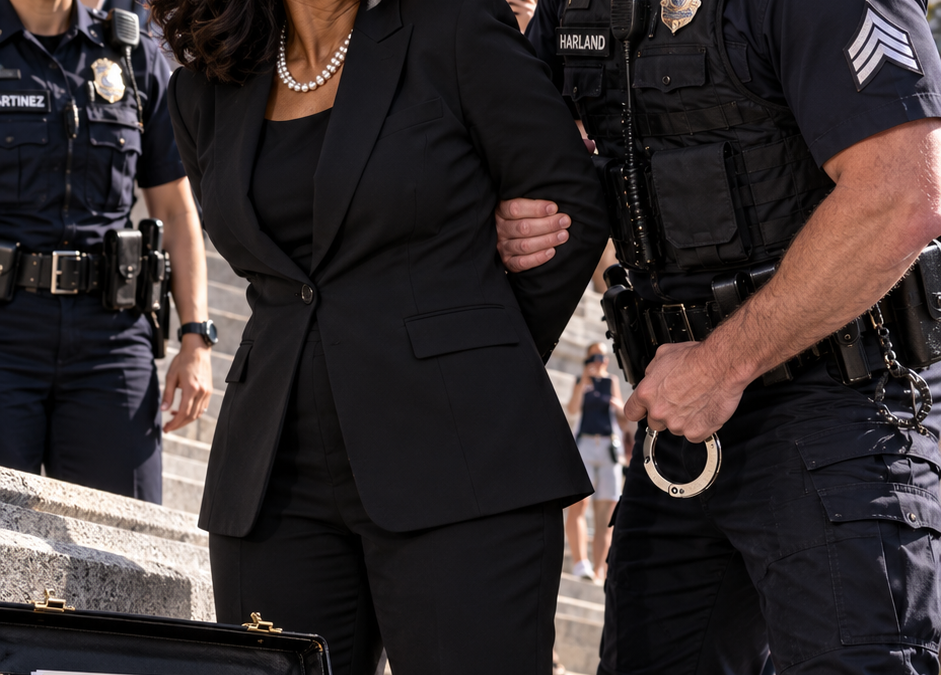
Then Harland stepped forward and grabbed my jacket.
The movement startled me.
His fist closed around the lapel of my charcoal blazer, pulling the fabric tight across my shoulder.
Conversation stopped around us.
I could hear footsteps slowing on the marble stairs.
A few people turned.
Then more.
“Sergeant, do not touch me.”
“Turn around.”
“I’m cooperating. You have no reason to grab me.”
He pulled me toward him.
For a moment, I lost my balance.
My briefcase tipped against my leg.
I caught myself before falling.
Ruiz stepped forward.
“Sergeant—”
“Stay back.”
Harland twisted me around and reached for his handcuffs.
I understood immediately that the encounter had moved beyond a disagreement about identification.
He was committing himself to an arrest.
And every opportunity I had given him to slow down had only seemed to make him more determined.
The first cuff closed around my right wrist.
I heard someone gasp.
A man farther down the steps shouted that I hadn’t done anything.
Harland pulled my left arm behind me.
I looked toward the body camera on his chest.
“Make sure you’re recording.”
“It is.”
“Good.”
The second cuff closed.
The metal was cold and uncomfortably tight.
For a moment, I stood perfectly still.
I could feel my heartbeat in my wrists.
I could hear several people talking at once.
And I could see my briefcase lying on the ground only a few feet away.
The identification that could have ended the encounter before it began was still inside.
Harland tightened his grip around my upper arm.
“Move.”
I turned toward the steps.
My hands were restrained behind my back, making it difficult to maintain my balance as he began leading me down the marble staircase.
“Sergeant, my identification is in the front pocket of my briefcase. I’ve given you permission to retrieve it.”
“You had your chance to cooperate.”
“I am cooperating.”
“You refused to identify yourself.”
“No. I told you precisely where my identification was.”
He glanced toward the growing crowd.
Then he began speaking loudly enough for the nearest phones to record.
“You crossed into a restricted security area, ignored repeated instructions, refused to provide identification, and became disruptive.”
I looked at him.
“Your body camera recorded what actually happened.”
His grip tightened.
That sentence appeared to bother him more than anything else I had said.
Behind us, Ruiz carried my briefcase.
I could see the uncertainty in her expression.
She had witnessed the entire exchange.
She knew I had offered my identification.
She had suggested checking it.
And now she was listening to her supervisor construct an account that contradicted what had occurred in front of her.
Near the bottom of the steps, a woman called my name.
“Judge Grant!”
I turned my head.
Natalie Brooks, a local courthouse correspondent, was pushing through the crowd.
I recognized her immediately.
She had covered federal court proceedings, judicial appointments, and public corruption cases for years.
She stopped several feet away and raised her phone.
“That’s Judge Alicia Grant. United States District Court.”
Harland hesitated.
I felt it in his grip.
For perhaps half a second, he looked toward the briefcase Ruiz was carrying.
Then he looked at the cameras surrounding us.
His expression hardened again.
“Back up or you’ll be detained for interfering.”
Natalie raised her free hand.
“I’m not interfering. I’m identifying the woman you’re arresting.”
“I said back up.”
I said nothing.
By that point, I had begun to understand something important about Harland.
He wasn’t simply making a mistake because he lacked information.
He had repeatedly refused opportunities to obtain information.
And now, with people watching, admitting uncertainty appeared to frighten him more than continuing the arrest.
He guided me toward his patrol vehicle.
The rear door opened.
I lowered my head and climbed inside.
He shut the door.
Through the window, I could see phones still raised along the sidewalk.
One belonged to a young journalism student named Evan Price.
I had seen him earlier at the legal forum, carrying a camera bag and taking photographs for a class assignment.
Unlike several people who had begun recording only after Harland grabbed me, Evan had filmed nearly the entire encounter.
He had captured my offer to provide identification.
He had recorded Ruiz suggesting that Harland verify it.
He had recorded Natalie recognizing me.
And he had continued recording as Harland placed me in the patrol car.
I didn’t know then how important that uninterrupted video would become.
Across town, my daughter was standing behind a podium in a classroom at East Denver Preparatory Academy.
Camille was seventeen.
She had inherited my dark curls, her father’s sense of humor, and a stubbornness that occasionally made me wonder how my mother had survived raising me.
She was practicing for her school’s mock trial competition.
Two years earlier, she had lost a debate tournament after repeatedly interrupting an opponent.
I had told her afterward that being right meant very little if nobody trusted the way she reached her conclusion.
She had been irritated with me at the time.
Now she was finally beginning to understand the lesson.
According to Camille, she was halfway through an argument about the legal requirements for temporary detention when her friend Sophie Bennett interrupted her.
“Camille.”
“Not now. I’m almost finished.”
“Camille, you need to see this.”
Sophie was staring at her phone.
Something about her expression made my daughter stop speaking.
She walked toward Sophie and took the phone.
On the screen was a shaky video from the Capitol.
Harland was marching me down the steps.
My hands were restrained behind my back.
Someone in the crowd was shouting my name.
Camille watched the recording once.
Then she called her father.
Marcus was sitting at our favorite Italian restaurant, waiting for me.
Our anniversary dinner was already running late.
When he saw Camille’s name on his phone, he answered with a joke.
“Tell your mother I’m ordering without her.”
“Dad.”
He stopped smiling.
“What’s wrong?”
“Mom’s been arrested.”
For several seconds, Marcus didn’t understand what she had said.
Then Camille sent him the video.
He stood so quickly that his chair fell backward.
He left cash beside the untouched water glasses, grabbed his jacket, and hurried out of the restaurant.
Meanwhile, I was sitting in the rear of Harland’s patrol vehicle, trying to relieve the pressure on my wrists.
Ruiz climbed into the passenger seat.
Harland started the engine.
For several blocks, nobody spoke.
Then he told her to begin the incident report.
“Put down that the subject refused to identify herself.”
Ruiz looked toward him.
“But she didn’t.”
I could hear the tension in her voice through the partition.
Harland tightened his grip on the steering wheel.
“Excuse me?”
“She told you her identification was in the briefcase. More than once.”
He didn’t answer immediately.
Then he spoke in a low, controlled voice.
“You’re new, Ruiz. Don’t make your first few years harder than they need to be.”
I watched her through the gap between the front seats.
She lowered her eyes to the tablet.
For a moment, I wondered whether she would enter the statement he wanted.
Instead, she closed the incident notes.
I looked away.
I had no intention of intervening in that exchange.
But I understood what I had just heard.
Harland was no longer simply defending his decision at the Capitol.
He was attempting to make his version of events become the official record.
Approximately twenty minutes later, we entered the underground vehicle entrance at Denver Central Precinct.
Harland escorted me through processing and placed my briefcase on the intake counter.
The lieutenant on duty was Raymond Foster.
He was fifty-eight, Black, silver-haired, and possessed the unhurried manner of someone who had spent nearly three decades learning that most problems became worse when people rushed to defend their first explanation.
He looked up from his paperwork.
“What do we have?”
Harland answered immediately.
“Security violation. Refusal to identify. Failure to comply.”
I spoke before he could continue.
“Lieutenant, my identification is in the front pocket of that briefcase. I’ve been asking Sergeant Harland to verify it since before he placed me in handcuffs.”
Foster looked at Harland.
Then he reached for the bag.
He opened the front pocket and removed my credential wallet.
When he opened it, I watched his expression change.
He read the name.
Then he looked at me.
Then he read it again.
“Alicia Grant.”
He slowly removed his glasses.
“United States District Judge.”
The processing area became very quiet.
Foster looked toward Harland.
“Cole.”
Harland frowned.
“What?”
“Do you have any idea who you just brought into this station?”
Harland opened his mouth.
Foster came around the counter.
“Take the handcuffs off her.”
“Lieutenant, she was—”
“Now, Sergeant.”
Ruiz stepped forward before Harland could argue again.
She took the handcuff key and unlocked my wrists.
I brought my hands forward carefully.
Red pressure marks had formed around both wrists, and my shoulders ached from being restrained behind my back.
Foster looked embarrassed.
“Judge Grant, I’m extremely sorry.”
I rubbed my right wrist.
“Has all the body camera footage from this incident been preserved?”
Nobody answered immediately.
I looked from Foster to Ruiz.
“Lieutenant, I need access to a private phone.”
“Of course.”
He escorted me into a small interview office beside processing.
The room smelled faintly of disinfectant and stale coffee.
I sat down, took a moment to steady my hands, and called Dana.
She answered immediately.
“Judge Grant! Are you all right?”
“I’m safe. I need you to make a note of something.”
I explained where I was and asked her to contact the appropriate legal personnel so that an independent preservation request could be initiated.
Every recording associated with the incident needed to be retained.
Harland’s body camera.
Ruiz’s body camera.
Capitol exterior surveillance footage.
Traffic cameras covering the East Plaza.
Dispatch audio.
Computer-aided dispatch entries.
Patrol vehicle location records.
Electronic incident reports and their revision histories.
Relevant communications created after the encounter began.
Dana listened carefully.
“Do you want counsel notified?”
“Yes. But make something absolutely clear. I’m asking that the evidence be preserved. I’m not requesting that anyone reach a conclusion before reviewing it.”
“Understood.”
I ended the call.
Then I sat alone for several seconds.
My hands were beginning to ache.
My phone contained missed calls from Marcus and Camille.
I wanted to call them immediately.
But I first needed to make certain that my personal circumstances didn’t compromise any investigation that might follow.
I was a federal judge.
I understood how easily a case could become entangled in allegations of preferential treatment if the wrong people became involved.
I didn’t want a special process because I held judicial office.
I wanted the same process that should have been available to anyone who had been detained without a lawful basis.
When I finally called Marcus, he answered before the first ring finished.
“Alicia?”
“I’m all right.”
“Where are you?”
“Denver Central Precinct.”
“I’m already on my way.”
“Marcus, please slow down. I’m safe.”
“Are you hurt?”
“My wrists are bruised.”
He was silent.
Then he asked the question I had been expecting.
“What happened?”
I looked toward the closed office door.
“An officer decided who I was before he asked.”
When Marcus arrived, Camille was with him.
My daughter came through the waiting room doors so quickly that she nearly collided with an officer.
She stopped when she saw me.
Then she ran toward me.
“Mom!”
I embraced her.
She held on tightly.
For a moment, I could feel her trembling.
Marcus approached more slowly.
He looked at my wrists.
Then at my face.
His jaw tightened.
I had been married to that man for twenty-two years.
I knew the expression.
He was angry enough to say something he might regret.
I took his hand.
“Not here.”
He looked toward the processing area.
“Did they hurt you?”
“I’m all right.”
“That’s not what I asked.”
I glanced at Camille.
“We’ll talk when we get home.”
I wanted the evening to end.
I wanted to go somewhere quiet, change out of my wrinkled suit, and sit with my family.
But elsewhere in the precinct, Harland was already making decisions that would turn the incident into something much larger.
He had contacted Captain Douglas Trent.
Trent had commanded Harland’s unit for six years.
I later learned that his first question had not concerned the grounds for my detention or whether I had been injured.
He wanted to know how many cameras had recorded the encounter.
Harland had told him there were many.
Trent arrived at the precinct shortly afterward.
He requested the preliminary incident report and called Ruiz into an administrative office.
The report already contained a sentence stating that I had repeatedly refused to provide identification.
Trent placed a black pen beside it.
“Officer Ruiz, you were there.”
“Yes, sir.”
“Then sign your statement.”
She examined the page.
Then she looked up.
“That’s not what happened.”
Trent leaned back.
“Excuse me?”
“Judge Grant told Sergeant Harland where her identification was. He refused to check it.”
Trent’s expression hardened.
“Reports are supposed to reflect the totality of the incident.”
“So are body cameras.”
According to Ruiz’s later account, neither of them spoke for several seconds.
Then she pushed the report back across the desk.
“I’m not signing that.”
I wouldn’t learn about that exchange until the following day.
At the time, I was sitting in Marcus’s car, watching Denver pass outside the window while Camille held my hand from the back seat.
She hadn’t stopped looking at my wrists.
“Mom, why didn’t you tell him who you were?”
“I did.”
“Then why didn’t he listen?”
I had no satisfactory answer.
“He didn’t believe me.”
Camille looked out the window.
“Would he have believed you if Dad had been standing there?”
Marcus glanced at me.
I knew what she was asking.
I also knew that answering too quickly would teach her the wrong lesson.
“I don’t know,” I said. “But he should have checked my identification regardless of who was standing beside me.”
She squeezed my hand.
“That video is everywhere.”
“I know.”
“People at school have already seen it.”
I turned toward her.
“Camille, you don’t have to explain anything to anyone.”
She looked down.
“Somebody asked whether you were going to sue everybody.”
“What did you say?”
“I told them you hadn’t even gotten home yet.”
Despite everything, I smiled.
“That was a good answer.”
When we reached the house, Marcus made tea while I changed into comfortable clothes.
I placed a cold pack against my wrist and sat at the kitchen table.
My phone was filled with messages.
Some came from colleagues.
Others came from friends, former students, and people I hadn’t spoken with in years.
I set it aside.
I didn’t want to spend my anniversary reading strangers’ opinions about the worst afternoon I had experienced in decades.
Marcus placed a cup of tea in front of me.
“Well,” he said quietly, “this wasn’t the anniversary dinner I planned.”
I looked at him.
“I’m sorry.”
He sat beside me.
“Don’t apologize for somebody else’s behavior.”
I rested my head against his shoulder.
For the first time since Harland grabbed my jacket, I allowed myself to feel how frightened I had been.
Not because I believed I was likely to remain in custody.
Once my identity was verified, I knew the situation would change.
What frightened me was remembering how quickly Harland had escalated the encounter.
How little my cooperation had mattered.
And how easily everything might have unfolded differently if there hadn’t been cameras surrounding us.
The following morning, Investigator Lena Cho began reconstructing the incident.
She was forty-two and had spent fourteen years examining internal misconduct.
She was known for an almost exhausting commitment to detail.
She didn’t like conclusions formed before the evidence had been reviewed.
And she was particularly suspicious of explanations that became more confident whenever contradictory records appeared.
By 8:12, she had synchronized three recordings.
Harland’s body camera.
Ruiz’s body camera.
Evan Price’s uninterrupted video.
The images began moving together on three monitors inside the evidence review room.
From Harland’s camera, I appeared standing beside the barricade, holding my phone.
Ruiz’s camera showed my position in relation to the restricted area.
Evan’s video captured the entire scene from the side.
I never crossed the barricade.
I never attempted to enter the restricted service lane.
I never threatened anyone.
I never attempted to leave after Harland began questioning me.
What I did repeatedly was explain where my identification was located.
Cho paused the footage at the moment I offered Harland permission to retrieve my credentials.
She compared the recording with the preliminary report.
The report stated that I had repeatedly refused to identify myself.
She replayed the relevant exchange.
Then she wrote down the contradiction.
According to Ruiz, who was present for part of the review, Cho asked her a simple question.
“Did Judge Grant ever refuse to identify herself?”
“No.”
“Did she physically resist?”
“No.”
“Did Sergeant Harland have a confirmed suspect description?”
“Not that I heard.”
Cho retrieved the dispatch recording.
The original security alert contained no reliable description.
But before speaking with me, Harland had radioed that he had located one of the people they were looking for.
Cho stopped the audio.
“One of whom?”
Nobody in the room had an answer.
By ten o’clock, investigators had begun reviewing Harland’s internal history.
He had been named in twelve civilian complaints during the previous eight years.
Five alleged excessive force.
Four involved stops in which the complainant disputed the legal basis for the detention.
Two civil cases had been settled by the city without an admission of wrongdoing.
Cho was careful not to treat every allegation as established fact.
Some complaints had been dismissed after investigation.
Others lacked independent witnesses or video.
But the pattern warranted closer examination.
And one name appeared repeatedly in the administrative approvals.
Douglas Trent.
The same captain who had asked how many cameras recorded my arrest.
The same captain who had presented Ruiz with an inaccurate report and expected her to sign it.
One older file attracted Cho’s attention.
It concerned a high school history teacher named Leon Harper.
Three years earlier, Leon had been stopped after leaving a convenience store late at night.
He was forty-three at the time.
According to Harland’s report, Leon had become argumentative, reached suddenly toward his waistband, and resisted when Harland attempted to restrain him.
Leon had filed a complaint describing something very different.
He said Harland had asked for identification.
Leon had explained that his wallet was in his back pocket.
When he reached for it, Harland grabbed his arm and forced him against a patrol car.
The similarities to my experience were disturbing.
But what troubled Cho most was the notation attached to Leon’s complaint.
The body camera file was listed as corrupted and unrecoverable.
The reviewing supervisor had been Captain Trent.
Cho referred the matter to Elise Morgan, a digital evidence specialist.
Elise had spent years recovering damaged data and examining electronic records whose histories didn’t match the explanations attached to them.
She discovered that the original body camera file was incomplete but not entirely gone.
A redundant server still held an archived fragment.
She reconstructed the damaged index.
Then she opened the surviving footage.
Harland appeared on the screen.
Leon stood beside a patrol car.
His hands were visible.
He explained where his wallet was located.
He did not make the sudden threatening movement described in the report.
Cho watched the recording twice.
Then Elise examined the access logs.
Someone had opened the file after it was uploaded but before it was marked corrupted.
The administrator credential belonged to Captain Douglas Trent.
I learned about that discovery later, after the investigation became public.
At the time, I was still trying to make my daughter understand that my arrest didn’t mean everything she had believed about the legal system was wrong.
One evening, Camille found me sitting at the kitchen table with an ice pack beside my wrist.
She had barely spoken since returning home.
Finally, she sat across from me.
“You always told me the system works.”
I closed the document I had been reviewing.
“No, sweetheart. I told you the system works when people inside it do their jobs.”
She looked at the bruises fading around my wrist.
“And when they don’t?”
I considered her question.
I thought about Harland.
About Ruiz refusing to sign the false report.
About Evan preserving his video.
And about a history teacher who had spent three years living with an official record that apparently contradicted the footage of his arrest.
“Then people have to insist that the evidence be examined and the rules be followed.”
Camille leaned back.
“That sounds exhausting.”
“Sometimes it is.”
“Is it worth it?”
I looked at her.
“Ask me again when we’ve seen what happens next.”
The investigation expanded over the following week.
Other officers began coming forward.
Some brought emails.
Others provided notes they had kept privately because they had never been comfortable with the way certain complaints were handled.
Cho’s team found messages instructing supervisors to clean up the language in reports before filing them.
Another message recommended avoiding unnecessary details in a use-of-force review.
A third told a lieutenant to keep a complaint from becoming a media problem.
Those messages required context.
Not every request to revise a report was improper.
Not every incomplete account was intentionally misleading.
But when investigators compared the communications with original drafts, final reports, and electronic audit records, a troubling pattern emerged.
Some reports had been changed in ways that softened findings of misconduct.
Other complaints had been closed without documenting important contradictory evidence.
And Trent had accessed Leon Harper’s body camera footage before the file was recorded as corrupted.
He had then approved the complaint’s closure without disclosing that access.
Meanwhile, Ruiz received a message from Harland.
Remember whose team you’re on.
She stared at the message for several minutes.
Then she took her phone to Cho.
“I have something else.”
Cho read it.
“What did you answer?”
Ruiz opened her reply.
I’m on the department’s team. That’s why I’m telling the truth.
Cho looked at her.
“You understand this may make your job difficult.”
Ruiz nodded.
“It already has.”
She placed the phone on the table.
“But difficult isn’t the same as wrong.”
I would eventually meet Ruiz for coffee, months after the incident, when the investigation had reached a point where we could speak without interfering with the evidence.
But even before that meeting, I understood how much her decision had cost.
She was twenty-five.
She had been a patrol officer for only two years.
She had grown up believing that rules protected citizens and officers alike.
Now she was discovering that refusing to sign one inaccurate report could change the way colleagues treated her.
Some officers thanked her privately.
Others stopped speaking whenever she entered a room.
Her former training sergeant was at the center of an expanding misconduct investigation.
And she had become one of the people whose testimony might determine whether his account survived.
Three days later, I attended a formal recorded interview at city headquarters.
Harland was present with his attorney, Daniel Mercer.
It was the first time we had faced one another since the arrest.
Without his uniform, Harland looked different.
He wore a plain white shirt.
There were dark circles beneath his eyes.
He avoided looking directly at me until the interview began.
His attorney explained that Harland had believed he was responding to a legitimate security concern.
I listened.
Then Harland interrupted.
“I didn’t know you were a federal judge.”
For a moment, I said nothing.
I had heard variations of that explanation repeatedly since the incident.
People seemed to assume that the central mistake was arresting someone with a judicial title.
I understood why my position had attracted attention.
But I also knew that my identification should never have been the deciding factor in whether I was treated lawfully.
I looked directly at Harland.
“That shouldn’t have mattered.”
He lowered his eyes.
“You didn’t need to know my job,” I continued. “You needed to know my rights.”
Nobody spoke for several seconds.
Then the interviewer continued.
I answered every question as accurately as I could.
I described where I had been standing, what I had said, and when Harland first touched me.
I explained that I had offered my credentials repeatedly and never attempted to enter the restricted area.
I didn’t speculate about what he had been thinking.
The recording, dispatch history, and other witnesses could establish what happened.
His intentions would have to be examined through the appropriate process.
Afterward, Marcus met me outside.
He looked tired.
“How was it?”
“Unpleasant.”
“Did he apologize?”
“No.”
Marcus opened the car door.
“Did you expect him to?”
I shook my head.
“Not particularly.”
He waited until I was seated.
“Then why do you look disappointed?”
I thought about that for a moment.
“Because he still seems to believe the problem began when he learned my name.”
Marcus closed the door quietly.
The disciplinary findings arrived before the criminal case was resolved.
Harland was terminated after the department concluded that his conduct during my detention violated its standards and that portions of his incident report were contradicted by recorded evidence.
Prosecutors subsequently filed charges related to falsifying official records and other conduct identified during the investigation.
Several older complaints involving him were reopened for independent review.
Trent was suspended after investigators established that he had improperly interfered with evidence-handling procedures in prior cases.
Additional administrative findings eventually forced him out of command.
Neither result changed what had happened to me on the Capitol steps.
But the recovery of Leon Harper’s footage changed something important for a man who had spent three years insisting that his arrest report was false.
Leon sat beside his attorney when a judge vacated the resisting-arrest finding associated with Harland’s earlier case.
He wore a brown teaching jacket and narrow glasses.
When the ruling was announced, he removed his glasses and wiped his eyes.
For three years, he had carried the consequences of an official account that portrayed him as threatening and uncooperative.
He had tried to challenge it.
He had filed a complaint.
He had maintained that the body camera would support his version of events.
But the footage had supposedly disappeared.
Now the surviving recording had been recovered, and the legal finding tied to the inaccurate account was finally removed.
A few days later, I received a letter from Leon.
He thanked me for insisting that the evidence from my arrest be preserved.
I sat with the letter for a long time.
The truth was that Leon deserved exactly the same care long before I ever stood outside the Capitol.
He shouldn’t have needed another person’s arrest to bring attention to his case.
I wrote back to tell him how glad I was that his own account had finally been heard.
Evan Price’s video also became an important part of the public record.
His university awarded him a student journalism prize for public-interest reporting.
At the ceremony, a reporter asked whether he had known he was recording a federal judge.
He said no.
Then the reporter asked whether he would have filmed the encounter differently if he had known.
Evan shook his head.
“The important part wasn’t that I filmed a judge. It was that I filmed a citizen.”
I read that statement in the newspaper the following morning.
Then I cut it out and placed it in the small folder where I kept letters and reminders of the people who had helped preserve the truth.
I wanted Camille to see it.
I wanted her to understand that the most important decisions during the encounter had been made by people who didn’t know what consequences their choices would eventually carry.
Evan had no idea whether his video would become important.
Ruiz didn’t know whether refusing to sign an inaccurate report would end her career.
Leon had no reason to believe his old complaint would ever receive another serious examination.
Yet their decisions had helped establish a record that no single officer or supervisor could rewrite.
A month after my arrest, a cream-colored envelope arrived at our house.
Camille was sitting at the kitchen counter working on an assignment when I opened it.
“What’s that?”
“An invitation.”
“To what?”
I read it carefully.
The organizers of a joint training session involving police recruits and law students wanted me to return to the Colorado State Capitol.
The event would focus on constitutional policing, public trust, evidence preservation, and the responsibilities of officers who witnessed misconduct.
Its location was the East Plaza.
The same steps where Harland had grabbed my jacket.
The same barricade where I had offered my identification.
The same marble staircase where he had marched me in handcuffs.
Camille watched my face.
“Are you going?”
I folded the letter.
For a moment, I remembered the pressure of Harland’s hand on my arm.
The sound of the first cuff closing.
The faces in the crowd.
And Marcus standing in our kitchen later that evening, trying to hide how frightened he had been.
Then I looked at my daughter.
“Yes.”
She smiled.
“Good.”
I wrote to the organizers accepting the invitation.
But I insisted on one condition.
The event could not become a celebration of my professional status or an account of how a police officer had damaged his career by arresting someone important.
If the only lesson people took away was that detaining a federal judge could carry consequences, then we would have learned almost nothing.
The purpose had to be examining the decisions that led to the arrest.
The failure to verify.
The refusal to slow down.
The inaccurate report.
And the importance of preserving evidence even when it contradicted someone with authority.
The organizers agreed.
Six months after the encounter, I returned to the East Plaza.
Spring had softened Denver.
The sky was a clear blue, and the gold dome shone above the Capitol just as it had on the afternoon of my arrest.
Rows of folding chairs had been arranged across the plaza.
Police recruits sat beside law students.
Prosecutors, public defenders, community advocates, patrol officers, and local residents filled the remaining seats.
I stood at the bottom of the steps for several minutes before the program began.
I had been determined not to let the memory of Harland’s grip influence how I felt about returning.
But memories rarely obey instructions.
I could still remember where I had placed my briefcase.
I knew which step I had been standing on when he grabbed my jacket.
I remembered the exact position of the patrol car.
For a brief moment, my wrists seemed to ache again.
Then Marcus appeared beside me.
“You all right?”
I nodded.
“Just remembering.”
He looked toward the steps.
“We can leave whenever you want.”
I smiled.
“After twenty-two years, you still think I’m going to walk away from a microphone once I’ve agreed to speak?”
He laughed.
“Hope springs eternal.”
I squeezed his hand.
Then I walked toward the stage.
Ruiz stood near the front row in uniform.
She had nearly resigned three months earlier.
The pressure following the investigation had been relentless.
Some colleagues had quietly thanked her for refusing to sign the false report.
Others seemed to believe she had betrayed the department simply by telling investigators what she had witnessed.
When we met for coffee, she admitted that she wasn’t certain she belonged in law enforcement anymore.
I listened as she described her disappointment.
She had joined the department because she wanted to serve people.
She had believed that good officers would intervene when colleagues made serious mistakes.
Now she was questioning whether she could continue working in an institution where some people treated accountability as disloyalty.
I didn’t tell her what decision to make.
I reminded her that the officers who cared about doing their jobs properly were also part of the institution she was considering leaving.
She eventually chose to remain.
And when I saw her at the Capitol that spring, she had been assigned to help mentor a new class of recruits.
She looked nervous.
But she smiled when our eyes met.
I approached the microphone.
The crowd quieted.
“Six months ago,” I began, “I was standing approximately twenty feet from where I’m standing now.”
I looked toward the barricade.
“An officer approached me because he believed I was someone he was looking for. He had no confirmed description. I had not crossed the restricted area. And I repeatedly offered him the identification that could have resolved the encounter.”
I allowed the words to settle.
“What happened next wasn’t inevitable.”
I talked about decisions.
The decision to verify information before making an accusation.
The decision to listen when a colleague raises a reasonable concern.
The decision to preserve an accurate record even when that record reveals an uncomfortable mistake.
And the decision to intervene when another officer begins crossing a line.
I didn’t ask the audience to regard me as exceptional.
My judicial office had become central to the public discussion of the incident, but it hadn’t made my constitutional protections different from those of the people sitting in front of me.
I explained that I had repeatedly offered my credentials because I wanted the encounter resolved.
The officer had refused to retrieve them.
The problem wasn’t that he had failed to recognize an important person.
It was that he had decided verification was unnecessary.
I glanced toward Ruiz.
“One officer that day refused to sign something she knew was false.”
Several people turned toward her.
“That decision mattered. So did the decision of a student journalist to preserve an uninterrupted recording. So did the work of the investigators who examined earlier complaints instead of treating my encounter as an isolated incident.”
Ruiz lowered her eyes briefly.
Then she looked back up.
I continued.
“The people who use public authority have an obligation to explain and document their actions. And when they get something wrong, an accurate record is what makes correction possible.”
The department had introduced several changes during those six months.
Supervisors could no longer independently delete or alter body camera evidence associated with misconduct complaints.
Every use-of-force complaint received a tracking number stored outside the immediate chain of command.
Serious incident reports had to be reviewed against available recordings before final approval.
Recruits also received access to an independent reporting channel when they believed a superior had directed them to violate policy or falsify a record.
Those changes weren’t proof that every problem had been solved.
They were safeguards.
They created opportunities for mistakes to be identified before they became patterns and for people who raised legitimate concerns to have those concerns documented.
After I finished speaking, several students approached me.
One asked whether I had been frightened during the arrest.
“Yes,” I answered.
Another asked whether I had known immediately that Harland would eventually face consequences.
“No. I knew only what I had seen and heard.”
A young police recruit asked what I believed Ruiz should have done differently at the Capitol.
I considered the question.
“She recognized that verification was possible and suggested it. When that failed, she later refused to support an inaccurate report.”
I looked toward Ruiz, who was standing nearby.
“The important part of examining her decisions is identifying where intervention was possible and how officers can be supported when they choose to act.”
The recruit nodded.
Then he thanked me.
I watched him return to his classmates.
For the first time since the incident, I felt that returning to the Capitol had given the afternoon a different meaning.
It was no longer only the place where I had been arrested.
It was also the place where people were discussing how to prevent the same failures from happening again.
Elsewhere in Denver, Leon Harper had returned to teaching full-time.
On the first morning after his record was formally cleared, he wrote a sentence across his classroom whiteboard before his students arrived.
History depends on who preserves the evidence.
I smiled when I heard about it.
Leon had spent years teaching students how to evaluate historical documents, compare competing accounts, and understand why primary sources mattered.
Now his own experience had become a painful example of those lessons.
Evan had begun an internship at a local newspaper.
Most of his assignments were considerably less dramatic than my arrest.
He covered school board meetings, transportation budgets, zoning disputes, and local government hearings.
He loved the work.
His professor reminded him that journalism wasn’t built on one extraordinary video.
It was built on consistently showing up, asking careful questions, and preserving the record even when nobody expected something important to happen.
Camille changed, too.
That spring, she won her school’s mock trial competition.
She had learned to slow down.
To listen.
To build an argument from facts before allowing emotion to determine her conclusions.
Two weeks after the competition, she came into my office at home and announced that she wanted to study law.
I looked up from my reading.
“Because of what happened to me?”
She shook her head.
“Because of what happened afterward.”
I smiled.
“That’s a better reason.”
Then she sat beside me and asked whether she could borrow some of my old law school books.
I told her she could have them as soon as she learned how to stop leaving dirty coffee mugs on my desk.
She accused me of imposing unreasonable conditions.
I told her she was welcome to appeal.
For the first time in months, our house sounded entirely like itself again.
Later that evening, Marcus announced that we were finally going to have our anniversary dinner.
I looked at him.
“Our anniversary was six months ago.”
“I noticed.”
“Are you seriously still keeping track?”
He held up a restaurant reservation.
“I’ve been waiting twenty-two years for an opportunity to make a six-month-late joke.”
Camille groaned.
“Dad, please.”
He ignored her.
At seven o’clock, we drove downtown.
The Italian restaurant was exactly as I remembered.
The same framed photograph of Denver hung near the entrance.
The same warm lighting reflected from the windows.
And Marcus, apparently determined to make the evening memorable, stopped beside our table and looked at his watch.
“You’re only six months late.”
I laughed.
“I’ve had a busy week.”
Camille rolled her eyes.
We sat down.
For the first time in months, nobody asked me about body camera footage, personnel files, legal proceedings, or the Capitol.
Marcus ordered dinner.
Camille complained about the overly formal menu.
I teased him about how many times he had apparently practiced his anniversary joke.
And for a little while, we were simply a family having dinner.
But before we entered the restaurant, something happened that stayed with me.
I had paused on the sidewalk when a patrol car moved slowly through the intersection.
The driver turned her head.
It was Megan Ruiz.
She recognized me immediately.
For a moment, neither of us moved.
Then she gave me a small nod.
I returned it.
Her cruiser continued down the street.
No siren.
No flashing lights.
No crowd gathering with phones.
Just a police officer driving through Denver on an ordinary evening.
I watched until she disappeared around the corner.
Then Marcus opened the restaurant door.
“Judge Grant, your table awaits.”
I looked at him.
“Are you going to call me that all night?”
“Only until the appetizers arrive.”
I laughed and stepped inside.
Six months earlier, I had stood beneath the Capitol dome trying to persuade a police sergeant to examine the identification I had already offered him.
He had refused.
Instead, he had grabbed my jacket, restrained my hands, and attempted to turn my cooperation into evidence of disobedience.
The investigation that followed had uncovered far more than one unjustified arrest.
It revealed an inaccurate report, a young officer pressured to support it, a history teacher whose complaint had been undermined, and failures in the handling of evidence that should have protected the truth.
But the most important part of the experience wasn’t the professional title that finally made Harland listen.
It was everything that happened because other people refused to let the truth disappear.
Ruiz refused to sign a false statement.
Evan preserved the original recording.
Investigators examined the records instead of accepting the most convenient explanation.
And Leon finally received the opportunity to challenge an account that had followed him for three years.
I had spent much of my life believing that the law’s greatest strength was its ability to limit arbitrary power.
That afternoon at the Capitol had shown me how easily those limits could be ignored.
The months afterward reminded me why preserving them mattered.
As Marcus pulled out my chair, I glanced at the faint marks that still occasionally appeared around my wrists in certain light.
Then I looked at my husband and daughter.
Our dinner was late.
Our anniversary had not gone according to plan.
And our family had endured months of uncertainty that none of us would have chosen.
But that evening, as Marcus began telling another terrible joke and Camille begged him to stop, I finally felt something I hadn’t experienced since before the arrest.
Peace.
Not because I had forgotten what happened.
But because the truth had survived it.








