𝗣𝗔𝗥𝗧 𝟮 The SEAL Ring on His Hand Looked Exactly Like My Father’s—So I Asked One Question I Never Expected Him to Answer
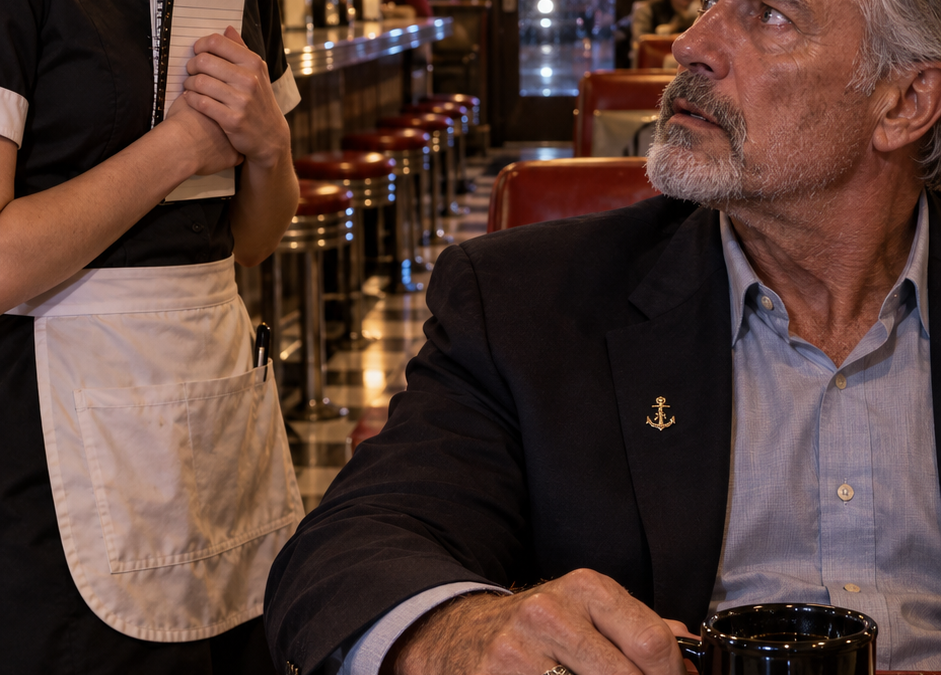
𝗣𝗔𝗥𝗧 𝟮
That was harder.
A grave gives grief a location.
My father’s disappearance gave mine a horizon.
It went on forever.
Mom kept some of his clothes for years.
I kept photographs.
One of my favorites had been taken when I was about twelve.
Dad was standing beside me near the ocean, squinting into the sunlight, his arm around my shoulder.
On his right hand was a gold ring.
The edges were worn smooth.
In the center was a trident.
I asked about it once.
He told me it wasn’t an official uniform item.
Just something that meant something to the men who had earned the right to understand it.
After he disappeared, I stared at that ring in photographs more times than I can count.
Then, fifteen years later, a forensic technician called my mother.
Human remains had been recovered years earlier in the same region where my father vanished.
At the time, they had not been identified.
New testing changed that.
Three months before I noticed the stranger’s ring, we finally received confirmation.
The remains belonged to Daniel Hale.
My father had died in Alaska.
That was essentially all the report could tell us.
Too much time had passed to determine a reliable cause.
There was no story of his last hour.
No explanation for why he left camp.
No way to know whether he fell, became injured, got lost, suffered exposure, or simply made one fatal mistake in terrain that forgave none.
For fifteen years, I had wanted certainty.
When it finally came, it was astonishing how little certainty it actually contained.
He was dead.
That was the answer.
Everything else remained blank.
I returned to work three days after we received the final paperwork.
I needed the diner.
I needed coffee orders and dirty plates and people arguing about whether hash browns counted as a vegetable.
I needed problems I could solve.
Booth three needed ketchup.
Table nine needed separate checks.
A kid had spilled chocolate milk.
An elderly man wanted his soup reheated.
Those were merciful problems.
They had answers.
By then I had worked at the diner for three years.
People assumed waitressing was simple.
Sometimes it was.
Sometimes it was an exercise in predicting human behavior.
You learned to read shoulders.
Hands.
Eyes.
The difference between impatience and embarrassment.
The difference between a customer who wanted conversation and one who wanted to be left alone.
You learned which arguments were going to end in apologies and which ones required you to quietly tell the manager to stay nearby.
My father had taught me to observe without realizing he was teaching me.
Maybe that was why I noticed the Thursday man.
Six weeks after his first visit, I still knew almost nothing about him.
He was somewhere in his sixties.
Strong without appearing obsessed with staying strong.
Short gray hair.
Clean-shaven.
Calm eyes.
He wore plain civilian clothes but carried himself with a precision that clothing couldn’t hide.
He said please.
He said thank you.
He never flirted.
He never complained.
And every Thursday, he looked tired in a way sleep probably could not fix.
That night, I approached booth six with the coffee pot.
“Top you off?”
He nodded.
“Please.”
I poured.
His right hand rested beside the cup.
That was when I saw the ring.
I stopped pouring so abruptly that the stream nearly hit the saucer.
Gold.
Smooth edges.
Trident.
For a second, the diner disappeared.
I saw my father’s hand gripping a fishing pole.
My father’s hand turning a wrench.
My father’s hand lifting mine when I was a child crossing a street.
That ring.
I had seen that ring.
The stranger noticed me staring.
I should have apologized.
Instead I heard myself say, “Sir, my father had a ring like that.”
He froze.
Completely.
It wasn’t surprise.
Surprise happens in the face.
This went through his whole body.
His shoulders locked.
His fingers stopped.
Even his breathing seemed to change.
I realized immediately that I had touched something I didn’t understand.
“I’m sorry,” I said. “I didn’t mean to—”
“Your father?”
His voice had gone lower.
“Yes.”
He looked at the ring, then back at me.
I don’t know why I kept talking.
Maybe because I had spent fifteen years swallowing every conversation about Dad before it became uncomfortable.
Maybe because grief makes you reckless around people who accidentally resemble a door.
“He died,” I said. “We only confirmed it a few months ago. He’d been missing fifteen years.”
The man’s coffee cup stopped halfway toward his mouth.
Slowly, he set it down.
“What was his name?”
There was something in his voice now that frightened me.
Not danger.
Recognition.
I swallowed.
“Daniel Hale.”
The color drained from his face.
I had seen people become pale before.
This was different.
He looked like the blood had left him from the inside.
I tightened my grip on the pot.
“They called him Ghost Rider,” I added. “At least that’s what the guys from his unit used to call him.”
The man closed his eyes.
He stayed that way long enough for me to wonder whether I should call someone.
Then he whispered, “Jesus.”
I put the coffee pot down.
“You knew him.”
It wasn’t a question.
He opened his eyes.
They looked older than they had thirty seconds earlier.
“My name is Marcus Reyes.”
He hesitated.
“Admiral Marcus Reyes. Retired.”
I knew the name.
Not personally.
But I had grown up around enough military conversations to recognize it.
My father had mentioned Reyes once or twice, though never with context.
“You served with my father.”
“For years.”
His mouth tightened.
“When I was a younger officer, your father taught me more about surviving bad decisions than any school ever did. Later, I became part of his chain of command.”
I pulled out the seat across from him.
Normally, sitting with customers during a shift would have earned me a look from my manager.
I didn’t care.
“Tell me about him.”
Reyes stared at me.
“What do you want to know?”
“Anything real.”
He looked confused.
I pressed my palms against the table.
“Everyone tells me he was a legend. Everyone tells me he was brave. Everyone tells me men trusted him. I know all that.”
My throat tightened.
“I want something real.”
Reyes leaned back.
For the first time since I’d known him, even casually, his military posture loosened.
Then he smiled.
Just a little.
“Your father hated raisins.”
I blinked.
“What?”
“Absolutely hated them. Claimed they were grapes that had lost the will to live.”
A laugh escaped me before I could stop it.
Reyes’s smile widened.
“He once traded two perfectly good field meals because both had raisins in them.”
“That sounds like him.”
“He cheated at cards.”
“My father did not cheat.”
“He called it ‘creating tactical uncertainty.'”
I covered my mouth.
I hadn’t expected laughter.
Certainly not there.
Not about him.
Reyes started telling stories.
Small ones.
Safe ones.
Stories without coordinates or classified details.
Dad singing badly when he thought nobody important could hear.
Dad keeping instant coffee packets in every possible pocket.
Dad once spending forty minutes repairing a young operator’s broken watch even though everyone else thought it was worthless.
Dad remembering the names of men’s children.
Dad making terrible jokes after missions because silence sometimes gave fear too much room.
I listened like a starving person.
For fifteen years, people had given me monuments.
Reyes gave me a man.
Then his expression changed.
The laughter disappeared.
He wrapped both hands around his coffee.
“Olivia.”
I had never told him my name.
He must have read my badge.
Still, hearing it in that tone made my skin tighten.
“There’s something else.”
My heart slowed.
“What?”
He stared into the coffee.
“Your father saved my life.”
I said nothing.
“More than once, depending on how you count. But one time in particular.”
His eyes lifted.
“I can’t give you the operational details. Not all of them. But I made a bad call. Young officer. Too much confidence. Not enough experience. Daniel recognized what was happening before I did.”
“What did he do?”
“What he always did.”
Reyes gave a humorless smile.
“He solved the problem everyone else was still trying to understand.”
He rubbed the ring with his thumb.
“I went home because your father did not.”
The sentence landed hard.
Reyes continued.
“I carried that debt for decades.”
“Then why do you look guilty?”
The question came out faster than I intended.
His face changed.
Because I had hit it.
Whatever lived beneath his stories, beneath that Thursday silence, I had touched it.
He looked toward the diner window.
When he spoke again, his voice was quieter.
“Because I have spent fifteen years wondering whether I contributed to what happened to him after he retired.”
My fingers went cold.
“What does that mean?”
Reyes did not answer immediately.
I felt irritation rise.
“You’ve had fifteen years to think about this. I’ve had five minutes. Please don’t protect me from the sentence now.”
His eyes returned to mine.
“Your father’s retirement wasn’t as simple as your family was told.”
I sat completely still.
“What happened?”
“In his final active year, Daniel found a problem inside a procurement stream attached to a classified operational program.”
“What kind of problem?”
“Equipment.”
He chose the word carefully.
“Critical equipment was being substituted with cheaper components. Specifications were being manipulated. Reports were being softened. Cost savings were being prioritized in places where cost should never have been the first concern.”
“Were people getting hurt?”
Reyes looked at me.
“Operators were being exposed to risks they should not have been exposed to.”
My father’s early retirement suddenly looked different.
“You knew?”
“I knew what Daniel believed he had found.”
“Believed?”
“At the time, the documentation was incomplete.”
“And what did you do?”
His jaw tightened.
“Not enough.”
I felt my breathing change.
Reyes continued before I could speak.
“Daniel wanted to force a formal review. He was relentless about it. He had names, shipment histories, discrepancy reports. He wanted everything examined.”
“And you stopped him.”
The words came out flat.
“I redirected him.”
“That’s a polite way of saying yes.”
He accepted that without argument.
“I thought I was protecting him.”
“From what?”
“From an institution that was already preparing to isolate him.”
“Because he found something embarrassing?”
“Because he was forcing people to acknowledge something expensive.”
I stared at him.
Reyes looked suddenly tired.
“Daniel had given nearly thirty years. He was exhausted, whether he would admit it or not. He was angry. He was fighting people who understood bureaucracy better than he did because bureaucracy was their battlefield.”
“So you pushed him into retirement.”
“I helped create a path for him to leave early without damaging his record.”
“Did he ask you to?”
The silence answered.
I leaned back.
“Wow.”
“Olivia—”
“No. Give me a second.”
I stood.
Then sat again because my knees had started shaking.
My father at the kitchen table before sunrise.
My father saying he was learning to be bored.
My father disappearing into Alaska.
All those memories shifted.
Not changed.
Shifted.
As if someone had moved a light and revealed shadows I had never noticed.
Reyes spoke quietly.
“I believed he needed peace.”
“Maybe he needed someone to listen.”
His eyes lowered.
“Yes.”
That one word stopped me.
No defense.
No explanation.
Just yes.
He took a breath.
“I told myself for years that I had made the right decision. And maybe, administratively, I did. Maybe I saved him from a fight that would have destroyed what was left of his career.”
He looked at me again.
“But I never asked what removing that fight would do to him.”
“You think he went to Alaska because of you.”
“I don’t know.”
“That’s not what I asked.”
His expression tightened.
“Yes.”
I suddenly hated the answer.
Not because I believed him.
Because I understood why he believed it.
“I’ve spent fifteen years wondering whether I took away the last thing that gave him purpose,” he said. “Whether I sent him into retirement believing I was giving him his life back, when what I actually did was remove the structure holding him together.”
My eyes burned.
“You don’t get to make his death about your guilt.”
He flinched.
Good.
I needed him to.
“My father was a grown man. He made his own decisions. You don’t get to turn his disappearance into proof that you ruined him just because guilt gives you a story you can control.”
Reyes stared at me.
I hadn’t known I believed that until I heard myself say it.
For fifteen years, I had wanted a villain.
Weather.
The wilderness.
A bad search.
A bad decision.
Someone.
Something.
Maybe guilt was just another way of making randomness feel intentional.
Reyes nodded.
“You’re right.”
“But you’re not finished.”
His expression told me I was right.
“What else?”
He looked at the table.
“There is a letter.”
I stopped breathing.
“What letter?”
“Daniel wrote to me before he went to Alaska.”
Every sound in the diner suddenly seemed too loud.
A fork hitting a plate.
The refrigerator compressor.
Someone laughing near the register.
“You have a letter from my father.”
“Yes.”
“Written before he disappeared.”
“Yes.”
“And you’ve had it for fifteen years.”
His face tightened.
“Yes.”
I stood so fast the table moved.
Reyes caught his coffee before it tipped.
I didn’t care.
“Why?”
“Olivia—”
“Why?”
People turned.
My manager looked over.
I lowered my voice because the last thing I wanted was strangers witnessing the moment my father’s ghost turned into an argument.
“Why do you have a letter from my dead father that my family has never seen?”
Reyes looked genuinely ashamed now.
“He sent it to me. It was personal.”
“Clearly.”
“I read it once.”
“And?”
“And I put it away.”
“For fifteen years?”
“I didn’t know what good it would do.”
I stared at him.
The anger was so large it became strangely calm.
“You didn’t know what good the last letter my father wrote to someone before he disappeared might do for his daughter.”
“It wasn’t a goodbye letter.”
“You don’t get points for that.”
“I know.”
“No, I don’t think you do.”
He accepted that too.
I hated how difficult it was to stay angry at someone who refused to fight back.
“I thought it would hurt your family.”
“You thought.”
“Yes.”
“You decided.”
“Yes.”
“You never asked us.”
“No.”
My voice broke.
“Fifteen years.”
Reyes looked down.
I had imagined my father writing something.
A journal.
A note.
Anything.
During the first years after he disappeared, I checked the mailbox with an irrational part of my brain that believed a letter might somehow arrive.
I searched his desk.
His books.
His truck after it was returned.
I read old birthday cards just to see his handwriting.
And this man had possessed a page written near the end.
For fifteen years.
“I want it.”
Reyes nodded immediately.
“It’s yours.”
“Don’t bring me a copy.”
“I won’t.”
“I want the original.”
“You’ll have it.”
“When?”
“Next Thursday.”
I almost laughed.
“Of course.”
He looked confused.
“Thursday.”
The same booth.
The same coffee.
The same ritual.
Fifteen years of guilt apparently needed routine.
I left the table before I said something I couldn’t take back.
For the next seven days, I barely slept.
I imagined the letter in a hundred different forms.
Maybe Dad knew he was in danger.
Maybe he named someone.
Maybe he blamed Reyes.
Maybe he hated retirement.
Maybe he regretted everything.
Maybe the letter was so ordinary that fifteen years of anticipation would collapse beneath it.
Thursday came.
At 6:12 p.m., Marcus Reyes walked through the diner door.
He stopped inside.
For the first time since he had become a regular, he didn’t immediately scan the room.
He looked only at me.
There was an envelope inside his jacket.
I knew before he touched it.
I told my manager I was taking my break.
Reyes sat in booth six.
I sat across from him.
Neither of us ordered anything.
He removed the envelope.
The paper was yellowed slightly at the edges.
My father’s handwriting was on the front.
M. Reyes.
That was all.
My hands began shaking.
Reyes slid it toward me.
“I am sorry.”
I didn’t answer.
I opened it.
The paper inside was worn at the folds.
Dad’s handwriting covered both sides.
I recognized it immediately.
Compact.
Slightly slanted.
Messier when he wrote quickly.
For several seconds, I couldn’t read.
I just touched the page.
Fifteen years.
My father’s hand had moved across that paper.
He had folded it.
Sealed it.
Sent it.
And now I was holding something he had touched before he vanished.
I started reading.
Marcus,
You were probably right.
I hated the first sentence.
I read on.
Dad wrote that continuing the fight over the procurement issue had become impossible.
Not because he believed he was wrong.
Because he could see what the fight was turning him into.
Angry.
Suspicious.
Exhausted.
He wrote that he had spent most of his adult life solving problems by identifying the threat, protecting the people beside him, and moving toward the danger.
Retirement had given him a problem with no target.
No mission.
No measurable objective.
He described civilian life as a room after someone removed all the furniture.
Nothing was technically wrong with it.
But he didn’t know where to sit.
My throat closed.
I kept reading.
He wrote about my mother.
About me.
He said we deserved more than the restless version of him wandering around the house trying to pretend freedom felt natural.
Then came the line that broke me.
I love them enough to know they cannot become my next mission.
I covered my mouth.
Reyes looked away.
Dad wrote that he was going to Alaska because he needed silence.
Not escape.
Not death.
Not danger.
Silence.
Two weeks in a place where nobody knew his rank.
Nobody needed an answer.
Nobody cared what he had once done.
He wanted to find out whether there was a version of Daniel Hale who existed after Master Chief Hale.
A husband.
A father.
A man who could wake up without needing the day to justify him.
There was no despairing farewell.
No hidden confession.
No evidence that he intended to die.
There was uncertainty.
That was all.
Ordinary, painful uncertainty.
For most of my life, I had imagined my father as someone incapable of not knowing what came next.
The letter destroyed that illusion.
And somehow gave me something better.
He had been human.
Not weak.
Not broken.
Human.
He had been searching.
Just like everyone searches eventually.
I read the letter twice.
Then a third time.
When I finally looked up, Reyes was staring at his hands.
“You read this once?”
“Yes.”
“And decided we shouldn’t see it.”
“Yes.”
“Why?”
His answer came slowly.
“Because the Daniel Hale I knew was almost mythological to people. I thought this would damage that memory.”
I felt anger rise again.
“My father didn’t belong to the people who needed him to be a myth.”
Reyes closed his eyes.
“No.”
“He belonged to us.”
“Yes.”
“My mother would have wanted this.”
“I know that now.”
“I would have wanted this.”
“I know.”
“You let me spend fifteen years thinking I didn’t understand my own father because you thought protecting his legend mattered more than letting me know the man.”
He absorbed every word.
I wanted him to argue.
Anger is easier when the other person resists.
He didn’t.
“I made that decision for you,” he said. “I had no right to.”
“No.”
“I believed I was being merciful.”
“You weren’t.”
“I know.”
I folded the letter carefully.
“I am angry with you.”
“You should be.”
“Don’t do that.”
He looked up.
“Do what?”
“Make it easy for yourself by agreeing that you’re terrible. You’re not getting absolution from me, but you’re not getting punishment either.”
He went very still.
“You made the wrong call.”
“Yes.”
“You kept something that wasn’t yours to keep.”
“Yes.”
“You will have to live with that.”
“I will.”
I looked down at the letter.
“But I don’t think you killed my father.”
Reyes stopped breathing for a second.
I continued.
“And I don’t think retirement killed him.”
His eyes shone.
“He went into wilderness alone,” I said. “Something happened. We may never know exactly what. But that letter doesn’t sound like a man walking toward death.”
Reyes looked away.
For fifteen years, he had apparently wanted someone to tell him that.
I wasn’t sure it was mine to give.
But it was mine to believe.
Dad had gone searching for himself.
The wilderness had taken him.
Those could both be true without one causing the other.
I slid the letter into its envelope.
Then I asked the question that had been bothering me since the week before.
“What happened to the equipment problem?”
Reyes looked back at me.
“The procurement issue?”
“The fraud.”
He hesitated.
“Some contracts changed eventually.”
“That’s not what I asked.”
“No.”
“So what happened?”
“The original allegation was never fully investigated.”
I stared at him.
“My father was right.”
“I believe he was.”
“And they buried it.”
“Effectively.”
“And you let that happen too.”
His face tightened.
“Yes.”
That answer changed something.
The letter was personal.
The procurement issue wasn’t.
Men had been placed at risk.
My father had tried to stop it.
People had moved him aside because solving the problem was less convenient than moving the man pointing at it.
“What can you do now?”
Reyes frowned.
“About what?”
“Don’t make me say it twice, Admiral.”
For the first time, something almost like the old officer appeared in his eyes.
He considered the question.
“I still have records.”
“What records?”
“Correspondence. Memoranda. Some discrepancy documentation. My own notes.”
“Enough?”
“Enough for what?”
“To make someone look.”
Reyes stared at me for several seconds.
I saw the moment he realized what I was asking.
His first instinct was resistance.
Not cowardice.
Calculation.
Fifteen years.
Changed personnel.
Old files.
Jurisdiction.
Classified records.
Institutional inertia.
All the invisible walls that make people decide not to try.
Then I watched something in his expression harden.
“Maybe.”
“That’s not an answer.”
He almost smiled.
“Your father used to say that.”
“Good.”
“I can formally request a historical review.”
“Will they do it?”
“They may refuse.”
“Then make them refuse in writing.”
His eyes sharpened.
That time he did smile.
“Definitely Daniel’s daughter.”
I wanted to reject the comparison.
For years I had lived beneath it.
Daniel Hale’s daughter.
Ghost Rider’s girl.
The child of a legend.
But this time it didn’t feel like a shadow.
It felt like inheritance.
Reyes filed the request the following Monday.
Nothing happened quickly.
That was the first lesson.
The second was that institutions often had a language specifically designed to make delay sound productive.
The matter was being assessed.
Relevant records were being identified.
Jurisdiction was being reviewed.
Historical documentation required authentication.
A preliminary determination remained pending.
Reyes translated every phrase for me.
“They’re stalling.”
“Why?”
“Because old mistakes are inconvenient.”
Months passed.
He came to the diner on Thursdays.
Sometimes he had updates.
Sometimes he didn’t.
Our conversations changed.
I asked about Dad.
Reyes told me things.
Once, he described a night years earlier when a mission had gone badly and everyone was waiting for extraction.
Rain.
Mud.
Bad visibility.
Tension.
A young operator had started shaking after the adrenaline crashed.
Dad sat beside him.
Said nothing.
Just handed him a piece of gum.
“What kind?” I asked.
Reyes looked confused.
“What?”
“What kind of gum?”
He laughed.
“Cinnamon.”
Dad always carried cinnamon gum.
I cried in my car after my shift that night.
Not because the story was tragic.
Because it was ordinary.
My father had become real in pieces.
A joke.
A bad habit.
A piece of gum.
A letter.
A decision.
That was what grief had denied me.
Not merely his body.
His dimensions.
Eventually the review became formal.
Records surfaced.
Old procurement reports.
Contract substitutions.
Testing deviations.
Internal warnings written in language carefully designed to avoid accusing anyone directly.
Reyes’s testimony mattered.
So did the material Dad had compiled before retirement.
The case was less dramatic than stories make corruption sound.
There was no secret room full of men plotting to kill operators.
No single villain twirling a metaphorical mustache.
The truth was worse in a more ordinary way.
A supplier had substituted cheaper components.
People responsible for oversight had accepted explanations they should have challenged.
Managers had been rewarded for reducing costs.
Deficiencies had been minimized.
Warnings were categorized as isolated.
Every individual decision was small enough to defend.
Together, they created risk.
My father had seen the pattern.
He had tried to force people to acknowledge the whole.
Instead, the system treated him as the disruptive element.
The review concluded that his concerns had been substantially justified.
I read that sentence six times.
Substantially justified.
Those two clinical words represented years of his frustration.
Reyes called me the day the finding became official.
I was standing behind the diner pouring iced tea.
“They confirmed it.”
I stepped into the storage room.
“Confirmed what?”
“Daniel was right.”
I leaned against a shelf.
“All of it?”
“Enough.”
I closed my eyes.
There are moments when vindication feels triumphant.
This wasn’t one of them.
Dad was still dead.
Fifteen years were still gone.
My mother had still spent those years wondering.
The correction could not travel backward in time.
It could only change the record.
But records matter.
Stories matter.
What institutions write down becomes what future people are told happened.
For fifteen years, my father’s final year in service had been documented as an ordinary retirement.
Now it wasn’t.
The corrected review acknowledged that he had identified procurement deficiencies, pushed for formal scrutiny, and encountered resistance that contributed to the circumstances surrounding his departure.
It didn’t accuse everyone of conspiracy.
It didn’t turn Dad into a saint.
It simply told the truth.
That was enough.
A few months later, I was invited to a private briefing.
No press.
No podium.
No giant American flag backdrop.
Just a secure conference room, Reyes, several officers, two civilian officials, my mother, and me.
Mom wore Dad’s old watch.
I carried his letter.
The reviewing officer spoke for maybe twenty minutes.
Most of it was institutional language.
Then he stopped reading.
He removed his glasses.
And looked directly at my mother.
“Mrs. Hale, your husband identified a real safety problem before the organization was prepared to acknowledge it.”
Mom’s fingers closed around mine.
“He should have been heard sooner.”
Four words.
Should have been heard.
My mother lowered her head.
I felt her shoulders shake once.
Just once.
Reyes stared at the table.
The officer continued.
“The official record will reflect his role.”
I expected relief.
Instead I felt grief.
Pure and uncomplicated.
Because justice arriving late is still late.
It may correct history.
It cannot correct time.
Afterward, Mom stood in the hallway holding the folder containing the findings.
She looked at me.
“Your father would hate all this attention.”
I laughed through tears.
“He’d complain for weeks.”
“He’d pretend he didn’t care.”
“Then frame the letter.”
She smiled.
For the first time in years, talking about Dad didn’t feel like walking around a hole.
It felt like remembering a person.
Reyes joined us several minutes later.
Mom looked at him.
He seemed more afraid of her than he had been of any review board.
“You kept his letter,” she said.
Reyes nodded.
“I did.”
“For fifteen years.”
“Yes, ma’am.”
She studied him.
I didn’t interfere.
Finally she said, “That was a terrible decision.”
“I know.”
“My husband made plenty of those too.”
Reyes looked startled.
Mom continued.
“He once bought a boat without telling me.”
I stared at her.
“What boat?”
“Exactly.”
For the first time, Reyes laughed in front of my mother.
Then she stepped closer.
“I’m angry with you.”
His smile disappeared.
“You have every right.”
“But my husband trusted you enough to send that letter.”
Reyes swallowed.
“I don’t know what to do with that yet.”
“Neither do I.”
Mom nodded.
“Then maybe we don’t have to decide today.”
That became our family’s version of forgiveness.
Not erasing.
Not pretending.
Making room.
Reyes continued visiting the diner.
Thursday.
Booth six.
Coffee.
Eggs.
Toast.
Bacon.
But he talked more.
He asked about my life.
Not merely Dad.
That surprised me.
For most of my adult life, people connected to the military had looked at me and seen Daniel Hale first.
Reyes began seeing me.
One Thursday, after watching me deal with an angry customer who had decided a twelve-minute wait for pancakes constituted a personal attack, he said something that stayed with me.
“You know you do it too.”
I put the coffee pot down.
“Do what?”
“Your father had this way of getting quieter when everyone else got louder.”
I looked at him.
“You just watched me threaten a man with decaf.”
“Strategically.”
“He deserved it.”
“He did.”
Reyes smiled.
“But I’m serious. You get calm when things fall apart.”
“Occupational hazard.”
“No.”
His expression became thoughtful.
“That’s Daniel.”
I felt my defenses rise automatically.
“I am not my father.”
“I didn’t say you were.”
“People have been comparing me to him since I was old enough to understand his job.”
“I’m not comparing careers.”
“Then what?”
“I’m telling you that something good in him survived.”
That silenced me.
Reyes rubbed his thumb across his ring.
“Not the operator. Not the legend. The steadiness.”
I looked away.
He continued.
“I work with a foundation.”
I groaned.
“That sounds like the beginning of a job offer.”
“It isn’t.”
“That’s exactly what people say before job offers.”
“It’s volunteer work.”
“Even worse.”
He laughed.
Then explained.
The organization assisted families of military personnel whose deaths or disappearances had remained unresolved for extended periods.
Some involved missing aircraft.
Some unidentified remains.
Some administrative errors.
Some records that never reached the right people.
Others simply involved families trapped for years between “missing” and “dead,” the same terrible territory my mother and I had inhabited.
“They need people who understand ambiguous loss,” Reyes said.
I hated the term.
It sounded too clean.
Too academic.
But it was accurate.
Loss without certainty.
Grief without edges.
“What would I do?”
“Sit with people.”
“That’s it?”
“Sometimes that’s everything.”
I crossed my arms.
“I’m a waitress.”
“You’re a woman who spent fifteen years hearing people say things they thought were comforting when they weren’t.”
That made me laugh.
“Fair.”
“You know what not to say.”
“Also fair.”
“You know paperwork can feel violent when it reduces someone you love to a case number.”
My smile faded.
“You know what it’s like when a family finally gets an answer and discovers the answer doesn’t fix everything.”
I looked at Dad’s ring in my mind.
“What if I’m bad at it?”
“You won’t be.”
“You sound awfully certain.”
“I watched your father walk into situations with less certainty than you’re showing right now.”
I stared at him.
“Was that supposed to help?”
“No.”
“Good.”
I didn’t say yes.
Not that day.
For three weeks, I thought about it.
I had spent years telling myself that the diner was enough.
It paid my bills.
I liked the people.
There was dignity in work that required patience and endurance.
I didn’t need some dramatic destiny simply because my father had lived an extraordinary life.
Dad’s shadow had already occupied enough space.
But the foundation wasn’t asking me to become him.
That was the part I kept returning to.
It was asking me to become useful as myself.
I agreed to one afternoon.
No commitment.
No grand plan.
Just one.
The first family I met had been waiting nine years for confirmation about a son lost during an overseas training accident.
His mother kept apologizing for crying.
“I thought I’d be better at this by now,” she said.
I knew that sentence.
I had said versions of it for fifteen years.
I reached across the table.
“There’s no schedule.”
She looked at me.
“For what?”
“Being good at missing someone.”
Her face changed.
Then she cried harder.
So did I.
Afterward, I sat in my car for almost an hour.
Then I called Reyes.
“I’ll do another day.”
He didn’t sound surprised.
Within months, another day became two days a week.
I still worked at the diner.
I wanted to.
The ordinary mattered.
The coffee.
The plates.
The predictable Thursday breakfast.
You don’t survive fifteen years of uncertainty by deciding ordinary life is beneath you.
You survive because ordinary life keeps giving you somewhere to stand.
But I changed.
Not dramatically.
No cinematic transformation.
I simply stopped treating my father’s absence as the central definition of my life.
For years, when people asked about my family, I had thought first:
My father disappeared.
Then:
My father died.
Eventually, something shifted.
My father lived.
He loved cinnamon gum.
He hated raisins.
He cheated at cards.
He saved lives.
He made mistakes.
He struggled after retirement.
He wrote a letter.
He tried to expose a problem people wanted ignored.
He went fishing in Alaska.
He never came home.
All of those sentences belonged to him.
Not just the last one.
About a year after Reyes first walked into my section, my mother gave me a small box.
We were sitting in her kitchen.
“What is it?”
“You know what it is.”
I opened it.
Dad’s ring rested inside.
Gold.
Worn smooth.
Trident.
I stared at her.
“Mom.”
“It should be worn.”
“I can’t wear this.”
“Why not?”
“I didn’t earn it.”
She shook her head.
“I’m not asking you to pretend you earned what the symbol meant in his profession.”
“Then what am I supposed to do?”
“Wear your father’s ring.”
I touched it.
For years, it had felt almost sacred.
Like a relic from a world I had no right to enter.
Mom watched me.
“He was my husband before he was anyone’s legend,” she said. “And he was your father before he was Ghost Rider.”
We had it resized.
I started wearing it on my right hand.
Not every day.
Only when I wanted him close.
The following Thursday, Reyes came into the diner.
He reached booth six before he noticed.
His eyes dropped to my hand.
He stopped.
For several seconds, neither of us spoke.
Then he touched his own ring.
“Looks better on you.”
I shook my head.
“Flattery won’t improve your coffee.”
“I’ve been drinking your coffee for a year. I abandoned hope months ago.”
“Careful, Admiral.”
He smiled.
I poured his cup.
For a moment, I remembered the first night.
The shock on his face.
The way my world had shifted because I noticed a piece of gold around a stranger’s finger.
If I hadn’t seen it, maybe Dad’s letter would still be in a drawer.
Maybe Reyes would still believe he had caused my father’s death.
Maybe the procurement record would still be wrong.
Maybe my mother would still know only half the story of the man she married.
Maybe I would still think closure meant discovering exactly how someone died.
I know better now.
Closure isn’t a door.
It doesn’t swing shut and stay shut.
It is learning to live with a story after enough of the missing pages have finally been returned.
I still don’t know exactly what happened to my father in Alaska.
I don’t know what his final thoughts were.
I don’t know whether he slipped.
Whether weather trapped him.
Whether an injury slowed him.
Whether he knew he wasn’t coming home.
There are questions I will carry for the rest of my life.
But they are no longer the only thing I carry.
I carry his letter.
I carry the stories Reyes told me.
I carry my mother’s memories.
I carry the corrected record.
I carry a gold ring worn smooth by my father’s hand.
Most of all, I carry the knowledge that Daniel Hale did not spend the last months of his life as the invincible legend everyone imagined.
He spent them as a man.
A husband worried about disappointing his wife.
A father afraid he had forgotten how to simply be present.
A retired warrior trying to understand who he was when nobody needed him to fight anymore.
For years, I thought learning that truth would somehow make him smaller.
It did the opposite.
Legends are easy to admire.
People are harder.
People are uncertain.
They get tired.
They make wrong decisions.
They hide pain because they don’t know how to explain it.
They leave letters with friends.
They go into the wilderness looking for answers.
Sometimes they don’t come back.
My father had spent his career being remembered for his strength.
What finally allowed me to know him was discovering his uncertainty.
And Marcus Reyes had spent fifteen years believing silence protected the people left behind.
In the end, silence had protected nothing.
Truth hurt.
The letter hurt.
The investigation hurt.
Learning how many years had been lost to other people’s caution hurt.
But pain with a shape was easier to carry than emptiness without one.
Reyes eventually told me why he had started coming to the diner every Thursday.
It had nothing to do with my father.
At least not consciously.
His wife had died two years earlier.
Thursday had been the night they went out for breakfast-for-dinner when he was finally home long enough to keep a routine.
After she died, he kept going.
Different restaurant at first.
Then ours.
Same day.
Same meal.
He said routine gave grief somewhere to report for duty.
That sounded like something Dad would have understood.
So every Thursday, I saved booth six when I could.
Reyes ordered his breakfast.
I insulted his taste in coffee.
Sometimes we talked about Dad.
Sometimes we talked about nothing important at all.
That became important too.
One evening, near closing, Reyes turned his ring slowly around his finger.
“Do you ever wish you hadn’t asked me about this?”
I looked at my father’s ring.
“No.”
“Even knowing what it cost?”
I thought about that.
The anger.
The months of investigation.
The new grief.
The old grief reopened.
My mother’s tears in the briefing room.
Reyes’s guilt.
The letter.
Then I thought about the woman at the foundation who had apologized for still missing her son after nine years.
I thought about the corrected record.
I thought about Dad’s handwriting.
“No,” I said again.
Reyes nodded.
I collected his plate.
As I turned away, he spoke.
“Olivia.”
I looked back.
“Your father would be proud of you.”
There was a time when those words would have broken me.
Because I could never ask Dad if they were true.
That night, they didn’t.
I smiled.
“I know.”
And for the first time since my father disappeared into the Alaskan wilderness fifteen years earlier, I realized I actually did.
Have you finished reading the story and want to read it again?
The SEAL Ring on His Hand Looked Exactly Like My Father’s—So I Asked One Question I Never Expected Him to Answer
For fifteen years, I had no idea how my father died.
Then I saw his ring on the hand of a stranger sitting alone in my diner.
When I said my father’s name, an admiral looked at me like the dead had just walked through the door.
PART2
Every Thursday night, the man sat in booth six.
Always alone.
Always facing the front door.
Always with his back protected by the wall.
I noticed things like that.
Most waitresses probably would have remembered him because he tipped well, never complained, and ordered exactly the same thing every week. Black coffee. Two eggs over medium. Wheat toast. Bacon crisp enough to snap but not burned.
I remembered him because of the way he entered a room.
He never looked nervous.
He looked aware.
There was a difference.
The first time he came in, he paused just inside the diner long enough to sweep his eyes across the exits, the kitchen entrance, the register, and the people sitting closest to the windows.
Nobody else seemed to notice.
I did.
I had grown up watching men do that.
My father had spent nearly thirty years in Naval Special Warfare, and although he never explained much about what he actually did, certain habits followed him home.
He always knew where the doors were.
He disliked sitting with his back exposed.
He could walk into a crowded restaurant and tell you who was drunk, who was angry, who was carrying something heavy beneath a jacket, and which couple was about to start an argument before either of them raised their voices.
As a little girl, I thought all fathers noticed those things.
It took me years to understand mine had been trained to.
His name was Master Chief Daniel Hale.
To me, he was Dad.
To men who had served with him, he was Ghost Rider.
I never knew exactly how he earned the name.
Whenever I asked, he would smile, touch the end of my nose, and tell me that some stories belonged to a younger and considerably stupider version of himself.
Then he would change the subject.
Other men never laughed when they heard the call sign.
That told me more than my father ever did.
I learned early that there were two Daniel Hales.
There was the man who stood barefoot in our kitchen making pancakes shaped like animals he clearly did not possess the artistic ability to create.
And there was Master Chief Hale, the man other operators fell silent around.
I knew the first man.
I spent most of my life trying to understand the second.
Then, when I was nineteen, both of them seemed to disappear at once.
Dad retired quietly after almost three decades in uniform.
There was no giant party.
No dramatic speech.
No line of people waiting to shake his hand.
At least not one I saw.
He came home one afternoon carrying two cardboard boxes, set them on the dining room floor, and announced that he was officially unemployed.
My mother cried.
I laughed.
Dad opened a beer.
For the first few months, retirement almost seemed to suit him.
He fixed everything that had been broken in our house since I was in middle school.
A cabinet hinge.
The back fence.
A leaking outdoor faucet.
The old porch light Mom had been complaining about for six years.
He bought fishing equipment.
He planted tomatoes even though he had no idea how to grow tomatoes.
He started waking up at six instead of four.
From a distance, he looked peaceful.
I know now that peace and emptiness can sometimes wear the same face.
At the time, I was too young to recognize the difference.
There were mornings when I came downstairs and found him sitting at the kitchen table before sunrise with a cup of coffee growing cold between his hands.
He wouldn’t be reading.
Wouldn’t be watching television.
Wouldn’t even be looking out the window.
He would simply be sitting there.
Still.
Sometimes I would ask if he was all right.
He always gave me the same answer.
“Just learning how to be bored, Liv.”
I believed him.
I wish I hadn’t.
Eighteen months after he retired, he told my mother he wanted to take a fishing trip to Alaska.
Two weeks.
No phone.
No schedule.
No people.
Just a truck, a pack, a tent, and more fishing equipment than any reasonable human being needed.
Mom didn’t love the idea.
But she understood him well enough not to turn concern into a cage.
He promised to check in as soon as he came back within range.
He kissed her.
He called me the night before his flight.
I remember that phone call with the cruelty of perfect clarity.
I was twenty-one, irritated about something so insignificant that I can no longer remember what it was.
Work, probably.
Or a boyfriend.
Maybe rent.
He asked how I was.
I gave him the short version.
Then he told me he was proud of me.
For no reason.
Just dropped it into the middle of the conversation.
“I’m proud of you, Liv.”
I laughed.
“For what?”
“For becoming someone who can handle herself.”
“That sounds suspiciously like you’re admitting you worried about me.”
“I worry about everyone.”
“You definitely don’t.”
He chuckled.
Then he said something that stayed with me.
“You don’t have to spend your whole life proving you’re tough just because you grew up around tough people.”
I told him I knew.
I didn’t.
We said good night.
That was the last time I heard his voice.
Two weeks passed.
Then three.
He never called.
Search teams found his truck at the trailhead exactly where he said he would leave it.
They found his camp farther in.
His tent was intact.
Some food remained.
A few supplies were scattered as if he had expected to return.
They found evidence that he had traveled deeper into the wilderness.
Then nothing.
For three weeks, people searched.
State troopers.
Rescue teams.
Volunteers.
Aircraft.
People from his old military community whose names I never learned.
Alaska was vast enough to make even trained men look small.
Eventually the search ended.
There was no body.
No clear accident.
No final message.
No explanation.
Just absence.
That was how my family lost Daniel Hale.
Not with a funeral.
Not with certainty.
With a question mark.
For years, that question mark followed me everywhere.
When strangers asked whether my father was alive, I never knew how to answer.
Technically?
Probably not.
Legally?
Eventually, he was declared presumed dead.
Emotionally?
That was harder.
A grave gives grief a location.
My father’s disappearance gave mine a horizon.
It went on forever.
Mom kept some of his clothes for years.
I kept photographs.
One of my favorites had been taken when I was about twelve.
Dad was standing beside me near the ocean, squinting into the sunlight, his arm around my shoulder.
On his right hand was a gold ring.
The edges were worn smooth.
In the center was a trident.
I asked about it once.
He told me it wasn’t an official uniform item.
Just something that meant something to the men who had earned the right to understand it.
After he disappeared, I stared at that ring in photographs more times than I can count.
Then, fifteen years later, a forensic technician called my mother.
Human remains had been recovered years earlier in the same region where my father vanished.
At the time, they had not been identified.
New testing changed that.
Three months before I noticed the stranger’s ring, we finally received confirmation.
The remains belonged to Daniel Hale.
My father had died in Alaska.
That was essentially all the report could tell us.
Too much time had passed to determine a reliable cause.
There was no story of his last hour.
No explanation for why he left camp.
No way to know whether he fell, became injured, got lost, suffered exposure, or simply made one fatal mistake in terrain that forgave none.
For fifteen years, I had wanted certainty.
When it finally came, it was astonishing how little certainty it actually contained.
He was dead.
That was the answer.
Everything else remained blank.
I returned to work three days after we received the final paperwork.
I needed the diner.
I needed coffee orders and dirty plates and people arguing about whether hash browns counted as a vegetable.
I needed problems I could solve.
Booth three needed ketchup.
Table nine needed separate checks.
A kid had spilled chocolate milk.
An elderly man wanted his soup reheated.
Those were merciful problems.
They had answers.
By then I had worked at the diner for three years.
People assumed waitressing was simple.
Sometimes it was.
Sometimes it was an exercise in predicting human behavior.
You learned to read shoulders.
Hands.
Eyes.
The difference between impatience and embarrassment.
The difference between a customer who wanted conversation and one who wanted to be left alone.
You learned which arguments were going to end in apologies and which ones required you to quietly tell the manager to stay nearby.
My father had taught me to observe without realizing he was teaching me.
Maybe that was why I noticed the Thursday man.
Six weeks after his first visit, I still knew almost nothing about him.
He was somewhere in his sixties.
Strong without appearing obsessed with staying strong.
Short gray hair.
Clean-shaven.
Calm eyes.
He wore plain civilian clothes but carried himself with a precision that clothing couldn’t hide.
He said please.
He said thank you.
He never flirted.
He never complained.
And every Thursday, he looked tired in a way sleep probably could not fix.
That night, I approached booth six with the coffee pot.
“Top you off?”
He nodded.
“Please.”
I poured.
His right hand rested beside the cup.
That was when I saw the ring.
I stopped pouring so abruptly that the stream nearly hit the saucer.
Gold.
Smooth edges.
Trident.
For a second, the diner disappeared.
I saw my father’s hand gripping a fishing pole.
My father’s hand turning a wrench.
My father’s hand lifting mine when I was a child crossing a street.
That ring.
I had seen that ring.
The stranger noticed me staring.
I should have apologized.
Instead I heard myself say, “Sir, my father had a ring like that.”
He froze.
Completely.
It wasn’t surprise.
Surprise happens in the face.
This went through his whole body.
His shoulders locked.
His fingers stopped.
Even his breathing seemed to change.
I realized immediately that I had touched something I didn’t understand.
“I’m sorry,” I said. “I didn’t mean to—”
“Your father?”
His voice had gone lower.
“Yes.”
He looked at the ring, then back at me.
I don’t know why I kept talking.
Maybe because I had spent fifteen years swallowing every conversation about Dad before it became uncomfortable.
Maybe because grief makes you reckless around people who accidentally resemble a door.
“He died,” I said. “We only confirmed it a few months ago. He’d been missing fifteen years.”
The man’s coffee cup stopped halfway toward his mouth.
Slowly, he set it down.
“What was his name?”
There was something in his voice now that frightened me.
Not danger.
Recognition.
I swallowed.
“Daniel Hale.”
The color drained from his face.
I had seen people become pale before.
This was different.
He looked like the blood had left him from the inside.
I tightened my grip on the pot.
“They called him Ghost Rider,” I added. “At least that’s what the guys from his unit used to call him.”
The man closed his eyes.
He stayed that way long enough for me to wonder whether I should call someone.
Then he whispered, “Jesus.”
I put the coffee pot down.
“You knew him.”
It wasn’t a question.
He opened his eyes.
They looked older than they had thirty seconds earlier.
“My name is Marcus Reyes.”
He hesitated.
“Admiral Marcus Reyes. Retired.”
I knew the name.
Not personally.
But I had grown up around enough military conversations to recognize it.
My father had mentioned Reyes once or twice, though never with context.
“You served with my father.”
“For years.”
His mouth tightened.
“When I was a younger officer, your father taught me more about surviving bad decisions than any school ever did. Later, I became part of his chain of command.”
I pulled out the seat across from him.
Normally, sitting with customers during a shift would have earned me a look from my manager.
I didn’t care.
“Tell me about him.”
Reyes stared at me.
“What do you want to know?”
“Anything real.”
He looked confused.
I pressed my palms against the table.
“Everyone tells me he was a legend. Everyone tells me he was brave. Everyone tells me men trusted him. I know all that.”
My throat tightened.
“I want something real.”
Reyes leaned back.
For the first time since I’d known him, even casually, his military posture loosened.
Then he smiled.
Just a little.
“Your father hated raisins.”
I blinked.
“What?”
“Absolutely hated them. Claimed they were grapes that had lost the will to live.”
A laugh escaped me before I could stop it.
Reyes’s smile widened.
“He once traded two perfectly good field meals because both had raisins in them.”
“That sounds like him.”
“He cheated at cards.”
“My father did not cheat.”
“He called it ‘creating tactical uncertainty.'”
I covered my mouth.
I hadn’t expected laughter.
Certainly not there.
Not about him.
Reyes started telling stories.
Small ones.
Safe ones.
Stories without coordinates or classified details.
Dad singing badly when he thought nobody important could hear.
Dad keeping instant coffee packets in every possible pocket.
Dad once spending forty minutes repairing a young operator’s broken watch even though everyone else thought it was worthless.
Dad remembering the names of men’s children.
Dad making terrible jokes after missions because silence sometimes gave fear too much room.
I listened like a starving person.
For fifteen years, people had given me monuments.
Reyes gave me a man.
Then his expression changed.
The laughter disappeared.
He wrapped both hands around his coffee.
“Olivia.”
I had never told him my name.
He must have read my badge.
Still, hearing it in that tone made my skin tighten.
“There’s something else.”
My heart slowed.
“What?”
He stared into the coffee.
“Your father saved my life.”
I said nothing.
“More than once, depending on how you count. But one time in particular.”
His eyes lifted.
“I can’t give you the operational details. Not all of them. But I made a bad call. Young officer. Too much confidence. Not enough experience. Daniel recognized what was happening before I did.”
“What did he do?”
“What he always did.”
Reyes gave a humorless smile.
“He solved the problem everyone else was still trying to understand.”
He rubbed the ring with his thumb.
“I went home because your father did not.”
The sentence landed hard.
Reyes continued.
“I carried that debt for decades.”
“Then why do you look guilty?”
The question came out faster than I intended.
His face changed.
Because I had hit it.
Whatever lived beneath his stories, beneath that Thursday silence, I had touched it.
He looked toward the diner window.
When he spoke again, his voice was quieter.
“Because I have spent fifteen years wondering whether I contributed to what happened to him after he retired.”
My fingers went cold.
“What does that mean?”
Reyes did not answer immediately.
I felt irritation rise.
“You’ve had fifteen years to think about this. I’ve had five minutes. Please don’t protect me from the sentence now.”
His eyes returned to mine.
“Your father’s retirement wasn’t as simple as your family was told.”
I sat completely still.
“What happened?”
“In his final active year, Daniel found a problem inside a procurement stream attached to a classified operational program.”
“What kind of problem?”
“Equipment.”
He chose the word carefully.
“Critical equipment was being substituted with cheaper components. Specifications were being manipulated. Reports were being softened. Cost savings were being prioritized in places where cost should never have been the first concern.”
“Were people getting hurt?”
Reyes looked at me.
“Operators were being exposed to risks they should not have been exposed to.”
My father’s early retirement suddenly looked different.
“You knew?”
“I knew what Daniel believed he had found.”
“Believed?”
“At the time, the documentation was incomplete.”
“And what did you do?”
His jaw tightened.
“Not enough.”
I felt my breathing change.
Reyes continued before I could speak.
“Daniel wanted to force a formal review. He was relentless about it. He had names, shipment histories, discrepancy reports. He wanted everything examined.”
“And you stopped him.”
The words came out flat.
“I redirected him.”
“That’s a polite way of saying yes.”
He accepted that without argument.
“I thought I was protecting him.”
“From what?”
“From an institution that was already preparing to isolate him.”
“Because he found something embarrassing?”
“Because he was forcing people to acknowledge something expensive.”
I stared at him.
Reyes looked suddenly tired.
“Daniel had given nearly thirty years. He was exhausted, whether he would admit it or not. He was angry. He was fighting people who understood bureaucracy better than he did because bureaucracy was their battlefield.”
“So you pushed him into retirement.”
“I helped create a path for him to leave early without damaging his record.”
“Did he ask you to?”
The silence answered.
I leaned back.
“Wow.”
“Olivia—”
“No. Give me a second.”
I stood.
Then sat again because my knees had started shaking.
My father at the kitchen table before sunrise.
My father saying he was learning to be bored.
My father disappearing into Alaska.
All those memories shifted.
Not changed.
Shifted.
As if someone had moved a light and revealed shadows I had never noticed.
Reyes spoke quietly.
“I believed he needed peace.”
“Maybe he needed someone to listen.”
His eyes lowered.
“Yes.”
That one word stopped me.
No defense.
No explanation.
Just yes.
He took a breath.
“I told myself for years that I had made the right decision. And maybe, administratively, I did. Maybe I saved him from a fight that would have destroyed what was left of his career.”
He looked at me again.
“But I never asked what removing that fight would do to him.”
“You think he went to Alaska because of you.”
“I don’t know.”
“That’s not what I asked.”
His expression tightened.
“Yes.”
I suddenly hated the answer.
Not because I believed him.
Because I understood why he believed it.
“I’ve spent fifteen years wondering whether I took away the last thing that gave him purpose,” he said. “Whether I sent him into retirement believing I was giving him his life back, when what I actually did was remove the structure holding him together.”
My eyes burned.
“You don’t get to make his death about your guilt.”
He flinched.
Good.
I needed him to.
“My father was a grown man. He made his own decisions. You don’t get to turn his disappearance into proof that you ruined him just because guilt gives you a story you can control.”
Reyes stared at me.
I hadn’t known I believed that until I heard myself say it.
For fifteen years, I had wanted a villain.
Weather.
The wilderness.
A bad search.
A bad decision.
Someone.
Something.
Maybe guilt was just another way of making randomness feel intentional.
Reyes nodded.
“You’re right.”
“But you’re not finished.”
His expression told me I was right.
“What else?”
He looked at the table.
“There is a letter.”
I stopped breathing.
“What letter?”
“Daniel wrote to me before he went to Alaska.”
Every sound in the diner suddenly seemed too loud.
A fork hitting a plate.
The refrigerator compressor.
Someone laughing near the register.
“You have a letter from my father.”
“Yes.”
“Written before he disappeared.”
“Yes.”
“And you’ve had it for fifteen years.”
His face tightened.
“Yes.”
I stood so fast the table moved.
Reyes caught his coffee before it tipped.
I didn’t care.
“Why?”
“Olivia—”
“Why?”
People turned.
My manager looked over.
I lowered my voice because the last thing I wanted was strangers witnessing the moment my father’s ghost turned into an argument.
“Why do you have a letter from my dead father that my family has never seen?”
Reyes looked genuinely ashamed now.
“He sent it to me. It was personal.”
“Clearly.”
“I read it once.”
“And?”
“And I put it away.”
“For fifteen years?”
“I didn’t know what good it would do.”
I stared at him.
The anger was so large it became strangely calm.
“You didn’t know what good the last letter my father wrote to someone before he disappeared might do for his daughter.”
“It wasn’t a goodbye letter.”
“You don’t get points for that.”
“I know.”
“No, I don’t think you do.”
He accepted that too.
I hated how difficult it was to stay angry at someone who refused to fight back.
“I thought it would hurt your family.”
“You thought.”
“Yes.”
“You decided.”
“Yes.”
“You never asked us.”
“No.”
My voice broke.
“Fifteen years.”
Reyes looked down.
I had imagined my father writing something.
A journal.
A note.
Anything.
During the first years after he disappeared, I checked the mailbox with an irrational part of my brain that believed a letter might somehow arrive.
I searched his desk.
His books.
His truck after it was returned.
I read old birthday cards just to see his handwriting.
And this man had possessed a page written near the end.
For fifteen years.
“I want it.”
Reyes nodded immediately.
“It’s yours.”
“Don’t bring me a copy.”
“I won’t.”
“I want the original.”
“You’ll have it.”
“When?”
“Next Thursday.”
I almost laughed.
“Of course.”
He looked confused.
“Thursday.”
The same booth.
The same coffee.
The same ritual.
Fifteen years of guilt apparently needed routine.
I left the table before I said something I couldn’t take back.
For the next seven days, I barely slept.
I imagined the letter in a hundred different forms.
Maybe Dad knew he was in danger.
Maybe he named someone.
Maybe he blamed Reyes.
Maybe he hated retirement.
Maybe he regretted everything.
Maybe the letter was so ordinary that fifteen years of anticipation would collapse beneath it.
Thursday came.
At 6:12 p.m., Marcus Reyes walked through the diner door.
He stopped inside.
For the first time since he had become a regular, he didn’t immediately scan the room.
He looked only at me.
There was an envelope inside his jacket.
I knew before he touched it.
I told my manager I was taking my break.
Reyes sat in booth six.
I sat across from him.
Neither of us ordered anything.
He removed the envelope.
The paper was yellowed slightly at the edges.
My father’s handwriting was on the front.
M. Reyes.
That was all.
My hands began shaking.
Reyes slid it toward me.
“I am sorry.”
I didn’t answer.
I opened it.
The paper inside was worn at the folds.
Dad’s handwriting covered both sides.
I recognized it immediately.
Compact.
Slightly slanted.
Messier when he wrote quickly.
For several seconds, I couldn’t read.
I just touched the page.
Fifteen years.
My father’s hand had moved across that paper.
He had folded it.
Sealed it.
Sent it.
And now I was holding something he had touched before he vanished.
I started reading.
Marcus,
You were probably right.
I hated the first sentence.
I read on.
Dad wrote that continuing the fight over the procurement issue had become impossible.
Not because he believed he was wrong.
Because he could see what the fight was turning him into.
Angry.
Suspicious.
Exhausted.
He wrote that he had spent most of his adult life solving problems by identifying the threat, protecting the people beside him, and moving toward the danger.
Retirement had given him a problem with no target.
No mission.
No measurable objective.
He described civilian life as a room after someone removed all the furniture.
Nothing was technically wrong with it.
But he didn’t know where to sit.
My throat closed.
I kept reading.
He wrote about my mother.
About me.
He said we deserved more than the restless version of him wandering around the house trying to pretend freedom felt natural.
Then came the line that broke me.
I love them enough to know they cannot become my next mission.
I covered my mouth.
Reyes looked away.
Dad wrote that he was going to Alaska because he needed silence.
Not escape.
Not death.
Not danger.
Silence.
Two weeks in a place where nobody knew his rank.
Nobody needed an answer.
Nobody cared what he had once done.
He wanted to find out whether there was a version of Daniel Hale who existed after Master Chief Hale.
A husband.
A father.
A man who could wake up without needing the day to justify him.
There was no despairing farewell.
No hidden confession.
No evidence that he intended to die.
There was uncertainty.
That was all.
Ordinary, painful uncertainty.
For most of my life, I had imagined my father as someone incapable of not knowing what came next.
The letter destroyed that illusion.
And somehow gave me something better.
He had been human.
Not weak.
Not broken.
Human.
He had been searching.
Just like everyone searches eventually.
I read the letter twice.
Then a third time.
When I finally looked up, Reyes was staring at his hands.
“You read this once?”
“Yes.”
“And decided we shouldn’t see it.”
“Yes.”
“Why?”
His answer came slowly.
“Because the Daniel Hale I knew was almost mythological to people. I thought this would damage that memory.”
I felt anger rise again.
“My father didn’t belong to the people who needed him to be a myth.”
Reyes closed his eyes.
“No.”
“He belonged to us.”
“Yes.”
“My mother would have wanted this.”
“I know that now.”
“I would have wanted this.”
“I know.”
“You let me spend fifteen years thinking I didn’t understand my own father because you thought protecting his legend mattered more than letting me know the man.”
He absorbed every word.
I wanted him to argue.
Anger is easier when the other person resists.
He didn’t.
“I made that decision for you,” he said. “I had no right to.”
“No.”
“I believed I was being merciful.”
“You weren’t.”
“I know.”
I folded the letter carefully.
“I am angry with you.”
“You should be.”
“Don’t do that.”
He looked up.
“Do what?”
“Make it easy for yourself by agreeing that you’re terrible. You’re not getting absolution from me, but you’re not getting punishment either.”
He went very still.
“You made the wrong call.”
“Yes.”
“You kept something that wasn’t yours to keep.”
“Yes.”
“You will have to live with that.”
“I will.”
I looked down at the letter.
“But I don’t think you killed my father.”
Reyes stopped breathing for a second.
I continued.
“And I don’t think retirement killed him.”
His eyes shone.
“He went into wilderness alone,” I said. “Something happened. We may never know exactly what. But that letter doesn’t sound like a man walking toward death.”
Reyes looked away.
For fifteen years, he had apparently wanted someone to tell him that.
I wasn’t sure it was mine to give.
But it was mine to believe.
Dad had gone searching for himself.
The wilderness had taken him.
Those could both be true without one causing the other.
I slid the letter into its envelope.
Then I asked the question that had been bothering me since the week before.
“What happened to the equipment problem?”
Reyes looked back at me.
“The procurement issue?”
“The fraud.”
He hesitated.
“Some contracts changed eventually.”
“That’s not what I asked.”
“No.”
“So what happened?”
“The original allegation was never fully investigated.”
I stared at him.
“My father was right.”
“I believe he was.”
“And they buried it.”
“Effectively.”
“And you let that happen too.”
His face tightened.
“Yes.”
That answer changed something.
The letter was personal.
The procurement issue wasn’t.
Men had been placed at risk.
My father had tried to stop it.
People had moved him aside because solving the problem was less convenient than moving the man pointing at it.
“What can you do now?”
Reyes frowned.
“About what?”
“Don’t make me say it twice, Admiral.”
For the first time, something almost like the old officer appeared in his eyes.
He considered the question.
“I still have records.”
“What records?”
“Correspondence. Memoranda. Some discrepancy documentation. My own notes.”
“Enough?”
“Enough for what?”
“To make someone look.”
Reyes stared at me for several seconds.
I saw the moment he realized what I was asking.
His first instinct was resistance.
Not cowardice.
Calculation.
Fifteen years.
Changed personnel.
Old files.
Jurisdiction.
Classified records.
Institutional inertia.
All the invisible walls that make people decide not to try.
Then I watched something in his expression harden.
“Maybe.”
“That’s not an answer.”
He almost smiled.
“Your father used to say that.”
“Good.”
“I can formally request a historical review.”
“Will they do it?”
“They may refuse.”
“Then make them refuse in writing.”
His eyes sharpened.
That time he did smile.
“Definitely Daniel’s daughter.”
I wanted to reject the comparison.
For years I had lived beneath it.
Daniel Hale’s daughter.
Ghost Rider’s girl.
The child of a legend.
But this time it didn’t feel like a shadow.
It felt like inheritance.
Reyes filed the request the following Monday.
Nothing happened quickly.
That was the first lesson.
The second was that institutions often had a language specifically designed to make delay sound productive.
The matter was being assessed.
Relevant records were being identified.
Jurisdiction was being reviewed.
Historical documentation required authentication.
A preliminary determination remained pending.
Reyes translated every phrase for me.
“They’re stalling.”
“Why?”
“Because old mistakes are inconvenient.”
Months passed.
He came to the diner on Thursdays.
Sometimes he had updates.
Sometimes he didn’t.
Our conversations changed.
I asked about Dad.
Reyes told me things.
Once, he described a night years earlier when a mission had gone badly and everyone was waiting for extraction.
Rain.
Mud.
Bad visibility.
Tension.
A young operator had started shaking after the adrenaline crashed.
Dad sat beside him.
Said nothing.
Just handed him a piece of gum.
“What kind?” I asked.
Reyes looked confused.
“What?”
“What kind of gum?”
He laughed.
“Cinnamon.”
Dad always carried cinnamon gum.
I cried in my car after my shift that night.
Not because the story was tragic.
Because it was ordinary.
My father had become real in pieces.
A joke.
A bad habit.
A piece of gum.
A letter.
A decision.
That was what grief had denied me.
Not merely his body.
His dimensions.
Eventually the review became formal.
Records surfaced.
Old procurement reports.
Contract substitutions.
Testing deviations.
Internal warnings written in language carefully designed to avoid accusing anyone directly.
Reyes’s testimony mattered.
So did the material Dad had compiled before retirement.
The case was less dramatic than stories make corruption sound.
There was no secret room full of men plotting to kill operators.
No single villain twirling a metaphorical mustache.
The truth was worse in a more ordinary way.
A supplier had substituted cheaper components.
People responsible for oversight had accepted explanations they should have challenged.
Managers had been rewarded for reducing costs.
Deficiencies had been minimized.
Warnings were categorized as isolated.
Every individual decision was small enough to defend.
Together, they created risk.
My father had seen the pattern.
He had tried to force people to acknowledge the whole.
Instead, the system treated him as the disruptive element.
The review concluded that his concerns had been substantially justified.
I read that sentence six times.
Substantially justified.
Those two clinical words represented years of his frustration.
Reyes called me the day the finding became official.
I was standing behind the diner pouring iced tea.
“They confirmed it.”
I stepped into the storage room.
“Confirmed what?”
“Daniel was right.”
I leaned against a shelf.
“All of it?”
“Enough.”
I closed my eyes.
There are moments when vindication feels triumphant.
This wasn’t one of them.
Dad was still dead.
Fifteen years were still gone.
My mother had still spent those years wondering.
The correction could not travel backward in time.
It could only change the record.
But records matter.
Stories matter.
What institutions write down becomes what future people are told happened.
For fifteen years, my father’s final year in service had been documented as an ordinary retirement.
Now it wasn’t.
The corrected review acknowledged that he had identified procurement deficiencies, pushed for formal scrutiny, and encountered resistance that contributed to the circumstances surrounding his departure.
It didn’t accuse everyone of conspiracy.
It didn’t turn Dad into a saint.
It simply told the truth.
That was enough.
A few months later, I was invited to a private briefing.
No press.
No podium.
No giant American flag backdrop.
Just a secure conference room, Reyes, several officers, two civilian officials, my mother, and me.
Mom wore Dad’s old watch.
I carried his letter.
The reviewing officer spoke for maybe twenty minutes.
Most of it was institutional language.
Then he stopped reading.
He removed his glasses.
And looked directly at my mother.
“Mrs. Hale, your husband identified a real safety problem before the organization was prepared to acknowledge it.”
Mom’s fingers closed around mine.
“He should have been heard sooner.”
Four words.
Should have been heard.
My mother lowered her head.
I felt her shoulders shake once.
Just once.
Reyes stared at the table.
The officer continued.
“The official record will reflect his role.”
I expected relief.
Instead I felt grief.
Pure and uncomplicated.
Because justice arriving late is still late.
It may correct history.
It cannot correct time.
Afterward, Mom stood in the hallway holding the folder containing the findings.
She looked at me.
“Your father would hate all this attention.”
I laughed through tears.
“He’d complain for weeks.”
“He’d pretend he didn’t care.”
“Then frame the letter.”
She smiled.
For the first time in years, talking about Dad didn’t feel like walking around a hole.
It felt like remembering a person.
Reyes joined us several minutes later.
Mom looked at him.
He seemed more afraid of her than he had been of any review board.
“You kept his letter,” she said.
Reyes nodded.
“I did.”
“For fifteen years.”
“Yes, ma’am.”
She studied him.
I didn’t interfere.
Finally she said, “That was a terrible decision.”
“I know.”
“My husband made plenty of those too.”
Reyes looked startled.
Mom continued.
“He once bought a boat without telling me.”
I stared at her.
“What boat?”
“Exactly.”
For the first time, Reyes laughed in front of my mother.
Then she stepped closer.
“I’m angry with you.”
His smile disappeared.
“You have every right.”
“But my husband trusted you enough to send that letter.”
Reyes swallowed.
“I don’t know what to do with that yet.”
“Neither do I.”
Mom nodded.
“Then maybe we don’t have to decide today.”
That became our family’s version of forgiveness.
Not erasing.
Not pretending.
Making room.
Reyes continued visiting the diner.
Thursday.
Booth six.
Coffee.
Eggs.
Toast.
Bacon.
But he talked more.
He asked about my life.
Not merely Dad.
That surprised me.
For most of my adult life, people connected to the military had looked at me and seen Daniel Hale first.
Reyes began seeing me.
One Thursday, after watching me deal with an angry customer who had decided a twelve-minute wait for pancakes constituted a personal attack, he said something that stayed with me.
“You know you do it too.”
I put the coffee pot down.
“Do what?”
“Your father had this way of getting quieter when everyone else got louder.”
I looked at him.
“You just watched me threaten a man with decaf.”
“Strategically.”
“He deserved it.”
“He did.”
Reyes smiled.
“But I’m serious. You get calm when things fall apart.”
“Occupational hazard.”
“No.”
His expression became thoughtful.
“That’s Daniel.”
I felt my defenses rise automatically.
“I am not my father.”
“I didn’t say you were.”
“People have been comparing me to him since I was old enough to understand his job.”
“I’m not comparing careers.”
“Then what?”
“I’m telling you that something good in him survived.”
That silenced me.
Reyes rubbed his thumb across his ring.
“Not the operator. Not the legend. The steadiness.”
I looked away.
He continued.
“I work with a foundation.”
I groaned.
“That sounds like the beginning of a job offer.”
“It isn’t.”
“That’s exactly what people say before job offers.”
“It’s volunteer work.”
“Even worse.”
He laughed.
Then explained.
The organization assisted families of military personnel whose deaths or disappearances had remained unresolved for extended periods.
Some involved missing aircraft.
Some unidentified remains.
Some administrative errors.
Some records that never reached the right people.
Others simply involved families trapped for years between “missing” and “dead,” the same terrible territory my mother and I had inhabited.
“They need people who understand ambiguous loss,” Reyes said.
I hated the term.
It sounded too clean.
Too academic.
But it was accurate.
Loss without certainty.
Grief without edges.
“What would I do?”
“Sit with people.”
“That’s it?”
“Sometimes that’s everything.”
I crossed my arms.
“I’m a waitress.”
“You’re a woman who spent fifteen years hearing people say things they thought were comforting when they weren’t.”
That made me laugh.
“Fair.”
“You know what not to say.”
“Also fair.”
“You know paperwork can feel violent when it reduces someone you love to a case number.”
My smile faded.
“You know what it’s like when a family finally gets an answer and discovers the answer doesn’t fix everything.”
I looked at Dad’s ring in my mind.
“What if I’m bad at it?”
“You won’t be.”
“You sound awfully certain.”
“I watched your father walk into situations with less certainty than you’re showing right now.”
I stared at him.
“Was that supposed to help?”
“No.”
“Good.”
I didn’t say yes.
Not that day.
For three weeks, I thought about it.
I had spent years telling myself that the diner was enough.
It paid my bills.
I liked the people.
There was dignity in work that required patience and endurance.
I didn’t need some dramatic destiny simply because my father had lived an extraordinary life.
Dad’s shadow had already occupied enough space.
But the foundation wasn’t asking me to become him.
That was the part I kept returning to.
It was asking me to become useful as myself.
I agreed to one afternoon.
No commitment.
No grand plan.
Just one.
The first family I met had been waiting nine years for confirmation about a son lost during an overseas training accident.
His mother kept apologizing for crying.
“I thought I’d be better at this by now,” she said.
I knew that sentence.
I had said versions of it for fifteen years.
I reached across the table.
“There’s no schedule.”
She looked at me.
“For what?”
“Being good at missing someone.”
Her face changed.
Then she cried harder.
So did I.
Afterward, I sat in my car for almost an hour.
Then I called Reyes.
“I’ll do another day.”
He didn’t sound surprised.
Within months, another day became two days a week.
I still worked at the diner.
I wanted to.
The ordinary mattered.
The coffee.
The plates.
The predictable Thursday breakfast.
You don’t survive fifteen years of uncertainty by deciding ordinary life is beneath you.
You survive because ordinary life keeps giving you somewhere to stand.
But I changed.
Not dramatically.
No cinematic transformation.
I simply stopped treating my father’s absence as the central definition of my life.
For years, when people asked about my family, I had thought first:
My father disappeared.
Then:
My father died.
Eventually, something shifted.
My father lived.
He loved cinnamon gum.
He hated raisins.
He cheated at cards.
He saved lives.
He made mistakes.
He struggled after retirement.
He wrote a letter.
He tried to expose a problem people wanted ignored.
He went fishing in Alaska.
He never came home.
All of those sentences belonged to him.
Not just the last one.
About a year after Reyes first walked into my section, my mother gave me a small box.
We were sitting in her kitchen.
“What is it?”
“You know what it is.”
I opened it.
Dad’s ring rested inside.
Gold.
Worn smooth.
Trident.
I stared at her.
“Mom.”
“It should be worn.”
“I can’t wear this.”
“Why not?”
“I didn’t earn it.”
She shook her head.
“I’m not asking you to pretend you earned what the symbol meant in his profession.”
“Then what am I supposed to do?”
“Wear your father’s ring.”
I touched it.
For years, it had felt almost sacred.
Like a relic from a world I had no right to enter.
Mom watched me.
“He was my husband before he was anyone’s legend,” she said. “And he was your father before he was Ghost Rider.”
We had it resized.
I started wearing it on my right hand.
Not every day.
Only when I wanted him close.
The following Thursday, Reyes came into the diner.
He reached booth six before he noticed.
His eyes dropped to my hand.
He stopped.
For several seconds, neither of us spoke.
Then he touched his own ring.
“Looks better on you.”
I shook my head.
“Flattery won’t improve your coffee.”
“I’ve been drinking your coffee for a year. I abandoned hope months ago.”
“Careful, Admiral.”
He smiled.
I poured his cup.
For a moment, I remembered the first night.
The shock on his face.
The way my world had shifted because I noticed a piece of gold around a stranger’s finger.
If I hadn’t seen it, maybe Dad’s letter would still be in a drawer.
Maybe Reyes would still believe he had caused my father’s death.
Maybe the procurement record would still be wrong.
Maybe my mother would still know only half the story of the man she married.
Maybe I would still think closure meant discovering exactly how someone died.
I know better now.
Closure isn’t a door.
It doesn’t swing shut and stay shut.
It is learning to live with a story after enough of the missing pages have finally been returned.
I still don’t know exactly what happened to my father in Alaska.
I don’t know what his final thoughts were.
I don’t know whether he slipped.
Whether weather trapped him.
Whether an injury slowed him.
Whether he knew he wasn’t coming home.
There are questions I will carry for the rest of my life.
But they are no longer the only thing I carry.
I carry his letter.
I carry the stories Reyes told me.
I carry my mother’s memories.
I carry the corrected record.
I carry a gold ring worn smooth by my father’s hand.
Most of all, I carry the knowledge that Daniel Hale did not spend the last months of his life as the invincible legend everyone imagined.
He spent them as a man.
A husband worried about disappointing his wife.
A father afraid he had forgotten how to simply be present.
A retired warrior trying to understand who he was when nobody needed him to fight anymore.
For years, I thought learning that truth would somehow make him smaller.
It did the opposite.
Legends are easy to admire.
People are harder.
People are uncertain.
They get tired.
They make wrong decisions.
They hide pain because they don’t know how to explain it.
They leave letters with friends.
They go into the wilderness looking for answers.
Sometimes they don’t come back.
My father had spent his career being remembered for his strength.
What finally allowed me to know him was discovering his uncertainty.
And Marcus Reyes had spent fifteen years believing silence protected the people left behind.
In the end, silence had protected nothing.
Truth hurt.
The letter hurt.
The investigation hurt.
Learning how many years had been lost to other people’s caution hurt.
But pain with a shape was easier to carry than emptiness without one.
Reyes eventually told me why he had started coming to the diner every Thursday.
It had nothing to do with my father.
At least not consciously.
His wife had died two years earlier.
Thursday had been the night they went out for breakfast-for-dinner when he was finally home long enough to keep a routine.
After she died, he kept going.
Different restaurant at first.
Then ours.
Same day.
Same meal.
He said routine gave grief somewhere to report for duty.
That sounded like something Dad would have understood.
So every Thursday, I saved booth six when I could.
Reyes ordered his breakfast.
I insulted his taste in coffee.
Sometimes we talked about Dad.
Sometimes we talked about nothing important at all.
That became important too.
One evening, near closing, Reyes turned his ring slowly around his finger.
“Do you ever wish you hadn’t asked me about this?”
I looked at my father’s ring.
“No.”
“Even knowing what it cost?”
I thought about that.
The anger.
The months of investigation.
The new grief.
The old grief reopened.
My mother’s tears in the briefing room.
Reyes’s guilt.
The letter.
Then I thought about the woman at the foundation who had apologized for still missing her son after nine years.
I thought about the corrected record.
I thought about Dad’s handwriting.
“No,” I said again.
Reyes nodded.
I collected his plate.
As I turned away, he spoke.
“Olivia.”
I looked back.
“Your father would be proud of you.”
There was a time when those words would have broken me.
Because I could never ask Dad if they were true.
That night, they didn’t.
I smiled.
“I know.”
And for the first time since my father disappeared into the Alaskan wilderness fifteen years earlier, I realized I actually did.








