𝗙𝗨𝗟𝗟 𝗦𝗧𝗢𝗥𝗬 The Rules on My Kitchen Table Were Only the First Lie Waiting for Me
𝗙𝗨𝗟𝗟 𝗦𝗧𝗢𝗥𝗬
He had heard it exactly three times in our marriage.
Once when a contractor tried to bill me for work he never finished.
Once when a dealership tried to explain why my brake repair had somehow become twelve hundred dollars more expensive than the estimate.
And once when Ethan’s college friend had made a joke at dinner about women who traveled for work “escaping marriage.”
Each time, I had smiled.
Each time, someone had learned that quiet was not the same thing as agreement.
That night, I slept in the downstairs office.
Not because Diane had assigned it to me.
Because I wanted to see what everyone did when they thought I had surrendered.
The office smelled faintly of printer paper, old books, and the lavender room spray Diane had apparently used everywhere. I lay on a narrow foldout sofa beneath Ethan’s framed college diploma because my mother-in-law was sleeping upstairs in the bed I had bought six years earlier.
I did not sleep much.
At 4:47 the next morning, I opened my eyes without an alarm.
For nine months, my body had learned to wake before sunrise.
There are habits you pick up when your days belong to schedules, briefings, flights, time differences, and people who expect you to be ready before you feel ready.
Coming home had not erased any of them.
For a few seconds, I forgot where I was.
Then I saw the laminated sheet on the desk.
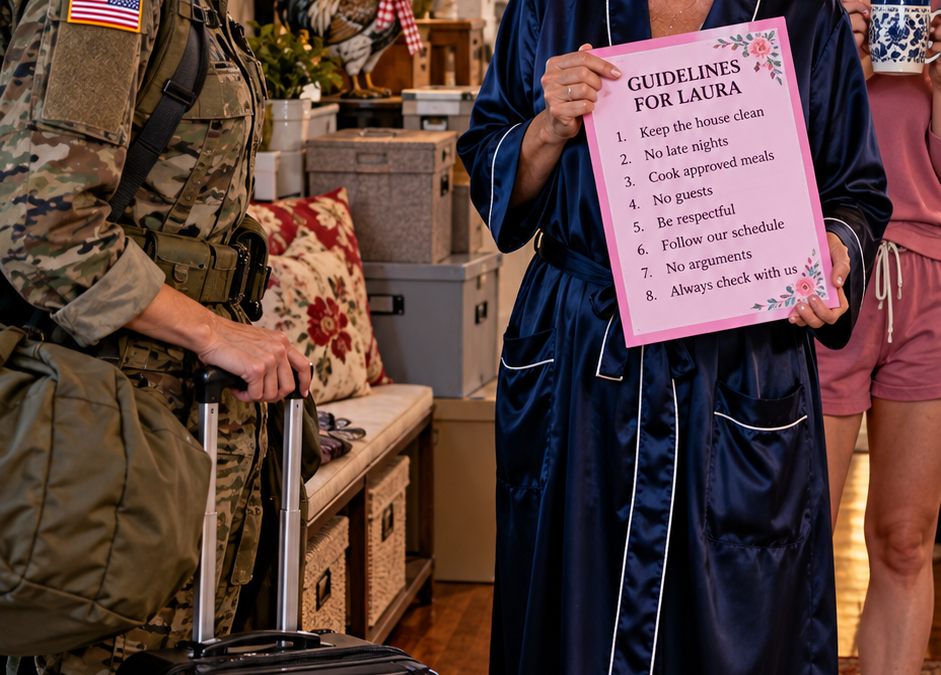
GUIDELINES FOR LAURA.
I remembered.
I checked the clock.
4:48.
Plenty of time.
I got dressed quietly.
Jeans.
Gray sweatshirt.
Running shoes.
Then I pulled my hair back and went into the kitchen.
The house was silent except for the refrigerator humming.
Diane had rearranged everything.
The coffee beans were no longer beside the grinder. My cast-iron skillet had been moved from the lower cabinet. Someone had placed little handwritten labels on three shelves.
BREAKFAST.
BAKING.
DINNER SUPPLIES.
I stood there staring at them.
It would have been easy to tear them down.
For a moment, I wanted to.
Instead, I made coffee.
At 4:56, I sat at the kitchen table with my laptop, the laminated rules beside me, and opened the folder I had spent an hour reviewing the night before.
Mortgage.
Deed.
Insurance.
Property tax.
Utility accounts.
The documents were exactly as I remembered.
The house had been purchased three years before Ethan and I married.
My name was on the deed.
Only mine.
After our wedding, I had offered more than once to add him.
Ethan had always refused.
“You bought it,” he said. “You worked for it before you ever met me. It doesn’t bother me.”
At the time, I had considered that generosity.
Now, at 4:59 in the morning, those words felt different.
The digital clock on the stove changed.
5:00.
Upstairs, a door opened.
Footsteps crossed the hallway.
Then Diane appeared at the top of the stairs.
She was still wearing my robe.
She saw me at the kitchen table and stopped.
“You’re up early.”
“I’m usually up earlier.”
She descended carefully, one hand on the railing.
Her knees did seem stiff.
That fact irritated me less than it had the night before.
Not because the situation was reasonable.
It was not.
But because anger had a way of turning people into flat characters.
Villain.
Victim.
Right.
Wrong.
Real families were rarely that simple.
Diane entered the kitchen.
“What are you doing?”
“Looking at the house paperwork.”
Her expression changed.
Only slightly.
But I noticed.
I closed the laptop.
“Coffee?”
She seemed surprised.
“No.”
Then, after a pause, “Actually, yes.”
I poured her a cup.
She took the chair across from me.
For the first time since I had arrived, neither of us spoke as if an audience were listening.
No Megan.
No Ethan.
No clipboard.
Just two women sitting in a kitchen before sunrise.
Diane wrapped both hands around the mug.
“I suppose you’re angry.”
“Wouldn’t you be?”
She looked down.
“Probably.”
“Then why hand me rules?”
Her mouth tightened.
“Because this house has been very difficult to manage.”
“My house wasn’t difficult to manage when I left.”
“Things changed.”
“What things?”
Diane glanced toward the stairs.
“Ethan should tell you.”
“Then why didn’t he?”
“I can’t answer for my son.”
“You’ve been doing a lot of answering for him.”
That landed.
She set down her cup.
“I know how this looks.”
I almost laughed.
“Diane, you’re wearing my robe.”
She looked at the sleeve.
For the first time, embarrassment crossed her face.
“I didn’t realize how inappropriate that would feel to you.”
“How else could it feel?”
“I suppose I got comfortable.”
“In my bedroom.”
She sighed.
“Your husband said you wouldn’t mind.”
There it was.
A small sentence.
Quietly spoken.
But something inside me shifted.
“Ethan told you I wouldn’t mind?”
“Yes.”
“The bedroom?”
“He said you’d agreed the stairs weren’t good for my knees.”
My office was downstairs.
The bedroom was upstairs.
I stared at her.
“That doesn’t even make sense.”
Diane frowned.
“He said you preferred the office because you often worked late.”
“I’ve been overseas.”
“He said when you returned.”
I leaned back.
“Did Ethan tell you I knew you were living here?”
Now she looked genuinely confused.
“Of course.”
“No.”
Her fingers tightened around the mug.
“I spoke to you.”
“When?”
“March.”
“I never spoke to you in March.”
“Not by phone. Ethan showed me your message.”
“What message?”
For several seconds, neither of us moved.
Then Diane stood.
“I’ll get it.”
She disappeared upstairs.
I heard a bedroom door open.
A drawer.
Footsteps again.
When she returned, she carried a folder.
Not a clipboard.
A folder.
She opened it and took out a printed email.
“Here.”
I read it.
The message looked ordinary.
My name appeared at the top.
Laura Walker.
The wording was casual.
Diane can stay as long as necessary. With my travel schedule, it’s probably easier if she uses our room. Tell her not to worry about asking me. I trust you both to arrange things.
I read it twice.
Then I looked at the date.
March 18.
I had been in Germany that week. I remembered because I had spent March 18 on a delayed connection after a twelve-hour workday, eating crackers for dinner in an airport lounge.
“I didn’t write this.”
Diane stared at me.
“It’s from your account.”
“No. It’s printed to look like it’s from my account.”
She sat again.
I examined the page.
No email headers.
No recipient line.
No timestamp beyond the typed date.
Just text.
Something anyone could have created.
“Where did Ethan get this?”
“He showed me on his laptop.”
“You saw it in an email?”
“I…”
Diane stopped.
“You saw the actual email?”
“I saw the message.”
“On screen?”
“Yes.”
“Inside my account?”
“I assumed so.”
“Diane.”
Her face changed again.
This time, certainty disappeared.
“I don’t know.”
The house felt very quiet.
At 5:14, footsteps came from the hall.
Ethan entered wearing sweatpants and an old Texas Longhorns shirt.
He saw the paper in my hand.
Stopped.
And closed his eyes.
That told me more than anything he could have said.
“Ethan.”
“Laura—”
“Did I send this?”
He glanced at his mother.
“Diane, can you give us a minute?”
“No,” I said.
Neither of them moved.
I placed the page on the table.
“Did I send this?”
Ethan pulled out a chair.
He looked exhausted.
Not sleepy.
Exhausted.
It was something I should have noticed the night before.
His face was thinner.
There were faint shadows under his eyes.
For months, I had seen him mostly through video calls with bad lighting and unreliable connections. I had told myself he looked tired because it was late.
Now I wondered how much I had not seen.
“No,” he said.
Diane whispered his name.
He looked at her.
“I’m sorry.”
She stood so quickly the chair legs scraped against the floor.
“You told me Laura knew.”
“I know.”
“You told me she invited me.”
“I know.”
“You showed me that message.”
“I know.”
I held up a hand.
“Nobody is going to yell.”
My own voice surprised me.
Calm.
Flat.
Controlled.
Ethan stared at the table.
“Tell me what happened.”
He rubbed both hands over his face.
“Not here.”
“This seems like exactly where.”
“Laura—”
“Nine months ago, I left a normal house. I came home and found your mother in our bedroom, your sister living here, half my things moved, rules with my name on them, and a request for nine hundred dollars a month.”
Diane interrupted.
“The nine hundred dollars wasn’t Ethan’s idea.”
I looked at her.
“It was mine.”
“Why?”
She hesitated.
“Because this household has expenses.”
“It’s my household.”
“I understand that now.”
“You understood it yesterday.”
Her cheeks reddened.
“Not in the same way.”
I looked back at Ethan.
“What happened?”
He stared toward the dark window over the sink.
Finally, he said, “Harrow closed.”
I frowned.
“What?”
“Harrow.”
The company where he had worked for eleven years.
“They closed the Austin office in February.”
My anger stalled.
“You told me you got promoted.”
“I lied.”
Diane closed her eyes.
Ethan continued before either of us could respond.
“They gave us six weeks’ severance. I thought I’d find something fast.”
“Why didn’t you tell me?”
“You were overseas.”
“I was still your wife.”
“I know.”
“Did you think being in another country meant I stopped being married?”
“No.”
“Then why?”
He did not answer.
Diane did.
“Pride.”
Ethan looked at her.
She folded her arms.
“You lied to me too. Don’t expect me to protect you now.”
There was no cruelty in her voice.
Only disappointment.
Ethan’s shoulders dropped.
“I thought it would be temporary.”
“What would be temporary?” I asked.
“The job situation. The money. Mom staying here.”
“What does your mother staying here have to do with losing your job?”
“My lease ended,” Diane said quietly.
I turned toward her.
She had sold her small townhouse the previous summer with plans to move into a senior community outside San Marcos.
I remembered that.
“You were buying the place near your sister.”
“It fell through.”
“Why?”
“The unit had structural problems. The inspection was terrible. I backed out.”
“And instead of renting somewhere—”
“Ethan told me you wanted me here.”
I looked at him.
He stared at his hands.
Megan appeared in the doorway.
Her hair was tied in a loose knot.
“What is everyone doing?”
Nobody answered immediately.
Then she noticed the printed email.
“Oh.”
That oh carried its own history.
I looked at her.
“What do you know?”
Megan leaned against the doorframe.
“Enough.”
“Megan,” Ethan said.
“No,” she replied. “She’s been home twelve hours. It’s already ridiculous.”
Diane turned.
“You knew?”
“I knew Ethan lost his job.”
“Did you know he lied to me about Laura inviting us?”
Megan blinked.
“No.”
Then she looked at Ethan.
“Seriously?”
He did not reply.
I pointed at the empty chair.
“Sit.”
Megan sat.
There we were.
5:17 in the morning.
Four adults at one kitchen table.
No television.
No rules.
No pretending.
I looked at Ethan.
“Start in February.”
So he did.
Harrow’s parent company had reorganized.
Austin lost nearly two hundred jobs.
Ethan received severance.
At first, he applied everywhere.
He had interviews.
Second interviews.
One company told him he was the leading candidate and then froze the position.
Another offered a salary nearly forty percent lower than he had been earning.
He turned it down.
“Why?” I asked.
“Because I thought something better was coming.”
“Was it?”
“No.”
March became April.
The severance ran out.
He moved money from savings into checking.
He cut some expenses.
Then Diane’s housing deal collapsed.
“Mom was staying in a hotel,” he said.
“I was not staying in a hotel,” Diane corrected. “I was staying with a friend.”
“On a sofa.”
“For eleven days.”
“You were miserable.”
“I was inconvenienced.”
Megan rolled her eyes.
“Mom, you called me four times about the mattress.”
“Because it had springs.”
Despite myself, I almost smiled.
The moment vanished quickly.
Ethan continued.
He had invited Diane to stay for a couple of weeks.
Then Diane’s knee pain worsened.
Her doctor recommended physical therapy.
The senior apartment waitlist changed.
Weeks became months.
“And Megan?” I asked.
Megan answered.
“My landlord sold my building.”
“Why didn’t you tell me?”
She gave me a strange look.
“Honestly?”
“Please.”
“I thought you didn’t like me.”
That caught me off guard.
“What?”
“You’ve always been polite, but distant.”
“I thought you didn’t like me.”
Megan blinked.
Diane looked between us.
“You both thought the other one disliked you?”
Neither of us answered.
Megan shrugged.
“Well. Apparently.”
I thought about every Thanksgiving where Megan disappeared to help in the kitchen whenever I sat beside her. Every birthday dinner where I assumed her short replies meant she wanted distance.
Maybe she had assumed my careful politeness meant the same.
Nine months away had not created every problem in that house.
Some had been sitting quietly between us for years.
“But you still moved into my house,” I said.
“Ethan said you knew.”
“Apparently Ethan said that to everyone.”
He flinched.
I did not apologize.
“Where were you sleeping at first?” I asked Diane.
“The guest room.”
“Then why are you in ours?”
“Ethan insisted.”
“I suggested,” Ethan said.
“You insisted,” Diane replied. “You said Laura had agreed.”
I looked at him.
“Why?”
He swallowed.
“Because the downstairs office sofa was easier than moving furniture.”
“For whom?”
“For me.”
The answer came so quietly I almost missed it.
I stared.
“You were sleeping downstairs?”
He nodded.
“Why?”
He looked toward Diane.
Then Megan.
Then me.
“Because I couldn’t sleep.”
Silence settled again.
Not dramatic silence.
The uncomfortable kind.
The kind filled with things people had avoided saying because admitting them would change the shape of a conversation.
“When did that start?” I asked.
“April.”
“Why?”
“I don’t know.”
“You do.”
He looked at me.
“I’d wake up at two or three and start thinking about bills. Interviews. Your messages. What I was going to tell you.”
“Which was apparently nothing.”
“I know.”
Megan spoke softly.
“He’d sit in the kitchen half the night.”
I remembered our video calls.
Ethan always called from the porch.
Or his car.
Or sometimes the backyard.
Rarely from our bedroom.
I had assumed he was trying not to wake anyone.
There had not been anyone to wake.
Not at first.
“You could have told me,” I said.
“I wanted to.”
“That’s different from telling me.”
“I know.”
“How bad are the finances?”
He did not answer quickly enough.
My stomach tightened.
“Ethan.”
“We’re current.”
“That’s not what I asked.”
“The mortgage is current.”
“Property taxes?”
“Paid.”
“Utilities?”
“Paid.”
“Credit cards?”
He looked down.
There it was.
“How much?”
“Laura—”
“How much?”
“About twenty-one.”
“Twenty-one hundred?”
Nobody spoke.
I felt a pulse behind my eyes.
“Twenty-one thousand?”
“Some of it is business expenses.”
“What business?”
He looked confused.
“I told you about the consulting work.”
“You told me you were doing consulting in addition to your job.”
His expression said everything.
There had been no job.
The consulting had been his attempt to create one.
I sat back.
The coffee had gone cold.
Diane quietly pushed the sugar bowl aside, as if clearing an inch of table might somehow help.
“Did you use our savings?”
“Some.”
“How much is some?”
“Laura.”
“Numbers.”
“Seventeen thousand.”
I closed my eyes.
That was the emergency fund we had built over almost four years.
Not all of it.
But a large part.
I opened my eyes again.
“And the nine hundred dollars?”
Diane looked at me.
“When I realized how much I was costing by staying here, I began paying toward groceries and utilities.”
“Nine hundred?”
“One thousand, actually.”
Megan said, “I pay six hundred.”
I stared at them.
Diane continued carefully.
“The rule was badly worded.”
“Badly worded?”
“It was based on the budget.”
“What budget?”
She stood, went to a drawer, and removed a yellow legal pad.
Columns of expenses covered the first page.
Electricity.
Water.
Internet.
Groceries.
Insurance.
Gas.
Household supplies.
Repairs.
Every figure was neatly written.
At the bottom were contributions.
Diane — 1000.
Megan — 600.
Ethan — VARIABLE.
Laura — 900.
I looked up.
“You budgeted my contribution before I even got home?”
Diane’s jaw tightened.
“Because Ethan told me your housing allowance continued while you were overseas.”
“It did.”
“And he said you planned to contribute more once you returned.”
“I already pay the mortgage.”
She froze.
Slowly, she turned toward Ethan.
I felt almost sorry for him.
Almost.
“You told me the mortgage was split,” Diane said.
He did not speak.
“I asked you directly.”
“I know.”
“You said Laura paid forty percent.”
“It’s complicated.”
“No,” I said. “It isn’t.”
The mortgage came from an account in my name. Ethan usually transferred money into our shared savings for other expenses. He had never paid the mortgage directly.
Not once.
Diane sat down again.
The anger had gone out of her face.
What replaced it was worse.
Humiliation.
Not mine.
Hers.
“I thought you weren’t helping,” she said.
The words were barely audible.
I studied her.
“Is that why the rules were addressed to me?”
She nodded.
“I thought Ethan had been carrying everything while you were gone.”
I turned toward him.
He looked miserable.
“Why would you let her believe that?”
“I didn’t say it exactly like that.”
“You didn’t correct it.”
“No.”
“Why?”
He shook his head.
“Because every lie made the previous lie easier.”
That was probably the first completely honest thing he had said all morning.
Diane removed her glasses.
“I owe you an apology.”
I looked at her.
She folded them on the table.
“The robe was thoughtless. The bedroom was worse. The rules…”
She exhaled.
“I believed I was stepping into a household that had become disorganized. I believed you and Ethan had agreed I should help.”
“I never asked for help.”
“I know that now.”
“You’ve known me eight years.”
“Yes.”
“Did you really think I’d come home and happily accept a laminated chore chart?”
To my surprise, Megan snorted.
Diane gave her a look.
Then, to my greater surprise, Diane smiled faintly.
“No.”
“Then why?”
She thought about it.
“Because I was angry with you.”
“Why?”
“I believed you had left Ethan to manage everything.”
“I was working.”
“I know.”
“I wasn’t on vacation.”
“I know.”
“Did he tell you otherwise?”
“No.”
She looked uncomfortable.
“He didn’t have to. I made assumptions.”
That honesty mattered.
Not enough to erase anything.
But enough to change the temperature in the room.
I folded the printed fake email.
“Everyone needs to understand something.”
They waited.
“I am not making any decisions this morning.”
Ethan looked up.
“But some things change immediately.”
Diane nodded.
“The rules come down.”
“Agreed.”
“My belongings are mine.”
“Of course.”
“You’ll move back into the guest room.”
She opened her mouth, then stopped.
“If that’s what you want.”
“It is.”
I looked at Ethan.
“You and I are not pretending this is resolved.”
“I know.”
“I need every financial statement.”
“I’ll give them to you.”
“All accounts.”
“Yes.”
“Credit cards.”
“Yes.”
“Consulting expenses.”
He hesitated.
“Yes.”
“Today.”
“Okay.”
Megan raised her hand slightly.
We all looked at her.
“Do I move out today?”
There was something unexpectedly young in the question.
Not childish.
Just uncertain.
I softened.
“No.”
Her shoulders lowered.
“But we need a plan.”
“Fair.”
“You too, Diane.”
“I’ve already been looking.”
Ethan stared at her.
“You have?”
“For weeks.”
“Why didn’t you say anything?”
“Because every time I mentioned leaving, you said Laura expected me to stay.”
His eyes closed again.
I stood.
“I need air.”
Ethan pushed back his chair.
“I’ll come.”
“No.”
He stopped.
“I need thirty minutes where nobody explains anything to me.”
He nodded.
Outside, dawn was beginning to lift the darkness.
The neighborhood looked exactly as it had in my memories. Mrs. Alvarez’s porch light glowed across the street. Someone’s sprinkler clicked rhythmically. A delivery truck rolled through the intersection.
Normal life.
I walked two blocks.
Then three.
By the time I reached the small park near our street, the sky had turned pale peach behind the live oaks.
I sat on a bench.
I had imagined coming home so many times.
In every version, Ethan met me at the airport.
We drove home laughing.
He complained about my suitcase.
I complained about his driving.
We ordered barbecue because neither of us wanted to cook.
Later, we climbed into our bed and talked until we fell asleep.
Reality had given me laminated rules and twenty-one thousand dollars of debt.
But strangely, the money was not what hurt most.
It was the editing.
Ethan had edited our marriage.
A missing job became a promotion.
Fear became consulting.
His mother’s temporary visit became something I had supposedly approved.
Every difficult truth had been replaced by something easier.
And from thousands of miles away, I had believed him.
My phone vibrated.
A message from Megan.
Your coffee is still on the table. Mom says she’ll make a fresh pot when you get back. She also took off the robe.
I laughed before I could stop myself.
The laugh hurt.
But it helped too.
When I returned, every laminated sign was gone.
Not just mine.
The HOUSEHOLD EXPECTATIONS sign had disappeared.
So had the bathroom schedule.
The labels remained in the kitchen.
I decided I could live with labels.
For now.
Diane was upstairs moving clothes.
Megan was loading the dishwasher.
Ethan sat at the table with a stack of folders.
I joined him.
“Where’s Mom?” he asked.
“Upstairs.”
“She’s upset.”
“She should be.”
“I meant with me.”
“She should be.”
He nodded.
Then pushed the folders toward me.
“Bank statements.”
For the next three hours, we went through our finances.
The situation was bad.
Not catastrophic.
There were no hidden gambling debts.
No secret apartment.
No mysterious transfers.
Just dozens of smaller decisions made by a frightened person trying to postpone one big conversation.
Software subscriptions for his consulting business.
A new laptop.
Professional insurance.
Advertising.
Two trips to Dallas for client meetings.
A business conference.
Groceries.
Utilities.
Minimum payments.
More minimum payments.
The seventeen thousand dollars from savings.
Then credit cards.
Then Diane’s contributions.
Then Megan’s.
I noticed one recurring deposit.
$1,000.
Diane.
Every month since May.
“You said this covered groceries.”
“Mostly.”
I traced the account.
“It didn’t.”
Ethan looked away.
The deposits were being used for credit card payments.
“Did she know?”
“No.”
“So she thought she was paying household expenses.”
“Yes.”
“But she was paying your debt.”
“Some of it.”
I shut the folder.
“Ethan.”
“I know.”
“Stop saying you know.”
He looked at me.
“You’re right.”
For a moment, he seemed ready to explain again.
Instead, he said, “I was ashamed.”
That stopped me.
Not because it excused anything.
It did not.
But because shame was the first explanation that sounded human instead of defensive.
“I’d spent eleven years at Harrow,” he said. “I thought I was good at what I did. Then suddenly I was forty-one and sitting in interviews with people ten years younger asking me where I saw myself in five years.”
I did not speak.
“I kept thinking I’d fix it before you came home.”
“Fix what?”
“Everything.”
“You thought you’d find a job, pay back seventeen thousand dollars, clear twenty-one thousand in credit cards, move your mother and sister out, put the house back exactly as it was, and never mention any of it?”
His mouth twisted.
“When you say it like that, it sounds ridiculous.”
“It was ridiculous before I said it.”
“I know.”
I gave him a look.
“Sorry.”
He stared at his wedding ring.
“I kept thinking I just needed another month.”
“And then?”
“Then another.”
“And when I told you my return date?”
“I panicked.”
I remembered his face during our last video call.
I had told him my flight details.
He had smiled.
Said he could not wait.
I had thought his awkwardness came from emotion.
Maybe it had.
Just not the kind I had imagined.
“Why didn’t you meet me?”
He looked embarrassed.
“I thought you were landing tomorrow.”
“I sent you the itinerary.”
“You sent the updated one.”
“Three times.”
“I know.”
I did not need to tell him.
He caught himself.
“I was so focused on trying to get the house ready that I mixed up the dates.”
“You didn’t get the house ready.”
“Mom told me not to move her things until she finished physical therapy.”
From upstairs, Diane called, “That is absolutely not what I said.”
Megan laughed from the living room.
Despite everything, Ethan almost smiled.
I did not.
Not yet.
At eleven, Diane came downstairs wearing her own clothes.
She had folded my robe and placed it on the back of my chair.
“I washed it.”
“Thank you.”
“And I moved my things.”
“Thank you.”
She stood awkwardly.
“I’d like to say something.”
I waited.
“When Ethan was a boy, he hated disappointing people.”
He sighed.
“Mom.”
“I’m not excusing you.”
She looked at me.
“If he got a C on a test, he’d hide it until the teacher called. If he broke something, he’d try to repair it before anyone noticed. Once he cracked a window playing baseball and spent three days saving allowance money because he thought he could replace the glass himself.”
“Mom.”
Diane ignored him.
“I used to think it meant he was responsible.”
She looked at her son.
“I understand now that sometimes it meant he was afraid of being honest.”
He did not argue.
Diane turned back to me.
“I think I encouraged that.”
That admission surprised all of us.
“Ethan’s father was difficult about mistakes,” she continued. “I compensated by solving things for Ethan. Probably too much. When your husband lost his job, I moved in and immediately started solving.”
“The labels,” Megan said.
Diane frowned.
“The labels are useful.”
“They’re terrifying.”
“They are perfectly readable.”
For the first time since coming home, I smiled.
Only briefly.
Diane saw it.
She smiled too.
Then the moment passed.
“I am sorry, Laura.”
This apology felt different from the earlier one.
Not because it was longer.
Because it did not contain a defense.
“I accept the apology,” I said.
Her eyes softened.
“That doesn’t mean everything is fine.”
“I understand.”
“And I want my blue mug back.”
Megan called from the living room, “Absolutely not.”
I looked toward her.
She appeared in the doorway holding it.
“I’ve emotionally bonded with this mug.”
“I bought it in Santa Fe.”
“I’ll pay you twelve dollars.”
“It cost forty.”
“That’s unreasonable for a mug.”
“Then give it back.”
She hugged it to her chest.
“Twenty.”
For reasons I could not explain, that silly negotiation loosened something in the room.
Not forgiveness.
Not trust.
But air.
At one thirty, Ethan left for an interview.
A real interview.
He showed me the confirmation email before he went.
I hated that I needed proof.
I hated more that he understood why.
After he left, I went upstairs.
My bedroom looked unfamiliar.
The quilt was different.
Diane had replaced my bedside lamp with one from the guest room.
A reading chair sat where my luggage rack used to be.
But my photographs were still on the dresser.
Wedding picture.
A trip to Big Bend.
Ethan asleep on a cabin porch with a book on his chest.
I picked up the wedding photograph.
Eight years.
We had been married eight years.
How much did eight years owe a mistake?
How much did love owe honesty?
How many lies could be explained by fear before explanation became excuse?
I did not know.
That bothered me most.
I liked knowing what to do.
My work had trained me to gather information, assess consequences, make decisions.
Marriage refused to behave like a spreadsheet.
I opened the closet.
Most of my clothes had been packed carefully into storage bins.
Not thrown.
Not damaged.
Folded.
Labeled.
WINTER.
WORK.
CASUAL.
Diane.
Of course.
I started putting things back.
An hour later, Megan knocked.
“Need help?”
I almost said no.
Then changed my mind.
“Sure.”
She opened one bin.
“Your entire wardrobe is gray.”
“It is not.”
She held up three sweaters.
Gray.
Gray.
Gray.
“Compelling defense.”
We worked quietly.
Finally, I said, “Why did you think I didn’t like you?”
She folded a blouse.
“You’re intimidating.”
I stared.
“Me?”
“You always know what you’re doing.”
I laughed.
“You’ve spent twelve hours with me since I came home. Does it look like I know what I’m doing?”
“Usually.”
“Usually is an illusion.”
She smiled.
Then became serious.
“You and Ethan were always the stable ones.”
“Apparently not.”
“No. I mean from outside.”
She sat on the edge of the bed.
“When my engagement ended, you sent flowers.”
“I remember.”
“You didn’t call.”
“I thought you’d want space.”
“I thought you sent flowers because you didn’t want to talk to me.”
I sat beside her.
“That’s absurd.”
“I know that now.”
“Why didn’t you call me?”
“Why didn’t you call me?”
We looked at each other.
Fair point.
Megan rubbed her palms together.
“I think this family is terrible at asking direct questions.”
“That might be the first useful rule anyone has written.”
She smiled.
Then glanced toward the hallway.
“There’s something else.”
My stomach tightened.
“What?”
“I found a letter last week.”
“What kind of letter?”
“I don’t know. Ethan got upset when he saw me holding it.”
“From whom?”
“A bank, I think.”
“Which bank?”
She shook her head.
“I only saw the envelope.”
“Did you ask?”
“He said it was business stuff.”
I stood.
“Where is it?”
“I don’t know.”
I went downstairs.
The stack of financial documents still covered the kitchen table.
I searched them.
Nothing unusual.
Business account.
Credit cards.
Utilities.
Mortgage.
Then I noticed one folder was numbered.
No. 3.
I checked again.
Megan stood behind me.
“Maybe he just numbered them wrong.”
“Maybe.”
But something about it bothered me.
At four fifteen, Ethan came home.
“How was the interview?” I asked.
“Good.”
He placed his keys down.
“I think.”
Then he saw the folders.
His face changed.
Very slightly.
But enough.
“Where’s folder three?”
He went still.
“What?”
“The folders. One, two, four. Where’s three?”
He looked at Megan.
She immediately raised both hands.
“I didn’t tell her about a folder.”
“You told her something.”
“I told her about the letter.”
Ethan exhaled.
I stared at him.
“What letter?”
“It’s not what you think.”
“I haven’t told you what I think.”
He walked toward the office.
“Let me get it.”
He returned holding a thin folder.
Number three.
He placed it in front of me.
“I was going to show you.”
“When?”
“Today.”
“Before or after I found out it existed?”
He accepted that without argument.
Inside was a bank statement.
But not ours.
Diane Walker.
I frowned.
“Why do you have your mother’s bank statement?”
Ethan sat down.
“Look at the transfer in June.”
I found it.
Twenty-eight thousand dollars.
Transferred out.
“Where did this go?”
“Our business account.”
My stomach dropped.
“Your mother gave you twenty-eight thousand dollars?”
“Loaned.”
“Does she know?”
“Yes.”
“Why wasn’t it in the statements this morning?”
“Because I paid most of it back.”
I turned the page.
He was right.
There were transfers.
Five thousand.
Three thousand.
Another four.
Not enough.
But substantial.
“From where?”
“Two consulting contracts.”
I looked closer.
There were invoices attached.
Real companies.
Real payments.
“You made this much consulting?”
“Some months.”
“Then why the credit cards?”
“Because the contracts paid late.”
He ran a hand through his hair.
“Laura, there’s something you need to understand. The consulting business didn’t completely fail.”
“What does that mean?”
“It means I have clients.”
“How many?”
“Four steady ones.”
“Income?”
“Not enough yet.”
“Enough for what?”
He hesitated.
“Enough that I almost turned down today’s interview.”
I stared at him.
“Why?”
“Because I want to build it.”
I could not believe what I was hearing.
“You borrowed money from your mother. Drained our savings. Ran up credit cards. Lied to me for months.”
“I know.”
“And now you’re telling me you want to keep doing the thing that helped create the problem?”
“It’s also the thing that might get us out.”
“Or deeper in.”
“Yes.”
The fact that he admitted it made me angrier.
“You don’t get to gamble with our life because you want to prove something.”
“I’m not asking you to let me.”
“Then what are you asking?”
He opened his mouth.
But Diane spoke from the hallway.
“He’s telling this badly.”
We both turned.
She carried a white envelope.
The same type Megan had described.
Diane placed it on the table.
“This is the letter.”
Ethan looked horrified.
“Mom.”
“She should see it.”
I took the envelope.
The return address belonged to a regional bank.
Inside was a formal notice.
Not foreclosure.
Not collections.
A loan approval.
I read the first page.
Then the second.
Applicant:
Diane Walker.
Purpose:
Purchase of residential property.
I looked up.
“You bought a house?”
Diane sat.
“Not yet.”
“Then what is this?”
“Preapproval.”
Ethan looked away.
Diane continued.
“I have been trying to buy a small place nearby.”
“Why nearby?”
She looked at me as though the answer should have been obvious.
“Because my son is here.”
Then she glanced toward the living room.
“And because Megan is here.”
Megan leaned against the doorway.
“I might have found an apartment.”
Everyone looked at her.
“What?” Diane said.
“It’s ten minutes away.”
“Since when?”
“Yesterday.”
Diane looked offended.
“You didn’t tell me?”
Megan gave her a pointed look.
“We’re working on direct communication.”
That almost made me laugh again.
But I was still holding the bank letter.
“What does this have to do with Ethan?”
Diane became quiet.
“He asked me not to buy.”
I looked at him.
“Why?”
He stared at the table.
“Diane?” I asked.
She answered for him.
“Because he thought Laura might not come back.”
Every sound in the room seemed to disappear.
I looked at Ethan.
“What does that mean?”
He lifted his eyes.
“What does that mean?” I asked again.
He swallowed.
“I didn’t know if you still wanted this marriage.”
I stared at him.
“Why would you think that?”
His voice was barely above a whisper.
“Because of the email you sent me in January.”
I frowned.
“What email?”
“The one where you said when you came home, we needed to talk about whether our lives still fit together.”
I felt cold.
“I never sent you an email like that.”
Ethan looked up.
Diane stopped breathing for a second.
Megan straightened.
“I did not send that,” I said.
Ethan stood.
“Yes, you did.”
“No.”
“I have it.”
“Show me.”
He walked to his laptop.
His hands shook slightly as he opened it.
He searched.
Clicked.
Then turned the screen toward me.
There it was.
My name.
My email address.
January 23.
Ethan,
I don’t want to do this by video call, but when I get home we need to have an honest conversation about whether our lives still fit together. Please don’t make plans around me until then. I need space to think.
Laura.
I read it once.
Twice.
Three times.
The words were unfamiliar.
But the address was mine.
The account was mine.
And unlike the printed message Diane had shown me that morning, this email had headers.
A timestamp.
A server record.
It was real.
Except I had never written it.
I looked at Ethan.
His face was pale.
For months, he had believed I was coming home to possibly leave him.
For months, I had believed he was successfully working, managing our house, and waiting for me.
Two separate marriages.
Two separate stories.
Both built around messages I had never sent.
And suddenly the laminated rules no longer felt like the biggest mystery in my house.
I looked again at the email dated January 23.
Then I remembered something.
On January 22, my laptop had disappeared for nearly six hours during a security update at the temporary office where I was working.
I had assumed IT had taken it.
But when it was returned, one thing had seemed strange.
My email session had already been open.
At the time, I had not thought anything of it.
Now I did.
Because the message on Ethan’s screen had been sent the following morning.
And according to the technical information beneath it, it had not been sent from Texas.
It had been sent from overseas.
From exactly where I had been.
Nobody spoke.
The house that had felt crowded all day suddenly felt too small for the silence inside it.
Megan was the first one to say the obvious.
“So someone used your email?”
I kept my eyes on the screen.
“Yes.”
Ethan shook his head slowly.
“But why? Who would even care about our marriage?”
That was the question.
A bad one.
Because the answer was not necessarily personal.
Sometimes people did not care about your marriage at all.
They cared about access.
Leverage.
Distraction.
I worked in logistics compliance for government contract operations. That was the public version. The version that fit on forms and explained why I spent months overseas auditing procurement chains, transport documentation, and vendor compliance on projects where mistakes could become security problems.
I did not carry a weapon.
I did not brief generals on television.
But I knew how records moved.
I knew how a forged message could reroute a decision before anyone saw the hand that wrote it.
I reached for my phone.
“Who are you calling?” Ethan asked.
“Someone who knows what headers are supposed to look like.”
“Laura.”
I looked at him.
“This is not about your job anymore.”
His face changed.
He understood then.
Maybe not the details.
But the category of danger.
I called Marcus Reed, an information security contractor I had worked with twice overseas. He answered with his usual lack of greeting.
“Walker.”
“Can you receive an email header and tell me whether it was sent from my machine?”
A pause.
“That’s an unpleasant question.”
“I’m having an unpleasant day.”
“Send it.”
I forwarded the message with full headers, then took screenshots, then exported a copy exactly the way he instructed. Ethan watched without interrupting. Diane folded her hands in her lap. Megan hovered behind me, no longer joking about mugs.
Ten minutes later, Marcus called back.
“Where are you?”
“Home.”
“Good. Stay there.”
My stomach tightened.
“Marcus.”
“The message came from an authenticated session tied to your work laptop. Not spoofed. Not simple account compromise. Session token looks valid.”
Ethan sat down slowly.
I closed my eyes.
“Who had custody of my laptop on January 22?”
“That is the next question.”
“It was taken for a security update.”
“By whom?”
“Local technical support office.”
“Name?”
I searched my memory.
A young technician with sandy hair.
Badge clipped upside down.
He had joked about how everyone hated mandatory updates.
“Nolan,” I said. “Nolan Pierce, I think.”
Marcus was quiet for three seconds too long.
“What?” I asked.
“Nolan Pierce was flagged in an internal vendor review two months ago.”
“For what?”
“Unauthorized device handling and improper credential storage.”
My fingers tightened around the phone.
“Why wasn’t I notified?”
“Because the review is still open.”
Of course it was.
Open reviews were where truth went to age quietly while people hoped it would become someone else’s problem.
Marcus continued.
“Laura, there’s something else. January 23 wasn’t the only outbound message from your account that day.”
I looked at Ethan.
He saw it.
His face emptied.
“How many?” I asked.
“Three.”
“To whom?”
“One to your husband. One to a local email address tied to Diane Walker. That one may be your printed message source, though the copy Diane showed you wasn’t a direct printout. And one to an external domain I don’t recognize.”
“What did it say?”
“I don’t have content yet. Only logs. But the attachment name is visible.”
“What attachment?”
Marcus exhaled softly.
“Household_Authorization.pdf.”
Diane whispered, “Oh my God.”
I looked at her.
She had gone gray.
“What?” I asked.
Diane stood too quickly, then steadied herself on the table.
“The property management form.”
“What property management form?”
She looked at Ethan.
“I didn’t understand it. I thought it was for insurance.”
Ethan looked baffled.
“What are you talking about?”
Diane covered her mouth.
“When I moved in, there was a form for temporary household access. It listed me as an authorized household manager. Ethan said Laura had sent it.”
“I never saw a form,” Ethan said.
That was when the last remaining simple explanation died.
Diane went upstairs and came back with another folder.
This one had not been on the clipboard.
Inside was a PDF printout with my name typed at the bottom.
Temporary Household Authorization.
It granted Diane Walker authority to coordinate utilities, household vendors, maintenance access, and residential occupancy arrangements for my address during my overseas assignment.
It did not transfer ownership.
It did not give her legal control of the house.
But to a utility company, a repair service, a neighborhood security patrol, or a contractor at the door, it would look official enough to make questions stop.
The signature was not mine.
Not even close.
But it did not need to fool me.
It only needed to fool everyone else while I was gone.
I read the form again.
Then I noticed the logo in the corner.
Not my employer.
Not a bank.
A vendor services portal used by one of the overseas contract teams I had audited.
My chest tightened.
I knew the portal.
I knew the vendor.
And suddenly I knew why someone might care about my marriage.
Because in November, two months before that email, I had flagged a procurement irregularity involving a subcontractor that billed for household support services, relocation assistance, temporary lodging, and local access coordination.
The kind of paperwork nobody glamorous cared about.
The kind of paperwork where fraud could hide for years.
“Laura?” Ethan said.
I heard him as if from far away.
I stood.
“Where is the printed copy from March?”
Diane handed it to me.
I laid the three documents side by side.
The January email to Ethan.
The March printed message to Diane.
The Household Authorization form.
Different formats.
Same purpose.
Make Ethan believe I was leaving.
Make Diane believe I had invited her to take over.
Create a paper trail showing someone else managed my house while I was overseas.
Megan frowned.
“Why would anyone need that?”
I looked at the authorization form.
“Because someone used my address.”
Ethan stood.
“For what?”
“I don’t know yet.”
But I had a guess.
And I hated it.
At my request, Marcus contacted the right people through the right channels. That was the phrase we used when nobody wanted to explain how many doors had to open before someone official was allowed to admit there was a hallway.
By evening, I had two calls.
The first was from my agency security liaison, who asked calm questions in a voice that made me feel less calm.
The second was from a federal investigator named Celia Grant, who did not waste time.
“Mrs. Walker, we have reason to believe your residential address was used as a domestic receiving point for documents and small shipments connected to an overseas billing investigation.”
Ethan gripped the back of a chair.
“What kind of shipments?” I asked.
“Records. Tokens. Vendor samples. Nothing hazardous.”
That was supposed to reassure me.
It did not.
“How many?”
“Six confirmed deliveries between February and June.”
I looked at Ethan.
“Did packages arrive for me?”
His face had gone pale.
“Yes.”
“How many?”
“I don’t know. A few.”
“What did you do with them?”
“I put them in your office.”
I turned toward the downstairs office where I had slept the night before.
The room suddenly felt less like an insult and more like evidence.
We found four packages in the closet behind a stack of printer paper.
Two unopened envelopes.
One small cardboard box.
One padded mailer.
All addressed to me.
All from companies I did not recognize.
Celia Grant told us not to open them.
By nine that night, two agents had arrived.
By ten, my house no longer felt like a home at all.
It felt like a scene.
Diane sat on the couch with both hands clasped tightly in her lap. Megan had finally surrendered my blue mug and now held a plain white one as if color itself had become too risky. Ethan stood near the kitchen, looking at the agents moving through our office with evidence bags.
His shame had changed.
The earlier shame had been about failure.
This was about consequences.
He came to stand beside me.
“I thought I was ruining our marriage,” he said quietly.
I kept my eyes on the office door.
“You were.”
He flinched.
I did not soften the truth.
Then I added, “But someone else helped.”
He swallowed.
“I should have told you everything.”
“Yes.”
“I should have questioned the email.”
“Yes.”
“I should have known you wouldn’t send something like that.”
That made me look at him.
“Why?”
“Because if you were going to leave me, you’d say it to my face.”
For the first time all day, something in my chest cracked open.
Not forgiveness.
Not yet.
But grief.
Because he was right.
And because some part of him had known me well enough to know better, but not trusted that knowledge when fear gave him an easier story.
Celia Grant emerged from the office holding an evidence bag.
Inside was a small authentication device.
Not mine.
Not Ethan’s.
“Where was that?” I asked.
“In the padded mailer.”
I stared at it.
I had seen devices like it before.
Not that exact model.
Close enough.
“Mrs. Walker,” she said, “does the name Nolan Pierce mean anything to you?”
“Yes.”
Her expression did not change.
“Good. We’ll need a formal statement.”
The investigation lasted weeks.
Not one dramatic night.
Not one neat confession.
Weeks.
Nolan Pierce had not acted alone. He had worked as a contracted technical support specialist overseas, with temporary access to employee laptops during mandatory updates. He did not need my password. He harvested an active session, used it to send carefully targeted messages, and created documents that made it look as though I had authorized household changes during deployment.
He chose me because I had flagged his subcontractor’s billing pathway.
He needed a domestic address to receive small items tied to the same fraud scheme, and my house gave him the perfect cover: an overseas employee, a spouse already receiving messages suggesting distance, and a mother-in-law newly positioned as household manager.
The scheme was not elegant.
Most schemes are not.
It worked because people filled in gaps with what they already feared.
Ethan feared I was leaving.
Diane feared her son was being abandoned.
Megan feared she was unwanted.
I feared nothing at home needed my attention because I desperately wanted that to be true.
Everyone believed the story that hurt them most.
That was how the lie got in.
Two months after I came home, Nolan Pierce was arrested along with two vendor managers and a logistics coordinator who had used residential addresses to receive and reroute documentation tied to fraudulent billing. My address had been one of several.
The investigators told me I was lucky.
I did not feel lucky.
I felt angry.
Then tired.
Then angry again.
The financial damage inside my house was still real.
Ethan had still lied.
Diane had still worn my robe, occupied my bedroom, and handed me laminated rules.
Megan had still lived in my house without calling me.
The fact that an outside criminal had manipulated the situation did not erase the choices made inside it.
That was the hardest part to explain to Ethan.
He wanted the investigation to become the explanation for everything.
It could not.
One night, after Diane moved into a small rental three neighborhoods away and Megan signed her lease for the apartment ten minutes from us, Ethan and I sat at the kitchen table with a debt repayment plan between us.
No laminated rules.
No labels except the ones still on the shelves, because, unfortunately, Diane had been right that they were useful.
Ethan slid a paper toward me.
“I got the job offer.”
I read it.
The salary was lower than Harrow.
But stable.
Benefits.
Start date in two weeks.
“And the consulting?” I asked.
“I’m keeping two clients. Evenings only. No new expenses without agreement. No credit cards. All income goes toward debt until we’re current.”
I looked at him.
“You made a plan.”
“I made a proposal.”
That mattered.
A plan assumed agreement.
A proposal asked for it.
I read the numbers.
They were careful.
Conservative.
Possible.
“You understand this does not fix the lying.”
“I know.”
He caught himself and winced.
“I mean, I understand.”
I almost smiled.
Almost.
“I’m not asking you to decide about us tonight,” he said.
“Good.”
“I’m asking if we can start with the truth for thirty days.”
“What does that mean?”
“No deleting fear. No editing facts. No pretending something is fine because it might be fine later.”
I looked around the kitchen.
At the shelves.
At the returned blue mug sitting beside the sink.
At the place where the laminated HOUSEHOLD EXPECTATIONS sign had once hung.
“Thirty days,” I said.
It was not a reconciliation.
It was not forgiveness.
It was an audit.
But sometimes audits save what speeches cannot.
Thirty days became sixty.
Sixty became ninety.
Trust did not return like a door swinging open.
It returned like a house being repaired after water damage.
First, you find the leak.
Then you tear out what rotted.
Then you live with exposed walls longer than you want.
Diane apologized again after moving out.
This time, she came over wearing her own cardigan and carrying my robe in a garment bag even though she had already washed it twice.
“I bought you a replacement,” she said.
“I don’t need a replacement.”
“I know. I needed to buy one.”
I accepted it because I understood the difference.
Megan returned the blue mug.
Then gave it back to me for my birthday with a note taped to the bottom.
For shared custody.
I let her use it when she visited.
Ethan started the new job.
Kept two consulting clients.
Paid down the first credit card.
Then the second.
Every Friday, he printed statements and put them on the kitchen table without being asked.
At first, the ritual hurt.
Then it steadied us.
The federal case moved forward somewhere beyond us. I gave statements, submitted device records, testified in a closed proceeding, and answered the same questions so many times that the truth began to feel less like a wound and more like a file.
Nolan Pierce eventually pleaded guilty.
I read the notice alone in the office where I had slept that first night home.
The foldout sofa was gone.
My desk was back.
So were my books.
The room smelled like paper again.
Only paper.
A year after I came home, I woke at 4:47 without an alarm.
Some habits remain.
Ethan was asleep beside me in our bed.
Our bed.
The primary bedroom looked like mine again, though not exactly the same. We had kept one of Diane’s lamps because I liked the warmer light. Megan’s apartment was fully furnished, except for the suspicious number of mugs she had taken from our cabinets. Diane’s small house had labels in every room and a guest bed she proudly referred to as “available but not permanent.”
The debt was not gone.
But it was smaller.
The marriage was not untouched.
But it was honest.
That morning, I went downstairs and made coffee.
The kitchen shelves were still labeled.
BREAKFAST.
BAKING.
DINNER SUPPLIES.
I ran my finger along the edge of one label and laughed quietly.
Then I opened the drawer where I kept important documents.
Mortgage.
Deed.
Insurance.
Property tax.
Utility accounts.
And one laminated sheet.
GUIDELINES FOR LAURA.
I had kept it.
Not because I needed the reminder that the house was mine.
I knew that.
Not because I wanted to stay angry.
Anger had done its job and stepped aside.
I kept it because that ridiculous laminated sheet marked the morning I stopped accepting edited versions of my own life.
Ethan entered the kitchen a few minutes later, hair rumpled, voice rough with sleep.
“You’re up early.”
“I’m usually up earlier.”
He smiled faintly, then saw the sheet in my hand.
His smile faded.
“I hate that thing.”
“I know.”
“Why keep it?”
I looked at the red title.
Then at him.
“Because it reminds me what happens when nobody asks direct questions.”
He nodded slowly.
“Fair.”
I folded it once.
Then placed it back in the drawer.
He poured coffee into my blue mug.
My mug.
Not Megan’s.
Not Diane’s.
Mine.
Then he handed it to me.
“Any rules for today?” he asked.
I took the mug.
“One.”
He waited.
“If something scares you, say it before it turns into paperwork.”
He looked down.
Then back at me.
“I can do that.”
“I know.”
This time, the words did not sound like a reflex.
They sounded like trust being rebuilt one truthful sentence at a time.
Outside, dawn lifted over the neighborhood.
The same porch lights.
The same live oaks.
The same street.
But the house felt different now.
Not because it had returned to exactly what it was before I left.
It had not.
Maybe it never could.
Home was not preserved by pretending nothing changed.
Home was protected by telling the truth fast enough that lies had nowhere comfortable to live.
Nine months overseas had taught me discipline.
Coming home taught me something harder.
A deed can prove ownership of a house.
It cannot protect a marriage.
It cannot teach a family to speak plainly.
It cannot stop fear from rearranging rooms, finances, and people’s memories until everyone is living inside a story that never happened.
But it can give you a place to stand while you ask the first honest question.
That morning, one year after I came home to my mother-in-law in my robe and rules with my name on them, I stood in my kitchen holding my coffee while Ethan read the job schedule posted on the fridge and sunlight moved across the floor.
The rooster was gone.
The Hill Country photograph was back in the foyer.
The scratch in the hardwood remained.
I never covered it.
Some marks are useful.
They remind you what belongs to you.
They remind you what survived being dragged across the floor.
And they remind you that a house can be reclaimed in a day, but a home has to be rebuilt on purpose.








