𝗙𝗨𝗟𝗟 𝗦𝗧𝗢𝗥𝗬 The Road Karen Tried to Take Had My Name Buried in Records She Never Bothered to Read
𝗙𝗨𝗟𝗟 𝗦𝗧𝗢𝗥𝗬
She looked pleased for half a second before realizing I had not said it warmly.
“The HOA has concerns about this road.”
“Then the HOA should keep those concerns inside its boundary.”
Her smile tightened.
“This road serves the community.”
“No, it runs beside the community.”
“Residents use it.”
“Some have tried.”
“It connects to the rear service area.”
“It connects to my pasture and equipment shed.”
She glanced past me, toward the gravel bending through the trees.
“It appears on our infrastructure map.”
“I’m sure it does.”
“That means it falls under our review.”
“No, Karen. It means someone drew it.”
She did not like that.
People like Karen never like plain language. Plain language removes the fog they use to make nonsense sound administrative.
She left that day without getting what she wanted.
But she also left without understanding that the conversation was over.
For the next few months, the HOA kept testing the edges.
A landscaper parked his trailer on the road and claimed the HOA told him it was a service route. I made him move it. A resident tried to drive a golf cart through to avoid traffic near the main entrance. I stopped him and told him not to come back. Then an HOA notice appeared on a cedar post near the entrance, announcing “temporary community access restrictions.”
I removed it and mailed it back.
After that, I installed a clearer sign.
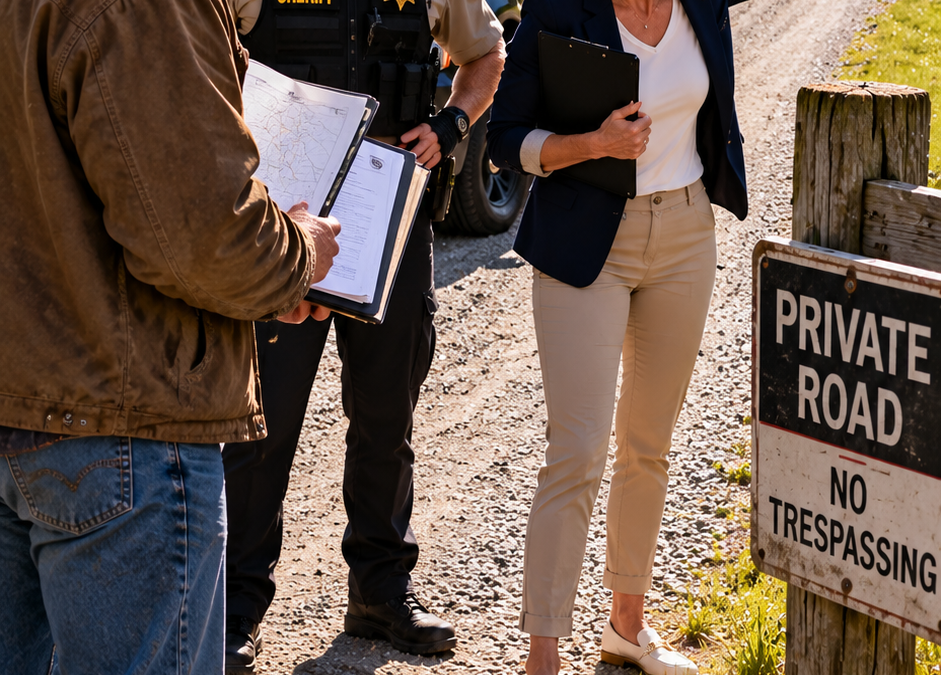
PRIVATE ROAD
WARD PROPERTY
NO HOA ACCESS WITHOUT WRITTEN PERMISSION
I thought that would settle the matter.
I should have known better.
The morning Karen brought the deputies, I had been out early checking the ditch line after a night of rain. The storm had been heavy enough to wash leaves into the culvert, and if I did not clear it, water would back up and eat into the shoulder.
The air smelled like wet gravel and oak bark. The sky was still low and gray, with breaks of pale sunlight pushing through the clouds. My boots sank slightly into the damp edge of the road as I used a rake to pull branches and leaves away from the culvert mouth.
It was quiet.
The kind of quiet I value more as I get older.
Then I heard engines.
Not one.
Several.
I looked up and saw three vehicles coming from the Briarwood side.
Karen’s white SUV led the way. Behind it came a sheriff’s cruiser. Then another.
My first thought was not fear.
It was irritation.
Deep, immediate irritation.
I had seen this tactic before in other forms. People who cannot win with documents try to win with uniforms. They call someone official, tell half a story, and hope the person who arrives will do the intimidating for them.
Karen parked at an angle across the road as if she were staging a press conference.
The deputies pulled in behind her.
Two of them stepped out.
The older one was broad through the shoulders, with a calm face and a trimmed mustache. The nameplate on his uniform read MILLER. The younger one stayed near the second cruiser, watching the scene with one hand resting lightly near his radio. His nameplate read HARRIS.
Karen got out before either of them could speak.
She pointed at me.
“That’s him.”
I rested the rake against the culvert and wiped my hands on a rag.
Deputy Miller looked from Karen to me, then down at the road.
“Sir, are you the individual refusing to leave the property?”
I almost smiled.
Not because it was funny.
Because Karen had actually done it.
She had called law enforcement and reported me as a trespasser on my own road.
“I’m the owner of the property,” I said.
Karen scoffed. “He says that every time.”
Deputy Miller held up a hand without looking at her.
“Ma’am, let me speak with him.”
That was the first thing he did right.
He turned back to me.
“Can I see some identification?”
“Of course.”
I took my driver’s license from my wallet and handed it to him. He read the name, looked at me, then looked toward the sign I had installed.
His expression shifted slightly.
“Mr. Ward?”
“Yes.”
Karen stepped forward.
“The HOA has already explained this. The road is part of Briarwood Ridge infrastructure. He has repeatedly interfered with community access.”
I looked at her.
“Community access to what?”
“To the rear service corridor.”
“That phrase still doesn’t mean anything.”
Deputy Miller looked at Karen.
“You called this in as a trespass complaint?”
“Yes.”
“Against him?”
“Yes. He has been blocking HOA use of the road.”
“I own the road,” I said.
Karen snapped, “You own land adjacent to it.”
I reached into my jacket pocket.
“No. I own the land under it.”
I unfolded a copy of my recorded deed.
I kept one in the truck because Karen had made it necessary. I had learned that dealing with people like her required preparation. The original stayed locked in my office, but I carried copies of the deed, survey, parcel map, and maintenance records whenever I worked near the road entrance.
Karen saw the paper and rolled her eyes.
“He always brings paperwork.”
“Yes,” I said. “Because paperwork matters.”
Deputy Miller took the deed from me carefully.
His manner was professional but guarded. I did not blame him. He had been called to a property dispute, and those can turn ugly fast. He did not know whether he was dealing with a stubborn landowner, an HOA power play, or something messier.
He read the deed.
Then he looked at the road again.
“Do you have a survey?”
“In my truck.”
Karen laughed under her breath.
“This is ridiculous. The HOA map already settles it.”
I looked at Deputy Miller.
“It doesn’t.”
He did not answer immediately.
I walked to my truck, pulled the survey packet from the center console, and brought it back. The hood of Deputy Miller’s cruiser made a flat surface, so I spread the survey across it and held the corners against the damp breeze.
The boundary line was clear.
My parcel wrapped around the road completely. The legal description traced the eastern edge, crossed the old drainage line, and ran along the fence before turning back near the oak stand. The road was not on HOA land. It was not shared common area. It was not a service corridor.
It was inside my recorded parcel.
Deputy Miller leaned over the map.
Deputy Harris moved closer too.
Karen stayed upright with her arms folded, but I noticed she did not lean in at first. People who trust their documents usually want others to read them. People who trust their assumptions prefer distance.
Miller studied the survey for several seconds.
Then he asked, “Where is the HOA boundary?”
Karen opened her folder quickly.
“Right here.”
She pulled out a glossy map with the Briarwood Ridge logo printed at the bottom. It showed the neighborhood streets, the clubhouse, walking trails, detention pond, and a shaded strip marked “community service access.”
The shaded strip covered my road.
Of course it did.
Karen placed it beside my survey as if the two documents carried equal weight.
Deputy Miller looked from one to the other.
“Is this a recorded survey?”
“It is the HOA community map,” Karen said.
“That’s not what I asked.”
Her jaw tightened.
“It is the official map used by the association.”
“Recorded where?”
Karen blinked.
“It’s in our HOA files.”
Miller tapped my survey with one finger.
“This has a surveyor’s seal and recording information.”
“HOA records are also official.”
“For HOA purposes,” he said. “Not necessarily for property ownership.”
Karen’s face changed.
Only slightly.
But I saw it.
So did Deputy Harris.
Karen had expected the deputies to arrive, listen to her title, and push me off the road. She had expected the uniform to amplify her voice. She had not expected questions.
And certainly not questions about recording information.
“Deputy,” she said, forcing her voice into a calmer tone, “the HOA has maintained this road for years.”
“No, it hasn’t,” I said.
She shot me a look.
“It has.”
“I have receipts for gravel, grading, culvert repair, tree work, ditch clearing, and shoulder restoration for twenty years. I can show them if necessary.”
Deputy Miller glanced at me.
“You have those records?”
“Yes.”
Karen waved a hand.
“That proves nothing. Anyone can maintain something.”
“It proves I didn’t need the HOA to do it.”
She turned back to Miller.
“Residents have used this road continuously.”
“Without permission,” I said.
“That is not accurate.”
“It is completely accurate.”
Deputy Harris asked, “Is there an easement?”
Karen answered quickly.
“Yes.”
I looked at her.
“No, there isn’t.”
Miller turned to Karen.
“Do you have a copy of the easement?”
She opened her folder again.
Paper moved. Clips snapped. Tabs shifted.
There was no easement.
I knew there would not be.
Because I had checked my title records twice after the first HOA letter. There was no access easement benefiting Briarwood Ridge over that road. No recorded road-sharing agreement. No maintenance covenant. No dedication to public use. No private agreement signed by me or by the prior owner.
Karen produced another page.
It was a board resolution.
Deputy Miller read the heading aloud.
“Resolution regarding community service road usage.”
Karen looked relieved.
“There. That gives us authority.”
I said, “No, it gives them minutes.”
Miller read silently for a moment, then handed it back.
“This appears to be an internal HOA resolution.”
“It governs association infrastructure.”
“But it does not establish ownership.”
Karen’s voice sharpened.
“Deputy, I am telling you this road is association property.”
“And I am asking you to show me the recorded document that proves that.”
The younger deputy, Harris, looked down at the survey again.
“The parcel number is listed here.”
He pulled out his phone and began checking county property records.
Karen saw that and shifted her weight.
“You cannot rely on an app over HOA records.”
Harris looked up.
“It’s the county assessor’s parcel system.”
“Those records can be outdated.”
“Maybe,” he said. “But they match his survey.”
That was the second crack.
The first had been Miller questioning the map. The second was Harris confirming that official county data lined up with mine.
Karen’s folder suddenly looked thinner.
Miller asked, “Can you show us the property marker?”
“Yes.”
I led him down the shoulder about forty yards, past the culvert and toward the oak line. Karen followed, still clutching her folder. Harris came behind us, phone in hand.
The marker was not dramatic. People expect boundary markers to look like monuments. Most do not. This one was a capped iron pin set near the base of a cedar post, half-hidden by grass until you knew where to look. I kept the area cleared because I had learned to respect markers.
I crouched and pulled back the wet grass.
“There.”
Miller crouched beside me.
The cap showed the surveyor’s license number.
Harris compared the location on his phone.
“This matches the parcel corner.”
Miller took photos.
Karen stood above us, stiff and silent.
The road stretched behind us, gravel damp from the rain, curving through land she had tried to call hers. From that angle, it looked exactly like what it was: a private road crossing private property.
No clubhouse.
No sidewalks.
No HOA signs.
Just gravel, trees, ditch, and fence.
Miller stood.
“Mrs. Whitmore, at this point I don’t see evidence that this road belongs to the HOA.”
Karen’s face hardened.
“That cannot be your conclusion.”
“It’s not a final legal ruling. But I do not have a basis to remove Mr. Ward from property that appears to be his.”
“I called because he is obstructing community access.”
“He is standing on his own road.”
“You are taking his side.”
“I am looking at the documents.”
“Then you are ignoring the HOA’s authority.”
Miller’s voice lowered slightly.
“Ma’am, the HOA’s authority has limits.”
Karen looked genuinely offended.
That was the thing about her. She did not simply enjoy authority. She believed in it when it belonged to her. She treated it as natural, obvious, and endless.
The idea that a boundary line could stop her was not just inconvenient.
It was insulting.
She turned toward me.
“You think you can intimidate everyone with old papers.”
“No,” I said. “I think old papers beat new assumptions.”
Her eyes narrowed.
“You have no idea how much trouble you’re making for yourself.”
I studied her for a second.
Then I asked, “Are you sure?”
Those three words changed the air.
Karen did not understand why.
Not yet.
Miller noticed my tone. So did Harris.
I reached slowly into the inner pocket of my jacket, the same jacket I wore over my work shirt because mornings after rain can turn cold. I took out my federal credentials and held them where both deputies could see clearly.
Deputy Miller’s eyes dropped to the identification.
Then his posture changed.
Not dramatically. He did not salute. He did not step back like a man in a movie. Real authority does not usually announce itself that way.
But his attention sharpened.
His shoulders squared.
He read the name again, then looked at my face.
“Deputy U.S. Marshal Ward?”
Karen blinked.
“What?”
Harris looked at the credentials too.
His expression shifted from cautious to startled.
I put the credentials away after they had seen enough.
“Yes,” I said. “Recently transferred into the district.”
Miller’s voice changed.
Professional before.
More careful now.
“I wasn’t aware.”
“You had no reason to be.”
Karen looked from him to me.
“No,” she said. “That is not relevant.”
“You’re right,” I said.
That confused her.
I continued.
“My federal position does not give me special ownership rights. It does not make my deed stronger. It does not make the road more mine than it already was.”
Karen seized on that. “Exactly.”
“But it also does not make HOA paperwork stronger than county records. And it certainly does not give you authority to call deputies to remove someone from land you have not proven you control.”
Miller looked at me for a moment, then nodded slightly.
Harris asked, carefully, “Are you assigned locally?”
“To the regional fugitive task force,” I said. “I report out of the district office. I’ll be coordinating with county agencies, including deputies detailed to joint operations.”
Miller’s eyes flicked briefly toward Harris.
That was when Karen finally understood part of what she had done.
She had not merely accused a random landowner.
She had called county deputies to remove the newly assigned federal supervisor who would soon be working with their department on joint operations.
But I did not let that become the point.
I did not want fear to replace law.
I wanted the record correct.
I looked at Miller.
“Deputy, I want to be clear. I’m not asking for professional courtesy. I’m asking you to follow the property evidence.”
He nodded.
“Understood.”
Karen made a frustrated sound.
“This is intimidation.”
“No,” I said. “Intimidation is telling deputies to remove a property owner without checking the deed.”
She opened her mouth.
Closed it.
Opened it again.
“You should have told us who you were.”
I looked at her.
“You never asked who I was. You asked how fast deputies could make me leave.”
That hit harder than I expected it to.
Not because I said it loudly.
Because it was true enough that nobody standing there could avoid it.
Karen looked down at her folder.
For the first time that morning, she seemed less angry than exposed.
Deputy Miller turned toward her.
“Mrs. Whitmore, unless you have a recorded document showing ownership, easement rights, or legal authority over this road, we’re not removing him.”
Karen’s head snapped up.
“I need to call the HOA attorney.”
“That’s fine,” Miller said.
She stepped away immediately, phone already in hand.
The rest of us stood beside the marker in a silence broken only by the sound of wet leaves dripping from the oaks.
Harris cleared his throat.
“Marshal Ward, I apologize if our initial approach seemed confrontational.”
I looked at him.
“You responded to the information you were given.”
Miller said, “Still, we should have asked for documents first.”
“You’re asking now.”
He nodded.
There was no need to make it worse for them.
Deputies get called into property disputes all the time by people who speak confidently. Some callers are honest and mistaken. Some are dishonest and rehearsed. Some do not know the difference between a right and a preference. A deputy arriving on scene has to untangle the story quickly, often with everyone angry and everyone claiming certainty.
Miller had done what mattered.
He stopped and looked at the evidence.
That separated him from Karen.
Karen stood fifteen feet away, speaking into her phone in clipped, furious sentences.
“No, Martin, I’m standing here with the deputies now.”
A pause.
“He has a deed.”
Another pause.
“He has a survey too.”
A longer pause.
“Yes, but our map shows—”
She stopped.
Her face changed.
I watched it happen.
First irritation.
Then disbelief.
Then humiliation.
She turned away slightly, lowering her voice, but the road was quiet enough that pieces carried.
“You told me it was part of the service corridor.”
Pause.
“Well, did legal confirm that?”
Pause.
“Then why was I sent out here?”
There it was.
The truth starting to move backward through the chain.
The HOA attorney was telling her something she did not want to hear.
Miller glanced at me.
I said nothing.
Karen listened for almost a full minute. Her shoulders dropped a fraction. The folder in her left hand sagged against her side.
When she ended the call, she did not immediately turn around.
That was how I knew the answer.
People with good news turn around quickly.
People with bad news face away until they rebuild their expression.
Finally, Karen came back.
Her mouth was tight.
“The HOA attorney says there may have been an error in the internal map.”
I raised my eyebrows.
“An error.”
She ignored that.
“He said additional review is needed before any enforcement action proceeds.”
Miller asked, “Did he confirm ownership?”
Karen hesitated.
“He said the road appears to be privately owned.”
“By Mr. Ward?”
She looked at me, then away.
“Yes.”
Harris wrote something in his notebook.
Miller closed his own.
“Then there is no basis for a trespass complaint.”
Karen’s voice sharpened again, but weaker now.
“The HOA still has concerns about access.”
“Then the HOA can address those through attorneys and proper legal channels,” Miller said. “Not by asking deputies to remove the owner.”
Karen looked at him as if he had betrayed her.
“You came because I called.”
“We came because a complaint was made.”
“And now you’re leaving?”
“Yes, ma’am. Unless there is some other immediate issue.”
She looked at me.
I could see the calculation in her eyes. She wanted to find one more accusation. One more angle. One more way to make the deputies stay and keep pressure on me.
But the documents had cornered her.
The county records. The marker. The attorney’s confirmation. My credentials had not created the truth, but they had forced everyone to handle it carefully.
“No,” she said finally.
Miller turned to me.
“Do you want an incident number?”
“Yes.”
He wrote it down on a card and handed it to me.
“For your records.”
“Thank you.”
Harris gave a short nod.
“Marshal.”
I nodded back.
“Deputy.”
Miller paused before leaving.
“We’ll make sure dispatch notes the property status based on the documents shown today.”
“I’d appreciate that.”
Karen stood rigidly beside her SUV while the deputies walked back to their cruisers. No one spoke until the engines started.
The cruisers reversed carefully on the gravel, turned near the oak line, and headed back toward the county road.
Just like that, the uniforms Karen had summoned were gone.
And she was still standing on my road.
Alone with the folder.
For several seconds, she did not look at me.
I let the silence stay.
That is another thing I learned in law enforcement. Silence makes people uncomfortable, especially people who depend on volume to control a room. If you wait long enough, they either tell the truth or reveal what they are most afraid of.
Karen did not tell the truth.
But she revealed enough.
“Why didn’t you say you were a marshal sooner?” she asked.
Her voice was lower now.
Not humble.
Not apologetic.
Just stripped of its performance.
I picked up the rake from beside the culvert.
“Because it shouldn’t have mattered.”
“It clearly did.”
“No. The deed mattered. The survey mattered. The county record mattered. My job only mattered because it made you realize you couldn’t bully me the way you planned to.”
She flinched at the word bully.
Good.
She needed to hear it.
“I was acting on behalf of the HOA,” she said.
“You were acting on assumptions.”
“The board gave me information.”
“And you didn’t check it.”
Her eyes flashed.
“That is not fair.”
I laughed once, not kindly.
“You called deputies to remove me from land I own. Don’t talk to me about fair.”
She looked toward the road, then back at the HOA map peeking from her folder.
“The map has shown this road as community access for years.”
“And for years, it was wrong.”
“You could have clarified this earlier.”
“I did. In writing. More than once.”
She did not answer.
Because she knew.
I had sent the deed copy. I had returned their notices. I had posted the sign. I had told her, plainly, that the road was private.
Karen had not lacked information.
She had lacked respect for information that did not serve her.
I stepped closer, stopping several feet away.
“Listen carefully. No HOA vehicle comes down this road without written permission. No resident uses it as a shortcut. No board member posts notices on my property. No contractor, landscaper, or patrol volunteer enters it under HOA authority. If there is a legal claim, have your attorney contact me properly.”
Her lips pressed into a thin line.
“You don’t get to dictate everything.”
“On my land, I get to dictate a lot.”
“That road affects the community.”
“The weather affects the community too. That doesn’t mean you own the sky.”
She looked away.
For once, Karen had no reply ready.
That may have been the most satisfying moment of the entire morning.
Not the deputies recognizing the credentials. Not the attorney confirming the road was mine. Not even Karen’s face when her own call collapsed under the weight of county records.
It was the silence after a woman who always had something to say finally ran out of usable words.
She got into her SUV without another threat.
Before closing the door, she looked at me through the open window.
“This isn’t over.”
I held her gaze.
“Then bring better documents next time.”
She slammed the door.
Her SUV backed down the road slowly, tires crunching over gravel I had paid for, maintained, and defended. At the county road, she paused long enough to make me think she might turn back. Then she pulled away.
The quiet returned.
But it did not feel like the same quiet as before.
I stood beside the culvert for a while, rake in hand, watching the empty road curve through the trees. The rainwater still moved beneath the ditch grate. Leaves clung to the wet gravel. Somewhere beyond the pasture, a hawk cried once, sharp and high.
It should have felt over.
It did not.
A false claim leaves residue.
Even after the person making it drives away, you can still feel where it touched your life. Karen had tried to turn my presence on my own road into a criminal matter. She had not argued across a table or sent a letter. She had called armed deputies and told them I was trespassing.
That does something to a man.
I had spent my career enforcing warrants, tracking fugitives, walking into houses where people had every reason to lie and sometimes every reason to fight. I knew what lawful authority was supposed to feel like. It was supposed to be limited. Documented. Accountable. It was supposed to move with evidence, not ego.
Karen had tried to borrow that authority without earning it.
That anger stayed with me.
So I documented everything.
I photographed the road. The marker. The spot where the cruisers had parked. Karen’s tire tracks. The sign. The culvert. The survey spread across my truck hood. I wrote down the time she arrived, the time the deputies arrived, the time her attorney confirmed the road was private, and the time everyone left.
Then I called my own attorney.
His name was Frank Delaney, a property lawyer who had handled a fence-line dispute for me years earlier. Frank was old enough to hate email but sharp enough to remember every clause in a deed after reading it once. I told him what happened.
He listened without interrupting.
When I finished, he said, “Send me everything.”
“I will.”
“And stop talking directly to Karen.”
“That won’t be difficult.”
“No, I mean it. From this point forward, everything goes through counsel. She escalated to law enforcement. That changes the temperature.”
“I know.”
“She’ll try to reframe it.”
“She already did.”
“Then we make the record cleaner than hers.”
By the end of the day, Frank had copies of the deed, survey, county parcel printout, HOA letters, my prior responses, photographs, and the incident number from Deputy Miller.
By the next morning, Briarwood Ridge HOA had a letter.
It was not long.
Frank did not waste words.
The letter stated that the road was private property owned by me, that no recorded easement granted Briarwood Ridge HOA access or control, that any future attempt to use law enforcement, contractors, signage, or resident traffic to interfere with my ownership would be treated as intentional misconduct, and that the HOA was to preserve all records related to its claim.
Emails.
Board minutes.
Maps.
Attorney communications.
Notices.
Access policies.
Text messages.
Everything.
That word, preserve, has a way of making careless people nervous.
Because suddenly the story they told casually becomes evidence.
Three days passed before the HOA responded.
During that time, the road stayed quiet.
Too quiet, maybe.
I found myself watching the entrance more than I wanted to. Every engine sound from the county road made me look up. Every unfamiliar vehicle passing slowly made my shoulders tighten. That irritated me more than anything.
Karen had not taken the road.
But she had taken the ease of it for a few days.
On the fourth day, Frank called.
“They have counsel involved.”
“Good.”
“They are claiming misunderstanding.”
“Of course.”
“They say the HOA map was created during development and has been used for planning purposes, but they are not currently asserting legal ownership of the road.”
“Currently.”
“I noticed that word too.”
“What do you recommend?”
“We push for a written acknowledgment. No ownership claim. No access right. No enforcement authority. No representation to residents that the road is community property.”
“And if they refuse?”
“Then we file for declaratory relief and injunctive protection. But let’s see if they’re smart enough to avoid court.”
It turned out they were smart enough.
Or at least their attorney was.
A week later, Briarwood Ridge issued what it called a “boundary clarification notice” to residents.
A copy arrived in my mailbox.
The notice said certain internal community maps had inaccurately depicted private property near the western edge of the development. It stated that the gravel road beyond the oak line was not HOA common area, not a community service road, and not open for resident access. It warned residents not to enter without owner permission.
It did not mention Karen.
It did not mention deputies.
It did not mention trespass.
It did not admit that the HOA president had tried to have the owner removed from his own land.
But it corrected the map.
That mattered.
Two days after the notice went out, Deputy Miller called me.
He had gotten my number through the incident report and sounded slightly cautious, as if he did not want to cross a professional line.
“Marshal Ward, I wanted to let you know our dispatch notes were updated. If the HOA calls again about that road, responding units should see the property clarification.”
“I appreciate that.”
“I also spoke with the sergeant about the call.”
“All right.”
“We should have asked for the deed before framing it as a trespass issue.”
“You did ask.”
“After initial contact.”
I respected that he cared about the distinction.
“Deputy, you adjusted when the facts came in. That’s the job.”
He was quiet for a second.
“Yes, sir.”
I almost told him not to call me sir.
But I let it stand.
Not because I needed deference.
Because he needed to mark the correction in his own mind.
That kind of thing matters to good officers. The bad ones never revisit themselves. The good ones do.
A month later, I learned Karen had lost her position as HOA president.
No one from the board told me officially. I heard it from a man named Arthur Blake, who lived near the Briarwood entrance and had stopped his truck beside my mailbox while I was checking the latch.
He rolled down his window.
“Thought you’d want to know,” he said. “Karen stepped down.”
“Did she?”
“After the special meeting.”
I leaned against the fence.
“What meeting?”
Arthur looked almost pleased to tell it.
“The road issue. People got angry when they found out the map was wrong. Turns out the board had been using that same map to justify several notices along the west boundary.”
“That right?”
“Yep. One guy got fined for parking a utility trailer on land that wasn’t even HOA property.”
I shook my head.
Arthur continued.
“Karen said she acted based on information from prior boards. Folks didn’t buy it. Too many letters had her signature.”
“Boards like signatures when things go well.”
“And hate them when they don’t,” he said.
That was true enough.
Arthur glanced down the road.
“You know, some of us never used it.”
“I know.”
“I’m just saying. Not everyone agreed with her.”
“I know that too.”
He nodded, then drove off.
I watched his truck disappear toward the subdivision.
That was one of the odd things about conflict with an HOA. The organization becomes a face, and the face becomes the organization. Karen had made herself Briarwood Ridge. For months, maybe years, people had let her. But behind every overreaching board are residents who either support it, fear it, ignore it, or quietly resent it.
Only after the damage starts do people decide which group they belonged to.
The road stayed closed.
Not with a gate at first.
I did not want to install one. A gate across a road changes the way land feels. It turns passage into permission. My sign should have been enough. My deed should have been enough. The boundary marker should have been enough.
But enough is a fragile word around people who treat maps like weapons.
So I installed a gate anyway.
Heavy steel. Set back from the county road. Locked, but not ugly. A local fabricator built it, and I made sure emergency access could be handled properly. I filed updated notice with the county, gave required access information to the appropriate services, and made the record as clean as I could.
The first evening after the gate went in, I stood beside it longer than I needed to.
I did not feel triumphant.
I felt older.
That may sound strange. But there is a kind of tiredness that comes from defending what should not need defense. You can win the argument and still resent the fact that the argument existed.
The road had been open in appearance for twenty years because I had trusted the obvious.
Private road. Private land. Clear records.
Karen taught me that obvious is not protection.
One Saturday in late fall, I walked the full length of the road just after sunrise.
The air was cold enough to show my breath. Frost silvered the grass along the ditch. The gravel crunched under my boots, the sound sharp and familiar. I passed the oak stand, the culvert, the fence line, the place where Deputy Miller had parked his cruiser, the marker he had photographed.
I stopped there.
The cap on the iron pin caught a small flash of light.
Such a small thing.
A piece of metal in the ground.
Yet that morning, it had spoken louder than Karen, louder than her folder, louder than the HOA map, louder than the complaint she had made with such confidence.
It had said: here.
Here is the line.
Here is where assumption stops.
Here is where ownership begins.
I thought about my father then.
He had been gone twelve years, but certain mornings brought him back sharply. He had believed in quiet competence. He never trusted people who needed to announce their importance too quickly. He used to say that a person who truly knew where he stood did not have to shout about it.
I wished he had been there the day Karen brought the deputies.
He would not have said much.
He would have stood beside the road, listened to her claims, looked at the survey, and probably asked the same kind of question I had.
Are you sure?
That was the question Karen should have asked herself before calling law enforcement.
Are you sure the road belongs to the HOA?
Are you sure the map is recorded?
Are you sure there is an easement?
Are you sure the man you are accusing has not already sent proof?
Are you sure your title gives you what your documents do not?
She had been sure.
That was her mistake.
Not ignorance alone.
Certainty without verification.
There is nothing more expensive than that.
After the gate went in and the HOA notice went out, Briarwood Ridge became quieter around me. Residents no longer tried to cut through. Landscapers stopped parking near the entrance. No more notices appeared on posts. No board member came to measure, inspect, or declare.
Karen drove past once.
I was clearing leaves from the ditch when her SUV slowed near the county road. She looked at the gate, then at me.
I expected a glare.
What I saw was something colder.
Resentment.
She still believed, somewhere inside herself, that she had been wronged by being corrected.
Some people do.
To them, accountability feels like an attack because authority has always felt like shelter.
I raised one hand in a neutral greeting.
She drove on without returning it.
That was fine.
I did not need peace with Karen.
I needed distance.
Winter came early that year.
The first snow fell before Thanksgiving, light at first, then heavy enough to bend the smaller branches along the road. I plowed it myself, as always. The new gate made the work slower, but cleaner. I unlocked it, pushed through, cleared the county entrance, then worked my way back toward the pasture.
The blade rolled snow to the shoulder. The truck heater blew warm air against my knees. The world turned white and quiet.
At the far end of the road, I stopped and looked back.
The tire tracks behind me were the only marks in the snow.
No HOA vehicles.
No golf carts.
No deputies.
No Karen.
Just my road, held inside its proper lines.
I thought that would be the final mark of the whole episode.
But the real ending came months later, in spring.
A certified letter arrived from Briarwood Ridge’s attorney. It contained a signed boundary acknowledgment, more formal than the resident notice and much harder to walk back. The HOA confirmed that it held no ownership interest in my road, claimed no easement across it, and would not represent it as common area or community access in any future map, policy, or communication.
Attached was the revised official HOA boundary exhibit.
This time, the road was not shaded.
It was not labeled as infrastructure.
It was not swallowed by the neighborhood’s colors.
It was left outside.
Exactly where it belonged.
I carried that letter to my office and placed it in the fireproof file box with my deed, survey, incident card, and correspondence.
The folder had grown thick.
Thicker than it should have needed to be.
But it was complete.
That afternoon, I walked down to the gate. The spring air smelled like wet soil and new grass. Birds moved through the oak branches. The culvert ran clear from recent rain, water flashing over stones before disappearing beneath the road.
I unlocked the gate and swung it open.
The hinges moved smoothly.
I stepped onto the gravel and stood there, remembering the morning Karen had arrived with deputies behind her and certainty written all over her face.
She had wanted a scene.
She had wanted law enforcement to stand on her side of a claim she had never verified.
She had wanted me removed from my own property because her map looked convenient and her title sounded important.
But the road had not moved.
The marker had not moved.
The deed had not changed.
And when the deputies followed the evidence instead of her demands, the entire performance collapsed.
I closed the gate again and locked it.
The sound of the latch was solid.
Final.
I stood there a moment longer, one hand resting on the steel, and looked down the road I had maintained for more than twenty years.
People like Karen think authority is something you can project loudly enough that others accept it. They mistake confidence for jurisdiction, titles for ownership, and internal maps for legal records. They believe calling someone official will transform their version of events into fact.
But real authority has limits.
It needs a source.
It needs a record.
It needs boundaries.
Karen came to my road believing the HOA could control anyone it wanted.
She left knowing the one thing she should have checked first.
The road was mine.
𝗧𝗛𝗘 𝗘𝗡𝗗
The Road Karen Tried to Take Had My Name Buried in Records She Never Bothered to Read
The first deputy stepped onto my gravel with one hand near his belt, believing he had been called to remove a trespasser.
Karen stood behind him smiling at me as if the road under my boots had already changed owners.
She had no idea the document in my jacket would turn her complaint into the most humiliating lesson of her career.
I had owned that road long before the first house in Briarwood Ridge had a foundation.
Before the stone entrance signs. Before the decorative streetlights. Before the HOA newsletters, landscape committees, complaint forms, and community violation notices. Before Karen Whitmore learned to walk around with a folder pressed against her chest like it was a badge.
That road was mine.
It ran from the county line, bent past an old stand of oaks, crossed a shallow drainage ditch, and climbed toward the back pasture where my property opened into higher ground. It was not wide. It was not fancy. In dry weather, dust followed every truck that crossed it. In heavy rain, the low stretch near the culvert turned soft enough to pull at tires. Every few years, I paid to grade it, crown it, add gravel, clear runoff, and repair whatever storms or careless drivers damaged.
For more than twenty years, I maintained it myself.
Not because anyone thanked me.
Because it was mine.
My father taught me that ownership was not just a name on paper. It was responsibility. It was knowing where your line ran and taking care of everything inside it. It was fixing the washout before someone got stuck. It was cutting back limbs before they scraped delivery trucks. It was replacing the marker post after a teenager clipped it one winter and never stopped to leave his name.
Most people saw a road.
I saw two decades of invoices, sweat, phone calls to the gravel company, Saturday mornings on a tractor, and evenings walking the shoulder after storms to see where the water had gone.
That was why, when Karen decided the HOA could simply take control of it, I did not raise my voice.
I got my papers.
People who do not own land often underestimate paper.
They think paper is just bureaucracy. A nuisance. A stack of forms nobody reads unless a lawyer charges by the hour. But a deed is not just paper. A recorded survey is not just paper. A legal description is not decoration.
Those documents are memory.
They remember what arrogant people try to forget.
Briarwood Ridge came later.
When the development first appeared, I ignored it as much as possible. I had no interest in its politics. Developers bought the old Miller tract east of my land, paved streets through what used to be pasture, and gave every cul-de-sac a name that sounded borrowed from a nature brochure.
Pine Hollow. Creekstone Way. Laurel Bend.
The irony was that they cut down half the pines, buried the creek in a concrete culvert, and planted imported shrubs along the entrance.
Still, none of that was my concern.
At first.
Then the HOA formed.
At the beginning, they sent polite letters. Notices, really. Not threats. The kind of letters committees write when they want to sound official without understanding the limits of their authority.
One letter asked whether I would consider allowing residents to walk the road for “community wellness purposes.”
I declined.
Another asked if the HOA could place seasonal lighting along the entrance curve because it was “visually connected” to their neighborhood.
I declined again.
A third stated that all roads “serving or adjacent to Briarwood Ridge” would be reviewed for safety standards by the HOA infrastructure committee.
That one I returned with a copy of my deed and a short handwritten note.
This road is private property.
For a while, that ended it.
Then Karen became HOA president.
Karen Whitmore did not request. She declared.
She was the kind of woman who treated uncertainty as a personal insult. She wore hard-colored blazers, carried neat folders, and spoke with the confidence of someone who had never been seriously challenged by the people she interrupted. She had a talent for making ordinary sentences sound like orders.
The first time she came to my road, she did not introduce herself as a neighbor. She introduced herself as the HOA president.
That told me enough.
She stood near the entrance one bright Tuesday afternoon while I was replacing a bent signpost, watching me like I was a hired hand who had started work without permission.
“You’re the owner of this access road?” she asked.
“I am.”
“I’m Karen Whitmore.”
“I know who you are.”
She looked pleased for half a second before realizing I had not said it warmly.
“The HOA has concerns about this road.”
“Then the HOA should keep those concerns inside its boundary.”
Her smile tightened.
“This road serves the community.”
“No, it runs beside the community.”
“Residents use it.”
“Some have tried.”
“It connects to the rear service area.”
“It connects to my pasture and equipment shed.”
She glanced past me, toward the gravel bending through the trees.
“It appears on our infrastructure map.”
“I’m sure it does.”
“That means it falls under our review.”
“No, Karen. It means someone drew it.”
She did not like that.
People like Karen never like plain language. Plain language removes the fog they use to make nonsense sound administrative.
She left that day without getting what she wanted.
But she also left without understanding that the conversation was over.
For the next few months, the HOA kept testing the edges.
A landscaper parked his trailer on the road and claimed the HOA told him it was a service route. I made him move it. A resident tried to drive a golf cart through to avoid traffic near the main entrance. I stopped him and told him not to come back. Then an HOA notice appeared on a cedar post near the entrance, announcing “temporary community access restrictions.”
I removed it and mailed it back.
After that, I installed a clearer sign.
PRIVATE ROAD
WARD PROPERTY
NO HOA ACCESS WITHOUT WRITTEN PERMISSION
I thought that would settle the matter.
I should have known better.
The morning Karen brought the deputies, I had been out early checking the ditch line after a night of rain. The storm had been heavy enough to wash leaves into the culvert, and if I did not clear it, water would back up and eat into the shoulder.
The air smelled like wet gravel and oak bark. The sky was still low and gray, with breaks of pale sunlight pushing through the clouds. My boots sank slightly into the damp edge of the road as I used a rake to pull branches and leaves away from the culvert mouth.
It was quiet.
The kind of quiet I value more as I get older.
Then I heard engines.
Not one.
Several.
I looked up and saw three vehicles coming from the Briarwood side.
Karen’s white SUV led the way. Behind it came a sheriff’s cruiser. Then another.
My first thought was not fear.
It was irritation.
Deep, immediate irritation.
I had seen this tactic before in other forms. People who cannot win with documents try to win with uniforms. They call someone official, tell half a story, and hope the person who arrives will do the intimidating for them.
Karen parked at an angle across the road as if she were staging a press conference.
The deputies pulled in behind her.
Two of them stepped out.
The older one was broad through the shoulders, with a calm face and a trimmed mustache. The nameplate on his uniform read MILLER. The younger one stayed near the second cruiser, watching the scene with one hand resting lightly near his radio. His nameplate read HARRIS.
Karen got out before either of them could speak.
She pointed at me.
“That’s him.”
I rested the rake against the culvert and wiped my hands on a rag.
Deputy Miller looked from Karen to me, then down at the road.
“Sir, are you the individual refusing to leave the property?”
I almost smiled.
Not because it was funny.
Because Karen had actually done it.
She had called law enforcement and reported me as a trespasser on my own road.
“I’m the owner of the property,” I said.
Karen scoffed. “He says that every time.”
Deputy Miller held up a hand without looking at her.
“Ma’am, let me speak with him.”
That was the first thing he did right.
He turned back to me.
“Can I see some identification?”
“Of course.”
I took my driver’s license from my wallet and handed it to him. He read the name, looked at me, then looked toward the sign I had installed.
His expression shifted slightly.
“Mr. Ward?”
“Yes.”
Karen stepped forward.
“The HOA has already explained this. The road is part of Briarwood Ridge infrastructure. He has repeatedly interfered with community access.”
I looked at her.
“Community access to what?”
“To the rear service corridor.”
“That phrase still doesn’t mean anything.”
Deputy Miller looked at Karen.
“You called this in as a trespass complaint?”
“Yes.”
“Against him?”
“Yes. He has been blocking HOA use of the road.”
“I own the road,” I said.
Karen snapped, “You own land adjacent to it.”
I reached into my jacket pocket.
“No. I own the land under it.”
I unfolded a copy of my recorded deed.
I kept one in the truck because Karen had made it necessary. I had learned that dealing with people like her required preparation. The original stayed locked in my office, but I carried copies of the deed, survey, parcel map, and maintenance records whenever I worked near the road entrance.
Karen saw the paper and rolled her eyes.
“He always brings paperwork.”
“Yes,” I said. “Because paperwork matters.”
Deputy Miller took the deed from me carefully.
His manner was professional but guarded. I did not blame him. He had been called to a property dispute, and those can turn ugly fast. He did not know whether he was dealing with a stubborn landowner, an HOA power play, or something messier.
He read the deed.
Then he looked at the road again.
“Do you have a survey?”
“In my truck.”
Karen laughed under her breath.
“This is ridiculous. The HOA map already settles it.”
I looked at Deputy Miller.
“It doesn’t.”
He did not answer immediately.
I walked to my truck, pulled the survey packet from the center console, and brought it back. The hood of Deputy Miller’s cruiser made a flat surface, so I spread the survey across it and held the corners against the damp breeze.
The boundary line was clear.
My parcel wrapped around the road completely. The legal description traced the eastern edge, crossed the old drainage line, and ran along the fence before turning back near the oak stand. The road was not on HOA land. It was not shared common area. It was not a service corridor.
It was inside my recorded parcel.
Deputy Miller leaned over the map.
Deputy Harris moved closer too.
Karen stayed upright with her arms folded, but I noticed she did not lean in at first. People who trust their documents usually want others to read them. People who trust their assumptions prefer distance.
Miller studied the survey for several seconds.
Then he asked, “Where is the HOA boundary?”
Karen opened her folder quickly.
“Right here.”
She pulled out a glossy map with the Briarwood Ridge logo printed at the bottom. It showed the neighborhood streets, the clubhouse, walking trails, detention pond, and a shaded strip marked “community service access.”
The shaded strip covered my road.
Of course it did.
Karen placed it beside my survey as if the two documents carried equal weight.
Deputy Miller looked from one to the other.
“Is this a recorded survey?”
“It is the HOA community map,” Karen said.
“That’s not what I asked.”
Her jaw tightened.
“It is the official map used by the association.”
“Recorded where?”
Karen blinked.
“It’s in our HOA files.”
Miller tapped my survey with one finger.
“This has a surveyor’s seal and recording information.”
“HOA records are also official.”
“For HOA purposes,” he said. “Not necessarily for property ownership.”
Karen’s face changed.
Only slightly.
But I saw it.
So did Deputy Harris.
Karen had expected the deputies to arrive, listen to her title, and push me off the road. She had expected the uniform to amplify her voice. She had not expected questions.
And certainly not questions about recording information.
“Deputy,” she said, forcing her voice into a calmer tone, “the HOA has maintained this road for years.”
“No, it hasn’t,” I said.
She shot me a look.
“It has.”
“I have receipts for gravel, grading, culvert repair, tree work, ditch clearing, and shoulder restoration for twenty years. I can show them if necessary.”
Deputy Miller glanced at me.
“You have those records?”
“Yes.”
Karen waved a hand.
“That proves nothing. Anyone can maintain something.”
“It proves I didn’t need the HOA to do it.”
She turned back to Miller.
“Residents have used this road continuously.”
“Without permission,” I said.
“That is not accurate.”
“It is completely accurate.”
Deputy Harris asked, “Is there an easement?”
Karen answered quickly.
“Yes.”
I looked at her.
“No, there isn’t.”
Miller turned to Karen.
“Do you have a copy of the easement?”
She opened her folder again.
Paper moved. Clips snapped. Tabs shifted.
There was no easement.
I knew there would not be.
Because I had checked my title records twice after the first HOA letter. There was no access easement benefiting Briarwood Ridge over that road. No recorded road-sharing agreement. No maintenance covenant. No dedication to public use. No private agreement signed by me or by the prior owner.
Karen produced another page.
It was a board resolution.
Deputy Miller read the heading aloud.
“Resolution regarding community service road usage.”
Karen looked relieved.
“There. That gives us authority.”
I said, “No, it gives them minutes.”
Miller read silently for a moment, then handed it back.
“This appears to be an internal HOA resolution.”
“It governs association infrastructure.”
“But it does not establish ownership.”
Karen’s voice sharpened.
“Deputy, I am telling you this road is association property.”
“And I am asking you to show me the recorded document that proves that.”
The younger deputy, Harris, looked down at the survey again.
“The parcel number is listed here.”
He pulled out his phone and began checking county property records.
Karen saw that and shifted her weight.
“You cannot rely on an app over HOA records.”
Harris looked up.
“It’s the county assessor’s parcel system.”
“Those records can be outdated.”
“Maybe,” he said. “But they match his survey.”
That was the second crack.
The first had been Miller questioning the map. The second was Harris confirming that official county data lined up with mine.
Karen’s folder suddenly looked thinner.
Miller asked, “Can you show us the property marker?”
“Yes.”
I led him down the shoulder about forty yards, past the culvert and toward the oak line. Karen followed, still clutching her folder. Harris came behind us, phone in hand.
The marker was not dramatic. People expect boundary markers to look like monuments. Most do not. This one was a capped iron pin set near the base of a cedar post, half-hidden by grass until you knew where to look. I kept the area cleared because I had learned to respect markers.
I crouched and pulled back the wet grass.
“There.”
Miller crouched beside me.
The cap showed the surveyor’s license number.
Harris compared the location on his phone.
“This matches the parcel corner.”
Miller took photos.
Karen stood above us, stiff and silent.
The road stretched behind us, gravel damp from the rain, curving through land she had tried to call hers. From that angle, it looked exactly like what it was: a private road crossing private property.
No clubhouse.
No sidewalks.
No HOA signs.
Just gravel, trees, ditch, and fence.
Miller stood.
“Mrs. Whitmore, at this point I don’t see evidence that this road belongs to the HOA.”
Karen’s face hardened.
“That cannot be your conclusion.”
“It’s not a final legal ruling. But I do not have a basis to remove Mr. Ward from property that appears to be his.”
“I called because he is obstructing community access.”
“He is standing on his own road.”
“You are taking his side.”
“I am looking at the documents.”
“Then you are ignoring the HOA’s authority.”
Miller’s voice lowered slightly.
“Ma’am, the HOA’s authority has limits.”
Karen looked genuinely offended.
That was the thing about her. She did not simply enjoy authority. She believed in it when it belonged to her. She treated it as natural, obvious, and endless.
The idea that a boundary line could stop her was not just inconvenient.
It was insulting.
She turned toward me.
“You think you can intimidate everyone with old papers.”
“No,” I said. “I think old papers beat new assumptions.”
Her eyes narrowed.
“You have no idea how much trouble you’re making for yourself.”
I studied her for a second.
Then I asked, “Are you sure?”
Those three words changed the air.
Karen did not understand why.
Not yet.
Miller noticed my tone. So did Harris.
I reached slowly into the inner pocket of my jacket, the same jacket I wore over my work shirt because mornings after rain can turn cold. I took out my federal credentials and held them where both deputies could see clearly.
Deputy Miller’s eyes dropped to the identification.
Then his posture changed.
Not dramatically. He did not salute. He did not step back like a man in a movie. Real authority does not usually announce itself that way.
But his attention sharpened.
His shoulders squared.
He read the name again, then looked at my face.
“Deputy U.S. Marshal Ward?”
Karen blinked.
“What?”
Harris looked at the credentials too.
His expression shifted from cautious to startled.
I put the credentials away after they had seen enough.
“Yes,” I said. “Recently transferred into the district.”
Miller’s voice changed.
Professional before.
More careful now.
“I wasn’t aware.”
“You had no reason to be.”
Karen looked from him to me.
“No,” she said. “That is not relevant.”
“You’re right,” I said.
That confused her.
I continued.
“My federal position does not give me special ownership rights. It does not make my deed stronger. It does not make the road more mine than it already was.”
Karen seized on that. “Exactly.”
“But it also does not make HOA paperwork stronger than county records. And it certainly does not give you authority to call deputies to remove someone from land you have not proven you control.”
Miller looked at me for a moment, then nodded slightly.
Harris asked, carefully, “Are you assigned locally?”
“To the regional fugitive task force,” I said. “I report out of the district office. I’ll be coordinating with county agencies, including deputies detailed to joint operations.”
Miller’s eyes flicked briefly toward Harris.
That was when Karen finally understood part of what she had done.
She had not merely accused a random landowner.
She had called county deputies to remove the newly assigned federal supervisor who would soon be working with their department on joint operations.
But I did not let that become the point.
I did not want fear to replace law.
I wanted the record correct.
I looked at Miller.
“Deputy, I want to be clear. I’m not asking for professional courtesy. I’m asking you to follow the property evidence.”
He nodded.
“Understood.”
Karen made a frustrated sound.
“This is intimidation.”
“No,” I said. “Intimidation is telling deputies to remove a property owner without checking the deed.”
She opened her mouth.
Closed it.
Opened it again.
“You should have told us who you were.”
I looked at her.
“You never asked who I was. You asked how fast deputies could make me leave.”
That hit harder than I expected it to.
Not because I said it loudly.
Because it was true enough that nobody standing there could avoid it.
Karen looked down at her folder.
For the first time that morning, she seemed less angry than exposed.
Deputy Miller turned toward her.
“Mrs. Whitmore, unless you have a recorded document showing ownership, easement rights, or legal authority over this road, we’re not removing him.”
Karen’s head snapped up.
“I need to call the HOA attorney.”
“That’s fine,” Miller said.
She stepped away immediately, phone already in hand.
The rest of us stood beside the marker in a silence broken only by the sound of wet leaves dripping from the oaks.
Harris cleared his throat.
“Marshal Ward, I apologize if our initial approach seemed confrontational.”
I looked at him.
“You responded to the information you were given.”
Miller said, “Still, we should have asked for documents first.”
“You’re asking now.”
He nodded.
There was no need to make it worse for them.
Deputies get called into property disputes all the time by people who speak confidently. Some callers are honest and mistaken. Some are dishonest and rehearsed. Some do not know the difference between a right and a preference. A deputy arriving on scene has to untangle the story quickly, often with everyone angry and everyone claiming certainty.
Miller had done what mattered.
He stopped and looked at the evidence.
That separated him from Karen.
Karen stood fifteen feet away, speaking into her phone in clipped, furious sentences.
“No, Martin, I’m standing here with the deputies now.”
A pause.
“He has a deed.”
Another pause.
“He has a survey too.”
A longer pause.
“Yes, but our map shows—”
She stopped.
Her face changed.
I watched it happen.
First irritation.
Then disbelief.
Then humiliation.
She turned away slightly, lowering her voice, but the road was quiet enough that pieces carried.
“You told me it was part of the service corridor.”
Pause.
“Well, did legal confirm that?”
Pause.
“Then why was I sent out here?”
There it was.
The truth starting to move backward through the chain.
The HOA attorney was telling her something she did not want to hear.
Miller glanced at me.
I said nothing.
Karen listened for almost a full minute. Her shoulders dropped a fraction. The folder in her left hand sagged against her side.
When she ended the call, she did not immediately turn around.
That was how I knew the answer.
People with good news turn around quickly.
People with bad news face away until they rebuild their expression.
Finally, Karen came back.
Her mouth was tight.
“The HOA attorney says there may have been an error in the internal map.”
I raised my eyebrows.
“An error.”
She ignored that.
“He said additional review is needed before any enforcement action proceeds.”
Miller asked, “Did he confirm ownership?”
Karen hesitated.
“He said the road appears to be privately owned.”
“By Mr. Ward?”
She looked at me, then away.
“Yes.”
Harris wrote something in his notebook.
Miller closed his own.
“Then there is no basis for a trespass complaint.”
Karen’s voice sharpened again, but weaker now.
“The HOA still has concerns about access.”
“Then the HOA can address those through attorneys and proper legal channels,” Miller said. “Not by asking deputies to remove the owner.”
Karen looked at him as if he had betrayed her.
“You came because I called.”
“We came because a complaint was made.”
“And now you’re leaving?”
“Yes, ma’am. Unless there is some other immediate issue.”
She looked at me.
I could see the calculation in her eyes. She wanted to find one more accusation. One more angle. One more way to make the deputies stay and keep pressure on me.
But the documents had cornered her.
The county records. The marker. The attorney’s confirmation. My credentials had not created the truth, but they had forced everyone to handle it carefully.
“No,” she said finally.
Miller turned to me.
“Do you want an incident number?”
“Yes.”
He wrote it down on a card and handed it to me.
“For your records.”
“Thank you.”
Harris gave a short nod.
“Marshal.”
I nodded back.
“Deputy.”
Miller paused before leaving.
“We’ll make sure dispatch notes the property status based on the documents shown today.”
“I’d appreciate that.”
Karen stood rigidly beside her SUV while the deputies walked back to their cruisers. No one spoke until the engines started.
The cruisers reversed carefully on the gravel, turned near the oak line, and headed back toward the county road.
Just like that, the uniforms Karen had summoned were gone.
And she was still standing on my road.
Alone with the folder.
For several seconds, she did not look at me.
I let the silence stay.
That is another thing I learned in law enforcement. Silence makes people uncomfortable, especially people who depend on volume to control a room. If you wait long enough, they either tell the truth or reveal what they are most afraid of.
Karen did not tell the truth.
But she revealed enough.
“Why didn’t you say you were a marshal sooner?” she asked.
Her voice was lower now.
Not humble.
Not apologetic.
Just stripped of its performance.
I picked up the rake from beside the culvert.
“Because it shouldn’t have mattered.”
“It clearly did.”
“No. The deed mattered. The survey mattered. The county record mattered. My job only mattered because it made you realize you couldn’t bully me the way you planned to.”
She flinched at the word bully.
Good.
She needed to hear it.
“I was acting on behalf of the HOA,” she said.
“You were acting on assumptions.”
“The board gave me information.”
“And you didn’t check it.”
Her eyes flashed.
“That is not fair.”
I laughed once, not kindly.
“You called deputies to remove me from land I own. Don’t talk to me about fair.”
She looked toward the road, then back at the HOA map peeking from her folder.
“The map has shown this road as community access for years.”
“And for years, it was wrong.”
“You could have clarified this earlier.”
“I did. In writing. More than once.”
She did not answer.
Because she knew.
I had sent the deed copy. I had returned their notices. I had posted the sign. I had told her, plainly, that the road was private.
Karen had not lacked information.
She had lacked respect for information that did not serve her.
I stepped closer, stopping several feet away.
“Listen carefully. No HOA vehicle comes down this road without written permission. No resident uses it as a shortcut. No board member posts notices on my property. No contractor, landscaper, or patrol volunteer enters it under HOA authority. If there is a legal claim, have your attorney contact me properly.”
Her lips pressed into a thin line.
“You don’t get to dictate everything.”
“On my land, I get to dictate a lot.”
“That road affects the community.”
“The weather affects the community too. That doesn’t mean you own the sky.”
She looked away.
For once, Karen had no reply ready.
That may have been the most satisfying moment of the entire morning.
Not the deputies recognizing the credentials. Not the attorney confirming the road was mine. Not even Karen’s face when her own call collapsed under the weight of county records.
It was the silence after a woman who always had something to say finally ran out of usable words.
She got into her SUV without another threat.
Before closing the door, she looked at me through the open window.
“This isn’t over.”
I held her gaze.
“Then bring better documents next time.”
She slammed the door.
Her SUV backed down the road slowly, tires crunching over gravel I had paid for, maintained, and defended. At the county road, she paused long enough to make me think she might turn back. Then she pulled away.
The quiet returned.
But it did not feel like the same quiet as before.
I stood beside the culvert for a while, rake in hand, watching the empty road curve through the trees. The rainwater still moved beneath the ditch grate. Leaves clung to the wet gravel. Somewhere beyond the pasture, a hawk cried once, sharp and high.
It should have felt over.
It did not.
A false claim leaves residue.
Even after the person making it drives away, you can still feel where it touched your life. Karen had tried to turn my presence on my own road into a criminal matter. She had not argued across a table or sent a letter. She had called armed deputies and told them I was trespassing.
That does something to a man.
I had spent my career enforcing warrants, tracking fugitives, walking into houses where people had every reason to lie and sometimes every reason to fight. I knew what lawful authority was supposed to feel like. It was supposed to be limited. Documented. Accountable. It was supposed to move with evidence, not ego.
Karen had tried to borrow that authority without earning it.
That anger stayed with me.
So I documented everything.
I photographed the road. The marker. The spot where the cruisers had parked. Karen’s tire tracks. The sign. The culvert. The survey spread across my truck hood. I wrote down the time she arrived, the time the deputies arrived, the time her attorney confirmed the road was private, and the time everyone left.
Then I called my own attorney.
His name was Frank Delaney, a property lawyer who had handled a fence-line dispute for me years earlier. Frank was old enough to hate email but sharp enough to remember every clause in a deed after reading it once. I told him what happened.
He listened without interrupting.
When I finished, he said, “Send me everything.”
“I will.”
“And stop talking directly to Karen.”
“That won’t be difficult.”
“No, I mean it. From this point forward, everything goes through counsel. She escalated to law enforcement. That changes the temperature.”
“I know.”
“She’ll try to reframe it.”
“She already did.”
“Then we make the record cleaner than hers.”
By the end of the day, Frank had copies of the deed, survey, county parcel printout, HOA letters, my prior responses, photographs, and the incident number from Deputy Miller.
By the next morning, Briarwood Ridge HOA had a letter.
It was not long.
Frank did not waste words.
The letter stated that the road was private property owned by me, that no recorded easement granted Briarwood Ridge HOA access or control, that any future attempt to use law enforcement, contractors, signage, or resident traffic to interfere with my ownership would be treated as intentional misconduct, and that the HOA was to preserve all records related to its claim.
Emails.
Board minutes.
Maps.
Attorney communications.
Notices.
Access policies.
Text messages.
Everything.
That word, preserve, has a way of making careless people nervous.
Because suddenly the story they told casually becomes evidence.
Three days passed before the HOA responded.
During that time, the road stayed quiet.
Too quiet, maybe.
I found myself watching the entrance more than I wanted to. Every engine sound from the county road made me look up. Every unfamiliar vehicle passing slowly made my shoulders tighten. That irritated me more than anything.
Karen had not taken the road.
But she had taken the ease of it for a few days.
On the fourth day, Frank called.
“They have counsel involved.”
“Good.”
“They are claiming misunderstanding.”
“Of course.”
“They say the HOA map was created during development and has been used for planning purposes, but they are not currently asserting legal ownership of the road.”
“Currently.”
“I noticed that word too.”
“What do you recommend?”
“We push for a written acknowledgment. No ownership claim. No access right. No enforcement authority. No representation to residents that the road is community property.”
“And if they refuse?”
“Then we file for declaratory relief and injunctive protection. But let’s see if they’re smart enough to avoid court.”
It turned out they were smart enough.
Or at least their attorney was.
A week later, Briarwood Ridge issued what it called a “boundary clarification notice” to residents.
A copy arrived in my mailbox.
The notice said certain internal community maps had inaccurately depicted private property near the western edge of the development. It stated that the gravel road beyond the oak line was not HOA common area, not a community service road, and not open for resident access. It warned residents not to enter without owner permission.
It did not mention Karen.
It did not mention deputies.
It did not mention trespass.
It did not admit that the HOA president had tried to have the owner removed from his own land.
But it corrected the map.
That mattered.
Two days after the notice went out, Deputy Miller called me.
He had gotten my number through the incident report and sounded slightly cautious, as if he did not want to cross a professional line.
“Marshal Ward, I wanted to let you know our dispatch notes were updated. If the HOA calls again about that road, responding units should see the property clarification.”
“I appreciate that.”
“I also spoke with the sergeant about the call.”
“All right.”
“We should have asked for the deed before framing it as a trespass issue.”
“You did ask.”
“After initial contact.”
I respected that he cared about the distinction.
“Deputy, you adjusted when the facts came in. That’s the job.”
He was quiet for a second.
“Yes, sir.”
I almost told him not to call me sir.
But I let it stand.
Not because I needed deference.
Because he needed to mark the correction in his own mind.
That kind of thing matters to good officers. The bad ones never revisit themselves. The good ones do.
A month later, I learned Karen had lost her position as HOA president.
No one from the board told me officially. I heard it from a man named Arthur Blake, who lived near the Briarwood entrance and had stopped his truck beside my mailbox while I was checking the latch.
He rolled down his window.
“Thought you’d want to know,” he said. “Karen stepped down.”
“Did she?”
“After the special meeting.”
I leaned against the fence.
“What meeting?”
Arthur looked almost pleased to tell it.
“The road issue. People got angry when they found out the map was wrong. Turns out the board had been using that same map to justify several notices along the west boundary.”
“That right?”
“Yep. One guy got fined for parking a utility trailer on land that wasn’t even HOA property.”
I shook my head.
Arthur continued.
“Karen said she acted based on information from prior boards. Folks didn’t buy it. Too many letters had her signature.”
“Boards like signatures when things go well.”
“And hate them when they don’t,” he said.
That was true enough.
Arthur glanced down the road.
“You know, some of us never used it.”
“I know.”
“I’m just saying. Not everyone agreed with her.”
“I know that too.”
He nodded, then drove off.
I watched his truck disappear toward the subdivision.
That was one of the odd things about conflict with an HOA. The organization becomes a face, and the face becomes the organization. Karen had made herself Briarwood Ridge. For months, maybe years, people had let her. But behind every overreaching board are residents who either support it, fear it, ignore it, or quietly resent it.
Only after the damage starts do people decide which group they belonged to.
The road stayed closed.
Not with a gate at first.
I did not want to install one. A gate across a road changes the way land feels. It turns passage into permission. My sign should have been enough. My deed should have been enough. The boundary marker should have been enough.
But enough is a fragile word around people who treat maps like weapons.
So I installed a gate anyway.
Heavy steel. Set back from the county road. Locked, but not ugly. A local fabricator built it, and I made sure emergency access could be handled properly. I filed updated notice with the county, gave required access information to the appropriate services, and made the record as clean as I could.
The first evening after the gate went in, I stood beside it longer than I needed to.
I did not feel triumphant.
I felt older.
That may sound strange. But there is a kind of tiredness that comes from defending what should not need defense. You can win the argument and still resent the fact that the argument existed.
The road had been open in appearance for twenty years because I had trusted the obvious.
Private road. Private land. Clear records.
Karen taught me that obvious is not protection.
One Saturday in late fall, I walked the full length of the road just after sunrise.
The air was cold enough to show my breath. Frost silvered the grass along the ditch. The gravel crunched under my boots, the sound sharp and familiar. I passed the oak stand, the culvert, the fence line, the place where Deputy Miller had parked his cruiser, the marker he had photographed.
I stopped there.
The cap on the iron pin caught a small flash of light.
Such a small thing.
A piece of metal in the ground.
Yet that morning, it had spoken louder than Karen, louder than her folder, louder than the HOA map, louder than the complaint she had made with such confidence.
It had said: here.
Here is the line.
Here is where assumption stops.
Here is where ownership begins.
I thought about my father then.
He had been gone twelve years, but certain mornings brought him back sharply. He had believed in quiet competence. He never trusted people who needed to announce their importance too quickly. He used to say that a person who truly knew where he stood did not have to shout about it.
I wished he had been there the day Karen brought the deputies.
He would not have said much.
He would have stood beside the road, listened to her claims, looked at the survey, and probably asked the same kind of question I had.
Are you sure?
That was the question Karen should have asked herself before calling law enforcement.
Are you sure the road belongs to the HOA?
Are you sure the map is recorded?
Are you sure there is an easement?
Are you sure the man you are accusing has not already sent proof?
Are you sure your title gives you what your documents do not?
She had been sure.
That was her mistake.
Not ignorance alone.
Certainty without verification.
There is nothing more expensive than that.
After the gate went in and the HOA notice went out, Briarwood Ridge became quieter around me. Residents no longer tried to cut through. Landscapers stopped parking near the entrance. No more notices appeared on posts. No board member came to measure, inspect, or declare.
Karen drove past once.
I was clearing leaves from the ditch when her SUV slowed near the county road. She looked at the gate, then at me.
I expected a glare.
What I saw was something colder.
Resentment.
She still believed, somewhere inside herself, that she had been wronged by being corrected.
Some people do.
To them, accountability feels like an attack because authority has always felt like shelter.
I raised one hand in a neutral greeting.
She drove on without returning it.
That was fine.
I did not need peace with Karen.
I needed distance.
Winter came early that year.
The first snow fell before Thanksgiving, light at first, then heavy enough to bend the smaller branches along the road. I plowed it myself, as always. The new gate made the work slower, but cleaner. I unlocked it, pushed through, cleared the county entrance, then worked my way back toward the pasture.
The blade rolled snow to the shoulder. The truck heater blew warm air against my knees. The world turned white and quiet.
At the far end of the road, I stopped and looked back.
The tire tracks behind me were the only marks in the snow.
No HOA vehicles.
No golf carts.
No deputies.
No Karen.
Just my road, held inside its proper lines.
I thought that would be the final mark of the whole episode.
But the real ending came months later, in spring.
A certified letter arrived from Briarwood Ridge’s attorney. It contained a signed boundary acknowledgment, more formal than the resident notice and much harder to walk back. The HOA confirmed that it held no ownership interest in my road, claimed no easement across it, and would not represent it as common area or community access in any future map, policy, or communication.
Attached was the revised official HOA boundary exhibit.
This time, the road was not shaded.
It was not labeled as infrastructure.
It was not swallowed by the neighborhood’s colors.
It was left outside.
Exactly where it belonged.
I carried that letter to my office and placed it in the fireproof file box with my deed, survey, incident card, and correspondence.
The folder had grown thick.
Thicker than it should have needed to be.
But it was complete.
That afternoon, I walked down to the gate. The spring air smelled like wet soil and new grass. Birds moved through the oak branches. The culvert ran clear from recent rain, water flashing over stones before disappearing beneath the road.
I unlocked the gate and swung it open.
The hinges moved smoothly.
I stepped onto the gravel and stood there, remembering the morning Karen had arrived with deputies behind her and certainty written all over her face.
She had wanted a scene.
She had wanted law enforcement to stand on her side of a claim she had never verified.
She had wanted me removed from my own property because her map looked convenient and her title sounded important.
But the road had not moved.
The marker had not moved.
The deed had not changed.
And when the deputies followed the evidence instead of her demands, the entire performance collapsed.
I closed the gate again and locked it.
The sound of the latch was solid.
Final.
I stood there a moment longer, one hand resting on the steel, and looked down the road I had maintained for more than twenty years.
People like Karen think authority is something you can project loudly enough that others accept it. They mistake confidence for jurisdiction, titles for ownership, and internal maps for legal records. They believe calling someone official will transform their version of events into fact.
But real authority has limits.
It needs a source.
It needs a record.
It needs boundaries.
Karen came to my road believing the HOA could control anyone it wanted.
She left knowing the one thing she should have checked first.
The road was mine.








