𝗣𝗔𝗥𝗧 𝟮 The Retired K9 Wouldn’t Let Me Enter Room 12, and I Realized He Wasn’t Guarding the Door
𝗙𝗨𝗟𝗟 𝗦𝗧𝗢𝗥𝗬
“Fine.”
I waited.
Ethan looked annoyed.
“Clare.”
“You’re the one who said he used to alert before you noticed symptoms.”
“I said he created space during episodes.”
“Then answer the question.”
He exhaled.
“Tired.”
“Dizzy?”
“No.”
“Lightheaded?”
“No.”
“Warm?”
His eyes shifted.
“A little.”
Megan noticed.
“So you are having a symptom.”
“I’m warm in a hospital.”
“Any nausea?”
“No.”
“Shortness of breath?”
“No.”
He immediately took a deeper breath.
I noticed that too.
I picked up the phone from my cart.
Ethan looked toward Rook.
“Because of him?”
“No.”
I dialed the physician.
“Because your last pressure matters, you’re telling me something changed, and standing is not medically necessary until we know more.”
Megan opened the chart.
“What was his last pressure?”
“108 over 68,” she said.
I looked at Ethan.
“What’s normal for you?”
“Higher.”
“How much?”
“120s.”
Megan scrolled backward.
“Low 130s earlier in the admission.”
Ethan looked vindicated.
“See?”
“I see a downward trend.”
Rook left the doorway again.
He went straight to Ethan.
This time, instead of pressing against the bed, he nudged Ethan’s wrist.
Ethan’s fingers automatically went behind Rook’s ear.
The dog nudged him again.
Ethan stopped rubbing.
I watched.
“He does that?”
Ethan looked at me.
“Sometimes.”
“Before what?”
He hesitated.
“Before I feel it.”
That was enough to justify taking his report seriously.
Not enough to diagnose anything.
I lifted the phone.
“Dr. Wells? Clare Bennett in recovery. Room 12. I’d like Cole reassessed before routine meds or ambulation.”
Dr. Aaron Wells asked for numbers.
I gave them.
Baseline.
Current trend.
Symptoms.
Then, after all of that, I told him about Rook.
“Retired military working dog. Previously trained to create space around the patient during blood pressure-related episodes. He’s interfering specifically when Cole prepares to stand.”
Wells asked, “Do you think Cole’s unstable?”
I looked through the doorway.
Ethan watched me.
Rook stood beside him.
“I don’t know.”
That was the safest answer I had.
“That’s why I’m asking you to reassess.”
Wells said he was coming.
Megan clipped the phone back to her waistband.
“I’ll cover your other rooms.”
“Thank you.”
“Nobody gets him out of bed.”
Ethan muttered, “Apparently not.”
Megan left.
Rook returned to the doorway.
I stayed outside.
The silence between Ethan and me lasted several seconds.
Then he said, “You believe me.”
“I believe what you told me is relevant.”
“That’s not the same thing.”
“No.”
He watched me.
“You really don’t think he knows?”
“I think he may know something changed before we do.”
“That sounds like the same thing.”
“It isn’t.”
I nodded toward the monitor.
“Rook doesn’t decide what your pressure means.”
Ethan’s hand rested on the blanket.
“Then why listen to him?”
“Because information is information.”
He looked at the dog.
“And if he’s wrong?”
“Then checking you costs us a few minutes.”
That answer satisfied him more than I expected.
Dr. Wells appeared two minutes later.
He stopped when he saw Rook.
One glove was halfway onto his hand.
“This the access problem?”
“Part of it.”
I handed him the chart.
“Last pressure 108 over 68, below baseline. Patient reports feeling warm. Respiratory pattern changed during conversation.”
“Dizzy?”
“No.”
“Nausea?”
“No.”
Wells scanned the trend.
“And the dog?”
“Previously trained to create space around blood pressure episodes. We don’t know what he’s reacting to.”
Wells looked at me.
“Good.”
Ethan frowned.
“What’s good?”
“She didn’t tell me your dog diagnosed hypotension.”
That shut Ethan up.
Wells looked through the doorway.
“Cole, can you position him from bed?”
Ethan lowered his hand.
“Rook. Place.”
Rook looked back.
Moved two feet away from the threshold.
Stopped.
“Place.”
The second command was quieter.
Rook moved beside the bed.
He remained standing.
Nobody entered.
After several seconds, the dog lowered himself.
Eyes still on Ethan.
Wells glanced at me.
“I’m going in alone.”
I moved my cart farther away.
“Ethan, keep him with you.”
Wells entered slowly.
Rook raised his head.
Stayed down.
The physician reached Ethan’s bedside.
Cuff around the arm.
Machine cycling.
98 over 62.
Wells frowned.
He checked manually.
Similar.
Ethan looked at me across the room.
“That’s low.”
“For you, yes.”
Wells checked pulse.
Lungs.
Skin temperature.
Asked about chest pain.
None.
Nausea.
None.
Dizziness lying down.
None.
“When was his last medication dose?”
I answered from the hall.
“Twenty-one hundred.”
“Fluids?”
“Running per order. Intake documented.”
Wells reviewed the medication record.
Then he stepped out.
“Hold the scheduled dose for now.”
I nodded.
“Repeat pressure in fifteen.”
“Okay.”
“Assisted mobility only.”
Ethan looked down at Rook.
“What about him?”
Wells followed his gaze.
“We manage what we can manage.”
He looked at me.
“What are we documenting?”
I thought before answering.
“What Rook does.”
“Not?”
“What we think it means.”
Wells nodded.
“If his behavior changes around Ethan’s activity or symptoms, reassess Ethan before treating the dog only as an access problem.”
“Exactly.”
Wells looked at Ethan.
“That does not make Rook a blood pressure monitor.”
“I understand.”
“But nobody needs to remove him if we can safely provide care.”
Ethan’s hand rested in the dog’s fur.
That mattered to him.
More than he wanted it to show.
Wells left.
I set a fifteen-minute timer.
Rook eventually moved back into the doorway.
I didn’t challenge him.
Ethan watched me.
“So how do we do the next pressure?”
I lifted the portable cuff.
“You tell me how to work around your dog.”
His eyebrows rose.
“I thought you were the nurse.”
“I know what I need for your care.”
I nodded toward Rook.
“You know his cues.”
“And if I tell you to just come in?”
“If I can’t do it safely, I won’t.”
Ethan studied me.
“You’re asking permission.”
“I’m coordinating.”
“That’s not how tonight started.”
“No.”
He looked down.
“That part was my fault.”
I said nothing.
Ethan looked up again.
“I warned you like he was a weapon.”
“You were scared.”
His jaw tightened.
“I don’t get scared of my own dog.”
“You were scared you couldn’t predict him.”
That landed harder.
He looked away.
The timer sounded.
I did not move immediately.
“Ready?”
Ethan glanced at Rook.
“Come slowly.”
“Okay.”
“Don’t walk straight at me.”
“Fine.”
“If he stands, stop.”
“Deal.”
He lowered his hand.
“Rook. Place.”
The dog stayed down.
I crossed the yellow line for the first time.
Along the wall.
Not directly toward the bed.
Rook’s eyes tracked me.
One ear came forward.
I stopped.
Ethan gave a small hand signal.
Rook shifted toward the chair.
Settled again.
I moved to the bedside.
Fitted the cuff.
99 over 64.
Pulse 78.
“Dizzy?”
“No.”
“Warm?”
“Not anymore.”
“Breathing?”
“Normal.”
I stepped back.
Crossed the threshold.
The tension in my shoulders did not release until I was in the hall.
Ethan noticed.
“That worked.”
“Yes.”
“Because it was you?”
“No.”
He looked confused.
“It worked because you positioned him.”
That answer mattered later.
At the time, I didn’t know how much.
I took a blank communication card from the cart.
Wrote three lines.
Announce before entering.
Ask Cole to position Rook.
If access becomes unsafe, step out and reassess before proceeding.
I held it up.
“Read.”
Ethan did.
“That’s it?”
“That’s enough.”
“You didn’t write unstable.”
“No.”
“Why?”
“Because unstable tells the next person what to fear.”
I clipped the card outside the room.
“It doesn’t tell them what to do.”
Twenty minutes later, the lab technician arrived.
He read the card.
“Mister Cole? Blood draw.”
Ethan looked at Rook.
“Place.”
The dog moved beside the chair.
The technician waited.
“Come in.”
He entered.
Drew blood.
Left.
Nothing dramatic happened.
Nobody called me.
Nobody called security.
I watched from the workstation.
Ethan looked at me afterward.
The expression on his face was small.
Surprised.
Almost relieved.
The room had functioned without anybody overpowering his dog.
And without me needing to become the dog expert.
That was the first thing that truly changed that night.
Then Ethan pressed the call light.
I walked back.
“What do you need?”
“Bathroom.”
I checked his mobility order.
Still assisted.
Pressure improving, but below baseline.
I unfolded a walker outside the room.
Rook stood immediately beside Ethan’s left leg.
“He stays left when I walk.”
I looked at the narrow space.
IV pole.
Bed.
Walker.
Bathroom door.
“The walker needs part of that space.”
“I know.”
“Can you position him somewhere else and still move safely?”
Ethan looked irritated.
“I can command him somewhere else.”
“That wasn’t my question.”
His eyes narrowed.
“What was?”
“Can you change his position without changing what he needs to do?”
He stared at me.
I nodded toward the dog.
“Why does he stay left?”
“Because that’s his position.”
“That’s where.”
I waited.
“Why?”
His hand stopped.
Rook looked up.
Ethan looked toward the bathroom.
“Because that’s his job.”
“Which part?”
“All of it.”
“That’s not an answer.”
Frustration surfaced.
“Standing on my left. Staying close. Watching me. Following me.”
I looked at the route.
“Right now, all of that doesn’t fit.”
“So move him out of the way.”
“I didn’t say that.”
“What are you asking?”
I looked at him.
“What has to stay the same?”
He didn’t answer.
“And what doesn’t?”
Silence.
I left the walker outside the yellow line.
“I’m not asking you to choose between Rook and your care.”
“It sounds like you are.”
“No.”
“Then what?”
I nodded toward the dog.
“Position or purpose?”
Ethan looked down at Rook.
Seven years of repetition lived in that spot beside his left leg.
I could see it.
That position probably meant more to Ethan than function.
It meant history.
Identity.
Partnership.
Control.
Things he had already lost too much of.
“The purpose,” he said finally.
“What is it?”
“To keep me safe.”
I nodded.
“Can he do that from somewhere else?”
Ethan studied the room.
The bathroom wall offered open space.
Clear sight line.
He pointed.
“If he stays there, he can see me.”
“And I can guard your right side without fighting him for the left.”
The tension in Ethan’s face eased.
He raised his hand.
“Rook. Forward place.”
The Malinois hesitated.
Ethan’s jaw tightened.
“Forward place.”
Rook crossed the room.
Settled against the wall.
Eyes fixed on Ethan.
I brought in the walker.
Megan appeared in the hall.
“Backup?”
“Yes.”
Ethan noticed her.
“I’m not collapsing.”
“Great.”
I locked the walker.
“Then you won’t need her.”
He gave me a look.
“Ready?”
Ethan gripped the handles.
“Ready.”
He stood.
Slowly.
I guarded his right side.
Did not lift him.
Rook’s head rose.
Ethan stopped.
“How do you feel?”
“Steady.”
“Dizzy?”
“No.”
“Lightheaded?”
“No.”
“Then decide what you need.”
He looked toward Rook.
The dog stayed in position.
“One step.”
Ethan moved.
Then another.
Halfway to the bathroom, Rook stood.
Ethan stopped.
The dog took one step toward him.
I kept my hand near Ethan’s elbow.
Did not touch.
“Symptoms?”
“No.”
Rook took another step.
Ethan watched him.
“Rook.”
The dog stopped.
For a second, Ethan looked at me.
Like he wanted me to tell him what to do.
I didn’t.
This was his dog.
His decision.
His partnership.
“Forward place.”
Rook hesitated.
Then returned to the wall.
Ethan exhaled.
I asked, “Still steady?”
“Yes.”
“Keep going.”
We reached the bathroom.
On the return, he moved more confidently.
Rook stayed where Ethan had placed him.
Only after Ethan was safely back on the bed did he release the dog.
Rook crossed the room immediately.
Pushed his head under Ethan’s hand.
Ethan rubbed behind his ear.
“Seven years on my left.”
I folded the walker.
“He was still doing his job.”
“Just somewhere else.”
“You figured that out.”
He gave a tired half smile.
“He’s going to hate rehab.”
“He can file a complaint.”
This time, Ethan laughed.
It was brief.
But real.
I checked his pressure after rest.
Stable enough.
I documented the assisted walk.
Then I reached for the card on the door.
Ethan noticed.
“Why are you taking that down?”
“It did its job.”
“People still need to know about Rook.”
“They need to know about you.”
He frowned.
“If this card stays up too long, people start treating my three lines like permanent dog-handling instructions.”
“And that’s bad?”
“You’re his handler.”
I took the card down.
“I shouldn’t become one because I own a pen.”
Ethan was quiet.
“So what happens when the next person comes?”
“They ask you.”
“And if he won’t move?”
“Then they stop.”
I looked at him.
“And check you before they fight him.”
Megan approached with the handoff sheet.
She looked at the empty place where the card had been.
Then at Ethan.
“What do you need from us?”
Ethan glanced at me.
I deliberately lowered my eyes to the chart.
His answer.
Not mine.
“Ask before entering.”
Megan wrote.
“Give me time to position him.”
She nodded.
“If he won’t position?”
Ethan looked at Rook.
“Don’t fight him first.”
Pause.
“Check me first.”
“And if you’re fine?”
“Then I handle him.”
Megan wrote it down.
“Emergency?”
Ethan answered immediately.
“You do your job.”
He touched Rook’s shoulder.
“I do mine.”
Megan nodded.
Good.
That was better than any sign I could have written.
Dr. Wells returned with a wheelchair and transport order.
“Imaging’s ready.”
I checked the order.
Ethan’s pressure had improved.
Wheelchair transport made sense.
Ethan reached for his shoes.
“Rook comes.”
Wells nodded.
“He’s cleared to travel with you?”
“Yes.”
“Then make it work.”
I rolled the wheelchair to the doorway.
Before I said anything, Ethan looked at the space.
“I’ll place him until I’m seated.”
“Works.”
“Then he travels beside the chair.”
“Fine.”
“Rook. Place.”
The dog crossed to the far side of the bed.
Settled.
I waited for Ethan’s nod.
Then entered.
Helped him sit at the edge.
“Dizzy?”
“No.”
“Lightheaded?”
“No.”
Wheelchair into position.
Ethan stood.
Transferred.
No rush.
Rook stayed.
Once Ethan was seated:
“Rook. Heel.”
The dog rose and moved beside the wheelchair.
Clear of Ethan’s legs.
Clear of my hands.
The arrangement looked effortless.
It wasn’t.
We had spent hours learning what everybody needed.
The transporter approached.
“I’ll take him.”
I looked at Ethan.
Not the transporter.
Ethan indicated the dog.
“Keep this side clear.”
“Understood.”
“He travels beside the chair.”
“Got it.”
“If he needs repositioning, I handle him.”
“Fine.”
Wells checked the chart.
“One more pressure before he leaves the unit.”
I brought the portable monitor.
Ethan wrapped the cuff himself.
The machine cycled.
The number was lower again.
Wells frowned.
Ethan looked at the screen.
“I don’t feel anything.”
“Let’s confirm.”
I took the manual cuff.
Ethan repositioned Rook before I approached.
I repeated it.
Still low.
Wells looked at Ethan.
“Dizzy?”
“No.”
“Warm?”
“No.”
“Breathing okay?”
“Yes.”
Wells closed the chart halfway.
“Transport waits.”
The transporter immediately released the handles.
I locked the wheelchair.
No alarm.
No argument.
The plan simply stopped.
That detail mattered more than I knew at the time.
Rook stood.
His attention fixed completely on Ethan.
Ethan noticed.
His thumb moved along the armrest.
“Seven years.”
I waited.
“I used to know what he was going to do before he did it.”
His eyes stayed on the dog.
“Tonight I keep getting him wrong.”
I didn’t reassure him.
Reassurance would have been easy.
Maybe comforting.
Probably dishonest.
“Then don’t guess for him.”
Ethan looked at me.
“What if he gets between you and me again?”
“I stop.”
“Even if I say I’m fine?”
“If I can’t reach you safely, yes.”
“And if he won’t listen?”
I thought carefully.
“You decide what command he gets.”
Ethan waited.
“You don’t have to decide what his behavior means.”
That answer seemed harder for him.
Wells reopened the chart.
“And neither of you decides whether he’s medically cleared.”
He tapped the pressure.
“That part is mine.”
Ethan glanced at him.
Wells continued.
“You handle Rook. Clare handles safe access. I decide whether you go anywhere.”
He looked between us.
“One condition changes, we stop.”
Three responsibilities.
Nobody had to own the whole room.
Ethan nodded.
“You hear that?”
Rook’s ear turned.
Ethan almost smiled.
The transporter waited several feet away.
I stayed close enough to reach Ethan.
Not close enough to crowd Rook.
Wells moved to the workstation.
For a few minutes, everything felt controlled.
Then Rook rose.
Looked toward Room 12.
Ethan followed his gaze.
Nothing blocked the doorway.
Not yet.
Wells reviewed the repeat pressure.
“Still lower than I want.”
Ethan shifted forward.
Rook stood instantly.
I saw it before Ethan did.
“Dizzy?”
“No.”
“I want you back in bed before we decide anything.”
I unlocked the wheelchair.
“Same rules.”
Ethan looked at Rook.
“Place.”
Rook went into Room 12.
Settled near the far side of the bed.
I rolled Ethan toward the doorway.
Stopped.
He checked the dog.
Nodded.
I entered.
Locked the chair.
Moved to Ethan’s weaker side.
“Ready?”
“Ready.”
He pushed from the armrests.
The instant his weight came forward, Rook rose.
“Place.”
Nothing.
“Rook. Place.”
The dog crossed the narrow space.
And planted himself between Ethan and me.
Broad shoulders blocking my access.
No bark.
No teeth.
No growl.
Just no.
I took my hand away from Ethan.
“Sit.”
His eyes flashed.
“Clare—”
“Sit.”
He lowered himself back into the wheelchair.
“Rook, move.”
The dog ignored him.
Ethan’s jaw tightened.
“He’s ignoring me.”
His hand started toward Rook’s collar.
Then stopped.
I said nothing.
Ethan looked at me.
The words from earlier were still there.
I keep getting him wrong.
Slowly, he lowered his hand.
“You’re not coming through.”
“No.”
“Even if I tell you he’s fine.”
“Yes.”
I stepped backward.
Across the yellow line.
Stopped in the hallway.
Rook watched me leave.
Then his head turned.
He abandoned the doorway.
Crossed straight back to Ethan.
Pressed his shoulder hard against Ethan’s knee.
Ethan frowned.
“Rook.”
The dog pushed again.
Ethan’s hand dropped to the familiar place behind his ear.
Then I saw Ethan’s face.
Color draining.
“Ethan.”
He blinked.
“Wait.”
His fingers closed around the armrest.
Wells was moving before I finished speaking.
“Cole. Look at me.”
Ethan swallowed.
His breathing shortened.
“Dizzy?”
A pause.
“Yeah.”
“Stay seated.”
Wells reached him from the open side.
Checked pulse.
“Chest pain?”
“No.”
“Nausea?”
“No.”
I lifted the portable cuff.
Wells held out his hand.
“Pass it.”
I stayed outside.
Handed it across.
Rook shifted just enough for Wells.
Remained against Ethan.
The cuff inflated.
Wells watched the number.
His expression changed.
“Transport is canceled.”
The transporter stepped back.
I reached for the manual cuff and medication record.
Rook turned at the movement.
Before I crossed the yellow line, he moved back into the doorway.
Exactly where he had been hours earlier.
I stopped.
Nobody needed to tell me this time.
Wells held out his hand.
“Pass the cuff.”
I did.
Megan arrived.
Saw Rook blocking the door.
Her hand never moved toward security.
“What do you need?”
I kept my eyes on Ethan.
“Clear the hall.”
She nodded.
“Transporter, stand down.”
The wheelchair route cleared.
“Give Wells room.”
Done.
No argument.
No one called the dog unstable.
No one tried to force him back.
Inside the room, Wells reassessed Ethan.
Rook stayed close.
He left the threshold only when Ethan was moved safely toward the bed.
I stayed in the hall.
Opened the medication record.
“Last held dose?”
I gave the time.
“Fluids?”
I read the intake.
“Urine output?”
I answered.
Care continued through the doorway.
Nothing collapsed because I did not enter the room.
That was another thing I learned that night.
Nurses are trained to act.
To move.
To fix.
Sometimes restraint is part of care too.
Ethan looked toward me once.
Hours earlier, he had called his dog unstable because he could no longer predict him.
Now Rook had refused Ethan’s command at exactly the moment Ethan’s condition changed.
I did not call that proof.
Neither did Wells.
That was important.
But nobody dismissed it anymore.
Several minutes later, Wells stepped into the hallway.
“Cole stays here.”
“Imaging?”
“Waits.”
I nodded.
“Pressure every fifteen.”
“Okay.”
“If Rook changes behavior before the timer, reassess Cole and call me.”
“Understood.”
“And document Cole.”
He looked back at the dog.
“Rook’s behavior is context. Not a clinical finding.”
“Agreed.”
Wells left.
I started charting.
Inside Room 12, Rook moved away from the doorway.
The entrance stood open.
Ethan watched me.
“You can come in.”
I looked up.
“Do you need anything?”
“No.”
“Then I don’t need to.”
He gave a tired half smile.
“You’ve spent the whole night trying to get into this room.”
“No.”
I went back to charting.
“I’ve spent the whole night trying to take care of you.”
He was quiet.
Then:
“Those aren’t the same thing.”
“No.”
Fifteen minutes later, Megan approached.
She did not look at me.
“Ethan, ready for another pressure?”
He reached for the cuff.
“Give me a second.”
He looked at Rook.
“Place.”
The dog moved beside the chair.
Megan waited.
Ethan nodded.
She entered.
He wrapped the cuff himself.
Pressure improving.
“Dizzy?”
“Little if I sit up.”
“Warm?”
“No.”
“Breathing?”
“Fine.”
Megan recorded.
Stepped out.
“Next one in fifteen unless something changes.”
“Okay.”
She walked away.
Ethan watched her.
“Nobody asked you what to do.”
“They didn’t need to.”
He looked down at Rook.
“I called him unstable.”
I stopped typing.
“You couldn’t predict him.”
“Neither could you.”
“No.”
“But you listened.”
“I paid attention.”
“You still don’t think he knew?”
I considered the wording.
“I think he changed what he was doing when your condition changed.”
“That’s it?”
“And that gave us a reason to check you.”
He waited for more.
I didn’t have more.
“That’s all I know.”
A faint smile appeared.
“You hate guessing.”
“Not when somebody’s care depends on it.”
The next timer sounded while I was reviewing another chart.
Megan was already on her way.
Ethan positioned Rook.
Wrapped his own cuff.
Answered his own questions.
Nobody looked toward me.
I turned back to my work.
That was success.
Not needing to remain at the center of something I had helped stabilize.
Behind me came ordinary hospital sounds.
The cuff inflating.
Keyboard clicks.
Rook’s tags touching softly against his collar.
The recovery ward settling toward morning.
Around 1:30, Ethan’s pressure began holding closer to baseline.
Wells adjusted the medication plan.
Fluids were reviewed.
Imaging postponed until daytime.
The immediate concern eased.
I eventually gave Ethan the medications Wells cleared.
Rook watched.
Ethan positioned him.
I entered.
Scanned.
Administered.
Left.
Simple.
Almost boring.
Boring is beautiful in a hospital.
At 2:10, I found Ethan awake.
Lights low.
Rook’s chin rested across the edge of the mattress.
I stood outside.
“You need anything?”
“No.”
I started to leave.
“Clare.”
I stopped.
He was looking at the dog.
“They tried to retire him before I did.”
I leaned against the doorframe.
“Why?”
“After his injury.”
I knew about the scar along Rook’s ribs.
“Shrapnel?”
“Yes.”
Ethan’s fingers moved through the dog’s fur.
“He came back different.”
“How?”
“Wouldn’t settle around new handlers. Started refusing some commands if I wasn’t there.”
He gave a dry laugh.
“Sound familiar?”
I didn’t answer.
Ethan looked at me.
“They called it behavioral instability.”
“What did you call it?”
“Rook.”
That made me smile.
He continued.
“We’d been together almost seven years.”
“Deployments?”
“Three.”
He looked at the ceiling.
“He knew my breathing before I did. Knew when I was angry. Knew when I was about to do something stupid.”
“Useful skill.”
“Necessary skill.”
Silence.
“After we got home, I had some problems.”
He said it the way military men often describe things that nearly destroyed them.
Some problems.
I had heard versions of that sentence at nursing school clinicals and during my rotation through the VA.
“What kind?”
“Blood pressure.”
I waited.
“Panic.”
There it was.
“Sleep.”
His hand stopped moving.
“Everything.”
Rook lifted his head.
Ethan touched him again.
“They retrained him for some of it.”
“Medical alert?”
“Partly.”
“Pressure changes?”
“Yes.”
“Panic?”
“Mostly interruption and space creation.”
He looked toward me.
“He’d get between me and whatever I was trying to push through.”
“That sounds familiar.”
“Tonight?”
“Yes.”
He nodded.
“Usually he listened when I told him to stand down.”
“Until tonight.”
“Until I got hurt.”
His face tightened.
“I thought the injury broke something in him.”
“Maybe it changed something.”
“That’s a polite way to say broken.”
“No.”
I crossed my arms.
“Broken is a conclusion.”
He looked at me.
“Changed is an observation.”
He laughed quietly.
“You really are new.”
“What does that mean?”
“Experienced nurses don’t talk like textbooks.”
“I’ll become cynical later.”
“Give it six months.”
I smiled.
Then Ethan’s expression softened.
“I was scared of him.”
That confession mattered more than everything else he had said.
Not scared Rook would attack him.
Scared the relationship had changed.
Scared the one partner he thought he understood had become unfamiliar.
“You were scared you’d lost the language.”
Ethan looked at me.
“Yes.”
Rook’s ears shifted.
Ethan rubbed them.
“I kept giving him commands because commands were the one part I still knew.”
“That makes sense.”
“It didn’t work.”
“Not always.”
“Tonight, it made things worse.”
“Sometimes.”
He stared at the dog.
“You make that sound normal.”
“It is.”
He looked up.
“When somebody’s condition changes, the old plan sometimes stops fitting.”
“That sounds like medicine.”
“It is.”
“It also sounds like dogs.”
“Apparently.”
The corner of his mouth lifted.
“Thanks.”
“For what?”
“Not turning him into a problem.”
I looked toward Rook.
“I almost did.”
“When?”
“First five minutes.”
“That doesn’t count.”
“It does.”
I straightened.
“The important part is what we do after we notice we might be wrong.”
Ethan looked down.
“I’ve been wrong about him all week.”
“Then you’ve got tomorrow.”
That was all I said.
Around 3:00, another nurse entered for a scheduled check.
She asked first.
Ethan positioned Rook.
No problem.
At 3:20, dietary services came through.
Same thing.
At 4:00, respiratory therapy needed access.
Ethan positioned Rook again.
Then something interesting happened.
Rook hesitated.
Not blocking.
Just slow.
Ethan looked at him.
Then at the therapist.
“Give me a minute.”
The therapist stepped back.
Ethan checked himself.
“I’m fine.”
He looked at Rook.
“Place.”
This time, the dog moved.
The therapist entered.
No drama.
Ethan had begun doing exactly what we needed.
Not assuming Rook was always right.
Not assuming he was wrong either.
Observing.
Checking himself.
Then deciding.
The pattern had become partnership again.
At 5:40, the recovery ward changed color.
Night shift lights still dim.
But dawn starting to press pale gray against the windows.
I hated that hour.
Too early to feel finished.
Too late to pretend the night had just started.
My feet hurt.
My coffee was cold.
My brain felt packed with cotton.
Megan sat beside me at the workstation.
“You did well tonight.”
I kept typing.
“That sounds dangerous.”
“Take the compliment.”
“I’ll consider it.”
She looked toward Room 12.
“I would’ve called security.”
“So would I.”
“No.”
She shook her head.
“You stopped me.”
“After I almost left.”
“But you noticed something.”
I saved the note.
“I noticed a pattern.”
“That’s nursing.”
“Wells would say it’s not a diagnosis.”
“He’d be right.”
She smiled.
“You’re going to be annoying.”
“I’ve been told.”
“Good nurses usually are.”
At 6:00, Rachel Moore arrived for days.
Fresh scrubs.
Fresh coffee.
Unfair amount of energy.
Megan gave handoff.
“Room 12. Cole. Blood pressure stabilized overnight after downward trend. Wells held one medication and changed the plan. Reassessment at rounds.”
Rachel looked at the chart.
“And dog?”
Megan said, “Ask Ethan before entering.”
Rachel looked up.
“Anything else?”
“Give him time to position Rook.”
“And if he won’t?”
Megan glanced toward me.
I kept charting.
She answered herself.
“Check Ethan before you treat it as just a handling problem.”
Rachel nodded.
“Emergency?”
“Do your job. Cole handles the dog if he can.”
“Simple enough.”
It had not felt simple six hours earlier.
That was usually how good plans looked after the work was done.
At 6:15, Rachel approached Room 12 with morning medications.
She stopped.
“Mister Cole?”
Ethan looked up from his breakfast tray.
“Morning.”
“Meds and vitals. Ready?”
He put down his coffee.
“Give me a second.”
“Sure.”
He looked at Rook.
“Place.”
The dog rose.
Moved beside the chair.
Settled clear of the path.
Rachel waited.
Ethan nodded.
“Come in.”
She entered.
Checked wristband.
Medication record.
Paused at the held dose.
“This one remains on hold until Wells rounds.”
“Okay.”
She handed Ethan the cuff.
He wrapped it around his own arm.
Rook remained down.
116 over 70.
Ethan looked at the number.
“That sounds more like me.”
Rachel smiled.
“Looks better.”
She checked pulse.
“Dizzy?”
“Not lying down.”
“Warm?”
“No.”
“Breathing?”
“Fine.”
She recorded everything.
Then left.
“I’ll be back.”
Ethan lifted his coffee.
“Thrilling.”
Rachel moved on.
Neither of them looked toward me.
I closed my chart.
My shift was over.
I clipped my badge reel into place.
Picked up my bag.
Ethan noticed.
“You leaving?”
“Eventually.”
“Shift over?”
“Yes.”
He glanced toward the open doorway.
“You want to come in before you go?”
I looked at him.
No medication.
No cuff.
No assessment.
No reason.
“I’m good here.”
He smiled.
“Fair.”
I started toward the elevators.
When I passed Room 12, Rook lifted his head.
His eyes followed me.
I slowed.
Did not stop.
The dog looked back at Ethan.
Lowered his chin onto his paws.
I continued.
Behind me, another cart rolled toward the room.
Rachel’s voice:
“Mister Cole?”
“Yeah?”
“Need to check your IV before rounds.”
Ethan said, “Give me a second.”
Then:
“Rook. Place.”
Tags clicked softly.
Rachel waited.
Ethan said, “Okay.”
The cart rolled across the doorway.
I reached the elevator.
Pressed the button.
“Clare.”
Ethan’s voice stopped me.
I turned.
He remained in Room 12.
One hand near Rook’s head.
“Thank you.”
I held his gaze.
There were a dozen things I could have said.
You’re welcome.
Take care of yourself.
Trust your dog.
Listen to your nurses.
None of them felt right.
I gave him a small nod.
That was enough.
The elevator opened.
I stepped inside.
As the doors began to close, I heard Rachel ask:
“Where do you want him for the next set?”
Ethan answered without hesitation.
“I’ll position him.”
The doors shut.
For the first time all night, Room 12 no longer needed me.
I went home.
Slept five hours.
Came back the next evening.
The first thing I did after report was look at the assignment board.
Room 12 was still mine.
I told myself I didn’t care.
Then I went there first.
Rook was not blocking the doorway.
He lay beside Ethan’s chair.
Ethan was dressed in hospital pants and a clean T-shirt instead of a gown.
His color looked better.
There was a walker near the bed.
“Evening.”
He looked up.
“Rookie.”
“That’s Nurse Bennett.”
“Yesterday it was Clare.”
“Yesterday your dog tried to run the unit.”
Rook lifted one ear.
Ethan smiled.
“He filed a complaint.”
“I predicted that.”
I stayed outside the room.
“How was today?”
“Physical therapy.”
“How’d it go?”
“Rook hated rehab.”
“Again, predicted.”
“He stayed forward place most of the session.”
“That’s good.”
Ethan looked down.
“I almost moved him left because it felt wrong.”
“But?”
“I asked myself position or purpose.”
I smiled.
“You stole my line.”
“I’m citing my source.”
“How was your pressure?”
“Better.”
“Any more episodes?”
“One low reading around noon.”
“What did Rook do?”
“Got up before I noticed.”
“And?”
“I sat down. Nurse checked me.”
“What did the reading show?”
“Low.”
His expression changed.
“Then he settled.”
I nodded.
“Good.”
“You believe him now?”
I looked at the dog.
“I believe checking you was useful.”
Ethan groaned.
“You’re exhausting.”
“So I hear.”
The evening went smoothly.
No doorway problems.
No security conversations.
Rook shifted when Ethan stood.
Ethan noticed.
Sometimes it meant something.
Sometimes it didn’t.
That was the part I respected most.
By the third night, Ethan stopped asking whether every movement meant an alert.
He simply paid attention.
At midnight, Rook lifted his head suddenly.
Ethan checked himself.
“I’m fine.”
Rook looked toward the hallway.
A housekeeping cart appeared.
Ethan laughed.
“Apparently he hates mops.”
Not every signal was medical.
That was healthy to remember.
Three days later, physical therapy increased Ethan’s walking distance.
Rook learned a new working position several feet ahead and left.
Not touching Ethan.
Still monitoring him.
The first time it worked through an entire session, Ethan sat down and looked at the dog like he had just witnessed something impossible.
“He adapted.”
The physical therapist shrugged.
“So did you.”
Ethan looked at me.
I was standing near the door.
“What?”
“Nothing.”
“You’re making that face.”
“What face?”
“The nurse face.”
“I don’t have one.”
“You do.”
I smiled.
“You thought changing his position meant losing what you had.”
Ethan looked at Rook.
“Maybe.”
“And?”
“It didn’t.”
That sentence was about more than the dog.
We both knew it.
I did not say so.
During Ethan’s second week, his discharge planning began.
The first meeting was ugly.
Home equipment.
Medication schedule.
Follow-up appointments.
Outpatient rehabilitation.
Mobility restrictions.
Ethan hated every page.
“This is temporary.”
The case manager said, “Yes.”
“You keep saying that like you believe it.”
“I do.”
He looked at his leg.
“I’ve heard temporary before.”
Rook pressed against his chair.
Ethan noticed.
His breathing slowed.
I was there only because I had medication due.
I stayed near the door.
The case manager continued.
“You will need assistance for the first part.”
“I live alone.”
“You have people?”
“No.”
That answer came too quickly.
The case manager looked at me.
I looked away.
Not my question.
Ethan eventually admitted there were teammates nearby.
He simply had not told them how difficult recovery had been.
Rook’s head rested against his knee.
“Call them.”
Ethan looked at me.
“Was I speaking to you?”
“No.”
“You’re still talking.”
“Occupational hazard.”
He stared at me.
Then laughed.
He called one friend that afternoon.
Another the next day.
By discharge, three former teammates had organized a schedule Ethan pretended to hate.
Rook adjusted to all of them.
Not immediately.
But enough.
The dog was not unstable.
He was a working animal trying to navigate a handler whose body, mobility, medication, environment, and routine had all changed at once.
Ethan had been doing the same thing.
Neither needed to be forced back into the exact position they occupied before.
They needed a new way to keep the purpose.
That became the lesson I carried out of Room 12.
Not that dogs can diagnose hypotension.
They cannot replace monitors, assessments, physicians, or clinical judgment.
Not that Rook was always right.
He wasn’t.
Not that Ethan should control every aspect of hospital access simply because the dog mattered to him.
He couldn’t.
The lesson was simpler.
Behavior is information.
Context matters.
And sometimes what looks like obstruction is a signal that you have misunderstood the problem.
On Ethan’s discharge morning, I was not assigned to him.
I found that irritating enough that Megan noticed.
“You can say goodbye.”
“I’m working.”
“You have three minutes.”
“I don’t need—”
“Go.”
I walked toward Room 12.
The door was open.
Ethan sat in a wheelchair wearing civilian clothes.
Dark jacket.
Boot on the uninjured foot.
Rook stood beside him wearing a harness.
Different from the one he had arrived with.
A new side handle.
Adjusted leash attachment.
Small changes.
Designed around the new walking arrangement.
Ethan looked up.
“Rookie.”
“You survived.”
“Barely.”
“I heard PT disagrees.”
“They’re liars.”
Rook walked toward me.
Stopped before the threshold.
I smiled.
“Look at you.”
The dog looked back at Ethan.
He gave no command.
Rook crossed the doorway and stood near me.
Not blocking.
Not alerting.
Just there.
I crouched slightly.
Not enough to invade his space.
“Is this allowed?”
Ethan said, “He likes you.”
“I don’t trust your judgment.”
“Fair.”
I held out my hand.
Rook sniffed it.
Then touched his nose once against my fingers.
Nothing dramatic.
No diner full of people.
No heroic moment.
Just a dog deciding I was no longer a problem.
I stood.
Ethan looked toward the hallway.
“You know the first night?”
“Yes.”
“I thought you were going to call security.”
“So did Megan.”
“You stopped her.”
“Eventually.”
“You could’ve just left.”
“I almost did.”
“Why didn’t you?”
I thought about it.
“The pattern changed.”
“That simple?”
“No.”
I looked at Rook.
“But simple enough.”
Ethan nodded slowly.
“I kept thinking he was failing commands.”
“He was.”
Ethan looked at me.
I continued.
“He was also trying to do his job.”
“Both.”
“Yes.”
That seemed important to him.
The ability to hold two truths at once.
Rook could disobey.
Rook could still be helping.
Ethan could be experienced.
Ethan could still misunderstand his own partner.
I could be new.
I could still notice something useful.
Hospitals are full of those contradictions.
Ethan held out his hand.
I shook it.
“Thank you.”
“You already did that.”
“I know.”
He glanced at Rook.
“This one is for making me stop treating him like he was broken.”
I looked at Ethan.
“I never told you he wasn’t.”
“You didn’t have to.”
I smiled.
“I told you changed isn’t the same as broken.”
“Close enough.”
His transporter appeared.
“Ready?”
Ethan looked at Rook.
“Ready.”
The wheelchair began moving.
Rook walked on the left.
Not as close as before.
Still close enough.
When they reached the hallway intersection, Ethan called back:
“Clare.”
I turned.
“Yeah?”
“If he blocks another nurse somewhere, what am I supposed to tell her?”
I looked at Rook.
Then at Ethan.
“Tell her to check you before she argues with the dog.”
Ethan laughed.
“That’s it?”
“And don’t stand up without help.”
He shook his head.
“Ruined the moment.”
“Good.”
They disappeared around the corner.
Three weeks later, a card arrived at the nurse’s station.
No return address.
Front had a photograph of a Belgian Malinois sitting beside a rehabilitation walker.
Inside, Ethan had written:
Position changed. Purpose didn’t.
Underneath:
BP stable. Rook still hates mops.
Megan taped it inside the staff room.
Nobody told me.
I pretended not to be pleased.
Months later, I was no longer the rookie nurse.
There was always someone newer.
That was how hospitals worked.
One night, a young nurse named Kara called me to a room because a patient’s wife would not let anyone move a chair.
“She’s being impossible.”
I stopped walking.
“Impossible how?”
Kara frowned.
“The chair has to stay beside the bed. She keeps moving it back every time we move it.”
“Why?”
“I don’t know.”
“Did you ask?”
Kara stared at me.
Then rolled her eyes.
“Okay.”
We went in together.
The chair turned out to be where the patient placed his prosthetic leg when he slept.
Moving it made him panic when he woke disoriented.
Problem solved in thirty seconds.
No security.
No argument.
No label.
That night, walking back to the nurse’s station, I thought of Rook.
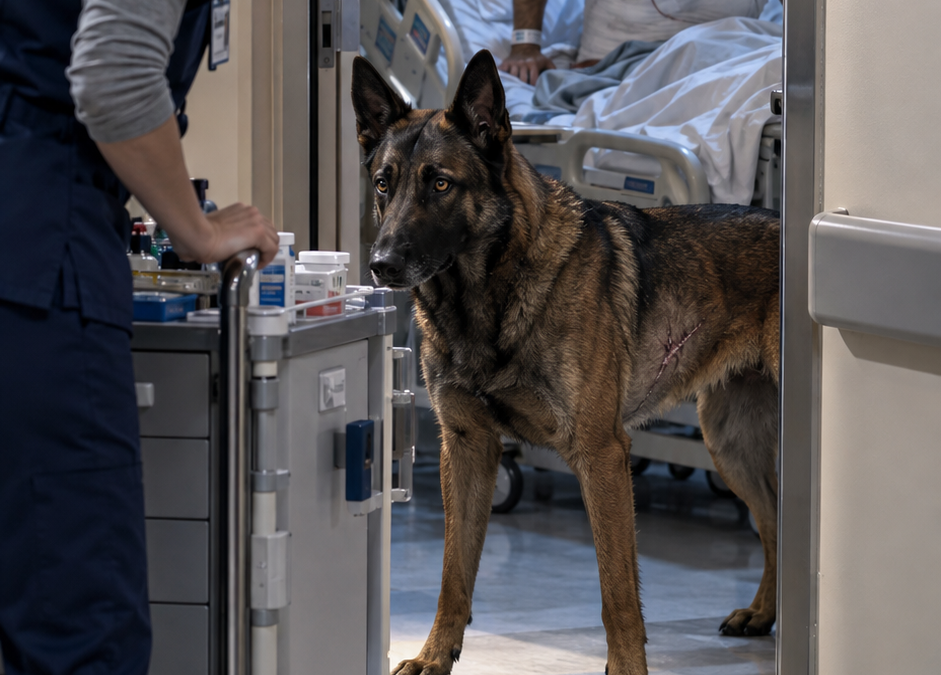
An eighty-pound dog across a doorway.
Everybody asking how to move him.
Nobody initially asking why he was there.
That was the part of Room 12 I never forgot.
Not the blood pressure numbers.
Not the transport delay.
Not even the moment Ethan’s face lost color and Wells canceled imaging.
The doorway.
Because that was where the whole night could have gone differently.
We could have called security.
Separated Ethan from Rook.
Forced access.
Made the dog more anxious.
Made Ethan more anxious.
Possibly gotten somebody hurt.
Maybe we still would have discovered Ethan’s pressure problem.
Maybe not.
What changed everything was not some magical understanding between a nurse and a military dog.
It was hesitation.
Thirty seconds of not assuming we already knew what we were looking at.
Years later, I saw Ethan again.
Not in the hospital.
At a veterans’ rehabilitation event.
I was there volunteering with a blood pressure screening station.
A familiar Belgian Malinois walked past first.
Gray beginning around his muzzle.
Slower.
Still unmistakable.
I looked up.
Ethan followed with a slight limp.
No walker.
He saw me.
Stopped.
“Rookie.”
I laughed.
“You’re still alive.”
“Despite hospital food.”
Rook recognized me after a moment.
His ears lifted.
He walked over.
Touched his nose to my hand.
“Still hates mops?”
Ethan nodded.
“Some things can’t be fixed.”
“How’s the pressure?”
“Managed.”
“Rook?”
“Retired from retirement.”
“What does that mean?”
“He sleeps most of the day and supervises everything.”
“Sounds senior.”
“He thinks so.”
We stood there for a minute.
Then Ethan looked down at him.
“You know what I finally figured out?”
“What?”
“That night in Room 12, I thought he had stopped trusting me.”
I waited.
“He hadn’t.”
Ethan rubbed behind Rook’s ear.
“He was trying to protect the job even when I was giving him the wrong instructions.”
I nodded.
“That sounds about right.”
“He still should’ve listened.”
“Probably.”
Ethan smiled.
“There it is.”
“What?”
“You still won’t turn him into a hero.”
“He’s a dog.”
Rook stared at me.
“A very good dog.”
“That better.”
Ethan looked toward the rehabilitation floor across the courtyard.
“I was pretty angry at you.”
“I noticed.”
“I thought you were treating me like I didn’t understand my own partner.”
“You didn’t.”
He laughed.
“Still annoying.”
“Still accurate.”
Then his expression softened.
“But you didn’t take him away.”
“No.”
“You didn’t let me do something stupid either.”
“No.”
“That’s a difficult combination.”
“It’s nursing.”
He nodded.
Rook sat between us.
Older.
Scar still visible along his ribs.
I thought about how frightening he had looked that first night.
Broad shoulders across the yellow line.
Dark eyes fixed on my hands.
The entire room reduced to one question:
How do we get past the dog?
That had been the wrong question.
The better one was:
What changed?
And that became one of the most valuable questions I ever learned to ask.
When a patient suddenly becomes difficult, what changed?
When a family member becomes demanding, what changed?
When somebody refuses something they accepted yesterday, what changed?
When an old military dog stops obeying the handler he has followed for seven years, what changed?
Sometimes the answer is fear.
Sometimes pain.
Sometimes confusion.
Sometimes nothing important at all.
But asking creates space between observation and judgment.
That space can keep people safe.
Ethan eventually walked away toward the main event.
Rook beside him.
Still on the left.
Mostly.
Halfway across the room, another dog barked.
Rook drifted a foot out of position.
Ethan looked down.
“Rook.”
The Malinois glanced up.
Ethan pointed.
Rook moved back.
Simple correction.
No panic.
No fear that one missed command meant the partnership was falling apart.
I watched them disappear through the crowd.
For seven years, Rook had stood beside Ethan’s left leg because that was where safety lived.
Then injury changed the room.
Changed the walking pattern.
Changed the medications.
Changed Ethan’s blood pressure.
Changed what safe care looked like.
For a while, both of them tried to force the old arrangement to survive.
It couldn’t.
The purpose could.
That was the difference.
The last thing I remember about Room 12 is not Rook blocking me.
It is hearing another nurse roll a cart across the threshold without needing me there.
Ethan had positioned the dog.
The nurse had waited.
The care happened.
Nothing dramatic.
Nothing heroic.
Just a patient, a nurse, and a retired K9 understanding where each responsibility began and ended.
That was how the problem was solved.
Not by controlling Rook.
Not by obeying him.
Not by turning him into something mystical.
By paying attention long enough to recognize that the doorway was never the real problem.
The patient was changing.
The dog noticed.
And once we stopped trying to force our way past him, we finally remembered to look at the man he had been guarding all along.








