𝗣𝗔𝗥𝗧 𝟮 The Retired K9 Kept Watching His Dying Handler’s Left Hand Like the Last Command Hadn’t Come Yet
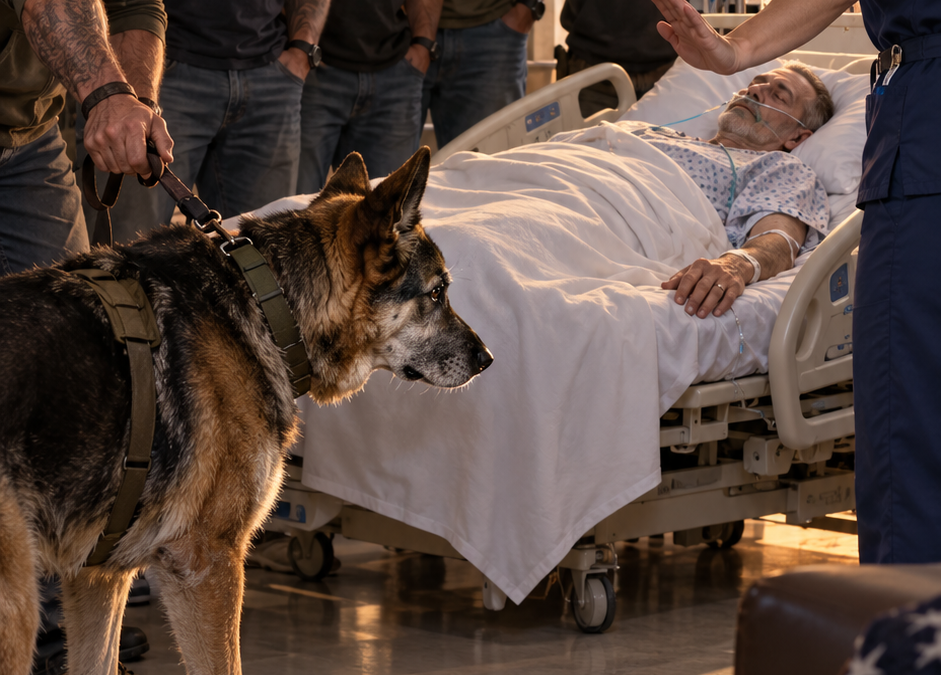
𝗣𝗔𝗥𝗧 𝟮
The room went quiet enough that the oxygen hiss sounded suddenly enormous.
Mason looked from Ranger to Ethan.
“Then what is he doing?”
I watched Ranger’s eyes settle on Ethan’s fingers again.
“I think he’s waiting.”
“For what?”
I didn’t know yet.
And I wasn’t going to invent an answer simply because five grieving men desperately wanted one.
So I took the leash from where it had fallen against the floor and placed the handle back into Mason’s palm.
“Keep it slack.”
Mason frowned.
“We don’t have all night.”
He wasn’t being cruel.
He was afraid.
Every pause in Ethan’s breathing felt like a door closing.
And Mason wanted Ranger across the room before that door shut completely.
“I know.”
“Then what are we waiting for?”
“The dog to show us.”
One of the others stepped forward and patted his thigh.
“Come on, boy. Go see him.”
Ranger didn’t move.
I raised a hand.
“Nobody call him.”
The man stopped.
“Then what do we do?”
“Give him the choice you thought he already had.”
I crossed to the rolling tray near the doorway and pushed it against the opposite wall, opening a clear route from Ranger to Ethan.
Then I looked at Mason.
“Two steps back.”
He did it reluctantly.
The leash now hung in a loose curve.
Ranger stood.
Everyone held their breath.
He took three slow steps into the room.
Circled near the foot of Ethan’s bed.
Then returned to the doorway.
He sat exactly where he had been.
Shoulders squared toward the room.
Head slightly angled toward the hall.
Eyes returning to Ethan’s left hand.
Mason’s face tightened.
I shook my head before he could interpret it as failure.
“No.”
“What?”
“That was his answer.”
Mason stared at Ranger.
“He chose to come back here.”
“Yes.”
Ethan drew in a short breath.
Then paused.
Mason instinctively moved toward the bed.
Ranger rose.
He didn’t bark.
Didn’t growl.
Didn’t bare his teeth.
He simply stepped sideways into Mason’s path.
Mason stopped.
Ranger looked at him.
Then looked toward Ethan’s hand.
A second later Mason stepped backward.
Ranger returned to the doorway.
I felt something cold move through my chest.
Until then, Ranger’s behavior could have been described as refusal.
Now it couldn’t.
He was actively controlling access.
“Luke,” I said.
Luke Harris looked at me.
“Approach Ethan from the right.”
Luke moved carefully.
Ranger watched him.
But stayed seated.
Luke reached the bedside.
Nothing.
I crossed behind the bed.
Ranger tracked me.
I adjusted the blanket from Ethan’s right side.
Still nothing.
Then I reached toward Ethan’s left forearm to check the pulse oximeter cable.
Ranger stood immediately.
Two silent steps toward me.
I froze before touching Ethan.
Ranger stopped too.
I withdrew my hand.
He backed away and sat.
Mason’s eyes widened.
“What the hell?”
I didn’t answer yet.
I didn’t want to turn one observation into a conclusion too quickly.
So instead of testing Ranger again, I changed the room.
I moved everything I needed to Ethan’s right side.
Oral-care supplies.
Water.
Monitoring equipment.
The bedside tray.
Then I looked at the men.
“Keep the left side clear.”
None of them argued.
The next time I checked Ethan’s vital signs, I did it from the right.
Ranger stayed at his post.
One of the men approached Ethan from the right.
Ranger remained seated.
Mason started toward Ethan’s left shoulder, caught himself, and changed course.
Ranger watched him.
But did not move.
That was when Mason looked down at the leash.
Slowly, without asking me, he unclipped it.
The metal clasp made a small sound.
Ranger glanced back.
Then returned his attention to Ethan.
Mason placed the leash over the chair.
He no longer had an easy way to force Ranger across the room.
I think that frightened him.
But he did it anyway.
“He’s not waiting for us to move him,” I said.
Mason stared at Ethan’s motionless fingers.
“Then we figure out what he thinks Ethan still has to do.”
That sentence changed everything.
Until then, the five SEALs had been trying to manage Ranger.
After that, they began listening to him.
“Show me how Ethan worked him,” I said.
Mason looked over.
“What do you mean?”
“Basic positioning. Nothing stressful. Just show me what he still remembers.”
Mason hesitated.
Then he made a short downward gesture with one hand.
Ranger responded immediately.
He rose.
Crossed the floor.
Stopped exactly where Mason indicated.
No hesitation.
No confusion.
Luke released a breath.
“He remembers.”
Mason gave another directional signal.
Ranger moved again.
Slower than he must once have moved, but cleanly.
He crossed behind Luke and settled near the wall.
Mason’s face had gone very still.
I watched Ethan.
His breathing remained shallow.
His left hand had not moved.
“Finish whatever sequence you started,” I said.
Mason swallowed.
“It’s been years.”
“He seems to know it.”
Mason gave Ranger another familiar signal.
Ranger held.
One second.
Two.
Then he broke position without being released.
He crossed near the foot of Ethan’s bed.
Passed only a few feet from him.
Then returned directly to the doorway.
Sat.
Looked at Ethan’s left hand.
Mason didn’t issue another command.
He just stared.
I picked up the leash and offered it back to him.
His fingers closed around mine instead of the handle.
He pushed it gently toward me.
“No.”
His voice cracked.
“If we put that back on him, we’re deciding for him again.”
So I hung the leash on the far wall.
That was the first real surrender in the room.
Five men who had entered determined to lead Ranger through a goodbye were now giving up the one tool that could force him to do it.
Mason moved to Ethan’s bedside.
He stayed on the right.
“What do you need from us, buddy?”
Ranger kept watching Ethan.
I didn’t let Mason turn the question into another command.
“Tell me how Ethan used him when he needed someone protected.”
Mason looked at me.
Then Ranger.
“Sometimes there wasn’t anything dramatic.”
“What would Ethan do?”
“Put Ranger somewhere.”
“And?”
“He stayed.”
“Until?”
Mason’s face changed.
“Until Ethan released him.”
No one moved.
I looked toward Ranger.
Still at the doorway.
Still checking the hallway.
Still watching Ethan’s hand.
“Then nobody releases him.”
One of the men frowned.
“Clare—”
“Not until we know whose release he’s waiting for.”
That ended the discussion.
Luke moved a chair away from Ranger’s position.
Someone else shut the bathroom door so there was only one main open route into the room.
Mason shifted Ethan’s personal items to the right.
A hospice aide appeared with fresh linens.
Ranger stood.
The aide stopped.
Before I could speak, Mason stepped forward.
“This way.”
He guided her around Ranger’s position and brought her to Ethan from the right.
Ranger watched.
Then sat again.
Mason and I looked at each other.
Neither of us smiled.
There was nothing to celebrate yet.
But responsibility had changed hands.
I was responsible for Ethan’s care.
The five men were now responsible for protecting Ranger’s ability to continue whatever duty he believed he still had.
Ranger himself was no longer being treated as an obstacle.
He was holding a post.
We just didn’t understand the post yet.
The oxygen alarm sounded less than twenty minutes later.
A soft warning tone.
I moved immediately.
But for the first time in years of nursing, my route to a patient was being influenced by a retired military dog.
I approached from Ethan’s right.
His oxygen cannula had shifted.
Mason moved the bedside table before I asked.
Luke steadied the tubing.
Ranger watched all three of us.
He stayed seated.
I repositioned the cannula.
Ethan’s oxygen saturation slowly recovered.
Then his eyelids fluttered.
Mason leaned closer.
“We’re here, brother.”
Ethan didn’t answer.
His left fingers moved faintly against the blanket.
Ranger stood.
Every person in that room went still.
The dog didn’t approach.
He took one step forward.
Stared at the hand.
The fingers settled.
Ranger remained standing several seconds longer.
Then returned to his post.
Luke whispered, “He saw that.”
“Yes.”
Mason looked at me.
“What does it mean?”
“I don’t know yet.”
And I meant it.
Patterns matter in nursing.
So does restraint.
A nurse who falls in love with an explanation too early can stop seeing what the patient is actually telling her.
Ranger deserved the same caution.
Later, I needed to perform oral care.
Ethan’s position would have made the left side easier.
I picked up the swab and started around the bed.
Ranger rose.
Mason stepped between us.
Not defensively.
Protectively.
“Wait.”
I stopped.
Mason looked at Ethan.
Then shifted the pillow and carefully adjusted Ethan’s head enough for me to work from the right.
Ranger watched.
Didn’t advance.
When I finished, Mason kept one hand against Ethan’s pillow for an extra second.
He had just rearranged himself around Ranger’s unfinished duty rather than making the dog surrender it for human convenience.
That mattered.
Then Ethan coughed.
Weakly.
His left arm slid several inches toward the edge of the mattress.
Ranger crossed half the room.
No command.
No call.
He stopped near the foot of the bed.
His gaze fixed on Ethan’s exposed hand.
“Ranger,” Mason whispered.
The dog didn’t even look at him.
Ethan’s fingers twitched once.
Ranger leaned forward.
Then the hand went still.
Ranger backed away.
Luke slowly lowered himself into a chair.
“He keeps doing it when the hand moves.”
I nodded.
This time, I changed something deliberately.
I adjusted Ethan’s blanket so his left hand remained exposed.
Visible.
Mason started to cover it again against the cool air.
His hand stopped halfway.
He looked at Ranger.
Then he pulled another blanket across Ethan’s chest instead.
The left hand stayed uncovered.
Ranger lowered himself by the doorway.
His head dipped slightly with fatigue.
But his eyes kept returning to those fingers.
The five men had brought Ranger there because they believed he needed to understand Ethan was dying.
Now we were arranging Ethan’s final hours around a single motionless hand because Ranger seemed convinced it still had something to say.
The breakthrough came almost quietly.
Mason had been watching Ethan’s hand for several minutes when suddenly he stood.
“Wait.”
Nobody moved.
He looked at Ranger.
Then slowly raised his own hand at chest height.
Index and middle fingers separated.
Barely an inch.
Ranger stood instantly.
My pulse jumped.
Mason dropped his hand.
Ranger stayed standing.
Luke looked between them.
“What was that?”
Mason didn’t answer at first.
All the color seemed to drain from his face.
“The release.”
I looked at Ranger.
“Release from what?”
“A post. A hold. Anything Ethan needed him to maintain until it was safe to stop.”
The room went very quiet.
Mason raised his two fingers again.
This time Ranger looked directly at the gesture.
But he did not respond.
He turned his gaze back toward Ethan’s hand.
Mason lowered his arm.
That was all I needed.
I crossed to Ethan.
Carefully, I adjusted the pillow beneath his left elbow.
Just enough to elevate the forearm.
His hand now rested clearly against the white blanket.
Visible from Ranger’s position.
Ranger took one step forward.
Stopped.
And waited.
Suddenly every strange choice he had made since entering the room fit together.
The doorway.
The hallway.
The protected left side.
The refusal to approach.
The constant attention to Ethan’s hand.
Ranger had not been refusing Ethan.
He had been obeying him.
Mason sat down hard.
He covered his mouth with one hand.
Luke turned toward the hallway, blinking rapidly.
I looked at Ethan’s fingers.
Loose.
Weak.
Nearly motionless.
And I understood what none of us could ethically do.
If Ranger was waiting for Ethan’s release signal, Mason could probably give it.
Maybe Luke could.
Maybe any man who knew the gesture could.
But that would not be Ethan’s release.
It would be ours.
We would be ending Ranger’s duty because the waiting hurt us.
Mason must have understood the same thing.
His hand lifted halfway.
Two fingers nearly separating.
Then he closed them into his palm.
“I could give it.”
“Yes.”
“He’d probably take it.”
“Maybe.”
Mason stared at Ranger.
His voice dropped.
“But it wouldn’t be Ethan.”
“No.”
His hand settled flat against his knee.
That restraint told me more about Mason than anything else had.
I moved the remaining equipment farther right.
Then I lowered the left bed rail enough to give Ethan’s hand room to move safely.
Ranger abandoned the doorway.
He crossed half the room and stopped several feet from Ethan.
Still not beside the bed.
Close enough to watch the hand without turning his head.
Mason whispered, “All this time, we thought he couldn’t let go.”
I looked at him.
“He may have been waiting to be told he was allowed to.”
Ethan’s fingers moved.
Ranger’s ears came forward.
His weight shifted.
The fingers stopped.
So did Ranger.
I placed two fingers gently against Ethan’s wrist, checking his pulse without altering the position of his hand.
His eyelids fluttered.
“Ethan.”
No response.
I leaned slightly closer.
“Ranger is here.”
Mason stood.
But stayed behind me.
Ethan’s eyes opened only a fraction.
Then closed.
His index finger moved against the blanket.
A moment later, the middle finger shifted too.
Not enough.
Not deliberate.
But Ranger leaned forward.
Mason took one involuntary step toward the bed.
Stopped himself.
I moved a chair away from Ethan’s left side.
The space between his hand and Ranger was now completely open.
Ranger lowered himself there.
Not beside Ethan yet.
Several feet away.
Front paws extended.
Eyes fixed on those fingers.
For the first time, he was no longer watching the hallway.
He had moved from guarding the room to waiting directly for the man who had assigned the duty.
There was nothing left for us to interpret.
Only something to respect.
I leaned close to Ethan.
“Ranger is waiting for you.”
His eyelids opened again.
I didn’t touch his fingers.
Instead, I folded a towel and placed it beneath his forearm so the weight of his wrist wouldn’t trap his hand against the mattress.
Ranger stood immediately.
Mason stepped forward.
Then stopped himself.
Ethan’s index finger moved.
The middle followed.
Both fell back.
Ranger remained standing.
“No one gives it for him,” I said.
Mason nodded.
His eyes were wet.
“Even if Ethan can’t?”
I met his gaze.
“Especially then.”
That was the hardest answer I gave all day.
Because I understood what it meant.
If Ethan could not complete that final motion, Ranger might remain on duty through Ethan’s last breath.
The five men would have to live with that.
So would I.
Mason crossed to the wall and removed the leash.
For a second I thought he had changed his mind.
Instead, he folded it.
Once.
Twice.
Then placed it inside Ethan’s old duffel beneath the chair.
He zipped the bag.
“Nobody uses that to move him.”
Luke nodded.
Then the others.
A decision became physical.
Ranger would not be dragged away if the waiting became unbearable.
I turned back toward Ethan.
His eyes were open now.
Unfocused.
But there.
I raised my own hand where he could see it.
Slowly, I demonstrated only the beginning of the two-finger movement.
I stopped before completing it.
Then lowered my hand.
That was the only help I was willing to give.
Ethan’s gaze moved toward Ranger.
Ranger’s whole body leaned forward without taking a step.
Ethan tried.
His fingers lifted less than an inch.
Trembled.
Separated slightly.
Collapsed.
Ranger edged closer.
Then caught himself.
Luke turned his face away.
One of the other men reached toward Ranger’s shoulder.
Stopped before touching him.
There was nothing left to rearrange.
No more equipment to move.
No more explanation to discover.
No leash.
No command.
No shortcut.
Ethan understood.
Ranger understood.
Everyone else had to wait.
Mason sat on Ethan’s right.
The other SEALs found chairs along the wall.
I stepped back.
Ranger rose fully.
One slow step.
He stopped where Ethan could see him without moving his head.
Ethan looked at the dog.
Then at his own hand.
His fingers shifted.
No one helped.
No one whispered instructions.
No one gave the signal for him.
For the first time since Ranger entered the room, there was only one man left who could decide whether his final watch was over.
Ethan drew another shallow breath.
His chest barely moved.
Ranger stood absolutely still.
Ethan tried again.
His wrist shifted against the towel.
The index finger lifted first.
The middle followed.
They trembled.
Fell.
Mason’s knuckles went white against the arm of his chair.
He could have ended the suffering in one second.
He did not.
Ethan inhaled.
The breath rattled softly.
His eyes found Ranger.
Ranger stepped closer.
Then stopped.
And I watched a dying man gather what little strength remained in his body for an action that must once have been effortless.
Not for us.
Not for himself.
For the dog standing beside his bed.
His wrist moved.
Two fingers lifted.
They trembled so violently I thought they would fall again.
Then they separated.
The release signal.
Ranger froze.
For one suspended second, nothing in that room breathed.
Then his ears softened.
The tension left his shoulders.
His chest lowered.
The rigid working posture that had held him together since entering the room simply disappeared.
Ranger stepped forward.
Not toward the hallway.
Not toward Mason.
Toward Ethan.
He crossed the remaining distance without anyone calling him.
At the bedside, he lowered his head beneath Ethan’s raised hand.
The fingers fell gently into the silver fur between his ears.
Ranger closed his eyes.
Then the old German Shepherd folded his front legs and lay down beside the bed.
Mason turned away.
Luke pressed a fist against his mouth.
One of the other men bowed his head.
No one made a sound.
Ethan’s hand rested on Ranger’s head.
He no longer had the strength to stroke him.
So Ranger pressed upward until the contact held.
I stepped backward.
I had noticed the waiting.
I had helped protect it.
But this moment did not belong to me.
Mason looked back.
His eyes moved from Ethan’s relaxed fingers to Ranger.
“He wasn’t waiting to say goodbye.”
I said nothing.
Ranger had already answered.
For hours, every cart in the hallway had made him turn.
Every person approaching Ethan’s left side had brought him to his feet.
Now another cart rolled past.
Ranger’s ears barely moved.
Footsteps crossed outside.
He didn’t look.
His post was over.
Ethan’s fingers shifted weakly through his fur.
Ranger released a long breath.
Then lowered his chin beside Ethan’s arm.
Mason started forward.
Stopped.
Then returned to his chair.
No one crowded the bed.
No one needed to.
I dimmed the overhead light.
Raised the opposite bed rail.
Checked the oxygen tubing.
Ranger did not move.
For the first time since entering the room, he wasn’t guarding anything.
He was simply lying beside Ethan.
The man’s hand resting against him.
The command completed.
The duty finished.
From that point forward, the room changed.
Not dramatically.
More like everyone finally understood the rules.
When I needed to check Ethan again, Mason moved the chair for me without being asked.
I approached from the right.
Ranger opened his eyes.
Saw me.
Stayed down.
Mason noticed.
Earlier, he would have watched Ranger as if intervention might be necessary.
Now he simply lifted one corner of the blanket so I could pull it higher over Ethan’s chest.
We left the left arm untouched.
Ethan’s fingers had slipped from Ranger’s head to the side of his neck.
The contact was imperfect.
We did not correct it.
Luke brought the chair from beside the doorway back into the room.
He started to place it near Ethan.
Then saw the space around Ranger.
He moved it farther back.
The other men did the same.
Soon five chairs formed a loose half-circle.
Ethan and Ranger remained at the center.
For a long time, no one spoke.
I had sat through countless vigils like that.
Families often think they will know what to say near the end.
Most discover that language becomes small in rooms like this.
Love is rarely expressed through perfect speeches.
Sometimes it is a blanket adjusted without disturbing a dog.
A chair moved three feet back.
A leash left untouched.
A hand no one forces into position.
Mason kept looking toward Ethan’s duffel.
The leash was inside.
Eventually someone would have to use it again.
Ranger would have to leave the building.
Someone would have to decide where he slept that night.
Tomorrow.
Next week.
For the rest of his life.
But nobody needed to make those decisions while Ethan’s hand was still touching him.
So Mason left the bag closed.
At one point, Ethan’s hand slipped.
Ranger raised his muzzle and followed it so the contact wouldn’t break.
Mason’s face tightened.
He looked down.
This time he didn’t hide behind a task.
Luke reached over and rested one hand on his shoulder.
Mason allowed it.
I started toward the door to give them privacy.
Mason noticed.
He moved aside.
Then pulled an empty chair a little closer to the group.
Not beside Ethan.
Not inside Ranger’s space.
Just close enough for me to understand.
I sat.
No one thanked me.
No one needed to.
By then the five SEALs no longer needed me to interpret Ranger.
And I no longer needed them to surrender control.
We were simply trying not to disturb what Ethan and Ranger had chosen.
Hours passed.
The hallway lights dimmed.
Ranger remained beside the bed.
Ethan’s breathing became slower.
Longer pauses.
Softer returns.
Mason eventually stood.
He crossed to the duffel.
Unzipped it.
Removed the leash.
Ranger raised his head.
Mason stopped immediately.
He held the leash loosely in both hands.
Then laid it across the back of a chair.
“Not this time.”
I looked at the clock.
Visiting hours had technically ended.
But no one was going to order Ranger from that room.
I opened the door.
That was all.
No command.
No gesture.
No call.
The five SEALs stood.
One by one, they moved into the hallway.
They left space.
Ranger stayed beside Ethan.
His eyes went toward the doorway.
Then back to the hand resting against his neck.
No signal remained unfinished now.
Nothing held him there except his own choice.
Ranger slowly pushed himself upright.
His aging joints made the movement stiff.
For several seconds he remained beside the bed.
Then he lowered his nose and touched Ethan’s hand.
Once.
Very gently.
Mason’s hand moved toward the leash.
Stopped.
Ranger stepped away from the bed.
He crossed the room without looking toward the place he had guarded for hours.
At the threshold, he paused.
Everyone waited.
Ranger looked back.
Not at me.
Not at Mason.
Not at the room.
At Ethan’s left hand.
It rested open against the white blanket.
The same hand Ranger had watched from the moment he entered.
For one quiet second, the old dog stood there.
Then he turned toward the hallway.
Mason stepped aside.
Luke did too.
The others opened their formation naturally.
No one stood in front of Ranger.
No one pulled him.
No one told him where to go.
Ranger walked into the space between them.
Five Navy SEALs and one retired K9 moved down the corridor together.
The leash remained hanging over Mason’s forearm.
Loose.
Unused.
Halfway toward the corner, Mason looked down at Ranger.
His pace slowed.
Ranger slowed too.
But he didn’t turn around.
I stayed beside Ethan.
From where I stood, I could still see the open doorway.
Ranger’s silver muzzle disappeared first.
Then Mason.
Then Luke.
Then the others.
Their footsteps faded.
The room became quiet again.
I turned back toward Ethan.
His left hand remained open on the blanket.
Hours earlier, five men had carried the weight of believing Ranger did not understand what was happening.
They thought the old dog was confused.
Afraid.
Unable to face the man he loved.
They thought they needed to pull him across the room so he could say goodbye.
But Ranger had understood far more than any of us.
He knew Ethan was there.
He knew his handler was weak.
He knew which side of the bed needed protecting.
And he remembered the one rule no amount of grief could erase.
Hold until released.
I had spent my career learning when intervention saved people.
That night taught me something equally important.
Sometimes caring means refusing to interfere.
Sometimes love is not pulling someone closer because you are frightened time is running out.
Sometimes it is trusting that a bond built over years has its own language.
The five men had come to help Ranger let Ethan go.
In the end, Ranger had been the one waiting for Ethan to tell him he finally could.
And when that tired hand gave him the last command, Ranger did exactly what he had been trained to do.
He obeyed.
Then, for the first time that night, he stopped being Ethan Cole’s K9.
He became simply Ranger.
An old dog who had finished his final watch and was finally allowed to walk away.
Have you finished reading the story and want to read it again?
The Retired K9 Kept Watching His Dying Handler’s Left Hand Like the Last Command Hadn’t Come Yet
“Don’t pull him to the bed.”
My voice was quiet, but it stopped five Navy SEALs at once.
Ranger had planted all four paws against the hospice room floor, his aging body angled toward the man dying beneath the white blanket. The leash stretched tight from his collar to Mason Reed’s hand, but the old German Shepherd would not take another step.
For everyone else in that room, this was supposed to be goodbye.
For Ranger, I was beginning to understand, it was something else entirely.
My name is Clare Bennett.
I had spent enough years as a nurse to know that death rarely looks the way people imagine it will.
Sometimes it comes dramatically, surrounded by alarms and rushing feet.
Sometimes it enters a room so quietly that you only notice because everyone else has stopped breathing.
That afternoon at Fort Calder’s hospice unit, death had settled beside Ethan Cole long before Ranger arrived.
Ethan had once been strong enough to serve in places his medical file described only in abbreviations. By the time I met him, his face had narrowed, his skin had taken on the pale translucence of prolonged illness, and every breath seemed to require a negotiation with his own body.
He was barely responsive.
His eyes remained closed most of the time.
Oxygen tubing curved beneath his nose.
His right hand rested beneath the blanket.
His left lay exposed near the mattress edge, fingers loose and motionless.
Five men stood around him.
Mason Reed.
Luke Harris.
And three others who had served with Ethan long enough that they moved around one another without needing to speak.
They had brought Ranger there because Ethan might not make it through the night.
Ranger was almost eleven.
His muzzle had gone silver.
His hips were stiff.
His movements lacked the speed he must once have had.
But age had not erased the shape of what he had been.
A working dog.
A military dog.
Ethan’s dog.
Or, as Mason corrected me when they arrived, Ethan’s partner.
They had expected Ranger to rush to the bed.
Instead, he stopped at the doorway.
Mason had tried gently at first.
“Come on, buddy.”
Ranger held.
Mason tightened the leash by an inch.
Ranger leaned backward.
His nails pressed against the tile.
“Ranger.”
Nothing.
One of the other men rubbed a hand over his face.
“Ethan would hate this.”
No one argued.
That sentence carried more weight than the leash.
They had come believing Ethan needed this.
That Ranger needed this.
Maybe both of them did.
And now, with Ethan fading only feet away, the dog who had followed him through years of service refused to approach.
“He doesn’t understand,” Mason said.
I didn’t answer.
Because I wasn’t sure that was true.
I had been watching Ranger’s body since the moment he entered.
He wasn’t cowering.
His tail wasn’t tucked.
He wasn’t turning toward the exit.
He wasn’t trembling or trying to hide behind Mason.
His chest was forward.
His weight was balanced.
His attention was sharp.
His eyes kept following the same sequence.
Doorway.
Hallway.
Ethan.
Then Ethan’s left hand.
Back to the doorway.
Again.
And again.
A cart rattled past outside.
Ranger’s ears rose immediately.
His head turned toward the hallway.
He listened until the noise faded.
Then his gaze returned to Ethan’s left hand.
That was when I told Mason to stop pulling.
He stared at me.
“We came here so he could be with him.”
“I know.”
“We may not have much time.”
“I know that too.”
Ethan’s breathing caught softly against the oxygen tubing.
Every man in the room looked toward the bed.
So did Ranger.
But he still wouldn’t move closer.
I nodded toward Mason’s fist.
“Loosen the leash.”
His jaw tightened.
I could see what he was thinking.
A nurse had no idea what Ranger and Ethan had been through together.
And he was right.
I didn’t.
I hadn’t walked beside them overseas.
I hadn’t seen Ranger work.
I hadn’t watched Ethan trust this dog with his life.
But I knew what forced behavior looked like.
And I knew what purposeful behavior looked like.
Ranger’s refusal did not look confused.
It looked deliberate.
“Why?” Mason asked.
“Because if he’s choosing not to approach, I want to know what happens when nobody argues with that choice.”
Mason looked at Ethan.
Another long pause between breaths.
Then he slowly opened his fist.
The leash sagged.
Ranger was free.
For a moment, everyone waited for him to move toward the bed.
He didn’t.
Instead, he stepped backward until his shoulder aligned with the doorway.
Then he sat.
Straight.
Alert.
Facing into the room.
Mason’s expression changed.
“He always went to Ethan.”
I crouched several feet from Ranger.
I didn’t call him.
Didn’t offer my hand.
Didn’t try to become part of whatever he was doing.
Ranger glanced at me once.
Then dismissed me completely.
Door.
Hallway.
Ethan.
Left hand.
Door again.
One of the SEALs lowered himself beside Ranger and offered a palm.
“Hey, old man.”
Ranger ignored him.
That mattered too.
He wasn’t asking for reassurance.
He wasn’t distressed by the room.
He wasn’t distracted.
He was maintaining something.
I stood.
“Don’t bring him any closer.”
Mason looked at me sharply.
“Why?”
I kept watching Ranger.
“Because I don’t think he’s refusing to say goodbye.”
The room went quiet enough that the oxygen hiss sounded suddenly enormous.
Mason looked from Ranger to Ethan.
“Then what is he doing?”
I watched Ranger’s eyes settle on Ethan’s fingers again.
“I think he’s waiting.”
“For what?”
I didn’t know yet.
And I wasn’t going to invent an answer simply because five grieving men desperately wanted one.
So I took the leash from where it had fallen against the floor and placed the handle back into Mason’s palm.
“Keep it slack.”
Mason frowned.
“We don’t have all night.”
He wasn’t being cruel.
He was afraid.
Every pause in Ethan’s breathing felt like a door closing.
And Mason wanted Ranger across the room before that door shut completely.
“I know.”
“Then what are we waiting for?”
“The dog to show us.”
One of the others stepped forward and patted his thigh.
“Come on, boy. Go see him.”
Ranger didn’t move.
I raised a hand.
“Nobody call him.”
The man stopped.
“Then what do we do?”
“Give him the choice you thought he already had.”
I crossed to the rolling tray near the doorway and pushed it against the opposite wall, opening a clear route from Ranger to Ethan.
Then I looked at Mason.
“Two steps back.”
He did it reluctantly.
The leash now hung in a loose curve.
Ranger stood.
Everyone held their breath.
He took three slow steps into the room.
Circled near the foot of Ethan’s bed.
Then returned to the doorway.
He sat exactly where he had been.
Shoulders squared toward the room.
Head slightly angled toward the hall.
Eyes returning to Ethan’s left hand.
Mason’s face tightened.
I shook my head before he could interpret it as failure.
“No.”
“What?”
“That was his answer.”
Mason stared at Ranger.
“He chose to come back here.”
“Yes.”
Ethan drew in a short breath.
Then paused.
Mason instinctively moved toward the bed.
Ranger rose.
He didn’t bark.
Didn’t growl.
Didn’t bare his teeth.
He simply stepped sideways into Mason’s path.
Mason stopped.
Ranger looked at him.
Then looked toward Ethan’s hand.
A second later Mason stepped backward.
Ranger returned to the doorway.
I felt something cold move through my chest.
Until then, Ranger’s behavior could have been described as refusal.
Now it couldn’t.
He was actively controlling access.
“Luke,” I said.
Luke Harris looked at me.
“Approach Ethan from the right.”
Luke moved carefully.
Ranger watched him.
But stayed seated.
Luke reached the bedside.
Nothing.
I crossed behind the bed.
Ranger tracked me.
I adjusted the blanket from Ethan’s right side.
Still nothing.
Then I reached toward Ethan’s left forearm to check the pulse oximeter cable.
Ranger stood immediately.
Two silent steps toward me.
I froze before touching Ethan.
Ranger stopped too.
I withdrew my hand.
He backed away and sat.
Mason’s eyes widened.
“What the hell?”
I didn’t answer yet.
I didn’t want to turn one observation into a conclusion too quickly.
So instead of testing Ranger again, I changed the room.
I moved everything I needed to Ethan’s right side.
Oral-care supplies.
Water.
Monitoring equipment.
The bedside tray.
Then I looked at the men.
“Keep the left side clear.”
None of them argued.
The next time I checked Ethan’s vital signs, I did it from the right.
Ranger stayed at his post.
One of the men approached Ethan from the right.
Ranger remained seated.
Mason started toward Ethan’s left shoulder, caught himself, and changed course.
Ranger watched him.
But did not move.
That was when Mason looked down at the leash.
Slowly, without asking me, he unclipped it.
The metal clasp made a small sound.
Ranger glanced back.
Then returned his attention to Ethan.
Mason placed the leash over the chair.
He no longer had an easy way to force Ranger across the room.
I think that frightened him.
But he did it anyway.
“He’s not waiting for us to move him,” I said.
Mason stared at Ethan’s motionless fingers.
“Then we figure out what he thinks Ethan still has to do.”
That sentence changed everything.
Until then, the five SEALs had been trying to manage Ranger.
After that, they began listening to him.
“Show me how Ethan worked him,” I said.
Mason looked over.
“What do you mean?”
“Basic positioning. Nothing stressful. Just show me what he still remembers.”
Mason hesitated.
Then he made a short downward gesture with one hand.
Ranger responded immediately.
He rose.
Crossed the floor.
Stopped exactly where Mason indicated.
No hesitation.
No confusion.
Luke released a breath.
“He remembers.”
Mason gave another directional signal.
Ranger moved again.
Slower than he must once have moved, but cleanly.
He crossed behind Luke and settled near the wall.
Mason’s face had gone very still.
I watched Ethan.
His breathing remained shallow.
His left hand had not moved.
“Finish whatever sequence you started,” I said.
Mason swallowed.
“It’s been years.”
“He seems to know it.”
Mason gave Ranger another familiar signal.
Ranger held.
One second.
Two.
Then he broke position without being released.
He crossed near the foot of Ethan’s bed.
Passed only a few feet from him.
Then returned directly to the doorway.
Sat.
Looked at Ethan’s left hand.
Mason didn’t issue another command.
He just stared.
I picked up the leash and offered it back to him.
His fingers closed around mine instead of the handle.
He pushed it gently toward me.
“No.”
His voice cracked.
“If we put that back on him, we’re deciding for him again.”
So I hung the leash on the far wall.
That was the first real surrender in the room.
Five men who had entered determined to lead Ranger through a goodbye were now giving up the one tool that could force him to do it.
Mason moved to Ethan’s bedside.
He stayed on the right.
“What do you need from us, buddy?”
Ranger kept watching Ethan.
I didn’t let Mason turn the question into another command.
“Tell me how Ethan used him when he needed someone protected.”
Mason looked at me.
Then Ranger.
“Sometimes there wasn’t anything dramatic.”
“What would Ethan do?”
“Put Ranger somewhere.”
“And?”
“He stayed.”
“Until?”
Mason’s face changed.
“Until Ethan released him.”
No one moved.
I looked toward Ranger.
Still at the doorway.
Still checking the hallway.
Still watching Ethan’s hand.
“Then nobody releases him.”
One of the men frowned.
“Clare—”
“Not until we know whose release he’s waiting for.”
That ended the discussion.
Luke moved a chair away from Ranger’s position.
Someone else shut the bathroom door so there was only one main open route into the room.
Mason shifted Ethan’s personal items to the right.
A hospice aide appeared with fresh linens.
Ranger stood.
The aide stopped.
Before I could speak, Mason stepped forward.
“This way.”
He guided her around Ranger’s position and brought her to Ethan from the right.
Ranger watched.
Then sat again.
Mason and I looked at each other.
Neither of us smiled.
There was nothing to celebrate yet.
But responsibility had changed hands.
I was responsible for Ethan’s care.
The five men were now responsible for protecting Ranger’s ability to continue whatever duty he believed he still had.
Ranger himself was no longer being treated as an obstacle.
He was holding a post.
We just didn’t understand the post yet.
The oxygen alarm sounded less than twenty minutes later.
A soft warning tone.
I moved immediately.
But for the first time in years of nursing, my route to a patient was being influenced by a retired military dog.
I approached from Ethan’s right.
His oxygen cannula had shifted.
Mason moved the bedside table before I asked.
Luke steadied the tubing.
Ranger watched all three of us.
He stayed seated.
I repositioned the cannula.
Ethan’s oxygen saturation slowly recovered.
Then his eyelids fluttered.
Mason leaned closer.
“We’re here, brother.”
Ethan didn’t answer.
His left fingers moved faintly against the blanket.
Ranger stood.
Every person in that room went still.
The dog didn’t approach.
He took one step forward.
Stared at the hand.
The fingers settled.
Ranger remained standing several seconds longer.
Then returned to his post.
Luke whispered, “He saw that.”
“Yes.”
Mason looked at me.
“What does it mean?”
“I don’t know yet.”
And I meant it.
Patterns matter in nursing.
So does restraint.
A nurse who falls in love with an explanation too early can stop seeing what the patient is actually telling her.
Ranger deserved the same caution.
Later, I needed to perform oral care.
Ethan’s position would have made the left side easier.
I picked up the swab and started around the bed.
Ranger rose.
Mason stepped between us.
Not defensively.
Protectively.
“Wait.”
I stopped.
Mason looked at Ethan.
Then shifted the pillow and carefully adjusted Ethan’s head enough for me to work from the right.
Ranger watched.
Didn’t advance.
When I finished, Mason kept one hand against Ethan’s pillow for an extra second.
He had just rearranged himself around Ranger’s unfinished duty rather than making the dog surrender it for human convenience.
That mattered.
Then Ethan coughed.
Weakly.
His left arm slid several inches toward the edge of the mattress.
Ranger crossed half the room.
No command.
No call.
He stopped near the foot of the bed.
His gaze fixed on Ethan’s exposed hand.
“Ranger,” Mason whispered.
The dog didn’t even look at him.
Ethan’s fingers twitched once.
Ranger leaned forward.
Then the hand went still.
Ranger backed away.
Luke slowly lowered himself into a chair.
“He keeps doing it when the hand moves.”
I nodded.
This time, I changed something deliberately.
I adjusted Ethan’s blanket so his left hand remained exposed.
Visible.
Mason started to cover it again against the cool air.
His hand stopped halfway.
He looked at Ranger.
Then he pulled another blanket across Ethan’s chest instead.
The left hand stayed uncovered.
Ranger lowered himself by the doorway.
His head dipped slightly with fatigue.
But his eyes kept returning to those fingers.
The five men had brought Ranger there because they believed he needed to understand Ethan was dying.
Now we were arranging Ethan’s final hours around a single motionless hand because Ranger seemed convinced it still had something to say.
The breakthrough came almost quietly.
Mason had been watching Ethan’s hand for several minutes when suddenly he stood.
“Wait.”
Nobody moved.
He looked at Ranger.
Then slowly raised his own hand at chest height.
Index and middle fingers separated.
Barely an inch.
Ranger stood instantly.
My pulse jumped.
Mason dropped his hand.
Ranger stayed standing.
Luke looked between them.
“What was that?”
Mason didn’t answer at first.
All the color seemed to drain from his face.
“The release.”
I looked at Ranger.
“Release from what?”
“A post. A hold. Anything Ethan needed him to maintain until it was safe to stop.”
The room went very quiet.
Mason raised his two fingers again.
This time Ranger looked directly at the gesture.
But he did not respond.
He turned his gaze back toward Ethan’s hand.
Mason lowered his arm.
That was all I needed.
I crossed to Ethan.
Carefully, I adjusted the pillow beneath his left elbow.
Just enough to elevate the forearm.
His hand now rested clearly against the white blanket.
Visible from Ranger’s position.
Ranger took one step forward.
Stopped.
And waited.
Suddenly every strange choice he had made since entering the room fit together.
The doorway.
The hallway.
The protected left side.
The refusal to approach.
The constant attention to Ethan’s hand.
Ranger had not been refusing Ethan.
He had been obeying him.
Mason sat down hard.
He covered his mouth with one hand.
Luke turned toward the hallway, blinking rapidly.
I looked at Ethan’s fingers.
Loose.
Weak.
Nearly motionless.
And I understood what none of us could ethically do.
If Ranger was waiting for Ethan’s release signal, Mason could probably give it.
Maybe Luke could.
Maybe any man who knew the gesture could.
But that would not be Ethan’s release.
It would be ours.
We would be ending Ranger’s duty because the waiting hurt us.
Mason must have understood the same thing.
His hand lifted halfway.
Two fingers nearly separating.
Then he closed them into his palm.
“I could give it.”
“Yes.”
“He’d probably take it.”
“Maybe.”
Mason stared at Ranger.
His voice dropped.
“But it wouldn’t be Ethan.”
“No.”
His hand settled flat against his knee.
That restraint told me more about Mason than anything else had.
I moved the remaining equipment farther right.
Then I lowered the left bed rail enough to give Ethan’s hand room to move safely.
Ranger abandoned the doorway.
He crossed half the room and stopped several feet from Ethan.
Still not beside the bed.
Close enough to watch the hand without turning his head.
Mason whispered, “All this time, we thought he couldn’t let go.”
I looked at him.
“He may have been waiting to be told he was allowed to.”
Ethan’s fingers moved.
Ranger’s ears came forward.
His weight shifted.
The fingers stopped.
So did Ranger.
I placed two fingers gently against Ethan’s wrist, checking his pulse without altering the position of his hand.
His eyelids fluttered.
“Ethan.”
No response.
I leaned slightly closer.
“Ranger is here.”
Mason stood.
But stayed behind me.
Ethan’s eyes opened only a fraction.
Then closed.
His index finger moved against the blanket.
A moment later, the middle finger shifted too.
Not enough.
Not deliberate.
But Ranger leaned forward.
Mason took one involuntary step toward the bed.
Stopped himself.
I moved a chair away from Ethan’s left side.
The space between his hand and Ranger was now completely open.
Ranger lowered himself there.
Not beside Ethan yet.
Several feet away.
Front paws extended.
Eyes fixed on those fingers.
For the first time, he was no longer watching the hallway.
He had moved from guarding the room to waiting directly for the man who had assigned the duty.
There was nothing left for us to interpret.
Only something to respect.
I leaned close to Ethan.
“Ranger is waiting for you.”
His eyelids opened again.
I didn’t touch his fingers.
Instead, I folded a towel and placed it beneath his forearm so the weight of his wrist wouldn’t trap his hand against the mattress.
Ranger stood immediately.
Mason stepped forward.
Then stopped himself.
Ethan’s index finger moved.
The middle followed.
Both fell back.
Ranger remained standing.
“No one gives it for him,” I said.
Mason nodded.
His eyes were wet.
“Even if Ethan can’t?”
I met his gaze.
“Especially then.”
That was the hardest answer I gave all day.
Because I understood what it meant.
If Ethan could not complete that final motion, Ranger might remain on duty through Ethan’s last breath.
The five men would have to live with that.
So would I.
Mason crossed to the wall and removed the leash.
For a second I thought he had changed his mind.
Instead, he folded it.
Once.
Twice.
Then placed it inside Ethan’s old duffel beneath the chair.
He zipped the bag.
“Nobody uses that to move him.”
Luke nodded.
Then the others.
A decision became physical.
Ranger would not be dragged away if the waiting became unbearable.
I turned back toward Ethan.
His eyes were open now.
Unfocused.
But there.
I raised my own hand where he could see it.
Slowly, I demonstrated only the beginning of the two-finger movement.
I stopped before completing it.
Then lowered my hand.
That was the only help I was willing to give.
Ethan’s gaze moved toward Ranger.
Ranger’s whole body leaned forward without taking a step.
Ethan tried.
His fingers lifted less than an inch.
Trembled.
Separated slightly.
Collapsed.
Ranger edged closer.
Then caught himself.
Luke turned his face away.
One of the other men reached toward Ranger’s shoulder.
Stopped before touching him.
There was nothing left to rearrange.
No more equipment to move.
No more explanation to discover.
No leash.
No command.
No shortcut.
Ethan understood.
Ranger understood.
Everyone else had to wait.
Mason sat on Ethan’s right.
The other SEALs found chairs along the wall.
I stepped back.
Ranger rose fully.
One slow step.
He stopped where Ethan could see him without moving his head.
Ethan looked at the dog.
Then at his own hand.
His fingers shifted.
No one helped.
No one whispered instructions.
No one gave the signal for him.
For the first time since Ranger entered the room, there was only one man left who could decide whether his final watch was over.
Ethan drew another shallow breath.
His chest barely moved.
Ranger stood absolutely still.
Ethan tried again.
His wrist shifted against the towel.
The index finger lifted first.
The middle followed.
They trembled.
Fell.
Mason’s knuckles went white against the arm of his chair.
He could have ended the suffering in one second.
He did not.
Ethan inhaled.
The breath rattled softly.
His eyes found Ranger.
Ranger stepped closer.
Then stopped.
And I watched a dying man gather what little strength remained in his body for an action that must once have been effortless.
Not for us.
Not for himself.
For the dog standing beside his bed.
His wrist moved.
Two fingers lifted.
They trembled so violently I thought they would fall again.
Then they separated.
The release signal.
Ranger froze.
For one suspended second, nothing in that room breathed.
Then his ears softened.
The tension left his shoulders.
His chest lowered.
The rigid working posture that had held him together since entering the room simply disappeared.
Ranger stepped forward.
Not toward the hallway.
Not toward Mason.
Toward Ethan.
He crossed the remaining distance without anyone calling him.
At the bedside, he lowered his head beneath Ethan’s raised hand.
The fingers fell gently into the silver fur between his ears.
Ranger closed his eyes.
Then the old German Shepherd folded his front legs and lay down beside the bed.
Mason turned away.
Luke pressed a fist against his mouth.
One of the other men bowed his head.
No one made a sound.
Ethan’s hand rested on Ranger’s head.
He no longer had the strength to stroke him.
So Ranger pressed upward until the contact held.
I stepped backward.
I had noticed the waiting.
I had helped protect it.
But this moment did not belong to me.
Mason looked back.
His eyes moved from Ethan’s relaxed fingers to Ranger.
“He wasn’t waiting to say goodbye.”
I said nothing.
Ranger had already answered.
For hours, every cart in the hallway had made him turn.
Every person approaching Ethan’s left side had brought him to his feet.
Now another cart rolled past.
Ranger’s ears barely moved.
Footsteps crossed outside.
He didn’t look.
His post was over.
Ethan’s fingers shifted weakly through his fur.
Ranger released a long breath.
Then lowered his chin beside Ethan’s arm.
Mason started forward.
Stopped.
Then returned to his chair.
No one crowded the bed.
No one needed to.
I dimmed the overhead light.
Raised the opposite bed rail.
Checked the oxygen tubing.
Ranger did not move.
For the first time since entering the room, he wasn’t guarding anything.
He was simply lying beside Ethan.
The man’s hand resting against him.
The command completed.
The duty finished.
From that point forward, the room changed.
Not dramatically.
More like everyone finally understood the rules.
When I needed to check Ethan again, Mason moved the chair for me without being asked.
I approached from the right.
Ranger opened his eyes.
Saw me.
Stayed down.
Mason noticed.
Earlier, he would have watched Ranger as if intervention might be necessary.
Now he simply lifted one corner of the blanket so I could pull it higher over Ethan’s chest.
We left the left arm untouched.
Ethan’s fingers had slipped from Ranger’s head to the side of his neck.
The contact was imperfect.
We did not correct it.
Luke brought the chair from beside the doorway back into the room.
He started to place it near Ethan.
Then saw the space around Ranger.
He moved it farther back.
The other men did the same.
Soon five chairs formed a loose half-circle.
Ethan and Ranger remained at the center.
For a long time, no one spoke.
I had sat through countless vigils like that.
Families often think they will know what to say near the end.
Most discover that language becomes small in rooms like this.
Love is rarely expressed through perfect speeches.
Sometimes it is a blanket adjusted without disturbing a dog.
A chair moved three feet back.
A leash left untouched.
A hand no one forces into position.
Mason kept looking toward Ethan’s duffel.
The leash was inside.
Eventually someone would have to use it again.
Ranger would have to leave the building.
Someone would have to decide where he slept that night.
Tomorrow.
Next week.
For the rest of his life.
But nobody needed to make those decisions while Ethan’s hand was still touching him.
So Mason left the bag closed.
At one point, Ethan’s hand slipped.
Ranger raised his muzzle and followed it so the contact wouldn’t break.
Mason’s face tightened.
He looked down.
This time he didn’t hide behind a task.
Luke reached over and rested one hand on his shoulder.
Mason allowed it.
I started toward the door to give them privacy.
Mason noticed.
He moved aside.
Then pulled an empty chair a little closer to the group.
Not beside Ethan.
Not inside Ranger’s space.
Just close enough for me to understand.
I sat.
No one thanked me.
No one needed to.
By then the five SEALs no longer needed me to interpret Ranger.
And I no longer needed them to surrender control.
We were simply trying not to disturb what Ethan and Ranger had chosen.
Hours passed.
The hallway lights dimmed.
Ranger remained beside the bed.
Ethan’s breathing became slower.
Longer pauses.
Softer returns.
Mason eventually stood.
He crossed to the duffel.
Unzipped it.
Removed the leash.
Ranger raised his head.
Mason stopped immediately.
He held the leash loosely in both hands.
Then laid it across the back of a chair.
“Not this time.”
I looked at the clock.
Visiting hours had technically ended.
But no one was going to order Ranger from that room.
I opened the door.
That was all.
No command.
No gesture.
No call.
The five SEALs stood.
One by one, they moved into the hallway.
They left space.
Ranger stayed beside Ethan.
His eyes went toward the doorway.
Then back to the hand resting against his neck.
No signal remained unfinished now.
Nothing held him there except his own choice.
Ranger slowly pushed himself upright.
His aging joints made the movement stiff.
For several seconds he remained beside the bed.
Then he lowered his nose and touched Ethan’s hand.
Once.
Very gently.
Mason’s hand moved toward the leash.
Stopped.
Ranger stepped away from the bed.
He crossed the room without looking toward the place he had guarded for hours.
At the threshold, he paused.
Everyone waited.
Ranger looked back.
Not at me.
Not at Mason.
Not at the room.
At Ethan’s left hand.
It rested open against the white blanket.
The same hand Ranger had watched from the moment he entered.
For one quiet second, the old dog stood there.
Then he turned toward the hallway.
Mason stepped aside.
Luke did too.
The others opened their formation naturally.
No one stood in front of Ranger.
No one pulled him.
No one told him where to go.
Ranger walked into the space between them.
Five Navy SEALs and one retired K9 moved down the corridor together.
The leash remained hanging over Mason’s forearm.
Loose.
Unused.
Halfway toward the corner, Mason looked down at Ranger.
His pace slowed.
Ranger slowed too.
But he didn’t turn around.
I stayed beside Ethan.
From where I stood, I could still see the open doorway.
Ranger’s silver muzzle disappeared first.
Then Mason.
Then Luke.
Then the others.
Their footsteps faded.
The room became quiet again.
I turned back toward Ethan.
His left hand remained open on the blanket.
Hours earlier, five men had carried the weight of believing Ranger did not understand what was happening.
They thought the old dog was confused.
Afraid.
Unable to face the man he loved.
They thought they needed to pull him across the room so he could say goodbye.
But Ranger had understood far more than any of us.
He knew Ethan was there.
He knew his handler was weak.
He knew which side of the bed needed protecting.
And he remembered the one rule no amount of grief could erase.
Hold until released.
I had spent my career learning when intervention saved people.
That night taught me something equally important.
Sometimes caring means refusing to interfere.
Sometimes love is not pulling someone closer because you are frightened time is running out.
Sometimes it is trusting that a bond built over years has its own language.
The five men had come to help Ranger let Ethan go.
In the end, Ranger had been the one waiting for Ethan to tell him he finally could.
And when that tired hand gave him the last command, Ranger did exactly what he had been trained to do.
He obeyed.
Then, for the first time that night, he stopped being Ethan Cole’s K9.
He became simply Ranger.
An old dog who had finished his final watch and was finally allowed to walk away.








