𝗙𝗨𝗟𝗟 𝗦𝗧𝗢𝗥𝗬 The Retired K9 Had Spent Months Waiting in a Cage—Then One Sunday He Heard the Sound He Had Trained His Whole Life For
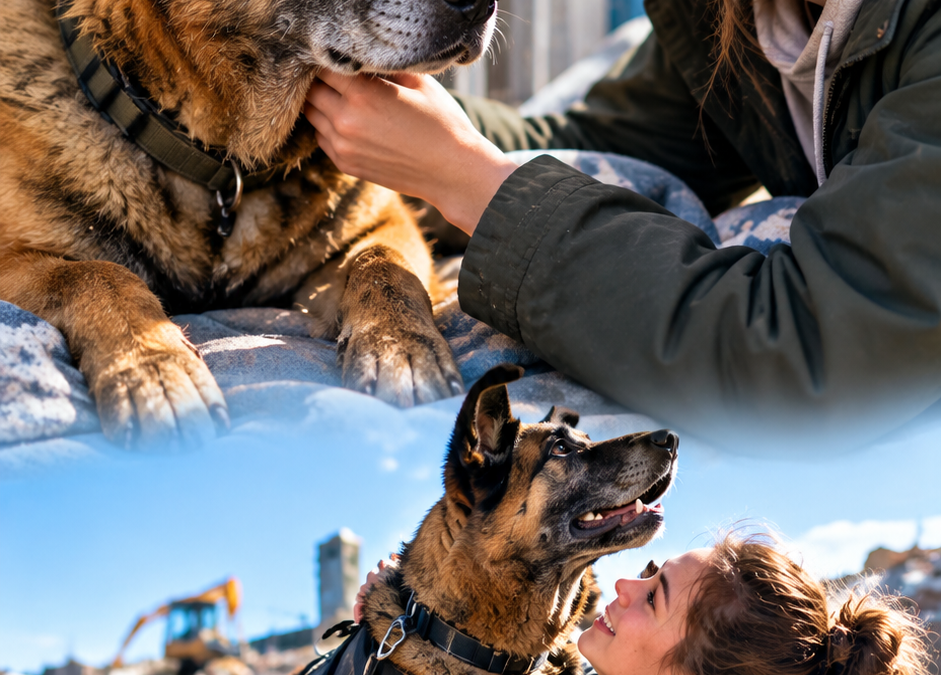
𝗣𝗔𝗥𝗧 𝟮
She sighed.
“It means the unit couldn’t keep him operationally, his previous handler had personal circumstances that made permanent care impossible, and nobody appropriate stepped forward.”
I frowned.
“So after twelve years of service, he ends up here?”
“It’s more complicated than that.”
Maybe it was.
But standing in front of his kennel, it didn’t feel complicated.
It felt wrong.
I crouched.
“Hi, Rex.”
Nothing.
His eyes did not lift.
“Hey.”
Still nothing.
I waited.
One minute.
Two.
Then I stood and went back to work.
The next day, I stopped again.
“Morning, Rex.”
His ear moved.
That was it.
I considered it progress.
By the end of the first week, I had turned speaking to him into a routine.
I told him everything.
Not because I expected answers.
Maybe because he never interrupted.
“Today I applied for a job I’m not even sure I want.”
No reaction.
“My mother thinks I need a five-year plan.”
His eyes remained half closed.
“I don’t even have a five-day plan.”
One ear twitched.
“Exactly.”
Sometimes I talked while cleaning nearby cages.
Other times I simply sat outside his kennel.
He was never aggressive.
He never growled.
He simply seemed uninterested in ordinary interaction.
One afternoon, I asked our shelter manager, Michelle, whether I could take him into the enclosed yard.
She looked at me like I had suggested releasing a wolf into the parking lot.
“No.”
“Why?”
“Because he’s a retired working dog.”
“He’s also a dog.”
“Anna.”
“What?”
“You don’t know his commands.”
“So teach me.”
“That’s not the issue.”
“Then what is?”
She sighed.
“Working dogs are different.”
“I know.”
“No, you don’t.”
That irritated me, mainly because she was right.
She continued.
“Rex has spent his entire life in structured environments. Handlers. Commands. Tasks. He didn’t go from puppyhood to family couch. Everything was purpose.”
“So?”
“So suddenly throwing him into casual situations can create stress.”
I looked through the glass toward his kennel.
“He’s stressed now.”
“He’s stable.”
“He’s sitting in a corner all day.”
“He’s old.”
“Those aren’t the same thing.”
Michelle crossed her arms.
“You’re getting attached.”
“Probably.”
“That’s not always helpful.”
“Neither is pretending he’s furniture.”
Her eyes narrowed.
I thought I had gone too far.
Then she sighed.
“Not yet.”
That was all she said.
But “not yet” sounded much better than “never.”
So I waited.
And I kept visiting Rex.
A few days later, something changed.
I came down the corridor carrying a bucket of clean towels.
Before I reached his kennel, Rex lifted his head.
I stopped.
He was looking directly at me.
I smiled.
“You know my footsteps?”
His tail did not move.
But he kept watching.
I placed the towels down and crouched.
“That’s either flattering or slightly terrifying.”
He stood.
Slowly.
For the first time, he walked toward the kennel gate while I was there.
Every movement looked deliberate.
Trained.
Measured.
He stopped directly in front of me.
I held out my hand but did not push my fingers through.
Rex leaned forward.
He sniffed.
Once.
Twice.
Then his nose touched my skin.
Warm breath moved across my knuckles.
I didn’t move.
“Hi.”
He looked at me.
Then he did something so simple that I nearly cried.
He pressed the side of his head against the bars.
I slowly raised my fingers and touched the fur behind his ear.
His eyes closed.
Only for a second.
But they closed.
From that day on, I came more often.
Rex still wasn’t affectionate in the way many shelter dogs were.
He never jumped.
Never whined for attention.
Never licked my face.
But he began expecting me.
When I approached, he stood.
When I sat near him, he moved closer.
When I talked, his eyes followed me.
One day, I realized he understood more of my moods than most people did.
I had received a rejection email from a job interview that morning.
Nothing catastrophic.
Just another small reminder that I had no idea what I was doing with my life.
I sat outside Rex’s kennel without talking.
He watched me.
After several minutes, he walked to the gate.
I moved closer.
He placed his head against the metal.
I put my hand there.
“You don’t know what you’re doing either, do you?”
His eyes remained on mine.
I smiled sadly.
“Maybe that’s why we get along.”
I kept asking about walking him.
Michelle kept refusing.
Then I started asking more intelligently.
“What exactly would need to happen for Rex to be approved for a short walk?”
That got her attention.
“You really aren’t going to stop.”
“No.”
She sighed.
“We’d need a behavioral reassessment.”
“Okay.”
“Veterinary clearance.”
“Okay.”
“You’d need to learn his handling cues.”
“Great.”
“And even then, maybe not.”
“I’ll take maybe.”
The veterinary exam came first.
Rex had arthritis, but moderate walking was actually beneficial.
His heart was good for his age.
No major respiratory problems.
His hips needed monitoring.
The veterinarian said gentle exercise could improve both mobility and mental stimulation.
I almost carried the report into Michelle’s office like legal evidence.
She held up one hand.
“Do not celebrate yet.”
“I’m not.”
“You are visibly celebrating.”
“Internally.”
She nearly smiled.
Then came handling training.
A former K9 trainer associated with the shelter visited one afternoon.
His name was Mark.
He was in his sixties and spoke to Rex in a calm, precise voice.
The difference was immediate.
Rex stood taller.
His eyes sharpened.
His posture changed.
Mark gave several basic cues.
Rex followed them instantly.
Sit.
Stay.
Heel.
Down.
Come.
Perfect.
It was extraordinary and heartbreaking.
Here was the dog who sat silently in his kennel for hours suddenly completely alive because someone was speaking the language of his old life.
Mark looked at me.
“See that?”
“Yes.”
“He isn’t shut down.”
“What is he?”
“Waiting.”
The word hit me.
“For what?”
“Structure. Purpose. Someone who knows what he understands.”
I looked at Rex.
“Can I learn?”
Mark nodded.
“If you’ll listen.”
“I’ll listen.”
He taught me how to handle the leash.
How not to flood Rex with unnecessary commands.
How to keep my voice steady.
How working dogs often responded poorly to nervous energy.
“Don’t micromanage him,” Mark said.
“Okay.”
“Don’t chatter during transitions.”
I raised an eyebrow.
“I talk to him all the time.”
“Talking is fine.”
He pointed toward Rex.
“But if you’re asking something of him, mean it.”
That made sense.
Perhaps more sense than most advice I had received about my own life.
After several sessions, Michelle finally agreed.
“One short walk.”
I grinned.
“Sunday.”
“Okay.”
“Daylight.”
“Yes.”
“Same route.”
“Fine.”
“Twenty minutes.”
“Thirty.”
“Twenty-five.”
“Deal.”
“And if he shows stress—”
“We come back.”
She gave me a long look.
“You care about this dog.”
“Yes.”
“Remember that caring sometimes means stopping before you want to.”
I nodded.
“I know.”
The first Sunday morning, it rained.
Of course it did.
Not a dramatic storm.
Just a cold, persistent rain that made the sidewalks shine and left the trees dripping.
I thought Michelle might cancel.
She didn’t.
“Still want to go?”
“Yes.”
I entered Rex’s kennel carrying the leash.
He stood immediately.
When I clipped it to his collar, I felt a faint tremor beneath my hand.
I looked at him.
“Easy.”
His eyes met mine.
We walked toward the shelter door.
At the threshold, he stopped.
Not because he was frightened exactly.
He simply froze.
Behind us were familiar walls.
In front of us was open air.
No training field.
No handler.
No vehicle.
No task.
Just outside.
I waited.
“Rex.”
His ear turned toward me.
“It’s okay.”
He stepped out.
Then stopped again.
Rain touched his face.
His head lifted.
His nose moved.
He breathed.
Deeply.
A long inhalation.
Then another.
His eyes closed.
I felt something tighten in my chest.
For twelve years, this dog had gone outside because someone needed something from him.
Search.
Track.
Locate.
Respond.
Perform.
Now nobody needed anything.
The rain was simply rain.
The street was simply a street.
He could walk because walking felt good.
We took our first steps.
He stayed beside me perfectly.
Of course he did.
Old training.
Even retired, Rex did not pull.
He didn’t chase birds.
Didn’t react to passing dogs.
He moved with slow dignity.
People occasionally looked at us.
Some crossed slightly farther away because he was a large Malinois.
Others smiled.
Nobody knew what he had done.
Nobody knew he had spent years entering places ordinary people ran from.
That made me strangely protective of him.
I wanted to stop strangers and explain.
Do you understand who this is?
Do you know how many people are alive because this dog existed?
But Rex didn’t care.
He walked.
That was enough.
When we returned, something subtle had changed.
He entered his kennel.
Turned around.
And for the first time, his tail moved when I removed the leash.
Only once.
A single slow wag.
I stared.
“Did you just—”
His tail moved again.
I laughed.
Michelle heard me.
“What?”
“He wagged.”
She leaned around the door.
“He has a tail. That’s generally what they’re for.”
“You know what I mean.”
She smiled.
“Yeah.”
Our Sunday walks became sacred.
Every week, Rex seemed to understand sooner.
By the fourth Sunday, he no longer paused at the door.
By the sixth, he lifted his head the moment he saw the leash.
We followed nearly the same route each time.
Down the shelter driveway.
Past a small park.
Along a quieter road lined with trees.
Then back.
Sometimes we sat on a bench.
I would talk.
Rex would watch the world.
I told him about interviews.
My family.
How everyone kept asking what I was going to do with my life.
“I think people hate uncertainty,” I told him one Sunday.
He stared across the park.
“They want everything named.”
A cyclist passed.
“Career. Relationship. Plan. Purpose.”
Rex looked at me.
“What if you don’t know yet?”
He blinked.
“You’re incredibly unhelpful sometimes.”
But I laughed.
And gradually, without realizing it, I stopped thinking of Rex as a retired hero trapped in a shelter.
He became my friend.
Then came the Sunday that changed everything.
It was autumn.
Clear.
Cool.
One of those mornings when the air feels almost polished.
Rex seemed unusually energetic.
He walked with his head higher.
Our route took us along the road near the park.
Traffic was moderate.
Nothing unusual.
I remember thinking how peaceful the morning felt.
Then came the sound.
A horn.
Long.
Sharp.
A screech of tires.
Then metal hit metal.
The impact was violent enough that I felt it in my chest.
Two vehicles collided maybe a hundred yards ahead.
One spun partially sideways.
The other struck the curb hard and stopped at an angle.
Glass scattered across the pavement.
I froze.
Completely.
My first thought wasn’t useful.
It was just:
Oh my God.
Then I saw smoke.
People shouted.
Someone farther down the sidewalk pulled out a phone.
I should have moved.
I should have called emergency services immediately.
I should have done something.
Instead, for several seconds, I stood there holding the leash like my body had forgotten its instructions.
Rex had not.
The change in him was instant.
His ears came forward.
Head lifted.
Body tightened.
Twelve-year-old dog disappeared.
In his place stood K9 Rex.
He pulled once.
Hard.
Not randomly.
Toward the wreck.
“Rex!”
He pulled again.
I started running.
“Okay. Go.”
I don’t know whether I consciously released more leash or simply followed.
He moved faster than I had seen him move in months.
Not recklessly.
Focused.
We reached the first vehicle.
A woman inside was conscious and trying to open her door.
Another passerby ran toward her.
Rex barely paused.
He moved toward the second car.
Smoke was coming from beneath the hood.
The driver’s side door was crushed inward but partly open.
Rex approached.
Sniffed.
Then barked.
One short bark.
Different from anything I had heard at the shelter.
Not frightened.
Not excited.
Purposeful.
I moved closer.
“Is someone in there?”
Rex pushed toward the opening.
I could see a man slumped over.
Blood near his forehead.
He wasn’t moving.
“Sir!”
No response.
My hands shook.
Someone behind me shouted, “An ambulance is coming!”
Rex forced his head and shoulders through the damaged doorway.
“Rex, careful!”
He disappeared partly inside.
I could hear him moving.
Then he backed out.
Repositioned.
Went in again.
Later, experts would explain that some details of what happened were likely instinct layered over years of training.
At that moment, all I knew was that Rex understood the emergency better than I did.
The driver’s seat belt had apparently released or broken during the impact.
The man was partially collapsed toward the damaged opening.
Rex gripped the sleeve and upper arm area of the man’s clothing carefully.
He pulled.
Nothing.
He adjusted.
Pulled again.
The man’s body shifted.
I rushed forward.
“I’ve got him.”
Rex pulled while I reached under the man’s shoulder.
Another man ran over.
“Need help?”
“Yes!”
Together, we worked.
Rex kept tension on the clothing.
We pulled the driver through the opening.
It wasn’t graceful.
It wasn’t cinematic.
It was messy.
Heavy.
Terrifying.
The unconscious man dropped partly against me before the stranger helped support his legs.
We dragged him several yards from the car.
“Farther,” someone shouted.
Smoke thickened.
We moved again.
Finally, we lowered him onto the grass beside the road.
Rex stood over him.
I checked for breathing.
There was breath.
Shallow.
But there.
“He’s breathing!”
The sound of sirens approached.
Rex remained beside the man’s shoulder.
I touched his collar.
“Easy.”
He didn’t move.
His eyes stayed on the injured man.
And then, maybe ten minutes after the crash, flames appeared beneath the vehicle’s hood.
Small at first.
Then suddenly larger.
People moved back.
Fire spread rapidly.
Within moments, much of the front of the car was burning.
I stared.
If the driver had remained inside…
I couldn’t finish the thought.
I looked down at Rex.
He was sitting.
Completely calm.
Not panting hard.
Not trembling.
Watching the man he had helped pull from the vehicle.
Firefighters arrived.
Paramedics moved in.
Police redirected traffic.
A medic approached us.
“Was the dog involved?”
I nodded.
“He found him.”
The medic looked at Rex.
“Search dog?”
“Retired.”
He raised his eyebrows.
“Apparently nobody told him.”
Despite everything, I laughed.
Then I started crying.
Not because I was afraid.
Not anymore.
I knelt.
Rex turned toward me.
I wrapped my arms around his neck.
For the first time since I had known him, he leaned fully into me.
I pressed my face against his fur.
“You did it.”
His head rested against my shoulder.
“You knew exactly what to do.”
I cried harder.
“You good boy.”
He stayed there.
Quiet.
Steady.
As if saving a stranger from a burning car was simply another Sunday assignment.
Back at the shelter, everyone already knew.
Someone from the police department had contacted management.
Michelle met us at the door.
She looked at me.
Then Rex.
Then me again.
“What happened?”
I laughed through tears.
“Your old retired dog just saved a man.”
She crouched.
Rex walked toward her.
His tail wagged.
Michelle stared.
“Well.”
She looked at me.
“I suppose twenty-five minutes was ambitious.”
I started laughing.
So did she.
But the most important change happened afterward.
Rex was different.
Not physically at first.
Internally.
Before the accident, even on good days, part of him had seemed absent.
Afterward, he began coming to the kennel gate whenever footsteps approached.
When he heard my voice, his tail moved.
He started bringing me his old leather ball.
Sometimes he even barked.
The first time it happened, Denise nearly dropped a bowl.
“Was that Rex?”
“Yes.”
“He barks?”
“Apparently retirement policy changed.”
His walks became more energetic.
Still careful.
Still within veterinary limits.
But his posture was different.
He no longer looked like a dog waiting for an order that would never arrive.
Sometimes I wondered if that final rescue had closed something inside him.
Not because he needed to prove himself.
Rex had nothing to prove.
But perhaps identity matters to animals more than we understand.
For twelve years, his life had meant usefulness.
Then suddenly, society told him:
You’re finished.
Rest now.
To humans, retirement sounds like reward.
To Rex, maybe it had sounded like disappearance.
That Sunday reminded him that aging had not erased who he was.
He was still Rex.
He still recognized danger.
Still acted.
Still protected.
Still mattered.
I didn’t know what happened to the injured driver.
Privacy rules and circumstances meant information was limited.
We heard only that he survived.
That was enough.
Or so I thought.
Several weeks later, on a cold December morning, I was cleaning food bowls when the receptionist called.
“Anna?”
“Yeah?”
“Someone is here asking about Rex.”
I dried my hands.
“Adopter?”
“I don’t think so.”
I walked toward the lobby.
A man stood near the front desk.
Mid-fifties.
Gray hair.
A faint scar near his temple.
He moved carefully, as though his body was still recovering from something.
The moment I saw him, I knew.
He turned.
“Are you Anna?”
“Yes.”
He held out his hand.
“I’m James.”
My throat tightened.
“The accident.”
He nodded.
“You were driving.”
“Apparently badly.”
His smile was small.
Then it disappeared.
“I’ve been trying to come here for weeks.”
“How are you?”
“Alive.”
He took a breath.
“Because of your dog.”
“He’s not technically mine.”
James looked toward the kennel area.
“He should belong to somebody.”
That sentence stayed with me.
“Would you like to see him?”
“Very much.”
We walked down the corridor.
Rex heard us approaching.
His head lifted.
James stopped several feet from the kennel.
For a long moment, he simply stared.
Rex looked back.
No dramatic recognition.
No barking.
Just attention.
James moved closer.
“Hi.”
Rex stood.
Slowly approached.
James knelt.
He put his hand near the bars.
Rex sniffed.
Once.
Then sat.
James’s eyes filled.
He touched the side of Rex’s face through the opening.
“Hey, old man.”
Rex pressed his head gently against the bars.
James broke.
His shoulders shook.
Tears dropped onto the floor.
I stepped back.
He whispered, “I don’t know what to say.”
Rex remained still.
“I don’t even remember you doing it.”
James swallowed.
“I don’t remember the crash properly.”
His hand moved over Rex’s fur.
“I remember waking up in the hospital.”
He looked at me.
“They told me the car caught fire.”
I nodded.
“They said I would’ve died.”
I couldn’t answer.
James looked back at Rex.
“A dog pulled me out.”
“Rex started. Other people helped.”
“He started it.”
“Yes.”
James laughed once through his tears.
“Of course he did.”
We stayed there several minutes.
Then James stood.
“I need to ask you something.”
“What?”
“Can he be adopted?”
My heart stopped for half a second.
“Yes.”
James nodded slowly.
“I want him.”
I stared at him.
“You just met him.”
“No.”
He looked at Rex.
“He met me first.”
I understood what he meant.
Still, adoption wasn’t a symbolic gesture.
It was a responsibility.
“James, Rex is twelve.”
“I know.”
“He has arthritis.”
“I know.”
“He’ll need medication. Veterinary monitoring. His mobility could decline.”
“I understand.”
“He’s a retired working dog. His adjustment might not be simple.”
James nodded.
“I’ve had difficult adjustments too.”
Something in his tone made me pause.
He leaned against the wall.
“I live alone.”
“Okay.”
“Have for years.”
He looked down.
“I thought I liked it.”
Then he gave a sad smile.
“After the accident, I realized there is a difference between privacy and having nobody waiting for you.”
That line hurt.
James continued.
“I have a small house outside town. Plenty of space. Fenced garden.”
Rex watched him.
“I grow vegetables badly.”
I smiled.
“That’s honest.”
“I have an old chair on the porch where I sit every evening.”
He looked at Rex.
“There’s room beside it.”
I felt tears coming again.
James noticed.
“I’m serious.”
“I know.”
“I don’t care if he has five years or five months.”
He swallowed.
“He gave me years I wasn’t supposed to have.”
He looked directly at me.
“I’d like to give him whatever time he has left.”
I wanted to say yes immediately.
But shelters couldn’t work that way.
Applications.
Assessments.
Home checks.
Medical discussions.
Management approval.
And Rex’s background created additional questions.
Michelle was cautious.
“He can’t become a gratitude project.”
“He’s not.”
“You don’t know that.”
“James understands what he’s taking on.”
“People say things when they’re emotional.”
“So evaluate him.”
“We will.”
“And evaluate Rex.”
“We will.”
“Then let the process decide.”
Michelle studied me.
“You’re going to advocate for this until I agree to review it, aren’t you?”
“Absolutely.”
She sighed.
“Fine.”
James returned multiple times.
Not every visit was emotional.
That mattered.
He learned Rex’s routines.
Medication.
Feeding.
Handling.
Commands.
Limitations.
He walked him in the shelter yard.
The first time James picked up the leash, Rex looked toward me.
I nodded.
“Go.”
He walked beside James.
Perfectly.
At the far side of the yard, James stopped.
Rex sat beside him.
They remained there quietly.
Michelle watched through the window.
“What do you think?” I asked.
She didn’t answer immediately.
Then:
“They look like two old men who don’t need to talk much.”
I smiled.
“That sounds promising.”
A home visit confirmed what James had said.
Small house.
Large fenced yard.
Quiet road.
One-story layout, ideal for Rex’s hips.
A porch.
And, exactly as promised, an old chair facing the garden.
Our veterinary staff spoke with James about aging dogs.
He listened.
Asked questions.
Wrote things down.
When told what Rex’s future might include, he didn’t romanticize it.
“I understand this may become difficult.”
“Yes.”
“I still want him.”
Several weeks later, the adoption was approved.
I should have been thrilled.
I was.
And I was devastated.
That’s the contradiction of rescue.
Success means goodbye.
The morning Rex left, I arrived early.
He was awake.
Sitting at the kennel door.
I entered.
“Big day.”
His tail moved.
I clipped on his leash.
He stood.
I looked around the kennel.
Months earlier, I had first seen him in the corner.
Head down.
Waiting.
Now he stood beside me.
Ready.
We walked outside.
James was already there.
When he saw Rex, he stepped away from the car.
Then stopped.
He didn’t call him.
Didn’t reach.
He simply waited.
Rex looked at him.
Then walked forward.
Sniffed James’s shoes.
Circled once.
And sat.
James knelt.
Rex rested his head against his knee.
James smiled.
“Hello, my friend.”
His voice cracked slightly.
“I’ve been waiting for you.”
I turned away for a second.
When I looked back, they were still there.
I brought Rex’s paperwork.
Medication.
Food instructions.
And an old leather ball.
James held it up.
“This his?”
“Favorite.”
Rex looked at the ball immediately.
James laughed.
“Good. At least one thing about him is normal.”
I knelt beside Rex.
This was harder than I expected.
I wrapped my arms around him.
“You are a very good dog.”
His nose touched my cheek.
“You know that?”
I rubbed his neck.
“You’re a hero.”
His eyes stayed on mine.
“And now you’re allowed to stop saving everyone.”
I laughed through tears.
“Just be a dog.”
He licked my hand.
I stood.
“Take care of him.”
James nodded.
“With my life.”
“That seems fair.”
He smiled.
Rex climbed into the car with some help.
He sat in the passenger area beside James.
Before the door closed, he looked at me.
I raised my hand.
“Go home.”
His tail moved.
The car pulled away.
I stood outside the shelter until I couldn’t see it anymore.
Then I cried.
Not because Rex was leaving.
Because for once, leaving meant exactly what it was supposed to mean.
Home.
James kept his promise.
He invited me to visit.
The first time I drove out to his house, I almost didn’t recognize Rex.
Not physically.
He was still gray.
Still slow.
Still stiff when he stood too quickly.
But his entire presence had changed.
He met me at the gate.
Actually met me.
Tail wagging.
Head high.
I crouched.
“There you are.”
He pressed against me.
James came out onto the porch.
“He heard your car.”
“He remembers.”
“Of course he remembers.”
I looked around.
The garden was larger than I expected.
Raised beds.
Tomatoes.
Peppers.
Herbs.
A narrow path along the fence.
And beside the porch chair was a dog bed.
Not an expensive one.
Just thick and comfortable.
“That’s his command post?” I asked.
James laughed.
“Apparently.”
Rex walked to the chair and lay beside it.
James sat.
I smiled.
“You weren’t exaggerating.”
“About what?”
“The chair.”
“I never lie about furniture.”
I sat on the porch step.
Rex looked completely content.
“What does he do all day?”
“Supervises.”
“Naturally.”
“Morning walk. Breakfast. Watches me work in the garden. Sleeps. Follows me into the kitchen. Judges my cooking.”
“Highly trained.”
“Elite.”
We laughed.
James looked down at him.
“Sometimes he runs.”
“Runs?”
“In the yard.”
“Why?”
“No reason.”
I watched Rex.
James smiled.
“That’s the best part.”
I understood.
For most of Rex’s life, running had meant something.
A search.
A target.
A mission.
Now he could run simply because the gate was open and the grass felt good beneath his paws.
That might have been the purest form of retirement possible.
Months passed.
I kept volunteering.
Something had changed in me too.
Before Rex, the shelter had been something I did while waiting for my real life to begin.
After Rex, I stopped thinking that way.
I started taking additional animal-care courses.
I learned more about behavior.
Rescue systems.
Senior-dog placement.
Working-dog transitions.
I began helping with rehabilitation plans for difficult cases.
My mother noticed.
“So is this becoming your career?”
“I don’t know.”
“You sound like you know.”
I laughed.
“Maybe.”
The strange thing was that I had spent so much time searching for a purpose as if purpose were something dramatic.
A revelation.
A lightning bolt.
Rex taught me it could begin quietly.
One dog.
One kennel.
One Sunday walk.
One insistence that an old animal deserved more than simply being safe.
About a year after Rex went home with James, I visited again.
It was late afternoon.
Warm sunlight covered the yard.
Rex lay in the grass.
James sat beside him.
Not in the chair this time.
On the ground.
I joined them.
Rex lifted his head.
His tail thumped twice.
“Hey, old man.”
I scratched behind his ear.
James looked at me.
“You know, he saved me twice.”
I smiled.
“Once wasn’t enough?”
“I’m serious.”
I waited.
“The accident was obvious.”
James looked toward the garden.
“But after I got home from the hospital…”
His voice became quieter.
“I wasn’t doing well.”
“Physically?”
“That too.”
He paused.
“But mostly here.”
He touched his chest.
“I’d spent years telling myself I was fine alone.”
Rex placed his chin on James’s leg.
“Then suddenly I almost died.”
James swallowed.
“And there was nobody in that hospital room who was mine.”
I didn’t interrupt.
“No wife. No kids. My sister lives across the country. Friends visited, but…”
He looked down at Rex.
“When I met him, I recognized something.”
“What?”
“Waiting.”
My throat tightened.
James smiled sadly.
“He’d been waiting in that shelter. I had been waiting in my house. Neither of us knew for what.”
He stroked Rex’s gray muzzle.
“Turns out it was each other.”
I looked away because I didn’t want them to see me cry.
James laughed.
“You’re crying.”
“No.”
“You’re terrible at lying.”
“Quiet.”
Rex sighed.
We all sat there.
Three lives that had intersected because of one walk.
One crash.
One old dog refusing to believe his useful years were over.
Before I left that day, James brought me inside.
“Want to see something?”
“Sure.”
On the living-room wall hung a framed photograph.
Rex sat in the garden.
Sunlight on his face.
Head lifted.
Eyes closed.
He looked peaceful.
Completely.
“When was this?”
“First day.”
“Here?”
James nodded.
“Right after you left.”
I stepped closer.
“He walked into the yard. Stopped there. Sat down. Lifted his face toward the sun.”
James smiled.
“And breathed.”
The memory struck me immediately.
The first Sunday.
Rain falling on Rex outside the shelter.
His head lifting.
Eyes closing.
Breathing.
Then, freedom had been temporary.
A twenty-five-minute walk.
This time, the yard was his.
“I took the picture because I knew.”
“Knew what?”
James looked at Rex, who had followed us inside.
“He was home.”
I stared at the photograph.
Then at the real dog.
Rex walked over and sat between us.
No command.
No assignment.
No purpose beyond being near two people he trusted.
And suddenly, I understood something I had been trying to understand since the day I first saw him sitting in that kennel.
Rex had spent twelve years doing extraordinary things.
Searches.
Rescues.
Dangerous operations.
Things most dogs would never experience.
People called him a hero.
They were right.
But heroism was what he did.
It wasn’t all that he was.
For too long, everyone had treated his retirement as though the end of his service meant the end of his importance.
I had almost made the opposite mistake.
I thought Rex needed another mission to become whole again.
The accident proved he still had his instincts.
It reminded him of his identity.
But saving James was not the final thing Rex needed.
James was.
A home was.
A life in which nobody expected him to perform was.
A yard where running had no objective.
An old chair where sitting had no command.
A hand resting on his head because someone simply wanted to touch him.
That was the real ending.
Not the rescue beside the burning car.
The quiet after.
Another year has begun now.
Rex is older.
His walks are shorter.
His arthritis is more noticeable.
James built a small ramp beside the porch steps.
Rex initially refused to use it.
Apparently retired K9 dignity has limits.
Eventually treats persuaded him.
He still has the leather ball I gave James.
He doesn’t chase it much anymore.
Mostly he carries it a few feet and lies down beside it.
James jokes that Rex has converted from active duty to management.
I still visit.
Every time I arrive, Rex recognizes the sound of my car.
He waits near the gate.
Not always standing anymore.
Sometimes sitting.
But waiting.
And every time I see him, I remember the first version of waiting.
A kennel.
Head lowered.
Silence.
Back then, waiting looked like emptiness.
Now it looks like expectation.
He knows people come back.
He knows James returns when he leaves.
He knows I will walk through that gate.
He knows where he belongs.
I am twenty-four now.
Still young enough for people to ask what I’m going to do with my life as though I owe them a final answer.
I don’t have one.
Not completely.
But I no longer feel ashamed of that.
I still volunteer at the shelter.
I work more hours now.
I take training seriously.
I want to stay in animal welfare.
Maybe behavior rehabilitation.
Maybe senior-dog placement.
Maybe working-dog transition programs.
I don’t know exactly where it leads.
And for the first time, that’s okay.
Rex taught me that purpose can change.
For twelve years, his purpose was service.
Then it was survival.
Then healing.
Then one final rescue.
And finally, something much simpler.
Companionship.
Maybe human lives work that way too.
Maybe we aren’t meant to have one purpose forever.
Sometimes the thing that defines you for years ends.
A career.
A relationship.
A role.
A dream.
And the ending can feel like losing yourself.
Rex sat in that kennel as if someone had retired not only his body but his identity.
He needed time to learn that he still existed when nobody was giving commands.
I think James needed the same lesson.
So did I.
Sometimes, when I visit, James and I sit in the garden while Rex sleeps between us.
James will say something like, “Remember when he dragged me out of a burning car?”
And I answer, “You say that like it’s a normal friendship origin story.”
He laughs.
Rex opens one eye.
Then goes back to sleep.
The hero doesn’t care.
He’s retired.
One afternoon, I asked James something I had wondered about for months.
“Do you ever think about what would’ve happened if Rex hadn’t been there?”
James was quiet.
“Yes.”
“Often?”
“Less now.”
He looked down at Rex.
“At first, every day.”
“Does it scare you?”
“It did.”
“And now?”
James smiled.
“Now I think about what happened because he was there.”
That difference stayed with me.
What happened because he was there.
James survived.
Rex found a home.
I found direction.
Three lives changed.
Not because anyone planned it.
Because an old dog went for a Sunday walk.
I don’t know whether I believe every event happens for a reason.
Working in rescue makes that difficult.
Too many unfair things happen to animals that don’t deserve them.
Too many endings make no sense.
So I won’t say destiny arranged a car crash.
That would be too simple.
What I do believe is that moments arrive.
And sometimes we are given the chance to respond.
I insisted Rex leave his kennel.
Rex responded when danger appeared.
James responded by offering a home.
Each choice opened the next door.
Maybe that is what people call destiny after the fact.
Not a script.
A chain of decisions made by people—and sometimes dogs—who refuse to turn away.
When I think about Rex now, I don’t picture the crash first.
I don’t picture flames.
I don’t picture sirens.
I picture sunlight.
The photograph on James’s wall.
Rex sitting in the garden.
Head tilted upward.
Eyes closed.
Peaceful.
Because that is who he deserved to become.
Not only the dog who saved lives.
The dog whose life was finally allowed to belong to him.
One evening recently, I stayed later than usual at James’s house.
The sun went down behind the trees.
James sat in his old chair.
I was on the porch step.
Rex lay between us.
His breathing was slow.
Steady.
The garden smelled like soil and tomato plants.
Nobody spoke for several minutes.
Then James said, “Funny, isn’t it?”
“What?”
“I thought he saved my life because he pulled me out of that car.”
I looked at him.
“And?”
He rested one hand on Rex’s back.
“Turns out that was just the beginning.”
I smiled.
Rex opened his eyes.
James scratched behind his ear.
“You old hero.”
Rex sighed.
I laughed.
“He doesn’t care about the title.”
“No.”
James looked toward the darkening yard.
“He just cares that he’s here.”
That was exactly right.
For twelve years, Rex had lived for commands.
For missions.
For strangers who needed him.
Then age placed him behind bars, where he seemed to believe usefulness had ended and perhaps his reason for being had ended with it.
But one Sunday morning, when metal screamed and a stranger lay unconscious inside a wrecked car, Rex remembered what years of service had written into him.
He acted.
He saved one more life.
And in doing so, he opened the door to his own.
James gave him a yard.
A porch.
A bed.
A place beside an old chair.
More importantly, James gave Rex something no medal or commendation ever could.
Permission to stop earning his place in the world.
Rex didn’t have to save anyone anymore.
Didn’t have to prove anything.
Didn’t have to wait for instructions.
He could wake up.
Eat breakfast.
Walk beside James.
Nap in sunlight.
Carry an old leather ball.
Run because he felt like running.
And sleep knowing that when morning came, someone who loved him would still be there.
Maybe that is why his story changed me so deeply.
I used to believe purpose meant doing something extraordinary.
Rex taught me otherwise.
Sometimes purpose is saving a stranger from a burning car.
Sometimes it is sitting beside someone who would otherwise sit alone.
Sometimes it is opening a kennel.
Sometimes it is refusing to give up on an old dog.
Sometimes it is simply staying.
I don’t know how much time Rex has left.
None of us do.
His muzzle is almost entirely gray now.
He sleeps more.
His legs are slower.
But when I arrive at James’s house and call his name, his ears still rise.
His tail still moves.
And sometimes, on a good day, he still runs a few steps across the garden.
No handler behind him.
No victim ahead.
No command in the air.
Just Rex.
Running.
Free.
The last time I visited, I knelt beside him before leaving.
“Remember me?” I whispered.
His eyes opened.
He lifted his head.
Then placed it across my knees.
Exactly as he had once leaned against the kennel bars.
I ran my fingers through the fur behind his ears.
“You saved James.”
His tail moved once.
“You probably saved me too.”
He looked at me.
“Don’t get arrogant.”
James laughed from the porch.
“Too late.”
I hugged Rex.
Then I stood.
At the gate, I looked back.
James was sitting in his chair.
Rex lay beside him.
The evening sunlight covered them both.
Two aging figures who had almost ended up alone.
Neither waiting anymore.
Neither searching.
Home.
And for the first time in my life, I realized I knew exactly what success looked like.
Not a title.
Not a five-year plan.
Not a perfect career.
Sometimes success is simply helping one living soul reach the place where it can finally stop surviving.
Rex had spent twelve years saving people.
On one ordinary Sunday, he saved one more.
But the most beautiful part of his story came afterward.
Because at last, someone looked at the old hero and said:
You have done enough.
Come home.
And for once, Rex followed an order that asked nothing of him except to be loved.
Have you finished reading the story and want to read it again?
The Retired K9 Had Spent Months Waiting in a Cage—Then One Sunday He Heard the Sound He Had Trained His Whole Life For
For twelve years, Rex had searched wreckage, followed human scent through darkness, and helped bring strangers home alive, but retirement left him sitting silently behind shelter bars as if the world had forgotten what he had once been.
I was twenty-three, uncertain about my own future, and somehow the only person stubborn enough to believe that an aging K9 who no longer had a badge still deserved a reason to get up every morning.
Then, on an ordinary Sunday walk, the sound of twisting metal shattered the quiet—and before I could even understand what had happened, Rex became the dog he had been waiting months to remember.
My name is Anna.
When I first met Rex, I had just finished college and had absolutely no idea what I was supposed to do next.
Everyone around me seemed to have a plan.
My former classmates were starting jobs, moving to new cities, applying to graduate school, getting engaged, talking about careers as if the rest of their lives had arrived neatly packaged with instructions.
I had none of that.
I had a degree, a small apartment, too much time to think, and a growing fear that perhaps everyone else had discovered some secret about adulthood that I had missed.
So I started volunteering at a local animal shelter.
At first, I told myself it was temporary.
Something useful to do while I figured things out.
The shelter wasn’t large. We usually had a few dozen dogs at most, along with several cats housed in a separate section.
The building was old.
The paint peeled in places.
The heating system complained loudly every winter.
The kennel doors rattled whenever one of the bigger dogs leaned against them.
Nothing about it was glamorous.
But every cage held a story.
Some dogs arrived because families had moved.
Some because owners became ill.
Some were strays whose histories we would never know.
Others had histories we wished we didn’t know.
I learned quickly that rescue work required a strange balance.
You had to care deeply enough to help.
But not so deeply that every departure destroyed you.
At least, that’s what experienced volunteers told me.
“Don’t take them all home in your heart,” one woman said during my first week.
I laughed.
She didn’t.
“You’ll understand.”
I did understand eventually.
Dogs left.
Sometimes for wonderful homes.
Sometimes for foster placements.
Sometimes for medical reasons.
Sometimes for endings we did everything possible to prevent.
You learned to celebrate departures without becoming empty afterward.
Or at least you tried.
Then Rex arrived.
And every rule I had made about emotional distance became useless.
He was a Belgian Malinois.
Twelve years old.
Large for his age, although time had narrowed him.
His once-dark muzzle was threaded with gray.
The muscles along his shoulders were still obvious beneath his coat, but arthritis had begun to stiffen his hips.
One ear stood slightly straighter than the other.
His eyes were dark, alert, and tired.
Not sleepy.
Tired.
There is a difference.
I first saw him sitting in the far corner of one of our kennels.
Most new dogs reacted to shelter life in obvious ways.
Some barked nonstop.
Some paced.
Some pressed themselves against the gate looking for attention.
Some hid.
Rex did none of those things.
He sat.
That was all.
His back was straight despite his age.
Front paws perfectly placed.
Head slightly lowered.
He looked less like a homeless dog than a soldier waiting outside an office for someone to call his name.
I stopped.
One of the staff members passed behind me.
“That’s Rex.”
I kept looking at him.
“What’s his story?”
“Retired K9.”
I turned.
“Police?”
“Search and rescue. Special unit.”
“How long?”
She checked the information sheet clipped nearby.
“Twelve years of service, according to the records.”
“Twelve years?”
“Pretty much his whole life.”
I looked back at him.
“Why is he here?”
“Retirement placement fell through.”
“What does that mean?”
She sighed.
“It means the unit couldn’t keep him operationally, his previous handler had personal circumstances that made permanent care impossible, and nobody appropriate stepped forward.”
I frowned.
“So after twelve years of service, he ends up here?”
“It’s more complicated than that.”
Maybe it was.
But standing in front of his kennel, it didn’t feel complicated.
It felt wrong.
I crouched.
“Hi, Rex.”
Nothing.
His eyes did not lift.
“Hey.”
Still nothing.
I waited.
One minute.
Two.
Then I stood and went back to work.
The next day, I stopped again.
“Morning, Rex.”
His ear moved.
That was it.
I considered it progress.
By the end of the first week, I had turned speaking to him into a routine.
I told him everything.
Not because I expected answers.
Maybe because he never interrupted.
“Today I applied for a job I’m not even sure I want.”
No reaction.
“My mother thinks I need a five-year plan.”
His eyes remained half closed.
“I don’t even have a five-day plan.”
One ear twitched.
“Exactly.”
Sometimes I talked while cleaning nearby cages.
Other times I simply sat outside his kennel.
He was never aggressive.
He never growled.
He simply seemed uninterested in ordinary interaction.
One afternoon, I asked our shelter manager, Michelle, whether I could take him into the enclosed yard.
She looked at me like I had suggested releasing a wolf into the parking lot.
“No.”
“Why?”
“Because he’s a retired working dog.”
“He’s also a dog.”
“Anna.”
“What?”
“You don’t know his commands.”
“So teach me.”
“That’s not the issue.”
“Then what is?”
She sighed.
“Working dogs are different.”
“I know.”
“No, you don’t.”
That irritated me, mainly because she was right.
She continued.
“Rex has spent his entire life in structured environments. Handlers. Commands. Tasks. He didn’t go from puppyhood to family couch. Everything was purpose.”
“So?”
“So suddenly throwing him into casual situations can create stress.”
I looked through the glass toward his kennel.
“He’s stressed now.”
“He’s stable.”
“He’s sitting in a corner all day.”
“He’s old.”
“Those aren’t the same thing.”
Michelle crossed her arms.
“You’re getting attached.”
“Probably.”
“That’s not always helpful.”
“Neither is pretending he’s furniture.”
Her eyes narrowed.
I thought I had gone too far.
Then she sighed.
“Not yet.”
That was all she said.
But “not yet” sounded much better than “never.”
So I waited.
And I kept visiting Rex.
A few days later, something changed.
I came down the corridor carrying a bucket of clean towels.
Before I reached his kennel, Rex lifted his head.
I stopped.
He was looking directly at me.
I smiled.
“You know my footsteps?”
His tail did not move.
But he kept watching.
I placed the towels down and crouched.
“That’s either flattering or slightly terrifying.”
He stood.
Slowly.
For the first time, he walked toward the kennel gate while I was there.
Every movement looked deliberate.
Trained.
Measured.
He stopped directly in front of me.
I held out my hand but did not push my fingers through.
Rex leaned forward.
He sniffed.
Once.
Twice.
Then his nose touched my skin.
Warm breath moved across my knuckles.
I didn’t move.
“Hi.”
He looked at me.
Then he did something so simple that I nearly cried.
He pressed the side of his head against the bars.
I slowly raised my fingers and touched the fur behind his ear.
His eyes closed.
Only for a second.
But they closed.
From that day on, I came more often.
Rex still wasn’t affectionate in the way many shelter dogs were.
He never jumped.
Never whined for attention.
Never licked my face.
But he began expecting me.
When I approached, he stood.
When I sat near him, he moved closer.
When I talked, his eyes followed me.
One day, I realized he understood more of my moods than most people did.
I had received a rejection email from a job interview that morning.
Nothing catastrophic.
Just another small reminder that I had no idea what I was doing with my life.
I sat outside Rex’s kennel without talking.
He watched me.
After several minutes, he walked to the gate.
I moved closer.
He placed his head against the metal.
I put my hand there.
“You don’t know what you’re doing either, do you?”
His eyes remained on mine.
I smiled sadly.
“Maybe that’s why we get along.”
I kept asking about walking him.
Michelle kept refusing.
Then I started asking more intelligently.
“What exactly would need to happen for Rex to be approved for a short walk?”
That got her attention.
“You really aren’t going to stop.”
“No.”
She sighed.
“We’d need a behavioral reassessment.”
“Okay.”
“Veterinary clearance.”
“Okay.”
“You’d need to learn his handling cues.”
“Great.”
“And even then, maybe not.”
“I’ll take maybe.”
The veterinary exam came first.
Rex had arthritis, but moderate walking was actually beneficial.
His heart was good for his age.
No major respiratory problems.
His hips needed monitoring.
The veterinarian said gentle exercise could improve both mobility and mental stimulation.
I almost carried the report into Michelle’s office like legal evidence.
She held up one hand.
“Do not celebrate yet.”
“I’m not.”
“You are visibly celebrating.”
“Internally.”
She nearly smiled.
Then came handling training.
A former K9 trainer associated with the shelter visited one afternoon.
His name was Mark.
He was in his sixties and spoke to Rex in a calm, precise voice.
The difference was immediate.
Rex stood taller.
His eyes sharpened.
His posture changed.
Mark gave several basic cues.
Rex followed them instantly.
Sit.
Stay.
Heel.
Down.
Come.
Perfect.
It was extraordinary and heartbreaking.
Here was the dog who sat silently in his kennel for hours suddenly completely alive because someone was speaking the language of his old life.
Mark looked at me.
“See that?”
“Yes.”
“He isn’t shut down.”
“What is he?”
“Waiting.”
The word hit me.
“For what?”
“Structure. Purpose. Someone who knows what he understands.”
I looked at Rex.
“Can I learn?”
Mark nodded.
“If you’ll listen.”
“I’ll listen.”
He taught me how to handle the leash.
How not to flood Rex with unnecessary commands.
How to keep my voice steady.
How working dogs often responded poorly to nervous energy.
“Don’t micromanage him,” Mark said.
“Okay.”
“Don’t chatter during transitions.”
I raised an eyebrow.
“I talk to him all the time.”
“Talking is fine.”
He pointed toward Rex.
“But if you’re asking something of him, mean it.”
That made sense.
Perhaps more sense than most advice I had received about my own life.
After several sessions, Michelle finally agreed.
“One short walk.”
I grinned.
“Sunday.”
“Okay.”
“Daylight.”
“Yes.”
“Same route.”
“Fine.”
“Twenty minutes.”
“Thirty.”
“Twenty-five.”
“Deal.”
“And if he shows stress—”
“We come back.”
She gave me a long look.
“You care about this dog.”
“Yes.”
“Remember that caring sometimes means stopping before you want to.”
I nodded.
“I know.”
The first Sunday morning, it rained.
Of course it did.
Not a dramatic storm.
Just a cold, persistent rain that made the sidewalks shine and left the trees dripping.
I thought Michelle might cancel.
She didn’t.
“Still want to go?”
“Yes.”
I entered Rex’s kennel carrying the leash.
He stood immediately.
When I clipped it to his collar, I felt a faint tremor beneath my hand.
I looked at him.
“Easy.”
His eyes met mine.
We walked toward the shelter door.
At the threshold, he stopped.
Not because he was frightened exactly.
He simply froze.
Behind us were familiar walls.
In front of us was open air.
No training field.
No handler.
No vehicle.
No task.
Just outside.
I waited.
“Rex.”
His ear turned toward me.
“It’s okay.”
He stepped out.
Then stopped again.
Rain touched his face.
His head lifted.
His nose moved.
He breathed.
Deeply.
A long inhalation.
Then another.
His eyes closed.
I felt something tighten in my chest.
For twelve years, this dog had gone outside because someone needed something from him.
Search.
Track.
Locate.
Respond.
Perform.
Now nobody needed anything.
The rain was simply rain.
The street was simply a street.
He could walk because walking felt good.
We took our first steps.
He stayed beside me perfectly.
Of course he did.
Old training.
Even retired, Rex did not pull.
He didn’t chase birds.
Didn’t react to passing dogs.
He moved with slow dignity.
People occasionally looked at us.
Some crossed slightly farther away because he was a large Malinois.
Others smiled.
Nobody knew what he had done.
Nobody knew he had spent years entering places ordinary people ran from.
That made me strangely protective of him.
I wanted to stop strangers and explain.
Do you understand who this is?
Do you know how many people are alive because this dog existed?
But Rex didn’t care.
He walked.
That was enough.
When we returned, something subtle had changed.
He entered his kennel.
Turned around.
And for the first time, his tail moved when I removed the leash.
Only once.
A single slow wag.
I stared.
“Did you just—”
His tail moved again.
I laughed.
Michelle heard me.
“What?”
“He wagged.”
She leaned around the door.
“He has a tail. That’s generally what they’re for.”
“You know what I mean.”
She smiled.
“Yeah.”
Our Sunday walks became sacred.
Every week, Rex seemed to understand sooner.
By the fourth Sunday, he no longer paused at the door.
By the sixth, he lifted his head the moment he saw the leash.
We followed nearly the same route each time.
Down the shelter driveway.
Past a small park.
Along a quieter road lined with trees.
Then back.
Sometimes we sat on a bench.
I would talk.
Rex would watch the world.
I told him about interviews.
My family.
How everyone kept asking what I was going to do with my life.
“I think people hate uncertainty,” I told him one Sunday.
He stared across the park.
“They want everything named.”
A cyclist passed.
“Career. Relationship. Plan. Purpose.”
Rex looked at me.
“What if you don’t know yet?”
He blinked.
“You’re incredibly unhelpful sometimes.”
But I laughed.
And gradually, without realizing it, I stopped thinking of Rex as a retired hero trapped in a shelter.
He became my friend.
Then came the Sunday that changed everything.
It was autumn.
Clear.
Cool.
One of those mornings when the air feels almost polished.
Rex seemed unusually energetic.
He walked with his head higher.
Our route took us along the road near the park.
Traffic was moderate.
Nothing unusual.
I remember thinking how peaceful the morning felt.
Then came the sound.
A horn.
Long.
Sharp.
A screech of tires.
Then metal hit metal.
The impact was violent enough that I felt it in my chest.
Two vehicles collided maybe a hundred yards ahead.
One spun partially sideways.
The other struck the curb hard and stopped at an angle.
Glass scattered across the pavement.
I froze.
Completely.
My first thought wasn’t useful.
It was just:
Oh my God.
Then I saw smoke.
People shouted.
Someone farther down the sidewalk pulled out a phone.
I should have moved.
I should have called emergency services immediately.
I should have done something.
Instead, for several seconds, I stood there holding the leash like my body had forgotten its instructions.
Rex had not.
The change in him was instant.
His ears came forward.
Head lifted.
Body tightened.
Twelve-year-old dog disappeared.
In his place stood K9 Rex.
He pulled once.
Hard.
Not randomly.
Toward the wreck.
“Rex!”
He pulled again.
I started running.
“Okay. Go.”
I don’t know whether I consciously released more leash or simply followed.
He moved faster than I had seen him move in months.
Not recklessly.
Focused.
We reached the first vehicle.
A woman inside was conscious and trying to open her door.
Another passerby ran toward her.
Rex barely paused.
He moved toward the second car.
Smoke was coming from beneath the hood.
The driver’s side door was crushed inward but partly open.
Rex approached.
Sniffed.
Then barked.
One short bark.
Different from anything I had heard at the shelter.
Not frightened.
Not excited.
Purposeful.
I moved closer.
“Is someone in there?”
Rex pushed toward the opening.
I could see a man slumped over.
Blood near his forehead.
He wasn’t moving.
“Sir!”
No response.
My hands shook.
Someone behind me shouted, “An ambulance is coming!”
Rex forced his head and shoulders through the damaged doorway.
“Rex, careful!”
He disappeared partly inside.
I could hear him moving.
Then he backed out.
Repositioned.
Went in again.
Later, experts would explain that some details of what happened were likely instinct layered over years of training.
At that moment, all I knew was that Rex understood the emergency better than I did.
The driver’s seat belt had apparently released or broken during the impact.
The man was partially collapsed toward the damaged opening.
Rex gripped the sleeve and upper arm area of the man’s clothing carefully.
He pulled.
Nothing.
He adjusted.
Pulled again.
The man’s body shifted.
I rushed forward.
“I’ve got him.”
Rex pulled while I reached under the man’s shoulder.
Another man ran over.
“Need help?”
“Yes!”
Together, we worked.
Rex kept tension on the clothing.
We pulled the driver through the opening.
It wasn’t graceful.
It wasn’t cinematic.
It was messy.
Heavy.
Terrifying.
The unconscious man dropped partly against me before the stranger helped support his legs.
We dragged him several yards from the car.
“Farther,” someone shouted.
Smoke thickened.
We moved again.
Finally, we lowered him onto the grass beside the road.
Rex stood over him.
I checked for breathing.
There was breath.
Shallow.
But there.
“He’s breathing!”
The sound of sirens approached.
Rex remained beside the man’s shoulder.
I touched his collar.
“Easy.”
He didn’t move.
His eyes stayed on the injured man.
And then, maybe ten minutes after the crash, flames appeared beneath the vehicle’s hood.
Small at first.
Then suddenly larger.
People moved back.
Fire spread rapidly.
Within moments, much of the front of the car was burning.
I stared.
If the driver had remained inside…
I couldn’t finish the thought.
I looked down at Rex.
He was sitting.
Completely calm.
Not panting hard.
Not trembling.
Watching the man he had helped pull from the vehicle.
Firefighters arrived.
Paramedics moved in.
Police redirected traffic.
A medic approached us.
“Was the dog involved?”
I nodded.
“He found him.”
The medic looked at Rex.
“Search dog?”
“Retired.”
He raised his eyebrows.
“Apparently nobody told him.”
Despite everything, I laughed.
Then I started crying.
Not because I was afraid.
Not anymore.
I knelt.
Rex turned toward me.
I wrapped my arms around his neck.
For the first time since I had known him, he leaned fully into me.
I pressed my face against his fur.
“You did it.”
His head rested against my shoulder.
“You knew exactly what to do.”
I cried harder.
“You good boy.”
He stayed there.
Quiet.
Steady.
As if saving a stranger from a burning car was simply another Sunday assignment.
Back at the shelter, everyone already knew.
Someone from the police department had contacted management.
Michelle met us at the door.
She looked at me.
Then Rex.
Then me again.
“What happened?”
I laughed through tears.
“Your old retired dog just saved a man.”
She crouched.
Rex walked toward her.
His tail wagged.
Michelle stared.
“Well.”
She looked at me.
“I suppose twenty-five minutes was ambitious.”
I started laughing.
So did she.
But the most important change happened afterward.
Rex was different.
Not physically at first.
Internally.
Before the accident, even on good days, part of him had seemed absent.
Afterward, he began coming to the kennel gate whenever footsteps approached.
When he heard my voice, his tail moved.
He started bringing me his old leather ball.
Sometimes he even barked.
The first time it happened, Denise nearly dropped a bowl.
“Was that Rex?”
“Yes.”
“He barks?”
“Apparently retirement policy changed.”
His walks became more energetic.
Still careful.
Still within veterinary limits.
But his posture was different.
He no longer looked like a dog waiting for an order that would never arrive.
Sometimes I wondered if that final rescue had closed something inside him.
Not because he needed to prove himself.
Rex had nothing to prove.
But perhaps identity matters to animals more than we understand.
For twelve years, his life had meant usefulness.
Then suddenly, society told him:
You’re finished.
Rest now.
To humans, retirement sounds like reward.
To Rex, maybe it had sounded like disappearance.
That Sunday reminded him that aging had not erased who he was.
He was still Rex.
He still recognized danger.
Still acted.
Still protected.
Still mattered.
I didn’t know what happened to the injured driver.
Privacy rules and circumstances meant information was limited.
We heard only that he survived.
That was enough.
Or so I thought.
Several weeks later, on a cold December morning, I was cleaning food bowls when the receptionist called.
“Anna?”
“Yeah?”
“Someone is here asking about Rex.”
I dried my hands.
“Adopter?”
“I don’t think so.”
I walked toward the lobby.
A man stood near the front desk.
Mid-fifties.
Gray hair.
A faint scar near his temple.
He moved carefully, as though his body was still recovering from something.
The moment I saw him, I knew.
He turned.
“Are you Anna?”
“Yes.”
He held out his hand.
“I’m James.”
My throat tightened.
“The accident.”
He nodded.
“You were driving.”
“Apparently badly.”
His smile was small.
Then it disappeared.
“I’ve been trying to come here for weeks.”
“How are you?”
“Alive.”
He took a breath.
“Because of your dog.”
“He’s not technically mine.”
James looked toward the kennel area.
“He should belong to somebody.”
That sentence stayed with me.
“Would you like to see him?”
“Very much.”
We walked down the corridor.
Rex heard us approaching.
His head lifted.
James stopped several feet from the kennel.
For a long moment, he simply stared.
Rex looked back.
No dramatic recognition.
No barking.
Just attention.
James moved closer.
“Hi.”
Rex stood.
Slowly approached.
James knelt.
He put his hand near the bars.
Rex sniffed.
Once.
Then sat.
James’s eyes filled.
He touched the side of Rex’s face through the opening.
“Hey, old man.”
Rex pressed his head gently against the bars.
James broke.
His shoulders shook.
Tears dropped onto the floor.
I stepped back.
He whispered, “I don’t know what to say.”
Rex remained still.
“I don’t even remember you doing it.”
James swallowed.
“I don’t remember the crash properly.”
His hand moved over Rex’s fur.
“I remember waking up in the hospital.”
He looked at me.
“They told me the car caught fire.”
I nodded.
“They said I would’ve died.”
I couldn’t answer.
James looked back at Rex.
“A dog pulled me out.”
“Rex started. Other people helped.”
“He started it.”
“Yes.”
James laughed once through his tears.
“Of course he did.”
We stayed there several minutes.
Then James stood.
“I need to ask you something.”
“What?”
“Can he be adopted?”
My heart stopped for half a second.
“Yes.”
James nodded slowly.
“I want him.”
I stared at him.
“You just met him.”
“No.”
He looked at Rex.
“He met me first.”
I understood what he meant.
Still, adoption wasn’t a symbolic gesture.
It was a responsibility.
“James, Rex is twelve.”
“I know.”
“He has arthritis.”
“I know.”
“He’ll need medication. Veterinary monitoring. His mobility could decline.”
“I understand.”
“He’s a retired working dog. His adjustment might not be simple.”
James nodded.
“I’ve had difficult adjustments too.”
Something in his tone made me pause.
He leaned against the wall.
“I live alone.”
“Okay.”
“Have for years.”
He looked down.
“I thought I liked it.”
Then he gave a sad smile.
“After the accident, I realized there is a difference between privacy and having nobody waiting for you.”
That line hurt.
James continued.
“I have a small house outside town. Plenty of space. Fenced garden.”
Rex watched him.
“I grow vegetables badly.”
I smiled.
“That’s honest.”
“I have an old chair on the porch where I sit every evening.”
He looked at Rex.
“There’s room beside it.”
I felt tears coming again.
James noticed.
“I’m serious.”
“I know.”
“I don’t care if he has five years or five months.”
He swallowed.
“He gave me years I wasn’t supposed to have.”
He looked directly at me.
“I’d like to give him whatever time he has left.”
I wanted to say yes immediately.
But shelters couldn’t work that way.
Applications.
Assessments.
Home checks.
Medical discussions.
Management approval.
And Rex’s background created additional questions.
Michelle was cautious.
“He can’t become a gratitude project.”
“He’s not.”
“You don’t know that.”
“James understands what he’s taking on.”
“People say things when they’re emotional.”
“So evaluate him.”
“We will.”
“And evaluate Rex.”
“We will.”
“Then let the process decide.”
Michelle studied me.
“You’re going to advocate for this until I agree to review it, aren’t you?”
“Absolutely.”
She sighed.
“Fine.”
James returned multiple times.
Not every visit was emotional.
That mattered.
He learned Rex’s routines.
Medication.
Feeding.
Handling.
Commands.
Limitations.
He walked him in the shelter yard.
The first time James picked up the leash, Rex looked toward me.
I nodded.
“Go.”
He walked beside James.
Perfectly.
At the far side of the yard, James stopped.
Rex sat beside him.
They remained there quietly.
Michelle watched through the window.
“What do you think?” I asked.
She didn’t answer immediately.
Then:
“They look like two old men who don’t need to talk much.”
I smiled.
“That sounds promising.”
A home visit confirmed what James had said.
Small house.
Large fenced yard.
Quiet road.
One-story layout, ideal for Rex’s hips.
A porch.
And, exactly as promised, an old chair facing the garden.
Our veterinary staff spoke with James about aging dogs.
He listened.
Asked questions.
Wrote things down.
When told what Rex’s future might include, he didn’t romanticize it.
“I understand this may become difficult.”
“Yes.”
“I still want him.”
Several weeks later, the adoption was approved.
I should have been thrilled.
I was.
And I was devastated.
That’s the contradiction of rescue.
Success means goodbye.
The morning Rex left, I arrived early.
He was awake.
Sitting at the kennel door.
I entered.
“Big day.”
His tail moved.
I clipped on his leash.
He stood.
I looked around the kennel.
Months earlier, I had first seen him in the corner.
Head down.
Waiting.
Now he stood beside me.
Ready.
We walked outside.
James was already there.
When he saw Rex, he stepped away from the car.
Then stopped.
He didn’t call him.
Didn’t reach.
He simply waited.
Rex looked at him.
Then walked forward.
Sniffed James’s shoes.
Circled once.
And sat.
James knelt.
Rex rested his head against his knee.
James smiled.
“Hello, my friend.”
His voice cracked slightly.
“I’ve been waiting for you.”
I turned away for a second.
When I looked back, they were still there.
I brought Rex’s paperwork.
Medication.
Food instructions.
And an old leather ball.
James held it up.
“This his?”
“Favorite.”
Rex looked at the ball immediately.
James laughed.
“Good. At least one thing about him is normal.”
I knelt beside Rex.
This was harder than I expected.
I wrapped my arms around him.
“You are a very good dog.”
His nose touched my cheek.
“You know that?”
I rubbed his neck.
“You’re a hero.”
His eyes stayed on mine.
“And now you’re allowed to stop saving everyone.”
I laughed through tears.
“Just be a dog.”
He licked my hand.
I stood.
“Take care of him.”
James nodded.
“With my life.”
“That seems fair.”
He smiled.
Rex climbed into the car with some help.
He sat in the passenger area beside James.
Before the door closed, he looked at me.
I raised my hand.
“Go home.”
His tail moved.
The car pulled away.
I stood outside the shelter until I couldn’t see it anymore.
Then I cried.
Not because Rex was leaving.
Because for once, leaving meant exactly what it was supposed to mean.
Home.
James kept his promise.
He invited me to visit.
The first time I drove out to his house, I almost didn’t recognize Rex.
Not physically.
He was still gray.
Still slow.
Still stiff when he stood too quickly.
But his entire presence had changed.
He met me at the gate.
Actually met me.
Tail wagging.
Head high.
I crouched.
“There you are.”
He pressed against me.
James came out onto the porch.
“He heard your car.”
“He remembers.”
“Of course he remembers.”
I looked around.
The garden was larger than I expected.
Raised beds.
Tomatoes.
Peppers.
Herbs.
A narrow path along the fence.
And beside the porch chair was a dog bed.
Not an expensive one.
Just thick and comfortable.
“That’s his command post?” I asked.
James laughed.
“Apparently.”
Rex walked to the chair and lay beside it.
James sat.
I smiled.
“You weren’t exaggerating.”
“About what?”
“The chair.”
“I never lie about furniture.”
I sat on the porch step.
Rex looked completely content.
“What does he do all day?”
“Supervises.”
“Naturally.”
“Morning walk. Breakfast. Watches me work in the garden. Sleeps. Follows me into the kitchen. Judges my cooking.”
“Highly trained.”
“Elite.”
We laughed.
James looked down at him.
“Sometimes he runs.”
“Runs?”
“In the yard.”
“Why?”
“No reason.”
I watched Rex.
James smiled.
“That’s the best part.”
I understood.
For most of Rex’s life, running had meant something.
A search.
A target.
A mission.
Now he could run simply because the gate was open and the grass felt good beneath his paws.
That might have been the purest form of retirement possible.
Months passed.
I kept volunteering.
Something had changed in me too.
Before Rex, the shelter had been something I did while waiting for my real life to begin.
After Rex, I stopped thinking that way.
I started taking additional animal-care courses.
I learned more about behavior.
Rescue systems.
Senior-dog placement.
Working-dog transitions.
I began helping with rehabilitation plans for difficult cases.
My mother noticed.
“So is this becoming your career?”
“I don’t know.”
“You sound like you know.”
I laughed.
“Maybe.”
The strange thing was that I had spent so much time searching for a purpose as if purpose were something dramatic.
A revelation.
A lightning bolt.
Rex taught me it could begin quietly.
One dog.
One kennel.
One Sunday walk.
One insistence that an old animal deserved more than simply being safe.
About a year after Rex went home with James, I visited again.
It was late afternoon.
Warm sunlight covered the yard.
Rex lay in the grass.
James sat beside him.
Not in the chair this time.
On the ground.
I joined them.
Rex lifted his head.
His tail thumped twice.
“Hey, old man.”
I scratched behind his ear.
James looked at me.
“You know, he saved me twice.”
I smiled.
“Once wasn’t enough?”
“I’m serious.”
I waited.
“The accident was obvious.”
James looked toward the garden.
“But after I got home from the hospital…”
His voice became quieter.
“I wasn’t doing well.”
“Physically?”
“That too.”
He paused.
“But mostly here.”
He touched his chest.
“I’d spent years telling myself I was fine alone.”
Rex placed his chin on James’s leg.
“Then suddenly I almost died.”
James swallowed.
“And there was nobody in that hospital room who was mine.”
I didn’t interrupt.
“No wife. No kids. My sister lives across the country. Friends visited, but…”
He looked down at Rex.
“When I met him, I recognized something.”
“What?”
“Waiting.”
My throat tightened.
James smiled sadly.
“He’d been waiting in that shelter. I had been waiting in my house. Neither of us knew for what.”
He stroked Rex’s gray muzzle.
“Turns out it was each other.”
I looked away because I didn’t want them to see me cry.
James laughed.
“You’re crying.”
“No.”
“You’re terrible at lying.”
“Quiet.”
Rex sighed.
We all sat there.
Three lives that had intersected because of one walk.
One crash.
One old dog refusing to believe his useful years were over.
Before I left that day, James brought me inside.
“Want to see something?”
“Sure.”
On the living-room wall hung a framed photograph.
Rex sat in the garden.
Sunlight on his face.
Head lifted.
Eyes closed.
He looked peaceful.
Completely.
“When was this?”
“First day.”
“Here?”
James nodded.
“Right after you left.”
I stepped closer.
“He walked into the yard. Stopped there. Sat down. Lifted his face toward the sun.”
James smiled.
“And breathed.”
The memory struck me immediately.
The first Sunday.
Rain falling on Rex outside the shelter.
His head lifting.
Eyes closing.
Breathing.
Then, freedom had been temporary.
A twenty-five-minute walk.
This time, the yard was his.
“I took the picture because I knew.”
“Knew what?”
James looked at Rex, who had followed us inside.
“He was home.”
I stared at the photograph.
Then at the real dog.
Rex walked over and sat between us.
No command.
No assignment.
No purpose beyond being near two people he trusted.
And suddenly, I understood something I had been trying to understand since the day I first saw him sitting in that kennel.
Rex had spent twelve years doing extraordinary things.
Searches.
Rescues.
Dangerous operations.
Things most dogs would never experience.
People called him a hero.
They were right.
But heroism was what he did.
It wasn’t all that he was.
For too long, everyone had treated his retirement as though the end of his service meant the end of his importance.
I had almost made the opposite mistake.
I thought Rex needed another mission to become whole again.
The accident proved he still had his instincts.
It reminded him of his identity.
But saving James was not the final thing Rex needed.
James was.
A home was.
A life in which nobody expected him to perform was.
A yard where running had no objective.
An old chair where sitting had no command.
A hand resting on his head because someone simply wanted to touch him.
That was the real ending.
Not the rescue beside the burning car.
The quiet after.
Another year has begun now.
Rex is older.
His walks are shorter.
His arthritis is more noticeable.
James built a small ramp beside the porch steps.
Rex initially refused to use it.
Apparently retired K9 dignity has limits.
Eventually treats persuaded him.
He still has the leather ball I gave James.
He doesn’t chase it much anymore.
Mostly he carries it a few feet and lies down beside it.
James jokes that Rex has converted from active duty to management.
I still visit.
Every time I arrive, Rex recognizes the sound of my car.
He waits near the gate.
Not always standing anymore.
Sometimes sitting.
But waiting.
And every time I see him, I remember the first version of waiting.
A kennel.
Head lowered.
Silence.
Back then, waiting looked like emptiness.
Now it looks like expectation.
He knows people come back.
He knows James returns when he leaves.
He knows I will walk through that gate.
He knows where he belongs.
I am twenty-four now.
Still young enough for people to ask what I’m going to do with my life as though I owe them a final answer.
I don’t have one.
Not completely.
But I no longer feel ashamed of that.
I still volunteer at the shelter.
I work more hours now.
I take training seriously.
I want to stay in animal welfare.
Maybe behavior rehabilitation.
Maybe senior-dog placement.
Maybe working-dog transition programs.
I don’t know exactly where it leads.
And for the first time, that’s okay.
Rex taught me that purpose can change.
For twelve years, his purpose was service.
Then it was survival.
Then healing.
Then one final rescue.
And finally, something much simpler.
Companionship.
Maybe human lives work that way too.
Maybe we aren’t meant to have one purpose forever.
Sometimes the thing that defines you for years ends.
A career.
A relationship.
A role.
A dream.
And the ending can feel like losing yourself.
Rex sat in that kennel as if someone had retired not only his body but his identity.
He needed time to learn that he still existed when nobody was giving commands.
I think James needed the same lesson.
So did I.
Sometimes, when I visit, James and I sit in the garden while Rex sleeps between us.
James will say something like, “Remember when he dragged me out of a burning car?”
And I answer, “You say that like it’s a normal friendship origin story.”
He laughs.
Rex opens one eye.
Then goes back to sleep.
The hero doesn’t care.
He’s retired.
One afternoon, I asked James something I had wondered about for months.
“Do you ever think about what would’ve happened if Rex hadn’t been there?”
James was quiet.
“Yes.”
“Often?”
“Less now.”
He looked down at Rex.
“At first, every day.”
“Does it scare you?”
“It did.”
“And now?”
James smiled.
“Now I think about what happened because he was there.”
That difference stayed with me.
What happened because he was there.
James survived.
Rex found a home.
I found direction.
Three lives changed.
Not because anyone planned it.
Because an old dog went for a Sunday walk.
I don’t know whether I believe every event happens for a reason.
Working in rescue makes that difficult.
Too many unfair things happen to animals that don’t deserve them.
Too many endings make no sense.
So I won’t say destiny arranged a car crash.
That would be too simple.
What I do believe is that moments arrive.
And sometimes we are given the chance to respond.
I insisted Rex leave his kennel.
Rex responded when danger appeared.
James responded by offering a home.
Each choice opened the next door.
Maybe that is what people call destiny after the fact.
Not a script.
A chain of decisions made by people—and sometimes dogs—who refuse to turn away.
When I think about Rex now, I don’t picture the crash first.
I don’t picture flames.
I don’t picture sirens.
I picture sunlight.
The photograph on James’s wall.
Rex sitting in the garden.
Head tilted upward.
Eyes closed.
Peaceful.
Because that is who he deserved to become.
Not only the dog who saved lives.
The dog whose life was finally allowed to belong to him.
One evening recently, I stayed later than usual at James’s house.
The sun went down behind the trees.
James sat in his old chair.
I was on the porch step.
Rex lay between us.
His breathing was slow.
Steady.
The garden smelled like soil and tomato plants.
Nobody spoke for several minutes.
Then James said, “Funny, isn’t it?”
“What?”
“I thought he saved my life because he pulled me out of that car.”
I looked at him.
“And?”
He rested one hand on Rex’s back.
“Turns out that was just the beginning.”
I smiled.
Rex opened his eyes.
James scratched behind his ear.
“You old hero.”
Rex sighed.
I laughed.
“He doesn’t care about the title.”
“No.”
James looked toward the darkening yard.
“He just cares that he’s here.”
That was exactly right.
For twelve years, Rex had lived for commands.
For missions.
For strangers who needed him.
Then age placed him behind bars, where he seemed to believe usefulness had ended and perhaps his reason for being had ended with it.
But one Sunday morning, when metal screamed and a stranger lay unconscious inside a wrecked car, Rex remembered what years of service had written into him.
He acted.
He saved one more life.
And in doing so, he opened the door to his own.
James gave him a yard.
A porch.
A bed.
A place beside an old chair.
More importantly, James gave Rex something no medal or commendation ever could.
Permission to stop earning his place in the world.
Rex didn’t have to save anyone anymore.
Didn’t have to prove anything.
Didn’t have to wait for instructions.
He could wake up.
Eat breakfast.
Walk beside James.
Nap in sunlight.
Carry an old leather ball.
Run because he felt like running.
And sleep knowing that when morning came, someone who loved him would still be there.
Maybe that is why his story changed me so deeply.
I used to believe purpose meant doing something extraordinary.
Rex taught me otherwise.
Sometimes purpose is saving a stranger from a burning car.
Sometimes it is sitting beside someone who would otherwise sit alone.
Sometimes it is opening a kennel.
Sometimes it is refusing to give up on an old dog.
Sometimes it is simply staying.
I don’t know how much time Rex has left.
None of us do.
His muzzle is almost entirely gray now.
He sleeps more.
His legs are slower.
But when I arrive at James’s house and call his name, his ears still rise.
His tail still moves.
And sometimes, on a good day, he still runs a few steps across the garden.
No handler behind him.
No victim ahead.
No command in the air.
Just Rex.
Running.
Free.
The last time I visited, I knelt beside him before leaving.
“Remember me?” I whispered.
His eyes opened.
He lifted his head.
Then placed it across my knees.
Exactly as he had once leaned against the kennel bars.
I ran my fingers through the fur behind his ears.
“You saved James.”
His tail moved once.
“You probably saved me too.”
He looked at me.
“Don’t get arrogant.”
James laughed from the porch.
“Too late.”
I hugged Rex.
Then I stood.
At the gate, I looked back.
James was sitting in his chair.
Rex lay beside him.
The evening sunlight covered them both.
Two aging figures who had almost ended up alone.
Neither waiting anymore.
Neither searching.
Home.
And for the first time in my life, I realized I knew exactly what success looked like.
Not a title.
Not a five-year plan.
Not a perfect career.
Sometimes success is simply helping one living soul reach the place where it can finally stop surviving.
Rex had spent twelve years saving people.
On one ordinary Sunday, he saved one more.
But the most beautiful part of his story came afterward.
Because at last, someone looked at the old hero and said:
You have done enough.
Come home.
And for once, Rex followed an order that asked nothing of him except to be loved.








