𝗣𝗔𝗥𝗧 𝟮 The Retired K9 Everyone Feared Had One Name on His Collar I Never Expected to See Again
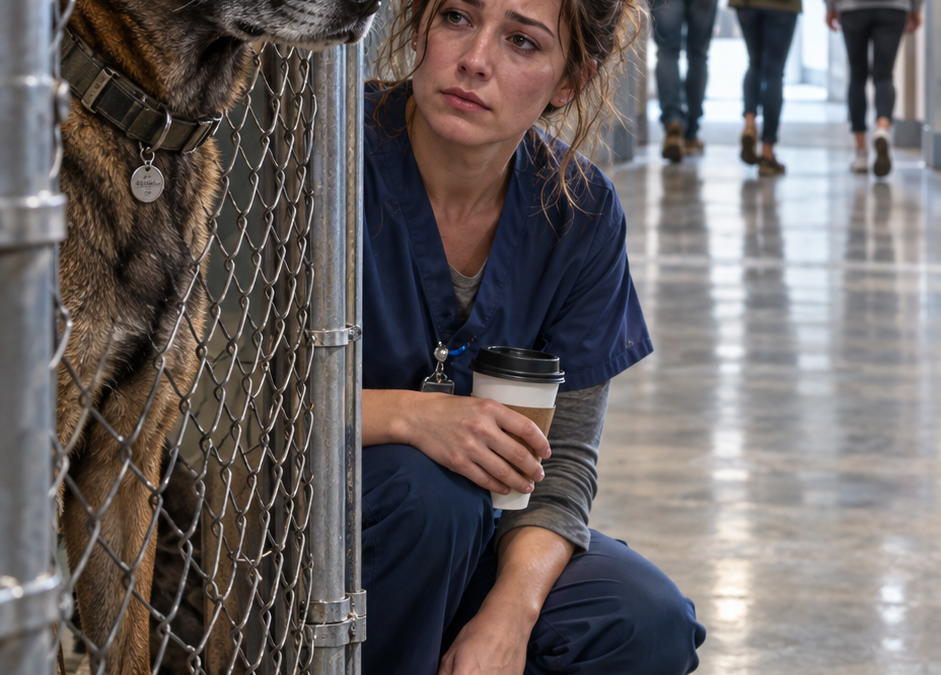
𝗣𝗔𝗥𝗧 𝟮
The dog lifted his head.
The collar shifted.
Fluorescent light caught the metal for perhaps half a second.
One word became visible.
WRAITH.
I read it silently.
Something about it stopped me.
“Wraith.”
The shepherd’s eyes moved directly to mine.
Mark glanced between us.
“Old service name, call sign, maybe. Records are incomplete.”
I said it again, quieter.
“Wraith.”
The dog’s ears moved.
Not forward.
Not backward.
Just enough to tell me the sound had reached somewhere specific.
Mark looked at his file.
“We kept Rook for placement. Easier.”
I did not answer.
A wheelchair rolled behind us.
One of our rehabilitation aides was pushing an older Army veteran toward physical therapy.
His right leg was elevated beneath a gray blanket.
The chair had barely reached the kennel entrance when Wraith changed.
Completely.
His head lifted.
His shoulders came up.
He stood.
No command.
No hesitation.
He moved to the front of the kennel and turned sideways.
At first I thought he was reacting defensively to the wheelchair.
Then I noticed his position.
He had placed his body between the passing veteran and the open corridor behind him.
Not facing the veteran.
Facing the hallway.
Scanning.
Protecting the veteran’s rear.
No bark.
No growl.
Nothing aggressive.
He simply held the position.
The wheelchair passed.
Wraith tracked it until the veteran was clear.
Then returned to the exact place where he had been lying.
My coffee stopped halfway to my mouth.
Mark had already returned to the paperwork.
“When does he leave?” I asked.
“Monday morning. Eight.”
“Can it move?”
Mark looked at me.
“Not without a measurable reason.”
“How long do I have?”
His expression changed slightly.
“Emily.”
“How long?”
“Final behavior notes tomorrow afternoon.”
“Give me until then.”
“For what?”
I set my coffee on the counter.
“To watch him before somebody asks him for something.”
Mark frowned.
“Three families already watched him.”
“No.”
I looked at the gate.
“They tried to take him home.”
“That’s the point of placement.”
“Maybe that’s not the same thing.”
Mark folded his arms.
“You think three families all misunderstood him?”
“I think three families wanted him to become something.”
“A pet?”
“A household dog.”
“That’s what retirement placement is.”
“Maybe.”
He stared at me.
I crouched.
Wraith’s shoulders tightened immediately.
I stopped.
Noticed.
Then lowered myself all the way to the floor several feet from the gate.
I turned my body sideways.
Hands loose in my lap.
No eye contact.
No reach.
Mark looked at me.
“What are you doing?”
“Watching.”
“From the floor?”
“He noticed me crouch.”
“So?”
“So I stopped.”
The ventilation system hummed overhead.
Wraith remained tense for several seconds.
Then his shoulders lowered slightly.
I looked toward his reflection in the kennel glass rather than directly at him.
“Every family walks straight up to him?”
“Most people approach a dog they’re trying to adopt.”
“And what does he do?”
“Backs away.”
“Then what?”
“They try commands.”
“Why?”
“Structure.”
“Does it work?”
Mark frowned.
“No.”
“Does he hear them?”
“Obviously.”
“Then maybe he isn’t ignoring the room.”
Mark’s face changed just a fraction.
We waited.
A supply cart rattled somewhere down the corridor.
One of Wraith’s ears turned.
A door opened.
His eyes moved.
Wheelchair wheels.
He tracked them.
Footsteps with an uneven gait.
Tracked those too.
None of his attention went toward the toy lying beside his bed.
None toward the food.
None toward me.
He was reading the corridor.
After almost a minute, he backed away from the gate and settled again.
Still facing outward.
Mark checked his watch.
“Tomorrow afternoon doesn’t move.”
“I know.”
“Whatever you think you’re seeing, find it fast.”
He left.
I stayed.
A cane tapped the floor somewhere down the hall.
Once.
Twice.
Before the veteran using it reached our section, Wraith was standing.
The man came into view.
Wraith stepped forward.
Turned sideways.
Again, the same position.
Between injured veteran and open hallway.
He held until the man passed.
Then his eyes found mine.
For one strange moment, I had the feeling he was checking whether I had seen it.
I looked at the old plate.
Wraith.
Three families had seen a dog who would not settle into a home.
Mark had seen a retired K9 waiting for commands.
I was beginning to see something else.
He wasn’t waiting for someone to tell him what to do.
He was already doing it.
The transfer order was sitting on Mark’s counter when I came back the following morning.
Monday.
8:00 a.m.
Unsigned.
For now.
Through the glass, Wraith stood in the same spot watching an older veteran move down the corridor with a walker.
Click.
Step.
Click.
Step.
His ears tracked every uneven movement.
“Final notes tomorrow afternoon,” Mark said.
“Give me until then.”
“For what exactly?”
I looked at Wraith.
“To find out whether he’s refusing people or refusing what people keep asking him to become.”
Mark rubbed his jaw.
“Emily, I can delay paperwork. I can’t invent a reason to keep him here.”
“Don’t invent one.”
I slid the file back toward him.
“Let him give us one.”
Mark studied me.
Then pulled the transfer sheet from the folder.
He did not sign it.
“Tomorrow afternoon. Something measurable.”
“Fair.”
For the rest of my shift, every break belonged to Wraith.
I changed almost nothing.
Same chair.
Same distance.
Same quiet entrance.
No reaching through the gate.
No cheerful calls.
No treats held between my fingers like a negotiation.
One aide asked, “Should I call him over?”
“No.”
“You want him to do nothing?”
“I want to know what he does when we stop telling him what to do.”
For ten minutes, Wraith stayed against the rear wall.
Food untouched.
I opened a patient chart.
Read.
Did not look at him.
A wheelchair passed.
His head lifted.
Supply cart.
One ear turned.
Veteran with cane.
Wraith stood.
Held until the man moved on.
I wrote down the time.
That was all.
Twenty minutes passed.
Then claws scraped softly across concrete.
I kept reading.
Wraith approached the bowl.
Stopped.
Looked toward me.
Then ate.
First several bites quickly.
Then slower.
I marked the time and distance.
Mark read the notes later.
“Sleeping with you six feet away and eating a few bites doesn’t make him placement ready.”
“No.”
“Then what did we learn?”
“He eats when nobody asks him for anything.”
“That could mean twelve different things.”
“Exactly.”
He looked at me.
“Exactly?”
“Now we have twelve things to test instead of one thing everybody decided was true.”
Mark glanced at the sheet.
Wheelchair.
Cane.
Food.
Distance.
Noise.
Doorway orientation.
He sighed.
“Tomorrow morning. Inside the enclosure.”
“You stay at the gate.”
“Emily—”
“His choice whether I get close.”
Mark considered it.
Then nodded.
The next morning, the kennel smelled of disinfectant, damp fur, and old concrete.
I stepped inside.
Mark remained beyond the gate.
I placed Wraith’s bowl down.
Stepped back.
Said nothing.
Forty seconds.
He approached.
Ate.
When he finished, he didn’t retreat to the back wall.
He stayed several feet away from me.
That was new.
I did not reward it with movement.
A human instinct says if a fearful animal offers an inch of trust, take the inch.
Sometimes that’s exactly how you lose it.
Wraith looked toward the corridor.
Then back toward me.
The old collar had twisted.
The buckle pressed awkwardly into his fur.
I raised one hand slowly.
Not even toward his face.
Toward the leather.
Wraith exploded backward.
The metal bowl shot across the floor.
His hindquarters struck the wall.
His body became rigid.
Eyes locked on my hand.
Mark’s fingers went immediately to the latch.
“Emily.”
“Stay there.”
His hand froze.
I lowered mine.
Then stepped sideways, clearing the path between Wraith and the door.
“I’m backing off.”
No command.
No “easy.”
No reaching.
Wraith’s chest moved hard.
Five seconds.
Ten.
Then he shifted sideways.
Not farther into the kennel.
Toward the corridor.
Even terrified, he tried to resume the same position.
That mattered.
The collar had shifted enough to expose part of the plate.
WRA—
Then fur covered it.
“Write that down,” I said.
Mark released the latch.
“What?”
“He ate with me in here.”
Mark looked at me.
“He stayed near me after he finished.”
“Yes.”
“He didn’t react when I moved.”
“Yes.”
“He reacted when my hand moved toward his collar.”
Mark looked down at the leather.
“Which makes him harder to place.”
“Maybe.”
I picked up the observation sheet.
“But ‘hard to place’ describes our problem.”
I wrote the note.
“It doesn’t explain his.”
Mark was quiet.
A walker clicked outside.
Wraith’s ears turned instantly.
His body followed.
I added another note.
Mark watched.
“You still think the doorway matters more than the collar?”
“They’re two questions.”
“Which do we answer first?”
I looked through the kennel window.
An elderly veteran was passing slowly with an aide.
Wraith tracked every step.
Only when the veteran disappeared did he settle.
“The one he keeps answering.”
For the first time, Mark watched where Wraith was watching instead of watching Wraith himself.
That changed everything.
“Tomorrow,” he said.
“Show me.”
The next morning, Mark was waiting outside the enclosure with my observation sheets tucked under one arm.
“You said he’s watching for something.”
“Yes.”
“Show me.”
I looked through the glass.
Wraith was awake.
Standing where the kennel opened toward the rehabilitation corridor.
“Not in here.”
Mark’s eyebrows rose.
“You want him out?”
“Controlled therapy room.”
“On lead.”
“Loose.”
“Commands?”
“None unless safety requires.”
“Handling?”
“None.”
Mark checked the clock.
“Fifteen minutes.”
It became twenty.
We used one of the smaller rehabilitation rooms.
Rubber flooring.
Parallel bars.
Padded chair.
Warm sunlight cutting through the high windows.
The room smelled faintly of vinyl and disinfectant.
Our participant was Daniel Price.
Twenty-seven.
Marine.
Recovering from a lower-body blast injury.
He was learning to move with forearm crutches while waiting for a longer-term mobility plan.
Daniel had one habit I had noticed during weeks of nursing care.
Before difficult movements, he tightened a strap around his right wrist.
Once.
Always once.
Then shifted his weight.
Wraith saw it immediately.
Daniel looked toward him.
“That’s the dog nobody wants?”
Mark winced.
“That’s one way to say it.”
“What am I supposed to do?”
I stayed near the wall.
“What you were doing before we came in.”
“That’s it?”
“That’s it.”
Mark let the lead hang loose.
Out of habit, he said,
“Rook, sit.”
One ear turned.
Nothing else moved.
Mark looked at me.
I raised one finger.
Wait.
Daniel reached the end of the parallel bars.
He began turning.
Right crutch planted too wide.
He corrected.
At that exact moment, an aide behind him pulled a stainless-steel tray from a cart.
The edge caught.
Metal crashed against tile.
Daniel flinched.
His right crutch slipped.
Wraith moved.
Fast.
But not toward the noise.
Not toward the aide.
Not toward Mark.
Toward Daniel.
He crossed the room and stopped beside him.
Then angled his body between Daniel and the open doorway.
Silent.
Balanced.
Alert.
Daniel froze.
Mark began gathering the lead.
“Don’t.”
He stopped.
I watched Wraith.
He wasn’t looking at the tray.
He wasn’t searching for the source of the crash.
His eyes moved from Daniel’s unstable stance to the doorway and back.
“Daniel.”
“Yeah?”
“You steady?”
He tested the right crutch.
“Give me a second.”
“Take it.”
Daniel tightened the wrist strap.
Reset.
Breathed.
Then made the decision himself.
He stepped.
Wraith stepped with him.
Not touching.
Not crowding.
Near enough to react.
Far enough not to interfere.
Step.
Pause.
Step.
By the third step, Daniel’s grip loosened.
By the fifth, he was looking ahead instead of at his feet.
The tray remained on the floor behind them.
Wraith never looked at it.
He stayed beside Daniel until the Marine reached the chair and sat.
Only then did Wraith walk away.
Mark stared at the slack lead in his hand.
“He heard the crash.”
“Yes.”
“But he didn’t go to it.”
“No.”
Mark looked at Daniel.
“He went to him.”
Daniel rested the crutches against his knees.
“Felt like he knew I was off balance before I did.”
I didn’t answer for the dog.
I didn’t need to.
Mark looked down at his form.
Under commands:
Sit—no response.
Then he looked at Daniel.
Then at Wraith.
“He still ignored the command.”
“Yes.”
“And chose this.”
“Yes.”
Something about saying it himself mattered.
Wraith had positioned himself where he could see Daniel, Mark, me, and the open door simultaneously.
“That doesn’t make him ready for somebody’s living room,” Mark said.
“No.”
I looked at the doorway.
“Maybe that’s not the question anymore.”
Daniel rubbed his thumb over the wrist strap.
“Can I try again?”
Mark looked at him.
“You don’t need to prove anything for the dog.”
“I know.”
Daniel stood.
“I want to know what he does.”
I stepped back.
“Then it’s your session.”
No tray fell.
No startling noise.
Daniel moved normally.
One step.
Two.
Wraith watched from the center of the room.
At the first difficult turn, Daniel’s shoulders tightened.
His thumb found the wrist strap.
Wraith stood.
Crossed the room.
Stopped several feet away.
Daniel saw him.
Took one breath.
Reset the crutch.
Moved.
Wraith followed.
Mark lowered the assessment sheet.
Then crossed out the heading.
PLACEMENT EVALUATION.
Underneath, he wrote:
FUNCTIONAL BEHAVIOR ASSESSMENT.
That single line felt bigger than it looked.
For days, everyone had been measuring Wraith by the commands he ignored, the hands he avoided, the homes he couldn’t fit into.
Now we were measuring what he chose to do when nobody forced him to become something else.
The following afternoon, we tested the opposite condition.
Nothing went wrong.
That mattered.
If Wraith only reacted to crisis, we needed to know.
Daniel sat beside the parallel bars.
One forearm crutch resting across his knees.
His thumb touched the right wrist strap.
“Same thing?”
“No.”
He looked at me.
“Yesterday we watched what happened when you lost balance.”
“And today?”
“We watch what happens when you don’t.”
Daniel glanced at Wraith.
“What do I do?”
“Your normal session.”
“And him?”
“We give him the same deal.”
I sat several feet away.
Mark wrote the start time.
No command.
Daniel stood.
Wraith remained by the doorway.
Daniel took several controlled steps.
Reached the turn.
His shoulders tightened.
Right hand closed harder around the rail.
Thumb caught the strap.
“Pause,” I said.
Daniel looked annoyed.
“I’m fine.”
“I know.”
I stayed seated.
“Take one breath before you decide what comes next.”
He inhaled through his nose.
Exhaled.
His shoulders dropped.
Across the room, Wraith’s ears moved.
Then he left the doorway.
He crossed halfway.
Stopped.
And lowered himself several feet from the bars.
Daniel noticed.
I said nothing.
Another breath.
Daniel reset.
Step.
Wraith stood.
Daniel stopped.
Wraith settled.
Step.
Pause.
Breathe.
The dog wasn’t leading him.
He was matching him.
By the second pass, I gave one reminder.
By the third, none.
Daniel reached the difficult turn.
His shoulders rose.
He caught himself.
“Breathe,” he whispered.
Reset.
Step.
Wraith remained beside the bars.
Mark looked at me.
“He’s pacing himself off the dog.”
“For now.”
“You don’t want that?”
“I want Daniel to own the rhythm eventually.”
Daniel heard me.
He reached the chair and sat.
“You think I’m going to depend on him?”
I looked at him.
“I think anything useful should leave you with more choices, not fewer.”
He considered that.
Then looked toward the bars again.
“One more.”
I didn’t answer.
He stood because he chose to.
Wraith stayed where he was.
Daniel took the first step alone.
Then the second.
His shoulders tightened before the turn.
He paused.
Breathed.
Reset.
Moved.
Wraith watched.
Daniel completed the turn.
Only then did the shepherd rise and follow.
At a distance.
Daniel reached the chair.
Sat.
Looked toward the dog.
“You made me do that one myself.”
Wraith lowered himself beside the bars.
I almost smiled.
“Maybe he knew you could.”
Daniel looked at me.
“Or maybe he’s a dog.”
“Also possible.”
Mark nearly laughed.
Then looked down at what he had written.
“This gives me something usable.”
Daniel leaned forward.
“What?”
Mark read:
“Spontaneous proximity during increased patient tension. Maintains distance. No physical interference.”
He continued.
“Disengages when support is not required.”
I pointed.
“Keep that last one.”
Mark underlined it.
Daniel left with an aide.
Mark opened the therapy-room door.
“Come on, Rook.”
Wraith’s ear turned.
He remained beside Daniel’s empty chair.
Mark started to repeat the command.
Stopped.
Waited.
I noticed.
Then Wraith pushed his muzzle beneath the old leather collar.
Once.
Again.
The strap had twisted.
Mark shortened the lead slightly.
“We need this room in ten.”
“Don’t pull him.”
He looked at me.
“If something under that collar is hurting him, we can’t ignore it.”
“Agreed.”
I stepped inside.
Stopped before Wraith’s shoulders tightened.
“But the last time I reached for it, he hit the wall.”
Mark loosened the lead.
“What do you want to do?”
“Find out whether he wants help before we decide he needs handling.”
Mark glanced at the clock.
“Five minutes.”
Then he stepped outside.
This time, he didn’t call Wraith.
I sat on the rubber floor.
Turned slightly sideways.
Placed one open hand between us.
No treat.
No command.
No reach.
Wraith looked at my palm.
Then the doorway.
Then back.
I left my hand where it was.
A week earlier, people had measured him by whether he would surrender control when someone reached for him.
I had begun measuring the opposite.
What he did when control remained his.
One step.
Stop.
Another.
His nose touched my fingertips.
Warm breath across my skin.
Then he pulled back.
I didn’t follow.
Several seconds passed.
He approached again.
This time, he lowered his head until the side of his muzzle rested in my open hand.
The weight startled me.
I still didn’t close my fingers.
Behind me, Mark shifted one shoe.
Wraith’s ear turned.
His head stayed.
“Close the door halfway,” I said.
Mark did.
The hallway noise softened.
Wraith’s breathing slowed.
I moved my fingers carefully through the fur beneath his jaw.
Stopped before the collar.
He could leave.
He didn’t.
My thumb touched the leather.
His whole body tightened.
I removed my hand immediately.
“Okay.”
Nothing else.
No second attempt.
No soothing pressure.
I lowered my palm back to the floor.
Five seconds.
Ten.
Wraith came closer again.
Lowered his head.
This time, the collar itself settled against my fingers.
I waited.
Then slipped one finger beneath it.
Skin warm.
No swelling.
No injury.
The buckle had simply twisted enough to press awkwardly into his coat.
I eased it away.
Loosened it one notch.
Wraith exhaled.
Stayed.
The scratched plate shifted beneath my thumb.
WRAITH.
The metal was cold.
Its edges worn.
I could have flipped it.
One movement.
Mark was watching.
So was I.
I stopped.
Wraith had come to me because the collar bothered him.
He had not given me permission to take everything curiosity wanted.
I let the plate fall back beneath his fur.
Then removed my hand.
Mark looked at me.
“You could’ve turned it.”
“Yes.”
“Why didn’t you?”
I looked at the dog.
“He asked for help with the collar.”
“So?”
“He didn’t ask me to take everything I could get.”
Mark was silent.
“Trust isn’t permission to keep going.”
His eyes moved toward Wraith.
Then toward the doorway.
He reached for the frame.
Stopped.
“Can I come in?”
That was new.
Two days earlier, Mark had grabbed the latch the second Wraith recoiled.
Yesterday, he had learned not to repeat commands automatically.
Now he was asking before entering.
I looked toward Wraith.
His body remained loose.
His eyes had shifted toward Mark.
“Give him a second.”
Mark waited.
Several seconds passed.
Wraith lowered himself onto the mat.
I nodded.
Mark entered.
No collar touch.
No shortened lead.
He stopped several feet away.
The change was tiny.
Most people would never have noticed.
I did.
Mark lowered his clipboard.
“Transfer decision tomorrow.”
“I know.”
“What we saw with Daniel is useful.”
“Yes.”
“But useful isn’t the same as enough to build a role around.”
“No.”
He looked at me.
“Then what do we still need?”
The question stopped me.
A week earlier, Mark had asked whether Wraith could fit inside somebody’s home.
Now he wanted evidence about what Wraith actually needed.
“We test whether he can help without Daniel becoming dependent.”
Mark nodded slowly.
“And whether he can walk away.”
“Exactly.”
“Tomorrow. Controlled evaluation.”
“Daniel gets a choice.”
“So does Wraith.”
I looked at him.
He had said it before I could.
“Yes.”
Mark glanced toward the collar.
“And that stays alone unless there’s a medical reason.”
“Veterinary first.”
“Agreed.”
From farther down the hallway came Daniel’s crutches.
Tap.
Step.
Tap.
Step.
Wraith’s ears rose.
He stood.
But he did not rush toward the sound.
He watched.
Waited.
I stepped out of his path.
The collar sat comfortably now.
The name beneath the fur hadn’t changed.
What had changed was the way we treated the animal carrying it.
The next afternoon, Mark placed two forms on the desk.
Transfer order on the left.
Observation sheets on the right.
Neither signed.
“I need something before five.”
Through the rehabilitation-room glass, Wraith rested near the wall.
Eyes closed.
One ear lifted when a walker clicked past.
I picked up the original placement form.
Routine handling.
Household commands.
Physical contact with unfamiliar adults.
Settling behavior.
Every category described what three families had hoped to receive.
Very little described the dog we were actually watching.
“I’m not recommending another home.”
Mark leaned against the counter.
“Then regional holding stays active.”
“I know.”
“Tomorrow morning he can be on transport unless I have a documented reason to pause.”
“Then document what we know.”
Mark pulled the functional notes closer.
“Which is?”
I turned the pages.
“He moved toward Daniel when Daniel became unstable.”
“Yes.”
“Maintained distance.”
“Yes.”
“Didn’t interfere.”
“Yes.”
“Disengaged when Daniel regained control.”
Mark nodded.
“Stayed out of the way when Daniel completed the pass himself.”
“Yes.”
“He reacts to changes in Daniel without being ordered.”
“That’s what we’re seeing.”
“He can stay close without touching.”
“Yes.”
“And Daniel can function when he leaves.”
Mark tapped that line.
“That matters most.”
“Enough to stop transfer?”
“Enough to justify one controlled evaluation.”
Not a promise.
Not a role.
Evidence.
Mark studied me.
“You know I could write this more strongly.”
“So could I.”
“And you won’t.”
“No.”
“Why?”
I looked through the glass.
“Because if we have to exaggerate the evidence to give him a fair chance, then it isn’t a fair record.”
A wheelchair passed.
Wraith opened his eyes.
Watched.
Settled again.
Mark uncapped his pen.
“One controlled veteran-support evaluation.”
He wrote.
“Existing rehabilitation routine. Engagement. Distance. Disengagement. Patient response.”
“No obedience testing unless required for safety.”
He added it.
“No forced handling.”
Added.
“Veterinary review for any collar or medical concerns.”
Added.
Then stopped.
“One more thing.”
“What?”
“Daniel does not participate because he thinks Wraith’s future depends on him.”
I looked at Mark.
“Agreed.”
“If Daniel says no, we stop.”
“Agreed.”
Mark signed the authorization.
Not the transfer cancellation.
That remained underneath.
I carried the consent form upstairs.
Daniel sat near the window with his crutches beside him.
His thumb caught the right wrist strap.
He saw the paper.
“They approved it?”
“An evaluation.”
“So you need me.”
“No.”
He looked at me.
“We need your answer.”
“Same thing.”
“No.”
I placed the consent form down.
“They aren’t the same.”
He looked toward the hallway.
“If I do it, does Wraith stay?”
I could have said yes.
Could have let guilt do the work.
Could have told him the unsigned transfer order was downstairs.
Instead I said,
“Maybe.”
His expression hardened slightly.
“But his future isn’t your responsibility.”
“Feels like it is if I’m the reason they’re reconsidering him.”
“You’re evidence.”
Daniel looked at me.
“You’re not the price.”
He said nothing.
“Tomorrow is not about proving Wraith deserves to stay. It’s about whether what happens between you is useful without either of you being forced to keep doing it.”
Daniel rubbed his thumb across the strap.
“If I stop?”
“We stop.”
“If he walks away?”
“He walks.”
“If he ignores me?”
“We write it down.”
He almost smiled.
“You really know how to sell something.”
“I’m trying not to.”
That earned a short laugh.
“When do you need an answer?”
“Before eight-thirty.”
“Can I think?”
“That’s why I’m leaving the paper.”
I walked out.
Near the end of my shift, Daniel found me at the nurse’s station.
Consent form folded once.
Signed.
I looked up.
“For Wraith?”
Daniel shook his head.
“Yesterday, I made the turn before he came over.”
His thumb touched the strap.
Then released.
“I want to know if I can do it again.”
I took the form.
“That’s a reason I can use.”
The following morning, Wraith entered the rehabilitation room on his own.
That mattered before the assessment even began.
Mark held the gate.
I walked in first.
Nobody called the dog.
Five seconds.
Ten.
Wraith looked at me.
Then the empty chair.
Then the parallel bars.
Finally, he crossed.
One step.
Pause.
Another.
He moved to the center of the room.
Settled where he could see both the doorway and the bars.
Mark closed the gate.
No collar touch.
No command.
Daniel entered.
Everything that mattered was now a choice.
His.
Wraith’s.
Ours.
Daniel stood between the parallel bars.
Crutches planted.
Thumb tightened the wrist strap once.
Wraith watched.
First pass.
Daniel moved slowly.
Tap.
Step.
Tap.
Step.
Wraith remained several feet away.
Daniel reached the far end.
His breathing shortened.
Eyes flicked toward Wraith.
Then back to the bars.
He loosened his grip himself.
Inhaled.
Exhaled.
Shoulders lowered.
Started back.
For two steps, Wraith remained still.
On the third, he stood.
Crossed.
Matched Daniel.
No touch.
No command.
Daniel glanced down.
“There you are.”
Another step.
Wraith followed.
Mark’s pen moved.
There was no crisis.
No stumble.
No loud noise.
Just a man doing the work and an old dog choosing when to stand beside him.
Then Wraith stopped.
Lowered his head.
Pushed his muzzle beneath the old collar.
Once.
Again.
Then looked at me.
I did not move.
He rubbed the leather.
Daniel stopped.
“You want me to wait?”
“Your session.”
Daniel thought about it.
Then continued.
Tap.
Step.
Wraith could follow.
Stay.
Leave.
Instead, he walked toward me.
One step.
Another.
His nose touched my open palm.
Then he lowered his head.
The old collar rested against my fingers.
I checked beneath the leather.
No irritation.
No twisted buckle.
Nothing to fix.
I began pulling away.
Wraith leaned into my hand.
The collar rolled.
The metal plate turned farther than it ever had.
WRAITH appeared.
I expected that.
Then I saw the lower edge.
A second line.
Faded.
Almost worn smooth.
A medical transfer notation.
Then two abbreviated letters separated by a slash.
My fingers stopped.
Not because I suddenly knew who Wraith had been.
Because I knew the format.
Years earlier, before Harbor Point, before civilian nursing, I had worked in a military casualty transfer unit.
We received wounded service members moving through evacuation chains.
Sometimes they stayed minutes.
Sometimes hours.
Our job was not to keep them.
Our job was to preserve what mattered and hand them forward correctly.
Medical history.
Medications.
Personal effects.
Tags.
Documentation.
Once, years earlier, I had carried a clear property pouch beside a critically wounded medic.
I remembered it because one item on the transfer sheet had seemed strange among the ordinary inventory.
Watch.
ID.
Field gear.
Then:
K9 MOVEMENT CARD—WRAITH.
I had checked it twice.
“Why is there a dog in the casualty property packet?” I had asked.
A corpsman told me the wounded man’s dog was being moved separately but their documentation needed to stay linked until final handoff.
I never saw the dog.
I never knew what happened afterward.
I remembered only the name.
Wraith.
Black block letters.
The same transfer notation now worn nearly smooth against my fingers.
“I know you,” I whispered.
Wraith lifted his eyes.
Mark’s pen stopped.
Daniel paused.
Mark said,
“You knew him?”
I shook my head.
“No.”
Then looked at the plate again.
“I knew the name.”
Mark waited.
“Years ago. Casualty transfer. A wounded medic came through with a K9 movement card in his property packet.”
“Wraith?”
“Yes.”
“Was he the handler?”
“Maybe.”
I shook my head.
“Or they were only linked administratively for transfer. I don’t know.”
Mark waited for more.
There wasn’t more.
I could have created a beautiful story.
A wounded handler.
A dog refusing to leave.
Some classified mission.
Fate carrying Wraith back to me years later.
But I did not know any of that.
And care without honesty becomes another kind of possession.
“The paperwork connected them,” I said. “That’s all I actually know.”
Mark took one small step.
Stopped.
“Can I see the plate?”
I looked at Wraith.
His head still rested against my hand.
“Not from him.”
Mark understood.
“Okay.”
He backed away.
I let the collar roll naturally beneath the fur.
Did not remove it.
Did not turn it over again.
Whatever else that piece of metal had carried belonged to Wraith’s history.
We didn’t need to take it from him to justify his present.
He lifted his head.
Looked toward Daniel.
Daniel was waiting between the bars.
“Should I keep going?”
I stood.
Moved from Wraith’s path.
“You tell me.”
Daniel looked at the distance ahead.
“Yeah.”
Step.
Wraith stayed beside me.
Second step.
Still.
Daniel’s shoulders tightened at the turn.
He breathed.
Reset the crutch.
Moved.
Three steps.
Four.
Wraith watched.
Halfway across, the dog left me.
Crossed the room.
Matched Daniel’s pace.
Daniel smiled but kept his eyes ahead.
Mark wrote:
Support offered without command.
Patient continues during canine disengagement.
Re-engagement voluntary.
Beneath his assessment sat the transfer order.
Mark pulled it out.
Folded it once.
Placed it aside.
“I have enough to recommend suspending household placement pending canine-program and veterinary review.”
I looked at him.
“Because of the collar?”
“No.”
That answer mattered.
“Because of the pattern.”
He looked toward Wraith and Daniel.
“Today confirmed it.”
Daniel reached the chair.
Sat.
Wraith stepped away voluntarily.
Returned to the center of the room.
Mark closed the folder.
A week earlier, he had asked whether Wraith could become someone’s dog.
Now he asked,
“What does he need to keep doing this safely?”
I watched Daniel catch his breath without calling the shepherd closer.
I watched Wraith choose the space between them.
“A way to leave.”
Mark looked at him.
“And if he comes back?”
“Then we pay attention to why.”
The next morning, Mark had already rewritten the protocol.
Controlled veteran support evaluation.
No forced contact.
No unnecessary commands.
Wraith may disengage.
Patient may stop at any time.
Veterinary clearance required for ongoing work.
I read the sheet.
“You remembered.”
“It’s the protocol now.”
That sentence did something to me.
The point of good care isn’t being the only person who understands.
It’s creating a system that still works after you walk away.
Daniel lowered himself into the chair.
Wraith settled several feet away.
Light caught the old plate.
WRAITH.
Then fur covered it.
Nobody reached.
Today we were testing what happened when Wraith chose not to help.
Mark entered.
Stopped in the center.
Then, instead of deciding where everyone belonged, looked toward Daniel.
“Where do you want me?”
Daniel studied the room.
“By the door.”
Mark moved.
Daniel looked at Wraith.
“If he walks away, nobody brings him back.”
Mark nodded.
“Agreed.”
I stood near the treatment counter.
Daniel rose.
Wraith rose too.
Tap.
Step.
Breathe.
For several steps they moved together.
Then Wraith stopped.
Daniel took one more before realizing.
His hand tightened.
Thumb found the old strap.
Shoulders rose.
His eyes searched for the dog.
Wraith remained in the center of the room.
Watching.
Not coming.
I stayed silent.
Daniel closed his eyes.
One breath.
Another.
His shoulders lowered.
He tested the right crutch.
Shifted his weight.
Stepped.
Alone.
One.
Two.
Three.
The rhythm returned.
By the time he reached the far end, he was no longer looking for Wraith.
He turned.
Reset.
Looked across the room.
“You’re really making me do this one.”
Wraith’s ears moved.
Daniel inhaled.
“Fine.”
He started back.
One.
Two.
Three.
Halfway across, Wraith stood.
Crossed.
Joined him.
Daniel smiled.
Kept both hands on his crutches.
No reaching.
No dependence.
They finished together.
Daniel sat.
Looked at me.
“I didn’t need him.”
“No.”
He looked at Wraith.
“Still glad he came back.”
I nodded.
“Those can both be true.”
Something about Daniel changed then.
Not his leg.
Not his strength.
His understanding.
Support didn’t have to mean helplessness.
Independence didn’t have to mean isolation.
Mark finished writing.
“Another pass?”
I asked Daniel.
He considered it.
Then shook his head.
“Not for the assessment.”
Mark lowered the clipboard immediately.
“Then we stop.”
No pressure for a cleaner result.
No request to prove anything twice.
That mattered too.
Outside the room, Mark placed the completed assessment over the folded transfer order.
“The recommendation stands.”
I looked at him.
“Household-placement track suspended. Program and veterinary review.”
I read the nursing section.
Voluntary engagement.
Voluntary disengagement.
Patient maintains regulation during canine absence.
No forced physical contact.
I nodded.
“Good.”
Then signed only beneath what I had personally observed.
Mark signed his section.
The transfer form remained folded.
No celebration.
No dramatic announcement.
No guarantee that Wraith had found a permanent role.
Just enough evidence to stop sending him toward a life he had repeatedly demonstrated did not fit.
That afternoon, I walked past the therapy room and heard Daniel before I saw him.
“You’re good there.”
I stopped outside the doorway.
Mark stood near the wall.
Wraith lay several feet from the bars.
Daniel was preparing another pass.
I had not scheduled it.
Hadn’t positioned anyone.
Mark looked at Daniel.
“Need anything moved?”
“No.”
Daniel tightened the wrist strap.
“I’m going again.”
Mark did not touch the lead.
Daniel took one step.
Then another.
At the first turn, his shoulders rose.
He stopped.
Breathed.
Reset.
Continued.
Wraith watched.
Three steps later, he stood and followed.
Mark wrote something.
I felt the old instinct pull me forward.
Check Daniel’s breathing.
Check Wraith’s distance.
Make sure Mark sees—
“Let him choose it,” Mark said.
He wasn’t talking to me.
Daniel nodded.
“I am.”
I stopped in the doorway.
That sentence hit harder than it should have.
A week earlier, I had been the only person willing to wait long enough to understand the dog.
Now Mark was protecting the same space without me.
Daniel reached the turn.
Wraith stayed several feet back.
Nobody called him closer.
A call light blinked at the nurse’s station.
I looked at it.
Then back into the room.
Daniel was moving.
Wraith was choosing.
Mark was waiting.
I turned away.
Picked up the next chart.
No one had found Wraith a new owner.
We had done something harder.
Stopped treating ownership as the answer.
We had given Daniel room to discover that support did not need to become dependence.
Given Wraith permission to leave without making leaving a failure.
Changed the record so the next people would not have to rediscover everything from scratch.
Behind me:
Tap.
Step.
Breathe.
I did not turn around.
For the first time, I was no longer the person holding the understanding together.
I had become unnecessary.
That was how I knew it was working.
Three weeks later, I nearly walked past the rehabilitation room without noticing anything unusual.
Then I saw Daniel.
No crutches.
He was between the parallel bars.
His right hand hovered near the rail.
Not gripping.
Just ready.
The wrist strap was gone along with the crutches.
Wraith lay several feet away.
Gray muzzle across his paws.
Watching.
Not following.
The old leather collar remained.
Veterinary staff had cleared it.
No injury beneath it.
No medical reason to remove it.
Near the doorway hung a new working vest.
Plain.
Clean.
Unused.
Mark stood beside a nurse I didn’t recognize.
He saw me.
Didn’t call me inside.
“Let him choose the distance,” he told her.
“And don’t use the vest to tell him he has to work.”
The nurse nodded.
“If he chooses the room, the vest follows.”
“Exactly.”
I stayed in the doorway.
Three weeks earlier, Mark had needed me to explain why pressure changed Wraith’s behavior.
Now he was teaching someone else.
Daniel reached the far end.
His breathing shortened.
Wraith lifted his head.
I felt my old reflex.
Step in.
Remind Daniel to slow his breathing.
One step would do it.
I stopped myself.
Daniel stopped too.
Closed his eyes.
In through the nose.
Slow release.
His shoulders dropped.
Wraith remained where he was.
Daniel opened his eyes.
Looked at him.
“I’m okay.”
Wraith’s ears shifted.
Daniel turned.
Started back.
One step.
Two.
Three.
Halfway across, Wraith rose.
Walked to Daniel.
Matched him.
No command.
Daniel never reached down.
They simply finished together.
The new nurse moved instinctively toward the working vest.
Mark touched the hanger before she could lift it.
“Wait.”
Her hand dropped.
So they waited.
Wraith left Daniel.
Walked toward the doorway.
Stopped beneath the vest.
Mark unhooked it.
Held it low.
Didn’t approach.
Wraith sniffed the fabric.
Paused.
Then stepped forward.
Mark waited another second.
Only then did he fasten it around the dog’s body.
His hands stayed clear of the old collar.
For a moment, the plate caught the light.
WRAITH.
Then the vest settled over it.
The name disappeared.
Nobody needed the collar to explain him anymore.
“Hey, Emily.”
Daniel had seen me.
“Hey.”
He nodded toward the bars.
“Six passes yesterday.”
“I heard.”
“Going for seven.”
I smiled.
“Then I’m probably slowing you down.”
He laughed.
“Probably.”
Then turned away.
He didn’t ask me to stay.
I stepped back into the corridor.
Mark caught me near the nurses’ station and slid an updated program sheet into the chart rack.
“Final approvals came through.”
I opened it.
Household placement suspended.
In its place:
Supervised veteran-support program.
Canine-program oversight.
Veterinary review.
Periodic reassessment.
No promise that one successful month had magically solved trauma.
No claim that Wraith was now safe in every setting.
No attempt to turn him into a mascot.
Just a role shaped around documented behavior and choice.
My observations were there.
So were Mark’s.
Daniel’s rehabilitation notes.
Veterinary notes.
Other nursing staff observations.
No one person owned the conclusion.
Mark tapped the folder.
“Anything you’d change?”
I read the first page.
Three weeks earlier, Wraith’s file had been built around failures.
Does not tolerate unfamiliar handling.
Does not reliably respond to household commands.
Difficulty settling.
Doorway blocking.
Hypervigilance.
Now the language had changed.
Voluntary engagement.
Functional distance.
Patient consent.
Ability to disengage.
No forced interaction.
Veterinary oversight.
Purposeful response to instability.
I closed the file.
“No.”
Mark waited.
I looked through the therapy-room door.
Daniel was already moving.
Wraith stood several feet away wearing the vest.
The old collar remained underneath.
The new nurse waited near the doorway.
Hands relaxed.
She didn’t call him.
Didn’t reach.
Daniel reached the turn.
Shoulders rose.
He paused.
Breathed.
Continued.
Wraith watched him take two steps alone.
Then joined him.
“They’ve got it,” I said.
Mark followed my eyes.
“Yeah.”
A call light sounded farther down the corridor.
I picked up another chart.
Walked toward it.
I passed the rehabilitation room without stopping.
Behind me came the rhythm I had learned almost as well as a heartbeat.
Step.
Pause.
Breathe.
No one called me back.
No one called Wraith closer.
At the turn, Daniel kept moving.
Mark stayed near the wall.
The nurse waited.
Wraith chose the distance himself.
I kept walking.
I had never needed Wraith to belong to me.
That was never the point.
I had never needed to be the only person who understood him either.
I had only needed everyone around him to stop deciding what he was before giving him enough room to show them.
Three families had not failed because they were cruel.
They had tried to give him what they believed a retired dog should want.
A quiet house.
A yard.
A family.
Food.
Affection.
Rest.
There was nothing wrong with any of that.
It simply wasn’t what Wraith understood himself to be yet.
He had spent years learning that his job was to watch the vulnerable person.
Read movement.
Notice imbalance.
Guard space.
Respond before being asked.
Then one day, somebody removed the uniform, changed his name, took away the work, and expected him to understand that peace meant stopping.
He didn’t.
Maybe none of us would have.
I understood that better than I wanted to.
When I left military medicine, people congratulated me on having a normal life again.
They meant well.
They told me I could relax.
Sleep.
Stop living on alert.
Stop measuring rooms.
Stop watching hands.
Stop memorizing exits.
As though someone could remove purpose as easily as a uniform.
I knew what it felt like when the thing that once made you useful became the thing everyone around you wanted you to outgrow.
Maybe that was why I had stopped beside his kennel.
Not because I knew Wraith.
I didn’t.
Not truly.
The plate had given me one thin thread between his past and mine.
A casualty-transfer card.
A name.
Nothing more.
But sometimes recognizing someone doesn’t mean knowing their history.
Sometimes it means recognizing the shape of what they are carrying.
The hospital did not save Wraith by finding the right owner.
Daniel did not save him by needing him.
I certainly did not save him because I remembered a name.
What changed him was smaller.
People stopped reaching before he was ready.
Stopped repeating commands because silence made them uncomfortable.
Stopped interpreting distance as rejection.
Stopped turning every sign of trust into permission for more.
Most importantly, we stopped demanding that retirement look like surrender.
Wraith still had difficult days.
The record showed that too.
Some mornings he refused the vest.
When he did, nobody put it on him.
Some sessions he entered the rehabilitation room and lay by the doorway without approaching anyone.
We recorded it.
Some noises brought his head up sharply.
Some unfamiliar men made him reposition toward exits.
Veterinary staff continued to monitor him.
The program reassessed him.
Daniel continued progressing.
Eventually, Daniel no longer needed the parallel bars.
Then came a cane.
Then fewer supports.
Wraith’s role changed with him.
That was part of the agreement.
The dog’s purpose could not become a cage for the patient either.
Months later, I found Daniel sitting outside the rehabilitation entrance.
No crutches.
No cane.
Wraith lay several feet away.
No vest that day.
I sat beside Daniel.
“You waiting for something?”
“My ride.”
I nodded toward Wraith.
“He off duty?”
Daniel smiled.
“He decided.”
We sat quietly.
Wraith watched a wheelchair roll past.
His ears moved.
He stayed down.
Daniel noticed me notice.
“Big deal?”
“Maybe.”
Wraith looked toward us.
Then rested his head again.
Daniel said, “Sometimes I think people wanted him calm so badly they never let him learn calm.”
I looked at him.
“That’s annoyingly insightful.”
“I’ve had good nurses.”
“Don’t ruin it.”
He laughed.
Then became quiet.
“Do you still think he remembers whatever happened before?”
I looked at the dark collar.
The plate hidden beneath his coat.
“Yes.”
“Do you think it matters?”
“Yes.”
“Do you think we need to know?”
I thought about the day I could have turned the plate over.
About the transfer notation.
About everything we still didn’t know.
“No.”
Daniel nodded.
That answer seemed to satisfy him.
His ride arrived a few minutes later.
He stood.
Wraith lifted his head.
Daniel looked toward him.
No command.
“See you tomorrow, old man.”
Then walked away.
Wraith watched until Daniel reached the elevator.
For one moment, I expected him to follow.
He didn’t.
He looked at me.
Then at the corridor.
Then lowered his head.
The first time I saw him, he watched people leave because he did not know what he was supposed to do when they were gone.
Now he could watch someone go and remain where he was.
That was progress too.
Mark came out of his office carrying coffee.
He stood beside me.
“You know what’s funny?”
“What?”
“We spent weeks proving he could leave.”
I looked at Wraith.
“And?”
“Now I’m impressed when he stays.”
I smiled.
“Context.”
“Apparently.”
Mark drank his coffee.
Then said,
“I owe you something.”
“No.”
“I haven’t even said what.”
“If it’s gratitude, paperwork, or another dog, no.”
He laughed.
“An apology.”
I looked at him.
“For what?”
“I thought you were projecting.”
“Maybe I was.”
“You weren’t.”
“You don’t know that.”
Mark frowned.
I continued.
“Recognizing something in another patient doesn’t automatically mean you’re wrong.”
“Dog.”
“Patient.”
“He’s not technically—”
“Don’t start.”
Mark smiled.
Then looked toward Wraith.
“I was so focused on placement that every behavior became evidence for whether he’d succeed or fail in a home.”
“That was your job.”
“Still.”
He exhaled.
“I stopped asking what the behavior was for.”
I nodded.
“That’s easy to do.”
“You didn’t.”
“I’ve done it plenty.”
Mark looked at me.
“When?”
“Different patients.”
“Military?”
I turned toward him.
He raised both hands.
“None of my business.”
“Correct.”
He laughed quietly.
We stood there.
Wraith closed his eyes.
The corridor carried on around him.
Wheelchairs.
Carts.
Voices.
Doors.
Life.
Months earlier, every sound had pulled him to his feet.
Now some did.
Some didn’t.
Choice had returned slowly.
That was the thing I came to understand about recovery.
People talk about gaining strength.
Confidence.
Function.
Trust.
But trauma often steals choice first.
Your body reacts before you decide.
You avoid before you decide.
You guard before you decide.
You stay when you should leave.
Leave when you wish you could stay.
Healing sometimes begins when the space between trigger and response becomes large enough for a choice to fit inside.
Wraith had that space now.
Not always.
Enough.
So did Daniel.
Maybe so did I.
One evening, long after my shift had ended, I walked through the rehabilitation hallway and found Wraith alone in the small therapy room.
The door was open.
He wasn’t locked in.
The vest hung beside the entrance.
He had chosen to lie near the parallel bars.
I stopped in the doorway.
“Wraith.”
His head lifted.
I almost never used Rook anymore.
Neither did Mark.
The program paperwork still included both names, but the staff had gradually returned to the one engraved on his collar.
Not because military service should define him forever.
Because erasing a name had never been necessary for him to become something new.
I walked in.
Stopped several feet away.
Sat on the floor.
The same way I had that first week.
Wraith watched me.
Then rested his head.
I smiled.
“I guess this is our thing.”
His ears moved.
I looked toward the old plate.
“I really did see your name before.”
No reaction.
“Different hospital. Different life.”
I rested my arms over my knees.
“There was a man with a transfer packet.”
Wraith’s eyes remained half closed.
“I don’t know if he was yours.”
That mattered enough to say out loud.
“I don’t know what happened.”
The room was quiet.
“But somebody cared enough to make sure your documentation stayed with his.”
Wraith exhaled.
Maybe it meant nothing.
Maybe everything.
I continued anyway.
“Then somehow you got here.”
I thought of three families.
Their frustration.
Their good intentions.
The closed doors.
“And nobody knew what to do with you.”
I smiled faintly.
“Story of our lives.”
Wraith stood.
Walked toward me.
Stopped.
Then lowered himself beside me.
Not touching.
Just close.
That was enough.
I did not reach for his collar.
I did not need the plate.
The name had done what names sometimes do.
Not explain a person.
Just remind someone to look again.
Several minutes later, Mark appeared.
He stopped at the doorway.
He didn’t enter.
“Ready?”
I looked up.
“For?”
“We’re closing this room.”
I nodded.
Then looked toward Wraith.
Mark waited.
Did not call him.
I stood.
Wraith remained down.
I walked toward the door.
At the threshold, I glanced back.
He still hadn’t moved.
Mark raised an eyebrow.
“He staying?”
“Looks like it.”
“We do need to lock up.”
“Then ask.”
Mark smiled.
“Wraith.”
The shepherd lifted his head.
Mark did not say come.
Did not shorten a lead.
He simply held the door open.
For a few seconds, Wraith stayed.
Then stood.
Walked out.
No hurry.
No fear.
No resistance.
His choice.
Mark shut the door behind him.
As we moved down the corridor, Wraith walked between us.
No vest.
Old collar.
Gray muzzle.
A dog who had been called unplaceable because three homes could not become what he needed.
A dog who had once been described almost entirely by what he refused to do.
Now the hospital file described his choices instead.
He could approach.
He could leave.
He could work.
He could rest.
He could offer support.
He could decide when support was unnecessary.
Those did not look like dramatic victories.
They were better.
They were durable.
Near the elevator, a young veteran came around the corner learning to maneuver a new wheelchair.
Wraith’s head turned.
Old instinct.
His body started to rise into that familiar alert posture.
Then stopped.
The veteran was stable.
An aide walked beside him.
No threat.
No imbalance.
Nothing required.
Wraith watched them pass.
Then continued walking with us.
Mark looked at me.
I looked at Wraith.
Neither of us said anything.
We didn’t need to.
He had seen someone vulnerable.
He had assessed the situation.
And for the first time I could remember, he had decided there was nothing he needed to do.
The elevator opened.
Wraith stepped inside.
I followed.
Mark came last.
As the doors closed, the metal plate shifted beneath the old leather.
WRAITH caught the light once.
Then disappeared beneath his fur again.
I smiled.
The name had once made me stop.
Now I understood that recognizing him had never been the important part.
The important part was what happened afterward.
We finally gave him enough room to tell us who he was when nobody was forcing him to become somebody else’s idea of what retirement should look like.
And when he showed us, we believed him.








