𝗙𝗨𝗟𝗟 𝗦𝗧𝗢𝗥𝗬 The Red Line on Their Map Ran Straight Through the Trees My Father Planted
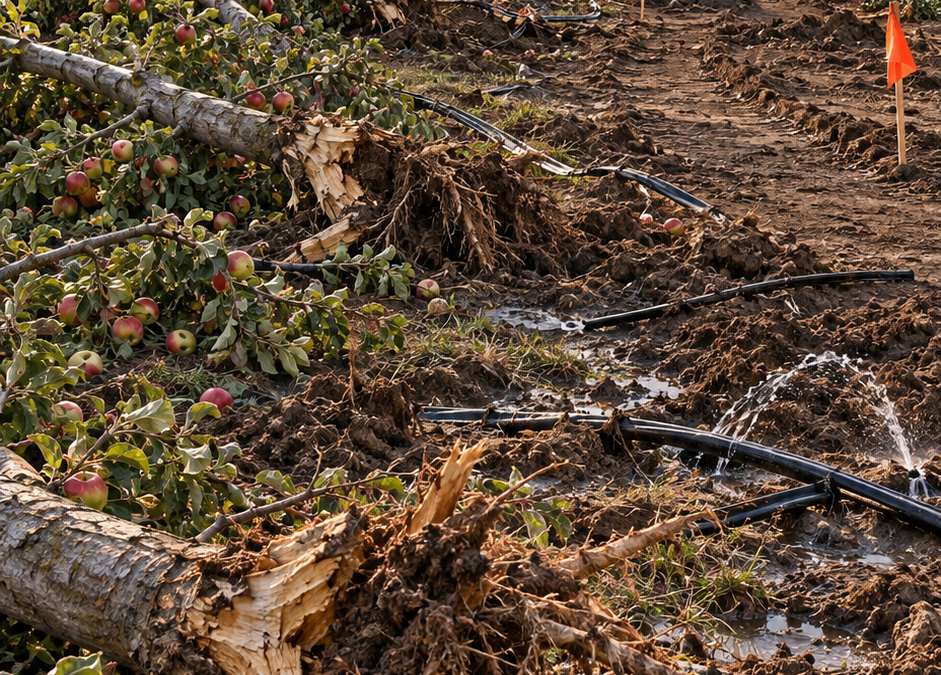
𝗙𝗨𝗟𝗟 𝗦𝗧𝗢𝗥𝗬
When I reached the irrigation trench, I found something else.
A concrete survey monument had been uncovered near the fence. One of their machines had scraped away the soil around it. The metal cap on top was still intact, dull and scratched but readable.
Stamped into it was my parcel number.
17-442.
I photographed that too.
Greg came back.
“We’re stopping temporarily.”
“Why?”
“Professional courtesy.”
I almost laughed. “You weren’t feeling courteous six trees ago.”
He ignored that.
“Our attorney will contact you.”
“Tell him to bring the easement.”
Greg rolled up his plans. “You should understand something, Mr. Bennett. Willow Creek requires a second emergency access road before the next phase can open.”
“This route has already been approved.”
“By whom?”
“The county.”
That got my attention.
I looked at the destroyed trees again, then at the red line running through my family’s orchard.
“Good,” I said.
Greg frowned. “Good?”
“Good. If the county approved a road across my land, they’ll have a record of it.”
An hour later, I was standing inside the county recorder’s office while a clerk named Rachel searched my parcel history.
I had known Rachel since high school. She had been two grades behind me, quiet, careful, the kind of person who could find a misplaced deed faster than most people could find their car keys. She did not waste time with small talk after I explained what had happened.
She tried my address.
My parcel number.
My father’s name.
My mother’s name.
My name.
Then Willow Creek Development.
Then the parent company behind the subdivision.
Finally, she leaned closer to the screen.
“That’s strange.”
“What?”
She opened the subdivision plat.
There was Willow Creek.
There was the proposed road.
There was my orchard.
But between them was something Greg’s construction plan had not shown clearly enough to matter.
A property boundary.
Mine.
Rachel searched again.
Then she turned toward me.
“Ben, I’m not finding any recorded easement across your parcel.”
I stared at the screen.
“Could it be filed somewhere else?”
“It shouldn’t be. Not if it affects this parcel.”
She pulled up the county approval documents.
Then her expression changed.
“Oh.”
“What did you find?”
Rachel pointed to a note beside the proposed secondary access.
Three words were highlighted.
EASEMENT TO BE ACQUIRED.
I felt my stomach drop.
Not easement acquired.
Not existing easement.
Not recorded access.
To be acquired.
And outside my office window, six apple trees were already lying on the ground.
“Print that page,” I said.
Rachel looked at me.
“The approval sheet. Everything connected to that road.”
She nodded and started sending documents to the printer.
I kept staring at those three words.
Easement to be acquired.
Willow Creek had acquired nothing from me.
Nobody had called.
Nobody had mailed an offer.
Nobody had knocked on my door.
Nobody had asked whether I would sell a strip of my orchard so forty feet of road could cut through rows my father planted with his own hands.
They had simply driven an excavator through my fence and started removing trees.
Rachel handed me the first stack.
“You should probably talk to planning and development too.”
“Why?”
“Because this approval appears conditional.”
Ten minutes later, I was upstairs sitting across from a county planner named Kevin Moore.
Kevin wore square glasses and had a habit of reading with one finger moving slowly along each line. He had the patient expression of a man who knew that one missing document could ruin an entire project if the wrong person tried to pretend it did not matter.
He read the approval sheet twice.
Then he picked up his phone.
“Who started construction?”
“Willow Creek Development. Today. About two hours ago.”
Kevin’s expression tightened.
“They shouldn’t be doing that.”
I leaned forward. “Did the county approve the road?”
“We approved the subdivision plan showing a potential secondary connection.”
“That is not what I asked.”
He paused.
“No. We did not give them ownership rights over your property.”
There it was.
I slid my phone across his desk.
The first photograph showed the excavator.
The second showed the broken irrigation line.
The third showed the six uprooted trees.
Kevin stopped scrolling.
“They’ve already cleared this?”
“Yes.”
He stood.
“I need to make some calls.”
My phone rang before he reached the door.
Greg Vance.
I answered on speaker.
“Mr. Bennett,” Greg said, his voice smoother than before, “we’ve confirmed there may be a documentation issue.”
Kevin stopped walking.
“A documentation issue?” I asked.
Greg continued. “Our title company is locating the original access agreement.”
“What original agreement?”
“The corridor was represented to us as existing.”
“By who?”
“I can’t discuss internal transactions.”
Kevin motioned for me to keep him talking.
Greg lowered his voice. “We’d prefer to resolve this without unnecessary escalation.”
I looked at the county planner.
“Then tell your crew to leave my property.”
“They’re already standing down.”
“Leave.”
A pause.
“We have equipment that can’t be moved immediately.”
“Funny. It moved onto my land pretty quickly.”
Kevin covered his mouth, but not fast enough to hide the start of a smile.
Greg did not respond for a second.
Then his tone changed.
“Mr. Bennett, Willow Creek is a multi-million-dollar project. That secondary road is required for emergency access. Delaying it could affect dozens of home closings.”
“And that gives you permission to destroy my orchard?”
“I’m explaining the stakes.”
“No. You’re explaining your stakes.”
I hung up.
Kevin walked to the window.
“I’ve asked code compliance to send someone out today.”
Immediately.
That was faster than I expected.
But Willow Creek moved faster.
By the time I returned to my orchard, Greg had three more vehicles parked near my fence. Two men in dress shirts stood beside him.
One introduced himself as David Sloan, the developer’s attorney.
The other said he represented the title company.
Greg pointed toward me.
“Here’s Mr. Bennett.”
David Sloan stepped forward. He had an expensive haircut, polished shoes, and the calm voice of a man trained to sound reasonable while standing beside damage someone else had caused.
“We’d like to discuss temporary access while we clarify the easement.”
“No.”
He blinked. “You haven’t heard the proposal.”
“You cut down my trees before asking permission. Now you’re asking permission to continue.”
Behind him, workers were loading tools.
At least they were leaving.
Then the title company representative opened a folder.
“We believe your father may have signed an access agreement in 1997.”
My chest tightened.
My father had died eleven years ago.
“Show me.”
He handed me a photocopy.
I read the first page.
Then the second.
My father’s name appeared in the background documents. So did the Bennett family name. For one second, a thin line of doubt opened inside me.
What if I had missed something?
What if my father had signed something and never told me?
Then I reached the legal description.
Parcel 18-442.
I knew my parcel number as well as I knew my own birthday.
17-442.
I looked up.
“This isn’t my property.”
The title representative grabbed the page back.
His face changed.
Greg stepped closer. “What?”
I pointed across the fence toward an abandoned field east of my orchard.
“That parcel belonged to my uncle.”
Nobody spoke.
Then a county vehicle turned onto the shoulder.
Kevin climbed out with a code compliance officer named Melissa Grant.
Melissa wore a county jacket, carried a tablet, and had the blunt posture of someone who did not intend to be impressed by anyone’s job title.
Greg whispered something I could not hear.
Melissa walked directly toward the excavator, photographed it, then looked at the cleared path.
“Who authorized work beyond the Willow Creek boundary?”
Greg raised the photocopied agreement.
“We have an easement.”
I answered before he could hand it over.
“Wrong parcel.”
Melissa took the document anyway. She compared it with something on her tablet.
Then she looked at Greg.
“Mr. Vance, shut this entire operation down.”
Greg’s face hardened. “We’ve already paused.”
“I’m not asking you to pause.”
She pulled a bright orange notice from her folder.
“I’m ordering you to stop.”
The notice went directly onto the excavator window.
STOP WORK. PROPERTY AUTHORIZATION REQUIRED.
Greg stared at it like Melissa had slapped him.
“This is unnecessary.”
Melissa did not even look up from her tablet.
“What’s unnecessary is grading private property without documentation.”
David Sloan stepped forward. “We have provided evidence of an easement.”
Melissa held up the photocopy.
“Parcel 18-442.”
She pointed toward my orchard.
“This is 17-442.”
The title company representative suddenly became very interested in his shoes.
Greg was not giving up.
“The access corridor appears on the approved subdivision plan.”
Kevin answered him.
“As conditional. Subject to acquisition of necessary property rights.”
Greg’s voice rose. “Willow Creek has buyers scheduled to close next month.”
Melissa finally looked at him.
“Then you should have verified access before sending an excavator through someone else’s orchard.”
That ended the conversation.
At least I thought it did.
The crew loaded its equipment and left.
The excavator stayed because the transport trailer could not arrive until morning.
I spent the rest of the afternoon with Miguel Santos, my orchard manager, shutting off the damaged irrigation branch and inspecting the trees. Miguel had worked beside my father for years before he ever worked for me. He knew every row, every irrigation line, every graft, every patch of soil that held too much clay after rain.
He stood beside the fallen trees with his hat in his hands.
For a while, neither of us spoke.
Six trees were completely gone.
Three more had root damage.
Then Miguel stopped beside one of the orange flags.
“Ben.”
“What?”
“These markings keep going.”
I followed his gaze.
The flags did not stop after the cleared section.
They continued another two hundred yards through two rows of mature Honeycrisp trees straight toward the county road.
I pulled one flag from the soil.
“How many trees would this take?”
Miguel looked down the line.
“Twenty-five. Maybe thirty.”
My stomach tightened.
The six trees were not the project.
They were the beginning.
A pickup slowed near the fence.
My neighbor, Evelyn Price, rolled down her window.
“I saw the machinery this morning. Everything okay?”
“Not exactly.”
She parked and walked over.
Evelyn had lived beside our orchard for forty years. She was nearly seventy, sharp-eyed, and knew more local history than most people at the courthouse. Her late husband had farmed the property west of mine, and she had watched Willow Creek rise from soybean fields with the suspicion of someone who had seen developers arrive smiling before.
When I explained what had happened, she frowned.
“That road again.”
I looked at her.
“What do you mean, again?”
She pointed north.
“Somebody came through last winter measuring from the development to Miller Road.”
“They came onto my land before?”
“Twice that I saw.”
Miguel and I exchanged a look.
Greg had acted that morning like construction was based on a simple paperwork assumption.
But they had been studying this route for months.
Evelyn continued.
“The second time, your father would have chased them out himself.”
She smiled faintly.
“Actually, he did something similar years ago.”
“What?”
“When the old farm north of you was sold, somebody wanted access through this orchard.”
I stared at her. “When?”
“Late nineties.”
The date hit me.
The agreement Greg had shown me.
I called Rachel at the recorder’s office before she left for the day.
“Can you pull parcel 18-442?”
Keyboard clicking.
Then Rachel said, “Yes.”
“Who owned it in 1997?”
More clicking.
“Thomas Bennett.”
My uncle.
Exactly as I remembered.
“And the access agreement?”
“It crosses his parcel east of yours.”
“Does it touch mine?”
“No.”
“Where does it lead?”
Rachel went quiet.
“Interesting.”
“What?”
“It connects the northern farm to Miller Road, but that route was abandoned when the properties were divided in 2003.”
So Willow Creek had found an old agreement.
But not for my land.
Not for my orchard.
Not for the road they were building.
Then headlights swept across the trees.
A black Willow Creek SUV stopped outside my fence.
Greg stepped out alone.
He did not have rolled plans this time.
He had an envelope.
“Mr. Bennett.”
I stayed on my side of the fence.
“What now?”
He held the envelope toward me.
“The company is prepared to compensate you.”
“For the trees?”
“For the trees. For everything.”
I did not take it.
“How much?”
“Fifty thousand dollars.”
Miguel actually laughed.
Greg ignored him.
“In exchange, you grant Willow Creek the access easement and withdraw your complaint.”
I looked down the orange flags cutting through my orchard.
“You destroyed my trees this morning because you said you already had an easement.”
Greg said nothing.
“Now you’re offering fifty thousand dollars to buy one.”
His jaw tightened.
“Think carefully before you make this difficult.”
I looked directly at him.
“Greg, you made it difficult when you started the excavator.”
He left the envelope hanging between us for another second.
Then he pulled it back.
“Fifty thousand is a fair offer.”
“For land you claimed you already had the right to use?”
His expression hardened.
“The company is trying to resolve uncertainty.”
“There isn’t any uncertainty on my side of the fence.”
Greg glanced toward Evelyn and Miguel. He clearly had not expected an audience.
“This conversation should stay between the property owner and Willow Creek.”
Evelyn folded her arms.
“You brought an excavator into his orchard. You don’t get privacy afterward.”
Greg looked at me.
“The offer expires tomorrow.”
“Then save yourself the drive.”
He walked back to his SUV.
Before leaving, he lowered the window.
“If this road doesn’t happen voluntarily, there may be other processes.”
It sounded carefully rehearsed.
Still, the meaning was obvious.
Sell, or we will find another way.
I photographed his license plate as he drove away.
The next morning, the county arrived before Willow Creek did.
Melissa brought a survey technician named Aaron Blake. Rachel came from records carrying copies of the archived parcel maps. Aaron set up his equipment beside the exposed concrete monument.
“Don’t move any flags yet,” he told me.
“I haven’t.”
He started taking measurements.
Twenty minutes later, another truck pulled onto the shoulder.
Raymond Cole stepped out holding an old leather field notebook.
Raymond was retired now, but for decades he had been the surveyor everybody called when old farm boundaries got messy. Evelyn had called him.
He walked toward us slowly, nodded to me, then looked at the orange flags.
“I surveyed this property in 2003,” he said.
Aaron looked surprised. “You did the Bennett division?”
“Sure did.”
He opened the notebook.
Handwritten measurements filled the pages.
Then he pointed toward the orange flags.
“Who laid that line?”
“Willow Creek’s contractor,” I said.
Raymond frowned.
“Well, they weren’t following any easement I ever recorded.”
Rachel unfolded the 1997 agreement across my truck hood.
Raymond recognized it immediately.
“Tom Bennett’s farm access.”
Melissa asked, “Did it ever cross this orchard?”
“Not one foot.”
Greg arrived fifteen minutes later with David Sloan.
The moment Greg saw Raymond, he stopped.
“You’ve got to be kidding.”
That reaction caught everyone.
“You two know each other?” I asked.
Raymond closed his notebook.
“He called me six months ago.”
Greg’s face changed.
David turned toward him. “For what?”
“To locate the old Bennett access.”
Nobody spoke.
Raymond continued.
“I told him the easement was east of this parcel and had been abandoned after the 2003 division.”
Greg stepped forward. “That’s not exactly what you said.”
Raymond pulled out his phone.
“Good thing I followed up by email.”
David stared at Greg.
“You contacted a surveyor six months ago?”
Greg did not answer.
Raymond found the message.
“I sent Willow Creek a map showing the old easement location.”
He turned the screen toward Melissa and me.
“I specifically wrote: no recorded access found across parcel 17-442.”
The orchard went silent.
I looked at Greg.
Yesterday he blamed title records.
This morning, a witness stood in front of us saying Willow Creek had known for six months.
David took Greg aside.
Their conversation became heated almost immediately.
Then Aaron called from near the damaged trees.
“Melissa, I found something.”
We walked over.
He was standing beside a wooden stake half buried under leaves. Unlike Willow Creek’s orange flags, this one was faded blue. Aaron brushed away dirt from its side.
A date was written across it.
Six months earlier.
Raymond stared at it.
“That’s one of mine.”
“What’s it marking?” I asked.
“The boundary.”
Aaron checked the position against his equipment.
Then he pointed toward the excavator tracks.
“They crossed it by thirty-eight feet.”
Melissa photographed everything.
Greg returned looking pale.
“We should stop until counsel reviews this.”
I stared at him.
“Stop?”
I pointed at the broken trees.
“You started six months after being told there was no easement.”
David looked at Greg. “Is that true?”
Greg opened his mouth.
Before he could answer, Raymond held up his phone.
“I still have your reply to my email.”
Greg froze.
Raymond read it aloud.
“Understood. We’ll address acquisition before construction.”
Nobody needed an explanation.
The developer had not made a simple mistake.
They had known they needed my permission before the first tree fell.
David Sloan did not defend Greg after that. He took the project manager twenty yards away and spoke to him with the kind of controlled anger that somehow looked worse than shouting.
Melissa kept photographing the blue boundary stake.
Aaron measured the excavator tracks again.
Thirty-eight feet inside my parcel.
No ambiguity.
No misplaced fence.
No questionable map.
Willow Creek’s equipment had crossed a surveyed boundary their own project manager had been shown six months earlier.
Then David walked back alone.
“Mr. Bennett, construction will remain suspended.”
“It already is.”
“Willow Creek would like an opportunity to investigate internally.”
I looked past him.
Greg was standing beside his SUV on the phone.
“Investigate what?”
David did not answer immediately.
That told me plenty.
Melissa did.
“The county is investigating too.”
David turned toward her. “On what basis?”
“Possible work outside approved development limits, damage associated with unverified access, and discrepancies between the site documents submitted for inspection and recorded property information.”
Greg stopped talking on his phone.
“What discrepancies?”
Melissa pulled up the plan on her tablet.
“This.”
The construction sheet showed the secondary road crossing my orchard, but the property boundary was drawn nearly forty feet west of where Aaron had just measured it.
Raymond leaned over the screen.
“That’s wrong.”
Aaron nodded.
“Very wrong.”
My stomach tightened.
“Could that be a drafting mistake?”
“It could,” Melissa said.
Then Raymond pointed at a notation near the bottom.
“Check the revision date.”
Three weeks earlier.
The plan had been revised shortly before construction.
David’s face changed.
“Who submitted that revision?”
Melissa scrolled.
“Willow Creek Development.”
Everyone looked at Greg.
He shook his head.
“I don’t prepare engineering drawings.”
“No,” David said quietly. “But you approve field coordination.”
Greg’s voice rose. “Are you seriously blaming me for a CAD line?”
Before anyone answered, a pickup stopped behind Evelyn’s car.
A man wearing a fluorescent vest climbed out.
I recognized him as the excavator operator from the day before.
He walked straight toward me.
“Mr. Bennett.”
“Yes?”
“I’m Luke Harris.”
“I remember.”
He glanced at Greg.
“I need to tell you something.”
Greg immediately stepped forward.
“Luke, you’re a subcontractor. Don’t involve yourself in contractual matters.”
Luke ignored him.
“Yesterday wasn’t the first time we were told there might be a property problem.”
Everything stopped.
Melissa opened her notebook.
“What were you told?”
Luke took out his phone.
“Our foreman sent this to Mr. Vance last week.”
It was a photograph of the blue survey stake.
My parcel number was visible.
Underneath was a text message.
Boundary marker conflicts with clearing plan. Confirm before mobilization.
Greg’s reply was beneath it.
Proceed per latest drawing.
David stared at the screen.
“You sent that?”
Greg looked furious. “The engineering plan controlled our work.”
Luke shook his head.
“Our foreman wanted written confirmation because the stakes didn’t match.”
“And you got it,” Melissa said.
Luke nodded.
Then he looked at me.
“I’m sorry about your trees.”
That was the first apology I had heard from anyone connected to the crew.
Greg turned toward his SUV.
Melissa called after him.
“Mr. Vance, don’t leave yet.”
He stopped. “Am I being detained?”
“No.”
“Then I’m leaving.”
He opened his door.
Before he could climb inside, another county vehicle pulled up.
Kevin Moore stepped out carrying a thick folder. His expression told me something had changed.
“I pulled Willow Creek’s original planning application.”
David walked toward him.
Kevin opened the folder on my truck hood.
“The original map shows the correct property line.”
He placed it beside the revised construction sheet.
The difference was obvious.
On the original, the road stopped at my boundary.
On the revision, the boundary had shifted and the road continued through my orchard.
I stared at Greg.
“Who changed it?”
Kevin looked at the signature block.
Then at David.
Then finally at Greg.
“That is what the county wants to know.”
Greg did not leave.
He stood beside his SUV while Kevin laid three versions of the Willow Creek site plan across my truck hood.
Original planning submission.
Engineering revision.
Construction issue set.
The road changed on each one.
On the first, it stopped at my property line.
On the second, it crossed the line.
On the third, the line itself had moved.
David stared at the drawings.
“Who issued Revision C?”
Kevin pointed to the title block.
“Northstar Civil Engineering.”
Greg seized on it immediately. “Then talk to Northstar.”
“We already did.”
Kevin pulled out his phone.
“They emailed me the transmittal record twenty minutes ago.”
Greg’s confidence disappeared.
“What record?”
“The change request.”
Kevin handed the phone to Melissa.
She read silently, then looked at Greg.
“Requested by Willow Creek Development. Attention: Gregory Vance.”
Greg shook his head. “That’s standard project coordination.”
“What did you request?” I asked.
He ignored me.
Kevin did not.
“Quote: align secondary access corridor with approved emergency route and remove conflicting legacy boundary graphics.”
Raymond gave a short laugh.
“Legacy boundary graphics.”
He pointed at the blue stake.
“You mean the property line?”
Greg’s face reddened.
“I relied on title information showing historical access.”
“The easement on my uncle’s parcel,” I said.
“An easement connected to former Bennett holdings.”
“Not mine.”
David stepped between us.
“Greg, stop talking.”
This time, Greg listened.
Then Melissa’s radio crackled.
She walked away, answered, and returned looking more serious.
“The county engineer is placing Willow Creek’s secondary access approval under review.”
David stiffened. “On what grounds?”
“Because the required easement was never acquired and the field plan appears inconsistent with the approved plat.”
Greg stared at Kevin.
“You can’t hold up an entire development over six trees.”
I felt Miguel move beside me.
I raised a hand before he could respond.
“This isn’t about six trees.”
Greg looked at me.
“It’s about what those trees were standing on.”
My land.
Nobody needed me to say it.
Then a sheriff’s cruiser pulled onto the shoulder.
Deputy Laura Mills stepped out.
Melissa had requested documentation because of the property damage. Mills photographed the cut fence, tire tracks, broken irrigation, and uprooted trees. Then she asked Greg one question before work began.
“Did you believe you had permission from the property owner?”
David immediately said, “My client won’t answer questions without separate counsel.”
Greg looked at him.
“Separate counsel?”
That was the first moment I realized David was no longer treating Greg and Willow Creek as the same problem.
Deputy Mills nodded.
“That’s fine.”
Then Luke, the excavator operator, approached.
“I can answer what the crew believed.”
David closed his eyes.
Luke showed Mills the text instructing them to proceed despite the boundary marker. She photographed it. Raymond gave her his email. Kevin gave her the original county plan.
By noon, my truck looked like an evidence table.
Then Evelyn came walking from her house holding a small security camera.
“My driveway camera faces Ben’s western fence.”
Greg went completely still.
She connected it to her tablet.
The footage from the previous morning appeared.
The excavator crossed my boundary.
The crew stopped.
The foreman got out.
He pointed directly at the blue stake.
Then Greg’s white pickup arrived.
We watched him walk to the marker.
We watched the foreman show him something on a phone.
We watched Greg wave toward the orchard.
Seconds later, the excavator moved again.
No misunderstanding.
No invisible boundary.
No surprise.
Mills watched the clip twice.
Then she looked at Greg.
“You were physically present before the clearing continued.”
Greg said nothing.
David stepped away from him.
And that was when Kevin’s phone rang.
He answered, listened, then looked at me.
“The county just completed its easement search.”
I held my breath.
Kevin turned toward Willow Creek’s attorney.
“There is no recorded easement across Bennett’s parcel.”
David’s shoulders dropped.
“None?”
“None.”
Kevin closed the folder.
“And until Willow Creek proves a lawful right of access, the county is removing this orchard route from the development’s approved emergency access plan.”
Greg finally stopped looking at me like I was the problem.
He looked at Kevin.
“You can’t remove that route.”
Kevin held up the county folder.
“We just did.”
Greg’s voice sharpened. “Phase Two requires two emergency access points.”
“Correct.”
“Without Bennett’s road, we can’t get occupancy approval.”
“Then Willow Creek needs another lawful access point.”
Greg turned toward David.
“Tell him.”
David did not move.
“Tell him the county approved our plan.”
“They approved it conditionally,” David said. “And the condition was acquisition of the easement.”
That sentence landed harder than anything I had said all morning.
Deputy Mills finished taking Luke’s statement while Melissa placed another county notice on the excavator.
This one was different.
UNAUTHORIZED WORK AREA. DO NOT DISTURB.
Greg read it.
“How long is this going to take?”
Melissa looked toward my damaged trees.
“That depends on how long the investigation takes.”
Then another vehicle arrived.
A dark sedan with the Willow Creek logo.
A man in his sixties stepped out.
Greg went pale.
“Mr. Harlon.”
Robert Harlon, owner of Willow Creek Development.
He did not introduce himself to Greg.
He walked directly to David.
“I got your call.”
David handed him the original county plan, then the revised plan, then Raymond’s email.
Harlon read everything without speaking.
Finally, he looked at Greg.
“Did you know we didn’t have the easement?”
Greg straightened.
“I believed historical access rights covered the corridor.”
Harlon held up Raymond’s email.
“This says no recorded access across parcel 17-442.”
“That’s one surveyor’s interpretation.”
Raymond stepped forward.
“I’m the surveyor you hired.”
Harlon looked at him.
“You told Greg this six months ago?”
“Yes.”
Harlon turned back.
Greg started talking faster.
“The project was already committed. We had road engineering, utility coordination, presales—”
“Did you know?” Harlon asked.
Silence.
Harlon asked again.
“Did you know we needed Bennett’s permission?”
Greg looked toward me.
That was his mistake.
Harlon saw it.
“Answer me, not him.”
Greg swallowed.
“We intended to acquire the easement.”
“Before construction?”
Another silence.
Harlon’s face hardened.
“Give me your company phone.”
Greg blinked. “What?”
“Now.”
Greg slowly handed it over.
Harlon gave it to David.
“Preserve everything.”
Deputy Mills glanced at Melissa.
Neither said anything.
They did not need to.
Then Harlon walked toward me.
“Mr. Bennett, I owe you an apology.”
I looked at the uprooted trees.
“Your company owes me more than that.”
“Yes,” he said. “No argument.”
That surprised me.
“We’ll pay for the damaged trees, irrigation, fencing, restoration, and whatever professional assessment is necessary.”
“And the road?”
“There will be no road through your orchard unless you voluntarily agree to one.”
Greg stepped forward. “Robert, you can’t promise that.”
Harlon turned.
“I just did.”
Greg’s face went red.
“Then Phase Two dies.”
“No,” Harlon said. “We redesign it.”
“That could cost millions.”
Harlon pointed toward my orchard.
“And whose decision created that problem?”
Greg had no answer.
Then Evelyn called from beside her tablet.
“There’s more footage.”
Everyone turned.
She had moved backward through her security recordings.
Three weeks earlier, Greg’s SUV appeared beside my fence after dark. He was not alone. Another man got out carrying rolled plans. They walked directly to the blue boundary stake. The second man measured from it toward Willow Creek. Then Greg pointed through my orchard.
Evelyn froze the image.
Kevin stepped closer.
“I know that man.”
David’s expression changed. “Who?”
“Northstar’s project engineer.”
The same firm that produced the revised drawing.
Harlon looked at Greg.
Greg looked away.
Kevin took out his phone.
“I’m calling the county engineer.”
Deputy Mills reached for her notebook again.
And suddenly the question was not whether Willow Creek had accidentally crossed my property line.
The question was how many people had known exactly where that line was before they crossed it.
The Northstar engineer arrived forty minutes later.
His name was Eric Dalton.
The moment he saw Evelyn’s frozen security footage, he stopped pretending the nighttime visit had not happened.
“I was asked to verify field conditions,” he said.
Kevin folded his arms.
“At nine-thirty at night?”
Eric looked at Greg.
Greg stared at the ground.
David spoke first.
“Eric, who asked you to come here?”
Eric hesitated.
“Greg.”
Harlon’s jaw tightened.
“What were you verifying?”
“The distance between the recorded Bennett boundary and the proposed emergency road.”
I felt Miguel shift beside me.
“So you knew where the boundary was?” I asked.
Eric looked at me.
“Yes.”
Greg finally snapped.
“We all knew where the boundary was. The issue was whether the historical access rights extended across it.”
Raymond shook his head.
“I told you they didn’t.”
“You gave an opinion.”
“I gave you the recorded documents.”
Kevin stepped closer to Eric.
“Why did Revision C remove the boundary line?”
Eric looked uncomfortable.
“It wasn’t removed.”
“What was it?”
“It was suppressed from the construction layer.”
“At whose request?”
Nobody moved.
Then Eric answered.
“Greg’s.”
Harlon turned away for a moment.
That was the instant the entire story changed.
Until then, Willow Creek could still call it confusion.
Bad title work.
Old easement records.
A drafting mistake.
Now their own engineer was saying the property line had been deliberately hidden from the construction sheet.
Deputy Mills asked Eric to repeat his statement.
He did.
Melissa documented it.
David stopped asking questions altogether.
Then Kevin’s phone rang again.
He listened, said he understood, and ended the call.
“The county engineer has suspended review of Willow Creek’s Phase Two occupancy approvals pending corrected access plans.”
Greg stared at him.
“You can’t freeze home approvals over a graphics issue.”
Kevin pointed toward my uprooted trees.
“The graphics issue is standing behind you.”
Harlon looked at Greg.
“You’re off the project.”
Greg blinked. “Robert—”
“Give David your laptop credentials and leave.”
“You can’t do this in front of everybody.”
“I can do it wherever I discover you exposed this company to exactly the risk our procedures were designed to prevent.”
Greg’s face burned for the first time since I had met him.
He had no threat left.
He walked toward his SUV.
Before getting inside, he looked at me.
“This development was bringing millions into this county. You could have taken the fifty thousand and everybody would have won.”
I looked at the torn roots beside the road.
“Everybody except the person who owned the land.”
Greg slammed his door and left.
Nobody followed him.
Then Harlon surprised me.
He picked up the envelope Greg had offered me the night before. Greg had apparently left a duplicate in the project file.
“Was this the offer?”
“Yes.”
Harlon tore it in half.
“We’ll start over.”
“I’m not selling an easement.”
“I understand.”
“And I want the orchard restored.”
“It will be.”
Two days later, county survey crews installed temporary boundary stakes along my entire western line.
Willow Creek’s excavator was removed under county supervision.
The orange construction flags disappeared.
The blue property markers stayed.
A week later, Harlon returned without attorneys.
He brought a restoration specialist and an arborist.
They estimated the lost trees, damaged irrigation, soil compaction, fencing, and years of reduced production. The arborist walked slowly around the empty spaces where the six trees had stood, touching cut roots, measuring trunk diameter, checking the three damaged trees that might not survive the season.
When he finished, he looked at Harlon.
“Mature trees aren’t replaced by planting six saplings.”
Harlon nodded.
“I know.”
That mattered more than I expected.
Not because it fixed anything.
Because someone finally understood what had been destroyed.
Before leaving, Kevin handed me the county’s written determination.
I read the sentence twice.
No recorded or otherwise established easement authorizing Willow Creek Development to cross parcel 17-442 has been identified.
Six trees were gone.
The land beneath them was not.
And now the county had put in writing what Greg should have respected before the first excavator ever started.
By the time the first replacement tree went into the ground, Willow Creek’s new road was already being built somewhere else.
Not through my orchard.
The developer redesigned the secondary access along the eastern edge of its own property, where it connected to a county road without crossing anyone else’s land.
It cost them more.
Nobody told me exactly how much.
I did not ask.
Three months after the excavator first appeared, Harlon stood beside me while a restoration crew repaired the last section of irrigation line.
Six mature apple trees could not simply be replaced. The arborist had been right about that. Those trees had taken decades of weather, pruning, soil, water, and work to become what they were. Saplings could fill the empty spaces, but they could not fill the years.
So Willow Creek paid for the destroyed trees.
They paid for the three damaged trees.
They paid for fencing.
Irrigation repairs.
Soil restoration.
Lost production.
Surveying costs.
Professional fees.
More importantly, they signed an agreement acknowledging they had no access rights across my parcel.
That mattered to me more than Greg’s fifty-thousand-dollar envelope ever had.
Miguel walked over carrying two coffees.
“Think they’ll try another road?”
I looked toward Willow Creek.
“They already have one on their land.”
“Imagine that.”
He laughed.
Then a pickup pulled into the orchard.
It was Raymond.
He had something wrapped in an old towel.
“I figured this belongs here.”
He uncovered a brass survey marker.
The county had authorized a permanent replacement near the western boundary after construction damaged the original reference area. Raymond set it carefully while I watched.
“Your father used to check these markers every spring,” he said.
“I didn’t know that.”
“He trusted people,” Raymond said. “He just trusted recorded boundaries more.”
That sounded like my father.
A week later, I received a letter from the county.
The review of Willow Creek’s plans was complete.
The orchard route had been permanently removed from the approved development documents. Northstar had submitted corrected drawings. Phase Two could continue only using the redesigned access.
Greg Vance was no longer listed as project manager.
I never saw him again.
Evelyn did.
She called me one afternoon.
“Guess who drove past?”
“Greg?”
“Didn’t even slow down.”
“Probably learned where the property line is.”
She laughed so hard she had to hang up.
By autumn, the empty spaces where the trees had fallen were still obvious.
Young replacement trees stood there supported by stakes. They looked almost ridiculous beside the mature rows, thin and fragile and too eager for a world that had already proven careless. But they were alive.
That counted for something.
One Saturday, several families from Willow Creek stopped at our roadside farm stand.
At first, I expected awkwardness.
Instead, a woman buying apples looked toward the repaired section.
“Is that where they tried to build the road?”
“That’s it.”
She shook her head. “We were told the orchard owner was blocking emergency access.”
I smiled slightly.
“I heard a few versions of that story.”
“I’m glad they found another route.”
“So am I.”
Her daughter picked up a Honeycrisp and asked if it came from one of the old trees.
“Probably,” I said.
She held it carefully, like that made it special.
After they left, I stood beside the stand and looked across the orchard.
I could still trace the path Greg wanted.
Straight through the western rows.
Across the irrigation line.
Past the blue survey stake.
Toward Miller Road.
On a construction drawing, it probably looked simple.
Just a red line forty feet wide.
Efficient.
Convenient.
Necessary.
But lines on development plans cross real places.
They cross fences somebody repaired, soil somebody worked, trees somebody planted decades earlier, and sometimes they cross land that does not belong to the person holding the pencil.
Greg thought the size of Willow Creek made his road inevitable.
He thought permits, engineers, deadlines, home closings, and millions of dollars could turn easement to be acquired into easement acquired.
They could not.
The county map did not care how expensive the subdivision was.
The recorder’s office did not care how urgently they needed a second entrance.
And my property line did not move because their schedule demanded it.
Every morning now, I pass that brass marker on my way into the orchard.
It is small.
Most people would never notice it.
But I do.
Because six trees were destroyed before anyone bothered respecting what that marker represented.
Willow Creek eventually got its road.
I kept my orchard.
And the most expensive lesson the developer learned was also the simplest one.
Before you cut through somebody else’s land, make sure you actually have the right to be there.
𝗧𝗛𝗘 𝗘𝗡𝗗
The Red Line on Their Map Ran Straight Through the Trees My Father Planted
The first thing I noticed was not the excavator.
It was the silence where six apple trees used to stand.
Then the developer told me the road through my orchard had already been approved.
Those trees were older than the subdivision that was about to replace the fields north of me.
I said that through the open window of my truck to a man sitting behind the controls of a yellow excavator in the middle of my orchard. He had one hand on the lever and the other resting near the ignition, like he was waiting for permission from someone other than the man who owned the ground beneath him.
For one strange second, after he killed the engine, everything went quiet.
No diesel rumble.
No hydraulic whine.
No sound except the wind moving through the apple rows and water dripping from a broken irrigation line.
Then I looked behind him.
Six apple trees were already down.
Not trimmed. Not damaged. Not leaning.
Down.
Their trunks had been snapped or pushed from the soil, roots exposed like torn muscle beneath a strip of raw earth. Broken irrigation tubing lay twisted in the dirt, still bleeding water into the rows. Orange survey flags ran between the remaining trees, marking a forty-foot-wide path straight through the western side of my property.
I had been gone for ninety minutes.
Ninety minutes to pick up fertilizer from the co-op.
And while I was gone, someone had started building a road through thirty years of my family’s orchard.
I stepped out of the truck slowly because if I moved too fast, I knew anger would move faster than sense.
“What are you doing?” I asked.
The operator looked down at me from the cab. He was younger than I expected, maybe early thirties, wearing a fluorescent vest and a hard hat with dust along the brim. He did not answer right away. Instead, he pointed toward a white pickup parked near my fence.
“Talk to Mr. Vance.”
A man in khaki pants stepped out of the pickup.
I recognized him before he reached me.
Greg Vance.
Project manager for Willow Creek Estates, the new subdivision being built on the former soybean acreage north of my orchard. I had met him once at a county planning meeting. He had shaken my hand, smiled too easily, and talked about “compatible rural development” in a way that made me check afterward whether my wallet was still in my pocket.
Now he walked toward me carrying rolled construction plans.
“Mr. Bennett,” he said. “I was hoping we’d catch you.”
I looked past him at the six broken trees.
“You caught six of my trees.”
His smile disappeared.
“We’re beginning access road construction.”
“On my property.”
“We have an easement.”
I looked at the broken trunks, the ripped roots, the excavator tracks cutting across wet soil.
“No,” I said. “You don’t.”
Greg sighed like I was slowing down his schedule.
“The development documents show a transportation corridor connecting Willow Creek to Miller Road.”
“Miller Road is south of me.”
“Correct.”
“And my orchard is between you and Miller Road.”
“Also correct.”
I waited.
Apparently, he did not hear the problem.
I stepped closer. “Who gave you permission to cross my land?”
“Our title work confirms access.”
“Show me.”
Greg unrolled the plans across the hood of his pickup.
A thick red line cut directly through my orchard.
It ran from the northern development boundary, across my western apple rows, through the irrigation line, over my fence line, and toward Miller Road like the trees, soil, and deed underneath it were blank space.
The label beside it read:
PROPOSED SECONDARY ACCESS.
I pointed at the line. “That is a construction drawing.”
“It is based on recorded property documents.”
“Then show me the recorded easement.”
His jaw tightened.
“The developer’s attorney has reviewed everything.”
That was not an answer.
Behind us, the excavator engine restarted.
I turned.
“Shut that machine down.”
Greg raised one hand toward the operator, but not to stop him.
“Keep working.”
The excavator lurched forward.
Something inside me went cold.
I stepped into the row.
The operator hit the brake immediately.
Greg stared at me. “Mr. Bennett, you are interfering with permitted construction.”
“You are destroying my orchard.”
“We have legal access.”
“Then call the sheriff.”
He blinked. “What?”
“Call whoever you want. But until somebody shows me an easement with my parcel number on it, nobody touches another tree.”
A second vehicle pulled up outside my fence.
Black SUV.
Willow Creek Development printed on the door.
A woman climbed out holding a tablet. Greg walked toward her and spoke quietly. She looked at me, then at the excavator, then back at Greg. Their expressions changed, not enough for an apology, but enough to tell me they were no longer sure how easy the morning was going to be.
I took out my phone and started photographing everything.
Every damaged tree.
Every tire track.
Every orange flag.
Every piece of broken irrigation.
Every machine mark where steel had bitten into soil my family had worked for decades.
When I reached the irrigation trench, I found something else.
A concrete survey monument had been uncovered near the fence. One of their machines had scraped away the soil around it. The metal cap on top was still intact, dull and scratched but readable.
Stamped into it was my parcel number.
17-442.
I photographed that too.
Greg came back.
“We’re stopping temporarily.”
“Why?”
“Professional courtesy.”
I almost laughed. “You weren’t feeling courteous six trees ago.”
He ignored that.
“Our attorney will contact you.”
“Tell him to bring the easement.”
Greg rolled up his plans. “You should understand something, Mr. Bennett. Willow Creek requires a second emergency access road before the next phase can open.”
“This route has already been approved.”
“By whom?”
“The county.”
That got my attention.
I looked at the destroyed trees again, then at the red line running through my family’s orchard.
“Good,” I said.
Greg frowned. “Good?”
“Good. If the county approved a road across my land, they’ll have a record of it.”
An hour later, I was standing inside the county recorder’s office while a clerk named Rachel searched my parcel history.
I had known Rachel since high school. She had been two grades behind me, quiet, careful, the kind of person who could find a misplaced deed faster than most people could find their car keys. She did not waste time with small talk after I explained what had happened.
She tried my address.
My parcel number.
My father’s name.
My mother’s name.
My name.
Then Willow Creek Development.
Then the parent company behind the subdivision.
Finally, she leaned closer to the screen.
“That’s strange.”
“What?”
She opened the subdivision plat.
There was Willow Creek.
There was the proposed road.
There was my orchard.
But between them was something Greg’s construction plan had not shown clearly enough to matter.
A property boundary.
Mine.
Rachel searched again.
Then she turned toward me.
“Ben, I’m not finding any recorded easement across your parcel.”
I stared at the screen.
“Could it be filed somewhere else?”
“It shouldn’t be. Not if it affects this parcel.”
She pulled up the county approval documents.
Then her expression changed.
“Oh.”
“What did you find?”
Rachel pointed to a note beside the proposed secondary access.
Three words were highlighted.
EASEMENT TO BE ACQUIRED.
I felt my stomach drop.
Not easement acquired.
Not existing easement.
Not recorded access.
To be acquired.
And outside my office window, six apple trees were already lying on the ground.
“Print that page,” I said.
Rachel looked at me.
“The approval sheet. Everything connected to that road.”
She nodded and started sending documents to the printer.
I kept staring at those three words.
Easement to be acquired.
Willow Creek had acquired nothing from me.
Nobody had called.
Nobody had mailed an offer.
Nobody had knocked on my door.
Nobody had asked whether I would sell a strip of my orchard so forty feet of road could cut through rows my father planted with his own hands.
They had simply driven an excavator through my fence and started removing trees.
Rachel handed me the first stack.
“You should probably talk to planning and development too.”
“Why?”
“Because this approval appears conditional.”
Ten minutes later, I was upstairs sitting across from a county planner named Kevin Moore.
Kevin wore square glasses and had a habit of reading with one finger moving slowly along each line. He had the patient expression of a man who knew that one missing document could ruin an entire project if the wrong person tried to pretend it did not matter.
He read the approval sheet twice.
Then he picked up his phone.
“Who started construction?”
“Willow Creek Development. Today. About two hours ago.”
Kevin’s expression tightened.
“They shouldn’t be doing that.”
I leaned forward. “Did the county approve the road?”
“We approved the subdivision plan showing a potential secondary connection.”
“That is not what I asked.”
He paused.
“No. We did not give them ownership rights over your property.”
There it was.
I slid my phone across his desk.
The first photograph showed the excavator.
The second showed the broken irrigation line.
The third showed the six uprooted trees.
Kevin stopped scrolling.
“They’ve already cleared this?”
“Yes.”
He stood.
“I need to make some calls.”
My phone rang before he reached the door.
Greg Vance.
I answered on speaker.
“Mr. Bennett,” Greg said, his voice smoother than before, “we’ve confirmed there may be a documentation issue.”
Kevin stopped walking.
“A documentation issue?” I asked.
Greg continued. “Our title company is locating the original access agreement.”
“What original agreement?”
“The corridor was represented to us as existing.”
“By who?”
“I can’t discuss internal transactions.”
Kevin motioned for me to keep him talking.
Greg lowered his voice. “We’d prefer to resolve this without unnecessary escalation.”
I looked at the county planner.
“Then tell your crew to leave my property.”
“They’re already standing down.”
“Leave.”
A pause.
“We have equipment that can’t be moved immediately.”
“Funny. It moved onto my land pretty quickly.”
Kevin covered his mouth, but not fast enough to hide the start of a smile.
Greg did not respond for a second.
Then his tone changed.
“Mr. Bennett, Willow Creek is a multi-million-dollar project. That secondary road is required for emergency access. Delaying it could affect dozens of home closings.”
“And that gives you permission to destroy my orchard?”
“I’m explaining the stakes.”
“No. You’re explaining your stakes.”
I hung up.
Kevin walked to the window.
“I’ve asked code compliance to send someone out today.”
Immediately.
That was faster than I expected.
But Willow Creek moved faster.
By the time I returned to my orchard, Greg had three more vehicles parked near my fence. Two men in dress shirts stood beside him.
One introduced himself as David Sloan, the developer’s attorney.
The other said he represented the title company.
Greg pointed toward me.
“Here’s Mr. Bennett.”
David Sloan stepped forward. He had an expensive haircut, polished shoes, and the calm voice of a man trained to sound reasonable while standing beside damage someone else had caused.
“We’d like to discuss temporary access while we clarify the easement.”
“No.”
He blinked. “You haven’t heard the proposal.”
“You cut down my trees before asking permission. Now you’re asking permission to continue.”
Behind him, workers were loading tools.
At least they were leaving.
Then the title company representative opened a folder.
“We believe your father may have signed an access agreement in 1997.”
My chest tightened.
My father had died eleven years ago.
“Show me.”
He handed me a photocopy.
I read the first page.
Then the second.
My father’s name appeared in the background documents. So did the Bennett family name. For one second, a thin line of doubt opened inside me.
What if I had missed something?
What if my father had signed something and never told me?
Then I reached the legal description.
Parcel 18-442.
I knew my parcel number as well as I knew my own birthday.
17-442.
I looked up.
“This isn’t my property.”
The title representative grabbed the page back.
His face changed.
Greg stepped closer. “What?”
I pointed across the fence toward an abandoned field east of my orchard.
“That parcel belonged to my uncle.”
Nobody spoke.
Then a county vehicle turned onto the shoulder.
Kevin climbed out with a code compliance officer named Melissa Grant.
Melissa wore a county jacket, carried a tablet, and had the blunt posture of someone who did not intend to be impressed by anyone’s job title.
Greg whispered something I could not hear.
Melissa walked directly toward the excavator, photographed it, then looked at the cleared path.
“Who authorized work beyond the Willow Creek boundary?”
Greg raised the photocopied agreement.
“We have an easement.”
I answered before he could hand it over.
“Wrong parcel.”
Melissa took the document anyway. She compared it with something on her tablet.
Then she looked at Greg.
“Mr. Vance, shut this entire operation down.”
Greg’s face hardened. “We’ve already paused.”
“I’m not asking you to pause.”
She pulled a bright orange notice from her folder.
“I’m ordering you to stop.”
The notice went directly onto the excavator window.
STOP WORK. PROPERTY AUTHORIZATION REQUIRED.
Greg stared at it like Melissa had slapped him.
“This is unnecessary.”
Melissa did not even look up from her tablet.
“What’s unnecessary is grading private property without documentation.”
David Sloan stepped forward. “We have provided evidence of an easement.”
Melissa held up the photocopy.
“Parcel 18-442.”
She pointed toward my orchard.
“This is 17-442.”
The title company representative suddenly became very interested in his shoes.
Greg was not giving up.
“The access corridor appears on the approved subdivision plan.”
Kevin answered him.
“As conditional. Subject to acquisition of necessary property rights.”
Greg’s voice rose. “Willow Creek has buyers scheduled to close next month.”
Melissa finally looked at him.
“Then you should have verified access before sending an excavator through someone else’s orchard.”
That ended the conversation.
At least I thought it did.
The crew loaded its equipment and left.
The excavator stayed because the transport trailer could not arrive until morning.
I spent the rest of the afternoon with Miguel Santos, my orchard manager, shutting off the damaged irrigation branch and inspecting the trees. Miguel had worked beside my father for years before he ever worked for me. He knew every row, every irrigation line, every graft, every patch of soil that held too much clay after rain.
He stood beside the fallen trees with his hat in his hands.
For a while, neither of us spoke.
Six trees were completely gone.
Three more had root damage.
Then Miguel stopped beside one of the orange flags.
“Ben.”
“What?”
“These markings keep going.”
I followed his gaze.
The flags did not stop after the cleared section.
They continued another two hundred yards through two rows of mature Honeycrisp trees straight toward the county road.
I pulled one flag from the soil.
“How many trees would this take?”
Miguel looked down the line.
“Twenty-five. Maybe thirty.”
My stomach tightened.
The six trees were not the project.
They were the beginning.
A pickup slowed near the fence.
My neighbor, Evelyn Price, rolled down her window.
“I saw the machinery this morning. Everything okay?”
“Not exactly.”
She parked and walked over.
Evelyn had lived beside our orchard for forty years. She was nearly seventy, sharp-eyed, and knew more local history than most people at the courthouse. Her late husband had farmed the property west of mine, and she had watched Willow Creek rise from soybean fields with the suspicion of someone who had seen developers arrive smiling before.
When I explained what had happened, she frowned.
“That road again.”
I looked at her.
“What do you mean, again?”
She pointed north.
“Somebody came through last winter measuring from the development to Miller Road.”
“They came onto my land before?”
“Twice that I saw.”
Miguel and I exchanged a look.
Greg had acted that morning like construction was based on a simple paperwork assumption.
But they had been studying this route for months.
Evelyn continued.
“The second time, your father would have chased them out himself.”
She smiled faintly.
“Actually, he did something similar years ago.”
“What?”
“When the old farm north of you was sold, somebody wanted access through this orchard.”
I stared at her. “When?”
“Late nineties.”
The date hit me.
The agreement Greg had shown me.
I called Rachel at the recorder’s office before she left for the day.
“Can you pull parcel 18-442?”
Keyboard clicking.
Then Rachel said, “Yes.”
“Who owned it in 1997?”
More clicking.
“Thomas Bennett.”
My uncle.
Exactly as I remembered.
“And the access agreement?”
“It crosses his parcel east of yours.”
“Does it touch mine?”
“No.”
“Where does it lead?”
Rachel went quiet.
“Interesting.”
“What?”
“It connects the northern farm to Miller Road, but that route was abandoned when the properties were divided in 2003.”
So Willow Creek had found an old agreement.
But not for my land.
Not for my orchard.
Not for the road they were building.
Then headlights swept across the trees.
A black Willow Creek SUV stopped outside my fence.
Greg stepped out alone.
He did not have rolled plans this time.
He had an envelope.
“Mr. Bennett.”
I stayed on my side of the fence.
“What now?”
He held the envelope toward me.
“The company is prepared to compensate you.”
“For the trees?”
“For the trees. For everything.”
I did not take it.
“How much?”
“Fifty thousand dollars.”
Miguel actually laughed.
Greg ignored him.
“In exchange, you grant Willow Creek the access easement and withdraw your complaint.”
I looked down the orange flags cutting through my orchard.
“You destroyed my trees this morning because you said you already had an easement.”
Greg said nothing.
“Now you’re offering fifty thousand dollars to buy one.”
His jaw tightened.
“Think carefully before you make this difficult.”
I looked directly at him.
“Greg, you made it difficult when you started the excavator.”
He left the envelope hanging between us for another second.
Then he pulled it back.
“Fifty thousand is a fair offer.”
“For land you claimed you already had the right to use?”
His expression hardened.
“The company is trying to resolve uncertainty.”
“There isn’t any uncertainty on my side of the fence.”
Greg glanced toward Evelyn and Miguel. He clearly had not expected an audience.
“This conversation should stay between the property owner and Willow Creek.”
Evelyn folded her arms.
“You brought an excavator into his orchard. You don’t get privacy afterward.”
Greg looked at me.
“The offer expires tomorrow.”
“Then save yourself the drive.”
He walked back to his SUV.
Before leaving, he lowered the window.
“If this road doesn’t happen voluntarily, there may be other processes.”
It sounded carefully rehearsed.
Still, the meaning was obvious.
Sell, or we will find another way.
I photographed his license plate as he drove away.
The next morning, the county arrived before Willow Creek did.
Melissa brought a survey technician named Aaron Blake. Rachel came from records carrying copies of the archived parcel maps. Aaron set up his equipment beside the exposed concrete monument.
“Don’t move any flags yet,” he told me.
“I haven’t.”
He started taking measurements.
Twenty minutes later, another truck pulled onto the shoulder.
Raymond Cole stepped out holding an old leather field notebook.
Raymond was retired now, but for decades he had been the surveyor everybody called when old farm boundaries got messy. Evelyn had called him.
He walked toward us slowly, nodded to me, then looked at the orange flags.
“I surveyed this property in 2003,” he said.
Aaron looked surprised. “You did the Bennett division?”
“Sure did.”
He opened the notebook.
Handwritten measurements filled the pages.
Then he pointed toward the orange flags.
“Who laid that line?”
“Willow Creek’s contractor,” I said.
Raymond frowned.
“Well, they weren’t following any easement I ever recorded.”
Rachel unfolded the 1997 agreement across my truck hood.
Raymond recognized it immediately.
“Tom Bennett’s farm access.”
Melissa asked, “Did it ever cross this orchard?”
“Not one foot.”
Greg arrived fifteen minutes later with David Sloan.
The moment Greg saw Raymond, he stopped.
“You’ve got to be kidding.”
That reaction caught everyone.
“You two know each other?” I asked.
Raymond closed his notebook.
“He called me six months ago.”
Greg’s face changed.
David turned toward him. “For what?”
“To locate the old Bennett access.”
Nobody spoke.
Raymond continued.
“I told him the easement was east of this parcel and had been abandoned after the 2003 division.”
Greg stepped forward. “That’s not exactly what you said.”
Raymond pulled out his phone.
“Good thing I followed up by email.”
David stared at Greg.
“You contacted a surveyor six months ago?”
Greg did not answer.
Raymond found the message.
“I sent Willow Creek a map showing the old easement location.”
He turned the screen toward Melissa and me.
“I specifically wrote: no recorded access found across parcel 17-442.”
The orchard went silent.
I looked at Greg.
Yesterday he blamed title records.
This morning, a witness stood in front of us saying Willow Creek had known for six months.
David took Greg aside.
Their conversation became heated almost immediately.
Then Aaron called from near the damaged trees.
“Melissa, I found something.”
We walked over.
He was standing beside a wooden stake half buried under leaves. Unlike Willow Creek’s orange flags, this one was faded blue. Aaron brushed away dirt from its side.
A date was written across it.
Six months earlier.
Raymond stared at it.
“That’s one of mine.”
“What’s it marking?” I asked.
“The boundary.”
Aaron checked the position against his equipment.
Then he pointed toward the excavator tracks.
“They crossed it by thirty-eight feet.”
Melissa photographed everything.
Greg returned looking pale.
“We should stop until counsel reviews this.”
I stared at him.
“Stop?”
I pointed at the broken trees.
“You started six months after being told there was no easement.”
David looked at Greg. “Is that true?”
Greg opened his mouth.
Before he could answer, Raymond held up his phone.
“I still have your reply to my email.”
Greg froze.
Raymond read it aloud.
“Understood. We’ll address acquisition before construction.”
Nobody needed an explanation.
The developer had not made a simple mistake.
They had known they needed my permission before the first tree fell.
David Sloan did not defend Greg after that. He took the project manager twenty yards away and spoke to him with the kind of controlled anger that somehow looked worse than shouting.
Melissa kept photographing the blue boundary stake.
Aaron measured the excavator tracks again.
Thirty-eight feet inside my parcel.
No ambiguity.
No misplaced fence.
No questionable map.
Willow Creek’s equipment had crossed a surveyed boundary their own project manager had been shown six months earlier.
Then David walked back alone.
“Mr. Bennett, construction will remain suspended.”
“It already is.”
“Willow Creek would like an opportunity to investigate internally.”
I looked past him.
Greg was standing beside his SUV on the phone.
“Investigate what?”
David did not answer immediately.
That told me plenty.
Melissa did.
“The county is investigating too.”
David turned toward her. “On what basis?”
“Possible work outside approved development limits, damage associated with unverified access, and discrepancies between the site documents submitted for inspection and recorded property information.”
Greg stopped talking on his phone.
“What discrepancies?”
Melissa pulled up the plan on her tablet.
“This.”
The construction sheet showed the secondary road crossing my orchard, but the property boundary was drawn nearly forty feet west of where Aaron had just measured it.
Raymond leaned over the screen.
“That’s wrong.”
Aaron nodded.
“Very wrong.”
My stomach tightened.
“Could that be a drafting mistake?”
“It could,” Melissa said.
Then Raymond pointed at a notation near the bottom.
“Check the revision date.”
Three weeks earlier.
The plan had been revised shortly before construction.
David’s face changed.
“Who submitted that revision?”
Melissa scrolled.
“Willow Creek Development.”
Everyone looked at Greg.
He shook his head.
“I don’t prepare engineering drawings.”
“No,” David said quietly. “But you approve field coordination.”
Greg’s voice rose. “Are you seriously blaming me for a CAD line?”
Before anyone answered, a pickup stopped behind Evelyn’s car.
A man wearing a fluorescent vest climbed out.
I recognized him as the excavator operator from the day before.
He walked straight toward me.
“Mr. Bennett.”
“Yes?”
“I’m Luke Harris.”
“I remember.”
He glanced at Greg.
“I need to tell you something.”
Greg immediately stepped forward.
“Luke, you’re a subcontractor. Don’t involve yourself in contractual matters.”
Luke ignored him.
“Yesterday wasn’t the first time we were told there might be a property problem.”
Everything stopped.
Melissa opened her notebook.
“What were you told?”
Luke took out his phone.
“Our foreman sent this to Mr. Vance last week.”
It was a photograph of the blue survey stake.
My parcel number was visible.
Underneath was a text message.
Boundary marker conflicts with clearing plan. Confirm before mobilization.
Greg’s reply was beneath it.
Proceed per latest drawing.
David stared at the screen.
“You sent that?”
Greg looked furious. “The engineering plan controlled our work.”
Luke shook his head.
“Our foreman wanted written confirmation because the stakes didn’t match.”
“And you got it,” Melissa said.
Luke nodded.
Then he looked at me.
“I’m sorry about your trees.”
That was the first apology I had heard from anyone connected to the crew.
Greg turned toward his SUV.
Melissa called after him.
“Mr. Vance, don’t leave yet.”
He stopped. “Am I being detained?”
“No.”
“Then I’m leaving.”
He opened his door.
Before he could climb inside, another county vehicle pulled up.
Kevin Moore stepped out carrying a thick folder. His expression told me something had changed.
“I pulled Willow Creek’s original planning application.”
David walked toward him.
Kevin opened the folder on my truck hood.
“The original map shows the correct property line.”
He placed it beside the revised construction sheet.
The difference was obvious.
On the original, the road stopped at my boundary.
On the revision, the boundary had shifted and the road continued through my orchard.
I stared at Greg.
“Who changed it?”
Kevin looked at the signature block.
Then at David.
Then finally at Greg.
“That is what the county wants to know.”
Greg did not leave.
He stood beside his SUV while Kevin laid three versions of the Willow Creek site plan across my truck hood.
Original planning submission.
Engineering revision.
Construction issue set.
The road changed on each one.
On the first, it stopped at my property line.
On the second, it crossed the line.
On the third, the line itself had moved.
David stared at the drawings.
“Who issued Revision C?”
Kevin pointed to the title block.
“Northstar Civil Engineering.”
Greg seized on it immediately. “Then talk to Northstar.”
“We already did.”
Kevin pulled out his phone.
“They emailed me the transmittal record twenty minutes ago.”
Greg’s confidence disappeared.
“What record?”
“The change request.”
Kevin handed the phone to Melissa.
She read silently, then looked at Greg.
“Requested by Willow Creek Development. Attention: Gregory Vance.”
Greg shook his head. “That’s standard project coordination.”
“What did you request?” I asked.
He ignored me.
Kevin did not.
“Quote: align secondary access corridor with approved emergency route and remove conflicting legacy boundary graphics.”
Raymond gave a short laugh.
“Legacy boundary graphics.”
He pointed at the blue stake.
“You mean the property line?”
Greg’s face reddened.
“I relied on title information showing historical access.”
“The easement on my uncle’s parcel,” I said.
“An easement connected to former Bennett holdings.”
“Not mine.”
David stepped between us.
“Greg, stop talking.”
This time, Greg listened.
Then Melissa’s radio crackled.
She walked away, answered, and returned looking more serious.
“The county engineer is placing Willow Creek’s secondary access approval under review.”
David stiffened. “On what grounds?”
“Because the required easement was never acquired and the field plan appears inconsistent with the approved plat.”
Greg stared at Kevin.
“You can’t hold up an entire development over six trees.”
I felt Miguel move beside me.
I raised a hand before he could respond.
“This isn’t about six trees.”
Greg looked at me.
“It’s about what those trees were standing on.”
My land.
Nobody needed me to say it.
Then a sheriff’s cruiser pulled onto the shoulder.
Deputy Laura Mills stepped out.
Melissa had requested documentation because of the property damage. Mills photographed the cut fence, tire tracks, broken irrigation, and uprooted trees. Then she asked Greg one question before work began.
“Did you believe you had permission from the property owner?”
David immediately said, “My client won’t answer questions without separate counsel.”
Greg looked at him.
“Separate counsel?”
That was the first moment I realized David was no longer treating Greg and Willow Creek as the same problem.
Deputy Mills nodded.
“That’s fine.”
Then Luke, the excavator operator, approached.
“I can answer what the crew believed.”
David closed his eyes.
Luke showed Mills the text instructing them to proceed despite the boundary marker. She photographed it. Raymond gave her his email. Kevin gave her the original county plan.
By noon, my truck looked like an evidence table.
Then Evelyn came walking from her house holding a small security camera.
“My driveway camera faces Ben’s western fence.”
Greg went completely still.
She connected it to her tablet.
The footage from the previous morning appeared.
The excavator crossed my boundary.
The crew stopped.
The foreman got out.
He pointed directly at the blue stake.
Then Greg’s white pickup arrived.
We watched him walk to the marker.
We watched the foreman show him something on a phone.
We watched Greg wave toward the orchard.
Seconds later, the excavator moved again.
No misunderstanding.
No invisible boundary.
No surprise.
Mills watched the clip twice.
Then she looked at Greg.
“You were physically present before the clearing continued.”
Greg said nothing.
David stepped away from him.
And that was when Kevin’s phone rang.
He answered, listened, then looked at me.
“The county just completed its easement search.”
I held my breath.
Kevin turned toward Willow Creek’s attorney.
“There is no recorded easement across Bennett’s parcel.”
David’s shoulders dropped.
“None?”
“None.”
Kevin closed the folder.
“And until Willow Creek proves a lawful right of access, the county is removing this orchard route from the development’s approved emergency access plan.”
Greg finally stopped looking at me like I was the problem.
He looked at Kevin.
“You can’t remove that route.”
Kevin held up the county folder.
“We just did.”
Greg’s voice sharpened. “Phase Two requires two emergency access points.”
“Correct.”
“Without Bennett’s road, we can’t get occupancy approval.”
“Then Willow Creek needs another lawful access point.”
Greg turned toward David.
“Tell him.”
David did not move.
“Tell him the county approved our plan.”
“They approved it conditionally,” David said. “And the condition was acquisition of the easement.”
That sentence landed harder than anything I had said all morning.
Deputy Mills finished taking Luke’s statement while Melissa placed another county notice on the excavator.
This one was different.
UNAUTHORIZED WORK AREA. DO NOT DISTURB.
Greg read it.
“How long is this going to take?”
Melissa looked toward my damaged trees.
“That depends on how long the investigation takes.”
Then another vehicle arrived.
A dark sedan with the Willow Creek logo.
A man in his sixties stepped out.
Greg went pale.
“Mr. Harlon.”
Robert Harlon, owner of Willow Creek Development.
He did not introduce himself to Greg.
He walked directly to David.
“I got your call.”
David handed him the original county plan, then the revised plan, then Raymond’s email.
Harlon read everything without speaking.
Finally, he looked at Greg.
“Did you know we didn’t have the easement?”
Greg straightened.
“I believed historical access rights covered the corridor.”
Harlon held up Raymond’s email.
“This says no recorded access across parcel 17-442.”
“That’s one surveyor’s interpretation.”
Raymond stepped forward.
“I’m the surveyor you hired.”
Harlon looked at him.
“You told Greg this six months ago?”
“Yes.”
Harlon turned back.
Greg started talking faster.
“The project was already committed. We had road engineering, utility coordination, presales—”
“Did you know?” Harlon asked.
Silence.
Harlon asked again.
“Did you know we needed Bennett’s permission?”
Greg looked toward me.
That was his mistake.
Harlon saw it.
“Answer me, not him.”
Greg swallowed.
“We intended to acquire the easement.”
“Before construction?”
Another silence.
Harlon’s face hardened.
“Give me your company phone.”
Greg blinked. “What?”
“Now.”
Greg slowly handed it over.
Harlon gave it to David.
“Preserve everything.”
Deputy Mills glanced at Melissa.
Neither said anything.
They did not need to.
Then Harlon walked toward me.
“Mr. Bennett, I owe you an apology.”
I looked at the uprooted trees.
“Your company owes me more than that.”
“Yes,” he said. “No argument.”
That surprised me.
“We’ll pay for the damaged trees, irrigation, fencing, restoration, and whatever professional assessment is necessary.”
“And the road?”
“There will be no road through your orchard unless you voluntarily agree to one.”
Greg stepped forward. “Robert, you can’t promise that.”
Harlon turned.
“I just did.”
Greg’s face went red.
“Then Phase Two dies.”
“No,” Harlon said. “We redesign it.”
“That could cost millions.”
Harlon pointed toward my orchard.
“And whose decision created that problem?”
Greg had no answer.
Then Evelyn called from beside her tablet.
“There’s more footage.”
Everyone turned.
She had moved backward through her security recordings.
Three weeks earlier, Greg’s SUV appeared beside my fence after dark. He was not alone. Another man got out carrying rolled plans. They walked directly to the blue boundary stake. The second man measured from it toward Willow Creek. Then Greg pointed through my orchard.
Evelyn froze the image.
Kevin stepped closer.
“I know that man.”
David’s expression changed. “Who?”
“Northstar’s project engineer.”
The same firm that produced the revised drawing.
Harlon looked at Greg.
Greg looked away.
Kevin took out his phone.
“I’m calling the county engineer.”
Deputy Mills reached for her notebook again.
And suddenly the question was not whether Willow Creek had accidentally crossed my property line.
The question was how many people had known exactly where that line was before they crossed it.
The Northstar engineer arrived forty minutes later.
His name was Eric Dalton.
The moment he saw Evelyn’s frozen security footage, he stopped pretending the nighttime visit had not happened.
“I was asked to verify field conditions,” he said.
Kevin folded his arms.
“At nine-thirty at night?”
Eric looked at Greg.
Greg stared at the ground.
David spoke first.
“Eric, who asked you to come here?”
Eric hesitated.
“Greg.”
Harlon’s jaw tightened.
“What were you verifying?”
“The distance between the recorded Bennett boundary and the proposed emergency road.”
I felt Miguel shift beside me.
“So you knew where the boundary was?” I asked.
Eric looked at me.
“Yes.”
Greg finally snapped.
“We all knew where the boundary was. The issue was whether the historical access rights extended across it.”
Raymond shook his head.
“I told you they didn’t.”
“You gave an opinion.”
“I gave you the recorded documents.”
Kevin stepped closer to Eric.
“Why did Revision C remove the boundary line?”
Eric looked uncomfortable.
“It wasn’t removed.”
“What was it?”
“It was suppressed from the construction layer.”
“At whose request?”
Nobody moved.
Then Eric answered.
“Greg’s.”
Harlon turned away for a moment.
That was the instant the entire story changed.
Until then, Willow Creek could still call it confusion.
Bad title work.
Old easement records.
A drafting mistake.
Now their own engineer was saying the property line had been deliberately hidden from the construction sheet.
Deputy Mills asked Eric to repeat his statement.
He did.
Melissa documented it.
David stopped asking questions altogether.
Then Kevin’s phone rang again.
He listened, said he understood, and ended the call.
“The county engineer has suspended review of Willow Creek’s Phase Two occupancy approvals pending corrected access plans.”
Greg stared at him.
“You can’t freeze home approvals over a graphics issue.”
Kevin pointed toward my uprooted trees.
“The graphics issue is standing behind you.”
Harlon looked at Greg.
“You’re off the project.”
Greg blinked. “Robert—”
“Give David your laptop credentials and leave.”
“You can’t do this in front of everybody.”
“I can do it wherever I discover you exposed this company to exactly the risk our procedures were designed to prevent.”
Greg’s face burned for the first time since I had met him.
He had no threat left.
He walked toward his SUV.
Before getting inside, he looked at me.
“This development was bringing millions into this county. You could have taken the fifty thousand and everybody would have won.”
I looked at the torn roots beside the road.
“Everybody except the person who owned the land.”
Greg slammed his door and left.
Nobody followed him.
Then Harlon surprised me.
He picked up the envelope Greg had offered me the night before. Greg had apparently left a duplicate in the project file.
“Was this the offer?”
“Yes.”
Harlon tore it in half.
“We’ll start over.”
“I’m not selling an easement.”
“I understand.”
“And I want the orchard restored.”
“It will be.”
Two days later, county survey crews installed temporary boundary stakes along my entire western line.
Willow Creek’s excavator was removed under county supervision.
The orange construction flags disappeared.
The blue property markers stayed.
A week later, Harlon returned without attorneys.
He brought a restoration specialist and an arborist.
They estimated the lost trees, damaged irrigation, soil compaction, fencing, and years of reduced production. The arborist walked slowly around the empty spaces where the six trees had stood, touching cut roots, measuring trunk diameter, checking the three damaged trees that might not survive the season.
When he finished, he looked at Harlon.
“Mature trees aren’t replaced by planting six saplings.”
Harlon nodded.
“I know.”
That mattered more than I expected.
Not because it fixed anything.
Because someone finally understood what had been destroyed.
Before leaving, Kevin handed me the county’s written determination.
I read the sentence twice.
No recorded or otherwise established easement authorizing Willow Creek Development to cross parcel 17-442 has been identified.
Six trees were gone.
The land beneath them was not.
And now the county had put in writing what Greg should have respected before the first excavator ever started.
By the time the first replacement tree went into the ground, Willow Creek’s new road was already being built somewhere else.
Not through my orchard.
The developer redesigned the secondary access along the eastern edge of its own property, where it connected to a county road without crossing anyone else’s land.
It cost them more.
Nobody told me exactly how much.
I did not ask.
Three months after the excavator first appeared, Harlon stood beside me while a restoration crew repaired the last section of irrigation line.
Six mature apple trees could not simply be replaced. The arborist had been right about that. Those trees had taken decades of weather, pruning, soil, water, and work to become what they were. Saplings could fill the empty spaces, but they could not fill the years.
So Willow Creek paid for the destroyed trees.
They paid for the three damaged trees.
They paid for fencing.
Irrigation repairs.
Soil restoration.
Lost production.
Surveying costs.
Professional fees.
More importantly, they signed an agreement acknowledging they had no access rights across my parcel.
That mattered to me more than Greg’s fifty-thousand-dollar envelope ever had.
Miguel walked over carrying two coffees.
“Think they’ll try another road?”
I looked toward Willow Creek.
“They already have one on their land.”
“Imagine that.”
He laughed.
Then a pickup pulled into the orchard.
It was Raymond.
He had something wrapped in an old towel.
“I figured this belongs here.”
He uncovered a brass survey marker.
The county had authorized a permanent replacement near the western boundary after construction damaged the original reference area. Raymond set it carefully while I watched.
“Your father used to check these markers every spring,” he said.
“I didn’t know that.”
“He trusted people,” Raymond said. “He just trusted recorded boundaries more.”
That sounded like my father.
A week later, I received a letter from the county.
The review of Willow Creek’s plans was complete.
The orchard route had been permanently removed from the approved development documents. Northstar had submitted corrected drawings. Phase Two could continue only using the redesigned access.
Greg Vance was no longer listed as project manager.
I never saw him again.
Evelyn did.
She called me one afternoon.
“Guess who drove past?”
“Greg?”
“Didn’t even slow down.”
“Probably learned where the property line is.”
She laughed so hard she had to hang up.
By autumn, the empty spaces where the trees had fallen were still obvious.
Young replacement trees stood there supported by stakes. They looked almost ridiculous beside the mature rows, thin and fragile and too eager for a world that had already proven careless. But they were alive.
That counted for something.
One Saturday, several families from Willow Creek stopped at our roadside farm stand.
At first, I expected awkwardness.
Instead, a woman buying apples looked toward the repaired section.
“Is that where they tried to build the road?”
“That’s it.”
She shook her head. “We were told the orchard owner was blocking emergency access.”
I smiled slightly.
“I heard a few versions of that story.”
“I’m glad they found another route.”
“So am I.”
Her daughter picked up a Honeycrisp and asked if it came from one of the old trees.
“Probably,” I said.
She held it carefully, like that made it special.
After they left, I stood beside the stand and looked across the orchard.
I could still trace the path Greg wanted.
Straight through the western rows.
Across the irrigation line.
Past the blue survey stake.
Toward Miller Road.
On a construction drawing, it probably looked simple.
Just a red line forty feet wide.
Efficient.
Convenient.
Necessary.
But lines on development plans cross real places.
They cross fences somebody repaired, soil somebody worked, trees somebody planted decades earlier, and sometimes they cross land that does not belong to the person holding the pencil.
Greg thought the size of Willow Creek made his road inevitable.
He thought permits, engineers, deadlines, home closings, and millions of dollars could turn easement to be acquired into easement acquired.
They could not.
The county map did not care how expensive the subdivision was.
The recorder’s office did not care how urgently they needed a second entrance.
And my property line did not move because their schedule demanded it.
Every morning now, I pass that brass marker on my way into the orchard.
It is small.
Most people would never notice it.
But I do.
Because six trees were destroyed before anyone bothered respecting what that marker represented.
Willow Creek eventually got its road.
I kept my orchard.
And the most expensive lesson the developer learned was also the simplest one.
Before you cut through somebody else’s land, make sure you actually have the right to be there.








