𝗙𝗨𝗟𝗟 𝗦𝗧𝗢𝗥𝗬 The Recruit Who Smiled Through the Slap Was Hiding a War None of Us Were Supposed to See
𝗙𝗨𝗟𝗟 𝗦𝗧𝗢𝗥𝗬
She continued unlacing her boot.
“You hear me?”
Miller looked up.
Her gray eyes settled on him.
Sterling pointed at her.
“My dad is going to find out exactly what kind of game you’re playing.”
Miller tilted her head.
“He probably already knows.”
Sterling froze.
Then she added quietly, “Tell him the ledger is still open.”
I didn’t understand the sentence.
Sterling did.
Every bit of color disappeared from his face.
“What ledger?”
Miller looked down at her boot again.
The barracks doors opened.
Sergeant Davis entered.
He was one of the loudest men on the base.
That afternoon, he sounded almost polite.
“Private Miller.”
She looked toward him.
“Commander’s office. Immediately.”
She stood.
Nobody spoke as she left.
The second the door shut, Sterling turned toward us.
“She’s fake.”
Nobody answered.
“She has to be.”
Still nothing.
“Hayes just got spooked by some tattoo.”
One recruit near the lockers finally said, “Then why’d you get spooked when she mentioned the ledger?”
Sterling’s eyes flashed.
“Shut your mouth.”
Ten minutes later, two military police entered.
They stopped at Sterling’s bunk.
“Cadet Sterling.”
He straightened.
“You are required at administration for an emergency call.”
Sterling’s confidence returned instantly.
He grinned at us.
“You see?”
He threw on his blouse.
“My father handled it.”
As the MPs escorted him away, he looked toward Miller’s empty bunk.
“She’s finished.”
I remember feeling something cold settle in my stomach.
The base sirens started ten minutes later.
Not a drill signal.
A lockdown.
The loudspeakers came alive.
“All personnel report to assigned sectors. This is not a drill.”
The barracks exploded into movement.
We grabbed gear.
Drill sergeants appeared in the hallway, but they looked different.
Distracted.
Nervous.
Through the windows, I saw black SUVs pull toward the administration building.
Men in dark suits got out.
No insignia.
No uniforms.
They moved like people who already knew exactly where everyone was.
Sergeant Davis ordered us to the briefing theater.
We filed inside.
Commander Hayes stood on the stage.
His head was bowed.
A man in a dark suit stood near the podium.
Miller stood beside him.
Her split lip had been bandaged.
Her uniform was clean.
She was no longer standing like a recruit.
That was the first thing I noticed.
Her shoulders were relaxed.
Her hands rested loosely behind her back.
She looked like the most senior person in the room.
Sterling’s seat was empty.
The suited man stepped toward the microphone.
“What you are about to hear concerns an active national security investigation.”
Nobody whispered.
The double doors opened.
The MPs dragged Sterling inside.
Actually dragged him.
His legs barely worked.
His face was gray.
He looked nothing like the man who had strutted out of our barracks less than an hour earlier.
“Please,” he kept saying. “My father can fix this.”
The man in the suit looked at Miller.
Miller took the microphone.
“Your father was arrested twenty minutes ago.”
Sterling stared at her.
“No.”
“He’s in federal custody.”
“No.”
“His offices are being searched right now.”
Sterling shook his head violently.
Miller looked toward the rest of us.
“Sterling’s father used defense contracts to hide illegal transfers of protected military data.”
No one moved.
“He believed money could bury the trail.”
Miller reached toward her collar.
She pulled the fabric aside.
We saw the tattoo fully for the first time.
It looked less like a tattoo now and more like a credential burned into skin.
A coded insignia.
Numbers beneath it.
The man in the suit remained still.
Miller’s voice hardened.
“I did not enter this training cycle because I needed basic military instruction.”
Sterling’s breathing became louder.
“I entered because this facility was part of an active counterintelligence operation.”
Someone behind me whispered, “Jesus.”
Miller continued.
“We knew classified material was leaving the installation.”
Her eyes moved toward Hayes.
“We did not know exactly who was controlling the transfer.”
Hayes said nothing.
“We knew Sterling’s father was involved.”
Sterling began crying.
Miller looked down at him.
“And you helped us open the rest of the network.”
Sterling stared up at her.
The man in the suit leaned toward Miller.
He whispered something.
Miller’s face changed.
The transformation was immediate.
Her calm disappeared.
“What?”
The agent spoke again.
Miller turned toward Hayes.
“Where is the second transport?”
Hayes slowly raised his head.
And smiled.
Every instinct in my body tightened.
Miller’s hand moved toward her side.
“Hayes.”
He kept smiling.
Then the lights went out.
Darkness hit like a physical thing.
People screamed.
Seats slammed backward.
Someone shoved me and I crashed against the row ahead.
“Stay down!”
I heard Davis.
Then another sound.
A struggle onstage.
Heavy.
Close.
A short electrical crack flashed blue across the room.
For one instant I saw Hayes above the suited agent.
Then darkness again.
A door slammed.
Emergency power activated.
Red lights glowed along the walls.
The room returned in pieces.
The agent lay near the podium.
Unmoving.
Two MPs were down.
Sterling was beneath the lectern, sobbing.
Miller knelt near the stage edge with one hand pressed against her side.
Blood soaked through her uniform.
Hayes was gone.
“The drive,” Miller said.
Davis reached her.
“What?”
“He took the drive.”
She tried to stand.
Davis forced a medical dressing toward her side.
“What drive?”
“The master package.”
Miller’s breathing was tight.
“The network evidence. Operational identities. Foreign contacts. Everything.”
The room went silent.
Sterling looked up.
“So my father—”
Miller looked at him.
“Was never the top of the chain.”
That was when I understood.
Hayes.
The base commander.
The man who controlled access, training schedules, security, transports.
He had not merely failed to see the corruption.
He was part of it.
Davis went to the main doors.
Locked.
The side exits were locked too.
Electronic bolts.
Miller looked toward the ceiling.
“He triggered Code Black.”
“What does that mean?”
She answered without looking at us.
“It means the base thinks we’re the threat.”
A hiss came from the ventilation system.
White vapor began pouring through the vents.
Panic detonated.
People surged toward the doors.
“Back!”
Davis shouted.
Miller raised her voice.
“Fire suppression system. It’s displacing the oxygen. Move low.”
That did not calm anyone.
The room became chaos.
My throat started burning.
Vision blurred.
I saw the reinforced viewing window beside the control booth.
“Break the glass!”
Davis looked toward me.
I pointed.
“That window!”
Several recruits grabbed a steel equipment case.
I took one side.
“Again!”
We rammed it into the glass.
The first hit cracked it.
The second shattered enough of the pane that fresh air rushed through.
We widened the opening.
People climbed out.
Hands pulled hands.
Boots slipped over broken safety glass.
Nobody cared about cuts.
Outside the theater, alarms screamed.
Miller came through last among the senior personnel.
She carried one of the MPs’ sidearms.
Davis looked at her wound.
“You need medical.”
“I need Hayes.”
“Where would he go?”
“The airfield.”
I remembered her question before the blackout.
“The second transport.”
Miller looked at me.
“Yes.”
She turned to Davis.
“He’s moving the package off-base.”
“Then call security.”
“He owns the security picture right now.”
She pointed toward the red warning lights.
“Every system identifies this sector as hostile.”
“So what do we do?”
Miller checked the weapon.
“We stop the aircraft before it leaves.”
She moved fast despite the blood loss.
Davis followed.
A few of us went with them because nobody told us not to.
Maybe that was stupid.
Probably.
But after weeks of being trained to move when leaders moved, we did what we knew.
We crossed behind barracks.
Spotlights swept the parade grounds.
Sirens drowned out almost everything.
We stayed against walls.
At the fence line, the airfield came into view.
A C-130 sat on the runway.
Engines running.
Rear ramp down.
Hayes was walking toward it.
A hardened case was attached to his wrist.
Men in black tactical clothing guarded the aircraft.
Not MPs.
Not soldiers I recognized.
Davis whispered, “Private contractors.”
Miller’s jaw tightened.
“Extraction team.”
Hayes reached the ramp.
Miller raised the handgun.
Everything after that happened too quickly.
Shots.
Shouting.
The men near the aircraft returned fire.
We went down behind stacked pallets and concrete barriers.
The noise was overwhelming.
Wood broke above us.
Dust hit my face.
I pressed myself flat against the ground.
Miller fired again.
Then her weapon malfunctioned.
She tried to clear it.
Her hands were shaking now.
Blood loss.
The C-130 ramp started closing.
Hayes stood inside.
For one second I saw his silhouette against the cargo bay lights.
He raised his hand.
A salute.
Mocking.
The plane started moving.
The armed men advanced.
I remember thinking this was how it ended.
Not heroically.
Not meaningfully.
Face down behind broken pallets, unable to do anything.
Then the ground began to vibrate.
I thought it was the aircraft.
Miller stopped working on the pistol.
She listened.
The vibration grew.
I looked at her.
She leaned her head back against the barrier.
And smiled.
The same smile she had worn after Sterling hit her.
That terrified me more than the gunfire.
“They’re late,” she whispered.
“What?”
She almost laughed.
Then the helicopters arrived.
Two dark aircraft came in low from the north.
No navigation lights.
They dropped behind the advancing gunmen so fast the men barely reacted.
Doors opened before the landing gear fully settled.
Operators poured out.
Gray equipment.
No visible insignia.
Precise movement.
Within seconds, the mercenaries were surrounded.
A third aircraft appeared ahead of the moving C-130.
The transport slowed.
Then stopped.
Its ramp lowered.
Hayes remained inside.
His smile was gone.
Miller stood.
Davis tried to stop her.
“Ma’am.”
“I’m fine.”
She wasn’t.
But she walked toward the aircraft anyway.
The gray-clad operators moved aside.
One saluted her.
“Director. Perimeter secure.”
Director.
The word hit me harder than anything that night.
Private Miller.
Quiet Miller.
The woman we had watched clean rifles and eat bad cafeteria eggs.
Director.
Hayes stared at her.
“You’re dead.”
Miller stopped below the ramp.
“No.”
“I saw the report.”
“You saw what we wanted you to see.”
Hayes’s face tightened.
“I authorized the Berlin strike.”
“On an empty site.”
His eyes moved over the operators.
Miller reached into her uniform and removed a small encrypted storage device.
She held it between two fingers.
“The drive you’re carrying is a decoy.”
Hayes looked at the case attached to his wrist.
For the first time, he looked genuinely defeated.
Miller continued.
“We needed you to believe the investigation was focused on Sterling’s father.”
Hayes laughed once.
“You built all this around that idiot kid?”
Sterling had been brought out under guard and stood several yards away, pale and shaking.
Miller looked toward him.
“No.”
Then back to Hayes.
“We built it around your belief that people beneath you were disposable.”
Hayes said nothing.
“You protected Sterling because his father moved money for you.”
Miller’s voice remained quiet.
“You tolerated his behavior because keeping the family comfortable mattered more than discipline.”
Hayes looked toward the runway.
“You sent yourself into a recruit cycle for this?”
“Yes.”
“You let that boy put his hands on you.”
“Yes.”
“Why?”
Miller stared at him.
“Because I needed the chain to move.”
Hayes looked confused.
“The assault created an investigative trigger you could not quietly suppress without exposing yourself.”
The pieces connected in my head.
Sterling’s behavior.
Hayes’s protection of him.
The father.
The money.
The network.
Miller had been waiting for something undeniable.
“You could have stopped him,” Hayes said.
“I could have.”
“You knew he might hit you.”
“Yes.”
Hayes shook his head.
“You let it happen.”
Miller touched the bandage over her lip.
“A split lip costs less than thirty-two dead operatives.”
The runway went quiet.
Hayes stopped smiling.
Miller stepped closer.
“That is how many people disappeared after information from this base entered hostile channels.”
Hayes looked away.
Miller’s voice became colder.
“Thirty-two.”
The number changed everything.
Until then, the operation had felt like espionage.
Money.
Data.
Secrets.
Suddenly it had bodies.
Families.
People who never came home.
Miller nodded toward the gray-clad operators.
“Take him.”
They moved up the ramp.
Hayes did not fight.
As they removed the case from his wrist, he looked at Miller.
“You think this fixes anything?”
“No.”
She answered immediately.
“It stops you from doing it again.”
They led him away.
Miller swayed.
The operator nearest her stepped forward.
“Director, medevac.”
“I’m still standing.”
“Barely.”
She looked as though she might argue.
Then she glanced toward us.
Hundreds of recruits had gathered near the edge of the training sector.
Some coughing.
Some bleeding from broken glass.
Some still wearing the stunned expressions of people who had spent the last hour discovering that nearly everything around them had been part of something larger.
Miller finally accepted a medical dressing.
Before she left, she walked back toward us.
The crowd opened automatically.
No one ordered it.
She stopped.
For several seconds, she simply looked at us.
Then she said, “You were never supposed to see any of this.”
Someone near me gave a nervous laugh.
Miller almost smiled.
“But you did.”
She looked toward the shattered briefing theater.
“The violence you witnessed was not training.”
Her eyes returned to us.
“The choices you made inside that room were.”
Nobody moved.
“You helped each other through the window.”
She pointed toward the recruits who had carried the equipment case.
“You followed instructions when the systems around you failed.”
Her gaze settled briefly on me.
“You adapted.”
That word meant more to me than praise.
Miller continued.
“Tomorrow you will be moved to another facility.”
A groan almost started.
She cut it off with one look.
“Your training records will continue. This location and tonight’s events will be restricted.”
Of course they would.
Everything about the night already felt impossible enough that I wondered whether anyone outside the base would ever believe us.
Miller looked along the formation.
“Some of you are angry.”
She was right.
“Some are frightened.”
Right again.
“Some of you are wondering whether anything you were taught here was real.”
Nobody answered.
She nodded.
“The drills were real.”
Her voice softened slightly.
“The exhaustion was real.”
A few people almost smiled.
“The standards were real.”
Then she looked toward Sterling.
“The consequences should have been real too.”
His head dropped.
“That failure belongs to leadership.”
She let the sentence stand.
No excuses.
No attempt to protect the institution by pretending everyone in authority had acted correctly.
Then Miller looked back at us.
“You are not soldiers because tonight turned dramatic.”
Her eyes moved slowly across the crowd.
“You are soldiers because when people around you panicked, many of you still chose to help someone else before helping yourselves.”
The words hit me unexpectedly.
I thought about the theater.
Hands lifting people through broken glass.
A recruit using his shirt to cover the jagged edge.
Someone carrying another person who could not breathe.
Nobody had known who was important.
Nobody had asked.
Miller raised her hand.
A salute.
For a moment, nobody responded.
Then Davis returned it.
The rest of us followed.
Four hundred hands rose.
The helicopters lifted in the distance.
Rotor wash pushed the last remnants of white suppression vapor away from the buildings.
The alarms stopped.
Silence replaced them.
For the first time all night, I heard normal things.
Wind.
Engines cooling.
Someone crying quietly.
Miller lowered her hand.
Then she turned and walked toward the waiting medical team.
I thought that was the end.
It wasn’t.
Nothing was simple afterward.
The next morning, federal investigators separated us by platoon.
We gave statements.
Again.
And again.
And again.
They asked about Sterling.
What had we seen?
What had he said?
Had Hayes intervened in earlier incidents?
Had rules been applied differently to him?
The answers became uncomfortable.
Yes.
Yes.
Yes.
We had all seen it.
Most of us had accepted it.
That realization stayed with me.
We liked to believe corruption announced itself dramatically.
Suitcases of cash.
Secret files.
Traitors running toward aircraft.
But the first warning signs had been smaller.
A watch nobody confiscated.
An insult nobody corrected.
A recruit protected because of his father.
Rules bending until everyone learned that some people mattered more than others.
Hayes’s betrayal had not begun with an encrypted drive.
It had begun with entitlement becoming normal.
Miller understood that long before we did.
I saw her only once during the debriefing period.
She was leaving the medical section.
Clean uniform.
Fresh bandage at her side.
The tattoo hidden again.
I was standing outside an interview room holding a paper cup of coffee.
She noticed me.
I didn’t know what to call her.
“Private” obviously felt ridiculous.
“Director” felt impossible.
So I said, “Ma’am.”
She stopped.
“Yes?”
I hesitated.
“There’s something I don’t understand.”
“That narrows it down.”
Despite everything, I laughed.
“The slap.”
Her expression changed slightly.
“You smiled.”
“I remember.”
“Why?”
Miller looked toward the window at the end of the corridor.
Morning light filled it.
For several seconds, she said nothing.
Then she answered.
“Because I had spent six months waiting for somebody in that network to make a mistake they couldn’t buy their way out of.”
I looked at her.
“And Sterling hitting you was that mistake?”
“It was one of them.”
“You knew he would?”
“No.”
“But you were waiting for something.”
“Yes.”
I thought about her words in the barracks.
The ledger is still open.
“You wanted his father to react.”
She looked at me.
“Sterling believed his father could protect him from consequences.”
“Which meant he’d call him.”
“Yes.”
“And his father would call…”
I stopped.
“Hayes.”
Miller nodded.
“We had financial patterns.”
“We had partial communications.”
“We had foreign transfer indicators.”
“But you needed the domestic chain.”
“Yes.”
I understood finally.
The assault did not create the crime.
It forced the people hiding it to move quickly.
Phone calls.
Payments.
Pressure.
Orders.
People who believed they controlled the system had exposed themselves while trying to protect Sterling.
“Couldn’t you have told Hayes who you were?”
Miller’s eyes hardened.
“We didn’t know whether Hayes was compromised until later.”
“But the tattoo.”
“He recognized the designation.”
“Why?”
She looked toward me.
“Because years ago, he had worked adjacent to one of our programs.”
“So when he saw it…”
“He knew touching me had become dangerous.”
I remembered his face.
“How long did you suspect him?”
“Long enough.”
“Then why stay?”
“Because suspicion does not dismantle a network.”
I nodded.
That was the same thing she had done with Sterling for weeks.
Wait.
Watch.
Let arrogance create evidence.
I looked down at my coffee.
“Were we ever in actual danger before last night?”
Miller did not answer quickly.
That frightened me.
“Training risk was controlled.”
“That is not what I asked.”
“No.”
Her honesty surprised me.
“When Hayes initiated Code Black, control was gone.”
I thought about the theater filling with suppression gas.
The runway.
The shots.
“You didn’t know he would do that.”
“No.”
“Were you scared?”
Miller looked amused.
“Of course.”
That answer startled me more than if she had said no.
“You didn’t look scared.”
“Looking afraid and being afraid are different things.”
I smiled faintly.
“That sounds like something an instructor would say.”
“I’ve been one.”
“Of course you have.”
For a moment, neither of us spoke.
Then I asked the question I had been carrying since the yard.
“Why didn’t you hit Sterling back?”
Miller’s eyes met mine.
“Because then the story becomes two recruits fighting.”
I understood immediately.
“If you stay still—”
“The story is one recruit attacking another without justification.”
“And four hundred witnesses.”
“Exactly.”
I thought about how angry we had been that she did nothing.
How weak it had seemed to some people.
It had been control.
Almost frightening control.
She started to leave.
“Ma’am?”
She stopped again.
“Commander Hayes apologized when he saw the tattoo.”
“Yes.”
“Did you know he would?”
“No.”
That seemed to surprise her too.
“He was supposed to remain uncertain about my identity.”
“Then why did you smile after Sterling hit you?”
This time the answer came faster.
“Because for the first time since I arrived, the people I was watching had stopped controlling the situation.”
She looked at me.
“They were reacting.”
Then she walked away.
A week later, we were transferred.
Officially, our original training site had undergone an emergency security reorganization.
That was the phrase placed in our records.
Nothing about the raid.
Nothing about Hayes.
Nothing about Sterling’s father.
Nothing about helicopters.
Most of us signed documents promising not to discuss operational details.
Sterling disappeared from the training cycle.
Rumors followed anyway.
Federal conspiracy charges.
Espionage.
Fraud.
Money laundering.
His father’s company collapsed.
Hayes’s name vanished from every public-facing command page I could find.
Miller’s name vanished even faster.
One day she existed.
The next, searching for her returned almost nothing.
That somehow made more sense than anything else.
Training continued.
Another base.
Different instructors.
New barracks.
Same boots.
Same terrible coffee.
But I was different.
All of us were.
The recruit beside me during our first formation at the new installation whispered, “Think anyone here is secretly running national counterintelligence?”
I looked down the line.
“Probably not.”
“Probably?”
“After last week, I’m not promising anything.”
He laughed.
Then the instructor started yelling and we returned to being ordinary recruits.
Mostly.
I noticed rules more closely after that.
Who followed them.
Who did not.
Who instructors corrected.
Who they ignored.
I stopped thinking of discipline as yelling and punishment.
Real discipline was what Miller had shown when Sterling struck her.
The ability to choose your response when anger offered an easier one.
Months later, after graduation, I thought about that morning again.
The slap.
The blood.
The smile.
For a long time I had believed the smile was about victory.
It wasn’t.
Not exactly.
Miller did not know everything that would happen afterward.
She could not have known Hayes would turn on the federal team.
She could not have known we would end up trapped in a theater or running toward an airfield.
Her plan had broken just like every real plan eventually does.
What she had known was simpler.
Sterling had finally done something his father’s money could not make invisible.
He had done it in daylight.
In front of hundreds of witnesses.
And Hayes, by reacting to the hidden mark on Miller’s neck, had exposed another crack in the wall.
That smile had been recognition.
The trap had finally started closing.
Years afterward, I occasionally encountered people who talked about courage as if it were obvious.
They imagined courageous people were loud.
Aggressive.
Fearless.
People who always hit back.
People who never allowed disrespect.
I never argued.
I just remembered Miller.
Blood running from her lip.
Standing perfectly still while the most arrogant man in our company waited for her to break.
She didn’t.
She smiled because she knew something he didn’t.
He thought the slap proved he had power.
In reality, it proved he had no control at all.
And that became the first thread that pulled apart everything his father, Commander Hayes, and the people behind them had spent years hiding.
On my last day before leaving training, Sergeant Davis caught me outside the barracks.
He had stayed.
Different assignment.
Same exhausted expression.
“You ever think about that night?” he asked.
“Every time somebody turns off the lights.”
He laughed.
Then became serious.
“You know what bothered me most?”
“What?”
“We all knew Sterling was a problem.”
I nodded.
“We laughed about it.”
“Sometimes.”
“We complained privately.”
“Yes.”
“But we accepted it.”
I knew where he was going.
“Because of his father.”
“Because we assumed nothing would happen.”
Davis looked toward the training yard.
“That’s how people like Hayes build space to operate.”
“By breaking rules?”
“No.”
He shook his head.
“By teaching everybody that breaking the rules is normal when the right person does it.”
I never forgot that sentence.
It explained more than the classified seal ever could.
The biggest betrayal on that base had not started in darkness.
It had started in public.
A favored recruit.
A protected family.
A commander choosing convenience over standards.
Then choosing money over duty.
The larger crimes grew inside the smaller compromises.
Miller had seen that.
Maybe that was why she endured Sterling for so long.
She wasn’t studying him alone.
She was studying everyone who protected him.
When I eventually left the installation for good, I passed the training yard one last time.
Different recruits stood in formation.
Different instructors shouted at them.
The asphalt looked exactly the same.
I slowed.
For a moment, I could almost see it again.
Sterling turning red with anger.
Miller’s head snapping sideways.
Blood.
That impossible smile.
Hayes charging across the yard.
Then stopping.
I had spent weeks wondering what the tattoo meant.
Years later, that was no longer the part that mattered.
The symbol had frightened Hayes because of what it represented.
Authority he could not manipulate.
An investigation he did not control.
People willing to look beneath the version of the base he had built.
But Miller’s real power had never been the tattoo.
It was patience.
She had entered our training cycle and allowed everyone to believe she was ordinary.
Weak, according to Sterling.
Strange, according to us.
Insignificant, according to Hayes.
And because they underestimated her, they behaved honestly around her.
That was what destroyed them.
Before I left, I stood at the edge of the yard for another second.
A new class moved through rifle drills.
An instructor shouted.
Someone stumbled.
Another recruit helped him back into position.
Normal training.
Nothing dramatic.
I hoped it stayed that way.
Then I remembered something Miller told us after the airfield.
The steel in your spine is real.
At the time, I thought she meant surviving the lockdown.
Later, I understood it differently.
Steel is not what you show when everybody knows they are watching.
It is what remains when nobody important seems to care.
Sterling had spent weeks believing Miller would never matter.
Hayes had spent years believing rules could be adjusted for useful people.
Miller waited.
Watched.
Endured.
Then, when the truth finally surfaced, she did not need to become someone else.
She had already been the most dangerous person on the base.
We simply hadn’t known where to look.
And that was why she smiled.
Have you finished reading the story and want to read it again?
The Recruit Who Smiled Through the Slap Was Hiding a War None of Us Were Supposed to See
The first thing I remember is the sound.
Not the shouting that came afterward.
Not the sirens.
Not the helicopters.
The slap.
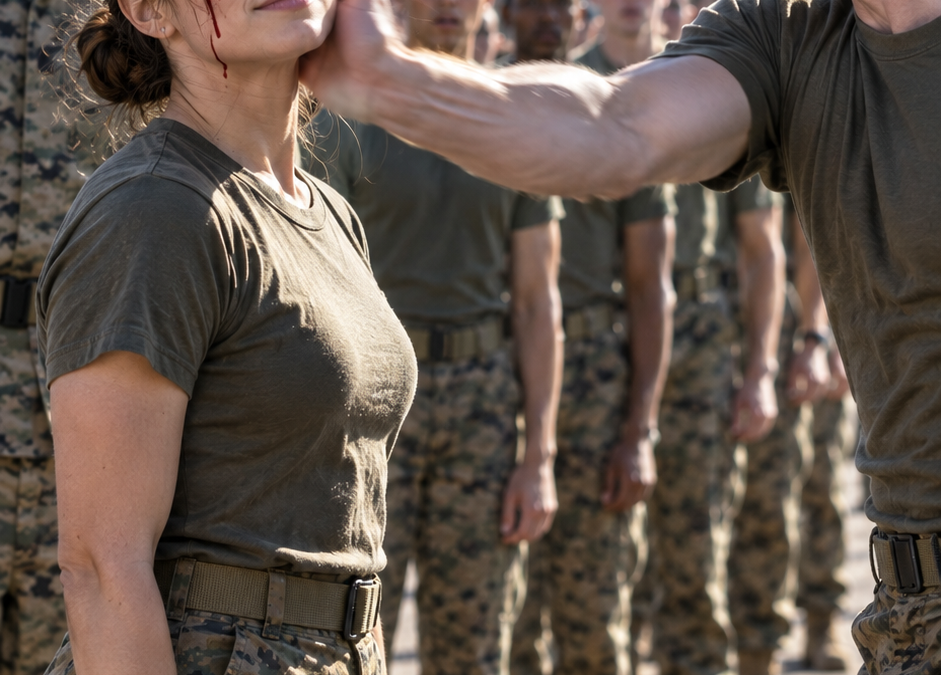
It cracked across the training yard so sharply that four hundred recruits seemed to stop breathing at the same time.
I was standing in the third row beneath a white, brutal morning sun, sweat crawling down my spine beneath my uniform. The asphalt shimmered from the heat. Somewhere beyond the barracks, a generator droned steadily, and the air smelled like dust, hot rubber, gun oil, and the kind of exhaustion that had become normal after seven weeks of training.
Then Cadet Sterling hit Private Miller across the face.
Her head snapped sideways.
A thin spray of blood caught the sunlight.
Nobody moved.
Nobody made a sound.
And Miller smiled.
That was the moment I realized there was something about her none of us understood.
Until then, Private Miller had been the strangest recruit in our company, but not in any obvious way.
She was older than most of us.
Early thirties, I guessed.
Maybe a little older.
She was small compared with many of the men in our platoon, lean rather than muscular, with gray eyes that always seemed to be measuring the room instead of merely looking at it.
She never complained.
That alone made her suspicious.
We complained about everything.
The cots.
The food.
The heat.
The drill sergeants.
The blisters.
The smell of our own uniforms.
By the second week, complaining had become the only thing that reminded us we were still human.
Miller never joined in.
She never bragged either.
She just trained.
During ruck marches, she remained in the middle of the formation no matter how badly everyone around her faded.
During weapons drills, she moved with an efficiency that seemed too clean for a first-time recruit.
When somebody got yelled at, she didn’t stare.
When somebody broke down crying after lights-out, she didn’t laugh.
She simply watched.
That stillness bothered people.
It especially bothered Sterling.
Cadet Andrew Sterling came from money so old and powerful that even he did not seem to know where it began.
His father owned a major defense contracting company.
Everybody knew it.
Sterling made sure we knew it.
Within his first week, he had explained—without anyone asking—that his father had dined with senators, generals, and senior officials whose names he dropped as casually as other people mentioned cousins.
Rules seemed to slide around him.
When one recruit was caught with a cheap unauthorized watch, he lost it immediately and spent two hours doing corrective exercises.
Sterling wore something that probably cost more than my first car.
No one touched it.
He noticed things like that.
Worse, he enjoyed them.
He shoved people in lines.
He mocked slower recruits.
He made jokes about women in the platoon when drill sergeants were just far enough away to pretend they hadn’t heard.
Most of us learned to avoid him.
Miller did not.
She also did not confront him.
That seemed to offend him even more.
Sterling wanted fear.
Anger would have worked too.
Anything that proved he mattered.
Miller gave him nothing.
The first time I saw him knock her food tray from her hands in the mess hall, he grinned and said, “Sorry, grandma.”
Miller looked down at the food on the floor.
Then at him.
She picked up the tray.
No complaint.
No threat.
No report.
Sterling frowned as if she had insulted him.
For weeks he kept escalating.
A shoulder check in the corridor.
An insult during formation.
A whispered comment close enough for her to hear and quiet enough that no instructor could.
Still nothing.
I once asked her why she let him do it.
It was after an evening drill.
We were cleaning gear on the floor between our bunks.
Sterling had just walked past and made some comment about Miller needing a “senior citizen waiver.”
She continued wiping down her equipment.
“You ever going to say something to him?” I asked.
She looked up.
“About what?”
“You know what.”
“He talks.”
“He does more than talk.”
Miller folded the cloth once.
“He wants a reaction.”
“So?”
“So I don’t have one for him.”
That was all.
I remember thinking she was either the most disciplined person I had ever met or completely dead inside.
Then came the morning on the rifle-training yard.
We were doing close-quarters movement drills.
No live ammunition at that stage, but the instructors treated every weapon as though it could kill someone, because that was the point.
Sterling was careless.
He always was.
He moved too fast because he thought speed looked impressive.
During one pivot, he stepped directly onto Miller’s ankle with the full weight of his combat boot.
I heard the impact.
So did several people around me.
Miller stopped.
She looked down at Sterling’s boot.
Then slowly raised her head.
Her expression did not change.
“Watch your step, boy.”
Four words.
I still don’t know whether she intended to provoke him.
Looking back, I’m not sure it mattered.
Sterling’s face changed instantly.
His ego simply could not survive being called boy in front of the platoon.
“What did you call me?”
Miller did not answer.
He stepped closer.
“I asked you a question.”
Nothing.
“Who the hell do you think you are?”
Miller’s eyes stayed on his.
Then Sterling slapped her.
Hard.
Her lip split against her teeth.
Blood appeared immediately.
And she smiled.
It wasn’t nervous.
That was what frightened me.
There was no embarrassment in it.
No shock.
No attempt to pretend she wasn’t hurt.
She looked almost relieved.
Sterling saw it too.
His expression faltered.
He actually stepped backward.
For the first time since I had known him, Andrew Sterling looked uncertain.
Then a voice exploded across the yard.
“What in God’s name is happening here?”
Commander Hayes.
Nobody feared anyone on that base more than Hayes.
He had a scar along one side of his jaw and a reputation for reducing arrogant recruits to silence with one look.
He ran the training cycle like the place belonged to him.
Maybe, in practice, it did.
Hayes came across the asphalt fast.
“Nobody moves!”
We froze.
He stopped in front of Sterling first.
“Explain why my formation is broken.”
Sterling reacted immediately.
“Sir, this recruit threatened me.”
I nearly looked sideways.
The lie was so shameless it was almost impressive.
“She became aggressive, sir. I acted in self-defense.”
Miller stood there with blood running from her lip.
Hayes turned toward her.
“Private?”
She didn’t answer.
She was still smiling.
Hayes’s face reddened.
“Wipe that look off your face.”
Nothing.
He stepped closer.
“You think this is funny?”
Miller stared straight through him.
Hayes lost his temper.
“You think you can disrupt my yard and stand there smiling?”
He grabbed the front of her uniform.
The fabric pulled sideways.
Her collar shifted.
Something black appeared along the right side of her neck.
A tattoo.
At first I only saw part of it.
A narrow symbol.
Angular lines.
Numbers.
Something like a broken spearhead surrounded by markings I didn’t recognize.
Hayes recognized it.
His entire body changed.
One second he was furious.
The next, he released her collar as though it had burned his hand.
He stepped backward.
The color drained from his face.
I had never seen fear on Commander Hayes.
Not irritation.
Not caution.
Fear.
His eyes went from the tattoo to Miller’s face.
Then back.
For several seconds, the entire yard seemed to tilt.
Hayes swallowed.
His voice, when it came, was barely recognizable.
“I’m sorry, ma’am.”
Four hundred recruits heard him.
No one breathed.
Miller’s smile disappeared.
She adjusted her collar.
Hayes looked as though he wished the ground would open under him.
Then he snapped toward the platoon sergeants.
“Dismiss the formation.”
They hesitated.
“Now.”
We marched away.
Nobody understood what had happened.
By the time we reached the barracks, discipline had collapsed into whispering.
“CID.”
“No chance.”
“Special Forces.”
“Did you see the symbol?”
“My cousin told me there are units that don’t wear patches.”
“Your cousin works at a tire shop.”
“Shut up.”
I kept watching Miller.
She marched normally.
No limp despite Sterling having stepped on her ankle.
No hand on the split lip.
No glance back toward Hayes.
Inside the barracks, she sat on her bunk and began unlacing her boots.
People gave her space.
Sterling did not.
He kicked his footlocker hard enough to dent it.
“This is complete garbage.”
Nobody responded.
He stormed toward Miller.
“Who the hell are you?”
She continued unlacing her boot.
“You hear me?”
Miller looked up.
Her gray eyes settled on him.
Sterling pointed at her.
“My dad is going to find out exactly what kind of game you’re playing.”
Miller tilted her head.
“He probably already knows.”
Sterling froze.
Then she added quietly, “Tell him the ledger is still open.”
I didn’t understand the sentence.
Sterling did.
Every bit of color disappeared from his face.
“What ledger?”
Miller looked down at her boot again.
The barracks doors opened.
Sergeant Davis entered.
He was one of the loudest men on the base.
That afternoon, he sounded almost polite.
“Private Miller.”
She looked toward him.
“Commander’s office. Immediately.”
She stood.
Nobody spoke as she left.
The second the door shut, Sterling turned toward us.
“She’s fake.”
Nobody answered.
“She has to be.”
Still nothing.
“Hayes just got spooked by some tattoo.”
One recruit near the lockers finally said, “Then why’d you get spooked when she mentioned the ledger?”
Sterling’s eyes flashed.
“Shut your mouth.”
Ten minutes later, two military police entered.
They stopped at Sterling’s bunk.
“Cadet Sterling.”
He straightened.
“You are required at administration for an emergency call.”
Sterling’s confidence returned instantly.
He grinned at us.
“You see?”
He threw on his blouse.
“My father handled it.”
As the MPs escorted him away, he looked toward Miller’s empty bunk.
“She’s finished.”
I remember feeling something cold settle in my stomach.
The base sirens started ten minutes later.
Not a drill signal.
A lockdown.
The loudspeakers came alive.
“All personnel report to assigned sectors. This is not a drill.”
The barracks exploded into movement.
We grabbed gear.
Drill sergeants appeared in the hallway, but they looked different.
Distracted.
Nervous.
Through the windows, I saw black SUVs pull toward the administration building.
Men in dark suits got out.
No insignia.
No uniforms.
They moved like people who already knew exactly where everyone was.
Sergeant Davis ordered us to the briefing theater.
We filed inside.
Commander Hayes stood on the stage.
His head was bowed.
A man in a dark suit stood near the podium.
Miller stood beside him.
Her split lip had been bandaged.
Her uniform was clean.
She was no longer standing like a recruit.
That was the first thing I noticed.
Her shoulders were relaxed.
Her hands rested loosely behind her back.
She looked like the most senior person in the room.
Sterling’s seat was empty.
The suited man stepped toward the microphone.
“What you are about to hear concerns an active national security investigation.”
Nobody whispered.
The double doors opened.
The MPs dragged Sterling inside.
Actually dragged him.
His legs barely worked.
His face was gray.
He looked nothing like the man who had strutted out of our barracks less than an hour earlier.
“Please,” he kept saying. “My father can fix this.”
The man in the suit looked at Miller.
Miller took the microphone.
“Your father was arrested twenty minutes ago.”
Sterling stared at her.
“No.”
“He’s in federal custody.”
“No.”
“His offices are being searched right now.”
Sterling shook his head violently.
Miller looked toward the rest of us.
“Sterling’s father used defense contracts to hide illegal transfers of protected military data.”
No one moved.
“He believed money could bury the trail.”
Miller reached toward her collar.
She pulled the fabric aside.
We saw the tattoo fully for the first time.
It looked less like a tattoo now and more like a credential burned into skin.
A coded insignia.
Numbers beneath it.
The man in the suit remained still.
Miller’s voice hardened.
“I did not enter this training cycle because I needed basic military instruction.”
Sterling’s breathing became louder.
“I entered because this facility was part of an active counterintelligence operation.”
Someone behind me whispered, “Jesus.”
Miller continued.
“We knew classified material was leaving the installation.”
Her eyes moved toward Hayes.
“We did not know exactly who was controlling the transfer.”
Hayes said nothing.
“We knew Sterling’s father was involved.”
Sterling began crying.
Miller looked down at him.
“And you helped us open the rest of the network.”
Sterling stared up at her.
The man in the suit leaned toward Miller.
He whispered something.
Miller’s face changed.
The transformation was immediate.
Her calm disappeared.
“What?”
The agent spoke again.
Miller turned toward Hayes.
“Where is the second transport?”
Hayes slowly raised his head.
And smiled.
Every instinct in my body tightened.
Miller’s hand moved toward her side.
“Hayes.”
He kept smiling.
Then the lights went out.
Darkness hit like a physical thing.
People screamed.
Seats slammed backward.
Someone shoved me and I crashed against the row ahead.
“Stay down!”
I heard Davis.
Then another sound.
A struggle onstage.
Heavy.
Close.
A short electrical crack flashed blue across the room.
For one instant I saw Hayes above the suited agent.
Then darkness again.
A door slammed.
Emergency power activated.
Red lights glowed along the walls.
The room returned in pieces.
The agent lay near the podium.
Unmoving.
Two MPs were down.
Sterling was beneath the lectern, sobbing.
Miller knelt near the stage edge with one hand pressed against her side.
Blood soaked through her uniform.
Hayes was gone.
“The drive,” Miller said.
Davis reached her.
“What?”
“He took the drive.”
She tried to stand.
Davis forced a medical dressing toward her side.
“What drive?”
“The master package.”
Miller’s breathing was tight.
“The network evidence. Operational identities. Foreign contacts. Everything.”
The room went silent.
Sterling looked up.
“So my father—”
Miller looked at him.
“Was never the top of the chain.”
That was when I understood.
Hayes.
The base commander.
The man who controlled access, training schedules, security, transports.
He had not merely failed to see the corruption.
He was part of it.
Davis went to the main doors.
Locked.
The side exits were locked too.
Electronic bolts.
Miller looked toward the ceiling.
“He triggered Code Black.”
“What does that mean?”
She answered without looking at us.
“It means the base thinks we’re the threat.”
A hiss came from the ventilation system.
White vapor began pouring through the vents.
Panic detonated.
People surged toward the doors.
“Back!”
Davis shouted.
Miller raised her voice.
“Fire suppression system. It’s displacing the oxygen. Move low.”
That did not calm anyone.
The room became chaos.
My throat started burning.
Vision blurred.
I saw the reinforced viewing window beside the control booth.
“Break the glass!”
Davis looked toward me.
I pointed.
“That window!”
Several recruits grabbed a steel equipment case.
I took one side.
“Again!”
We rammed it into the glass.
The first hit cracked it.
The second shattered enough of the pane that fresh air rushed through.
We widened the opening.
People climbed out.
Hands pulled hands.
Boots slipped over broken safety glass.
Nobody cared about cuts.
Outside the theater, alarms screamed.
Miller came through last among the senior personnel.
She carried one of the MPs’ sidearms.
Davis looked at her wound.
“You need medical.”
“I need Hayes.”
“Where would he go?”
“The airfield.”
I remembered her question before the blackout.
“The second transport.”
Miller looked at me.
“Yes.”
She turned to Davis.
“He’s moving the package off-base.”
“Then call security.”
“He owns the security picture right now.”
She pointed toward the red warning lights.
“Every system identifies this sector as hostile.”
“So what do we do?”
Miller checked the weapon.
“We stop the aircraft before it leaves.”
She moved fast despite the blood loss.
Davis followed.
A few of us went with them because nobody told us not to.
Maybe that was stupid.
Probably.
But after weeks of being trained to move when leaders moved, we did what we knew.
We crossed behind barracks.
Spotlights swept the parade grounds.
Sirens drowned out almost everything.
We stayed against walls.
At the fence line, the airfield came into view.
A C-130 sat on the runway.
Engines running.
Rear ramp down.
Hayes was walking toward it.
A hardened case was attached to his wrist.
Men in black tactical clothing guarded the aircraft.
Not MPs.
Not soldiers I recognized.
Davis whispered, “Private contractors.”
Miller’s jaw tightened.
“Extraction team.”
Hayes reached the ramp.
Miller raised the handgun.
Everything after that happened too quickly.
Shots.
Shouting.
The men near the aircraft returned fire.
We went down behind stacked pallets and concrete barriers.
The noise was overwhelming.
Wood broke above us.
Dust hit my face.
I pressed myself flat against the ground.
Miller fired again.
Then her weapon malfunctioned.
She tried to clear it.
Her hands were shaking now.
Blood loss.
The C-130 ramp started closing.
Hayes stood inside.
For one second I saw his silhouette against the cargo bay lights.
He raised his hand.
A salute.
Mocking.
The plane started moving.
The armed men advanced.
I remember thinking this was how it ended.
Not heroically.
Not meaningfully.
Face down behind broken pallets, unable to do anything.
Then the ground began to vibrate.
I thought it was the aircraft.
Miller stopped working on the pistol.
She listened.
The vibration grew.
I looked at her.
She leaned her head back against the barrier.
And smiled.
The same smile she had worn after Sterling hit her.
That terrified me more than the gunfire.
“They’re late,” she whispered.
“What?”
She almost laughed.
Then the helicopters arrived.
Two dark aircraft came in low from the north.
No navigation lights.
They dropped behind the advancing gunmen so fast the men barely reacted.
Doors opened before the landing gear fully settled.
Operators poured out.
Gray equipment.
No visible insignia.
Precise movement.
Within seconds, the mercenaries were surrounded.
A third aircraft appeared ahead of the moving C-130.
The transport slowed.
Then stopped.
Its ramp lowered.
Hayes remained inside.
His smile was gone.
Miller stood.
Davis tried to stop her.
“Ma’am.”
“I’m fine.”
She wasn’t.
But she walked toward the aircraft anyway.
The gray-clad operators moved aside.
One saluted her.
“Director. Perimeter secure.”
Director.
The word hit me harder than anything that night.
Private Miller.
Quiet Miller.
The woman we had watched clean rifles and eat bad cafeteria eggs.
Director.
Hayes stared at her.
“You’re dead.”
Miller stopped below the ramp.
“No.”
“I saw the report.”
“You saw what we wanted you to see.”
Hayes’s face tightened.
“I authorized the Berlin strike.”
“On an empty site.”
His eyes moved over the operators.
Miller reached into her uniform and removed a small encrypted storage device.
She held it between two fingers.
“The drive you’re carrying is a decoy.”
Hayes looked at the case attached to his wrist.
For the first time, he looked genuinely defeated.
Miller continued.
“We needed you to believe the investigation was focused on Sterling’s father.”
Hayes laughed once.
“You built all this around that idiot kid?”
Sterling had been brought out under guard and stood several yards away, pale and shaking.
Miller looked toward him.
“No.”
Then back to Hayes.
“We built it around your belief that people beneath you were disposable.”
Hayes said nothing.
“You protected Sterling because his father moved money for you.”
Miller’s voice remained quiet.
“You tolerated his behavior because keeping the family comfortable mattered more than discipline.”
Hayes looked toward the runway.
“You sent yourself into a recruit cycle for this?”
“Yes.”
“You let that boy put his hands on you.”
“Yes.”
“Why?”
Miller stared at him.
“Because I needed the chain to move.”
Hayes looked confused.
“The assault created an investigative trigger you could not quietly suppress without exposing yourself.”
The pieces connected in my head.
Sterling’s behavior.
Hayes’s protection of him.
The father.
The money.
The network.
Miller had been waiting for something undeniable.
“You could have stopped him,” Hayes said.
“I could have.”
“You knew he might hit you.”
“Yes.”
Hayes shook his head.
“You let it happen.”
Miller touched the bandage over her lip.
“A split lip costs less than thirty-two dead operatives.”
The runway went quiet.
Hayes stopped smiling.
Miller stepped closer.
“That is how many people disappeared after information from this base entered hostile channels.”
Hayes looked away.
Miller’s voice became colder.
“Thirty-two.”
The number changed everything.
Until then, the operation had felt like espionage.
Money.
Data.
Secrets.
Suddenly it had bodies.
Families.
People who never came home.
Miller nodded toward the gray-clad operators.
“Take him.”
They moved up the ramp.
Hayes did not fight.
As they removed the case from his wrist, he looked at Miller.
“You think this fixes anything?”
“No.”
She answered immediately.
“It stops you from doing it again.”
They led him away.
Miller swayed.
The operator nearest her stepped forward.
“Director, medevac.”
“I’m still standing.”
“Barely.”
She looked as though she might argue.
Then she glanced toward us.
Hundreds of recruits had gathered near the edge of the training sector.
Some coughing.
Some bleeding from broken glass.
Some still wearing the stunned expressions of people who had spent the last hour discovering that nearly everything around them had been part of something larger.
Miller finally accepted a medical dressing.
Before she left, she walked back toward us.
The crowd opened automatically.
No one ordered it.
She stopped.
For several seconds, she simply looked at us.
Then she said, “You were never supposed to see any of this.”
Someone near me gave a nervous laugh.
Miller almost smiled.
“But you did.”
She looked toward the shattered briefing theater.
“The violence you witnessed was not training.”
Her eyes returned to us.
“The choices you made inside that room were.”
Nobody moved.
“You helped each other through the window.”
She pointed toward the recruits who had carried the equipment case.
“You followed instructions when the systems around you failed.”
Her gaze settled briefly on me.
“You adapted.”
That word meant more to me than praise.
Miller continued.
“Tomorrow you will be moved to another facility.”
A groan almost started.
She cut it off with one look.
“Your training records will continue. This location and tonight’s events will be restricted.”
Of course they would.
Everything about the night already felt impossible enough that I wondered whether anyone outside the base would ever believe us.
Miller looked along the formation.
“Some of you are angry.”
She was right.
“Some are frightened.”
Right again.
“Some of you are wondering whether anything you were taught here was real.”
Nobody answered.
She nodded.
“The drills were real.”
Her voice softened slightly.
“The exhaustion was real.”
A few people almost smiled.
“The standards were real.”
Then she looked toward Sterling.
“The consequences should have been real too.”
His head dropped.
“That failure belongs to leadership.”
She let the sentence stand.
No excuses.
No attempt to protect the institution by pretending everyone in authority had acted correctly.
Then Miller looked back at us.
“You are not soldiers because tonight turned dramatic.”
Her eyes moved slowly across the crowd.
“You are soldiers because when people around you panicked, many of you still chose to help someone else before helping yourselves.”
The words hit me unexpectedly.
I thought about the theater.
Hands lifting people through broken glass.
A recruit using his shirt to cover the jagged edge.
Someone carrying another person who could not breathe.
Nobody had known who was important.
Nobody had asked.
Miller raised her hand.
A salute.
For a moment, nobody responded.
Then Davis returned it.
The rest of us followed.
Four hundred hands rose.
The helicopters lifted in the distance.
Rotor wash pushed the last remnants of white suppression vapor away from the buildings.
The alarms stopped.
Silence replaced them.
For the first time all night, I heard normal things.
Wind.
Engines cooling.
Someone crying quietly.
Miller lowered her hand.
Then she turned and walked toward the waiting medical team.
I thought that was the end.
It wasn’t.
Nothing was simple afterward.
The next morning, federal investigators separated us by platoon.
We gave statements.
Again.
And again.
And again.
They asked about Sterling.
What had we seen?
What had he said?
Had Hayes intervened in earlier incidents?
Had rules been applied differently to him?
The answers became uncomfortable.
Yes.
Yes.
Yes.
We had all seen it.
Most of us had accepted it.
That realization stayed with me.
We liked to believe corruption announced itself dramatically.
Suitcases of cash.
Secret files.
Traitors running toward aircraft.
But the first warning signs had been smaller.
A watch nobody confiscated.
An insult nobody corrected.
A recruit protected because of his father.
Rules bending until everyone learned that some people mattered more than others.
Hayes’s betrayal had not begun with an encrypted drive.
It had begun with entitlement becoming normal.
Miller understood that long before we did.
I saw her only once during the debriefing period.
She was leaving the medical section.
Clean uniform.
Fresh bandage at her side.
The tattoo hidden again.
I was standing outside an interview room holding a paper cup of coffee.
She noticed me.
I didn’t know what to call her.
“Private” obviously felt ridiculous.
“Director” felt impossible.
So I said, “Ma’am.”
She stopped.
“Yes?”
I hesitated.
“There’s something I don’t understand.”
“That narrows it down.”
Despite everything, I laughed.
“The slap.”
Her expression changed slightly.
“You smiled.”
“I remember.”
“Why?”
Miller looked toward the window at the end of the corridor.
Morning light filled it.
For several seconds, she said nothing.
Then she answered.
“Because I had spent six months waiting for somebody in that network to make a mistake they couldn’t buy their way out of.”
I looked at her.
“And Sterling hitting you was that mistake?”
“It was one of them.”
“You knew he would?”
“No.”
“But you were waiting for something.”
“Yes.”
I thought about her words in the barracks.
The ledger is still open.
“You wanted his father to react.”
She looked at me.
“Sterling believed his father could protect him from consequences.”
“Which meant he’d call him.”
“Yes.”
“And his father would call…”
I stopped.
“Hayes.”
Miller nodded.
“We had financial patterns.”
“We had partial communications.”
“We had foreign transfer indicators.”
“But you needed the domestic chain.”
“Yes.”
I understood finally.
The assault did not create the crime.
It forced the people hiding it to move quickly.
Phone calls.
Payments.
Pressure.
Orders.
People who believed they controlled the system had exposed themselves while trying to protect Sterling.
“Couldn’t you have told Hayes who you were?”
Miller’s eyes hardened.
“We didn’t know whether Hayes was compromised until later.”
“But the tattoo.”
“He recognized the designation.”
“Why?”
She looked toward me.
“Because years ago, he had worked adjacent to one of our programs.”
“So when he saw it…”
“He knew touching me had become dangerous.”
I remembered his face.
“How long did you suspect him?”
“Long enough.”
“Then why stay?”
“Because suspicion does not dismantle a network.”
I nodded.
That was the same thing she had done with Sterling for weeks.
Wait.
Watch.
Let arrogance create evidence.
I looked down at my coffee.
“Were we ever in actual danger before last night?”
Miller did not answer quickly.
That frightened me.
“Training risk was controlled.”
“That is not what I asked.”
“No.”
Her honesty surprised me.
“When Hayes initiated Code Black, control was gone.”
I thought about the theater filling with suppression gas.
The runway.
The shots.
“You didn’t know he would do that.”
“No.”
“Were you scared?”
Miller looked amused.
“Of course.”
That answer startled me more than if she had said no.
“You didn’t look scared.”
“Looking afraid and being afraid are different things.”
I smiled faintly.
“That sounds like something an instructor would say.”
“I’ve been one.”
“Of course you have.”
For a moment, neither of us spoke.
Then I asked the question I had been carrying since the yard.
“Why didn’t you hit Sterling back?”
Miller’s eyes met mine.
“Because then the story becomes two recruits fighting.”
I understood immediately.
“If you stay still—”
“The story is one recruit attacking another without justification.”
“And four hundred witnesses.”
“Exactly.”
I thought about how angry we had been that she did nothing.
How weak it had seemed to some people.
It had been control.
Almost frightening control.
She started to leave.
“Ma’am?”
She stopped again.
“Commander Hayes apologized when he saw the tattoo.”
“Yes.”
“Did you know he would?”
“No.”
That seemed to surprise her too.
“He was supposed to remain uncertain about my identity.”
“Then why did you smile after Sterling hit you?”
This time the answer came faster.
“Because for the first time since I arrived, the people I was watching had stopped controlling the situation.”
She looked at me.
“They were reacting.”
Then she walked away.
A week later, we were transferred.
Officially, our original training site had undergone an emergency security reorganization.
That was the phrase placed in our records.
Nothing about the raid.
Nothing about Hayes.
Nothing about Sterling’s father.
Nothing about helicopters.
Most of us signed documents promising not to discuss operational details.
Sterling disappeared from the training cycle.
Rumors followed anyway.
Federal conspiracy charges.
Espionage.
Fraud.
Money laundering.
His father’s company collapsed.
Hayes’s name vanished from every public-facing command page I could find.
Miller’s name vanished even faster.
One day she existed.
The next, searching for her returned almost nothing.
That somehow made more sense than anything else.
Training continued.
Another base.
Different instructors.
New barracks.
Same boots.
Same terrible coffee.
But I was different.
All of us were.
The recruit beside me during our first formation at the new installation whispered, “Think anyone here is secretly running national counterintelligence?”
I looked down the line.
“Probably not.”
“Probably?”
“After last week, I’m not promising anything.”
He laughed.
Then the instructor started yelling and we returned to being ordinary recruits.
Mostly.
I noticed rules more closely after that.
Who followed them.
Who did not.
Who instructors corrected.
Who they ignored.
I stopped thinking of discipline as yelling and punishment.
Real discipline was what Miller had shown when Sterling struck her.
The ability to choose your response when anger offered an easier one.
Months later, after graduation, I thought about that morning again.
The slap.
The blood.
The smile.
For a long time I had believed the smile was about victory.
It wasn’t.
Not exactly.
Miller did not know everything that would happen afterward.
She could not have known Hayes would turn on the federal team.
She could not have known we would end up trapped in a theater or running toward an airfield.
Her plan had broken just like every real plan eventually does.
What she had known was simpler.
Sterling had finally done something his father’s money could not make invisible.
He had done it in daylight.
In front of hundreds of witnesses.
And Hayes, by reacting to the hidden mark on Miller’s neck, had exposed another crack in the wall.
That smile had been recognition.
The trap had finally started closing.
Years afterward, I occasionally encountered people who talked about courage as if it were obvious.
They imagined courageous people were loud.
Aggressive.
Fearless.
People who always hit back.
People who never allowed disrespect.
I never argued.
I just remembered Miller.
Blood running from her lip.
Standing perfectly still while the most arrogant man in our company waited for her to break.
She didn’t.
She smiled because she knew something he didn’t.
He thought the slap proved he had power.
In reality, it proved he had no control at all.
And that became the first thread that pulled apart everything his father, Commander Hayes, and the people behind them had spent years hiding.
On my last day before leaving training, Sergeant Davis caught me outside the barracks.
He had stayed.
Different assignment.
Same exhausted expression.
“You ever think about that night?” he asked.
“Every time somebody turns off the lights.”
He laughed.
Then became serious.
“You know what bothered me most?”
“What?”
“We all knew Sterling was a problem.”
I nodded.
“We laughed about it.”
“Sometimes.”
“We complained privately.”
“Yes.”
“But we accepted it.”
I knew where he was going.
“Because of his father.”
“Because we assumed nothing would happen.”
Davis looked toward the training yard.
“That’s how people like Hayes build space to operate.”
“By breaking rules?”
“No.”
He shook his head.
“By teaching everybody that breaking the rules is normal when the right person does it.”
I never forgot that sentence.
It explained more than the classified seal ever could.
The biggest betrayal on that base had not started in darkness.
It had started in public.
A favored recruit.
A protected family.
A commander choosing convenience over standards.
Then choosing money over duty.
The larger crimes grew inside the smaller compromises.
Miller had seen that.
Maybe that was why she endured Sterling for so long.
She wasn’t studying him alone.
She was studying everyone who protected him.
When I eventually left the installation for good, I passed the training yard one last time.
Different recruits stood in formation.
Different instructors shouted at them.
The asphalt looked exactly the same.
I slowed.
For a moment, I could almost see it again.
Sterling turning red with anger.
Miller’s head snapping sideways.
Blood.
That impossible smile.
Hayes charging across the yard.
Then stopping.
I had spent weeks wondering what the tattoo meant.
Years later, that was no longer the part that mattered.
The symbol had frightened Hayes because of what it represented.
Authority he could not manipulate.
An investigation he did not control.
People willing to look beneath the version of the base he had built.
But Miller’s real power had never been the tattoo.
It was patience.
She had entered our training cycle and allowed everyone to believe she was ordinary.
Weak, according to Sterling.
Strange, according to us.
Insignificant, according to Hayes.
And because they underestimated her, they behaved honestly around her.
That was what destroyed them.
Before I left, I stood at the edge of the yard for another second.
A new class moved through rifle drills.
An instructor shouted.
Someone stumbled.
Another recruit helped him back into position.
Normal training.
Nothing dramatic.
I hoped it stayed that way.
Then I remembered something Miller told us after the airfield.
The steel in your spine is real.
At the time, I thought she meant surviving the lockdown.
Later, I understood it differently.
Steel is not what you show when everybody knows they are watching.
It is what remains when nobody important seems to care.
Sterling had spent weeks believing Miller would never matter.
Hayes had spent years believing rules could be adjusted for useful people.
Miller waited.
Watched.
Endured.
Then, when the truth finally surfaced, she did not need to become someone else.
She had already been the most dangerous person on the base.
We simply hadn’t known where to look.
And that was why she smiled.








