𝗙𝗨𝗟𝗟 𝗦𝗧𝗢𝗥𝗬 The Quiet Passenger in 8A Knew Exactly What the Captain Was Afraid to Say
𝗣𝗔𝗥𝗧 𝟮
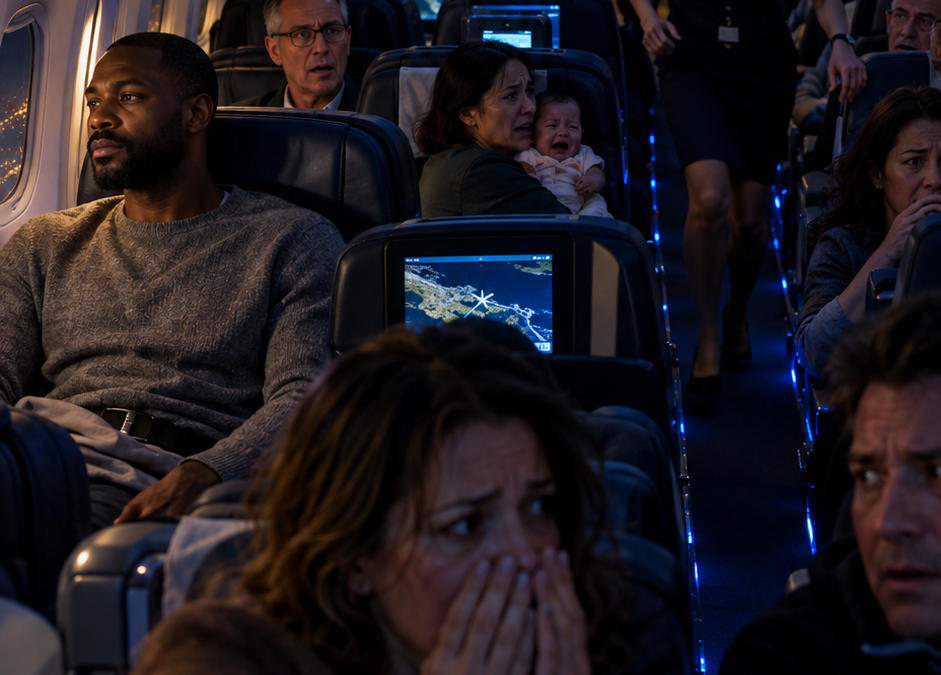
Then I stood.
“I can help.”
At first, nobody reacted.
The words were swallowed by the murmurs around me.
I raised my voice.
“I can help.”
Marissa turned toward me.
“I’m a former combat pilot,” I said. “United States Air Force. Fifteen hundred hours in F-16s. I’ve handled severe flight-control emergencies.”
The cabin fell silent.
Dozens of faces turned toward me.
Marissa moved quickly down the aisle, but I saw the doubt appear before she said a word. Her eyes moved over my sweater, my tired face, my empty hands.
“Sir,” she said carefully, “do you have military identification?”
“No. I left the service eight years ago.”
Her hesitation sharpened.
I understood it.
A flight attendant had every reason to be careful. A frightened passenger could say anything. A cockpit in crisis was not a place for fantasy or ego.
So I lowered my voice.
“Ask the captain what systems they’ve lost. If they’re getting cascading flight-control faults and unstable trim response, they’re running out of options. If the aircraft is hunting in pitch and roll the way it feels from back here, they need someone who can help process the problem while they fly the jet.”
Marissa’s face changed.
Not because she understood every word.
Because some of them matched what she had already heard.
Behind me, a voice muttered loudly enough for several rows to hear.
“He doesn’t look like a pilot.”
I turned slowly.
A man across the aisle stared at me with wide, frightened eyes and the defensive confidence of someone who had turned fear into suspicion because suspicion made him feel less helpless.
Nobody corrected him.
That was the part I noticed.
Not because I was surprised.
I had spent enough of my life in rooms where people looked at me and saw everything except what I had earned.
A Black man in jeans was a passenger.
A Black man sleeping in seat 8A was tired.
A Black man claiming to have flown fighters into combat became, to some people, a question before he became a possibility.
I looked at him for one second.
Then the airplane dropped.
It was not a gentle dip.
It felt as if the floor had disappeared beneath us.
Screams ripped through the cabin. A service cart slammed against a galley latch. A woman near the window cried out, “Jesus!” Overhead bins rattled. Someone’s tablet flew into the aisle and skidded under a seat.
I caught the headrest beside me and stayed on my feet.
The aircraft recovered, but not smoothly.
The nose came up too quickly.
Then settled.
Then wavered.
Marissa grabbed my arm.
“Sir,” she gasped, “the captain needs you in the cockpit. Now.”
I followed her forward.
The aisle felt longer than it should have.
People reached for me as I passed. Not intentionally. Not really. Hands lifted in fear, in prayer, in the irrational hope that if they touched the man going toward the cockpit, some part of his steadiness might remain with them.
At the forward galley, Marissa looked at me.
“You need to understand something. We have two pilots conscious. They are both trained. They are both qualified. You are not taking over this aircraft unless the captain orders it.”
“I understand.”
“Do you?”
“Yes.”
I held her gaze.
“I’m not here to play hero. I’m here to help them think.”
That convinced her more than any boast could have.
She knocked twice.
The cockpit door opened.
Heat, light, alarms, and tension spilled into the small space.
Captain Reynolds was in the left seat. White hair, jaw clenched, eyes moving fast but not panicked. The first officer, a younger woman with dark hair pulled tight behind her head, sat in the right seat. Sweat shone along her temples.
Both of them were alive.
Both of them were flying.
That was good.
Not enough.
But good.
The cockpit was lit by warning messages and instrument glow. A chime sounded, stopped, sounded again. The aircraft rolled slightly left, then corrected right.
Captain Reynolds glanced back.
“You the military pilot?”
“Former Air Force. F-16s.”
“Name?”
“Marcus Cole.”
“Ever flown heavy?”
“Simulator only. Years ago. Not current.”
“Good,” he said.
That answer surprised me.
He did not need someone pretending to be type-rated.
He needed someone honest.
“What do you see?” he asked.
I stepped behind the center pedestal and scanned.
In combat aircraft, information comes fast, loud, and unforgiving. Airliners are different. More systems. More redundancy. More automation. More layers between pilot input and aircraft response.
But physics does not care what you fly.
Attitude.
Airspeed.
Altitude.
Vertical speed.
Trim.
Power.
Configuration.
Warnings.
I read what I could, fast.
The aircraft was in degraded control law. Several flight-control messages were active. Autopilot unavailable. Autothrottle unreliable. Trim response inconsistent. Yaw damper faults. Hydraulic system warning on one side. Another intermittent electrical bus caution that looked like it had come and gone more than once.
The captain was hand-flying.
The first officer was working checklists, radios, and system pages.
They were over the Atlantic, not close enough to land for anyone’s comfort.
“What happened?” I asked.
Captain Reynolds kept his left hand on the control column and his right near the thrust levers.
“Multiple flight-control faults. Started with intermittent autopilot disconnects, then uncommanded trim inputs, then hydraulic and electrical cascade. We stabilized once. Then lost reliable trim again.”
The aircraft shuddered.
The first officer called, “Airspeed two-seven-zero. Altitude three-five-zero.”
“Trying to keep her there,” Reynolds said.
His voice was controlled.
But I heard strain beneath it.
He had probably been fighting the airplane for longer than the cabin knew.
“What do you need from me?” I asked.
“Help us stay ahead of it. Read attitude, airspeed, altitude. Watch trim indication. If something changes, say it before we chase it.”
That made sense.
In a crisis, the person flying the aircraft can lose the wider picture because every muscle is occupied with keeping wings level and nose where it belongs. The person monitoring can become buried in procedures and radios. A third trained set of eyes could matter.
I moved into position.
The first officer glanced at me.
Her name patch read PATEL.
“Can you read transport instruments?”
“Yes.”
“Call deviations, not commentary.”
“Yes, ma’am.”
She almost smiled.
Almost.
Captain Reynolds said, “We’re diverting to Shannon. Weather acceptable. Fuel sufficient. Control reliability questionable.”
“Understood.”
“Do not touch anything unless instructed.”
“Understood.”
He gave one sharp nod.
Then the aircraft tried to roll left.
“Left bank increasing,” I said. “Ten degrees. Fifteen.”
“I’ve got it.”
“Correcting through ten. Five. Wings level.”
“Trim?”
“Indicating nose-up movement. Not commanded?”
“No.”
“Patel?”
“Trim cutout procedure complete,” she said. “Movement should be isolated.”
“It isn’t,” I said.
Her eyes snapped to the display.
“Damn.”
The captain’s hands tightened.
“Manual force increasing.”
I had seen that before in different machines under different skies.
The airplane was not just damaged.
It was lying inconsistently.
That was worse.
A failure that behaves predictably can be managed. A failure that appears corrected and then returns makes crews second-guess every action.
I heard Sarah’s voice in my memory then.
Not from any dramatic moment.
Just an ordinary morning in our kitchen years earlier.
Marcus, you cannot control everything by gripping harder.
I looked at the captain’s arms.
He was strong, but fatigue would beat strength eventually.
“Captain,” I said, “how long have you been hand-flying against this?”
“Too long.”
“Can you and the first officer alternate?”
“Not until we trust the handoff.”
Another small pitch oscillation.
“Nose rising,” I called. “Two degrees. Airspeed bleeding. Two-six-five. Two-six-two.”
“I feel it.”
“Power?”
“Adding.”
The engines increased.
The nose settled.
The first officer spoke into the radio, coordinating with oceanic control. Her voice was professional, but I heard the same thing I had heard in the cabin announcement.
Fear wrapped in procedure.
I knew that voice.
I had used it myself.
“Captain,” Patel said, “Shannon confirms emergency services standing by. They ask souls onboard and fuel remaining.”
“Two-four-three passengers, eleven crew,” Reynolds said. “Fuel remaining…” He glanced quickly. “Give them five decimal two hours.”
Patel transmitted.
I watched the airspeed.
“Stable two-seven-zero.”
The captain exhaled through his nose.
“Cole, you said severe flight-control emergencies.”
“Yes.”
“What kind?”
“Battle damage. Hydraulic loss. Control surface damage. Trim runaway in training aircraft years before that. Partial panel recovery. High workload manual approaches under hostile conditions.”
“Any passenger jets?”
“No.”
“Good.”
Again, that word.
This time I understood.
He did not want someone who thought this was familiar.
He wanted someone who respected what was not.
“Then tell me if you see me overcontrolling,” he said.
That was trust.
Not full trust.
But enough.
“Yes, Captain.”
Minutes stretched.
The cockpit became a world of numbers and controlled voices.
Airspeed.
Altitude.
Attitude.
Trim.
Heading.
Checklist item.
Warning.
Correction.
Repeat.
Behind the door were 243 passengers, but inside the cockpit, they had to become weight, balance, fuel, souls onboard, and responsibility. Not because they were less human. Because if we allowed ourselves to imagine every face, every child, every person praying in the dark, we would lose the precision needed to save them.
Then Marissa knocked.
Patel unlocked the door long enough for her to lean in.
“Captain, cabin is secure as possible. We have several passengers panicking. One medical issue, likely anxiety, being assisted.”
Captain Reynolds did not look back.
“Tell them we are diverting and the crew is handling the situation.”
Marissa looked at me.
I saw the question in her face.
She wanted something human to tell them.
The captain heard the silence.
“Cole,” he said, “you have kids?”
“One daughter.”
“How old?”
“Seven.”
He nodded once.
“Say something they can believe.”
I stared at him.
“I’m not crew.”
“You are tonight.”
That hit me harder than it should have.
I followed Marissa back into the galley.
The cabin looked worse than before.
Fear has a smell: sweat, recycled air, spilled coffee, and the sharp metallic edge of panic. People stared at me as if my face might reveal whether they would live. The man who had said I didn’t look like a pilot would not meet my eyes.
Marissa handed me the interphone.
I pressed the button.
“This is Marcus Cole. I’m assisting the flight crew.”
The cabin went silent enough for me to hear the engines.
“I’m a former Air Force pilot. Captain Reynolds and First Officer Patel are flying the aircraft. They are trained, focused, and in control of the situation. We are diverting to Shannon, Ireland. The crew needs everyone seated, belted, and quiet enough to hear instructions.”
A child began crying harder.
I paused.
Then I added, “I have a seven-year-old daughter. I promised her I’d come home. I know many of you made promises like that too. Right now, the best thing you can do for the people waiting for you is listen to the cabin crew and stay ready.”
No drama.
No false guarantees.
Never tell frightened people that everything will be fine when you do not know that.
Tell them what to do.
Give fear a job.
I handed the interphone back to Marissa.
Her eyes were wet.
“Thank you.”
I returned to the cockpit.
The aircraft lurched again before I reached the seat behind the captain.
I grabbed the frame.
“Status?”
Patel answered. “Another trim anomaly. Cutout confirmed but indication still unreliable.”
Captain Reynolds’s breathing had changed.
Not panic.
Fatigue.
His arms had been fighting the aircraft too long.
“Captain,” I said, “you need a controlled transfer before you’re forced into a bad one.”
“I know.”
He looked at Patel.
“Ready?”
She adjusted her seat and grip.
“Ready.”
I leaned forward, watching the instruments.
Captain Reynolds said, “Your aircraft.”
Patel took control.
“My aircraft.”
For two seconds, the handoff held.
Then the nose dipped.
“Pitch down,” I called. “Three degrees. Vertical speed increasing. Airspeed two-eight-zero.”
“I have it,” Patel said.
She corrected, but the aircraft responded sluggishly, then too much.
“Nose rising. Airspeed two-seven-five. Two-seven-zero.”
“Damn it,” she whispered.
“Small inputs,” I said. “Let it answer before you ask again.”
“I know.”
“I know you know. Saying it anyway.”
Her jaw tightened.
But the inputs smoothed.
Captain Reynolds flexed his right hand, then his left.
He tried to hide it.
I saw.
“Are you injured?” I asked.
“No.”
Patel said, “He has been wrestling this thing for almost forty minutes.”
“Patel,” Reynolds warned.
“She needs relief,” I said. “You need circulation back. Use me.”
The cockpit became still except for the aircraft noise.
“No,” Reynolds said.
“I’m not asking to command the aircraft.”
“No.”
“I can hold attitude under your instruction for thirty seconds if needed.”
“You are not current, not certified, and not trained on this type.”
“That is all true.”
He looked back at me.
I held his gaze.
“But if both of you lose physical capacity, certification won’t hold the column.”
Nobody spoke.
Then Reynolds looked forward again.
“Not unless there is no other choice.”
“Agreed.”
That was the closest we came to discussing the unthinkable.
The next twenty minutes were a study in controlled deterioration.
The aircraft remained flyable, but barely in the way any pilot likes. We descended gradually. Lower altitude gave us denser air and more manageable response. Shannon was still too far away, but closer with every minute.
Patel flew.
Reynolds managed systems and radios.
I monitored deviations and called them before they grew teeth.
“Bank right five.”
“Correcting.”
“Airspeed two-six-eight.”
“Power set.”
“Altitude three-one-zero passing.”
“Check.”
“Trim indication flicker. No movement felt.”
“Ignore unless movement confirmed.”
“Vertical speed stable.”
The rhythm saved us.
Not heroism.
Rhythm.
Then the weather came into the conversation.
“Shannon reports wind two-four-zero at two-eight, gusting three-six,” Patel said.
The captain closed his eyes for half a second.
A gusty crosswind.
Of course.
Because emergencies are rarely courteous enough to happen in calm air.
“Runway?” I asked.
“Two-four.”
“Wind nearly down the pipe,” Reynolds said. “Gusting, but manageable.”
Manageable.
Another aviation word that can mean anything from easy to terrifying.
The closer we got to Ireland, the more the cabin behind us seemed to disappear from my mind. Not because I forgot them. Because landing would demand everything.
An F-16 lands nothing like a Boeing across the Atlantic.
But energy management is energy management.
A damaged aircraft must be flown all the way through touchdown. Not hoped down. Not prayed down. Flown.
At ten thousand feet, the coastline was somewhere ahead in the dark.
At eight thousand, Patel’s hands began showing fatigue.
At seven, the aircraft gave us the worst roll oscillation yet.
“Left bank fifteen,” I called.
“Correcting.”
“Twenty.”
“I’m correcting.”
A warning sounded.
The nose dropped.
“Airspeed increasing. Two-niner-zero.”
Reynolds reached for the controls.
“My aircraft.”
Patel released.
“Your aircraft.”
He brought the bank under control, but the exchange cost altitude.
“Vertical speed down two thousand,” I said. “Altitude six thousand three hundred.”
“I see it.”
“Terrain?”
Patel checked.
“Clear. Minimums not a factor yet.”
Yet.
The runway lights appeared ahead like a fragile promise.
Captain Reynolds exhaled.
“Cole, talk me down if I start chasing it.”
“Yes, Captain.”
I moved closer, bracing one hand against the cockpit wall.
The tower cleared us to land.
Emergency vehicles waited below, red and blue lights scattered near the runway edges.
Patel configured cautiously.
Every flap setting mattered. Too much change could provoke the damaged control system. Too little could leave us too fast.
“Flaps five.”
The aircraft shuddered but held.
“Speed stable,” I said.
“Gear down.”
The gear came down with a heavy mechanical sound that felt almost reassuring.
Three green.
Then the aircraft yawed.
“Right yaw,” I called.
“Rudder response sluggish,” Reynolds said.
“Correcting.”
“Wind gust,” Patel said.
“Speed?”
“Vref plus twenty.”
“Keep the margin,” Reynolds said.
The runway grew larger.
My mouth went dry.
I thought of Zoey again, but only for half a second.
Her face.
Her gap-toothed smile.
Daddy will be home in two days.
Not yet, baby.
Not yet.
“Five hundred,” the automated voice called.
The aircraft rolled right.
“Right bank ten,” I said.
“Correcting.”
“Seven. Five. Wings close.”
“Sink rate stable.”
“Four hundred.”
A gust hit us.
The left wing lifted.
“Left correction,” I called. “Bank right increasing.”
“I have it.”
He did.
Barely.
“Three hundred.”
Patel called speeds.
I watched the nose.
The runway lights wavered.
“Small inputs,” I said.
Reynolds made a sound that might have been a laugh if we had been anywhere else.
“Now you sound like my first instructor.”
“He was probably right.”
“He was insufferable.”
“Most right people are.”
“Two hundred.”
The runway filled the windshield.
For a moment, the airplane felt suspended between obedience and refusal.
“One hundred.”
A crosswind gust shoved the nose slightly left.
“Drift,” I called.
“Correcting.”
“Fifty.”
“Forty.”
“Thirty.”
The descent rate increased.
“Check sink.”
“I know.”
“Twenty.”
The flare was not pretty.
Damaged aircraft rarely give you pretty.
The main gear struck hard.
A violent shudder tore through the cockpit.
For half a second, I thought the left gear had failed.
Then the spoilers deployed.
Reversers.
Braking.
The aircraft yawed.
“Right drift,” Patel called.
“Correcting.”
The runway centerline slid away, came back, slid again.
Reynolds fought it with everything he had left.
The speed bled down.
One hundred knots.
Eighty.
Sixty.
The aircraft slowed.
Rolled.
Held.
Finally, blessedly, stopped.
Nobody moved.
Not in the cockpit.
Not for two full seconds.
Then Patel whispered, “Aircraft stopped.”
Captain Reynolds bowed his head over the controls.
I realized my hands were shaking.
From behind the cockpit door came a sound I will never forget.
The cabin erupted.
Not cheering at first.
Crying.
Sobbing.
A human wave of relief breaking through fear.
Then applause.
Then voices.
Then someone shouting, “Thank you!”
Captain Reynolds leaned back slowly.
He looked ten years older than when I had entered.
“Nice work,” he said.
I almost laughed.
That was pilot language for we nearly died and somehow didn’t.
“You too,” I said.
Patel looked back at me.
“You weren’t kidding about the F-16s.”
“No.”
“Good.”
The emergency crews surrounded the aircraft.
The shutdown took time. Passengers had to remain seated. Medical personnel boarded. Crew coordinated with airport authorities. The world, having nearly ended for everyone onboard, immediately became administrative.
That was normal.
Survival always creates paperwork.
When I finally stepped out of the cockpit, the cabin fell quiet.
Faces turned toward me.
Some wet with tears.
Some stunned.
Some smiling in disbelief.
Marissa stood near the galley with both hands clasped.
The man who had said I didn’t look like a pilot stood in the aisle as if he had been waiting.
His face was pale.
“I’m sorry,” he said.
The words were quiet.
But several people heard.
I looked at him.
I could have said many things.
I could have made him carry the shame publicly.
But the night had already taken enough from everyone.
So I said, “Go home safe.”
His eyes lowered.
“Yes, sir.”
Passengers reached out as I passed.
A woman touched my sleeve.
A father holding a trembling little boy nodded at me without speaking.
An elderly man whispered, “God bless you.”
I did not know what to do with any of it.
I had not saved them alone.
The crew had saved them.
The captain’s endurance saved them.
Patel’s discipline saved them.
The flight attendants’ control of the cabin saved them.
Maintenance records, training, emergency services, weather reports, and the stubborn engineering of an aircraft that kept flying while wounded saved them.
I had helped.
That was enough.
Inside the terminal, airline officials, airport police, medical personnel, and investigators separated everyone into groups. Statements had to be taken. Crew needed evaluation. Passengers needed rebooking, hotel rooms, calls, explanations.
Someone handed me a paper cup of coffee.
It tasted terrible.
I drank it anyway.
At some point, Captain Reynolds found me near a window overlooking the aircraft. Flight 617 sat beneath floodlights on the tarmac, surrounded by vehicles.
From a distance, it looked peaceful.
That almost made me angry.
Machines never look guilty after frightening you.
Reynolds stood beside me.
“I checked with dispatch,” he said.
“About?”
“You.”
I looked at him.
He smiled faintly.
“Major Marcus Cole. Distinguished Flying Cross. F-16s. Combat hours. Looks like you undersold yourself.”
“I said enough.”
“You did.”
We watched crews moving around the aircraft.
After a moment, he said, “Why’d you leave?”
“My wife died.”
His expression changed.
“I’m sorry.”
“Thank you.”
“You have a daughter?”
“Zoey. Seven.”
“You said that over the PA.”
“Yes.”
He nodded slowly.
“She’s lucky.”
I looked at my coffee.
“She lost her mother. Luck is complicated.”
“Fair.”
We stood in silence.
Then he said, “You should call her.”
I looked at the dark glass.
It was still the middle of the night in Chicago.
But I knew my mother would be awake by now. News traveled fast, especially when planes made emergency landings over the Atlantic.
My phone had survived.
I stepped away and called.
My mother answered before the first ring finished.
“Marcus?”
“I’m okay.”
She started crying immediately.
In the background, I heard Zoey’s sleepy voice.
“Grandma? Is that Daddy?”
My throat closed.
“Can I talk to her?”
There was rustling.
Then Zoey came on the line.
“Daddy?”
“Hey, star girl.”
“Grandma is crying.”
“I know.”
“Are you on the airplane?”
“Not anymore.”
“Did it land?”
I closed my eyes.
“Yes. It landed.”
“Are you coming home?”
The question cut through everything.
The cockpit.
The alarms.
The runway lights.
The applause.
All of it fell away.
“Yes,” I said. “I’m coming home.”
“You promised.”
“I know.”
“Bigger than the sky?”
I had to sit down.
“Bigger than the sky.”
I pressed the phone against my forehead after she gave it back to my mother.
For eight years, I had believed leaving aviation meant I had chosen my daughter over the part of me that belonged to the air.
That night taught me the truth was more complicated.
The sky had never stopped being part of me.
I had simply stopped letting it take more from my family than I could afford to give.
The investigation took hours.
By morning, the story had already spread.
Former fighter pilot helps crew during emergency landing.
Software engineer identified as decorated Air Force veteran.
Passengers praise quiet hero from seat 8A.
I hated most of the headlines.
Not because they were entirely wrong.
Because they made it sound simple.
They did not mention Captain Reynolds’s arms shaking after landing. They did not mention First Officer Patel refusing to let fear enter her voice. They did not mention Marissa standing in the aisle with panic all around her and still doing her job. They did not mention the private pilot who stood up because he wanted to help, even if the problem was beyond him.
They barely mentioned the crew.
Hero stories like clean lines.
Real emergencies are messier.
Two days later, I returned to Chicago.
I had not gone to London.
The client meeting could survive without me.
When I came through arrivals at O’Hare, Zoey broke free from my mother and ran toward me so fast her backpack bounced against her shoulders.
I dropped my bag and caught her.
She wrapped both arms around my neck.
“You were on the news,” she said into my shoulder.
“I heard.”
“Grandma said you helped the airplane.”
“A lot of people helped the airplane.”
“But you helped too.”
“Yes.”
She pulled back and placed both small hands on my face.
“Don’t go on broken airplanes anymore.”
I laughed.
Then I cried, just once, before I could stop it.
“I’ll do my best.”
My mother hugged me next.
She held on longer than usual.
When we got home, Zoey made me sit on the couch and explain everything using pillows, a cereal box, and three stuffed animals. In her version, the airplane was a dragon, Captain Reynolds was a knight, First Officer Patel was a wizard, and I was “Daddy, but with a headset.”
That was the first version of the story I actually liked.
That evening, after Zoey fell asleep, I took the medal box from the back of my closet.
The Distinguished Flying Cross was still inside.
So were old patches, photographs, and a folded printout of the citation I had not read in years.
I had hidden those things because I did not want Zoey growing up with a father trapped in stories about war.
But hiding was not the same as healing.
The next morning, she found me at the kitchen table looking at an old photo of myself beside an F-16.
She climbed into the chair across from me.
“Is that you?”
“Yes.”
“You look younger.”
“That happens in old pictures.”
“Did you fly that?”
“I did.”
She stared at the aircraft.
“Was Mommy alive then?”
I swallowed.
“Yes.”
“Did she like it?”
“She was proud of me. And scared sometimes.”
Zoey considered that.
“Were you scared?”
I thought about lying.
Then I thought about Flight 617, the cabin full of frightened people, and my daughter growing up in a world that would often tell her courage meant pretending fear did not exist.
“Yes,” I said. “Sometimes.”
She nodded as if that made perfect sense.
“Did you still do it?”
“Yes.”
She smiled.
“That’s brave.”
I looked at my daughter.
Maybe it was.
Not the way headlines meant it.
Not clean. Not fearless. Not larger than life.
Just human.
A week later, I received a letter from Captain Reynolds.
Inside was a short note.
Marcus,
You told the passengers that you had promised your daughter you would come home. I want you to know that because you stood up, many of us got to keep our promises too.
If you ever decide the sky still has a place in your life, there are people who would be honored to help you find the right one.
—Thomas Reynolds
I read it twice.
Then I placed it in the medal box.
I did not return to military flying.
That chapter of my life was closed, and I had no desire to reopen it simply because one terrible night reminded people what I used to be.
But months later, I began volunteering with a veterans’ aviation mentorship program. Once a month, I spoke with young pilots transitioning out of service, especially those terrified that leaving the cockpit meant losing themselves.
I told them what I had learned.
That sometimes the bravest landing is the one that brings you home permanently.
That identity can survive silence.
That skills buried for years are not wasted if they help even once.
And that no one else gets to decide what a pilot is supposed to look like.
On the first anniversary of Flight 617, I took Zoey to a small aviation museum outside Chicago.
She held my hand as we walked beneath the wing of a retired fighter aircraft. She asked a hundred questions. Some technical. Some impossible. Some about her mother.
I answered what I could.
Near the end, she looked up at me.
“Daddy?”
“Yes?”
“Do you miss flying?”
I looked at the aircraft.
For once, the question did not hurt.
“Yes,” I said. “Sometimes.”
“More than you like being my dad?”
I crouched in front of her immediately.
“Nothing more than that.”
She studied my face.
“Promise?”
“Bigger than the sky.”
She grinned.
The missing tooth had started growing back.
I took her hand, and together we walked toward the exit.
People still sometimes recognized me from the news. They wanted the dramatic version—the sleeping passenger, the desperate announcement, the emergency landing in Ireland. They wanted to hear how a man nobody noticed stood up when everything seemed lost.
I understood why.
But that was not the part I carried most.
What stayed with me was the moment before I unbuckled my seat belt.
The moment when Zoey’s face filled my phone screen and I understood that keeping a promise to my daughter did not mean ignoring everyone else’s desperate need to keep theirs.
For eight years, I thought I had left the sky behind.
On Flight 617, somewhere over the dark Atlantic, the sky came back for me.
This time, it did not take anything.
It gave me a way to bring everyone home.
𝗧𝗛𝗘 𝗘𝗡𝗗
The Quiet Passenger in 8A Knew Exactly What the Captain Was Afraid to Say
I woke to the sound of fear trying to disguise itself as procedure.
For a few seconds, I did not know where I was.
The cabin was dark except for the soft blue glow along the aisles and the pale rectangles of a few seat-back screens still playing movies nobody was watching. The engines hummed beneath us with that deep, constant vibration that makes long-haul flights feel almost unreal, as if the aircraft exists outside the world for a while.
Then the captain’s voice came through the speakers.
“Ladies and gentlemen, this is Captain Reynolds. If there is anyone onboard with military aviation experience, especially combat flight or advanced manual flight-control experience, please notify a crew member immediately.”
The cabin changed instantly.
Blankets shifted. Seat belts clicked. People lifted their heads from travel pillows and each other’s shoulders. Someone whispered, “What did he say?” A baby started crying near the bulkhead. Across the aisle, a woman clutched the armrest with both hands.
I sat still in seat 8A.
My name is Marcus Cole.
To almost everyone on Flight 617, I was just another tired passenger flying overnight from Chicago to London. A Black father in a worn gray sweater. A software engineer with noise-canceling headphones, a laptop bag under the seat, and the kind of exhaustion that comes from working too many hours and sleeping too little.
Nobody had looked twice when I boarded.
I preferred it that way.
Before the announcement, my biggest concern had been whether I would land with enough time to shower before the client meeting in London. I had already promised myself that after this trip, I would stop saying yes to international travel unless it was absolutely necessary.
Because every time I left Chicago, I left Zoey.
My daughter was seven years old, missing one front tooth, and convinced that cereal tasted better when eaten from a mug. She was staying with my mother while I was away. Before boarding at O’Hare, I had recorded our usual video message near the gate.
“Daddy will be home in two days,” I told her. “I love you bigger than the sky.”
She had made me say it twice because the first recording, according to her, did not include enough enthusiasm.
Eight years earlier, I had walked away from that sky for her.
Before I became a software engineer in Rogers Park, before school drop-offs and bedtime stories and learning how to braid a little girl’s hair badly enough that my mother threatened to stage an intervention, I had been Major Marcus Cole, United States Air Force.
F-16s.
More than fifteen hundred flight hours.
Combat missions overseas.
A Distinguished Flying Cross I kept in a box because medals have a way of impressing people who do not understand what they cost.
I used to know the sky through instruments, coordinates, fuel calculations, threat calls, and the voice of a controller cutting through static. I used to wear speed like a second skin. I used to believe I could handle almost anything as long as I had enough altitude and a clear objective.
Then Sarah died.
One phone call changed everything.
A car accident on a wet road outside Naperville. My wife gone before I could reach the hospital. My three-year-old daughter asking, again and again, when Mommy was coming home.
After that, deployments felt different.
Cockpits felt different.
The sky felt enormous and beautiful and cruel.
I realized I could keep serving, or I could become the father Zoey needed.
I chose my daughter.
I buried Major Cole beneath a software career, rent payments, PTA emails, and a modest apartment with too many stuffed animals on the living room floor.
For eight years, I had done everything I could to stay on the ground.
Then the captain spoke again.
“This is Captain Reynolds. The situation is worsening. Anyone with advanced manual flight experience, please identify yourself to the crew immediately.”
That was not a normal announcement.
Pilots did not ask passengers for combat aviation experience because a light came on or an autopilot disconnected.
Something was very wrong.
Several rows ahead, a white man in a blue blazer stood quickly.
“I’m a private pilot,” he said.
A flight attendant hurried toward him with visible relief.
“What aircraft, sir?”
“Cessna. Mostly single-engine. Some twin time.”
She nodded anyway.
“Please come with me.”
For a moment, relief moved through the cabin like a breath.
People wanted someone to stand up. They wanted a solution with a face. They wanted proof that we were still inside a story where help arrived when called.
The man disappeared behind the cockpit door.
I remained seated.
My hands were folded loosely in my lap.
But inside, something old had opened its eyes.
I listened.
That was the first thing pilots learn, though not always in those words.
Listen to the airplane.
Not just the instruments. Not just the checklist. Not just the callouts from another pilot who might be frightened enough to misread what he is seeing.
Listen to the machine.
The Boeing was still flying, but the ride had changed. There was a slight wandering in the nose. Not turbulence exactly. Something less random. The wings corrected, then corrected the correction. The aircraft felt as if it were arguing with itself.
My pulse slowed.
Not because I was calm.
Because fear, when trained properly, becomes information.
The cockpit door opened.
The private pilot returned.
His face was gray.
He moved down the aisle and sat without speaking.
Nobody asked him what had happened.
They did not need to.
The flight attendant remained near the forward galley for half a second longer than necessary, one hand pressed against the wall. Her name tag read MARISSA.
She looked toward the cabin, and I saw the decision forming in her face.
She was about to ask again.
I pulled out my phone.
Zoey’s smiling face filled the screen.
Her gap-toothed grin.
Her curls tied in uneven puffs because I was still learning.
Her brown eyes, so much like Sarah’s that there were mornings I could barely look at her without feeling joy and grief strike the same place in my chest.
I had promised my daughter I would come home.
But 242 other people on that aircraft had someone waiting too.
Parents.
Children.
Spouses.
Friends.
People who had said “text me when you land” because humans are always making small promises to reassure themselves that love can schedule arrival times.
I unbuckled my seat belt.
Then I stood.
“I can help.”
At first, nobody reacted.
The words were swallowed by the murmurs around me.
I raised my voice.
“I can help.”
Marissa turned toward me.
“I’m a former combat pilot,” I said. “United States Air Force. Fifteen hundred hours in F-16s. I’ve handled severe flight-control emergencies.”
The cabin fell silent.
Dozens of faces turned toward me.
Marissa moved quickly down the aisle, but I saw the doubt appear before she said a word. Her eyes moved over my sweater, my tired face, my empty hands.
“Sir,” she said carefully, “do you have military identification?”
“No. I left the service eight years ago.”
Her hesitation sharpened.
I understood it.
A flight attendant had every reason to be careful. A frightened passenger could say anything. A cockpit in crisis was not a place for fantasy or ego.
So I lowered my voice.
“Ask the captain what systems they’ve lost. If they’re getting cascading flight-control faults and unstable trim response, they’re running out of options. If the aircraft is hunting in pitch and roll the way it feels from back here, they need someone who can help process the problem while they fly the jet.”
Marissa’s face changed.
Not because she understood every word.
Because some of them matched what she had already heard.
Behind me, a voice muttered loudly enough for several rows to hear.
“He doesn’t look like a pilot.”
I turned slowly.
A man across the aisle stared at me with wide, frightened eyes and the defensive confidence of someone who had turned fear into suspicion because suspicion made him feel less helpless.
Nobody corrected him.
That was the part I noticed.
Not because I was surprised.
I had spent enough of my life in rooms where people looked at me and saw everything except what I had earned.
A Black man in jeans was a passenger.
A Black man sleeping in seat 8A was tired.
A Black man claiming to have flown fighters into combat became, to some people, a question before he became a possibility.
I looked at him for one second.
Then the airplane dropped.
It was not a gentle dip.
It felt as if the floor had disappeared beneath us.
Screams ripped through the cabin. A service cart slammed against a galley latch. A woman near the window cried out, “Jesus!” Overhead bins rattled. Someone’s tablet flew into the aisle and skidded under a seat.
I caught the headrest beside me and stayed on my feet.
The aircraft recovered, but not smoothly.
The nose came up too quickly.
Then settled.
Then wavered.
Marissa grabbed my arm.
“Sir,” she gasped, “the captain needs you in the cockpit. Now.”
I followed her forward.
The aisle felt longer than it should have.
People reached for me as I passed. Not intentionally. Not really. Hands lifted in fear, in prayer, in the irrational hope that if they touched the man going toward the cockpit, some part of his steadiness might remain with them.
At the forward galley, Marissa looked at me.
“You need to understand something. We have two pilots conscious. They are both trained. They are both qualified. You are not taking over this aircraft unless the captain orders it.”
“I understand.”
“Do you?”
“Yes.”
I held her gaze.
“I’m not here to play hero. I’m here to help them think.”
That convinced her more than any boast could have.
She knocked twice.
The cockpit door opened.
Heat, light, alarms, and tension spilled into the small space.
Captain Reynolds was in the left seat. White hair, jaw clenched, eyes moving fast but not panicked. The first officer, a younger woman with dark hair pulled tight behind her head, sat in the right seat. Sweat shone along her temples.
Both of them were alive.
Both of them were flying.
That was good.
Not enough.
But good.
The cockpit was lit by warning messages and instrument glow. A chime sounded, stopped, sounded again. The aircraft rolled slightly left, then corrected right.
Captain Reynolds glanced back.
“You the military pilot?”
“Former Air Force. F-16s.”
“Name?”
“Marcus Cole.”
“Ever flown heavy?”
“Simulator only. Years ago. Not current.”
“Good,” he said.
That answer surprised me.
He did not need someone pretending to be type-rated.
He needed someone honest.
“What do you see?” he asked.
I stepped behind the center pedestal and scanned.
In combat aircraft, information comes fast, loud, and unforgiving. Airliners are different. More systems. More redundancy. More automation. More layers between pilot input and aircraft response.
But physics does not care what you fly.
Attitude.
Airspeed.
Altitude.
Vertical speed.
Trim.
Power.
Configuration.
Warnings.
I read what I could, fast.
The aircraft was in degraded control law. Several flight-control messages were active. Autopilot unavailable. Autothrottle unreliable. Trim response inconsistent. Yaw damper faults. Hydraulic system warning on one side. Another intermittent electrical bus caution that looked like it had come and gone more than once.
The captain was hand-flying.
The first officer was working checklists, radios, and system pages.
They were over the Atlantic, not close enough to land for anyone’s comfort.
“What happened?” I asked.
Captain Reynolds kept his left hand on the control column and his right near the thrust levers.
“Multiple flight-control faults. Started with intermittent autopilot disconnects, then uncommanded trim inputs, then hydraulic and electrical cascade. We stabilized once. Then lost reliable trim again.”
The aircraft shuddered.
The first officer called, “Airspeed two-seven-zero. Altitude three-five-zero.”
“Trying to keep her there,” Reynolds said.
His voice was controlled.
But I heard strain beneath it.
He had probably been fighting the airplane for longer than the cabin knew.
“What do you need from me?” I asked.
“Help us stay ahead of it. Read attitude, airspeed, altitude. Watch trim indication. If something changes, say it before we chase it.”
That made sense.
In a crisis, the person flying the aircraft can lose the wider picture because every muscle is occupied with keeping wings level and nose where it belongs. The person monitoring can become buried in procedures and radios. A third trained set of eyes could matter.
I moved into position.
The first officer glanced at me.
Her name patch read PATEL.
“Can you read transport instruments?”
“Yes.”
“Call deviations, not commentary.”
“Yes, ma’am.”
She almost smiled.
Almost.
Captain Reynolds said, “We’re diverting to Shannon. Weather acceptable. Fuel sufficient. Control reliability questionable.”
“Understood.”
“Do not touch anything unless instructed.”
“Understood.”
He gave one sharp nod.
Then the aircraft tried to roll left.
“Left bank increasing,” I said. “Ten degrees. Fifteen.”
“I’ve got it.”
“Correcting through ten. Five. Wings level.”
“Trim?”
“Indicating nose-up movement. Not commanded?”
“No.”
“Patel?”
“Trim cutout procedure complete,” she said. “Movement should be isolated.”
“It isn’t,” I said.
Her eyes snapped to the display.
“Damn.”
The captain’s hands tightened.
“Manual force increasing.”
I had seen that before in different machines under different skies.
The airplane was not just damaged.
It was lying inconsistently.
That was worse.
A failure that behaves predictably can be managed. A failure that appears corrected and then returns makes crews second-guess every action.
I heard Sarah’s voice in my memory then.
Not from any dramatic moment.
Just an ordinary morning in our kitchen years earlier.
Marcus, you cannot control everything by gripping harder.
I looked at the captain’s arms.
He was strong, but fatigue would beat strength eventually.
“Captain,” I said, “how long have you been hand-flying against this?”
“Too long.”
“Can you and the first officer alternate?”
“Not until we trust the handoff.”
Another small pitch oscillation.
“Nose rising,” I called. “Two degrees. Airspeed bleeding. Two-six-five. Two-six-two.”
“I feel it.”
“Power?”
“Adding.”
The engines increased.
The nose settled.
The first officer spoke into the radio, coordinating with oceanic control. Her voice was professional, but I heard the same thing I had heard in the cabin announcement.
Fear wrapped in procedure.
I knew that voice.
I had used it myself.
“Captain,” Patel said, “Shannon confirms emergency services standing by. They ask souls onboard and fuel remaining.”
“Two-four-three passengers, eleven crew,” Reynolds said. “Fuel remaining…” He glanced quickly. “Give them five decimal two hours.”
Patel transmitted.
I watched the airspeed.
“Stable two-seven-zero.”
The captain exhaled through his nose.
“Cole, you said severe flight-control emergencies.”
“Yes.”
“What kind?”
“Battle damage. Hydraulic loss. Control surface damage. Trim runaway in training aircraft years before that. Partial panel recovery. High workload manual approaches under hostile conditions.”
“Any passenger jets?”
“No.”
“Good.”
Again, that word.
This time I understood.
He did not want someone who thought this was familiar.
He wanted someone who respected what was not.
“Then tell me if you see me overcontrolling,” he said.
That was trust.
Not full trust.
But enough.
“Yes, Captain.”
Minutes stretched.
The cockpit became a world of numbers and controlled voices.
Airspeed.
Altitude.
Attitude.
Trim.
Heading.
Checklist item.
Warning.
Correction.
Repeat.
Behind the door were 243 passengers, but inside the cockpit, they had to become weight, balance, fuel, souls onboard, and responsibility. Not because they were less human. Because if we allowed ourselves to imagine every face, every child, every person praying in the dark, we would lose the precision needed to save them.
Then Marissa knocked.
Patel unlocked the door long enough for her to lean in.
“Captain, cabin is secure as possible. We have several passengers panicking. One medical issue, likely anxiety, being assisted.”
Captain Reynolds did not look back.
“Tell them we are diverting and the crew is handling the situation.”
Marissa looked at me.
I saw the question in her face.
She wanted something human to tell them.
The captain heard the silence.
“Cole,” he said, “you have kids?”
“One daughter.”
“How old?”
“Seven.”
He nodded once.
“Say something they can believe.”
I stared at him.
“I’m not crew.”
“You are tonight.”
That hit me harder than it should have.
I followed Marissa back into the galley.
The cabin looked worse than before.
Fear has a smell: sweat, recycled air, spilled coffee, and the sharp metallic edge of panic. People stared at me as if my face might reveal whether they would live. The man who had said I didn’t look like a pilot would not meet my eyes.
Marissa handed me the interphone.
I pressed the button.
“This is Marcus Cole. I’m assisting the flight crew.”
The cabin went silent enough for me to hear the engines.
“I’m a former Air Force pilot. Captain Reynolds and First Officer Patel are flying the aircraft. They are trained, focused, and in control of the situation. We are diverting to Shannon, Ireland. The crew needs everyone seated, belted, and quiet enough to hear instructions.”
A child began crying harder.
I paused.
Then I added, “I have a seven-year-old daughter. I promised her I’d come home. I know many of you made promises like that too. Right now, the best thing you can do for the people waiting for you is listen to the cabin crew and stay ready.”
No drama.
No false guarantees.
Never tell frightened people that everything will be fine when you do not know that.
Tell them what to do.
Give fear a job.
I handed the interphone back to Marissa.
Her eyes were wet.
“Thank you.”
I returned to the cockpit.
The aircraft lurched again before I reached the seat behind the captain.
I grabbed the frame.
“Status?”
Patel answered. “Another trim anomaly. Cutout confirmed but indication still unreliable.”
Captain Reynolds’s breathing had changed.
Not panic.
Fatigue.
His arms had been fighting the aircraft too long.
“Captain,” I said, “you need a controlled transfer before you’re forced into a bad one.”
“I know.”
He looked at Patel.
“Ready?”
She adjusted her seat and grip.
“Ready.”
I leaned forward, watching the instruments.
Captain Reynolds said, “Your aircraft.”
Patel took control.
“My aircraft.”
For two seconds, the handoff held.
Then the nose dipped.
“Pitch down,” I called. “Three degrees. Vertical speed increasing. Airspeed two-eight-zero.”
“I have it,” Patel said.
She corrected, but the aircraft responded sluggishly, then too much.
“Nose rising. Airspeed two-seven-five. Two-seven-zero.”
“Damn it,” she whispered.
“Small inputs,” I said. “Let it answer before you ask again.”
“I know.”
“I know you know. Saying it anyway.”
Her jaw tightened.
But the inputs smoothed.
Captain Reynolds flexed his right hand, then his left.
He tried to hide it.
I saw.
“Are you injured?” I asked.
“No.”
Patel said, “He has been wrestling this thing for almost forty minutes.”
“Patel,” Reynolds warned.
“She needs relief,” I said. “You need circulation back. Use me.”
The cockpit became still except for the aircraft noise.
“No,” Reynolds said.
“I’m not asking to command the aircraft.”
“No.”
“I can hold attitude under your instruction for thirty seconds if needed.”
“You are not current, not certified, and not trained on this type.”
“That is all true.”
He looked back at me.
I held his gaze.
“But if both of you lose physical capacity, certification won’t hold the column.”
Nobody spoke.
Then Reynolds looked forward again.
“Not unless there is no other choice.”
“Agreed.”
That was the closest we came to discussing the unthinkable.
The next twenty minutes were a study in controlled deterioration.
The aircraft remained flyable, but barely in the way any pilot likes. We descended gradually. Lower altitude gave us denser air and more manageable response. Shannon was still too far away, but closer with every minute.
Patel flew.
Reynolds managed systems and radios.
I monitored deviations and called them before they grew teeth.
“Bank right five.”
“Correcting.”
“Airspeed two-six-eight.”
“Power set.”
“Altitude three-one-zero passing.”
“Check.”
“Trim indication flicker. No movement felt.”
“Ignore unless movement confirmed.”
“Vertical speed stable.”
The rhythm saved us.
Not heroism.
Rhythm.
Then the weather came into the conversation.
“Shannon reports wind two-four-zero at two-eight, gusting three-six,” Patel said.
The captain closed his eyes for half a second.
A gusty crosswind.
Of course.
Because emergencies are rarely courteous enough to happen in calm air.
“Runway?” I asked.
“Two-four.”
“Wind nearly down the pipe,” Reynolds said. “Gusting, but manageable.”
Manageable.
Another aviation word that can mean anything from easy to terrifying.
The closer we got to Ireland, the more the cabin behind us seemed to disappear from my mind. Not because I forgot them. Because landing would demand everything.
An F-16 lands nothing like a Boeing across the Atlantic.
But energy management is energy management.
A damaged aircraft must be flown all the way through touchdown. Not hoped down. Not prayed down. Flown.
At ten thousand feet, the coastline was somewhere ahead in the dark.
At eight thousand, Patel’s hands began showing fatigue.
At seven, the aircraft gave us the worst roll oscillation yet.
“Left bank fifteen,” I called.
“Correcting.”
“Twenty.”
“I’m correcting.”
A warning sounded.
The nose dropped.
“Airspeed increasing. Two-niner-zero.”
Reynolds reached for the controls.
“My aircraft.”
Patel released.
“Your aircraft.”
He brought the bank under control, but the exchange cost altitude.
“Vertical speed down two thousand,” I said. “Altitude six thousand three hundred.”
“I see it.”
“Terrain?”
Patel checked.
“Clear. Minimums not a factor yet.”
Yet.
The runway lights appeared ahead like a fragile promise.
Captain Reynolds exhaled.
“Cole, talk me down if I start chasing it.”
“Yes, Captain.”
I moved closer, bracing one hand against the cockpit wall.
The tower cleared us to land.
Emergency vehicles waited below, red and blue lights scattered near the runway edges.
Patel configured cautiously.
Every flap setting mattered. Too much change could provoke the damaged control system. Too little could leave us too fast.
“Flaps five.”
The aircraft shuddered but held.
“Speed stable,” I said.
“Gear down.”
The gear came down with a heavy mechanical sound that felt almost reassuring.
Three green.
Then the aircraft yawed.
“Right yaw,” I called.
“Rudder response sluggish,” Reynolds said.
“Correcting.”
“Wind gust,” Patel said.
“Speed?”
“Vref plus twenty.”
“Keep the margin,” Reynolds said.
The runway grew larger.
My mouth went dry.
I thought of Zoey again, but only for half a second.
Her face.
Her gap-toothed smile.
Daddy will be home in two days.
Not yet, baby.
Not yet.
“Five hundred,” the automated voice called.
The aircraft rolled right.
“Right bank ten,” I said.
“Correcting.”
“Seven. Five. Wings close.”
“Sink rate stable.”
“Four hundred.”
A gust hit us.
The left wing lifted.
“Left correction,” I called. “Bank right increasing.”
“I have it.”
He did.
Barely.
“Three hundred.”
Patel called speeds.
I watched the nose.
The runway lights wavered.
“Small inputs,” I said.
Reynolds made a sound that might have been a laugh if we had been anywhere else.
“Now you sound like my first instructor.”
“He was probably right.”
“He was insufferable.”
“Most right people are.”
“Two hundred.”
The runway filled the windshield.
For a moment, the airplane felt suspended between obedience and refusal.
“One hundred.”
A crosswind gust shoved the nose slightly left.
“Drift,” I called.
“Correcting.”
“Fifty.”
“Forty.”
“Thirty.”
The descent rate increased.
“Check sink.”
“I know.”
“Twenty.”
The flare was not pretty.
Damaged aircraft rarely give you pretty.
The main gear struck hard.
A violent shudder tore through the cockpit.
For half a second, I thought the left gear had failed.
Then the spoilers deployed.
Reversers.
Braking.
The aircraft yawed.
“Right drift,” Patel called.
“Correcting.”
The runway centerline slid away, came back, slid again.
Reynolds fought it with everything he had left.
The speed bled down.
One hundred knots.
Eighty.
Sixty.
The aircraft slowed.
Rolled.
Held.
Finally, blessedly, stopped.
Nobody moved.
Not in the cockpit.
Not for two full seconds.
Then Patel whispered, “Aircraft stopped.”
Captain Reynolds bowed his head over the controls.
I realized my hands were shaking.
From behind the cockpit door came a sound I will never forget.
The cabin erupted.
Not cheering at first.
Crying.
Sobbing.
A human wave of relief breaking through fear.
Then applause.
Then voices.
Then someone shouting, “Thank you!”
Captain Reynolds leaned back slowly.
He looked ten years older than when I had entered.
“Nice work,” he said.
I almost laughed.
That was pilot language for we nearly died and somehow didn’t.
“You too,” I said.
Patel looked back at me.
“You weren’t kidding about the F-16s.”
“No.”
“Good.”
The emergency crews surrounded the aircraft.
The shutdown took time. Passengers had to remain seated. Medical personnel boarded. Crew coordinated with airport authorities. The world, having nearly ended for everyone onboard, immediately became administrative.
That was normal.
Survival always creates paperwork.
When I finally stepped out of the cockpit, the cabin fell quiet.
Faces turned toward me.
Some wet with tears.
Some stunned.
Some smiling in disbelief.
Marissa stood near the galley with both hands clasped.
The man who had said I didn’t look like a pilot stood in the aisle as if he had been waiting.
His face was pale.
“I’m sorry,” he said.
The words were quiet.
But several people heard.
I looked at him.
I could have said many things.
I could have made him carry the shame publicly.
But the night had already taken enough from everyone.
So I said, “Go home safe.”
His eyes lowered.
“Yes, sir.”
Passengers reached out as I passed.
A woman touched my sleeve.
A father holding a trembling little boy nodded at me without speaking.
An elderly man whispered, “God bless you.”
I did not know what to do with any of it.
I had not saved them alone.
The crew had saved them.
The captain’s endurance saved them.
Patel’s discipline saved them.
The flight attendants’ control of the cabin saved them.
Maintenance records, training, emergency services, weather reports, and the stubborn engineering of an aircraft that kept flying while wounded saved them.
I had helped.
That was enough.
Inside the terminal, airline officials, airport police, medical personnel, and investigators separated everyone into groups. Statements had to be taken. Crew needed evaluation. Passengers needed rebooking, hotel rooms, calls, explanations.
Someone handed me a paper cup of coffee.
It tasted terrible.
I drank it anyway.
At some point, Captain Reynolds found me near a window overlooking the aircraft. Flight 617 sat beneath floodlights on the tarmac, surrounded by vehicles.
From a distance, it looked peaceful.
That almost made me angry.
Machines never look guilty after frightening you.
Reynolds stood beside me.
“I checked with dispatch,” he said.
“About?”
“You.”
I looked at him.
He smiled faintly.
“Major Marcus Cole. Distinguished Flying Cross. F-16s. Combat hours. Looks like you undersold yourself.”
“I said enough.”
“You did.”
We watched crews moving around the aircraft.
After a moment, he said, “Why’d you leave?”
“My wife died.”
His expression changed.
“I’m sorry.”
“Thank you.”
“You have a daughter?”
“Zoey. Seven.”
“You said that over the PA.”
“Yes.”
He nodded slowly.
“She’s lucky.”
I looked at my coffee.
“She lost her mother. Luck is complicated.”
“Fair.”
We stood in silence.
Then he said, “You should call her.”
I looked at the dark glass.
It was still the middle of the night in Chicago.
But I knew my mother would be awake by now. News traveled fast, especially when planes made emergency landings over the Atlantic.
My phone had survived.
I stepped away and called.
My mother answered before the first ring finished.
“Marcus?”
“I’m okay.”
She started crying immediately.
In the background, I heard Zoey’s sleepy voice.
“Grandma? Is that Daddy?”
My throat closed.
“Can I talk to her?”
There was rustling.
Then Zoey came on the line.
“Daddy?”
“Hey, star girl.”
“Grandma is crying.”
“I know.”
“Are you on the airplane?”
“Not anymore.”
“Did it land?”
I closed my eyes.
“Yes. It landed.”
“Are you coming home?”
The question cut through everything.
The cockpit.
The alarms.
The runway lights.
The applause.
All of it fell away.
“Yes,” I said. “I’m coming home.”
“You promised.”
“I know.”
“Bigger than the sky?”
I had to sit down.
“Bigger than the sky.”
I pressed the phone against my forehead after she gave it back to my mother.
For eight years, I had believed leaving aviation meant I had chosen my daughter over the part of me that belonged to the air.
That night taught me the truth was more complicated.
The sky had never stopped being part of me.
I had simply stopped letting it take more from my family than I could afford to give.
The investigation took hours.
By morning, the story had already spread.
Former fighter pilot helps crew during emergency landing.
Software engineer identified as decorated Air Force veteran.
Passengers praise quiet hero from seat 8A.
I hated most of the headlines.
Not because they were entirely wrong.
Because they made it sound simple.
They did not mention Captain Reynolds’s arms shaking after landing. They did not mention First Officer Patel refusing to let fear enter her voice. They did not mention Marissa standing in the aisle with panic all around her and still doing her job. They did not mention the private pilot who stood up because he wanted to help, even if the problem was beyond him.
They barely mentioned the crew.
Hero stories like clean lines.
Real emergencies are messier.
Two days later, I returned to Chicago.
I had not gone to London.
The client meeting could survive without me.
When I came through arrivals at O’Hare, Zoey broke free from my mother and ran toward me so fast her backpack bounced against her shoulders.
I dropped my bag and caught her.
She wrapped both arms around my neck.
“You were on the news,” she said into my shoulder.
“I heard.”
“Grandma said you helped the airplane.”
“A lot of people helped the airplane.”
“But you helped too.”
“Yes.”
She pulled back and placed both small hands on my face.
“Don’t go on broken airplanes anymore.”
I laughed.
Then I cried, just once, before I could stop it.
“I’ll do my best.”
My mother hugged me next.
She held on longer than usual.
When we got home, Zoey made me sit on the couch and explain everything using pillows, a cereal box, and three stuffed animals. In her version, the airplane was a dragon, Captain Reynolds was a knight, First Officer Patel was a wizard, and I was “Daddy, but with a headset.”
That was the first version of the story I actually liked.
That evening, after Zoey fell asleep, I took the medal box from the back of my closet.
The Distinguished Flying Cross was still inside.
So were old patches, photographs, and a folded printout of the citation I had not read in years.
I had hidden those things because I did not want Zoey growing up with a father trapped in stories about war.
But hiding was not the same as healing.
The next morning, she found me at the kitchen table looking at an old photo of myself beside an F-16.
She climbed into the chair across from me.
“Is that you?”
“Yes.”
“You look younger.”
“That happens in old pictures.”
“Did you fly that?”
“I did.”
She stared at the aircraft.
“Was Mommy alive then?”
I swallowed.
“Yes.”
“Did she like it?”
“She was proud of me. And scared sometimes.”
Zoey considered that.
“Were you scared?”
I thought about lying.
Then I thought about Flight 617, the cabin full of frightened people, and my daughter growing up in a world that would often tell her courage meant pretending fear did not exist.
“Yes,” I said. “Sometimes.”
She nodded as if that made perfect sense.
“Did you still do it?”
“Yes.”
She smiled.
“That’s brave.”
I looked at my daughter.
Maybe it was.
Not the way headlines meant it.
Not clean. Not fearless. Not larger than life.
Just human.
A week later, I received a letter from Captain Reynolds.
Inside was a short note.
Marcus,
You told the passengers that you had promised your daughter you would come home. I want you to know that because you stood up, many of us got to keep our promises too.
If you ever decide the sky still has a place in your life, there are people who would be honored to help you find the right one.
—Thomas Reynolds
I read it twice.
Then I placed it in the medal box.
I did not return to military flying.
That chapter of my life was closed, and I had no desire to reopen it simply because one terrible night reminded people what I used to be.
But months later, I began volunteering with a veterans’ aviation mentorship program. Once a month, I spoke with young pilots transitioning out of service, especially those terrified that leaving the cockpit meant losing themselves.
I told them what I had learned.
That sometimes the bravest landing is the one that brings you home permanently.
That identity can survive silence.
That skills buried for years are not wasted if they help even once.
And that no one else gets to decide what a pilot is supposed to look like.
On the first anniversary of Flight 617, I took Zoey to a small aviation museum outside Chicago.
She held my hand as we walked beneath the wing of a retired fighter aircraft. She asked a hundred questions. Some technical. Some impossible. Some about her mother.
I answered what I could.
Near the end, she looked up at me.
“Daddy?”
“Yes?”
“Do you miss flying?”
I looked at the aircraft.
For once, the question did not hurt.
“Yes,” I said. “Sometimes.”
“More than you like being my dad?”
I crouched in front of her immediately.
“Nothing more than that.”
She studied my face.
“Promise?”
“Bigger than the sky.”
She grinned.
The missing tooth had started growing back.
I took her hand, and together we walked toward the exit.
People still sometimes recognized me from the news. They wanted the dramatic version—the sleeping passenger, the desperate announcement, the emergency landing in Ireland. They wanted to hear how a man nobody noticed stood up when everything seemed lost.
I understood why.
But that was not the part I carried most.
What stayed with me was the moment before I unbuckled my seat belt.
The moment when Zoey’s face filled my phone screen and I understood that keeping a promise to my daughter did not mean ignoring everyone else’s desperate need to keep theirs.
For eight years, I thought I had left the sky behind.
On Flight 617, somewhere over the dark Atlantic, the sky came back for me.
This time, it did not take anything.
It gave me a way to bring everyone home.








