𝗣𝗔𝗥𝗧 𝟮 The Pregnant Dog in the Garbage Dump Kept Wagging Her Tail as If She Had One Last Request
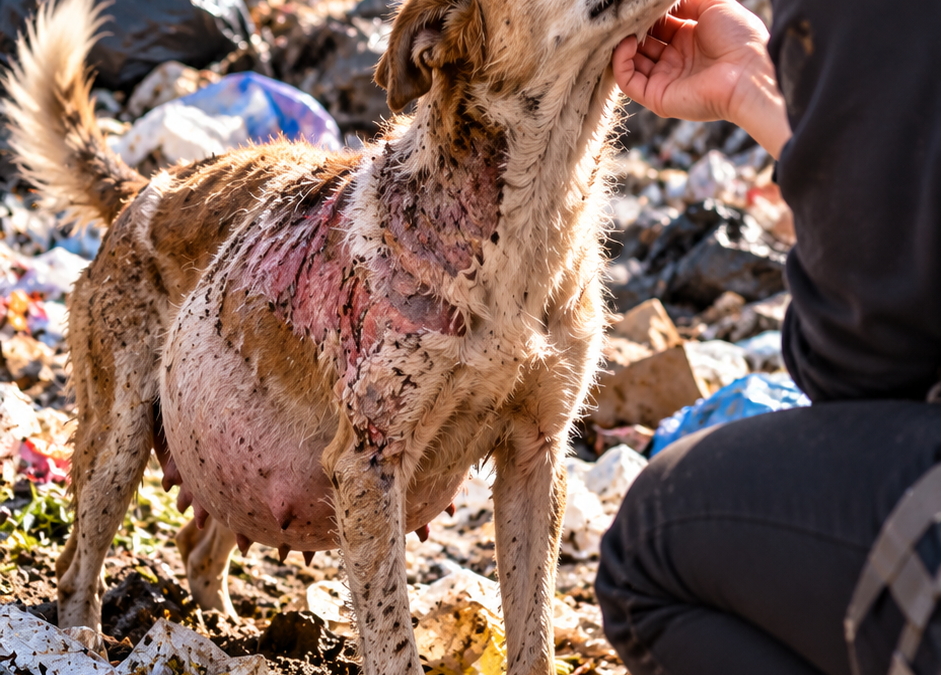
𝗙𝗨𝗟𝗟 𝗦𝗧𝗢𝗥𝗬
I wanted the veterinarian to tell me that everything would be fine.
I wanted someone to promise that Carmi would recover and that her puppies would be born healthy.
But promises wouldn’t change her medical condition.
The only thing we could do was begin treatment and give her the best chance possible.
There was one piece of encouraging news.
Carmi tested negative for distemper.
When the veterinarian explained the result, I felt the first small measure of relief since finding her. Distemper was one more potentially devastating illness we wouldn’t have to fight.
It didn’t erase her other medical problems.
It didn’t guarantee that she or her puppies would survive.
But after hearing so much bad news, one negative test felt significant.
I went back to her and gently stroked the part of her head where her skin was healthy.
“That’s one thing we don’t have to worry about,” I whispered.
She looked at me.
Her tail moved again.
I began calling her Carmi.
The name seemed to belong to her almost immediately. It was easier to say than “the pregnant dog from the dump,” and I hated the thought of reducing her identity to the worst thing that had happened to her.
She deserved a name.
She deserved to be someone.
Over the next several days, the veterinary team began the careful work of addressing her infections, supporting her kidney function, treating her injuries, and rebuilding her depleted strength.
Nothing about her condition allowed for shortcuts.
Her body needed nourishment, but it had been deprived for so long that feeding had to be managed carefully. Her injuries needed attention, and her medical treatment had to take her pregnancy into account.
Every decision involved balancing her immediate needs with the safety of the puppies developing inside her.
I had imagined that getting her out of the dump would be the hardest part.
I was wrong.
Rescue was only the beginning.
There is a particular helplessness that comes from caring for an animal who has already suffered more than you can imagine.
You can provide a clean bed.
You can arrange medical treatment.
You can make sure food and water are available and that someone is watching over her.
But you cannot instantly restore everything neglect has taken away.
You cannot tell a damaged kidney to heal overnight.
You cannot replace lost blood cells with reassurance.
And you cannot explain to a frightened dog why the people surrounding her are suddenly handling her wounds after so much time spent trying to avoid danger.
During Carmi’s early treatment, I began to understand just how much patience recovery would require.
There were moments when she seemed brighter. She would lift her head when someone entered the room or respond to a familiar voice with a small movement of her tail.
Then, a short time later, she would look exhausted again.
I learned not to mistake one encouraging moment for a complete recovery.
Her blood infection was serious, her anemia left her weak, and her kidneys needed careful monitoring.
Whenever I visited, I asked the veterinary team the same questions.
Was she eating?
Was she comfortable?
Were her test results improving?
Was there anything else we could do?
And always, somewhere beneath those questions, was the one I was almost afraid to say aloud.
What about her babies?
We couldn’t see the future.
We could only care for the mother carrying them.
I spent a great deal of time beside Carmi during those early days. Sometimes I talked to her. Sometimes I sat quietly while she rested, allowing her to become familiar with my presence without asking anything from her.
I began to notice the little things.
When someone approached too quickly, her body stiffened.
When a hand moved gently toward her, she seemed to relax.
She was particularly attentive when she heard the sound of food being prepared, though her appetite wasn’t always consistent.
And whenever I spoke to her in the same voice I’d used at the dump, she looked toward me.
I wondered whether she remembered.
Perhaps she recognized my scent or the sound of my voice. Perhaps she simply associated me with a place where food and warmth were now available.
Whatever the reason, those small moments mattered.
One afternoon, I sat beside her while she rested on her blanket.
“You know,” I told her, “I don’t think you understand how much you’ve scared everybody.”
She lifted one ear.
“You’re supposed to be resting, eating, and getting stronger. That’s your entire job right now.”
She stared at me with an expression so serious that I almost laughed.
Then her tail tapped the blanket.
It was such a small thing.
But I smiled for the first time that day.
As Carmi began to tolerate her treatment, we paid particular attention to making her surroundings as comfortable as possible.
The garbage dump had offered her no reliable place to rest. Even lying down there would have exposed her damaged skin to dirt, sharp objects, and contaminated materials.
Now she had clean bedding.
She had access to safe water.
Her food was prepared for her, and she didn’t have to fight or scavenge for it.
Nobody expected her to search through another pile of trash.
At first, she seemed almost uncertain about these simple comforts.
When she was given a fresh blanket, she sniffed it carefully before lying down. If someone placed food nearby, she sometimes looked up at the person before beginning to eat.
I found myself imagining the life she might have had before we met.
Had she once slept beside someone’s bed?
Had she known the sound of a front door opening and hurried to greet the person coming home?
Had she been accustomed to affection before someone abandoned her?
There was no way to know.
I stopped trying to invent an explanation for her past.
Whatever had happened to her, the injuries were real. The starvation was real. The terrible place where we’d found her was real.
Those were the things we could respond to.
And every day she survived gave us another opportunity to help.
The pregnancy made everything feel more urgent.
Carmi’s body was already struggling with serious illness, yet it was also supporting the developing puppies inside her.
Sometimes, when she lay on her side, I watched the gentle rise and fall of her abdomen and wondered what those unborn puppies would look like.
Would they have her eyes?
Would they inherit her gentle nature?
Would they ever know how close they had come to being born in a garbage dump?
The last thought was the one that stayed with me.
I could picture Carmi alone among the trash, searching for a secluded place to give birth while her damaged body struggled with infection.
I could picture newborn puppies lying against the filthy ground, unable to see or hear, completely dependent on a mother who could barely keep herself alive.
Every time those images entered my mind, I looked at Carmi resting on her clean blanket and felt intensely grateful that we had found her when we did.
But gratitude didn’t remove the uncertainty.
The veterinary team continued monitoring her closely.
We had no guarantee that her illness wouldn’t worsen or that childbirth wouldn’t place too much strain on her already fragile body.
When Carmi’s condition showed signs of improvement, I allowed myself a little hope.
When she seemed tired or uncomfortable, that hope became fear again.
I was learning to live between the two.
By the middle of her first week in care, Carmi had begun responding more consistently to the people around her.
She still needed substantial medical attention, but she was becoming more engaged with her surroundings.
Her tail no longer moved only when someone approached her with food. Sometimes it began wagging the moment she recognized a familiar person.
Occasionally, she lifted her head and watched people moving around the room, as though she were beginning to believe that this new world was worth paying attention to.
I remember arriving one morning and finding her awake.
“Good morning, Carmi.”
Her tail immediately began moving.
“Well, look at you.”
I knelt beside her and gently rubbed her head.
She leaned toward my hand.
For a few seconds, I thought of the first time she’d pressed her nose into my palm at the dump.
Back then, she had seemed to be asking whether I was safe.
Now she was beginning to behave as though she knew the answer.
“You’re getting pretty comfortable around here, aren’t you?”
She lowered her head into my hand.
I stayed beside her longer than I’d planned.
There was something extraordinary about watching an animal rediscover the simple pleasure of being touched without fear.
Not every interaction had to involve an examination or a painful injury.
Sometimes a hand could simply offer affection.
Sometimes a voice could mean that someone was happy to see her.
And sometimes she could close her eyes and rest without having to remain alert to everything around her.
Her pregnancy was advancing, and the veterinary staff began preparing for the possibility that she might give birth soon.
I tried to maintain a practical attitude.
We had already arranged medical care. She was being monitored, her nutritional needs were receiving attention, and she was no longer exposed to the dangers of the dump.
Those were concrete improvements.
But whenever I thought about the delivery itself, I felt the familiar knot return to my stomach.
I had seen healthy dogs become exhausted during labor.
Carmi was not a healthy dog.
She was recovering from anemia, infection, and kidney problems, and her body had only recently begun receiving consistent nutrition.
I was afraid that the effort required to give birth might overwhelm her.
I was equally afraid of what her medical condition might mean for the puppies.
The veterinarian remained focused on her treatment and careful monitoring.
“We take it one day at a time,” she reminded me.
I nodded.
I understood the advice.
I just wished the days would move faster.
By the ninth day, I could barely think about anything except Carmi.
Every visit began with a quick look at her face.
Was she alert?
Was she comfortable?
Was her breathing normal?
Had she eaten?
I found myself studying her as though I could somehow predict what would happen by watching closely enough.
Of course, I couldn’t.
The only thing I could do was remain available and trust the people caring for her.
On the tenth day after her rescue, everything changed.
Carmi went into labor.
When I learned what was happening, my heart seemed to jump into my throat.
For ten days, we’d been concentrating on keeping her alive and helping her weakened body recover.
Now she was facing the physical demands of childbirth.
I hurried to her.
The veterinary team was already monitoring her, making sure she had the support she needed while giving her room to respond naturally to the process.
Carmi was restless and uncomfortable.
She shifted on her bedding, panting as the contractions came, her exhausted body working toward something it could no longer postpone.
I knelt nearby.
“Hey, sweetheart.”
She looked toward me.
“I’m here.”
There was nothing I could do to take the contractions away. No amount of affection could make labor painless or eliminate the medical risks.
I could only remain calm, follow the veterinary team’s directions, and stay close enough for Carmi to know she wasn’t alone.
She lowered her head, then lifted it again as another contraction passed through her.
I watched the movement of her thin body and remembered carrying her out of the dump.
Ten days earlier, she had been searching through contaminated garbage for something to eat.
Now she was lying on clean bedding, surrounded by people who wanted her and her puppies to live.
The contrast was almost unbearable.
“You’re doing so well,” I whispered.
I don’t know how much time I spent watching her.
During moments of intense worry, time seems to lose its ordinary meaning. A few minutes can feel endless, while entire stretches disappear from memory.
I remember the veterinarian’s calm instructions.
I remember the sound of Carmi’s breathing.
I remember the way I kept my hands still because I didn’t want my own nervousness to disturb her.
And then the first puppy arrived.
For one extraordinary moment, the room seemed to become very quiet.
The veterinary team checked the newborn while Carmi turned her attention toward the tiny life she had just brought into the world.
I stared.
The puppy was alive.
After everything Carmi had endured, her first baby had been born.
I felt a sudden pressure behind my eyes.
“There’s your baby, girl,” I whispered.
But Carmi wasn’t finished.
There was another puppy.
And another.
And finally, a fourth.
Four puppies.
All four were born strong and healthy.
I had spent ten days imagining every possible complication. I had worried about malnutrition, contamination, infection, Carmi’s depleted strength, and the countless dangers of giving birth while seriously ill.
Now I was looking at four healthy newborns beside the exhausted mother who had carried them through all of it.
I covered my mouth with my hand.
For a few seconds, I couldn’t speak.
The veterinarian continued examining Carmi and monitoring her recovery from labor, while the rest of the team made sure the puppies were doing well.
I watched as Carmi turned toward them.
Her body was still fragile. Her medical problems hadn’t disappeared, and she had a long recovery ahead of her.
But she seemed immediately attentive to her babies.
She lowered her nose toward one of them, carefully investigating the tiny creature beside her.
Then she began tending to her newborns.
I sat beside her and cried.
Not because everything was suddenly perfect.
It wasn’t.
Carmi remained seriously ill, and the successful delivery didn’t guarantee an uncomplicated recovery.
I cried because, for the first time since meeting her, I was looking at something that her suffering had not managed to destroy.
Four new lives.
Four tiny bodies resting safely beside their mother.
Four puppies who had entered the world somewhere clean and warm instead of among the sharp, contaminated debris where we’d found her.
I wiped my face before leaning toward Carmi.
“You did it, sweetheart.”
She barely lifted her head.
“Look at them.”
She returned her attention to the puppies.
I laughed through my tears.
“All four of them.”
That night, I couldn’t stop thinking about what might have happened if nobody had noticed her in the garbage dump.
I knew there were countless abandoned animals still waiting for help, and I knew that Carmi’s survival didn’t erase the suffering she’d experienced.
But the image of her puppies beside her kept returning to me.
They hadn’t known the dump.
They hadn’t spent days searching through garbage.
Their first experiences were the warmth of their mother, clean bedding, and the quiet attention of people working to keep them healthy.
Carmi had endured the worst part of the journey before they were even born.
And now, finally, they had a chance to grow up somewhere safe.
The days following the delivery were not simple.
Childbirth had placed additional demands on Carmi’s fragile body, and she still needed treatment for the serious medical problems we’d discovered when she arrived.
Her infection required continued attention.
Her anemia had left her with a considerable deficit to overcome.
Her kidney function remained a concern, and her nutritional recovery couldn’t be rushed.
On top of everything else, she was now caring for four newborn puppies.
I had imagined that once the puppies were born, the fear might disappear.
Instead, it changed.
Before the delivery, I’d been afraid she wouldn’t survive long enough to meet her babies.
Afterward, I worried about whether she would recover while caring for them.
I watched her closely whenever I visited.
Sometimes she looked exhausted, her head resting on the bedding while the puppies settled against her.
Other times, she was remarkably alert, checking their movements and responding whenever one of them became restless.
Even when she needed rest, she remained attentive to them.
I couldn’t help being moved by her persistence.
But I also wanted Carmi to understand something that no amount of human speech could truly explain to her.
She was allowed to be cared for, too.
She had spent too much of her life struggling to survive.
Now there were people making sure she had food, medical attention, clean bedding, and whatever support her recovery required.
She didn’t have to face everything alone.
One afternoon, as she rested with her puppies, I sat beside her and watched the four tiny bodies shifting against one another.
They looked impossibly small.
Their paws made little movements as they settled, and their soft newborn sounds filled the quiet space around Carmi.
I found myself counting them.
One.
Two.
Three.
Four.
I did it every time I visited, even though I knew perfectly well how many there were.
Perhaps I simply couldn’t believe that all four had arrived healthy.
Carmi lifted her head and looked at me.
“They’re all here,” I told her.
She returned her attention to them.
I gently stroked her head.
“And so are you.”
Over the following weeks, the puppies began growing stronger.
Their bodies filled out, their movements became more purposeful, and the quiet newborn creatures we’d first watched beside their exhausted mother gradually became active, curious little dogs.
Their world was expanding.
At first, they depended completely on Carmi.
Then they began noticing their surroundings, moving away from her in small, awkward explorations before returning to the familiar comfort of her presence.
Their personalities started to emerge.
One seemed particularly eager to investigate whatever was nearby. Another was content to remain close to Carmi for as long as possible. They stumbled over one another, discovered their own paws, and occasionally became so absorbed in exploring that they seemed surprised to find their siblings beside them.
I loved watching them.
There was a sweetness in their clumsy attempts to understand the world, but there was also something profoundly moving about seeing Carmi surrounded by healthy, growing puppies.
Every little milestone represented a future that had once seemed terribly uncertain.
The first time they began interacting playfully, I sat on the floor and watched until my legs became uncomfortable.
One puppy attempted to climb over another, lost its balance, and tumbled onto the bedding.
I laughed.
Carmi looked up at me.
“Don’t worry,” I told her. “I think they’re going to be just fine.”
She watched them for a moment before settling down again.
Meanwhile, her own recovery was slowly becoming visible.
At first, the changes were so subtle that I only noticed them when I thought back to the day we’d found her.
She was beginning to gain weight.
Her movements were steadier.
Her appetite improved as her treatment and nutritional support continued.
The damaged areas of her skin gradually healed, and new fur began growing where her coat had once been thin or missing.
Her medical recovery required ongoing attention, but her overall condition was moving in the right direction.
One day, I found myself looking at her and realizing that her ribs were no longer the first thing I noticed.
It sounds like a small observation.
To me, it felt enormous.
When I’d first lifted her out of the dump, her body had seemed to consist of little more than bones, a swollen pregnant belly, and the determination to keep moving.
Now I could see strength returning to her.
Her face looked fuller, her posture more comfortable, and her eyes brighter.
She was beginning to look like a dog who expected to have another meal tomorrow.
That change meant more to me than I could easily explain.
There were still days when she needed extra rest, and the veterinary team continued monitoring her progress. Nobody forgot how serious her condition had been.
But we were finally seeing the results of consistent treatment, nourishment, and care.
Her body was beginning to repair the damage that neglect had caused.
And her behavior was changing along with it.
The dog I’d met at the garbage dump had been gentle, but there was a desperate uncertainty in the way she’d approached me.
She’d wagged her tail, yet she seemed almost afraid to believe that the attention being offered would last.
Now she greeted familiar people with increasing enthusiasm.
She began anticipating the little routines of her day.
She knew when someone was approaching with food.
She recognized the voices of her caregivers.
She responded eagerly to affection and increasingly seemed to enjoy the simple pleasure of being near people.
Sometimes, when I arrived, she wagged her tail so enthusiastically that her entire body moved.
I would stop in the doorway and stare at her.
“Where was all this energy hiding?”
She would look at me expectantly, her tail still sweeping back and forth.
I could scarcely reconcile her with the exhausted animal who had struggled to follow me through the garbage.
The physical transformation was obvious, but her growing confidence affected me even more.
She was learning that she could relax.
That a person approaching her didn’t mean she had to protect herself.
That food would arrive without a desperate search through trash.
That a clean place to sleep would still be there when she woke.
And perhaps most importantly, that the people around her weren’t going to disappear simply because she no longer needed immediate rescuing.
I began to understand that we weren’t just helping Carmi recover from illness.
We were giving her the opportunity to experience a completely different kind of life.
As the puppies continued growing, they became increasingly independent.
They played together, explored their safe surroundings, and gradually required less constant attention from their mother.
I watched Carmi respond to their energy with a mixture of patience and what looked very much like maternal exhaustion.
Sometimes she seemed delighted to have them nearby.
Other times, she appeared perfectly content when they were occupied with one another.
I couldn’t blame her.
Four energetic puppies could make even a healthy dog look tired.
One afternoon, they were tumbling over each other on the bedding while Carmi rested a short distance away.
I sat beside her and watched the commotion.
“Quite a family you’ve got there.”
She looked toward the puppies.
One of them lost its balance while attempting to climb over a sibling.
I laughed.
Carmi lowered her head again.
“Yeah,” I said. “I’d need a nap, too.”
For the first time since meeting her, I realized that my thoughts were no longer consumed entirely by fear.
I could simply enjoy being with her.
We still had responsibilities. Her medical recovery wasn’t something we could take for granted, and the puppies would eventually need homes of their own.
But the constant dread I’d felt during her first days at the clinic had gradually been replaced by something gentler.
I was beginning to imagine a future for her.
Not just survival.
A life.
I imagined her waking up in a comfortable home, stretching after a peaceful night’s sleep, and greeting someone who was genuinely happy to see her.
I imagined her eating a proper meal without having to search through garbage.
I imagined her walking across clean grass, feeling sunlight on her healthier coat, and resting somewhere warm when she was tired.
Ordinary things.
Things I had once taken for granted.
After seeing where Carmi had come from, none of those experiences seemed ordinary anymore.
They seemed precious.
Eventually, the time came to begin preparing her puppies for their own homes.
I knew it was coming.
From the moment they were born, the goal had been to give them safe, healthy lives. That meant finding loving families who could provide the care and stability they deserved.
Still, I found myself unexpectedly emotional as the puppies grew old enough to leave their mother.
I’d watched them enter the world.
I’d counted their tiny bodies beside Carmi when I was afraid something might go wrong.
I’d seen them open up to their surroundings, begin playing with one another, and develop into healthy young dogs.
The thought of saying goodbye felt strange.
For weeks, they’d been part of Carmi’s recovery and part of my daily routine.
Now their lives were about to expand beyond the place where they had been born.
I reminded myself that this was exactly what we’d wanted.
The puppies hadn’t been rescued from the dump themselves, but their future had depended on getting Carmi out of it.
They deserved families who would love them from the beginning.
They deserved homes where their needs were met and where growing up meant discovering the world rather than fighting to survive in it.
As each puppy moved toward a loving home, I felt the familiar combination of happiness and sadness that comes with watching rescued animals begin new lives.
I wanted to keep them close enough to know that they were safe.
At the same time, I knew that letting them go was part of giving them the future we’d fought so hard to protect.
All four eventually found loving homes.
Every one of them.
I remember thinking about that number again.
Four.
Four healthy puppies who had once been carried inside the body of a starving, injured dog living among toxic garbage.
Four lives that had begun in safety because their mother had been found in time.
Each time I thought about their future, I returned to the same image of Carmi standing beside that torn plastic bag.
I wondered what she would have done if we’d arrived even a little later.
But I no longer wanted to spend all my time imagining the terrible possibilities.
There were four healthy puppies living with families who cared for them.
That was real.
And Carmi had a future of her own.
With her puppies safely settled into their new lives, more of our attention turned toward her continued recovery.
She had already made remarkable progress, but the effects of her earlier suffering couldn’t be dismissed simply because her appearance had improved.
Her body still needed care.
Her strength had to rebuild gradually.
And the sense of safety she was developing needed to be reinforced through consistent, gentle treatment.
We continued providing her with the stability she’d never had at the dump.
Regular meals.
Clean water.
Comfortable bedding.
Medical attention.
Affection whenever she sought it.
And, perhaps most importantly, time.
Time to rest.
Time to heal.
Time to discover what she enjoyed when she no longer had to spend every waking moment searching for food.
As the weeks passed, I watched her become increasingly comfortable with ordinary routines.
She began seeking attention rather than merely accepting it.
She would approach familiar people with her tail wagging and lean into their hands as though she had finally decided that affection was something she was allowed to ask for.
Sometimes she simply wanted to be near someone.
She would settle comfortably while people moved around her, watching them with the peaceful interest of a dog who didn’t expect her surroundings to become dangerous without warning.
I found those moments especially moving.
Her joy wasn’t always dramatic.
Sometimes it was the quiet satisfaction of lying on a soft blanket.
Sometimes it was the anticipation of a meal.
Sometimes it was a contented sigh when someone gently scratched the side of her neck.
And sometimes it was the way she closed her eyes when she realized she could sleep without being disturbed.
I thought often about what the dump had demanded of her.
Every meal had required effort and risk.
Every place she lay down exposed her to possible injury.
Every unfamiliar sound might have meant danger.
Her body had been forced to endure starvation, infection, toxic surroundings, and pregnancy without reliable shelter or care.
Now the world around her had changed.
She no longer needed to search through discarded waste for scraps of food.
She no longer had to navigate sharp debris on injured legs.
She no longer needed to find a place to rest among garbage piles or face the uncertainty of giving birth alone.
There were people watching over her.
People who noticed when she seemed uncomfortable.
People who made sure she ate and had clean water.
People who were happy simply because she was there.
One afternoon, I watched Carmi lying in a patch of sunlight.
Her coat had grown back considerably, and her body looked healthier than I would have dared to imagine when I’d first carried her into the veterinary clinic.
She was resting comfortably, her eyes half-closed, with none of the anxious vigilance I’d seen during her early days.
I sat beside her.
“Remember when we first met?”
She opened one eye.
“You probably don’t want to remember that place.”
Her tail moved lazily.
I smiled and gently stroked her shoulder.
“I don’t blame you.”
She shifted a little closer to me, then settled again.
For several minutes, neither of us moved.
I listened to her breathing and watched the sunlight fall across her healthier coat.
It was such a simple moment.
There were no medical alarms, no urgent conversations, and no frightened questions about whether she would survive the night.
There was just a dog resting peacefully beside someone who loved her.
I realized then how much of Carmi’s journey had been about reclaiming the ordinary experiences that neglect had stolen from her.
Safety.
Comfort.
Trust.
The freedom to rest without fear.
The pleasure of greeting someone who would greet her back.
The certainty that food, shelter, and care would still be available tomorrow.
Those things couldn’t undo what had happened to her.
Her burns had been real, her illness had been real, and the suffering she endured before we found her would always be part of her history.
But that history no longer determined every moment of her life.
Carmi had survived the garbage dump.
She had survived serious illness.
She had given birth to four healthy puppies while still recovering from an ordeal that might easily have overwhelmed her.
And now she was learning how to live without the constant pressure of simply staying alive.
I began noticing how differently people reacted to her.
When she first arrived at the clinic, the sight of her had made people fall silent.
Her damaged skin, thin body, and exhausted expression told a story of neglect that was impossible to ignore.
Now, when someone saw Carmi, they often smiled before saying anything.
They noticed her bright eyes.
Her wagging tail.
Her growing confidence.
The way she approached familiar people with unmistakable pleasure.
Some of them had trouble believing she was the same dog.
I understood.
Even though I’d watched the transformation happen gradually, I still found myself surprised by her progress.
One day, I looked through the photographs taken shortly after her rescue.
For a moment, I could barely recognize the dog in them.
Her body was gaunt, her coat was severely damaged, and the swollen belly carrying her puppies seemed almost too much for her frail frame.
I remembered the smell of the dump.
The sound of garbage shifting beneath my shoes.
The feeling of her bones when I lifted her into my arms.
I remembered the veterinarian explaining her anemia, infection, and kidney problems.
I remembered staring at the clean blanket beneath her and wishing that kindness alone could make her healthy.
Then I looked up.
Carmi was standing a short distance away, watching me with her tail moving.
I put the photographs aside.
“Come here, sweetheart.”
She approached immediately.
I rubbed her head and laughed as she leaned against me.
“Look at you now.”
She seemed delighted by the attention.
For a few seconds, I held her close and thought about how little I’d known when I first saw her.
I’d thought we were rescuing a pregnant dog from a garbage dump.
I hadn’t understood how deeply her recovery would affect me.
I’d become accustomed to watching animals in distress, arranging care, and celebrating progress.
But Carmi had reminded me that the most meaningful changes weren’t always the dramatic ones.
Sometimes survival looked like a dog finally eating a complete meal.
Sometimes recovery looked like new fur growing over damaged skin.
Sometimes trust looked like a frightened animal choosing to rest beside a person rather than moving away.
And sometimes a second chance looked like four puppies sleeping safely beside their mother.
Carmi’s story contained all of those moments.
As her condition continued improving, she became increasingly playful and affectionate.
She began greeting the people around her with the enthusiasm of a dog who had discovered that attention could be one of life’s greatest pleasures.
Her tail seemed to have an opinion about everything.
Food arrived.
Her tail wagged.
Someone spoke to her.
Her tail wagged.
A familiar person entered the room.
Her entire body seemed to join in.
I couldn’t watch her without remembering the weak, uncertain movement she’d managed at the dump.
Even then, despite the pain and fear, she’d offered that small gesture.
I had interpreted it as hope.
Now it looked like happiness.
There was a difference.
Hope had been the fragile possibility that someone might help her.
Happiness was the growing certainty that she was already loved.
Eventually, Carmi’s life settled into the comfort and stability we’d hoped to provide from the beginning.
She was surrounded by people who cared for her, and she no longer had to face the dangers that had defined her existence at the dump.
Her weight had improved.
Her coat had grown back.
Her body was stronger, and the fearful uncertainty of her earliest days had gradually given way to confidence.
She had learned that she could accept affection without expecting pain in return.
She had learned that her needs would be met.
And she had learned that the people who loved her weren’t going to abandon her when the immediate emergency was over.
Her puppies were safe in their own loving homes.
Carmi was safe, too.
That was the future I’d been afraid to imagine when we first reached the clinic.
Now it was the life she was living.
I visited her one day when the weather was beautiful.
She was resting comfortably when I approached, but the moment she recognized me, she stood and started wagging her tail.
“There’s my girl.”
She came toward me, and I crouched to greet her.
She pressed her head into my hands.
I held her gently and felt the warmth of her healthier body against me.
It was almost impossible to reconcile that moment with the memory of carrying her through the garbage dump.
The same dog.
The same trusting eyes.
But everything else had changed.
I sat with her for a while, enjoying the quiet.
At some point, she settled beside me and rested her head against my leg.
I looked down at her.
“Your babies are doing well,” I told her softly.
She lifted her eyes toward me.
“All four of them.”
I smiled.
“They’ve got families who love them.”
Carmi rested her head again.
“And so do you.”
I stayed there, running my hand gently along her back.
I thought about the mother she’d been when we found her, scavenging among toxic debris while her body struggled to support the puppies growing inside her.
I thought about those ten uncertain days at the clinic, when every medical update had felt like a warning and every small improvement had seemed worth celebrating.
I remembered watching her give birth, counting each healthy puppy, and crying when I realized they were all alive.
And I thought about the many weeks that followed, when patience and consistent care slowly restored Carmi’s strength.
What moved me most wasn’t simply that she’d survived.
It was that she could finally enjoy the life she’d fought so hard to keep.
She could stretch out on clean bedding without worrying about what might be hidden beneath it.
She could eat nutritious food without searching through contaminated garbage.
She could approach people and expect gentle hands.
She could fall asleep knowing that she was safe.
She could exist without fear being the most important part of every decision she made.
I looked down at her again.
She was almost asleep.
Her breathing was slow and peaceful, and her tail gave one small movement when I touched her head.
For the first time, I realized I no longer needed to imagine a different future for Carmi.
She was already living it.
Sometimes I still think about the place where we found her.
I can remember the mounds of garbage, the smell of rotting waste, and the way she stood with her swollen belly while searching for something to eat.
I remember the injuries on her skin and the exhaustion in her eyes.
But most of all, I remember the way she looked at me when I crouched beside her.
She didn’t know who I was.
She didn’t know whether I could help her.
She had no reason to believe that following me would lead anywhere better than the place she already knew.
Yet when I reached out my hand, she pressed her nose against it.
Then she wagged her tail.
That tiny gesture was the beginning of everything that followed.
Ten days later, she gave birth to four healthy puppies.
In the weeks that followed, those puppies grew strong enough to begin lives of their own, and Carmi slowly recovered from the terrible condition in which we’d found her.
Eventually, all four puppies found loving homes.
And the mother who had once searched through toxic garbage for scraps of food found something she’d been denied for far too long.
A safe place to live.
People who loved her.
And the freedom to be happy.
When I look at Carmi now, I don’t see the abandoned dog from the dump.
I see a mother who survived an extraordinary ordeal, a gentle soul who somehow continued trusting people even after being treated so cruelly, and a beautiful dog whose future is no longer defined by the place where we found her.
I see the little movement of her tail that first convinced me to kneel beside her.
Only now, that tail never seems to stop wagging.
And whenever Carmi curls up in her comfortable home, closes her eyes, and drifts peacefully to sleep, I think about the four puppies growing up with families of their own.
None of them will ever need to understand what their mother endured to bring them into the world.
They only need to know the warmth of a home and the love of the people who chose them.
And Carmi, who once had nothing but the will to survive, finally has a life in which she no longer has to fight for every single day.
She is home.
And this time, she is loved.








