𝗙𝗨𝗟𝗟 𝗦𝗧𝗢𝗥𝗬 The Package She Wanted Buried Was Still Sitting in My Truck
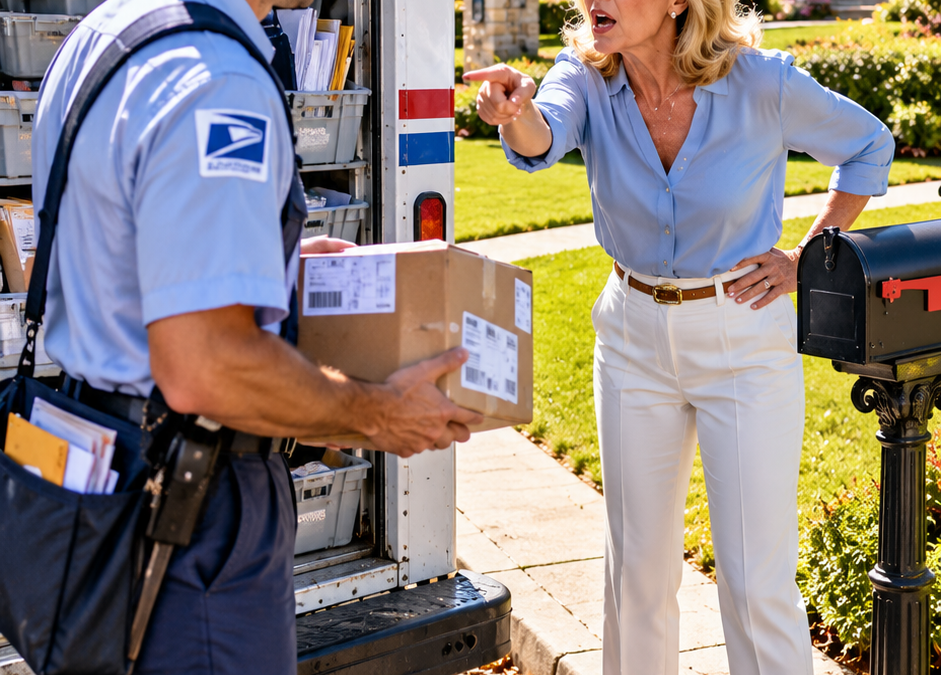
𝗙𝗨𝗟𝗟 𝗦𝗧𝗢𝗥𝗬
She made a short sound through her nose and looked toward the house behind her, then back at me. “It was supposed to be here yesterday.”
I took out my scanner. “Sometimes estimated delivery changes in the system. I can check the current status.”
“I do not want an excuse. I want my package.”
I looked up at her.
There are moments on a route when a customer’s frustration is understandable. People wait for medication, legal paperwork, replacement bank cards, things that matter. I had seen panic over delayed checks and tears over missing documents. When people are scared, they do not always speak gently.
So I gave her room.
“What name is it under?”
“Linda Whitmore.”
I searched the package manifest for the address.
The information came up quickly.
One parcel assigned to her address. Scheduled for delivery that afternoon. Loaded into the vehicle, yes. Not yet scanned as delivered. Not missing. Not delayed beyond the current day’s delivery window.
Everything normal.
I turned the scanner slightly, not handing it to her, but letting her see I had checked.
“It’s still scheduled for today,” I said. “It’s on the route. I haven’t reached the package portion for this block yet.”
Her face tightened. “So you have it.”
“It is in the vehicle inventory.”
“Then give it to me.”
“I’ll deliver it when I reach that stop in sequence.”
She stared at me as if I had spoken in another language.
“You are standing at my mailbox.”
“I’m delivering letter mail right now. Parcels are organized by stop order. I have to follow procedure.”
“That is ridiculous.”
“It prevents mistakes.”
“No,” she said, stepping closer. “What is ridiculous is that I have had to stand outside my own home waiting for a package that should have been delivered already.”
I glanced toward her porch.
The curtains moved.
Someone inside was watching.
“I understand the frustration,” I said. “But the system shows it is not late. It’s scheduled for today.”
Linda lowered her voice.
That was when the conversation changed.
Until then, she had been irritated. Pushy. Entitled. Nothing I had not seen before.
But when she looked past my shoulder toward the truck and then back at me, her anger sharpened into something more deliberate.
“I need you to mark it missing.”
I thought I had misheard her.
“What?”
“The package,” she said. “Mark it missing.”
I stared at her for a second, waiting for the rest of the sentence.
There was none.
I said, “It is not missing.”
“I know what I said.”
“Mrs. Whitmore, I can’t mark a package missing when it is physically in route inventory.”
Her lips pressed together.
“Then mark it damaged.”
“Is it damaged?”
“How would I know?”
“Then I can’t mark it damaged.”
She looked at me like I was intentionally being slow.
“Just lose it.”
The words landed between us with a strange quiet weight.
Behind us, a sprinkler ticked over a lawn. Somewhere across the street, a dog barked once and stopped. A delivery truck rumbled faintly two blocks over. The morning continued as if nothing serious had happened.
But something serious had happened.
I had been asked to falsify a delivery record.
Not hinted at. Not implied.
Asked.
I took one breath before answering.
“No, ma’am.”
Linda’s eyes narrowed.
“You don’t understand.”
“I understand exactly what you asked me to do.”
“No, you don’t.” She leaned closer. Her perfume was sharp and floral, expensive enough to announce itself. “That package is causing problems.”
“That has nothing to do with my delivery record.”
“It has everything to do with it.”
I kept my hands relaxed at my sides. “If you do not want the package, you can refuse delivery when it arrives. There are procedures for that.”
“I don’t want a refusal on record.”
That sentence told me more than she meant to reveal.
I looked at her more carefully.
The package was not something she did not want.
It was something she did not want traced.
“I can’t help you with that,” I said.
For the first time, her polished expression cracked.
The smile vanished. The polite neighbor mask fell so cleanly it was almost impressive.
“You people always hide behind procedure.”
I had been doing this job long enough to know when to end a conversation.
“Your package is scheduled for delivery today,” I said. “That’s all I can tell you.”
I turned toward the mailbox.
She stepped sideways, blocking me again.
“I am not finished speaking to you.”
I looked at her, then at the mailbox, then back at her.
“I still have a route to complete.”
“And I have authority in this neighborhood.”
There it was.
The thing she had been waiting to say.
Not frustration. Not concern. Authority.
She straightened her shoulders and lifted her chin.
“I am the president of the Briar Glen Homeowners Association. I can file complaints. I can make your supervisor aware that you are uncooperative. I can make sure this route is reviewed.”
I had heard threats before.
Most were empty. Some were not. The difficult thing about being in a public-facing job is that anyone can complain. They do not have to be honest. They do not have to be reasonable. They only have to sound offended enough to create paperwork.
And paperwork can become trouble.
I thought about that.
I thought about my supervisor, who believed in documentation but also hated customer escalations before lunch. I thought about the fact that I had a mortgage, a daughter starting community college in the fall, and a job that paid the bills because I showed up every day and did it right.
Then I thought about the package.
The one Linda wanted me to erase.
“I can’t falsify a scan because of an HOA issue,” I said.
Her cheeks flushed.
“This is not an HOA issue.”
“You just brought up the HOA.”
“I brought up my position because you clearly need to understand who you’re speaking to.”
“I know who I’m speaking to.”
“Then act like it.”
That should have made me angry.
Maybe part of me was angry.
But the anger stayed low and controlled, the way it does when you know losing your temper would only help the person trying to trap you.
I slid the letters into her mailbox.
“Have a good day, Mrs. Whitmore.”
I stepped around her and started back toward the truck.
“You will regret this,” she said behind me.
I did not answer.
That was another thing the job had taught me.
Silence can be stronger than the last word.
I climbed into the truck, logged the stop, and eased forward to the next house.
For maybe thirty seconds, I thought the confrontation was over.
Then I saw her in the side mirror.
Linda was following me.
At first, she walked fast down the sidewalk, white slacks flashing between the hedges. Then she broke into a sharper stride, almost a march, her phone clutched in one hand. I stopped at the next mailbox, stepped out, and delivered a small stack of letters.
“Stop ignoring me!” she shouted.
I kept my eyes on the mail.
A man watering plants two houses down turned his head.
Across the street, a garage door froze halfway open.
Briar Glen Estates had a talent for silence, but it also had a hunger for spectacle.
Linda reached me as I closed the mailbox.
“You cannot just walk away from a resident complaint.”
“I already answered your question.”
“No, you refused to cooperate.”
“I refused to falsify a record.”
Her expression hardened.
“Lower your voice.”
I almost laughed at that.
She had followed me down the sidewalk shouting, and now she wanted control of the volume because people were watching.
I glanced at the neighbors.
A woman in a purple robe stood on her porch holding a coffee mug. An older man had paused beside his recycling bin. Two landscapers working near the corner had stopped trimming hedges.
Linda noticed them too.
Her posture changed.
She turned slightly outward, performing now.
“This mail carrier is refusing to deliver my property,” she announced.
My jaw tightened.
“That is not true.”
“He admitted he has my package in the truck.”
“It is scheduled for delivery today.”
“He won’t give it to me.”
“Because I have to follow delivery procedure.”
Linda pointed toward the truck. “Open it.”
“No.”
The word was calm, direct, and final.
She blinked.
“I beg your pardon?”
“No. I’m not opening a package compartment because you’re demanding it on the sidewalk.”
“You work for us.”
That sentence drew a quiet reaction from the porch across the street. The woman in the purple robe lowered her coffee cup.
I turned fully toward Linda.
“I do not work for the HOA.”
“You serve this neighborhood.”
“I serve a federal mail route.”
Her mouth twisted.
“Do not get technical with me.”
“Mail delivery is technical.”
I moved toward the truck again.
Linda stepped in front of me.
This time, there was no mistaking it. She was not simply arguing. She was physically preventing me from continuing the route.
I stopped.
The entire street seemed to hold its breath.
“Mrs. Whitmore,” I said carefully, “you need to move.”
“I am not moving until you hand over the package.”
“I cannot continue my route while you’re blocking my vehicle.”
“Then we understand each other.”
My hand tightened around the mail bundle.
I looked at her face and understood something that made my stomach settle into a cold, steady place.
Linda thought she could win because she had always won.
Maybe not in court. Maybe not on paper. Maybe not in any way that mattered outside these streets. But inside Briar Glen, she had learned that if she stood in someone’s way long enough, spoke with enough certainty, and threatened the right complaint, people moved.
Contractors moved.
Neighbors moved.
Delivery drivers probably moved.
People apologized just to get away from her.
I was tired, and I was behind schedule, and I did not want a scene.
But I also knew what would happen if I opened that compartment.
The moment I gave in, I would own whatever came next.
If the package disappeared, my scan history would matter. If she claimed I handed it to the wrong person, my decision would matter. If she wanted no refusal record, no delivery record, no missing record that could be honestly explained, then she was trying to pull me into something that had nothing to do with mail.
I reached slowly for my phone.
Linda’s eyes snapped to my hand.
“What are you doing?”
“Documenting the obstruction.”
Her voice rose. “You are not recording me.”
“I’m calling for assistance.”
“You do not have my consent.”
“You’re blocking a mail vehicle in the street.”
The older man by the recycling bin took a step closer to his driveway. The woman in the robe lifted her phone too, though whether she was recording or just pretending, I could not tell.
I called the station first and explained the situation in the cleanest terms possible.
“Resident is blocking the vehicle and demanding a false package scan. Package is still in route inventory. I cannot proceed.”
My supervisor’s voice changed immediately.
“Are you safe?”
“Yes.”
“Do not engage further. If she continues blocking you, contact local law enforcement.”
Linda stood close enough to hear pieces of the call.
Her face went pale with anger.
“You are making this sound criminal.”
I looked at her.
“You are the one blocking the truck.”
I ended the call and dialed dispatch.
I did not dramatize it. I did not accuse her of anything beyond what I could prove. I gave the street, the house number, my name, my route designation, and the fact that a resident was preventing me from leaving while demanding access to a package.
The dispatcher asked if there were weapons.
“No.”
Was anyone injured?
“No.”
Was the person still blocking the vehicle?
I looked at Linda.
“Yes.”
Linda laughed, but the sound had no humor in it.
“This is unbelievable.”
I stayed beside the truck and waited.
Those minutes felt longer than they were.
Linda used every second.
She paced in front of the vehicle, talking loudly enough for every neighbor to hear.
“This is what happens when there is no accountability.”
No one answered.
“I have lived here for seventeen years.”
Still no one answered.
“I manage community standards for one hundred and forty-six homes.”
The woman in the purple robe finally said, “Linda, maybe just let him finish his route.”
Linda turned on her.
“Margaret, stay out of this.”
The woman, Margaret, did not retreat. “He said the package is coming today.”
“You don’t know what this is about.”
“Then maybe stop making it everyone’s business.”
That was the first crack in the neighborhood silence.
A small one.
But I felt it.
Linda did too.
She pointed at Margaret. “This is precisely why we have procedures.”
I could not help myself.
“So do I.”
Linda spun back toward me.
“You think you’re clever.”
“No, ma’am. I think I’m employed.”
The landscapers looked down quickly, trying not to smile.
That only made Linda angrier.
She came toward me again.
“I want your full name.”
“It’s on my badge.”
“I want your supervisor’s name.”
“You can file a formal complaint through customer service.”
“I am not going through customer service.”
“That is the process.”
She looked toward the truck again. Her gaze moved to the rear compartment.
“How do I know the package is even there?”
“You don’t need to know that.”
“It has my name on it.”
“And it is still mail until properly delivered.”
The word mail seemed to irritate her more than anything else.
Because it was not neighborhood property.
It was not HOA property.
It was not under her authority.
A police cruiser turned onto the street less than ten minutes after the call.
The sound of its engine changed the entire block.
People who had been pretending not to watch stopped pretending. A few doors opened. Someone stepped out onto a balcony. Margaret remained on her porch, her arms crossed now, her coffee forgotten on the railing.
The cruiser pulled up behind my truck.
Two officers stepped out.
One was tall, broad-shouldered, maybe mid-forties, with a calm face and tired eyes. The other was younger, sharper in movement, scanning everything at once.
Linda moved first.
Of course she did.
“Officers, thank goodness,” she said, walking toward them as if she had called them herself. “This man is refusing to give me my package.”
The older officer held up one hand.
“Ma’am, we’ll speak to everyone.”
“I am the HOA president.”
“I understand.”
That was the polite way officers say they do not care yet.
The younger officer came toward me.
“Are you the one who called?”
“Yes, sir.”
I gave my name, my employee ID, and the route information. I explained the package status, the request to mark it missing, the continued obstruction, and the call to my supervisor.
I kept my voice steady.
I did not add emotion.
Facts first. Feelings later.
The older officer listened while Linda hovered three feet away, vibrating with impatience.
When I said she had asked me to mark the package missing, Linda cut in.
“That is not what I said.”
The officer turned to her. “Ma’am, please let him finish.”
“He is lying.”
“Ma’am.”
“I never asked him to do anything improper.”
I looked at her then.
She looked back at me with pure confidence.
Not nervousness.
Not shame.
Confidence.
That was when I realized she had already rewritten the morning in her mind. Or maybe she was simply used to saying things with enough force that people accepted them.
The officer asked, “What did you ask him to do?”
Linda placed a hand against her chest.
“I asked why my package was being withheld.”
“It is not being withheld,” I said.
She talked over me. “He admitted he had it.”
The officer looked at me.
I held up the scanner.
“It is scheduled for delivery today. The route has not reached parcel delivery for that stop yet.”
Linda pointed at me. “See? He has it and refuses to give it to me.”
The younger officer asked, “Is there a reason you can’t deliver it right now?”
“Yes,” I said. “It has to be delivered according to procedure and scanned properly. Also, at this point, because she has demanded that it be marked missing, refused, or otherwise altered, I’m not comfortable handling it outside normal process without documentation.”
Linda let out a sharp laugh.
“Listen to him. He’s making himself sound important.”
The older officer’s expression did not change.
“Ma’am, did you block the vehicle?”
“I stood in front of it because he tried to leave.”
“Did he ask you to move?”
“He was being unreasonable.”
“That’s not what I asked.”
Linda hesitated.
A very small hesitation.
“Yes, but—”
The officer nodded once.
“Okay.”
“He chased me,” Linda suddenly said.
The street went still.
I turned my head slowly.
The younger officer looked up from his notepad.
“What?”
Linda’s eyes flicked toward the watching neighbors, then back to the officers.
“He chased me down the sidewalk when I asked about the package.”
I felt something hot move through my chest.
Not fear exactly.
Something close to disbelief, but heavier.
It is one thing to be insulted. It is another to watch someone build a lie in real time and place you inside it as the threat.
“I did not chase her,” I said.
My voice sounded different now.
Lower.
The older officer looked at Linda.
“You said he chased you?”
“Yes.”
“From where to where?”
Linda gestured vaguely. “From my house down here.”
The officer looked at the distance between her mailbox and the current stop.
“He chased you while carrying mail?”
“He followed me.”
I said, “She followed me from her mailbox after I ended the conversation.”
Linda snapped, “That is not true.”
“Yes, it is,” Margaret called from her porch.
Every head turned.
Margaret came down her front steps in slippers and a purple robe, holding her phone at her side. She looked nervous, but she kept walking until she stood near the edge of her driveway.
“I saw it,” she said. “She followed him.”
Linda’s face changed in an instant.
“Margaret.”
The name came out like a warning.
Margaret swallowed but continued.
“He was delivering. Linda came after him. She was yelling. He kept trying to work.”
The older officer turned toward her. “Ma’am, your name?”
“Margaret Ellis. I live at 214.”
“Did you see her block the vehicle?”
“Yes.”
Linda said, “You have no idea what happened before that.”
Margaret looked at her then, and there was something tired in her face.
“Linda, everyone has an idea.”
That sentence changed the street.
It was quiet, but it landed hard.
A man stepped forward from two houses down, the one who had been standing near the recycling bin.
“I saw her stand in front of the truck,” he said.
The younger officer turned to him. “Name?”
“Robert Chen. 218 Briar Glen.”
Linda threw up her hands.
“Oh, wonderful. So now this is a neighborhood meeting?”
Robert ignored her.
“He told her to move,” he said. “More than once.”
The landscapers did not speak, but one of them nodded when the officer glanced their way.
Linda looked around the street as if she could not understand how the audience had turned into witnesses.
That was the moment her control slipped.
For years, maybe, people had watched her bend conversations until everyone else backed down. They had watched her weaponize bylaws, warnings, fines, and social pressure. They had watched quietly because speaking meant becoming her next project.
But she had picked a fight in public.
Against a person whose job came with records.
And she had done it in front of neighbors who were tired.
The officer asked to see the delivery status.
I showed him the scanner.
He did not touch it. He just looked as I explained the item number, the scheduled delivery window, the route inventory status, and the absence of any missing package report.
“It’s listed as in vehicle inventory?” he asked.
“Yes.”
“Not scanned delivered?”
“No.”
“Not scanned attempted?”
“No.”
“Not reported lost?”
“No.”
“Did she ask you to report it lost?”
I looked at Linda.
She stared back, daring me.
“Yes,” I said. “Her words were, ‘Just lose it.’”
Linda’s voice rose. “That is taken completely out of context.”
The officer turned to her. “What was the context?”
She opened her mouth.
Nothing came out.
For the first time all morning, Linda Whitmore had no prepared sentence.
The younger officer asked, “What is in the package?”
Linda’s head snapped toward him.
“That is private.”
“It may be. But you’re demanding a mail carrier alter the record, and you’re blocking his route over it. So I’m trying to understand what’s going on.”
“I don’t have to tell you what I ordered.”
“No, ma’am,” the older officer said. “You don’t. But you do have to stop interfering with him.”
Linda folded her arms again, trying to rebuild herself.
“I want the package delivered now.”
“That is between you and the postal service.”
“He is standing right there.”
“And you are standing in front of his vehicle.”
Linda looked at my uniform then, her eyes sharp with contempt.
“He works for this neighborhood. We have standards here.”
The officer’s eyebrows lifted slightly.
“No, ma’am. He does not work for your HOA.”
“He delivers here.”
“That is not the same thing.”
“He is refusing service.”
“He has explained the delivery status. You may file a complaint through the proper channels.”
Linda’s mouth tightened. “I want his supervisor here.”
“I spoke with my supervisor,” I said. “They instructed me not to engage further while the vehicle was blocked.”
Linda pointed toward my truck. “Then open it and prove the package is there.”
“No,” the officer said.
That one word was not loud, but it cut through everything.
Linda stared at him.
He continued, “You are not going into his vehicle. You are not touching the mail. You are not preventing him from leaving.”
“You don’t understand who I am.”
“I understand you’re a resident on this street.”
“I am the HOA president.”
“That does not give you authority over a mail vehicle.”
Her face flushed dark red.
“I have responsibilities.”
“Not here,” he said.
The street went silent again.
But this silence was different.
The first silence had belonged to Linda.
This one did not.
I could feel the neighbors absorbing it. I could feel the quiet relief in Margaret’s posture, the way Robert shifted his weight, the way even the landscapers seemed to breathe easier.
Linda was being told no by someone she could not fine.
The older officer stepped slightly aside and spoke quietly into his radio. The younger one stayed near me.
I did not move.
My hands were steady, but my heart was beating hard. I hated that it was. I hated that one person’s demand had turned an ordinary workday into a scene where I had to defend my honesty in front of strangers.
People think public workers get used to being accused.
You do not.
You learn how to respond. You learn how to document. You learn not to take every insult home with you.
But you do not stop feeling the sting when someone looks at your uniform and decides it means you are easy to blame.
I thought about all the mornings I had delivered in rain so heavy my socks stayed wet for six hours. I thought about the Christmas season when my hands cracked from cardboard and cold. I thought about carrying medication up icy steps because an elderly man could not get to his mailbox.
I had done this job carefully.
Not perfectly.
No one does any job perfectly.
But honestly.
That mattered to me.
Linda had tried to turn that honesty into an inconvenience.
The older officer came back.
“Mrs. Whitmore,” he said, “you need to step away from the vehicle.”
“I am not finished.”
“You are finished blocking him.”
“I will move when he gives me my property.”
The officer’s voice lowered.
“That is not how this is going to work.”
Linda stared at him for a long moment.
Then she did something so sudden that even I did not expect it.
She turned and reached toward the rear compartment handle on my truck.
I moved back immediately.
“Do not touch the vehicle.”
The younger officer stepped in fast.
“Ma’am, stop.”
Linda’s hand hovered inches from the handle.
“I have a right to my package.”
“Step back,” he ordered.
She did not.
For one frozen second, her hand stayed there.
That second felt enormous.
Every warning had been given. Every explanation had been offered. Every chance to step away had been placed in front of her.
She looked at the officer, then at me, then at the handle.
And she still seemed to believe the world would bend.
“I said,” the officer repeated, “step back.”
Linda dropped her hand, but she did not move away.
Instead, she pointed at me with a trembling finger.
“Mark it lost. Right now. This ends if you mark it lost.”
There it was again.
Clear.
Unmistakable.
In front of two officers and half the block.
The older officer closed his notebook.
“Mrs. Whitmore, turn around.”
Her mouth fell open.
“What?”
“Turn around and place your hands behind your back.”
For a moment, I do not think she understood the words.
No one moved.
Then Linda laughed once.
A sharp, stunned sound.
“You cannot be serious.”
“You are being detained for interfering with this worker and refusing lawful instructions to move away from the vehicle.”
“This is absurd.”
“Hands behind your back.”
“I know the mayor.”
“Hands behind your back.”
“You will regret this.”
The younger officer moved closer.
Linda looked around at the neighbors.
I will never forget her face in that moment.
Not because she was afraid.
Because she was humiliated.
That mattered to her more.
Margaret looked down. Robert folded his arms. No one stepped forward to rescue her. No one said this had gone too far. No one told the officers that Linda was a good woman who had simply gotten upset.
The silence she had trained into the neighborhood finally answered her.
The officers cuffed her beside the truck she had tried to control.
She kept talking while they did it.
“This is a misunderstanding.”
No one responded.
“I was asking a question.”
No one responded.
“He provoked me.”
Margaret said quietly, “No, he didn’t.”
Linda turned her head so sharply I thought she might hurt herself.
“You stay out of this.”
The older officer guided her toward the cruiser.
“That’s enough.”
As they walked her away, she looked back at me.
There was hatred in her eyes, but underneath it something else had started to appear.
Fear.
Not fear of jail, maybe. Not yet.
Fear of losing the story.
People like Linda survive by controlling the story. They can survive conflict. They can survive complaints. They can survive being disliked. But they cannot survive a version of events they do not own.
That morning, the story had witnesses.
Records.
A scanner log.
A call history.
Two officers.
And a street full of neighbors who had finally seen the same thing at the same time.
I gave my statement beside the truck.
I explained everything again, slowly and clearly. The first contact at her mailbox. The request to mark the package missing. The phrase “Just lose it.” The threat involving the HOA. The obstruction. The false claim that I chased her. The attempt to touch the vehicle.
The officers took notes.
Margaret gave her statement. Robert gave his. One of the landscapers, a young man named Luis, said he had not heard the beginning but had seen Linda blocking the truck and refusing to move.
The cruiser door closed with Linda inside.
The sound was soft.
Final.
When the officers left, the neighborhood did not immediately return to normal.
People lingered.
That was unusual for Briar Glen.
Normally, doors shut quickly after trouble passed. Curtains fell back into place. Everyone retreated to privacy and pretended nothing had happened.
But this time, Margaret walked over to me.
She had changed somehow in the last twenty minutes. She still looked nervous, still clutched her robe closed with one hand, but her eyes were steady.
“I’m sorry,” she said.
I shook my head. “You don’t need to apologize.”
“Yes,” she said. “I do. Maybe not for today. But for all the days we all let her act like that.”
I did not know what to say to that.
So I said the only true thing.
“Thank you for speaking up.”
Robert came over too.
“She’s done this to contractors,” he said. “Gardeners. Delivery people. Neighbors. Anyone she thinks can’t push back.”
Margaret looked toward Linda’s house.
“The package,” she said quietly. “Do you know what it was?”
“I don’t look inside people’s packages.”
“No, I mean…” She hesitated. “There’s been a fight on the board. Records requests. Something about HOA expenses. She’s been trying to stop documents from getting around.”
Robert nodded. “A certified packet was supposed to come from the management company. People have been asking questions.”
I looked at my scanner.
The parcel in my inventory was not marked certified, but it did not matter.
Whatever Linda feared was not my business.
My business was the delivery record.
And the record was clean.
“I’m going to finish the route,” I said.
Margaret stepped back immediately. “Of course. Sorry.”
Robert gave a small nod. “You handled that better than most people would have.”
I climbed into the truck.
For a moment, I just sat there.
The engine hummed under me. The scanner rested in its mount. The mail tray waited with the next bundle, ordinary and patient. The street ahead was clear now.
But my hands stayed on the steering wheel.
I had been threatened before. Yelled at before. Blamed for things I did not do.
This felt different.
Maybe because Linda had not just wanted the package. She had wanted my name on the lie. She had wanted my scan, my record, my job, my integrity, all bent around whatever problem she was trying to bury.
People think corruption looks dramatic.
Sometimes it does.
Sometimes it looks like a woman in white slacks on a clean sidewalk saying, “Just lose it,” because she assumes the person in uniform needs the job badly enough to obey.
I took a breath, logged the delay, and continued.
The rest of the block watched me differently.
Not with suspicion.
With awareness.
At the next house, an elderly man opened his door before I reached the mailbox.
“You okay?” he asked.
“Yes, sir.”
He nodded. “Good.”
That was all.
But it mattered.
At another house, a woman I had delivered to for years gave me a bottle of water and said, “For later.” I almost refused because accepting things on route can be complicated, but it was sealed, and I was tired, and her kindness did not feel like a transaction.
By the time I returned to Linda’s stop later in the route, the street had emptied.
Her house stood quiet.
No one waited in the driveway. No perfect posture. No folded arms. No command waiting at the curb.
I located the package.
It was a medium cardboard parcel, plain brown, properly labeled, no visible damage. I scanned it according to procedure. The scanner beeped.
A clean record.
That sound gave me more satisfaction than I expected.
I carried the package to her porch.
For a second, I stood there with it in my hands, thinking about everything that little box had caused. Or maybe not caused. Revealed.
That was the better word.
Revealed.
The package had not turned the neighborhood against itself.
Linda had.
The package had simply forced everyone to choose whether they would keep pretending.
I placed it at the designated delivery location, took the required photo, and stepped back.
Delivered.
Not missing.
Not damaged.
Not buried inside a false scan.
Delivered.
I returned to the truck and continued the route.
By late afternoon, word had traveled faster than the mail ever could.
At the station, my supervisor called me into the office. He had already received a preliminary report from law enforcement and the call log from dispatch. He asked for my full statement, and I gave it. He reviewed the scan history, the time stamps, the route delay, and the package delivery confirmation.
Then he leaned back in his chair and said, “You did it right.”
I did not realize how much I needed to hear that until he said it.
“I wasn’t trying to escalate it,” I told him.
“I know.”
“She asked me to falsify the record.”
“I know.”
“I couldn’t do that.”
He looked at me over the top of the monitor.
“That’s why I said you did it right.”
I nodded.
My throat felt tighter than I wanted it to.
He printed the incident report and added it to the file.
“Take tomorrow if you need it.”
I almost laughed.
Not because it was funny, but because the offer was so unexpected.
“I’ll be here.”
He studied me for a moment, then nodded.
“I figured.”
The next morning, I drove into Briar Glen Estates at the same time as always.
The stone pillars still stood at the entrance. The lawns were still trimmed. The sprinklers still clicked. The flags still hung at perfect angles.
But the neighborhood felt different.
Not loud.
Not transformed.
Just awake.
Margaret was outside when I reached her house. This time, she was dressed for the day, not in her robe. She raised one hand.
“Morning,” she called.
“Morning.”
Robert nodded from his driveway.
At three houses along the block, people waved who had never waved before.
That might sound small.
It was not.
A neighborhood does not change all at once. People do not become brave because one police cruiser leaves with one difficult woman inside. Fear does not vanish because someone finally says what everyone knows.
But silence can crack.
And once it cracks, people hear themselves differently.
Later that week, I learned that Linda had stepped down temporarily from the HOA board pending “review of conduct.” That was the phrase in the letter residents received. Margaret showed it to me from six feet away, careful not to put me in the middle of their business.
“It doesn’t say much,” she said.
“Those letters usually don’t.”
She smiled faintly. “No. But it says enough.”
Within two weeks, the HOA board held a special meeting. I did not attend. I had no reason to. But Briar Glen residents loved talking near mailboxes, and for once, the talk was not gossip designed to hurt someone.
It was relief.
People requested financial records. People questioned fines. People asked why one person had been allowed to speak for everyone for so long. The board voted to bring in an outside management review. Linda’s allies tried to call it unnecessary. Margaret stood up and said the word necessary so clearly that half the room applauded.
That was what Robert told me, anyway.
I only knew what happened on my route.
And what happened was this: the street got quieter in a better way.
Not the old quiet, built from pressure and fear.
A real quiet.
The kind where people tended their gardens without watching for Linda’s SUV. The kind where contractors parked without being shouted at before they unloaded tools. The kind where neighbors spoke in driveways and did not stop when another neighbor passed.
As for Linda, I saw her once more.
About a month after the arrest, she was walking from her car to her front door when I delivered mail across the street. She looked thinner, less polished somehow, though still dressed carefully. She saw me.
For a moment, neither of us moved.
I expected anger.
Maybe another accusation.
Maybe a warning that she was not finished.
Instead, she looked away.
It was not an apology.
I did not mistake it for one.
But it was the first honest thing I had ever seen her do.
She had nothing to say.
So she said nothing.
I finished the block and drove on.
People sometimes ask whether a day like that makes you cynical.
It could.
It would be easy to remember only the insult. The demand. The lie. The way Linda looked at my uniform and decided I could be pressured into risking my livelihood for her convenience.
But that is not the part I remember most.
I remember Margaret stepping off her porch in slippers, scared but speaking anyway.
I remember Robert saying what he saw.
I remember the officer saying, “That does not give you authority over a mail vehicle.”
I remember the clean beep of the scanner when I delivered the package exactly the way it was supposed to be delivered.
Most of all, I remember the strange peace afterward.
My route returned to its ordinary rhythm. Letters, bills, medicine, birthday cards, catalogs, packages. Doorsteps and mailboxes. Dogs behind fences. Sprinklers ticking across morning lawns.
But Briar Glen never felt quite the same again.
Neither did I.
Because that day reminded me that integrity is not usually tested in grand moments. Most of the time, it is tested quietly, in the middle of a workday, by someone who wants a small dishonest favor and expects you to care more about avoiding trouble than doing what is right.
Linda Whitmore thought one package could be buried with a false scan.
She thought her title could make a lie official.
She thought the neighborhood would stay silent because it always had before.
But the package was never missing.
The record never changed.
And by the time I finished my route that day, everyone on Briar Glen Drive knew exactly who had tried to make the truth disappear.
𝗧𝗛𝗘 𝗘𝗡𝗗
The Package She Wanted Buried Was Still Sitting in My Truck
Linda Whitmore stopped me before I reached her mailbox, smiling like this was a normal morning and not the beginning of the strangest confrontation I had ever had on my route.
She already knew the package was not missing.
What she wanted was for me to make it disappear.
My mail route had always been one of the quiet ones.
That was what I liked about it.
Every morning, I turned onto Briar Glen Drive just after eight-thirty, rolled past the same trimmed hedges, the same porch swings, the same sprinklers clicking across lawns so perfect they looked staged. The neighborhood had money, rules, and the kind of silence that came from people watching each other from behind expensive windows.
To most folks, a mail route probably looks simple. You drive, you stop, you scan, you deliver, you move on. But after years of doing it, a route becomes something more personal than a map. You learn the rhythms of a place. You learn who works nights because their porch light stays on until sunrise. You learn who has a newborn because suddenly the house is getting diapers every three days. You learn who lost someone because the sympathy cards come first, then the medical bills, then the silence.
I knew which dogs barked but never bit. I knew which retirees waited for medication shipments. I knew which residents waved because they meant it and which waved because the neighborhood association had trained everyone to perform friendliness like a civic duty.
Briar Glen Estates was one of those neighborhoods.
Clean streets. Tall oaks. Stone entry pillars. Flags mounted at perfect angles. Mailboxes polished like trophies.
And an HOA that seemed to believe it governed more than landscaping.
I had dealt with them before.
Not officially. Not in any way that ever became a report. But I knew the tone. I knew the sharp little notes taped to mailboxes when someone had parked too long in a driveway. I knew the residents who whispered, “Sorry about her,” after Linda Whitmore walked away. I knew the way conversations changed when Linda’s white SUV rolled slowly past, as if it were a patrol car.
Linda Whitmore was the president of the Briar Glen Homeowners Association.
She made sure everyone knew it.
She was in her late fifties, always dressed like she was on her way to a board meeting even when she was standing barefoot on her own lawn. Her hair never moved. Her makeup never looked accidental. She had the kind of smile that stayed on her face while her eyes measured damage.
I had never had a real problem with her before that morning. A few complaints, sure. Once she told me I was “inconsistent” because I delivered mail at 10:14 instead of 10:05. Another time she said my vehicle looked “unprofessional” because it had mud on the tires after three days of rain.
I listened. I nodded. I kept working.
That is one of the first things you learn on a mail route.
Not every argument deserves your energy.
That Tuesday started like every other Tuesday.
The air was cool, the sun still low enough to throw long shadows across the sidewalks. My scanner was clipped to my belt. My satchel rested against my hip. The truck smelled faintly of cardboard, dust, and the bitter coffee I had been drinking since dawn.
I had already delivered to Maple Court and Whitestone Lane. Nothing unusual. A few bills. Two medication packages. A stack of political flyers nobody wanted but everyone received. By the time I turned onto Briar Glen Drive, I was thinking about the rest of the route, not trouble.
Then I saw Linda.
She was standing outside her house before I even reached the curb.
That alone made me slow down.
Linda did not wait casually. She staged herself. She stood at the edge of her driveway with both arms folded, her chin slightly lifted, wearing a pale blue blouse, white slacks, and an expression that told me she had already decided I was late, wrong, and beneath her.
I parked beside her mailbox.
Before I could step out fully, she moved into my path.
“Finally,” she said.
No greeting. No good morning. No attempt at pretending.
I shut the truck door carefully and reached for the bundle of letters assigned to her street.
“Morning, Mrs. Whitmore.”
“Where is my package?”
There was something in her voice that made me pause.
Not worry.
Demand.
I had heard that tone before from people who believed a uniform made me a servant.
I kept my voice even. “Let me check. What’s the tracking number?”
She blinked as if the question offended her. “You should know.”
“I carry hundreds of items a day,” I said. “I need the tracking number or your address to confirm what you’re asking about.”
“You know my address.”
“Yes, ma’am. I still need to verify the item.”
She made a short sound through her nose and looked toward the house behind her, then back at me. “It was supposed to be here yesterday.”
I took out my scanner. “Sometimes estimated delivery changes in the system. I can check the current status.”
“I do not want an excuse. I want my package.”
I looked up at her.
There are moments on a route when a customer’s frustration is understandable. People wait for medication, legal paperwork, replacement bank cards, things that matter. I had seen panic over delayed checks and tears over missing documents. When people are scared, they do not always speak gently.
So I gave her room.
“What name is it under?”
“Linda Whitmore.”
I searched the package manifest for the address.
The information came up quickly.
One parcel assigned to her address. Scheduled for delivery that afternoon. Loaded into the vehicle, yes. Not yet scanned as delivered. Not missing. Not delayed beyond the current day’s delivery window.
Everything normal.
I turned the scanner slightly, not handing it to her, but letting her see I had checked.
“It’s still scheduled for today,” I said. “It’s on the route. I haven’t reached the package portion for this block yet.”
Her face tightened. “So you have it.”
“It is in the vehicle inventory.”
“Then give it to me.”
“I’ll deliver it when I reach that stop in sequence.”
She stared at me as if I had spoken in another language.
“You are standing at my mailbox.”
“I’m delivering letter mail right now. Parcels are organized by stop order. I have to follow procedure.”
“That is ridiculous.”
“It prevents mistakes.”
“No,” she said, stepping closer. “What is ridiculous is that I have had to stand outside my own home waiting for a package that should have been delivered already.”
I glanced toward her porch.
The curtains moved.
Someone inside was watching.
“I understand the frustration,” I said. “But the system shows it is not late. It’s scheduled for today.”
Linda lowered her voice.
That was when the conversation changed.
Until then, she had been irritated. Pushy. Entitled. Nothing I had not seen before.
But when she looked past my shoulder toward the truck and then back at me, her anger sharpened into something more deliberate.
“I need you to mark it missing.”
I thought I had misheard her.
“What?”
“The package,” she said. “Mark it missing.”
I stared at her for a second, waiting for the rest of the sentence.
There was none.
I said, “It is not missing.”
“I know what I said.”
“Mrs. Whitmore, I can’t mark a package missing when it is physically in route inventory.”
Her lips pressed together.
“Then mark it damaged.”
“Is it damaged?”
“How would I know?”
“Then I can’t mark it damaged.”
She looked at me like I was intentionally being slow.
“Just lose it.”
The words landed between us with a strange quiet weight.
Behind us, a sprinkler ticked over a lawn. Somewhere across the street, a dog barked once and stopped. A delivery truck rumbled faintly two blocks over. The morning continued as if nothing serious had happened.
But something serious had happened.
I had been asked to falsify a delivery record.
Not hinted at. Not implied.
Asked.
I took one breath before answering.
“No, ma’am.”
Linda’s eyes narrowed.
“You don’t understand.”
“I understand exactly what you asked me to do.”
“No, you don’t.” She leaned closer. Her perfume was sharp and floral, expensive enough to announce itself. “That package is causing problems.”
“That has nothing to do with my delivery record.”
“It has everything to do with it.”
I kept my hands relaxed at my sides. “If you do not want the package, you can refuse delivery when it arrives. There are procedures for that.”
“I don’t want a refusal on record.”
That sentence told me more than she meant to reveal.
I looked at her more carefully.
The package was not something she did not want.
It was something she did not want traced.
“I can’t help you with that,” I said.
For the first time, her polished expression cracked.
The smile vanished. The polite neighbor mask fell so cleanly it was almost impressive.
“You people always hide behind procedure.”
I had been doing this job long enough to know when to end a conversation.
“Your package is scheduled for delivery today,” I said. “That’s all I can tell you.”
I turned toward the mailbox.
She stepped sideways, blocking me again.
“I am not finished speaking to you.”
I looked at her, then at the mailbox, then back at her.
“I still have a route to complete.”
“And I have authority in this neighborhood.”
There it was.
The thing she had been waiting to say.
Not frustration. Not concern. Authority.
She straightened her shoulders and lifted her chin.
“I am the president of the Briar Glen Homeowners Association. I can file complaints. I can make your supervisor aware that you are uncooperative. I can make sure this route is reviewed.”
I had heard threats before.
Most were empty. Some were not. The difficult thing about being in a public-facing job is that anyone can complain. They do not have to be honest. They do not have to be reasonable. They only have to sound offended enough to create paperwork.
And paperwork can become trouble.
I thought about that.
I thought about my supervisor, who believed in documentation but also hated customer escalations before lunch. I thought about the fact that I had a mortgage, a daughter starting community college in the fall, and a job that paid the bills because I showed up every day and did it right.
Then I thought about the package.
The one Linda wanted me to erase.
“I can’t falsify a scan because of an HOA issue,” I said.
Her cheeks flushed.
“This is not an HOA issue.”
“You just brought up the HOA.”
“I brought up my position because you clearly need to understand who you’re speaking to.”
“I know who I’m speaking to.”
“Then act like it.”
That should have made me angry.
Maybe part of me was angry.
But the anger stayed low and controlled, the way it does when you know losing your temper would only help the person trying to trap you.
I slid the letters into her mailbox.
“Have a good day, Mrs. Whitmore.”
I stepped around her and started back toward the truck.
“You will regret this,” she said behind me.
I did not answer.
That was another thing the job had taught me.
Silence can be stronger than the last word.
I climbed into the truck, logged the stop, and eased forward to the next house.
For maybe thirty seconds, I thought the confrontation was over.
Then I saw her in the side mirror.
Linda was following me.
At first, she walked fast down the sidewalk, white slacks flashing between the hedges. Then she broke into a sharper stride, almost a march, her phone clutched in one hand. I stopped at the next mailbox, stepped out, and delivered a small stack of letters.
“Stop ignoring me!” she shouted.
I kept my eyes on the mail.
A man watering plants two houses down turned his head.
Across the street, a garage door froze halfway open.
Briar Glen Estates had a talent for silence, but it also had a hunger for spectacle.
Linda reached me as I closed the mailbox.
“You cannot just walk away from a resident complaint.”
“I already answered your question.”
“No, you refused to cooperate.”
“I refused to falsify a record.”
Her expression hardened.
“Lower your voice.”
I almost laughed at that.
She had followed me down the sidewalk shouting, and now she wanted control of the volume because people were watching.
I glanced at the neighbors.
A woman in a purple robe stood on her porch holding a coffee mug. An older man had paused beside his recycling bin. Two landscapers working near the corner had stopped trimming hedges.
Linda noticed them too.
Her posture changed.
She turned slightly outward, performing now.
“This mail carrier is refusing to deliver my property,” she announced.
My jaw tightened.
“That is not true.”
“He admitted he has my package in the truck.”
“It is scheduled for delivery today.”
“He won’t give it to me.”
“Because I have to follow delivery procedure.”
Linda pointed toward the truck. “Open it.”
“No.”
The word was calm, direct, and final.
She blinked.
“I beg your pardon?”
“No. I’m not opening a package compartment because you’re demanding it on the sidewalk.”
“You work for us.”
That sentence drew a quiet reaction from the porch across the street. The woman in the purple robe lowered her coffee cup.
I turned fully toward Linda.
“I do not work for the HOA.”
“You serve this neighborhood.”
“I serve a federal mail route.”
Her mouth twisted.
“Do not get technical with me.”
“Mail delivery is technical.”
I moved toward the truck again.
Linda stepped in front of me.
This time, there was no mistaking it. She was not simply arguing. She was physically preventing me from continuing the route.
I stopped.
The entire street seemed to hold its breath.
“Mrs. Whitmore,” I said carefully, “you need to move.”
“I am not moving until you hand over the package.”
“I cannot continue my route while you’re blocking my vehicle.”
“Then we understand each other.”
My hand tightened around the mail bundle.
I looked at her face and understood something that made my stomach settle into a cold, steady place.
Linda thought she could win because she had always won.
Maybe not in court. Maybe not on paper. Maybe not in any way that mattered outside these streets. But inside Briar Glen, she had learned that if she stood in someone’s way long enough, spoke with enough certainty, and threatened the right complaint, people moved.
Contractors moved.
Neighbors moved.
Delivery drivers probably moved.
People apologized just to get away from her.
I was tired, and I was behind schedule, and I did not want a scene.
But I also knew what would happen if I opened that compartment.
The moment I gave in, I would own whatever came next.
If the package disappeared, my scan history would matter. If she claimed I handed it to the wrong person, my decision would matter. If she wanted no refusal record, no delivery record, no missing record that could be honestly explained, then she was trying to pull me into something that had nothing to do with mail.
I reached slowly for my phone.
Linda’s eyes snapped to my hand.
“What are you doing?”
“Documenting the obstruction.”
Her voice rose. “You are not recording me.”
“I’m calling for assistance.”
“You do not have my consent.”
“You’re blocking a mail vehicle in the street.”
The older man by the recycling bin took a step closer to his driveway. The woman in the robe lifted her phone too, though whether she was recording or just pretending, I could not tell.
I called the station first and explained the situation in the cleanest terms possible.
“Resident is blocking the vehicle and demanding a false package scan. Package is still in route inventory. I cannot proceed.”
My supervisor’s voice changed immediately.
“Are you safe?”
“Yes.”
“Do not engage further. If she continues blocking you, contact local law enforcement.”
Linda stood close enough to hear pieces of the call.
Her face went pale with anger.
“You are making this sound criminal.”
I looked at her.
“You are the one blocking the truck.”
I ended the call and dialed dispatch.
I did not dramatize it. I did not accuse her of anything beyond what I could prove. I gave the street, the house number, my name, my route designation, and the fact that a resident was preventing me from leaving while demanding access to a package.
The dispatcher asked if there were weapons.
“No.”
Was anyone injured?
“No.”
Was the person still blocking the vehicle?
I looked at Linda.
“Yes.”
Linda laughed, but the sound had no humor in it.
“This is unbelievable.”
I stayed beside the truck and waited.
Those minutes felt longer than they were.
Linda used every second.
She paced in front of the vehicle, talking loudly enough for every neighbor to hear.
“This is what happens when there is no accountability.”
No one answered.
“I have lived here for seventeen years.”
Still no one answered.
“I manage community standards for one hundred and forty-six homes.”
The woman in the purple robe finally said, “Linda, maybe just let him finish his route.”
Linda turned on her.
“Margaret, stay out of this.”
The woman, Margaret, did not retreat. “He said the package is coming today.”
“You don’t know what this is about.”
“Then maybe stop making it everyone’s business.”
That was the first crack in the neighborhood silence.
A small one.
But I felt it.
Linda did too.
She pointed at Margaret. “This is precisely why we have procedures.”
I could not help myself.
“So do I.”
Linda spun back toward me.
“You think you’re clever.”
“No, ma’am. I think I’m employed.”
The landscapers looked down quickly, trying not to smile.
That only made Linda angrier.
She came toward me again.
“I want your full name.”
“It’s on my badge.”
“I want your supervisor’s name.”
“You can file a formal complaint through customer service.”
“I am not going through customer service.”
“That is the process.”
She looked toward the truck again. Her gaze moved to the rear compartment.
“How do I know the package is even there?”
“You don’t need to know that.”
“It has my name on it.”
“And it is still mail until properly delivered.”
The word mail seemed to irritate her more than anything else.
Because it was not neighborhood property.
It was not HOA property.
It was not under her authority.
A police cruiser turned onto the street less than ten minutes after the call.
The sound of its engine changed the entire block.
People who had been pretending not to watch stopped pretending. A few doors opened. Someone stepped out onto a balcony. Margaret remained on her porch, her arms crossed now, her coffee forgotten on the railing.
The cruiser pulled up behind my truck.
Two officers stepped out.
One was tall, broad-shouldered, maybe mid-forties, with a calm face and tired eyes. The other was younger, sharper in movement, scanning everything at once.
Linda moved first.
Of course she did.
“Officers, thank goodness,” she said, walking toward them as if she had called them herself. “This man is refusing to give me my package.”
The older officer held up one hand.
“Ma’am, we’ll speak to everyone.”
“I am the HOA president.”
“I understand.”
That was the polite way officers say they do not care yet.
The younger officer came toward me.
“Are you the one who called?”
“Yes, sir.”
I gave my name, my employee ID, and the route information. I explained the package status, the request to mark it missing, the continued obstruction, and the call to my supervisor.
I kept my voice steady.
I did not add emotion.
Facts first. Feelings later.
The older officer listened while Linda hovered three feet away, vibrating with impatience.
When I said she had asked me to mark the package missing, Linda cut in.
“That is not what I said.”
The officer turned to her. “Ma’am, please let him finish.”
“He is lying.”
“Ma’am.”
“I never asked him to do anything improper.”
I looked at her then.
She looked back at me with pure confidence.
Not nervousness.
Not shame.
Confidence.
That was when I realized she had already rewritten the morning in her mind. Or maybe she was simply used to saying things with enough force that people accepted them.
The officer asked, “What did you ask him to do?”
Linda placed a hand against her chest.
“I asked why my package was being withheld.”
“It is not being withheld,” I said.
She talked over me. “He admitted he had it.”
The officer looked at me.
I held up the scanner.
“It is scheduled for delivery today. The route has not reached parcel delivery for that stop yet.”
Linda pointed at me. “See? He has it and refuses to give it to me.”
The younger officer asked, “Is there a reason you can’t deliver it right now?”
“Yes,” I said. “It has to be delivered according to procedure and scanned properly. Also, at this point, because she has demanded that it be marked missing, refused, or otherwise altered, I’m not comfortable handling it outside normal process without documentation.”
Linda let out a sharp laugh.
“Listen to him. He’s making himself sound important.”
The older officer’s expression did not change.
“Ma’am, did you block the vehicle?”
“I stood in front of it because he tried to leave.”
“Did he ask you to move?”
“He was being unreasonable.”
“That’s not what I asked.”
Linda hesitated.
A very small hesitation.
“Yes, but—”
The officer nodded once.
“Okay.”
“He chased me,” Linda suddenly said.
The street went still.
I turned my head slowly.
The younger officer looked up from his notepad.
“What?”
Linda’s eyes flicked toward the watching neighbors, then back to the officers.
“He chased me down the sidewalk when I asked about the package.”
I felt something hot move through my chest.
Not fear exactly.
Something close to disbelief, but heavier.
It is one thing to be insulted. It is another to watch someone build a lie in real time and place you inside it as the threat.
“I did not chase her,” I said.
My voice sounded different now.
Lower.
The older officer looked at Linda.
“You said he chased you?”
“Yes.”
“From where to where?”
Linda gestured vaguely. “From my house down here.”
The officer looked at the distance between her mailbox and the current stop.
“He chased you while carrying mail?”
“He followed me.”
I said, “She followed me from her mailbox after I ended the conversation.”
Linda snapped, “That is not true.”
“Yes, it is,” Margaret called from her porch.
Every head turned.
Margaret came down her front steps in slippers and a purple robe, holding her phone at her side. She looked nervous, but she kept walking until she stood near the edge of her driveway.
“I saw it,” she said. “She followed him.”
Linda’s face changed in an instant.
“Margaret.”
The name came out like a warning.
Margaret swallowed but continued.
“He was delivering. Linda came after him. She was yelling. He kept trying to work.”
The older officer turned toward her. “Ma’am, your name?”
“Margaret Ellis. I live at 214.”
“Did you see her block the vehicle?”
“Yes.”
Linda said, “You have no idea what happened before that.”
Margaret looked at her then, and there was something tired in her face.
“Linda, everyone has an idea.”
That sentence changed the street.
It was quiet, but it landed hard.
A man stepped forward from two houses down, the one who had been standing near the recycling bin.
“I saw her stand in front of the truck,” he said.
The younger officer turned to him. “Name?”
“Robert Chen. 218 Briar Glen.”
Linda threw up her hands.
“Oh, wonderful. So now this is a neighborhood meeting?”
Robert ignored her.
“He told her to move,” he said. “More than once.”
The landscapers did not speak, but one of them nodded when the officer glanced their way.
Linda looked around the street as if she could not understand how the audience had turned into witnesses.
That was the moment her control slipped.
For years, maybe, people had watched her bend conversations until everyone else backed down. They had watched her weaponize bylaws, warnings, fines, and social pressure. They had watched quietly because speaking meant becoming her next project.
But she had picked a fight in public.
Against a person whose job came with records.
And she had done it in front of neighbors who were tired.
The officer asked to see the delivery status.
I showed him the scanner.
He did not touch it. He just looked as I explained the item number, the scheduled delivery window, the route inventory status, and the absence of any missing package report.
“It’s listed as in vehicle inventory?” he asked.
“Yes.”
“Not scanned delivered?”
“No.”
“Not scanned attempted?”
“No.”
“Not reported lost?”
“No.”
“Did she ask you to report it lost?”
I looked at Linda.
She stared back, daring me.
“Yes,” I said. “Her words were, ‘Just lose it.’”
Linda’s voice rose. “That is taken completely out of context.”
The officer turned to her. “What was the context?”
She opened her mouth.
Nothing came out.
For the first time all morning, Linda Whitmore had no prepared sentence.
The younger officer asked, “What is in the package?”
Linda’s head snapped toward him.
“That is private.”
“It may be. But you’re demanding a mail carrier alter the record, and you’re blocking his route over it. So I’m trying to understand what’s going on.”
“I don’t have to tell you what I ordered.”
“No, ma’am,” the older officer said. “You don’t. But you do have to stop interfering with him.”
Linda folded her arms again, trying to rebuild herself.
“I want the package delivered now.”
“That is between you and the postal service.”
“He is standing right there.”
“And you are standing in front of his vehicle.”
Linda looked at my uniform then, her eyes sharp with contempt.
“He works for this neighborhood. We have standards here.”
The officer’s eyebrows lifted slightly.
“No, ma’am. He does not work for your HOA.”
“He delivers here.”
“That is not the same thing.”
“He is refusing service.”
“He has explained the delivery status. You may file a complaint through the proper channels.”
Linda’s mouth tightened. “I want his supervisor here.”
“I spoke with my supervisor,” I said. “They instructed me not to engage further while the vehicle was blocked.”
Linda pointed toward my truck. “Then open it and prove the package is there.”
“No,” the officer said.
That one word was not loud, but it cut through everything.
Linda stared at him.
He continued, “You are not going into his vehicle. You are not touching the mail. You are not preventing him from leaving.”
“You don’t understand who I am.”
“I understand you’re a resident on this street.”
“I am the HOA president.”
“That does not give you authority over a mail vehicle.”
Her face flushed dark red.
“I have responsibilities.”
“Not here,” he said.
The street went silent again.
But this silence was different.
The first silence had belonged to Linda.
This one did not.
I could feel the neighbors absorbing it. I could feel the quiet relief in Margaret’s posture, the way Robert shifted his weight, the way even the landscapers seemed to breathe easier.
Linda was being told no by someone she could not fine.
The older officer stepped slightly aside and spoke quietly into his radio. The younger one stayed near me.
I did not move.
My hands were steady, but my heart was beating hard. I hated that it was. I hated that one person’s demand had turned an ordinary workday into a scene where I had to defend my honesty in front of strangers.
People think public workers get used to being accused.
You do not.
You learn how to respond. You learn how to document. You learn not to take every insult home with you.
But you do not stop feeling the sting when someone looks at your uniform and decides it means you are easy to blame.
I thought about all the mornings I had delivered in rain so heavy my socks stayed wet for six hours. I thought about the Christmas season when my hands cracked from cardboard and cold. I thought about carrying medication up icy steps because an elderly man could not get to his mailbox.
I had done this job carefully.
Not perfectly.
No one does any job perfectly.
But honestly.
That mattered to me.
Linda had tried to turn that honesty into an inconvenience.
The older officer came back.
“Mrs. Whitmore,” he said, “you need to step away from the vehicle.”
“I am not finished.”
“You are finished blocking him.”
“I will move when he gives me my property.”
The officer’s voice lowered.
“That is not how this is going to work.”
Linda stared at him for a long moment.
Then she did something so sudden that even I did not expect it.
She turned and reached toward the rear compartment handle on my truck.
I moved back immediately.
“Do not touch the vehicle.”
The younger officer stepped in fast.
“Ma’am, stop.”
Linda’s hand hovered inches from the handle.
“I have a right to my package.”
“Step back,” he ordered.
She did not.
For one frozen second, her hand stayed there.
That second felt enormous.
Every warning had been given. Every explanation had been offered. Every chance to step away had been placed in front of her.
She looked at the officer, then at me, then at the handle.
And she still seemed to believe the world would bend.
“I said,” the officer repeated, “step back.”
Linda dropped her hand, but she did not move away.
Instead, she pointed at me with a trembling finger.
“Mark it lost. Right now. This ends if you mark it lost.”
There it was again.
Clear.
Unmistakable.
In front of two officers and half the block.
The older officer closed his notebook.
“Mrs. Whitmore, turn around.”
Her mouth fell open.
“What?”
“Turn around and place your hands behind your back.”
For a moment, I do not think she understood the words.
No one moved.
Then Linda laughed once.
A sharp, stunned sound.
“You cannot be serious.”
“You are being detained for interfering with this worker and refusing lawful instructions to move away from the vehicle.”
“This is absurd.”
“Hands behind your back.”
“I know the mayor.”
“Hands behind your back.”
“You will regret this.”
The younger officer moved closer.
Linda looked around at the neighbors.
I will never forget her face in that moment.
Not because she was afraid.
Because she was humiliated.
That mattered to her more.
Margaret looked down. Robert folded his arms. No one stepped forward to rescue her. No one said this had gone too far. No one told the officers that Linda was a good woman who had simply gotten upset.
The silence she had trained into the neighborhood finally answered her.
The officers cuffed her beside the truck she had tried to control.
She kept talking while they did it.
“This is a misunderstanding.”
No one responded.
“I was asking a question.”
No one responded.
“He provoked me.”
Margaret said quietly, “No, he didn’t.”
Linda turned her head so sharply I thought she might hurt herself.
“You stay out of this.”
The older officer guided her toward the cruiser.
“That’s enough.”
As they walked her away, she looked back at me.
There was hatred in her eyes, but underneath it something else had started to appear.
Fear.
Not fear of jail, maybe. Not yet.
Fear of losing the story.
People like Linda survive by controlling the story. They can survive conflict. They can survive complaints. They can survive being disliked. But they cannot survive a version of events they do not own.
That morning, the story had witnesses.
Records.
A scanner log.
A call history.
Two officers.
And a street full of neighbors who had finally seen the same thing at the same time.
I gave my statement beside the truck.
I explained everything again, slowly and clearly. The first contact at her mailbox. The request to mark the package missing. The phrase “Just lose it.” The threat involving the HOA. The obstruction. The false claim that I chased her. The attempt to touch the vehicle.
The officers took notes.
Margaret gave her statement. Robert gave his. One of the landscapers, a young man named Luis, said he had not heard the beginning but had seen Linda blocking the truck and refusing to move.
The cruiser door closed with Linda inside.
The sound was soft.
Final.
When the officers left, the neighborhood did not immediately return to normal.
People lingered.
That was unusual for Briar Glen.
Normally, doors shut quickly after trouble passed. Curtains fell back into place. Everyone retreated to privacy and pretended nothing had happened.
But this time, Margaret walked over to me.
She had changed somehow in the last twenty minutes. She still looked nervous, still clutched her robe closed with one hand, but her eyes were steady.
“I’m sorry,” she said.
I shook my head. “You don’t need to apologize.”
“Yes,” she said. “I do. Maybe not for today. But for all the days we all let her act like that.”
I did not know what to say to that.
So I said the only true thing.
“Thank you for speaking up.”
Robert came over too.
“She’s done this to contractors,” he said. “Gardeners. Delivery people. Neighbors. Anyone she thinks can’t push back.”
Margaret looked toward Linda’s house.
“The package,” she said quietly. “Do you know what it was?”
“I don’t look inside people’s packages.”
“No, I mean…” She hesitated. “There’s been a fight on the board. Records requests. Something about HOA expenses. She’s been trying to stop documents from getting around.”
Robert nodded. “A certified packet was supposed to come from the management company. People have been asking questions.”
I looked at my scanner.
The parcel in my inventory was not marked certified, but it did not matter.
Whatever Linda feared was not my business.
My business was the delivery record.
And the record was clean.
“I’m going to finish the route,” I said.
Margaret stepped back immediately. “Of course. Sorry.”
Robert gave a small nod. “You handled that better than most people would have.”
I climbed into the truck.
For a moment, I just sat there.
The engine hummed under me. The scanner rested in its mount. The mail tray waited with the next bundle, ordinary and patient. The street ahead was clear now.
But my hands stayed on the steering wheel.
I had been threatened before. Yelled at before. Blamed for things I did not do.
This felt different.
Maybe because Linda had not just wanted the package. She had wanted my name on the lie. She had wanted my scan, my record, my job, my integrity, all bent around whatever problem she was trying to bury.
People think corruption looks dramatic.
Sometimes it does.
Sometimes it looks like a woman in white slacks on a clean sidewalk saying, “Just lose it,” because she assumes the person in uniform needs the job badly enough to obey.
I took a breath, logged the delay, and continued.
The rest of the block watched me differently.
Not with suspicion.
With awareness.
At the next house, an elderly man opened his door before I reached the mailbox.
“You okay?” he asked.
“Yes, sir.”
He nodded. “Good.”
That was all.
But it mattered.
At another house, a woman I had delivered to for years gave me a bottle of water and said, “For later.” I almost refused because accepting things on route can be complicated, but it was sealed, and I was tired, and her kindness did not feel like a transaction.
By the time I returned to Linda’s stop later in the route, the street had emptied.
Her house stood quiet.
No one waited in the driveway. No perfect posture. No folded arms. No command waiting at the curb.
I located the package.
It was a medium cardboard parcel, plain brown, properly labeled, no visible damage. I scanned it according to procedure. The scanner beeped.
A clean record.
That sound gave me more satisfaction than I expected.
I carried the package to her porch.
For a second, I stood there with it in my hands, thinking about everything that little box had caused. Or maybe not caused. Revealed.
That was the better word.
Revealed.
The package had not turned the neighborhood against itself.
Linda had.
The package had simply forced everyone to choose whether they would keep pretending.
I placed it at the designated delivery location, took the required photo, and stepped back.
Delivered.
Not missing.
Not damaged.
Not buried inside a false scan.
Delivered.
I returned to the truck and continued the route.
By late afternoon, word had traveled faster than the mail ever could.
At the station, my supervisor called me into the office. He had already received a preliminary report from law enforcement and the call log from dispatch. He asked for my full statement, and I gave it. He reviewed the scan history, the time stamps, the route delay, and the package delivery confirmation.
Then he leaned back in his chair and said, “You did it right.”
I did not realize how much I needed to hear that until he said it.
“I wasn’t trying to escalate it,” I told him.
“I know.”
“She asked me to falsify the record.”
“I know.”
“I couldn’t do that.”
He looked at me over the top of the monitor.
“That’s why I said you did it right.”
I nodded.
My throat felt tighter than I wanted it to.
He printed the incident report and added it to the file.
“Take tomorrow if you need it.”
I almost laughed.
Not because it was funny, but because the offer was so unexpected.
“I’ll be here.”
He studied me for a moment, then nodded.
“I figured.”
The next morning, I drove into Briar Glen Estates at the same time as always.
The stone pillars still stood at the entrance. The lawns were still trimmed. The sprinklers still clicked. The flags still hung at perfect angles.
But the neighborhood felt different.
Not loud.
Not transformed.
Just awake.
Margaret was outside when I reached her house. This time, she was dressed for the day, not in her robe. She raised one hand.
“Morning,” she called.
“Morning.”
Robert nodded from his driveway.
At three houses along the block, people waved who had never waved before.
That might sound small.
It was not.
A neighborhood does not change all at once. People do not become brave because one police cruiser leaves with one difficult woman inside. Fear does not vanish because someone finally says what everyone knows.
But silence can crack.
And once it cracks, people hear themselves differently.
Later that week, I learned that Linda had stepped down temporarily from the HOA board pending “review of conduct.” That was the phrase in the letter residents received. Margaret showed it to me from six feet away, careful not to put me in the middle of their business.
“It doesn’t say much,” she said.
“Those letters usually don’t.”
She smiled faintly. “No. But it says enough.”
Within two weeks, the HOA board held a special meeting. I did not attend. I had no reason to. But Briar Glen residents loved talking near mailboxes, and for once, the talk was not gossip designed to hurt someone.
It was relief.
People requested financial records. People questioned fines. People asked why one person had been allowed to speak for everyone for so long. The board voted to bring in an outside management review. Linda’s allies tried to call it unnecessary. Margaret stood up and said the word necessary so clearly that half the room applauded.
That was what Robert told me, anyway.
I only knew what happened on my route.
And what happened was this: the street got quieter in a better way.
Not the old quiet, built from pressure and fear.
A real quiet.
The kind where people tended their gardens without watching for Linda’s SUV. The kind where contractors parked without being shouted at before they unloaded tools. The kind where neighbors spoke in driveways and did not stop when another neighbor passed.
As for Linda, I saw her once more.
About a month after the arrest, she was walking from her car to her front door when I delivered mail across the street. She looked thinner, less polished somehow, though still dressed carefully. She saw me.
For a moment, neither of us moved.
I expected anger.
Maybe another accusation.
Maybe a warning that she was not finished.
Instead, she looked away.
It was not an apology.
I did not mistake it for one.
But it was the first honest thing I had ever seen her do.
She had nothing to say.
So she said nothing.
I finished the block and drove on.
People sometimes ask whether a day like that makes you cynical.
It could.
It would be easy to remember only the insult. The demand. The lie. The way Linda looked at my uniform and decided I could be pressured into risking my livelihood for her convenience.
But that is not the part I remember most.
I remember Margaret stepping off her porch in slippers, scared but speaking anyway.
I remember Robert saying what he saw.
I remember the officer saying, “That does not give you authority over a mail vehicle.”
I remember the clean beep of the scanner when I delivered the package exactly the way it was supposed to be delivered.
Most of all, I remember the strange peace afterward.
My route returned to its ordinary rhythm. Letters, bills, medicine, birthday cards, catalogs, packages. Doorsteps and mailboxes. Dogs behind fences. Sprinklers ticking across morning lawns.
But Briar Glen never felt quite the same again.
Neither did I.
Because that day reminded me that integrity is not usually tested in grand moments. Most of the time, it is tested quietly, in the middle of a workday, by someone who wants a small dishonest favor and expects you to care more about avoiding trouble than doing what is right.
Linda Whitmore thought one package could be buried with a false scan.
She thought her title could make a lie official.
She thought the neighborhood would stay silent because it always had before.
But the package was never missing.
The record never changed.
And by the time I finished my route that day, everyone on Briar Glen Drive knew exactly who had tried to make the truth disappear.








