𝗙𝗨𝗟𝗟 𝗦𝗧𝗢𝗥𝗬 The One Question Dana Never Asked About the Water Tower Was Waiting for Her on My Land
𝗣𝗔𝗥𝗧 𝟮
There was a small pause.
Then I watched something settle behind her eyes.
It was not ordinary confusion.
Confusion is temporary.
A person hears new information, adjusts, and moves on.
Dana’s expression was different.
It was refusal disguised as politeness.
“Well,” she said, smiling, “those parcels up there generally belong to the association.”
I looked at her.
“No. Mine doesn’t.”
She gave a small laugh and turned back toward the people beside her.
They resumed discussing fence stain colors.
I stood there with my mail in my hand thinking about the certainty in her voice.
She had never seen my deed.
Never pulled the plat.
Never reviewed the legal description.
Never checked the county parcel map.
But she had made a statement about ownership with the confidence of somebody announcing the day of the week.
I did not correct her twice.
I had boxes to unpack and a well pump to bleed.
For several months, nothing happened.
I saw her SUV occasionally.
She waved once or twice.
I mowed my field.
I spread gravel on the lane.
City utility trucks climbed the ridge whenever they needed access.
Then early that fall, I found a cream-colored envelope in my mailbox.
The Crest Haven Hills logo was printed in one corner.
My name was typed neatly across the front.
I opened it while standing beside my truck.
The heading read:
NOTICE OF UNAUTHORIZED ACCESS.
I read the entire page.
Then I read it again because the first time through I genuinely wondered whether I had misunderstood which property they meant.
According to the letter, the area surrounding the water tower had been designated the “Crest Haven Hills Restricted Utility Area.”
Association policy, it said, limited access to authorized personnel.
I was instructed not to drive on the gravel access lane.
Not to park near the tower.
Not to alter or remove vegetation.
And not to enter the designated area without prior written authorization from the HOA board.
I sat in my truck and stared through the windshield.
The access lane they were forbidding me to use was on my property.
It was also the only practical vehicle route to the back portion of my six acres.
If I followed their notice, I would need permission from a homeowners association I did not belong to before driving across land for which I paid property taxes.
My first reaction was not anger.
It was professional embarrassment for them.
I had seen this kind of mistake before.
A board uses a sales map instead of a recorded plat.
A maintenance contractor assumes mowing equals ownership.
A developer hands over incomplete institutional knowledge.
Then somebody builds policy on top of bad assumptions.
Usually, one calm meeting fixes it.
I treated Dana’s letter that way.
I sent a polite email to the general association address and copied her.
I gave them my parcel number.
Deed book and page.
Recording information for the 1968 easement.
I explained that the tower enclosure was city-owned but the underlying property belonged to me.
I even offered to meet a board representative at the county recorder’s office and review the documents together.
I ended with:
“I assume this is a mapping error and am not looking for a conflict.”
Dana responded the next morning.
She did not mention my parcel number.
She did not mention the deed.
She did not mention the easement.
Instead, she wrote that Crest Haven Hills had maintained the area for years.
She said the board took its stewardship of community infrastructure seriously.
She said my email had been noted.
Then she ended with a sentence I remembered word for word.
“You should learn to respect the community you have chosen to live beside.”
Beside.
That word did more work than the rest of the message.
She understood I did not live inside Crest Haven Hills.
Yet somehow she still believed its authority extended uphill onto my property.
There was also something else in the tone that bothered me.
Dana had positioned herself as the person teaching me how property rights worked.
I had spent nineteen years negotiating utility easements.
I had written access agreements.
Participated in right-of-way acquisition.
Testified in a condemnation proceeding.
Reviewed recorded instruments that remained enforceable decades after the people who signed them had died.
And the HOA president who would not look at my deed was telling me I needed to learn.
I sent one more response.
Shorter.
“Which parcel number does the association believe it owns on Bellweather Ridge?”
That was all.
A parcel number is wonderfully boring.
It does not care about confidence.
If Crest Haven Hills owned the ridge property, Dana could have answered in minutes.
She never did.
Not that day.
Not the next week.
Not ever.
Instead, the following morning, a sign appeared beside my access lane.
Professionally fabricated.
White aluminum.
Reflective black letters.
Mounted on two galvanized posts.
It stood about ninety feet above the county road.
Well inside my property.
HOA PROPERTY.
AUTHORIZED PERSONNEL ONLY.
Below that was the association’s name and a phone number for reporting violations.
I sat in my truck looking at it for several minutes.
It is difficult to explain what it feels like when somebody physically plants a false claim in land you own.
The first emotion is not always rage.
For me it felt like the brief loss of balance you get when a stair is not where you expected it to be.
Then the feeling passed.
What replaced it was calm.
And organization.
I could have pulled the sign out immediately.
It was on my land.
I wanted to.
But I did not.
The moment I destroyed or removed property the association had installed, the story became messier.
Now both sides had acted.
Now somebody could say I damaged HOA property.
Now an officer writing a report would have two competing narratives instead of one documented encroachment.
I had watched enough boundary disputes to know one basic rule:
Stay boring.
So I photographed the sign.
Front.
Back.
Both posts.
The county road in the frame for orientation.
Then I placed a tape measure between the nearest post and the surveyed boundary marker and photographed that.
I logged the date.
Time.
Weather.
Location.
Then I went inside and built a file.
My warranty deed.
Full legal description.
My 2019 stamped boundary survey.
The access road.
Tower enclosure.
Property lines.
Utility easement.
Everything clearly shown.
Then the original 1968 easement grant from the old farm family to the city.
A fifty-foot corridor for construction, operation, maintenance, repair, replacement, and access to municipal water facilities.
Then the 1997 Crest Haven Hills subdivision plat.
My parcel appeared as an outparcel excluded from the subdivision.
Across it were the words:
NOT A PART.
Then I pulled the association’s own recorded declaration of covenants.
Its common areas were specifically identified by tract and lot.
Pool.
Entry areas.
Detention basins.
Walking paths.
A mowing strip at the toe of the ridge.
Not one square foot of my parcel.
Every document said the same thing.
That kind of consistency is rare enough that I appreciated it professionally.
The tower belonged to the city.
The city had an access easement.
The land belonged to me.
The HOA owned nothing on the upper ridge.
I also found something almost funny.
An original Crest Haven Hills sales brochure.
The artist had drawn the subdivision in soft greens.
Neat rooftops.
Curving streets.
At the top of the illustration was the water tower.
No boundary lines.
No parcel designations.
Nothing distinguishing private land from association property.
It was not a survey.
It was a picture designed to sell houses.
Somewhere over the years, people had apparently begun treating the picture as geography.
Three weeks later, Crest Haven held its regular open board meeting.
I went.
Around thirty-five homeowners sat in folding chairs inside the clubhouse.
Five board members were behind a table at the front.
Name cards.
Coffee urn.
Meeting packets.
On the wall behind them was a large aerial photograph of the neighborhood.
Somebody had drawn a thick black line around what they apparently believed was association property.
The line curved up the ridge.
Around the tower.
Across part of my parcel.
Written next to it in black marker were the words:
CREST HAVEN COMMUNITY WATER FACILITY.
They had named it.
That detail fascinated me.
Not researched it.
Not verified it.
Named it.
We sat through landscaping bids.
Pool maintenance.
A fifteen-minute argument about basketball hoops.
Then Dana opened public comment.
I stood.
“My name is Desmond Avery. I own the parcel on Bellweather Ridge.”
Several people turned.
“The association sent me a notice restricting my access to my own property. It has also installed a sign inside my boundary.”
Dana’s expression did not move.
“I brought my recorded deed, stamped survey, subdivision plat, and the city easement for the board to review.”
I walked forward.
Placed the folder on the table.
Then returned to where I had been standing.
Dana did not open it.
She pushed it about two inches to her right.
Then addressed the room.
“The board has been made aware of an attempt by an adjacent property owner to lay claim to an essential community facility.”
I almost interrupted.
I did not.
She continued.
She talked about decades of association maintenance.
Homeowner expense.
Stewardship.
Community security.
Then she said,
“Sometimes individuals move next to an established community and mistake proximity for entitlement.”
That one caused several people to look at me.
“I’m not claiming the tower,” I said.
Dana turned toward me.
“I own the land under and around it.”
She smiled slightly.
“Mr. Avery, do you honestly expect this board to believe the city built a public water tower on your private property?”
“Yes.”
A chair squeaked somewhere behind me.
“That is exactly what a utility easement allows. The city has the legal right to place and maintain infrastructure there. That does not mean the city owns my entire parcel.”
Dana laughed softly.
Not enough to appear rude.
Enough to signal to the room that she believed the answer was ridiculous.
But something changed in the audience.
A few people shifted.
Someone whispered.
A silver-haired man in the third row leaned forward and looked at the unopened folder.
I later learned his name was Nolan Pierce.
Retired insurance adjuster.
Eight years on the HOA board.
At that moment, he did not speak.
He just stared at the documents.
Dana ended the discussion.
“The board will continue protecting community assets.”
The meeting moved on.
Afterward, while I was putting on my coat, Dana walked around the table.
She lowered her voice.
“If I see you around the water tower again, I’m calling the police.”
I looked at her.
“You have my survey.”
“You heard me.”
“Yes.”
I left.
Three days later, the city utility called me.
A supervisor named Ruiz explained that telemetry from the Bellweather tank had been dropping intermittently.
A pressure transducer signal was cutting in and out.
Nothing dangerous.
No service interruption.
But a crew was scheduled to inspect the conduit and equipment Thursday morning.
Because the access easement crossed private property, protocol required notifying the owner.
“Any issue with us being on the lane around eight?” he asked.
“No problem.”
I paused.
“I’ll probably be up there myself.”
That was deliberate.
Over the previous few weeks, I had seen association contractors working along the lower ridge.
Fresh posts.
Landscaping.
Some kind of decorative installation beside the road.
If Dana was preparing to escalate, I wanted to know exactly what had been built and where.
Thursday morning was clear and cold.
Frost remained in shaded patches.
I drove up the lane shortly after eight.
Parked about forty feet outside the city’s fenced enclosure.
Then I took my survey and started walking.
I want to be precise about what I did because within half an hour Dana would describe it very differently.
I located the northwest property pin.
An iron rod with a plastic survey cap.
Exactly where the survey showed.
Then I compared the pin to a row of new posts installed by an HOA contractor.
Four posts were between eleven and fourteen feet inside my property.
I photographed each.
Next, I walked around the outside of the utility enclosure.
Outside.
I never opened the city gate.
Never touched the lock.
Never touched a valve.
Never entered the fenced facility.
I had no authority to enter it and no reason to.
On the north side, I found a row of freshly planted arborvitae.
They sat inside the recorded easement.
Worse, they had been planted in the widening area utility crews used for truck maneuvering.
I was photographing one of them when I heard tires throwing gravel.
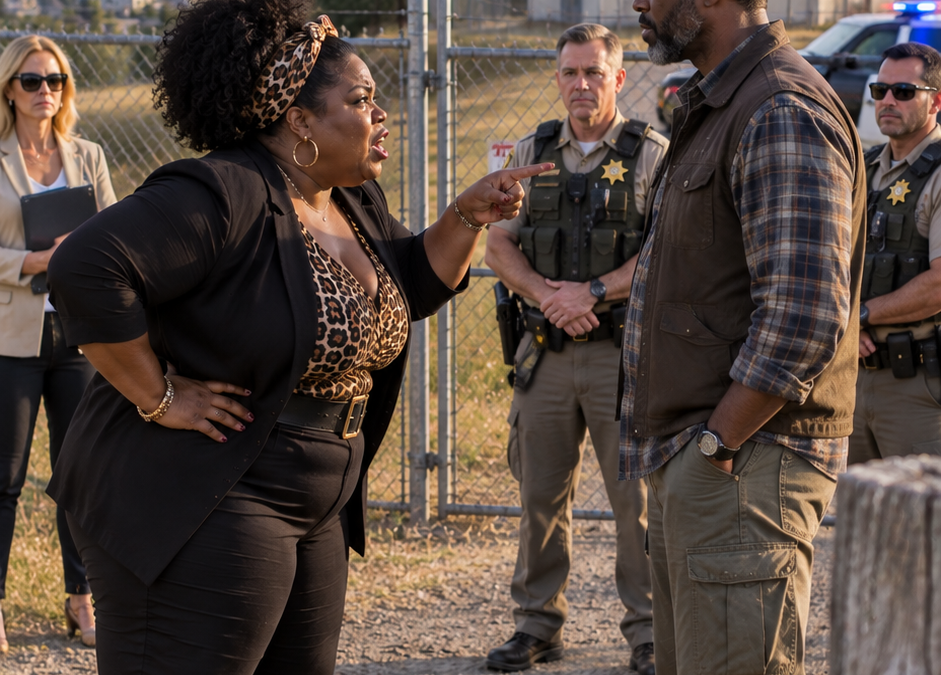
Dana’s white SUV came up the hill much too fast.
She stopped behind my truck at an angle.
Got out holding her phone.
Charcoal coat.
Low heels.
Bad shoes for gravel.
She walked toward me.
“What are you doing on association property?”
I lowered the camera.
“You need to stop calling it that.”
“You’ve been notified in writing.”
“The utility has a crew coming. I’m checking my boundary markers on my property.”
I lifted the clipboard.
“My stamped survey is right here. You can look at it.”
“I don’t need to look at your papers.”
That word again.
Papers.
As if recorded documents were clutter.
“I need you to leave.”
“No.”
I did not raise my voice.
Just one word.
Her expression changed.
Until that second, I think Dana had genuinely believed I would eventually submit to her confidence.
Letter.
Sign.
Meeting.
Threat.
Surely somewhere in that sequence I was supposed to become uncomfortable enough to leave my own land.
When I did not, she reached for the only greater authority she had left.
“I warned you.”
She dialed 911.
I stood still.
And listened.
That call mattered because of the words she chose.
Dana did not say:
“We have a property-line dispute.”
She did not say:
“There’s a man here who claims he owns the parcel.”
She did not say:
“He has shown us a deed and survey that we haven’t reviewed.”
She said there was a man trespassing at a water facility.
Twice.
Then she added that I had previously been warned and that she was concerned about the security of the community water supply.
I had spent my career in municipal utilities.
I knew exactly what that language did.
A neighbor dispute becomes something else the instant somebody mentions a potential threat to critical infrastructure.
Different dispatch priority.
Different officer mindset.
Different risk.
I stood on my gravel road with an engineering clipboard in my hand and realized Dana had just described me to law enforcement as someone who might threaten drinking water for 206 homes.
So I did something I wish nobody ever had to think about.
I put the clipboard on my truck.
Slowly took out my phone.
Started recording.
Not to trap Dana.
To record myself.
My hands.
My location.
My behavior.
The first cruiser arrived nine minutes later.
The second came less than a minute after.
Officer Tessa Monroe got out of the lead vehicle.
Late thirties.
Dark hair pulled tightly back.
Her movements were calm.
Not lazy.
Controlled.
The kind of calm you see in somebody who has spent years arriving at scenes where the person talking fastest is not necessarily telling the truth.
Dana reached her first.
She spoke for nearly three minutes.
I was not a member of Crest Haven Hills.
Correct.
I had been warned in writing.
Also true, although she left out what I had sent back.
I had ignored those warnings.
The association maintained the hillside.
There was no legitimate reason for me to be near the water facility.
I had been photographing fences.
Checking markers.
Walking around the area.
Then her voice lowered.
She said she was concerned about “what someone might be planning around the water supply.”
Officer Monroe listened.
When Dana finished, Monroe turned to me.
“Sir, your name?”
“Desmond Avery.”
“What are you doing here?”
“I own this parcel. I’m checking my survey monuments and documenting structures installed across my boundary.”
I kept both hands visible.
“I have not entered the city enclosure. I haven’t touched the lock or any utility equipment. The utility itself notified me yesterday that a crew would be here this morning.”
“Do you have documentation showing ownership?”
“Yes. It’s in the folder on my truck.”
“Go ahead.”
Before I reached for it, I said,
“Officer, there’s one question I’d ask you to put to Ms. Whitlock before this goes any further.”
Monroe waited.
“Ask her which parcel number the association owns on this ridge.”
Dana made an irritated sound.
“Don’t let him turn this into a paperwork argument.”
Officer Monroe looked at her.
“Ma’am, trespassing is a paperwork argument.”
Dana went silent.
“Somebody owns the property,” Monroe continued. “Somebody doesn’t. That’s what I need to establish.”
Dana recovered.
“Our records are maintained by a professional management company. We can provide whatever documentation is necessary through appropriate channels.”
Monroe wrote something in her notebook.
I opened the folder.
First, my deed.
Then the stamped survey.
Then the 1997 subdivision plat.
I pointed to my parcel.
“See this?”
Monroe leaned closer.
“NOT A PART.”
“Yes.”
Then I showed her the easement.
“This hatched strip is the city utility corridor. Fifty feet wide. Recorded in 1968.”
I traced the survey line.
“This is my boundary. The tower enclosure is located within my parcel. The city has permanent rights to access it.”
Then I opened the HOA declaration.
“These are the association common areas. They’re identified by tract number.”
Monroe read for a moment.
“None of these are up here.”
“No.”
Dana glanced at the documents.
Then she laughed.
A quick dry sound.
“Those are old papers. Anybody can print old papers.”
“They’re recorded instruments,” I said. “You can pull the same copies at the county recorder.”
We heard a diesel engine coming up the lane.
A white utility truck appeared around the bend.
City seal on the door.
It stopped behind the cruisers.
The man who climbed out was not the technician I had expected.
It was Graham Hensley.
Fifty-seven.
Water utility chief.
Thirty years in municipal water.
He and I had worked on two projects together years earlier.
One transmission-main relocation.
One pressure-zone study.
Graham was the least theatrical person I had ever met.
He could discuss a catastrophic pump failure in the same tone most people used to order lunch.
He got out.
Removed his hard hat.
Looked at the police cars.
Then at me.
Then Dana.
Then the HOA sign farther down the lane.
“Somebody want to tell me what’s happening at my tank?”
Dana walked toward him and extended her hand.
“Dana Whitlock. President of the Crest Haven Hills Homeowners Association. Thank you for coming. We’ve been dealing with an individual repeatedly accessing the facility.”
Graham looked at me.
Then back at her.
“Accessing it how?”
“He’s been photographing the fence. He’s been warned multiple times that this is association property.”
Graham’s face did not change.
“Who told you the association owns this land?”
Dana blinked.
“I’m sorry?”
“Who told you?”
“We have maintained this hillside for years. The landscaping, mowing—”
“I didn’t ask who mows it.”
He was not rude.
Not loud.
That made the question heavier.
“I asked who told you the association owns it.”
For the first time since I met Dana, I saw her standing inside a silence she had not chosen.
Officer Monroe stopped writing.
Dana looked from Graham to the tower.
Then at me.
Graham waited.
Finally, he said,
“All right. Let’s put everybody on the same page.”
He pointed toward the tank.
“That tank, its foundation, risers, valve vault, controls—all city water utility.”
He pointed at the fence.
“Fence, gate, security equipment, lock—city.”
Then the access road.
“This corridor from the county road to the enclosure is a recorded city utility easement dating to 1968. We have the right to access it, maintain it, and keep it usable.”
Finally he pointed downward.
“But the dirt?”
He looked at Dana.
“Mr. Avery’s.”
Dana’s lips parted slightly.
Graham continued.
“The association owns nothing on this ridge.”
He indicated the enclosure again.
“Not the tank.”
Then the road.
“Not the corridor.”
Then the ground beneath us.
“And not the property.”
Dana’s face changed by layers.
The first part of her still wanted to argue.
The second was calculating.
The third had already understood.
Graham put his hard hat back on.
“Mr. Avery has more right to stand where he is than you do. He’s standing on his own parcel.”
Officer Monroe closed her notebook halfway.
“Ms. Whitlock, you called in a trespass complaint.”
Dana nodded once.
“To move forward with that, I need evidence the association has some possessory interest here. A deed. Recorded common-area plat. Something in your declaration. Do you have any of that?”
“I would need our management company to—”
“So not today.”
“That isn’t what I said.”
“For today, ma’am, it’s no.”
Monroe’s voice remained even.
Then she added,
“I also need you to understand something. You reported a trespasser at a water facility and raised concerns involving the water supply.”
Dana glanced toward her.
“That language changes the way officers respond. Mr. Avery has produced a deed, stamped survey, recorded easement, and association documents. The utility chief is also confirming his account.”
She paused.
“There is no evidence of trespass here.”
Then Graham looked down the hill again.
His eyes settled on the HOA sign.
“Actually, I have a different question.”
He started walking.
We followed.
“Who authorized the association to drive posts into my utility access corridor?”
Dana stopped.
“What?”
Graham pulled a tape measure from his truck.
That was when the morning became much worse for her.
During the previous five weeks, Dana had not merely sent letters.
She had directed association contractors to alter the ridge.
We walked the corridor together.
Officer Monroe came too.
The first obstruction was the sign.
Two galvanized posts.
The sign itself sat eleven feet inside my property line.
It also stood inside the city’s fifty-foot easement.
Farther up were six decorative steel bollards painted dark green.
They had been installed along the lane to make the road look more landscaped and controlled.
Three were inside the easement.
At the narrowest point, they reduced usable width from about twenty-two feet to just under sixteen.
Then came fourteen split-rail fence posts.
Several sat where the utility corridor widened near the tower.
Then the arborvitae.
Nine of them.
Freshly planted.
Placed in the exact maneuvering area used by maintenance trucks.
Finally, along the downhill edge, contractors had stacked decorative landscape stone.
The stone looked attractive.
It also narrowed the shoulder and weakened the usable turnaround area.
Nothing had failed.
That matters.
There had been no water outage.
No contamination.
No broken main.
No emergency delayed.
I have never exaggerated that part.
The danger was potential.
Graham measured between two bollards.
Then stood upright.
“My tank truck is nine feet wide at the mirrors.”
Dana folded her arms.
“My boom unit needs approximately eighteen feet of swing clearance and about twenty-four feet when we deploy outriggers.”
He looked down at the tape.
“You’ve given me fifteen feet nine inches here.”
Dana started to speak.
Graham pointed toward the enclosure.
“If I have a valve failure at two o’clock in the morning in February and a crew can’t position a boom truck because somebody decorated my access road, that’s not an aesthetic issue.”
He looked at her.
“That becomes a service problem for two hundred six houses.”
She glanced at the bollards.
“They can be removed.”
“Yes.”
Graham rolled up the tape.
“They will be.”
Dana’s posture stiffened.
“We were never informed that this road had specific clearance requirements.”
Graham looked almost surprised.
“You never asked us.”
That sentence landed harder than anything else he had said.
Dana turned toward me.
“This entire situation could have been avoided if Mr. Avery had been clearer from the beginning.”
I could not believe it.
“You mean when I emailed you my parcel number?”
She looked away.
“Or when I gave you the deed book and page?”
“Desmond—”
“Or the easement recording number?”
“This is not the place.”
“I offered to meet you at the recorder’s office.”
She faced me again.
“You allowed the association to proceed under a misunderstanding.”
“No.”
I kept my voice quiet.
“You proceeded after I corrected you.”
“That is not accurate.”
“It’s in writing.”
I let the silence stay there.
“Both of ours are.”
A gray sedan came up the lane.
The driver was Nolan Pierce, the silver-haired board member from the clubhouse meeting.
He parked below the utility truck and walked up.
He looked at the cruisers.
The city truck.
The tape measure.
The bollards.
Dana.
“What happened?”
Nobody answered immediately.
Then Nolan looked at Dana.
“Has our attorney ever confirmed we own this?”
She frowned.
“Nolan, this really isn’t the time.”
“There are two police cars on the ridge.”
He looked around.
“I think this is exactly the time.”
Dana lowered her voice.
“We have always treated this as association property.”
“That’s not what I asked.”
He stepped closer.
“Has counsel ever given us a written opinion saying the hillside is common area?”
“Our position has always been—”
“Dana.”
His voice sounded tired more than angry.
“Has anyone actually checked?”
She did not answer.
Nolan pulled out his phone.
“I knew I remembered something.”
He scrolled.
Then stopped.
His face changed.
“Seven weeks ago, Eileen Foley sent the board an email.”
Dana’s head turned sharply.
“Nolan.”
He continued.
“She was reviewing the plat for the drainage issue on Willow Bend.”
I watched Dana.
Nolan read from the screen.
“‘I cannot locate the ridge parcel in the common-area schedule. The recorded plat appears to show the upper parcel as an excluded outparcel marked NOT A PART. Before the association takes any action regarding the tower road or upper slope, I recommend counsel confirm ownership and boundary.’”
Officer Monroe opened her notebook again.
Nolan looked at Dana.
“You replied.”
Dana said nothing.
He read the response.
Three words.
“Proceeding as planned.”
Nobody moved.
The wind shifted across the ridge.
Somewhere below us, a school bus stopped on one of the neighborhood streets.
Nolan looked up from his phone.
“Did the board vote on any of this?”
Dana’s answer came quickly.
“The work was administrative.”
“The sign?”
“Yes.”
“The bollards?”
“Maintenance improvements.”
“The letters to Mr. Avery?”
“Within the president’s authority.”
“Did the board vote?”
“Nolan—”
“Did we?”
She stared at him.
“No.”
One syllable.
But everything changed after it.
Until that moment, Dana could still present herself as a board president who had made an honest mistake about a boundary.
Now there was a dated warning.
Before the sign.
Before the contractor work.
Before the police call.
A board member had raised the exact ownership issue.
Dana had been told the plat did not appear to support her claim.
She had declined to verify it.
Then she had authorized work on property the HOA did not own.
Inside a municipal access easement.
Using association money.
Without a board vote.
And after receiving my documentation, she had called 911 and described me as a possible threat to the water supply.
Graham looked at Nolan.
“Who manages the contractor?”
Nolan closed his eyes briefly.
“The association.”
“Then effective immediately, no more association work anywhere inside this corridor until my office signs off.”
Graham returned to his truck.
He printed something from a portable unit inside the cab.
A few minutes later, he taped a written stop-work notice directly to one of the posts supporting the HOA sign.
I admit I appreciated the symmetry.
Officer Monroe spoke with her partner.
Then came over to me.
“No charges.”
“I assumed.”
She looked at the documents still spread across my hood.
“You had everything ready quickly.”
“I keep records.”
“Most people don’t have a deed and a survey sitting in a truck folder.”
“Most people don’t need them.”
She nodded.
“You knew you might.”
I did not answer.
She did not make me.
Then she walked to Dana.
Their conversation was quieter, but I heard enough.
Monroe explained that future calls involving a disputed property claim needed to be described accurately.
Calling someone a trespasser around critical infrastructure when ownership had not been established was not a substitute for establishing ownership.
Dana kept her face composed.
But her authority on that hill was finished.
The next six weeks were almost entirely paperwork.
Which suited me.
Paper is patient.
It does not get embarrassed.
It does not care who speaks more confidently.
It waits.
Crest Haven’s attorney ordered a title examination.
The board hired a licensed surveyor to independently certify the boundary.
I gave them written permission to access my parcel for surveying.
No games.
No obstacles.
I wanted the question dead permanently.
Not won temporarily.
The survey confirmed mine within a tenth of a foot.
My parcel had been created in 1926.
It had never been incorporated into Crest Haven Hills.
The subdivision plat was recorded in 1997.
The ridge parcel was clearly excluded.
NOT A PART.
The city utility easement had existed since 1968.
Twenty-nine years before Crest Haven Hills was platted.
The HOA common areas were exactly where its declaration said they were.
Entry monuments.
Pool tract.
Detention basins.
Creek trail.
Landscape strip along the lower slope.
Nothing above the toe of Bellweather Ridge.
Nothing around the tower.
Nothing along my access lane.
No hidden clause.
No dramatic loophole.
No ancient error waiting to be discovered.
The documents had been clear from the beginning.
Dana had simply refused to read them.
The remedy came in writing.
First, the HOA had to remove every unauthorized improvement within the city easement.
The sign came out.
Then the bollards.
Then the split-rail posts.
The arborvitae were dug up.
The landscape stone was removed.
The road shoulder was reconstructed and compacted to the utility’s requirements.
Graham personally inspected the restored corridor.
Twenty-two feet clear.
Then the association formally withdrew both notices it had sent me.
A separate letter confirmed my property was not subject to Crest Haven Hills covenants or HOA jurisdiction.
The internal property maps had to be corrected.
That included the large aerial photo in the clubhouse where somebody had drawn the false boundary around my land.
The black marker line disappeared.
But one requirement caused more resistance than all the others.
The HOA had to send written notice to all 206 homeowners explaining the ownership situation.
Not a vague correction.
Not an update buried in meeting minutes.
A direct notice.
The tower belonged to the city.
The city had a recorded easement.
The underlying land belonged to a private owner.
The ridge was not association common area.
Dana hated that requirement.
I understood why.
Removing bollards costs money.
Removing a sign is embarrassing.
But a letter enters every kitchen.
Every mailbox.
Every conversation between neighbors.
It creates a record of what happened.
The board meeting where the remedy was formally approved drew the largest turnout in Crest Haven history.
They ran out of normal meeting chairs and brought folding chairs from pool storage.
I stood at the back.
I was not an HOA member.
I did not want a resident standing because I had taken a seat.
Dana sat behind her name card.
She looked composed.
She had prepared a statement.
It was professionally written.
She referred to a “technical misunderstanding concerning historical parcel designations.”
She said the board had acted in good faith to protect community infrastructure.
She said procedures would be improved.
She promised “more robust verification practices going forward.”
It was an impressive paragraph.
The only thing missing was a person responsible for anything.
During open comment, I raised my hand.
Dana looked reluctant.
Nolan recognized me.
“Mr. Avery.”
I stood.
“I only have one point.”
The room quieted.
“A misunderstanding happens before somebody knows the facts.”
I looked at Dana.
“I sent the parcel number, deed reference, and easement information a month before the police were called.”
Nobody moved.
“You told me to learn respect.”
Dana’s jaw tightened.
“That wasn’t a technical misunderstanding.”
I sat down.
There was no applause.
I was glad.
I did not want applause.
A woman in the front row turned and looked directly at Dana.
Then the man beside her did.
Then someone farther back.
It moved through the room slowly.
For months, Dana had defined the story.
That night, she had to sit still while the people whose authority she had borrowed looked at her.
There is something else I need to explain because it mattered more to me than whether Dana lost a board position.
I had leverage.
Real leverage.
Two hundred six houses depended on a water tower physically located on my parcel.
City vehicles reached it using an easement across my property.
Dana had called the police on me.
She had suggested I might threaten a public water supply.
The HOA had placed signs and barriers on my land.
An angry man could have convinced himself he was entitled to retaliate.
Lock the gate.
Make access difficult.
Demand new compensation.
Hire an attorney to invent ways of making everybody uncomfortable.
I did none of those things.
Not because I am unusually forgiving.
Because it would have been wrong.
The easement belonged to the city.
The public right created in 1968 did not become mine to weaponize because an HOA president insulted me.
If I had interfered with that corridor, Dana would not have suffered first.
Some family on Alder Court might.
A child taking a bath.
An elderly couple.
A firefighter needing hydrant pressure.
A crew trying to reach a valve at two in the morning during freezing weather.
Those people had not called the police on me.
They had not sent me letters.
They had not planted a sign on my property.
Public infrastructure cannot become a bargaining chip just because the land beneath it belongs to somebody private.
I had spent my career believing that.
I was not going to abandon that principle the first time abandoning it would feel satisfying.
There was another reason too.
I did not want anything from Crest Haven Hills.
I did not want their money.
Their land.
Their dues.
Their admiration.
I wanted one simple thing.
The line where my property ended should be the line where their authority ended.
That was all.
The board voted unanimously that evening to remove Dana from all matters involving land, utilities, contractors, and boundaries until the next election.
Two months later, the annual election was held.
Dana lost the presidency to Nolan Pierce.
The margin was large enough that the final count felt almost ceremonial.
She stayed in Crest Haven Hills.
Her house remained beautiful.
I still occasionally saw her SUV on the county road.
We did not wave.
Nolan sent me a letter afterward.
A real apology.
Not “mistakes were made.”
Not “regret was expressed.”
He wrote that the board had asserted authority over property without verifying ownership.
That it had received information questioning the claim and failed to act on it.
That its president had involved law enforcement after the association possessed information that should have caused it to stop and investigate.
Then he wrote something I respected.
He said it was a board failure, not simply Dana’s failure.
He signed the letter.
A week later, he called.
“There’s one practical thing I’d like to ask.”
“What’s that?”
“For years our landscaper has mowed the narrow grass strip near the toe of your ridge. Residents like the way it looks from the street.”
I knew the strip.
It was mine.
Barely.
“We’d like to keep mowing it if you’re comfortable with that.”
“Sure.”
There was a pause.
Then I added,
“But put it in writing.”
Nolan laughed.
“I was hoping you’d say that.”
We created a one-page license agreement.
Mowing only.
Defined width.
No signs.
No structures.
No planting.
No grading.
No assumption of ownership.
Thirty-day termination right.
Revocable.
Signed by both sides.
It took maybe twenty minutes.
It cost almost nothing.
And it became one of my favorite documents because it transformed twenty years of assumption into something everybody could read.
That was the strange lesson underneath the entire fight.
The conflict had not begun because agreements were complicated.
It began because there had been no agreement and Dana behaved as if confidence could substitute for one.
Late the following spring, Graham drove up for the tower’s annual inspection.
Warm Tuesday.
Short-sleeve weather.
I walked up to meet him.
By then, we had developed a habit of spending ten minutes on the ridge talking about water systems and nothing important.
The white HOA sign was gone.
The bollards were gone.
The arborvitae had been transplanted to the clubhouse, where I was told they looked excellent.
The road shoulder had been rebuilt.
The utility corridor was clear.
Near the bottom of the lane, Graham’s department had installed one small official marker.
Four inches by twelve.
Green.
CITY UTILITY EASEMENT
PRIVATE PARCEL
Graham looked at it while pulling on his gloves.
“That’s confusing as hell.”
I smiled.
“Only if somebody refuses to read a deed.”
He laughed once.
Then climbed toward the tank.
I remained on the gravel.
From there, the whole neighborhood spread beneath me.
Two hundred six roofs.
Maples covered in new leaves.
Cars moving through the streets.
Sprinklers starting on lawns.
Somewhere down there, somebody was filling a coffee pot with water stored in the tank forty feet behind me.
And the arrangement suddenly seemed beautifully simple.
The tank belonged to the city.
The easement belonged to the public utility.
The land belonged to me.
Different rights occupying the same physical space without needing to compete.
That is what property records are designed to do.
Dana had seen the water tower and assumed ownership flowed outward from it.
The neighborhood depended on the tower.
Therefore the neighborhood must own the hill.
The association had mowed parts of the slope.
Therefore the association must control the road.
A map in the clubhouse showed the tower inside a marker line.
Therefore the marker line must be a boundary.
One assumption stacked onto another until she was willing to call police on the actual owner for standing on his own gravel.
But that was only part of what happened.
The deeper mistake was what Dana assumed about me.
I thought about our first conversation often.
The mailbox.
Her cream blazer.
My old pickup.
Survey stakes in the bed.
“Are you the maintenance man?”
There was nothing insulting about being a maintenance man.
I had spent half my career around maintenance crews and trusted many of them more than executives.
The insult was not the job she assigned me.
It was the certainty with which she decided I could not possibly be the owner.
After that, every new fact had to fight through the version of me she had already constructed.
The older truck.
The small house.
A Black man living alone on the ridge beside an expensive subdivision.
No gatehouse.
No stone monument.
No matching mailbox.
Nothing about me looked like the authority Dana recognized.
So when I said I owned the land, she treated it as an attitude problem.
When I sent a deed, she called it an email that had been noted.
When I sent a parcel number, she ignored it.
When I brought a survey, she did not open the folder.
When a board member warned her to verify ownership, she wrote,
“Proceeding as planned.”
Then she called 911.
That was the most revealing moment.
Not because calling police is automatically wrong.
Sometimes it is absolutely necessary.
It was revealing because Dana used law enforcement as a substitute for answering a property question.
She thought being the first person to call made her the first person to define the facts.
She told them there was a trespasser at a water facility.
She did not mention the recorded dispute.
She did not mention my documents.
She did not mention the board member’s warning.
She gave police the version of the story most likely to make them see me through her eyes.
What stopped that version was not charisma.
I did not make a speech.
I did not shout.
I did not need anyone to like me.
Officer Monroe asked for proof.
Graham asked who had told Dana the association owned the land.
Those two questions did more than months of argument could have done.
Show me the document.
Who told you?
That was the entire collapse.
I think about that whenever somebody tells me paperwork is boring.
Paperwork is boring when everything is going well.
So are fire extinguishers.
So are seat belts.
So are emergency generators.
The value appears when somebody decides reality should be something else.
My deed was boring.
The survey was boring.
The easement was boring.
The subdivision plat was boring.
The association declaration was exceptionally boring.
But on the morning two police cruisers were parked on my land, boring was exactly what I needed.
Nothing in those documents depended on my tone of voice.
Or Dana’s.
Nothing depended on who looked wealthier.
Who had a title.
Who had 206 homeowners behind them.
The boundary did not move because she sounded certain.
The easement did not expand because the HOA mowed grass.
Ownership did not transfer because somebody drew a line on an aerial photograph.
The land was what the record said it was.
That lesson stayed with Crest Haven too.
Nolan’s board changed procedures.
Any contractor work near a property boundary required a current survey reference.
Any claim involving association ownership had to be verified against the recorded declaration or title record.
Utility work had to be coordinated with the actual utility.
They also stopped using the old sales map as if it were a plat.
That alone probably prevented several future arguments.
I never joined the HOA.
Obviously.
But over time, my relationship with the neighborhood became ordinary.
Which was what I wanted.
A couple from Willow Bend started buying tomatoes from me in summer.
A retired teacher walked the county road most mornings and waved.
Kids occasionally stopped their bikes at the lower fence to watch city crews inspect the tower.
The landscaper kept mowing the licensed strip.
Every now and then, Nolan called before a contractor project just to make sure there was no boundary issue.
Those conversations usually lasted two minutes.
“Desmond, we’re replacing some irrigation near the lower slope. I emailed you the plan.”
“I’ll look at it.”
“Anything crosses the line?”
“I’ll tell you.”
That was it.
No drama.
No police.
No emergency meeting.
No lecture about respect.
Just people checking before acting.
The final irony was that Dana’s original stated goal had been protecting the community’s water infrastructure.
If she had actually asked the utility how to protect it, Graham would have told her to keep the access corridor clear.
Instead, under the banner of protecting the tower, she installed bollards, shrubs, fence posts, landscaping stone, and a sign inside the very easement crews needed to reach it.
She made emergency access worse while accusing me of being the danger.
And that is why I never needed revenge.
Facts had already done something more complete.
They forced everybody involved to look at what had actually happened.
The person Dana had called the threat was the property owner cooperating with the utility.
The person who claimed to protect access was obstructing it.
The association that claimed ownership had no deed.
The president who said nobody had told her had received warnings in writing.
Nothing I could have done out of anger would have improved that contrast.
Years of infrastructure work taught me that most failures do not begin with one enormous mistake.
They begin with a small unverified assumption.
Someone believes a valve is open.
Someone assumes a map is current.
Someone thinks another crew inspected the line.
Someone says, “That’s probably fine.”
If nobody checks, the assumption hardens into procedure.
Then one day everybody is standing around a failure wondering how something so obvious was missed.
Dana’s assumption was that Crest Haven owned the ridge.
At first, it was probably harmless.
Somebody had always mowed up there.
The water tower served the neighborhood.
The sales brochure showed the tower above the houses.
Maybe a previous president called it “our tower.”
Then the assumption hardened.
“Our tower” became “our facility.”
“Our facility” became “our property.”
“Our property” became “our access road.”
“Our access road” became a sign.
A letter.
A threat.
A police call.
By the time Dana stood beside two cruisers insisting I had no reason to be on the hill, she was no longer protecting an honest misunderstanding.
She was protecting all the decisions she had made because of it.
That is why she could not look at the survey.
The paper threatened too many choices at once.
A few months after everything settled, I was sorting old project files in my office when I found a photograph from one of my first municipal jobs.
I was twenty-nine.
Hard hat too clean.
Safety vest still bright.
Standing beside an old utility superintendent named Walter Briggs.
Walter taught me one of the rules I carried through my career.
He would hand a young engineer a map and ask,
“What do you know?”
We would point at something.
He would shake his head.
“No. That’s what the map says. What do you know?”
Then we would pull the deed.
Survey.
As-built drawings.
Field notes.
Locate the monument.
Open the vault.
Verify.
Walter used to say,
“Confidence is not a measurement.”
Dana would have hated him.
I wish she had met him.
The last time I saw her on the ridge was almost a year after the police call.
She did not come to see me.
She was walking with another homeowner near the lower road.
I happened to be replacing a washed-out section of gravel.
She saw me.
Stopped for half a second.
Then continued walking.
No confrontation.
No apology.
No final speech.
That was fine.
Some stories do not need reconciliation.
They need boundaries.
Mine was finally visible to everyone who mattered.
Not because I built a taller fence.
Because the record had been acknowledged.
I still own the same six acres.
The water tower still stands near the northern edge.
Utility trucks still climb the gravel road.
Sometimes they arrive before sunrise.
Sometimes after dark.
They call when protocol requires it.
I leave the road clear.
They maintain the system.
Crest Haven Hills still sits below me.
Two hundred six houses drinking from a city tank resting over private ground under a public easement created before almost everyone living there was born.
It works because each right has a limit.
The city has the right to reach its infrastructure.
I have the right to my property.
The HOA has authority inside the land and covenants that actually belong to it.
None of those things has to threaten the others.
The trouble started only when one person decided the limits did not apply to her.
Sometimes I walk to the edge of the ridge in the evening.
From there, the subdivision looks almost unreal.
Porch lights.
Trees.
Cars turning into driveways.
The tower above everything, catching the last light.
You would never know two police cruisers once sat on that gravel because an HOA president accused the landowner of trespassing there.
You would never know a sign once declared the road HOA property.
That is probably how it should be.
The scar does not need to remain just to prove the wound happened.
But one small green marker still sits near the road.
CITY UTILITY EASEMENT.
PRIVATE PARCEL.
It is not dramatic.
It does not mention Dana.
It does not tell the story.
It simply states two facts that can exist at the same time.
That marker might be the most accurate monument to the whole year.
Dana Whitlock believed authority was something you projected.
A title behind your name.
A clipboard.
A board table.
A professionally printed notice.
A phone call to the police.
Two hundred six households assuming you had checked the documents before speaking for them.
But authority without verification is fragile.
It survives only until somebody asks for the record.
Officer Monroe asked for a document.
Graham Hensley asked who had told Dana the association owned the land.
Dana had months to prepare for either question.
She never did.
Because she never imagined she would be the one required to prove anything.
That was the part she misunderstood from the beginning.
She thought I was the outsider who had wandered too close to her community’s water tower.
She thought the burden belonged to me.
Prove you belong here.
Explain yourself.
Ask permission.
Leave when told.
What she never considered was the simplest fact in the entire file.
The morning Dana Whitlock called the police because she believed I was standing where I did not belong, every step she took toward me carried her farther onto my land.








