𝗙𝗨𝗟𝗟 𝗦𝗧𝗢𝗥𝗬 The One Person My Father Feared Seeing Walked Into My Wedding Before I Did
𝗙𝗨𝗟𝗟 𝗦𝗧𝗢𝗥𝗬
I looked at them.
On the other side sat my father, my mother, and Tyler. I knew where they would be. Front row. My father relaxed and confident, waiting for me to cancel. My mother tense, possibly crying, but still sitting beside him. Tyler pretending boredom while watching for damage.
They thought they had taken everything they needed to take.
They thought lace and satin were the foundation of my courage.
I squared my shoulders and approached the doors.
My palms touched the oak.
Then someone behind me said my name.
“Claire.”
I stopped.
For one strange second, the church disappeared.
The guests. The organ music. The morning light spilling through stained glass. All of it seemed to fall away beneath the sound of that voice.
I knew it.
Even after sixteen years.
I turned.
A woman stood several yards behind me near the stone steps.
She was tall, silver-haired, and dressed in a simple navy suit. She carried a narrow wooden box tucked beneath one arm. Time had changed her face, but not enough to hide the sharp Bennett cheekbones or the pale gray eyes that looked so much like my father’s.
“Aunt Rebecca?”
She smiled.
It was small and uncertain around the edges.
“Hello, Claire.”
I had not seen my father’s older sister in almost sixteen years.
Not since I was a teenager.
Not since one Thanksgiving dinner ended with my father and Rebecca arguing in the kitchen while the rest of us sat silently around a table covered with cooling food.
Nobody ever explained the argument.
The next morning, Rebecca left.
After that, whenever I asked why she didn’t visit anymore, Dad gave the same answer.
“Rebecca made her choices.”
Eventually, I stopped asking.
And now she was there.
At my wedding.
Carol glanced between us.
“You know her?”
“She’s my aunt.”
Rebecca approached slowly, as if she understood that arriving after sixteen years carried a weight no ordinary greeting could hold.
“I hope I’m not intruding.”
I stared at her.
“How did you even know?”
Her eyes shifted toward the church doors.
“Your mother called me.”
That surprised me more than seeing Rebecca herself.
“My mother?”
“Three weeks ago.”
I looked through the narrow opening between the doors.
From where I stood, I could see the front pew.
Mom sat rigidly beside Dad.
Tyler leaned forward, elbows on his knees.
And my father—
My father was staring directly at Rebecca.
The confidence had vanished from his face.
Not because he looked frightened.
Because he looked stunned.
Rebecca followed my gaze.
“I wasn’t sure I should come,” she said quietly. “Susan told me things had been difficult. She thought maybe having someone here from your father’s side of the family might matter to you.”
I swallowed.
“Did she tell you what happened last night?”
Rebecca’s expression changed.
“Not until this morning.”
For a moment, anger flashed across her face, but she controlled it.
Then she looked at my uniform.
Her eyes softened.
“You look beautiful.”
I laughed once, though tears suddenly burned behind my eyes.
“This wasn’t exactly Plan A.”
“The best things rarely are.”
That sounded so much like the woman I remembered that my chest tightened.
When I was twelve, Rebecca had been the first person who ever took me to an air show.
Dad had claimed he was too busy.
Rebecca drove me three hours instead.
I remembered standing beside a runway with my hands pressed over my ears while a fighter climbed almost vertically into the bright summer sky.
I remembered turning to her afterward and saying, with complete certainty, “I want to do that.”
She had crouched beside me and replied, “Then learn everything you can, and don’t let anyone decide your ceiling for you.”
Years later, when I told Dad I wanted to join the Air Force, he called it impractical.
Rebecca had already vanished from our lives by then.
I had often wondered what she would have said.
Now I knew.
Carol touched my elbow.
“The ceremony can wait another minute.”
I nodded.
Rebecca looked relieved.
Then her eyes moved toward the doors again.
“I didn’t come to create a scene, Claire.”
“I know.”
“If Frank asks me to leave, I will.”
“No.”
My answer came immediately.
She looked back at me.
“You came for me?”
“Yes.”
“Then you’re staying for me.”
Something flickered across her face.
Gratitude, perhaps.
Or sadness.
“Okay.”
Carol smiled.
“That settles that.”
I looked down at myself.
There was no lace.
No veil.
No sweeping train.
No careful softness I had spent months imagining.
But suddenly, I understood something.
I was not walking into that church despite what I wore.
I was walking in as myself.
Not the version of me my family found easiest to accept.
Not the daughter who apologized for succeeding.
Not the sister who pretended Tyler’s jokes did not sting.
Just Claire.
Carol returned to her seat.
Rebecca moved toward the side aisle.
The organist waited.
I stood alone again.
Then the music began.
I opened the doors.
The congregation rose.
A hundred faces turned toward me.
There was a brief ripple of surprise, followed almost immediately by smiles. I heard a few soft gasps, then a murmur that moved through the room like wind.
Ethan stood at the altar.
The moment he saw me, his expression changed.
Not disappointment.
Not confusion.
His eyes filled with something warm and steady.
Pride.
He did not even glance at the uniform as if it required explanation.
He looked at me.
And smiled.
That nearly broke me.
I began walking.
There had been endless conversations about who would escort me down the aisle. My father had assumed it would be him. I had originally agreed because some traditions felt simpler to preserve than challenge.
That morning, I made a different decision.
I walked alone.
Not angrily.
Not defiantly.
Simply because I could.
When I passed the first pew, Dad’s eyes met mine.
For once, I could not read him.
Mom was crying silently.
Tyler looked down at his hands.
Rebecca sat several rows behind them.
She did not look at my father.
She looked only at me.
When I reached Ethan, he took my hand.
“You okay?” he whispered.
“I am now.”
He squeezed my fingers.
“You look incredible.”
“I’m wearing government property to my wedding.”
His mouth twitched.
“Very budget-conscious.”
I almost laughed aloud.
That was Ethan.
He could make room for humor without minimizing anything.
The ceremony continued.
Our pastor had apparently been told that something unusual had happened, though thankfully not the details. He said nothing about appearances. Nothing about adversity. Nothing about family conflict.
He simply spoke about marriage.
About two adults choosing, deliberately and repeatedly, to build a home in which each person was safe being fully known.
Those words stayed with me.
Fully known.
For most of my life, I had confused being known with being judged.
Ethan had taught me the difference.
When it was time for our vows, his voice trembled.
“I promise,” he said, “that home will never be somewhere you have to become smaller to fit inside.”
I had not heard that line before.
We had written our vows separately.
My throat tightened.
He knew.
Of course he knew.
Not every detail.
But enough.
I took a breath before saying mine.
“I promise to choose honesty over silence, partnership over pride, and love that leaves room for both of us to grow.”
Mom bowed her head.
I noticed.
Dad did too.
Then the pastor pronounced us husband and wife.
The church erupted in applause.
For the first time since two that morning, I stopped thinking about what had been destroyed.
I kissed my husband.
And the day became ours again.
The reception was held at a renovated farmhouse outside town. Long windows overlooked autumn fields turning gold beneath the afternoon sun. I had worried that everyone would ask about my uniform.
Some did.
But fewer than I expected.
Most people simply congratulated us.
Ethan’s grandmother hugged me and said, “You know, I married in a borrowed suit because my dress never arrived.”
“You never told me that.”
“Nobody asked.”
Then she wandered away in search of cake.
Life, it turned out, contained far more imperfect weddings than bridal magazines admitted.
Lieutenant Colonel Holloway attended with his wife. He shook Ethan’s hand, then looked at me.
“Captain Bennett.”
“Sir.”
“You do realize you’re technically overdressed for cake.”
“Yes, sir.”
“Carry on.”
His wife elbowed him.
“Stop being colonel-ish at the wedding.”
“Yes, ma’am.”
For several hours, the atmosphere remained almost normal.
Almost.
Dad kept his distance.
Mom circulated nervously, checking flowers that did not need checking and straightening place cards that were already straight.
Tyler disappeared outside twice.
Rebecca stayed near the back of the room.
She did not approach Dad.
Dad did not approach her.
Their silence had shape.
History.
I could feel it from across the room.
Eventually, I found Mom standing alone beside the dessert table.
“Can we talk?”
She stiffened.
“Of course.”
We stepped onto the side porch. A breeze moved across the fields.
For a moment, neither of us spoke.
Then she said, “I’m sorry.”
I studied her.
“For calling Rebecca?”
“No.”
She looked at me.
“For last night.”
The words came quietly.
“I should have stopped him.”
“Yes.”
She flinched, though my voice was calm.
I had spent years making difficult truths easier for other people to hear.
I did not want to do that anymore.
“You should have.”
“I know.”
“Why didn’t you?”
Mom looked across the field.
“I told myself your father was angry and would calm down.”
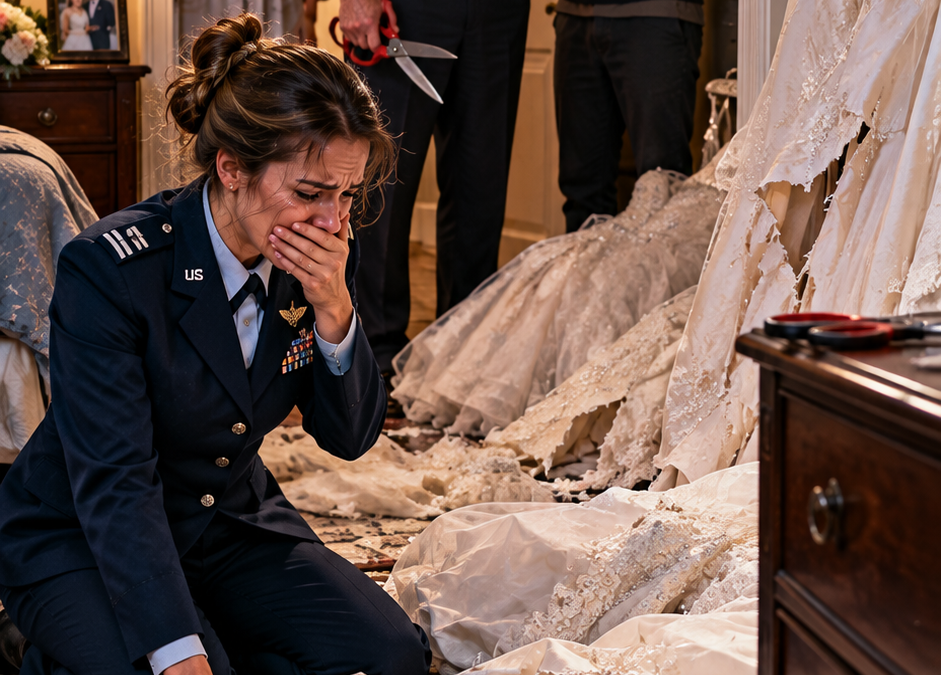
“He had scissors in his hand.”
“I know.”
“You stood there.”
“I know.”
There were tears in her eyes.
I did not rush to comfort her.
That surprised both of us.
“I’ve spent a very long time convincing myself that keeping the peace was the same as keeping the family together,” she said.
I waited.
“It isn’t.”
“No.”
She wiped her cheek.
“I learned that too late.”
“Not necessarily.”
She turned toward me.
“But something has to change.”
“I know.”
“Not just today.”
Her shoulders dropped.
“Claire, I called Rebecca because I was worried.”
“About the wedding?”
“About your father.”
I felt myself tense.
She noticed.
“Not because I thought he would hurt anyone.”
“Then what?”
“Because you were getting married, and every time someone mentioned the wedding, he became… bitter.”
That was not news.
“What does Rebecca have to do with that?”
Mom hesitated.
“I thought she might understand.”
“Understand what?”
“I think that’s something your father needs to tell you.”
“No.”
The word came sharper than I intended.
Mom looked surprised.
“I’m done with everyone telling me there’s some secret family explanation I’m not allowed to know.”
“You’re right.”
“Then tell me.”
She took a long breath.
“Your father wasn’t always opposed to the Air Force.”
I stared at her.
“He acts like my career is a personal insult.”
“I know.”
“He skipped my promotion ceremony.”
“I know.”
“He said flying was a ridiculous way to spend my life.”
“I know what he said.”
“Then what are you talking about?”
Mom looked toward the reception windows.
Dad was visible inside, talking to one of his cousins.
“When Frank was eighteen,” she said, “he wanted to fly.”
I almost smiled because the statement sounded absurd.
“My father?”
“Yes.”
“He hates airplanes.”
“No, Claire.”
Mom’s expression was strange.
Sad.
“He hates what they remind him of.”
Before I could ask anything else, the porch door opened.
Rebecca stepped outside.
She stopped when she saw us.
“I can come back.”
“No,” I said. “Apparently everyone knows something except me.”
Rebecca glanced at Mom.
Mom gave the faintest nod.
Rebecca exhaled.
“Frank applied to the Air Force Academy.”
I laughed.
Neither woman joined me.
My laughter died.
“You’re serious.”
Rebecca nodded.
“He was accepted.”
The world seemed to tilt, not dramatically, but enough that old memories rearranged themselves.
Dad refusing to come to my first solo flight celebration.
Dad changing the channel when military aircraft appeared on television.
Dad telling me medals were “just pieces of metal.”
Dad’s strange silence the day I earned my wings.
“Why didn’t he go?”
Rebecca leaned against the porch railing.
“Our mother got sick.”
“My grandmother?”
“Yes.”
I barely remembered Grandma Bennett. She died when I was six.
“Dad stayed to help her?”
Rebecca nodded.
“So you went instead?”
Her eyes met mine.
“Not to the Academy. I enlisted two years later. Eventually, I became an officer.”
I blinked.
My father had never told me Rebecca served.
Not once.
“What branch?”
“Air Force.”
I stared.
Rebecca gave a humorless little smile.
“Twenty-four years.”
“What?”
“I retired as a colonel.”
My mind struggled to catch up.
“You were an Air Force colonel?”
“Yes.”
“And Dad never mentioned it?”
“No.”
“Why?”
Rebecca was quiet.
Mom stepped back toward the door.
“I should let you two talk.”
I looked at her.
“Mom.”
“I’m not running away.”
She touched my hand.
“I’m going inside because this part belongs to Rebecca.”
Then she left.
Rebecca watched the door close.
“What happened between you and Dad?” I asked.
“A lot of small things that became one large thing.”
“That’s vague.”
“It’s also true.”
She looked toward the fields.
“When Frank gave up the Academy appointment, he never admitted how much it hurt him. Our mother needed help. Our father was working constantly. Frank told everyone he didn’t care.”
“But he did.”
“Very much.”
“And then you enlisted.”
“Two years later.”
“He thought you abandoned them.”
“Yes.”
“Did you?”
Rebecca considered the question carefully.
“In some ways, probably.”
I had not expected that.
“I sent money home,” she said. “I called. I came whenever I could. But Frank stayed. He handled doctor appointments. Groceries. Bills. Everything.”
“That doesn’t explain sixteen years of silence.”
“No.”
“What does?”
Rebecca’s jaw tightened slightly.
“You.”
“Me?”
“When you were sixteen, you told everyone at Thanksgiving that you wanted to attend the Academy.”
I remembered.
Dad had immediately dismissed the idea.
I had shouted at him.
Rebecca had defended me.
Then came the argument in the kitchen.
“What did you say to him?”
“I told him not to punish you for a decision he made eighteen years earlier.”
I closed my eyes.
“And?”
“He told me I had no right to interfere in his family.”
“So you stopped visiting?”
“He told me never to come back.”
I looked through the glass.
My father was laughing weakly at something a guest had said.
Suddenly, he seemed less simple than he had that morning.
Not better.
Not excused.
Just more complicated.
“I would have come anyway,” Rebecca said, “if I thought you wanted me.”
“I didn’t know.”
“I know.”
“Why didn’t you contact me when I became an adult?”
Her face softened with regret.
“I asked myself that question many times.”
“And?”
“I was proud too.”
The admission came without defense.
“I thought Frank would tell you what happened eventually. Then years passed. I heard about your career through relatives.”
“You knew?”
“Every promotion.”
A smile appeared.
“I may have bragged about you to people who had never met you.”
I looked down.
For years, I had imagined there was something wrong with me because success seemed to make my father withdraw.
Now I stood beside a woman who had quietly celebrated every step.
“You should have called,” I said.
“I should have.”
I nodded.
“So should I.”
“You were the child, Claire. That wasn’t your responsibility.”
Before I could answer, Ethan appeared through the doorway.
He paused.
“Am I interrupting?”
“No.”
He walked toward us.
“Your husband has been asked approximately forty-seven questions about why the bride disappeared.”
“And?”
“I told them you were conducting classified operations.”
Rebecca laughed.
Ethan held out his hand.
“You must be Rebecca.”
Her eyebrows rose.
“How did you know?”
“You have Claire’s eyes.”
They shook hands.
“Ethan Cole.”
“I know.”
He looked at me.
“You okay?”
“Yes.”
And I meant it.
Confused.
Angry.
Sad.
But okay.
“I’ll give you two a minute,” Rebecca said.
As she passed Ethan, she touched his arm.
“Take care of her.”
Ethan smiled.
“She’d object if I tried.”
“I like you already.”
When she went inside, Ethan leaned against the railing beside me.
“What happened?”
I told him.
Not every detail.
Just enough.
When I finished, he looked through the window at Dad.
“That explains some things.”
“It explains them,” I said. “It doesn’t excuse them.”
“No.”
“I don’t know what I’m supposed to do with this.”
“Nothing today.”
I looked at him.
“Nothing?”
“You got married forty-five minutes ago.”
“So?”
“So maybe today you’re allowed to eat cake before solving three generations of Bennett family history.”
I rested my head briefly against his shoulder.
“You’re annoyingly reasonable.”
“It’s one of my worst qualities.”
Dad approached me near sunset.
The reception had begun thinning. The golden fields outside the windows had turned amber, then copper. People were laughing more softly now, full from dinner and tired from dancing.
Dad stood several feet away.
“Can we talk?”
Ethan looked at me.
I nodded.
He left without making a performance of it.
Dad shoved his hands into his pockets.
I had never seen him look unsure of where to put them before.
“Your aunt told you.”
It was not a question.
“Some of it.”
He nodded.
“I figured.”
“Why didn’t you tell me?”
“Would it have changed anything?”
“Yes.”
He looked skeptical.
“I might have understood you.”
“I didn’t want understanding.”
“What did you want?”
His eyes moved toward the windows where Rebecca stood talking to Carol.
“I wanted none of it to matter anymore.”
“But it did.”
His mouth tightened.
“Yes.”
The admission surprised me.
I waited.
Dad looked older than he had the previous week.
“I was good,” he said.
“At flying?”
“At everything they wanted.”
There was no boastfulness in his voice.
Only memory.
“I had the grades. The nomination. The fitness tests. I thought I knew exactly what my life would look like.”
“And Grandma got sick.”
“Yeah.”
“You stayed.”
“Someone had to.”
“You resented Rebecca because she left.”
“I did.”
“Do you still?”
He did not answer immediately.
“I resented anyone who could leave.”
That sentence landed differently.
Dad looked at me.
“When you joined, I knew you’d leave too.”
“Dad, children grow up.”
“I know that.”
“Do you?”
He looked down.
Perhaps he had expected anger.
Calm questions seemed harder for him.
“You were proud of me when I was little,” I said.
“I’m still proud of you.”
“No.”
His head came up.
“You don’t get to rewrite that today.”
I kept my voice low.
“You mocked my career. You missed ceremonies. Every accomplishment became an argument. If you were proud, you hid it very well.”
His face reddened with shame.
“I did.”
“Why?”
“I don’t know.”
“That’s not enough.”
“No.”
He looked toward the fields.
“Maybe because every time you moved forward, I remembered the place where I stopped.”
There it was.
Not an excuse.
Not a grand confession.
Just a sad, ordinary truth.
He had mistaken my life for a judgment on his.
I suddenly understood him better.
And understanding did not erase the morning.
“Last night,” I said, “you crossed a line.”
“I know.”
“No, Dad. I need you to hear this.”
He faced me.
“What you did wasn’t about a dress. You wanted to prove that you could decide whether my wedding happened.”
His eyes dropped.
“I was angry.”
“You wanted control.”
“Yes.”
That answer surprised me.
“I don’t know when I became that person,” he said.
I thought about it.
“Probably slowly.”
He gave a tired nod.
“Probably.”
“I’m not pretending it didn’t happen.”
“I’m not asking you to.”
“You might someday.”
“I won’t.”
I studied him.
“Then what are you asking?”
He struggled for several seconds.
“A chance to become someone you might want in your life again.”
The word again hurt more than I expected.
I looked away.
Behind us, laughter floated from the reception room. Someone had started another song.
My wedding was continuing without needing my attention.
That felt strangely comforting.
“I can’t answer that today.”
“I know.”
“I’m not ready to forgive you.”
“I know.”
“And if you blame Rebecca, Mom, Ethan, or my job for what happened, we’re done talking.”
“I won’t.”
I nodded.
Then Dad surprised me.
He did not ask for a hug.
He did not say family should forgive family.
He did not remind me he was my father.
He simply said, “I’m sorry, Claire.”
And walked away.
It was the first apology I could remember receiving from him that contained no but.
Ethan and I left the reception around eight.
There was no dramatic send-off.
We wanted quiet.
Carol had booked us one night at a small inn before we flew out for our honeymoon the following afternoon.
When we reached the car, Rebecca was waiting beside it with the wooden box she had carried into the church.
“I have something for you.”
She handed it to me.
“What is it?”
“Open it somewhere quiet.”
I frowned.
“You’re becoming mysterious in your old age.”
“I was mysterious when I was young too.”
“You weren’t.”
“No. I really wasn’t.”
We both smiled.
Then Rebecca hugged me.
At first, I stood stiffly.
Sixteen years could not disappear in one afternoon.
Then something in me softened.
I hugged her back.
She whispered, “I should have come sooner.”
“Yes.”
“I’m sorry.”
“I know.”
When we separated, she looked at my uniform.
“For what it’s worth, Captain Bennett, you chose well.”
“The husband or the career?”
“Both.”
Ethan opened the passenger door.
“I’m putting that on our Christmas cards.”
At the inn, we changed clothes, ordered room service, and sat cross-legged on the bed eating grilled cheese sandwiches because neither of us had eaten enough at the reception.
The wooden box sat on the dresser.
Finally, Ethan nodded toward it.
“You’ve looked at that thing nineteen times.”
“I have not.”
“Twenty.”
I sighed.
“Fine.”
I carried it to the bed.
The box was old walnut, polished smooth at the corners from years of handling. A small brass clasp held it shut.
Inside lay several envelopes.
Under them was a silver pilot-wing pin.
Not military issue.
Older.
Civilian.
Beneath it was a black-and-white photograph of two teenagers standing beside a small propeller airplane.
One was Rebecca.
The other was my father.
He could not have been older than seventeen.
He was smiling.
Not the tight, controlled smile I knew.
A huge, open grin.
He had one arm around Rebecca and the other resting on the aircraft.
On the back, someone had written:
Frank’s first solo. June 18, 1978.
I stared at it for a long time.
“He flew,” I whispered.
Ethan looked over my shoulder.
“Apparently.”
I opened the first envelope.
Inside was an old Air Force Academy appointment letter.
My father’s name sat at the top.
Francis Michael Bennett.
I read it twice.
Then three times.
“He really was accepted.”
Ethan said nothing.
There was another envelope beneath it.
This one was newer.
My name was written across the front.
Claire.
The handwriting was not Rebecca’s.
I knew it.
Even after all these years.
My grandfather’s.
Grandpa Bennett had died when I was nineteen. I had loved him fiercely. He had taught me how to change a tire, sharpen a kitchen knife, make pancakes, and tell when rain was coming by watching swallows fly.
My hands trembled slightly as I opened the envelope.
Inside was a folded sheet of paper.
The date at the top was seventeen years earlier.
I began reading.
Dear Claire,
If Rebecca has given you this, then either I finally became brave enough to explain some things, or I ran out of time.
I stopped.
Ethan touched my hand.
“You don’t have to read it tonight.”
“Yes,” I said softly. “I do.”
I continued.
Your father once dreamed of flying.
I know he has probably never told you.
When his mother became ill, Frank gave up an opportunity he had worked years to earn. He did it because he loved his family, but somewhere along the way, sacrifice turned into resentment.
I wish I had understood sooner what it cost him.
I wish I had told him that choosing us did not mean he had to spend the rest of his life punishing himself.
My vision blurred.
I blinked until the words sharpened.
Then I reached the final paragraph.
Claire, there is something else you should know.
The summer you turned sixteen, Frank came to me after you told the family you wanted to fly.
He was angry, but beneath that anger, he was terrified.
He said, “What if she’s better than I ever could have been?”
I told him I hoped she was.
He cried.
I froze.
Ethan stopped breathing beside me.
The last lines were written more heavily than the rest.
Your father was proud of you long before he knew how to show it.
But pride kept hidden too long can become indistinguishable from rejection.
If Frank never finds the courage to tell you the truth, do not build your life around waiting for him.
Fly anyway.
Love,
Grandpa
I lowered the letter.
The room was completely silent.
For seventeen years, that letter had existed somewhere.
Waiting.
I looked back inside the box.
There was one final envelope.
Unlike the others, it was sealed.
Across the front were five words in my father’s handwriting.
For Rebecca, when I’m ready.
I looked at Ethan.
“Did Rebecca know this was in here?”
“I don’t know.”
I turned the envelope over.
It had never been opened.
And suddenly I realized the family story I had heard that afternoon was still incomplete.
Because whatever my father had written to his sister, he had never found the courage to send.
For a moment, I was tempted to open it.
The impulse was sharp.
After everything my father had done, after all the years of secrecy, after the dresses, after the silence, some part of me felt entitled to know.
But I held the envelope in my hands and understood something I might not have understood the day before.
Truth mattered.
So did consent.
That letter was not mine.
I placed it back in the box.
Ethan watched me.
“You’re not opening it?”
“No.”
“You want to.”
“Very much.”
“But?”
“But I spent my whole life having people make decisions about my story without me.” I closed the lid of the box. “I’m not doing that to Rebecca.”
Ethan leaned over and kissed my forehead.
“That’s why I married you.”
“For my restraint with sealed correspondence?”
“That and the government-property wedding outfit.”
I laughed, and the sound surprised me because it was real.
The next morning, before Ethan and I left for the airport, I called Rebecca.
She answered on the second ring.
“Claire?”
“I opened the box.”
A quiet breath.
“And?”
“Thank you.”
“I wasn’t sure whether giving it to you on your wedding night was fair.”
“It was a lot.”
“I know.”
“But I needed it.”
She was quiet.
Then I said, “There was an envelope inside. For you. From Dad.”
Silence.
Not ordinary silence.
The kind that arrives when the past suddenly stands in the room.
“What?”
“It’s sealed.”
“He wrote to me?”
“Yes.”
“When?”
“I don’t know. But it looks old.”
Rebecca did not speak for several seconds.
Then she asked, “Did you read it?”
“No.”
Her voice changed.
Softened.
“Thank you.”
“It belongs to you.”
“And Frank?”
“I think it belongs to both of you now.”
Another silence.
Then she said, “Are you asking me to talk to him?”
“No. I’m asking if you want the letter.”
“Yes.”
There was no hesitation.
“I’ll bring it after the honeymoon,” I said.
“No.”
That surprised me.
“I’ll come get it today.”
“Rebecca, we’re leaving for the airport.”
“Then I’ll meet you there.”
I almost smiled.
“You Bennett people are dramatic.”
“You are a Bennett person.”
“I married out yesterday.”
“Blood doesn’t process paperwork that quickly.”
She met us at the airport forty minutes later.
She arrived breathless, her silver hair windblown, her navy suit replaced with jeans and a sweater. For the first time, she looked less like a figure from family history and more like a woman who had driven too fast because she was afraid courage might expire.
I handed her the envelope.
She held it with both hands.
For a moment, I thought she might cry.
Instead, she looked at me.
“Whatever is in this, I’m sorry you had to carry it even for a night.”
“I’m not.”
She frowned.
“It taught me something.”
“What?”
“That not every secret is mine to solve.”
Rebecca’s face softened.
“You sound more grown-up than all of us.”
“No. Just tired.”
She laughed once.
Then she hugged me again, more naturally this time.
When she pulled back, Ethan said, “We have to board.”
Rebecca nodded.
“Go. Be happy. That will irritate your father and inspire him in equal measure.”
I smiled.
“Will you call me after you read it?”
“If you want.”
“I do.”
On the plane, I looked out the window as the runway slid beneath us.
For most of my life, flying had felt like escape.
That morning, it felt like choosing direction.
Ethan took my hand.
“You okay?”
“I’m getting there.”
He nodded.
“That counts.”
We spent our honeymoon on the Oregon coast, in a little inn where the ocean sounded like something breathing in its sleep. We ate too much seafood, walked under gray skies, and talked about everything except my father for the first two days.
On the third morning, Rebecca called.
I stepped onto the balcony with a blanket around my shoulders.
“Did you read it?”
“Yes.”
Her voice was raw.
“What did it say?”
She took a shaky breath.
“It was an apology.”
I looked out at the water.
“For what?”
“For telling me never to come back. For making me the villain because he didn’t know what to do with his own regret. For letting you grow up without me.”
My throat tightened.
“And?”
“And he wrote that he wasn’t ready to send it because sending it meant admitting he had been wrong before anyone forced him to.”
“That sounds like him.”
“It does.”
“Are you going to call him?”
“I already did.”
I gripped the balcony railing.
“What happened?”
“He answered.”
“And?”
“At first, nothing. We just breathed at each other like idiots.”
Despite everything, I smiled.
“Then he said, ‘You found it.’”
“Not hello?”
“No.”
“Very Dad.”
“Yes.”
“What did you say?”
“I said, ‘Claire gave it to me unopened.’”
I closed my eyes.
“What did he say?”
Rebecca’s voice broke slightly.
“He said, ‘Of course she did.’”
I did not expect that to hurt.
It did.
Not because it was cruel.
Because it sounded like pride.
The kind my father had hidden so long that I had stopped believing it existed.
Rebecca continued.
“He asked if I would meet him when you get back.”
“And will you?”
“Yes.”
“Are you ready?”
“No.”
I laughed softly.
“Apparently readiness is not a requirement in this family.”
“No,” she said. “Maybe willingness is.”
The day after Ethan and I returned, I went to my parents’ house.
Not because everything was fixed.
It wasn’t.
Not because I was ready to forgive my father completely.
I wasn’t.
I went because I needed to say what came next before everyone else wrote it for me.
Dad answered the door.
For a second, we stared at each other.
He looked smaller than I remembered, but I knew that was not physical. He had lost the armor of certainty. Without it, he was just a man in his sixties standing in the doorway of a house where he had done damage he could no longer explain away.
“Claire,” he said.
“Dad.”
He stepped back.
“Come in.”
Mom was in the kitchen.
Tyler was not there.
That was good.
I was not ready for him.
Rebecca’s wooden box sat on the table. So did the envelope, now opened.
Dad looked at it, then at me.
“You didn’t read it.”
“No.”
“Why?”
“Because it wasn’t mine.”
He nodded slowly.
“I should have sent it.”
“Yes.”
“I should have told you about the Academy.”
“Yes.”
“I should not have touched your dresses.”
“No. You shouldn’t have.”
His face tightened.
“I’ll pay for them.”
“You will.”
He seemed almost relieved to hear something concrete.
“But that’s not the real consequence,” I said.
He looked at me.
“For now, you don’t get to be close to my life just because you’re my father. You get what I choose to give you. If you want more, you earn trust by changing consistently, not by making one apology on a wedding day.”
Mom closed her eyes briefly.
Dad took it without arguing.
“What does that mean?”
“It means no comments about my career. No insults disguised as jokes. No using Mom as a messenger. No blaming Rebecca. No blaming Ethan. No blaming the past like it walked into my room with scissors.”
He flinched.
Good.
Not because I wanted him hurt.
Because I wanted him awake.
“And Tyler?” Mom asked quietly.
I turned toward her.
“Tyler laughed while Dad destroyed my dresses. I’m not ready to see him.”
She nodded.
“I understand.”
I looked back at Dad.
“If you want a relationship with me, you start by speaking to someone who can help you understand why you did what you did.”
“You mean counseling.”
“Yes.”
He looked down.
The old Dad would have scoffed.
The old Dad would have said therapy was for people who liked blaming their parents.
The old Dad would have turned the conversation into an argument he could win.
This Dad did none of that.
“Okay,” he said.
One word.
Quiet.
I believed him only a little.
But a little was more than I had expected.
Rebecca arrived twenty minutes later.
When my father opened the door and saw her, the room became still.
They looked at each other across sixteen years of pride.
Rebecca spoke first.
“Frank.”
“Rebecca.”
No one moved.
Then Dad said, “I read your face before you said a word. You’re still mad.”
Rebecca’s mouth twitched.
“I’ve had sixteen years to practice.”
He looked down.
“I deserved that.”
“You did.”
Mom drew in a breath.
Dad nodded.
Then he said the sentence I had never thought I would hear.
“I’m sorry I made you pay for the life I thought I lost.”
Rebecca’s expression changed.
Pain crossed her face so quickly it might have been mistaken for anger.
“You didn’t lose that life because of me.”
“I know.”
“No,” she said. “I need you to really know it.”
He nodded.
“I’m trying.”
Rebecca looked at him for a long time.
Then she said, “I’m sorry I stayed away from Claire.”
Dad closed his eyes.
“That part is on me.”
“It’s on both of us.”
I stood in the doorway between the kitchen and the living room, listening to two people finally speak sentences that should have been spoken before I was old enough to memorize silence.
Nothing was fixed that day.
No one hugged dramatically.
No music swelled.
Dad and Rebecca sat at the table and talked for forty minutes. Sometimes their voices shook. Sometimes they sharpened. Once, Rebecca stood and walked outside for air. Dad did not follow her. He waited. When she came back, he said, “Thank you for coming back.”
She said, “Don’t make me regret it.”
He said, “I’ll try not to.”
It was not perfect.
It was honest.
That was better.
A month after the wedding, a package arrived at Ethan’s and my apartment.
Inside was a framed piece of lace.
At first, I did not understand.
Then I recognized it.
A section from one of the destroyed gowns.
The lace had been cleaned, repaired as much as possible, and set against deep blue velvet. Beneath it was a small engraved plate.
Not ruined. Remembered.
There was a note from my mother.
Claire,
I saved this from the floor that night and didn’t know why. I think maybe I wanted proof—not of what your father did, but of what you survived without becoming cruel.
I am learning the difference between peace and silence.
Love,
Mom
I sat on the couch holding the note for a long time.
Ethan read it beside me.
“That’s something,” he said.
“Yes.”
“Enough?”
“Not yet.”
“But something.”
I nodded.
“But something.”
Two months after the wedding, Dad began counseling.
Three months after the wedding, Tyler sent a text that said, Sorry about the dress thing.
I stared at it, then deleted it.
Not because I would never speak to him again.
Because if he wanted forgiveness, he would have to learn that an apology required more than naming the category of harm like it was a weather event.
Six months after the wedding, Dad came to my base for a family day.
I had invited Mom.
Not him.
She asked if he could come.
I nearly said no.
Then I said yes with conditions.
No comments.
No sulking.
No rewriting history.
No pretending the wedding was a funny family story.
He agreed.
When he arrived, he stood near the flight line in sunglasses and a plain jacket. For most of the morning, he was quiet. Too quiet, maybe, but not hostile.
Then a young airman recognized me and asked a question about a training procedure. I answered. Dad watched the exchange from a few feet away.
After the airman left, Dad said, “You’re good at that.”
“At what?”
“Explaining without making someone feel stupid.”
I looked at him.
He seemed uncomfortable, but he did not take the words back.
“Thank you,” I said.
A jet roared overhead before either of us could say anything else.
Dad looked up.
For the first time in my life, I saw his face as he watched an aircraft climb.
Not angry.
Not dismissive.
Grieving.
Awed.
Both.
When the sound faded, he said, almost too quietly to hear, “I used to dream about that.”
“I know.”
He glanced at me.
“Rebecca told you.”
“And Grandpa.”
His mouth tightened.
“Of course Dad left a letter.”
“He loved you.”
Dad looked back at the sky.
“I know that now.”
“Did you not know it then?”
“I thought love meant needing me to stay.”
That sentence stayed with me.
Because for years, I had thought love meant making myself smaller so my father would not feel left behind.
We had both been wrong.
A year after the wedding, Ethan and I hosted Thanksgiving.
That was my idea.
Probably reckless.
Possibly brave.
Maybe both.
Rebecca came.
My parents came.
Tyler came too, after sending an actual apology three weeks earlier. Not perfect, but real enough to open the door.
Before dinner, Dad asked if he could say something.
My entire body tensed.
Ethan touched my knee under the table.
Dad stood at the end of the dining room, looking deeply uncomfortable.
“I used to think family meant nobody left,” he said. “Then I thought family meant nobody talked about who had left. I was wrong both times.”
No one moved.
He looked at Rebecca.
“I’m glad you’re here.”
Rebecca nodded.
Then he looked at me.
“And Claire, I’m glad you flew anyway.”
It was not enough to erase everything.
Nothing could.
But it was the first time my father spoke about my life as something that belonged to me, not something taken from him.
After dinner, Rebecca showed Ethan old photos from her Air Force years. Mom laughed more easily than I remembered. Tyler helped with dishes without being asked, which was so unusual that I checked the driveway to make sure no one had replaced him with a more useful cousin.
Dad found me on the porch after sunset.
The air was cold.
For a while, we stood side by side.
Then he said, “Do you still have the lace your mother framed?”
“Yes.”
“Good.”
I waited.
He swallowed.
“I think about that night a lot.”
“So do I.”
“I wish I could take it back.”
“You can’t.”
“I know.”
For once, that sentence carried no defense.
Just truth.
He looked at me.
“I’m grateful you didn’t let it stop you.”
“I almost did.”
His face changed.
I had never told him that.
“I almost called Ethan and canceled everything,” I said. “For a few minutes, I believed you.”
Dad looked devastated.
Good.
Some truths needed to hurt.
Then I said, “But only for a few minutes.”
He nodded slowly.
“I’m glad it was only a few minutes.”
“So am I.”
The porch light hummed above us.
Inside, I could hear Ethan laughing at something Rebecca said.
Dad followed the sound.
“He’s good for you.”
“Yes.”
“He doesn’t make you smaller.”
“No.”
Dad nodded.
“I’m learning what that looks like.”
That was as close to a promise as he could make.
I accepted it as a beginning.
Not an ending.
Later that night, after everyone left, Ethan and I stood in the living room surrounded by empty plates and half-folded napkins. The framed lace hung on the wall near the hallway. Across from it, I had placed the photo of my father’s first solo flight and one of Rebecca in uniform.
Not to worship the past.
To stop hiding it.
Ethan came up behind me and wrapped his arms around my waist.
“You survived Thanksgiving with the Bennetts,” he said.
“I’ve flown in thunderstorms. I was prepared.”
He kissed my shoulder.
“You okay?”
I looked at the framed lace.
Then at the photograph of my father at seventeen, smiling beside an airplane before life taught him to turn grief into control.
Then at Rebecca in uniform, young and serious, carrying her own guilt into a career nobody in my house had been allowed to discuss.
Then at my reflection in the window.
Captain Claire Bennett Cole.
Daughter.
Pilot.
Wife.
Woman in uniform.
Bride without a dress.
Bride anyway.
“Yes,” I said. “I’m okay.”
And I meant it.
My father had believed that destroying my dresses would stop my wedding.
He thought satin was the ceremony.
He thought lace was the courage.
He thought if he took away the image I had planned, I would have nothing left to walk in with.
But when the church doors opened, I walked in wearing the life I had built.
Every ribbon.
Every scar.
Every choice.
Every mile I had flown away from the house that taught me love could sound like criticism.
And when the one person my father never expected to see stepped into that church, she brought more than old family history.
She brought proof that silence can last for years and still not be stronger than truth.
My wedding did not happen the way I planned.
It happened the way I needed.
No dress.
No illusion.
No father giving me away like I was something he owned.
Just me, walking forward in uniform, toward a man who saw me fully and did not ask me to shrink.
For a long time, I thought my family had destroyed the softest part of me.
They had not.
They only forced me to learn that softness was never in the dress.
It was in the courage to keep loving without disappearing.
And that morning, in front of everyone who thought I had been broken, I did not disappear.
I opened the doors.
I walked in.
And I chose my life.








