𝗣𝗔𝗥𝗧 𝟮 The One Page Vanessa Forgot About Was Sitting in My File Cabinet While She Ordered My Solar Panels Removed
𝗣𝗔𝗥𝗧 𝟮
The process had worked.
Two hours later, I received an email from Vanessa’s official association account.
Twelve words.
“Your revised solar application has been approved. You may proceed with installation.”
I forwarded that email to Evan.
Printed it.
Stapled it behind the signed form.
Then put everything in a manila folder.
On the tab I wrote:
SOLAR — HOA / PERMIT / INSPECTION.
That folder went into the second drawer of my office file cabinet.
And for eleven months, I barely thought about it.
Meridian installed the system sixteen days later.
Eighteen modules.
Three rows of six.
Black frames.
Black backsheets.
The conduit was painted to match my garage exactly as Vanessa had requested.
The city inspector came Thursday morning.
Checked racking.
Grounding.
Disconnect labels.
Rapid shutdown.
Conduit support.
Breaker.
Placards.
He signed the final inspection card without one correction.
Meridian commissioned the system that afternoon.
Friday morning, I was producing electricity.
My first full electric bill after commissioning was $61.
I stood in my kitchen and laughed.
Out loud.
At a utility bill.
The system went through fall.
Winter.
Spring.
We had a hailstorm hard enough to damage roofs two streets over.
The modules were fine.
No complaints.
No letters.
No HOA warnings.
Nothing.
Eleven months.
Then the HOA presidency changed.
The old president, Harold Mays, was a retired postal supervisor.
Nice man.
Ran meetings in golf shirts.
Believed agendas should fit on one sheet of paper.
His general philosophy seemed to be that eighty percent of neighborhood conflicts disappeared if nobody fed them for a week.
He stepped down for health reasons.
A special election followed.
Only one person actively campaigned.
Vanessa.
She knocked on doors.
Printed flyers.
Promised stronger standards.
More consistent enforcement.
Greater protection of property values.
Turnout was around thirty-one percent.
In HOA terms, that was apparently a mandate.
The neighborhood changed almost immediately.
Vanessa used three phrases constantly.
“Property values.”
“Architectural consistency.”
“Community image.”
The words themselves were harmless.
The way she used them was not.
Things that used to earn a polite note began producing formal violation letters with case numbers.
A basketball hoop that had stood on Sycamore for six years suddenly became a compliance problem.
Decorative planters became color issues.
Fence stains.
Mailbox posts.
Trailer parking.
One homeowner received a written warning because his mulch was described as “excessively red relative to neighborhood landscaping tones.”
Within two months, Brierwood issued more formal violations than it had during the previous three years.
I stayed out of it.
Not because I thought Vanessa was right.
Because most fights are expensive in attention before they are expensive in money.
My panels were approved.
My yard was maintained.
My garbage cans were hidden.
I had no reason to volunteer for her attention.
Then came a Saturday morning in June.
I was washing a coffee cup when I saw a white sedan stop near my driveway.
Vanessa got out.
Cream blazer.
Already hot outside.
With her was a younger man carrying a tablet.
I recognized him vaguely as a recent architectural committee appointment.
They did not knock.
They stood at the end of my driveway staring up at the roof.
Vanessa pointed.
The younger man tapped something onto his tablet.
I dried my hands.
Went outside.
“Morning.”
Vanessa did not return it.
“Who authorized you to put those panels in that position?”
For a second, I thought she might be joking.
“I had HOA approval before installation.”
She looked at me.
“Written approval?”
“Yes.”
“From whom?”
“The architectural committee.”
She gave me a small smile.
“Darius, I know how association files work. You don’t need to explain the process to me.”
There was something in the way she said my first name.
Slow.
Patient.
As though I had misunderstood a basic instruction.
I knew that tone.
I had spent nineteen years walking into mechanical rooms where contractors saw a Black man in work boots and assumed I was there to carry equipment.
You learn not to react every time.
If you do, you spend your life exhausted.
I let the heat rise through my neck.
Then let it go.
“The layout you’re looking at is the layout that was approved.”
“The panels are too visible from the main street.”
“That visibility was shown in the rendering.”
“They’re inconsistent with Brierwood’s character.”
“The committee reviewed that too.”
She stared at me.
Then said,
“If you actually had a valid approval, we wouldn’t be standing here.”
That sentence stayed with me.
Because it was backward.
A person who had reviewed a file and discovered a problem would normally say:
“I checked your application and found an issue.”
Or:
“The approval does not cover this configuration.”
Vanessa did not say either.
She started with the conclusion.
If the approval existed, reality was somehow wrong.
She turned.
Walked back to the sedan.
The younger committee member followed without speaking.
I stood in the driveway looking at eighteen perfectly ordinary solar modules.
Two days later, Vanessa returned.
This time in early evening.
People were walking dogs.
Watering flowers.
A few kids were riding scooters.
Her timing was not accidental.
She got out with a manila envelope.
I started toward her.
She did not wait.
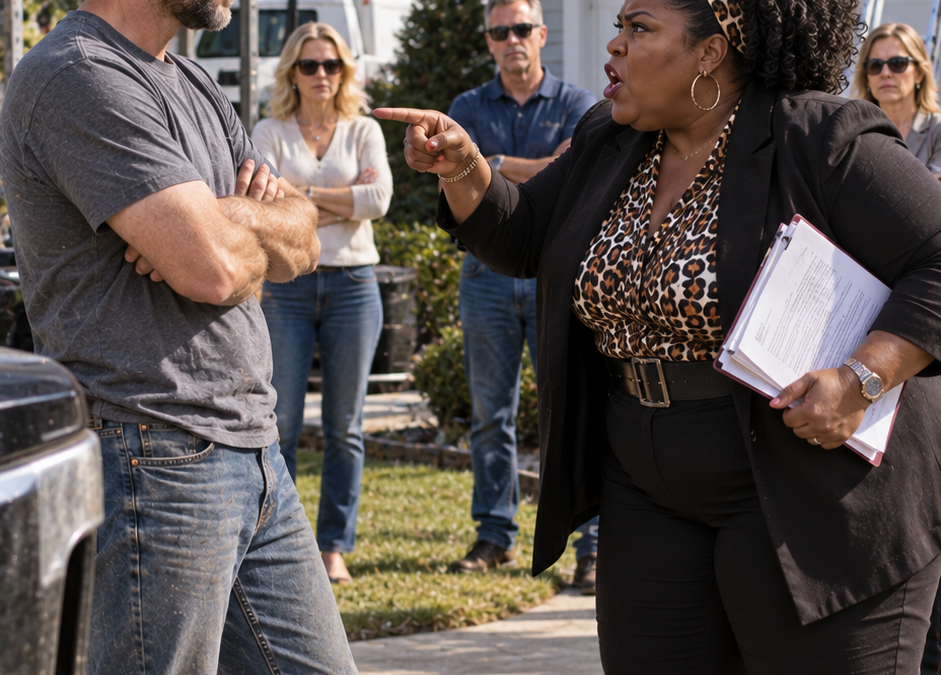
She pointed straight at my roof.
“Those solar panels come down today.”
Loud.
Loud enough for the street.
Then she pushed the envelope against my chest.
Inside was a formal Notice of Violation.
Unauthorized Exterior Roof Modification.
Initial assessment:
$2,500.
Continuing noncompliance subject to additional penalties.
Thirty-day corrective requirement.
I read the notice once.
Then again.
Vanessa folded her arms.
“You understand?”
“I understand what this says.”
“Good.”
She looked at the roof.
“You work maintenance, right?”
“Yes.”
“So taking a few panels down shouldn’t be difficult for you.”
Then she laughed.
Small.
Almost friendly.
That sentence hit harder than the fine.
Not because there is anything wrong with maintenance work.
I am proud of what I do.
But I knew what she meant.
My hands were useful.
My head, in her estimation, was not.
Across the street, my neighbor Ray Morgan stopped coiling his hose.
Ray was a retired Marine and wore the same faded Corps cap every time he mowed.
He looked from Vanessa to me.
I felt my jaw lock.
Then I asked one question.
“Which covenant section am I violating?”
Vanessa looked at the notice.
“You’ll receive everything you need in writing.”
“What section?”
“The board has reviewed the matter.”
“That isn’t a section.”
Her eyes narrowed.
“Don’t turn something simple into something expensive.”
Then she walked to her car.
I watched her leave.
Went inside.
Put the notice on my kitchen table.
And stared at the violation code.
That code mattered.
It was not for deviations from approved architectural work.
It was not for maintenance.
Not for appearance.
Not for setback.
It was the code used when somebody performed exterior work without submitting for architectural review at all.
In the association’s own shorthand, Vanessa was not saying:
Your approved project has a problem.
She was saying:
You never asked permission.
That was a factual claim.
And it was false.
I walked into my office.
Opened the second drawer.
Found the manila folder.
Then I laid every document across the floor.
Original twenty-six-page application.
Delivery receipt.
Email submission.
Vanessa’s modification request.
Revised drawings.
Signed approval.
Approval email.
City permit.
Final inspection card.
Meridian commissioning report.
I arranged them by date.
Then took out a legal pad.
Application submitted.
Modification requested.
Revision submitted.
Approval signed.
Email permission received.
Installation scheduled.
City inspection.
Commissioning.
No gaps.
No contradictions.
Nothing retroactive.
The system had been approved before Meridian put one foot on my roof.
I called Evan.
He remembered the job.
“Lot 38? Black-on-black array?”
“That’s me.”
“What happened?”
“HOA says it was never approved.”
Silence.
Then:
“What?”
I explained.
Evan pulled the company file while we were speaking.
Meridian kept project records for seven years.
He had my HOA approval stamped into the job folder.
The internal log showed the date Meridian received it.
Company policy prevented scheduling installations in governed communities until written association approval had been verified.
They also had before-and-after photographs.
As-built measurements.
Crew verification photos.
“If you need a declaration,” Evan said, “I’ll sign one.”
“Thanks.”
“I’ve seen this before.”
“What usually happens?”
“The file wins.”
That was exactly what I intended.
I stopped reacting.
Started requesting.
I sent a formal records demand to the HOA and management company.
No insults.
No accusations.
Four items.
One: identify the exact covenant provision I allegedly violated.
Two: provide minutes from the board or committee meeting where my installation was determined noncompliant.
Three: provide the complete architectural file for Lot 38.
Four: explain the authority under which a previously issued written approval had been rescinded, revoked, or otherwise invalidated.
Vanessa replied four days later.
One sentence.
“The board has determined your installation is non-compliant.”
No covenant.
No minutes.
No file.
No revocation.
Nothing.
I replied.
Subject:
WHICH BOARD MEETING?
Body:
Please identify it.
No answer.
Two days later, I received another notice.
Additional penalties:
$500.
Balance:
$3,000.
That was when I understood the strategy.
She was not trying to prove the violation.
She was making resistance expensive.
Removing the array would cost roughly four to five thousand dollars in labor.
Then roof repairs.
Then I would lose over a thousand dollars annually in energy savings.
Add the fines.
Potential legal costs.
It becomes easy for a person to say:
Fine.
Just make it stop.
Vanessa was betting I would do that.
Instead, I requested the hearing guaranteed under the covenants before fines became final.
Certified mail.
Return receipt.
Her response came a week later.
And it introduced a new argument.
She wrote that the document I had relied on was not actually an approval.
It was a “preliminary architectural acknowledgment.”
I sat at my desk reading that phrase.
Then I pulled out the form.
Three options.
Denied.
Approved as Submitted.
Approved as Submitted with Modification.
No preliminary acknowledgment.
I searched all forty-one pages of the covenants electronically.
“Preliminary architectural acknowledgment” appeared zero times.
Architectural procedures.
Zero.
Fee schedule.
Zero.
Meeting rules.
Zero.
It did not exist.
Vanessa had invented a category because the real category hurt her argument.
I went to the clubhouse one Wednesday.
She was at a table going through binders.
I placed the approval in front of her.
“Can you explain this?”
She barely looked.
“I know what it is.”
“You called it preliminary.”
“It was part of the preliminary review process.”
I pointed at the checked box.
“It says approved.”
“You’re reading a few words on a form and imagining you understand the governing documents.”
I took a breath.
Then pointed at the bottom.
“What does your signature mean?”
Vanessa glanced down.
“I sign a lot of papers.”
That answer stayed with me more than anything she said afterward.
“I sign a lot of papers.”
It was probably the most truthful statement she made.
Somewhere along the way, her signature had stopped meaning commitment.
It was just something her hand did because she was in charge.
She signed.
People complied.
Documents followed.
She expected reality to remain flexible around her title.
I gathered the form.
Before I could leave, she changed arguments again.
“Even if the committee approved a solar installation generally, what you built is not what we approved.”
I stopped.
“What’s different?”
“The array extends too far toward the street-facing roof edge.”
“How far?”
“That isn’t the point.”
“It is exactly the point.”
“You’ll receive the specifics.”
Of course I would.
Later.
After she found them.
I went home.
Called Evan again.
Three hours later, Meridian emailed the as-built package.
Approved drawing:
four feet six inches from ridge.
Two feet from eave.
Three columns.
Six modules each.
As-built:
four feet six inches.
Two feet.
Three by six.
Meridian’s crew had photographed the tape measure against the racking during installation precisely because HOAs sometimes challenged completed work.
The approved layout and physical installation matched.
Exactly.
Now Vanessa’s story had three versions.
First:
No approval existed.
Second:
The approval existed but was preliminary.
Third:
The approval existed but the installation did not match it.
Each argument appeared only after the previous one failed.
That is one of the clearest signs I know that somebody is not investigating facts.
They are protecting an outcome.
My record requests continued.
Then something unexpected happened.
Vanessa stopped answering them personally.
The association secretary did.
Lydia Harrow.
Forty-four.
Exact.
Quiet.
The kind of person who probably alphabetized spices.
I had lived four hundred yards from Lydia for six years and barely spoken to her.
She became one of the most important people in the entire dispute because she believed records existed to be produced.
No drama.
No interpretation.
I requested archived architectural minutes.
She sent fourteen months.
I opened the files after dinner.
Pool furniture.
Holiday decorations.
Mailboxes.
Fence replacements.
Tree removals.
Then I found my lot.
SOLAR APPLICATION — LOT 38.
Approved 4–0.
I stared at the screen.
There it was.
The association’s own permanent minutes.
Four committee members.
Unanimous approval.
No preliminary language.
No conditions other than the conduit modification I had already satisfied.
Then I read the full entry.
Motion by Vanessa Whitmore to approve Lot 38 solar application.
Seconded.
Vote: 4–0.
I leaned back.
Then laughed.
Alone.
In my kitchen.
Not only had Vanessa signed the approval.
She had made the motion.
She had personally asked the committee to approve my roof.
Two days later, Lydia sent archived committee emails.
I opened one from Vanessa to the other members.
Date:
the morning before the vote.
Subject:
Lot 38 Solar Revision.
“Mr. Cole has satisfied the requested conduit modification. I see no remaining architectural issue.”
I printed it.
Now I had three independent layers.
Her signed form.
Her direct email telling me to proceed with installation.
Her motion and unanimous committee vote.
Actually four, if I counted the internal email recommending approval.
Any one should have resolved a good-faith dispute.
Together, they ended it.
But I did not send them to Vanessa.
That decision was harder than people might think.
Every part of me wanted to attach the records to an email with one line:
Anything else?
I wanted her to read them alone.
I wanted the private satisfaction.
Then I thought about how quickly she had invented the second and third explanations.
If I showed her everything three weeks before the hearing, she would have three weeks to invent a fourth.
And even if she backed down privately, the record might remain muddy.
Maybe my fines disappeared without explanation.
Maybe the file showed an unresolved violation.
Maybe another president tried again later.
I did not need Vanessa to privately admit defeat.
I needed the board to acknowledge the approval publicly and permanently.
So I put everything into a black three-ring binder.
Tabs.
Chronology.
Index.
Then I closed it.
For eleven days, I said almost nothing.
Vanessa escalated.
Six days before the hearing, she sent a settlement offer.
If I signed an agreement promising to remove the solar array within thirty days at my expense, the HOA would reduce the penalties from $3,500 to $1,000.
If I refused, the matter could be sent to association counsel and I might be responsible for legal fees.
I read that letter twice.
Then filed it too.
Two days later, I encountered Vanessa outside the clubhouse.
I had stopped to verify the hearing was still on the calendar.
She changed direction toward me.
“You’re turning something you cannot win into a war.”
“Am I?”
She stepped closer.
“I have worked with associations longer than you’ve lived in Brierwood.”
“That’s true.”
She seemed surprised.
I continued.
“You’ve been here long enough to remember what you signed.”
Something flickered across her face.
Brief.
A search.
Like somebody trying to remember whether they had left the stove on.
Then it disappeared.
“The board will do what the board will do.”
She walked away.
That was the first time I think she wondered what I had.
But she did not check.
If she had, the hearing never would have happened the way it did.
Around then, I finally learned why my roof mattered so much to her.
Grant Holloway explained part of it later.
Grant was sixty-one.
Retired civil engineer.
Nine years on the HOA board.
Vanessa had been promoting something she called the Streetscape Uniformity Program.
It would standardize the appearance of roof planes visible from the main road.
Roofing materials.
Vent colors.
Mounted equipment.
Solar.
Metal surfaces.
Anything visible.
The problem was that implementing it properly required amending the covenants.
That required a two-thirds membership vote.
Vanessa did not have it.
Two board members already thought the proposal went too far.
My solar array was one of the most visible in the neighborhood.
If she could force mine down under existing enforcement authority, she would have an example.
A precedent.
The next homeowner asking for visible solar could be told:
We made Cole remove his.
No amendment necessary.
No two-thirds vote.
Just enforcement.
There was no hidden financial conspiracy.
No kickback.
No vendor scam.
No stolen reserve money.
The truth was more ordinary.
And in some ways more disturbing.
Vanessa had developed an appetite for control.
She liked being the person who decided.
Once that became part of her identity, every calm question sounded like defiance.
My real offense was not solar.
It was that I did not behave intimidated.
The hearing was Thursday at seven.
Normally, architectural hearings attracted maybe six people.
That night there were more than forty.
Possibly fifty.
Neighbors in folding chairs.
Several standing along the wall.
Ray was there in his Marine Corps cap.
A couple from Sycamore who had received basketball-hoop warnings.
A woman who had been fined over a shed color.
Word had traveled.
The board sat behind a long table.
Vanessa in the center.
Leather portfolio.
Bottle of water.
Grant to her left.
Lydia to her right with her laptop and minute book.
I sat at a smaller table facing them.
My black binder was closed in front of me.
Vanessa opened with a prepared statement.
She called my installation unauthorized.
Visually intrusive.
Inconsistent with the neighborhood’s established architectural character.
She said I had performed the work without valid architectural review.
She said I had refused repeated opportunities to resolve the matter cooperatively.
She recommended affirming the violation.
Upholding all fines.
Ordering removal within thirty days.
I did not interrupt.
Not once.
I had learned something from an old foreman years earlier.
Never interrupt somebody who is carefully explaining exactly how wrong they are.
When Vanessa finished, Grant leaned toward his microphone.
“Mr. Cole, do you have evidence that this installation was approved?”
I opened the binder.
Tab one.
I stood.
Carried one page to the board.
“This is the architectural decision form for Lot 38.”
I placed it in front of Grant.
“The decision box states ‘Approved as Submitted with Modification.’ The listed modification concerns conduit color. That modification was completed.”
Grant read it.
Then slid it toward Vanessa.
Her eyes dropped.
I watched her recognize her signature.
The room became silent.
She looked up.
“That form was preliminary.”
I had expected it.
Tab two.
I removed the email.
“Then I would ask the board to review this.”
I placed it beside the form.
“Sent from the architectural committee chair’s official association address two hours after the form was signed.”
Grant adjusted his glasses.
I said,
“It reads: ‘Your revised solar application has been approved. You may proceed with installation.’”
Grant read it himself.
Out loud.
When he reached “You may proceed with installation,” someone behind me made a quiet sound.
Vanessa responded immediately.
“That email is being taken out of context.”
I looked at her.
She continued.
“It may have referred to proceeding to the next phase of the architectural process rather than physical installation.”
Nobody moved.
Even before I said anything, I could feel the room trying to understand how the words “proceed with installation” might mean “do not install.”
I did not argue.
Tab three.
Association minutes.
“This document came directly from the HOA’s archived architectural records in response to my written request.”
I handed it to Grant.
“May I read the relevant entry?”
He nodded.
I read:
“Motion by Vanessa Whitmore to approve Lot 38 solar application. Second by member Pruitt. Vote four to zero in favor.”
Then I stopped.
Looked directly at Vanessa.
“So which part was preliminary?”
No response.
“The unanimous vote?”
Silence.
“Your email?”
Nothing.
“Or your signature?”
The room stayed completely still.
Ten seconds is not long.
Unless fifty people are waiting for one person to speak.
Then it becomes enormous.
Vanessa finally moved.
She straightened.
“Regardless of earlier paperwork, the system installed on the property does not match the layout that was approved.”
Version four.
I nodded.
“I anticipated that.”
I opened tab four.
“Mr. Roark from Meridian Solar Works is available by phone. May I put him on speaker?”
Grant said yes before Vanessa could answer.
I called.
Evan picked up.
Identified himself.
Company.
License.
Role on the project.
He explained Meridian’s policy.
No installation scheduling in covenant-controlled communities until written architectural approval is received and logged.
My approval was logged before the crew was dispatched.
Then dimensions.
Approved drawing:
four feet six inches from ridge.
Two feet from eave.
Three columns of six modules.
As-built verification:
same.
He had photographs.
Measurements.
Signed declaration.
I placed the approved drawing and as-built survey side by side.
Same roof.
Same array.
Same dimensions.
Then Grant asked Lydia the question that ended the dispute.
“Do our records contain any document rescinding, revising, conditioning, suspending, or revoking the Lot 38 approval after it was granted?”
Lydia had obviously prepared.
She answered without looking at Vanessa.
“No.”
Grant waited.
Lydia continued.
“There is no rescission document.”
No one moved.
“No amended architectural decision.”
She typed as she spoke.
“No minutes reflecting any subsequent board or committee action concerning Lot 38.”
Vanessa’s hand tightened around her water bottle.
“No member complaint, formal or informal, regarding the installation.”
Lydia looked at Grant.
“No correspondence with Mr. Cole between the approval and the June violation notice.”
Grant asked,
“So according to the association’s permanent records, the approval remained in effect for the full eleven months?”
“Yes.”
That was it.
The argument was over.
Even Vanessa knew it.
Grant requested a recess to consult association counsel.
The board disappeared into a side office.
Door closed.
I stayed at the little table.
Binder in front of me.
Hands resting beside it.
Nineteen minutes.
Ray brought me water.
He set it down.
Did not give me a speech.
That was exactly what I needed.
The board returned.
Vanessa sat down but did not reach for the microphone.
Grant did.
His voice was measured.
“The board has completed its review.”
Lydia began typing.
“The violation issued to Lot 38 is rescinded in full.”
I stared at the table.
“All related penalties, currently totaling $3,500, are vacated.”
Somebody behind me exhaled loudly.
“The homeowner account will be returned to a zero balance.”
Grant continued.
“The association’s records will reflect that the solar installation was approved by the architectural committee, constructed pursuant to that approval, and remains compliant under that approval.”
Then the sentence I cared about most.
“The board further acknowledges that the enforcement action was initiated without adequate documentary support and was inconsistent with the association’s existing records.”
Not:
Misunderstanding.
Not:
Administrative confusion.
Not:
Resolved by agreement.
The enforcement action was unsupported.
On the record.
In the minutes.
Closed.
I could have stopped there.
Probably should have.
But there was one thing left.
I opened the binder.
Removed the original approval form.
Walked to the board table.
Set it in front of Vanessa.
Blue ink visible at the bottom.
“Vanessa.”
She looked up.
“The other evening, you stood in my driveway and told me these panels were coming down that day.”
Nobody moved.
“You fined me for work you said was never approved.”
Her eyes went to the paper.
I turned it so she could read it correctly.
Then asked,
“Do you still recognize your own signature?”
No laughter.
I was grateful for that.
If people had laughed, Vanessa could have turned herself into the victim of public humiliation.
Instead, there was only silence.
Lydia’s keyboard.
The fluorescent lights.
Vanessa staring at her own name.
I returned to my seat.
The meeting moved on, technically.
But everybody knew it was finished.
What happened afterward was not dramatic.
No police.
No courtroom.
No television crew.
Vanessa did not lose her house.
Nothing cinematic happened.
The consequences were administrative.
Which felt appropriate because administrative power was what she had abused.
Eleven days later, the board held an internal governance session.
By a vote of four to one, Vanessa dissenting, it removed unilateral enforcement discretion from the president.
Any violation carrying more than a $250 potential penalty would now require majority board review.
The notice had to identify the specific covenant section being enforced.
No generic violation codes without citation.
No penalties based solely on a president’s instruction.
Three weeks later, Vanessa announced she would not run for another term.
Grant became interim president.
He was later confirmed.
The association also overhauled its architectural recordkeeping.
That change mattered more to me than Vanessa leaving.
Every architectural approval would now be stored as one unified electronic file.
Application.
Drawings.
Correspondence.
Decision form.
Vote.
Any later modification.
All connected.
No approval could be retroactively treated as invalid without a noticed hearing and a written finding explaining why.
In other words:
If the HOA signed something, the HOA had to remember it.
Nine days after the hearing, I received a letter from the management company.
One paragraph.
Lot 38 solar installation remains approved.
Account balance:
$0.00.
I filed it behind the hearing decision.
Closed the drawer.
Life went back to normal.
That fall, two neighbors installed solar.
One was a woman named Denise on Maple Court.
She knocked on my door with her application packet.
“Can you look at this?”
I smiled.
“You’re asking the wrong guy.”
“You beat Vanessa.”
“No. Paperwork beat Vanessa.”
“Fine. Can you look at my paperwork?”
That made me laugh.
We sat at my kitchen table.
Forty minutes.
Her application was good.
I suggested two clearer dimension callouts.
She submitted.
Approval came nineteen days later.
No argument.
Her panels went up in October.
That was what I had wanted from the beginning.
Not victory.
Predictability.
A rule should be a rule before you break it.
An approval should remain an approval after the person who signed it gets promoted.
Authority should not change the meaning of yesterday’s records.
Late that September, I was replacing landscape edging along my front walk.
I straightened to stretch my back.
Vanessa’s white sedan turned onto the street.
For months after the hearing, whenever she passed my house, she would slow slightly.
Look toward the roof.
Not stop.
Just look.
That afternoon she did not.
She drove at the speed limit.
Eyes forward.
Passed my driveway.
Disappeared around the curve.
Four seconds.
I went back to the edging.
That was enough.
I did not need an apology.
People asked me later if I ever wanted one.
Not really.
An apology is personal.
What happened to me was institutional.
Vanessa could have apologized beautifully and left the system exactly as vulnerable as it had been.
Instead, the board changed the procedure.
That protected the next homeowner.
I preferred that.
There was another reason I never needed her apology.
I understood by then that the whole conflict had never been about the solar panels themselves.
Not really.
The system performed exactly as designed.
The city approved it.
The architectural committee approved it.
The physical installation matched the drawings.
No neighbor had complained.
The panels were simply useful to Vanessa.
They were visible.
They gave her an opportunity to demonstrate authority.
If she could make me remove something that had already been approved, she could show the neighborhood that her interpretation of community image mattered more than old decisions.
And she thought I was a convenient person to use for that demonstration.
That part stayed with me.
The first thing she asked when she saw the roof was not:
Do you have an approval?
She asked:
Who authorized you?
There is a difference.
One is a request for information.
The other assumes wrongdoing.
Then came:
“You do maintenance work.”
As though that explained what kind of resistance she expected.
People sometimes imagine prejudice as something loud.
Obvious.
A slur.
An open insult.
Sometimes it is.
Sometimes it is quieter.
A person looks at your work boots.
Your truck.
Your job title.
Your skin.
Then starts filling empty spaces with assumptions.
They assume you are good with your hands but not documents.
Useful but not knowledgeable.
Capable of physical labor but unlikely to understand a forty-one-page covenant.
Vanessa never said any of that directly.
She did not need to.
It was in the way she spoke.
In the laugh after telling me removing the panels should be easy because I worked maintenance.
In the certainty that an invented phrase like “preliminary architectural acknowledgment” would confuse me.
In the assumption that increasing fines would eventually scare me into surrender.
What she did not understand was that my entire professional life had trained me for exactly her kind of mistake.
I spend my days around people who say things confidently.
“The breaker is fine.”
“The circuit is dead.”
“That inspection was completed.”
“The disconnect was replaced.”
“That drawing is current.”
My first response is always the same.
Show me.
Not because everybody lies.
Most people do not.
But memory is unreliable.
Confidence is unreliable.
Hierarchy is unreliable.
Paper trails exist because people forget what they said.
Or because somebody new takes over and decides old facts are inconvenient.
Vanessa thought her title let her redefine the record.
The record disagreed.
A few months after everything settled, Grant called me.
“I want your opinion on something.”
“That sounds dangerous.”
He laughed.
“The board is considering digital architectural archives.”
“You should.”
“We already decided that part.”
“What do you need from me?”
“How would you organize it?”
I ended up spending an hour at the clubhouse with Lydia and the management-company representative.
Nothing formal.
I showed them how we handled electrical maintenance records at work.
Original document.
Revision.
Approval date.
Superseded versions.
Who authorized change.
Why.
Audit trail.
Lydia loved it.
Of course she did.
She was Lydia.
Within six months, every active architectural approval in Brierwood had been scanned and indexed.
People joked that Vanessa had accidentally modernized the HOA.
They were not entirely wrong.
The strangest part was that Brierwood became quieter afterward.
Not perfect.
Still an HOA.
People still argued over fences and parking.
But enforcement became slower.
That was good.
Slow is underrated.
A violation above $250 required another person to look at it.
Covenant number.
Section.
Evidence.
Board vote if necessary.
Most bad decisions do not survive one additional pair of eyes.
The solar controversy became neighborhood history surprisingly quickly.
A year later, new residents had barely heard about it.
That is how communities work.
At the time, something feels enormous.
Then people move.
Elections happen.
Children grow.
A tree falls in a storm.
Somebody paints a front door blue.
The world keeps going.
My panels kept going too.
Summer afternoons, production peaked.
Cloudy winter days, less.
Spring, more.
The inverter did not know who served on the HOA board.
Sunlight did not care about architectural politics.
Electrons have no respect for titles.
There was something satisfying about that.
Every time Vanessa had stood in my driveway, she behaved as if the panels were a public challenge to her.
To the system, they were eighteen pieces of equipment converting light into electricity.
Nothing more.
One afternoon, about eighteen months after the hearing, Evan stopped by.
Meridian was doing a warranty inspection in the area.
He checked my system.
Everything looked good.
We stood near the garage.
“You ever take them down?” he asked.
I looked at him.
Then he smiled.
“Sorry. Bad joke.”
“You testified by phone. You know how it ended.”
“I know.”
He looked at the roof.
“Still exactly where we put them.”
“Exactly where Vanessa moved to approve putting them.”
He laughed.
“You kept that minute?”
“Of course.”
He shook his head.
“Electricians.”
“Project managers.”
Then he said something that stayed with me.
“You know what she counted on?”
“What?”
“That you wouldn’t have the file.”
“I know.”
“No. More than that.”
He pointed toward my house.
“She counted on you being normal.”
I thought about it.
He was right.
Normal people do not keep every architectural email.
They throw away approval letters once construction finishes.
They trust an association to keep its own records.
They assume if a committee approved something last year, the same committee will remember this year.
That should be reasonable.
But if I had lost that folder?
The archived minutes still existed.
Lydia might still have found them.
Meridian still had its copy.
But the first weeks would have looked different.
Vanessa would have controlled the paper in front of everyone.
Her notice.
Her code.
Her fines.
My memory against her letterhead.
I had been lucky.
Or prepared.
Maybe both.
After that, I began telling neighbors something whenever they asked about approvals.
Keep the paper.
Not because every board is dishonest.
Not because every president becomes Vanessa.
Because institutions change.
Personnel changes.
Memory changes.
A signed document does not.
There is a reason deeds are recorded.
Permits filed.
Inspection cards retained.
Electrical panels labeled.
Human beings are inconsistent.
Systems exist to compensate.
Vanessa’s deepest mistake was not forgetting one signature.
It was believing signatures were less important than the person currently holding the pen.
By the time she became president, I think she had started viewing prior approvals as recommendations.
Old decisions could be reconsidered.
Old permissions reevaluated.
Old records renamed.
That may feel efficient when you are the person doing the renaming.
It feels very different when somebody else reorganizes your property rights according to their taste.
I have thought about her phrase many times.
“I sign a lot of papers.”
There is something almost sad about it.
Authority had become routine enough that she stopped feeling the weight of her name.
For me, her signature meant I could spend tens of thousands of dollars on a permanent improvement.
I relied on it.
Meridian relied on it.
The city permit proceeded after it.
The work was scheduled.
Holes were drilled.
Racking installed.
Modules mounted.
Money changed hands.
Then eleven months later, the person who wrote her name at the bottom of the approval acted as though the act had meant nothing.
That is why the hearing mattered beyond my roof.
If the HOA could treat her signature as meaningless when it became inconvenient, then no homeowner approval was reliable.
Fence.
Addition.
Pool.
Roof.
Solar.
Landscaping.
Anything.
What good is permission if the association can later say it was not really permission?
Grant understood that after the hearing.
He told me once,
“When Lydia said there was no rescission document, I realized we had a bigger problem than your panels.”
“What problem?”
“Our approvals had to mean something.”
Exactly.
You cannot govern people through documents while also reserving the right to pretend the documents mean something else later.
That is not administration.
That is improvisation with penalties attached.
By the second year after the dispute, my electric savings had covered more than I originally projected.
Rates rose.
My system kept offsetting them.
One July afternoon, I received a utility bill for $47.
I put it beside the old $412 statement.
Same kitchen table.
Two pieces of paper.
I laughed again.
Then I thought about the $3,500 in HOA fines that had briefly sat on my account.
All because one person wanted my roof to prove a point.
It felt ridiculous from the distance of two years.
At the time, it had not felt ridiculous.
It had felt threatening.
That is something else I think people underestimate.
A $500 notice can be funny in a story after you win.
It is not funny when it is attached to your house.
Associations can lien property.
Legal costs accumulate.
Deadlines create pressure.
Most people do not have time to spend nights reading covenants.
They have children.
Jobs.
Sick parents.
Mortgages.
They pay just to make stress disappear.
Vanessa understood that.
Whether consciously or not, she used escalation as leverage.
That is why my calm was never passivity.
I was doing math.
Every angry email I did not send was one less thing she could use.
Every question I asked narrowed the issue.
Which section?
Which meeting?
Which document?
What does your signature mean?
People who depend on ambiguity hate precise questions.
Precision reduces room.
By the hearing, Vanessa had almost none left.
No one dramatic piece of evidence defeated her.
It was accumulation.
Application.
Modification request.
Approval form.
Approval email.
Committee minutes.
Her own motion.
Her archived message.
Installer record.
As-built measurements.
Association archive.
No rescission.
No complaint.
No contrary decision.
Layer after layer.
By the time I asked which part was preliminary, there was nowhere useful for the answer to go.
I never framed the approval form.
People suggested it.
Ray said I should put it behind glass above my desk.
I did not.
It belongs in the folder.
Second drawer.
That is where useful documents belong.
A trophy turns a record into a memory of conflict.
I wanted it to stay what it always had been.
Proof of permission.
Nothing more.
I did make one change.
I scanned the entire file.
Multiple backups.
Cloud.
External drive.
Paper remains.
Maybe that sounds excessive.
It probably is.
But if somebody ever walks into my driveway again and points at my roof, I will not have to walk sixty feet to the office.
I can pull up the approval before they finish the sentence.
Brierwood eventually got another solar application wave.
Electric rates climbed.
Newer panels became cheaper.
Within three years, nine houses had arrays.
Several were more visible from the main road than mine.
The neighborhood did not collapse.
Property values did not crater.
People did not stand in the street mourning architectural consistency.
The sun came up.
Panels produced power.
Life continued.
The Streetscape Uniformity Program disappeared from the agenda.
No two-thirds amendment vote ever happened.
That told me something too.
Vanessa had treated her aesthetic preference like a community emergency.
Once she was no longer driving it, the emergency vanished.
That is often how you can tell the difference between a real institutional problem and one person’s obsession.
Real problems survive the person.
Obsessions usually leave with them.
I saw Vanessa occasionally.
Grocery store.
Post office.
Driving.
We never had a reconciliation scene.
No handshake.
No apology.
No final acknowledgment.
I did not need one.
The last direct conversation we had came months after she stepped down.
I was checking mail at the community boxes.
She arrived while I was there.
For a moment we stood beside each other.
She sorted envelopes.
Then said,
“You made me look dishonest.”
I turned toward her.
I could have answered several ways.
Instead, I said,
“I showed people the records.”
Her mouth tightened.
“You knew exactly what you were doing at that hearing.”
“Yes.”
“You could have sent me those minutes beforehand.”
“Yes.”
“Then why didn’t you?”
I thought about it.
“Because I already sent you the approval beforehand.”
She said nothing.
“That should have been enough.”
She looked away.
I continued.
“And when that wasn’t enough, I needed the board to see why.”
She picked up her mail.
“You enjoyed it.”
“No.”
She looked at me.
“I enjoyed being finished with it.”
That was true.
She walked away.
I never spoke with her again.
There is a difference between revenge and closure.
Revenge wants the other person to feel what you felt.
Closure wants them to stop being able to do it again.
What happened in Brierwood ended with the second.
That suited me.
The panels are still there.
Same roof plane.
Same setbacks.
Same eighteen modules.
The conduit is still painted the exact color Vanessa requested eleven months before she called it unauthorized.
Every once in a while, when I am cleaning gutters, I see the conduit and laugh.
That tiny $140 modification may be my favorite detail.
Because it proves something the signature alone almost does not.
Vanessa did not glance at my application.
She reviewed it.
She found a specific problem.
She required a specific correction.
I made the correction.
She confirmed it.
Then moved to approve.
You cannot participate more directly in an approval without climbing onto the roof yourself.
That was why all her later explanations failed.
She knew too much.
Her own paper trail was too good.
Ironically, if she had been less thorough the first time, the second fight might have been harder.
Her competence as committee chair became evidence against her behavior as president.
I do not know whether she ever understood that.
Maybe not.
But I did.
The association did too.
Sometimes I stand in the driveway around sunset.
The panels turn almost black against the roof.
Not beautiful.
Not ugly.
Just equipment.
They have never seemed rebellious to me.
They sit there quietly.
Generate electricity.
Reduce my bills.
Occasionally collect pollen.
That is all.
But I understand why they became symbolic to Vanessa.
They represented a decision made before she became president.
A limit.
Something she could not simply reshape without admitting that authority had boundaries.
That is a hard thing for certain people.
They mistake holding an office for owning every decision associated with it.
But authority inherited from an institution also inherits the institution’s history.
If the architectural committee approved something last year, the new president does not get to pretend the approval vanished because she dislikes the view this year.
Records survive promotions.
That is the whole point.
There is one lesson from my nineteen years in electrical maintenance that applies almost perfectly.
Before you touch a circuit, verify.
Do not trust the label.
Do not trust the person who says it is dead.
Test it.
Confirm it.
Know what you are dealing with before you put your hands on it.
Vanessa did the opposite.
She looked at my roof.
Decided she did not like it.
Then built the facts backward from that feeling.
No approval.
Then preliminary approval.
Then wrong installation.
Then current board authority overriding the old record.
Every explanation was another wire she grabbed without testing.
Eventually, she reached the one connected directly to her own signature.
That was the part she could not talk her way around.
I never needed her to admit she had been wrong.
The minutes did that.
I never needed the neighborhood to cheer.
The zero balance did that.
I never needed her punished.
The new procedures mattered more.
And I never needed those panels to prove anything about me.
They only needed to stay where they had been legally approved to stay.
Today, if somebody new moves into Brierwood and submits a solar application, the process is almost painfully boring.
They upload the drawings.
The committee reviews them.
Comments go into one digital file.
Decision gets recorded.
Vote attached.
Signed approval saved.
If a later board questions it, every document appears together.
No one can quietly rename an approval.
No one can claim the signature was only preliminary.
Nobody should ever have to stand in front of fifty neighbors proving that the association meant what it wrote.
That may be the best ending I could have asked for.
Not that Vanessa lost.
That the next person does not have to fight the same battle.
A few mornings ago, I walked outside before work.
Clear sky.
Cool air.
Sun just coming over the houses to the east.
The inverter clicked on.
I heard it from the garage wall.
A tiny sound.
Almost nothing.
Then the system started producing.
I looked up.
Eighteen panels.
Exactly where they had always been.
Exactly where the approved plan placed them.
Exactly where Vanessa Whitmore once stood before four committee members and moved that they should be allowed to go.
For eleven months, that fact sat quietly inside a file cabinet while she reinvented the story around it.
But facts do not become less true while nobody is looking at them.
They wait.
Sometimes in an email archive.
Sometimes in meeting minutes.
Sometimes in blue ink at the bottom of a page.
Vanessa thought the loudest thing on my property was the solar array she wanted removed.
She was wrong.
The loudest thing was a piece of paper that never made a sound at all.








