𝗙𝗨𝗟𝗟 𝗦𝗧𝗢𝗥𝗬 The Old SEAL K9 Guarded Those Surgical Doors Like One Wrong Move Would Cost Him Everything
𝗣𝗔𝗥𝗧 𝟮
The transporter slowed.
“Need me to wait?”
“Just a second.”
The orderly pulled again.
Ranger slid perhaps half an inch.
Then planted himself harder.
I watched his face.
His attention never went to the orderly.
It stayed on the doors.
That was when I understood the mistake.
“Stop pulling.”
The orderly looked at me.
“Ma’am?”
“Stop pulling.”
“This corridor has to stay clear.”
“I know what kind of corridor it is.”
He studied me for a moment.
Maybe he heard the old nurse in my voice.
Maybe he was simply tired enough to listen to anybody with a plan.
Either way, his grip relaxed slightly.
I pointed toward the opposite side of the hall.
“Move the traffic.”
He frowned.
“Excuse me?”
“Move the traffic. Not the dog.”
“This is an active surgical corridor.”
“Exactly.”
I looked at Ranger.
“He’s calm until somebody tries to take him away from that door. Every time you pull him, you make him believe he has to defend his position.”
“He can’t stay in the middle of the hallway.”
“He doesn’t need the middle.”
I pointed toward the wall.
“Give him a defined space. Move the cart. Shift the walking path a few feet. Let him keep sight of the doors.”
The nurse standing nearby looked from me to Ranger.
Then she nodded slowly.
“He’s right against the edge already.”
“Then protect the edge.”
The orderly looked skeptical.
But he loosened the leash.
The change in Ranger was immediate.
His shoulders lowered by a fraction.
The transporter guided the wheelchair around the opposite side.
Ranger’s eyes followed nothing except the doors.
That told me I was right.
A dog preparing to attack watches threats.
A frightened dog watches escape routes.
A guarding dog scans everything.
Ranger was doing none of those things.
His world had narrowed to two surgical doors and the man who had disappeared behind them.
The nurse stepped closer to me.
“We tried moving him earlier.”
“How?”
“Blanket. Water. Jacket. Gentle pulling.”
“What happened?”
“He kept coming back.”
She pointed to a section of floor directly in front of the doors.
“Same place every time.”
As if summoned by the conversation, something clicked behind the doors.
Ranger’s head snapped up.
Before I could process how stiff his back legs had looked, he was standing.
Or trying to.
His front legs came up first.
His hindquarters lagged.
One paw slipped.
He caught himself.
Then the doors opened.
A surgical technician stepped through.
Ranger moved forward one step.
Not toward the technician.
Past her.
Searching.
His nose lifted.
His eyes swept the opening.
No Thomas.
The doors swung closed.
Ranger stopped.
For one heartbreaking second, he remained standing as though he could force the doors to reopen simply by refusing to accept that they had closed.
Then his rear legs began to shake.
He lowered himself awkwardly.
Not a clean sit.
Not the controlled movement of a younger dog.
His back end seemed to fold beneath him.
The nurse winced.
“He’s been doing that every time.”
“How old?”
“I don’t know.”
Old enough.
That was the answer that mattered.
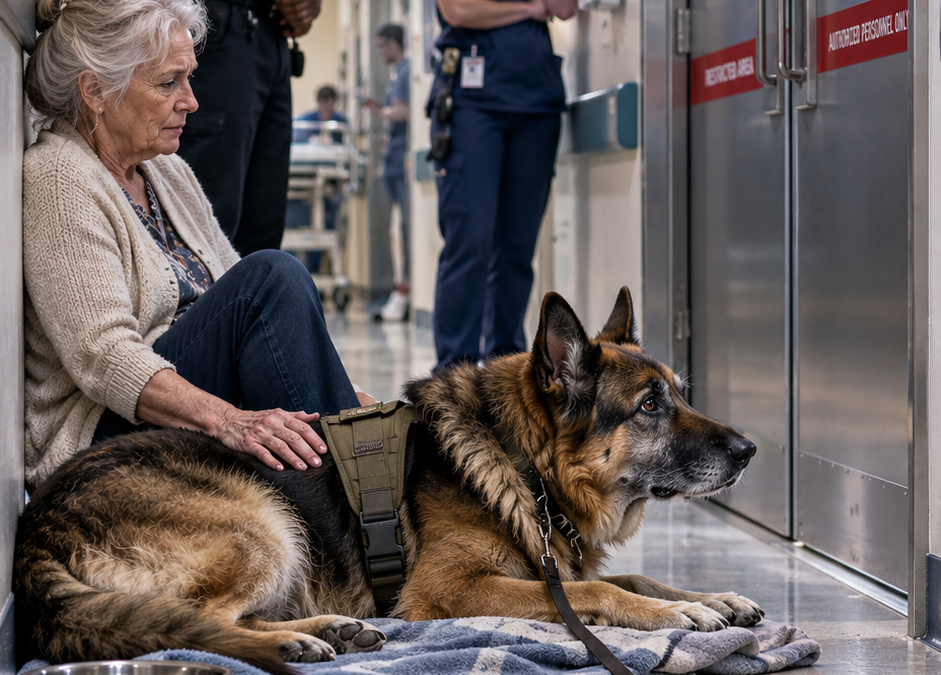
There was silver around Ranger’s muzzle.
His hind legs were stiff.
His shoulders were still broad, but age had drawn his frame tighter beneath his coat.
This was a dog who had once been built to run, climb, track, hold position, and move without hesitation.
Now standing up cost him something.
And still, every time the doors opened, he paid.
I stayed where I was.
I didn’t kneel.
I didn’t offer my hand.
I didn’t say his name.
People make that mistake with animals all the time.
We decide affection is automatically comforting.
It isn’t.
Not when trust hasn’t been offered.
Not when an animal already has one overwhelming task consuming every thought.
I watched.
That was something nursing had taught me long before Ranger.
When people are frightened, everyone wants to do something.
Touch them.
Move them.
Explain things.
Fix something.
But sometimes the first useful act is observation.
Ranger lowered his chest onto the blanket.
His head remained upright.
The metal water bowl sat perhaps three feet from him.
Thomas’s jacket lay near the wall.
Ranger glanced at neither.
Another hospital employee approached with linens.
Ranger’s eyes did not move.
Only when the surgical doors clicked did his ears rise.
Narrow pattern.
Singular focus.
He wasn’t refusing comfort.
He was refusing any comfort that required him to stop doing his job.
I looked at the nurse.
“Move the water closer.”
“We did.”
“Not close enough.”
She nudged it carefully toward the blanket.
Ranger’s eyes flicked toward the sound.
Then back to the doors.
“Leave it,” I said.
A few seconds passed.
Then another few.
Ranger lowered his nose toward the bowl.
Stopped.
Looked at the doors.
Nothing moved.
He leaned forward and drank once.
Then twice.
Then a third time.
The nurse looked at me.
“That’s the first time he’s taken any.”
I didn’t smile.
Not because I wasn’t relieved.
Because I didn’t want us to misunderstand what had happened.
“He didn’t drink because I’m here,” I said.
“He drank because nobody made drinking cost him his position.”
I found a chair several feet away and turned it so it faced the surgical doors.
Then I sat.
Ranger looked at me.
Only once.
His eyes took in my posture.
My hands.
My distance.
Then he turned back toward the doors.
I did the same.
That was the beginning.
No grand gesture.
No miracle.
No instant bond.
An old dog and an old nurse facing the same direction.
For the next several minutes, I didn’t speak.
A volunteer came through carrying a tray.
She slowed when she saw Ranger.
I raised one hand.
“Give him room.”
She changed course without argument.
Ranger’s ears twitched.
He did not stand.
That mattered.
Until then, he had been spending energy monitoring not only the surgical doors but also everyone who might interfere with his position.
Once people stopped approaching him, his body began to let go of that second responsibility.
His front paws slid forward.
His chest lowered.
The rigid line through his shoulders softened.
He still watched the doors.
But he no longer seemed to expect a hand on his leash every few minutes.
I leaned back.
The nurse brought Thomas’s jacket closer.
I stopped her before she placed it directly beneath Ranger.
“Leave it at the edge.”
“Why?”
“Let him decide.”
She did.
Ranger noticed the jacket almost immediately.
His nose moved.
A familiar scent had reached him.
He turned his head.
Pressed his muzzle into the fabric.
His eyes closed.
Only for a second.
Then he repositioned himself so his chin rested across one sleeve while his face remained aimed toward the surgical doors.
Something tightened in my chest.
I had seen that kind of loyalty before.
Not in dogs.
In people.
Spouses sitting beside ventilators.
Parents refusing to leave pediatric intensive care.
Adult children sleeping upright beside dying fathers.
Soldiers who stayed at bedsides long after visiting hours because a friend had no family in the state.
Love doesn’t always look soft.
Sometimes it looks exactly like refusal.
I wondered how many people walking past Ranger saw only the inconvenience.
A dog where a dog technically shouldn’t be.
A leash nobody could use.
A hallway being rerouted.
A problem.
Hospitals can do that to people.
Efficiency matters.
It has to.
But efficiency can become a kind of blindness if you forget what all that movement is supposed to serve.
A cart needs to get through.
A stretcher needs room.
Staff need access.
All true.
But Ranger was not equipment.
And whatever Thomas Reed was to everyone behind those doors—patient, case, emergency procedure, surgical schedule—to Ranger he was simply Thomas.
His person.
His partner.
His assignment.
The doors opened.
Ranger stood.
Again his hindquarters struggled.
Again he forced them underneath him.
A nurse came through holding a clipboard.
No Thomas.
Ranger searched behind her.
She noticed him.
Then me.
“He’s still in surgery,” she said quietly. “It may be a while.”
I nodded.
Ranger didn’t understand the sentence.
But he understood the doors closing.
His ears lowered.
He stayed standing.
His rear legs trembled harder.
I leaned forward.
My hands remained in my lap.
“Easy,” I said.
Not stay.
Not down.
Not come.
Just easy.
His head turned.
Our eyes met.
It was the first time he had really looked at me.
Not assessed.
Looked.
I lowered one hand toward the floor.
Palm down.
Several feet away from him.
I didn’t call.
Didn’t tap the tile.
Didn’t wiggle my fingers.
I looked back at the doors.
Ranger looked at my hand.
Then the doors.
Then me.
Slowly, he lowered himself.
His body landed heavily on the blanket.
Thomas’s jacket remained beneath his chin.
For three seconds, Ranger closed his eyes.
Then they opened.
But he had shifted.
Only several inches.
Toward me.
That was all.
I didn’t acknowledge it.
Trust is fragile when it’s being built.
Too much enthusiasm can feel like pressure.
I had seen inexperienced nurses do it with frightened patients.
They’d get one response and immediately ask for five more.
One sip of water becomes a full meal.
One word becomes a conversation.
One touch becomes an examination.
Sometimes you need to let one act remain complete.
Ranger had moved closer.
So I let that be enough.
After a while, I moved from the chair to the floor.
Slowly.
My knees complained immediately.
Retirement hadn’t improved them.
But I lowered myself several feet from Ranger, keeping the same line of sight.
He watched me from the corner of one eye.
He did not rise.
Another small victory I refused to celebrate outwardly.
A staff member arrived carrying a fresh blanket.
“Should we move him farther down where it’s quieter?”
Ranger’s head lifted.
“No,” I said.
The staff member stopped.
“Put it under him.”
“How?”
“Piece by piece.”
We unfolded it beside the first blanket.
Then slid one section carefully beneath Ranger’s chest.
He shifted his weight.
Another section went beneath his hips.
He stiffened once but never stood.
The last corner was tucked beneath his rear legs.
Then everyone moved away.
Ranger exhaled.
Long and slow.
His chin returned to Thomas’s jacket.
“Comfort’s fine,” I said quietly. “As long as comfort doesn’t require him to abandon the job.”
The nurse beside me gave a faint smile.
“You talk like you know him.”
“I don’t.”
I looked at Ranger.
“I know patients.”
She raised an eyebrow.
“He’s not your patient.”
“No.”
I watched the old dog’s breathing.
“But fear behaves similarly in most living things.”
The doors opened again.
Ranger’s head snapped up.
This time, he didn’t immediately rise.
His paws tensed.
His hindquarters twitched.
A nurse emerged alone.
Ranger watched.
No Thomas.
The doors closed.
He stayed down.
His eyes shifted toward me.
I was already watching the doors.
For several seconds, neither of us moved.
Then Ranger lowered his head.
That was the moment I understood my role had changed.
At first, I had only protected his space.
Now he had started allowing me to share the watch.
Another ten minutes passed.
Maybe more.
Time behaves strangely in hospitals.
There are clocks everywhere, but important moments rarely obey them.
Ranger shifted his rear leg and flinched.
I noticed.
I used the toe of my shoe to push the water bowl closer.
He drank lying down.
The nurse who had first loosened his leash passed us.
“He’s doing better with you here.”
I shook my head.
“He’s doing better because no one’s making him leave.”
She looked at Ranger.
“And you?”
“I’m just not giving him another problem.”
She nodded and continued walking.
Ranger began closing his eyes for several seconds at a time.
Every click reopened them.
Every movement behind the doors brought his ears forward.
But he no longer stood automatically.
The cost of vigilance had changed.
He had found another way to keep his promise.
Then he surprised me.
He lifted his head from Thomas’s jacket and looked directly at me.
After a moment, he shifted forward.
One paw length.
Stopped.
Watched the doors.
Shifted again.
His shoulder touched the leg of the chair beside me.
He didn’t lean.
Didn’t nudge.
Didn’t ask for petting.
He simply eliminated the distance.
I kept my hands folded.
Ranger settled with his head near my shoe.
The waiting had changed.
He still would not leave Thomas.
But he no longer seemed determined to wait alone.
The doors opened again.
Ranger’s body came alive.
Head.
Chest.
Front legs.
Then the older, slower hindquarters.
I stood with him.
A nurse stepped into the hall.
“Mr. Reed is still in surgery. They’re continuing. It’s going to be longer than we hoped.”
I heard the words.
Ranger heard only the door.
He searched behind her.
No Thomas.
His weight moved forward.
For an instant I thought he would try to reach the opening.
Then the doors closed.
He remained standing.
His back legs trembled.
A staff member reached toward the leash.
I placed my shoe over the loose end before the person could pick it up.
“Let him choose.”
The hand withdrew.
Ranger took one step toward the doors.
His rear paw dragged.
He corrected it.
Took another.
Nobody stopped him.
The blanket was behind him now.
So was the jacket.
He reached the edge of the cleared space.
Then stopped.
The doors remained closed.
Ranger stood there.
His whole body seemed to argue with itself.
His heart said forward.
His legs said enough.
He lowered his hips.
Tried to rise again.
Failed.
Tried once more.
My hand moved instinctively toward him.
I stopped it halfway.
I suddenly understood the deeper problem.
Ranger did not believe resting was compatible with loyalty.
That was the danger.
Not aggression.
Not disruption.
Devotion.
The kind that could hurt him because he did not know how to stop giving.
I looked at the nearest staff member.
“Bring the blanket.”
She hesitated.
“Here?”
“Bring everything here. Blanket. Jacket. Water.”
We slid them toward the exact place Ranger had chosen.
No one touched his collar.
No one pulled him backward.
We moved his comfort to his post instead of moving him to the comfort.
Ranger looked down at the blanket.
Then at the doors.
Slowly, he lowered himself.
This time, there was no controlled sit.
His body surrendered.
His chest settled.
One hip rolled sideways.
His head remained up for several seconds before finally dropping onto Thomas’s jacket.
I returned to the chair.
Ranger looked at me.
One paw moved toward the empty floor between us.
Not dramatic.
Barely an inch.
But I saw it.
He wanted me close enough to remain part of the watch.
So I sat.
The surgical doors clicked.
His eyes opened.
He did not rise.
I was already watching.
Ranger studied my face.
Then lowered his head again.
That became our rhythm.
The door clicked.
I looked first.
He looked second.
If nothing changed, he rested.
Minutes became an hour or something close to it.
I stopped checking.
A staff member offered me another chair.
I shook my head.
“Leave it against the wall.”
Moving would make Ranger reassess the arrangement, and he had finally spent enough time with me to stop doing that.
His water bowl emptied.
When I reached for it, his head lifted.
I moved slowly.
Showed him every motion.
Walked only as far as the fountain.
Returned.
Set the bowl down.
He drank.
No panic.
No attempt to follow.
Trust is not always following someone.
Sometimes trust is believing they will return.
Ranger stretched one rear leg stiffly behind him.
I adjusted the blanket beneath it.
This time my fingers touched the fur along his hip.
He did not flinch.
Did not turn.
Did not warn me away.
Permission.
Not surrender.
There is a difference.
I withdrew my hand.
Ranger placed his paw over the blanket edge I had moved, almost as though he were anchoring it.
Then the doors opened.
His head rose sharply.
I shifted onto one knee.
Someone emerged.
Not Thomas.
The doors closed.
Ranger pushed up with his front legs.
His hindquarters failed.
He tried again.
I moved beside him.
Close enough for him to feel my presence.
Not close enough to hold him down.
He looked at the doors.
Then at me.
His chest lowered.
He stayed.
That was perhaps the most important choice he made all afternoon.
He had not stopped waiting.
He had stopped believing waiting required pain every second.
I settled onto the floor beside him.
Not touching.
My back against the wall.
Hands open on my lap.
Ranger looked at the space between us.
Then something happened that I still think about.
He lifted one paw.
Hooked the edge of the blanket.
Pulled it several inches toward me.
Once.
Then stopped.
I stared at the folded fabric.
There was nothing accidental about it.
He had closed part of the distance.
I did not move into it.
I let him finish the decision.
The next time the surgical doors opened, Ranger didn’t stand.
He looked at me.
I was already facing them.
Someone stepped out.
No Thomas.
Ranger settled.
That was when I knew what remained.
I had spent hours sitting near him.
Protecting his space.
Watching his doors.
But there was still a small distinction between us.
I was beside the vigil.
He was inside it.
Ranger had been the one closing that distance.
So I let him make the final invitation.
Then I accepted it.
I pushed the chair aside.
Lowered myself fully onto the floor.
And sat beside him.
Shoulder almost touching shoulder.
Both of us facing the surgical doors.
Ranger lifted his head.
He stared at me for several seconds.
His eyes were older than I had noticed before.
Not weak.
Not confused.
Old.
There is dignity in an aging working animal that’s difficult to describe.
Their bodies lose speed before their minds lose purpose.
They remember what they were built to do long after joints and muscles begin demanding compromises.
Ranger’s eyes held that conflict.
Part of him still seemed to believe he should be the dog he had once been.
The dog who could stand every time.
Move every time.
Protect every time.
Never hesitate.
Never tire.
But his body had changed.
And Thomas was somewhere behind those doors.
I placed one hand flat on the floor between us.
No command.
No touching.
Ranger looked down at it.
Then back toward the doors.
A cart rolled behind us.
He ignored it.
A nurse walked across the corridor.
He ignored her.
Then the surgical doors opened.
Ranger tensed instantly.
His paws dug into the blanket.
His head came up.
Every muscle he had left seemed to prepare.
I remained still.
Someone stepped through.
Not Thomas.
Ranger stared into the gap.
The doors closed.
His chest rose sharply.
His hind legs moved beneath him.
For one terrible second, I thought he would force himself upright again.
Then he looked at me.
I was still there.
Still facing the door.
Not restraining him.
Not asking him to abandon anything.
Something softened.
His paws slid forward.
His shoulders lowered.
An inch.
Another.
Then his head came down.
Onto my thigh.
My breath caught.
I didn’t touch him.
Didn’t speak.
Ranger closed his eyes.
Not for three seconds.
Not for five.
He slept.
Lightly at first.
His ears continued moving.
His breathing remained shallow.
The surgical doors clicked again.
His ears lifted.
But his head stayed on my leg.
I watched the doors for him.
Nothing.
His breathing slowed.
Longer.
Deeper.
A nurse passing nearby stopped.
She looked at us.
Then quietly turned and took another route.
No one disturbed him.
Ranger shifted once.
Pressed more of his weight against my leg.
Exhaled.
I felt that breath through the fabric of my pants.
Warm.
Tired.
Trusting.
I had spent decades beside people on some of the hardest days of their lives.
I had sat beside men waiting for wives to come out of surgery.
Women waiting for children.
Children waiting for parents.
I had held hands when people were frightened.
Held shoulders when news arrived.
Stood silently when words became useless.
Yet sitting beside Ranger felt strangely familiar.
Because underneath everything else, waiting is waiting.
You don’t need language to understand it.
You don’t need to know diagnoses or surgical procedures.
You only need to understand that someone you love has disappeared behind a door you are not allowed to cross.
That helplessness is universal.
I stayed.
My back started aching.
Then my knee.
Then my hip.
Retirement had made me less forgiving of hospital floors.
But I didn’t move.
When the water needed shifting, I pulled it closer without standing.
When footsteps approached, I checked the doors before Ranger had to.
He slept in short intervals.
Wake.
Check.
Breathe.
Sleep.
The leash remained untouched.
Eventually Ranger woke more fully.
His ears moved first.
Then his eyes opened.
He didn’t scramble up.
He checked the doors.
Then me.
Still here.
I reached for the water bowl.
Instead of placing it directly in front of him, I set it halfway between us.
He drank slowly.
Then rested against my leg again.
A nurse approached from the surgical corridor.
Ranger saw her first.
His head lifted.
His body stayed down.
I followed his gaze.
She stopped outside the space everyone had learned to protect.
“They’re still working,” she said softly. “Nothing you need to do right now.”
I nodded.
I didn’t speak to Ranger.
There was nothing useful I could translate.
The nurse placed a cup of water within my reach.
For me this time.
Then she left.
I drank half.
The hallway had completely changed.
Earlier, everyone had seen Ranger as something to solve.
Now no one reached for the leash.
A transporter approached with equipment, saw us, slowed, and automatically used the far side.
A doctor walking quickly toward another corridor altered his path without complaint.
Ranger had stopped defending the space because the people around him had begun protecting it.
After a while, I had to move.
My left leg was going numb.
I shifted.
Ranger’s head rose immediately.
I froze.
He looked at my hands.
Then the doors.
Then me.
I decided not to stay frozen.
Trust couldn’t mean I was never allowed to move.
That wasn’t trust.
That was dependence.
So I slowly pushed myself up.
Ranger stayed down.
One step.
He watched.
Second step.
He still did not rise.
I walked to the fountain.
Filled the bowl.
Returned.
When I sat beside him again, Ranger didn’t wait for me to settle completely.
He shifted across the blanket.
Pressed his shoulder against my hip.
I lowered one hand onto the floor.
Ranger sniffed my fingers.
Once.
Then placed one paw over the back of my hand.
I looked down.
Heavy paw.
Gray hairs between the toes.
Nails worn blunt from a lifetime I knew nothing about.
I wondered where those paws had carried him.
What doors he had waited outside before.
What rooms he had searched.
What dangers he had followed Thomas through.
What commands he once obeyed without hesitation.
But none of that mattered as much as what he was asking now.
Stay.
That was all.
I left my hand beneath his paw.
The surgical doors opened.
Ranger’s ears rose.
His head lifted.
We both watched.
A staff member came through.
No Thomas.
The doors closed.
Ranger’s paw remained on my hand.
Then his head lowered again.
I leaned against the wall.
There was a strange intimacy to the silence between us.
Not affection in the ordinary sense.
Not yet.
Something steadier.
Mutual obligation.
Ranger had decided I belonged to the waiting.
And once he made that decision, I felt responsible for honoring it.
Another long quiet stretch passed.
I adjusted Thomas’s jacket beneath his muzzle.
Ranger let me.
He didn’t even raise his head.
One paw remained on Thomas’s sleeve.
The other rested near my hand.
Two anchors.
The person he was waiting for.
And the person waiting beside him.
Then the surgical doors opened.
I expected the usual pattern.
Head up.
Ears forward.
Search.
Disappointment.
But this time the person coming through stopped.
A nurse looked directly at me.
There was something different in her face.
Not alarm.
Not sorrow.
Release.
She gave a small nod.
“They’re moving him to recovery.”
For half a second, I forgot Ranger couldn’t understand.
My own breath escaped before I could stop it.
“Oh.”
Ranger’s eyes went to my face.
He noticed the change.
Of course he did.
I turned toward the doors.
“So do you.”
His ears lifted.
He followed my gaze.
The doors opened wider.
A stretcher appeared.
Thomas lay beneath a light blanket.
Pale.
Still groggy.
One arm resting near his side.
Ranger transformed.
There is no gentler word for it.
One moment he was an exhausted old dog leaning against a retired nurse.
The next, years disappeared from his eyes.
His head shot up.
His front legs came beneath him.
His entire body surged with recognition.
I expected him to lunge.
Expected instinct to overpower every careful change of the previous hours.
He didn’t.
Ranger looked at me.
That broke my heart more than anything else had.
Because after all that time, at the exact moment he had been waiting for, he checked me.
As if making sure the watch was really over.
I slid my hand out from beneath his paw.
Placed it flat on the floor.
No restraint.
No command.
“You choose,” I whispered.
Ranger stood.
Slowly.
Front legs first.
Then the old hindquarters.
They shook.
He waited until they steadied.
Then he stepped forward.
I rose beside him.
No one touched the leash.
We walked toward Thomas together.
Ranger reached the stretcher.
Stopped.
Thomas’s eyes fluttered open.
For a moment I didn’t know whether he truly saw the dog or was only responding to movement.
Then his hand shifted.
Weakly.
Toward the edge of the mattress.
Ranger raised his muzzle.
Pressed it beneath Thomas’s fingers.
Thomas’s hand settled against his head.
His lips moved.
I stepped closer but still couldn’t hear.
Then the sound came.
“Ranger.”
Barely a whisper.
But the old dog heard it.
His ears softened.
His eyes closed.
Thomas’s fingers curled weakly into the fur behind one ear.
Ranger stood perfectly still.
No whining.
No jumping.
No frantic movement.
Just contact.
After hours of demanding nothing except the right to remain close to the place Thomas had vanished, Ranger finally had what he had been waiting for.
Proof.
Thomas had come back.
I turned my face away.
Thirty years of nursing will not make you immune to moments like that.
It only teaches you not to be embarrassed by them.
A recovery nurse touched the stretcher rail.
“We need to keep moving.”
Ranger opened his eyes.
Thomas’s hand slipped slightly as the stretcher started forward.
Ranger followed.
The nurse held up one hand.
“He can come as far as the recovery corridor turn.”
Ranger didn’t know what she said.
But I did.
I walked beside him.
Thomas’s stretcher rolled ahead.
Ranger’s steps were slow now.
The burst of energy had cost him.
His rear paw dragged once.
Then again.
But he kept going.
At the corridor turn, staff continued with Thomas.
Ranger stopped.
Thomas’s hand slipped away.
The stretcher moved farther.
Ranger watched.
His body leaned forward.
Every hour of waiting seemed to gather again behind his eyes.
I stopped beside him.
No leash.
No hand on his collar.
Nothing.
Ranger looked toward Thomas.
Then up at me.
For a second, I saw the question.
The surgical doors had been simple.
Thomas went through them.
Ranger stayed.
The job was clear.
But now Thomas was moving somewhere Ranger could not follow.
That was different.
I turned toward the direction the hospital staff had indicated.
The path we were allowed to take.
Ranger watched me.
Then looked once more toward Thomas.
And stepped forward beside me.
That was how I knew the vigil was over.
Not because someone announced it.
Not because the operation ended.
Not even because Ranger saw Thomas alive.
The vigil ended when Ranger understood that staying in front of those doors was no longer what Thomas needed from him.
We walked together as far as staff permitted.
Slowly.
Ranger’s shoulder close to my leg.
Behind us, the surgical entrance stood empty.
The blanket remained on the floor for a few moments before someone collected it.
Thomas’s jacket lay folded across one corner.
The metal water bowl sat beside the wall.
The place Ranger had fought so fiercely to keep no longer held him.
I looked back at it once.
Hours earlier, half the corridor had treated that patch of floor like a logistical problem.
Now it looked almost sacred.
Not because anything dramatic had happened there.
No rescue.
No medical miracle.
No command performance.
An old dog had simply refused to leave the last place he had seen the person he trusted most.
And eventually, instead of forcing him to abandon that devotion, everyone had learned to make room for it.
I had spent most of my nursing career believing care was something you did.
Administer medication.
Change dressings.
Monitor vitals.
Explain procedures.
Lift.
Clean.
Measure.
Comfort.
Intervene.
But Ranger reminded me of something I should never have forgotten.
Sometimes care is not an intervention.
Sometimes care is restraint.
The decision not to pull.
Not to command.
Not to distract.
Not to demand that someone grieve, fear, wait, or love in the way most convenient for the room around them.
Sometimes the most compassionate thing you can do is recognize what someone is trying desperately to protect and sit down beside it.
Ranger hadn’t needed me to convince him Thomas would return.
I couldn’t promise that.
No honest nurse could.
He hadn’t needed me to make him forget the doors.
He would never have allowed it.
He needed someone to understand why he could not leave.
Once he had that, he rested.
Once he knew another pair of eyes was watching, he slept.
Once the corridor stopped fighting his loyalty, his body finally had permission to survive the waiting.
We reached the end of the permitted area.
A nurse told me Thomas was stable enough for recovery monitoring.
I looked down at Ranger.
He was still watching the corridor where the stretcher had disappeared.
But he wasn’t pulling toward it.
His breathing was steady.
His ears relaxed.
I lowered myself carefully into the chair someone had placed nearby.
Ranger turned.
For the first time all afternoon, he did not choose a position facing the surgical doors.
He walked to me.
Circled once.
And lowered himself beside my feet.
His back rested against my shoe.
Not alert.
Not braced.
Just tired.
I reached down slowly.
This time, Ranger didn’t merely tolerate my hand.
He leaned into it.
My fingers moved through the thick fur along his neck.
He closed his eyes.
“You did your job,” I whispered.
His ear moved.
Maybe at the sound of my voice.
Maybe at Thomas’s name being called somewhere beyond the recovery doors.
Maybe nothing at all.
I kept my hand there.
For all the years I had worked in hospitals, I had watched people define strength the wrong way.
They thought strength meant never breaking.
Never sitting.
Never asking.
Never needing anyone.
Ranger had arrived at those doors with that same kind of strength.
The relentless kind.
The kind that can destroy the body carrying it.
He would have stood until his legs failed if no one had shown him another way to remain loyal.
By the end, he had learned something harder.
He could rest without abandoning Thomas.
He could trust someone else with part of the watch.
He could close his eyes and still be faithful.
And I realized, sitting there with his old body leaning against my shoe, that perhaps I had learned the same lesson years too late.
Thirty years of nursing had taught me to stay useful.
To stay alert.
To keep moving.
Retirement had taken away the structure that told me where to stand and what needed doing.
Maybe that was part of why I had noticed Ranger.
I recognized a creature who didn’t know who he was if he wasn’t on duty.
I looked down at him.
Silver muzzle.
Tired legs.
One ear still angled toward the recovery corridor.
“You and me both,” I murmured.
Ranger opened one eye.
Then closed it again.
We stayed there until another nurse came and told us Thomas would be waking more fully soon.
I stood.
Ranger rose with me.
Slowly.
No desperate scramble.
No slipping paws.
He waited while I steadied myself.
I waited while he steadied himself.
Then we walked together.
The leash still hung loose.
I never picked it up.
I didn’t need to.
For all those hours, everyone had worried about how to make Ranger follow.
In the end, following was never the problem.
He only needed to know where Thomas was going.
And he needed one person willing to understand why he had stayed.
When we reached the next turn, Ranger paused and looked back once toward the distant surgical doors.
I followed his gaze.
The floor outside them was empty now.
Nothing remained of the struggle that had occupied so many people.
No pulled leash.
No carts being redirected.
No blanket.
No water bowl.
Just polished tile beneath fluorescent lights.
Ranger stared for another second.
Then turned away.
He stepped beside me.
And this time, he did not look back.
Neither did I.
Have you finished reading the story and want to read it again?
The Old SEAL K9 Guarded Those Surgical Doors Like One Wrong Move Would Cost Him Everything
I knew the difference between a dangerous dog and a terrified one.
I also knew the difference between stubbornness and duty.
The old German Shepherd lying outside those surgical doors wasn’t refusing to move because he didn’t understand what people wanted from him. He understood perfectly.
He simply believed something more important was waiting on the other side.
I hadn’t planned on spending my afternoon sitting on a hospital floor.
At my age, I certainly hadn’t planned on spending hours there with one knee aching, my back pressed against a wall, and an aging military dog slowly learning whether I could be trusted with the most important watch of his life.
I had only come to the hospital to drop off paperwork for a former colleague.
That was all.
I had retired after more than thirty years in nursing, and although retirement had supposedly freed me from fluorescent corridors, squeaking carts, clipped conversations, alarms, and the particular smell of antiseptic that seemed to live permanently inside hospital walls, I still found myself returning every now and then.
Hospitals have a way of staying inside you after you’ve spent enough years in them.
You remember where people stand when they’re afraid.
You remember how doctors walk when something has gone wrong.
You remember the difference between a nurse carrying routine lab results and one carrying bad news.
And sometimes, even after retirement, your body recognizes a crisis before your mind has decided it belongs to you.
That was what happened when I turned the corner near the surgical corridor and saw Ranger.
I didn’t know his name yet.
All I saw was an old German Shepherd stretched across a folded hospital blanket in front of a set of restricted double doors.
A leash trailed from his collar.
An orderly stood several feet away.
A nurse hovered near the wall.
Someone had placed a metal bowl of water beside the dog, but it looked almost untouched.
And every person moving through that hallway was giving him a little more space than hospital staff normally gave anything that wasn’t bolted to the floor.
I stopped.
Not because he was large.
Not because he was a dog inside a surgical area.
I stopped because of his eyes.
They were fixed on the doors.
Not glancing at them.
Not checking them occasionally.
Fixed.
His entire body seemed organized around that one point.
His ears lifted whenever the mechanisms inside the doors clicked.
His shoulders tensed whenever footsteps approached from the other side.
Every time someone emerged, his head rose.
He searched behind them.
Then, when whoever he was waiting for failed to appear, something in him seemed to sink.
But he never turned away.
The orderly noticed me watching.
“You can go around,” he said.
“I know.”
He looked tired.
Not exhausted.
Frustrated.
There’s a difference.
I’d worn that expression myself enough times to recognize it.
“What happened?” I asked.
He exhaled and looked toward the dog.
“His owner was taken into emergency surgery.”
The German Shepherd’s ear twitched at the sound of his voice.
“Owner?”
“Retired Navy SEAL. Thomas Reed.”
The orderly glanced toward the double doors.
“Dog’s apparently retired military too. His name is Ranger.”
That explained some things.
Not everything.
But some.
“How long has he been here?”
“Since they took Reed back.”
“And he won’t move?”
The orderly gave a humorless little laugh.
“That depends what you mean by move.”
Before I could answer, a transporter came around the corner pushing a wheelchair.
The chair’s footrest angled toward the space where Ranger lay.
The orderly immediately reached for the leash.
“We need to move him farther down.”
The second his fingers closed around the leash, Ranger changed.
There was no barking.
No growling.
No teeth.
That was important.
Instead, the dog’s front paws spread wider against the polished floor.
His shoulders dropped.
His weight shifted backward.
The leash tightened.
The orderly pulled gently.
“Come on, buddy.”
Ranger did not move.
The transporter slowed.
“Need me to wait?”
“Just a second.”
The orderly pulled again.
Ranger slid perhaps half an inch.
Then planted himself harder.
I watched his face.
His attention never went to the orderly.
It stayed on the doors.
That was when I understood the mistake.
“Stop pulling.”
The orderly looked at me.
“Ma’am?”
“Stop pulling.”
“This corridor has to stay clear.”
“I know what kind of corridor it is.”
He studied me for a moment.
Maybe he heard the old nurse in my voice.
Maybe he was simply tired enough to listen to anybody with a plan.
Either way, his grip relaxed slightly.
I pointed toward the opposite side of the hall.
“Move the traffic.”
He frowned.
“Excuse me?”
“Move the traffic. Not the dog.”
“This is an active surgical corridor.”
“Exactly.”
I looked at Ranger.
“He’s calm until somebody tries to take him away from that door. Every time you pull him, you make him believe he has to defend his position.”
“He can’t stay in the middle of the hallway.”
“He doesn’t need the middle.”
I pointed toward the wall.
“Give him a defined space. Move the cart. Shift the walking path a few feet. Let him keep sight of the doors.”
The nurse standing nearby looked from me to Ranger.
Then she nodded slowly.
“He’s right against the edge already.”
“Then protect the edge.”
The orderly looked skeptical.
But he loosened the leash.
The change in Ranger was immediate.
His shoulders lowered by a fraction.
The transporter guided the wheelchair around the opposite side.
Ranger’s eyes followed nothing except the doors.
That told me I was right.
A dog preparing to attack watches threats.
A frightened dog watches escape routes.
A guarding dog scans everything.
Ranger was doing none of those things.
His world had narrowed to two surgical doors and the man who had disappeared behind them.
The nurse stepped closer to me.
“We tried moving him earlier.”
“How?”
“Blanket. Water. Jacket. Gentle pulling.”
“What happened?”
“He kept coming back.”
She pointed to a section of floor directly in front of the doors.
“Same place every time.”
As if summoned by the conversation, something clicked behind the doors.
Ranger’s head snapped up.
Before I could process how stiff his back legs had looked, he was standing.
Or trying to.
His front legs came up first.
His hindquarters lagged.
One paw slipped.
He caught himself.
Then the doors opened.
A surgical technician stepped through.
Ranger moved forward one step.
Not toward the technician.
Past her.
Searching.
His nose lifted.
His eyes swept the opening.
No Thomas.
The doors swung closed.
Ranger stopped.
For one heartbreaking second, he remained standing as though he could force the doors to reopen simply by refusing to accept that they had closed.
Then his rear legs began to shake.
He lowered himself awkwardly.
Not a clean sit.
Not the controlled movement of a younger dog.
His back end seemed to fold beneath him.
The nurse winced.
“He’s been doing that every time.”
“How old?”
“I don’t know.”
Old enough.
That was the answer that mattered.
There was silver around Ranger’s muzzle.
His hind legs were stiff.
His shoulders were still broad, but age had drawn his frame tighter beneath his coat.
This was a dog who had once been built to run, climb, track, hold position, and move without hesitation.
Now standing up cost him something.
And still, every time the doors opened, he paid.
I stayed where I was.
I didn’t kneel.
I didn’t offer my hand.
I didn’t say his name.
People make that mistake with animals all the time.
We decide affection is automatically comforting.
It isn’t.
Not when trust hasn’t been offered.
Not when an animal already has one overwhelming task consuming every thought.
I watched.
That was something nursing had taught me long before Ranger.
When people are frightened, everyone wants to do something.
Touch them.
Move them.
Explain things.
Fix something.
But sometimes the first useful act is observation.
Ranger lowered his chest onto the blanket.
His head remained upright.
The metal water bowl sat perhaps three feet from him.
Thomas’s jacket lay near the wall.
Ranger glanced at neither.
Another hospital employee approached with linens.
Ranger’s eyes did not move.
Only when the surgical doors clicked did his ears rise.
Narrow pattern.
Singular focus.
He wasn’t refusing comfort.
He was refusing any comfort that required him to stop doing his job.
I looked at the nurse.
“Move the water closer.”
“We did.”
“Not close enough.”
She nudged it carefully toward the blanket.
Ranger’s eyes flicked toward the sound.
Then back to the doors.
“Leave it,” I said.
A few seconds passed.
Then another few.
Ranger lowered his nose toward the bowl.
Stopped.
Looked at the doors.
Nothing moved.
He leaned forward and drank once.
Then twice.
Then a third time.
The nurse looked at me.
“That’s the first time he’s taken any.”
I didn’t smile.
Not because I wasn’t relieved.
Because I didn’t want us to misunderstand what had happened.
“He didn’t drink because I’m here,” I said.
“He drank because nobody made drinking cost him his position.”
I found a chair several feet away and turned it so it faced the surgical doors.
Then I sat.
Ranger looked at me.
Only once.
His eyes took in my posture.
My hands.
My distance.
Then he turned back toward the doors.
I did the same.
That was the beginning.
No grand gesture.
No miracle.
No instant bond.
An old dog and an old nurse facing the same direction.
For the next several minutes, I didn’t speak.
A volunteer came through carrying a tray.
She slowed when she saw Ranger.
I raised one hand.
“Give him room.”
She changed course without argument.
Ranger’s ears twitched.
He did not stand.
That mattered.
Until then, he had been spending energy monitoring not only the surgical doors but also everyone who might interfere with his position.
Once people stopped approaching him, his body began to let go of that second responsibility.
His front paws slid forward.
His chest lowered.
The rigid line through his shoulders softened.
He still watched the doors.
But he no longer seemed to expect a hand on his leash every few minutes.
I leaned back.
The nurse brought Thomas’s jacket closer.
I stopped her before she placed it directly beneath Ranger.
“Leave it at the edge.”
“Why?”
“Let him decide.”
She did.
Ranger noticed the jacket almost immediately.
His nose moved.
A familiar scent had reached him.
He turned his head.
Pressed his muzzle into the fabric.
His eyes closed.
Only for a second.
Then he repositioned himself so his chin rested across one sleeve while his face remained aimed toward the surgical doors.
Something tightened in my chest.
I had seen that kind of loyalty before.
Not in dogs.
In people.
Spouses sitting beside ventilators.
Parents refusing to leave pediatric intensive care.
Adult children sleeping upright beside dying fathers.
Soldiers who stayed at bedsides long after visiting hours because a friend had no family in the state.
Love doesn’t always look soft.
Sometimes it looks exactly like refusal.
I wondered how many people walking past Ranger saw only the inconvenience.
A dog where a dog technically shouldn’t be.
A leash nobody could use.
A hallway being rerouted.
A problem.
Hospitals can do that to people.
Efficiency matters.
It has to.
But efficiency can become a kind of blindness if you forget what all that movement is supposed to serve.
A cart needs to get through.
A stretcher needs room.
Staff need access.
All true.
But Ranger was not equipment.
And whatever Thomas Reed was to everyone behind those doors—patient, case, emergency procedure, surgical schedule—to Ranger he was simply Thomas.
His person.
His partner.
His assignment.
The doors opened.
Ranger stood.
Again his hindquarters struggled.
Again he forced them underneath him.
A nurse came through holding a clipboard.
No Thomas.
Ranger searched behind her.
She noticed him.
Then me.
“He’s still in surgery,” she said quietly. “It may be a while.”
I nodded.
Ranger didn’t understand the sentence.
But he understood the doors closing.
His ears lowered.
He stayed standing.
His rear legs trembled harder.
I leaned forward.
My hands remained in my lap.
“Easy,” I said.
Not stay.
Not down.
Not come.
Just easy.
His head turned.
Our eyes met.
It was the first time he had really looked at me.
Not assessed.
Looked.
I lowered one hand toward the floor.
Palm down.
Several feet away from him.
I didn’t call.
Didn’t tap the tile.
Didn’t wiggle my fingers.
I looked back at the doors.
Ranger looked at my hand.
Then the doors.
Then me.
Slowly, he lowered himself.
His body landed heavily on the blanket.
Thomas’s jacket remained beneath his chin.
For three seconds, Ranger closed his eyes.
Then they opened.
But he had shifted.
Only several inches.
Toward me.
That was all.
I didn’t acknowledge it.
Trust is fragile when it’s being built.
Too much enthusiasm can feel like pressure.
I had seen inexperienced nurses do it with frightened patients.
They’d get one response and immediately ask for five more.
One sip of water becomes a full meal.
One word becomes a conversation.
One touch becomes an examination.
Sometimes you need to let one act remain complete.
Ranger had moved closer.
So I let that be enough.
After a while, I moved from the chair to the floor.
Slowly.
My knees complained immediately.
Retirement hadn’t improved them.
But I lowered myself several feet from Ranger, keeping the same line of sight.
He watched me from the corner of one eye.
He did not rise.
Another small victory I refused to celebrate outwardly.
A staff member arrived carrying a fresh blanket.
“Should we move him farther down where it’s quieter?”
Ranger’s head lifted.
“No,” I said.
The staff member stopped.
“Put it under him.”
“How?”
“Piece by piece.”
We unfolded it beside the first blanket.
Then slid one section carefully beneath Ranger’s chest.
He shifted his weight.
Another section went beneath his hips.
He stiffened once but never stood.
The last corner was tucked beneath his rear legs.
Then everyone moved away.
Ranger exhaled.
Long and slow.
His chin returned to Thomas’s jacket.
“Comfort’s fine,” I said quietly. “As long as comfort doesn’t require him to abandon the job.”
The nurse beside me gave a faint smile.
“You talk like you know him.”
“I don’t.”
I looked at Ranger.
“I know patients.”
She raised an eyebrow.
“He’s not your patient.”
“No.”
I watched the old dog’s breathing.
“But fear behaves similarly in most living things.”
The doors opened again.
Ranger’s head snapped up.
This time, he didn’t immediately rise.
His paws tensed.
His hindquarters twitched.
A nurse emerged alone.
Ranger watched.
No Thomas.
The doors closed.
He stayed down.
His eyes shifted toward me.
I was already watching the doors.
For several seconds, neither of us moved.
Then Ranger lowered his head.
That was the moment I understood my role had changed.
At first, I had only protected his space.
Now he had started allowing me to share the watch.
Another ten minutes passed.
Maybe more.
Time behaves strangely in hospitals.
There are clocks everywhere, but important moments rarely obey them.
Ranger shifted his rear leg and flinched.
I noticed.
I used the toe of my shoe to push the water bowl closer.
He drank lying down.
The nurse who had first loosened his leash passed us.
“He’s doing better with you here.”
I shook my head.
“He’s doing better because no one’s making him leave.”
She looked at Ranger.
“And you?”
“I’m just not giving him another problem.”
She nodded and continued walking.
Ranger began closing his eyes for several seconds at a time.
Every click reopened them.
Every movement behind the doors brought his ears forward.
But he no longer stood automatically.
The cost of vigilance had changed.
He had found another way to keep his promise.
Then he surprised me.
He lifted his head from Thomas’s jacket and looked directly at me.
After a moment, he shifted forward.
One paw length.
Stopped.
Watched the doors.
Shifted again.
His shoulder touched the leg of the chair beside me.
He didn’t lean.
Didn’t nudge.
Didn’t ask for petting.
He simply eliminated the distance.
I kept my hands folded.
Ranger settled with his head near my shoe.
The waiting had changed.
He still would not leave Thomas.
But he no longer seemed determined to wait alone.
The doors opened again.
Ranger’s body came alive.
Head.
Chest.
Front legs.
Then the older, slower hindquarters.
I stood with him.
A nurse stepped into the hall.
“Mr. Reed is still in surgery. They’re continuing. It’s going to be longer than we hoped.”
I heard the words.
Ranger heard only the door.
He searched behind her.
No Thomas.
His weight moved forward.
For an instant I thought he would try to reach the opening.
Then the doors closed.
He remained standing.
His back legs trembled.
A staff member reached toward the leash.
I placed my shoe over the loose end before the person could pick it up.
“Let him choose.”
The hand withdrew.
Ranger took one step toward the doors.
His rear paw dragged.
He corrected it.
Took another.
Nobody stopped him.
The blanket was behind him now.
So was the jacket.
He reached the edge of the cleared space.
Then stopped.
The doors remained closed.
Ranger stood there.
His whole body seemed to argue with itself.
His heart said forward.
His legs said enough.
He lowered his hips.
Tried to rise again.
Failed.
Tried once more.
My hand moved instinctively toward him.
I stopped it halfway.
I suddenly understood the deeper problem.
Ranger did not believe resting was compatible with loyalty.
That was the danger.
Not aggression.
Not disruption.
Devotion.
The kind that could hurt him because he did not know how to stop giving.
I looked at the nearest staff member.
“Bring the blanket.”
She hesitated.
“Here?”
“Bring everything here. Blanket. Jacket. Water.”
We slid them toward the exact place Ranger had chosen.
No one touched his collar.
No one pulled him backward.
We moved his comfort to his post instead of moving him to the comfort.
Ranger looked down at the blanket.
Then at the doors.
Slowly, he lowered himself.
This time, there was no controlled sit.
His body surrendered.
His chest settled.
One hip rolled sideways.
His head remained up for several seconds before finally dropping onto Thomas’s jacket.
I returned to the chair.
Ranger looked at me.
One paw moved toward the empty floor between us.
Not dramatic.
Barely an inch.
But I saw it.
He wanted me close enough to remain part of the watch.
So I sat.
The surgical doors clicked.
His eyes opened.
He did not rise.
I was already watching.
Ranger studied my face.
Then lowered his head again.
That became our rhythm.
The door clicked.
I looked first.
He looked second.
If nothing changed, he rested.
Minutes became an hour or something close to it.
I stopped checking.
A staff member offered me another chair.
I shook my head.
“Leave it against the wall.”
Moving would make Ranger reassess the arrangement, and he had finally spent enough time with me to stop doing that.
His water bowl emptied.
When I reached for it, his head lifted.
I moved slowly.
Showed him every motion.
Walked only as far as the fountain.
Returned.
Set the bowl down.
He drank.
No panic.
No attempt to follow.
Trust is not always following someone.
Sometimes trust is believing they will return.
Ranger stretched one rear leg stiffly behind him.
I adjusted the blanket beneath it.
This time my fingers touched the fur along his hip.
He did not flinch.
Did not turn.
Did not warn me away.
Permission.
Not surrender.
There is a difference.
I withdrew my hand.
Ranger placed his paw over the blanket edge I had moved, almost as though he were anchoring it.
Then the doors opened.
His head rose sharply.
I shifted onto one knee.
Someone emerged.
Not Thomas.
The doors closed.
Ranger pushed up with his front legs.
His hindquarters failed.
He tried again.
I moved beside him.
Close enough for him to feel my presence.
Not close enough to hold him down.
He looked at the doors.
Then at me.
His chest lowered.
He stayed.
That was perhaps the most important choice he made all afternoon.
He had not stopped waiting.
He had stopped believing waiting required pain every second.
I settled onto the floor beside him.
Not touching.
My back against the wall.
Hands open on my lap.
Ranger looked at the space between us.
Then something happened that I still think about.
He lifted one paw.
Hooked the edge of the blanket.
Pulled it several inches toward me.
Once.
Then stopped.
I stared at the folded fabric.
There was nothing accidental about it.
He had closed part of the distance.
I did not move into it.
I let him finish the decision.
The next time the surgical doors opened, Ranger didn’t stand.
He looked at me.
I was already facing them.
Someone stepped out.
No Thomas.
Ranger settled.
That was when I knew what remained.
I had spent hours sitting near him.
Protecting his space.
Watching his doors.
But there was still a small distinction between us.
I was beside the vigil.
He was inside it.
Ranger had been the one closing that distance.
So I let him make the final invitation.
Then I accepted it.
I pushed the chair aside.
Lowered myself fully onto the floor.
And sat beside him.
Shoulder almost touching shoulder.
Both of us facing the surgical doors.
Ranger lifted his head.
He stared at me for several seconds.
His eyes were older than I had noticed before.
Not weak.
Not confused.
Old.
There is dignity in an aging working animal that’s difficult to describe.
Their bodies lose speed before their minds lose purpose.
They remember what they were built to do long after joints and muscles begin demanding compromises.
Ranger’s eyes held that conflict.
Part of him still seemed to believe he should be the dog he had once been.
The dog who could stand every time.
Move every time.
Protect every time.
Never hesitate.
Never tire.
But his body had changed.
And Thomas was somewhere behind those doors.
I placed one hand flat on the floor between us.
No command.
No touching.
Ranger looked down at it.
Then back toward the doors.
A cart rolled behind us.
He ignored it.
A nurse walked across the corridor.
He ignored her.
Then the surgical doors opened.
Ranger tensed instantly.
His paws dug into the blanket.
His head came up.
Every muscle he had left seemed to prepare.
I remained still.
Someone stepped through.
Not Thomas.
Ranger stared into the gap.
The doors closed.
His chest rose sharply.
His hind legs moved beneath him.
For one terrible second, I thought he would force himself upright again.
Then he looked at me.
I was still there.
Still facing the door.
Not restraining him.
Not asking him to abandon anything.
Something softened.
His paws slid forward.
His shoulders lowered.
An inch.
Another.
Then his head came down.
Onto my thigh.
My breath caught.
I didn’t touch him.
Didn’t speak.
Ranger closed his eyes.
Not for three seconds.
Not for five.
He slept.
Lightly at first.
His ears continued moving.
His breathing remained shallow.
The surgical doors clicked again.
His ears lifted.
But his head stayed on my leg.
I watched the doors for him.
Nothing.
His breathing slowed.
Longer.
Deeper.
A nurse passing nearby stopped.
She looked at us.
Then quietly turned and took another route.
No one disturbed him.
Ranger shifted once.
Pressed more of his weight against my leg.
Exhaled.
I felt that breath through the fabric of my pants.
Warm.
Tired.
Trusting.
I had spent decades beside people on some of the hardest days of their lives.
I had sat beside men waiting for wives to come out of surgery.
Women waiting for children.
Children waiting for parents.
I had held hands when people were frightened.
Held shoulders when news arrived.
Stood silently when words became useless.
Yet sitting beside Ranger felt strangely familiar.
Because underneath everything else, waiting is waiting.
You don’t need language to understand it.
You don’t need to know diagnoses or surgical procedures.
You only need to understand that someone you love has disappeared behind a door you are not allowed to cross.
That helplessness is universal.
I stayed.
My back started aching.
Then my knee.
Then my hip.
Retirement had made me less forgiving of hospital floors.
But I didn’t move.
When the water needed shifting, I pulled it closer without standing.
When footsteps approached, I checked the doors before Ranger had to.
He slept in short intervals.
Wake.
Check.
Breathe.
Sleep.
The leash remained untouched.
Eventually Ranger woke more fully.
His ears moved first.
Then his eyes opened.
He didn’t scramble up.
He checked the doors.
Then me.
Still here.
I reached for the water bowl.
Instead of placing it directly in front of him, I set it halfway between us.
He drank slowly.
Then rested against my leg again.
A nurse approached from the surgical corridor.
Ranger saw her first.
His head lifted.
His body stayed down.
I followed his gaze.
She stopped outside the space everyone had learned to protect.
“They’re still working,” she said softly. “Nothing you need to do right now.”
I nodded.
I didn’t speak to Ranger.
There was nothing useful I could translate.
The nurse placed a cup of water within my reach.
For me this time.
Then she left.
I drank half.
The hallway had completely changed.
Earlier, everyone had seen Ranger as something to solve.
Now no one reached for the leash.
A transporter approached with equipment, saw us, slowed, and automatically used the far side.
A doctor walking quickly toward another corridor altered his path without complaint.
Ranger had stopped defending the space because the people around him had begun protecting it.
After a while, I had to move.
My left leg was going numb.
I shifted.
Ranger’s head rose immediately.
I froze.
He looked at my hands.
Then the doors.
Then me.
I decided not to stay frozen.
Trust couldn’t mean I was never allowed to move.
That wasn’t trust.
That was dependence.
So I slowly pushed myself up.
Ranger stayed down.
One step.
He watched.
Second step.
He still did not rise.
I walked to the fountain.
Filled the bowl.
Returned.
When I sat beside him again, Ranger didn’t wait for me to settle completely.
He shifted across the blanket.
Pressed his shoulder against my hip.
I lowered one hand onto the floor.
Ranger sniffed my fingers.
Once.
Then placed one paw over the back of my hand.
I looked down.
Heavy paw.
Gray hairs between the toes.
Nails worn blunt from a lifetime I knew nothing about.
I wondered where those paws had carried him.
What doors he had waited outside before.
What rooms he had searched.
What dangers he had followed Thomas through.
What commands he once obeyed without hesitation.
But none of that mattered as much as what he was asking now.
Stay.
That was all.
I left my hand beneath his paw.
The surgical doors opened.
Ranger’s ears rose.
His head lifted.
We both watched.
A staff member came through.
No Thomas.
The doors closed.
Ranger’s paw remained on my hand.
Then his head lowered again.
I leaned against the wall.
There was a strange intimacy to the silence between us.
Not affection in the ordinary sense.
Not yet.
Something steadier.
Mutual obligation.
Ranger had decided I belonged to the waiting.
And once he made that decision, I felt responsible for honoring it.
Another long quiet stretch passed.
I adjusted Thomas’s jacket beneath his muzzle.
Ranger let me.
He didn’t even raise his head.
One paw remained on Thomas’s sleeve.
The other rested near my hand.
Two anchors.
The person he was waiting for.
And the person waiting beside him.
Then the surgical doors opened.
I expected the usual pattern.
Head up.
Ears forward.
Search.
Disappointment.
But this time the person coming through stopped.
A nurse looked directly at me.
There was something different in her face.
Not alarm.
Not sorrow.
Release.
She gave a small nod.
“They’re moving him to recovery.”
For half a second, I forgot Ranger couldn’t understand.
My own breath escaped before I could stop it.
“Oh.”
Ranger’s eyes went to my face.
He noticed the change.
Of course he did.
I turned toward the doors.
“So do you.”
His ears lifted.
He followed my gaze.
The doors opened wider.
A stretcher appeared.
Thomas lay beneath a light blanket.
Pale.
Still groggy.
One arm resting near his side.
Ranger transformed.
There is no gentler word for it.
One moment he was an exhausted old dog leaning against a retired nurse.
The next, years disappeared from his eyes.
His head shot up.
His front legs came beneath him.
His entire body surged with recognition.
I expected him to lunge.
Expected instinct to overpower every careful change of the previous hours.
He didn’t.
Ranger looked at me.
That broke my heart more than anything else had.
Because after all that time, at the exact moment he had been waiting for, he checked me.
As if making sure the watch was really over.
I slid my hand out from beneath his paw.
Placed it flat on the floor.
No restraint.
No command.
“You choose,” I whispered.
Ranger stood.
Slowly.
Front legs first.
Then the old hindquarters.
They shook.
He waited until they steadied.
Then he stepped forward.
I rose beside him.
No one touched the leash.
We walked toward Thomas together.
Ranger reached the stretcher.
Stopped.
Thomas’s eyes fluttered open.
For a moment I didn’t know whether he truly saw the dog or was only responding to movement.
Then his hand shifted.
Weakly.
Toward the edge of the mattress.
Ranger raised his muzzle.
Pressed it beneath Thomas’s fingers.
Thomas’s hand settled against his head.
His lips moved.
I stepped closer but still couldn’t hear.
Then the sound came.
“Ranger.”
Barely a whisper.
But the old dog heard it.
His ears softened.
His eyes closed.
Thomas’s fingers curled weakly into the fur behind one ear.
Ranger stood perfectly still.
No whining.
No jumping.
No frantic movement.
Just contact.
After hours of demanding nothing except the right to remain close to the place Thomas had vanished, Ranger finally had what he had been waiting for.
Proof.
Thomas had come back.
I turned my face away.
Thirty years of nursing will not make you immune to moments like that.
It only teaches you not to be embarrassed by them.
A recovery nurse touched the stretcher rail.
“We need to keep moving.”
Ranger opened his eyes.
Thomas’s hand slipped slightly as the stretcher started forward.
Ranger followed.
The nurse held up one hand.
“He can come as far as the recovery corridor turn.”
Ranger didn’t know what she said.
But I did.
I walked beside him.
Thomas’s stretcher rolled ahead.
Ranger’s steps were slow now.
The burst of energy had cost him.
His rear paw dragged once.
Then again.
But he kept going.
At the corridor turn, staff continued with Thomas.
Ranger stopped.
Thomas’s hand slipped away.
The stretcher moved farther.
Ranger watched.
His body leaned forward.
Every hour of waiting seemed to gather again behind his eyes.
I stopped beside him.
No leash.
No hand on his collar.
Nothing.
Ranger looked toward Thomas.
Then up at me.
For a second, I saw the question.
The surgical doors had been simple.
Thomas went through them.
Ranger stayed.
The job was clear.
But now Thomas was moving somewhere Ranger could not follow.
That was different.
I turned toward the direction the hospital staff had indicated.
The path we were allowed to take.
Ranger watched me.
Then looked once more toward Thomas.
And stepped forward beside me.
That was how I knew the vigil was over.
Not because someone announced it.
Not because the operation ended.
Not even because Ranger saw Thomas alive.
The vigil ended when Ranger understood that staying in front of those doors was no longer what Thomas needed from him.
We walked together as far as staff permitted.
Slowly.
Ranger’s shoulder close to my leg.
Behind us, the surgical entrance stood empty.
The blanket remained on the floor for a few moments before someone collected it.
Thomas’s jacket lay folded across one corner.
The metal water bowl sat beside the wall.
The place Ranger had fought so fiercely to keep no longer held him.
I looked back at it once.
Hours earlier, half the corridor had treated that patch of floor like a logistical problem.
Now it looked almost sacred.
Not because anything dramatic had happened there.
No rescue.
No medical miracle.
No command performance.
An old dog had simply refused to leave the last place he had seen the person he trusted most.
And eventually, instead of forcing him to abandon that devotion, everyone had learned to make room for it.
I had spent most of my nursing career believing care was something you did.
Administer medication.
Change dressings.
Monitor vitals.
Explain procedures.
Lift.
Clean.
Measure.
Comfort.
Intervene.
But Ranger reminded me of something I should never have forgotten.
Sometimes care is not an intervention.
Sometimes care is restraint.
The decision not to pull.
Not to command.
Not to distract.
Not to demand that someone grieve, fear, wait, or love in the way most convenient for the room around them.
Sometimes the most compassionate thing you can do is recognize what someone is trying desperately to protect and sit down beside it.
Ranger hadn’t needed me to convince him Thomas would return.
I couldn’t promise that.
No honest nurse could.
He hadn’t needed me to make him forget the doors.
He would never have allowed it.
He needed someone to understand why he could not leave.
Once he had that, he rested.
Once he knew another pair of eyes was watching, he slept.
Once the corridor stopped fighting his loyalty, his body finally had permission to survive the waiting.
We reached the end of the permitted area.
A nurse told me Thomas was stable enough for recovery monitoring.
I looked down at Ranger.
He was still watching the corridor where the stretcher had disappeared.
But he wasn’t pulling toward it.
His breathing was steady.
His ears relaxed.
I lowered myself carefully into the chair someone had placed nearby.
Ranger turned.
For the first time all afternoon, he did not choose a position facing the surgical doors.
He walked to me.
Circled once.
And lowered himself beside my feet.
His back rested against my shoe.
Not alert.
Not braced.
Just tired.
I reached down slowly.
This time, Ranger didn’t merely tolerate my hand.
He leaned into it.
My fingers moved through the thick fur along his neck.
He closed his eyes.
“You did your job,” I whispered.
His ear moved.
Maybe at the sound of my voice.
Maybe at Thomas’s name being called somewhere beyond the recovery doors.
Maybe nothing at all.
I kept my hand there.
For all the years I had worked in hospitals, I had watched people define strength the wrong way.
They thought strength meant never breaking.
Never sitting.
Never asking.
Never needing anyone.
Ranger had arrived at those doors with that same kind of strength.
The relentless kind.
The kind that can destroy the body carrying it.
He would have stood until his legs failed if no one had shown him another way to remain loyal.
By the end, he had learned something harder.
He could rest without abandoning Thomas.
He could trust someone else with part of the watch.
He could close his eyes and still be faithful.
And I realized, sitting there with his old body leaning against my shoe, that perhaps I had learned the same lesson years too late.
Thirty years of nursing had taught me to stay useful.
To stay alert.
To keep moving.
Retirement had taken away the structure that told me where to stand and what needed doing.
Maybe that was part of why I had noticed Ranger.
I recognized a creature who didn’t know who he was if he wasn’t on duty.
I looked down at him.
Silver muzzle.
Tired legs.
One ear still angled toward the recovery corridor.
“You and me both,” I murmured.
Ranger opened one eye.
Then closed it again.
We stayed there until another nurse came and told us Thomas would be waking more fully soon.
I stood.
Ranger rose with me.
Slowly.
No desperate scramble.
No slipping paws.
He waited while I steadied myself.
I waited while he steadied himself.
Then we walked together.
The leash still hung loose.
I never picked it up.
I didn’t need to.
For all those hours, everyone had worried about how to make Ranger follow.
In the end, following was never the problem.
He only needed to know where Thomas was going.
And he needed one person willing to understand why he had stayed.
When we reached the next turn, Ranger paused and looked back once toward the distant surgical doors.
I followed his gaze.
The floor outside them was empty now.
Nothing remained of the struggle that had occupied so many people.
No pulled leash.
No carts being redirected.
No blanket.
No water bowl.
Just polished tile beneath fluorescent lights.
Ranger stared for another second.
Then turned away.
He stepped beside me.
And this time, he did not look back.
Neither did I.








