𝗙𝗨𝗟𝗟 𝗦𝗧𝗢𝗥𝗬 The Officer Who Smashed My Window Had No Idea What Was Rising Behind Him
𝗙𝗨𝗟𝗟 𝗦𝗧𝗢𝗥𝗬
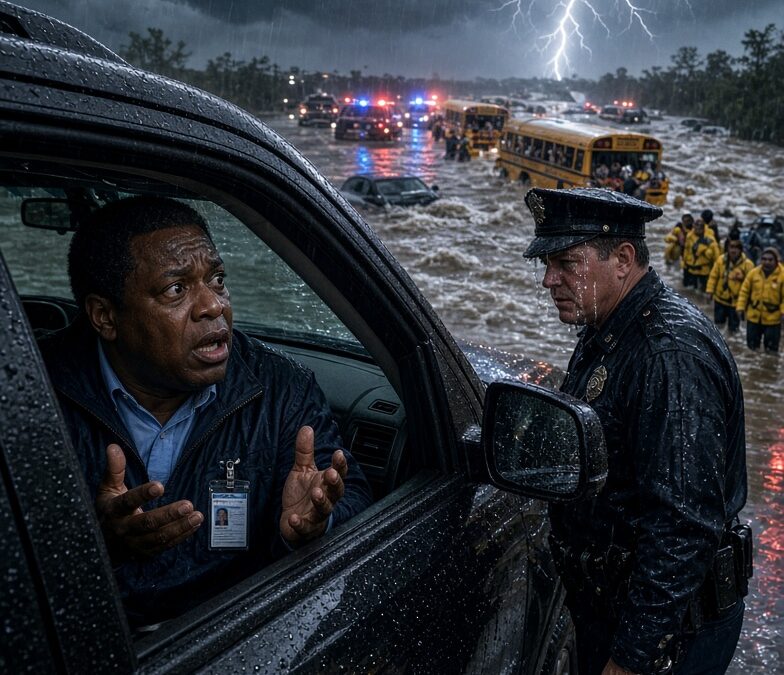
He leaned toward the opening.
“Turn this vehicle around.”
“I’m authorized to enter the restricted zone. My state credentials are inside my coat.”
“I said turn around.”
“I understand. If you contact emergency command, they’ll verify my authorization.”
He looked at the unmarked SUV.
“Everybody’s got an excuse today.”
I kept my hands visible on the steering wheel.
“I’m not asking you to make an exception. I’m asking you to verify my credentials.”
He glanced toward the traffic gathering behind me.
“Get out of the vehicle.”
I looked to my left.
The school bus was edging forward with barely enough clearance to pass.
An ambulance was approaching from the opposite direction.
Opening my door would put me directly between two moving vehicles on a flooded road.
“Officer, I can step out as soon as that bus clears. Right now, there’s no safe space beside the vehicle.”
“Don’t tell me what’s safe.”
“I’m looking at the traffic.”
“Get out.”
I could hear the strain in his voice.
He’d probably been standing in the rain for hours, dealing with frightened drivers, contradictory instructions, and people demanding access to roads that emergency crews were trying to keep clear.
I understood his frustration.
I’d supervised enough disaster operations to know that exhaustion could make even experienced personnel impatient.
But understanding why someone was frustrated didn’t excuse what they chose to do with that frustration.
I gestured toward the radio clipped to his shoulder.
“Just call command. They’ll confirm my identity.”
He stepped closer.
“Do you have a problem following instructions?”
“No. I’m trying to prevent an unnecessary confrontation.”
He stared at me.
Something changed in his expression.
I could almost see the moment he stopped hearing what I was saying and started interpreting every word as a personal challenge.
A second officer approached from behind the barricade.
His name was Ryan Mercer.
He looked younger than Nolan and carried a pair of handcuffs near his belt.
I later learned he’d arrived at the checkpoint only twenty minutes earlier and hadn’t attended the briefing identifying senior state officials expected along the corridor.
But even without that information, he could see I wasn’t attempting to force my way through.
My engine was idling.
My vehicle remained stationary.
Both my hands were above the steering wheel.
I hadn’t made a threatening movement.
“Officer Nolan,” I said, “my state identification is in my jacket. I don’t want to reach for it without your permission.”
“Then get out and show it to me.”
“There’s a bus passing my door.”
“You’re really going to make me repeat myself?”
I glanced at the traffic again.
The bus was almost clear.
“Give me thirty seconds.”
He removed his baton.
I felt my stomach tighten.
There are moments when the body recognizes danger before the mind finishes processing it.
I had experienced that feeling during hurricanes when a structure began shifting unexpectedly, and during rescue operations when a current suddenly became stronger than the equipment meant to resist it.
Now I felt it while sitting behind my own steering wheel.
Nolan gripped the baton and moved closer to the window.
“Last warning.”
I kept my palms open.
“Officer, there’s no reason to escalate this.”
“Open this door.”
“The traffic—”
“Open it!”
I looked toward Mercer.
“Would you please contact emergency command?”
Mercer shifted forward.
For a moment, I thought he was going to intervene.
But Nolan had already raised the baton.
“Do not swing that,” I said.
The first blow struck the driver’s window.
The glass fractured into a white spiderweb.
I instinctively turned my face away.
The second strike shattered the pane.
Broken safety glass exploded into the cabin, scattering across my lap, shoulder, center console, and the wet pavement beneath the door.
A fragment struck my temple.
I felt a sharp sting followed by warmth spreading toward my cheek.
Before I could react, Nolan reached through the broken window, unlocked the door, and yanked it open.
“Out!”
“Officer, my hands are visible!”
He grabbed the front of my rain jacket.
The school bus had finally cleared, but traffic was still moving dangerously close to the checkpoint.
Nolan dragged me sideways from the driver’s seat.
My foot slipped on the wet pavement.
For an instant, I thought I was going to fall beneath the approaching traffic.
I caught myself against the doorframe.
Then he twisted me toward the SUV and pressed my upper body against the rain-covered metal.
“Stop resisting!”
“I’m not resisting!”
His forearm pressed against my shoulder.
Rainwater ran down my face, mixing with the blood from the cut near my temple.
I spread my fingers and kept both hands visible.
“I’m cooperating. Stop pulling me.”
He tightened his grip.
“Should’ve obeyed the first time.”
Behind him, Mercer approached with the handcuffs.
I looked at the younger officer.
“My identification is inside my coat. Call the state emergency operations center.”
Mercer hesitated.
Nolan pushed me harder against the vehicle.
“Keep your hands where I can see them!”
“They are where you can see them.”
I could feel pieces of broken glass pressing into the fabric around my shoulder.
My jacket had torn near the collar.
A few feet away, water was rushing through the roadside ditch.
Beyond the checkpoint, hundreds of residents were waiting for transportation.
And I was being pinned against an SUV because an officer had decided that making me obey was more important than verifying why I needed access.
A silver minivan moved slowly past us.
The woman driving raised her phone.
Behind her, a man in a pickup truck began recording through his rain-streaked windshield.
I saw their cameras, but I kept my eyes on Nolan’s hands.
My safety depended on remaining completely predictable.
“Officer,” I said, “I’m asking you one last time to contact command.”
He leaned closer.
“You’re not in charge here.”
I looked at him.
“No. Right now, you are.”
For a moment, he seemed satisfied.
Then I continued.
“That’s why I’m asking you to make the right decision.”
His face hardened.
I thought he was about to twist my arm again.
Then something behind us changed.
A different sound rose above the rain and traffic.
Multiple emergency sirens.
Not the scattered, uneven sirens of ambulances fighting their way through congestion.
An organized sequence.
I turned my head slightly.
Through the curtain of rain, I could see flashing lights approaching the checkpoint.
A white command vehicle emerged first.
Behind it came state police SUVs, a communications truck, an ambulance, and several high-water rescue vehicles carrying boats and emergency equipment.
I recognized the convoy immediately.
It was mine.
Two minutes after Nolan shattered my window, the lead vehicle rolled toward the barricade.
The state command team had arrived.
And I was still pressed against the side of my SUV.
The white command vehicle stopped.
Maya Brooks stepped out before its driver had fully secured the parking brake.
She wore a bright yellow emergency management jacket over her black field uniform. Her dark hair was pulled tightly back, and she carried the same weatherproof tablet she’d shown me earlier that morning.
At first, she looked toward the staging area.
Then she noticed my damaged SUV.
She saw the shattered window.
The broken glass.
The officer holding me against the vehicle.
And my face.
I will never forget her expression.
She stopped so abruptly that one of the rescue coordinators nearly walked into her.
Then she started toward us.
“Director Cole!”
Nolan’s grip loosened.
Mercer lowered the handcuffs.
Maya crossed the remaining distance quickly.
“What is happening here?”
Nolan looked at her state jacket.
Then at the convoy.
Then back at me.
“Ma’am, this driver refused to comply with checkpoint instructions.”
“Driver?”
Maya stared at him.
“That’s the state emergency management director.”
His face changed.
I could feel his grip weakening.
Maya looked toward Mercer.
“Did either of you contact emergency command?”
Mercer opened his mouth.
No answer came out.
She turned back toward Nolan.
“His vehicle authorization was transmitted this morning.”
Nolan stared at me.
For the first time since he’d stepped into the road, he seemed interested in something other than controlling the encounter.
“You’re the director?”
I didn’t answer immediately.
I was looking at the state convoy backed up behind the barricade.
We were losing time.
And time was the one resource we couldn’t send another truck to replace.
“Step away from me,” I said.
Nolan released my jacket.
I moved carefully toward my coat.
“Officer, I’m retrieving my identification now.”
He said nothing.
I removed my credential wallet and opened it.
The blue state card displayed my photograph, name, title, security seal, and emergency access authorization.
Mercer studied it.
Then he looked toward the convoy.
His expression was almost painful to watch.
Nolan stared at the credential longer.
“Why didn’t you tell me?”
I looked directly at him.
“I did.”
Before he could respond, another state police SUV stopped near the barricade.
Captain Elena Ruiz stepped out into the rain.
I’d worked with Elena during several major emergencies. She was one of the most disciplined officers I’d ever known, and she had an extraordinary ability to establish order without raising her voice.
She examined the scene.
The broken glass.
My torn jacket.
The blood near my temple.
Nolan’s baton.
Mercer’s handcuffs.
Then she looked at Maya.
“Tell me what you know.”
Maya gave her a brief account, carefully limiting it to what she’d witnessed after arriving.
Elena nodded.
She placed a state trooper between Nolan and me.
“Officer Nolan, step away from the vehicle.”
Nolan began explaining.
Elena raised one hand.
“You’ll have an opportunity to provide a full statement. Right now, I need your equipment secured and this scene preserved.”
She turned toward Mercer.
“Officer, don’t alter or delete anything from your body camera. Remain available for questioning.”
Then she looked at me.
“Director, do you need medical attention?”
I touched my temple.
My fingers came away red.
“Apparently.”
Maya was already examining the cut.
“Darius, you’re bleeding.”
“It’s superficial.”
“You don’t know that.”
I looked at her tablet.
“What’s happening at Staging Area Four?”
Her expression changed.
The concern on her face didn’t disappear, but it moved behind the more immediate responsibility we both understood.
“Approximately four hundred people are still waiting for transportation.”
“Parish Nine?”
“Water is rising faster than projected.”
“Show me.”
She opened the updated flood map.
And just like that, the confrontation at the checkpoint became secondary.
The command convoy had arrived approximately six minutes later than planned.
Six minutes.
Under ordinary circumstances, six minutes might have meant nothing.
During a flood, six minutes could mean the difference between a bus crossing a road and that same bus becoming trapped behind moving water.
Maya enlarged the map.
The eastern flood zone had expanded since I left headquarters.
A drainage channel near Parish Nine was already approaching a critical level.
The roadway was the principal evacuation route connecting Franklin Bend to our northern staging corridor.
Hundreds of vehicles had used it throughout the day.
Several buses were still approaching.
I studied the newest gauge readings.
“How long do we have?”
“Maybe twenty minutes if the current trend holds.”
I compared the latest measurement with the earlier elevation model.
Then I checked the timestamps.
The water level wasn’t rising steadily.
It was accelerating.
“Twenty minutes is too optimistic.”
Maya leaned closer.
I pointed toward the drainage crossing.
“If debris collects here, the water will start overtopping the pavement before the model catches up.”
“How much time?”
“Less than fifteen minutes.”
For a moment, neither of us spoke.
Then I looked toward the command vehicle.
“Get everybody inside. We’re changing the evacuation plan.”
Maya turned immediately.
Behind us, Elena continued securing the checkpoint.
Nolan stood several yards away beneath state police supervision, looking at the convoy that had arrived to receive instructions from the man he’d just dragged out of an SUV.
I didn’t look back.
Whatever happened to him would be dealt with later.
Right then, I had people to get out of the water.
The mobile command vehicle was already operating when I climbed inside.
Six displays filled the narrow interior.
Radar imagery.
Traffic feeds.
Water-level gauges.
Rescue-team locations.
Shelter capacity.
Digital maps showing flood zones expanding across southern Baton Rouge.
My soaked jacket left water on the floor.
Glass still clung to my shoulder.
I ignored both.
Maya stood beside me as I enlarged the map around Parish Nine.
The latest sensor reading showed an increase of nearly eight inches in less than twenty minutes.
The roadway was already operating dangerously close to flood stage.
“Close it,” I said.
Maya looked at me.
“Immediately?”
“Immediately.”
“We still have buses approaching from the south.”
“Redirect them before they reach the crossing.”
She reached for her radio.
I studied Ridgeway, the elevated northern alternative.
Under our original plan, Ridgeway was reserved for rescue vehicles and medical support moving toward the flooded neighborhoods.
Reversing its direction would temporarily delay incoming emergency crews.
But leaving civilian traffic on Parish Nine was becoming a greater risk.
“Convert Ridgeway to outbound evacuation traffic,” I ordered. “Hold incoming rescue vehicles at Junction Four. State police control both ends.”
Maya repeated the instructions over the operations channel.
Outside, Elena began repositioning troopers.
Patrol vehicles moved toward the intersections required to reverse the traffic flow.
Rescue trucks were redirected into temporary holding areas.
Ambulances were assigned alternative access points.
Every change affected another part of the system.
That’s what makes disaster management so unforgiving.
You rarely solve one problem without creating another.
The question is whether the new problem is safer than the one you’re trying to prevent.
We had been working for less than five minutes when a new message appeared on the central display.
One evacuation bus hadn’t cleared the southern collection point.
It was carrying thirty-seven elderly residents from Willow Court, a retirement complex near Franklin Bend.
Some passengers required walkers.
Others carried portable oxygen equipment.
Several needed assistance climbing the bus steps.
The driver was Samuel Pierce, a sixty-year-old former school transportation supervisor who’d volunteered repeatedly during previous storm evacuations.
I’d met him during an earlier emergency.
He was the kind of driver who would wait an extra thirty seconds for a frightened passenger rather than leave someone behind.
That afternoon, he’d waited for two residents who had arrived late from an adjacent building.
Now his bus was moving north through increasingly dangerous conditions.
“Get Samuel on the radio,” I said.
A communications specialist established contact.
Samuel’s voice came through beneath the sound of his engine and passengers talking.
“Command, this is Willow Court Bus Two.”
“Samuel, this is Director Cole. What’s your location?”
“Just cleared the southern collection point. Got standing water along the shoulder, but the lane’s still passable.”
“Do not approach Parish Nine.”
There was a pause.
“That’s my assigned route.”
“Not anymore. You’re heading for Ridgeway. State police will clear your path.”
“Understood.”
I studied his tracking icon.
It moved slowly toward the northern junction.
“Samuel, keep me updated. Don’t attempt any flooded crossing, no matter what the vehicles ahead of you are doing.”
“Yes, sir.”
The connection ended.
Maya was already adjusting the other bus assignments.
Three evacuation buses reached Ridgeway in sequence.
Behind them came civilian vehicles escorted by local deputies.
The revised traffic pattern was functioning.
But Samuel’s bus was still moving slowly.
I watched its tracking icon inch north.
Standing water near Willow Court had forced him to navigate around abandoned cars and floating debris.
Several intersections were congested.
We assigned another patrol unit to clear traffic ahead of him.
Maya stood beside me without speaking.
Then Samuel’s icon finally crossed the safest elevated section of Ridgeway.
I released a breath I hadn’t realized I was holding.
“Thirty-seven confirmed past the junction,” Maya said.
“Good. Keep them moving.”
She marked the bus clear.
Then the camera overlooking Parish Nine disappeared from the central display.
A connection-error symbol replaced the live image.
Almost simultaneously, the nearest water-level sensor stopped transmitting.
I looked at Maya.
“Check the network.”
She contacted the communications team.
Every surrounding camera remained operational.
Other sensors were still transmitting.
Only the equipment positioned near the drainage crossing had gone dark.
I knew what that probably meant.
Water had reached the camera junction and gauge housing.
“Send reconnaissance to the western entrance,” I ordered. “Nobody crosses until we have visual confirmation.”
Several minutes later, the field team reported back.
Brown water was pouring across Parish Nine.
Branches, plastic containers, and sections of roadside fencing were moving through the current.
The road was already unsafe for ordinary vehicles.
The flood had reached the crossing almost exactly when I feared it would.
I stared at the empty camera feed.
If we’d waited for visible flooding before closing the route, Samuel’s bus might have reached the crossing with thirty-seven elderly people aboard.
Other vehicles could have followed it.
Families who had spent hours escaping their homes might have become trapped on a road disappearing beneath water.
Maya looked at me.
“You were right.”
I shook my head.
“The sensors were right. We just had to listen before it was too late.”
I knew how close we’d come.
And I knew we’d lost six minutes at the checkpoint before anyone bothered to verify who I was.
But we hadn’t finished the evacuation.
There were still populated areas inside the expanding flood zone.
And the next emergency was already waiting for us.
Aaron Bell, our communications specialist, turned from his console.
“Director, Shelter Three just reported a complete backup-power failure.”
I looked at the shelter network display.
“How many people?”
“More than two hundred.”
“Medical dependencies?”
“Several. Refrigerated medication, oxygen equipment, and electrically powered medical devices.”
Maya enlarged the shelter map.
Shelter Three occupied an aging high school on slightly elevated ground north of the flooded neighborhoods.
The brick building had wide hallways, a reinforced gymnasium, and enough classrooms to accommodate hundreds of displaced residents.
It had originally appeared safer than the surrounding evacuation sites.
But the backup generator was located in a ground-level utility room near the southern loading entrance.
Floodwater had reached that section of the campus.
The generator had shut down automatically.
Now the building was relying on limited battery power.
Emergency lighting.
Medical refrigeration.
Ventilation.
Communications.
All of them were at risk.
I studied the newest flood projection.
The school itself remained above the deepest water.
But the roads serving it were becoming increasingly vulnerable.
“We need to move them.”
Maya looked up.
“All of them?”
“All of them. While buses can still reach the building.”
She began searching the transportation network.
Most of our available buses were committed to Franklin Bend.
Only four were within immediate reach.
Two more were approaching from the north, but they hadn’t yet reached their assigned collection points.
“Redirect those two to Shelter Three,” I said.
“That leaves us short in Franklin Bend.”
“Use high-water trucks for the remaining pickups. They’re better suited to the streets still flooding.”
Maya transmitted the revised assignments.
Six buses began moving toward the school.
Rescue teams reorganized around the altered plan.
I watched the map while our transportation coordinator estimated the time required to load more than two hundred people, including wheelchair users, young children, and elderly residents who needed assistance.
It would be tight.
But it was possible.
Then the southern access road began flooding.
I stepped outside the command vehicle for a moment while crews adjusted their assignments.
The rain had weakened slightly.
My damaged SUV remained near the original checkpoint, its shattered driver’s window temporarily covered with clear plastic.
Broken glass still glittered across the wet pavement.
I could see Nolan’s original position beside the barricade.
For a second, the memory returned with uncomfortable clarity.
The raised baton.
The explosion of glass.
His fist in my jacket.
The sudden fear of falling into moving traffic.
Then a paramedic approached.
“Director Cole?”
I turned.
She was a small woman with sharp eyes and a waterproof hood pulled over dark hair.
Her name was Rachel Kim.
“I need to look at that cut.”
“It’s fine.”
“You’ve been saying that for an hour.”
“I’ve been busy.”
“And I’m about to become very inconvenient if you don’t let me check it.”
I almost smiled.
“All right.”
She cleaned the wound near my temple and removed several glass fragments from my jacket collar.
The cut appeared superficial.
My shoulder was bruised, but I could still move it normally.
Rachel secured a small dressing near my hairline.
“Any dizziness?”
“No.”
“Blurred vision?”
“No.”
“Headache?”
“Not until you started asking questions.”
She didn’t laugh.
“Take the injury seriously, Director.”
“I will.”
She gave me a look that made it clear she didn’t entirely believe me.
As she finished, Captain Ruiz approached.
“We’ve secured three recordings of the checkpoint incident,” she told me.
“Both body cameras?”
“Yes. And a civilian video.”
“Good.”
“Nolan’s equipment has been preserved. He’s been removed from checkpoint duty.”
I nodded.
“What about Mercer?”
“He’s cooperating. I’ve separated him from further enforcement action involving you until we establish exactly what happened.”
“Make sure the witnesses aren’t interfered with.”
“Already handled.”
She paused.
“Darius, you don’t have to deal with this while you’re running an evacuation.”
I looked toward the command vehicle.
“I know.”
“Then let us do our jobs.”
I appreciated her tone.
She wasn’t asking me to ignore what happened.
She was reminding me that accountability required careful investigation, not an immediate reaction driven by anger.
“Keep everything documented,” I said.
“We will.”
I returned to the command vehicle.
Maya was waiting beside the main display.
“We’ve got another problem.”
I looked at the screen.
The southern bridge leading to Shelter Three was no longer safe.
A county road technician had sent photographs showing fast-moving water sweeping across one side of the bridge deck.
Debris was striking the guardrail.
The four buses approaching from the south had stopped before the crossing.
The school was now cut off from our intended route.
For several seconds, I stared at the map.
We had transportation.
We had drivers.
We had rescue personnel.
We had more than two hundred people ready to evacuate.
But we no longer had a safe road connecting them.
I felt the weight of the day settle across my shoulders.
Every solution seemed to expire almost as soon as we implemented it.
“Can we bring the buses in from the north?”
Maya shook her head.
“Not by the standard route.”
“What about the levee?”
She enlarged the map.
A narrow maintenance road followed the levee north of the school before connecting with higher ground near Ridgeway.
It was normally restricted to inspection vehicles.
Two locked service gates controlled access.
And we’d never approved it as a civilian evacuation route.
I studied its elevation.
“Has anybody inspected it today?”
“Not yet.”
“Find the levee authority. I want someone who knows that road.”
Maya contacted the regional levee office.
A supervisor named Walter Gaines answered.
He’d spent nearly thirty years maintaining the flood-control structures around the parish.
He knew the maintenance road, its narrow sections, and the areas where heavy vehicles needed extra guidance.
When Maya explained our situation, Walter didn’t hesitate.
“I can reach the northern gate,” he told us. “Give me fifteen minutes.”
I took the radio.
“Walter, before any bus enters, I need you to inspect the surface. We can’t put two hundred people onto an unstable levee road.”
“Understood, Director.”
“And if there’s any indication the shoulder won’t support a bus, tell us immediately.”
“Yes, sir.”
The connection ended.
I watched the clock.
Minutes passed.
Inside the school, shelter staff began preparing residents for departure.
People with mobility limitations were moved toward the northern doors.
Families with young children were organized behind them.
Medical supplies were packed separately so patients wouldn’t become separated from their oxygen equipment or refrigerated medication.
I could hear the shelter coordinator over the radio.
Her voice was steady, but I recognized the strain beneath it.
They were keeping frightened people organized inside a building losing power while water advanced toward its only remaining accessible entrance.
Walter reached the gate.
He inspected the road.
Then his voice came through the radio.
“Surface is holding. I’ve got two narrow sections, but we can guide the buses through if they move slowly.”
I looked at Maya.
“Send the first state police cruiser.”
The lead vehicle entered the maintenance road.
Walter opened the gate.
Four buses followed in single file.
Every driver received instructions to maintain distance and avoid the soft shoulders.
For several minutes, nobody in the command vehicle spoke above a murmur.
We watched their tracking icons move along the levee.
Then the first bus reached the school.
I heard the shelter coordinator’s voice.
“Command, first bus is at the northern loading area.”
“Begin boarding.”
The response came immediately.
“Copy.”
The second bus arrived.
Then the third.
Then the fourth.
Water was beginning to spread across the school’s southern parking lot.
Abandoned vehicles near the loading entrance were partially surrounded.
The staff kept moving.
Wheelchair users were assisted aboard.
Elderly residents were helped up the bus steps.
Parents carried children who were too frightened or exhausted to walk.
Medical personnel confirmed that oxygen equipment and refrigerated medication were traveling with the correct passengers.
Two additional buses arrived through the same levee road.
We finally had the transportation capacity we needed.
But the evacuation wasn’t complete until every person was accounted for.
I had learned that lesson years earlier.
During a previous hurricane, a shelter reported itself empty while an elderly man remained asleep in an auxiliary classroom.
He was found before the building became unsafe, but the incident had changed how I approached every evacuation afterward.
A building wasn’t empty because the main room looked empty.
It was empty when somebody had checked every space where a person could remain.
I contacted the shelter coordinator.
“Before the final bus leaves, I want a room-by-room sweep.”
“Already underway.”
“Bathrooms, storage rooms, offices, classrooms. Everything.”
“Understood.”
I watched the final passengers board.
The last bus pulled away from the school while floodwater entered the lower parking area.
Then the building’s status changed on our display.
EVACUATED.
Six bus icons moved north along the levee road.
I followed them until each crossed beyond the projected flood boundary.
Only when the final vehicle reached its receiving site did I sit down.
My legs suddenly felt heavier than they had all afternoon.
Maya placed a bottle of water beside me.
“Drink.”
I obeyed.
She studied my face.
“You need to get that shoulder checked again.”
“After the shift change.”
“You always say after the shift change.”
“And eventually the shift changes.”
She gave me a tired smile.
Then she returned to the transportation display.
We still had families moving north from Franklin Bend.
High-water trucks were completing the final pickups.
Several smaller roads had already become impassable.
But the main evacuation stream had stabilized.
For the first time that afternoon, the red zones on the map were expanding into areas we’d already cleared rather than areas where large numbers of residents remained.
It was the closest thing to relief I’d felt since leaving headquarters.
By early evening, more than a thousand residents had been evacuated from neighborhoods threatened by deep water.
Every resident transferred out of Shelter Three had reached a designated receiving location.
Parish Nine was submerged.
The school complex had been closed.
But none of our evacuation buses had become trapped on the flooded roads.
I stared at those results for several minutes.
A number on a screen can look strangely impersonal.
One thousand.
Thirty-seven.
Two hundred.
But I’d spent enough time in disaster zones to know that every number represented a person with an entire life attached to it.
The thirty-seven people aboard Samuel Pierce’s bus had families who were probably calling them repeatedly, wondering whether they’d reached safety.
The residents of Shelter Three had abandoned homes, medication, photographs, pets, and possessions they might never recover.
The people leaving Franklin Bend were watching entire neighborhoods disappear through their vehicle windows.
We hadn’t saved their houses.
We hadn’t prevented the flood.
But we’d given them the chance to survive it.
And after everything that had happened at the checkpoint, that mattered more to me than anything else.
The night shift assumed primary flood coordination shortly afterward.
I handed over the updated maps, route restrictions, shelter status reports, and outstanding rescue assignments.
Then I left the mobile command vehicle.
The rain had weakened to a steady drizzle.
Emergency lights still reflected off the flooded roadway.
My original SUV had been moved to a secured position for evidence preservation.
I climbed into a replacement vehicle and traveled to a secondary operations post inside a county emergency services building.
Captain Ruiz was waiting in a small briefing room.
Three video feeds were displayed on a monitor.
One came from Nolan’s body camera.
Another came from Mercer’s.
The third belonged to the woman who’d recorded the confrontation from her silver minivan.
Her name was Linda Parker.
She was a forty-seven-year-old middle school librarian who’d been evacuating with her teenage son when Nolan stopped my SUV.
Her recording began before the window broke.
That detail made it especially important.
I’d learned long ago that a video beginning after an officer uses force can tell a very different story from one showing the entire encounter.
Linda’s recording preserved the minutes leading to the confrontation.
She’d stayed in her vehicle, kept her son safe, and continued filming through the rain.
Now her footage would help investigators establish what happened without depending solely on my account or the officers’ recollections.
Lieutenant Marcus Hail, the investigator assigned to coordinate the administrative review, sat beside Elena.
He was a methodical man with more than twenty years of experience handling officer conduct complaints.
He introduced himself, explained the review process, and asked whether I was comfortable watching the recordings.
I nodded.
“Let’s see them.”
The first video began.
I watched my SUV approach the barricade.
Nolan stepped into the lane.
I lowered my window.
The sound wasn’t perfect beneath the rain and traffic, but my request was clear.
My state credentials were inside my coat.
Command could verify them.
I repeatedly asked Nolan to make the radio call.
The footage showed my hands on the steering wheel.
It showed the school bus passing close beside my vehicle.
It showed the ambulance approaching from the other direction.
Then Nolan ordered me out.
I explained why opening the door was unsafe.
He became louder.
Mercer’s body camera showed the traffic conditions even more clearly.
It also showed him looking toward Nolan as the confrontation escalated.
I watched my recorded image gesture toward the radio on Nolan’s shoulder.
Then the baton came out.
The room became silent as the first strike hit the window.
Glass fractured.
The second strike shattered it.
My head turned.
Nolan reached through the opening.
Then he dragged me from the driver’s seat.
I hadn’t realized how violently my shoulder had struck the doorframe.
Watching it afterward made the pain return.
The recording continued.
Nolan pinned me against the SUV.
Mercer approached with the handcuffs.
Then the convoy appeared through the rain.
Elena paused the video.
“Is this consistent with your recollection?”
“Yes.”
She turned toward Marcus.
“Mercer’s preliminary statement also supports that sequence.”
Marcus nodded.
“He confirms that Director Cole requested verification more than once. He also acknowledges that he failed to intervene before Nolan broke the window.”
I looked at the frozen image.
Nolan’s baton was still visible beside the shattered glass.
I remembered how certain he’d sounded.
How he’d interpreted every explanation as resistance.
And how easily a simple radio call could have prevented the entire encounter.
“What does the dispatch record show?” I asked.
Marcus opened another folder.
“A dedicated emergency verification channel was available at the checkpoint.”
“Was it operational?”
“According to the central logs, yes. We’re still establishing whether both officers knew how to access it.”
Elena added another document.
“The authorized-vehicle list issued to the checkpoint was incomplete. Your SUV registration wasn’t included in the copy Nolan received.”
I leaned back.
“Why?”
“That’s one of the questions we’re investigating.”
I looked toward the recordings again.
There were multiple failures here.
My vehicle should have appeared on the authorization list.
The officers should have been briefed about incoming command personnel.
The verification channel should have been clearly identified.
And once I requested verification, Nolan should have used it before resorting to physical force.
Those failures didn’t all belong to the same person.
An administrative mistake could explain the missing vehicle registration.
An incomplete briefing could explain why Mercer didn’t recognize my credentials.
But neither of those possibilities explained why Nolan smashed my window while I sat with both hands visible.
“I don’t want this review reduced to the fact that he failed to recognize me,” I said.
Marcus looked up.
“Explain.”
“Suppose I was an ordinary resident with a legitimate reason to approach that checkpoint. Suppose my identification was inside my coat, traffic made it unsafe to open the door, and I asked for a supervisor to verify my situation.”
I gestured toward the frozen video.
“Would what happened here have been acceptable?”
“No,” Elena answered.
“Then that’s what the review needs to establish.”
Marcus made a note.
I continued.
“My title matters because the delay affected the emergency operation. But it isn’t the reason I deserved to be treated safely.”
Neither investigator interrupted.
“The officer had several opportunities to resolve the uncertainty before using force. That’s what concerns me.”
Elena nodded.
“We’ll make sure that distinction is included.”
Maya entered the room a few minutes later carrying the final operational summary.
Her yellow jacket was covered in dried mud.
She’d been moving between staging areas for hours, and exhaustion had finally begun showing around her eyes.
“Final numbers,” she said.
She placed the document on the table.
No fatalities had been reported in the three evacuation sectors directly managed by our command team during the most dangerous period of the flood.
Several residents had required treatment for exposure, falls, and minor injuries.
But the major relocations had been completed before the most important roads became impassable.
I read the report carefully.
Then I set it down.
For the first time that day, I allowed myself to feel relieved.
Not completely.
The city had suffered enormous damage.
Thousands of families would return to houses filled with mud, broken furniture, and ruined possessions.
Some businesses might never reopen.
Road repairs could take months.
But people had made it out alive.
That was something we could build from.
Three days later, the floodwater began retreating from the higher sections of southern Baton Rouge.
The neighborhoods we’d evacuated looked almost unrecognizable.
Mud covered streets that had been busy with ordinary life less than a week earlier.
Branches and household debris were scattered across yards.
Cars rested at strange angles beside drainage ditches where the current had pushed them from driveways.
Brown watermarks stained brick walls, storefronts, and garage doors.
In some homes, the water had risen almost to an adult’s waist.
I traveled through Franklin Bend with a damage-assessment team.
People were beginning to return.
A woman stood outside her house staring at a pile of ruined furniture.
Two men carried a waterlogged sofa toward the curb.
An elderly couple was trying to separate photographs that had dried together.
I stopped beside them.
“Can we get someone to help you with that?”
The older man looked up.
“We’ve already got neighbors coming.”
His wife held a photograph carefully between her fingers.
It showed a family standing outside a house on a bright summer afternoon.
She looked at me.
“We got everybody out,” she said.
I nodded.
“That’s what matters most.”
She gave a small, exhausted smile.
“I know. I just wish we’d had time to take more.”
I didn’t know what to say.
Sometimes the most respectful thing you can do is acknowledge that somebody has lost something you cannot replace.
I stayed with them for a few minutes before continuing down the street.
At every stop, I saw the same complicated mixture of relief and grief.
People were grateful to be alive.
They were also grieving homes, photographs, furniture, family keepsakes, and the ordinary possessions that carry memories no insurance payment can fully restore.
I understood why our recovery teams needed to move quickly.
But I also understood why people sometimes stood motionless in their flooded living rooms, unable to decide what to save first.
A disaster doesn’t end when the water recedes.
That’s often when the emotional cost finally becomes visible.
Later that afternoon, I returned to Shelter Three.
The gymnasium was empty.
Folded cots stood against one wall.
Emergency signs remained taped beside several doors.
Mud had dried along the lower walls near the failed generator room.
Outside, water still covered portions of the southern parking lot.
Maya stood beside me as I examined the high-water mark on the building.
It was considerably higher than the level shown on our original projection.
I looked toward the northern service road.
“How close did the water come to the final bus?”
“Closer than I’d like.”
She studied the same mark.
“If we’d waited for the generator repair team, we’d have been trying to evacuate people after the southern bridge closed.”
“And the levee road?”
“Still usable, but the inspection crew found shoulder damage after the last heavy vehicle passed.”
I looked at her.
“Then we were fortunate Walter checked it before the buses entered.”
She nodded.
“He knew exactly where the weak sections were.”
I thought about the thirty-seven passengers on Samuel Pierce’s bus.
The elderly residents from Willow Court.
The two hundred people who had been waiting inside this building.
The people whose lives had depended on a series of decisions made under increasingly difficult conditions.
And once again, I thought about those six minutes lost at the checkpoint.
The story had already spread online.
A civilian video showing Nolan’s raised baton and my shattered window had been shared widely.
Reporters wanted interviews.
Television stations requested statements.
Some articles focused on the officer’s use of force.
Others emphasized the moment the state convoy arrived and Nolan discovered my identity.
The headlines made the encounter sound like an extraordinary reversal of power.
A police officer humiliates an ordinary driver.
Then the driver turns out to be an important state official.
I understood why that interested people.
But I found myself increasingly uncomfortable with the implication.
If I hadn’t been the emergency management director, would the officer’s behavior have been less serious?
Would the shattered glass have mattered less?
Would my visible cooperation have been any less obvious?
Would the people recording from nearby vehicles have been less deserving of an accurate investigation?
I didn’t believe so.
And I didn’t want the department’s response to suggest otherwise.
One week after the incident, I returned alone to the checkpoint.
The temporary barricades were gone.
Orange traffic markers lined the shoulder.
Public works crews were repairing pavement damaged when floodwater undermined the road.
Parish Nine remained closed farther south.
The drainage channel was still carrying an enormous volume of water, although the current was no longer threatening the surrounding neighborhoods.
I parked a replacement SUV well outside the active work area.
No escort.
No emergency lights.
No television crew.
Just me.
I walked toward the place where Nolan had stopped my vehicle.
A utility pole and a damaged section of guardrail helped me identify the approximate location.
I stood there for several minutes.
The road looked ordinary.
It was difficult to reconcile the quiet scene with the chaos I’d experienced only days earlier.
I could almost hear the baton striking the glass.
Feel the officer pulling my jacket.
See the school bus moving past my door.
But those weren’t the details that stayed with me longest.
I kept thinking about the clock.
Six minutes.
Six minutes between the first demand at the checkpoint and the moment our convoy regained operational control.
Six minutes while floodwater rose toward Parish Nine.
Six minutes while Samuel Pierce drove thirty-seven elderly residents toward a route that was about to disappear.
Six minutes while more than two hundred people inside Shelter Three relied on an aging generator in a utility room vulnerable to flooding.
It was impossible to know precisely what would have happened if those minutes hadn’t been recovered.
We had rerouted the buses in time.
We had cleared the school.
We had moved more than a thousand people out of danger.
But the margin had been frighteningly narrow.
The investigation into Nolan’s conduct was continuing.
He had been suspended from patrol duties while investigators examined the recordings, dispatch logs, briefing documents, and his decision to use force.
Mercer had been removed from checkpoint operations and was cooperating with the review.
The evidence collected from nearby drivers had been preserved alongside both officers’ body-camera recordings.
My damaged SUV, the baton, the glass pattern, and the radio records had all been documented.
I wanted the review to reach its conclusions through evidence rather than public anger.
But I also wanted the emergency management system to learn from what happened before another storm put people in the same position.
We couldn’t wait for every personnel decision to be finalized before correcting an obvious operational weakness.
That was why we’d already implemented new checkpoint procedures.
Every evacuation checkpoint operating under state coordination would maintain a dedicated verification channel connected directly to emergency command.
Supervisors would confirm that officers could access and use the channel before taking their positions.
Updated authorization lists would be transmitted through a controlled system, with confirmation that each checkpoint had received the current version.
And officers would receive clearer instructions for situations involving unfamiliar vehicles or identification secured inside clothing.
Those changes weren’t complicated.
They required better communication, better training, and the willingness to recognize that uncertainty shouldn’t automatically become confrontation.
I had seen what happened when those safeguards failed.
I wasn’t willing to leave the next emergency to chance.
As I stood beside the repaired roadway, my phone vibrated.
It was Maya.
“Where are you?”
“Back at the old checkpoint.”
She was silent for a moment.
“Why?”
I looked toward the drainage channel.
“Checking something.”
“What?”
“How ordinary it looks.”
She understood.
“The investigation is still moving forward, Darius.”
“I know.”
“And the new verification procedures are active.”
“Good.”
She hesitated.
“You should come back. We’ve got the latest recovery report.”
I looked toward the workers repairing the shoulder.
“On my way.”
Before leaving, I walked back to the replacement SUV.
I stopped beside the driver’s window.
It was intact.
The glass reflected my face, the pale autumn sky, and the flood-damaged road behind me.
For a moment, I remembered Nolan leaning toward my original window.
He’d seen an unfamiliar Black man driving an unmarked SUV toward a restricted checkpoint.
He hadn’t seen an emergency management director.
He hadn’t seen the hundreds of people waiting beyond the barricade.
He hadn’t seen the evacuation buses, the failing generator, or the floodwater accelerating toward the road.
But he hadn’t needed to know any of that to handle the encounter differently.
All he’d needed to do was listen.
One radio call.
One verification.
One decision to value safety over control.
That was the lesson I wanted every officer, dispatcher, and emergency supervisor to understand before the next disaster.
Because when another flood came, the people trying to escape wouldn’t care who had the most impressive title.
They would care whether the road remained open.
Whether the buses arrived.
Whether the shelter had power.
Whether somebody answered when they called for help.
And whether the people entrusted with keeping them safe understood that every unnecessary confrontation consumed time somebody else might desperately need.
I climbed into the SUV and started the engine.
Behind me, the floodwater continued moving through the drainage channel.
Ahead, the road was open.
And this time, there was nobody standing in the lane refusing to listen.
Have you finished reading the story and want to read it again?
The Officer Who Smashed My Window Had No Idea What Was Rising Behind Him
I kept both hands visible as the officer raised his baton beside my window.
Beyond his barricade, floodwater was closing in on hundreds of families who had almost run out of time.
I begged him to make one radio call before he did something neither of us could undo.
My name is Darius Cole. I was fifty-two years old when this happened, and I’d spent most of my professional life preparing for the kind of disaster unfolding across southern Baton Rouge that afternoon.
I’d worked through hurricanes that tore roofs from hospitals, chemical emergencies that emptied entire neighborhoods, and river floods that turned familiar streets into channels of brown, fast-moving water.
I had watched parents carry sleeping children through waist-deep floodwater. I’d stood beside rescue workers who hadn’t slept in thirty hours. I’d listened to elderly people apologize for needing help because they were afraid of becoming a burden.
Those experiences had taught me that emergencies rarely gave you enough time to make perfect decisions.
They demanded that you make the safest decision possible with the information available, communicate it clearly, and accept responsibility when circumstances changed.
As Louisiana’s state emergency management director, I carried that responsibility every day.
But nothing in my training had prepared me for the afternoon a police officer smashed my SUV window while hundreds of people waited for evacuation orders only I was authorized to coordinate.
It began on a Thursday in late autumn.
Rain had been falling across southern Louisiana for nearly two days. By that morning, drainage canals around Baton Rouge were overflowing, low-lying neighborhoods were disappearing beneath muddy water, and emergency crews were struggling to keep evacuation routes open.
I had left the state operations center ahead of our command convoy because I wanted to inspect Staging Area Four personally.
The site had become a critical collection point for residents evacuating from two neighborhoods threatened by rising floodwater.
School buses, ambulances, high-water rescue vehicles, and utility trucks were moving through the surrounding roads in an increasingly complicated pattern.
Every route depended on another route remaining open.
If one major road flooded unexpectedly, traffic could back up across several intersections and trap evacuation vehicles behind the rising water.
My deputy operations coordinator, Maya Brooks, was traveling with the main convoy.
She had worked beside me during major emergencies for almost a decade, and I trusted her judgment more than almost anyone else’s.
Before I left headquarters, she’d handed me a weatherproof tablet containing the latest flood projections.
“Parish Nine is going to be our problem,” she warned.
I studied the map.
“How long do we have?”
“Under the current model? Maybe forty-five minutes before the lowest section becomes questionable.”
“And if the drainage crossing gets blocked?”
She looked at me.
“Considerably less.”
I nodded.
“Get the convoy moving. I’ll inspect the staging area and meet you there.”
She hesitated.
“You’re taking the unmarked SUV?”
“It’s the quickest way through the city.”
“Make sure the checkpoints have your authorization.”
“They should already have it.”
That final exchange would stay with me long after the floodwater receded.
The black SUV assigned to my office had no emergency lights or visible state markings. It looked like any other government vehicle moving through downtown traffic.
I’d chosen it deliberately.
I didn’t need a motorcade to inspect an evacuation site. I needed to reach the field crews without creating additional congestion.
My state credentials were secured in my rain jacket, and the vehicle had been assigned emergency access authorization earlier that week.
I also had direct communication with the state operations center.
Under normal circumstances, a checkpoint officer could verify my identity in less than a minute.
But almost nothing about that afternoon was normal.
By the time I reached the southern outskirts of Baton Rouge, rain was striking the windshield so hard that the wipers could barely clear it.
Water filled the roadside ditches.
Traffic crawled through the evacuation corridor.
A school bus moved ahead of me, its windows crowded with frightened faces. To my right, an ambulance navigated between cars while its emergency lights flashed through the rain.
I could see temporary barricades farther down the road.
Portable floodlights illuminated the checkpoint, creating long reflections across the wet pavement.
An officer stepped into my lane and raised one hand.
I slowed immediately.
The man was muscular, short-haired, and visibly exhausted. Rainwater streamed from his dark uniform, collecting along the edges of his tactical vest.
His nameplate read NOLAN.
I lowered my window halfway.
“Afternoon, Officer.”
He leaned toward the opening.
“Turn this vehicle around.”
“I’m authorized to enter the restricted zone. My state credentials are inside my coat.”
“I said turn around.”
“I understand. If you contact emergency command, they’ll verify my authorization.”
He looked at the unmarked SUV.
“Everybody’s got an excuse today.”
I kept my hands visible on the steering wheel.
“I’m not asking you to make an exception. I’m asking you to verify my credentials.”
He glanced toward the traffic gathering behind me.
“Get out of the vehicle.”
I looked to my left.
The school bus was edging forward with barely enough clearance to pass.
An ambulance was approaching from the opposite direction.
Opening my door would put me directly between two moving vehicles on a flooded road.
“Officer, I can step out as soon as that bus clears. Right now, there’s no safe space beside the vehicle.”
“Don’t tell me what’s safe.”
“I’m looking at the traffic.”
“Get out.”
I could hear the strain in his voice.
He’d probably been standing in the rain for hours, dealing with frightened drivers, contradictory instructions, and people demanding access to roads that emergency crews were trying to keep clear.
I understood his frustration.
I’d supervised enough disaster operations to know that exhaustion could make even experienced personnel impatient.
But understanding why someone was frustrated didn’t excuse what they chose to do with that frustration.
I gestured toward the radio clipped to his shoulder.
“Just call command. They’ll confirm my identity.”
He stepped closer.
“Do you have a problem following instructions?”
“No. I’m trying to prevent an unnecessary confrontation.”
He stared at me.
Something changed in his expression.
I could almost see the moment he stopped hearing what I was saying and started interpreting every word as a personal challenge.
A second officer approached from behind the barricade.
His name was Ryan Mercer.
He looked younger than Nolan and carried a pair of handcuffs near his belt.
I later learned he’d arrived at the checkpoint only twenty minutes earlier and hadn’t attended the briefing identifying senior state officials expected along the corridor.
But even without that information, he could see I wasn’t attempting to force my way through.
My engine was idling.
My vehicle remained stationary.
Both my hands were above the steering wheel.
I hadn’t made a threatening movement.
“Officer Nolan,” I said, “my state identification is in my jacket. I don’t want to reach for it without your permission.”
“Then get out and show it to me.”
“There’s a bus passing my door.”
“You’re really going to make me repeat myself?”
I glanced at the traffic again.
The bus was almost clear.
“Give me thirty seconds.”
He removed his baton.
I felt my stomach tighten.
There are moments when the body recognizes danger before the mind finishes processing it.
I had experienced that feeling during hurricanes when a structure began shifting unexpectedly, and during rescue operations when a current suddenly became stronger than the equipment meant to resist it.
Now I felt it while sitting behind my own steering wheel.
Nolan gripped the baton and moved closer to the window.
“Last warning.”
I kept my palms open.
“Officer, there’s no reason to escalate this.”
“Open this door.”
“The traffic—”
“Open it!”
I looked toward Mercer.
“Would you please contact emergency command?”
Mercer shifted forward.
For a moment, I thought he was going to intervene.
But Nolan had already raised the baton.
“Do not swing that,” I said.
The first blow struck the driver’s window.
The glass fractured into a white spiderweb.
I instinctively turned my face away.
The second strike shattered the pane.
Broken safety glass exploded into the cabin, scattering across my lap, shoulder, center console, and the wet pavement beneath the door.
A fragment struck my temple.
I felt a sharp sting followed by warmth spreading toward my cheek.
Before I could react, Nolan reached through the broken window, unlocked the door, and yanked it open.
“Out!”
“Officer, my hands are visible!”
He grabbed the front of my rain jacket.
The school bus had finally cleared, but traffic was still moving dangerously close to the checkpoint.
Nolan dragged me sideways from the driver’s seat.
My foot slipped on the wet pavement.
For an instant, I thought I was going to fall beneath the approaching traffic.
I caught myself against the doorframe.
Then he twisted me toward the SUV and pressed my upper body against the rain-covered metal.
“Stop resisting!”
“I’m not resisting!”
His forearm pressed against my shoulder.
Rainwater ran down my face, mixing with the blood from the cut near my temple.
I spread my fingers and kept both hands visible.
“I’m cooperating. Stop pulling me.”
He tightened his grip.
“Should’ve obeyed the first time.”
Behind him, Mercer approached with the handcuffs.
I looked at the younger officer.
“My identification is inside my coat. Call the state emergency operations center.”
Mercer hesitated.
Nolan pushed me harder against the vehicle.
“Keep your hands where I can see them!”
“They are where you can see them.”
I could feel pieces of broken glass pressing into the fabric around my shoulder.
My jacket had torn near the collar.
A few feet away, water was rushing through the roadside ditch.
Beyond the checkpoint, hundreds of residents were waiting for transportation.
And I was being pinned against an SUV because an officer had decided that making me obey was more important than verifying why I needed access.
A silver minivan moved slowly past us.
The woman driving raised her phone.
Behind her, a man in a pickup truck began recording through his rain-streaked windshield.
I saw their cameras, but I kept my eyes on Nolan’s hands.
My safety depended on remaining completely predictable.
“Officer,” I said, “I’m asking you one last time to contact command.”
He leaned closer.
“You’re not in charge here.”
I looked at him.
“No. Right now, you are.”
For a moment, he seemed satisfied.
Then I continued.
“That’s why I’m asking you to make the right decision.”
His face hardened.
I thought he was about to twist my arm again.
Then something behind us changed.
A different sound rose above the rain and traffic.
Multiple emergency sirens.
Not the scattered, uneven sirens of ambulances fighting their way through congestion.
An organized sequence.
I turned my head slightly.
Through the curtain of rain, I could see flashing lights approaching the checkpoint.
A white command vehicle emerged first.
Behind it came state police SUVs, a communications truck, an ambulance, and several high-water rescue vehicles carrying boats and emergency equipment.
I recognized the convoy immediately.
It was mine.
Two minutes after Nolan shattered my window, the lead vehicle rolled toward the barricade.
The state command team had arrived.
And I was still pressed against the side of my SUV.
The white command vehicle stopped.
Maya Brooks stepped out before its driver had fully secured the parking brake.
She wore a bright yellow emergency management jacket over her black field uniform. Her dark hair was pulled tightly back, and she carried the same weatherproof tablet she’d shown me earlier that morning.
At first, she looked toward the staging area.
Then she noticed my damaged SUV.
She saw the shattered window.
The broken glass.
The officer holding me against the vehicle.
And my face.
I will never forget her expression.
She stopped so abruptly that one of the rescue coordinators nearly walked into her.
Then she started toward us.
“Director Cole!”
Nolan’s grip loosened.
Mercer lowered the handcuffs.
Maya crossed the remaining distance quickly.
“What is happening here?”
Nolan looked at her state jacket.
Then at the convoy.
Then back at me.
“Ma’am, this driver refused to comply with checkpoint instructions.”
“Driver?”
Maya stared at him.
“That’s the state emergency management director.”
His face changed.
I could feel his grip weakening.
Maya looked toward Mercer.
“Did either of you contact emergency command?”
Mercer opened his mouth.
No answer came out.
She turned back toward Nolan.
“His vehicle authorization was transmitted this morning.”
Nolan stared at me.
For the first time since he’d stepped into the road, he seemed interested in something other than controlling the encounter.
“You’re the director?”
I didn’t answer immediately.
I was looking at the state convoy backed up behind the barricade.
We were losing time.
And time was the one resource we couldn’t send another truck to replace.
“Step away from me,” I said.
Nolan released my jacket.
I moved carefully toward my coat.
“Officer, I’m retrieving my identification now.”
He said nothing.
I removed my credential wallet and opened it.
The blue state card displayed my photograph, name, title, security seal, and emergency access authorization.
Mercer studied it.
Then he looked toward the convoy.
His expression was almost painful to watch.
Nolan stared at the credential longer.
“Why didn’t you tell me?”
I looked directly at him.
“I did.”
Before he could respond, another state police SUV stopped near the barricade.
Captain Elena Ruiz stepped out into the rain.
I’d worked with Elena during several major emergencies. She was one of the most disciplined officers I’d ever known, and she had an extraordinary ability to establish order without raising her voice.
She examined the scene.
The broken glass.
My torn jacket.
The blood near my temple.
Nolan’s baton.
Mercer’s handcuffs.
Then she looked at Maya.
“Tell me what you know.”
Maya gave her a brief account, carefully limiting it to what she’d witnessed after arriving.
Elena nodded.
She placed a state trooper between Nolan and me.
“Officer Nolan, step away from the vehicle.”
Nolan began explaining.
Elena raised one hand.
“You’ll have an opportunity to provide a full statement. Right now, I need your equipment secured and this scene preserved.”
She turned toward Mercer.
“Officer, don’t alter or delete anything from your body camera. Remain available for questioning.”
Then she looked at me.
“Director, do you need medical attention?”
I touched my temple.
My fingers came away red.
“Apparently.”
Maya was already examining the cut.
“Darius, you’re bleeding.”
“It’s superficial.”
“You don’t know that.”
I looked at her tablet.
“What’s happening at Staging Area Four?”
Her expression changed.
The concern on her face didn’t disappear, but it moved behind the more immediate responsibility we both understood.
“Approximately four hundred people are still waiting for transportation.”
“Parish Nine?”
“Water is rising faster than projected.”
“Show me.”
She opened the updated flood map.
And just like that, the confrontation at the checkpoint became secondary.
The command convoy had arrived approximately six minutes later than planned.
Six minutes.
Under ordinary circumstances, six minutes might have meant nothing.
During a flood, six minutes could mean the difference between a bus crossing a road and that same bus becoming trapped behind moving water.
Maya enlarged the map.
The eastern flood zone had expanded since I left headquarters.
A drainage channel near Parish Nine was already approaching a critical level.
The roadway was the principal evacuation route connecting Franklin Bend to our northern staging corridor.
Hundreds of vehicles had used it throughout the day.
Several buses were still approaching.
I studied the newest gauge readings.
“How long do we have?”
“Maybe twenty minutes if the current trend holds.”
I compared the latest measurement with the earlier elevation model.
Then I checked the timestamps.
The water level wasn’t rising steadily.
It was accelerating.
“Twenty minutes is too optimistic.”
Maya leaned closer.
I pointed toward the drainage crossing.
“If debris collects here, the water will start overtopping the pavement before the model catches up.”
“How much time?”
“Less than fifteen minutes.”
For a moment, neither of us spoke.
Then I looked toward the command vehicle.
“Get everybody inside. We’re changing the evacuation plan.”
Maya turned immediately.
Behind us, Elena continued securing the checkpoint.
Nolan stood several yards away beneath state police supervision, looking at the convoy that had arrived to receive instructions from the man he’d just dragged out of an SUV.
I didn’t look back.
Whatever happened to him would be dealt with later.
Right then, I had people to get out of the water.
The mobile command vehicle was already operating when I climbed inside.
Six displays filled the narrow interior.
Radar imagery.
Traffic feeds.
Water-level gauges.
Rescue-team locations.
Shelter capacity.
Digital maps showing flood zones expanding across southern Baton Rouge.
My soaked jacket left water on the floor.
Glass still clung to my shoulder.
I ignored both.
Maya stood beside me as I enlarged the map around Parish Nine.
The latest sensor reading showed an increase of nearly eight inches in less than twenty minutes.
The roadway was already operating dangerously close to flood stage.
“Close it,” I said.
Maya looked at me.
“Immediately?”
“Immediately.”
“We still have buses approaching from the south.”
“Redirect them before they reach the crossing.”
She reached for her radio.
I studied Ridgeway, the elevated northern alternative.
Under our original plan, Ridgeway was reserved for rescue vehicles and medical support moving toward the flooded neighborhoods.
Reversing its direction would temporarily delay incoming emergency crews.
But leaving civilian traffic on Parish Nine was becoming a greater risk.
“Convert Ridgeway to outbound evacuation traffic,” I ordered. “Hold incoming rescue vehicles at Junction Four. State police control both ends.”
Maya repeated the instructions over the operations channel.
Outside, Elena began repositioning troopers.
Patrol vehicles moved toward the intersections required to reverse the traffic flow.
Rescue trucks were redirected into temporary holding areas.
Ambulances were assigned alternative access points.
Every change affected another part of the system.
That’s what makes disaster management so unforgiving.
You rarely solve one problem without creating another.
The question is whether the new problem is safer than the one you’re trying to prevent.
We had been working for less than five minutes when a new message appeared on the central display.
One evacuation bus hadn’t cleared the southern collection point.
It was carrying thirty-seven elderly residents from Willow Court, a retirement complex near Franklin Bend.
Some passengers required walkers.
Others carried portable oxygen equipment.
Several needed assistance climbing the bus steps.
The driver was Samuel Pierce, a sixty-year-old former school transportation supervisor who’d volunteered repeatedly during previous storm evacuations.
I’d met him during an earlier emergency.
He was the kind of driver who would wait an extra thirty seconds for a frightened passenger rather than leave someone behind.
That afternoon, he’d waited for two residents who had arrived late from an adjacent building.
Now his bus was moving north through increasingly dangerous conditions.
“Get Samuel on the radio,” I said.
A communications specialist established contact.
Samuel’s voice came through beneath the sound of his engine and passengers talking.
“Command, this is Willow Court Bus Two.”
“Samuel, this is Director Cole. What’s your location?”
“Just cleared the southern collection point. Got standing water along the shoulder, but the lane’s still passable.”
“Do not approach Parish Nine.”
There was a pause.
“That’s my assigned route.”
“Not anymore. You’re heading for Ridgeway. State police will clear your path.”
“Understood.”
I studied his tracking icon.
It moved slowly toward the northern junction.
“Samuel, keep me updated. Don’t attempt any flooded crossing, no matter what the vehicles ahead of you are doing.”
“Yes, sir.”
The connection ended.
Maya was already adjusting the other bus assignments.
Three evacuation buses reached Ridgeway in sequence.
Behind them came civilian vehicles escorted by local deputies.
The revised traffic pattern was functioning.
But Samuel’s bus was still moving slowly.
I watched its tracking icon inch north.
Standing water near Willow Court had forced him to navigate around abandoned cars and floating debris.
Several intersections were congested.
We assigned another patrol unit to clear traffic ahead of him.
Maya stood beside me without speaking.
Then Samuel’s icon finally crossed the safest elevated section of Ridgeway.
I released a breath I hadn’t realized I was holding.
“Thirty-seven confirmed past the junction,” Maya said.
“Good. Keep them moving.”
She marked the bus clear.
Then the camera overlooking Parish Nine disappeared from the central display.
A connection-error symbol replaced the live image.
Almost simultaneously, the nearest water-level sensor stopped transmitting.
I looked at Maya.
“Check the network.”
She contacted the communications team.
Every surrounding camera remained operational.
Other sensors were still transmitting.
Only the equipment positioned near the drainage crossing had gone dark.
I knew what that probably meant.
Water had reached the camera junction and gauge housing.
“Send reconnaissance to the western entrance,” I ordered. “Nobody crosses until we have visual confirmation.”
Several minutes later, the field team reported back.
Brown water was pouring across Parish Nine.
Branches, plastic containers, and sections of roadside fencing were moving through the current.
The road was already unsafe for ordinary vehicles.
The flood had reached the crossing almost exactly when I feared it would.
I stared at the empty camera feed.
If we’d waited for visible flooding before closing the route, Samuel’s bus might have reached the crossing with thirty-seven elderly people aboard.
Other vehicles could have followed it.
Families who had spent hours escaping their homes might have become trapped on a road disappearing beneath water.
Maya looked at me.
“You were right.”
I shook my head.
“The sensors were right. We just had to listen before it was too late.”
I knew how close we’d come.
And I knew we’d lost six minutes at the checkpoint before anyone bothered to verify who I was.
But we hadn’t finished the evacuation.
There were still populated areas inside the expanding flood zone.
And the next emergency was already waiting for us.
Aaron Bell, our communications specialist, turned from his console.
“Director, Shelter Three just reported a complete backup-power failure.”
I looked at the shelter network display.
“How many people?”
“More than two hundred.”
“Medical dependencies?”
“Several. Refrigerated medication, oxygen equipment, and electrically powered medical devices.”
Maya enlarged the shelter map.
Shelter Three occupied an aging high school on slightly elevated ground north of the flooded neighborhoods.
The brick building had wide hallways, a reinforced gymnasium, and enough classrooms to accommodate hundreds of displaced residents.
It had originally appeared safer than the surrounding evacuation sites.
But the backup generator was located in a ground-level utility room near the southern loading entrance.
Floodwater had reached that section of the campus.
The generator had shut down automatically.
Now the building was relying on limited battery power.
Emergency lighting.
Medical refrigeration.
Ventilation.
Communications.
All of them were at risk.
I studied the newest flood projection.
The school itself remained above the deepest water.
But the roads serving it were becoming increasingly vulnerable.
“We need to move them.”
Maya looked up.
“All of them?”
“All of them. While buses can still reach the building.”
She began searching the transportation network.
Most of our available buses were committed to Franklin Bend.
Only four were within immediate reach.
Two more were approaching from the north, but they hadn’t yet reached their assigned collection points.
“Redirect those two to Shelter Three,” I said.
“That leaves us short in Franklin Bend.”
“Use high-water trucks for the remaining pickups. They’re better suited to the streets still flooding.”
Maya transmitted the revised assignments.
Six buses began moving toward the school.
Rescue teams reorganized around the altered plan.
I watched the map while our transportation coordinator estimated the time required to load more than two hundred people, including wheelchair users, young children, and elderly residents who needed assistance.
It would be tight.
But it was possible.
Then the southern access road began flooding.
I stepped outside the command vehicle for a moment while crews adjusted their assignments.
The rain had weakened slightly.
My damaged SUV remained near the original checkpoint, its shattered driver’s window temporarily covered with clear plastic.
Broken glass still glittered across the wet pavement.
I could see Nolan’s original position beside the barricade.
For a second, the memory returned with uncomfortable clarity.
The raised baton.
The explosion of glass.
His fist in my jacket.
The sudden fear of falling into moving traffic.
Then a paramedic approached.
“Director Cole?”
I turned.
She was a small woman with sharp eyes and a waterproof hood pulled over dark hair.
Her name was Rachel Kim.
“I need to look at that cut.”
“It’s fine.”
“You’ve been saying that for an hour.”
“I’ve been busy.”
“And I’m about to become very inconvenient if you don’t let me check it.”
I almost smiled.
“All right.”
She cleaned the wound near my temple and removed several glass fragments from my jacket collar.
The cut appeared superficial.
My shoulder was bruised, but I could still move it normally.
Rachel secured a small dressing near my hairline.
“Any dizziness?”
“No.”
“Blurred vision?”
“No.”
“Headache?”
“Not until you started asking questions.”
She didn’t laugh.
“Take the injury seriously, Director.”
“I will.”
She gave me a look that made it clear she didn’t entirely believe me.
As she finished, Captain Ruiz approached.
“We’ve secured three recordings of the checkpoint incident,” she told me.
“Both body cameras?”
“Yes. And a civilian video.”
“Good.”
“Nolan’s equipment has been preserved. He’s been removed from checkpoint duty.”
I nodded.
“What about Mercer?”
“He’s cooperating. I’ve separated him from further enforcement action involving you until we establish exactly what happened.”
“Make sure the witnesses aren’t interfered with.”
“Already handled.”
She paused.
“Darius, you don’t have to deal with this while you’re running an evacuation.”
I looked toward the command vehicle.
“I know.”
“Then let us do our jobs.”
I appreciated her tone.
She wasn’t asking me to ignore what happened.
She was reminding me that accountability required careful investigation, not an immediate reaction driven by anger.
“Keep everything documented,” I said.
“We will.”
I returned to the command vehicle.
Maya was waiting beside the main display.
“We’ve got another problem.”
I looked at the screen.
The southern bridge leading to Shelter Three was no longer safe.
A county road technician had sent photographs showing fast-moving water sweeping across one side of the bridge deck.
Debris was striking the guardrail.
The four buses approaching from the south had stopped before the crossing.
The school was now cut off from our intended route.
For several seconds, I stared at the map.
We had transportation.
We had drivers.
We had rescue personnel.
We had more than two hundred people ready to evacuate.
But we no longer had a safe road connecting them.
I felt the weight of the day settle across my shoulders.
Every solution seemed to expire almost as soon as we implemented it.
“Can we bring the buses in from the north?”
Maya shook her head.
“Not by the standard route.”
“What about the levee?”
She enlarged the map.
A narrow maintenance road followed the levee north of the school before connecting with higher ground near Ridgeway.
It was normally restricted to inspection vehicles.
Two locked service gates controlled access.
And we’d never approved it as a civilian evacuation route.
I studied its elevation.
“Has anybody inspected it today?”
“Not yet.”
“Find the levee authority. I want someone who knows that road.”
Maya contacted the regional levee office.
A supervisor named Walter Gaines answered.
He’d spent nearly thirty years maintaining the flood-control structures around the parish.
He knew the maintenance road, its narrow sections, and the areas where heavy vehicles needed extra guidance.
When Maya explained our situation, Walter didn’t hesitate.
“I can reach the northern gate,” he told us. “Give me fifteen minutes.”
I took the radio.
“Walter, before any bus enters, I need you to inspect the surface. We can’t put two hundred people onto an unstable levee road.”
“Understood, Director.”
“And if there’s any indication the shoulder won’t support a bus, tell us immediately.”
“Yes, sir.”
The connection ended.
I watched the clock.
Minutes passed.
Inside the school, shelter staff began preparing residents for departure.
People with mobility limitations were moved toward the northern doors.
Families with young children were organized behind them.
Medical supplies were packed separately so patients wouldn’t become separated from their oxygen equipment or refrigerated medication.
I could hear the shelter coordinator over the radio.
Her voice was steady, but I recognized the strain beneath it.
They were keeping frightened people organized inside a building losing power while water advanced toward its only remaining accessible entrance.
Walter reached the gate.
He inspected the road.
Then his voice came through the radio.
“Surface is holding. I’ve got two narrow sections, but we can guide the buses through if they move slowly.”
I looked at Maya.
“Send the first state police cruiser.”
The lead vehicle entered the maintenance road.
Walter opened the gate.
Four buses followed in single file.
Every driver received instructions to maintain distance and avoid the soft shoulders.
For several minutes, nobody in the command vehicle spoke above a murmur.
We watched their tracking icons move along the levee.
Then the first bus reached the school.
I heard the shelter coordinator’s voice.
“Command, first bus is at the northern loading area.”
“Begin boarding.”
The response came immediately.
“Copy.”
The second bus arrived.
Then the third.
Then the fourth.
Water was beginning to spread across the school’s southern parking lot.
Abandoned vehicles near the loading entrance were partially surrounded.
The staff kept moving.
Wheelchair users were assisted aboard.
Elderly residents were helped up the bus steps.
Parents carried children who were too frightened or exhausted to walk.
Medical personnel confirmed that oxygen equipment and refrigerated medication were traveling with the correct passengers.
Two additional buses arrived through the same levee road.
We finally had the transportation capacity we needed.
But the evacuation wasn’t complete until every person was accounted for.
I had learned that lesson years earlier.
During a previous hurricane, a shelter reported itself empty while an elderly man remained asleep in an auxiliary classroom.
He was found before the building became unsafe, but the incident had changed how I approached every evacuation afterward.
A building wasn’t empty because the main room looked empty.
It was empty when somebody had checked every space where a person could remain.
I contacted the shelter coordinator.
“Before the final bus leaves, I want a room-by-room sweep.”
“Already underway.”
“Bathrooms, storage rooms, offices, classrooms. Everything.”
“Understood.”
I watched the final passengers board.
The last bus pulled away from the school while floodwater entered the lower parking area.
Then the building’s status changed on our display.
EVACUATED.
Six bus icons moved north along the levee road.
I followed them until each crossed beyond the projected flood boundary.
Only when the final vehicle reached its receiving site did I sit down.
My legs suddenly felt heavier than they had all afternoon.
Maya placed a bottle of water beside me.
“Drink.”
I obeyed.
She studied my face.
“You need to get that shoulder checked again.”
“After the shift change.”
“You always say after the shift change.”
“And eventually the shift changes.”
She gave me a tired smile.
Then she returned to the transportation display.
We still had families moving north from Franklin Bend.
High-water trucks were completing the final pickups.
Several smaller roads had already become impassable.
But the main evacuation stream had stabilized.
For the first time that afternoon, the red zones on the map were expanding into areas we’d already cleared rather than areas where large numbers of residents remained.
It was the closest thing to relief I’d felt since leaving headquarters.
By early evening, more than a thousand residents had been evacuated from neighborhoods threatened by deep water.
Every resident transferred out of Shelter Three had reached a designated receiving location.
Parish Nine was submerged.
The school complex had been closed.
But none of our evacuation buses had become trapped on the flooded roads.
I stared at those results for several minutes.
A number on a screen can look strangely impersonal.
One thousand.
Thirty-seven.
Two hundred.
But I’d spent enough time in disaster zones to know that every number represented a person with an entire life attached to it.
The thirty-seven people aboard Samuel Pierce’s bus had families who were probably calling them repeatedly, wondering whether they’d reached safety.
The residents of Shelter Three had abandoned homes, medication, photographs, pets, and possessions they might never recover.
The people leaving Franklin Bend were watching entire neighborhoods disappear through their vehicle windows.
We hadn’t saved their houses.
We hadn’t prevented the flood.
But we’d given them the chance to survive it.
And after everything that had happened at the checkpoint, that mattered more to me than anything else.
The night shift assumed primary flood coordination shortly afterward.
I handed over the updated maps, route restrictions, shelter status reports, and outstanding rescue assignments.
Then I left the mobile command vehicle.
The rain had weakened to a steady drizzle.
Emergency lights still reflected off the flooded roadway.
My original SUV had been moved to a secured position for evidence preservation.
I climbed into a replacement vehicle and traveled to a secondary operations post inside a county emergency services building.
Captain Ruiz was waiting in a small briefing room.
Three video feeds were displayed on a monitor.
One came from Nolan’s body camera.
Another came from Mercer’s.
The third belonged to the woman who’d recorded the confrontation from her silver minivan.
Her name was Linda Parker.
She was a forty-seven-year-old middle school librarian who’d been evacuating with her teenage son when Nolan stopped my SUV.
Her recording began before the window broke.
That detail made it especially important.
I’d learned long ago that a video beginning after an officer uses force can tell a very different story from one showing the entire encounter.
Linda’s recording preserved the minutes leading to the confrontation.
She’d stayed in her vehicle, kept her son safe, and continued filming through the rain.
Now her footage would help investigators establish what happened without depending solely on my account or the officers’ recollections.
Lieutenant Marcus Hail, the investigator assigned to coordinate the administrative review, sat beside Elena.
He was a methodical man with more than twenty years of experience handling officer conduct complaints.
He introduced himself, explained the review process, and asked whether I was comfortable watching the recordings.
I nodded.
“Let’s see them.”
The first video began.
I watched my SUV approach the barricade.
Nolan stepped into the lane.
I lowered my window.
The sound wasn’t perfect beneath the rain and traffic, but my request was clear.
My state credentials were inside my coat.
Command could verify them.
I repeatedly asked Nolan to make the radio call.
The footage showed my hands on the steering wheel.
It showed the school bus passing close beside my vehicle.
It showed the ambulance approaching from the other direction.
Then Nolan ordered me out.
I explained why opening the door was unsafe.
He became louder.
Mercer’s body camera showed the traffic conditions even more clearly.
It also showed him looking toward Nolan as the confrontation escalated.
I watched my recorded image gesture toward the radio on Nolan’s shoulder.
Then the baton came out.
The room became silent as the first strike hit the window.
Glass fractured.
The second strike shattered it.
My head turned.
Nolan reached through the opening.
Then he dragged me from the driver’s seat.
I hadn’t realized how violently my shoulder had struck the doorframe.
Watching it afterward made the pain return.
The recording continued.
Nolan pinned me against the SUV.
Mercer approached with the handcuffs.
Then the convoy appeared through the rain.
Elena paused the video.
“Is this consistent with your recollection?”
“Yes.”
She turned toward Marcus.
“Mercer’s preliminary statement also supports that sequence.”
Marcus nodded.
“He confirms that Director Cole requested verification more than once. He also acknowledges that he failed to intervene before Nolan broke the window.”
I looked at the frozen image.
Nolan’s baton was still visible beside the shattered glass.
I remembered how certain he’d sounded.
How he’d interpreted every explanation as resistance.
And how easily a simple radio call could have prevented the entire encounter.
“What does the dispatch record show?” I asked.
Marcus opened another folder.
“A dedicated emergency verification channel was available at the checkpoint.”
“Was it operational?”
“According to the central logs, yes. We’re still establishing whether both officers knew how to access it.”
Elena added another document.
“The authorized-vehicle list issued to the checkpoint was incomplete. Your SUV registration wasn’t included in the copy Nolan received.”
I leaned back.
“Why?”
“That’s one of the questions we’re investigating.”
I looked toward the recordings again.
There were multiple failures here.
My vehicle should have appeared on the authorization list.
The officers should have been briefed about incoming command personnel.
The verification channel should have been clearly identified.
And once I requested verification, Nolan should have used it before resorting to physical force.
Those failures didn’t all belong to the same person.
An administrative mistake could explain the missing vehicle registration.
An incomplete briefing could explain why Mercer didn’t recognize my credentials.
But neither of those possibilities explained why Nolan smashed my window while I sat with both hands visible.
“I don’t want this review reduced to the fact that he failed to recognize me,” I said.
Marcus looked up.
“Explain.”
“Suppose I was an ordinary resident with a legitimate reason to approach that checkpoint. Suppose my identification was inside my coat, traffic made it unsafe to open the door, and I asked for a supervisor to verify my situation.”
I gestured toward the frozen video.
“Would what happened here have been acceptable?”
“No,” Elena answered.
“Then that’s what the review needs to establish.”
Marcus made a note.
I continued.
“My title matters because the delay affected the emergency operation. But it isn’t the reason I deserved to be treated safely.”
Neither investigator interrupted.
“The officer had several opportunities to resolve the uncertainty before using force. That’s what concerns me.”
Elena nodded.
“We’ll make sure that distinction is included.”
Maya entered the room a few minutes later carrying the final operational summary.
Her yellow jacket was covered in dried mud.
She’d been moving between staging areas for hours, and exhaustion had finally begun showing around her eyes.
“Final numbers,” she said.
She placed the document on the table.
No fatalities had been reported in the three evacuation sectors directly managed by our command team during the most dangerous period of the flood.
Several residents had required treatment for exposure, falls, and minor injuries.
But the major relocations had been completed before the most important roads became impassable.
I read the report carefully.
Then I set it down.
For the first time that day, I allowed myself to feel relieved.
Not completely.
The city had suffered enormous damage.
Thousands of families would return to houses filled with mud, broken furniture, and ruined possessions.
Some businesses might never reopen.
Road repairs could take months.
But people had made it out alive.
That was something we could build from.
Three days later, the floodwater began retreating from the higher sections of southern Baton Rouge.
The neighborhoods we’d evacuated looked almost unrecognizable.
Mud covered streets that had been busy with ordinary life less than a week earlier.
Branches and household debris were scattered across yards.
Cars rested at strange angles beside drainage ditches where the current had pushed them from driveways.
Brown watermarks stained brick walls, storefronts, and garage doors.
In some homes, the water had risen almost to an adult’s waist.
I traveled through Franklin Bend with a damage-assessment team.
People were beginning to return.
A woman stood outside her house staring at a pile of ruined furniture.
Two men carried a waterlogged sofa toward the curb.
An elderly couple was trying to separate photographs that had dried together.
I stopped beside them.
“Can we get someone to help you with that?”
The older man looked up.
“We’ve already got neighbors coming.”
His wife held a photograph carefully between her fingers.
It showed a family standing outside a house on a bright summer afternoon.
She looked at me.
“We got everybody out,” she said.
I nodded.
“That’s what matters most.”
She gave a small, exhausted smile.
“I know. I just wish we’d had time to take more.”
I didn’t know what to say.
Sometimes the most respectful thing you can do is acknowledge that somebody has lost something you cannot replace.
I stayed with them for a few minutes before continuing down the street.
At every stop, I saw the same complicated mixture of relief and grief.
People were grateful to be alive.
They were also grieving homes, photographs, furniture, family keepsakes, and the ordinary possessions that carry memories no insurance payment can fully restore.
I understood why our recovery teams needed to move quickly.
But I also understood why people sometimes stood motionless in their flooded living rooms, unable to decide what to save first.
A disaster doesn’t end when the water recedes.
That’s often when the emotional cost finally becomes visible.
Later that afternoon, I returned to Shelter Three.
The gymnasium was empty.
Folded cots stood against one wall.
Emergency signs remained taped beside several doors.
Mud had dried along the lower walls near the failed generator room.
Outside, water still covered portions of the southern parking lot.
Maya stood beside me as I examined the high-water mark on the building.
It was considerably higher than the level shown on our original projection.
I looked toward the northern service road.
“How close did the water come to the final bus?”
“Closer than I’d like.”
She studied the same mark.
“If we’d waited for the generator repair team, we’d have been trying to evacuate people after the southern bridge closed.”
“And the levee road?”
“Still usable, but the inspection crew found shoulder damage after the last heavy vehicle passed.”
I looked at her.
“Then we were fortunate Walter checked it before the buses entered.”
She nodded.
“He knew exactly where the weak sections were.”
I thought about the thirty-seven passengers on Samuel Pierce’s bus.
The elderly residents from Willow Court.
The two hundred people who had been waiting inside this building.
The people whose lives had depended on a series of decisions made under increasingly difficult conditions.
And once again, I thought about those six minutes lost at the checkpoint.
The story had already spread online.
A civilian video showing Nolan’s raised baton and my shattered window had been shared widely.
Reporters wanted interviews.
Television stations requested statements.
Some articles focused on the officer’s use of force.
Others emphasized the moment the state convoy arrived and Nolan discovered my identity.
The headlines made the encounter sound like an extraordinary reversal of power.
A police officer humiliates an ordinary driver.
Then the driver turns out to be an important state official.
I understood why that interested people.
But I found myself increasingly uncomfortable with the implication.
If I hadn’t been the emergency management director, would the officer’s behavior have been less serious?
Would the shattered glass have mattered less?
Would my visible cooperation have been any less obvious?
Would the people recording from nearby vehicles have been less deserving of an accurate investigation?
I didn’t believe so.
And I didn’t want the department’s response to suggest otherwise.
One week after the incident, I returned alone to the checkpoint.
The temporary barricades were gone.
Orange traffic markers lined the shoulder.
Public works crews were repairing pavement damaged when floodwater undermined the road.
Parish Nine remained closed farther south.
The drainage channel was still carrying an enormous volume of water, although the current was no longer threatening the surrounding neighborhoods.
I parked a replacement SUV well outside the active work area.
No escort.
No emergency lights.
No television crew.
Just me.
I walked toward the place where Nolan had stopped my vehicle.
A utility pole and a damaged section of guardrail helped me identify the approximate location.
I stood there for several minutes.
The road looked ordinary.
It was difficult to reconcile the quiet scene with the chaos I’d experienced only days earlier.
I could almost hear the baton striking the glass.
Feel the officer pulling my jacket.
See the school bus moving past my door.
But those weren’t the details that stayed with me longest.
I kept thinking about the clock.
Six minutes.
Six minutes between the first demand at the checkpoint and the moment our convoy regained operational control.
Six minutes while floodwater rose toward Parish Nine.
Six minutes while Samuel Pierce drove thirty-seven elderly residents toward a route that was about to disappear.
Six minutes while more than two hundred people inside Shelter Three relied on an aging generator in a utility room vulnerable to flooding.
It was impossible to know precisely what would have happened if those minutes hadn’t been recovered.
We had rerouted the buses in time.
We had cleared the school.
We had moved more than a thousand people out of danger.
But the margin had been frighteningly narrow.
The investigation into Nolan’s conduct was continuing.
He had been suspended from patrol duties while investigators examined the recordings, dispatch logs, briefing documents, and his decision to use force.
Mercer had been removed from checkpoint operations and was cooperating with the review.
The evidence collected from nearby drivers had been preserved alongside both officers’ body-camera recordings.
My damaged SUV, the baton, the glass pattern, and the radio records had all been documented.
I wanted the review to reach its conclusions through evidence rather than public anger.
But I also wanted the emergency management system to learn from what happened before another storm put people in the same position.
We couldn’t wait for every personnel decision to be finalized before correcting an obvious operational weakness.
That was why we’d already implemented new checkpoint procedures.
Every evacuation checkpoint operating under state coordination would maintain a dedicated verification channel connected directly to emergency command.
Supervisors would confirm that officers could access and use the channel before taking their positions.
Updated authorization lists would be transmitted through a controlled system, with confirmation that each checkpoint had received the current version.
And officers would receive clearer instructions for situations involving unfamiliar vehicles or identification secured inside clothing.
Those changes weren’t complicated.
They required better communication, better training, and the willingness to recognize that uncertainty shouldn’t automatically become confrontation.
I had seen what happened when those safeguards failed.
I wasn’t willing to leave the next emergency to chance.
As I stood beside the repaired roadway, my phone vibrated.
It was Maya.
“Where are you?”
“Back at the old checkpoint.”
She was silent for a moment.
“Why?”
I looked toward the drainage channel.
“Checking something.”
“What?”
“How ordinary it looks.”
She understood.
“The investigation is still moving forward, Darius.”
“I know.”
“And the new verification procedures are active.”
“Good.”
She hesitated.
“You should come back. We’ve got the latest recovery report.”
I looked toward the workers repairing the shoulder.
“On my way.”
Before leaving, I walked back to the replacement SUV.
I stopped beside the driver’s window.
It was intact.
The glass reflected my face, the pale autumn sky, and the flood-damaged road behind me.
For a moment, I remembered Nolan leaning toward my original window.
He’d seen an unfamiliar Black man driving an unmarked SUV toward a restricted checkpoint.
He hadn’t seen an emergency management director.
He hadn’t seen the hundreds of people waiting beyond the barricade.
He hadn’t seen the evacuation buses, the failing generator, or the floodwater accelerating toward the road.
But he hadn’t needed to know any of that to handle the encounter differently.
All he’d needed to do was listen.
One radio call.
One verification.
One decision to value safety over control.
That was the lesson I wanted every officer, dispatcher, and emergency supervisor to understand before the next disaster.
Because when another flood came, the people trying to escape wouldn’t care who had the most impressive title.
They would care whether the road remained open.
Whether the buses arrived.
Whether the shelter had power.
Whether somebody answered when they called for help.
And whether the people entrusted with keeping them safe understood that every unnecessary confrontation consumed time somebody else might desperately need.
I climbed into the SUV and started the engine.
Behind me, the floodwater continued moving through the drainage channel.
Ahead, the road was open.
And this time, there was nobody standing in the lane refusing to listen.








