𝗙𝗨𝗟𝗟 𝗦𝗧𝗢𝗥𝗬 The Officer Who Smashed My Rolls-Royce Window Never Asked Why I Was So Calm
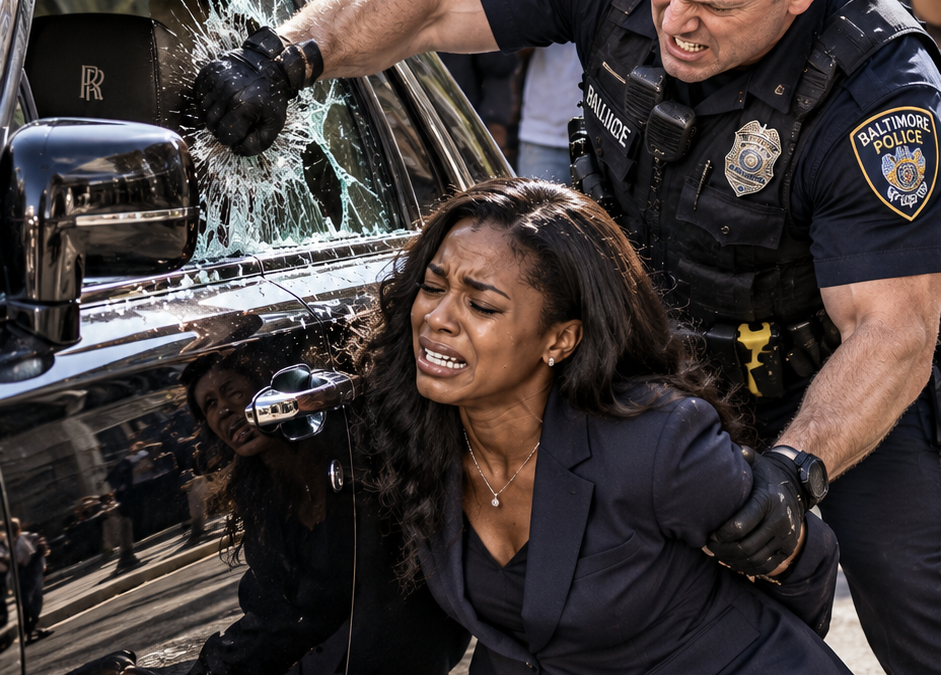
𝗙𝗨𝗟𝗟 𝗦𝗧𝗢𝗥𝗬
Another officer chuckled.
“Maybe she found the keys while cleaning somebody’s mansion.”
Their laughter spread across the sidewalk.
For a moment, I closed my eyes.
Not because I was defeated.
Because I needed to remember every voice.
Every sentence.
Every person who laughed.
And every person who looked uncomfortable but chose to remain silent.
Above my dashboard, concealed inside trim that appeared to be factory-installed, a miniature encrypted camera was recording.
Its existence was known to fewer people than I could count on one hand.
I’d spent months preparing for the possibility that the operation might become dangerous.
I hadn’t expected it to begin with a shattered window in broad daylight.
Holloway leaned toward me again.
“Know what your biggest mistake was?”
I looked straight at him.
“No. Tell me.”
“You actually thought people would see a Black woman driving a Rolls-Royce and believe it was hers.”
The remark was loud enough for the entire crowd to hear.
A college student standing near the intersection lowered his phone momentarily.
“Did he seriously just say that?”
His friend continued recording.
Holloway slapped the roof of my car.
“My instincts don’t miss.”
“Evidence should matter more than instinct,” I answered.
He laughed.
“Listen to her. She’s going to teach me how to do my job.”
Then he reached into my jacket pocket and removed my wallet.
Inside were my driver’s license, credit cards, and several business cards.
He barely examined them.
“Run her name,” he told Derek.
A few seconds later, dispatch confirmed that my driver’s license was valid.
No warrants.
No outstanding violations.
The vehicle’s registration was also valid.
“Registered owner: Monroe Strategic Consulting.”
Holloway rolled his eyes.
“Fake shell company.”
Dispatch repeated that every available record had returned valid.
For a reasonable officer, that would have been a reason to reconsider the detention.
For Holloway, it appeared to be a personal insult.
“She’s probably hiding drugs.”
Derek searched the glove compartment.
He checked beneath the seats, opened the storage compartments, and emptied several small containers onto the passenger seat.
Nothing.
No drugs.
No weapons.
No stolen property.
No evidence of any offense.
Yet Holloway kept insisting there had to be something.
A middle-aged veteran stepped forward from the crowd.
“Officer, I’ve watched this entire encounter. What exactly is your probable cause?”
Holloway pointed at him.
“Back up.”
“I served this country for twenty-six years. I know when something doesn’t look right.”
“I don’t care if you served on the moon.”
The man raised both hands and stepped back.
I appreciated what he had tried to do.
But the more important detail was that he remained there, watching.
Holloway had been so focused on proving that I didn’t belong behind the wheel of an expensive car that he hadn’t noticed how many witnesses were documenting his behavior.
Then Derek found my credential holder.
It was tucked inside the center console, beneath a small stack of business documents.
“Grant, you might want to see this.”
Holloway turned impatiently.
“What?”
Derek opened the black leather holder.
A polished federal badge caught the afternoon sunlight.
I watched Holloway take it.
For the first time since the stop began, my attention narrowed completely.
He glanced at the badge without properly examining it.
“Fake credentials. Great. She’s carrying a fake federal badge, too.”
Then he stuffed it into his vest.
I felt a sharp pulse of concern.
That badge wasn’t merely identification.
It was connected to an operation that had consumed almost a year of my life.
And if Derek searched any deeper into the vehicle, he might discover something that could compromise far more than my cover.
Holloway noticed the change in my expression.
“There it is,” he said triumphantly. “I knew you’d crack eventually.”
I looked directly at him.
“You’ve mistaken patience for surrender.”
His smile disappeared.
He ordered Derek to put me in the patrol car.
Derek grabbed my elbow and shoved me toward the cruiser. I stumbled as my heels caught against uneven pavement.
“Hey!” someone shouted. “She’s not resisting!”
Holloway turned toward the crowd.
“Anyone else want an obstruction charge?”
Nobody stepped closer.
But nobody stopped recording.
He spotted the young man in the university sweatshirt.
“You. Delete that video.”
The student lowered his phone.
“I have a right to record.”
“I said delete it.”
“No.”
A gray-haired attorney standing outside the coffee shop stepped forward.
“He doesn’t have to delete anything. Recording police activity in public is protected by the First Amendment, subject to reasonable restrictions.”
Holloway glared at him.
“And who are you supposed to be?”
“Someone who’s practiced constitutional law for thirty years.”
The officer moved closer and said something too quietly for most of the crowd to hear.
I heard enough.
It was a threat.
The attorney didn’t argue.
He simply kept recording.
Derek opened the back door of the cruiser and guided me inside.
Holloway leaned down to speak through the opening.
“You know what happens next? We book you. We impound your fancy car. Then we take it apart until we find out what you’re hiding.”
I held his gaze.
“If that’s what you decide to do, I hope you’re prepared to explain every step.”
He laughed.
“I don’t explain myself to suspects.”
“You might have to.”
He slammed the door.
I watched the damaged Rolls-Royce through the rear window as the cruiser pulled away.
The people on the sidewalk were still filming.
I couldn’t tell whether the hidden camera was still transmitting.
I couldn’t reach my team.
And I had no way of knowing whether Holloway’s next mistake would merely strengthen our case or expose an operation that had taken eleven months to build.
Twenty minutes later, we arrived at Baltimore’s Sixth Precinct.
Holloway marched me through the lobby with the satisfaction of a man returning from a successful hunt.
Several officers looked up from their desks.
“What’s the charge?” one asked.
Holloway grinned.
“Possession of a suspicious vehicle.”
Laughter spread.
Another officer glanced toward the parking lot, where the damaged Rolls-Royce was being delivered for processing.
“That’s one expensive mistake.”
I said nothing.
I had already learned that silence irritated Holloway more than an argument.
A detention officer took me to interview room three, removed one handcuff, and secured my other wrist to a metal ring beneath the table.
The room smelled of disinfectant and stale coffee.
Fluorescent lights hummed overhead.
A short time later, Holloway returned carrying a stack of paperwork.
He dropped it in front of me.
“Sign.”
I read the first paragraph.
The report claimed I’d become aggressive during the traffic stop.
I looked up.
“That isn’t true.”
He shrugged.
“It’s true now.”
“You wrote a false report.”
“I wrote the report that keeps my officers safe.”
“You mean the report that protects you.”
His expression darkened.
He leaned across the table.
“Here’s what’s going to happen. You’re going to sign that statement, admit you resisted, and pay for the damage to the window. Then maybe the prosecutor will go easy on you.”
I pushed the papers back.
“I won’t sign a statement describing something that never happened.”
His palm struck the metal table.
The sound echoed through the room.
“You don’t get to negotiate with me.”
Several officers glanced toward the doorway.
Holloway lowered his voice.
“You think you’re smarter than everybody in this building?”
“No.”
I looked at the paperwork.
“I think the truth is.”
He stared at me for another moment before storming out.
Only after the door closed did I allow myself to examine the red marks around my wrists.
My right shoulder ached where it had struck the car.
The cut on my cheek had dried.
I’d trained for dangerous assignments.
I’d spent years preparing to remain composed under pressure.
But I was still a human being sitting handcuffed in a room after being assaulted by a man who believed my skin color was sufficient evidence of criminality.
I wanted to stand up.
I wanted to call my supervisor.
I wanted somebody to tell me that the operation was secure and that I could leave.
Instead, I remained seated.
The reason was simple.
I wasn’t in that precinct by accident.
For eleven months, I’d been investigating corruption among officers assigned to the very building where Holloway had brought me.
My name was Special Agent Alyssa Monroe.
And the FBI investigation I was conducting had already uncovered a network of falsified police reports, extortion, protection payments, and suspected financial relationships between officers and criminal organizations.
The Rolls-Royce was registered through Monroe Strategic Consulting, the business identity used for my undercover work.
It was expensive because the role I was playing required it.
But everything associated with the operation was real enough to survive ordinary scrutiny.
For nearly a year, my team had collected evidence from confidential witnesses, bank records, hidden surveillance, and the department’s own documentation.
We had been building a case against people who used their badges to protect criminal associates and intimidate anyone who questioned them.
Holloway had just brought me directly into the center of it.
That could have accelerated everything.
Or it could have destroyed everything.
The greatest danger wasn’t his ability to recognize my badge.
It was the possibility that someone might access the vehicle’s secure compartments and expose information before my team could complete its preparations.
The original copies of our most sensitive evidence had already been transferred to secure federal storage.
But certain encrypted operational materials remained in the car.
I needed to protect them.
And I needed to stay alive long enough for the investigation to reach its next stage.
Outside my interview room, Holloway was still enjoying himself.
I learned later that Lieutenant Travis Cole had approached Captain Randall Pierce shortly after my arrival.
Cole had confirmed that my driver’s license was valid, the vehicle was properly registered, and the search had uncovered nothing illegal.
Pierce apparently recognized the problem immediately.
But his concern wasn’t whether I’d been mistreated.
He wanted to know whether Holloway could find something that justified the arrest.
“If the car is clean,” Pierce reportedly told Cole, “make sure it doesn’t stay that way.”
That sentence would eventually become one of the most important pieces of evidence in the case.
At the time, I didn’t know he’d said it.
I only knew that the officers seemed increasingly determined to make me guilty of something.
In the evidence garage, Derek Lawson continued searching the Rolls-Royce.
He recovered an unfamiliar black device beneath the front seat and placed it in an evidence bag, believing it was some sort of tracking module.
The device was actually one of our encrypted transmission backups.
When he disconnected it, a live feed went dark.
Three blocks away, my surveillance team received the alert.
A federal operations vehicle had been positioned close enough to monitor developments without drawing attention.
My colleagues knew I was in custody.
They also knew that exposing my identity prematurely could compromise the broader investigation.
Their instructions were to intervene immediately if my life was in danger.
Otherwise, they would maintain surveillance while the remaining warrants and operational authorizations were finalized.
I wasn’t entirely comfortable with that arrangement.
No agent enjoys becoming dependent on people outside a locked room, especially when the people controlling the door have already demonstrated their willingness to lie.
But we’d spent too many months documenting that precinct’s misconduct to surrender the operation without necessity.
Holloway returned to interview room three carrying coffee.
He placed a paper cup on the table.
“Hungry?”
“No.”
“Thirsty?”
“No, thank you.”
He sat across from me.
“You know what I don’t understand?”
I waited.
“You’re awfully calm for somebody who’s about to lose everything.”
“Being calm doesn’t mean I’m not concerned.”
“Most innocent people panic.”
“Some do. Some don’t. Fear isn’t evidence.”
He shook his head.
“You’re really something.”
He pushed a blank legal pad toward me.
“Write down who owns that Rolls-Royce.”
“I’ve already provided the registration information.”
“I want it in writing.”
I picked up the pen.
“Will this statement be preserved as evidence?”
He frowned.
“Why?”
“Because every written record matters.”
He waved dismissively.
“Sure.”
I wrote a single sentence.
The registered owner can be verified through lawful federal channels.
Holloway read it twice.
“What kind of answer is this?”
“The truthful one.”
He crumpled the paper.
“You think you’re clever?”
“I think precision matters.”
He threw the paper into the trash and stood.
“One last chance. Tell me who you really work for.”
I looked directly at him.
“You’ll know soon enough.”
He left without touching the coffee.
I sat alone for several minutes, listening to footsteps and distant conversations in the hallway.
Then the door opened again.
A young officer entered carrying a bottle of water.
She looked barely twenty-six.
“I’m Emily Foster,” she said quietly.
“Thank you, Officer.”
She placed the bottle in front of me.
Then she hesitated.
“I watched some of the videos.”
I said nothing.
“I don’t think what happened to you was right.”
Something about the way she said it caught my attention.
She wasn’t trying to impress me.
She sounded genuinely troubled.
“Why are you telling me this?”
She glanced toward the door.
“Because not everybody here agrees with Holloway.”
I looked at her nameplate.
“Then be careful, Officer Foster.”
She offered a faint, sad smile.
“So should you.”
After she left, I remained looking at the closed door.
Emily reminded me of something I’d almost forgotten during the previous few hours.
The investigation wasn’t simply about finding corrupt officers.
It was also about discovering how an institution responded when decent people recognized misconduct.
Would they speak?
Would they document what they’d witnessed?
Or would they convince themselves that remaining silent was the same as remaining innocent?
Elsewhere in the building, Lieutenant Cole was asking similar questions.
I later learned that he’d begun reviewing Holloway’s prior stops.
The records were disturbing.
Complaints about excessive force.
Allegations of civil-rights violations.
Disputed arrests.
Missing body-camera recordings.
Black motorists who described being treated as suspects without reasonable justification.
The pattern extended much further back than the incident involving my car.
Cole had worked in that building for years.
Yet he’d never seriously examined what the accumulating complaints meant.
Now he was beginning to recognize that he had overlooked far more than a difficult colleague.
Meanwhile, Officer Lawson continued cataloging the Rolls-Royce.
He found my luggage, business documents, expensive clothing, and a heavily encrypted laptop.
None of it was illegal.
Then he noticed a narrow compartment beneath the rear armrest.
When he pressed the release, the panel opened only a few inches.
Something inside prevented it from opening farther.
He reached toward it.
His radio crackled.
Captain Pierce wanted him upstairs.
Derek closed the panel and left.
When my team reviewed the remaining surveillance footage, they discovered just how close he had come to finding the secure storage unit.
Fortunately, the material most important to our investigation was already beyond the precinct’s reach.
The car itself had become something else.
A test of how far these officers were prepared to go once they believed a woman they considered powerless was completely under their control.
By early evening, videos of the encounter had spread across Baltimore.
The first had appeared online forty-three minutes after Holloway pulled me from the Rolls-Royce.
Then another recording surfaced.
And another.
Different angles showed the same event.
My hands on the steering wheel.
Holloway standing beside the car.
His baton swinging.
The window exploding before I made any threatening movement.
The incident was becoming impossible to explain away.
Reporters gathered outside the precinct.
Local television stations demanded statements.
Captain Pierce ordered his officers not to speak to the press.
Holloway remained confident that the attention would disappear within a day or two.
But Lieutenant Cole had watched the original footage.
He knew what the cameras showed.
And Officer Lawson’s recording provided another perspective that contradicted Holloway’s claim that I’d resisted before the window was broken.
The department’s own evidence was beginning to undermine its official version of events.
Inside interview room three, I heard people moving quickly through the corridor.
Then Officer Foster returned with fresh water.
She looked more nervous than before.
“They’re still searching your car,” she whispered.
“I expected that.”
“Doesn’t that worry you?”
“Of course it does.”
She seemed surprised by my answer.
I smiled faintly.
“Worry doesn’t necessarily change what happens next.”
She sat opposite me for a moment.
“I’ve only been here fourteen months,” she said. “My father was a police officer. He always told me this badge meant protecting people.”
Her voice faltered.
“But today…”
“Today made you question whether everyone wearing it believes the same thing.”
She nodded.
“My father used to say the fastest way to lose the public’s trust is to stop telling yourself the truth.”
I studied her face.
“Then listen to him.”
She looked toward the door.
“What if telling the truth costs me my career?”
“That’s a possibility you’ll have to consider. But protecting a lie has consequences too.”
She lowered her eyes.
Before leaving, she looked back at me.
“I hope somebody comes for you.”
I held her gaze.
“So do I.”
When the door closed, I allowed myself a small breath.
I knew my team was already close.
What I didn’t know was precisely when the final authorizations would arrive.
In a secure federal operations center, Special Agent Marcus Ellison was coordinating the next stage of Operation Iron Veil.
He had been involved in the investigation from the beginning.
By then, our team had enough evidence to connect several officers to unlawful stops, fabricated charges, altered evidence, and suspected protection payments.
Financial records placed members of the precinct in contact with known criminal associates.
Witnesses had described money changing hands in exchange for favorable treatment.
Internal communications suggested that senior officers had helped conceal misconduct.
We had already prepared federal warrant applications before Holloway stopped my car.
What happened that afternoon generated additional evidence, but it wasn’t the foundation of the case.
And Marcus understood something Holloway did not.
Our investigation wasn’t dependent on anything remaining inside the Rolls-Royce.
The critical evidence was secure.
The immediate question was whether Holloway and his superiors would continue escalating until they implicated themselves in further crimes.
They did.
Holloway returned to the evidence garage and searched my car again.
He examined the dashboard, pressed unfamiliar controls, and insisted there had to be another hidden compartment.
When his colleagues told him they’d already searched the vehicle repeatedly, he ordered them to do it again.
They found a thin folder beneath the spare-tire cover.
Inside were corporate filings, financial statements, property documents, and donation records.
Holloway flipped through the pages.
“Accounting paperwork?”
He threw the folder aside.
What he hadn’t noticed was the small federal reference marking at the bottom of each page.
The documents weren’t classified.
They had been deliberately placed in the vehicle.
They were ordinary enough to distract an undisciplined searcher and relevant enough to remain part of the documented evidence inventory.
Holloway was looking for something dramatic.
He couldn’t imagine that the most useful evidence against him might be his own conduct.
He returned to the dashboard.
When he failed to find anything incriminating, he began trying to access the car’s encrypted electronic systems.
Our technical team detected the unauthorized activity.
Every attempt was documented.
A few minutes later, Holloway received a telephone call.
He was still in the garage when he answered.
An unfamiliar male voice advised him to stop searching the vehicle before the search became the least of his problems.
The caller disconnected.
Holloway apparently dismissed it as a prank.
But the warning unsettled him.
For the first time that afternoon, he began to suspect that somebody outside the precinct knew exactly what was happening inside it.
He still hadn’t considered the obvious possibility.
The woman he had humiliated might know far more about him than he knew about her.
Internal Affairs requested the original body-camera recordings that evening.
Captain Pierce called his officers into a conference room.
The public videos were playing on a television behind him.
Holloway insisted the recordings lacked context.
Lieutenant Cole responded that Internal Affairs wanted the unedited files.
Pierce turned toward Holloway.
“You didn’t turn your camera off, did you?”
Holloway hesitated.
“It lost connection for a few minutes.”
“When?”
“Right after the window broke.”
The room fell silent.
Cole looked at him.
“That’s not a normal equipment failure.”
Holloway shrugged.
“It happens.”
Pierce appeared increasingly alarmed.
If Holloway had manually disabled his camera, the department’s problems were about to become much worse.
But instead of immediately preserving all available evidence and ending the questionable detention, Pierce began looking for ways to protect the officers involved.
He ordered Derek Lawson to alter the evidence log.
Specifically, he wanted the recorded recovery time of my federal credential holder changed.
Derek checked the original inventory.
The timestamps didn’t match Holloway’s account.
Pierce didn’t care.
“I want the paperwork consistent.”
Derek stared at him.
“But it wouldn’t be accurate.”
Pierce moved closer.
“You’ve got a promising career. Don’t throw it away over paperwork.”
Derek asked for a minute.
Pierce gave him five.
That was another moment in which the investigation nearly changed direction.
Derek had participated in the search.
He had handled my credentials.
He had stood there while Holloway made insulting remarks and used unnecessary force.
But he still had a choice about whether to become part of the cover-up.
He didn’t alter the log.
Instead, he compared the timestamps against his body-camera footage.
The discrepancy was unmistakable.
Holloway’s report claimed I’d resisted before the window was broken.
The recording showed the window being smashed before any alleged resistance.
The official account couldn’t be true.
Meanwhile, the precinct’s civilian IT contractor had quietly confirmed access to systems relevant to our investigation.
He wasn’t an ordinary contractor.
He was part of our operation.
When the final digital-preservation preparations were complete, he transmitted an encrypted message to the federal team.
The warrant package was ready.
All that remained was the final authorization.
Holloway had no idea that while he was demanding signatures on false reports, the evidence against his entire network was being secured beyond his reach.
A short time later, Captain Pierce and Holloway entered my interview room carrying another stack of documents.
Pierce placed them in front of me.
“We’re officially charging you with resisting arrest, obstructing an investigation, and interfering with law enforcement.”
Holloway smiled.
“You’ve had plenty of chances to cooperate.”
I read the documents carefully.
Once again, the narrative contradicted what had actually happened.
Once again, the officers wanted my signature beneath it.
“I won’t sign a false statement.”
Pierce leaned forward.
“You’re making this unnecessarily difficult.”
“No, Captain. I’m asking you to describe events accurately.”
Holloway laughed.
“Then enjoy spending the night in a holding cell.”
I looked at the signature lines.
There were several names already written beneath the report.
A few others remained blank.
“Before you file these charges,” I asked, “are you absolutely certain everyone involved wants their name on these documents?”
Holloway folded his arms.
“Every one of us.”
I nodded slowly.
“I was hoping you’d say that.”
For the first time, he seemed uncertain about what I meant.
But his pride was too strong to let him reconsider.
He ordered the detention officers to transfer me to holding cell two.
As they escorted me through the booking area, conversations stopped.
Holloway followed behind us, announcing loudly that this was what happened when somebody thought she was smarter than the badge.
Some officers laughed.
Others looked away.
Emily Foster stood near a desk, her expression troubled.
Derek Lawson held a folder against his chest and didn’t join the laughter.
Holloway opened the holding-cell door.
I turned toward him.
“Is humiliating people part of your training?”
He leaned close enough to speak without the entire room hearing him.
“No. It’s a bonus.”
The door slammed shut.
He smiled through the bars.
“Enjoy the view.”
I sat on the narrow bench.
“You should enjoy yours while you still can.”
Then I waited.
I could hear activity building beyond the corridor.
Footsteps.
Voices.
The metallic sounds of evidence lockers being opened and closed.
Somewhere in the building, Captain Pierce was assembling the final charging documents.
He wanted signatures from every officer involved.
Grant signed immediately.
Two others, Mills and Benton, added their names.
Then the paperwork reached Derek Lawson.
He stopped.
Holloway noticed.
“Problem?”
Derek stared at the report.
“It says she became aggressive before the window was broken.”
“That’s right.”
“That’s not what I saw.”
The room went quiet.
Pierce asked him what he meant.
Derek took a breath.
“My body camera shows something different.”
Holloway stepped toward him.
“Careful.”
Derek didn’t move.
“I can’t sign this.”
“You really want to throw away your career for somebody you’ve never met?”
Derek looked up.
“I don’t want to throw away my integrity.”
That was when the electronic buzzer sounded near the precinct’s front entrance.
Then it sounded again.
And again.
The dispatcher called Captain Pierce over the radio.
He needed to come to the lobby immediately.
I heard the change in the building before I saw anyone.
The overlapping conversations stopped.
Boots moved rapidly across the floor.
Doors opened.
Somebody asked why so many vehicles were outside.
Then came a voice I knew.
Special Agent Marcus Ellison.
His tone was controlled and unmistakable.
He identified himself and announced that he was entering under federal authority.
Within seconds, agents began securing the precinct.
Evidence lockers.
Records offices.
Computer servers.
Dispatch systems.
Every location relevant to the investigation was placed under federal control pursuant to the warrants and preservation orders.
I later learned that nearly two dozen dark, unmarked vehicles had surrounded the front parking lot.
Their emergency lights flashed against the precinct windows.
More than twenty federal agents entered in a coordinated movement.
No one needed to shout.
The documents Marcus carried were enough.
Captain Pierce apparently tried to object.
He claimed there had to be a mistake.
Marcus handed him the federal search warrant.
Then the evidence-preservation order.
Then the arrest warrants.
Holloway demanded to know whether this was all about my traffic stop.
Marcus told him it was about far more than one incident.
Then he turned toward the holding cells.
“Bring Agent Alyssa Monroe.”
For the first time that afternoon, the entire building went silent for a reason that had nothing to do with Holloway.
Two federal agents appeared outside my cell.
One unlocked the door.
The other smiled.
“Good evening, ma’am. We’re ready.”
I stood.
My wrists were still marked from Holloway’s cuffs.
One agent handed me a black leather case.
Inside was the credential holder Holloway had dismissed as counterfeit and stuffed into his vest.
I opened it, checked my identification, and clipped my badge to my jacket.
Then I straightened my sleeves.
“Let’s finish this.”
The lobby was full of people when I walked in.
Federal agents stood near the entrances.
The precinct’s officers remained gathered around the front desk.
Derek Lawson was still holding the charging documents.
Emily Foster looked at me, her eyes widening as she recognized the badge on my jacket.
Captain Pierce’s face had lost its color.
Holloway stared at me as though his mind refused to accept what he was seeing.
“No.”
I stopped a few feet away.
He shook his head.
“That’s impossible.”
“You said fake badges don’t fool experienced officers.”
He glanced at Marcus.
“She’s been sitting in one of our cells all afternoon.”
Marcus nodded.
“Exactly.”
I handed him my credentials.
He opened the holder and displayed my federal identification.
Special Agent Alyssa Monroe.
Federal Bureau of Investigation.
The same badge Holloway had mocked.
The same identification he’d concealed in his vest instead of properly examining.
Marcus closed the holder.
“Does anyone still want to question Agent Monroe’s identity?”
Nobody answered.
Then Holloway recovered enough confidence to point at me.
“So what? Being FBI doesn’t put her above the law.”
I stepped forward.
“No, Officer Holloway. It doesn’t.”
I looked directly at him.
“But neither does your badge.”
Marcus opened the first evidence folder.
“This investigation began eleven months ago.”
He laid photographs across the front desk.
Officers meeting suspected drug traffickers.
Cash exchanges.
Private warehouse meetings.
Luxury trips connected to known criminal associates.
Banking records showing unexplained deposits.
Documents linking members of the precinct to extortion, false arrests, protection payments, and evidence manipulation.
Lieutenant Cole stared at the photographs.
“I’ve never seen these.”
Marcus looked at him.
“You weren’t supposed to.”
Several sealed federal evidence containers were brought inside.
Then Marcus asked a technician to activate the projector.
The lights dimmed.
A video appeared on the wall.
The perspective was unmistakable.
It came from inside my Rolls-Royce.
My steering wheel filled the foreground.
Holloway stood outside the driver’s window.
Then his voice filled the lobby.
“A Black woman doesn’t belong behind the wheel of a Rolls-Royce like this.”
Nobody moved.
The baton rose.
Glass exploded across the cabin.
My face turned away.
The recording continued.
Every insult.
Every threat.
Every moment of unnecessary force.
Holloway watched himself drag me from the vehicle and shove me against the door.
Then he heard his own voice accusing me of pretending to belong among successful people.
He stared at the screen.
“Where did that camera come from?”
I looked at him.
“The moment you decided to destroy my window, you also activated three independent federal recording systems.”
His face drained of color.
The video showed him dismissing my credentials without examining them.
It captured his accusations about the ownership of the car.
It documented my cooperation.
And it preserved his decision to arrest me despite having no evidence of an offense.
Marcus explained that when Derek disconnected one transmission module, the backup systems continued recording and transmitting through separate channels.
The original recordings were already secure on federal servers.
Holloway looked toward Derek.
Then toward Pierce.
Neither man offered him a way out.
Pierce attempted one final argument.
“This might establish excessive force. It doesn’t prove corruption.”
Marcus nodded.
“You’re right.”
He opened another folder.
“That’s why we brought the rest.”
Federal cyber specialists displayed records recovered from the precinct’s own systems.
Modified arrest reports.
Altered timestamps.
Deleted evidence logs.
Unauthorized changes to case narratives.
Records showing attempted manipulation of body-camera files.
The digital audit trails identified the accounts responsible.
Grant Holloway.
Captain Randall Pierce.
Two supervising sergeants.
Other officers involved in the falsification of departmental records.
The attempted modifications made less than two hours earlier appeared beside older evidence of systematic manipulation.
Lieutenant Cole’s account wasn’t among them.
Neither was Emily Foster’s.
Marcus turned toward Cole.
“Your body-camera files remained untouched.”
Cole nodded slowly.
“I started reviewing the complaints this afternoon.”
“We know.”
I watched him lower his head.
There was no satisfaction in seeing his expression.
Cole had ignored warning signs for years.
He was beginning to understand how much harm that silence had permitted.
But he’d finally started examining the evidence rather than accepting his colleagues’ explanations.
And Derek had refused to sign the false report.
Those decisions mattered.
Holloway suddenly lunged toward the nearest computer.
“Turn that off!”
Two federal agents stepped between him and the equipment.
“Don’t move.”
He froze.
Marcus produced the final document.
“Officer Grant Holloway, you’re under arrest.”
The warrant identified federal civil-rights violations, obstruction, destruction of evidence, conspiracy to falsify official records, and deprivation of rights under color of law.
Holloway shook his head.
“You can’t prove all that.”
I reached into my briefcase and removed a small digital recorder.
“Actually, I can.”
I pressed play.
Captain Pierce’s voice filled the lobby.
“If the car is clean, make sure it doesn’t stay that way.”
Pierce lowered his head.
For eleven months, he had relied on his position to keep complaints from reaching the people who could investigate them.
Now his own words had become evidence.
Marcus gave the order to execute the warrants.
Federal agents moved through the precinct.
Holloway was handcuffed.
So was Captain Pierce.
Mills and Benton were detained.
Several detectives, evidence clerks, and a supervising sergeant were taken into custody under the federal warrants.
Weapons were surrendered.
Credentials were collected.
The people who had spent years believing that their authority made them untouchable were escorted through the same lobby where they’d laughed at me only hours earlier.
Holloway looked toward me as an agent secured his wrists.
“I was just doing my job.”
I stood in front of him.
“No. You stopped doing your job when you decided the color of my skin mattered more than the truth.”
He opened his mouth.
Then closed it.
For the first time since I’d encountered him, Officer Grant Holloway had nothing to say.
Outside, television crews recorded federal agents escorting officers into waiting vehicles.
The same witnesses who had filmed my arrest watched the people responsible for it being taken away.
I didn’t feel triumphant.
My shoulder still hurt.
My wrists were bruised.
And somewhere in the city were people who had endured much worse encounters with those officers long before I’d driven through Jefferson Avenue.
My arrest had been recorded by a federal surveillance system.
Most of their encounters hadn’t.
Some had filed complaints that disappeared.
Others had been threatened into silence.
Some had lost jobs, money, freedom, and years of their lives because an officer’s lie carried more institutional authority than their truth.
I wasn’t thinking about the Rolls-Royce anymore.
I was thinking about them.
Lieutenant Cole remained near the front desk as the final arrests were carried out.
Marcus approached him.
“You understand why you’re not in handcuffs?”
Cole nodded.
“I should have stopped this years ago.”
“You should have.”
Cole looked down.
“I ignored too many warning signs.”
Marcus glanced toward Pierce’s empty office.
“Looking away isn’t the same as committing the crime. But it gives wrongdoing room to grow.”
Cole didn’t argue.
He removed his lieutenant’s badge and placed it on the counter.
“I don’t deserve to wear this until the public trusts the department again.”
Marcus didn’t tell him whether he was right.
That was a question for the investigation and the city.
Across the lobby, Emily Foster approached me.
Her eyes were wet.
“I owe you an apology.”
“For what?”
“I wore the same uniform.”
“You weren’t the one who abused it.”
She looked down.
“I almost stayed silent.”
“But you didn’t.”
Her voice trembled.
“I wasn’t brave.”
I put a hand on her shoulder.
“Emily, courage isn’t the absence of fear. It’s choosing to tell the truth when being afraid would give you an easier excuse.”
She nodded.
A few minutes later, Derek Lawson came toward us.
He looked exhausted.
“I should have spoken sooner.”
“You spoke when they asked you to sign a lie.”
“Not soon enough.”
I understood his regret.
But I also understood that guilt could either become an excuse for withdrawal or the beginning of accountability.
“You still have a responsibility to tell investigators everything you know.”
“I will.”
He told me he’d already agreed to cooperate with the federal investigation.
His testimony helped establish the timeline of the stop, the vehicle searches, and Pierce’s attempts to alter the evidence log.
There would be consequences for people who participated in misconduct.
There would also be a difficult reckoning for people who had allowed it to continue.
That was how accountability worked.
Not through a single dramatic arrest, but through the much harder process of examining what everyone had done, what everyone had known, and what everyone had chosen not to say.
Three months later, I entered the federal courthouse as a witness.
The corruption trial had attracted national attention.
Reporters crowded the steps.
The public gallery was packed.
Jurors heard testimony from people whose complaints had been dismissed, motorists whose property had been searched without proper justification, and witnesses who described officers demanding money in exchange for favorable treatment.
They examined financial records.
They reviewed falsified police reports.
They listened to recordings of conversations that the defendants had believed would never become public.
And they watched the video of my traffic stop.
The defense argued that Holloway had made a split-second decision under pressure.
The prosecution played his words again.
“A Black woman doesn’t belong behind the wheel of a Rolls-Royce like this.”
No complicated interpretation was necessary.
He had explained his assumptions in front of dozens of witnesses before committing the act he later tried to justify.
The jurors also saw the evidence that he hadn’t stopped after the initial assault.
He’d detained me without a substantiated offense.
He’d dismissed legitimate credentials.
He’d searched my car repeatedly.
He’d attempted to support false charges with altered documentation.
And he’d helped turn a discriminatory stop into a broader effort to obstruct the truth.
The jury deliberated for less than six hours.
Holloway was convicted on multiple federal charges.
They included civil-rights violations, conspiracy to falsify official records, obstruction of justice, and destruction of federal evidence.
Captain Pierce was convicted for his role in the conspiracy, witness intimidation, and directing the falsification of police reports.
Several other officers accepted plea agreements and agreed to testify in related cases.
I sat quietly as the verdicts were read.
My hands were resting on my lap.
For a brief moment, I remembered the handcuffs closing around my wrists beside the Rolls-Royce.
I remembered Holloway telling me that women like me didn’t belong among successful people.
I remembered the laughter in the precinct lobby.
And I remembered Emily Foster bringing me water because she couldn’t bear to watch what was happening without doing something.
The judge’s remarks stayed with me.
He reminded the defendants that a badge represented public trust, not personal power.
And that officers who deliberately violated the constitutional rights they had sworn to protect betrayed both the public and the honest people who served alongside them.
Over the following months, the Sixth Precinct underwent extensive changes.
More than twenty officers were dismissed or prosecuted.
Use-of-force complaints from the previous five years were reopened for independent review.
Body-camera policies were strengthened.
Evidence-management systems were placed under external oversight.
Civil-rights training became mandatory.
The city established a permanent civilian review board with authority to compel testimony and obtain relevant records.
Those reforms didn’t erase what had happened.
They couldn’t restore every lost opportunity or undo every wrongful arrest.
But they created avenues for scrutiny that the old leadership had spent years trying to avoid.
As for me, the investigation was finally coming to an end.
Operation Iron Veil had achieved what eleven months of work had been designed to accomplish.
The corrupt network had been exposed.
The evidence had survived.
And people who had once believed their complaints would never be heard were finally being given the chance to tell their stories before independent investigators.
One autumn afternoon, I returned to the intersection on Jefferson Avenue.
The glass from my Rolls-Royce had long since been swept away.
Traffic moved normally.
Pedestrians hurried past the coffee shop.
The afternoon sunlight reflected off storefront windows, just as it had on the day Holloway stopped me.
I stood near the curb and looked across the street.
I could still remember exactly where my car had been parked.
Exactly where the elderly woman had stood filming.
Exactly where the college student had refused to delete his video.
And exactly where Holloway had shoved me against the door.
I was so absorbed in those memories that I almost didn’t notice a patrol car slowing beside me.
It pulled over.
The driver’s door opened.
Emily Foster stepped out.
She was now a field training officer.
“I thought I might find you here,” she said.
I smiled.
“It’s quieter now.”
She looked around the intersection.
“Funny, isn’t it? The place where everything fell apart became the place where things finally started changing.”
I thought about that.
Then I shook my head gently.
“I don’t think everything started changing here.”
“Where, then?”
“When people decided they weren’t going to keep accepting lies.”
Emily smiled.
She extended her hand.
“Thank you, Alyssa.”
I shook it.
“No. Thank you for choosing the truth when staying comfortable would have been easier.”
She returned to her patrol car and drove away.
I watched the vehicle disappear into the afternoon traffic.
There was something reassuring about seeing her behind the wheel.
Not because she wore a badge.
Because I knew what she’d chosen to do when that badge had been tested.
My phone vibrated.
A secure message appeared on the screen.
Operation Iron Veil closed. Status: Successful.
I read it twice.
Then I slipped the phone into my pocket.
For eleven months, I had investigated officers who believed their uniforms gave them the authority to decide whose rights mattered.
On the day Holloway shattered my window, he had looked at my skin, my clothes, and my car and convinced himself that I was someone he could humiliate without consequences.
He never imagined that I might be the person documenting the corruption he had spent years believing nobody could expose.
But the badge I carried wasn’t the reason what he did was wrong.
And I didn’t need to be an FBI agent to deserve the dignity he denied me.
The elderly woman who kept recording deserved it.
The college student who refused to delete his video deserved it.
Every person whose complaint had been buried deserved it.
And every innocent motorist Holloway had stopped before me deserved it.
That was what I wanted to remember long after the trial, long after my bruises faded, and long after the Rolls-Royce was repaired.
Justice was never supposed to depend on whether the person being mistreated happened to possess a more powerful badge.
It was supposed to belong to everyone.
And if there was one thing that eleven months inside that investigation had taught me, it was that a lie could survive an astonishing amount of silence.
But the moment enough people chose to preserve the truth, even the most powerful men in the room could no longer pretend they hadn’t heard it.








