𝗙𝗨𝗟𝗟 𝗦𝗧𝗢𝗥𝗬 The Officer Who Pointed a Gun at My Chest Had No Idea What I’d Just Carried Out of Court
𝗙𝗨𝗟𝗟 𝗦𝗧𝗢𝗥𝗬
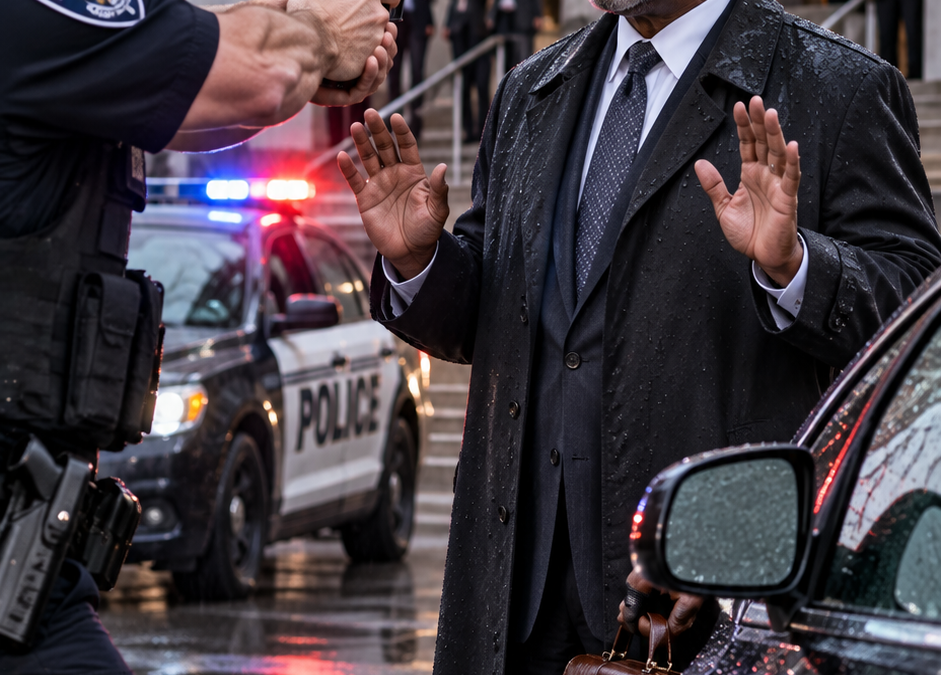
A second officer stepped out of the passenger side.
He was younger, perhaps thirty, with short black hair and a lean, athletic build.
His nameplate read RUIZ.
Unlike Grant, he didn’t immediately approach me.
He studied my hands, the distance between us, the vehicle, and the surrounding sidewalk.
I noticed the recording indicator on his body camera.
It was already running.
Grant’s camera was dark.
“Identification,” Grant demanded.
“My driver’s license is inside my coat. My registration is in the glove compartment. I’ll retrieve either one if you tell me to.”
“Don’t reach for anything!”
“I won’t.”
He looked toward my briefcase.
“What’s in the bag?”
“Legal documents.”
“What kind of legal documents?”
“Documents from a hearing I just attended.”
He stepped closer.
“Are you trying to be difficult?”
“No.”
“Then answer my questions.”
“I have been answering them.”
For an instant, I saw something change in his eyes.
It wasn’t fear.
It was anger at the fact that I hadn’t become frightened enough to abandon the conversation.
His hand closed around his pistol.
Then he drew it.
The muzzle rose toward my upper chest.
“Hands above your shoulders! Now!”
I lifted both hands.
“Officer, my hands are up.”
“Don’t move!”
I stopped breathing for a moment.
Over the course of my career, I had interviewed people who had been held at gunpoint by law enforcement officers. I had reviewed body camera footage of armed encounters and questioned witnesses about exactly when they believed their lives were in danger.
But knowing how to reconstruct a dangerous encounter afterward was very different from standing inside one.
I could see Grant’s pistol.
I could see how tightly he was holding it.
I could see his shoulders rising as his breathing became more pronounced.
And I could feel the cold realization that one misunderstood movement might be enough to end my life.
The brass latch on my briefcase struck the pavement as the case tipped sideways.
The sharp sound drew the attention of several people leaving the courthouse.
A young man in glasses stopped halfway down the steps.
He took out his phone.
I later learned his name was Evan Cole.
He had come to the courthouse on an unrelated personal matter and was about to become an important witness in mine.
Grant glanced toward him.
Then toward two other people who had stopped near the entrance.
His pistol remained aimed at me.
“Turn around.”
I obeyed.
“Place your hands on the car.”
I moved slowly toward the sedan.
The roof was cold and wet beneath my palms.
Grant approached from behind my right shoulder.
I could hear the leather equipment on his duty belt shifting as he moved.
“Don’t try anything.”
“I have no intention of trying anything.”
He began patting the outside of my overcoat.
I kept my hands flat against the roof.
“Officer, I haven’t consented to a search.”
“I’m checking for weapons.”
“I understand what you’re doing. I’m asking what facts made you believe I was armed.”
He pressed harder against my back.
“Stop challenging my authority.”
I looked straight ahead.
I had spent decades learning to control my temper inside courtrooms.
Now, standing beside my own car with a police officer’s weapon inches away, I understood why that discipline mattered.
There was a particular kind of anger that arrived when somebody treated your dignity as an obstacle.
I felt it moving through my chest.
But I also understood that giving Grant an emotional reaction might become the very thing he later used to justify his conduct.
So I remained still.
He finished patting my coat.
Then his attention shifted toward my briefcase.
“What’s in there?”
“I told you. Legal documents.”
“I’m going to take a look.”
I turned my head only slightly.
“I don’t consent to a search of my briefcase.”
His expression hardened.
“You think you can tell me what I can and can’t search?”
“I’m telling you that I don’t consent. If you believe you have lawful authority to search it without consent, I want that basis documented.”
Grant took another step toward the case.
I felt my stomach tighten.
That briefcase contained confidential attorney work product and sensitive information concerning people who had entrusted me with some of the most frightening experiences of their lives.
Some had already expressed concern about retaliation.
Others had agreed to testify only after receiving assurances that their personal information would be handled carefully.
I wasn’t going to casually surrender those documents because an officer was irritated that I had asked why he stopped me.
Grant bent slightly toward the brass latch.
“Stay where you are.”
“I’m not moving.”
He looked back at me.
“One more word, and you’re going in handcuffs.”
That was when I heard a familiar voice.
“Officer, please don’t open that case.”
Rachel Monroe was standing near the bottom of the courthouse steps.
She had come through the glass doors carrying her own files, apparently after seeing the commotion outside.
Rachel was forty-three and had spent nearly two decades practicing civil litigation.
She wasn’t naturally confrontational.
But she had an extraordinary ability to become calm whenever a situation required someone to distinguish between what was being asserted and what could actually be established.
She stopped several yards away.
Both hands remained visible.
“I’m an attorney,” she said. “I was inside the courthouse with this gentleman a few minutes ago.”
Grant straightened.
“Ma’am, step away from the scene.”
“I’m not interfering. I’m telling you that the briefcase contains protected legal materials.”
“Back up.”
Rachel remained outside his immediate working area.
“The vehicle belongs to him. We just attended a hearing together.”
“I said back up!”
I could see her considering how much information to reveal.
We had worked together long enough that I recognized her expression.
She was calculating.
Not how to embarrass Grant.
How to prevent the encounter from becoming any more dangerous.
“Rachel,” I said quietly.
She looked toward me.
“I’m all right. Just stay where you are.”
She didn’t believe I was all right.
Neither did I.
But she understood what I was asking.
She stopped moving.
Meanwhile, the second officer had walked toward the rear of my sedan.
Ruiz examined the license plate and entered the number into his portable terminal.
His camera continued recording.
I could see that he was deliberately avoiding any sudden movement or unnecessary confrontation.
He seemed increasingly concerned about what his partner was doing.
Grant, however, had begun watching the people gathering on the courthouse steps.
Evan was still filming.
Another man in a tan business coat had stopped near a stone column.
A young woman wearing courthouse identification raised her phone.
Someone near a delivery van began recording from the opposite side of the street.
Within minutes, Grant was surrounded by cameras.
I suspected that was making him angrier.
He had approached me as though the sidewalk belonged to him.
Now an audience was preserving every command and every movement.
“Everybody needs to move along,” he shouted.
Most of the bystanders remained where they were, keeping a safe distance.
I kept my hands against the sedan.
My shoulders were beginning to ache.
Cold rain had soaked into the upper part of my overcoat.
I could feel water running along the back of my neck.
But I was determined not to make a single unnecessary movement.
Then Ruiz received information from dispatch.
He listened through his earpiece.
His expression changed.
I couldn’t hear every word, but I understood the essential details when he repeated them.
The original call had concerned a man standing near a dark sedan outside the courthouse.
The caller described the situation as suspicious.
There had been no report of broken glass.
No attempted theft.
No damaged vehicle.
No weapon.
No threats.
No indication that anyone had tried to force open a car door.
I had been standing beside my own vehicle, preparing to unlock it.
That was the entire foundation of the encounter.
Ruiz checked my license plate again.
The registration was current.
The vehicle was registered to Marcus Elijah Whitfield.
The address matched my driver’s license.
There were no outstanding warrants or stolen-vehicle alerts.
He looked toward Grant.
“Tyler, the car checks out.”
Grant didn’t answer.
Ruiz continued.
“Registration matches his identification.”
I waited.
In a reasonable world, that would have been the end of the encounter.
An officer had responded to a report, made inquiries, verified the available information, and discovered no apparent criminal activity.
But Grant had already pointed a gun at me.
He had already ordered me against my car.
He had already threatened to arrest me for refusing permission to search my briefcase.
Ending the detention now would require him to acknowledge that the facts no longer supported his response.
And he seemed incapable of doing that.
“What about the bag?” he asked.
I looked toward my briefcase.
“It contains my legal documents.”
“Then you shouldn’t have a problem letting me inspect it.”
“Officer, refusing consent doesn’t mean I’m hiding something illegal.”
Grant’s jaw tightened.
He began moving toward the briefcase again.
Rachel took one careful step forward.
“Officer, those are confidential legal materials. Please leave them closed until your supervisor arrives.”
Grant turned toward her.
“Ma’am, I have already told you to stay out of this.”
Rachel stopped.
“I am staying out of your physical workspace. I’m also informing you that the documents may be protected.”
He looked as though he was about to argue.
Then the courthouse doors opened again.
A uniformed security supervisor descended the steps.
His name was Samuel Price.
He was fifty-seven, thick through the shoulders, with a gray mustache and deliberate movements.
Samuel had worked in the county sheriff’s office for more than twenty years before a knee injury led him into courthouse security.
I knew him from previous visits.
He knew me.
But as he approached, he didn’t announce who I was.
He looked first at my visible hands.
Then the car.
Then my briefcase.
Finally, he addressed Grant.
“Officer, can you explain what’s happening?”
“Suspicious person investigation.”
Samuel glanced toward Ruiz.
“Has the vehicle ownership been confirmed?”
Ruiz nodded.
“Yes, sir. Registered owner is standing right here.”
Samuel looked back at Grant.
“Then what’s the basis for continuing the detention?”
Grant gestured toward me.
“His behavior. He’s been uncooperative.”
I felt a bitter laugh rising in my throat.
I swallowed it.
Samuel studied me.
I was standing motionless beside my own car, with both hands visible and several people recording the encounter.
Nothing about the scene matched Grant’s description of an uncooperative suspect.
Samuel turned toward the briefcase.
“I’d recommend leaving that where it is until a supervisor determines whether there’s a legal basis to search it.”
Grant didn’t respond.
For the first time since the cruiser pulled up behind me, I could see uncertainty beginning to replace his confidence.
But the encounter still wasn’t over.
Another Harrison police cruiser arrived less than two minutes later.
A senior patrol supervisor stepped out.
Sergeant Cole Patterson.
He was forty-eight, with graying brown hair, a weathered face, and the kind of measured expression I associated with people who had spent years resolving difficult situations without allowing their own emotions to become part of the problem.
Patterson surveyed the scene before speaking.
He looked at Grant.
At Ruiz.
At Rachel.
At Samuel.
Then at the people recording from the courthouse steps.
Finally, he approached Grant.
“Give me a summary.”
Grant began immediately.
“Responded to a suspicious person call. Subject was standing beside a vehicle. He became argumentative, wouldn’t comply properly, and made movements toward his coat.”
I listened.
It was remarkable how quickly my ordinary questions had become argumentative behavior.
How my careful movements had become unpredictable.
How refusing consent had become suspicious.
Patterson looked toward me.
My hands were still visible.
Then he turned to Ruiz.
“Daniel, what did you observe?”
Ruiz hesitated.
I could almost see the calculation happening behind his eyes.
Contradicting a senior partner in front of a supervisor and several witnesses wasn’t a small decision.
Police officers depended on one another during dangerous calls.
Trust could become a matter of survival.
But trust wasn’t supposed to require dishonesty.
Ruiz glanced briefly toward his body camera.
Then he answered.
“Mr. Whitfield complied with the primary safety instructions. His hands remained visible. He told us where his identification was before making any movement.”
Grant’s expression changed.
Ruiz continued.
“Officer Grant drew his weapon before we verified the vehicle information. Dispatch didn’t report any weapon, burglary, or violence. The registration matches Mr. Whitfield’s identification.”
Patterson listened without interrupting.
“Did you observe any threatening movement?”
“No, Sergeant.”
Grant turned toward his partner.
“Daniel—”
Patterson raised a hand.
“Let him finish.”
Ruiz swallowed.
“I didn’t observe any threatening movement. I also didn’t see anything establishing that the briefcase was connected to criminal activity.”
For several seconds, nobody spoke.
Rain tapped against the roof of my sedan.
The cruiser’s emergency lights continued flashing across the courthouse columns.
Then Patterson looked at Grant.
“Holster your weapon.”
Grant complied.
The sudden absence of the pistol brought me more relief than I wanted to admit.
But I still didn’t move.
I had learned years earlier that an encounter wasn’t truly over simply because somebody stopped pointing a gun.
Patterson turned toward Rachel.
“Ma’am, you said you know this gentleman?”
“Yes, Sergeant.”
She took a measured breath.
“His name is Marcus Elijah Whitfield. He’s a civil rights attorney and a former assistant United States attorney.”
Grant looked toward me.
Rachel continued.
“We just attended a hearing inside this courthouse. Mr. Whitfield currently represents several plaintiffs in federal litigation challenging stop-and-search practices involving members of the Harrison Police Department.”
Patterson’s expression became more serious.
The silence that followed seemed to stretch across the entire sidewalk.
Then Rachel gestured toward my briefcase.
“Those documents are related to that litigation.”
Grant stared at the case.
Then at me.
For the first time since he stepped out of his cruiser, he appeared to understand that my questions had never been random attempts to challenge him.
I knew precisely what I was asking.
I knew what I was refusing.
And I understood the constitutional issues involved because I had spent the afternoon arguing about strikingly similar conduct in court.
Patterson turned toward me.
“Mr. Whitfield, is that accurate?”
“Yes, Sergeant.”
I slowly lowered my hands after he confirmed I was free to do so.
“Officer Grant, I understand you were responding to a call. But the original information didn’t report a crime, the vehicle belongs to me, and I complied with your safety instructions.”
Grant said nothing.
I continued.
“I don’t want anyone touching that briefcase until this is properly documented.”
Patterson nodded.
“Understood.”
I looked toward Samuel Price.
“Please preserve the courthouse surveillance footage. Every exterior camera covering this curb, the vehicle entrance, and the courthouse steps.”
Samuel nodded.
“I’ll take care of it.”
Then I addressed Patterson.
“I also want preservation of both officers’ body camera recordings, dispatch audio, computer-aided dispatch records, radio communications, vehicle data, and all associated timestamps.”
Patterson glanced toward Grant.
Then toward Ruiz.
He understood.
This wasn’t going to disappear into a short incident report.
I wasn’t asking for special treatment because I had once worked for the federal government.
I was asking for the same thing every person detained by police should be entitled to receive when an encounter becomes disputed.
An accurate record of what happened.
Rachel stepped away long enough to call our office.
Our paralegal, Lauren Keane, immediately began documenting the afternoon’s timeline.
She preserved our courthouse schedule, hearing materials, filing confirmations, and records showing why I had been inside the building.
She didn’t contact reporters.
She didn’t speculate about Grant’s motives.
She concentrated on facts that might later become contested.
Meanwhile, the public consequences were already moving faster than any of us expected.
One witness had posted a short video showing Grant pointing his pistol at me beside the courthouse.
The clip reached my daughter before I even left the curb.
My phone vibrated repeatedly inside my coat.
Naomi.
Then another call.
Then several messages.
My daughter was thirty-two and worked as an emergency physician.
She had inherited my steady eyes and her mother’s unwillingness to tolerate evasive answers.
She had spent years learning to remain composed while treating badly injured patients.
But seeing her father standing beneath a police officer’s gun defeated every ounce of professional distance she possessed.
When Patterson confirmed I could retrieve my phone, I explained the movement before reaching into my coat.
Then I answered.
“Dad!”
“I’m all right, sweetheart.”
“Where are you?”
“Outside the courthouse.”
“Are you hurt?”
“No.”
“Then why am I looking at a video of somebody pointing a gun at your chest?”
I closed my eyes.
“Naomi, listen to me. I’m safe. The weapon is holstered. A supervisor is here.”
She inhaled sharply.
“I’m coming.”
“You don’t have to.”
“Don’t start.”
I almost smiled.
“All right.”
Then her voice broke.
“Dad, I thought somebody was about to shoot you.”
My chest tightened.
For the first time that afternoon, I stopped thinking like an attorney.
I thought about my daughter watching a stranger’s video and imagining the worst.
“I’m okay,” I said quietly. “I’m still here.”
After we ended the call, I looked toward the courthouse.
The people who had witnessed the confrontation were beginning to disperse.
The rain had become heavier.
My briefcase remained on the pavement.
And Tyler Grant stood several yards away, no longer controlling the encounter he had initiated.
Eventually, Patterson formally ended the detention.
No one opened my briefcase.
No one arrested me.
No one discovered evidence of a crime because there had never been evidence of a crime to discover.
I picked up my case, thanked Samuel for preserving the security footage, and returned to my car.
As I opened the driver’s door, I looked toward Grant.
For a moment, I considered saying something.
I could have told him what his conduct might mean for his career.
I could have explained how much legal exposure he had created for his department.
But I had spent enough years in litigation to know that angry predictions were rarely as useful as carefully preserved evidence.
I simply got into my car and drove home.
The next morning, the Harrison Police Department released its first official statement.
According to the department, officers had responded to a possible vehicle burglary outside the courthouse.
The statement claimed the detained individual failed to comply immediately with officers’ instructions.
It said nothing about the registration being verified.
Nothing about the original caller reporting no actual burglary.
Nothing about Grant drawing his gun before activating his body camera.
And nothing about the independent recordings that had captured the encounter.
I read the statement at my dining-room table.
Then I printed it and placed it beside our preservation requests.
Naomi stood near the kitchen counter watching me.
“You’re not going to respond?”
“Not yet.”
“Dad, they’re lying about you.”
“They’re presenting a version that leaves out important facts.”
She folded her arms.
“That’s a very lawyerly way of saying they’re lying.”
I looked up.
She was frightened.
I could see it beneath her anger.
She had spent the previous evening watching the video repeatedly, trying to determine how close the encounter had come to ending differently.
I understood her concern.
But I also knew the worst thing I could do was turn the case into a public argument before the evidence had been secured.
“Naomi, I promise you we’re going to address this. But I want every recording preserved before anybody starts telling the public what the recordings mean.”
She looked down at the documents scattered across the table.
Then she pulled out a chair.
“Have you eaten?”
I hesitated.
She sighed.
“Of course you haven’t.”
She went into the kitchen.
I returned to the records.
Rachel arrived later that afternoon carrying her laptop and several folders.
Lauren joined us remotely from the office.
Together, we began reconstructing the encounter.
The courthouse surveillance provided the clearest beginning.
It showed me leaving the building alone, walking toward my black sedan, placing my briefcase near the curb, and retrieving my keys.
I didn’t touch any other vehicle.
I didn’t test door handles.
I didn’t look inside parked cars.
I didn’t break anything or attempt to enter a vehicle that wasn’t mine.
Grant’s cruiser entered the frame only after I had already reached my car.
The dispatch recording came next.
The caller had described a man standing near a dark sedan and said the situation looked suspicious.
There was no allegation of forced entry.
No reported theft.
No weapon.
No threat.
No violence.
The information had been transmitted as a suspicious-person call.
Yet the department’s public statement described the encounter as a response to a possible vehicle burglary.
That difference mattered.
Rachel opened Evan Cole’s cellphone video.
The recording began moments before Grant drew his pistol.
I appeared several feet away from him.
Both hands were visible.
I made no movement toward my coat, briefcase, or vehicle before the weapon appeared.
Another civilian recording captured the same moment from a different angle.
Together, the videos made it difficult to claim that some threatening movement had occurred outside the first camera’s field of view.
Then we opened Ruiz’s body camera recording.
He had activated it before stepping out of the cruiser.
It captured almost the entire encounter.
Grant’s commands.
My responses.
The moment he drew his pistol.
Rachel’s arrival.
The license plate verification.
The dispatch clarification.
And the continued detention after the original suspicion had substantially weakened.
It also captured the precise moment Ruiz told Grant the sedan belonged to me.
I watched the footage carefully.
I saw Grant glance toward my briefcase.
Then back toward me.
Then toward the people recording from the courthouse steps.
His behavior became increasingly difficult to justify once the reason for the original stop disappeared.
But the most revealing discrepancy involved Grant’s own body camera.
His recording began only after he had drawn his weapon.
Department policy required officers to activate their cameras when initiating enforcement encounters whenever circumstances reasonably allowed.
Grant had exited a marked cruiser, approached me across open pavement, issued commands, and drawn his pistol before beginning to record.
The opening moments were missing from his video.
They survived only because Ruiz, courthouse security, and civilian witnesses had recorded them independently.
Rachel stopped the playback.
“That’s going to be difficult for the department to explain.”
I nodded.
“But I don’t want to assume why he waited.”
She looked toward me.
“You’re still giving him the benefit of the doubt?”
“I’m giving the evidence the opportunity to answer the question.”
That distinction had guided my legal career.
I didn’t need to invent Tyler Grant’s motives.
His actions were already preserved.
Within three days, Internal Affairs began formal interviews.
Captain Elaine Foster led the initial review.
She had twenty-six years of experience inside municipal law enforcement and had spent the previous decade investigating complaints involving use of force, procedural violations, and inaccurate reporting.
Foster wasn’t interested in dramatic accusations.
She wanted timestamps.
Written policies.
Dispatch records.
Officer statements.
And recordings that could establish what people knew at particular moments.
Ruiz entered his interview knowing that his answers might affect his career long after the investigation ended.
Grant had been his partner during difficult calls.
He had backed Ruiz during arrests involving dangerous suspects.
Once, after Ruiz injured his shoulder during an arrest, Grant had remained beside him through an entire hospital shift.
Those memories mattered.
But they couldn’t change the video.
Foster placed the body camera chronology beside the dispatch log.
“Officer Ruiz, start from the moment your cruiser arrived.”
He described the encounter exactly as he remembered it.
He confirmed that my hands remained visible.
He confirmed that I informed the officers before making requested movements.
He confirmed that Grant drew his pistol before the vehicle registration was checked.
And he confirmed that dispatch had not reported a weapon, attempted theft, or violent conduct.
Foster asked whether he had attempted to redirect the encounter toward verifying the vehicle information.
“Yes.”
“Why?”
“Because I didn’t see any immediate threat. I thought we needed to establish what the caller had actually observed.”
“Did Officer Grant agree?”
“No.”
Ruiz paused.
Then he added, “I should have challenged the escalation sooner.”
Foster looked at him.
He didn’t try to make himself sound heroic.
He acknowledged his hesitation.
That honesty became important when the review expanded.
City attorneys requested Grant’s disciplinary and supervisory history.
Not every previous complaint had been sustained.
Some involved disputed allegations without independent video or reliable corroboration.
But the records contained two supervisory reviews expressing concern that Grant had continued detentions after the initial justification weakened.
Another documented his tendency to interpret repeated questions as unwillingness to cooperate.
The courthouse incident was no longer being examined in isolation.
Investigators wanted to know whether the department had already identified a recurring problem and, if so, what it had done to address it.
While the review continued, Naomi began noticing changes in me.
I stayed up late organizing records.
I skipped meals.
I answered work calls during dinner.
I brought case files home on weekends and spread them across the dining-room table.
One evening, she found me reviewing body camera footage after midnight.
“Dad.”
I looked up.
She was standing in the doorway wearing scrubs after a twelve-hour hospital shift.
“What are you doing?”
“Working.”
“I can see that.”
She approached the table.
“You’ve watched that video a dozen times.”
“I’m checking the sequence.”
“Rachel has checked it. Lauren has checked it. Internal Affairs has checked it.”
“I know.”
She pulled out a chair.
“Then why are you still watching it?”
I didn’t answer immediately.
The truth was uncomfortable.
I was trying to control what had happened by examining every second.
I was looking for the moment when the encounter might have gone differently.
The instant Grant decided to draw his gun.
The moment Ruiz hesitated.
The second Rachel came through the courthouse doors.
I kept imagining how easily a slight movement of my hand or one misunderstood word could have changed the afternoon.
Naomi reached across the table and closed my laptop.
“Enough.”
I looked at her.
“I’m not finished.”
“You don’t have to finish everything tonight.”
She lowered her voice.
“When I saw that video, I thought I was about to watch my father die.”
Her words stopped me.
I had spent so much time focusing on the legal consequences that I had barely considered what the encounter had done to her.
She looked toward my briefcase.
“I treat people who come into the emergency room after violent incidents. I know how quickly things can go wrong.”
Her eyes filled.
“But that was you.”
I reached for her hand.
“I’m sorry.”
She shook her head.
“You didn’t do anything wrong.”
“I know. But I still need to remember you’re living through this, too.”
She nodded.
We sat together for several minutes.
Then I closed the case files and went to the kitchen with her.
For the first time in days, I ate a proper dinner without my phone beside the plate.
The independent review eventually began reconstructing the entire encounter second by second.
It was led by Margaret Ellis, a former state inspector who had spent nearly three decades examining police policy and municipal accountability.
Her team compared the dispatch audio, body camera recordings, courthouse surveillance, civilian videos, registration records, and department policies.
The findings were detailed.
Grant had authority to investigate the initial suspicious-person report.
But the information available to him did not establish that I had committed a burglary or posed an immediate threat.
Investigators concluded that the initial display of his firearm was disproportionate to the circumstances.
They also found that the justification for continuing the detention weakened substantially once the registration confirmed that I owned the sedan and dispatch clarified what the caller had actually reported.
Refusing consent to search my briefcase did not independently establish criminal suspicion.
Neither did asking why I was being detained.
The review identified a separate body camera policy violation because Grant had failed to activate his recording device during the opening portion of the encounter, despite having a reasonable opportunity to do so.
Harrison placed him on administrative suspension while the disciplinary process continued.
He surrendered department equipment and was removed from enforcement duties.
I learned about the suspension from Rachel.
She called while I was reviewing a deposition transcript.
“Grant’s been suspended.”
I put down my pen.
“Pending the hearing?”
“Yes.”
I looked out my office window.
Traffic was moving through downtown Bell Haven.
People were walking along the sidewalk carrying coffee cups and shopping bags, completely unaware that an investigation involving a single encounter outside the courthouse was reaching an important stage.
“Marcus?”
“I’m here.”
“How do you feel?”
I considered the question.
I wasn’t happy.
I wasn’t disappointed.
I wasn’t experiencing the satisfaction some people expected me to feel.
“I’m glad they’re taking it seriously.”
Rachel was quiet.
Then she said, “That’s a very restrained answer.”
I smiled.
“You’ve known me long enough.”
The disciplinary board later reviewed the complete evidence.
The members examined Ruiz’s recording, the courthouse footage, the civilian videos, the dispatch history, and Grant’s earlier supervisory reviews.
They considered his explanation of the encounter.
But the central issue wasn’t who I was or which clients I represented.
It was what Grant had known before drawing his weapon and what he did after the original reason for suspicion disappeared.
The board ultimately found that his conduct violated department policies and standards.
After the disciplinary process concluded, the Harrison Police Department terminated his employment.
When reporters asked me to comment, I declined to celebrate.
The dismissal was significant.
But I had never intended for my case to become a public campaign to humiliate one officer.
I was concerned about the ordinary people who might experience similar encounters without the advantages I had possessed.
I had been standing outside a courthouse.
Security cameras covered the curb.
A colleague who understood the law saw the confrontation.
A former sheriff’s deputy working courthouse security recognized the procedural problems.
Another officer had activated his body camera before the encounter began.
Several independent witnesses recorded what happened.
And I had the professional resources to demand immediate preservation of the evidence.
What would have happened if I’d been alone on a poorly lit street?
What if there had been no courthouse cameras?
What if Ruiz hadn’t recorded?
What if the person detained had been a teenager who didn’t understand how to refuse consent without becoming frightened?
Those questions mattered more to me than any photograph of Grant surrendering his badge.
Our existing federal lawsuit had already challenged stop-and-search practices involving members of the Harrison Police Department.
The courthouse incident added another documented example of how an initially limited suspicion could escalate into a prolonged armed detention.
It provided unusually complete evidence.
The city could no longer rely solely on disputed memories or officers’ accounts when discussing how these encounters occurred.
Multiple cameras showed the sequence.
The dispatch logs established what information was available.
The registration records identified the moment ownership had been confirmed.
And the disciplinary review documented how Grant’s actions compared with department policy.
Rachel and I entered settlement discussions focused on changes that could be implemented, measured, and independently monitored.
I wasn’t interested in an agreement that merely required everyone to attend another presentation about constitutional rights.
I wanted practical procedures that would change what officers did during actual encounters.
The negotiations lasted months.
City attorneys were initially defensive about several proposals.
Some feared that mandatory reviews would create excessive paperwork.
Others argued that officers needed discretion in rapidly developing situations.
I understood those concerns.
I had represented enough people and reviewed enough serious incidents to know that officers sometimes had to make difficult decisions under pressure.
But the encounter outside the courthouse had not begun with an immediate attack or a rapidly unfolding emergency.
It had begun with a vague report about a man standing beside a car.
The problem wasn’t that Grant had lacked authority to investigate.
It was that he had escalated before confirming basic facts and continued treating me as suspicious after those facts undermined his assumptions.
Eventually, the parties reached an agreement.
The Harrison Police Department adopted revised body camera requirements.
Officers would be required to activate cameras at the beginning of enforcement encounters whenever circumstances reasonably allowed.
Any encounter involving a drawn firearm would receive mandatory supervisory review within a defined period.
Relevant footage would be automatically preserved whenever specified use-of-force events, detention disputes, or formal complaints triggered the department’s preservation procedures.
Officers would receive additional instruction on reasonable suspicion, investigative detention, consent searches, and the limits on prolonging an encounter once the original justification disappeared.
Training would emphasize that refusing consent was not itself evidence of criminal conduct.
Neither was asking a legal question.
Supervisors would have to document the justification for extending detentions after the initial suspicion weakened.
And the department would track body camera activation failures instead of treating each one as an isolated technical problem.
An independent auditor was appointed to monitor implementation for several years.
Her name was Dr. Helen Ward.
She had previously worked as a criminal justice professor and compliance consultant, reviewing reform agreements across several Midwestern jurisdictions.
Helen believed that policies meant very little unless someone examined whether officers were actually following them.
She would review random body camera samples, complaint trends, supervisory reports, training records, and compliance with preservation requirements.
Her findings would establish whether the reforms existed only on paper or were becoming part of the department’s daily practices.
I remember signing the final agreement.
Rachel sat beside me.
Lauren had organized the supporting documents into precise sections with color-coded tabs.
My briefcase rested near my chair.
The same brown leather case Grant had tried to open on the courthouse pavement.
Rachel watched me finish signing.
“You know,” she said, “we spent months arguing about what officers should do when the facts change.”
I closed the pen.
“And then one of them gave us a very clear demonstration of why it matters.”
She smiled.
It wasn’t a triumphant moment.
There were no cameras flashing.
No dramatic speech.
Just attorneys, records, signatures, and enforceable commitments.
But I understood the importance of what we had accomplished.
The agreement didn’t depend on the next person knowing the law as well as I did.
That was the entire point.
Ruiz’s future became more complicated than the headlines suggested.
Some people called him courageous for contradicting Grant.
Others criticized him for not intervening sooner.
Internal Affairs reviewed his decisions during the encounter, including his initial hesitation and his later willingness to provide an accurate account.
The department did not treat him as a hero.
Nor did the evidence support accusing him of the same misconduct committed by Grant.
He had preserved his body camera recording, confirmed the vehicle information, and refused to support an inaccurate version of the encounter.
Months later, Ruiz transferred into the department’s training division.
The courthouse footage became part of scenario-based instruction for younger officers.
I attended one of those sessions at his invitation.
Twenty-two recruits sat in a classroom while Ruiz displayed the moment Grant drew his pistol.
He paused the video.
“What do you know at this point?”
One recruit raised his hand.
“There’s a suspicious-person report.”
“What else?”
“He’s standing beside a vehicle.”
“Do we know whether it’s his vehicle?”
“No.”
“Do we have a report of a weapon?”
“No.”
“Attempted burglary?”
“No.”
Ruiz looked around the room.
“Then what are we missing?”
Another recruit answered.
“Information.”
Ruiz nodded.
“Exactly.”
He advanced the video until the registration came back.
“Now what do we know?”
The students began listing the facts.
The vehicle belonged to me.
My identification matched.
The caller had not reported violence or theft.
I had complied with the officers’ primary safety instructions.
Ruiz stopped the recording again.
“This is where the encounter should have changed.”
He let the silence settle.
“Every new fact changes what you can reasonably believe. If the original suspicion disappears, you don’t keep looking for another reason to justify everything you’ve already done.”
I watched from the back of the classroom.
He continued.
“Loyalty to your partner matters. But loyalty doesn’t mean defending every decision your partner makes.”
For a moment, he looked toward me.
Then back at the recruits.
“And if you see the situation moving in the wrong direction, don’t assume somebody else is going to stop it.”
I understood what he meant.
He wasn’t simply teaching a lesson about Grant.
He was explaining what he wished he had done differently.
Afterward, we spoke briefly outside the classroom.
He offered his hand.
“Mr. Whitfield.”
“Officer Ruiz.”
He smiled.
“Just Daniel is fine.”
I shook his hand.
“You did something important.”
He looked down.
“I should’ve spoken up sooner.”
“Maybe.”
He met my eyes.
“But you told the truth when it mattered. And now you’re teaching others what you learned.”
He nodded.
I didn’t tell him that everything was forgiven or that his actions had been perfect.
I didn’t believe either statement was necessary.
We had both learned something from the encounter.
And both of us had work left to do.
Rachel continued practicing alongside me.
If anything, the courthouse incident made her more willing to challenge me when I became consumed by a case.
Sometimes she would walk into my office at seven in the evening, look at the papers covering my desk, and simply stand there.
I knew exactly what she was doing.
“Don’t start,” I’d tell her.
She would glance at the clock.
“Your daughter called.”
“I know.”
“She’s expecting you for dinner.”
“I have one more thing.”
“Marcus.”
That was usually enough.
I had spent decades convincing myself that dedication meant being available whenever someone needed legal help.
But the sight of Naomi watching a stranger’s video of me beneath a police officer’s gun had forced me to recognize how much my work affected the people who loved me.
She had already lost her mother.
I couldn’t imagine what she felt while watching that recording.
I began protecting several evenings each week.
I stopped accepting every hearing simply because I believed nobody else could handle it.
I trusted Rachel with more responsibility.
I allowed Lauren to organize and delegate work rather than treating every document as something I needed to personally review at midnight.
Naomi noticed.
One Thursday evening, she arrived at my house expecting to find me surrounded by files.
Instead, I was standing in the kitchen preparing dinner.
She stopped in the doorway.
“Who are you, and what have you done with my father?”
I laughed.
“Very funny.”
She looked toward the dining table.
No papers.
No laptop.
No phone.
“Are you sick?”
“Sit down, Naomi.”
She smiled.
Then she walked over and kissed my cheek.
“I’m proud of you.”
For a moment, I didn’t know what to say.
I had spent my entire career receiving professional recognition.
Successful verdicts.
Legal awards.
Invitations to speak.
But hearing my daughter say she was proud of me because I’d finally learned to put work aside for an evening meant more than I expected.
Several months later, I returned to Harrison County Courthouse for another hearing.
The weather had changed.
There was no rain.
The stone columns glowed beneath a pale afternoon sun.
I carried the same brown briefcase.
My black sedan was parked near the same curb.
When I stepped outside, I found myself pausing near the spot where Grant had ordered me away from my car.
I could still remember the sound of his voice.
The cold pavement.
The pistol pointing toward my chest.
The humiliation of standing beside my own vehicle while someone treated every question as defiance.
But this time, the street was ordinary.
A young patrol officer was standing near the entrance, helping an elderly woman find the correct parking area.
He pointed toward a nearby garage, then walked several steps with her to make sure she understood the directions.
When he noticed me, he gave a small, respectful nod.
I returned it.
Then he went back to helping the woman.
No commands.
No weapon.
No flashing emergency lights.
I continued toward my car.
As I approached the curb, I looked once more toward the courthouse entrance.
I thought about the first time I had walked down those steps carrying documents from our federal lawsuit.
I had believed the most important work of that day was already finished.
Then Tyler Grant stepped out of his cruiser and turned an ordinary afternoon into another example of the very practices I had been challenging.
For a while, I had been angry about the fact that it happened to me.
Later, I became more concerned about all the people who might have experienced something similar without anyone recording.
I had been fortunate.
I knew the law.
I had colleagues nearby.
The courthouse cameras were working.
Several witnesses chose not to look away.
And one young officer decided that protecting his partner didn’t require changing the truth.
The outcome hadn’t come from my professional title alone.
It came from evidence that could be examined, independent people willing to preserve it, and procedures that eventually required the department to answer for what happened.
I placed my briefcase inside the sedan.
For a moment, my fingers rested on the worn leather handle.
I remembered my wife giving it to me.
I remembered the hundreds of clients whose stories had filled it over the years.
Then I got into the driver’s seat.
Before starting the engine, I called Naomi.
She answered almost immediately.
“Hey, Dad.”
“Just finished at the courthouse.”
“Everything okay?”
“Everything’s fine.”
“You coming over tonight?”
I looked toward the stone steps one final time.
“Wouldn’t miss it.”
She laughed.
“You used to say that all the time.”
“I know.”
“Then I’ll believe it when I see you.”
I smiled.
“Fair enough.”
I put the phone down and drove away.
Behind me, the courthouse grew smaller in the rearview mirror.
Ahead, traffic moved quietly through Bell Haven.
I had spent much of my career believing that the most important part of justice was winning the argument.
That afternoon outside the courthouse taught me something more complicated.
Sometimes, justice begins long before a verdict or a settlement.
It begins when someone preserves a recording instead of looking away.
When an officer refuses to make an uncertain situation sound more dangerous than it was.
When a supervisor examines the facts rather than automatically defending a colleague.
And when people insist that constitutional protections belong just as fully to someone standing alone beside an ordinary car as they do to an attorney carrying a briefcase full of legal documents.
I couldn’t change what Tyler Grant had done.
But I could help ensure that the next person standing on that curb wouldn’t need my education, my career, or my connections to receive the protection the law already promised.
And as I turned toward Naomi’s neighborhood, with dinner waiting and an evening I had every intention of keeping free from work, that mattered far more to me than seeing one officer lose his badge.
Have you finished reading the story and want to read it again?
The Officer Who Pointed a Gun at My Chest Had No Idea What I’d Just Carried Out of Court
The police officer drew his gun before I could explain why I was standing beside my own car.
I had just walked out of a courthouse carrying documents that could expose serious misconduct inside his department.
But the most important evidence of that afternoon was about to be created right in front of him.
My name is Marcus Whitfield, and at sixty-one years old, I had spent nearly half my life standing in courtrooms, challenging unlawful government actions, and representing people who had discovered how quickly their lives could unravel when someone with authority decided their rights were inconvenient.
I knew the law. I knew how police investigations were supposed to work. And I knew that even the most routine encounter could become dangerous when an officer began treating ordinary questions as personal challenges.
What I didn’t know was that I was about to experience that danger myself.
It was a cold, rainy afternoon in Bell Haven, Missouri. I had spent most of the day inside Harrison County Courthouse, where my colleague Rachel Monroe and I had attended a hearing connected to a federal civil rights lawsuit against the Harrison Police Department.
Our case involved several residents who alleged they had been subjected to prolonged investigative detentions and searches that continued after the original reasons for stopping them had disappeared.
One plaintiff was an elderly man who had been ordered out of his vehicle while waiting for his wife outside a pharmacy.
Another was a young father whose car had been searched after he declined to answer questions unrelated to an ordinary traffic stop.
A third had been detained while walking home from work because an officer believed he was behaving suspiciously.
The details differed, but the allegations shared an important feature.
The plaintiffs claimed that officers had continued looking for reasons to detain them even after the available facts no longer supported the original suspicion.
That afternoon, Rachel and I had presented arguments about the department’s policies, the scope of the evidence we were seeking, and the need to examine how officers documented encounters when no arrest occurred.
It had been an exhausting day.
By four o’clock, I wanted nothing more than to get into my car, drive home, and have dinner with my daughter.
I was wearing a charcoal overcoat over my dark suit. My close-cropped gray hair was damp from the mist, and my polished shoes had already collected water along the edges.
In my right hand, I carried a brown leather briefcase containing attorney notes, court filings, witness statements, and working documents from the hearing.
I had purchased that briefcase almost fifteen years earlier.
The leather had softened with age, and one brass latch occasionally stuck when the weather became cold.
I was particularly fond of it because my late wife had given it to me after I opened my private practice.
She had told me that if I intended to carry the weight of everyone else’s problems, I might as well have something sturdy enough to hold the paperwork.
I thought about her as I descended the courthouse steps.
Then I walked toward my black sedan, which was legally parked along the curb.
I had just taken my keys from my coat when a marked police cruiser pulled sharply behind me.
Its emergency lights illuminated the wet pavement.
The driver’s door swung open.
A broad-shouldered officer stepped out.
“Back away from the vehicle. Keep your hands where I can see them.”
I stopped.
For a moment, I assumed he was addressing somebody behind me.
Then he pointed directly at my chest.
“You. Step away from the car.”
I looked at him.
“Officer, this is my vehicle.”
“Move away from it.”
I placed my briefcase on the pavement and took two careful steps sideways.
Both hands remained visible.
“All right. I’m moving. Can you tell me why you’re stopping me?”
His expression tightened.
“You don’t decide when I explain myself.”
I took another step.
“I’m cooperating. I’m simply asking for the reason.”
“Keep pressing me, and this turns into something you won’t like.”
I had heard that kind of warning before.
Usually, it came from officers who had stopped distinguishing between a person’s failure to obey instructions and a person’s unwillingness to surrender every legal right during an encounter.
I kept my voice steady.
“A question isn’t a threat.”
His right hand moved toward his pistol.
“Reach for that coat again, and I’ll treat it like one.”
I froze.
“Then watch carefully, Officer. I’m not reaching for anything.”
His nameplate read GRANT.
I would later learn that Officer Tyler Grant was thirty-four years old and had served nine years with the Harrison Police Department.
He had acquired a reputation for being decisive during difficult calls, although several supervisors had previously expressed concerns about his tendency to prolong encounters when civilians questioned his instructions.
At that moment, I knew none of his history.
I knew only that I was standing beside my own car outside a courthouse and that an increasingly irritated officer appeared to believe my willingness to ask questions justified escalating the encounter.
A second officer stepped out of the passenger side.
He was younger, perhaps thirty, with short black hair and a lean, athletic build.
His nameplate read RUIZ.
Unlike Grant, he didn’t immediately approach me.
He studied my hands, the distance between us, the vehicle, and the surrounding sidewalk.
I noticed the recording indicator on his body camera.
It was already running.
Grant’s camera was dark.
“Identification,” Grant demanded.
“My driver’s license is inside my coat. My registration is in the glove compartment. I’ll retrieve either one if you tell me to.”
“Don’t reach for anything!”
“I won’t.”
He looked toward my briefcase.
“What’s in the bag?”
“Legal documents.”
“What kind of legal documents?”
“Documents from a hearing I just attended.”
He stepped closer.
“Are you trying to be difficult?”
“No.”
“Then answer my questions.”
“I have been answering them.”
For an instant, I saw something change in his eyes.
It wasn’t fear.
It was anger at the fact that I hadn’t become frightened enough to abandon the conversation.
His hand closed around his pistol.
Then he drew it.
The muzzle rose toward my upper chest.
“Hands above your shoulders! Now!”
I lifted both hands.
“Officer, my hands are up.”
“Don’t move!”
I stopped breathing for a moment.
Over the course of my career, I had interviewed people who had been held at gunpoint by law enforcement officers. I had reviewed body camera footage of armed encounters and questioned witnesses about exactly when they believed their lives were in danger.
But knowing how to reconstruct a dangerous encounter afterward was very different from standing inside one.
I could see Grant’s pistol.
I could see how tightly he was holding it.
I could see his shoulders rising as his breathing became more pronounced.
And I could feel the cold realization that one misunderstood movement might be enough to end my life.
The brass latch on my briefcase struck the pavement as the case tipped sideways.
The sharp sound drew the attention of several people leaving the courthouse.
A young man in glasses stopped halfway down the steps.
He took out his phone.
I later learned his name was Evan Cole.
He had come to the courthouse on an unrelated personal matter and was about to become an important witness in mine.
Grant glanced toward him.
Then toward two other people who had stopped near the entrance.
His pistol remained aimed at me.
“Turn around.”
I obeyed.
“Place your hands on the car.”
I moved slowly toward the sedan.
The roof was cold and wet beneath my palms.
Grant approached from behind my right shoulder.
I could hear the leather equipment on his duty belt shifting as he moved.
“Don’t try anything.”
“I have no intention of trying anything.”
He began patting the outside of my overcoat.
I kept my hands flat against the roof.
“Officer, I haven’t consented to a search.”
“I’m checking for weapons.”
“I understand what you’re doing. I’m asking what facts made you believe I was armed.”
He pressed harder against my back.
“Stop challenging my authority.”
I looked straight ahead.
I had spent decades learning to control my temper inside courtrooms.
Now, standing beside my own car with a police officer’s weapon inches away, I understood why that discipline mattered.
There was a particular kind of anger that arrived when somebody treated your dignity as an obstacle.
I felt it moving through my chest.
But I also understood that giving Grant an emotional reaction might become the very thing he later used to justify his conduct.
So I remained still.
He finished patting my coat.
Then his attention shifted toward my briefcase.
“What’s in there?”
“I told you. Legal documents.”
“I’m going to take a look.”
I turned my head only slightly.
“I don’t consent to a search of my briefcase.”
His expression hardened.
“You think you can tell me what I can and can’t search?”
“I’m telling you that I don’t consent. If you believe you have lawful authority to search it without consent, I want that basis documented.”
Grant took another step toward the case.
I felt my stomach tighten.
That briefcase contained confidential attorney work product and sensitive information concerning people who had entrusted me with some of the most frightening experiences of their lives.
Some had already expressed concern about retaliation.
Others had agreed to testify only after receiving assurances that their personal information would be handled carefully.
I wasn’t going to casually surrender those documents because an officer was irritated that I had asked why he stopped me.
Grant bent slightly toward the brass latch.
“Stay where you are.”
“I’m not moving.”
He looked back at me.
“One more word, and you’re going in handcuffs.”
That was when I heard a familiar voice.
“Officer, please don’t open that case.”
Rachel Monroe was standing near the bottom of the courthouse steps.
She had come through the glass doors carrying her own files, apparently after seeing the commotion outside.
Rachel was forty-three and had spent nearly two decades practicing civil litigation.
She wasn’t naturally confrontational.
But she had an extraordinary ability to become calm whenever a situation required someone to distinguish between what was being asserted and what could actually be established.
She stopped several yards away.
Both hands remained visible.
“I’m an attorney,” she said. “I was inside the courthouse with this gentleman a few minutes ago.”
Grant straightened.
“Ma’am, step away from the scene.”
“I’m not interfering. I’m telling you that the briefcase contains protected legal materials.”
“Back up.”
Rachel remained outside his immediate working area.
“The vehicle belongs to him. We just attended a hearing together.”
“I said back up!”
I could see her considering how much information to reveal.
We had worked together long enough that I recognized her expression.
She was calculating.
Not how to embarrass Grant.
How to prevent the encounter from becoming any more dangerous.
“Rachel,” I said quietly.
She looked toward me.
“I’m all right. Just stay where you are.”
She didn’t believe I was all right.
Neither did I.
But she understood what I was asking.
She stopped moving.
Meanwhile, the second officer had walked toward the rear of my sedan.
Ruiz examined the license plate and entered the number into his portable terminal.
His camera continued recording.
I could see that he was deliberately avoiding any sudden movement or unnecessary confrontation.
He seemed increasingly concerned about what his partner was doing.
Grant, however, had begun watching the people gathering on the courthouse steps.
Evan was still filming.
Another man in a tan business coat had stopped near a stone column.
A young woman wearing courthouse identification raised her phone.
Someone near a delivery van began recording from the opposite side of the street.
Within minutes, Grant was surrounded by cameras.
I suspected that was making him angrier.
He had approached me as though the sidewalk belonged to him.
Now an audience was preserving every command and every movement.
“Everybody needs to move along,” he shouted.
Most of the bystanders remained where they were, keeping a safe distance.
I kept my hands against the sedan.
My shoulders were beginning to ache.
Cold rain had soaked into the upper part of my overcoat.
I could feel water running along the back of my neck.
But I was determined not to make a single unnecessary movement.
Then Ruiz received information from dispatch.
He listened through his earpiece.
His expression changed.
I couldn’t hear every word, but I understood the essential details when he repeated them.
The original call had concerned a man standing near a dark sedan outside the courthouse.
The caller described the situation as suspicious.
There had been no report of broken glass.
No attempted theft.
No damaged vehicle.
No weapon.
No threats.
No indication that anyone had tried to force open a car door.
I had been standing beside my own vehicle, preparing to unlock it.
That was the entire foundation of the encounter.
Ruiz checked my license plate again.
The registration was current.
The vehicle was registered to Marcus Elijah Whitfield.
The address matched my driver’s license.
There were no outstanding warrants or stolen-vehicle alerts.
He looked toward Grant.
“Tyler, the car checks out.”
Grant didn’t answer.
Ruiz continued.
“Registration matches his identification.”
I waited.
In a reasonable world, that would have been the end of the encounter.
An officer had responded to a report, made inquiries, verified the available information, and discovered no apparent criminal activity.
But Grant had already pointed a gun at me.
He had already ordered me against my car.
He had already threatened to arrest me for refusing permission to search my briefcase.
Ending the detention now would require him to acknowledge that the facts no longer supported his response.
And he seemed incapable of doing that.
“What about the bag?” he asked.
I looked toward my briefcase.
“It contains my legal documents.”
“Then you shouldn’t have a problem letting me inspect it.”
“Officer, refusing consent doesn’t mean I’m hiding something illegal.”
Grant’s jaw tightened.
He began moving toward the briefcase again.
Rachel took one careful step forward.
“Officer, those are confidential legal materials. Please leave them closed until your supervisor arrives.”
Grant turned toward her.
“Ma’am, I have already told you to stay out of this.”
Rachel stopped.
“I am staying out of your physical workspace. I’m also informing you that the documents may be protected.”
He looked as though he was about to argue.
Then the courthouse doors opened again.
A uniformed security supervisor descended the steps.
His name was Samuel Price.
He was fifty-seven, thick through the shoulders, with a gray mustache and deliberate movements.
Samuel had worked in the county sheriff’s office for more than twenty years before a knee injury led him into courthouse security.
I knew him from previous visits.
He knew me.
But as he approached, he didn’t announce who I was.
He looked first at my visible hands.
Then the car.
Then my briefcase.
Finally, he addressed Grant.
“Officer, can you explain what’s happening?”
“Suspicious person investigation.”
Samuel glanced toward Ruiz.
“Has the vehicle ownership been confirmed?”
Ruiz nodded.
“Yes, sir. Registered owner is standing right here.”
Samuel looked back at Grant.
“Then what’s the basis for continuing the detention?”
Grant gestured toward me.
“His behavior. He’s been uncooperative.”
I felt a bitter laugh rising in my throat.
I swallowed it.
Samuel studied me.
I was standing motionless beside my own car, with both hands visible and several people recording the encounter.
Nothing about the scene matched Grant’s description of an uncooperative suspect.
Samuel turned toward the briefcase.
“I’d recommend leaving that where it is until a supervisor determines whether there’s a legal basis to search it.”
Grant didn’t respond.
For the first time since the cruiser pulled up behind me, I could see uncertainty beginning to replace his confidence.
But the encounter still wasn’t over.
Another Harrison police cruiser arrived less than two minutes later.
A senior patrol supervisor stepped out.
Sergeant Cole Patterson.
He was forty-eight, with graying brown hair, a weathered face, and the kind of measured expression I associated with people who had spent years resolving difficult situations without allowing their own emotions to become part of the problem.
Patterson surveyed the scene before speaking.
He looked at Grant.
At Ruiz.
At Rachel.
At Samuel.
Then at the people recording from the courthouse steps.
Finally, he approached Grant.
“Give me a summary.”
Grant began immediately.
“Responded to a suspicious person call. Subject was standing beside a vehicle. He became argumentative, wouldn’t comply properly, and made movements toward his coat.”
I listened.
It was remarkable how quickly my ordinary questions had become argumentative behavior.
How my careful movements had become unpredictable.
How refusing consent had become suspicious.
Patterson looked toward me.
My hands were still visible.
Then he turned to Ruiz.
“Daniel, what did you observe?”
Ruiz hesitated.
I could almost see the calculation happening behind his eyes.
Contradicting a senior partner in front of a supervisor and several witnesses wasn’t a small decision.
Police officers depended on one another during dangerous calls.
Trust could become a matter of survival.
But trust wasn’t supposed to require dishonesty.
Ruiz glanced briefly toward his body camera.
Then he answered.
“Mr. Whitfield complied with the primary safety instructions. His hands remained visible. He told us where his identification was before making any movement.”
Grant’s expression changed.
Ruiz continued.
“Officer Grant drew his weapon before we verified the vehicle information. Dispatch didn’t report any weapon, burglary, or violence. The registration matches Mr. Whitfield’s identification.”
Patterson listened without interrupting.
“Did you observe any threatening movement?”
“No, Sergeant.”
Grant turned toward his partner.
“Daniel—”
Patterson raised a hand.
“Let him finish.”
Ruiz swallowed.
“I didn’t observe any threatening movement. I also didn’t see anything establishing that the briefcase was connected to criminal activity.”
For several seconds, nobody spoke.
Rain tapped against the roof of my sedan.
The cruiser’s emergency lights continued flashing across the courthouse columns.
Then Patterson looked at Grant.
“Holster your weapon.”
Grant complied.
The sudden absence of the pistol brought me more relief than I wanted to admit.
But I still didn’t move.
I had learned years earlier that an encounter wasn’t truly over simply because somebody stopped pointing a gun.
Patterson turned toward Rachel.
“Ma’am, you said you know this gentleman?”
“Yes, Sergeant.”
She took a measured breath.
“His name is Marcus Elijah Whitfield. He’s a civil rights attorney and a former assistant United States attorney.”
Grant looked toward me.
Rachel continued.
“We just attended a hearing inside this courthouse. Mr. Whitfield currently represents several plaintiffs in federal litigation challenging stop-and-search practices involving members of the Harrison Police Department.”
Patterson’s expression became more serious.
The silence that followed seemed to stretch across the entire sidewalk.
Then Rachel gestured toward my briefcase.
“Those documents are related to that litigation.”
Grant stared at the case.
Then at me.
For the first time since he stepped out of his cruiser, he appeared to understand that my questions had never been random attempts to challenge him.
I knew precisely what I was asking.
I knew what I was refusing.
And I understood the constitutional issues involved because I had spent the afternoon arguing about strikingly similar conduct in court.
Patterson turned toward me.
“Mr. Whitfield, is that accurate?”
“Yes, Sergeant.”
I slowly lowered my hands after he confirmed I was free to do so.
“Officer Grant, I understand you were responding to a call. But the original information didn’t report a crime, the vehicle belongs to me, and I complied with your safety instructions.”
Grant said nothing.
I continued.
“I don’t want anyone touching that briefcase until this is properly documented.”
Patterson nodded.
“Understood.”
I looked toward Samuel Price.
“Please preserve the courthouse surveillance footage. Every exterior camera covering this curb, the vehicle entrance, and the courthouse steps.”
Samuel nodded.
“I’ll take care of it.”
Then I addressed Patterson.
“I also want preservation of both officers’ body camera recordings, dispatch audio, computer-aided dispatch records, radio communications, vehicle data, and all associated timestamps.”
Patterson glanced toward Grant.
Then toward Ruiz.
He understood.
This wasn’t going to disappear into a short incident report.
I wasn’t asking for special treatment because I had once worked for the federal government.
I was asking for the same thing every person detained by police should be entitled to receive when an encounter becomes disputed.
An accurate record of what happened.
Rachel stepped away long enough to call our office.
Our paralegal, Lauren Keane, immediately began documenting the afternoon’s timeline.
She preserved our courthouse schedule, hearing materials, filing confirmations, and records showing why I had been inside the building.
She didn’t contact reporters.
She didn’t speculate about Grant’s motives.
She concentrated on facts that might later become contested.
Meanwhile, the public consequences were already moving faster than any of us expected.
One witness had posted a short video showing Grant pointing his pistol at me beside the courthouse.
The clip reached my daughter before I even left the curb.
My phone vibrated repeatedly inside my coat.
Naomi.
Then another call.
Then several messages.
My daughter was thirty-two and worked as an emergency physician.
She had inherited my steady eyes and her mother’s unwillingness to tolerate evasive answers.
She had spent years learning to remain composed while treating badly injured patients.
But seeing her father standing beneath a police officer’s gun defeated every ounce of professional distance she possessed.
When Patterson confirmed I could retrieve my phone, I explained the movement before reaching into my coat.
Then I answered.
“Dad!”
“I’m all right, sweetheart.”
“Where are you?”
“Outside the courthouse.”
“Are you hurt?”
“No.”
“Then why am I looking at a video of somebody pointing a gun at your chest?”
I closed my eyes.
“Naomi, listen to me. I’m safe. The weapon is holstered. A supervisor is here.”
She inhaled sharply.
“I’m coming.”
“You don’t have to.”
“Don’t start.”
I almost smiled.
“All right.”
Then her voice broke.
“Dad, I thought somebody was about to shoot you.”
My chest tightened.
For the first time that afternoon, I stopped thinking like an attorney.
I thought about my daughter watching a stranger’s video and imagining the worst.
“I’m okay,” I said quietly. “I’m still here.”
After we ended the call, I looked toward the courthouse.
The people who had witnessed the confrontation were beginning to disperse.
The rain had become heavier.
My briefcase remained on the pavement.
And Tyler Grant stood several yards away, no longer controlling the encounter he had initiated.
Eventually, Patterson formally ended the detention.
No one opened my briefcase.
No one arrested me.
No one discovered evidence of a crime because there had never been evidence of a crime to discover.
I picked up my case, thanked Samuel for preserving the security footage, and returned to my car.
As I opened the driver’s door, I looked toward Grant.
For a moment, I considered saying something.
I could have told him what his conduct might mean for his career.
I could have explained how much legal exposure he had created for his department.
But I had spent enough years in litigation to know that angry predictions were rarely as useful as carefully preserved evidence.
I simply got into my car and drove home.
The next morning, the Harrison Police Department released its first official statement.
According to the department, officers had responded to a possible vehicle burglary outside the courthouse.
The statement claimed the detained individual failed to comply immediately with officers’ instructions.
It said nothing about the registration being verified.
Nothing about the original caller reporting no actual burglary.
Nothing about Grant drawing his gun before activating his body camera.
And nothing about the independent recordings that had captured the encounter.
I read the statement at my dining-room table.
Then I printed it and placed it beside our preservation requests.
Naomi stood near the kitchen counter watching me.
“You’re not going to respond?”
“Not yet.”
“Dad, they’re lying about you.”
“They’re presenting a version that leaves out important facts.”
She folded her arms.
“That’s a very lawyerly way of saying they’re lying.”
I looked up.
She was frightened.
I could see it beneath her anger.
She had spent the previous evening watching the video repeatedly, trying to determine how close the encounter had come to ending differently.
I understood her concern.
But I also knew the worst thing I could do was turn the case into a public argument before the evidence had been secured.
“Naomi, I promise you we’re going to address this. But I want every recording preserved before anybody starts telling the public what the recordings mean.”
She looked down at the documents scattered across the table.
Then she pulled out a chair.
“Have you eaten?”
I hesitated.
She sighed.
“Of course you haven’t.”
She went into the kitchen.
I returned to the records.
Rachel arrived later that afternoon carrying her laptop and several folders.
Lauren joined us remotely from the office.
Together, we began reconstructing the encounter.
The courthouse surveillance provided the clearest beginning.
It showed me leaving the building alone, walking toward my black sedan, placing my briefcase near the curb, and retrieving my keys.
I didn’t touch any other vehicle.
I didn’t test door handles.
I didn’t look inside parked cars.
I didn’t break anything or attempt to enter a vehicle that wasn’t mine.
Grant’s cruiser entered the frame only after I had already reached my car.
The dispatch recording came next.
The caller had described a man standing near a dark sedan and said the situation looked suspicious.
There was no allegation of forced entry.
No reported theft.
No weapon.
No threat.
No violence.
The information had been transmitted as a suspicious-person call.
Yet the department’s public statement described the encounter as a response to a possible vehicle burglary.
That difference mattered.
Rachel opened Evan Cole’s cellphone video.
The recording began moments before Grant drew his pistol.
I appeared several feet away from him.
Both hands were visible.
I made no movement toward my coat, briefcase, or vehicle before the weapon appeared.
Another civilian recording captured the same moment from a different angle.
Together, the videos made it difficult to claim that some threatening movement had occurred outside the first camera’s field of view.
Then we opened Ruiz’s body camera recording.
He had activated it before stepping out of the cruiser.
It captured almost the entire encounter.
Grant’s commands.
My responses.
The moment he drew his pistol.
Rachel’s arrival.
The license plate verification.
The dispatch clarification.
And the continued detention after the original suspicion had substantially weakened.
It also captured the precise moment Ruiz told Grant the sedan belonged to me.
I watched the footage carefully.
I saw Grant glance toward my briefcase.
Then back toward me.
Then toward the people recording from the courthouse steps.
His behavior became increasingly difficult to justify once the reason for the original stop disappeared.
But the most revealing discrepancy involved Grant’s own body camera.
His recording began only after he had drawn his weapon.
Department policy required officers to activate their cameras when initiating enforcement encounters whenever circumstances reasonably allowed.
Grant had exited a marked cruiser, approached me across open pavement, issued commands, and drawn his pistol before beginning to record.
The opening moments were missing from his video.
They survived only because Ruiz, courthouse security, and civilian witnesses had recorded them independently.
Rachel stopped the playback.
“That’s going to be difficult for the department to explain.”
I nodded.
“But I don’t want to assume why he waited.”
She looked toward me.
“You’re still giving him the benefit of the doubt?”
“I’m giving the evidence the opportunity to answer the question.”
That distinction had guided my legal career.
I didn’t need to invent Tyler Grant’s motives.
His actions were already preserved.
Within three days, Internal Affairs began formal interviews.
Captain Elaine Foster led the initial review.
She had twenty-six years of experience inside municipal law enforcement and had spent the previous decade investigating complaints involving use of force, procedural violations, and inaccurate reporting.
Foster wasn’t interested in dramatic accusations.
She wanted timestamps.
Written policies.
Dispatch records.
Officer statements.
And recordings that could establish what people knew at particular moments.
Ruiz entered his interview knowing that his answers might affect his career long after the investigation ended.
Grant had been his partner during difficult calls.
He had backed Ruiz during arrests involving dangerous suspects.
Once, after Ruiz injured his shoulder during an arrest, Grant had remained beside him through an entire hospital shift.
Those memories mattered.
But they couldn’t change the video.
Foster placed the body camera chronology beside the dispatch log.
“Officer Ruiz, start from the moment your cruiser arrived.”
He described the encounter exactly as he remembered it.
He confirmed that my hands remained visible.
He confirmed that I informed the officers before making requested movements.
He confirmed that Grant drew his pistol before the vehicle registration was checked.
And he confirmed that dispatch had not reported a weapon, attempted theft, or violent conduct.
Foster asked whether he had attempted to redirect the encounter toward verifying the vehicle information.
“Yes.”
“Why?”
“Because I didn’t see any immediate threat. I thought we needed to establish what the caller had actually observed.”
“Did Officer Grant agree?”
“No.”
Ruiz paused.
Then he added, “I should have challenged the escalation sooner.”
Foster looked at him.
He didn’t try to make himself sound heroic.
He acknowledged his hesitation.
That honesty became important when the review expanded.
City attorneys requested Grant’s disciplinary and supervisory history.
Not every previous complaint had been sustained.
Some involved disputed allegations without independent video or reliable corroboration.
But the records contained two supervisory reviews expressing concern that Grant had continued detentions after the initial justification weakened.
Another documented his tendency to interpret repeated questions as unwillingness to cooperate.
The courthouse incident was no longer being examined in isolation.
Investigators wanted to know whether the department had already identified a recurring problem and, if so, what it had done to address it.
While the review continued, Naomi began noticing changes in me.
I stayed up late organizing records.
I skipped meals.
I answered work calls during dinner.
I brought case files home on weekends and spread them across the dining-room table.
One evening, she found me reviewing body camera footage after midnight.
“Dad.”
I looked up.
She was standing in the doorway wearing scrubs after a twelve-hour hospital shift.
“What are you doing?”
“Working.”
“I can see that.”
She approached the table.
“You’ve watched that video a dozen times.”
“I’m checking the sequence.”
“Rachel has checked it. Lauren has checked it. Internal Affairs has checked it.”
“I know.”
She pulled out a chair.
“Then why are you still watching it?”
I didn’t answer immediately.
The truth was uncomfortable.
I was trying to control what had happened by examining every second.
I was looking for the moment when the encounter might have gone differently.
The instant Grant decided to draw his gun.
The moment Ruiz hesitated.
The second Rachel came through the courthouse doors.
I kept imagining how easily a slight movement of my hand or one misunderstood word could have changed the afternoon.
Naomi reached across the table and closed my laptop.
“Enough.”
I looked at her.
“I’m not finished.”
“You don’t have to finish everything tonight.”
She lowered her voice.
“When I saw that video, I thought I was about to watch my father die.”
Her words stopped me.
I had spent so much time focusing on the legal consequences that I had barely considered what the encounter had done to her.
She looked toward my briefcase.
“I treat people who come into the emergency room after violent incidents. I know how quickly things can go wrong.”
Her eyes filled.
“But that was you.”
I reached for her hand.
“I’m sorry.”
She shook her head.
“You didn’t do anything wrong.”
“I know. But I still need to remember you’re living through this, too.”
She nodded.
We sat together for several minutes.
Then I closed the case files and went to the kitchen with her.
For the first time in days, I ate a proper dinner without my phone beside the plate.
The independent review eventually began reconstructing the entire encounter second by second.
It was led by Margaret Ellis, a former state inspector who had spent nearly three decades examining police policy and municipal accountability.
Her team compared the dispatch audio, body camera recordings, courthouse surveillance, civilian videos, registration records, and department policies.
The findings were detailed.
Grant had authority to investigate the initial suspicious-person report.
But the information available to him did not establish that I had committed a burglary or posed an immediate threat.
Investigators concluded that the initial display of his firearm was disproportionate to the circumstances.
They also found that the justification for continuing the detention weakened substantially once the registration confirmed that I owned the sedan and dispatch clarified what the caller had actually reported.
Refusing consent to search my briefcase did not independently establish criminal suspicion.
Neither did asking why I was being detained.
The review identified a separate body camera policy violation because Grant had failed to activate his recording device during the opening portion of the encounter, despite having a reasonable opportunity to do so.
Harrison placed him on administrative suspension while the disciplinary process continued.
He surrendered department equipment and was removed from enforcement duties.
I learned about the suspension from Rachel.
She called while I was reviewing a deposition transcript.
“Grant’s been suspended.”
I put down my pen.
“Pending the hearing?”
“Yes.”
I looked out my office window.
Traffic was moving through downtown Bell Haven.
People were walking along the sidewalk carrying coffee cups and shopping bags, completely unaware that an investigation involving a single encounter outside the courthouse was reaching an important stage.
“Marcus?”
“I’m here.”
“How do you feel?”
I considered the question.
I wasn’t happy.
I wasn’t disappointed.
I wasn’t experiencing the satisfaction some people expected me to feel.
“I’m glad they’re taking it seriously.”
Rachel was quiet.
Then she said, “That’s a very restrained answer.”
I smiled.
“You’ve known me long enough.”
The disciplinary board later reviewed the complete evidence.
The members examined Ruiz’s recording, the courthouse footage, the civilian videos, the dispatch history, and Grant’s earlier supervisory reviews.
They considered his explanation of the encounter.
But the central issue wasn’t who I was or which clients I represented.
It was what Grant had known before drawing his weapon and what he did after the original reason for suspicion disappeared.
The board ultimately found that his conduct violated department policies and standards.
After the disciplinary process concluded, the Harrison Police Department terminated his employment.
When reporters asked me to comment, I declined to celebrate.
The dismissal was significant.
But I had never intended for my case to become a public campaign to humiliate one officer.
I was concerned about the ordinary people who might experience similar encounters without the advantages I had possessed.
I had been standing outside a courthouse.
Security cameras covered the curb.
A colleague who understood the law saw the confrontation.
A former sheriff’s deputy working courthouse security recognized the procedural problems.
Another officer had activated his body camera before the encounter began.
Several independent witnesses recorded what happened.
And I had the professional resources to demand immediate preservation of the evidence.
What would have happened if I’d been alone on a poorly lit street?
What if there had been no courthouse cameras?
What if Ruiz hadn’t recorded?
What if the person detained had been a teenager who didn’t understand how to refuse consent without becoming frightened?
Those questions mattered more to me than any photograph of Grant surrendering his badge.
Our existing federal lawsuit had already challenged stop-and-search practices involving members of the Harrison Police Department.
The courthouse incident added another documented example of how an initially limited suspicion could escalate into a prolonged armed detention.
It provided unusually complete evidence.
The city could no longer rely solely on disputed memories or officers’ accounts when discussing how these encounters occurred.
Multiple cameras showed the sequence.
The dispatch logs established what information was available.
The registration records identified the moment ownership had been confirmed.
And the disciplinary review documented how Grant’s actions compared with department policy.
Rachel and I entered settlement discussions focused on changes that could be implemented, measured, and independently monitored.
I wasn’t interested in an agreement that merely required everyone to attend another presentation about constitutional rights.
I wanted practical procedures that would change what officers did during actual encounters.
The negotiations lasted months.
City attorneys were initially defensive about several proposals.
Some feared that mandatory reviews would create excessive paperwork.
Others argued that officers needed discretion in rapidly developing situations.
I understood those concerns.
I had represented enough people and reviewed enough serious incidents to know that officers sometimes had to make difficult decisions under pressure.
But the encounter outside the courthouse had not begun with an immediate attack or a rapidly unfolding emergency.
It had begun with a vague report about a man standing beside a car.
The problem wasn’t that Grant had lacked authority to investigate.
It was that he had escalated before confirming basic facts and continued treating me as suspicious after those facts undermined his assumptions.
Eventually, the parties reached an agreement.
The Harrison Police Department adopted revised body camera requirements.
Officers would be required to activate cameras at the beginning of enforcement encounters whenever circumstances reasonably allowed.
Any encounter involving a drawn firearm would receive mandatory supervisory review within a defined period.
Relevant footage would be automatically preserved whenever specified use-of-force events, detention disputes, or formal complaints triggered the department’s preservation procedures.
Officers would receive additional instruction on reasonable suspicion, investigative detention, consent searches, and the limits on prolonging an encounter once the original justification disappeared.
Training would emphasize that refusing consent was not itself evidence of criminal conduct.
Neither was asking a legal question.
Supervisors would have to document the justification for extending detentions after the initial suspicion weakened.
And the department would track body camera activation failures instead of treating each one as an isolated technical problem.
An independent auditor was appointed to monitor implementation for several years.
Her name was Dr. Helen Ward.
She had previously worked as a criminal justice professor and compliance consultant, reviewing reform agreements across several Midwestern jurisdictions.
Helen believed that policies meant very little unless someone examined whether officers were actually following them.
She would review random body camera samples, complaint trends, supervisory reports, training records, and compliance with preservation requirements.
Her findings would establish whether the reforms existed only on paper or were becoming part of the department’s daily practices.
I remember signing the final agreement.
Rachel sat beside me.
Lauren had organized the supporting documents into precise sections with color-coded tabs.
My briefcase rested near my chair.
The same brown leather case Grant had tried to open on the courthouse pavement.
Rachel watched me finish signing.
“You know,” she said, “we spent months arguing about what officers should do when the facts change.”
I closed the pen.
“And then one of them gave us a very clear demonstration of why it matters.”
She smiled.
It wasn’t a triumphant moment.
There were no cameras flashing.
No dramatic speech.
Just attorneys, records, signatures, and enforceable commitments.
But I understood the importance of what we had accomplished.
The agreement didn’t depend on the next person knowing the law as well as I did.
That was the entire point.
Ruiz’s future became more complicated than the headlines suggested.
Some people called him courageous for contradicting Grant.
Others criticized him for not intervening sooner.
Internal Affairs reviewed his decisions during the encounter, including his initial hesitation and his later willingness to provide an accurate account.
The department did not treat him as a hero.
Nor did the evidence support accusing him of the same misconduct committed by Grant.
He had preserved his body camera recording, confirmed the vehicle information, and refused to support an inaccurate version of the encounter.
Months later, Ruiz transferred into the department’s training division.
The courthouse footage became part of scenario-based instruction for younger officers.
I attended one of those sessions at his invitation.
Twenty-two recruits sat in a classroom while Ruiz displayed the moment Grant drew his pistol.
He paused the video.
“What do you know at this point?”
One recruit raised his hand.
“There’s a suspicious-person report.”
“What else?”
“He’s standing beside a vehicle.”
“Do we know whether it’s his vehicle?”
“No.”
“Do we have a report of a weapon?”
“No.”
“Attempted burglary?”
“No.”
Ruiz looked around the room.
“Then what are we missing?”
Another recruit answered.
“Information.”
Ruiz nodded.
“Exactly.”
He advanced the video until the registration came back.
“Now what do we know?”
The students began listing the facts.
The vehicle belonged to me.
My identification matched.
The caller had not reported violence or theft.
I had complied with the officers’ primary safety instructions.
Ruiz stopped the recording again.
“This is where the encounter should have changed.”
He let the silence settle.
“Every new fact changes what you can reasonably believe. If the original suspicion disappears, you don’t keep looking for another reason to justify everything you’ve already done.”
I watched from the back of the classroom.
He continued.
“Loyalty to your partner matters. But loyalty doesn’t mean defending every decision your partner makes.”
For a moment, he looked toward me.
Then back at the recruits.
“And if you see the situation moving in the wrong direction, don’t assume somebody else is going to stop it.”
I understood what he meant.
He wasn’t simply teaching a lesson about Grant.
He was explaining what he wished he had done differently.
Afterward, we spoke briefly outside the classroom.
He offered his hand.
“Mr. Whitfield.”
“Officer Ruiz.”
He smiled.
“Just Daniel is fine.”
I shook his hand.
“You did something important.”
He looked down.
“I should’ve spoken up sooner.”
“Maybe.”
He met my eyes.
“But you told the truth when it mattered. And now you’re teaching others what you learned.”
He nodded.
I didn’t tell him that everything was forgiven or that his actions had been perfect.
I didn’t believe either statement was necessary.
We had both learned something from the encounter.
And both of us had work left to do.
Rachel continued practicing alongside me.
If anything, the courthouse incident made her more willing to challenge me when I became consumed by a case.
Sometimes she would walk into my office at seven in the evening, look at the papers covering my desk, and simply stand there.
I knew exactly what she was doing.
“Don’t start,” I’d tell her.
She would glance at the clock.
“Your daughter called.”
“I know.”
“She’s expecting you for dinner.”
“I have one more thing.”
“Marcus.”
That was usually enough.
I had spent decades convincing myself that dedication meant being available whenever someone needed legal help.
But the sight of Naomi watching a stranger’s video of me beneath a police officer’s gun had forced me to recognize how much my work affected the people who loved me.
She had already lost her mother.
I couldn’t imagine what she felt while watching that recording.
I began protecting several evenings each week.
I stopped accepting every hearing simply because I believed nobody else could handle it.
I trusted Rachel with more responsibility.
I allowed Lauren to organize and delegate work rather than treating every document as something I needed to personally review at midnight.
Naomi noticed.
One Thursday evening, she arrived at my house expecting to find me surrounded by files.
Instead, I was standing in the kitchen preparing dinner.
She stopped in the doorway.
“Who are you, and what have you done with my father?”
I laughed.
“Very funny.”
She looked toward the dining table.
No papers.
No laptop.
No phone.
“Are you sick?”
“Sit down, Naomi.”
She smiled.
Then she walked over and kissed my cheek.
“I’m proud of you.”
For a moment, I didn’t know what to say.
I had spent my entire career receiving professional recognition.
Successful verdicts.
Legal awards.
Invitations to speak.
But hearing my daughter say she was proud of me because I’d finally learned to put work aside for an evening meant more than I expected.
Several months later, I returned to Harrison County Courthouse for another hearing.
The weather had changed.
There was no rain.
The stone columns glowed beneath a pale afternoon sun.
I carried the same brown briefcase.
My black sedan was parked near the same curb.
When I stepped outside, I found myself pausing near the spot where Grant had ordered me away from my car.
I could still remember the sound of his voice.
The cold pavement.
The pistol pointing toward my chest.
The humiliation of standing beside my own vehicle while someone treated every question as defiance.
But this time, the street was ordinary.
A young patrol officer was standing near the entrance, helping an elderly woman find the correct parking area.
He pointed toward a nearby garage, then walked several steps with her to make sure she understood the directions.
When he noticed me, he gave a small, respectful nod.
I returned it.
Then he went back to helping the woman.
No commands.
No weapon.
No flashing emergency lights.
I continued toward my car.
As I approached the curb, I looked once more toward the courthouse entrance.
I thought about the first time I had walked down those steps carrying documents from our federal lawsuit.
I had believed the most important work of that day was already finished.
Then Tyler Grant stepped out of his cruiser and turned an ordinary afternoon into another example of the very practices I had been challenging.
For a while, I had been angry about the fact that it happened to me.
Later, I became more concerned about all the people who might have experienced something similar without anyone recording.
I had been fortunate.
I knew the law.
I had colleagues nearby.
The courthouse cameras were working.
Several witnesses chose not to look away.
And one young officer decided that protecting his partner didn’t require changing the truth.
The outcome hadn’t come from my professional title alone.
It came from evidence that could be examined, independent people willing to preserve it, and procedures that eventually required the department to answer for what happened.
I placed my briefcase inside the sedan.
For a moment, my fingers rested on the worn leather handle.
I remembered my wife giving it to me.
I remembered the hundreds of clients whose stories had filled it over the years.
Then I got into the driver’s seat.
Before starting the engine, I called Naomi.
She answered almost immediately.
“Hey, Dad.”
“Just finished at the courthouse.”
“Everything okay?”
“Everything’s fine.”
“You coming over tonight?”
I looked toward the stone steps one final time.
“Wouldn’t miss it.”
She laughed.
“You used to say that all the time.”
“I know.”
“Then I’ll believe it when I see you.”
I smiled.
“Fair enough.”
I put the phone down and drove away.
Behind me, the courthouse grew smaller in the rearview mirror.
Ahead, traffic moved quietly through Bell Haven.
I had spent much of my career believing that the most important part of justice was winning the argument.
That afternoon outside the courthouse taught me something more complicated.
Sometimes, justice begins long before a verdict or a settlement.
It begins when someone preserves a recording instead of looking away.
When an officer refuses to make an uncertain situation sound more dangerous than it was.
When a supervisor examines the facts rather than automatically defending a colleague.
And when people insist that constitutional protections belong just as fully to someone standing alone beside an ordinary car as they do to an attorney carrying a briefcase full of legal documents.
I couldn’t change what Tyler Grant had done.
But I could help ensure that the next person standing on that curb wouldn’t need my education, my career, or my connections to receive the protection the law already promised.
And as I turned toward Naomi’s neighborhood, with dinner waiting and an evening I had every intention of keeping free from work, that mattered far more to me than seeing one officer lose his badge.








