𝗙𝗨𝗟𝗟 𝗦𝗧𝗢𝗥𝗬 The Officer Who Opened My Classified Briefcase Had No Idea Whose Investigation He Was Interrupting
𝗙𝗨𝗟𝗟 𝗦𝗧𝗢𝗥𝗬
I complied.
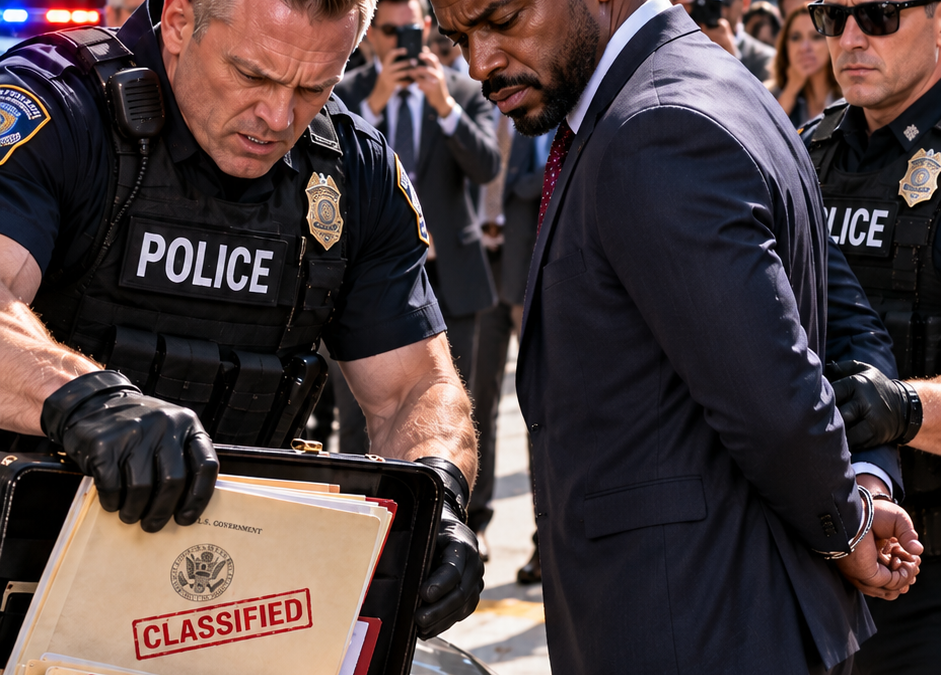
He pulled my hands behind my back and secured the cuffs.
The metal was tight against my wrists.
“You’re being detained while we determine whether those documents were obtained legally.”
He took the briefcase from my hand.
I turned my head slightly.
“That case must remain closed until its contents can be reviewed by someone with appropriate authorization.”
Whitmore looked down at it.
“You’re in no position to give orders.”
He carried it toward the patrol car.
I stood on the sidewalk, handcuffed, surrounded by people who had no idea who I was or why I had been stopped.
And for the first time that morning, I understood how quickly an ordinary encounter could become something much more serious when one person refused to reconsider his assumptions.
My name was Ethan Caldwell.
I was the Director of the Federal Bureau of Investigation.
And the officer who had just arrested me was a member of the police department my investigators had been examining for six months.
I didn’t announce any of that to the gathering crowd.
There were operational reasons for keeping my identity discreet, but there was another reason as well.
I wanted to see what Whitmore would do when he believed I was simply an ordinary man who couldn’t immediately summon someone more powerful than he was.
I didn’t have to wait long.
He guided me toward the back of his patrol vehicle.
“People like you always think you have a connection somewhere,” he muttered.
I looked at him.
“People like me?”
“Government employees. Contractors. Whoever you are. You carry a fancy briefcase, throw around important words, and suddenly you think the rules don’t apply.”
“The rules apply to everyone, Officer.”
“Exactly.”
He opened the rear door.
“That’s what you’re about to learn.”
I sat down carefully.
The seat was uncomfortable, and my hands were positioned awkwardly behind my back.
Whitmore shut the door.
Through the window, I watched him speak briefly with the second officer.
Then he looked at my briefcase again.
I could tell he wanted to open it immediately.
But he hesitated.
That hesitation was important.
Some part of him recognized that he might be dealing with genuinely protected material.
Instead of responding with caution, he appeared to interpret that possibility as an additional reason to suspect me.
He placed the case in the front of the patrol vehicle.
Then we drove toward the precinct.
I watched the streets pass.
The distance was short, but I had enough time to think about the six months that had brought me there.
The investigation had started with a complaint forwarded by a federal civil-rights attorney.
A family living outside Washington had challenged the handling of an encounter involving local police officers.
Their complaint described inconsistent statements, missing documentation, and a departmental review that appeared to have been concluded before key witnesses were interviewed.
Initially, it was one of many reports.
My staff referred it for preliminary examination.
Then another complaint arrived.
Then several more.
Different people.
Different incidents.
Different neighborhoods.
But certain details repeated.
Body-camera footage was missing or incomplete.
Witness statements didn’t match official summaries.
Disciplinary findings were reversed without adequate explanation.
Complaints involving particular officers disappeared into administrative procedures that seemed designed to ensure nobody ever reached a conclusion.
My team began comparing records.
We discovered that Captain Richard Hail had approved or overseen an unusual number of the disputed decisions.
His name appeared in the review histories of cases involving officers whose conduct had repeatedly been challenged.
There were no grounds to assume that every questionable decision constituted deliberate wrongdoing.
But the pattern required an independent investigation.
We collected documents.
We interviewed former employees.
We reviewed internal procedures and obtained records through proper legal channels.
We listened to people who had spent months, sometimes years, trying to make their complaints heard.
Some were angry.
Others were exhausted.
A few had become so accustomed to being dismissed that they seemed embarrassed to explain why they’d continued trying.
One conversation stayed with me.
A man whose complaint had been closed without an interview asked whether anyone would actually read the documents he had brought.
I told him we would.
He looked at the folder on my desk.
“That’s what the last three people said.”
I had no response that could repair what had already happened to him.
So I opened his folder and began reading.
That experience shaped the investigation more than I initially realized.
It reminded me that misconduct doesn’t end when an official closes a file.
The consequences continue for the people whose experiences have been reduced to paperwork.
I wanted our investigation to be meticulous.
Not because I was interested in producing an impressive report.
Because people had trusted us with accounts of events that had changed their lives.
Now, sitting in the back of Whitmore’s patrol car, I wondered how many complainants had experienced an encounter like mine.
How many had remained calm, asked reasonable questions, and been interpreted as uncooperative because they refused to surrender their rights.
How many had been detained simply because an officer decided their explanations weren’t believable.
I already knew the numbers in our preliminary records.
But numbers become something very different when you’re sitting on the other side of a locked door.
We arrived at the downtown precinct shortly afterward.
Whitmore escorted me through the entrance.
Several officers looked up from their desks.
One asked what had happened.
Whitmore held up my briefcase.
“Possible theft of classified government material.”
The officer whistled.
“Seriously?”
“Found him walking around the federal district with a case full of sensitive documents. Won’t explain where he got them.”
I turned toward him.
“That isn’t what I said.”
Whitmore stopped.
“Did somebody ask you to speak?”
I looked at the officers watching us.
“I explained that the documents were protected and that my identity should be verified through the appropriate federal channels.”
He laughed.
“See? Same speech he’s been giving me all morning.”
A few people smiled.
Others simply returned to their work.
That response interested me.
Nobody asked what evidence supported the allegation.
Nobody asked whether Whitmore had verified that any documents were missing.
And nobody appeared concerned that a local officer was carrying a case he believed might contain classified federal material through an ordinary police station.
I was escorted to an interview room near the back of the building.
The room was small.
White walls.
A wooden table.
Three chairs.
A clock that ticked loudly enough to become distracting whenever conversation stopped.
Whitmore placed the briefcase on the table.
Then he sat opposite me.
“You understand how serious this looks, right?”
“I understand that you’ve detained me without establishing that I’ve committed a crime.”
He leaned back.
“That’s your interpretation.”
“It’s a description of what happened.”
“You were carrying suspicious documents.”
“You haven’t established that the documents are suspicious.”
“You refused to let me inspect them.”
“Because you haven’t established authorization to examine them.”
He exhaled sharply.
“Do you have any idea how arrogant you sound?”
I studied his face.
I had spent years interviewing witnesses, reviewing investigative reports, and evaluating explanations offered by people facing difficult questions.
One thing I’d learned was that anger often appeared when a person began losing confidence in an explanation they had already committed themselves to defending.
Whitmore seemed increasingly frustrated that I wouldn’t accept the role he’d assigned me.
He wanted me to behave like someone frightened of being discovered.
He wanted excuses.
He wanted an admission.
I was giving him questions.
And each question forced him to confront the gap between his assumptions and the evidence.
“What looks suspicious,” I told him, “and what is actually true aren’t always the same thing.”
He stared at me.
Then he opened the briefcase.
I immediately raised my voice.
“Officer Whitmore, stop.”
He froze.
“This material requires proper handling. You’re not authorized to examine it.”
He looked down at the documents.
Several folders carried official markings.
Others contained reference numbers and controlled-distribution notices.
His expression changed slightly.
Then he picked up the first folder.
“Well, look at that.”
He opened it.
I felt a knot tighten in my stomach.
“Close the folder.”
He glanced up.
“Why? Afraid I’ll find something?”
“I’m concerned that you’re compromising protected federal material.”
He held up a page.
“This has official markings all over it.”
“Yes.”
“And you expect me to believe some random guy walking down the street is supposed to have it?”
“I expect you to verify the circumstances before treating possession as evidence of theft.”
Whitmore set the page down.
“You know what I think?”
I waited.
“I think you know enough about government procedures to make a convincing story.”
“Then test the story against the facts.”
He shook his head.
“I don’t need you telling me how to investigate.”
That sentence told me more about his approach than almost anything else he’d said.
He wanted confirmation.
He didn’t want verification.
Outside the room, footsteps moved along the hallway.
Someone laughed near the front desk.
A telephone rang twice before being answered.
The ordinary sounds of a working police station continued around us.
For the people outside that room, the morning was probably unremarkable.
For me, it was becoming an unusually direct examination of how one officer could turn an unsupported suspicion into an official accusation.
Whitmore began filling out paperwork.
“Full name.”
“Ethan Caldwell.”
“Employer.”
“Federal government.”
He stopped writing.
“Which agency?”
“I can provide that information to an authorized supervisor through a verified channel.”
He stared at me.
“You’re seriously going to keep doing this?”
“I’m trying to protect the material you took from me.”
“Maybe the material needs protection from you.”
I looked toward the folders.
“Have you established that I’m unauthorized to possess any of those documents?”
He didn’t answer.
Instead, he began another line of questioning.
Where had I obtained the files?
Who had given them to me?
Why was I walking through the government district?
Who was I meeting?
I answered questions that could be addressed without compromising sensitive information.
For the rest, I repeated that my identity and authority could be verified through the appropriate federal contacts.
He interpreted every protected answer as evasiveness.
Every careful statement became another reason to believe I was hiding something.
Eventually, I stopped trying to persuade him.
I began listening.
Whitmore sat back in his chair.
“You think if you stay calm long enough, somebody important is going to show up and rescue you.”
I looked directly at him.
“Someone important doesn’t have to appear before you start following proper procedure.”
His expression hardened.
“You’re going to regret that attitude.”
I glanced at the clock.
We had been in the interview room for nearly an hour.
“Officer, I have an official appointment this morning. Your continued detention is interfering with it.”
“Then maybe you should have thought about that before walking around with classified documents.”
I leaned forward slightly.
“Have you considered that the reason you’re so concerned about these files might have something to do with what’s written inside them?”
For the first time, he stopped moving.
“What?”
“The important question isn’t why I have these documents.”
I looked at the folder nearest him.
“It’s why you seem so worried about them.”
A flash of irritation crossed his face.
He closed the folder.
“Are you accusing me of something?”
“I’m asking a question.”
He stood.
“This interview is over until you decide to cooperate.”
He collected the documents and left the room.
The door closed behind him.
I watched the handle settle.
Then I took a slow breath.
It would be tempting to describe myself as completely calm during those hours.
That wouldn’t be true.
I was concerned about the documents.
I was concerned about the implications for our investigation.
And I was increasingly concerned about the possibility that Whitmore might try to transform a questionable detention into something more serious simply to avoid acknowledging that he’d made a mistake.
Experience doesn’t eliminate fear.
It teaches you to recognize which fears require immediate action and which merely demand patience.
I had no intention of turning the situation into a confrontation that could endanger the case.
But I also knew that I couldn’t allow the officer’s behavior to continue indefinitely.
At some point, my absence from the scheduled meeting would trigger the security procedures established by my team.
That point was approaching.
I didn’t know exactly what was happening outside the interview room, but I could hear the atmosphere beginning to change.
Footsteps became more frequent.
People spoke in lower voices.
A telephone rang and continued ringing until someone answered it.
Then an officer hurried past the narrow window in the door.
Several minutes later, Whitmore returned.
His expression was different.
“Who exactly are you?”
I’d already given him my name.
I looked at him.
“Ethan Caldwell.”
“I know your name. Who do you work for?”
“The federal government.”
“Which part?”
“Have you contacted the appropriate verification office?”
He didn’t answer.
Instead, he opened the briefcase again.
His movements had become more deliberate.
I could see that the reference numbers, distribution markings, and official documentation had begun to trouble him.
He had probably expected the papers to look fraudulent.
Instead, they appeared increasingly authentic.
That created a problem.
If the documents were legitimate, he needed a credible reason to explain why he’d seized them.
And if my authority to possess them was legitimate, he needed an explanation for why he’d refused multiple opportunities to verify it.
“You understand why we had questions,” he said.
“Questions were never the problem.”
He looked up.
“The problem is what happens when you decide you already know the answers.”
He shifted in his chair.
“You keep talking like you’re investigating me.”
I didn’t respond.
He stared at me.
Then, almost reluctantly, he asked, “Are you?”
Before I could answer, someone knocked on the door.
Whitmore turned.
A young officer stood in the hallway.
“Sir, Lieutenant Grant wants you at the front desk.”
“Tell her I’m interviewing a suspect.”
“She said now.”
Something in the young officer’s tone made Whitmore stand immediately.
He stepped outside and closed the door.
Through the narrow window, I watched him walk toward the front of the precinct.
A woman in uniform was standing beside the dispatch desk, studying something on a computer monitor.
I later learned her name was Melissa Grant.
She had been assigned to administrative duty that morning and had received a request for information concerning the man being held in interview room three.
She recognized the reference numbers associated with the federal review process.
More importantly, she recognized that the inquiry came from a verified federal contact rather than an ordinary outside caller.
She had no reason to assume every document in my briefcase was authentic.
But she understood that the situation required immediate verification by someone with the appropriate authority.
When Whitmore reached the desk, she asked him a simple question.
“Who exactly is the man you’re holding?”
He reportedly gave her the same explanation he’d given everyone else.
Suspicious individual.
Possible possession of stolen classified material.
Refusal to cooperate.
Melissa asked whether he’d confirmed that any material had actually been stolen.
He hadn’t.
She asked whether he’d contacted a federal security office to verify my identification.
He hadn’t done that either.
Then she showed him the incoming verification request.
His confidence began to disappear.
Back in the interview room, I sat watching the clock.
I thought about Captain Richard Hail.
He had become one of the central subjects of our investigation because his name appeared repeatedly in administrative decisions that prevented complaints from receiving adequate scrutiny.
Six months earlier, our first review had identified three separate cases in which official explanations didn’t match available evidence.
In one, the timeline in the incident report conflicted with witness accounts.
In another, the recorded justification for a search had been entered only after the search occurred.
A third involved a complaint that had been marked resolved despite an important witness never being interviewed.
Hail had overseen aspects of all three reviews.
When investigators requested the supporting documentation, they received incomplete files.
When they requested explanations, they received references to departmental policy.
And when they asked who had approved certain changes, the answers became increasingly difficult to establish.
That was why I’d authorized a deeper investigation.
Our task wasn’t simply to identify one officer who made questionable decisions.
It was to determine whether supervisors had created an environment in which misconduct could be hidden, complaints could be dismissed, and the official record could be made to tell whatever story protected the department.
Whitmore’s behavior that morning had given me a disturbing example of how that culture might operate at the street level.
He’d treated my questions as challenges to his authority.
He’d viewed my refusal to expose protected documents as evidence of guilt.
And he’d repeatedly confused my composure with arrogance.
I wondered whether he would have behaved differently if I’d arrived in a government vehicle surrounded by security personnel.
Almost certainly.
But that wasn’t the question that troubled me most.
The question was how many ordinary citizens had experienced the same treatment without possessing any realistic means of challenging it.
My thoughts were interrupted by another knock.
The door opened.
This time, Melissa Grant stepped inside.
She closed it carefully behind her.
“Mr. Caldwell?”
“Yes.”
“I’m Lieutenant Melissa Grant.”
“Good morning, Lieutenant.”
She glanced toward the briefcase.
“Officer Whitmore says you’re carrying sensitive federal documents.”
“That’s correct.”
“And that you’ve refused to identify the agency responsible for them.”
“I’ve repeatedly offered to establish my identity through an authorized federal contact.”
She nodded.
“I’ve received a request from a federal office asking about your detention.”
“Then I recommend that you follow the authentication procedures attached to that request.”
She studied me.
For several seconds, neither of us spoke.
Then she asked, “Is there anything I should know before I contact Captain Hail?”
I considered the question carefully.
“Yes.”
Her expression tightened.
“Preserve the original incident report, any body-camera recordings, and all communications concerning my detention.”
She looked surprised.
“Why?”
“Because the accuracy of what happened this morning may become important.”
She nodded slowly.
Then she left.
I heard Whitmore speaking sharply in the hallway.
His voice rose for a moment.
Melissa answered him in a tone I couldn’t make out.
Then everything became quiet again.
A little more than ten minutes later, the atmosphere inside the precinct changed completely.
The first indication was the sound of the entrance door opening.
Several people began speaking at once.
Footsteps approached from the front of the building.
Then I heard a woman’s voice.
Clear.
Controlled.
Immediately familiar.
“Good afternoon. I’m Special Agent Sarah Mitchell. I need to speak with the officer responsible for detaining Ethan Caldwell.”
I closed my eyes for one brief moment.
Not from relief alone.
I was thinking about everything that would have to happen next.
Sarah had worked alongside me throughout the investigation.
She knew the evidence.
She knew the operational restrictions.
And she understood that my detention was now part of a matter requiring careful documentation rather than a private misunderstanding to be resolved with a handshake.
Whitmore appeared at the interview-room door.
His face was pale.
Behind him stood Sarah, wearing a dark suit and carrying a secure folder.
She looked past him.
“Director Caldwell?”
I stood.
“Agent Mitchell.”
The silence that followed was extraordinary.
Whitmore looked from Sarah to me.
Then back to Sarah.
“Director?”
She turned toward him.
“Yes.”
He stared at me.
For the first time since he’d approached me on the sidewalk, I saw uncertainty completely replace his confidence.
Sarah stepped into the room.
“Director Caldwell, are you injured?”
“No.”
“Have you been denied access to medical care or necessary communication?”
“No medical care has been necessary. I have repeatedly requested appropriate verification of my identity.”
She nodded.
“Understood.”
Whitmore finally found his voice.
“Wait. Director of what?”
Sarah looked directly at him.
“The Federal Bureau of Investigation.”
His expression changed so abruptly that I almost felt sorry for him.
Almost.
He looked toward the briefcase.
Then toward the documents he’d already opened.
Then back at me.
“You’re the FBI director?”
“Yes.”
“But you never told me.”
I held his gaze.
“I gave you my name. I explained that the material was protected. And I repeatedly asked you to verify my identity through the proper channels.”
He opened his mouth.
Nothing came out.
Then he looked at Sarah.
“How was I supposed to know?”
She answered before I could.
“By verifying the information you were given.”
Whitmore stepped away from the table.
The young officer who had come to fetch him earlier was watching from the hallway.
Several other officers had gathered near the door.
The same people who had barely noticed me when I arrived in handcuffs were now staring as though someone had replaced the ordinary government employee with a completely different man.
But I hadn’t changed.
My jacket was still wrinkled.
My wrists still carried the faint pressure marks from the cuffs.
And the briefcase Whitmore had seized still contained the same documents.
Only their understanding of me had changed.
That was precisely what made the moment so revealing.
I looked at Whitmore.
“The truth was always available, Officer. The question was whether you were willing to examine it.”
He lowered his eyes.
Sarah placed her secure folder on the table.
She explained that the investigation into the department had reached a critical stage and that the evidence-preservation measures associated with the federal review were now being implemented.
Our legal team had already obtained the necessary authorizations for the next phase.
The precinct’s internal records, relevant communications, and complaint histories would be examined independently.
The evidence in my briefcase was only one part of a much larger investigative record.
Whitmore stared at Sarah.
“You’re investigating this department?”
“Yes.”
“For what?”
“That information will be provided to the appropriate officials.”
He looked toward me.
“And you came here because of us?”
I didn’t answer immediately.
I thought about the complainants whose records we’d been reviewing for months.
The people who’d struggled to obtain explanations.
The witnesses who’d stopped expecting anyone to believe them.
Then I said, “I came here because people deserve to know that the institutions entrusted with protecting them can also be held accountable.”
Whitmore’s face flushed.
He looked toward the hallway.
I could see that he wanted to find someone who would explain how to make the situation disappear.
But that was no longer an option.
Sarah asked that the briefcase be returned without further unauthorized examination.
Melissa Grant supervised the transfer and documented the condition of the materials.
The original detention records were preserved.
Whitmore was instructed not to alter his report or contact potential witnesses about their accounts of the incident.
Then Sarah turned toward me.
“Captain Hail is on his way.”
I nodded.
“Good.”
There was a great deal more work to do.
I didn’t want the day’s events to become a story about a foolish officer accidentally arresting somebody important.
That would have been the easiest explanation.
It would also have missed the entire point.
If Whitmore’s conduct was inappropriate, it would have been inappropriate regardless of whether I was an FBI director, a federal contractor, an office worker, or an ordinary visitor walking through Washington.
My position made it easier to challenge what had happened.
It did not make what had happened wrong.
That distinction mattered.
And I intended to make sure the department understood it.
Captain Richard Hail arrived shortly afterward.
He was a tall man with carefully combed gray hair and the practiced expression of someone accustomed to calming difficult situations through conversation.
When he entered the precinct, he immediately recognized Sarah.
Then he recognized me.
His expression became guarded.
“Director Caldwell.”
“Captain Hail.”
He extended his hand.
I shook it briefly.
“I understand there’s been some kind of misunderstanding.”
I glanced toward Whitmore.
“There’s been a detention that requires examination. I suggest we begin with the facts.”
Hail offered a strained smile.
“Of course. I’m sure we can resolve this.”
“That’s what the investigation is intended to determine.”
His smile disappeared.
Sarah opened her folder.
She explained the scope of the federal review and identified the records that needed immediate preservation.
Hail listened carefully.
Then he asked whether the department’s legal office had been notified.
It had.
He asked whether the appropriate authorizations had been issued.
They had.
Finally, he asked if the matter could be discussed privately before anyone began collecting records.
I looked at him.
“Captain, the investigation isn’t a negotiation.”
His jaw tightened.
“I understand that.”
“I’m not certain you do.”
The words came out more sharply than I’d intended.
I took a moment before continuing.
“For six months, my team has been examining complaints that should have received serious attention when they were first submitted. We’ve encountered missing records, unexplained changes, delayed reviews, and repeated decisions involving the same group of officers.”
Hail shifted slightly.
“There are administrative explanations for many of those issues.”
“Then we’ll examine those explanations.”
“Our department handles thousands of incidents.”
“I know.”
“Mistakes happen.”
“Yes, they do.”
He seemed encouraged by my agreement.
Then I continued.
“But when mistakes repeatedly protect the same individuals, investigators have a responsibility to determine whether those outcomes are accidental.”
Hail said nothing.
I looked toward the front desk, where several officers were still watching us.
“This morning, Officer Whitmore detained me without adequately verifying the information I provided. He seized sensitive federal material and interpreted every attempt to establish appropriate procedures as resistance.”
Whitmore lowered his head.
I turned back toward Hail.
“What concerns me is that nobody initially challenged his account.”
The captain folded his hands.
“We’ll conduct an internal review.”
“An independent federal review is already underway.”
His expression hardened.
“You don’t believe this department can investigate itself?”
“I believe that question is one of the reasons we’re here.”
The conversation ended shortly afterward.
Sarah’s team began securing the authorized records.
Officers responsible for evidence management were instructed to preserve original files.
Investigators documented the chain of custody for my briefcase.
And the department was formally notified of the scope and requirements of the ongoing federal investigation.
I remained at the precinct for several hours.
Not because Whitmore was still detaining me.
Because I wanted to observe the process and ensure that the evidence was handled correctly.
I reviewed the initial account of my encounter.
The report described me as evasive.
It suggested that I’d refused to identify myself.
It emphasized my possession of sensitive documents while minimizing the officer’s failure to follow the verification procedures I’d requested.
I compared the language with the original audio recording.
Then I looked at Sarah.
“Preserve both.”
She nodded.
“Already done.”
I recognized the pattern.
An officer makes an assumption.
The person being questioned challenges that assumption.
The challenge is characterized as suspicious behavior.
The officer responds more forcefully.
And the official report later describes the person’s objections as the reason escalation became necessary.
It was the same sequence we’d seen in several of the complaints our team had reviewed.
Only this time, the person sitting across from the officer had the ability to document what happened and immediately involve federal investigators.
That was an advantage I couldn’t ignore.
But it also came with a responsibility.
I needed to ensure that the investigation remained focused on actual evidence rather than the embarrassment of discovering my title.
Whitmore’s mistake wasn’t failing to recognize me.
It was failing to consider the possibility that his assumptions were wrong.
His treatment of me mattered because it reflected a problem much larger than one morning.
As the day continued, Melissa Grant began reviewing the precinct’s records with the federal team.
She’d recognized the significance of the verification request and had taken appropriate steps once she understood the potential sensitivity of the material.
I spoke with her briefly before leaving.
“Thank you for following the authentication procedures.”
She looked uncomfortable.
“I should have asked more questions sooner.”
“Perhaps. But you recognized the problem and acted.”
She glanced toward Whitmore’s desk.
“This isn’t the first time we’ve had complaints about how he handles people.”
“Then those complaints need to be examined.”
She nodded.
“I understand.”
I believed she did.
She was beginning to realize that an official record could be incomplete not only because someone deliberately falsified it, but also because colleagues stopped asking questions when they recognized the name of the officer involved.
That realization would become important during the weeks ahead.
The federal review expanded immediately.
Investigators compared records collected from the precinct against the independent evidence we’d already obtained.
They reconstructed timelines.
They reviewed internal communications.
They compared the dates on complaint forms with the dates entered into official systems.
They examined why some cases had been closed before available witnesses were interviewed.
They looked for patterns in the decisions made by supervisors.
And they began identifying the individuals responsible for approving changes to disputed records.
The work was painstaking.
There was no single document that explained everything.
No dramatic confession.
No convenient recording in which a supervisor admitted to hiding misconduct.
Instead, the evidence developed through hundreds of details that became meaningful when examined together.
A report entered unusually late.
An email contradicting an official explanation.
A witness statement omitted from a final summary.
A complaint reassigned to a supervisor with a personal connection to the officer involved.
A disciplinary recommendation that disappeared between its initial review and the final decision.
Every discrepancy required its own examination.
Every allegation required corroboration.
And every person involved was entitled to respond to the evidence.
I insisted on that.
I had seen what happened when investigators began with a conclusion and then selected information that supported it.
That was the mistake Whitmore had made on the sidewalk.
I had no intention of repeating it with considerably greater power.
Several officers cooperated with the review.
Others were defensive.
Some insisted that the missing records resulted from outdated computer systems or poor administrative practices.
A few explanations proved legitimate.
Others collapsed when compared with contemporaneous emails and original documentation.
Captain Hail’s decisions received particular scrutiny.
Investigators discovered that he had repeatedly approved the early closure of complaints involving officers with prior allegations of misconduct.
In several instances, the required investigative steps had not been completed.
Other records showed that internal concerns raised by junior employees had been dismissed without documented consideration.
The evidence did not support every accusation made against the department.
But it supported enough to establish that serious failures had persisted under Hail’s leadership.
When the findings were presented to the appropriate oversight authorities, the response was immediate.
Several administrative reviews were reopened.
Officers whose conduct was implicated by the evidence were placed on leave or referred for further investigation.
The department was required to preserve and produce records under procedures designed to prevent undocumented changes.
And Captain Hail faced a formal review of his leadership decisions.
He would no longer be allowed to decide privately which complaints deserved attention when those decisions concerned his own handling of the department.
I met him once more during the review process.
We sat across from each other in a conference room.
He looked tired.
There were folders stacked on the table between us.
“You’ve spent a great deal of time examining my decisions,” he said.
“Yes.”
“I’ve spent my career trying to protect this department.”
“I understand.”
He looked relieved for a moment.
Then I continued.
“But protecting an institution’s reputation cannot mean protecting its employees from legitimate accountability.”
He stared at the table.
“You have no idea how much pressure comes with running a department.”
“You’re right. I don’t know every pressure you’ve faced here.”
I leaned forward.
“But I do know that leadership becomes meaningless when people are afraid to report wrongdoing because they believe the person receiving their complaint is more interested in protecting the accused than discovering what happened.”
Hail didn’t respond immediately.
For the first time, he seemed less interested in defending individual decisions and more aware of the pattern those decisions had created.
Whether that awareness represented genuine understanding was something only his future actions could establish.
I wasn’t there to decide what he felt.
I was there to ensure that the evidence was examined and that the appropriate authorities could make decisions based on it.
Officer Derek Whitmore underwent his own review.
The original recording of our encounter was examined.
His report was compared against the available evidence.
His supervisors reviewed the decisions he’d made from the moment he approached me until Sarah arrived at the precinct.
The investigation concluded that he had escalated the encounter without adequately establishing the factual basis for his suspicions and had failed to follow appropriate procedures for handling protected government material.
He also had to answer for the way he’d characterized my attempts to verify my identity.
I was asked whether I wanted to submit a statement.
I did.
I described the encounter in chronological order.
I included my own words.
I included his.
I identified the points at which I’d requested verification and the moments when he’d interpreted those requests as defiance.
I didn’t exaggerate.
I didn’t need to.
The recording was clear.
The issue wasn’t whether Whitmore had knowingly arrested the FBI director.
He hadn’t.
The issue was whether he’d treated a person fairly before knowing whether that person held an important position.
On that question, the evidence spoke for itself.
Several weeks later, Whitmore requested a meeting.
I initially considered declining.
The investigation had been stressful enough for everyone involved, and I had no interest in turning the incident into a personal reconciliation story.
But Sarah encouraged me to hear what he wanted to say.
“He may have something relevant to the review,” she told me.
I agreed to meet him with the appropriate safeguards in place.
We sat in a small conference room not unlike the interview room where our first conversation had taken place.
Whitmore looked different without his patrol uniform.
He wore a gray shirt and dark trousers.
He’d lost some of the certainty that had defined his behavior on the sidewalk.
For several seconds, he stared at the table.
Then he spoke.
“I’ve gone over that morning a hundred times.”
I waited.
“I really believed something was wrong when I saw the briefcase.”
“Believing something might be wrong wasn’t the problem.”
He looked up.
“I know.”
“Do you?”
He took a breath.
“I should have checked your identity before detaining you.”
“Yes.”
“And I shouldn’t have opened the files.”
“Correct.”
He looked down again.
“But I think the worst part was that I kept treating everything you said as another reason not to believe you.”
I studied his face.
“Why?”
He hesitated.
“Because I thought I understood the situation.”
“Before you had the evidence.”
“Yes.”
He rubbed his hands together.
“When Agent Mitchell walked in and called you Director, I felt like the floor disappeared.”
I nodded.
“I imagine you did.”
He looked toward me.
“I’ve been thinking about something you said. That the truth was always available.”
I waited.
“I kept telling myself I would’ve handled it differently if you’d identified yourself immediately.”
“And?”
He swallowed.
“Then I realized that was the problem. I was telling myself I would’ve treated you better if I’d known you were important.”
I leaned back.
That was the first useful thing he’d said since the encounter.
“Officer Whitmore, you shouldn’t need to know somebody’s title before you treat them according to the law.”
He nodded slowly.
“I understand that now.”
I wanted to believe him.
But I had spent too many years investigating misconduct to confuse an apology with proof of change.
Understanding required more than an uncomfortable conversation.
It required different decisions when the next person standing in front of him couldn’t summon a federal agent or produce a credential that changed the room.
“What matters now,” I told him, “is whether that understanding changes how you behave.”
He accepted the statement without arguing.
Before leaving, he looked back.
“I’m sorry, Director.”
I considered my response.
“I appreciate you saying that. But the people whose complaints have been ignored deserve the same willingness to acknowledge mistakes.”
He nodded.
“I know.”
The meeting ended there.
I didn’t offer him forgiveness on behalf of anyone else.
That wasn’t mine to give.
And I didn’t try to turn his embarrassment into a personal victory.
The investigation had never been about proving that I was more powerful than the officer who arrested me.
It was about whether an institution could recognize its own failures and correct them before more people were harmed.
Over the following months, the department began implementing substantial changes.
An independent review process was established for serious misconduct complaints.
Disputed records were subjected to stricter preservation requirements.
Supervisors could no longer close certain categories of complaints without documenting the investigative steps completed and the evidence considered.
Training was revised to emphasize lawful detention, proper verification procedures, and the distinction between a person’s refusal to consent and evidence of criminal conduct.
Employees received clearer procedures for reporting concerns outside their immediate chain of command.
Those changes were important.
But I knew how easily reforms could become attractive language on paper while daily behavior remained unchanged.
A policy doesn’t protect anybody if supervisors ignore it.
Training accomplishes little if officers treat it as a formality.
And transparency means nothing when people responsible for reviewing complaints have already decided whom they intend to protect.
We therefore required measurable follow-up.
Independent reviewers examined whether complaints were being acknowledged promptly.
They checked whether records remained complete.
They evaluated whether witnesses were contacted and whether decisions could be explained by the available evidence.
The department’s progress was reviewed over time rather than declared complete after a press conference.
I found that part of the process less dramatic than the day Sarah walked into the precinct.
It was also much more important.
Real accountability rarely arrives as a single unforgettable moment.
More often, it appears in decisions that never attract an audience.
A supervisor who insists that a complaint be investigated.
An officer who challenges an inaccurate report.
A records employee who refuses to change a timestamp without an explanation.
An investigator who follows the evidence even when the findings are inconvenient.
Those decisions determine whether an institution deserves the trust people place in it.
By the time our final report was ready, the precinct had undergone significant changes.
The review had identified serious deficiencies in its complaint-handling system and established grounds for additional proceedings concerning specific officers and supervisory decisions.
Some allegations remained unresolved because sufficient evidence couldn’t be recovered.
Other cases were reopened when independent investigators discovered information that had previously been overlooked.
Several officers faced disciplinary action.
Others were cleared after the evidence failed to substantiate the allegations against them.
I considered that distinction essential.
A credible investigation had to be willing to reach either conclusion.
The objective was never to punish as many people as possible.
It was to establish what had happened and ensure that the people responsible were held accountable under the appropriate procedures.
When Sarah brought the final summary to my office, she placed the folder on my desk and sat down.
“The department has started implementing the recommendations,” she said.
I opened the report.
“How are the independent reviews progressing?”
“Better than expected. The complaint backlog is being reassessed, and they’re documenting every decision.”
“What about the people who originally filed the complaints?”
“They’re being notified when their cases are reopened.”
I nodded.
That mattered.
Too often, institutions announce reforms without ever returning to the people who suffered under the previous system.
A family whose complaint was dismissed doesn’t receive justice simply because a department updates its training manual.
The harm has already occurred.
At the very least, those people deserve an accurate account of what happened, an opportunity to provide evidence, and an explanation for the decisions affecting them.
Sarah seemed to know what I was thinking.
“We’ve also requested a full accounting of the complaints that were closed without required investigative steps.”
“Good.”
I turned another page.
“What about Captain Hail?”
“His leadership review is proceeding through the appropriate administrative process. He’s no longer overseeing the complaints that involve his own decisions.”
I closed the folder.
For several moments, we sat quietly.
Through my office window, Washington continued moving.
Vehicles stopped at intersections.
Pedestrians crossed streets.
Government employees hurried between buildings, most of them unaware of the months of work represented by the report lying on my desk.
That was how it should be.
The public shouldn’t have to know the details of every internal investigation to expect its institutions to function properly.
But when those institutions fail, people have a right to answers.
Sarah stood.
“Anything else, Director?”
I looked at the report one more time.
“Make sure the people who trusted us enough to speak are informed about the findings that concern them.”
She nodded.
“I’ll take care of it.”
After she left, I remained at my desk for a while.
The memory of Whitmore placing me in handcuffs had begun to lose its immediacy.
The physical marks had disappeared within days.
The documents had been returned securely.
My official schedule had recovered from the unexpected disruption.
But something about the experience continued to trouble me.
I had spent my career investigating the abuse of authority from the position of someone empowered to challenge it.
That morning, I had briefly experienced what it felt like when the officer controlling the encounter refused to listen.
I had known that the situation would eventually be resolved.
Even while sitting in the interview room, I knew my team would notice my absence.
I knew Sarah would verify my location.
I knew federal procedures existed to protect the material in my briefcase.
Most people detained under questionable circumstances have no such assurances.
They don’t know whether someone will believe their account.
They don’t know whether an inaccurate report will follow them into court.
They don’t know whether the officer questioning them will become more aggressive if they ask for a supervisor.
And they certainly don’t know whether anyone reviewing their complaint will care enough to examine the evidence independently.
Those were the people I thought about when I reviewed the final report.
Their experiences were the reason the investigation had begun.
And their right to fair treatment remained far more important than the story of an officer discovering he’d arrested the FBI director.
Several weeks later, I attended a community meeting organized as part of the department’s reform process.
Residents had been invited to ask questions about complaint procedures, reporting standards, and independent oversight.
I didn’t make a dramatic entrance.
I took a seat near the back and listened.
A woman spoke about the frustration of filing a complaint and waiting months for a response.
A man described receiving contradictory explanations about how an incident involving his son had been reviewed.
Others asked whether the new procedures would remain in place after public attention faded.
Those questions were reasonable.
They deserved clear answers.
Department representatives explained the new reporting channels and independent review requirements.
Community advocates challenged parts of the implementation plan.
Several residents expressed cautious hope.
Others remained skeptical.
I didn’t expect them to trust the changes simply because someone in authority said the right things.
Trust would have to develop through repeated evidence that the new procedures were being followed.
Near the end of the meeting, I noticed Whitmore standing beside the entrance.
He had been assigned administrative duties while completing the review process.
When he saw me, he approached.
“Director Caldwell.”
“Officer Whitmore.”
He looked toward the people still speaking with the review panel.
“I never realized how many people felt like nobody was listening.”
I glanced at him.
“They’ve been saying it for a long time.”
He nodded.
“I know.”
For a moment, neither of us spoke.
Then he said something I remembered long afterward.
“I thought having the badge meant I was supposed to be the person who knew what was right.”
I looked at the people leaving the meeting.
“A badge gives you responsibility. It doesn’t give you permission to stop listening.”
He accepted the words quietly.
I could see that he still had a great deal to learn.
But he had begun by recognizing that his first assumption didn’t deserve the protection he’d given it.
That was a beginning.
Not a conclusion.
As the meeting ended, several residents approached me.
One woman thanked me for taking their concerns seriously.
Another asked whether the changes would continue after the investigation was officially closed.
I answered as carefully as I could.
“We’ve established requirements for continued independent review. But people will have to keep examining whether those requirements are being met.”
She nodded.
“That’s all we’ve wanted. For someone to actually check.”
Her words stayed with me.
Months earlier, a man had asked whether anyone would genuinely read the complaint he’d carried from office to office.
Now, at least, a mechanism existed to ensure that people like him received more than a polite dismissal.
It wasn’t a perfect ending.
Real investigations rarely produce perfect endings.
But it was meaningful progress.
One evening, after the final meeting associated with the review, I walked through the same government district where Whitmore had stopped me.
The sky was gray again.
The sidewalks were crowded.
Office workers hurried toward transit stations while traffic moved slowly beneath the streetlights.
I carried the same black leather briefcase.
Its contents were ordinary now.
Meeting notes.
Administrative correspondence.
A few documents I needed to review the following morning.
Nothing that required a federal security team to protect it.
I stopped briefly near the intersection where the patrol cars had pulled over months earlier.
I could still remember Whitmore’s expression.
His certainty.
The way he looked at the briefcase and decided the situation was already understood.
I remembered the sound of the handcuffs closing around my wrists.
And I remembered the interview room, where he repeatedly demanded explanations while refusing to verify the answers I gave him.
The moment Sarah entered that precinct, the officers began seeing me differently.
The same man.
The same documents.
The same explanations.
But suddenly my words carried weight because they understood my title.
I had thought about that transformation many times.
It would have been easy to enjoy it.
There was a certain satisfaction in watching someone who’d abused his authority discover that he was no longer in control.
But satisfaction wasn’t the same as justice.
If the encounter had ended with Whitmore apologizing only because I was his superior in a different institution, nothing meaningful would have changed.
The next ordinary person he stopped might have received exactly the same treatment.
That was why the investigation had to continue beyond my release.
Why the records had to be examined.
Why the complaints had to be reopened.
Why Captain Hail’s decisions had to face independent scrutiny.
And why the department had to demonstrate that the same failures wouldn’t simply reappear after everyone stopped paying attention.
I adjusted the handle of my briefcase and continued walking.
Ahead of me, the traffic light turned green.
The people waiting at the corner began crossing.
I joined them.
For most of my life, I’d believed that leadership meant being willing to make difficult decisions when the consequences were uncertain.
That morning had taught me something more personal.
Leadership also meant recognizing that the authority attached to my position wasn’t a substitute for the obligations that came with it.
I had been treated unfairly.
I had possessed the resources to challenge that treatment.
And because I had those resources, I had a responsibility to ensure that the investigation didn’t end merely when my own inconvenience was over.
I thought about the people whose names appeared in the original complaints.
The families who had waited for answers.
The witnesses who had questioned whether anyone would believe them.
The employees who had watched questionable decisions being made and wondered whether speaking up would cost them their careers.
Those were the people whose trust the department needed to earn.
Not through speeches.
Not through carefully written apologies.
Through evidence that it could acknowledge mistakes, investigate misconduct, and apply its own standards consistently.
When I reached the next intersection, my phone vibrated.
It was a message from Sarah.
The latest independent review had been completed.
Several previously dismissed complaints had been reopened, and investigators had located additional supporting records.
I read the message.
Then I looked back toward the street where Whitmore had stopped me.
I realized that I no longer thought of that morning primarily as the day a police officer had mistakenly arrested the FBI director.
I thought of it as the day I had seen, firsthand, what happened when someone entrusted with authority became more interested in defending his judgment than discovering the truth.
And I remembered the quiet moment when everything finally changed.
Sarah standing in the precinct hallway.
Whitmore staring at her.
The words “Director Caldwell” settling over a room full of people who had spent hours treating me as though my explanations were meaningless.
My identity had been the same from the beginning.
The evidence had been the same.
The truth had been standing in front of them the entire time.
All they had needed to do was listen.








