𝗙𝗨𝗟𝗟 𝗦𝗧𝗢𝗥𝗬 The Officer Who Hurt My Twelve-Year-Old Daughter Was Certain His Report Would Bury the Truth
𝗙𝗨𝗟𝗟 𝗦𝗧𝗢𝗥𝗬
I hated that the moment my daughter needed me to hold her, I was thinking about metadata, chain of custody, body cameras, dispatch recordings, and disappearing evidence.
But I knew how quickly an official account could become the only account if nobody preserved the material contradicting it.
I photographed her injuries.
I recorded the time she had returned home.
I carefully placed the torn pharmacy bag, both prescription bottles, and Dana’s handwritten receipt inside a clean paper grocery sack.
Then I contacted my supervisor.
Rebecca Halpern was the United States Attorney, and she understood what my call meant before I finished explaining.
“My daughter was subjected to force by a Westbridge police officer less than ninety minutes ago,” I told her. “Videos are circulating publicly. I’m reporting this as a parent, and I need to be screened from any investigation that follows.”
There was a brief silence.
“Is Aaliyah safe?”
“She’s conscious. Her shoulder and wrist are injured. I’m taking her to the doctor now.”
“Do that first. I’ll contact the Civil Rights Division and the FBI field office.”
She paused.
“Simone, don’t contact anyone at Westbridge Police yourself.”
“I wasn’t planning to.”
“I know. But I had to say it.”
She was right.
If I used my position to demand a particular result, Mallerie’s attorneys could eventually claim that the investigation had been driven by professional retaliation.
If I did nothing, evidence might disappear.
I needed to protect my daughter without becoming the person directing the investigation.
Rebecca arranged for prosecutors from the Justice Department’s Civil Rights Division to handle the matter independently.
Agents unfamiliar with my previous cases would conduct the investigation.
I would be treated as Aaliyah’s mother and a potential witness.
Nothing more.
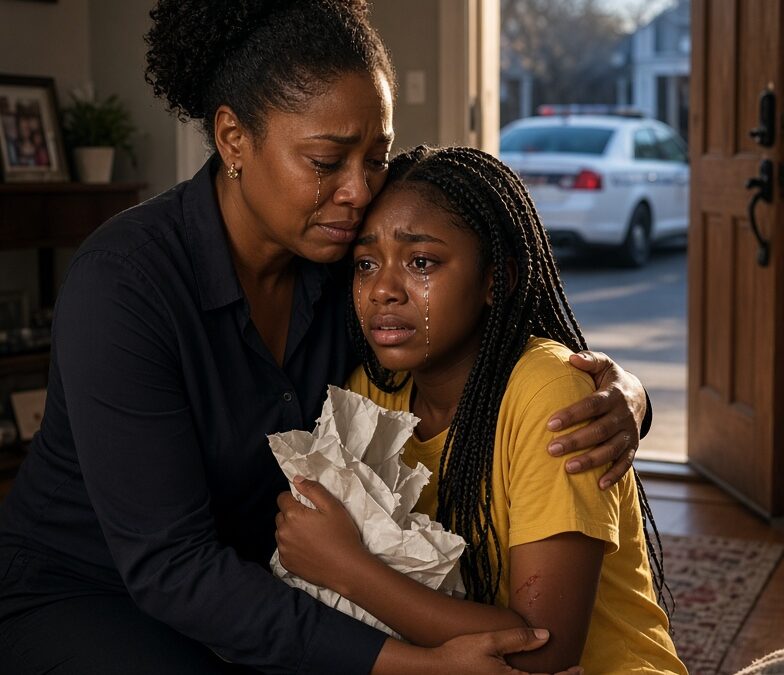
When I returned to the living room, my daughter was watching me with worried eyes.
“Are you going to arrest him?”
“No, baby.”
“But you put bad police officers in court.”
“Sometimes. But I can’t work on this case because you’re my daughter. Other people have to examine what happened and decide whether the law was broken.”
She looked disappointed.
“Then what can you do?”
I sat beside her and carefully took her uninjured hand.
“I can make sure the truth doesn’t disappear.”
At urgent care, Dr. Elena Ruiz examined Aaliyah’s shoulder, wrist, and cheek.
The X-rays showed no fractures.
There was swelling, bruising, and a mild abrasion near her cheekbone.
For the first time since my daughter entered our house, I felt something resembling relief.
Then Dr. Ruiz asked Aaliyah how she was feeling.
“My shoulder hurts. And I feel weird.”
“What kind of weird?”
“Like he’s still standing behind me.”
Dr. Ruiz pulled a chair closer.
“After something frightening, your body can stay on alert even when you’re safe. You may have trouble sleeping or feel nervous when you hear loud noises. We can help with that.”
Aaliyah nodded.
Then she asked whether she could still attend basketball camp on Monday.
I nearly cried.
She was twelve.
She was supposed to be worrying about basketball camp, summer assignments, and whether her friends were available to spend the afternoon together.
Instead, she was sitting in an examination room because a police officer had turned an ordinary walk home into an experience she couldn’t stop remembering.
While we waited for her discharge paperwork, a television near the ceiling switched to the five o’clock news.
A reporter began describing a developing story involving a Westbridge police officer and a juvenile pedestrian.
Then I heard Aaliyah’s voice.
“Please! You’re hurting me!”
My daughter covered her ears.
“Turn it off!”
A nurse immediately changed the channel.
I wrapped my arm around Aaliyah and held her while she cried.
The video had become public before either of us had fully understood what had happened.
Across town, Police Chief Raymond Pierce was watching the same footage inside a conference room at headquarters.
I would learn about that meeting much later, through testimony and departmental records.
Mallerie sat beside Sergeant Lucas Dwire, his union representative.
The department’s public information officer had prepared a statement describing the footage as an edited social media clip and promising an internal review.
Pierce questioned whether anyone had established that the video had been misleadingly edited.
Nobody had.
Mallerie insisted that Aaliyah had entered traffic, refused his commands, and become combative.
He described his actions as minimal control pressure.
He denied causing an injury.
When Pierce asked whether his body camera had been operating, Mallerie said it should have activated when he opened the patrol car door.
The chief ordered the original recording preserved.
Then Dwire showed him my professional biography.
Pierce read it.
Assistant United States Attorney.
Civil rights prosecutions.
According to the account later documented in the departmental review, Mallerie’s confidence changed noticeably.
He had apparently assumed my daughter would return home, her mother would complain, and the department would accept his report as it had accepted others before.
He hadn’t anticipated an independent federal investigation.
At 5:23, preservation requests reached Westbridge Police headquarters.
They covered the original body camera recording, dash camera footage, vehicle location records, dispatch communications, mobile data terminal messages, and relevant personnel and complaint records.
Separate preservation notices went to the pharmacy, bakery, traffic department, and surrounding businesses.
An FBI agent named Nia Hammond began contacting witnesses.
Malik Carter agreed to provide the original video from his phone rather than a compressed social media copy.
Dana Whitaker preserved her longer recording.
The delivery driver and other witnesses did the same.
By early evening, Mallerie had been placed on administrative leave.
At 6:22, Dana’s complete recording reached a local television station.
It lasted three minutes and forty-eight seconds.
It showed the illuminated pedestrian signal.
It showed Mallerie’s patrol car crossing the stop line.
It showed Aaliyah’s hands before he demanded that she raise them.
And it recorded him refusing medical assistance after she complained of pain.
By seven o’clock, the mayor’s office had received thousands of messages.
By eight, Mallerie was completing his official report.
He wrote that an unidentified juvenile had suddenly entered the path of his patrol car, concealed her hands near an unknown bag, and attempted to pull away when he issued lawful commands.
He described the force he used as minimal.
He stated that he had observed no complaint of pain or visible injury.
He submitted that report after the videos had begun circulating.
I learned about the report later.
That evening, I was sitting beside Aaliyah’s bed, trying to persuade her that she didn’t have to sleep with the bedroom light on unless she wanted to.
She was wearing her oversized Westbridge Wildcats shirt.
The cold pack had slipped from her shoulder onto the blanket.
“Mom?”
“Yes, baby?”
“Does he know where we live?”
The question struck me harder than anything she had asked at the hospital.
She had given him our address because he demanded it.
Now she was afraid he might use it.
“He isn’t allowed to contact us. People are watching what happened very carefully.”
She looked toward the window.
“People were watching when he did it.”
I didn’t have an answer.
I stayed until she fell asleep.
Then I walked into the hallway, sat on the floor outside her bedroom, and cried without making a sound.
For years, I had stood in courtrooms explaining why official power required accountability.
I had presented photographs of injuries, questioned officers about contradictory reports, and listened to witnesses describe the moment they realized the person hurting them had the authority to decide what happened next.
I believed deeply in the work.
But nothing had prepared me to see that fear in my daughter’s eyes.
My phone displayed hundreds of notifications.
Some people offered love.
Others demanded interviews.
A few accused me of deliberately sending Aaliyah into traffic to manufacture a federal case.
Someone had posted our home address online.
I forwarded the threatening messages to Agent Hammond and stopped reading.
Rebecca called shortly before ten.
“The evidence is being preserved,” she told me. “Agent Hammond is coordinating the investigation, and a trained child forensic interviewer will speak with Aaliyah tomorrow if you consent.”
“I consent.”
“You won’t be in the interview room.”
“I understand.”
She was quiet for a moment.
“Simone, you need to be her mother tonight. Let us handle the investigation.”
I looked through the doorway at my sleeping daughter.
“I’m trying.”
The following morning, Aaliyah met Dr. Felicia Grant at a child advocacy center.
The interview took place in a quiet room designed for children who had experienced frightening or traumatic events.
I watched through one-way glass with a victim specialist.
Dr. Grant began by asking about school, basketball, and Aaliyah’s favorite books.
She explained that my daughter could stop whenever she needed to, correct anything the interviewer said incorrectly, and admit when she didn’t remember something.
Only after Aaliyah became comfortable did the conversation move toward the intersection.
Her account matched what she had told me.
She remembered the white walking figure.
She remembered the patrol car’s horn.
She remembered the prescription bottle rolling beneath the vehicle.
She remembered Mallerie’s grip around her wrist and the terrible heat of the door.
“What did you think would happen if you moved?” Dr. Grant asked.
Aaliyah looked down.
“I thought he would hurt me more.”
“And what happened when you stayed still?”
“He kept saying I was fighting.”
She rubbed her hands together.
“I didn’t know what he wanted me to do.”
Behind the glass, I closed my eyes.
Aaliyah had spent the entire encounter trying to obey an adult whose instructions became impossible to follow.
When the interview ended, Agent Hammond photographed the bruises that had darkened overnight and collected the preserved pharmacy bag and bottles.
She also accepted the bakery receipt Dana had given Aaliyah.
My daughter looked embarrassed when Hammond thanked her for keeping it.
“I didn’t do anything. Miss Dana gave it to me.”
“You brought it home,” Hammond replied. “That matters.”
Meanwhile, investigators were examining Mallerie’s body camera.
The original file began when he opened his patrol car door.
It showed Aaliyah already inside the marked crosswalk while the pedestrian signal remained active.
It recorded him muttering under his breath before confronting her.
Her hands were visible.
She never threatened him.
She never attempted to flee.
She never concealed a weapon.
When she asked why she had to turn around, Mallerie quietly said something the witnesses’ phones had not clearly captured.
“Kids like you learn the hard way.”
Later, while he held her against the car, he muttered another phrase.
“They always make a scene.”
Those statements did not, by themselves, establish racial intent.
But investigators had begun examining his history.
And that history raised serious questions.
During eleven years with the Westbridge Police Department, Mallerie had been named in fourteen citizen complaints.
Nine involved Black residents.
Five alleged unnecessary force.
Several described nearly identical language in his reports: furtive movements, aggressive posture, failure to obey clear verbal commands.
Only one complaint had been sustained.
That case involved his failure to activate a body camera during a traffic stop.
He received a written warning.
Two years before Aaliyah’s encounter, Mallerie had detained seventeen-year-old Darius Bell outside a convenience store.
He claimed the teenager matched the description of a burglary suspect and had reached toward his waistband.
Darius maintained that he had been retrieving his school identification.
During the detention, Mallerie twisted his arm behind his back until his shoulder dislocated.
Subsequent records showed that no burglary had occurred in that neighborhood.
The description cited in Mallerie’s report concerned an adult wearing a red jacket.
Darius had been wearing a gray school uniform.
The department nevertheless cleared Mallerie after a twelve-day investigation.
The city later paid Darius’s family $180,000.
I remembered seeing a brief reference to the settlement years earlier, but I hadn’t known the details.
A reporter named Laya Monroe had covered the city council vote approving the payment.
When she called me after Aaliyah’s video circulated, I referred her directly to Hammond.
“I can’t discuss the investigation,” I explained. “But if you have original records, please preserve them.”
“There are other families,” she said. “I think the city made each one believe they were alone.”
She was right.
By that weekend, six former complainants had agreed to speak with federal investigators.
Their experiences were not identical, but a pattern began emerging.
Mallerie would stop someone based on a minor or poorly defined suspicion.
When the person asked why, he interpreted the question as defiance.
He escalated his commands until the person became confused or physically unable to comply.
Then he described that confusion in his report as dangerous or aggressive behavior.
Investigators requested five years of his discretionary pedestrian and traffic stop records.
A data analyst named Priya Shaw compared his activity with officers assigned to similar districts and shifts.
The preliminary figures were disturbing.
Black residents represented approximately thirty-eight percent of the population in Mallerie’s usual patrol areas.
They accounted for nearly seventy-one percent of his discretionary stops.
His consent-search rate was more than twice that of comparable officers, yet those searches discovered contraband less frequently.
The statistics couldn’t establish what he had been thinking when he approached my daughter.
But they showed a pattern of decisions that required explanation.
Priya also discovered that twelve of his reports involving contested searches or force contained passages copied from earlier reports.
Some sentences were identical down to the punctuation.
His descriptions of perceived danger barely changed even when the incidents occurred in entirely different locations.
One supervisor’s name appeared repeatedly on the reports.
Lucas Dwire.
The same sergeant who had sat beside Mallerie when Chief Pierce questioned him about Aaliyah.
An even more troubling development followed.
Captain Rosa Mendes, a former internal affairs supervisor who had been transferred to administrative services, contacted Hammond through counsel.
Mendes explained that she had repeatedly objected to complaint findings being softened before they reached command staff and civilian reviewers.
Investigators would recommend that force was not justified.
A later version would say the policy was unclear.
An inconsistent statement would become insufficient evidence.
An officer whose conduct required discipline would be described as having made a reasonable decision under difficult circumstances.
Mendes provided the case numbers needed to locate her original report on Darius Bell.
She had recommended that Mallerie’s use of force be found unnecessary and his stated suspicion unsupported.
The final version omitted her central analysis.
Three pages had disappeared.
Fortunately, the department’s document management system retained its version history.
Mendes had uploaded a twenty-seven-page report.
Dwire downloaded it that afternoon.
The following day, a twenty-four-page version was uploaded under the same case number.
The missing pages contained the force analysis, the map establishing that the reported burglary had occurred outside Mallerie’s patrol area, and the recommendation for discipline.
Investigators obtained legal authorization to examine Dwire’s relevant communications.
They discovered a message Mallerie had sent during the earlier case.
He wanted the Bell report to come out clean because the teenager’s family had already retained a lawyer.
Dwire replied with instructions to use standard movement language.
The exchange did not prove every complaint against Mallerie had been deliberately concealed.
But it provided a substantial reason to investigate whether his supervisors had helped him construct defensible reports rather than accurately document what happened.
When Hammond questioned Dwire, he insisted he had been referring to professional terminology and formatting.
He denied knowingly removing Mendes’s analysis.
Then investigators asked why three pages of substantive findings had disappeared.
He ended the interview.
Mallerie declined an interview altogether.
His decision was his legal right.
The investigators continued examining the physical and electronic evidence already available.
The traffic department supplied the intersection’s signal records.
They confirmed that the pedestrian crossing phase still had seventeen seconds remaining when Aaliyah entered the road.
Mallerie’s vehicle crossed the stop line three seconds later.
His lights and siren were off.
He had not been responding to an emergency.
The pharmacy receipt established that Aaliyah had collected our medicine at 3:14.
The exterior security camera showed her walking calmly toward the intersection.
The bakery camera captured the crossing from above.
From that angle, there was no reasonable interpretation in which my daughter had suddenly leaped into the path of an emergency vehicle.
Every independent record contradicted Mallerie’s account.
A week after the incident, the department placed him on unpaid suspension and required him to surrender his badge, weapon, and access credentials.
His attorney, Gavin Sloan, held a news conference claiming that Mallerie had made a split-second decision in a dangerous traffic situation.
He argued that a short video could not capture everything an experienced officer perceived.
He also suggested that my position as a federal prosecutor had distorted the public response.
Aaliyah heard part of that statement during a therapy appointment.
She asked me what the attorney meant by the totality of the circumstances.
“It means the whole situation,” I explained.
She frowned.
“But the whole video is longer than his report.”
“Yes.”
“And I’m still twelve in the whole situation.”
I felt my throat tighten.
“Yes, baby. You are.”
Her recovery had become more difficult than the doctors initially expected.
The physical injuries were improving, but she had stopped wearing her yellow shirt because it reminded her of the patrol car.
She didn’t want to cross North Mercer Avenue.
She startled whenever a siren sounded.
At night, she sometimes woke from dreams in which she couldn’t move her arms.
One evening, she asked whether Mallerie genuinely believed she had been dangerous.
“I don’t know,” I answered.
“Then why does he keep saying it?”
I thought about the reports investigators were uncovering.
“Sometimes people become so invested in protecting their version of themselves that admitting the truth feels more frightening than the harm they’ve caused.”
She looked at me.
“That’s not a very good reason.”
“No,” I said. “It isn’t.”
That evening, investigators received another recording.
A woman who had been sitting in a parked car across the intersection discovered that her phone had continued recording after Aaliyah walked away.
The footage captured Mallerie speaking on his personal phone.
He laughed about the encounter, dismissed my daughter’s injuries, and complained that the crowd had overreacted.
He also mentioned that she had threatened to tell her mother.
The recording established that he had used his personal phone immediately after the stop.
Investigators obtained a warrant limited to relevant communications and records.
At 3:32 that afternoon, Mallerie had texted Dwire about an encounter with a juvenile that was likely to appear on social media.
He described the contact as minimal and requested guidance on how to classify the incident.
Dwire told him to document the commands first and emphasize her hands and the traffic hazard.
He also instructed Mallerie not to watch the videos before writing his report.
But the phone records showed that Mallerie had opened Malik’s video at 6:58.
More than an hour before he submitted his written account.
He had watched my daughter complain of pain.
He had seen that her hands were visible.
And afterward, he wrote that neither fact had occurred.
That discovery changed the investigation significantly.
It was no longer focused only on what Mallerie had done during a rapidly developing encounter.
It also concerned what he had chosen to write after he had the opportunity to review the evidence.
Federal prosecutor Daniel Cho was assigned to lead the case.
He had never worked with me, and he insisted that most communication with our family occur through a victim-witness coordinator.
I respected that decision.
I also found it excruciating.
For the first time in my professional life, I was on the other side of an investigation in which I understood nearly every procedural step but couldn’t control any of them.
On the eighth day, Cho met with me in a neutral conference room.
“I know you understand the legal standards,” he began. “But I want to discuss them with you as Aaliyah’s mother, not as a prosecutor.”
I folded my hands.
“Go ahead.”
“A federal civil rights prosecution requires proof that the defendant willfully deprived her of a protected constitutional right while acting under color of law. Bad judgment and negligence are not enough.”
“I know.”
“And I can’t promise an indictment.”
“I haven’t asked you to.”
He nodded.
“Aaliyah may eventually have to testify. I want her to receive support without anyone promising an outcome.”
I looked through the conference room window.
Hammond was sitting beside my daughter, who was drawing cartoon faces on a yellow legal pad.
“She keeps asking me how long the truth takes.”
Cho followed my gaze.
“Sometimes longer than anyone deserves.”
When I joined Aaliyah, she closed her drawing pad.
“Did they decide?”
“Not yet.”
“But everybody saw the video.”
“I know.”
“It only took seventy-three seconds.”
I sat beside her.
“A camera can show what happened. A court has to decide whether the evidence proves a particular crime under the law.”
“That’s harder?”
“Much harder.”
She thought about that for a moment.
“Is that why you always work late?”
Despite everything, I laughed.
“That’s one reason.”
Two weeks after the confrontation, a federal grand jury returned a three-count indictment against Trent Mallerie.
The charges included willful deprivation of Aaliyah’s right to be free from unreasonable seizure, willful use of unreasonable force resulting in bodily injury, and obstruction through a materially false report intended to influence a foreseeable federal investigation.
Maryland prosecutors filed separate charges involving assault and misconduct in office.
An indictment was not a conviction.
I made sure Aaliyah understood that before the news reached her through television.
Federal agents arrested Mallerie at his home.
He surrendered without incident and appeared in court wearing a gray suit.
The magistrate judge released him pending trial under strict conditions.
He was prohibited from contacting Aaliyah, me, or the witnesses. He had to surrender personally owned firearms and could perform no law enforcement duties.
After his initial appearance, reporters gathered outside the courthouse.
For the first time since the incident, I agreed to make a public statement.
Aaliyah asked to stand beside me.
She wore a navy dress and held my hand while I thanked the witnesses, investigators, and everyone who had helped preserve the evidence.
I emphasized that the indictment was an accusation and that the court would determine whether the government had proved its charges.
I also said something that had been troubling me since the afternoon my daughter walked through our front door.
No child’s safety should depend on her parent’s profession.
No officer should believe that a badge places his actions beyond the law.
Aaliyah squeezed my hand as we stepped away from the microphones.
“Was that the right thing to say?”
“It was the true thing.”
“Is he going to prison now?”
“Not now. A jury still has to decide whether the government proves the charges.”
She looked frustrated.
“But I know what he did.”
“I know you do.”
“Everybody saw it.”
I stopped beside our car.
“The rules protecting someone accused of a crime matter, even when we’re convinced that person hurt us.”
“That sounds like protecting him.”
“Right now, they do protect him. But those same rules also protect people who don’t have lawyers, important jobs, or anyone powerful to speak for them.”
She thought about that quietly.
“I still want them to believe me.”
I pulled her close.
“So do I.”
The months before trial were difficult in ways I hadn’t anticipated.
Public attention came in waves.
Whenever a new court filing appeared, reporters returned to our neighborhood.
When the story disappeared from the news, some people behaved as though Aaliyah should have recovered simply because strangers had stopped talking about her.
She returned to school in late August.
For the first week, students stared at her in the hallways.
Some treated her like a celebrity.
Others repeated accusations they had heard adults make online.
One boy asked whether I was going to shut down the entire police department.
Aaliyah told him I couldn’t even make her clean her bedroom without asking twice.
The joke spread through seventh grade and helped her feel like herself again.
But healing didn’t happen all at once.
A sudden siren could still stop her mid-sentence.
When the school resource officer entered the cafeteria one afternoon, she stood so quickly that she knocked over her milk.
She came home embarrassed and angry.
“I know he isn’t the same officer,” she told me. “I know that. My body just doesn’t listen.”
Her therapist helped her practice grounding exercises.
She learned to place both feet on the floor, identify five things she could see, and slow her breathing until the immediate fear began to pass.
Sometimes I joined her appointments.
Other times, I waited outside.
I had to learn that loving my daughter didn’t mean I could reach into every part of her experience and fix it.
Meanwhile, the investigation into the department’s handling of earlier complaints continued.
An independent statistical review supported broader scrutiny of Westbridge Police’s stop patterns and supervisory practices.
The state attorney general announced an examination of the department’s policies, supervision, and complaint procedures.
The city council ordered outside audits and reviewed settlement payments from the previous decade.
Chief Pierce appeared before the council and acknowledged knowing about the Darius Bell case, although he maintained that he had never seen Captain Mendes’s original force analysis.
A council member displayed the document audit trail.
His office had accessed the shortened report multiple times.
When asked why nobody had questioned the disappearance of three pages recommending discipline, he struggled to provide an answer.
He resigned the following morning.
Aaliyah saw the news while I was making grilled cheese sandwiches.
“Did I make the police chief quit?”
I turned off the stove.
“No, baby. The decisions those adults made before you ever walked to the pharmacy caused this. Your case made people look at those decisions.”
She stood quietly beside the kitchen counter.
“If something like this happened to Darius before me, why didn’t they look then?”
“Some people tried.”
“But they didn’t listen because his mom wasn’t you.”
I didn’t answer immediately.
That question landed directly where my pride and guilt had been fighting for weeks.
“Maybe my job helped people pay attention,” I admitted. “It certainly helped me understand which evidence needed to be preserved.”
She looked down.
“That’s not fair.”
“No. It isn’t.”
“Then make that part better, too.”
It was the first thing she had demanded of me since the afternoon of the incident.
I reached for her hand.
“We’ll try.”
Westbridge began implementing new procedures for encounters involving children.
Officers were required to explain the reason for a stop as soon as safety permitted, notify a parent or guardian promptly, and arrange medical evaluation when a child complained of injury after force.
A separate evidence policy required investigators to preserve original complaint findings and every subsequent revision.
Captain Rosa Mendes became interim director of a reorganized Professional Standards Bureau after the city council granted it greater independence and authority to publish complaint information.
Darius Bell and his mother joined a community advisory panel.
Malik received a civic courage award, which embarrassed him so thoroughly that Aaliyah laughed when she saw the photographs.
Dwire was charged separately in connection with falsification and obstruction involving the earlier Bell investigation.
He eventually pleaded guilty to a state records offense and cooperated with the administrative review.
He admitted advising Mallerie to use language that would portray my daughter’s conduct as threatening before examining the objective evidence.
Mallerie’s attorneys challenged several categories of evidence before trial.
Some of their arguments succeeded.
The judge excluded allegations that had never been proved when their only apparent purpose was to suggest that Mallerie was a bad person who must have acted badly again.
Other evidence was admitted for narrower purposes, including intent, absence of mistake, and the preparation of the false official report.
I respected those rulings.
A criminal trial could not become a referendum on every accusation anyone had ever made against the defendant.
It had to determine whether the government proved the charges involving Aaliyah.
Seven months after the afternoon at Laurel and North Mercer, jury selection began in federal court in Baltimore.
Winter rain struck the courthouse windows.
Aaliyah was thirteen now.
She had grown half an inch and cut her braids to shoulder length.
The morning before her testimony, she stood in front of the bathroom mirror, adjusting the collar of her blouse.
“Do I look too little?”
I looked up from the doorway.
“What?”
“Like a little kid.”
“You’re supposed to look like yourself.”
She turned toward me.
“What if they don’t believe me because I look young?”
I wanted to tell her that nothing she could wear, say, or do would make the courtroom less frightening.
Instead, I stepped beside her.
“Your age is part of what happened. You don’t need to look older to tell the truth.”
Daniel Cho had met with her twice to explain what testifying would involve.
He never rehearsed her answers.
He told her that she could ask for a question to be repeated, admit when she didn’t remember something, and correct an attorney who included an inaccurate assumption in a question.
“Your job isn’t to win an argument,” he explained. “Your job is to answer honestly.”
She asked whether I could sit somewhere she would be able to see me.
The judge permitted me to sit in the front row but warned that I must not signal, react, or communicate with her during testimony.
I agreed.
I had never imagined that being silent while someone questioned my daughter would be one of the hardest things I would ever have to do.
The government’s opening statement began with the pedestrian signal.
Cho described a child stepping into a crosswalk while the white walking figure remained illuminated.
He explained that the officer’s own driving placed his vehicle across the stop line, creating the encounter he later claimed had been caused by Aaliyah.
Then he described the escalation, injuries, and false report.
Mallerie’s attorney argued that police officers sometimes had to make decisions in seconds under dangerous conditions.
He emphasized the unknown pharmacy bag, the growing crowd, and what he characterized as my daughter’s failure to obey instructions.
He claimed the government had turned imperfect policing into a federal prosecution because the video had become politically explosive.
The first witnesses established the physical facts.
A traffic engineer explained the signal timing.
The pharmacy clerk authenticated the receipt.
A vehicle systems specialist reconstructed Mallerie’s speed and position.
Dr. Ruiz described Aaliyah’s injuries without exaggerating their severity.
Then Malik Carter testified.
He wore a borrowed jacket and looked deeply uncomfortable when asked about the millions of people who had watched his video.
The defense attorney suggested that online attention and a civic award had given him reasons to exaggerate.
Malik looked at the jury.
“I didn’t get millions of anything. I just recorded what was happening in front of me.”
Dana Whitaker testified next.
When the defense suggested that her medical training had caused her to interfere before understanding the police encounter, she answered calmly.
“My training helped me recognize a child in pain. My eyes helped me see that she had the walking signal.”
I nearly smiled.
Dana had been one of the first adults willing to stand between my daughter and an officer who was threatening to detain anyone who intervened.
Now she was sitting in federal court, describing exactly what she had seen.
Hammond testified about the collection and authentication of the recordings.
Priya explained the copied language in Mallerie’s reports within the limits imposed by the judge.
The most powerful evidence needed very little interpretation.
The bakery camera showed the intersection from above.
The body camera captured Mallerie’s words.
The phone records established when he watched the video.
His official report showed what he wrote afterward.
On the fourth day of trial, Aaliyah took the witness stand.
I sat in the front row with my hands clasped so tightly that my fingers hurt.
She adjusted the microphone and promised to tell the truth.
Cho began with ordinary questions about the pharmacy, the route home, and the pedestrian signal.
Then he asked what happened when Mallerie exited his patrol car.
“He told me to show my hands,” she answered. “I thought he could already see them.”
“What did you do?”
“I held up the pharmacy bag because I wanted him to know it was medicine.”
“What happened after that?”
“He told me to turn around. I asked why. Then he grabbed me.”
She glanced toward me.
I remained still.
“How did that feel?”
“At first, I thought my wrist was going to break.”
Her voice trembled.
“Then the car burned my shoulder. I tried to lift my face away from the window, but he pushed harder and kept saying I was resisting.”
“Were you trying to fight him?”
“No.”
“Were you trying to escape?”
“No. I didn’t know how to do what he wanted because I couldn’t move.”
Cho allowed her a moment.
“Why did you tell him your mother would know?”
She looked directly at him.
“Because my mom knows the law.”
A small pause followed.
“But mostly because she’s my mom. When something bad happens, you’re supposed to tell your mom.”
I felt tears gathering behind my eyes.
I kept my face still.
On cross-examination, Sloan spoke gently.
“Aaliyah, you were frightened that day, correct?”
“Yes.”
“And sometimes fear can make an event seem more forceful than it actually was.”
She considered the statement.
“I know what he did to me.”
“Isn’t it possible that you pulled your arm when Officer Mallerie took your wrist?”
“My arm moved because he pulled it.”
“You also turned your head away from the patrol car.”
“The window was hot.”
“So you did move while he was trying to control you.”
She looked briefly toward the judge.
Then she turned back.
“I moved my face so it wouldn’t burn. I wasn’t trying to fight him.”
Sloan displayed a still image of her right hand near the torn pharmacy bag.
“An officer seeing this for the first time wouldn’t know what was inside that bag, would he?”
“He could have asked.”
“That wasn’t my question.”
“No,” she replied. “He didn’t know because he didn’t ask.”
The defense ended the examination shortly afterward.
Once Aaliyah was released from the witness stand, I met her in a private hallway.
We weren’t allowed to discuss the substance of her testimony while the trial continued.
So I opened my arms.
She stepped into them.
“Did I do it right?”
I kissed the top of her head.
“You told the truth. That’s all I ever wanted you to do.”
The defense called a former police training instructor who explained that certain control techniques could be appropriate when an officer reasonably perceived physical resistance.
During cross-examination, Cho asked him to identify the exact moment in any recording when Aaliyah had threatened Mallerie.
The expert couldn’t.
Then Mallerie took the witness stand.
He testified that he had been concerned my daughter might step back into traffic.
He claimed the pharmacy bag could have contained a weapon.
He described her questions as escalating noncompliance and maintained that the gathering crowd had distracted him from hearing her complaints of pain.
Cho approached with the original report.
“You wrote that she suddenly entered the path of your vehicle.”
“Yes.”
“The pedestrian signal gave her permission to enter that crosswalk, correct?”
“Pedestrians still have to exercise caution.”
“Your patrol car crossed the stop line.”
“Partially.”
“You wrote that her hands were concealed. Where are they concealed in the bakery video?”
“The camera has a different angle.”
“Your body camera had your angle.”
The footage appeared on the courtroom monitor.
Aaliyah’s hands were clearly visible.
Mallerie hesitated.
“At certain points.”
Cho played the audio of my daughter crying out that he was hurting her.
Then he displayed the dispatch record in which Mallerie refused medical assistance.
Finally, he presented the time Mallerie had opened Malik’s recording on his personal phone.
He had watched the video before writing the official report.
He had seen Aaliyah’s hands.
He had heard her complaint of pain.
And he had subsequently written that neither thing had occurred.
Mallerie insisted that he had documented what he remembered from the encounter rather than what the camera showed.
I watched the jurors as that explanation settled over the room.
By then, the case no longer depended on whether he had made a mistake while responding to a pedestrian.
The question was whether he had deliberately used his authority without lawful justification, applied unreasonable force, and then falsified the record to conceal what he had done.
Closing arguments took place on a Monday morning.
The defense reminded the jury that bad policing was not automatically criminal policing.
Cho acknowledged that distinction.
Then he directed the jurors back to the evidence.
Aaliyah had entered a lawful crosswalk.
She had not threatened the officer.
She had not concealed her hands.
Her questions had not justified the force used against her.
And the official report had been written after Mallerie watched a recording contradicting several of its central claims.
The jury deliberated for nine hours over two days.
Aaliyah and I waited in a private room with a victim specialist.
We tried playing a card game.
Neither of us could concentrate long enough to remember whose turn it was.
Every time footsteps passed the door, I looked up.
Aaliyah eventually placed her cards on the table.
“Mom?”
“Yes?”
“What happens if they say he’s not guilty?”
I considered my answer carefully.
“We go home. We keep working on helping you feel safe. And we remember that a verdict doesn’t change what happened to you.”
She looked at her cards.
“But I want him to have to admit it.”
“I know.”
“Do you think he ever will?”
I reached across the table.
“I don’t know, baby.”
At 3:46 on the second afternoon, a court officer entered.
“We have a verdict.”
The courtroom filled within minutes.
Mallerie stood between his attorneys.
Aaliyah sat beside me with the victim specialist on her other side.
The foreperson rose.
Guilty on the first count.
Guilty on the second.
Guilty on the third.
Mallerie didn’t react at first.
Then his shoulders dropped.
The judge revoked his release and ordered him taken into custody pending sentencing.
A deputy approached and instructed him to place his hands together.
Aaliyah looked away.
Later, she explained that she hadn’t wanted to watch another person being handcuffed.
Not even him.
Outside the courthouse, reporters shouted questions as we moved toward our vehicle.
I gave one short statement.
A jury had held one man accountable.
The larger responsibility of making accountability ordinary was still unfinished.
Three months later, we returned for sentencing.
Aaliyah had written her own victim-impact statement.
She didn’t want me to edit it.
She didn’t want Cho to improve the language.
She wanted Mallerie to hear what the encounter had meant to the girl who had been standing in the crosswalk.
When the judge invited her to speak, she stepped forward holding several pages.
Her hands trembled.
But her voice was clear.
“You told me I needed to learn how to behave,” she said, looking toward Mallerie. “After that day, I was scared of sirens, crosswalks, and people who were supposed to help me.”
She stopped to steady herself.
“I kept thinking everything happened because I asked why. Now I know that asking why wasn’t a crime. Walking home wasn’t a crime. Being afraid when you hurt me wasn’t resisting.”
I pressed my fingers together in my lap.
She continued.
“I don’t want you punished because my mom has an important job. I want the next kid’s mother to matter even if nobody knows her name.”
When she finished, the courtroom was silent.
Mallerie apologized.
But he continued describing the confrontation as a mistake made under pressure.
The judge questioned how much weight an apology could carry when the defendant still minimized conduct the jury had found to be deliberate.
He sentenced Mallerie to fifty-four months in federal prison, followed by supervised release.
He was barred from law enforcement employment during that period.
The separate state charges were resolved through a concurrent sentence, and he permanently surrendered his Maryland police certification.
Dwire lost his supervisory rank and certification.
The broader review led to the reopening of eleven complaints, new disciplinary procedures, and the appointment of an independent monitor.
Westbridge began publishing stop data broken down by officer and race.
It also established a procedure allowing families to request immediate preservation of body camera footage and dispatch records.
Not everyone welcomed the changes.
The police union challenged several measures.
City officials argued about the cost.
Some officers complained that additional documentation punished an entire department for the actions of a few.
Captain Mendes responded that proper documentation wasn’t punishment.
It was institutional memory.
And an institution that refused to preserve its memory would eventually repeat the mistakes it preferred to forget.
The changes were imperfect.
They didn’t undo my daughter’s injuries.
They didn’t restore the summer she had spent worrying about courtrooms, sirens, and strangers watching her.
But they made it more difficult for another officer to alter a report without leaving a record.
And they gave other families access to protections that I had known how to request because of my profession.
In July, one year after the incident, Aaliyah asked me to walk with her to Laurel and North Mercer.
I didn’t ask whether she was certain.
She had been working toward that moment with her therapist for months.
We arrived in the late afternoon.
Dana was waiting outside the bakery with another box of cupcakes.
Malik leaned against his bicycle.
Darius Bell stood beside his mother near the curb.
The city had repainted the crosswalk and adjusted the signal so pedestrians received several seconds to enter before vehicles were given a green light.
Aaliyah approached the button.
She pressed it.
The white walking figure appeared.
For a moment, she couldn’t move.
A parked car reflected the sunlight, and I saw her glance toward its window.
Her hand instinctively moved to her shoulder.
I didn’t pull her forward.
“We can turn around,” I said.
She shook her head.
Then she stepped into the crosswalk.
I walked beside her.
Nobody spoke until we reached the opposite curb.
Dana began clapping.
Malik rang the bell on his bicycle.
Aaliyah laughed so suddenly that tears came with it.
I held her hand and let her laugh.
The intersection would always be the place where a police officer had hurt my daughter.
But now it was also the place where she had returned, surrounded by people who had refused to let the truth disappear.
Later that afternoon, we stood outside the federal courthouse after the final restitution paperwork was filed.
The crowds were gone.
There were no reporters or cameras.
The stone steps held the last warmth of the day.
Aaliyah leaned against me.
“Mom, do you think he understood what he did in the end?”
I looked toward the courthouse doors.
“I don’t know. Courts can impose consequences. They can’t force someone to understand.”
“Then what was all of this for?”
I thought about the frightened child who had walked through our front door carrying a torn pharmacy bag.
I thought about Dana standing with her hands raised on a public sidewalk, Malik reading an officer’s badge number into his phone, and the families whose complaints had been buried long before anyone knew my daughter’s name.
“So the truth would be recorded,” I told her. “So he couldn’t use his authority without answering for what he did. So the people who protected him would have to examine their own decisions.”
I squeezed her hand.
“And so you would know that what happened wasn’t your fault.”
Aaliyah looked up at me.
“I know that now.”
I smiled.
“That’s what matters.”
Behind us, the courthouse doors began closing for the evening.
A year earlier, Trent Mallerie had believed that his uniform, his official report, and the silence of a frightened child would protect him.
He had never imagined that the little girl he pinned against his patrol car would one day describe that afternoon from a federal witness stand.
But my professional title wasn’t what convicted him.
It was the witnesses who refused to leave, the recordings that preserved what he denied, the records that exposed what his supervisors had concealed, and my daughter’s own voice.
As we descended the courthouse steps together, Aaliyah slipped her hand into mine.
For the first time in a long while, she wasn’t looking over her shoulder.
She was looking ahead.








