𝗙𝗨𝗟𝗟 𝗦𝗧𝗢𝗥𝗬 The Officer Who Handcuffed Me at the Marina Had No Idea What the Incoming Storm Would Demand
𝗙𝗨𝗟𝗟 𝗦𝗧𝗢𝗥𝗬
Rachel examined it.
Each case had an asset number.
The thermal blankets had been purchased through a county emergency preparedness grant. The sonar unit had come from a veterans charity. The drone case carried our asset number and the required aviation registration information.
She looked toward the warehouse entrance.
“Do you have a lease?”
“Inside, with the access records. The marina manager can confirm it.”
Rachel nodded.
Then she walked toward Briggs’s patrol vehicle.
“Colton, the documentation matches. We should check the marina access list.”
I could hear Briggs responding.
“People use legitimate organizations to move stolen property.”
Rachel glanced back toward the truck.
“That’s a lot of matching documentation.”
“Sometimes that’s exactly what people use when they’re trying to hide something.”
I heard him clearly.
“Officer,” I said, “that doesn’t make sense.”
He turned toward me.
“You want to tell me how to conduct an investigation?”
“I want you to conduct one.”
His face tightened.
For several seconds, nobody spoke.
Then I noticed the patrol computer displaying the results of my records check.
Everything was clear.
No outstanding warrants.
No criminal history.
The truck registration matched TideWatch.
The warehouse address matched our lease.
The marina’s own database listed me as an authorized user.
There was no factual discrepancy requiring an explanation.
Briggs appeared unwilling to accept that.
I could sense Ava watching us.
She was holding her camera near her waist, trying to keep the image steady.
I’d taught her enough about documentary work to know that the wider scene mattered as much as the person speaking.
Her footage included the truck, our equipment, both officers, and the marina security office in the background.
I didn’t realize how frightened she was until I glanced toward her and saw her fingers trembling around the camera.
She’d grown up hearing stories about my military service.
She’d attended ceremonies where people shook my hand and thanked me for things she barely understood.
But I had never wanted her to see me threatened by someone who was supposed to protect the public.
I slowly reached toward my wallet.
Briggs’s hand moved toward his weapon.
“Keep your hands where I can see them!”
“You asked for additional identification.”
He stared at me.
“Move slowly.”
I removed my retired military identification card.
“This may help establish my background. You can verify the information.”
He took it.
His eyes moved across the photograph and service details.
“Senior Chief,” he read aloud.
Then he looked up.
“Navy SEAL. Retired.”
“That’s correct.”
He gave a short laugh.
“This could be fake.”
Rachel moved closer.
“Those credentials have verification information.”
I nodded.
“Contact the appropriate military records office. The county emergency office can also confirm my identity and my role with TideWatch.”
Briggs held the card between two fingers.
“People buy fake military credentials online.”
“Then verify it.”
I wasn’t angry yet.
I was becoming concerned about the time.
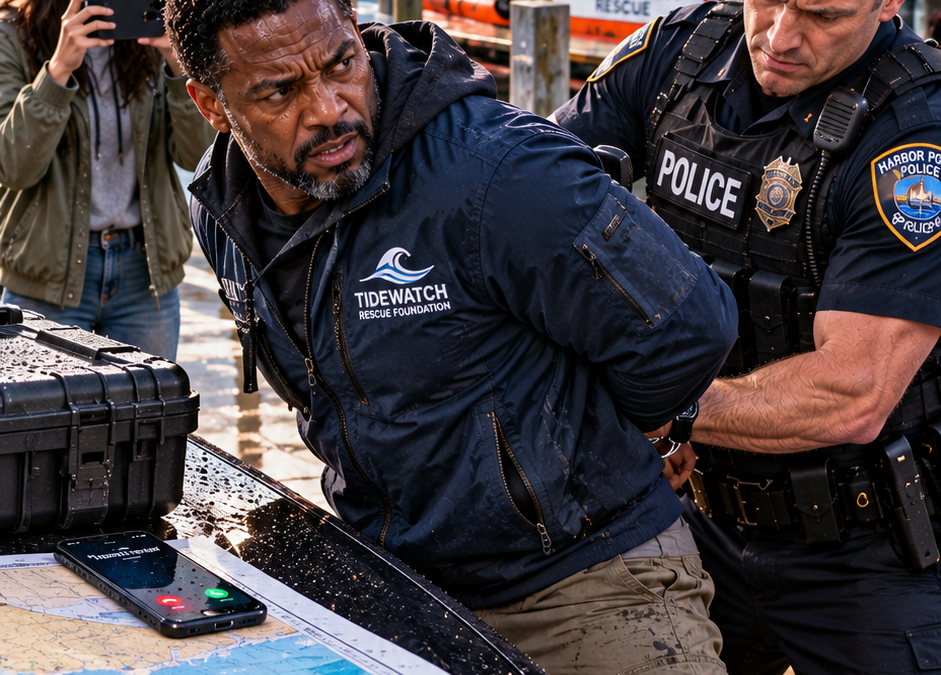
My phone began vibrating against the hood.
Ben’s name appeared on the screen.
The call ended.
Then another began.
A weather alert appeared beneath it.
Marine warning issued. Fast-moving storm approaching Harbor Point.
I looked toward the horizon.
The dark cloud bank had thickened noticeably.
“Officer, I need to answer that.”
Briggs picked up the phone before I could reach it.
“Your phone is being secured during the investigation.”
“It belongs to me.”
“Then you can have it back when we’re finished.”
The screen lit up again.
This time, the caller was Coastal County Emergency Coordination.
Rachel noticed.
“Colton, that’s an official emergency number.”
Briggs silenced the call.
My stomach tightened.
“That call may concern an active rescue.”
He looked at me.
“First you’re a Navy SEAL, and now you’re running emergency operations?”
“I’ve given you documentation for both.”
I could hear wind striking the rigging of the nearby boats.
A few dock workers had begun securing loose equipment.
Then Rachel’s radio crackled.
Dispatch was reporting an unstable distress signal near Raven Shoals.
A small fishing vessel might be disabled.
Marine response units were being contacted.
I felt the familiar shift inside me that came whenever an emergency began.
It wasn’t excitement.
It was the immediate understanding that somewhere, somebody needed help, and every decision we made from that moment forward would affect their chances of getting home.
“Officer,” I said, “we need to verify this immediately.”
Briggs stared at me.
I pointed toward the drone case.
“That equipment can help locate people in low visibility. If a vessel is disabled near Raven Shoals, darkness and worsening weather will make the search much harder.”
Rachel turned toward him.
“We need to check his role with the county.”
Briggs looked around.
Several people were watching.
Ava was still filming.
Rachel’s body camera was recording.
And I could see something in his expression that troubled me.
He appeared more concerned about the embarrassment of admitting he was wrong than about the possibility that somebody might be in danger.
I didn’t know that the distress signal had come from Tom and Evan.
Not yet.
Miles offshore, their fishing boat had lost engine power.
The wind was pushing them toward a dangerous stretch of submerged rocks near Raven Shoals.
A loose metal box had slid across the deck and struck Tom’s head. He was bleeding, disoriented, and struggling to remain conscious.
Evan had reached for the radio he’d repaired that morning.
“TideWatch, this is Brooks’s boat. Engine’s dead. Tom’s hurt. We’re drifting south.”
The transmission broke apart in static.
At TideWatch headquarters, Ben heard enough to recognize the voice.
He replayed the message and checked the emergency locator information.
A weak signal appeared near Raven Shoals, vanished, then returned farther east.
Ben called me.
No answer.
He called the county emergency center.
The county activated TideWatch for a possible search-and-rescue mission.
Then Ben looked toward the equipment rack where our thermal drone should have been.
It was empty.
The drone was still inside my truck at Seabreak Marina.
Back at the marina, Briggs was holding my phone.
The county emergency number appeared again.
I saw it before he slipped the device into an evidence pouch.
“Answer that call,” I said.
He looked at me.
“You’re not giving orders here.”
“That call could involve a rescue operation.”
“You don’t know that.”
“I recognize the emergency center’s number. TideWatch is part of the county response network.”
Rachel moved closer.
“Dispatch has a distress report near Raven Shoals. Let me verify this.”
Briggs turned toward her.
“I’ve got it under control.”
Then he looked back at me.
“You’re not going anywhere until I finish my investigation.”
I kept my hands at my sides.
“Am I free to leave?”
“No.”
“What crime do you reasonably suspect me of committing?”
“I’m done answering your questions.”
I looked at the phone sealed inside the evidence pouch.
Then toward the approaching storm.
“Officer, you have documentation establishing who I am, who owns this equipment, and why I’m here. Continuing to detain me is delaying an emergency response.”
He stepped forward.
“Turn around.”
Ava raised her camera.
“I recorded everything.”
Briggs pointed toward her.
“Turn that off!”
Rachel immediately intervened.
“She’s standing in a public access area. She can record.”
Briggs glanced toward Rachel’s body camera.
Its recording light remained active.
He’d switched his own camera off earlier while adjusting his vest, but Rachel had kept hers running.
I looked directly at him.
“Officer, I’m not resisting.”
He removed his handcuffs.
“You’re under arrest for interfering with an investigation and refusing a lawful order.”
My first instinct was to argue.
My second was to look toward Ava.
Her face had gone pale.
For a moment, I saw the little girl who used to run to the front door whenever I returned from deployment.
The same girl who had once asked why I always came home carrying bags that smelled like airplanes and rain.
I couldn’t bear the thought of frightening her any more than I already had.
So I turned slowly.
I placed my hands behind my back.
The cuffs closed around my wrists.
I felt the metal tighten.
And for the first time in years, I experienced something close to panic.
Not because I was afraid of being arrested.
Because I couldn’t stop thinking about the boy whose photograph had appeared on my phone less than an hour earlier.
Evan.
Smiling beside Tom.
Holding the radio he’d repaired himself.
Proud of you. Stay close to—
I had never finished the message.
Ava was already calling Ben.
“They’re arresting him.”
I could hear her voice trembling.
“The drone is still here.”
Ben apparently told her to keep filming.
Then he began preparing our rescue boat.
Briggs guided me toward the patrol car.
The sky over Harbor Point had darkened from gray to almost black.
A wall of rain was moving toward the harbor entrance.
I looked toward the storm.
Then I turned to Briggs.
“If a child dies out there because you delayed the equipment that could find him, who’s going to answer for that?”
He didn’t reply.
He opened the rear door.
I got inside.
The drive to Harbor Point Police Headquarters took fourteen minutes.
Briggs said nothing.
I sat behind the metal partition with my wrists cuffed tightly, watching the first heavy drops of rain strike the windows.
My phone remained inside an evidence bag beside him.
Every time it vibrated, I imagined Ben calling with another update.
Every unanswered call represented information I didn’t have.
And somewhere beyond the harbor, the weather was getting worse.
I tried to think through our available resources.
Ben could launch TideWatch One with the volunteers already at headquarters.
The county would be coordinating with other marine response units.
The Coast Guard would receive the distress information.
But our drone and portable sonar system were still in the truck.
The equipment might not be the only way to locate the missing boat, but it could significantly improve our chances in deteriorating visibility.
I looked toward Briggs.
“Please contact Coastal County Emergency Coordination.”
He kept driving.
“That information’s already in the report.”
“This isn’t about your report.”
“You’re not helping yourself.”
I stopped speaking.
The old lessons from my military career returned almost automatically.
Control what you can.
Identify the next useful action.
Don’t waste energy on an argument that won’t change the immediate problem.
But sitting behind that partition, I had very little control.
I couldn’t contact Ben.
I couldn’t communicate with the county.
I couldn’t retrieve our equipment.
And I couldn’t help the boy who had trusted me enough to send me a photograph of his repaired radio.
At the station, Briggs led me through a fluorescent hallway into the processing room.
The building smelled of wet uniforms, old coffee, and disinfectant.
A booking officer asked for the charge.
“Interfering with an investigation and refusing lawful commands,” Briggs answered.
I looked toward the wall clock.
“Before you process anything, please contact the county emergency center. A fishing boat may be missing near Raven Shoals.”
Briggs sat at a desk.
“The rescue story has been noted.”
“It’s not a story.”
He began typing.
“You introduced an emergency after I asked you to cooperate.”
“The emergency center called before you arrested me.”
He continued typing.
From where I sat, I could see part of the report.
One phrase caught my attention.
Subject became increasingly aggressive.
I stared at the words.
I’d never raised my voice.
I’d kept my hands visible.
I’d repeatedly offered documentation and methods to verify it.
And now the officer who had refused to examine the evidence was writing a record that described me as aggressive.
I wondered how many people had sat in that same room, watching an officer turn their attempts to explain themselves into a justification for arrest.
Rachel entered several minutes later.
Her uniform was wet from the rain.
She placed her body camera in the upload dock and waited while the system began transferring the footage.
Then she selected the option protecting the recording from routine deletion.
She wrote down the arrest time, the unanswered emergency calls, and the marine distress alert.
Briggs glanced toward her.
“You writing a novel?”
“I’m documenting the timeline.”
“I already have the report.”
Rachel looked toward his computer.
Then toward me.
“Your report isn’t the only record.”
For a moment, I thought Briggs might respond angrily.
Instead, he returned to typing.
I asked Rachel to contact the emergency center.
She nodded once.
Then she left the room.
I later learned that she’d gone directly to an empty interview office and called Coastal County Emergency Coordination from a department phone.
The duty coordinator verified that TideWatch had been activated eleven minutes earlier.
I was listed as the organization’s certified rescue commander.
The missing vessel was carrying Tom Brooks and fifteen-year-old Evan Brooks.
Its emergency locator had produced two weak signals near Raven Shoals before disappearing.
The thermal drone and portable sonar system remained in my truck at Seabreak Marina.
Rachel wrote down every detail.
The coordinator warned her that the water temperature was dropping and the wind was worsening.
If either missing person had entered the water, their survival window was shrinking.
Rachel didn’t return to the processing room immediately.
She went to Captain Mara Ellison.
Mara was a fifty-one-year-old police captain known for reviewing reports carefully and refusing to treat preventable delays as harmless administrative mistakes.
Years earlier, her younger brother had died after emergency crews were dispatched to the wrong location.
That experience had shaped the way she approached every incident involving emergency response.
Rachel placed her notes on Mara’s desk.
Then she showed her the body camera footage.
Mara watched Briggs ignore our organization’s markings.
She heard me offer identification, vehicle registration, warehouse records, and multiple ways to verify my military credentials.
She watched him dismiss repeated calls from the county emergency center.
Then she saw him arrest me while I remained controlled and compliant.
Mara opened Briggs’s personnel record.
Three previous complaints described extended detentions after drivers had already provided valid documentation.
None had resulted in discipline.
She stood.
“Where is Reed?”
Back in the processing room, Briggs was making another change to his report.
He replaced a description of my questions about the legal basis for the search with a statement that I’d become confrontational.
He added that I’d attempted to intimidate the officers by invoking my military background.
Mara entered before he could finish.
“Remove the handcuffs.”
Briggs turned.
“Captain, I’m still completing the report.”
“Remove them. Now.”
Rachel stood in the doorway.
Her body camera footage had already been preserved.
Briggs could revise his report, but he couldn’t change what the recording showed.
When the cuffs came off, I rubbed my wrists.
Dark red marks circled both of them.
Mara returned my phone, wallet, military identification, and keys.
“Mr. Reed, your detention is ending. A patrol unit will take you back to Seabreak Marina.”
I immediately checked my phone.
Nine missed calls from Ben.
Three from the county emergency center.
My stomach dropped.
“How long have they been missing?”
“County coordination is actively managing the search. Your organization has already been notified that you’re being released.”
I looked toward the station entrance.
“Then I need to get back to the marina.”
Mara noticed my wrists.
“We can arrange a medical examination after the rescue. Those injuries should be documented.”
I shook my head.
“A child needs a rescue team more than I need a doctor right now.”
When I reached the lobby, Ava was waiting.
The moment she saw me, she hurried forward.
“Dad!”
I opened my arms.
For a second, she seemed about to hug me.
Then she stopped and looked toward my wrists.
Her expression changed.
“Are you hurt?”
“I’m all right.”
She didn’t look convinced.
She raised her phone.
“The video is ready. I can post it now.”
I looked at the screen.
She had captured the entire encounter.
Every instruction.
Every refusal to verify my documents.
Every time Rachel tried to intervene.
And the moment Briggs decided to arrest me instead of answering the emergency calls.
I understood why Ava wanted the world to see it.
But I also understood the danger of allowing our anger to turn a complete record into a collection of carefully selected moments.
“Don’t edit it,” I told her.
She looked startled.
“They arrested you!”
“I know.”
“Then people need to see what happened.”
“They do. But they need to see all of it.”
I put a hand on her shoulder.
“Preserve the original. The full recording will tell the story without us changing anything.”
She nodded slowly.
Then she looked toward the station doors.
“Ben’s waiting for us.”
I followed her outside.
By the time we reached Seabreak Marina, the storm had arrived.
Rain swept sideways across the docks.
Boats strained against their mooring lines.
The harbor entrance had nearly disappeared behind sheets of dark water.
Ben stood beside TideWatch One while volunteers secured the final equipment.
He was trying to conceal the limp that became more pronounced whenever his prosthetic leg caused him pain.
I stepped out of the patrol car.
He turned immediately.
“Well, look who decided to join us.”
I could hear the relief beneath his attempt at humor.
“What’s our status?”
“Last locator signal near Raven Shoals. County’s coordinating. We have the vessel ready, but the drone’s still in your truck.”
I handed him the keys.
“Get it aboard.”
He looked toward my wrists.
For once, Ben didn’t make a joke.
“Isaiah—”
“Later.”
He nodded.
“Understood.”
I pulled on a yellow rescue vest and moved toward the boat.
Ava followed me.
“Dad, I’m coming.”
I turned toward her.
“No.”
Her expression tightened.
“I’ve been filming this whole thing. I can help.”
“I know you can. But I need you at the emergency coordination center.”
She looked as though she wanted to argue.
I continued before she could.
“Document the radio traffic, the weather updates, and the decisions being made. If something changes, I want you somewhere you can communicate with the county.”
She stared at me.
“You’re not just sending me away?”
“No.”
I reached for her hand.
“I’m trusting you with an important job.”
For a moment, she looked like the little girl who used to ask whether she could help me pack before deployment.
Then she nodded.
“Okay.”
I squeezed her hand.
“I’ll see you when we get back.”
She looked toward the black water beyond the harbor wall.
“You promise?”
The question struck deeper than she could have known.
There had been too many times during my military career when I’d told her mother I would be home soon, even when I couldn’t honestly guarantee it.
I wasn’t going to make that mistake again.
“I promise I’ll do everything I can.”
She stepped closer and hugged me.
I held her for a moment.
Then I released her and climbed aboard TideWatch One.
The engines started.
Ben checked the equipment.
Our volunteers secured the drone and sonar system.
Then we cleared the harbor wall and entered open water beneath a sky so dark it seemed impossible that the afternoon had begun in daylight.
The first wave struck us hard enough to send loose equipment sliding against the cabin wall.
Rain hammered the windshield.
Visibility dropped rapidly.
I took the controls while Ben monitored the navigation display and the last known emergency locator positions.
The county continued transmitting updated weather and rescue coordination information.
Other vessels were preparing to search, but the shallower water near Raven Shoals created serious limitations.
The submerged rocks were dangerous even in good weather.
In a storm, they could destroy a rescue boat before its crew ever reached the people they were trying to save.
I examined the last signal.
Then the wind direction.
Then the outgoing tide.
A disabled fishing boat would be moving differently from a powered vessel.
If Tom’s engine had failed near the shoals, the current could have pushed them south toward the rocky shallows.
“Three degrees east,” Ben called.
I adjusted course.
The boat climbed another wave.
For a moment, the bow seemed to hang in the darkness.
Then it dropped heavily into the trough.
Water struck the windshield.
One of our volunteers stumbled against the cabin wall.
“Everybody secure yourselves!”
I waited until the next wave passed.
Then I looked toward Ben.
“Can we get the drone up?”
“The operator’s ready.”
“Do it.”
A volunteer launched the thermal drone from the rear deck.
The wind caught it almost immediately.
Its signal flickered.
For several seconds, the display showed little more than rain interference and the uneven outlines of the surrounding water.
Then the image stabilized.
We began searching.
At the emergency coordination center, Rachel had joined the personnel managing the response.
Mara had taken Briggs off active patrol pending the investigation.
Rachel’s knowledge of the original arrest and the missing equipment made her useful to the rescue coordinators, and she began relaying updated information to our team.
Ava stood behind the radio operator with her camera.
She later told me that listening to my voice through the static had felt strange.
For years, she had interpreted my calmness during difficult conversations as emotional distance.
She thought I remained silent because I didn’t know how deeply she missed her mother.
At the coordination center, she heard the same calmness being used to organize a rescue in almost impossible conditions.
She began to understand that I wasn’t unaffected by fear.
I’d simply spent my life learning to remain functional while frightened.
What she didn’t yet understand was that the same habit had made it difficult for me to speak honestly about grief.
Back aboard TideWatch One, Ben examined a weak return near the western rocks.
“Hold on.”
I reduced speed.
The drone operator leaned closer to the screen.
“Possible heat source.”
I looked toward the display.
“Human?”
“Can’t confirm.”
We adjusted our course.
The rain became heavier.
Then the drone operator raised one hand.
“Wait.”
Through the drone’s microphone came a faint sound.
Three short blasts.
A pause.
Then three more.
I felt my throat tighten.
Evan’s rescue whistle.
I’d given it to him during youth training several months earlier.
I’d taught him to use repeated bursts because a consistent distress signal was easier to recognize than someone shouting until their voice failed.
I could hear him demonstrating it on a sunny afternoon, grinning as Ben pretended the noise was giving him a headache.
Now the same sound was coming through our equipment in the middle of a storm.
“That’s Evan,” I said.
Ben looked at me.
“You’re sure?”
“I’m sure.”
I turned the boat toward the signal.
Minutes later, our searchlight caught the outline of a damaged fishing vessel wedged against the rocky shallows.
The boat was half-filled with water.
Its hull had been driven against a jagged section of reef, and the waves were striking it from the exposed side.
Tom lay motionless beneath a twisted anchor line.
Evan was clinging to a broken section of the hull, struggling to keep his head above the waves.
I could see the red whistle attached to his jacket.
“Prepare the rescue line!”
The volunteers moved immediately.
I clipped into the rope, checked my equipment, and entered the water.
The cold hit me like a physical blow.
For a moment, the strength of the current surprised me.
Then I regained my orientation and moved toward the wreck.
The waves were forcing the boat against the rocks.
I reached the hull and pulled myself toward Tom.
He was unconscious.
Blood had dried along one side of his head before the rain washed it away.
The anchor line had trapped part of his clothing and prevented him from moving freely.
I checked his breathing as quickly as conditions allowed.
Then I cut the obstructing line.
“TideWatch One, prepare to retrieve!”
The rope tightened.
Ben and the retrieval team began pulling.
For several seconds, Tom’s weight shifted awkwardly against the damaged hull.
Then another wave lifted us clear.
I guided him toward the rescue boat.
Two volunteers reached down and secured him.
“Get him aboard!”
They pulled him over the side.
I turned toward Evan.
He was still holding the broken section of hull.
“Evan!”
He looked up.
For one instant, I saw his face in the beam of the searchlight.
He recognized me.
Then a large wave struck the wreck.
The broken section of hull shifted violently.
Evan lost his grip.
He disappeared beneath the water.
My chest tightened.
I heard somebody shout from the rescue boat.
But I was already moving.
I released my hold on the wreck and swam toward the place where I’d last seen him.
The current pushed him toward the rocks.
For one terrible second, I couldn’t find him.
Then his head appeared between two waves.
I lunged forward.
My fingers caught the back of his jacket just before the current carried him into the reef.
He was struggling, coughing, and barely able to keep his head above the water.
“I’ve got you!”
He tried to answer.
Water filled his mouth.
I pulled him toward me and signaled the boat.
The rescue line tightened.
Behind us, the waves continued breaking against the damaged fishing vessel.
I held on to Evan while the retrieval team brought us toward TideWatch One.
My arms burned.
The cold had begun affecting my hands.
But I refused to loosen my grip.
When we reached the boat, two volunteers pulled Evan aboard.
I climbed after him.
He collapsed onto the deck, shivering uncontrollably.
Ben moved toward him with thermal blankets.
Then I noticed blood soaking the fabric around Ben’s prosthetic leg.
“Ben!”
“I’m fine.”
“No, you’re not.”
He looked toward the rescue line.
“I need another minute.”
I grabbed his shoulder.
“Ask for help.”
For a moment, he stared at me.
I knew what he was thinking.
He had spent years believing that admitting pain meant accepting that he was no longer the man he’d been before losing his leg.
He’d fought that belief through rehabilitation, through the early days of TideWatch, and through every rescue mission where he felt compelled to prove himself all over again.
But this wasn’t about proving anything.
It was about keeping our team safe.
Ben finally looked toward another volunteer.
“I need help with this line.”
The volunteer immediately took position beside him.
Together, they secured the equipment while I checked Evan.
His body temperature had dropped dangerously low.
He was exhausted and barely responsive.
But he was breathing.
Tom had a pulse, although his head injury required urgent medical treatment.
I stabilized his neck and monitored his breathing while we prepared to return to Harbor Point.
The county coordinated with emergency medical personnel and the rescue helicopter crew.
A pilot later told us that another twenty minutes in those conditions might have changed the outcome dramatically.
I didn’t need anyone to explain how close we’d come.
I could feel it in the shaking of my hands.
Evan opened his eyes briefly.
He looked toward Tom.
Then toward me.
Rainwater was running down my face, and the dark marks from Briggs’s handcuffs were still visible around my wrists.
“You came,” he whispered.
I bent closer.
“I told you I would.”
His eyes closed again.
This time, I let them.
He was aboard our boat.
He was surrounded by people who knew how to care for him.
And we were bringing him home.
When TideWatch One returned to Harbor Point, emergency personnel were waiting along the dock.
Tom was transferred for urgent medical treatment.
Evan was wrapped in additional thermal blankets and carried toward an ambulance.
I stayed beside him until the medical team assured me he was stable enough for transport.
Only then did I step away.
The dock was crowded.
Volunteers.
Emergency workers.
Residents who had heard about the search.
Several reporters stood near the marina entrance, their cameras pointed toward the rescue boat.
I wasn’t interested in talking to any of them.
I was soaked, exhausted, and beginning to feel the pain from my wrists and shoulders.
Then I saw Ava.
She was standing near the emergency coordination vehicle with her camera lowered.
For a moment, she simply stared at me.
Then she ran.
“Dad!”
I barely had time to open my arms before she threw herself against me.
She held on so tightly that I could feel her trembling.
I wrapped both arms around her.
For the first time since her mother’s funeral, she hugged me without hesitation, without embarrassment, and without pulling away the moment someone might notice.
I closed my eyes.
“I’m here.”
She began crying.
“I know.”
I held her while the rain continued falling around us.
Behind us, Ben was receiving medical attention for his injured leg.
Ahead of us, ambulances were preparing to leave with Tom and Evan.
The storm hadn’t completely passed.
But our people were coming home.
Tom underwent emergency surgery at Coastal Mercy Hospital before midnight.
His head injury was serious, but the surgeons told us he was expected to recover.
Evan had suffered hypothermia and severe exhaustion.
He was alive, awake, and breathing without assistance.
I visited him as soon as the medical staff allowed it.
He looked impossibly small beneath the hospital blankets.
His red rescue whistle lay on the bedside table.
When I entered, he stared at my wrists.
“Did the police hurt you?”
I pulled a chair closer.
“I’ll be all right.”
He looked down.
“Are you mad at me?”
I shook my head.
“Why would I be mad at you?”
“For going out there. Tom told me we should’ve checked the weather again.”
I looked toward the whistle.
“Did you use your radio?”
He nodded.
“Until it stopped working.”
“And the whistle?”
“Just like you taught us.”
I smiled.
“Then you did exactly what you were supposed to do once things went wrong.”
He stared at the blanket.
“I thought we were going to die.”
I moved closer.
“I know.”
His eyes filled with tears.
“Tom wasn’t waking up. I kept calling his name.”
I reached for his hand.
“You kept trying. You sent a distress call. You stayed with him. And you used your whistle.”
He began crying.
I waited.
There was nothing useful to say that could erase what he’d experienced.
Eventually, he looked up.
“You’re not angry?”
“Adults are responsible for bringing children home. We don’t abandon them because they made a mistake.”
He squeezed my hand.
A few days later, Tom told a social worker that he intended to complete Evan’s adoption as soon as he recovered.
He had nearly lost the boy once.
He wasn’t going to let paperwork leave Evan wondering whether he truly belonged in their family.
While Tom and Evan recovered, the footage Ava recorded at Seabreak Marina began attracting attention.
Reporters wanted the dramatic moment when Briggs placed me in handcuffs.
They wanted a short clip they could replay between interviews.
But Ava remembered what I’d told her at the police station.
She preserved the original recording.
Then we released the complete sequence, beginning with Briggs’s first commands and continuing through Rachel’s repeated requests to verify my documents and the emergency calls.
There was no need to manufacture outrage.
The recording showed the confrontation exactly as it happened.
Ava changed the title of her documentary.
Originally, she’d planned to call it A Badge Against a Hero.
After the rescue, she reconsidered.
She wanted the film to focus less on what Briggs had done and more on the people who had refused to let his decisions become the end of the story.
She renamed it The Man Who Came Back.
I told her I wasn’t sure I deserved a title like that.
She looked at me for a long moment.
“Maybe it’s not just about coming back from the storm, Dad.”
I didn’t know how to answer.
But I understood what she was trying to tell me.
The Harbor Point Police Department opened a formal internal investigation.
The evidence was extensive.
Gavin Morrow’s original call identified no actual theft, damaged property, forced entry, or threatening conduct.
When questioned, he eventually admitted that he’d called police because I didn’t look like somebody he expected to see handling expensive equipment at Seabreak Marina.
His security contract was terminated.
Investigators also confirmed that Briggs had been given access to my clean records check, TideWatch’s vehicle registration, our warehouse agreement, the authorized access list, and the equipment inventory before arresting me.
He’d ignored repeated opportunities to verify the documents.
He’d also disregarded the county’s emergency calls.
His written report claimed I’d been aggressive and threatening.
Ava’s video and Rachel’s body camera showed me speaking calmly with my hands visible.
The arrest time in his report differed from the timestamp on the preserved recording.
An examination of previous complaints revealed a troubling pattern.
Department records covering four years showed that Briggs stopped Black drivers and pedestrians far more frequently than the departmental average, particularly near wealthy neighborhoods and commercial districts.
Rachel testified about everything she’d witnessed.
She described my cooperation, Briggs’s refusal to verify the documents, and his decision to ignore the emergency calls.
Her testimony wasn’t popular with everyone in the department.
Several officers stopped speaking to her.
One called her disloyal in the locker room.
Captain Mara Ellison responded publicly.
“Loyalty to a colleague does not require loyalty to a lie.”
Briggs was suspended without pay while the disciplinary proceedings continued.
His case was also referred to the state police certification board.
The city initially offered me a quick financial settlement.
It included confidentiality provisions and no admission of wrongdoing.
I rejected it.
Not because I believed money was unimportant.
TideWatch had expenses. Our volunteers needed equipment, and our rescue boats required constant maintenance.
But the incident had exposed problems that a confidential payment couldn’t resolve.
I met with the city attorneys and placed six demands on the table.
I wanted the investigation released publicly.
An early-warning system for officers with repeated complaints.
Stronger civilian oversight.
Training on constitutional stops and searches.
Mandatory verification when readily available documentation could resolve uncertainty before an encounter escalated.
And joint training between police officers and veteran-led rescue teams so that emergency responders understood one another’s roles before a crisis occurred.
The city attorneys studied the list.
One of them looked toward me.
“Mr. Reed, that’s a substantial set of institutional changes.”
“I understand.”
“We’re here to discuss compensation.”
“So am I.”
I pointed toward the final demand.
“How much compensation would you place on the time we lost while a child was drifting toward those rocks?”
Nobody answered.
I didn’t expect them to.
I wasn’t asking them to put a price on Evan’s life.
I was asking them to understand that the consequences of misconduct didn’t stop with the person standing in handcuffs.
They extended to every emergency that couldn’t be answered, every witness who was afraid to speak, and every family forced to trust that someone in authority would eventually recognize the truth.
Some residents wanted Briggs punished as severely as possible.
I understood their anger.
But I also understood that accountability had to follow evidence.
I’d spent too many years making decisions in dangerous situations to believe that anger alone could tell me what justice required.
I didn’t want another person treated unfairly simply because the public had decided to hate him.
I wanted a process capable of establishing what happened and imposing consequences that could withstand scrutiny.
The city council chamber was full when Evan appeared at the public hearing.
He was still recovering from the storm.
Tom sat nearby in a wheelchair.
I was seated behind them.
Evan walked slowly toward the podium carrying his red rescue whistle.
He placed it beside the microphone.
For a moment, he stared at the council members.
Then he looked toward me.
“Isaiah came into that storm to save me.”
His voice trembled.
“But before he could do that, this city handcuffed the one man who knew how to find us.”
The room became completely silent.
Evan looked down at the whistle.
“I don’t know what would’ve happened if he got there any later.”
He paused.
“All I know is that he came.”
I lowered my eyes.
I’d spent years attending ceremonies where people praised courage, sacrifice, and service.
But nothing I’d ever heard in a formal military setting affected me as deeply as the words of that frightened fifteen-year-old boy.
Because I knew how close we’d come.
And because I couldn’t stop thinking about how little any of it had needed to happen.
Nine months after Evan spoke before the city council, Harbor Point approved a settlement with me.
The agreement included substantial compensation, full legal costs, and a three-year reform program supervised by an independent civilian panel.
For me, the money was never the most important part.
I used most of it to expand TideWatch into the Harbor Point Joint Rescue and Training Center.
Police officers, firefighters, veterans, and teenagers would train together there.
They would practice emergency communications, marine rescue procedures, equipment verification, and coordinated responses.
They would learn one another’s responsibilities before meeting for the first time in the middle of a crisis.
The investigation ended Briggs’s policing career.
He was terminated for unlawful arrest, falsifying an official report, and violating body camera policy.
The state certification board revoked his authority to work as a police officer in North Carolina.
At his final hearing, Briggs stood before the panel without a uniform.
He admitted that he’d become more concerned with protecting his authority than discovering the truth.
I listened.
I didn’t feel satisfaction.
I thought about Gavin’s phone call.
My identification card.
The rescue equipment sitting untouched in our truck.
And Evan blowing that little red whistle while his foster father lay unconscious beside him.
When I was given an opportunity to speak, I looked toward Briggs.
“I can’t forgive you on behalf of everyone you stopped before me. That belongs to them.”
He lowered his eyes.
“But telling the truth is the first step toward making sure you don’t harm anyone else.”
The department adopted every major reform I’d requested.
Traffic stop data would be audited by race.
Repeated complaints would trigger early-warning reviews.
Body cameras were required to remain active during public encounters.
Refusing consent to a search could not be treated automatically as evidence of criminal activity.
Officers were required to verify documents when that verification could be completed quickly, and supervisors had to compare written reports with available camera footage before approving them.
A strengthened civilian oversight board gained authority to reopen closed complaints.
Rachel Kim was promoted to community training coordinator.
She began teaching new officers how to ask questions without turning uncertainty into unnecessary force.
Captain Mara Ellison worked beside her, making it clear that integrity wasn’t a betrayal of the badge.
Ben finally sought treatment for the injury beneath his prosthetic leg.
He also joined a veteran support group.
For years, he’d treated pain as something he needed to conceal in order to prove he remained useful.
The night at Raven Shoals had taught him that asking for help could be the decision that kept everyone safe.
When our new rescue vessel was commissioned, we redesigned it to accommodate operators with prosthetic limbs.
Ben returned to active missions without hiding his pain.
Tom completed Evan’s adoption.
And Evan graduated from TideWatch’s youth rescue course as its youngest authorized trainee.
The day he received his certificate, he wore the same red whistle I’d given him before the storm.
He insisted that it still worked perfectly.
I told him I hoped he never needed it in quite the same way again.
Ava’s documentary, The Man Who Came Back, earned her the journalism scholarship she’d been working toward.
But the award wasn’t what mattered most to either of us.
During the months after the rescue, we began talking.
Not only about school, the foundation, or the documentary.
We talked about her mother.
About the mornings Ava had watched me leave the house because I couldn’t stand being surrounded by memories.
About the birthdays I’d celebrated while exhausted, the evenings I’d missed because somebody needed rescuing, and the times I’d told myself that providing for my daughter was the same thing as being emotionally present.
One evening, she asked me something I’d spent years dreading.
“Did you ever blame yourself for Mom?”
I looked toward the photograph on the living room shelf.
“Every day.”
Ava stared at me.
“Why?”
“Because I wasn’t there for all the moments I wish I could’ve had with her.”
She sat beside me.
“Dad, you couldn’t have saved her.”
I closed my eyes.
“I know.”
“Then why do you keep acting like you failed?”
I thought about the nights I’d spent at sea, the people I’d carried through storms, and the countless emergencies I’d responded to because helping strangers had always seemed easier than sitting alone with my grief.
“I guess I kept believing that if I saved enough people, eventually I’d feel like I hadn’t lost her.”
Ava began crying.
I put my arm around her.
For the first time in years, neither of us tried to make the conversation easier by changing the subject.
We simply sat together and let ourselves miss her.
One year after the storm, Harbor Point gathered for the opening of the new rescue center.
The docks were crowded with families, veterans, firefighters, police officers, and children enrolled in our first training programs.
The weather was clear.
Sunlight reflected off the water.
A gentle breeze moved through the flags along the pier.
Rachel was instructing a group of young officers near the equipment room.
Ben guided our newly modified rescue boat into its berth, moving easily around the deck without trying to conceal his prosthetic leg.
Tom stood beside Evan, watching the boy proudly explain radio procedures to several younger trainees.
Ava was filming the ceremony.
I wore my TideWatch jacket and a simple bracelet made from the rescue rope we’d used at Raven Shoals.
The red marks from Briggs’s handcuffs had disappeared months earlier.
The bracelet was something I chose to keep.
A reminder of the night when everything had gone wrong, and of the people who had refused to let those mistakes decide the outcome.
At the opening ceremony, I handed red rescue whistles to the first class of children.
Evan stood nearby, smiling whenever one of them immediately tried blowing into a whistle as loudly as possible.
Ben pretended to cover his ears.
Rachel laughed.
And Ava captured all of it.
When the opening bell rang, she lowered her camera and came to stand beside me.
For a moment, I looked toward the harbor entrance.
A year earlier, that stretch of water had disappeared beneath a wall of rain.
I’d climbed aboard TideWatch One with my wrists still marked by handcuffs, desperate to reach a boy who might already have been running out of time.
I’d spent most of my life believing that duty meant going wherever somebody needed help, regardless of the danger.
That belief hadn’t changed.
But I’d finally learned that duty also meant knowing when to come home.
It meant allowing my friends to support me.
It meant admitting when I was frightened.
And it meant being present for the people who loved me long after the emergency had ended.
Ava slipped her hand into mine.
“Proud of you, Dad.”
I looked at her.
For years, I’d been able to command a room full of experienced operators without hesitation.
But those four words left me struggling to speak.
“I’m proud of you, too.”
She rested her head briefly against my shoulder.
We stood together while the children practiced throwing rescue lines, Ben demonstrated the new boat, and families gathered along the dock.
For the first time in years, I wasn’t searching the horizon for somebody who needed saving.
I was standing beside my daughter, surrounded by people who had survived a terrible night and built something meaningful from what they’d learned.
Evan was alive.
Tom had come home.
Ben no longer had to hide his pain.
Rachel had chosen the truth over professional convenience.
And Ava and I had finally found our way back to each other.
The officer at Seabreak Marina had looked at a Black man beside a rescue truck and decided he couldn’t possibly belong there.
He’d ignored the documents that could have resolved his doubts, dismissed the warnings that could have prevented a crisis, and used his authority to punish somebody for asking him to verify the facts.
But my military record had never been the reason I deserved fair treatment.
My rescue foundation hadn’t made my rights more important than anyone else’s.
And saving Evan hadn’t transformed me into somebody who deserved dignity only after accomplishing something extraordinary.
I’d deserved it from the moment the officer approached my truck.
So had everyone else he’d stopped.
As the ceremony ended, Evan ran toward us carrying another box of red whistles.
“Isaiah! We need more of these at the training dock!”
I laughed.
“Then let’s get them where they belong.”
Ava picked up her camera.
I took the box from Evan and walked with them toward the water.
This time, there was no storm approaching.
No emergency call going unanswered.
No police officer standing between me and the work I needed to do.
Just the sound of children laughing, boats moving gently against their lines, and my daughter’s footsteps beside mine.
After years of running toward danger and away from grief, I’d finally learned that coming home could be its own kind of courage.








