The Officer Who Called Me “Boy” Never Thought to Look Toward the Guard Tower
𝗙𝗨𝗟𝗟 𝗦𝗧𝗢𝗥𝗬
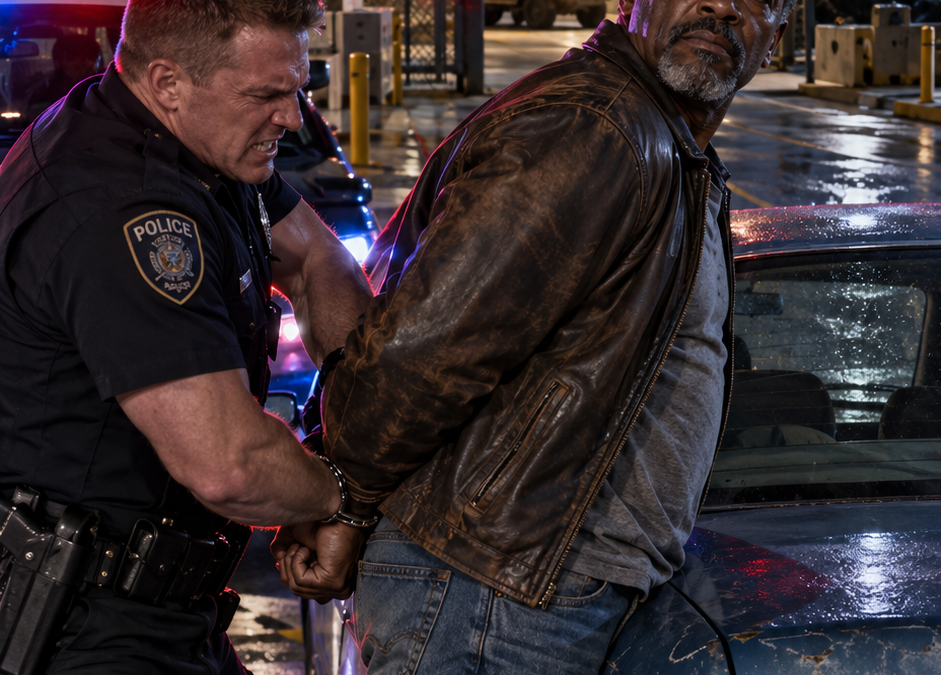
Standing against my Taurus, I finally understood what he had meant.
“Read my identification,” I told Wilkins. “Then call your supervisor.”
He twisted my left arm behind my back.
“You’re not in command out here.”
“That’s where you’re mistaken.”
The first handcuff snapped around my wrist.
He tightened it far beyond what was necessary.
The second followed.
Metal bit into my skin.
“You’re under arrest for driving under the influence, failure to obey, and resisting.”
I turned my head as far as I could.
“You haven’t conducted a sobriety test.”
“I can smell alcohol.”
“I don’t drink.”
“Save it for the judge.”
He pulled me upright.
Under the flashing red and blue lights, I studied his face.
What disturbed me wasn’t simply his anger. Anger could pass. It was his certainty that troubled me.
He had decided what kind of man I was before approaching my car. Every fact that contradicted his conclusion had become another reason to punish me.
“Officer Wilkins,” I said, reading his nameplate, “you crossed a marked federal boundary, ignored valid identification, used unnecessary force, and accused me of drinking without conducting a test. This encounter is being recorded.”
He glanced at his body camera.
Then he adjusted the strap of his vest, pulling it across the camera’s lens.
“Not anymore.”
I looked past him toward the illuminated guardhouse.
“You should look behind you.”
He didn’t.
And that was when the situation changed.
Corporal Terrence Ross was on duty at Gate Four that night.
Two weeks earlier, I’d personally presented him with a Navy and Marine Corps Achievement Medal after he discovered a faulty barrier sensor during an installation inspection.
I remembered the young corporal standing at attention in front of me, trying unsuccessfully to conceal how proud he was.
According to the statement he later provided investigators, he initially believed he was watching an ordinary traffic stop near the installation boundary.
Then he recognized my car.
When he saw the officer force me against its roof, he picked up a pair of binoculars.
He recognized the scar beside my left ear.
And when Wilkins pulled my injured arm upward, Ross reached for his radio.
“Sergeant of the Guard, Gate Four, priority traffic.”
“Go ahead, Gate Four.”
“Local law enforcement has crossed the federal boundary and placed base actual in handcuffs. Repeat, base actual is restrained at the south approach.”
There was a brief silence.
“Confirm identity.”
“Confirmed visually. Colonel Wallace. Officer is using force. Request immediate response.”
The sergeant’s reply came sharply.
“Lock the approach. Do not engage unless there’s an imminent threat. Quick reaction force moving.”
I didn’t hear that radio exchange at the time.
I was standing beside my car with my hands cuffed behind my back while Wilkins opened the rear door of his cruiser.
He grabbed my upper arm.
“Get in.”
Before I could move, an alarm sounded.
It came from the installation entrance, a deep mechanical warning that cut through the quiet coastal night.
Wilkins turned.
Two massive wedge-shaped security barriers erupted from the pavement behind his cruiser.
Another set rose ahead of it.
Amber warning lights began spinning above the lanes, and the reinforced installation gates rolled shut.
The cruiser was trapped between barriers built to stop heavily loaded vehicles traveling at high speed.
“What the hell?”
Wilkins released my arm.
Floodlights ignited from both guard towers.
The darkness vanished.
For an instant, the light was so intense that I had to close my eyes.
When I opened them, three military police vehicles were approaching from inside the installation.
Their emergency lights flashed across the concrete barriers.
They stopped behind the inner security line.
Doors opened.
Marines wearing helmets and body armor moved into position, their weapons held at a controlled, low-ready angle.
Nobody fired.
Nobody shouted threats.
But every Marine standing there understood that an armed civilian officer was attempting to remove their commanding officer from a restricted installation.
Captain Daniel Reynolds, the night watch commander, stepped forward with a loudspeaker.
“Oceanside police officer, move away from the detainee. Keep both hands visible. Do not reach for your weapon.”
Wilkins froze.
His right hand hovered near his belt.
He seemed unable to decide whether to draw his pistol, reach for his radio, or demand that everyone explain what was happening.
Then his radio crackled.
“Unit Twelve, dispatch. Registration returns to Isaiah Samuel Wallace. Department of Defense affiliation confirmed. Unit Twelve, acknowledge.”
He didn’t answer.
Instead, he looked at me.
Then at the Marines.
Then back at me.
I watched realization arrive in stages.
First, he understood that the identification card he had discarded was genuine.
Then he recognized that the Marines weren’t gathering around a random traffic stop.
Finally, he understood that the man whose wrists he had injured was the commanding officer of the installation directly in front of him.
“You knew who I was,” I said. “I told you before you handcuffed me.”
“You gave me a fake card.”
“Dispatch just confirmed it.”
He opened his mouth.
Nothing came out.
Captain Reynolds approached the inner security barrier.
“Officer, place your radio on the hood of your cruiser. Then move away from Colonel Wallace.”
“I’m conducting a lawful arrest!”
“You’re an armed civilian inside a restricted federal installation. You’ll be temporarily disarmed while we establish the facts and resolve jurisdiction.”
Wilkins looked toward the rifles.
“You can’t do this!”
Reynolds kept his voice level.
“Keep your hands visible. Place the radio on the hood. Do not touch your firearm.”
For the first time that night, Wilkins looked genuinely frightened.
Then he turned toward me.
“Tell them to stand down.”
I studied him for a moment.
“You had an opportunity to verify who I was. You threw it onto my passenger seat.”
He slowly placed his radio on the cruiser.
Reynolds signaled to the military police.
Two officers approached through the secured pedestrian passage, removed Wilkins’s weapons for safety, and documented the location of his equipment.
Reynolds asked for the handcuff key.
Wilkins hesitated.
“Now, Officer.”
His fingers trembled as he retrieved it.
When the restraints finally opened, I brought my hands forward.
Dark red grooves circled both wrists. A thin line of blood had appeared where the metal had pinched the skin.
My left shoulder throbbed.
Reynolds saw the injuries.
“Sir, do you require medical attention?”
“In a moment.”
I looked toward Wilkins.
“Secure the scene. Preserve his cruiser, body camera, radio, and the relevant communications. Notify the Naval Criminal Investigative Service and the United States Attorney’s duty office. Any search needs proper legal authority.”
Reynolds nodded.
“Yes, sir.”
“And notify his department. He’s being temporarily detained pending a determination by the appropriate authorities.”
Wilkins stared at me.
“You can’t detain me. I’m a police officer.”
“So were you when you covered your camera and claimed you smelled alcohol.”
Reynolds instructed him to turn around.
Military police placed him in restraints.
They checked the spacing, double-locked the cuffs, and treated him without unnecessary force.
Nobody slammed his face against a vehicle.
Nobody tightened the metal to cause pain.
I didn’t need the difference explained.
Two additional Oceanside police vehicles arrived outside the closed gate.
Their emergency lights washed over the raised security barriers.
The senior officer, Sergeant Paul Danner, stepped from his cruiser and demanded to know why one of his officers was being held.
Reynolds explained the situation through the intercom and advised him that federal investigators and police leadership were being notified.
While they argued about access, I walked toward the guardhouse.
My shoulder hurt with every step.
A Navy corpsman named Petty Officer Lewis examined my wrists and the aggravated injury near my collarbone. He recommended X-rays and asked whether I wanted an ambulance.
I declined the ambulance but agreed to visit the base clinic.
Corporal Ross stood near the communications desk.
He was pale, rigid, and visibly shaken.
“Colonel, sir—”
“Ross.”
He snapped to attention.
“Sir, I didn’t know if—”
“You recognized a developing threat. You notified the chain of command and activated the barriers before an unauthorized vehicle could remove someone from the installation. You followed procedure.”
His shoulders lowered slightly.
“Thank you, sir.”
I looked through the guardhouse windows at the Marines securing the entrance.
“You also maintained fire discipline. That may be the most important thing anyone did tonight.”
“Yes, sir.”
Outside, my Taurus sat with its driver’s door open.
The Department of Defense identification card lay facedown near the gearshift, exactly where Wilkins had thrown it.
Above the entrance, the security cameras continued recording.
They had witnessed what his body camera was no longer showing.
Special Agent Maya Chen of the Naval Criminal Investigative Service arrived shortly after midnight.
She was composed, direct, and entirely uninterested in allowing my rank to interfere with her investigation.
Her first instruction was that neither vehicle be moved.
Her second was addressed to me.
“Colonel Wallace, you’re a victim and a witness. You cannot also direct the investigation.”
I nodded.
“Agreed.”
“Captain Reynolds can continue managing installation security. My team will control the evidence. You’ll need to provide a recorded statement.”
“Whatever you need.”
I could see that she appreciated the distinction.
Powerful people often demand exceptions when rules become inconvenient.
That night, I wanted the opposite.
I wanted every procedure followed so carefully that no one could later claim the case had been manufactured by a furious military commander.
Chen’s team photographed the federal boundary, measured the position of Wilkins’s cruiser, preserved the installation surveillance footage, and secured the electronic records from the security barriers.
The base’s road sensors showed my speed before and after the patrol car activated its emergency lights.
The gate cameras recorded my hazard lights coming on immediately.
Another camera captured the officer crossing the boundary and using force.
Most importantly, a directional microphone mounted above the gate had recorded nearly every word of the encounter.
It captured Wilkins calling me “boy.”
It captured his claim that he smelled alcohol before he had even reached my car window.
And it captured me calmly announcing my movements while trying to prevent the situation from escalating.
Chen reviewed the recordings before questioning Wilkins.
According to her later testimony, he immediately demanded his union attorney and police chief.
He also claimed I’d threatened him and ordered the Marines to arrest him.
Chen showed him a photograph of his cruiser beyond the federal boundary and his hand forcing my arm upward.
She told him every allegation would be investigated, including his.
He declined to answer further questions without counsel.
At 1:15 a.m., I was sitting in the base clinic while a physician examined my injuries.
The X-rays showed no fracture, but my old shoulder injury had been aggravated. The doctor placed my arm in a sling and instructed me to avoid lifting anything heavy for several days.
I hated the sling immediately.
It made me feel conspicuous, and after everything that had happened, being the center of attention was the last thing I wanted.
Major Sarah Jenkins, our staff judge advocate, arrived carrying a tablet and a legal pad.
She sat beside me while I adjusted the sling.
“I found something you need to know.”
I looked up.
“Wilkins?”
“Seven civilian complaints in three years. Five involved Black or Hispanic drivers. Three complainants were service members assigned to Camp Harrington.”
I stared at her.
“Why didn’t we know?”
“Some complaints were sealed. Others never reached military channels. At least one Marine accepted a diversion agreement because he was afraid a pending charge would jeopardize his deployment.”
I looked down at the red marks circling my wrists.
“Find those Marines.”
“Sir, we can ask whether they’re willing to speak. We cannot order them into somebody else’s criminal investigation.”
“Then ask. Offer independent counsel. Make it clear that their careers won’t be threatened for telling the truth.”
Jenkins studied me.
“You think this is bigger than one traffic stop.”
I remembered Wilkins moving his vest strap across the camera with practiced ease.
“I think a man doesn’t learn to conceal evidence that smoothly the first time he decides to lie.”
At 2:10 a.m., Oceanside Police Chief David Harrison arrived at the visitor control center.
He expected professional courtesy.
Instead, his vehicle was searched, his identification was verified, and he was required to secure his firearm before entering.
Harrison had spent thirty-four years in policing. He was a polished, experienced administrator who knew how to sound sympathetic while carefully protecting his institution.
When he entered the conference room, I was sitting at the far end of the table with my injured arm in a sling.
Chen sat beside an audio recorder.
Major Jenkins and Captain Reynolds occupied the opposite side.
Harrison looked at my wrists.
“Colonel Wallace, I’m deeply sorry. Officer Wilkins made a serious error in judgment.”
“He made a series of choices.”
“Of course. I intend to place him on administrative leave immediately. If he’s released to our custody, internal affairs can conduct a full investigation.”
Chen answered before I could.
“Chief Harrison, your officer is temporarily detained following an armed security incident on federal property. Any transfer or criminal charge will be coordinated with the United States Attorney’s Office.”
Harrison looked toward her.
“And you are?”
“Special Agent Maya Chen, NCIS.”
His expression changed.
He had apparently expected to resolve the matter directly with military command.
Instead, he was facing independent federal investigators.
“We need to be careful,” he said. “An interagency conflict would serve nobody. Brent is young. He encountered an out-of-state vehicle near a sensitive military facility after midnight. There may have been confusion about where the city road ends.”
Jenkins slid an aerial photograph across the table.
The yellow boundary line was clearly visible.
Wilkins’s cruiser was almost entirely beyond it.
“If the initial traffic stop was lawful, jurisdiction may be more complicated,” Chen said. “We’ll review that issue. We’ll also investigate the reason for the stop, the force used, the handling of valid identification, and the officer’s statements about alcohol.”
Harrison rubbed his wedding ring.
“This doesn’t need to destroy anyone’s life.”
I felt something cold settle in my chest.
“Chief, your officer looked at valid identification and decided a man in an old car couldn’t possibly be the colonel named on it. He called me ‘boy,’ injured me, invented evidence of intoxication, and tried to take me away from the installation I command.”
Harrison opened his mouth.
I continued before he could interrupt.
“If this had happened five miles from my gate, there wouldn’t have been barriers or Marines or military surveillance cameras. His report might have become the official truth, and mine might have been dismissed as an excuse.”
“I’m not defending what he said.”
“You haven’t asked whether I’m all right.”
Harrison fell silent.
I leaned forward.
“You came here to protect your department. I’m thinking about every nineteen-year-old Marine who’s driven beyond these gates and encountered an officer who knew the complaint process would protect him.”
Harrison’s face tightened.
“This city provides services your installation depends on, Colonel. Emergency response, roads, water, housing cooperation. A public dispute could damage both communities.”
Jenkins stopped writing.
Chen looked directly at him.
“Is that a threat?”
“It’s reality.”
“Then reality can remain on the recording,” I said.
Harrison glanced toward the small red light beside Chen’s recorder.
For the first time since entering the room, he appeared to recognize that his words might create consequences he couldn’t easily control.
He stood.
“My legal counsel will contact the United States Attorney.”
Chen reminded him of the formal preservation demands covering Wilkins’s body camera, dash camera, dispatch records, location data, and related communications.
Harrison assured her the department understood how to preserve evidence.
Then he left without asking to see his officer.
I didn’t know what happened inside his department after that meeting.
Months later, Detective Lena Park’s testimony would fill in the missing pieces.
Park had worked for Oceanside for nine years. She had entered policing believing that careful documentation and honest investigations could correct institutional mistakes.
Over time, that belief had been tested by complaints that disappeared, supervisors who discouraged legitimate inquiries, and cases that were quietly closed despite evidence contradicting the official narrative.
Eighteen months before my traffic stop, a young Marine named Lance Corporal Marcus Green had accused Wilkins of placing an open liquor bottle beneath his passenger seat.
Green had passed a breath test, but Wilkins arrested him anyway.
Park found convenience store footage that contradicted the officer’s report. Before she could finish her investigation, Chief Harrison removed her from the case.
Internal affairs closed the complaint.
The surveillance recording later disappeared from the ordinary case file.
When news of my detention reached Park, she opened the automatic body camera upload from Wilkins’s patrol vehicle.
The camera had transmitted nineteen seconds of clear video before his vest blocked most of the lens.
The audio continued.
She heard me identify myself.
She heard him dismiss my identification.
Then she heard the word “boy.”
Park checked the file’s access history.
Deputy Chief Nolan Pierce had already opened it.
A trimmed copy was being prepared for review.
Park preserved the audit records through a protected evidence system and wrote down the contact information for NCIS.
She had no way of knowing whether doing the right thing would end her career.
She only knew that another recording was in danger of disappearing.
At 3:45 a.m., Assistant United States Attorney Rebecca Shaw joined a secure conference call with Chen, Jenkins, and representatives from the Justice Department’s Civil Rights Division.
I learned about the discussion afterward.
Shaw warned everyone against rushing to announce criminal charges before the evidence had been evaluated.
The federal boundary had to be established. The physical force had to be documented. The officer’s intentions had to be examined.
My rank could not replace those legal requirements.
By 5:30 a.m., a federal magistrate judge had reviewed a sworn affidavit containing the surveillance evidence, medical records, dispatch confirmation, and vehicle location data.
An arrest warrant was issued for Wilkins.
The initial charges included willful deprivation of rights under color of law, assault within federal jurisdiction, and falsifying information during a law enforcement action.
He was transferred to the United States Marshals Service.
I didn’t watch him leave.
By then, I had finally returned to my quarters.
My father’s Taurus was parked in the driveway, and my keys were lying on the kitchen counter.
I removed the sling and stood in the darkness, listening to the refrigerator hum.
My wife, Denise, had died of ovarian cancer five years earlier.
During her final month, she had made me promise that grief wouldn’t turn me into a man who confused isolation with strength.
I had tried to honor that promise.
Some days, I succeeded.
Other days, I buried myself in command responsibilities because it was easier to solve everyone else’s problems than admit that my own house had become painfully quiet.
I opened a cabinet and took out a chipped coffee mug she’d bought during our first posting together.
The faded gold lettering read, “Leadership is what you do when power is yours.”
I filled it with water and sat at the kitchen table.
There were thirty-two messages on my phone.
Some were from senior officers. Others were from friends who had already heard about the confrontation at the gate.
One message was from my daughter, Naomi.
Dad, call me now.
Naomi was twenty-six and worked as an emergency room nurse in Baltimore. She had inherited her mother’s ability to recognize when I was trying to hide something.
She answered before the first ring ended.
“Why am I hearing from Aunt Carol that you were arrested?”
“I was briefly detained. I’m home now.”
“Were you hurt?”
“My shoulder’s sore.”
“Dad.”
I looked at my wrists.
“The cuffs cut my skin. Nothing’s broken.”
She was quiet.
Then she asked the question nobody else had asked me quite so directly.
“Did you think he might shoot you?”
I stared at Denise’s empty chair.
“Yes.”
I heard my daughter inhale.
“I did everything right, Naomi. I kept my hands visible. I announced every movement. I gave him my identification.”
My voice became quieter.
“None of it mattered because he’d already decided what he thought I was.”
She didn’t speak for several seconds.
Then she said, “Please don’t let them call it a misunderstanding.”
I closed my eyes.
“I won’t.”
At sunrise, I showered, shaved, and put on my service uniform.
The silver eagles on my collar caught the morning light.
I studied my reflection for a moment.
The man in the mirror looked composed and authoritative. His ribbons represented years of service, deployments, commendations, and sacrifices.
Yet underneath the uniform, my wrists were still injured.
My shoulder still hurt.
And I felt no safer than I had in the gray shirt the night before.
When I entered headquarters, Marines snapped to attention along the corridor.
News of the incident had spread across the installation despite orders against speculation.
I saw anger in their faces.
I also saw something that troubled me more.
Recognition.
Many of the young Marines serving under my command understood exactly how quickly a uniform could lose its protective meaning once they left the installation.
At seven o’clock, I called my senior staff together.
“Last night’s incident is now a federal investigation. Nobody on this installation will interfere with it, threaten local police officers, leak evidence, or use my name to settle a personal grievance.”
I looked around the room.
“We will cooperate with lawful authorities. We will protect the rights of everyone involved, including Officer Wilkins.”
Several officers shifted in their seats.
I understood their anger.
I shared it.
But anger wasn’t a substitute for discipline.
“Justice cannot become revenge simply because we’re the ones who were hurt.”
Then I gave Major Jenkins another assignment.
I wanted an independent, confidential reporting channel for Marines who believed they’d been mistreated by local law enforcement.
Complaints would go directly to legal personnel rather than passing through unit commanders who might misunderstand an arrest or interpret a complaint as a disciplinary problem.
Nobody would be punished for asking for legal counsel.
By 8:30 that morning, eleven reports had arrived.
Some described humiliation without arrest.
Others were far more serious.
Staff Sergeant Andre Coleman reported being stopped four times in six months, always after dark, without receiving a citation.
Private First Class Luis Mendoza described an officer threatening to contact his command unless he consented to a vehicle search.
Sergeant Kayla Brooks reported witnessing Wilkins shove her younger brother against a wall outside a restaurant while another officer stood nearby.
Several reports involved members of the same night patrol squad.
Jenkins organized them into separate files and arranged for independent legal assistance.
When I asked to read the statements, she stopped me.
“Sir, you’re still a witness.”
“I understand.”
“Then you cannot become the prosecutor simply because these are your Marines.”
I almost smiled.
“You’re enjoying this entirely too much, Major.”
“Only because you keep proving why I need to say it.”
She was right.
My anger had to remain separate from the investigation.
At 9:15, Chief Harrison returned to Camp Harrington with District Attorney Richard Caldwell and a city attorney.
This time, they arrived by appointment and surrendered their weapons without argument.
Caldwell was a polished man who appeared accustomed to making difficult questions disappear beneath confident explanations.
He placed a flash drive on the conference table.
“We’ve reviewed Officer Wilkins’s dash camera footage. It shows Colonel Wallace failed to stop promptly and continued across the federal boundary. Under the doctrine of fresh pursuit, the officer had authority to complete the stop.”
Assistant United States Attorney Shaw attended by secure video.
Chen sat beside Jenkins.
I had been invited because Caldwell was directly challenging my account.
“Play it,” Shaw said.
The recording appeared on the conference room screen.
I watched the back of my Taurus traveling along the highway.
Wilkins accelerated.
My right tire appeared close to the white edge line.
His emergency lights activated.
Then the video jumped.
Suddenly, my car was already stopped near Gate Four.
Caldwell gestured toward the screen.
“There. He continued across the boundary.”
Chen leaned forward.
“Why does the time code skip sixteen seconds?”
“A routine buffer error.”
“The file has been exported and re-encoded,” Chen said. “Where’s the original?”
“On the city server.”
“The preservation notice specifically required the original.”
Caldwell’s smile faded.
“You have the substance of the recording. Let’s not manufacture an obstruction investigation over incompatible software.”
Jenkins touched the conference room control panel.
The screen divided into four views.
One showed the guard tower camera.
Another showed the gatehouse.
A third displayed the license plate reader.
The fourth contained data from the base transportation office’s road sensor.
A synchronized clock appeared beneath all four.
We watched the unedited sequence.
My Taurus maintained a constant speed before the emergency lights activated.
My hazard lights came on immediately.
I slowed and stopped fourteen seconds later in the first illuminated area.
The recordings showed Wilkins crossing the federal boundary, ordering me from the car, and forcing me against its roof.
Then the audio played.
My voice sounded calm and deliberate.
Wilkins’s voice sounded exactly as I remembered it.
When he called me “boy,” my injured shoulder tightened involuntarily.
For a moment, the conference room seemed to disappear.
I could feel the Taurus beneath my chest again.
I could remember the handcuffs cutting into my wrists.
Jenkins noticed my expression and quietly lowered the volume.
Chen paused the recording on a clear image of Wilkins adjusting his vest strap over the body camera.
“Your copy removed the section most damaging to the officer’s account.”
Caldwell folded his arms.
“An export error isn’t evidence of a conspiracy.”
Shaw looked into the camera.
“Nobody used that word, Mr. Caldwell. You did.”
The room became silent.
Federal investigators directed the city to preserve every original file, audit log, internal message, and instruction concerning the incident.
Caldwell reached for his flash drive.
Chen stopped him.
“It was presented as evidence in an active federal investigation. Leave it.”
He removed his hand.
Harrison stood.
“Are we finished?”
“For now,” Shaw replied.
As Harrison approached the door, I spoke.
“Chief.”
He turned.
“Last night, you told me a public dispute could hurt both communities. You were right.”
He waited.
“What will hurt them more is discovering that the people entrusted with preserving evidence altered it before sunrise.”
“You don’t know what happened.”
“Neither do you, apparently. That should concern you more than it concerns me.”
He left without answering.
Later that morning, Detective Lena Park checked the protected audit system at Oceanside Police headquarters.
The original body camera upload was still intact, but someone using Deputy Chief Pierce’s credentials had created a trimmed version and marked it as the primary review file.
She also discovered that six earlier complaints against Wilkins had been recategorized as informal service concerns, removing them from the statistics submitted to the civilian oversight commission.
Park preserved the relevant records through an authorized investigative transfer.
At 11:20, she called NCIS from outside the courthouse.
“My name is Detective Lena Park. I work for Oceanside Police. I believe evidence related to your investigation is being altered.”
Chen asked whether she was somewhere safe.
“For the moment.”
She was warned not to remove records she wasn’t legally authorized to access or confront anyone involved.
Federal attorneys arranged a protected interview.
Park later told investigators that she’d spent nine years believing the department could correct itself if honest officers documented misconduct carefully.
The disappearance of Marcus Green’s evidence had nearly destroyed that belief.
My arrest finally forced her to choose between remaining silent and risking the career she’d built.
That afternoon, she met with Chen, Shaw, and two FBI civil rights agents.
She provided the audit history, identified the original recordings, and explained how complaints had been quietly converted into categories that prevented meaningful review.
Then she described another pattern.
Wilkins and two officers from his squad frequently stopped young service members near payday weekends.
They threatened arrests that could damage military careers and then offered citations or diversion agreements.
Vehicles were often towed to Pacific Crown Recovery, a private company charging unusually high release fees.
The company’s owner had made donations to Chief Harrison and District Attorney Caldwell.
Park didn’t claim she had personally uncovered a financial conspiracy.
She simply explained what she’d observed and identified the records investigators should examine.
By evening, the Justice Department had opened a broader inquiry alongside the criminal case against Wilkins.
Federal warrants secured the original camera files, relevant phones, and Pacific Crown’s business records.
Harrison and Pierce were placed on administrative leave.
Within hours, the story had reached national news.
Television networks replayed the security footage of the barriers rising around the cruiser.
Commentators argued about jurisdiction, race, military authority, and policing.
Some portrayed me as a colonel who had used military power to humiliate a civilian officer.
Others described me as proof that even senior military rank couldn’t protect a Black man from discriminatory treatment.
I rejected every interview request.
Instead, I issued a written statement.
“This matter concerns equal treatment under the law, not special treatment for military rank. I expect a complete and independent investigation and ask everyone to reject threats against the people involved.”
I refused to turn the case into a contest between the Marine Corps and civilian law enforcement.
The issue was what had happened on that road and whether the institutions responsible for investigating it would tell the truth.
Senator Arthur Wilkins, Brent’s uncle, publicly criticized the military response and called for an inquiry into the deployment of armed Marines against a local police officer.
He also contacted the Pentagon’s legislative affairs office.
I later learned that officials had reviewed the unedited footage before responding.
The Marines had activated installation security barriers, maintained controlled weapon positions, and prevented an armed confrontation from escalating.
No shots had been fired.
Within forty-eight hours, investigators found messages on Chief Harrison’s phone from a member of the senator’s district staff.
One message, sent after a previous complaint against Brent, reminded Harrison that Brent was family and that the senator trusted the chief to prevent minor problems from becoming headlines.
Another mentioned police pension funding.
Those messages didn’t independently establish a crime by the senator, but they supported Park’s account of political pressure.
The deeper evidence came from Pacific Crown Recovery.
Investigators discovered monthly consulting payments to a company owned by Deputy Chief Pierce’s brother.
The payments increased during months when Wilkins’s squad ordered more vehicles towed.
Several drivers had paid more than a thousand dollars to recover cars after their charges were dismissed.
Young Marines were particularly vulnerable.
They needed transportation to report for duty and often feared that a civilian arrest could cost them a deployment, promotion, or security clearance.
Marcus Green became the first former victim to agree to a recorded interview.
He arrived carrying a folder he’d kept through two duty stations.
Inside were his breath test receipt, towing invoice, diversion agreement, photographs of bruises, and a handwritten account of the night Wilkins arrested him.
Chen asked why he’d preserved everything.
Green told her he had needed proof that his memories were real.
Wilkins had accused him of swerving.
He knew he hadn’t.
The officer claimed an open liquor bottle had been beneath his seat.
Green had never seen it before.
Internal affairs later told him the camera had malfunctioned.
His defense attorney advised him that a jury might believe the uniformed officer over him.
So he accepted a diversion agreement, trying to protect his military career while carrying the knowledge that he’d been punished for something he hadn’t done.
When Chen asked why he hadn’t reported the matter to his command, he explained that he’d been selected for a deployment and feared an allegation of resisting arrest could cost him the assignment.
Wilkins had exploited that fear.
He’d asked Green whether he wanted his colonel to hear that he couldn’t obey a simple order.
I wasn’t allowed to attend Green’s interview.
Jenkins later informed me that he’d agreed to cooperate.
I sat silently for a long time.
The word colonel had been used against that young Marine as a threat.
Meanwhile, my own rank was part of the reason the system had finally listened.
“We failed him,” I said.
Jenkins shook her head.
“Wilkins failed him. The department failed him. His lawyer may have failed him. You cannot make every failure your personal responsibility.”
“His fear of us kept him silent.”
“Then change that part.”
So I did.
We revised installation procedures to ensure that unproven civilian allegations were not automatically treated as evidence of military misconduct.
Legal consultation became mandatory before adverse personnel action based solely on an arrest.
We established monthly off-base legal rights briefings and expanded late-night transportation from nearby entertainment districts to the installation.
Local civil rights organizations, defense attorneys, and experienced city officers were invited to help develop the training.
Some senior leaders argued that these changes suggested distrust of civilian police.
I told them that trust unable to survive scrutiny was not trust at all.
It was obedience.
Wilkins remained in federal custody for six days before a judge released him under strict conditions.
He surrendered his passport and firearms, agreed to avoid witnesses, and returned to his mother’s house wearing an electronic monitoring device.
His attorney publicly argued that he’d made a reasonable mistake during a tense traffic stop near a sensitive installation.
According to the defense, race had played no role, the body camera obstruction was accidental, and any inconsistencies in the reports resulted from stress.
Then prosecutors disclosed that Wilkins had prepared two versions of his report.
The first, saved before the installation barriers rose, described me as cooperative but possibly impersonating military personnel.
The second, entered after my identity became undeniable, described me as aggressive, intoxicated, and physically resistant.
The metadata showed that the new allegations had been added through Deputy Chief Pierce’s account while Wilkins was detained at Camp Harrington.
Confronted with the financial records from Pacific Crown and the evidence tampering logs, Pierce requested a meeting with prosecutors.
He arrived without his badge.
Over seven hours, he explained how the system had operated.
According to Pierce, Harrison protected officers who produced high arrest numbers. Caldwell’s office encouraged diversion agreements, avoiding trials where weak evidence could be challenged.
Pacific Crown rewarded the arrangement through campaign donations, sponsorships, and concealed consulting payments.
Senator Wilkins’s influence had protected his nephew, but Brent was not the only officer benefiting.
Pierce eventually pleaded guilty to obstruction and conspiracy.
His cooperation required him to testify and surrender illegal payments.
The investigation expanded beyond the single traffic stop that had brought everything to light.
Harrison denied Pierce’s allegations.
When investigators confronted him with messages he’d sent, he called them jokes.
When they showed him evidence that his credentials had accessed complaint files, he blamed an assistant.
Caldwell held out longer.
He argued that diversion agreements reduced court congestion and that campaign donations from a towing company didn’t establish favoritism.
But a search of his office uncovered a private spreadsheet identifying cases involving service members.
Some entries included phrases such as clearance leverage, quick plea, and no jury.
Marcus Green’s name appeared beside a note instructing prosecutors not to challenge the officer’s nephew.
Caldwell resigned the following morning.
The investigations continued for eleven months.
During that time, I remained in command of Camp Harrington.
I learned how slowly accountability moved when it had to survive legal motions, hearings, employment protections, and the enormous pressure of public opinion.
Twenty-nine cases involving Wilkins’s squad were reopened.
Fourteen convictions or diversion agreements were eventually vacated.
Pacific Crown refunded towing fees under a civil settlement and lost its city contract.
The city council created an independent inspector general with access to body camera audit logs.
Those changes mattered.
But I knew they couldn’t restore the nights innocent people had spent in cells, the money families had lost, or the career opportunities young service members had surrendered out of fear.
Detective Park paid a price for her decision to cooperate.
Once her identity became known, she was placed on paid leave.
Some officers accused her of betraying the department.
Anonymous threats appeared at her home.
One message called her a rat.
Another included a photograph of her leaving the federal building.
The FBI investigated the threats. The city eventually provided additional security after news organizations reported how slowly her protection had been arranged.
I wanted to call her.
Jenkins advised against direct contact while Park remained an important witness.
Instead, I wrote a letter through her attorney.
“An institution isn’t protected when misconduct is hidden. It’s protected when someone accepts the cost of telling the truth. The Marines at Camp Harrington know what your decision required.”
Months later, I learned that Park had kept the letter folded in the same folder as her badge.
She eventually returned to work under a new chief selected from outside the department.
On her first day back, some officers refused to meet her eyes.
Others quietly touched her shoulder or welcomed her back.
She was later promoted to lead a professional standards unit with independent oversight of evidence preservation.
She accepted the position on one condition.
All complaint categories, including informal concerns, had to remain visible to civilian auditors.
Senator Arthur Wilkins was never charged in the criminal conspiracy.
Federal prosecutors concluded that the available messages documented influence and favoritism but didn’t prove beyond a reasonable doubt that he knew about the evidence tampering or illegal towing payments.
Many people were angry about that distinction.
I understood their frustration.
But I also understood why it had to be respected.
Justice couldn’t mean charging everyone we disliked.
The standard had to remain high precisely when anger made a lower standard feel satisfying.
There were political consequences nevertheless.
The senator’s own party removed him from the committee overseeing municipal grants.
During a public hearing, Marcus Green read aloud the message describing Brent Wilkins as family.
Then he asked whether the young Marines targeted by the senator’s nephew had ever been considered family by the state they served.
The clip spread nationwide.
Senator Wilkins later announced that he wouldn’t seek reelection.
Chief Harrison pleaded guilty to obstruction of justice and making false statements.
He admitted directing subordinates to conceal complaint records and approve altered evidence.
He received twenty-eight months in federal prison.
Pierce received a reduced sentence because of his cooperation but forfeited pension contributions associated with his illegal payments.
Caldwell was convicted of obstruction and conspiracy after jurors reviewed his spreadsheet and heard testimony from defendants pressured into accepting diversion agreements.
He permanently lost his law license.
Brent Wilkins chose to stand trial.
His attorney argued that my traffic stop had become a political symbol too large for any jury to evaluate fairly.
He emphasized the darkness, the Georgia license plate, the proximity to the military installation, and the fourteen seconds I had driven before stopping.
He described Wilkins as an inexperienced officer forced to make rapid decisions under pressure.
He warned the jury against confusing offensive language with criminal intent.
The prosecution reconstructed his decisions one by one.
The road sensors showed no meaningful lane violation.
Dispatch records established that Wilkins had initiated the stop before receiving the registration information.
The gate microphone captured me calmly announcing every movement.
The body camera recorded him dismissing my military identification and deliberately covering the lens.
The clinic records showed no alcohol in my system.
The two incident reports documented how his account changed after he learned my identity.
Marcus Green and three other drivers testified about similar encounters involving fabricated allegations.
Detective Park explained how complaints had disappeared inside the department.
Pierce testified about the protection Wilkins expected because of his political connections.
I took the witness stand on the fourth day.
I wore my service uniform.
The judge instructed the jurors that my rank didn’t make my testimony more truthful than anyone else’s.
I appreciated that instruction.
It expressed the principle at the heart of the case.
The prosecutor asked me to describe what happened when Wilkins ordered me out of my vehicle.
“I believed he’d already decided I was dangerous. I also believed any sudden movement could cost me my life. So I kept my hands visible, announced every action, and complied.”
“Did you resist?”
“No.”
“Did you tell him you commanded Camp Harrington?”
“Yes.”
“Why?”
“Because we were inside the marked installation approach, and military police were available. I wanted him to pause long enough to verify the facts.”
“Were you trying to use your rank to avoid a lawful traffic stop?”
I considered the question carefully.
“I was trying to survive an unlawful escalation. If I’d been a private, his duty to treat me lawfully would have been exactly the same.”
During cross-examination, Wilkins’s attorney asked whether the arrival of armed Marines had frightened his client.
“I’m certain it did.”
“And you enjoyed watching him become frightened, didn’t you, Colonel?”
“No.”
“Not even after he called you a racial slur?”
I looked toward Wilkins.
Eleven months had changed him.
His police uniform was gone. His shoulders appeared curved inward, and he avoided looking at me directly.
But I remembered the certainty on his face beneath the flashing emergency lights.
“I felt relief when the gates closed,” I answered. “I felt anger when the restraints came off.”
“Isn’t that the same thing as satisfaction?”
“No.”
“Why not?”
“Because satisfaction would’ve required me to enjoy watching another man become powerless.”
I paused.
“That was his mistake. I’m not going to repeat it.”
The courtroom became silent.
The trial lasted six days.
After nine hours of deliberation, the jury returned guilty verdicts for willfully depriving me of my constitutional rights through unreasonable force, falsifying an official report, and obstructing the preservation of evidence.
Wilkins was also convicted in connection with two earlier traffic stops, including Marcus Green’s case.
He was acquitted on one count involving another driver because the evidence didn’t establish intent beyond a reasonable doubt.
That acquittal mattered to me.
It demonstrated that the jury had considered each charge separately rather than treating the defendant as guilty of everything because he was guilty of something.
At sentencing, Marcus Green spoke first.
He described missing a deployment, losing confidence in his chain of command, and carrying a false accusation like a stain that followed him from one duty station to another.
Detective Park described the professional and personal cost of speaking out inside a department where honest reporting had come to be treated as disloyalty.
I spoke last.
“I don’t ask this court for vengeance. Officer Wilkins should be sentenced for the harm proven here, not for every national failure people have projected onto this case.”
I looked toward the judge.
“But I ask the court to understand why his choices were dangerous. His badge gave his words immediate power. When he said he smelled alcohol, that fiction could’ve taken away my freedom. When he covered his camera, he tried to remove the public’s witness.”
I paused.
“When he ignored my identification, he didn’t merely fail to recognize a colonel. He refused to recognize the person standing in front of him.”
The judge sentenced Wilkins to nine years in federal prison, followed by three years of supervised release.
He was barred from law enforcement employment and ordered to pay restitution to the victims whose cases formed part of his conviction.
The judge made clear that the sentence wasn’t enhanced because I held a high military rank.
The seriousness of the crimes lay in his repeated use of public authority to manufacture guilt, inflict unnecessary pain, and conceal evidence.
Wilkins didn’t look at me as the marshals led him away.
He looked at Marcus Green.
Green remained seated until the courtroom door closed.
Then his shoulders dropped.
I recognized that expression.
It was the face of a man who had been carrying something impossibly heavy for years and had finally been allowed to put part of it down.
Outside the courthouse, reporters crowded the steps.
Before approaching the microphones, I stopped beside Green.
“Marcus, I owe you an apology.”
He looked startled.
“Sir?”
“You believed reporting what happened would damage your career. That fear didn’t come from nowhere. We created an environment where young Marines sometimes believed their commanders would see an arrest before they saw the person.”
He lowered his eyes.
“I should’ve said something.”
“You survived the choices available to you. The failure belongs to the people who narrowed those choices.”
We shook hands.
Cameras captured the moment, but neither of us turned toward them.
When I finally addressed the reporters, I gave no triumphant speech.
I thanked the jurors, investigators, prosecutors, defense counsel, and witnesses who had made it possible for the facts to be examined.
I reminded everyone that most police officers hadn’t been on trial and that honest officers were essential to meaningful reform.
Then I stepped aside so Marcus Green and Lena Park could speak in their own names.
Three weeks later, Camp Harrington held a small ceremony near Gate Four.
Corporal Terrence Ross had been selected for promotion to sergeant.
His mother had flown from Detroit and stood proudly in the front row while I pinned the new chevrons on her son’s uniform.
“Sergeant Ross,” I said quietly, “people will tell you leadership means knowing the rule for every situation. That night, you understood both the rule and its purpose.”
He stood at attention.
“You activated the barriers, requested support, and refused to let fear turn into gunfire. Remember that last part.”
“I will, sir.”
After the ceremony, I climbed into my father’s Taurus and drove toward the same entrance where the confrontation had begun.
The city had repainted the approach.
The yellow boundary line was brighter than before.
New signs displayed a direct number for military legal assistance.
Above the guardhouse, a small camera indicator glowed, visible to everyone entering or leaving.
Ross stepped out of the booth and saluted.
“Good evening, Colonel.”
I returned the salute.
“How’s the perimeter, Sergeant?”
“Secure, sir.”
He glanced toward the Taurus.
“Although we’re still monitoring one suspicious vehicle with Georgia plates.”
I laughed.
It was the first time I’d laughed easily near that gate in almost a year.
“Keep a close watch on it.”
“Yes, sir.”
I rolled forward and stopped briefly before crossing the boundary.
In my rearview mirror, I could see the Marines changing watch beneath the raised American flag.
Beyond the gate lay the same coastal highway where Wilkins had followed me.
The darkness hadn’t changed.
And I knew I couldn’t completely control what might be waiting inside it.
Naomi had asked me recently why I still drove the Taurus.
I’d told her it belonged to her grandfather.
That was true.
But it wasn’t the whole truth.
Replacing the car would have felt like accepting the idea that safety belonged only to people who looked important.
My father had driven that vehicle for years without thinking he needed anyone’s approval.
I intended to do the same.
A citizen shouldn’t need an expensive suit, a new car, a military uniform, or twelve thousand Marines behind a steel gate to be treated with dignity.
I crossed onto the highway and turned north.
A patrol cruiser approached in the opposite lane.
For one involuntary second, my hands tightened around the steering wheel.
The cruiser passed without slowing.
I exhaled and continued driving along the water.
The entire case had begun with a boundary painted across a road.
Wilkins had believed his authority allowed him to step over it without consequence.
Harrison and Caldwell had believed their influence would let them erase what happened afterward.
But the most important boundary was never the one separating city property from federal land.
It was the line between power and abuse.
Between loyalty and concealment.
Between a lawful order and a convenient lie.
That line didn’t protect itself.
Ross had protected it when he activated the security barriers without firing a shot.
Maya Chen had protected it when she separated my rank from the evidence.
Lena Park had protected it when she preserved records her superiors wanted changed.
Marcus Green had protected it when he opened the folder he’d carried for years and finally told investigators what had happened.
The jurors had protected it when they convicted Wilkins on the charges supported by evidence and acquitted him on the charge that hadn’t been proven.
And I had learned that sometimes leadership meant stepping aside so the truth could be examined without the weight of my own authority.
Sometimes it meant admitting that the protections surrounding me had failed people with less rank.
Sometimes it meant returning to a dark road even when the memory of what happened there hadn’t entirely lost its power.
The lights of Camp Harrington faded behind me.
Ahead, the first pale silver of dawn appeared above the ocean.
I lowered the window and let the cool air move through the car.
My father’s engine hummed steadily beneath the hood.
I knew justice hadn’t arrived automatically when the gates closed or the cameras recorded what happened. It had arrived because ordinary people had repeatedly chosen not to look away, even when telling the truth placed their own futures at risk.
And for the first time since that night, I drove past Gate Four without wondering whether I needed to prove who I was.
I was Isaiah Wallace.
That had always been enough.








