𝗙𝗨𝗟𝗟 𝗦𝗧𝗢𝗥𝗬 The Officer Outside the Bank Refused to Lower His Gun Even When the Truth Was Right in Front of Him
𝗙𝗨𝗟𝗟 𝗦𝗧𝗢𝗥𝗬
I was almost beside my SUV when a patrol cruiser turned sharply into the parking lot.
Its emergency lights were flashing.
It crossed two empty spaces and stopped behind my vehicle.
I slowed.
I assumed the officers were responding to something happening inside the bank.
Then the driver’s door opened.
Derek Vaughn stepped out.
“Hey! You! Step away from the SUV!”
I looked toward him.
“Me?”
“Yes, you. Hands where I can see them.”
I stopped immediately.
The envelope remained beneath my arm.
I slowly moved it to the hood of the SUV and raised both hands.
“Of course, Officer. Is there a problem?”
He advanced toward me.
“Move away from the vehicle.”
I took several careful steps sideways into an empty parking space.
My hands stayed raised.
I could see another officer emerging from the passenger side.
She was younger, athletic, with dark blonde hair pulled tightly behind her head.
Her nameplate read Foster.
Unlike Vaughn, she didn’t rush toward me.
She stopped near the front corner of the cruiser and began assessing the scene.
Vaughn continued approaching.
“What’s your business here?”
“I just finished an appointment inside the bank.”
“Who are you waiting for?”
“Nobody. That’s my vehicle. I was about to leave.”
“Don’t move.”
I stopped.
He looked me over.
Then he drew his pistol.
For a fraction of a second, I didn’t quite believe what I was seeing.
There had been no argument.
No threatening movement.
No report of a weapon that he’d mentioned.
I’d complied with every instruction.
Yet he was now holding a firearm in a two-handed grip, aiming directly at my chest.
My training took over before my emotions could catch up.
I remained completely still.
“Officer, my hands are visible.”
“Keep them that way.”
“What am I suspected of doing?”
“Stop asking questions.”
I felt my heartbeat accelerate.
Not because I intended to resist.
Because the officer in front of me appeared to be treating my desire to understand the situation as evidence that I was dangerous.
I knew how easily that assumption could become self-reinforcing.
An officer expects resistance.
A citizen asks a question.
The question is interpreted as defiance.
The officer escalates.
The citizen becomes frightened.
The fear is interpreted as suspicious behavior.
And suddenly, an encounter that should have ended with a brief conversation becomes something much more serious.
I wasn’t going to give Vaughn an opportunity to mistake my movements for aggression.
But I also wasn’t going to pretend that being held at gunpoint outside a bank was an ordinary inconvenience.
“Am I being detained?”
He took another step toward me.
“You don’t get to ask the questions right now.”
“I’m standing still, Officer. I’m asking what offense you’re investigating.”
“Keep pushing me.”
My eyes moved briefly toward his body camera.
A small indicator light was blinking.
His encounter with me was being recorded.
Officer Foster’s camera was active, too.
Above the bank entrance, a fixed security camera overlooked most of the parking lot.
I noticed all three without turning my head.
Years of investigative work had taught me that evidence was often preserved by people who didn’t yet understand its importance.
And in that moment, I was grateful there might be something beyond our competing recollections of what happened.
Vaughn moved farther into the parking space.
“Step back again.”
I complied.
“Here?”
“Keep moving.”
I stepped back until the SUV was several feet away from me.
Then I stopped.
He kept his pistol raised.
His expression hadn’t softened.
If anything, my cooperation seemed to irritate him.
Officer Foster looked toward the bank entrance.
Then she turned to Vaughn.
“Derek, what exactly did dispatch say?”
He didn’t look at her.
“Suspicious subject near the vehicles.”
“Was there a reported weapon?”
“We’ll establish that.”
She paused.
“But was one reported?”
“Stay on the subject.”
I saw something change in her expression.
She wasn’t refusing to take the call seriously.
She was trying to determine what information actually justified the level of force being used.
That was precisely what I’d been asking Vaughn to do.
Foster stepped toward the cruiser and used her shoulder radio.
“Dispatch, repeat the original caller information.”
A moment later, the dispatcher responded.
The caller had reported a Black man acting suspiciously near expensive vehicles outside Cedar Point Bank.
There had been no confirmed robbery.
No reported assault.
No weapon observed.
No identified victim.
And no specific criminal conduct described beyond the caller’s belief that somebody looked suspicious.
Foster listened carefully.
Then she looked back at me.
My hands were still raised.
I hadn’t moved toward Vaughn.
I hadn’t approached the SUV.
And I hadn’t attempted to reach into my clothing.
Vaughn heard the clarification, too.
He didn’t lower his pistol.
Instead, he shifted to his right, maintaining a position that kept me separated from the driver’s side of my vehicle.
“Keep your eyes forward.”
I looked at him.
“Officer, the dispatcher has confirmed there’s no report of a weapon or a crime.”
His face reddened.
“I told you to stop talking.”
I could feel the strain beginning in my shoulders.
Holding both arms raised for an extended period is uncomfortable, particularly when you’re no longer a young man.
But I didn’t lower them.
I understood what could happen if Vaughn decided I was disobeying his instructions.
Inside the bank, Emily Parker had noticed the flashing lights.
She approached the glass entrance doors.
Then she recognized me.
I could see the surprise on her face.
She’d watched me enter for a scheduled appointment.
She’d helped confirm my information.
She knew I’d completed normal business with the branch manager.
Now she was watching an officer aim a pistol at me in the parking lot.
Emily stepped outside.
“Officers?”
Vaughn turned his head sharply.
“Ma’am, stay back!”
She stopped near the entrance.
“I work here. That gentleman was just inside for an appointment.”
“Get back inside!”
Her expression tightened.
“I’m only trying to explain—”
“Now!”
She didn’t retreat entirely.
Instead, she remained near the doors, looking toward Foster.
I could see she was frightened.
But she also understood that she possessed information the officers needed.
I wanted to tell her to return inside.
An increasingly irritated officer with a gun was not a situation I wanted an unarmed bank employee stepping into.
Before I could speak, Foster moved slightly toward the entrance.
“I hear you, ma’am. Please stay where you are.”
Emily nodded.
“My manager met with him personally. He didn’t do anything wrong.”
Vaughn shook his head.
“Everybody needs to stop interfering.”
I felt something cold settle in my chest.
He had been given the original dispatch information.
He had been told there was no reported weapon.
He had watched me comply with every instruction.
Now an independent witness was confirming that I’d completed legitimate business inside the bank.
None of it seemed to matter.
Instead of becoming less certain as contradictory information accumulated, Vaughn was becoming more determined to maintain the confrontation.
Across the parking lane, a young man slowed when he saw the flashing lights.
He wore a gray sweatshirt and had braided hair pulled back from his face.
He was carrying a backpack and a phone.
I later learned his name was Jordan Miles.
He was twenty-one, a communications student at a nearby community college, and had spent enough time working on journalism projects to understand the value of documenting events accurately.
He stopped behind the concrete base of a parking lot light pole.
Then he raised his phone and began recording.
I noticed him without turning my head.
He was keeping a sensible distance.
He wasn’t shouting at the officers.
He wasn’t approaching the confrontation or attempting to become part of it.
He was simply preserving what he could see.
Foster noticed him, too.
Then she looked toward Vaughn’s pistol.
“Derek, maybe we can lower the temperature here.”
His eyes narrowed.
“What?”
“He’s complying. Nobody reported a weapon.”
“I’m controlling the scene.”
“I understand, but—”
“Then let me control it.”
She stopped speaking.
But she didn’t move away.
I could tell she was weighing her responsibilities.
An officer needs to support a partner during a dangerous encounter.
But supporting a partner doesn’t require ignoring information that suggests the encounter is becoming unnecessarily dangerous.
She was beginning to recognize that distinction.
Vaughn, meanwhile, had become increasingly focused on me.
“Identification.”
I looked at him.
“My wallet is inside my coat.”
“Then get it.”
I didn’t move.
He frowned.
“I gave you an order.”
“Yes, Officer. But your gun is pointed at me, and my wallet is inside my coat. I need to know exactly how you want me to retrieve it.”
His expression changed.
For a moment, he seemed genuinely surprised.
Then irritation returned.
“You’re really going to make this difficult?”
“I’m trying to make sure nobody misunderstands my movement.”
“One hand. Slowly. Keep the other one up.”
I nodded.
“Understood.”
I lowered my right hand with deliberate care.
My left remained raised beside my head.
I moved toward the inside pocket of my charcoal coat.
Every movement was slow enough for both officers to follow.
Foster shifted slightly closer, positioning herself where she could observe my hand without crossing Vaughn’s line of fire.
I could feel his attention narrowing.
His pistol remained level.
My fingers reached the edge of my wallet.
I stopped briefly.
Then I carefully withdrew it.
I held the leather cover between two fingers, away from my body.
“Here it is.”
Vaughn gestured toward the SUV.
“Put it on the hood.”
I moved only after he’d finished giving the instruction.
I placed the wallet flat against the rain-speckled hood.
Then I stepped backward.
Both hands returned to their raised position.
“There.”
He kept his pistol pointed toward me.
Foster approached the vehicle.
She opened the wallet.
My Virginia driver’s license appeared first.
My name.
My photograph.
My address.
The SUV registration on the patrol computer matched the same information.
She looked toward me.
Then she opened the next compartment.
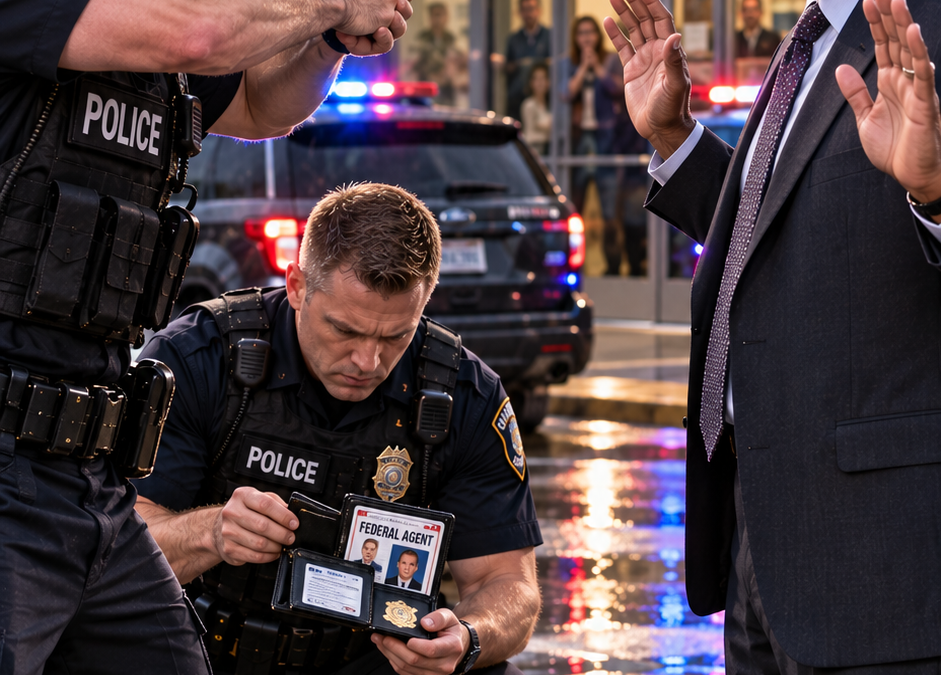
Inside was my federal credential.
My photograph appeared beside the Department of Justice identification markings and information confirming my status as a federal investigator.
I watched her expression change.
It wasn’t theatrical surprise.
She didn’t gasp.
She simply became very still.
Then she examined the document again.
For several seconds, nobody spoke.
I knew what she was reading.
But I also knew that announcing my federal status too aggressively could make Vaughn more defensive.
Some officers become more careful when they realize they’ve made a mistake.
Others become more reckless because admitting the mistake feels like surrendering authority.
I didn’t know which kind of man I was dealing with.
So I kept my hands raised.
And I let Foster examine the credentials herself.
She looked at me again.
“Mr. Hail?”
“Yes.”
“You’re with the Department of Justice?”
“That’s correct.”
She glanced at Vaughn.
“Derek, I think we need to verify this.”
He looked irritated.
“Verify what?”
She angled the wallet toward him.
“Federal credentials.”
His face tightened.
For a moment, I thought he might finally lower his weapon.
Instead, he shook his head.
“Anybody can carry fake identification.”
Foster looked at him.
“Then let’s verify it.”
“Keep him where he is.”
I took a slow breath.
The absurdity was becoming difficult to bear.
My driver’s license matched my vehicle.
A bank employee had confirmed my appointment.
Dispatch had reported no weapon and no specific crime.
And now an officer was holding my federal identification while her partner continued aiming a gun at me.
I understood that a credential could be forged.
That’s why verification procedures existed.
What I couldn’t understand was why Vaughn seemed determined to treat the possibility of forgery as another reason to delay the very process that would establish whether the document was authentic.
Foster moved several steps away.
She kept the credential open beneath her body camera and used her radio to contact dispatch through the appropriate channel.
She read the identification number carefully.
Then she requested official verification.
Vaughn watched her.
His posture had become increasingly rigid.
Several customers were now standing behind the bank windows.
Jordan was still filming.
Emily remained near the entrance.
Thomas Reed, the branch manager, had appeared behind the glass and was watching the confrontation with growing concern.
I could see him speaking into a phone.
He had worked in banking long enough to understand the importance of preserving records when something unusual happened on the property.
He contacted the bank’s regional security department and requested that all relevant exterior surveillance recordings be retained.
The bank had multiple cameras covering the entrance, the parking lanes, the ATM area, and the space surrounding my SUV.
Those recordings would later prove essential.
At the time, however, I was still standing in an empty parking space with my arms raised.
And Vaughn still hadn’t lowered his pistol.
I looked at Foster.
“Officer, I’d like a supervisor present while you verify the credential.”
She nodded immediately.
“That’s reasonable.”
Vaughn turned toward her.
“Are you serious?”
She met his eyes.
“Yes.”
I could see the tension between them.
They’d worked together for years.
Foster knew that openly questioning another officer in front of witnesses could create lasting problems inside a department.
But she’d also spent six years on patrol learning that incomplete information shouldn’t automatically be treated as evidence of danger.
Now she had official identification in her hand.
The vehicle registration matched.
The bank had confirmed my legitimate presence.
And her partner was still holding me at gunpoint.
She contacted dispatch again and requested supervisory assistance.
Vaughn’s jaw tightened.
I kept my eyes on his hands.
Whatever professional embarrassment he might be feeling, I had no interest in giving him a reason to act on it.
The credential verification had been underway for less than three minutes when a black government sedan entered the parking lot.
It crossed the outer lane quickly, then slowed and stopped well outside Vaughn’s immediate position.
I recognized the vehicle.
Two people stepped out.
Special Agent Rachel Kim came from the driver’s side.
She was forty-three, compactly built, with straight black hair tied neatly behind her neck.
She had spent fifteen years investigating civil rights violations, public corruption, and cases involving misconduct by people working in positions of authority.
Rachel was one of the most disciplined investigators I’d ever worked with.
She had an extraordinary ability to enter a hostile room, identify what mattered, and make everybody else slow down without raising her voice.
Special Agent Aaron Pierce emerged from the passenger side.
He was forty-seven, tall and lean, with graying brown hair and the quiet manner of somebody who preferred observing a situation before deciding what to say.
Aaron had worked complicated conspiracy and official misconduct investigations across several states.
He knew that a sudden movement at the wrong moment could ruin months of careful work.
Neither of them approached recklessly.
Rachel immediately displayed her federal credentials.
Aaron kept his hands visible while assessing the positions of the officers, the witnesses, my SUV, and Vaughn’s extended pistol.
The moment I saw them, I felt a measure of relief.
Not because I suddenly had powerful friends capable of rescuing me.
Because I knew Rachel and Aaron wouldn’t let professional pride become more important than controlling the immediate danger.
Rachel stopped several feet from Vaughn.
“Special Agent Rachel Kim. Department of Justice.”
Vaughn glanced toward her identification.
Then toward Aaron.
Then back at me.
Rachel kept her voice steady.
“Officer, that man is Marcus Hail. His credentials have been verified through our federal team.”
Vaughn’s expression changed.
I could see surprise.
Then uncertainty.
Then something that looked almost like embarrassment.
But his pistol remained pointed toward me.
I felt my stomach tighten.
That was precisely the reaction I’d been afraid of.
He now had direct confirmation from federal personnel.
Yet lowering his weapon apparently required him to acknowledge that the armed confrontation he’d created was no longer justified.
And for several seconds, he seemed unable to make that decision.
Rachel noticed immediately.
“Officer, lower your weapon.”
Her tone wasn’t theatrical.
She wasn’t trying to humiliate him.
She simply made the instruction clear.
Aaron moved slightly to his left, ensuring that nobody accidentally crossed Vaughn’s line of fire.
Foster stepped farther away from her partner’s position.
I kept my hands raised.
Rachel repeated herself.
“The identity verification is complete. Lower your weapon.”
Finally, Vaughn moved.
The muzzle dropped toward the pavement.
Then he carefully returned the pistol to its holster.
I watched every inch of that movement.
Only after Rachel confirmed that the immediate danger had ended did I slowly lower my arms.
The relief was immediate.
So was the pain.
My shoulders had become stiff from holding the same position for so long.
There was a deep ache between my shoulder blades.
I flexed my fingers carefully.
Then I looked toward Vaughn.
He was suddenly speaking much more quickly than he had before.
He gestured toward the cruiser.
Then toward the bank.
He mentioned the original dispatch report.
The suspicious person call.
The need for officer safety.
He seemed desperate to explain why he’d drawn his weapon.
I listened without interrupting.
I wasn’t going to turn the parking lot into a public argument.
And I wasn’t going to use my federal credentials to humiliate an officer who had already demonstrated how poorly he handled perceived challenges to his authority.
But I wanted one thing established clearly.
“Officer Vaughn,” I said, “the problem isn’t that you failed to recognize a federal investigator.”
He stopped talking.
I looked directly at him.
“The problem is that you pointed a weapon at someone who displayed no threatening behavior based on a call that didn’t report a weapon or identify a crime.”
He opened his mouth.
I continued.
“You had my cooperation. You had a bank employee confirming my appointment. You had a vehicle registration matching my identification. Your partner offered multiple opportunities to reduce the level of force.”
He looked toward Foster.
She didn’t lower her eyes.
“And even after the federal credential appeared,” I said, “you kept your gun pointed at me.”
Vaughn’s face reddened.
I could see he wanted to argue.
But before he could respond, Rachel stepped closer.
“We’re not going to debate the evidence in the parking lot.”
She looked toward Foster.
“Please preserve your body-camera footage.”
Foster nodded.
“Of course.”
Then Rachel turned toward Thomas Reed, who was now standing near the bank entrance.
“Are you the branch manager?”
“Yes.”
“Do you have exterior security footage covering this encounter?”
He nodded.
“Multiple cameras.”
“Please preserve the complete original recordings, including timestamps and metadata.”
Thomas looked relieved.
“I’ve already contacted regional security. The relevant files are being retained.”
Rachel thanked him.
Then she looked toward Jordan.
He was still standing behind the light pole, his phone lowered slightly now that Vaughn had holstered his weapon.
“Did you record the encounter?”
Jordan nodded cautiously.
“Yes.”
“Please preserve the original file. Don’t edit it.”
He nodded again.
“I already sent a backup to my sister.”
“Good.”
Rachel asked whether he’d be willing to provide a witness statement.
He agreed.
I looked toward him.
Our eyes met briefly.
He seemed nervous.
I gave him a small nod.
He returned it.
Then I turned toward Emily.
She was standing near the bank doors, her expression still unsettled.
I walked a little closer.
“Thank you for speaking up.”
She shook her head.
“I wish he’d listened.”
“So do I.”
She looked at Vaughn.
Then back at me.
“I couldn’t understand why he was doing that. You’d just been inside. You hadn’t done anything.”
I took a slow breath.
“That’s why your statement matters.”
Several minutes later, another patrol vehicle entered the lot.
Sergeant Paul Harland stepped out.
He was forty-nine, broad through the shoulders, with thinning gray hair, a trimmed mustache, and the tired expression of somebody who had spent twenty-four years learning that the most difficult incidents rarely began with an accurate description of what was happening.
He surveyed the scene before approaching.
My SUV.
The marked cruiser.
Vaughn standing beside it.
Foster holding my credentials.
Two federal agents nearby.
Witnesses gathered outside the bank.
And a security camera positioned directly above the space where Vaughn had kept his pistol aimed at me.
I could see Harland recognizing that whatever had happened was no longer a routine suspicious person call.
He turned toward Foster.
“Start from the beginning.”
She did.
She described the dispatch information.
She confirmed that no weapon had been reported.
She explained that I’d complied with every instruction.
She described Vaughn drawing his pistol.
Then she outlined her attempts to obtain additional dispatch information, verify my identity, and reduce the level of force.
She didn’t dramatize anything.
She didn’t omit the uncomfortable details.
Harland listened carefully.
Then he looked toward Vaughn.
“Keep your body camera running. Both of you.”
He instructed dispatch to preserve the original call audio, radio traffic, timestamps, and event notes.
He also directed the body-camera files to be marked for preservation.
Then he looked toward Rachel.
“I understand you have federal involvement.”
She nodded.
“Mr. Hail is a member of our investigative team. We’ll coordinate with your department regarding the evidence and any necessary review.”
Harland glanced at me.
“Mr. Hail, I’m sorry this encounter occurred.”
I studied him.
“I appreciate that. But I want it reviewed the same way you’d review it if I didn’t have federal credentials.”
He nodded.
“Understood.”
I hoped he meant it.
At approximately seven thirty that evening, Jordan’s video began spreading across social media.
He hadn’t originally intended to publish it immediately.
During the encounter, he’d sent a backup to his older sister, Natalie Miles.
Natalie was twenty-eight and worked as an associate producer at a Richmond television station.
She knew that citizen recordings could provide important evidence.
She also knew that viral attention could move faster than verification.
When Jordan sent her the footage, he’d specifically asked her not to publish it while the confrontation was still happening.
She respected that request.
But other customers had also recorded parts of the encounter.
Short clips began appearing online.
One showed me standing with both hands raised.
Another captured Vaughn holding his pistol.
A third showed Foster positioned several feet behind her partner, visibly less aggressive.
The videos didn’t show every moment.
But they showed enough to attract immediate attention.
Soon, people across Richmond were asking why an officer had pointed a gun at an apparently unarmed Black man outside a bank.
By the end of the evening, reporters had confirmed that I worked for the Department of Justice.
The story expanded rapidly.
I wasn’t particularly interested in watching it spread.
I had spent enough years investigating misconduct to know that publicity could be both useful and dangerous.
It could bring witnesses forward.
It could encourage institutions to preserve evidence.
But it could also create pressure for conclusions before the investigation had established all the facts.
I wanted neither a public acquittal nor a public conviction based on incomplete clips.
I wanted the full encounter examined.
Every instruction.
Every movement.
Every piece of information available to the officers.
And every decision made after that information became available.
Before midnight, Harland had completed an initial review of the recordings.
He compared Vaughn’s body-camera footage with Foster’s and the dispatch information.
He examined the original call.
He reviewed the department’s policies on threat assessment, de-escalation, and the presentation of firearms during uncertain encounters.
The preliminary evidence raised enough concern for immediate administrative action.
Vaughn was placed on suspension pending a formal investigation.
His patrol authority was temporarily removed.
The department’s announcement was carefully worded.
It didn’t declare him guilty of misconduct before the review was complete.
But it acknowledged that the encounter required serious examination.
That evening, I returned to the secure federal office where our investigative team had been working.
Rachel and Aaron were already inside the conference room.
Several laptops were open.
Evidence folders covered the table.
Printed timelines from the bank encounter had been arranged beside the dispatch records.
At the far end of the room sat Elena Vargas.
Elena was forty-six, a Justice Department attorney with dark curly hair, narrow glasses, and seventeen years of experience handling civil rights reviews involving law enforcement agencies.
She was meticulous.
She could identify a weakness in an otherwise compelling case with a single question.
And she had little patience for investigators who allowed justified anger to become a substitute for evidence.
When I entered, she looked up.
“Marcus.”
I nodded.
“Elena.”
She gestured toward a chair.
“Sit down.”
I almost smiled.
“That’s usually my line.”
“Tonight, I’m using it.”
I sat.
She looked at me carefully.
“Are you all right?”
“My shoulders are sore.”
“That’s not what I asked.”
I hesitated.
Then I answered more honestly.
“I’m still processing it.”
She nodded.
Rachel placed a folder in front of me.
“We’ve begun organizing the evidence.”
I opened it.
The first page contained a timeline.
The cruiser entering the parking lot.
Vaughn exiting the vehicle.
His first command.
My response.
The moment he drew his pistol.
Foster’s request for additional dispatch information.
Emily’s attempt to confirm my appointment.
My identification being placed on the SUV.
The discovery of my federal credential.
The verification request.
Rachel and Aaron’s arrival.
And the moment Vaughn finally holstered his weapon.
I studied the sequence.
It was unsettling to see one of the most frightening experiences of my life reduced to timestamps and procedural descriptions.
But I also knew those details were necessary.
We couldn’t evaluate the encounter based entirely on how it had felt to me.
We needed to establish what Vaughn knew, when he knew it, and whether his actions were reasonably supported by the information available at each point.
I looked toward Elena.
“I don’t want this handled differently because I’m part of the federal team.”
She nodded.
“That’s what Rachel told me.”
“Then process it under the same standards we’re applying to every civilian complaint.”
Aaron leaned forward.
“We agree.”
I looked at the other files spread across the table.
Months of allegations.
Reports from ordinary residents.
People who hadn’t been carrying federal credentials.
People who didn’t have agents arriving within minutes to confirm their identities.
People who had filed complaints and waited for somebody to believe them.
My encounter was now part of the same investigation.
Not because my title made the conduct more serious.
Because the evidence suggested it might illustrate some of the patterns we’d already been examining.
Rachel opened another folder.
“Several previous complaints describe similar behavior.”
I looked at her.
“Questioning treated as resistance?”
She nodded.
“Among other things.”
Aaron continued.
“Drivers ordered out of vehicles without a clear explanation. Searches following requests for clarification. Officers interpreting calm disagreement as defiance.”
Elena raised one hand.
“We still need to distinguish the facts of each incident. Similar allegations don’t automatically establish a departmental pattern.”
“Of course,” I said.
She looked at me.
“But this encounter gives us something unusually complete.”
I nodded.
Body cameras.
Independent bank cameras.
Dispatch audio.
A civilian recording.
Witnesses.
The vehicle registration.
Official identification.
Multiple perspectives covering nearly the entire incident.
We rarely had so much independent documentation of a single encounter.
I wanted to make sure we used it properly.
The next morning, I woke in my hotel room to seventeen missed notifications.
Most were from colleagues asking whether I was safe.
Several were from journalists requesting interviews.
One was from my son.
David Hail was thirty-one, tall and quiet, with closely trimmed hair and the analytical temperament of a civil engineer.
He had grown up knowing my work sometimes involved risks I couldn’t explain.
He had also grown up learning that I generally didn’t discuss frightening incidents until long after they were over.
That habit had always seemed sensible to me.
Why worry my family about dangers they couldn’t control?
Why burden my son with the details of investigations he wasn’t allowed to discuss?
But that weekend, my habit of silence had left David watching a video of his father standing at gunpoint on the internet.
When I called him, he answered immediately.
“Dad.”
“Morning, son.”
“Don’t do that.”
I frowned.
“Do what?”
“Act like this is a normal Saturday.”
I sat on the edge of the bed.
“I’m all right.”
“I watched a cop point a gun at you.”
“I know.”
“He kept it pointed at you while you were standing there with your hands up.”
“Yes.”
David took a breath.
Then his voice changed.
“Why didn’t you call me?”
I looked toward the hotel window.
“I was dealing with the investigation.”
“Everybody else apparently had time to post the video.”
His words stung.
Not because they were unfair.
Because they were true.
I had spent years convincing myself that protecting my family meant withholding anything that might frighten them.
But David had been frightened anyway.
And instead of hearing my voice, he’d been left watching strangers argue about whether his father had done something wrong.
“I’m sorry,” I said.
He was quiet.
Then he asked, “Did you think he was going to shoot you?”
I stared at the floor.
The easy answer would have been no.
I could have told him that my training had kept me calm.
That I’d recognized the officer’s mistakes.
That I’d known the cameras were recording.
But none of those things had guaranteed my safety.
And I was tired of pretending otherwise.
“Yes,” I said quietly. “For a little while, I thought he might.”
David didn’t answer.
I heard him breathing.
Then he said, “I hate that you were alone.”
Something tightened in my throat.
“I wasn’t entirely alone.”
“You know what I mean.”
I did.
There had been witnesses.
There had been another officer trying to reduce the danger.
There had been federal agents arriving within minutes.
But when Vaughn first pointed the pistol at my chest, I had been the only person standing directly in front of it.
And nothing about my career had made that moment feel safe.
“I know, son.”
We talked for another twenty minutes.
I told him what I could about the encounter without discussing protected investigative details.
I explained that the evidence had been preserved and that both local and federal reviews were underway.
But I didn’t promise him everything would be fine.
I simply told him I was safe.
And that I would call him directly if anything changed.
Afterward, I sat quietly for a long time.
I realized that being an investigator had taught me how to reconstruct other people’s frightening experiences.
It hadn’t taught me how to explain my own to somebody I loved.
Across the city, Foster was dealing with her own difficult conversations.
After submitting her initial report, she returned to a nearly empty locker room.
Several colleagues had already heard that she’d questioned Vaughn’s actions and cooperated with the preliminary review.
Nobody openly threatened her.
But some officers who’d previously greeted her warmly now found reasons to avoid speaking.
She had worked beside those people for years.
She’d attended their weddings.
She’d covered dangerous calls with them.
She knew that accurately reporting another officer’s conduct could be interpreted as disloyalty by colleagues who believed police officers should protect one another from outside scrutiny.
That evening, she called her older sister, Laura.
Laura was thirty-four and worked as a pediatric nurse.
She was accustomed to dealing with frightened parents, exhausted medical staff, and situations where telling an uncomfortable truth was more important than preserving somebody’s pride.
Foster described what had happened without disclosing information she wasn’t authorized to share.
She told Laura about the vague dispatch call.
The drawn pistol.
My repeated cooperation.
The bank employee trying to confirm my appointment.
And the moment she discovered my federal credentials.
Then she admitted what disturbed her most.
Nothing about my behavior had changed when she opened the wallet.
My hands had been empty before.
I’d been cooperative before.
I’d requested an explanation before.
The only thing that changed was that she discovered I worked for the federal government.
Laura listened.
Then she asked whether Foster had written her report accurately.
“Yes.”
“Then you’ve done what you’re supposed to do.”
Foster hesitated.
“I should have intervened sooner.”
“Then learn from that.”
I didn’t hear their conversation directly.
Foster told me about it later.
But I recognized the conflict she was describing.
An officer can feel loyalty toward a partner and still have a responsibility to identify when that partner is making a dangerous mistake.
Those obligations don’t always feel compatible in the moment.
But the public depends on officers being able to distinguish them.
Meanwhile, Harland continued examining the training records.
He spent hours comparing the incident with departmental guidance on suspicious person calls, firearm presentation, and de-escalation.
The original dispatch information remained the most troubling detail.
There had been no report of a weapon.
No robbery.
No assault.
No specific victim.
The caller had described a Black man near expensive vehicles and considered his behavior suspicious.
Vaughn had supplied the rest of the threat assessment through his own assumptions.
By the time he approached me, he seemed to have decided that I represented a danger requiring immediate armed control.
Every subsequent piece of information had been filtered through that decision.
My calm questions became defiance.
My cooperation became calculation.
Emily’s confirmation became interference.
Foster’s caution became hesitation.
And my federal credential became something that might be fake rather than an opportunity to resolve the encounter safely.
The investigation needed to determine precisely where legitimate caution had become unnecessary escalation.
It also needed to establish what officers were being taught about situations where the original call provided little more than a person’s appearance and location.
Over the following weeks, the administrative investigation and the federal review proceeded separately.
Harland’s department examined Vaughn’s conduct under its policies and training standards.
Our federal team reviewed the incident alongside the broader collection of complaints we’d already gathered.
I insisted that my involvement be handled carefully.
I provided a complete statement.
Then I stepped back from decisions where my personal experience created an obvious conflict.
Elena and the other investigators examined the evidence using the same standards applied to every other allegation.
Rachel coordinated the review of relevant records.
Aaron constructed a precise timeline.
Foster submitted a complete written account and later repeated it during a recorded interview.
She described the original dispatch information without embellishment.
She explained when Vaughn drew his weapon.
She documented the information that emerged while the encounter continued.
And she acknowledged her own efforts to reduce the danger.
Her cooperation mattered.
Without it, some people might have portrayed the entire incident as a dispute between federal investigators and local police.
But Foster was a local officer.
She had stood beside Vaughn.
She’d watched my hands.
She’d heard dispatch repeat the original call.
And she’d seen her partner refuse to lower his weapon even as the evidence increasingly contradicted his initial assumptions.
Her statement wasn’t an outside accusation.
It was an officer describing what happened while she was present.
The combined timeline became difficult to dispute.
Vaughn had selected me before observing specific criminal conduct.
He’d drawn his pistol without a confirmed weapon report or an observed threatening movement.
I’d complied with his commands.
I’d moved away from my SUV.
I’d kept my hands visible.
I’d asked why I was being detained without becoming physically resistant.
He’d received information that should have reduced his suspicion.
The original dispatch clarification.
Emily’s confirmation.
The vehicle registration.
My identification.
Foster’s request for a less aggressive posture.
And, eventually, direct verification of my federal status.
Still, he had continued holding me at gunpoint.
Even after Rachel and Aaron arrived, several seconds passed before he finally holstered his weapon.
The bank’s independent cameras confirmed what the body cameras had recorded.
Jordan’s original video provided another perspective.
The different recordings reinforced one another rather than revealing significant contradictions.
That consistency made the incident much harder to dismiss as confusion caused by one incomplete camera angle.
The department eventually acknowledged that the encounter had not met its standards for threat assessment and de-escalation.
Vaughn remained suspended during the disciplinary process and was later removed from patrol duties while the case proceeded.
The public statement didn’t condemn every officer involved.
It specifically recognized Foster’s attempts to reduce the danger.
It also acknowledged Harland’s efforts to preserve the evidence and conduct a fair review.
I appreciated that distinction.
Accountability without accuracy can become another form of injustice.
I didn’t want the department to protect Vaughn simply because he wore a uniform.
But I also didn’t want Foster punished for being his partner or Harland criticized for insisting on a careful investigation.
People needed to be evaluated according to what they actually did.
Not according to the conclusions others wanted to reach about them.
At the federal office, Elena and the investigative team began incorporating the Cedar Point incident into our broader analysis.
Several recurring weaknesses were becoming clearer.
Suspicious person calls often contained vague descriptions that offered officers little information about actual criminal conduct.
Some reports relied heavily on appearance, location, or the reporting party’s subjective discomfort.
The department’s documentation procedures didn’t always require officers to distinguish those observations from confirmed facts.
Training materials also needed clearer guidance on when displaying a firearm was justified during uncertain encounters.
And the department lacked sufficiently consistent supervisory review for stops involving officers pointing weapons at civilians.
The proposed changes weren’t designed to prevent officers from protecting themselves.
They were intended to make sure protective measures remained proportionate to the information available.
Calls would need clearer documentation of the behavior that prompted suspicion.
Officers would receive more specific guidance on firearm presentation.
Incidents involving weapons pointed at civilians would receive automatic supervisory review.
And body-camera audits would become more frequent, particularly when written reports described resistance that video evidence might independently confirm or contradict.
Foster became involved in a part-time de-escalation training group while continuing her other police duties.
She worked with younger officers, examining decision points where caution remained necessary but fear or professional pride could distort an encounter.
Her experience carried unusual weight because she’d been present during a confrontation where another officer repeatedly refused information that might have resolved the situation.
She didn’t present herself as a hero.
She talked about what she’d noticed.
What she’d tried to do.
And what she believed she should have done sooner.
That honesty made her an effective instructor.
Cedar Point Bank made changes, too.
Thomas Reed worked with regional security and local police representatives to improve the way employees reported suspicious behavior.
The updated guidance emphasized observable conduct rather than assumptions about who looked as though they belonged near expensive vehicles.
Employees were encouraged to describe specific actions, clothing, location, direction of travel, and any actual threats or weapons observed.
They were also trained to distinguish something they’d personally witnessed from something they merely suspected.
Emily participated in the process.
She’d seen how quickly incomplete information could become dangerous after being passed through several people.
The bank strengthened its procedures for preserving exterior security footage when a serious incident occurred on the property.
Those changes were modest.
They wouldn’t prevent every misunderstanding.
But they addressed several specific weaknesses exposed by my encounter.
And I had learned long ago that lasting improvements often begin with correcting the small failures people have become accustomed to overlooking.
After the formal evidence review was completed, I met Jordan Miles at a small coffee shop near downtown Richmond.
He arrived carrying a backpack and looking considerably more nervous than he had while filming the confrontation.
I stood when he approached.
“Jordan?”
He nodded.
“Mr. Hail.”
We shook hands.
“Call me Marcus.”
He smiled.
“Yes, sir.”
I laughed.
“That’s a start.”
We sat beside a window overlooking the street.
He ordered coffee.
I had tea.
For a few minutes, we discussed his studies and his interest in media production.
Then I thanked him for preserving the video.
He looked embarrassed.
“I didn’t really do anything.”
I studied him.
“You stayed at a safe distance. You recorded continuously. You kept the original file. And you made sure somebody else had a backup.”
He shrugged.
“I just thought somebody should have a record of what happened.”
“That’s more important than you realize.”
He looked down at his cup.
“I was scared the officer would see me recording.”
“I noticed you stayed behind the light pole.”
“Yeah.”
He hesitated.
“I kept thinking I should do something.”
“You did.”
He looked up.
I continued.
“Getting involved physically could have made the situation worse. Preserving what you witnessed was useful without putting yourself or anybody else in unnecessary danger.”
He nodded slowly.
Then he asked whether I was angry about the video becoming public.
I considered the question.
“Not about the fact that people saw it.”
“What about the comments?”
I gave him a tired smile.
“I’ve spent enough years investigating misconduct to know that people form opinions long before they have all the facts.”
He looked concerned.
“I didn’t post the whole thing myself.”
“I know.”
“I sent it to my sister because I was worried somebody might take my phone.”
“That was sensible.”
He seemed relieved.
I explained that independent evidence didn’t automatically establish misconduct.
Recordings could be incomplete.
Camera angles could create misleading impressions.
But preserving the original material helped investigators reconstruct events without relying entirely on memory or self-interested explanations.
Then I looked at him.
“You gave us a record that existed outside the police department’s control. That mattered.”
He smiled.
For the first time since we’d sat down, he looked proud of what he’d done.
Several days before I planned to return to Washington, David came to Richmond.
He’d arranged a few days away from work.
We had spoken several times since the incident, but our conversations had been strained.
He was still angry that he’d learned about my encounter through a viral video.
I was still struggling to explain why my instinct had been to deal with the official process before calling him.
We met at my hotel.
He hugged me longer than usual.
Then he stepped back and looked at me carefully.
“You really are okay.”
I smiled.
“I told you.”
“Yeah. But seeing you is different.”
I understood.
We spent the afternoon walking along the James River.
The weather was mild, and the city seemed peaceful in a way it hadn’t during the weeks of investigation.
David asked about my work.
I told him what I could.
I explained that some operational details had to remain confidential.
But I also admitted that I’d been using professional secrecy as an excuse to avoid conversations that made me uncomfortable.
He listened.
Then he told me how frightened he’d been when he first saw the video.
He’d watched it repeatedly.
He’d studied my hands.
The officer’s weapon.
The distance between us.
He’d searched for clues that might tell him what happened next.
And every time the clip ended, he was left with the same unanswered question.
Had his father made it home?
I stopped walking.
“I’m sorry, David.”
He looked toward the river.
“I know you were busy.”
“That’s not an excuse.”
He nodded.
I continued.
“I’ve spent most of your life trying to protect you from worrying about my work. Somewhere along the way, I forgot that keeping you informed can be part of protecting you, too.”
He took a slow breath.
“I don’t need every detail, Dad. I just need to know you’re okay.”
I put a hand on his shoulder.
“Understood.”
That evening, we had dinner at a quiet restaurant near the river.
We talked about his engineering projects.
His plans for the future.
A woman he’d recently started seeing.
And whether he was finally going to replace the aging car I’d been telling him to get rid of for three years.
He laughed when I brought it up.
“You sound like Grandpa.”
I smiled.
“Your grandfather was a wise man.”
“He was also convinced every problem in life could be solved by buying a different car.”
“Sometimes he was right.”
For the first time since the bank incident, our conversation felt entirely ordinary.
I hadn’t realized how much I’d missed that.
Months later, I returned to Cedar Point Bank for another scheduled appointment.
The sky was clear.
Sunlight reflected off the same rows of parked vehicles.
The same glass entrance doors opened toward the sidewalk.
The bank’s exterior cameras still overlooked the parking lot.
I pulled into a space near the building and switched off the engine.
For a moment, I remained seated.
I looked toward the empty parking space where Vaughn had ordered me to stand.
I could remember exactly how the pavement had looked beneath the emergency lights.
The damp surface.
The reflections.
The distance between us.
And the terrible sensation of knowing that the officer holding a gun was becoming angrier every time I tried to help him understand the situation.
I took a slow breath.
Then I stepped out of the SUV.
As I walked toward the entrance, I noticed another police encounter taking place near a silver sedan.
A young patrol officer stood beside a man near the driver’s door.
The officer was Caleb Warren.
I didn’t know him personally, but I later learned he was twenty-five and had joined the department after the revised review procedures were introduced.
He was lean, clean-shaven, with short sandy hair and the careful posture of somebody still forming his habits in uniform.
I slowed slightly.
His hands remained visible near his duty belt.
His pistol stayed holstered.
The civilian stood beside the vehicle with his arms relaxed.
Warren asked a question.
The man answered.
Then Warren used his radio to verify information.
There were no shouted commands.
No weapon pointed toward the civilian.
No crowd gathering around an unnecessary confrontation.
I couldn’t know every detail of the call simply by watching.
I didn’t know whether the man had committed an offense or whether the officer would eventually make an arrest.
But I could see something important.
Warren was gathering information before deciding what the situation required.
And he was allowing the man in front of him to answer without treating every word as a challenge to his authority.
I watched only long enough to understand what I was seeing.
Then I continued toward the bank entrance.
Emily Parker was standing near the lobby.
She recognized me immediately.
“Mr. Hail!”
I smiled.
“Good afternoon, Emily.”
She looked toward the parking lot.
Then back at me.
“It’s good to see you.”
“Good to see you, too.”
Thomas Reed appeared from his office and greeted me warmly.
We completed our appointment without incident.
Before I left, he mentioned the new training procedures the bank had implemented following the confrontation.
He said employees were now more careful about documenting what they’d actually witnessed when reporting suspicious activity.
I thanked him.
Then I walked back outside.
Warren’s patrol car was gone.
The silver sedan had left, too.
The parking lot looked completely ordinary.
I stood beside my SUV for a moment and considered everything that had happened there.
Vaughn’s decisions had been reviewed.
Foster had told the truth.
Harland had preserved the evidence.
Jordan had recorded the encounter.
The bank had improved its reporting procedures.
And our federal team had incorporated the incident into a broader examination of how uncertainty could become unnecessary force.
The changes weren’t a guarantee.
No policy can eliminate every bad decision.
No training program can ensure every officer remains patient under pressure.
And no investigation can erase the fear somebody experiences when a weapon is pointed at them without adequate justification.
But changes grounded in evidence can make it harder for the same mistakes to repeat themselves.
That mattered.
I thought about David and the video he’d watched.
I thought about the ordinary residents whose complaints had brought our federal team to Richmond in the first place.
People who didn’t have agents arriving to confirm their identities.
People whose names weren’t recognized by government officials.
People who had to trust that an officer would treat them fairly without first discovering they belonged to an important institution.
I’d spent my career believing authority deserved scrutiny precisely because ordinary people so often encountered it alone.
The afternoon outside Cedar Point Bank had made that belief painfully personal.
For several minutes, I’d been nothing more than a Black man standing beside an expensive vehicle while an officer decided that asking for an explanation was suspicious.
My credentials hadn’t changed my conduct.
They hadn’t changed the original dispatch call.
They hadn’t changed what the bank cameras recorded.
They had simply forced people to reconsider assumptions they should have questioned much earlier.
I opened my SUV and climbed inside.
Then I called David.
He answered immediately.
“Hey, Dad.”
“Hey, son. Just finished my meeting.”
“Everything okay?”
I smiled.
“Everything’s fine.”
He laughed.
“Good. Because Mom says you promised to call us more often.”
“I did.”
“And?”
“And I’m calling.”
He laughed again.
We talked for several minutes.
Nothing important.
Nothing confidential.
Just a father and son catching up on an ordinary afternoon.
When we finished, I placed the phone beside me and started the engine.
As I pulled out of the parking lot, I glanced once toward the space where Vaughn had pointed his pistol at me.
The asphalt had dried.
The emergency lights were gone.
And nobody standing there now would have known anything unusual had happened.
But I knew.
I also knew why the quiet encounter I’d just witnessed near the silver sedan mattered more than any recognition of my professional title.
Fair treatment shouldn’t begin when somebody discovers you’re a federal investigator.
It should begin the moment an officer approaches you.
And if the changes made after my encounter helped even one ordinary person walk away from a police stop without experiencing the fear I’d felt that afternoon, then preserving the truth had been worth every difficult conversation that followed.








