𝗙𝗨𝗟𝗟 𝗦𝗧𝗢𝗥𝗬 The Officer at Gate One Thought My Worn Jacket Told Him Everything He Needed to Know
𝗙𝗨𝗟𝗟 𝗦𝗧𝗢𝗥𝗬
The reply crackled through the rain.
“Standby confirmed. Exercise convoy delayed at Gate One.”
I looked directly at him.
“You’re delaying the command convoy because you refuse to verify my credentials.”
He pointed toward the shoulder beyond the checkpoint.
“Move your car. You’re blocking official traffic.”
“Official traffic is blocked because you won’t complete the security check.”
Mercer lifted his chin.
“They can wait.”
The rear door of the lead command vehicle opened.
A uniformed aide stepped onto the pavement, holding a tablet beneath his jacket to protect it from the rain.
He approached the checkpoint.
“Officer, we have a strategic coordination meeting in twelve minutes. The readiness exercise begins immediately afterward.”
Mercer barely looked at him.
“Then you should’ve used another gate.”
The aide stood motionless for a moment.
Then he turned back toward the vehicle.
His expression told me that the morning’s difficulties were already being reported to operations.
I checked the clock.
6:48 a.m.
Twelve minutes.
At seven o’clock, several units would begin executing a carefully coordinated readiness scenario.
Communications teams, command personnel, logistics officers, and emergency response staff had spent weeks preparing for it.
A delayed briefing wouldn’t necessarily destroy the entire exercise.
But it would disrupt the sequence, force adjustments across multiple units, and waste hours of work that had already gone into coordinating the event.
I wasn’t about to let that happen simply because Mercer wanted to win an argument.
“Officer, there are command vehicles waiting behind my car. You have my credentials, and your scanner is functioning. Is there a specific security concern preventing you from completing verification?”
He stared at me.
“You’re the security concern.”
“Based on what?”
“Your behavior.”
“My behavior consists of presenting valid identification and requesting access to a meeting I’m required to attend.”
His face tightened.
“You’re getting awfully argumentative for someone who claims to understand military discipline.”
I looked at the lowered barrier.
“No. I’m asking you to do your job.”
Another radio transmission interrupted us.
“Gate One, operations is requesting a status update.”
Mercer pressed his radio.
“Unauthorized visitor is refusing to clear the access lane. Command convoy remains on hold.”
I felt my jaw tighten.
There was no point debating an allegation he had already decided to repeat.
I needed confirmation from someone who would consult the actual command schedule.
I removed my phone from my jacket.
Mercer’s eyes narrowed.
“Calling somebody to make this disappear?”
“No. I’m confirming my schedule.”
I selected the command duty desk from the installation directory.
The call connected after two rings.
“Command duty desk.”
A woman’s voice answered, clipped and professional.
“This is Colonel Elias Brooks. Please confirm my reporting time and assigned location for this morning.”
Mercer laughed.
He made sure the drivers behind us could hear.
“You really expect anybody to believe this?”
I ignored him.
Through the phone, I heard keys clicking.
There was a brief pause.
Then the duty officer’s voice became noticeably more formal.
“Colonel Brooks, your reporting time is zero seven hundred hours. You’re expected at the strategic readiness coordination meeting in Building Three.”
“What’s the meeting’s current status?”
Another pause.
“Delayed pending your arrival, sir. Operations has been notified.”
I looked at Mercer.
The word sir had carried clearly through the rain.
His fingers tightened around the visitor log.
“Thank you,” I told the duty officer.
I ended the call and slipped my phone back into my jacket.
“There is your confirmation. Now please complete the security procedure.”
Mercer stared at me for several seconds.
One movement of his hand would have settled everything.
He could have scanned my card, verified the result, and opened the gate.
Instead, he leaned against the counter.
“A phone call doesn’t override security.”
“Correct,” I said. “Neither does your personal opinion.”
The aide in the command vehicle was watching us through the windshield.
More soldiers had begun lowering their windows to hear what was happening.
Mercer looked toward them.
Then he pointed toward the marked inspection area beside the guardhouse.
“If you want inside, you follow my instructions.”
“I’ve followed them. I presented identification. I requested verification. I confirmed my assignment through command.”
I paused.
“The next step belongs to you.”
His radio crackled again.
“Gate One, operations needs this issue resolved within seven minutes.”
Mercer’s hand hovered above the scanner.
For one brief moment, I believed he was finally going to use it.
Then he withdrew his hand.
“Move your vehicle.”
I looked at the clock.
The seven minutes were going to pass quickly.
And Mercer seemed more concerned about proving he controlled the gate than about the hundreds of Marines whose schedule he was disrupting.
The guardhouse printer suddenly began chattering.
A narrow strip of paper emerged and curled toward the damp counter.
Mercer tore it free.
He flattened it beneath his palm, then looked toward me with a smile that never reached his eyes.
“You think a phone call makes you untouchable?”
“No.”
“Good. Because I’m not impressed.”
“I’m not asking you to be impressed.”
“You’re trying to pressure a security officer.”
I took a slow breath.
“No. I’m asking you to follow the same procedure you’d use for anyone else.”
Something in that answer seemed to push him past the point where he could admit he had made a mistake.
He stepped out from under the canopy.
Rain struck his polished shoes as he crossed the lane.
“Turn around. Hands where I can see them.”
The command convoy grew noticeably quieter.
Several men leaned forward in their seats.
I slowly raised my hands and turned.
I knew that challenging a security search at a restricted installation could create additional complications, especially when an officer was already determined to describe my behavior as suspicious.
So I kept my movements deliberate.
Mercer circled me, examining the seams of my jacket, my pockets, and my belt.
His search was more theatrical than necessary.
He spoke loudly throughout it, apparently ensuring everyone nearby understood that he had decided I was a security threat.
“No weapon,” he announced.
Then he looked toward the convoy.
“No authorized escort. No proper uniform. Civilian vehicle blocking a military access point.”
I turned my head slightly.
“My military identification is in your possession. You refused to scan it.”
“You don’t get to instruct me on security.”
“I haven’t instructed you to do anything outside your established procedure.”
He returned to the guardhouse.
Rainwater dripped from the brim of his cap onto the visitor log.
He picked up his pen.
And began writing.
I watched him turn his personal suspicions into an official report.
Subject detained outside Gate One.
Access denied.
Pending security review.
Refusal to comply with gate instructions.
He paused.
Then checked another box.
Suspicious conduct.
I could hear the scratch of the pen over the paper.
Each accusation was becoming part of an administrative record that could be read by people who hadn’t witnessed the encounter.
If I walked away without challenging it, his version might become the only version anyone consulted.
That was how carelessness became institutional fact.
“Read it back,” I said.
Mercer looked up.
“What?”
“Your report. Read every allegation into the record.”
He stared at me.
“You’re being held outside the installation because you failed to establish lawful access. You attempted to influence a security officer through unofficial contact. You’ll remain here until command decides otherwise.”
I nodded.
“Then sign it.”
His pen hovered.
For a moment, there was no sound except the rain striking the guardhouse roof and the diesel engines rumbling behind my car.
Then he signed.
Grant Mercer.
He tore off the bottom copy and held it toward me.
I accepted the damp paper between two fingers.
The ink was already beginning to feather along its edges.
I folded it carefully and slipped it inside my jacket.
Mercer turned toward the barrier controls, apparently satisfied that he had transformed my refusal to leave into an official security incident.
Then his radio crackled.
“Gate One, operations is requesting the name of the officer who formally denied Colonel Brooks access.”
His hand stopped above the control panel.
I watched him glance toward me.
He looked less amused now.
“Gate One, identify the officer,” the dispatcher repeated.
Mercer lifted the handset.
“Officer Grant Mercer. I denied access pending verification.”
At the command duty desk, the officer I’d spoken with was comparing the delayed meeting notice against the secure attendance roster.
I learned later that my name appeared on a restricted list reserved for command oversight visitors.
Beside it was a designation that immediately caught her attention.
Special Command Authority.
As an officer attached to the Inspector General’s Office, I had been issued command-level access for the inspection and readiness coordination activities I was conducting at the installation.
That authority did not excuse me from following checkpoint procedures.
It made those procedures even more important.
My credentials were supposed to be verified accurately, and any unusual access condition was supposed to be referred to the security center.
Instead, Mercer had refused to scan my card and entered a series of unsupported accusations into the gate records.
The command duty officer began examining the discrepancy.
At Gate One, a yellow warning appeared on Mercer’s terminal.
SPECIAL COMMAND CREDENTIAL DETECTED.
VERIFY THROUGH SECURITY CENTER.
I couldn’t see the screen clearly from where I stood, but I noticed Mercer suddenly become very still.
He glanced toward me.
Then toward the signed report on the counter.
The warning required a simple response.
He needed to notify the security center and preserve the access record.
Instead, he reached across the console.
Pressed the override key.
And cleared the alert.
A soft electronic chime sounded.
“Alert cleared,” the terminal announced.
I watched his expression.
“Did the system identify my credential?”
“False flag.”
“Did you verify that with the security center?”
“It’s handled.”
He wouldn’t meet my eyes.
I looked toward the scanner, still glowing green on the counter.
The piece of equipment that could have resolved the entire problem within seconds remained unused.
At the command duty desk, however, the manually dismissed alert created another problem.
The duty officer could see that the credential had not been cleared by the security center.
Someone at Gate One had overridden it locally.
She opened a secure incident channel, entered the terminal number, and began preserving the access history.
Then she called the guardhouse directly.
Mercer’s phone rang.
He looked at the incoming number.
For a second, he seemed reluctant to answer.
Then he lifted the handset.
“Gate One. Officer Mercer.”
The duty officer’s voice was controlled.
“Officer Mercer, did your terminal just receive a special command credential alert?”
He looked through the rain-streaked glass at me.
“False system flag. Handled locally.”
A pause followed.
Then I heard the reply.
“That credential belongs to Colonel Elias Brooks. His name is on a restricted command list.”
Mercer’s hand tightened around the handset.
“Then send somebody down to verify it. Until then, he stays outside.”
He hung up.
I checked the clock.
6:54 a.m.
Six minutes before the scheduled meeting.
The command convoy remained stationary.
The readiness exercise was in danger of being postponed.
And the officer who had accused me of suspicious conduct had just dismissed a command-level security alert without the required authorization.
A new message appeared on his terminal.
SECURITY CENTER AUDIT PENDING.
DO NOT ALTER GATE RECORDS.
Mercer stared at it.
For the first time that morning, I saw genuine uncertainty replace the satisfaction on his face.
I looked toward the emergency access panel beside the pedestrian gate.
Its metal casing was slick with rain, and a small green reader light pulsed beside the secured door.
I had presented my credentials.
I had confirmed my assignment through the command duty desk.
I had requested ordinary verification repeatedly.
And Mercer had now created a signed report claiming that I lacked lawful access.
There was no useful conversation left to have with him.
I turned toward the emergency panel.
He immediately stepped out from the guardhouse.
“Where do you think you’re going?”
“To the access reader.”
“That panel is for authorized personnel only.”
“I understand.”
“Stop right there!”
I stopped.
The rain had softened into a cold silver mist.
Behind me, the command convoy remained in place, its drivers watching the exchange through their fogged windows.
I turned toward Mercer.
“You made an official record stating that I’m unauthorized.”
“That’s correct.”
“You’ve refused to use the verification equipment at your station, ignored confirmation from command, and manually dismissed a security alert.”
He looked toward the panel.
“What are you trying to do?”
“Use the independent access procedure.”
“You touch that panel, and you’re going to make this much worse for yourself.”
I took out my identification card.
“Then let the system answer the question.”
I held the card against the reader.
A sharp electronic tone sounded.
Then a second tone, deeper and longer.
The light changed from green to blue.
Inside the guardhouse, the terminal screens briefly went dark.
When they returned, a secure command interface occupied the displays.
The emergency panel announced the result in a clear, mechanical voice.
“Identity confirmed. Colonel Elias Brooks. Inspector General’s Office. Command access authorized.”
The entire checkpoint seemed to fall silent.
Mercer stared at the reader.
Beyond the barrier, a Marine holding a clipboard lowered it slowly.
I remained beside the panel while the access system completed its authorization sequence.
The pedestrian gate unlocked with a heavy metallic click.
Then the vehicle barrier began rising.
Its hydraulic arms groaned against the weight of the mechanism, lifting the striped barrier that Mercer had used to keep me outside.
Inside the guardhouse, another message appeared.
ACCESS LEVEL: BASEWIDE COMMAND PRIORITY.
The secure entrances connected to the installation’s command access network recognized the same credential Mercer had mocked minutes earlier.
Building Three.
The operations corridor.
The authorized command facilities associated with my assignment.
Every relevant secured entrance had received the verification he refused to perform.
I slipped the card back into my jacket.
Mercer looked at me as though I had changed into an entirely different person.
But I was still wearing the same old boots.
The same plain khaki pants.
The same rain-soaked jacket.
The only thing that had changed was his ability to deny what was directly in front of him.
“Officer Mercer,” I said, “you were right about one thing.”
He didn’t answer.
“Security procedures matter.”
The barrier reached its fully raised position.
Behind me, the convoy began moving.
Tires hissed across the wet pavement as the first command vehicle advanced through the checkpoint.
Mercer stepped backward.
I could see that he wanted to say something, perhaps offer an explanation or begin a different argument now that my identity had been established beyond dispute.
But before he could speak, his terminal chimed again.
COMMAND REVIEW IN PROGRESS.
OFFICER MERCER: REMAIN AT GATE ONE.
I looked toward the command vehicles entering the installation.
The meeting was already late.
But there was another responsibility I needed to address before walking away.
I turned back toward the guardhouse.
“Officer Mercer, step away from the control console.”
He straightened.
“You can’t order me off my post without command authority.”
I removed my credential again.
I didn’t scan it.
Instead, I used the secure command function now available through the emergency panel and entered the required authorization.
A low tone sounded through the checkpoint.
Every terminal in the guardhouse briefly changed screens.
Then the same notice appeared across all of them.
INSTALLATION NOTICE.
IDENTITY VERIFIED: COLONEL ELIAS BROOKS.
INSPECTOR GENERAL’S OFFICE.
PRESERVE RELEVANT RECORDS.
SECURITY REVIEW INITIATED.
Mercer’s radio crackled.
The command duty officer spoke.
“Gate One, this is command duty. Officer Mercer, your gate access privileges are suspended pending review. Do not access, amend, delete, or transmit records associated with this morning’s incident.”
He stared at the radio.
“This is a misunderstanding.”
I looked toward the signed report lying beside the terminal.
“Is it?”
“I followed security protocol.”
“Protocol begins with verification.”
He opened his mouth.
I continued.
“You were given a credential. You were given confirmation from command. You chose not to use either.”
The guardhouse printer started operating.
Mercer reached toward the pages emerging from it.
“Leave them,” I said.
He withdrew his hand.
The duty officer’s voice sounded again, this time over the security channel.
“Security Center is preserving Gate One logs, body camera recordings, radio traffic, credential alerts, scanner activity, and incident reports from zero six hundred hours onward. No local edits are authorized.”
The printer continued producing copies.
Mercer’s accusations appeared again in black ink.
Unauthorized access.
Suspicious conduct.
Improper influence.
The report he had signed with such confidence was now being preserved exactly as written.
So was the access history showing that he’d dismissed the special command credential alert.
His face tightened.
“You’re trying to ruin my career.”
I looked at him for several seconds.
“No.”
He gave a bitter laugh.
“That’s easy for you to say.”
“I’m making sure nobody else has to depend on your mood to receive basic respect.”
He looked away.
I wasn’t interested in humiliating him in front of the convoy.
I had no desire to make him stand outside in the rain as some kind of symbolic punishment.
But I couldn’t overlook what he had done simply because the system had finally recognized my authority.
There was a difference between an officer making an honest mistake during a difficult security check and an officer repeatedly refusing to verify information because he disliked the person presenting it.
Mercer had been given multiple opportunities to resolve the situation.
He had chosen ridicule.
Then obstruction.
Then an inaccurate official report.
And finally, the unauthorized dismissal of a security alert.
Those choices required review.
I used the command function to authorize an examination of previous Gate One contacts and the relevant access records.
Another notice appeared on the terminal.
PRIOR GATE CONTACT REVIEW AUTHORIZED.
That final message seemed to trouble Mercer more than anything else.
His shoulders dropped.
He looked toward the visitor log, then the scanner, then the secured access records.
I couldn’t know whether he was remembering other people he’d delayed, mocked, or turned away.
But I knew something important.
The morning’s records would no longer depend on what he chose to write.
They would be reviewed alongside the electronic evidence.
And if other people had experienced similar treatment at that checkpoint, their complaints could be examined against the same objective records.
A replacement security officer arrived a few minutes later.
She approached the guardhouse with a checklist and instructions from the security center.
Mercer removed his duty credential.
For a moment, he held it between his fingers.
Then he placed it on the metal counter.
The card made a small, dry clicking sound.
I watched the replacement officer document the condition of the workstation, the signed incident report, and the equipment Mercer had been instructed not to touch.
She didn’t argue with him.
She didn’t make jokes about his suspension.
She simply followed the procedure.
I found the contrast remarkable.
That was all I had asked him to do from the beginning.
Outside, the rain had thinned to a fine mist.
The final command vehicle disappeared down the main access road.
I checked the clock and headed toward Building Three.
The strategic coordination meeting would begin as soon as I arrived.
The readiness exercise had been delayed, but operations was already adjusting the schedule to minimize the disruption.
I wasn’t particularly concerned about the inconvenience to my own morning.
What bothered me was the unnecessary cost imposed on everyone else.
Hundreds of Marines had prepared for an exercise that required careful coordination across multiple units.
Their time mattered.
The planning mattered.
The installation’s operational responsibilities mattered.
And all of it had been affected because one officer decided an ordinary-looking Black man couldn’t possibly possess the authority printed on his identification card.
I approached the first secured entrance along the administrative corridor.
The access reader glowed green as I presented my credential.
The lock disengaged.
I walked inside.
Warm air replaced the cold mist.
The polished floor reflected long strips of overhead lighting, and the sounds of the checkpoint gradually faded behind me.
Farther along the corridor, another secured door recognized my credentials.
A Marine corporal standing beside it stepped aside.
“Good morning, Colonel.”
“Good morning.”
He held the door only after the electronic reader had verified my access.
That small detail mattered.
He had respected the security procedure instead of trying to substitute his own assumptions for it.
I continued toward the operations wing.
Another reader flashed blue.
Another lock released.
Through the open doorway, I could hear radios, hurried footsteps, and officers discussing adjustments to the morning’s exercise schedule.
People were working.
Decisions were being made.
The installation was returning to the business that had been interrupted at its front gate.
As I crossed the courtyard toward Building Three, I thought about Mercer’s expression when the emergency panel announced my identity.
He had looked utterly shocked.
As though the person I’d claimed to be couldn’t possibly exist in the clothes I was wearing.
I wondered how many other people had stood before him holding valid identification while he decided whether they looked respectable enough to receive the benefit of an ordinary security check.
A young Marine arriving at a new assignment.
A civilian contractor trying to report for work.
A parent visiting a child stationed on the installation.
A maintenance employee who had spent decades supporting the same base.
I didn’t know whether Mercer had mistreated any of them.
That was why the records needed to be reviewed.
The question couldn’t be answered by my anger or his embarrassment.
It required evidence.
At the entrance to the command center, a staff officer was waiting.
“Colonel Brooks, the coordination team is assembled. Operations has adjusted the exercise sequence. We can begin as soon as you’re ready.”
“Thank you.”
He glanced at my wet jacket.
“Would you like a moment to change?”
I looked down at the dark patches across the fabric.
My boots had left a trail of damp footprints behind me.
Under ordinary circumstances, I might have changed before entering a room full of senior personnel.
That morning, I felt differently.
“No. We’ve kept everyone waiting long enough.”
I lifted my identification card toward the final reader.
The panel flashed green.
The heavy doors opened inward.
Beyond them stretched a bright corridor lined with unit insignias, framed photographs, and the names of Marines who had served the installation long before I arrived.
I stepped through.
And for the first time that morning, I was exactly where I was supposed to be.
After the coordination meeting, I requested a formal briefing from the security center.
I wanted to know whether the checkpoint records had been preserved successfully and whether the readiness exercise had resumed without further disruption.
The duty officer confirmed that the original gate logs, radio communications, body camera footage, credential events, and signed report were secured.
The review of Mercer’s conduct would proceed through the appropriate channels.
His suspension remained in effect pending that review.
I didn’t demand that he be fired.
I didn’t ask for a punishment before the facts had been examined.
I wanted an investigation capable of distinguishing between a procedural misunderstanding, intentional misconduct, and any broader pattern the records might reveal.
More importantly, I wanted the checkpoint’s procedures to remain clear and consistent after the attention surrounding my own experience disappeared.
A security officer shouldn’t have to recognize an important face to perform a proper identity check.
And a visitor shouldn’t have to possess command-level credentials to insist that an officer follow established procedure.
Later that afternoon, I walked past a window overlooking the main access road.
The pavement was beginning to dry.
Gate One was functioning normally again.
Vehicles approached, identification cards were scanned, and authorized personnel continued into the installation.
There were no raised voices.
No unnecessary delays.
No officer turning a security check into a public spectacle.
I watched a young Marine approach the checkpoint carrying a duffel bag. His uniform looked slightly oversized, and he appeared uncertain about which lane to enter.
The replacement officer directed him toward the proper window.
She examined his identification, checked the necessary information, and gave him clear instructions.
He thanked her and continued inside.
The entire exchange lasted less than a minute.
Nobody applauded.
Nobody seemed to think anything extraordinary had happened.
That was precisely the point.
Proper security shouldn’t depend on an officer’s willingness to acknowledge that a stranger might be someone worth treating respectfully.
It should be the ordinary result of training, professionalism, and accountability.
I thought about the way Mercer had held my identification between two fingers, displaying it for the amusement of the soldiers waiting behind me.
He had believed that the gate belonged to him because he controlled its barriers.
He had mistaken the temporary authority of his position for permission to decide another person’s worth.
And when the system finally contradicted him, he had tried to dismiss the warning rather than reconsider his judgment.
I hoped the investigation would give him an opportunity to understand the seriousness of those decisions.
But whether he learned anything from the experience was no longer mine to control.
I had a base to inspect, a readiness exercise to oversee, and service members whose work deserved my attention.
Before leaving the window, I looked once more toward the checkpoint.
The barrier lifted.
Another vehicle entered.
Then another.
The gate continued opening for people whose identities and authorization had been properly verified.
I returned to my work.
That morning, my credential had opened every secured command door I needed to pass through.
But the most important lesson had nothing to do with the access it gave me.
The officer who mocked my jacket had been wrong long before he learned my rank.
He had been wrong when he looked at a stranger and decided appearance was more important than evidence.
He had been wrong when he treated a security checkpoint as a stage for humiliation.
And he had been wrong when he believed the authority to close a gate included the authority to close another person’s dignity.
My identification proved I had permission to enter the installation.
I had deserved basic respect before he ever scanned it.
Have you finished reading the story and want to read it again?
The Officer at Gate One Thought My Worn Jacket Told Him Everything He Needed to Know
The officer laughed at my military identification while an entire convoy waited behind my car in the pouring rain.
I could have explained why the base needed me inside before seven o’clock, but he seemed more interested in humiliating me than verifying my credentials.
When he finally decided to make his accusations official, I knew the morning was about to become far more complicated than either of us had expected.
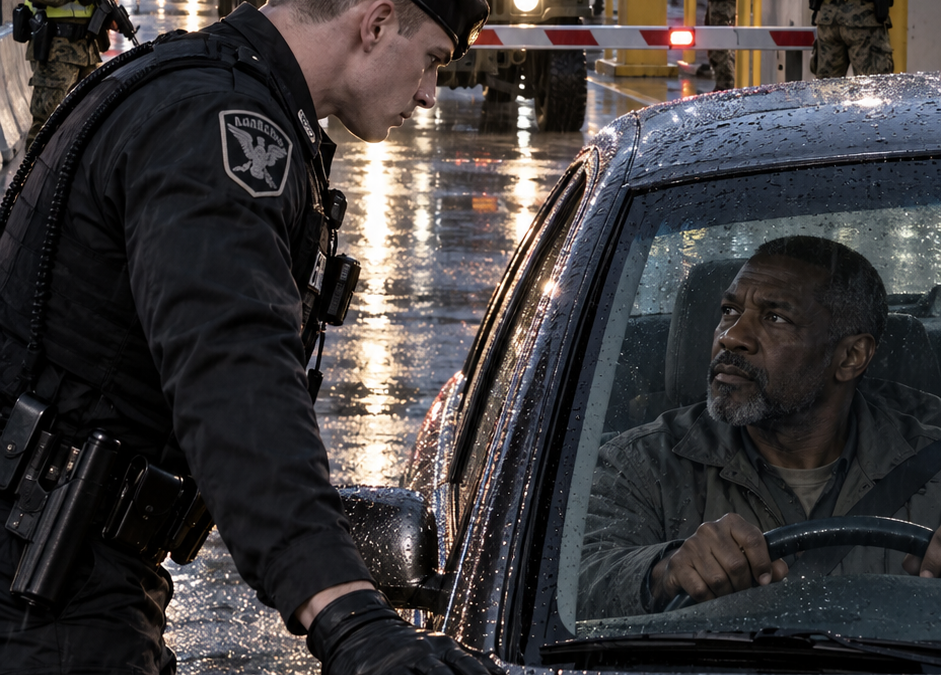
The first thing Officer Grant Mercer did was slap his gloved palm against the hood of my sedan.
The sharp crack cut through the steady hiss of rain and the rumble of military vehicles idling behind me. I looked through the windshield at his expression, then lowered my window three inches.
Cold morning air rushed into the car, carrying the smell of diesel exhaust, wet concrete, and the saltwater drifting inland from the nearby coast.
“Can I help you, Officer?”
Mercer leaned toward the narrow opening.
“You lost?”
His voice had the casual arrogance of a man who had already decided the answer to every question he intended to ask.
I kept both hands visible on the steering wheel.
“I’m here for the base.”
He looked past me at the empty passenger seat, then slowly examined my clothes.
I was wearing a dark gray field jacket, plain khaki pants, and an old pair of black boots. The jacket had accompanied me through years of travel, and the cuffs had softened from repeated wear. My boots were clean but hardly fashionable, and the car I drove was an ordinary sedan without anything to suggest the military rank I held.
Mercer apparently considered all of that important.
“This is a restricted military installation,” he said. “Not a parking lot for people who need directions.”
“I know where I am.”
His smile narrowed.
“Then you should know better than to show up dressed like that.”
I glanced at the security checkpoint.
The main vehicle barrier remained lowered between two reinforced concrete structures. Beyond it, Marines wearing reflective vests directed supply vehicles toward a separate entrance.
Floodlights reflected off the wet pavement. Radio transmissions drifted from the guardhouse, mixing with the rain striking its metal canopy.
It was an ordinary morning at a busy military installation.
Or it should have been.
“I have official business here,” I told him.
“Everybody says that.”
Mercer folded his arms.
“Let me guess. Delivery? Maintenance? Somebody give you the wrong entrance?”
“Neither.”
He leaned closer.
“Then what exactly are you doing here?”
“My name is Colonel Elias Brooks. I’m expected at a command meeting.”
He stared at me for a moment.
Then he laughed.
It wasn’t a surprised laugh or the kind of brief reaction someone might have upon hearing something unexpected.
He laughed as though I had deliberately told him a joke.
“Colonel?”
“That’s correct.”
He looked at my boots again.
“Sure you are.”
For a few seconds, I studied the young officer standing beside my window.
His uniform was immaculate despite the weather. His cap sat perfectly straight, and his polished shoes reflected the white security lights above us.
Nothing about his appearance suggested carelessness.
His conduct, however, was already telling a different story.
I had served in places where a moment’s hesitation could endanger an entire unit. I’d watched young Marines struggle to follow complicated instructions while exhausted, frightened, and operating under terrible conditions.
I understood pressure.
I understood the importance of security procedures, particularly at an installation preparing for a major readiness exercise.
And I understood that a gate officer had both the authority and the responsibility to verify anyone requesting entry.
What I didn’t understand was why Mercer seemed determined to do everything except verify me.
“Officer, I have identification.”
He raised a hand.
“Don’t get ahead of yourself.”
A horn sounded from somewhere behind me.
Mercer didn’t turn around.
Instead, he straightened and looked toward the line of vehicles, apparently enjoying the attention our conversation was attracting.
“You don’t just drive up to a military base wearing civilian clothes and expect everybody to salute you.”
I took a slow breath.
The rain intensified, striking the roof of my car in uneven bursts.
I could have told him I had entered installations in combat zones, secured command centers halfway around the world, and facilities whose names didn’t appear on ordinary visitor maps.
I could have listed my assignments or explained the authority attached to my current position.
But none of those things should have been necessary.
I wasn’t asking for special treatment.
I was asking him to perform the verification procedure he had been trained to follow.
I opened my door slowly and stepped onto the wet pavement.
Mercer moved backward immediately.
“Hold it right there.”
I closed the door and kept my hands visible.
At six feet two inches, I stood nearly eye level with him. Water began soaking into the shoulders of my jacket, and cold rain trickled beneath my collar.
I resisted the instinct to pull it tighter.
“Sir,” I said, “I need you to tell me whether you’re denying me entry because of an established security procedure or because of what you think I look like.”
His smirk disappeared.
Only for a moment.
Then he tapped the guardhouse window with two knuckles and glanced toward the soldiers waiting in their vehicles.
“I think you came to the wrong gate.”
There it was.
Not a regulation.
Not a verification problem.
A judgment.
He had looked at a Black man in ordinary clothes, standing beside an ordinary car, and decided I couldn’t possibly be someone important enough to have a legitimate reason for entering the installation.
I reached into my jacket and removed my military identification card.
“My credentials.”
Mercer looked at the card without accepting it.
For a moment, his gloved hand remained on the counter beside the visitor log.
Then he took the identification between two fingers and lifted it toward the fluorescent light.
“Credentials,” he repeated.
His expression suggested he found the entire situation amusing.
He examined the photograph.
Then the name.
“Colonel Elias Brooks.”
He deliberately raised his voice so the drivers behind us could hear.
“That’s quite a title.”
“The card will verify through your scanner.”
“Will it?”
He turned it over and examined the barcode.
But he made no attempt to use the scanner sitting less than a foot away.
“Because from where I’m standing, Colonel, you look more like somebody who’s supposed to be dropping off a package.”
A brief laugh escaped from one of the vehicles behind us.
Mercer heard it.
His smile widened.
“Maybe this is the new uniform for delivery men,” he announced. “Field jacket, khakis, old boots. Very official.”
I heard movement inside the nearest vehicle.
A young lance corporal lowered his eyes toward the steering wheel. Another Marine stared straight ahead, his jaw tightening beneath the brim of his cover.
Neither laughed.
But neither challenged Mercer.
I understood their hesitation.
At a security checkpoint, a gate officer’s instructions were not something a young service member could simply ignore because he disliked the officer’s behavior.
Mercer was relying on that.
He had turned a routine identification check into a public performance, and everyone waiting behind me had become his audience.
I extended my hand.
“Scan the card, Officer.”
He didn’t return it immediately.
Instead, he examined me again.
“You don’t give orders at my gate.”
“I’m asking you to verify my identity.”
He placed the card on the counter rather than handing it back.
I retrieved it and moved it toward the scanner.
Mercer immediately covered the device with his palm.
“No.”
I stopped.
“You don’t operate my equipment.”
“Then please operate it yourself.”
“My procedure says unauthorized visitors wait outside.”
“I’m not an unauthorized visitor.”
“That remains to be seen.”
He opened the visitor log and clicked his pen.
“Delivery personnel can use the service entrance,” he announced loudly. “Assuming they have an actual delivery to make.”
Nobody laughed this time.
The rain continued falling.
Behind me, engines idled, windshield wipers moved steadily across the glass, and more headlights appeared through the gray morning.
I glanced at the electronic clock inside the guardhouse.
Time was becoming a problem.
I was scheduled to attend a strategic readiness coordination meeting in Building Three at seven o’clock. The meeting would finalize the instructions for an emergency readiness exercise involving hundreds of service members across the installation.
Command vehicles were beginning to arrive.
Operations personnel needed the meeting to begin on schedule.
And I was still standing in the rain because the officer at Gate One refused to scan a valid military identification card.
“Officer Mercer, I’m going to ask you one more time to follow the verification procedure.”
He shut the visitor log.
“You know what? You can wait.”
I watched him turn away.
The insult itself wasn’t what disturbed me most.
I’d spent enough years in uniform to understand that not everyone respected rank and that people sometimes behaved badly when they felt challenged.
What troubled me was his willingness to use a position of responsibility as an opportunity to humiliate someone.
He was supposed to protect an installation.
Instead, he seemed determined to prove that he could decide who belonged there without consulting the very security system provided for that purpose.
I stepped back toward my car.
Two dark command vehicles had joined the line, their headlights illuminating the rear of my sedan.
A third vehicle approached behind them.
The lead vehicle stopped.
Its windshield wipers moved slowly.
Through the glass, I could see several officers examining tablets and checking the time.
They were waiting for me.
Mercer noticed the convoy.
For a moment, I thought the additional vehicles might finally persuade him to verify my identification.
Instead, he picked up his radio.
“Gate One is holding an unauthorized civilian. Route all incoming command traffic to standby.”
The reply crackled through the rain.
“Standby confirmed. Exercise convoy delayed at Gate One.”
I looked directly at him.
“You’re delaying the command convoy because you refuse to verify my credentials.”
He pointed toward the shoulder beyond the checkpoint.
“Move your car. You’re blocking official traffic.”
“Official traffic is blocked because you won’t complete the security check.”
Mercer lifted his chin.
“They can wait.”
The rear door of the lead command vehicle opened.
A uniformed aide stepped onto the pavement, holding a tablet beneath his jacket to protect it from the rain.
He approached the checkpoint.
“Officer, we have a strategic coordination meeting in twelve minutes. The readiness exercise begins immediately afterward.”
Mercer barely looked at him.
“Then you should’ve used another gate.”
The aide stood motionless for a moment.
Then he turned back toward the vehicle.
His expression told me that the morning’s difficulties were already being reported to operations.
I checked the clock.
6:48 a.m.
Twelve minutes.
At seven o’clock, several units would begin executing a carefully coordinated readiness scenario.
Communications teams, command personnel, logistics officers, and emergency response staff had spent weeks preparing for it.
A delayed briefing wouldn’t necessarily destroy the entire exercise.
But it would disrupt the sequence, force adjustments across multiple units, and waste hours of work that had already gone into coordinating the event.
I wasn’t about to let that happen simply because Mercer wanted to win an argument.
“Officer, there are command vehicles waiting behind my car. You have my credentials, and your scanner is functioning. Is there a specific security concern preventing you from completing verification?”
He stared at me.
“You’re the security concern.”
“Based on what?”
“Your behavior.”
“My behavior consists of presenting valid identification and requesting access to a meeting I’m required to attend.”
His face tightened.
“You’re getting awfully argumentative for someone who claims to understand military discipline.”
I looked at the lowered barrier.
“No. I’m asking you to do your job.”
Another radio transmission interrupted us.
“Gate One, operations is requesting a status update.”
Mercer pressed his radio.
“Unauthorized visitor is refusing to clear the access lane. Command convoy remains on hold.”
I felt my jaw tighten.
There was no point debating an allegation he had already decided to repeat.
I needed confirmation from someone who would consult the actual command schedule.
I removed my phone from my jacket.
Mercer’s eyes narrowed.
“Calling somebody to make this disappear?”
“No. I’m confirming my schedule.”
I selected the command duty desk from the installation directory.
The call connected after two rings.
“Command duty desk.”
A woman’s voice answered, clipped and professional.
“This is Colonel Elias Brooks. Please confirm my reporting time and assigned location for this morning.”
Mercer laughed.
He made sure the drivers behind us could hear.
“You really expect anybody to believe this?”
I ignored him.
Through the phone, I heard keys clicking.
There was a brief pause.
Then the duty officer’s voice became noticeably more formal.
“Colonel Brooks, your reporting time is zero seven hundred hours. You’re expected at the strategic readiness coordination meeting in Building Three.”
“What’s the meeting’s current status?”
Another pause.
“Delayed pending your arrival, sir. Operations has been notified.”
I looked at Mercer.
The word sir had carried clearly through the rain.
His fingers tightened around the visitor log.
“Thank you,” I told the duty officer.
I ended the call and slipped my phone back into my jacket.
“There is your confirmation. Now please complete the security procedure.”
Mercer stared at me for several seconds.
One movement of his hand would have settled everything.
He could have scanned my card, verified the result, and opened the gate.
Instead, he leaned against the counter.
“A phone call doesn’t override security.”
“Correct,” I said. “Neither does your personal opinion.”
The aide in the command vehicle was watching us through the windshield.
More soldiers had begun lowering their windows to hear what was happening.
Mercer looked toward them.
Then he pointed toward the marked inspection area beside the guardhouse.
“If you want inside, you follow my instructions.”
“I’ve followed them. I presented identification. I requested verification. I confirmed my assignment through command.”
I paused.
“The next step belongs to you.”
His radio crackled again.
“Gate One, operations needs this issue resolved within seven minutes.”
Mercer’s hand hovered above the scanner.
For one brief moment, I believed he was finally going to use it.
Then he withdrew his hand.
“Move your vehicle.”
I looked at the clock.
The seven minutes were going to pass quickly.
And Mercer seemed more concerned about proving he controlled the gate than about the hundreds of Marines whose schedule he was disrupting.
The guardhouse printer suddenly began chattering.
A narrow strip of paper emerged and curled toward the damp counter.
Mercer tore it free.
He flattened it beneath his palm, then looked toward me with a smile that never reached his eyes.
“You think a phone call makes you untouchable?”
“No.”
“Good. Because I’m not impressed.”
“I’m not asking you to be impressed.”
“You’re trying to pressure a security officer.”
I took a slow breath.
“No. I’m asking you to follow the same procedure you’d use for anyone else.”
Something in that answer seemed to push him past the point where he could admit he had made a mistake.
He stepped out from under the canopy.
Rain struck his polished shoes as he crossed the lane.
“Turn around. Hands where I can see them.”
The command convoy grew noticeably quieter.
Several men leaned forward in their seats.
I slowly raised my hands and turned.
I knew that challenging a security search at a restricted installation could create additional complications, especially when an officer was already determined to describe my behavior as suspicious.
So I kept my movements deliberate.
Mercer circled me, examining the seams of my jacket, my pockets, and my belt.
His search was more theatrical than necessary.
He spoke loudly throughout it, apparently ensuring everyone nearby understood that he had decided I was a security threat.
“No weapon,” he announced.
Then he looked toward the convoy.
“No authorized escort. No proper uniform. Civilian vehicle blocking a military access point.”
I turned my head slightly.
“My military identification is in your possession. You refused to scan it.”
“You don’t get to instruct me on security.”
“I haven’t instructed you to do anything outside your established procedure.”
He returned to the guardhouse.
Rainwater dripped from the brim of his cap onto the visitor log.
He picked up his pen.
And began writing.
I watched him turn his personal suspicions into an official report.
Subject detained outside Gate One.
Access denied.
Pending security review.
Refusal to comply with gate instructions.
He paused.
Then checked another box.
Suspicious conduct.
I could hear the scratch of the pen over the paper.
Each accusation was becoming part of an administrative record that could be read by people who hadn’t witnessed the encounter.
If I walked away without challenging it, his version might become the only version anyone consulted.
That was how carelessness became institutional fact.
“Read it back,” I said.
Mercer looked up.
“What?”
“Your report. Read every allegation into the record.”
He stared at me.
“You’re being held outside the installation because you failed to establish lawful access. You attempted to influence a security officer through unofficial contact. You’ll remain here until command decides otherwise.”
I nodded.
“Then sign it.”
His pen hovered.
For a moment, there was no sound except the rain striking the guardhouse roof and the diesel engines rumbling behind my car.
Then he signed.
Grant Mercer.
He tore off the bottom copy and held it toward me.
I accepted the damp paper between two fingers.
The ink was already beginning to feather along its edges.
I folded it carefully and slipped it inside my jacket.
Mercer turned toward the barrier controls, apparently satisfied that he had transformed my refusal to leave into an official security incident.
Then his radio crackled.
“Gate One, operations is requesting the name of the officer who formally denied Colonel Brooks access.”
His hand stopped above the control panel.
I watched him glance toward me.
He looked less amused now.
“Gate One, identify the officer,” the dispatcher repeated.
Mercer lifted the handset.
“Officer Grant Mercer. I denied access pending verification.”
At the command duty desk, the officer I’d spoken with was comparing the delayed meeting notice against the secure attendance roster.
I learned later that my name appeared on a restricted list reserved for command oversight visitors.
Beside it was a designation that immediately caught her attention.
Special Command Authority.
As an officer attached to the Inspector General’s Office, I had been issued command-level access for the inspection and readiness coordination activities I was conducting at the installation.
That authority did not excuse me from following checkpoint procedures.
It made those procedures even more important.
My credentials were supposed to be verified accurately, and any unusual access condition was supposed to be referred to the security center.
Instead, Mercer had refused to scan my card and entered a series of unsupported accusations into the gate records.
The command duty officer began examining the discrepancy.
At Gate One, a yellow warning appeared on Mercer’s terminal.
SPECIAL COMMAND CREDENTIAL DETECTED.
VERIFY THROUGH SECURITY CENTER.
I couldn’t see the screen clearly from where I stood, but I noticed Mercer suddenly become very still.
He glanced toward me.
Then toward the signed report on the counter.
The warning required a simple response.
He needed to notify the security center and preserve the access record.
Instead, he reached across the console.
Pressed the override key.
And cleared the alert.
A soft electronic chime sounded.
“Alert cleared,” the terminal announced.
I watched his expression.
“Did the system identify my credential?”
“False flag.”
“Did you verify that with the security center?”
“It’s handled.”
He wouldn’t meet my eyes.
I looked toward the scanner, still glowing green on the counter.
The piece of equipment that could have resolved the entire problem within seconds remained unused.
At the command duty desk, however, the manually dismissed alert created another problem.
The duty officer could see that the credential had not been cleared by the security center.
Someone at Gate One had overridden it locally.
She opened a secure incident channel, entered the terminal number, and began preserving the access history.
Then she called the guardhouse directly.
Mercer’s phone rang.
He looked at the incoming number.
For a second, he seemed reluctant to answer.
Then he lifted the handset.
“Gate One. Officer Mercer.”
The duty officer’s voice was controlled.
“Officer Mercer, did your terminal just receive a special command credential alert?”
He looked through the rain-streaked glass at me.
“False system flag. Handled locally.”
A pause followed.
Then I heard the reply.
“That credential belongs to Colonel Elias Brooks. His name is on a restricted command list.”
Mercer’s hand tightened around the handset.
“Then send somebody down to verify it. Until then, he stays outside.”
He hung up.
I checked the clock.
6:54 a.m.
Six minutes before the scheduled meeting.
The command convoy remained stationary.
The readiness exercise was in danger of being postponed.
And the officer who had accused me of suspicious conduct had just dismissed a command-level security alert without the required authorization.
A new message appeared on his terminal.
SECURITY CENTER AUDIT PENDING.
DO NOT ALTER GATE RECORDS.
Mercer stared at it.
For the first time that morning, I saw genuine uncertainty replace the satisfaction on his face.
I looked toward the emergency access panel beside the pedestrian gate.
Its metal casing was slick with rain, and a small green reader light pulsed beside the secured door.
I had presented my credentials.
I had confirmed my assignment through the command duty desk.
I had requested ordinary verification repeatedly.
And Mercer had now created a signed report claiming that I lacked lawful access.
There was no useful conversation left to have with him.
I turned toward the emergency panel.
He immediately stepped out from the guardhouse.
“Where do you think you’re going?”
“To the access reader.”
“That panel is for authorized personnel only.”
“I understand.”
“Stop right there!”
I stopped.
The rain had softened into a cold silver mist.
Behind me, the command convoy remained in place, its drivers watching the exchange through their fogged windows.
I turned toward Mercer.
“You made an official record stating that I’m unauthorized.”
“That’s correct.”
“You’ve refused to use the verification equipment at your station, ignored confirmation from command, and manually dismissed a security alert.”
He looked toward the panel.
“What are you trying to do?”
“Use the independent access procedure.”
“You touch that panel, and you’re going to make this much worse for yourself.”
I took out my identification card.
“Then let the system answer the question.”
I held the card against the reader.
A sharp electronic tone sounded.
Then a second tone, deeper and longer.
The light changed from green to blue.
Inside the guardhouse, the terminal screens briefly went dark.
When they returned, a secure command interface occupied the displays.
The emergency panel announced the result in a clear, mechanical voice.
“Identity confirmed. Colonel Elias Brooks. Inspector General’s Office. Command access authorized.”
The entire checkpoint seemed to fall silent.
Mercer stared at the reader.
Beyond the barrier, a Marine holding a clipboard lowered it slowly.
I remained beside the panel while the access system completed its authorization sequence.
The pedestrian gate unlocked with a heavy metallic click.
Then the vehicle barrier began rising.
Its hydraulic arms groaned against the weight of the mechanism, lifting the striped barrier that Mercer had used to keep me outside.
Inside the guardhouse, another message appeared.
ACCESS LEVEL: BASEWIDE COMMAND PRIORITY.
The secure entrances connected to the installation’s command access network recognized the same credential Mercer had mocked minutes earlier.
Building Three.
The operations corridor.
The authorized command facilities associated with my assignment.
Every relevant secured entrance had received the verification he refused to perform.
I slipped the card back into my jacket.
Mercer looked at me as though I had changed into an entirely different person.
But I was still wearing the same old boots.
The same plain khaki pants.
The same rain-soaked jacket.
The only thing that had changed was his ability to deny what was directly in front of him.
“Officer Mercer,” I said, “you were right about one thing.”
He didn’t answer.
“Security procedures matter.”
The barrier reached its fully raised position.
Behind me, the convoy began moving.
Tires hissed across the wet pavement as the first command vehicle advanced through the checkpoint.
Mercer stepped backward.
I could see that he wanted to say something, perhaps offer an explanation or begin a different argument now that my identity had been established beyond dispute.
But before he could speak, his terminal chimed again.
COMMAND REVIEW IN PROGRESS.
OFFICER MERCER: REMAIN AT GATE ONE.
I looked toward the command vehicles entering the installation.
The meeting was already late.
But there was another responsibility I needed to address before walking away.
I turned back toward the guardhouse.
“Officer Mercer, step away from the control console.”
He straightened.
“You can’t order me off my post without command authority.”
I removed my credential again.
I didn’t scan it.
Instead, I used the secure command function now available through the emergency panel and entered the required authorization.
A low tone sounded through the checkpoint.
Every terminal in the guardhouse briefly changed screens.
Then the same notice appeared across all of them.
INSTALLATION NOTICE.
IDENTITY VERIFIED: COLONEL ELIAS BROOKS.
INSPECTOR GENERAL’S OFFICE.
PRESERVE RELEVANT RECORDS.
SECURITY REVIEW INITIATED.
Mercer’s radio crackled.
The command duty officer spoke.
“Gate One, this is command duty. Officer Mercer, your gate access privileges are suspended pending review. Do not access, amend, delete, or transmit records associated with this morning’s incident.”
He stared at the radio.
“This is a misunderstanding.”
I looked toward the signed report lying beside the terminal.
“Is it?”
“I followed security protocol.”
“Protocol begins with verification.”
He opened his mouth.
I continued.
“You were given a credential. You were given confirmation from command. You chose not to use either.”
The guardhouse printer started operating.
Mercer reached toward the pages emerging from it.
“Leave them,” I said.
He withdrew his hand.
The duty officer’s voice sounded again, this time over the security channel.
“Security Center is preserving Gate One logs, body camera recordings, radio traffic, credential alerts, scanner activity, and incident reports from zero six hundred hours onward. No local edits are authorized.”
The printer continued producing copies.
Mercer’s accusations appeared again in black ink.
Unauthorized access.
Suspicious conduct.
Improper influence.
The report he had signed with such confidence was now being preserved exactly as written.
So was the access history showing that he’d dismissed the special command credential alert.
His face tightened.
“You’re trying to ruin my career.”
I looked at him for several seconds.
“No.”
He gave a bitter laugh.
“That’s easy for you to say.”
“I’m making sure nobody else has to depend on your mood to receive basic respect.”
He looked away.
I wasn’t interested in humiliating him in front of the convoy.
I had no desire to make him stand outside in the rain as some kind of symbolic punishment.
But I couldn’t overlook what he had done simply because the system had finally recognized my authority.
There was a difference between an officer making an honest mistake during a difficult security check and an officer repeatedly refusing to verify information because he disliked the person presenting it.
Mercer had been given multiple opportunities to resolve the situation.
He had chosen ridicule.
Then obstruction.
Then an inaccurate official report.
And finally, the unauthorized dismissal of a security alert.
Those choices required review.
I used the command function to authorize an examination of previous Gate One contacts and the relevant access records.
Another notice appeared on the terminal.
PRIOR GATE CONTACT REVIEW AUTHORIZED.
That final message seemed to trouble Mercer more than anything else.
His shoulders dropped.
He looked toward the visitor log, then the scanner, then the secured access records.
I couldn’t know whether he was remembering other people he’d delayed, mocked, or turned away.
But I knew something important.
The morning’s records would no longer depend on what he chose to write.
They would be reviewed alongside the electronic evidence.
And if other people had experienced similar treatment at that checkpoint, their complaints could be examined against the same objective records.
A replacement security officer arrived a few minutes later.
She approached the guardhouse with a checklist and instructions from the security center.
Mercer removed his duty credential.
For a moment, he held it between his fingers.
Then he placed it on the metal counter.
The card made a small, dry clicking sound.
I watched the replacement officer document the condition of the workstation, the signed incident report, and the equipment Mercer had been instructed not to touch.
She didn’t argue with him.
She didn’t make jokes about his suspension.
She simply followed the procedure.
I found the contrast remarkable.
That was all I had asked him to do from the beginning.
Outside, the rain had thinned to a fine mist.
The final command vehicle disappeared down the main access road.
I checked the clock and headed toward Building Three.
The strategic coordination meeting would begin as soon as I arrived.
The readiness exercise had been delayed, but operations was already adjusting the schedule to minimize the disruption.
I wasn’t particularly concerned about the inconvenience to my own morning.
What bothered me was the unnecessary cost imposed on everyone else.
Hundreds of Marines had prepared for an exercise that required careful coordination across multiple units.
Their time mattered.
The planning mattered.
The installation’s operational responsibilities mattered.
And all of it had been affected because one officer decided an ordinary-looking Black man couldn’t possibly possess the authority printed on his identification card.
I approached the first secured entrance along the administrative corridor.
The access reader glowed green as I presented my credential.
The lock disengaged.
I walked inside.
Warm air replaced the cold mist.
The polished floor reflected long strips of overhead lighting, and the sounds of the checkpoint gradually faded behind me.
Farther along the corridor, another secured door recognized my credentials.
A Marine corporal standing beside it stepped aside.
“Good morning, Colonel.”
“Good morning.”
He held the door only after the electronic reader had verified my access.
That small detail mattered.
He had respected the security procedure instead of trying to substitute his own assumptions for it.
I continued toward the operations wing.
Another reader flashed blue.
Another lock released.
Through the open doorway, I could hear radios, hurried footsteps, and officers discussing adjustments to the morning’s exercise schedule.
People were working.
Decisions were being made.
The installation was returning to the business that had been interrupted at its front gate.
As I crossed the courtyard toward Building Three, I thought about Mercer’s expression when the emergency panel announced my identity.
He had looked utterly shocked.
As though the person I’d claimed to be couldn’t possibly exist in the clothes I was wearing.
I wondered how many other people had stood before him holding valid identification while he decided whether they looked respectable enough to receive the benefit of an ordinary security check.
A young Marine arriving at a new assignment.
A civilian contractor trying to report for work.
A parent visiting a child stationed on the installation.
A maintenance employee who had spent decades supporting the same base.
I didn’t know whether Mercer had mistreated any of them.
That was why the records needed to be reviewed.
The question couldn’t be answered by my anger or his embarrassment.
It required evidence.
At the entrance to the command center, a staff officer was waiting.
“Colonel Brooks, the coordination team is assembled. Operations has adjusted the exercise sequence. We can begin as soon as you’re ready.”
“Thank you.”
He glanced at my wet jacket.
“Would you like a moment to change?”
I looked down at the dark patches across the fabric.
My boots had left a trail of damp footprints behind me.
Under ordinary circumstances, I might have changed before entering a room full of senior personnel.
That morning, I felt differently.
“No. We’ve kept everyone waiting long enough.”
I lifted my identification card toward the final reader.
The panel flashed green.
The heavy doors opened inward.
Beyond them stretched a bright corridor lined with unit insignias, framed photographs, and the names of Marines who had served the installation long before I arrived.
I stepped through.
And for the first time that morning, I was exactly where I was supposed to be.
After the coordination meeting, I requested a formal briefing from the security center.
I wanted to know whether the checkpoint records had been preserved successfully and whether the readiness exercise had resumed without further disruption.
The duty officer confirmed that the original gate logs, radio communications, body camera footage, credential events, and signed report were secured.
The review of Mercer’s conduct would proceed through the appropriate channels.
His suspension remained in effect pending that review.
I didn’t demand that he be fired.
I didn’t ask for a punishment before the facts had been examined.
I wanted an investigation capable of distinguishing between a procedural misunderstanding, intentional misconduct, and any broader pattern the records might reveal.
More importantly, I wanted the checkpoint’s procedures to remain clear and consistent after the attention surrounding my own experience disappeared.
A security officer shouldn’t have to recognize an important face to perform a proper identity check.
And a visitor shouldn’t have to possess command-level credentials to insist that an officer follow established procedure.
Later that afternoon, I walked past a window overlooking the main access road.
The pavement was beginning to dry.
Gate One was functioning normally again.
Vehicles approached, identification cards were scanned, and authorized personnel continued into the installation.
There were no raised voices.
No unnecessary delays.
No officer turning a security check into a public spectacle.
I watched a young Marine approach the checkpoint carrying a duffel bag. His uniform looked slightly oversized, and he appeared uncertain about which lane to enter.
The replacement officer directed him toward the proper window.
She examined his identification, checked the necessary information, and gave him clear instructions.
He thanked her and continued inside.
The entire exchange lasted less than a minute.
Nobody applauded.
Nobody seemed to think anything extraordinary had happened.
That was precisely the point.
Proper security shouldn’t depend on an officer’s willingness to acknowledge that a stranger might be someone worth treating respectfully.
It should be the ordinary result of training, professionalism, and accountability.
I thought about the way Mercer had held my identification between two fingers, displaying it for the amusement of the soldiers waiting behind me.
He had believed that the gate belonged to him because he controlled its barriers.
He had mistaken the temporary authority of his position for permission to decide another person’s worth.
And when the system finally contradicted him, he had tried to dismiss the warning rather than reconsider his judgment.
I hoped the investigation would give him an opportunity to understand the seriousness of those decisions.
But whether he learned anything from the experience was no longer mine to control.
I had a base to inspect, a readiness exercise to oversee, and service members whose work deserved my attention.
Before leaving the window, I looked once more toward the checkpoint.
The barrier lifted.
Another vehicle entered.
Then another.
The gate continued opening for people whose identities and authorization had been properly verified.
I returned to my work.
That morning, my credential had opened every secured command door I needed to pass through.
But the most important lesson had nothing to do with the access it gave me.
The officer who mocked my jacket had been wrong long before he learned my rank.
He had been wrong when he looked at a stranger and decided appearance was more important than evidence.
He had been wrong when he treated a security checkpoint as a stage for humiliation.
And he had been wrong when he believed the authority to close a gate included the authority to close another person’s dignity.
My identification proved I had permission to enter the installation.
I had deserved basic respect before he ever scanned it.








