𝗙𝗨𝗟𝗟 𝗦𝗧𝗢𝗥𝗬 The Ocean Was Supposed to Hide What My Husband Had Done
𝗣𝗔𝗥𝗧 𝟮
His jaw tightened for half a second.
Then the mask returned.
“You’re right,” he said, turning slightly toward the watching crowd. “Of course you’re right. Forget I asked.”
He kissed my forehead.
The gesture looked tender from a distance.
Up close, it felt like a warning.
“Here,” he said, pressing two capsules into my palm. “Your prenatal vitamins. You forgot them at breakfast.”
I looked down at them.
Small. White. Familiar.
Julian had handed me vitamins before. He had organized my medications when my blood pressure spiked in the second trimester. He had sat beside me during doctor appointments, nodding gravely when specialists warned us that stress, impact, or sudden trauma could trigger complications.
He knew everything.
Every risk.
Every warning.
Every possible consequence.
I swallowed the capsules with water from the bottle he handed me.
I trusted him.
That was the mistake that almost killed us.
I remember the dock blurring first.
Victoria was laughing at something one of the investors said. Julian’s hand rested at the small of my back. The sun flashed against the ocean so brightly that the world seemed overexposed.
Then my legs weakened.
“Julian,” I whispered.
He caught my elbow.
To anyone watching, he looked attentive.
Concerned.
Like a devoted husband steadying his pregnant wife.
“You should lie down,” he said softly.
My tongue felt heavy.
“What did you give me?”
His smile did not change.
“Something to help you relax.”
The last thing I saw before darkness took me was Victoria looking at my stomach.
Not at my face.
My stomach.
As if the child inside me were not a baby, but a deadline.
When I woke, the ocean was attacking me from every direction.
Salt water hit my face first. Then wind. Then the brutal slap of waves against fiberglass. My arms were stretched forward, wrists tied to the handles of a jet ski. A thick strap crossed under my chest and around my back, locking me against the machine. My stomach pressed painfully against the seat, every jolt sending terror through my body.
For several seconds, I could not understand where I was.
Then the tow rope snapped tight.
The jet ski lurched forward.
Pain tore through my abdomen so sharply that I screamed.
Ahead of me, another jet ski cut across the water.
Victoria was driving it.
She glanced back over her shoulder, her sunglasses bright in the sun.
And she smiled.
“Julian!” I screamed.
My voice ripped apart in the wind.
The dock was far behind us, but not too far to see him.
Julian stood there with a glass of scotch in one hand and binoculars in the other.
Watching.
Not running.
Not shouting for help.
Watching.
A coldness more terrifying than the water moved through me.
This was not an accident.
This was not a prank gone too far.
This was a plan.
“Please!” I screamed. “I’m pregnant! Stop!”
Victoria laughed.
“Then hold on tighter, honey.”
The tow rope jerked again.
My body slammed forward. Something deep inside me twisted with a pain so intense that my vision flashed white.
“No,” I gasped. “No, no, no…”
I looked down.
At first, I thought the red in the water was a reflection from the jet ski.
Then I felt warmth running down my legs.
Blood.
My daughter shifted once.
Then stillness.
Panic broke through whatever drug Julian had given me.
I fought the straps, but my wrists were tied too tightly. The rope pulled my jet ski over another wave, and my stomach hit the front console. I screamed until my voice cracked.
Victoria swerved deliberately, making my jet ski whip sideways through the wake.
The ocean blurred.
The sky tilted.
For one horrifying second, I thought I would flip.
Then something hard struck my wrist.
My father’s watch.
Most people thought it was sentimental. A heavy black tactical watch with a scratched face and a worn band, too plain to match the resort, too old to look expensive. My father had given it to me three years earlier after Julian complained that I was “too cautious” about security.
Dad had fastened it around my wrist himself.
“You press this button,” he had said, tapping a nearly invisible ridge on the side, “and I don’t care where you are. I’ll know.”
I had laughed then.
“Dad, I’m married. I’m not deployed.”
His expression had not changed.
“Danger doesn’t ask for your résumé.”
I had worn it mostly to humor him.
Now, with blood spreading beneath me and Victoria laughing ahead of me, I twisted my wrist against the handlebar.
The first time, my fingers slipped.
The second time, the jet ski bucked and my shoulder nearly dislocated.
The third time, my thumb found the ridge.
I pressed.
A small vibration pulsed against my skin.
For two seconds, nothing happened.
Then the watch warmed.
Static crackled near my wrist.
A voice came through.
“Genevieve?”
My father.
The sound of him almost destroyed me.
“Dad,” I whispered.
His voice sharpened instantly.
“Genevieve, what happened?”
I looked at the red water around me.
At the rope pulling me farther from shore.
At Victoria’s hair whipping in the wind as she glanced back, triumphant.
At Julian standing on the dock, waiting to become a widower.
“They’re trying to kill us,” I said.
There was no hesitation.
No confusion.
No wasted question.
My father’s voice turned into something I had heard only once before, when I was sixteen and a naval officer came to our house to tell him my grandfather had died.
Cold.
Controlled.
Terrifying.
“Hold on, baby girl.”
“I can’t.”
“Yes, you can.”
“My baby—”
“I heard you,” he said. “I’m coming.”
The signal stayed open.
I heard voices behind him. Orders. Coordinates. Someone repeating my location. Someone saying Coast Guard. Someone else saying medevac.
Victoria looked back again.
This time, she noticed my mouth moving.
Her smile faltered.
“What are you doing?” she shouted.
I did not answer.
She saw the watch.
Her face changed.
For the first time that day, Victoria Hayes looked afraid.
She accelerated.
The tow rope snapped tight so violently that my wrists burned against the restraints. The jet ski beneath me lurched, and pain tore through me again.
I screamed.
My father heard it.
The line exploded with his voice.
“Genevieve!”
“I’m here,” I sobbed. “I’m here.”
“Stay awake.”
“I’m bleeding.”
“I know.”
“No, Dad, I’m bleeding.”
His voice almost broke.
Then it steadied.
“Listen to me. You listen to my voice. You keep breathing. You keep talking.”
The sky changed before the water did.
A deep mechanical thunder rolled over the bay.
Victoria looked up.
I did too.
The first helicopter came in low over the resort, dark against the white blaze of afternoon. A second followed from the north. Then Coast Guard vessels appeared beyond the breakwater, cutting through the water with impossible speed.
The helicopter dropped so low that seawater exploded around us.
Victoria screamed.
Commands thundered through speakers.
“Release the tow line! Cut power immediately!”
Victoria did neither.
She tried to turn.
The tow rope dragged my jet ski sideways.
Pain split through me.
Then a Coast Guard vessel crossed in front of her, close enough that she panicked and released the rope.
My jet ski spun.
The horizon disappeared.
For a moment, there was only water, sky, and the sound of my own body failing.
Then hands were on me.
Real hands.
Gloved hands.
A man shouting, “Ma’am, stay awake!”
Someone cut the strap across my body.
Someone else sliced through the restraints around my wrists.
“My baby,” I gasped.
“We’ve got you.”
“My baby.”
“Ma’am, listen to me. We are getting you out.”
Through blurred vision, I saw Victoria in the water, thrashing as officers dragged her toward a vessel. Her face was twisted with terror now, all elegance gone.
Good.
Then I saw the dock.
Julian was running.
For half a second, some broken part of me thought he was running toward me.
Then I saw the phone in his hand.
He was trying to call someone.
Or delete something.
Or warn someone.
Two armed officers intercepted him before he made it ten feet.
“This is insane!” Julian shouted. “My wife agreed to the ride!”
Even from the water, I found enough strength to laugh.
It came out broken and bloody.
“You drugged me.”
His face changed.
Only slightly.
But my father saw it.
Admiral Hector Sterling stepped out of the second helicopter wearing a dark flight jacket and the expression of a man who had already decided the room was his, even if the room was an entire coastline.
Julian stared at him.
Then at the officers.
Then at me.
“Genevieve,” he said, voice cracking. “Who is that?”
My father walked straight past him.
He did not slow.
He did not glance at Victoria.
He came to me, dropped to one knee on the wet deck of the rescue vessel, and took my face in both hands.
“Baby girl.”
Julian went white.
“You’re her father?”
Dad did not even look at him.
A medic placed an oxygen mask over my face.
“We need transport immediately,” she said. “Possible placental abruption.”
Those words erased everything else.
The ocean.
Victoria.
Julian.
Money.
Marriage.
Betrayal.
All of it vanished beneath one terrible truth.
My daughter was in danger.
I grabbed my father’s sleeve.
“Save her.”
His hand covered mine.
“We will.”
“You promise?”
His eyes shone, but his voice remained steady.
“I promise.”
As they lifted me onto the helicopter, Victoria began screaming from the dock.
“This wasn’t supposed to happen!”
Julian turned on her.
“Shut up!”
Too late.
Every officer heard it.
So did my father.
He finally looked at her.
“What wasn’t supposed to happen?”
Victoria started crying.
Julian lunged toward her.
Two men slammed him against the railing.
Then an investigator opened Victoria’s waterproof bag.
Inside was a second phone.
On the screen was a scheduled email addressed to Julian.
Subject line:
AFTER GENEVIÈVE.
My father opened the attachment.
Insurance documents.
My life insurance documents.
Forty million dollars.
Beneficiary: Julian Vance.
But beneath them was something worse.
A signed agreement transferring control of Julian’s company if I died before giving birth.
Victoria looked at him in horror.
“You told me she was worth ten million.”
Julian stopped struggling.
My father finally smiled.
There was no warmth in it.
“No,” he said. “My daughter is worth considerably more.”
Then the monitor beside me began screaming inside the helicopter.
The medic’s face changed.
“Fetal distress!”
The helicopter lifted so fast my stomach dropped.
Or maybe that was the blood loss.
My father stayed beside me, one hand locked around mine, the other braced against the cabin wall as the aircraft banked toward the hospital. The medic pressed hard against my abdomen while another started an IV. Voices overlapped. Numbers. Blood pressure. Heart rate. Estimated time.
I caught fragments.
“Operating room on standby.”
“Possible emergency C-section.”
“Notify neonatal team.”
I tried to lift my head.
The medic pushed me gently back.
“Ma’am, stay still.”
“My baby,” I whispered again.
My father leaned close.
“Her name, Genevieve.”
I blinked up at him.
“What?”
“Tell me her name.”
I knew what he was doing.
He was anchoring me.
He had done it when I was a child terrified of thunderstorms. He had done it when my brother broke his arm falling from a horse. He had done it when Mom went into surgery years ago and I shook so badly I could not hold a cup.
Name what you are fighting for.
“Aria,” I whispered.
His face tightened.
“You named her?”
“I was waiting to tell Julian.”
The words hurt more than the injuries.
Dad brushed wet hair from my face.
“Then tell me.”
“Aria Celeste.”
After my mother.
His eyes filled.
“She’ll love that.”
“She has to live first.”
“She will.”
The medic looked at my father.
He looked back.
For a moment, the admiral was gone, and only my dad remained.
“Please,” he said quietly.
The medic nodded.
“We’re doing everything.”
At the hospital, everything became white light.
Hands moved me. Voices asked questions I could not answer. Someone cut away the soaked remains of my resort dress. A doctor leaned over me, calm and direct.
“Genevieve, I’m Dr. Alvarez. We need to deliver your baby now.”
“Is she alive?”
“She has a heartbeat.”
I cried then.
Not with relief.
With terror so deep it had no shape.
My father was not allowed into the operating room. I heard him arguing until someone said, “Admiral, you can help her by letting us work.”
Then the doors closed.
I remember the ceiling.
The mask.
Cold.
Pressure.
Someone saying my blood pressure was dropping.
Someone else saying, “We need to move.”
I remember thinking, absurdly, that Julian would hate the scar.
Then I remembered Julian had tried to kill me.
After that, I let the anesthesia take me.
When I woke, I heard beeping.
Not ocean.
Not helicopters.
Machines.
Hospital machines.
My throat was dry. My body felt as if I had been broken open and put back together by strangers with urgent hands.
I turned my head.
My mother sat beside the bed.
Celeste Sterling never looked undone. Even at funerals, even in crisis, she carried herself with the kind of grace people mistook for fragility until they made the mistake of challenging her.
But now her hair was loose around her face, her eyes red, her hands wrapped around mine.
“Mom,” I whispered.
She stood so quickly the chair scraped.
“Oh, my darling.”
“My baby.”
“She’s alive.”
The world stopped.
I closed my eyes.
The tears slipped out before I could stop them.
“She’s small,” Mom said. “She’s in the neonatal unit. But she’s alive, Genevieve. She cried.”
“She cried?”
“She cried,” my mother said, smiling through tears. “A furious little sound. Very Sterling.”
A broken laugh escaped me.
Then pain punished me for it.
“Julian?”
My mother’s face changed.
It became still.
Dangerously still.
“In custody.”
“Victoria?”
“In custody.”
“Dad?”
“With Aria.”
Of course he was.
The first time I saw my daughter, she was inside a clear incubator, wearing a tiny cap too large for her head.
She looked impossibly small.
Not fragile.
No.
That was not the right word.
She looked unfinished.
As if the world had demanded she arrive before she was ready, and she had come furious about the inconvenience.
My father stood beside the incubator with both hands behind his back, shoulders rigid, eyes fixed on her.
He did not notice me at first.
Or maybe he did and needed a moment before turning around.
A nurse pushed my wheelchair closer.
“Five minutes,” she said. “No more.”
My father stepped aside.
I placed one hand against the incubator wall.
“Hi, Aria.”
She moved.
Barely.
One tiny fist curling near her cheek.
The sound that left me was not a sob exactly.
It was something older.
Something primal.
“She knows your voice,” Dad said.
I looked at him.
His eyes were wet.
“Dad.”
“I know.”
I did not have to finish.
I am sorry I hid so much.
I am sorry I trusted him.
I am sorry you had to hear me say they were trying to kill us.
I am sorry I made you rescue me.
He knew all of it.
And because he was my father, he answered the part I could not say.
“You did nothing wrong by wanting to be loved for yourself.”
That destroyed me.
I cried beside my daughter’s incubator while my father stood guard like the whole world might still try to take her from us.
For three days, I lived between my hospital room and the neonatal unit.
My body hurt in ways I did not have words for. My wrists were bruised. My abdomen felt like a battlefield. Doctors checked me constantly for complications. Nurses helped me sit up, stand, breathe, pump milk, sleep, wake, sign forms, answer questions.
And then came the investigators.
Mexican authorities.
American federal agents.
Insurance fraud specialists.
Corporate attorneys.
My father managed the chaos like a naval operation, but my mother managed the consequences.
She froze my private accounts before Julian could touch anything.
She notified trustees.
She activated clauses in the investment structures Julian had never bothered to understand because he thought I was a decorative wife with a convenient inheritance.
By the fourth day, Vance Meridian’s emergency board meeting had removed Julian as CEO pending criminal investigation.
By the fifth, the anonymous investor who had saved his company years earlier was no longer anonymous.
It was me.
My signature.
My money.
My terms.
Julian’s empire had survived because I had believed in him.
Now it would survive without him because I had been smart enough not to give him control.
He asked to see me on the sixth day.
My father said no before the request reached my room.
My mother asked me.
That was the difference between them.
Dad protected like a shield.
Mom protected like a blade hidden in silk.
“Do you want to see him?” she asked.
I was sitting in a hospital chair with a pillow against my incision, watching Aria’s monitor on a tablet feed.
“No.”
She nodded.
Then I changed my mind.
“Wait.”
Mom turned.
I looked at the tiny rise and fall of Aria’s chest on the screen.
“Yes,” I said. “I want to see him.”
My father hated it.
He did not say so.
He simply stood beside the window in my room, jaw tight, while two federal agents arranged the meeting under strict supervision.
Julian was brought in wearing a wrinkled shirt, no belt, and handcuffs.
I had never seen him without polish.
No tailored suit.
No expensive watch.
No carefully controlled lighting.
Just a man with bloodshot eyes and a face that had begun to understand money could not fix everything.
He stopped when he saw me.
For one second, I saw something like shock.
Maybe guilt.
Maybe only surprise that I was still alive.
“Genevieve,” he said.
I hated the way my name sounded in his mouth.
“Sit down.”
He glanced at the agents.
Then obeyed.
My father stood near the wall.
My mother sat beside my bed.
Julian looked from one to the other, finally understanding the scale of what he had never known.
“Your father is Admiral Sterling.”
“Yes.”
“And your mother…”
“Celeste Sterling.”
His face tightened.
“You lied to me.”
For a moment, I simply stared.
Then I laughed.
It hurt so badly that I had to press a hand against my abdomen, but I laughed anyway.
“I lied to you?”
“You hid who you were.”
“I hid my family name,” I said. “You hid a mistress, an insurance policy, a murder plan, and a contract to steal my company interest after my death. Let’s not pretend those are equal.”
His eyes flashed.
“It wasn’t supposed to go that far.”
My father took one step forward.
I lifted a hand.
He stopped.
That small obedience almost made Julian flinch.
He was beginning to realize that power did not always announce itself loudly.
“What was supposed to happen, Julian?”
He swallowed.
“You were supposed to get scared. You were supposed to agree to revise the trust documents.”
I stared at him.
“What?”
His mouth tightened as if he had not meant to say that.
My mother leaned forward slightly.
“What trust documents?”
Julian looked away.
I understood before he answered.
The life insurance was only one part.
The company agreement was only one part.
The ride was not originally meant to kill me.
It was meant to terrify me.
To force me into early labor or medical crisis. To make me dependent, frightened, and easier to manipulate.
“You wanted me to think I was vulnerable,” I said.
He said nothing.
“You wanted to scare me into giving you control.”
“I built that company.”
“With my money.”
“I made it valuable.”
“And that made you think you owned me?”
His face hardened.
“There it is.”
“What?”
“That Sterling arrogance.”
My father’s voice cut through the room.
“Careful.”
Julian went silent.
I leaned back against the pillows.
For the first time, I did not feel like his wife.
I felt like a witness.
“You never loved me,” I said.
He looked at me quickly.
“That’s not true.”
“Then when did it stop?”
He opened his mouth.
Closed it.
And in that silence, I got my answer.
Maybe he had loved me in the beginning.
Maybe he had loved the version of me who believed in him, funded him quietly, softened his failures, and asked for nothing but honesty.
But somewhere along the way, he had begun to love what I gave him more than who I was.
Then he found Victoria, who loved the version of him he wanted to become.
Ruthless.
Untouchable.
Unburdened.
“You should have told me who you were,” Julian said.
“No,” I said. “I should have believed you when you showed me who you were.”
He had no answer for that.
I looked at the agents.
“I’m done.”
As they lifted him to his feet, Julian turned desperate.
“Genevieve, please. We can still fix this.”
My mother’s voice was soft.
“There is no we.”
Julian looked at her.
She smiled faintly.
“And there is no this.”
They took him away.
Victoria tried to save herself within forty-eight hours.
Women like Victoria Hayes believe loyalty is a luxury for people without better options. Once she understood Julian could not protect her, she started talking.
She gave investigators messages.
Recordings.
Emails.
A timeline.
She claimed the plan had been Julian’s. Julian claimed the plan had been hers. They both lied. They both told partial truths. They both underestimated how much evidence they had created because cruelty makes people careless when they believe the victim will not survive to explain it.
The scheduled email titled AFTER GENEVIÈVE became the beginning.
Not the end.
Investigators found searches on Julian’s laptop about maritime accident liability, high-risk pregnancy complications, offshore jurisdiction, and insurance contestability. They found messages from Victoria joking that “one big wave could solve everything.” They found the drug Julian had given me inside a travel pill case in his luggage, residue matching my bloodwork.
And they found something that made my mother go silent for nearly a full minute.
A draft press statement.
It had been prepared before the Cabo trip.
Julian had written it as if I were already dead.
My beloved wife, Genevieve, was fearless, luminous, and full of life…
I read only the first line before closing the folder.
I did not need to see how he planned to mourn me.
Aria remained in the neonatal unit for nineteen days.
Those nineteen days became the real trial before any courtroom.
I learned the rhythm of monitors. The meaning of oxygen levels. The difference between a nurse’s calm face and a worried one. I learned how to hold my daughter with wires attached to her body. I learned that milk could be measured in milliliters and hope could shrink to the size of a feeding tube.
My father visited every morning before meeting investigators.
He never came empty-handed. Sometimes coffee. Sometimes clean socks. Once, inexplicably, a stuffed octopus because a nurse told him premature babies liked tentacles to grip.
The sight of Admiral Hector Sterling seriously comparing plush octopuses in a hospital gift shop nearly made my mother laugh for the first time in days.
Mom handled the empire.
That was what I began calling it.
The lawyers. The trust. The company. The press. The board. The insurance investigators. The quiet calls from people who suddenly remembered how much they valued our family.
She moved through them all with lethal grace.
One afternoon, she sat beside me while I held Aria against my chest.
“I need to ask you something,” she said.
I looked up.
“About Julian?”
“About you.”
I waited.
“When this becomes public, they will tell the story in a way that makes sense to strangers. Billionaire family. Secret heiress. Greedy husband. Mistress. Attempted murder. Miracle baby.”
I looked down at Aria.
“She is a miracle.”
“Yes,” Mom said. “But you are not only a headline. Before the world gets loud, I want to know what you want.”
No one had asked me that yet.
Everyone had asked what I remembered, what I signed, what I knew, what hurt, what medication I needed, what statement I would give.
Not what I wanted.
“I want my daughter safe.”
“She is.”
“I want Julian away from us forever.”
“He will be.”
“I want the company protected from him.”
“It is.”
My voice dropped.
“And I want to stop being ashamed that I wanted him to love me without knowing my last name.”
My mother’s face softened.
“Oh, Genevieve.”
“It feels stupid now.”
“No,” she said. “It feels human.”
I cried quietly because Aria was sleeping against me, and I had learned how to fall apart without waking her.
The criminal proceedings began months later.
By then, Aria had grown round-cheeked and furious, with her grandfather’s stare and my mother’s ability to make entire rooms reorganize themselves around her comfort.
I filed for divorce from Julian the day after I returned home.
Not to our old house.
Never there again.
I moved into my parents’ coastal estate temporarily, though temporary became complicated once my father converted an entire wing into what he called “basic security upgrades” and my mother called “your father attempting to invade his own home.”
The first time I slept more than three hours, I woke to find Dad sitting in a chair outside the nursery door, reading naval history with a baby monitor clipped to his jacket.
“Dad,” I whispered.
He looked up.
“What?”
“Are you guarding a newborn?”
He turned a page.
“She’s high value.”
I should have laughed.
Instead, I cried.
Healing is like that.
It ambushes you in doorways.
Julian’s trial lasted seven weeks.
He entered the courtroom every day in a suit I had bought him years earlier. That bothered me until my mother told his attorney, through channels I still do not fully understand, that any clothing purchased with marital funds was being inventoried.
He wore a cheaper suit the next day.
Victoria testified against him under an agreement, then destroyed herself on cross-examination by admitting she had expected to become interim head of strategy after my death.
Julian stared at her like betrayal was something only he was allowed to commit.
The prosecutor played the helicopter footage.
My voice came through the courtroom speakers.
“They’re trying to kill us.”
I heard my father inhale sharply behind me.
I did not turn around.
Then came Victoria’s voice.
“This wasn’t supposed to happen!”
Then Julian’s.
“Shut up!”
The jury heard it three times.
By the third, Julian stopped looking at me.
The hardest moment was not the footage.
It was the doctor.
Dr. Alvarez testified about placental abruption, fetal distress, blood loss, and how close Aria and I had come to dying. She spoke clinically, but her hands tightened once around the edge of the witness stand.
That was when I understood how many people had fought for us while I was unconscious.
Not because of my last name.
Because we were alive and needed saving.
Julian’s defense tried to claim I had agreed to the ride and panicked afterward because of pregnancy hormones and family influence. That argument lasted until the toxicology report was entered.
Then the insurance documents.
Then the company transfer agreement.
Then the draft obituary.
By the end, even his attorney looked tired of him.
The jury convicted Julian on charges tied to attempted murder, conspiracy, assault, fraud, and financial crimes. Victoria was sentenced separately. Her cooperation reduced her time, but it did not erase the image of her laughing while I begged for my life.
Nothing could.
At sentencing, Julian asked to speak.
Against advice, apparently.
He stood in his prison uniform and turned toward me.
For one insane second, I thought he might apologize.
Instead, he said, “Genevieve knows I never would have hurt the baby.”
The courtroom went still.
My father’s hand closed around the bench in front of him.
I stood.
The judge looked at me.
I had already given my victim impact statement. I had already described the pain, the fear, the surgeries, the nightmares, the way I woke up gasping whenever I smelled salt water.
But that sentence could not stand.
“Your Honor,” I said, “may I respond?”
The judge studied me.
Then nodded.
I turned toward Julian.
“You keep separating us,” I said.
He frowned.
“Me and my daughter. My body and her body. My life and hers. You say you would not have hurt the baby as if she was not inside me when you tied me to that machine. As if every wave that hit me did not hit her. As if every drop of blood I lost did not threaten her.”
My voice shook, but it did not break.
“You did hurt her. She survived anyway. That is not your defense. That is her strength.”
Julian looked away.
I faced the judge.
“That is all.”
My father cried that day.
Quietly.
But I saw.
Six months after the sentencing, I returned to the ocean.
Not Cabo.
Never Cabo.
A quiet stretch of beach near my parents’ estate, early morning, no cameras, no guests, no polished cruelty pretending to be love.
Aria was strapped against my chest in a carrier, wearing a sun hat too large for her head. My father walked on one side of me. My mother on the other.
The waves rolled in gently.
Still, my breath caught.
My body remembered before my mind could argue.
Dad noticed.
“We can go back.”
“No.”
Mom touched my arm.
“Darling—”
“No,” I said again, softer. “I need her to know the ocean is not only what happened to us.”
So we walked.
Slowly.
The water reached my ankles.
I shook.
Aria slept through all of it, unimpressed by trauma, weather, and symbolism.
A laugh broke out of me.
My parents looked alarmed.
“She doesn’t care,” I said.
Mom smiled.
“She’s a baby.”
“She should appreciate the moment.”
Dad looked down at his granddaughter.
“She outranks the moment.”
That sounded exactly like something he would say.
And somehow, standing there with the tide around my feet, I realized I was no longer inside the worst day of my life.
I would always carry it.
My wrists still bore faint marks.
My scar still pulled when I moved too fast.
Some nights, I woke hearing Victoria’s laugh and Julian’s voice telling me to stop acting fragile.
But Aria’s fingers curled against my shirt.
My parents stood beside me.
The ocean came in.
The ocean went out.
It had not kept Julian’s secret.
It had carried my signal.
It had brought helicopters, rescuers, evidence, truth.
It had nearly taken everything.
It had failed.
One year later, I stood in the boardroom of Vance Meridian for the first time since Julian’s arrest.
The company had a new name by then.
Meridian Sterling Logistics.
Not because I needed my family stamped across it, but because I was done hiding the truth from rooms that profited from my silence.
The executives stood when I entered.
Once, I would have hated that.
Now, I understood respect was not always vanity.
Sometimes it was a boundary.
I placed my hands on the table and looked at the people who had known Julian, admired him, feared him, excused him, or looked away because success made discomfort profitable.
“My husband built this company’s public face,” I said. “But he did not build it alone. No one does. Not founders. Not investors. Not executives. Not families.”
The room remained silent.
“For years, I believed staying hidden made my love purer. I thought if Julian did not know the full power behind me, then whatever he felt for me would be real.”
I paused.
“I was asking the wrong question.”
Several people looked down.
“Love that requires a woman to disappear is not love. Loyalty that depends on silence is not loyalty. And power hidden from the wrong people does not protect you when those people mistake your quiet for weakness.”
I saw Victoria’s empty chair in my mind.
Julian’s smile.
The dock.
The blood in the water.
Then I saw Aria’s tiny fist through the incubator wall.
And I continued.
“This company will not be run by fear, fraud, or worship of one man’s ambition. It will be rebuilt transparently, or it will not be rebuilt at all.”
No one applauded.
Good.
I did not need applause.
I needed compliance.
After the meeting, my father called.
“How did it go?”
“You would have been proud.”
“I’m always proud.”
“Dad.”
“What?”
“You can’t say things like that every time.”
“I’m an admiral. I can say what I want.”
I smiled despite myself.
In the background, I heard my mother telling him to stop hovering and give the phone to the baby.
Aria babbled into the receiver.
My entire body softened.
“Hi, my love,” I whispered.
She responded with a noise that sounded like a command.
My father came back on the line.
“She wants a promotion.”
“She can have the company.”
“She’d run it better than half the executives.”
“She can’t sit up without falling over.”
“Neither can half the executives.”
I laughed then.
A real laugh.
Not untouched by grief.
Not free of memory.
But mine.
That night, I returned home and found Aria asleep in her crib, one hand curled near her face. I stood there for a long time, watching her breathe.
I thought about the woman I had been on that dock.
Nine months pregnant. Still hoping Julian’s cruelty had a limit. Still believing my hidden life had protected something sacred.
Then I thought about the woman strapped to the jet ski, bleeding into the sea, reaching for one hidden button because a father who loved her had refused to let her walk through the world unprotected.
And I thought about the woman I was now.
Not porcelain.
Not fragile.
Not a secret.
Aria stirred.
I placed a hand over my heart and whispered the truth I wanted her to grow up knowing.
“You do not have to make yourself smaller to be loved.”
Outside, the ocean moved in the distance, dark and endless under the moon.
Once, Julian thought the water would hide what he had done.
Instead, it carried the signal that exposed him.
It carried the beginning of my daughter’s life.
And it carried me back to myself.
𝗧𝗛𝗘 𝗘𝗡𝗗
The Ocean Was Supposed to Hide What My Husband Had Done
“If you actually trust me, get on the jet ski and stop acting like a porcelain pregnant woman.”
That was the sentence my husband chose to say in front of investors, executives, resort guests, and the woman who had been quietly taking my place for six months.
Julian Vance smiled when he said it.
That was the worst part.
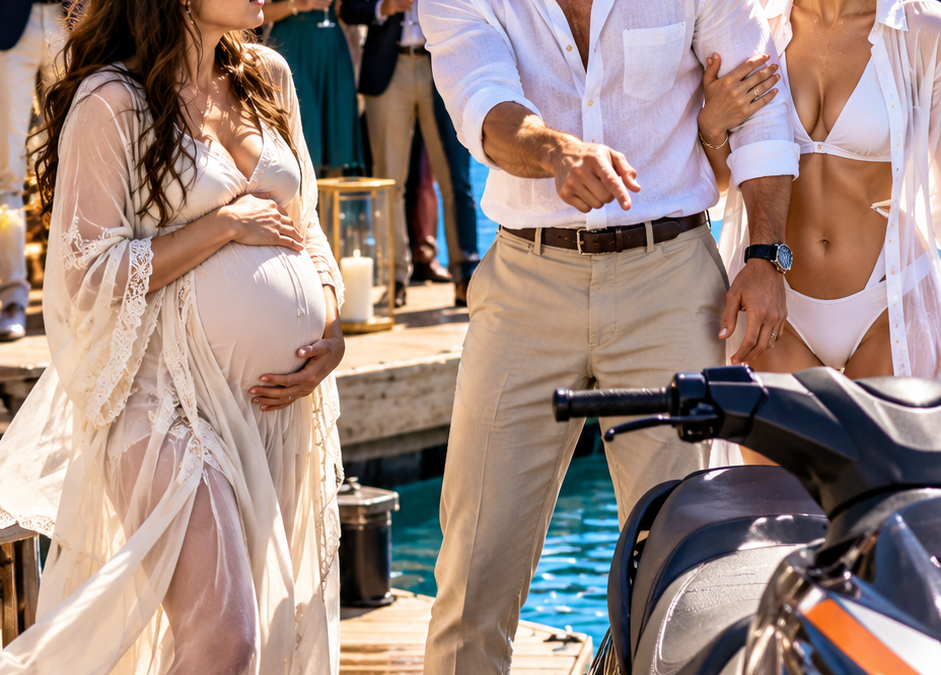
Not the words themselves. Not even the humiliation of standing barefoot on a private dock in Cabo, nine months pregnant, with the wind whipping my cover-up around my swollen ankles while strangers pretended not to stare.
It was the smile.
Charming. Polished. Effortless.
The same smile he used in boardrooms when he needed people to trust him with money. The same smile he gave magazine photographers when they asked him how he had built Vance Meridian from a failing logistics startup into one of the fastest-growing private firms on the West Coast.
The same smile he had used on me ten years earlier when he was broke, brilliant, and sleeping four hours a night on a couch in the back of a rented office.
Back then, I thought that smile meant hope.
On that dock, I finally saw what it had become.
Performance.
I wrapped both hands around my stomach and tried to keep my voice steady.
“Julian, my pregnancy is high-risk. You know that.”
Our daughter shifted under my ribs as if she knew her mother was trying not to tremble.
Julian glanced at the people around us. Investors in linen shirts. Executives from his company. Their spouses holding champagne. Resort staff frozen in that careful posture of people trained to witness uncomfortable things without reacting.
And beside him stood Victoria Hayes.
She wore a white swimsuit under an open silk shirt, her auburn hair pinned back like she had been styled for a yacht advertisement. She was Julian’s chief strategy officer. At least, that was what everyone called her in public.
In private, she had been much more.
I had known for six months.
I had not said a word.
Victoria tilted her head at me, smiling like she was already telling this story later.
“It’s only one quick ride,” she said. “Don’t tell me you’re afraid.”
Afraid.
The word floated between us.
I had grown up in military hospitals, naval bases, and secure briefing rooms. My father, Admiral Hector Sterling, had commanded fleets before most of Julian’s investors learned to read a balance sheet. My mother, Celeste Sterling, controlled one of the most powerful family trusts in the country, though she preferred garden clubs and handwritten letters to any public show of influence.
I had spent most of my adult life hiding both names.
Not because I was ashamed of them.
Because I wanted to know what love looked like when no one could profit from it.
When I met Julian, I introduced myself as Genevieve Hale, using my grandmother’s maiden name. He knew I came from money, but he never knew how much. He knew I had private accounts, but not where they came from. He knew I had connections, but not their reach.
When his company nearly collapsed in its third year, a quiet investment saved him.
He never knew it came from me.
He believed an anonymous private equity group had seen his potential.
I let him believe that because I loved him, and because part of me wanted to protect his pride.
That was my first mistake.
My second was believing gratitude and loyalty were the same thing.
Julian stepped closer and lowered his voice, though not enough to keep Victoria from hearing.
“Sweetheart, don’t make this awkward.”
I looked at him.
“I’m not riding a jet ski at nine months pregnant.”
His jaw tightened for half a second.
Then the mask returned.
“You’re right,” he said, turning slightly toward the watching crowd. “Of course you’re right. Forget I asked.”
He kissed my forehead.
The gesture looked tender from a distance.
Up close, it felt like a warning.
“Here,” he said, pressing two capsules into my palm. “Your prenatal vitamins. You forgot them at breakfast.”
I looked down at them.
Small. White. Familiar.
Julian had handed me vitamins before. He had organized my medications when my blood pressure spiked in the second trimester. He had sat beside me during doctor appointments, nodding gravely when specialists warned us that stress, impact, or sudden trauma could trigger complications.
He knew everything.
Every risk.
Every warning.
Every possible consequence.
I swallowed the capsules with water from the bottle he handed me.
I trusted him.
That was the mistake that almost killed us.
I remember the dock blurring first.
Victoria was laughing at something one of the investors said. Julian’s hand rested at the small of my back. The sun flashed against the ocean so brightly that the world seemed overexposed.
Then my legs weakened.
“Julian,” I whispered.
He caught my elbow.
To anyone watching, he looked attentive.
Concerned.
Like a devoted husband steadying his pregnant wife.
“You should lie down,” he said softly.
My tongue felt heavy.
“What did you give me?”
His smile did not change.
“Something to help you relax.”
The last thing I saw before darkness took me was Victoria looking at my stomach.
Not at my face.
My stomach.
As if the child inside me were not a baby, but a deadline.
When I woke, the ocean was attacking me from every direction.
Salt water hit my face first. Then wind. Then the brutal slap of waves against fiberglass. My arms were stretched forward, wrists tied to the handles of a jet ski. A thick strap crossed under my chest and around my back, locking me against the machine. My stomach pressed painfully against the seat, every jolt sending terror through my body.
For several seconds, I could not understand where I was.
Then the tow rope snapped tight.
The jet ski lurched forward.
Pain tore through my abdomen so sharply that I screamed.
Ahead of me, another jet ski cut across the water.
Victoria was driving it.
She glanced back over her shoulder, her sunglasses bright in the sun.
And she smiled.
“Julian!” I screamed.
My voice ripped apart in the wind.
The dock was far behind us, but not too far to see him.
Julian stood there with a glass of scotch in one hand and binoculars in the other.
Watching.
Not running.
Not shouting for help.
Watching.
A coldness more terrifying than the water moved through me.
This was not an accident.
This was not a prank gone too far.
This was a plan.
“Please!” I screamed. “I’m pregnant! Stop!”
Victoria laughed.
“Then hold on tighter, honey.”
The tow rope jerked again.
My body slammed forward. Something deep inside me twisted with a pain so intense that my vision flashed white.
“No,” I gasped. “No, no, no…”
I looked down.
At first, I thought the red in the water was a reflection from the jet ski.
Then I felt warmth running down my legs.
Blood.
My daughter shifted once.
Then stillness.
Panic broke through whatever drug Julian had given me.
I fought the straps, but my wrists were tied too tightly. The rope pulled my jet ski over another wave, and my stomach hit the front console. I screamed until my voice cracked.
Victoria swerved deliberately, making my jet ski whip sideways through the wake.
The ocean blurred.
The sky tilted.
For one horrifying second, I thought I would flip.
Then something hard struck my wrist.
My father’s watch.
Most people thought it was sentimental. A heavy black tactical watch with a scratched face and a worn band, too plain to match the resort, too old to look expensive. My father had given it to me three years earlier after Julian complained that I was “too cautious” about security.
Dad had fastened it around my wrist himself.
“You press this button,” he had said, tapping a nearly invisible ridge on the side, “and I don’t care where you are. I’ll know.”
I had laughed then.
“Dad, I’m married. I’m not deployed.”
His expression had not changed.
“Danger doesn’t ask for your résumé.”
I had worn it mostly to humor him.
Now, with blood spreading beneath me and Victoria laughing ahead of me, I twisted my wrist against the handlebar.
The first time, my fingers slipped.
The second time, the jet ski bucked and my shoulder nearly dislocated.
The third time, my thumb found the ridge.
I pressed.
A small vibration pulsed against my skin.
For two seconds, nothing happened.
Then the watch warmed.
Static crackled near my wrist.
A voice came through.
“Genevieve?”
My father.
The sound of him almost destroyed me.
“Dad,” I whispered.
His voice sharpened instantly.
“Genevieve, what happened?”
I looked at the red water around me.
At the rope pulling me farther from shore.
At Victoria’s hair whipping in the wind as she glanced back, triumphant.
At Julian standing on the dock, waiting to become a widower.
“They’re trying to kill us,” I said.
There was no hesitation.
No confusion.
No wasted question.
My father’s voice turned into something I had heard only once before, when I was sixteen and a naval officer came to our house to tell him my grandfather had died.
Cold.
Controlled.
Terrifying.
“Hold on, baby girl.”
“I can’t.”
“Yes, you can.”
“My baby—”
“I heard you,” he said. “I’m coming.”
The signal stayed open.
I heard voices behind him. Orders. Coordinates. Someone repeating my location. Someone saying Coast Guard. Someone else saying medevac.
Victoria looked back again.
This time, she noticed my mouth moving.
Her smile faltered.
“What are you doing?” she shouted.
I did not answer.
She saw the watch.
Her face changed.
For the first time that day, Victoria Hayes looked afraid.
She accelerated.
The tow rope snapped tight so violently that my wrists burned against the restraints. The jet ski beneath me lurched, and pain tore through me again.
I screamed.
My father heard it.
The line exploded with his voice.
“Genevieve!”
“I’m here,” I sobbed. “I’m here.”
“Stay awake.”
“I’m bleeding.”
“I know.”
“No, Dad, I’m bleeding.”
His voice almost broke.
Then it steadied.
“Listen to me. You listen to my voice. You keep breathing. You keep talking.”
The sky changed before the water did.
A deep mechanical thunder rolled over the bay.
Victoria looked up.
I did too.
The first helicopter came in low over the resort, dark against the white blaze of afternoon. A second followed from the north. Then Coast Guard vessels appeared beyond the breakwater, cutting through the water with impossible speed.
The helicopter dropped so low that seawater exploded around us.
Victoria screamed.
Commands thundered through speakers.
“Release the tow line! Cut power immediately!”
Victoria did neither.
She tried to turn.
The tow rope dragged my jet ski sideways.
Pain split through me.
Then a Coast Guard vessel crossed in front of her, close enough that she panicked and released the rope.
My jet ski spun.
The horizon disappeared.
For a moment, there was only water, sky, and the sound of my own body failing.
Then hands were on me.
Real hands.
Gloved hands.
A man shouting, “Ma’am, stay awake!”
Someone cut the strap across my body.
Someone else sliced through the restraints around my wrists.
“My baby,” I gasped.
“We’ve got you.”
“My baby.”
“Ma’am, listen to me. We are getting you out.”
Through blurred vision, I saw Victoria in the water, thrashing as officers dragged her toward a vessel. Her face was twisted with terror now, all elegance gone.
Good.
Then I saw the dock.
Julian was running.
For half a second, some broken part of me thought he was running toward me.
Then I saw the phone in his hand.
He was trying to call someone.
Or delete something.
Or warn someone.
Two armed officers intercepted him before he made it ten feet.
“This is insane!” Julian shouted. “My wife agreed to the ride!”
Even from the water, I found enough strength to laugh.
It came out broken and bloody.
“You drugged me.”
His face changed.
Only slightly.
But my father saw it.
Admiral Hector Sterling stepped out of the second helicopter wearing a dark flight jacket and the expression of a man who had already decided the room was his, even if the room was an entire coastline.
Julian stared at him.
Then at the officers.
Then at me.
“Genevieve,” he said, voice cracking. “Who is that?”
My father walked straight past him.
He did not slow.
He did not glance at Victoria.
He came to me, dropped to one knee on the wet deck of the rescue vessel, and took my face in both hands.
“Baby girl.”
Julian went white.
“You’re her father?”
Dad did not even look at him.
A medic placed an oxygen mask over my face.
“We need transport immediately,” she said. “Possible placental abruption.”
Those words erased everything else.
The ocean.
Victoria.
Julian.
Money.
Marriage.
Betrayal.
All of it vanished beneath one terrible truth.
My daughter was in danger.
I grabbed my father’s sleeve.
“Save her.”
His hand covered mine.
“We will.”
“You promise?”
His eyes shone, but his voice remained steady.
“I promise.”
As they lifted me onto the helicopter, Victoria began screaming from the dock.
“This wasn’t supposed to happen!”
Julian turned on her.
“Shut up!”
Too late.
Every officer heard it.
So did my father.
He finally looked at her.
“What wasn’t supposed to happen?”
Victoria started crying.
Julian lunged toward her.
Two men slammed him against the railing.
Then an investigator opened Victoria’s waterproof bag.
Inside was a second phone.
On the screen was a scheduled email addressed to Julian.
Subject line:
AFTER GENEVIÈVE.
My father opened the attachment.
Insurance documents.
My life insurance documents.
Forty million dollars.
Beneficiary: Julian Vance.
But beneath them was something worse.
A signed agreement transferring control of Julian’s company if I died before giving birth.
Victoria looked at him in horror.
“You told me she was worth ten million.”
Julian stopped struggling.
My father finally smiled.
There was no warmth in it.
“No,” he said. “My daughter is worth considerably more.”
Then the monitor beside me began screaming inside the helicopter.
The medic’s face changed.
“Fetal distress!”
The helicopter lifted so fast my stomach dropped.
Or maybe that was the blood loss.
My father stayed beside me, one hand locked around mine, the other braced against the cabin wall as the aircraft banked toward the hospital. The medic pressed hard against my abdomen while another started an IV. Voices overlapped. Numbers. Blood pressure. Heart rate. Estimated time.
I caught fragments.
“Operating room on standby.”
“Possible emergency C-section.”
“Notify neonatal team.”
I tried to lift my head.
The medic pushed me gently back.
“Ma’am, stay still.”
“My baby,” I whispered again.
My father leaned close.
“Her name, Genevieve.”
I blinked up at him.
“What?”
“Tell me her name.”
I knew what he was doing.
He was anchoring me.
He had done it when I was a child terrified of thunderstorms. He had done it when my brother broke his arm falling from a horse. He had done it when Mom went into surgery years ago and I shook so badly I could not hold a cup.
Name what you are fighting for.
“Aria,” I whispered.
His face tightened.
“You named her?”
“I was waiting to tell Julian.”
The words hurt more than the injuries.
Dad brushed wet hair from my face.
“Then tell me.”
“Aria Celeste.”
After my mother.
His eyes filled.
“She’ll love that.”
“She has to live first.”
“She will.”
The medic looked at my father.
He looked back.
For a moment, the admiral was gone, and only my dad remained.
“Please,” he said quietly.
The medic nodded.
“We’re doing everything.”
At the hospital, everything became white light.
Hands moved me. Voices asked questions I could not answer. Someone cut away the soaked remains of my resort dress. A doctor leaned over me, calm and direct.
“Genevieve, I’m Dr. Alvarez. We need to deliver your baby now.”
“Is she alive?”
“She has a heartbeat.”
I cried then.
Not with relief.
With terror so deep it had no shape.
My father was not allowed into the operating room. I heard him arguing until someone said, “Admiral, you can help her by letting us work.”
Then the doors closed.
I remember the ceiling.
The mask.
Cold.
Pressure.
Someone saying my blood pressure was dropping.
Someone else saying, “We need to move.”
I remember thinking, absurdly, that Julian would hate the scar.
Then I remembered Julian had tried to kill me.
After that, I let the anesthesia take me.
When I woke, I heard beeping.
Not ocean.
Not helicopters.
Machines.
Hospital machines.
My throat was dry. My body felt as if I had been broken open and put back together by strangers with urgent hands.
I turned my head.
My mother sat beside the bed.
Celeste Sterling never looked undone. Even at funerals, even in crisis, she carried herself with the kind of grace people mistook for fragility until they made the mistake of challenging her.
But now her hair was loose around her face, her eyes red, her hands wrapped around mine.
“Mom,” I whispered.
She stood so quickly the chair scraped.
“Oh, my darling.”
“My baby.”
“She’s alive.”
The world stopped.
I closed my eyes.
The tears slipped out before I could stop them.
“She’s small,” Mom said. “She’s in the neonatal unit. But she’s alive, Genevieve. She cried.”
“She cried?”
“She cried,” my mother said, smiling through tears. “A furious little sound. Very Sterling.”
A broken laugh escaped me.
Then pain punished me for it.
“Julian?”
My mother’s face changed.
It became still.
Dangerously still.
“In custody.”
“Victoria?”
“In custody.”
“Dad?”
“With Aria.”
Of course he was.
The first time I saw my daughter, she was inside a clear incubator, wearing a tiny cap too large for her head.
She looked impossibly small.
Not fragile.
No.
That was not the right word.
She looked unfinished.
As if the world had demanded she arrive before she was ready, and she had come furious about the inconvenience.
My father stood beside the incubator with both hands behind his back, shoulders rigid, eyes fixed on her.
He did not notice me at first.
Or maybe he did and needed a moment before turning around.
A nurse pushed my wheelchair closer.
“Five minutes,” she said. “No more.”
My father stepped aside.
I placed one hand against the incubator wall.
“Hi, Aria.”
She moved.
Barely.
One tiny fist curling near her cheek.
The sound that left me was not a sob exactly.
It was something older.
Something primal.
“She knows your voice,” Dad said.
I looked at him.
His eyes were wet.
“Dad.”
“I know.”
I did not have to finish.
I am sorry I hid so much.
I am sorry I trusted him.
I am sorry you had to hear me say they were trying to kill us.
I am sorry I made you rescue me.
He knew all of it.
And because he was my father, he answered the part I could not say.
“You did nothing wrong by wanting to be loved for yourself.”
That destroyed me.
I cried beside my daughter’s incubator while my father stood guard like the whole world might still try to take her from us.
For three days, I lived between my hospital room and the neonatal unit.
My body hurt in ways I did not have words for. My wrists were bruised. My abdomen felt like a battlefield. Doctors checked me constantly for complications. Nurses helped me sit up, stand, breathe, pump milk, sleep, wake, sign forms, answer questions.
And then came the investigators.
Mexican authorities.
American federal agents.
Insurance fraud specialists.
Corporate attorneys.
My father managed the chaos like a naval operation, but my mother managed the consequences.
She froze my private accounts before Julian could touch anything.
She notified trustees.
She activated clauses in the investment structures Julian had never bothered to understand because he thought I was a decorative wife with a convenient inheritance.
By the fourth day, Vance Meridian’s emergency board meeting had removed Julian as CEO pending criminal investigation.
By the fifth, the anonymous investor who had saved his company years earlier was no longer anonymous.
It was me.
My signature.
My money.
My terms.
Julian’s empire had survived because I had believed in him.
Now it would survive without him because I had been smart enough not to give him control.
He asked to see me on the sixth day.
My father said no before the request reached my room.
My mother asked me.
That was the difference between them.
Dad protected like a shield.
Mom protected like a blade hidden in silk.
“Do you want to see him?” she asked.
I was sitting in a hospital chair with a pillow against my incision, watching Aria’s monitor on a tablet feed.
“No.”
She nodded.
Then I changed my mind.
“Wait.”
Mom turned.
I looked at the tiny rise and fall of Aria’s chest on the screen.
“Yes,” I said. “I want to see him.”
My father hated it.
He did not say so.
He simply stood beside the window in my room, jaw tight, while two federal agents arranged the meeting under strict supervision.
Julian was brought in wearing a wrinkled shirt, no belt, and handcuffs.
I had never seen him without polish.
No tailored suit.
No expensive watch.
No carefully controlled lighting.
Just a man with bloodshot eyes and a face that had begun to understand money could not fix everything.
He stopped when he saw me.
For one second, I saw something like shock.
Maybe guilt.
Maybe only surprise that I was still alive.
“Genevieve,” he said.
I hated the way my name sounded in his mouth.
“Sit down.”
He glanced at the agents.
Then obeyed.
My father stood near the wall.
My mother sat beside my bed.
Julian looked from one to the other, finally understanding the scale of what he had never known.
“Your father is Admiral Sterling.”
“Yes.”
“And your mother…”
“Celeste Sterling.”
His face tightened.
“You lied to me.”
For a moment, I simply stared.
Then I laughed.
It hurt so badly that I had to press a hand against my abdomen, but I laughed anyway.
“I lied to you?”
“You hid who you were.”
“I hid my family name,” I said. “You hid a mistress, an insurance policy, a murder plan, and a contract to steal my company interest after my death. Let’s not pretend those are equal.”
His eyes flashed.
“It wasn’t supposed to go that far.”
My father took one step forward.
I lifted a hand.
He stopped.
That small obedience almost made Julian flinch.
He was beginning to realize that power did not always announce itself loudly.
“What was supposed to happen, Julian?”
He swallowed.
“You were supposed to get scared. You were supposed to agree to revise the trust documents.”
I stared at him.
“What?”
His mouth tightened as if he had not meant to say that.
My mother leaned forward slightly.
“What trust documents?”
Julian looked away.
I understood before he answered.
The life insurance was only one part.
The company agreement was only one part.
The ride was not originally meant to kill me.
It was meant to terrify me.
To force me into early labor or medical crisis. To make me dependent, frightened, and easier to manipulate.
“You wanted me to think I was vulnerable,” I said.
He said nothing.
“You wanted to scare me into giving you control.”
“I built that company.”
“With my money.”
“I made it valuable.”
“And that made you think you owned me?”
His face hardened.
“There it is.”
“What?”
“That Sterling arrogance.”
My father’s voice cut through the room.
“Careful.”
Julian went silent.
I leaned back against the pillows.
For the first time, I did not feel like his wife.
I felt like a witness.
“You never loved me,” I said.
He looked at me quickly.
“That’s not true.”
“Then when did it stop?”
He opened his mouth.
Closed it.
And in that silence, I got my answer.
Maybe he had loved me in the beginning.
Maybe he had loved the version of me who believed in him, funded him quietly, softened his failures, and asked for nothing but honesty.
But somewhere along the way, he had begun to love what I gave him more than who I was.
Then he found Victoria, who loved the version of him he wanted to become.
Ruthless.
Untouchable.
Unburdened.
“You should have told me who you were,” Julian said.
“No,” I said. “I should have believed you when you showed me who you were.”
He had no answer for that.
I looked at the agents.
“I’m done.”
As they lifted him to his feet, Julian turned desperate.
“Genevieve, please. We can still fix this.”
My mother’s voice was soft.
“There is no we.”
Julian looked at her.
She smiled faintly.
“And there is no this.”
They took him away.
Victoria tried to save herself within forty-eight hours.
Women like Victoria Hayes believe loyalty is a luxury for people without better options. Once she understood Julian could not protect her, she started talking.
She gave investigators messages.
Recordings.
Emails.
A timeline.
She claimed the plan had been Julian’s. Julian claimed the plan had been hers. They both lied. They both told partial truths. They both underestimated how much evidence they had created because cruelty makes people careless when they believe the victim will not survive to explain it.
The scheduled email titled AFTER GENEVIÈVE became the beginning.
Not the end.
Investigators found searches on Julian’s laptop about maritime accident liability, high-risk pregnancy complications, offshore jurisdiction, and insurance contestability. They found messages from Victoria joking that “one big wave could solve everything.” They found the drug Julian had given me inside a travel pill case in his luggage, residue matching my bloodwork.
And they found something that made my mother go silent for nearly a full minute.
A draft press statement.
It had been prepared before the Cabo trip.
Julian had written it as if I were already dead.
My beloved wife, Genevieve, was fearless, luminous, and full of life…
I read only the first line before closing the folder.
I did not need to see how he planned to mourn me.
Aria remained in the neonatal unit for nineteen days.
Those nineteen days became the real trial before any courtroom.
I learned the rhythm of monitors. The meaning of oxygen levels. The difference between a nurse’s calm face and a worried one. I learned how to hold my daughter with wires attached to her body. I learned that milk could be measured in milliliters and hope could shrink to the size of a feeding tube.
My father visited every morning before meeting investigators.
He never came empty-handed. Sometimes coffee. Sometimes clean socks. Once, inexplicably, a stuffed octopus because a nurse told him premature babies liked tentacles to grip.
The sight of Admiral Hector Sterling seriously comparing plush octopuses in a hospital gift shop nearly made my mother laugh for the first time in days.
Mom handled the empire.
That was what I began calling it.
The lawyers. The trust. The company. The press. The board. The insurance investigators. The quiet calls from people who suddenly remembered how much they valued our family.
She moved through them all with lethal grace.
One afternoon, she sat beside me while I held Aria against my chest.
“I need to ask you something,” she said.
I looked up.
“About Julian?”
“About you.”
I waited.
“When this becomes public, they will tell the story in a way that makes sense to strangers. Billionaire family. Secret heiress. Greedy husband. Mistress. Attempted murder. Miracle baby.”
I looked down at Aria.
“She is a miracle.”
“Yes,” Mom said. “But you are not only a headline. Before the world gets loud, I want to know what you want.”
No one had asked me that yet.
Everyone had asked what I remembered, what I signed, what I knew, what hurt, what medication I needed, what statement I would give.
Not what I wanted.
“I want my daughter safe.”
“She is.”
“I want Julian away from us forever.”
“He will be.”
“I want the company protected from him.”
“It is.”
My voice dropped.
“And I want to stop being ashamed that I wanted him to love me without knowing my last name.”
My mother’s face softened.
“Oh, Genevieve.”
“It feels stupid now.”
“No,” she said. “It feels human.”
I cried quietly because Aria was sleeping against me, and I had learned how to fall apart without waking her.
The criminal proceedings began months later.
By then, Aria had grown round-cheeked and furious, with her grandfather’s stare and my mother’s ability to make entire rooms reorganize themselves around her comfort.
I filed for divorce from Julian the day after I returned home.
Not to our old house.
Never there again.
I moved into my parents’ coastal estate temporarily, though temporary became complicated once my father converted an entire wing into what he called “basic security upgrades” and my mother called “your father attempting to invade his own home.”
The first time I slept more than three hours, I woke to find Dad sitting in a chair outside the nursery door, reading naval history with a baby monitor clipped to his jacket.
“Dad,” I whispered.
He looked up.
“What?”
“Are you guarding a newborn?”
He turned a page.
“She’s high value.”
I should have laughed.
Instead, I cried.
Healing is like that.
It ambushes you in doorways.
Julian’s trial lasted seven weeks.
He entered the courtroom every day in a suit I had bought him years earlier. That bothered me until my mother told his attorney, through channels I still do not fully understand, that any clothing purchased with marital funds was being inventoried.
He wore a cheaper suit the next day.
Victoria testified against him under an agreement, then destroyed herself on cross-examination by admitting she had expected to become interim head of strategy after my death.
Julian stared at her like betrayal was something only he was allowed to commit.
The prosecutor played the helicopter footage.
My voice came through the courtroom speakers.
“They’re trying to kill us.”
I heard my father inhale sharply behind me.
I did not turn around.
Then came Victoria’s voice.
“This wasn’t supposed to happen!”
Then Julian’s.
“Shut up!”
The jury heard it three times.
By the third, Julian stopped looking at me.
The hardest moment was not the footage.
It was the doctor.
Dr. Alvarez testified about placental abruption, fetal distress, blood loss, and how close Aria and I had come to dying. She spoke clinically, but her hands tightened once around the edge of the witness stand.
That was when I understood how many people had fought for us while I was unconscious.
Not because of my last name.
Because we were alive and needed saving.
Julian’s defense tried to claim I had agreed to the ride and panicked afterward because of pregnancy hormones and family influence. That argument lasted until the toxicology report was entered.
Then the insurance documents.
Then the company transfer agreement.
Then the draft obituary.
By the end, even his attorney looked tired of him.
The jury convicted Julian on charges tied to attempted murder, conspiracy, assault, fraud, and financial crimes. Victoria was sentenced separately. Her cooperation reduced her time, but it did not erase the image of her laughing while I begged for my life.
Nothing could.
At sentencing, Julian asked to speak.
Against advice, apparently.
He stood in his prison uniform and turned toward me.
For one insane second, I thought he might apologize.
Instead, he said, “Genevieve knows I never would have hurt the baby.”
The courtroom went still.
My father’s hand closed around the bench in front of him.
I stood.
The judge looked at me.
I had already given my victim impact statement. I had already described the pain, the fear, the surgeries, the nightmares, the way I woke up gasping whenever I smelled salt water.
But that sentence could not stand.
“Your Honor,” I said, “may I respond?”
The judge studied me.
Then nodded.
I turned toward Julian.
“You keep separating us,” I said.
He frowned.
“Me and my daughter. My body and her body. My life and hers. You say you would not have hurt the baby as if she was not inside me when you tied me to that machine. As if every wave that hit me did not hit her. As if every drop of blood I lost did not threaten her.”
My voice shook, but it did not break.
“You did hurt her. She survived anyway. That is not your defense. That is her strength.”
Julian looked away.
I faced the judge.
“That is all.”
My father cried that day.
Quietly.
But I saw.
Six months after the sentencing, I returned to the ocean.
Not Cabo.
Never Cabo.
A quiet stretch of beach near my parents’ estate, early morning, no cameras, no guests, no polished cruelty pretending to be love.
Aria was strapped against my chest in a carrier, wearing a sun hat too large for her head. My father walked on one side of me. My mother on the other.
The waves rolled in gently.
Still, my breath caught.
My body remembered before my mind could argue.
Dad noticed.
“We can go back.”
“No.”
Mom touched my arm.
“Darling—”
“No,” I said again, softer. “I need her to know the ocean is not only what happened to us.”
So we walked.
Slowly.
The water reached my ankles.
I shook.
Aria slept through all of it, unimpressed by trauma, weather, and symbolism.
A laugh broke out of me.
My parents looked alarmed.
“She doesn’t care,” I said.
Mom smiled.
“She’s a baby.”
“She should appreciate the moment.”
Dad looked down at his granddaughter.
“She outranks the moment.”
That sounded exactly like something he would say.
And somehow, standing there with the tide around my feet, I realized I was no longer inside the worst day of my life.
I would always carry it.
My wrists still bore faint marks.
My scar still pulled when I moved too fast.
Some nights, I woke hearing Victoria’s laugh and Julian’s voice telling me to stop acting fragile.
But Aria’s fingers curled against my shirt.
My parents stood beside me.
The ocean came in.
The ocean went out.
It had not kept Julian’s secret.
It had carried my signal.
It had brought helicopters, rescuers, evidence, truth.
It had nearly taken everything.
It had failed.
One year later, I stood in the boardroom of Vance Meridian for the first time since Julian’s arrest.
The company had a new name by then.
Meridian Sterling Logistics.
Not because I needed my family stamped across it, but because I was done hiding the truth from rooms that profited from my silence.
The executives stood when I entered.
Once, I would have hated that.
Now, I understood respect was not always vanity.
Sometimes it was a boundary.
I placed my hands on the table and looked at the people who had known Julian, admired him, feared him, excused him, or looked away because success made discomfort profitable.
“My husband built this company’s public face,” I said. “But he did not build it alone. No one does. Not founders. Not investors. Not executives. Not families.”
The room remained silent.
“For years, I believed staying hidden made my love purer. I thought if Julian did not know the full power behind me, then whatever he felt for me would be real.”
I paused.
“I was asking the wrong question.”
Several people looked down.
“Love that requires a woman to disappear is not love. Loyalty that depends on silence is not loyalty. And power hidden from the wrong people does not protect you when those people mistake your quiet for weakness.”
I saw Victoria’s empty chair in my mind.
Julian’s smile.
The dock.
The blood in the water.
Then I saw Aria’s tiny fist through the incubator wall.
And I continued.
“This company will not be run by fear, fraud, or worship of one man’s ambition. It will be rebuilt transparently, or it will not be rebuilt at all.”
No one applauded.
Good.
I did not need applause.
I needed compliance.
After the meeting, my father called.
“How did it go?”
“You would have been proud.”
“I’m always proud.”
“Dad.”
“What?”
“You can’t say things like that every time.”
“I’m an admiral. I can say what I want.”
I smiled despite myself.
In the background, I heard my mother telling him to stop hovering and give the phone to the baby.
Aria babbled into the receiver.
My entire body softened.
“Hi, my love,” I whispered.
She responded with a noise that sounded like a command.
My father came back on the line.
“She wants a promotion.”
“She can have the company.”
“She’d run it better than half the executives.”
“She can’t sit up without falling over.”
“Neither can half the executives.”
I laughed then.
A real laugh.
Not untouched by grief.
Not free of memory.
But mine.
That night, I returned home and found Aria asleep in her crib, one hand curled near her face. I stood there for a long time, watching her breathe.
I thought about the woman I had been on that dock.
Nine months pregnant. Still hoping Julian’s cruelty had a limit. Still believing my hidden life had protected something sacred.
Then I thought about the woman strapped to the jet ski, bleeding into the sea, reaching for one hidden button because a father who loved her had refused to let her walk through the world unprotected.
And I thought about the woman I was now.
Not porcelain.
Not fragile.
Not a secret.
Aria stirred.
I placed a hand over my heart and whispered the truth I wanted her to grow up knowing.
“You do not have to make yourself smaller to be loved.”
Outside, the ocean moved in the distance, dark and endless under the moon.
Once, Julian thought the water would hide what he had done.
Instead, it carried the signal that exposed him.
It carried the beginning of my daughter’s life.
And it carried me back to myself.








