𝗙𝗨𝗟𝗟 𝗦𝗧𝗢𝗥𝗬 The Notice on My Workshop Door Was Only the First Thing Monica Planned to Tear Down
𝗙𝗨𝗟𝗟 𝗦𝗧𝗢𝗥𝗬
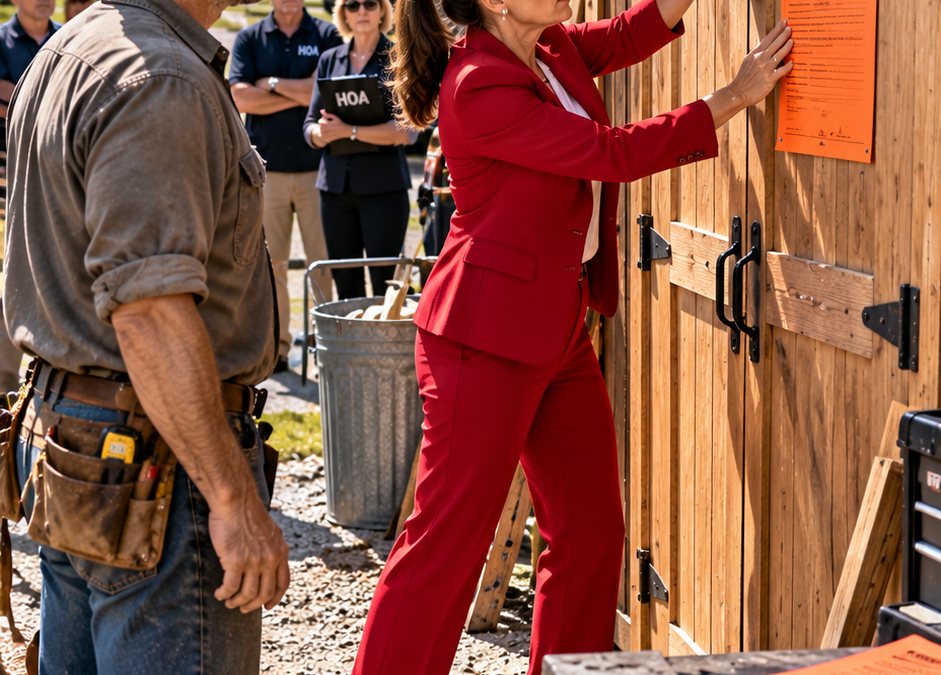
She turned and walked toward her white SUV, heels clicking across my gravel like a metronome.
I watched her leave.
Then I looked down at the orange paper in my hand.
For seventeen years, that workshop had survived hail, drought, two windstorms, one divorce, my father’s death, and every bad month my business ever had.
Now somebody in a red suit had given it three weeks to disappear.
I went back inside.
The table saw hummed down to silence. Sunlight came through the west window and caught dust floating above Dad’s old workbench. The shop smelled like cedar and oil and old coffee. Everything was exactly where it had been that morning, but it no longer felt safe.
I laid the notice beside a tape measure and tried to finish the cabinet doors I had promised a customer by Monday.
I made one cut wrong.
Then another.
That had not happened in years.
I shut everything off.
Around seven that evening, I heard tires crunch slowly up my driveway.
Harold Finch climbed out of his old Ford pickup carrying an envelope.
Harold lived four houses down. Seventy-one years old, narrow through the shoulders, permanent dirt beneath his fingernails from the greenhouse his wife had loved before she died. He did not bother saying hello. He walked into my workshop and put an orange sheet on the bench beside mine.
“Same paper,” he said. “Same wording. Same twenty-one-day order.”
I looked at the notice.
“They’re telling me to remove Ellen’s greenhouse.”
His thumb rubbed the edge of the envelope.
“Says it’s sitting on their land.”
I stared at him.
“Your greenhouse is almost three hundred feet from my shop.”
“I know.”
My phone buzzed against the workbench.
Naomi Brooks.
She lived two streets over.
She had sent a photograph.
Orange notice attached to her backyard fence.
I had not finished reading her message when another came in from Curtis Bell.
Then another from a number I barely recognized.
Shed.
Fence.
Garden structure.
Access ramp.
Chicken run.
Covered work area.
Different homes. Different things people had built, repaired, painted, planted around, and lived with for years.
Same sentence.
HOA property.
By 11:43 that night, twelve orange notices were spread across my workbench.
Mine in the center. Eleven more around it.
Harold stood beside me under the fluorescent lights while moths tapped against the window screen. The shop smelled like cedar dust and hot coffee. Outside, the neighborhood was quiet enough to hear the old wall clock ticking above Dad’s pegboard.
I counted the notices again.
Twelve.
Monica had not come for my workshop.
She had come for a strip of our lives, one backyard at a time.
And for the first time that day, I stopped looking at the twenty-one-day deadline printed across my own name.
Sunday morning smelled like wet cedar and coffee.
A storm had rolled through before dawn, leaving the pavement black and the grass heavy with water. I loaded my tape measure, cordless driver, level, pry bars, fasteners, and a pair of sawhorses into my truck.
Eleven addresses were written on the back of Monica’s orange notice.
I started with Harold.
His greenhouse sat behind his house, exactly where it had stood since 2009. Condensation clouded the glass. Inside, tomato vines climbed strings toward the roof, and the air smelled like damp soil and fertilizer.
Harold ran his fingers along the aluminum door frame.
“Ellen picked this one.”
His wife had been gone for years.
He did not need to explain why he had not torn it down.
I checked the base, measured the frame, and walked around it twice.
“We can reinforce the corners,” I said. “If we have to move it, we can break it into sections.”
He nodded, but his eyes stayed on a faded ceramic planter near the door.
Naomi Brooks was next.
She answered in blue hospital scrubs, looking like she had slept maybe three hours after a night shift. Her notice had been screwed to a six-foot privacy fence running along the rear of her yard.
On the other side of the fence, her eight-year-old son chased a red rubber ball across the grass.
“They want all of this gone?” she asked.
“That’s what the letter says.”
Her hand tightened around her coffee mug.
“That fence is why I bought this house.”
She pointed toward the street beyond the side gate.
“I work nights. My mother watches him. Without this, he doesn’t play outside unless somebody stands over him.”
I walked the fence line.
The posts were solid. The boards had weathered but held. Instead of telling her everything would be fine, I marked the sections we could detach without ruining the panels.
By noon, the humidity had climbed high enough that my navy shirt stuck between my shoulder blades.
Curtis Bell met me beside a weathered twelve-by-six shed packed with socket sets, fishing gear, an air compressor, and enough truck parts to rebuild half a transmission.
Curtis was built like a refrigerator and did not waste words.
“Can you move it?”
“Yeah.”
“How fast?”
I looked underneath. Concrete blocks. Wood skids. Tight access on the east side.
“With my equipment, half a day if nothing fights us.”
He glanced at the orange letter nailed beside his door.
“Everything fights us.”
By late afternoon, I had seen a chicken run, two fences, a garden shed, a covered work area, and a wheelchair ramp belonging to a retired school librarian named Beth Porter.
That one slowed me down.
Beth’s husband used that ramp every day.
There was no version of remove your structure that was merely an inconvenience there. Taking down that ramp changed whether a man could get from his kitchen to his own backyard.
I stood at the bottom of it with my tape extended, writing measurements against my palm because I had run out of clean paper.
That was when the shape of it became visible.
The threatened structures were different, but they all touched the same wandering strip behind the neighborhood. Not a straight line. More like someone had dragged a thick marker behind the houses and called everything beneath it theirs.
I should have stopped there and thought harder.
Instead, I did what I had always done when something broke.
I reached for tools.
Monday, I moved two customer jobs.
Tuesday, I canceled one.
Wednesday night, I was at Naomi’s until nearly ten, replacing ordinary hinge screws with structural ones so her fence sections could come apart cleanly if we had to move them.
Thursday, Curtis backed his trailer behind my workshop, and we welded temporary brackets for his shed. Sparks snapped against the concrete floor. The smell of hot steel mixed with sawdust. Harold sat at my workbench labeling greenhouse panels with masking tape.
For a few days, it felt like progress because my hands never stopped moving.
That was the trap.
I was solving eleven separate problems.
Monica only had to wait for me to run out of hours.
Friday afternoon, my phone rang while I was underneath Curtis’s shed with a bottle jack.
The caller ID showed Molly.
I wiped grease across my jeans and answered.
“Hey, sweetheart.”
Silence.
Only half a second.
But I knew.
“You remember dinner tonight?” she asked.
I closed my eyes.
Her birthday.
Twenty-three.
The reservation she had made three weeks earlier.
I looked at my watch.
6:12.
We were supposed to meet at six.
“Molly, I’m sorry.”
“It’s okay.”
The way she said it made my stomach tighten.
Behind me, Curtis’s impact wrench rattled against steel.
“No, it’s not. Give me forty minutes.”
“Dad, I’m already leaving.”
The line went quiet.
I sat there beneath somebody else’s shed with gravel pressing through my jeans and my daughter’s voice still in my ear.
“Just one bad week,” I said.
She did not answer right away.
“That’s what you said Sunday.”
After we hung up, I stayed under that shed for another minute.
Then I crawled out and went back to work.
By the time I reached my workshop that night, eleven different sets of measurements covered my notebook. Eleven little rescue plans. Eleven jobs depending on my truck, my trailer, my tools, my hands.
The fluorescent lights buzzed overhead.
Monica’s orange notice was still lying beside Dad’s old tape measure.
I looked at both and finally admitted something I should have understood days earlier.
I was not protecting twelve properties.
I was trying to be twelve people.
The first new deadline hit Harold on Monday morning.
Fifteen days.
Naomi’s came that afternoon.
Twelve.
Curtis called Tuesday before breakfast and read his twice because he thought he had missed something.
“Nine days,” he said.
I stood in my workshop with the phone against my ear, staring at the twelve orange notices spread beneath a coffee can full of pencils.
“Mine still says twenty-one,” I said. “So does Beth’s.”
Curtis paused.
“Why am I nine?”
I did not have an answer.
By Wednesday, I did not need one.
Monica was not waiting for twelve clocks to run out together.
She was winding them separately.
Every time I shifted toward one property, another deadline tightened.
I started sleeping in four-hour pieces. My truck smelled like coffee, sweat, and lumber. Tools migrated from my workshop into the back seat because unloading them cost ten minutes I did not have.
Thursday morning, I was at Curtis’s place finishing the skid brackets beneath his shed when Harold called.
I almost let it ring.
My hands were black with grease, and we had one corner left to lift.
Then I heard his voicemail start through the speaker.
“Dean, they’re here.”
I dropped the wrench.
Curtis saw my face.
“Go.”
I was in the truck before he finished the word.
Harold lived four houses away, but the neighborhood streets curved around two cul-de-sacs. I hit every turn too fast and still arrived too late.
A white contractor van sat beside Monica’s SUV.
Two workers were carrying aluminum greenhouse panels toward the curb.
One glass section had already shattered. Tiny pieces glittered across the wet grass. Harold stood inside what remained of the greenhouse with both hands hanging at his sides.
Three tomato vines had collapsed where the roof panel used to be.
One lay across the soil with green fruit still hanging from it.
“Stop,” I said.
One contractor lowered the panel he was carrying.
Monica stepped around the van.
Red pantsuit again. Sunglasses this time.
“Dean, this doesn’t concern you.”
I walked past her. My boots crunched over broken safety glass.
The greenhouse smelled wrong without the roof. Wet dirt. Crushed tomato leaves. Hot aluminum.
Harold bent slowly and picked up a ceramic planter that had fallen onto its side.
Ellen’s planter.
The faded blue one I had seen on my first visit.
A crack ran from the rim almost to the base. He brushed soil from it with his thumb.
“I thought we had fifteen days,” I said.
Monica held up a paper.
“The rear section was classified as an immediate access obstruction. Mr. Finch was notified yesterday.”
Harold looked at her.
“You taped something to my mailbox at six last night.”
“That constitutes notice.”
My jaw tightened.
“And this couldn’t wait until morning?”
“You people keep acting like this is one problem.”
Monica lowered her sunglasses just enough to look directly at me.
“It isn’t.”
For once, she was not trying to insult me.
She was telling me exactly how she planned to win.
Eleven houses. Eleven deadlines. Eleven owners looking at me whenever a truck appeared.
I could reinforce Curtis’s shed or help Harold save his greenhouse.
I could work on Naomi’s fence or rebuild Beth’s ramp.
Every choice meant leaving something else exposed.
Monica climbed into her SUV.
The contractors packed their tools and followed her out. They had removed only enough of Harold’s greenhouse to make it unusable.
That was worse somehow.
Harold sat on an overturned bucket holding Ellen’s cracked planter between his knees.
I found a tarp in my truck and covered the open roof before the afternoon rain came.
Neither of us said much.
That night, I went back to my workshop alone.
I did not turn on the table saw. I did not touch the customer cabinets stacked unfinished against the wall. I stood in front of Dad’s pegboard.
He had traced every wrench, square, hammer, and hand plane in black marker. If a tool was missing, you knew before reaching for it.
I used to tease him about it.
He would say, “A shop only works when every tool has a place, and every place can still function when one tool is gone.”
My eyes moved from the pegboard to the eleven rescue plans scattered across my bench.
Eleven separate pages.
Eleven separate problems.
Monica’s sentence came back to me.
You people keep acting like this is one problem.
I grabbed a sheet of plywood from the rack and dropped it across two sawhorses. Then I took a carpenter’s pencil and started drawing.
Harold’s greenhouse.
Naomi’s fence.
Curtis’s shed.
Beth’s ramp.
My workshop.
Back lots. Rear access lanes. Gates. Trailers. Tools. People.
I stopped drawing houses and started drawing connections.
By midnight, the plywood was covered in black lines.
I stepped back, rubbed sawdust from my eyes, and looked at the whole thing for the first time.
Monica had divided us because I had been helping her do it.
That ended tonight.
By eight the next morning, my workshop sounded different.
Not louder.
Busier.
Purposeful.
Impact drivers rattled against lumber. A compressor kicked on beneath the west window. Coffee steamed beside a box of deck screws, and the smell of fresh-cut pine hung under the fluorescent lights.
The plywood map from the night before was screwed to the wall where everyone could see it.
Harold arrived first, carrying Ellen’s cracked blue planter under one arm.
Naomi came straight from the hospital in scrubs and sneakers, her ponytail still flattened from twelve hours under fluorescent lights.
Curtis backed his trailer into my driveway ten minutes later.
By nine, nine of the eleven households had someone standing inside my shop.
They expected a speech.
I handed Naomi an impact driver.
“Ever used one?”
“Not without somebody yelling instructions.”
“Today, nobody yells.”
I showed her how to seat the bit, keep pressure behind it, and stop before stripping the head.
Then I handed Curtis a marker and pointed at the plywood.
“Your trailer can reach Harold from the west side without touching the service road. Mark it.”
He drew a thick black line.
Harold looked at his greenhouse on the map.
“What about mine?”
“We don’t rebuild it yet.”
His face hardened.
“Dean—”
“We make sure what happened to yours can’t happen to somebody else while I’m across the neighborhood.”
That stopped him.
For the next six hours, my workshop stopped being mine.
We labeled portable tools with masking tape. Curtis measured gates wide enough for his trailer. Naomi practiced removing and reinstalling a fence panel until she could do it without me touching the driver. Beth Porter sat at Dad’s workbench with a yellow legal pad, writing down who had trucks, who had generators, who worked nights, who could lift, who could not.
Her husband could not stand for long, but he knew every rear access point in the neighborhood from twenty years of walking those streets before his legs gave out. He marked three paths I had missed.
Nobody talked about winning.
We talked about what could move, what could not, and who needed help first.
The change showed itself Tuesday afternoon.
I was replacing a customer’s porch rail six miles away when Naomi called.
“Two men are measuring behind my fence.”
I put my hammer down.
My old instinct was already moving toward the truck.
“Is Curtis there?” I asked.
“Across the street.”
“Call him. Don’t wait for me.”
Twenty minutes later, she sent a photo.
Her fence was still standing.
Curtis’s trailer sat nearby.
Harold was there with a cordless drill.
They had not needed me.
I stared at that picture longer than I should have.
Then I picked up my hammer and finished the porch.
That evening, Molly pulled into my driveway while we were working.
She walked through the open workshop door carrying two paper bags of takeout and stopped beneath the plywood map. The place looked like a hardware store after an earthquake. Extension cords crossed the floor. Tool cases sat open. Harold was repairing greenhouse hinges at one bench. Naomi was labeling fence sections at another.
“So this is why you missed dinner.”
Her voice was not angry.
That was worse.
I wiped my hands on my jeans.
“I screwed that up.”
“Yeah,” she said. “I know.”
She set the food beside Dad’s old tape measure.
Her eyes moved toward the support post near the back wall.
Three pencil lines. Her name beside each one in Dad’s blocky handwriting.
She touched the thirteen-year mark with one finger.
“You haven’t changed this place at all.”
“I’ve changed plenty.”
“Not this.”
I knew what she meant.
Dad’s workbench still occupied the same corner. His pegboard still had the black outlines. Even his dented thermos sat on the top shelf because moving it felt like admitting he was not coming back.
Molly looked around at the strangers using his tools.
“Are you saving the workshop, Dad?”
She turned toward me.
“Or are you hiding inside it?”
A drill stopped behind us.
Then started again.
I looked at the post instead of her.
“Little of both, probably.”
She gave me a tired half smile.
“At least that’s an honest answer.”
Two days later, Monica walked into the driveway without knocking.
Red pantsuit. Cream blouse. Clipboard tucked against her ribs.
She stopped at the open workshop door and watched Naomi run an impact driver while Curtis rolled a generator toward his trailer.
Monica’s eyes moved to the plywood map for the first time since this started.
Her smile disappeared.
“You’ve turned a compliance matter into a rebellion.”
I leaned against Dad’s workbench.
“No.”
Behind her, Harold carried Ellen’s cracked planter toward a patch of sunlight beside the door.
“You mailed eleven invitations.”
Monica looked at me for a long second.
Then she looked at the workshop full of people who no longer needed me standing beside them.
She did not argue.
She simply turned and walked back toward her SUV.
That silence bothered me more than anything she had said.
Because Monica had finally stopped trying to make us obey.
She was deciding what to do when we did not.
Her answer came forty-eight hours later on the side of a diesel truck.
I heard the engine before I saw it. A low mechanical rumble rolling behind the houses just after seven in the morning. When I stepped out of my workshop, coffee still hot in my hand, a white flatbed was crawling down the rear service road with a compact excavator chained to the deck.
Behind it came another truck carrying temporary fencing, steel plates, and orange traffic cones.
The smell of diesel drifted over the wet grass.
Monica’s SUV followed them.
She parked beside my driveway and stepped out wearing red again, as if she had decided subtlety was wasted on us.
“Morning, Dean.”
I set my coffee on the fence post.
“You hiring landscapers now?”
“Removal contractors.”
She handed me a new notice.
The supervisor glanced at the work order in his hand. From the way he checked the page instead of asking me anything, I could tell Monica had sold the crew a much cleaner job than the one actually waiting behind those houses.
I did not reach for the notice.
“The voluntary compliance period has failed,” she said. “The association is proceeding with professional removal.”
Behind her, a worker in a reflective vest climbed from the truck and began measuring the service road. Another hammered a wooden stake into the ground. Then another. Pink marking ribbon fluttered from each one.
“You’re bringing an excavator through here?” I asked.
“Where necessary.”
“For fences and garden sheds?”
“For unauthorized structures.”
Her eyes shifted toward my workshop.
“Including yours.”
I watched the crew for another minute.
They were not measuring buildings.
They were measuring access.
Turning radius. Gate width. Ground clearance. Places heavy equipment could pass without backing up.
That changed the problem.
Until then, Monica had needed homeowners to cooperate.
Now she was building a way to act without them.
I walked past her and followed the stakes.
The service road ran behind my workshop, narrowed between my rear fence and a drainage swale, then opened toward Harold’s property before bending behind the other lots. At the narrowest point, there was barely enough room for a truck and trailer.
My workshop sat less than twenty feet from it.
I stopped.
Monica had followed me.
“Now you see it.”
I looked from the stakes to the excavator.
“You’re using my place as the entrance.”
“We are using association access.”
“You keep saying that like repetition turns it into concrete.”
Her mouth tightened.
“You had an opportunity to handle this privately.”
“Twelve people had twelve opportunities to surrender privately. That’s different.”
She stepped closer, clipboard pressed against her side.
“You turned a compliance issue into a rebellion.”
“And you brought construction equipment to a fence fight.”
For half a second, neither of us moved.
Then Monica pointed toward the workshop.
“When removal begins, anything obstructing access will be addressed first.”
There it was.
Not a threat shouted across a lawn.
A plan.
She got back into her SUV and drove away while the crew finished staking the road.
I spent the rest of that morning changing our setup.
We cleared loose lumber from the rear lane. Curtis parked his trailer where it could be hooked up fast. I moved the generator near the front doors. We reinforced the workshop’s double doors and shifted portable tools into rolling cases. Naomi marked alternate routes on the plywood map. Harold sat at Dad’s bench repairing the last usable greenhouse hinge.
Everyone worked faster now because we could hear what was coming.
By afternoon, the shop floor had been cleared enough to roll equipment out in minutes.
But when Curtis reached for my cabinet saw, I stopped him.
“That stays.”
He looked at me.
“Why?”
“Too heavy to keep moving.”
That was true.
It was not the whole truth.
Dad had bought that saw used when I was nineteen. Same with his cast-iron drill press. Same with the workbench bolted into the slab.
I had spent days teaching everyone else how not to depend on one place, then quietly kept the things I cared about most exactly where they had always been.
Curtis wiped his hands on a rag.
“You got everybody ready to lose something except you.”
“I’m ready.”
He glanced toward the support post with Molly’s pencil marks.
“No, you’re prepared. Different thing.”
He walked outside before I answered.
That evening, the others left one by one.
The workshop settled into its familiar silence.
I locked the rolling tool cases near the truck, checked the rear doors twice, then stood beneath the plywood map.
The black lines we had drawn now had pink stakes outside matching them almost point for point.
Monica had adapted.
So had we.
But she had noticed something I had not wanted to admit.
My workshop was not just where our network started.
It sat beside the narrowest access point to almost everything she wanted removed.
I walked outside into the cooling air.
Beyond the fence, the fresh stakes ran down the service road like a fuse. At the far end, one carried a strip of fluorescent tape marked in black marker.
PHASE ONE ACCESS.
I followed the line back with my eyes until it ended beside my workshop door.
By Friday, the workshop looked ready for a storm nobody could see.
Rolling tool cases sat near the front doors. Extension cords were coiled instead of stretched across the floor. Curtis’s trailer stayed hitched to his truck. Naomi had copied the plywood map onto twelve sheets of paper, so nobody needed to come here for instructions.
I should have felt better.
Instead, every time I walked past Dad’s cabinet saw, I checked that it was still there.
The pressure finally cracked us that afternoon.
We were behind Beth Porter’s house, working out how to keep her husband’s ramp usable if access from the rear got blocked. The sun was hard and white overhead. Sweat ran down my back beneath my navy shirt. Curtis leaned against his truck while I assigned positions for the third time.
“If equipment comes through the west road, you take the trailer to Harold. Naomi calls Beth. I’ll come from the shop.”
Curtis shook his head.
“No.”
I looked up.
“No, what?”
“No more Dean comes from the shop.”
Naomi stopped writing.
Curtis pushed away from the truck.
“Everything still runs through you. Your tools, your truck, your workshop, your call.”
“Somebody has to coordinate.”
“Coordinate isn’t the same as control.”
I felt my jaw tighten.
“You got a better system?”
“Yeah. One where eleven grown adults don’t wait for you to show up wearing a cape.”
“I’m trying to keep your shed standing.”
“And I’m trying to tell you you’re burning yourself out protecting a building none of us grew up in.”
The yard went quiet.
Even the cicadas seemed farther away.
Curtis pointed toward my house, four lots down.
“That shop matters to you. I get it. But you keep asking us to risk our stuff while yours stays packed with everything. You won’t move.”
“That’s not what I’m doing.”
“Then let me take the saw.”
I did not answer.
That was answer enough.
Curtis tossed his work gloves into his truck.
“Call me when this becomes everybody’s plan instead of yours.”
He left.
Two other homeowners followed before sunset.
Naomi stayed, but she did not defend me. She just folded her copy of the map and slipped it into her pocket.
“He’s not completely wrong,” she said.
That night, I sat alone on Dad’s workbench with the lights off except for the lamp above the drill press. The shop smelled like old oil and pine. Molly’s three pencil marks were six feet from me. Dad’s dented thermos sat where it had sat since his funeral.
I had spent years telling myself I kept those things because they were useful.
Sitting there, that excuse sounded thin.
I picked up the thermos.
Dust had collected beneath it in a perfect circle.
The next morning, I called Curtis.
“Bring the trailer.”
He arrived twenty minutes later without mentioning yesterday.
We rolled the cabinet saw onto a steel dolly. It took four of us to get it over the threshold. The cast-iron top flashed in the sunlight, and for a second, I almost told them to put it back.
Instead, I tightened the strap myself.
“Harold gets the generator,” I said. “Naomi gets the cordless kits and fasteners. Beth gets the portable ramp hardware. Your place takes the compressor.”
Curtis looked toward Dad’s drill press.
“That too?”
I swallowed.
“That too.”
By noon, my workshop had empty patches everywhere.
Pale rectangles showed where cabinets had stood for years. The pegboard was missing half its tools. The floor looked bigger than I remembered.
But across the neighborhood, eleven houses were becoming harder to isolate.
I stopped assigning people to me and started assigning people to each other.
Naomi paired with Beth. Curtis took Harold. Two families on the east end shared a pickup and hardware. Every group had tools, transportation, and a copy of the access plan.
If my phone died, nothing stopped.
If my truck failed, nothing stopped.
If my workshop disappeared, nothing stopped.
Molly came by near dusk.
She stood in the doorway, staring at the empty space where the cabinet saw had been.
“You moved it?”
“Yeah.”
I handed her Dad’s thermos.
“Take this home for me.”
She turned it in her hands, then looked at the support post.
“What about that?”
I ran my thumb across the pencil line beside her name at thirteen.
“Can’t put the whole building on a trailer.”
Outside, Curtis started his truck. The generator was already at Harold’s. Naomi had the cordless tools. The plywood map stayed on my wall, but twelve copies of it were scattered through the neighborhood.
For the first time since Monica screwed that orange notice into my door, the workshop was no longer the place everybody had to run toward.
I locked up.
After dark, there was not much left inside worth stealing.
That was the point.
I stood in the driveway and listened as, one by one, drills and generators started up behind other houses.
The sound moved down the block without me.
The diesel engines started at 6:38 Monday morning.
I was already awake.
The sound came through my bedroom wall, low and steady, then multiplied until the glass in the window gave a faint rattle. I pulled on my jeans, buttoned my navy shirt, grabbed my hat, and stepped outside.
Three trucks sat on the rear service road.
The compact excavator I had seen days earlier was already off its trailer, yellow arm folded over itself. A second crew unloaded barriers and steel plates. Monica stood beside her SUV with a paper cup in one hand and her clipboard in the other.
The morning air was cool, but diesel exhaust hung warm and bitter behind my workshop.
Curtis came through the side gate.
Naomi was thirty yards down the road talking to Beth. Harold stood near his damaged greenhouse.
Nobody needed me to call them.
That should have made me feel ready.
Then the excavator turned toward my shop, its tracks clattering over the steel plates.
“Dean.”
Monica walked toward me.
“This is your final opportunity to clear the structure voluntarily.”
I looked past her at the operator.
“You’re starting here.”
“Your workshop obstructs phase one access.”
I almost laughed.
She had spent weeks calling the building an unauthorized structure.
Now she finally said what it really was to her.
An obstacle.
I walked into the shop and opened both front doors.
Inside, it looked stripped compared with a week earlier. Empty floor where Dad’s cabinet saw had stood. Blank hooks on the pegboard. Rolling cases gone. But the workbench was still bolted down. The support post still carried Molly’s pencil marks.
The plywood map remained screwed to the wall.
Curtis followed me in.
“Trucks ready,” he said.
My pickup sat thirty feet away. His trailer could be swung sideways across the narrow service entrance in under two minutes. We had measured it twice. Parked correctly, it would force the removal crew to stop while everything around my workshop was cleared.
It was the move I had been saving.
I reached for my keys.
Naomi’s voice burst from Curtis’s handheld radio.
“Dean, east end. They’ve got another crew coming through Palmer’s vacant lot.”
Curtis grabbed the radio.
“What equipment?”
“Skid steer and a flatbed. They’re heading toward Beth and the south properties.”
I froze with the keys in my hand.
Monica had not brought one route.
She had opened two.
From where I stood, I could block the main service road and protect the workshop. Curtis’s trailer, my truck, Harold, and three others were already here.
But doing that meant keeping our transportation at my end while the second crew moved toward the people farthest away.
Beth’s ramp was down there.
Naomi’s fence.
Two sheds we had not finished preparing.
“Dean,” Curtis said.
Outside, the excavator engine rose.
I looked at Dad’s workbench.
Then at the support post.
Molly at seven. Ten. Thirteen.
Seventeen years of telling myself some things stayed because you refused to let them move.
I tossed Curtis the keys.
He caught them against his chest.
“We’re blocking here, right?”
“No. Hook your trailer and go east.”
He stared at me.
“That leaves the shop open.”
“I know.”
“Dean.”
“Go.”
I pulled the plywood map from the wall hard enough to tear one screw through the corner and shoved it into his hands.
“Naomi knows the routes. Get Beth covered first, then the south lots. Don’t bring anybody back here.”
Curtis looked over my shoulder toward the workshop. His face changed when he understood I was not coming with him.
Then he shook his head.
“You’re coming too.”
Outside, Harold was already climbing into Curtis’s passenger seat.
I took one last look around the shop.
Dad’s bench.
His pegboard.
Molly’s marks.
Morning light cutting through sawdust above the bare floor.
I shut the doors without locking them.
“Yeah,” I said. “I’m coming.”
We pulled away while Monica watched from beside the excavator.
In the side mirror, my workshop got smaller behind us.
Then the yellow arm lifted.
I turned forward.
At the east end, everything moved fast.
Naomi had already gotten Beth’s husband inside. Two neighbors were shifting portable ramp sections we had prepared. Curtis backed the trailer into position where it could carry equipment between properties. Harold took the generator.
Nobody waited for instructions.
I spent the next forty minutes moving from one yard to another, helping detach what could be moved and keeping the access routes clear for the people who needed them.
Then my radio went quiet for a moment.
Through that silence, I heard something from four houses away.
A deep crack.
Wood under pressure.
I knew the sound before I saw anything.
I walked back alone.
One corner of the workshop roof sagged toward the ground.
Cedar siding lay scattered beside the service road. The double doors I had rebuilt last spring hung crooked from one hinge. Part of Dad’s workbench was buried beneath broken rafters. The excavator sat twenty feet away with its bucket lowered.
Monica stood beside it.
She did not smile.
She did not need to.
I stepped through the opening where my west wall had been.
Sawdust and insulation floated in the sunlight.
I moved one board, then another, until I found the support post.
It leaned at an angle, scarred deep where something heavy had struck it.
I wiped dust away with my thumb.
Molly’s three pencil marks were still there.
Behind me, engines approached.
I turned, expecting contractors.
Curtis’s truck stopped first.
Then Naomi’s car.
Harold arrived with two neighbors behind him, then another pickup, then another.
Nobody asked whether the workshop could be saved.
Curtis stepped through the broken wall and looked at the empty spaces where we had moved the tools two days earlier.
His eyes settled on me.
“East side’s covered.”
Naomi came in behind him.
“Beth’s ramp is still usable.”
Harold touched the damaged support post, then looked toward Monica outside.
A week earlier, losing this building would have ended everything.
Standing there in the dust, I understood what Monica had not.
She had finally hit the center.
We had already moved it.
Curtis did not wait for me to tell him what came next.
He stepped back through the broken wall, pointed at two neighbors, and said, “Take the trailer south. Naomi knows where.”
They moved.
No discussion.
No glance in my direction.
Harold picked up the handheld radio from a pile of splintered cedar and wiped dust off the speaker with his sleeve.
“Beth says they’re shifting toward her place again.”
“Tell her we’re coming.”
Harold looked at me.
“She’s already got people there.”
That was the moment the whole thing changed.
I stayed beside my damaged workshop while the network moved without me.
Down the service road, Curtis’s trailer rolled toward the next property. Naomi crossed behind the houses with two cordless kits and a bucket of hardware. A pickup from the east end carried portable sections we had prepared days earlier.
The sounds came from everywhere now.
Tailgates slamming.
Drills whining.
Trailer chains clinking against steel.
Monica walked toward me fast. Dust had settled across one shoulder of her red jacket.
“This operation is continuing.”
“Then continue.”
She stopped.
I think she had expected an argument.
I nodded toward the service road.
“Your crew is waiting.”
The excavator operator was talking to his supervisor. Farther down, the second crew had stopped near Beth’s property because the easy sequence Monica expected no longer existed.
Things that could be moved had already moved. Tools were not sitting in my workshop anymore. Transportation was not parked in one place. The homeowners were not waiting alone beside their structures for someone to arrive and save them.
Monica turned and marched toward the supervisor.
I could not hear everything over the engines, but I heard enough.
“Proceed to the next structure.”
The supervisor pointed toward my workshop.
“We already have damage here.”
“You’re authorized.”
“I’m asking who is accepting responsibility for additional property damage.”
Monica lifted her clipboard.
“The association.”
“I need that in writing for each location.”
Her shoulders went rigid.
“You have a contract.”
The supervisor looked from Monica to the trucks scattered across the neighborhood, then back toward the excavator.
“You hired us for removals,” he said. “Fixed access. Fixed scope. One crew moving from address to address.”
He pointed down the road.
“That isn’t what this is anymore.”
Monica’s jaw tightened.
“Every property is different now,” he continued. “Different access, different equipment, people working on site, materials moving between addresses. Every time we reposition, the risk changes.”
“You have a contract.”
“For the job you described.”
He folded the work order once and handed it back to her.
“If you want us to keep going, I need a new scope for every location, written responsibility for damage, and a new price.”
For the first time all morning, Monica had nothing ready to say.
She had built her plan around twelve isolated removals.
We had turned them into twelve moving targets.
She looked down the service road at eleven properties that were supposed to have been handled one at a time. Instead, people stood beside one another under the afternoon sun, passing tools, loading trailers, reconnecting what had been moved.
Monica had brought machines because she thought machines would end the argument.
All she had done was turn her cheap compliance campaign into an expensive operation that could not move without creating another problem.
The crew loaded the excavator.
Steel ramps rang against pavement. Chains tightened. One truck pulled away, then the next.
Monica stayed behind.
“I’ll hire another company.”
Curtis had walked up beside me. Naomi stood a few feet away, drinking warm water from a plastic bottle. Harold held Ellen’s cracked planter against his hip.
Nobody answered Monica.
She looked at me.
“You think this is over?”
I glanced at the hole in my workshop wall.
“No.”
Then I looked past her at the people already putting Beth’s equipment back where it belonged.
“I think it’s expensive.”
She got into her SUV and drove away.
Behind me, Curtis picked up a fallen two-by-four from my workshop.
“Where do you want this?”
I reached for the other end.
“Not here yet.”
Across the neighborhood, drills were already starting again.
The second removal crew never came.
Neither did a third.
For three days, Monica’s pink stakes stayed along the service road, bright little flags moving in the wind, but no engines followed them.
On Thursday morning, a plain white envelope appeared in every mailbox involved.
No orange paper this time.
No bold type.
The HOA was suspending physical removal operations pending reassessment of access, cost, and liability.
I read mine standing beside the torn wall of my workshop.
Then I folded it once and put it in my back pocket.
Nobody cheered.
Harold was already unloading lumber from Curtis’s trailer.
The damage was not being forgotten. I had photographed every broken rafter and buried tool before we touched anything. Harold had done the same at his greenhouse, and the HOA’s insurer and the contractor were already sorting out who owed what.
I was not waiting for that argument to finish before we put roofs back over the things underneath them.
Naomi showed up after her shift with two boxes of exterior screws and enough coffee for six people. Beth’s husband sat beneath an umbrella near the driveway, sorting hardware into coffee cans.
By eight, hammers were moving.
My workshop went back together differently than it had come apart.
Curtis framed the damaged west corner while I reset the roofline. Naomi primed replacement siding. Harold repaired the double doors on two sawhorses, stopping every few minutes to check the hinges the way Dad used to.
People came and went according to work schedules, school pickups, doctor appointments, and whatever else normal life demanded.
Nobody waited for me to assign them anything.
That part was over.
Molly arrived Saturday morning wearing old jeans and carrying Dad’s dented thermos.
“Figured this belongs here.”
She set it on the workbench.
I looked at the new framing, then at the thermos.
“Maybe.”
She smiled.
“That’s progress.”
We spent the afternoon hanging siding.
Near sunset, Curtis called me inside.
“You need to see this.”
The old support post was lying across two sawhorses.
The excavator had gouged one side deep enough to splinter the edge, but the center was solid. Three faded pencil marks were still visible beneath the dust.
Molly at 7.
Molly at 10.
Molly at 13.
“I’ll cut a new one,” I said. “Already got the stock.”
Molly ran her fingers over the damaged wood.
“Why?”
“Because this one’s beat up.”
She looked at me.
“Leave it.”
I started to argue.
Then stopped.
We reset the post the next morning.
The scar faced the open floor where nobody could miss it.
Molly found a carpenter’s pencil on Dad’s bench, stepped against the wood, and straightened her back.
“Seriously?” I asked.
“You started it.”
“Your grandfather started it.”
“Then don’t mess with tradition.”
I put the pencil on top of her head and drew a fourth line.
Molly, 23.
She stepped away and looked at it for a second.
Seventeen years sat on one piece of wood.
Outside, Harold had placed Ellen’s cracked blue planter beside the rebuilt doors. He had wired the crack tight instead of replacing it. A tomato plant stood inside, tied to a short cedar stake.
The eleven other properties did not return to exactly what they had been either.
Harold rebuilt only part of his greenhouse, and three neighbors helped him do it. Naomi’s fence went back up with removable sections she could handle herself. Curtis kept his shed on the skids we had installed. Beth’s ramp never stopped being usable.
The tools I had scattered around the neighborhood came back slowly.
Not all of them.
Curtis kept the compressor because he used it more than I did.
Naomi kept one cordless driver.
I never asked for either.
A week later, I found the original orange notices stacked beneath a box on my bench.
Twelve sheets, edges curled, stained with grease and sawdust.
For a moment, I considered hanging them on the wall.
Then a customer called about a set of built-in shelves. I grabbed the nearest notice, flipped it over, and wrote the measurements across the blank side.
Forty-eight and three-eighths.
Thirty-two and a quarter.
Six shelves.
That felt better than framing it.
Monica still lived three streets over.
I saw her sometimes driving past in the white SUV. She was still Monica, still polished, still stiff-backed, but she was not directing removal crews anymore.
After the contractor walked off the job, the board took physical enforcement out of her hands rather than keep paying for the damage her operation was creating.
She still had a title.
She still had opinions.
What she no longer had was the ability to point at somebody’s property and make a machine move.
The pink stakes disappeared from the service road.
The excavator never returned.
The HOA had learned what its letters could no longer do.
A notice could still arrive in a mailbox.
It just could not count on finding one frightened homeowner standing alone behind it.
Late one afternoon, I shut off the table saw and opened both workshop doors.
The rebuilt siding still smelled faintly of fresh cedar. Harold was next door checking his tomatoes. Somewhere farther down the block, Naomi’s impact driver rattled twice, stopped, then rattled again.
Curtis answered with a hammer from another yard.
I stood beside the scarred support post and listened.
Monica had mailed twelve letters because she thought twelve separate targets would be easier to remove.
She almost got my workshop.
What she actually built was eleven people who no longer needed me to save them.
And one man who finally understood that keeping something does not always mean holding on to it.
I ran my thumb across the dent in the post, switched off the lights, and left the doors open while the sound of hammers carried down the block.
Justice is not always loud.
Sometimes it sounds like twelve people building at once.








