The Night Vietnamese Sappers Slipped Into Fire Support Base Mary Ann and Turned Our Stronghold Into Chaos
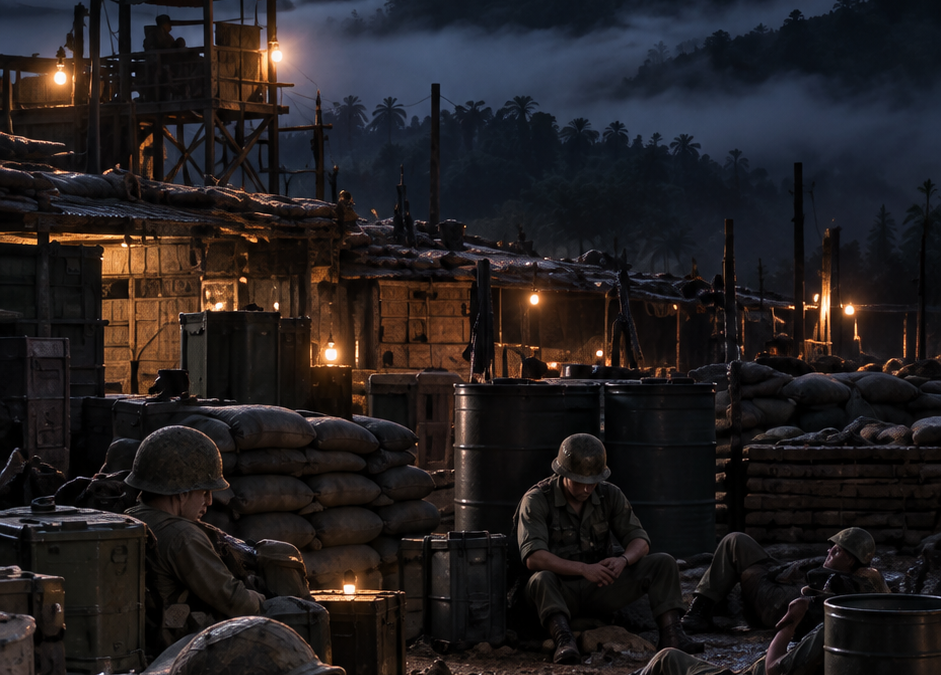
At Mary Ann, we had wire.
We had bunkers.
We had artillery.
We had radios.
We had numbers.
They had darkness, preparation, and the willingness to crawl directly toward all of it.
I was asleep when the first mortar round landed.
For the rest of my life, I have remembered waking before I remembered hearing the explosion.
That is how fast it happened.
One second there was nothing.
The next, the world was orange.
The ground jumped beneath me.
Dust poured from above.
Somebody screamed.
Then another explosion landed.
Then another.
The sound changed from individual detonations into one continuous tearing roar.
I rolled off my cot and hit the floor.
Tommy shouted something I could not hear.
“Helmet!”
Maybe that was it.
Maybe he said my name.
Maybe I invented the word afterward because memory hates empty spaces.
I found my rifle.
My fingers were shaking so badly I could barely work the sling free.
Another mortar round landed somewhere toward the center of the firebase.
Something metallic clattered past the doorway.
Men were yelling.
The radio net erupted.
At first I thought it was simply a mortar attack.
We had procedures for that.
Everybody in Vietnam learned procedures.
Get down.
Get to cover.
Wait.
Locate the firing position if possible.
Return fire.
Report casualties.
Restore communications.
Simple things.
Comforting things.
Procedures depend on knowing what kind of problem you have.
We did not.
The mortar barrage was not the attack.
It was the door opening.
While our attention went upward toward incoming rounds, men were already coming through the perimeter.
The sappers had approached in small groups, some three men, some perhaps six.
They worked through the wire deliberately.
That was another thing I learned later.
They did not simply charge.
They cut and crawled.
They found paths.
They used darkness and terrain.
They moved under the protection of the mortar barrage until several teams had penetrated the defenses.
One account described four paths through the outer wire before the attackers reached the inner barriers and spread along the southwest side of the position. (U S Military History)
Then Mary Ann changed from a firebase into a killing ground.
I saw the first sapper perhaps twenty yards away.
For years I told people I never saw his face.
That was not exactly true.
I saw part of it.
What I mean is that I did not see enough to recognize him as a man.
There was an explosion near the bunker line.
Light flashed across the slope.
For half a second a dark figure appeared where no American should have been.
Bare arms.
Something across his chest.
A weapon.
Then darkness swallowed him again.
I froze.
Tommy didn’t.
He fired.
Three shots.
Maybe four.
The figure vanished.
“Inside!” Tommy screamed.
That word traveled through me colder than any fear I had felt before.
Inside.
The enemy was inside Mary Ann.
Everything we had built our sense of security around existed to keep that from happening.
The wire was supposed to keep them outside.
The mines were supposed to keep them outside.
The bunkers faced outward because danger was supposed to remain outside.
But once attackers were inside, geography reversed itself.
Our own defenses became obstacles.
Sandbag walls blocked our vision.
Bunkers created blind spots.
Communication trenches turned into channels through which armed men could move.
Buildings became targets.
Light became dangerous.
Smoke hid movement.
Everybody knew the base.
But so, somehow, did they.
A satchel charge detonated against one of the positions near us.
I felt the pressure in my chest before I heard it.
My ears went flat.
Tommy dropped.
I grabbed his shoulder.
He pushed me away.
“I’m good.”
He wasn’t hurt.
Not yet.
We crawled toward the edge of the position.
A second explosion threw dirt over us.
Then came a smell I still cannot separate from Vietnam.
Explosives.
Burning fuel.
Dust.
Sweat.
Cordite.
Plastic.
Wood.
And underneath all of it, something chemical.
Gas.
Some of the attackers carried grenades that produced choking or irritating fumes.
In darkness and confusion, men could not immediately tell whether they were breathing smoke, dust, or chemical irritant.
Eyes watered.
Throats closed.
Visibility collapsed.
Commands became coughing.
Somebody ran past us without a helmet.
He had blood down the side of his face.
“TOC!” he yelled.
“What?”
“They’re at the TOC!”
The tactical operations center was one of the places that mattered most.
Radios.
Maps.
Command.
Coordination.
The nervous system of the battalion.
The attackers understood that.
That fact disturbed me long after the battle ended.
They were not moving randomly.
They had targets.
They were hitting command positions.
Communications.
Sleeping areas.
Bunkers.
Places where officers and soldiers were concentrated.
This was not chaos to them.
It was a plan.
To us, it felt like the world had broken apart.
To them, each explosion was supposed to happen where it happened.
That is the difference between being surprised and doing the surprising.
One side experiences confusion.
The other side experiences sequence.
We heard automatic fire near the command area.
Then another charge.
Then shouting.
Some men trying to escape their sleeping positions were hit as they emerged.
Others never made it out.
Flames moved faster than anyone expected.
Wood, canvas, fuel, ammunition, clothing—everything seemed ready to burn.
A man ran from a bunker with his shirt on fire.
Two soldiers tackled him and rolled him into the dirt.
Another explosion knocked all three down.
I remember seeing one of them move afterward.
I do not remember seeing the other two move.
Tommy fired again.
I fired where he fired.
That is something veterans rarely explain because civilians imagine combat as a series of clear decisions.
You see the enemy.
You aim.
You fire.
Sometimes.
At Mary Ann, I often fired because the man beside me had seen something I had not.
A shadow moved.
A muzzle flashed.
Somebody shouted a direction.
We shot into darkness because darkness was shooting back.
A figure suddenly came around the side of a sandbagged position.
He was so close that I could see the shine of sweat through the dark coating on his skin.
For an instant both of us stopped.
I have wondered for decades whether he was as surprised as I was.
He looked younger than I expected.
That is another thing people do not tell you about enemies.
Before you see them up close, you imagine a category.
North Vietnamese.
Viet Cong.
Sapper.
Enemy.
Those are words large enough to hide a human being.
At twenty yards, he was a target.
At six feet, he was a young man.
Then Tommy fired.
The man fell backward.
There was no dramatic moment.
No speech.
No understanding.
He simply disappeared behind the sandbags.
Tommy pulled me down.
“What the hell are you doing?”
I did not know.
I had frozen because for one second the war had become too specific.
That face followed me home.
I never learned his name.
I do not know if anyone did.
The battle kept moving.
Someone shouted that the company command position had been hit.
Another soldier yelled for a medic.
Then everyone seemed to be yelling for a medic.
The medics ran anyway.
That still amazes me.
Men were throwing explosives into bunkers, rounds were snapping over the ground, structures were burning, and our medics moved toward the voices calling them.
I saw one crawling with his aid bag dragging behind him.
A wounded soldier grabbed his sleeve.
The medic stopped.
Five yards away, another man screamed.
The medic looked toward both.
For one second I saw the decision on his face.
Who first?
That was Vietnam reduced to one human expression.
Who can I save?
Who can wait?
Who cannot?
Then the medic began working.
There was another explosion.
Smoke covered him.
I lost sight of them.
Near the center of the firebase, the fighting grew even worse.
The attackers struck the battalion tactical operations center and the command bunker of C Company.
Our company commander was killed during the attack.
Men in sleeping areas were caught before they could fully understand what was happening.
Some were shot.
Some were killed by explosives.
Some were trapped by fire.
Some survived wounds that should have killed them.
Others died from wounds that initially looked survivable.
In combat, logic is often the first casualty.
You can stand beside a man when a blast kills him and somehow walk away.
A piece of metal the size of a thumbnail can end a life.
A wall can stop it.
A helmet can turn it.
An inch matters.
A second matters.
Where you sleep matters.
Which direction you roll when you wake matters.
Whether you bend down to tie your boot before the first explosion matters.
People later ask why one man survived and another didn’t.
Most of the time, there is no answer worth giving.
Tommy and I moved toward a firing position closer to the perimeter.
He was ahead of me.
I remember his back.
Mud.
Web gear.
The strap of his rifle.
Then light filled the trench.
There was no sound at first.
Just light.
Tommy went forward.
I went backward.
My helmet came off.
For several seconds I could not breathe.
When I crawled to him, he was on his side.
I called his name.
Nothing.
I rolled him carefully.
There was blood beneath him.
Too much.
“Tommy.”
His eyes opened.
That was almost worse.
People imagine dying soldiers say meaningful things.
Sometimes they do.
Most often they say the same things any frightened human being would say.
“Help me.”
He whispered it.
I shouted for a medic.
Then louder.
“Medic!”
Tommy grabbed my sleeve.
“Don’t leave.”
“I’m not leaving.”
“Don’t leave me.”
“I’m right here.”
The battlefield continued around us.
That is one of the cruelest things about war.
The world does not honor the importance of one man’s death.
To me, Tommy was becoming the entire universe.
To the battle, he was one casualty among many.
Rounds continued.
People shouted.
Explosions came from every direction.
A structure burned fifty yards away.
The radio crackled.
Men returned fire.
Somewhere, somebody was trying to reorganize the defense.
And Tommy was looking at me like I had the power to keep him alive.
I didn’t.
The medic arrived.
He worked fast.
Pressure dressing.
Hands.
Bandage.
More pressure.
He asked Tommy questions.
Name.
Unit.
Where are you hit?
Stay with me.
Tommy stopped answering.
The medic looked at me.
I knew before he said anything.
“You need to move.”
“No.”
“He’s gone.”
“No.”
“We need you.”
I hated him for saying it.
I hated the mortar crews.
I hated the attackers.
I hated the hill.
I hated the Army.
I hated myself because I was alive.
Mostly I hated those two words.
He’s gone.
They sounded too small.
A man could not disappear into two words.
A husband.
A father.
A twenty-one-year-old kid who had spent the afternoon cleaning his rifle and talking about sleeping in his own bed again.
Gone.
But there was no time to argue with death.
The medic moved toward somebody else.
I took Tommy’s ammunition.
That was what soldiers did.
The living used what the dead no longer needed.
Then I crawled away from my friend.
For years, that felt like betrayal.
The attackers kept pushing through the base.
They threw satchel charges into positions they had identified.
They used grenades.
Automatic weapons.
Explosives.
They moved with speed once they were inside.
But the speed came after preparation.
That point became important to me later.
People sometimes describe a sapper attack as wild, almost suicidal violence.
What happened at Mary Ann taught me the opposite.
The violence was intense.
But the method behind it was disciplined.
They had studied us.
They knew where our important structures were.
They knew when darkness favored them.
They knew our defenses had become less alert.
They knew mortar fire would force men down at the same moment their assault teams needed to cross exposed ground.
They knew explosives could do more than bullets in confined positions.
And, above all, they understood surprise.
An American firebase represented enormous firepower when it could see an enemy at distance.
Artillery.
Machine guns.
Mortars.
Rifles.
Communications.
Reinforcement.
Air support.
But the sappers did not challenge those advantages in the way we expected.
They did not assemble in a conventional formation and march toward us.
They came close enough to make much of our superior firepower difficult to use.
Once friend and enemy are mixed together inside a small defensive position, artillery becomes dangerous to everyone.
Once attackers are among the bunkers, long-range weapons lose much of their meaning.
A sapper force tried to collapse distance.
That was its great equalizer.
Later, I read Vietnamese descriptions of the concept.
One image stayed with me.
“Blooming inside the enemy.”
The idea was simple and terrifying.
Penetrate first.
Do not begin by attacking the outside of a strong position from a distance.
Get inside it.
Reach the protected center.
Then expand the attack outward from within.
A small force could create effects completely disproportionate to its size if it entered the correct place at the correct moment.
At Mary Ann, I watched that idea become physical.
We were not being attacked from one direction.
Suddenly danger seemed to exist everywhere.
That psychological effect mattered.
If you believe the enemy is beyond the wire, you can orient your defense.
If you believe he may be behind any bunker, every shadow becomes a threat.
Men hesitate.
Units fragment.
Orders take longer to reach people.
The enemy does not need to defeat everybody at once.
He needs to destroy coherence.
Around three in the morning, Mary Ann no longer felt like one base.
It felt like dozens of small fights happening at the same time.
A bunker here.
A trench there.
A burning structure.
A wounded man.
A sapper team.
Three Americans trying to clear a position.
A radio operator searching for a functioning set.
A medic dragging somebody into cover.
Men knew only what was twenty feet around them.
That is how command disappears.
Not because officers stop trying to lead.
Because the battlefield becomes too broken for information to move.
At one point, I joined two soldiers near an ammunition position.
One was Sergeant Bell, a hard man from Georgia who almost never raised his voice.
That night he screamed until he could barely speak.
“Watch the gaps!”
A burst of automatic fire passed over us.
Bell pointed.
“Left!”
I fired.
Someone else fired.
A dark figure dropped.
Another appeared behind him.
A grenade came over the sandbags.
Bell saw it.
“Down!”
We flattened ourselves.
The explosion was small compared with the satchel charges, but in a confined position small is enough.
My right ear rang.
Bell’s cheek was cut.
The third soldier had fragments in his shoulder.
He looked at the blood and said something absurd.
“My mom is gonna kill me.”
Bell laughed.
Actually laughed.
Maybe we all did.
Fear does strange things.
Sometimes men laugh because the alternative is screaming.
We kept fighting.
Gradually, resistance stiffened.
Surprise cannot last forever.
Americans who had survived the first attack organized themselves.
Fire began coming from positions the sappers had failed to destroy.
Individual soldiers started understanding where attackers were moving.
Small groups formed.
The base began fighting as a base again.
But the damage had already been done.
The attackers had hit their primary targets.
Structures burned.
Command positions had been struck.
Casualties were everywhere.
The darkness that had protected them now helped cover their withdrawal.
That, too, was part of their doctrine.
These were not men trained simply to die in place.
One of the greatest misunderstandings I encountered after the war was the belief that specialized Vietnamese assault troops were basically suicide soldiers.
They were not.
Their training represented an investment.
A sapper who had spent months learning infiltration, reconnaissance, demolitions, fieldcraft, weapons, navigation, discipline, and target selection was valuable.
The mission was not merely to penetrate.
The mission was to penetrate, destroy the assigned targets, and, when possible, return.
Survival mattered because experience mattered.
The Vietnamese command understood that a veteran sapper who lived through one mission was more valuable on the next one.
They were expected to accept extraordinary danger.
That was not the same thing as being expected to throw their lives away without purpose.
At Mary Ann, many of them withdrew before dawn.
The entire attack lasted roughly an hour.
An hour.
I have spent more than half a century carrying an hour.
When daylight finally began pushing through the smoke, the firebase looked unfamiliar.
You would think sunlight makes things better.
It did not.
Darkness had hidden what happened.
Morning displayed it.
Buildings were burned.
Bunkers were shattered.
Equipment lay twisted.
Spent cartridges covered the ground.
Sandbags had been ripped open.
Smoke hung low over everything.
The smell was unbearable.
Men walked through the wreckage calling names.
Some names received answers.
Some did not.
We found wounded men in places we had passed during the fighting without seeing them.
We found dead men where they had been sleeping.
We found men killed while trying to escape burning positions.
We found attackers too.
Young men.
Small in death.
That surprised me.
The enemy had seemed enormous during the battle.
Invisible men everywhere.
Explosions from every direction.
An entire firebase overwhelmed by shadows.
In daylight, a dead sapper looked like what he was.
One human body.
One man’s hands.
One man’s feet.
One man’s face.
There was soot and grime across his skin.
His equipment was simple.
I stared at him longer than I should have.
A soldier beside me said, “Come on.”
I didn’t move.
I kept thinking about the man Tommy had shot earlier.
Maybe this was him.
Maybe not.
I wanted to hate whoever lay there.
I thought hatred would make Tommy’s death easier.
It didn’t.
The body did not look like hatred.
It looked like somebody’s son.
That realization made me angry.
I did not want the enemy to have a mother.
I did not want him to have a childhood.
I did not want anybody waiting for him.
I wanted him to be exactly what soldiers sometimes need the enemy to be: a shape that shoots at you.
War becomes harder to carry when the shapes regain names you do not know.
By midmorning, the casualty figures started becoming real.
Thirty Americans had been killed and many dozens wounded in the attack, according to veteran and memorial accounts. Some later tallies vary, but every version agrees on the scale of the disaster. (NVVMF)
Thirty.
People hear a number like that and imagine thirty identical deaths.
There is no such thing.
Thirty deaths are thirty families receiving thirty different messages.
Thirty mothers.
Thirty fathers.
Wives.
Children.
Brothers.
Sisters.
Thirty bedrooms that will never feel the same.
Thirty sets of possessions somebody will pack into boxes.
Thirty futures stopping in the same hour.
Tommy’s daughter would grow up knowing him mostly through photographs and other people’s stories.
That thought nearly broke me.
I took the picture from his shirt before his body was moved.
I did not keep it.
I wanted to.
I wanted something that proved the man I knew had existed before that morning.
But it belonged to his wife.
So I put it with his personal effects.
For weeks afterward, I worried that it had been lost.
Years later, I found his widow.
I wrote a letter.
It took me four months to finish.
I told her he had talked about their daughter the afternoon before he died.
I told her he had loved them.
I did not describe his wounds.
I did not describe the battlefield.
I did not tell her that he had asked me not to leave.
Some memories belong to the living because giving them away would only create another wound.
She wrote back.
Two pages.
At the bottom she wrote:
“Thank you for being with him.”
I stared at that sentence until the words blurred.
She thanked me.
For years I had hated myself for crawling away from him after he died.
And the woman who loved him had thanked me for staying as long as I had.
That was the first time I understood that guilt and responsibility are not always the same thing.
The Army investigated what happened at Mary Ann.
Questions came quickly.
How had the sappers gotten through?
Why had security become lax?
Were guards alert?
Was the wire sufficient?
Had intelligence warnings been missed?
Were soldiers prepared?
Why had attackers been able to reach critical positions?
Those were necessary questions.
They were also painful.
Nobody wants to hear the word complacency attached to the place where his friends died.
It can sound like an accusation against the dead.
That is not how I understand it now.
Complacency is not cowardice.
It is not stupidity.
It is a human response to repetition.
If a threat fails to appear long enough, the mind lowers its estimate of danger.
Soldiers are not immune to that.
Neither are commanders.
Mary Ann had experienced relatively little recent enemy activity.
The attackers knew the difference between a position that looked defended and a position that remained psychologically prepared to be attacked.
That difference cost us.
For a long time, I thought studying the enemy would feel disloyal.
I wanted to think about Tommy.
About our dead.
About what Americans had endured.
I did not want to study the men who had killed them.
Then I realized something.
If I refused to understand the enemy, I would never understand what happened to us.
So after I came home, I began reading.
At first it was occasional.
A magazine article.
An Army report.
A book.
Then it became a habit that lasted decades.
I read about Vietnamese sapper units.
I read translated training material.
I read accounts by American soldiers.
I read Vietnamese military writing when translations became available.
I spoke with veterans.
Eventually, the shadows from Mary Ann became an organization.
That changed everything.
The men who attacked us belonged to a military tradition that had developed specialized assault techniques for dealing with stronger fortified positions.
Recruitment emphasized courage, intelligence, discipline, physical endurance, political reliability, and the ability to operate independently.
A sapper might have to move for hours without being detected, memorize a target area, recognize obstacles, judge patrol patterns, cut through wire without creating noise, carry explosives, choose the right target, attack under extreme pressure, and then find a path back out.
That takes more than aggression.
It takes self-control.
The training could last for months.
Accounts of the force describe courses varying considerably depending on the student’s background and mission, sometimes stretching from a few months to well over a year.
They practiced crawling.
Demolitions.
Camouflage.
Reconnaissance.
Wire penetration.
Explosive placement.
Weapons.
Navigation.
Physical conditioning.
Observation.
Patience.
They studied fortified positions until those positions were no longer mysterious.
One Vietnamese description of the force emphasized extraordinary flexibility, skill, discipline, political commitment, and determination.
That language sounded ideological to an American veteran reading it years later.
But behind the slogans was something tactically important.
They expected small teams to function without constant supervision.
A man deep inside an enemy position cannot stop every thirty seconds to ask a headquarters what to do.
He has to understand the purpose of the mission.
He has to recognize opportunities.
He has to adapt.
That independence was part of what made them dangerous.
The American military possessed enormous technological advantages.
But technology does not eliminate the oldest facts of combat.
A patient man can still crawl through darkness.
Wire can still be cut.
A sentry can still look in the wrong direction.
An explosive charge still works when pressed against the correct wall.
One determined team can still destroy something that took hundreds of people to build.
The sapper doctrine turned those simple facts into a system.
The more I learned, the more I understood why their tactics were different from classic guerrilla warfare.
Americans often used broad labels for almost everything we encountered.
“VC.”
“NVA.”
“Guerrillas.”
“Sappers.”
Sometimes those categories overlapped.
Sometimes they concealed important distinctions.
A guerrilla unit might prefer an ambush, hit a vulnerable patrol, strike a small isolated target, and disappear.
A sapper unit could deliberately target a position defended by a much larger force.
That seems irrational until you understand the purpose.
They did not intend to fight the entire defending force on equal terms.
They intended to make the defenders’ numbers irrelevant.
Their problem was not: How do fifty men defeat two hundred soldiers in an open firefight?
Their problem was: How do fifty men reach the places where two hundred soldiers are most vulnerable before those soldiers can organize?
That is a completely different question.
And at Mary Ann they answered it.
Reconnaissance was essential.
Sapper units preferred targets they could study.
A fixed firebase has weaknesses precisely because it is fixed.
Routes become predictable.
Sleeping areas remain in the same place.
Command bunkers remain in the same place.
Wire remains in the same place.
Weapons positions remain in the same place.
Guards develop habits.
Lights appear at regular times.
Waste is dumped along predictable paths.
Men walk the same trenches.
What feels like stability to the defender becomes information for the attacker.
A moving American unit might be more difficult to locate and study.
A firebase could be watched.
Night after night.
A sapper reconnaissance element could learn things even some soldiers inside the base stopped noticing.
Where is the command bunker?
Which position contains communications equipment?
Where does the terrain create dead ground?
Which part of the perimeter is least visible?
Where are the mines?
Where are the trip flares?
Where can wire be cut?
How long does a guard stare into one sector before turning his head?
What time are men most tired?
How quickly does artillery react?
Where will defenders run when the first rounds land?
That last question is especially important.
A good attack does not merely react to the enemy.
It predicts him.
The mortar barrage at Mary Ann did more than inflict casualties.
It shaped behavior.
Men went to cover.
Attention shifted outward.
Heads went down.
Noise increased.
Visibility deteriorated.
Communications became overloaded.
Then the penetration teams exploited the confusion.
Once inside, they attacked command and control.
That created more confusion.
The attack became a chain.
One disruption enabled another.
That is why the term “sapper” never again sounded simple to me.
It represented a philosophy of fighting.
Use a small number of highly trained men.
Study the target.
Exploit routine.
Remove distance.
Enter the strong position rather than battering it from outside.
Destroy the things that allow a larger force to act like a larger force.
Then withdraw before superior firepower can fully respond.
Few things I learned later unsettled me more than discovering that Vietnamese commanders did not generally regard these men as disposable suicide troops.
That had been one of the stories we told ourselves.
“You’d have to be suicidal to crawl through that wire.”
No.
You had to believe it could be done.
There is a difference.
They planned escape routes.
They valued experience.
They trained men to return.
Their willingness to accept danger was extraordinary, but danger was a cost of the mission, not necessarily its purpose.
That distinction made the attack at Mary Ann even more impressive tactically and even harder for me emotionally.
A man charging to certain death is frightening.
A man calmly entering a place you believe impossible to enter, destroying what he came to destroy, and attempting to leave alive is something else.
That is professionalism.
I do not use that word as praise for what happened to my friends.
I use it because underestimating an enemy is a form of disrespect toward your own dead.
Tommy was not killed by ghosts.
He was killed in an attack planned and executed by trained men.
Pretending otherwise would make his death easier to romanticize and harder to understand.
After the Tet Offensive of 1968, Vietnamese sapper organization in the South became more centralized.
The force developed dedicated command, training, and oversight structures, including the organization often identified as Sapper Group 429.
Training centers operated in different regions.
Doctrine became increasingly systematized.
The techniques used at Mary Ann were therefore not one accidental act of battlefield improvisation.
They belonged to a developed institution.
That mattered.
Because when I first came home, the story people wanted was simple.
“Were you attacked by Viet Cong?”
“Yes.”
“How many?”
“About fifty.”
“How many Americans?”
“More than two hundred.”
“Then how did they do it?”
That was the question.
How?
At twenty-two, I had no answer.
At seventy, I do.
Preparation.
Reconnaissance.
Discipline.
Surprise.
Specialized training.
A target whose defenders had grown accustomed to quiet.
And fifty men willing to crawl toward a place where almost every material advantage belonged to the other side.
There was another part of the answer, though.
Human beings.
On both sides.
That sounds sentimental until you have spent decades trying to remember the exact voice of someone who died young.
War is often written in units.
Company.
Battalion.
Brigade.
Division.
Thirty killed.
Seventy-six wounded.
Fifty attackers.
Numbers make history manageable.
Memory does not work that way.
I remember Tommy’s photograph.
I remember Sergeant Bell bleeding from his cheek and screaming directions.
I remember the wounded soldier saying his mother was going to kill him.
I remember the medic deciding whom to treat first.
I remember a young Vietnamese man appearing six feet from me in the darkness.
I remember his eyes.
Of all the things fire destroyed at Mary Ann, those details survived.
I came home later that year.
People congratulated me.
They said I looked good.
That confused me.
I had lost weight.
I barely slept.
I jumped whenever a car backfired.
But I had two arms, two legs, and no visible wound, so people decided I looked good.
My mother hugged me in the airport.
My father shook my hand first.
That was his generation.
Then he hugged me too.
At home, my bedroom was almost exactly as I had left it.
Baseball glove.
High school yearbook.
Books.
A photograph of a girl I no longer loved.
For several minutes I stood in the doorway.
It looked like somebody else’s room.
My mother had washed the sheets.
I sat on the bed.
Then I remembered Tommy saying he would never sleep outside again.
I got up.
That first night home, I slept on the floor.
I could not explain why.
For months I woke before dawn.
Sometimes I smelled smoke that wasn’t there.
Sometimes I heard the first mortar impact.
Sometimes I saw Tommy turning toward me.
The worst dreams were not the loud ones.
They were quiet.
In them, Mary Ann looked exactly as it had the evening before the attack.
Tommy sat beside me cleaning his rifle.
The sun went down.
Nothing happened.
And I knew what was coming.
I would try to warn him.
No sound came out.
He would grin and ask how many days I had left.
I would watch the darkness behind him.
Then I would wake.
My wife eventually learned not to touch me immediately.
She would say my name first.
Softly.
Again.
Then wait.
Years passed.
We had children.
I built a career.
I bought a house.
I mowed lawns.
I attended school plays.
I paid taxes.
I fixed gutters.
I became the ordinary American man I had once wanted desperately to become.
But Mary Ann followed me.
Not every day.
Trauma is not always dramatic.
Sometimes it is simply a room in your house that stays locked.
You walk past it.
You know what is inside.
Most days you do not open the door.
Then a smell, a sound, a date, or a photograph turns the handle.
March was difficult.
For years my family did not know why.
My wife eventually asked.
“What happened in March?”
I told her.
Not everything.
Enough.
She listened.
When I finished, she said, “Why did you never tell me?”
I answered with the stupidest honest answer I had.
“Because then you’d have to know it too.”
She reached across the table.
“You don’t protect people by disappearing from them.”
I remember that sentence almost as clearly as anything from the war.
So I began talking.
Slowly.
To her.
Then to other veterans.
Then, eventually, to Tommy’s family.
Understanding the sapper force became part of that process.
I wanted to know who had come through the wire.
I wanted to know what kind of men trained for that.
I wanted to know whether the image in my memory—darkened skin, light equipment, explosives, speed—matched the historical record.
It did.
I learned that Vietnamese sapper culture placed extraordinary emphasis on stealth and individual skill.
Men learned to use terrain intimately.
Their equipment could be stripped down to the minimum needed for the target.
Camouflage was practical rather than decorative.
Anything reflective could betray them.
Anything loose could make noise.
Anything unnecessary was weight.
They were expected to cross obstacles at distances where a small mistake meant death.
Imagine crawling toward armed men who do not know you exist.
Every movement becomes a calculation.
A pebble.
A piece of wire.
A flare.
A cough.
A dog.
A sentry turning unexpectedly.
An equipment buckle striking a rock.
One sound can turn stealth into a firefight.
That psychological pressure alone would defeat many soldiers.
Training existed partly to replace panic with procedure.
Where to place a hand.
How to move a knee.
How to hold wire.
How to pass equipment.
How to communicate without speech.
How to freeze.
How to wait.
Then, once the attack began, slowness became speed.
That contrast fascinated me.
Before penetration: patience.
After penetration: violence.
The transition had to happen instantly.
The quiet man crawling through wire became the man throwing a satchel charge into a bunker.
That was the tactical contradiction at the heart of sapper warfare.
Extreme restraint followed by extreme aggression.
The men who attacked Mary Ann did not possess our logistics.
They did not possess our helicopters, artillery network, radios, medical evacuation system, or industrial base.
So they developed methods designed to attack those advantages indirectly.
That is what weaker forces have done throughout history.
They search for an asymmetry the stronger force has overlooked.
At Mary Ann, the asymmetry was distance.
We were most powerful when the enemy was far enough away for us to use everything.
They were most dangerous when they were so close that our advantages became difficult to employ.
Both things could be true at once.
That is why I eventually stopped describing the attack as mysterious.
There was nothing supernatural about it.
The title “sapper” sometimes encouraged Americans to imagine men who appeared from nowhere.
They did not appear from nowhere.
They crawled.
Inch by inch.
Minute by minute.
Through terrain we thought we controlled.
That is more frightening because it is real.
No magic.
No ghosts.
Observation.
Training.
Courage.
Mistakes on our side.
Skill on theirs.
War.
When I finally visited the Vietnam Veterans Memorial in Washington, D.C., I was older than my father had been when I came home.
I went alone.
That surprised my wife.
“You don’t want me there?”
“I need to do this first one by myself.”
She understood.
The Wall was quieter than I expected.
People walked slowly.
Some touched names.
Some cried openly.
Some stood with their hands in their pockets because they did not know what else to do with them.
I found the panel.
Then I found Tommy.
There are moments when fifty years collapse.
I was no longer an old man in Washington.
I was twenty-two again.
He was beside me.
Dirty hands.
Plastic photograph.
Big stupid grin.
“One hundred and twelve?”
“You know exactly.”
Everybody knows exactly.
I put my fingers against his name.
For years I had remembered his last words.
Help me.
Don’t leave.
That day I forced myself to remember the words before those.
I’m going home and never sleeping outside again.
I laughed.
Then I cried.
Not quietly.
I had spent decades being careful with grief.
That afternoon I stopped.
A younger man nearby looked at me.
He said nothing.
He simply waited until I could breathe again.
I appreciated that.
There are times when kindness means understanding that words would make something smaller.
Before leaving, I thought about the Vietnamese soldier whose face I remembered from six feet away.
His name was not on that wall.
I would never know where his name was written, or whether it was written anywhere.
I wondered if his mother had received a message.
I wondered if he survived Mary Ann.
For years I had assumed he died because Tommy fired.
But memory is unreliable in combat.
Maybe Tommy missed.
Maybe the man fell and moved.
Maybe somebody else killed him later.
Maybe he escaped.
Maybe he lived another fifty years remembering two frightened Americans staring at him across a sandbag wall.
I will never know.
What I know is that the hatred I carried home did not survive as long as the grief.
Hatred requires certainty.
Age destroys certainty.
Grief is different.
Grief can live beside understanding.
I can mourn the Americans killed at Mary Ann and still recognize the skill of the men who attacked us.
I can love Tommy and admit that we underestimated our enemy.
I can say that our security had become too relaxed without blaming every young soldier on that ridge.
I can study Vietnamese sapper doctrine without turning war into admiration.
Understanding is not celebration.
It is responsibility.
History owes the dead more than mythology.
That is why, when people ask me today what happened at Mary Ann, I do not begin with the explosions.
I begin with the quiet.
Because the quiet was part of the attack even before we understood it.
The enemy had allowed us to become accustomed to not seeing him.
He studied while we relaxed.
He approached while we slept.
He used darkness, terrain, training, and surprise to attack a position whose defenders outnumbered him many times over.
For roughly an hour, a small specialized force turned a fortified American base inside out.
Not because the men there were cowards.
Not because the enemy possessed some mystical power.
Because warfare punishes assumptions.
Especially comfortable ones.
The lesson stayed with me long after I stopped wearing a uniform.
Security is not the same as safety.
Strength is not the same as readiness.
Technology is not the same as awareness.
And an enemy you dismiss does not become less dangerous because you refuse to understand him.
The sapper force that entered Mary Ann represented a distinctly Vietnamese answer to a problem Vietnamese commanders had faced for years: how does a smaller force penetrate a stronger one?
Their answer depended on people more than machinery.
Choose carefully.
Train intensely.
Reconnoiter patiently.
Get close.
Attack the critical point.
Create confusion.
Move before the larger force recovers.
Withdraw if you can.
It was not magic.
But on a dark ridge in Quảng Tín Province, to the men waking under mortar fire, it felt like men had materialized inside our defenses.
That illusion was created by months of training and hours of crawling.
There is something important in that distinction.
Calling them ghosts allows us to avoid asking how they entered.
Calling them fanatics allows us to avoid asking how they trained.
Calling the attack unbelievable allows us to avoid studying the mistakes that made it possible.
I have no interest in protecting myself with those explanations anymore.
Too many men died for that.
I still think about the last moments before Mary Ann changed.
Tommy beside me.
Coffee somewhere.
Men playing cards.
A radio.
The smell of dust.
Someone laughing.
The valley disappearing into darkness.
Fifty men somewhere below us.
Moving.
Waiting.
Watching.
None of us knew their names.
Most of them did not know ours.
Yet before sunrise our lives would become permanently connected.
That is one of the cruelties of war.
A stranger can become the most important person in your life without either of you ever speaking.
He can cross an ocean of politics, history, ideology, language, and geography and arrive six feet from you in darkness.
Then one second decides which of you becomes a memory.
I survived that second.
Tommy did not.
Thirty American families received the news that their sons, husbands, brothers, or fathers would not be coming home alive.
Dozens more men carried wounds away from the firebase.
Some wounds could be seen.
Others waited years before anyone recognized them.
Mary Ann itself passed into history.
The war continued.
Units moved.
Maps changed.
Governments changed.
Generations were born who knew the Vietnam War only through books, photographs, documentaries, monuments, and old men like me trying to explain things we still did not completely understand.
But for those of us who were there, Mary Ann never became past tense.
It exists in flashes.
A mortar round.
A satchel charge.
A burning bunker.
A medic crawling through smoke.
A friend’s hand around my sleeve.
A young enemy soldier’s eyes.
Dawn over a ruined firebase.
I have learned to live with those images.
That is different from forgetting them.
For a long time, I thought healing meant reaching a day when I no longer remembered.
Now I know better.
Healing meant reaching a day when memory stopped being only pain.
Tommy’s life is more than the moment he died.
When I remember him now, sometimes I see the photograph before I see the blood.
Sometimes I hear his laugh before the explosion.
Sometimes I remember him complaining about my coffee.
That is progress.
And when I think about the men who came through the wire, I no longer see faceless creatures moving through darkness.
I see soldiers.
Young men trained for a brutal job.
Men who had been told we were the enemy.
Men who carried explosives toward us while we carried rifles against them.
Some of them died.
Some lived.
All belonged to families somewhere.
Recognizing that does not erase what happened.
It makes what happened sadder.
War becomes easier to glorify when everyone on the opposite side remains a silhouette.
Mary Ann cured me of silhouettes.
I saw one from six feet away.
He had a face.
So did Tommy.
That is what remains after all the tactics, doctrine, ideology, unit designations, casualty statistics, and military analysis have been studied.
Faces.
And one lesson I wish we had understood before that morning.
Never confuse an enemy’s silence with his absence.
Sometimes the quietest night is quiet because somebody is already close enough that he no longer needs to make a sound.








