𝗙𝗨𝗟𝗟 𝗦𝗧𝗢𝗥𝗬 The Night the Marina Lights Came On Across a Shoreline Linda Carter Never Owned
𝗙𝗨𝗟𝗟 𝗦𝗧𝗢𝗥𝗬
I stared at her.
There are moments when a person says something so absurd that anger has to fight through disbelief before it can reach your face.
“The board disagrees,” I repeated.
“Yes.”
“With my deed?”
“With your interpretation of the boundary.”
“My interpretation is the recorded property description.”
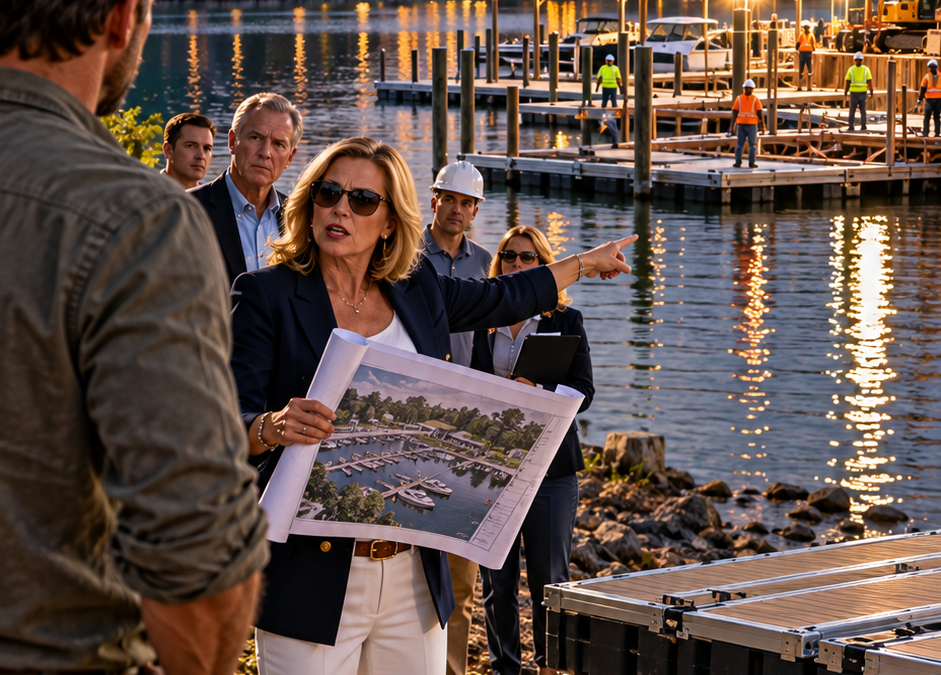
Linda tapped one manicured finger on the blueprint. “The HOA has already voted.”
“That means nothing here.”
“It means the community has made a decision.”
“The community cannot vote itself onto private land.”
Her smile finally faded.
The two men in company shirts exchanged a look.
I turned toward them. “Are you contractors?”
One of them nodded. “Shoreline Development Group. We’re here for preliminary review.”
“You are standing on private property. There is no permission for construction, clearing, grading, docking, parking, lighting, or anything else.”
Linda laughed softly. “This is exactly why we wanted to speak with you before mobilization. There’s no need for hostility.”
“Then leave.”
Her expression hardened. “You may want to consider the consequences of obstructing an approved community project.”
I folded the plans back toward her, not carefully.
“You may want to consider the consequences of building on land you do not own.”
The air changed after that.
The board members stopped pretending this was friendly. Linda rolled up the plans, handed them to Greg, and looked out across the lake as if she were already picturing boats lined along the water.
“It is a beautiful site,” she said.
“It is not a site.”
She turned back to me. “We’ll be in touch.”
“No. You’ll stay off my shoreline.”
She put her sunglasses back on.
“We’ll see.”
I watched them leave, their vehicles crawling back up the lane through dust and sunlight.
For several minutes after they were gone, I stood there beside the water with my hands shaking—not from fear, but from the strange force it takes to keep yourself from doing something stupid when another person casually threatens what generations of your family protected.
That afternoon, I pulled out every property record I had.
My family kept documents in a fireproof cabinet in the office off the kitchen. Deeds. Surveys. tax maps. easement releases. Old handwritten notes from my father. A brittle envelope containing papers my grandfather had signed before I was born. I laid them across the desk and began comparing descriptions.
The lakefront boundary was not ambiguous.
The legal description ran along the western ridge, down to the old stone reference point, then followed the shoreline section where the proposed marina would sit. The south bank, the cove, and the control structure were all inside my family’s parcel. There were no documents granting Pine Hollow access. No marina rights. No recreation agreement. No lease. No easement.
Nothing.
I called my attorney the next morning.
His name was Warren Albright, and he had handled two previous disputes for me when Pine Hollow residents treated my land like overflow common area. Warren was not dramatic. He liked clean records, short letters, and facts that could survive cross-examination.
When I told him Linda Carter had presented plans for a marina on my shoreline, he was quiet long enough that I checked whether the call had dropped.
“Warren?”
“I’m here,” he said. “I’m deciding whether I heard you correctly.”
“You did.”
“Send me the plans if you have photos.”
“I took pictures.”
“Good. Send those, your deed, the most recent survey, any prior correspondence with the HOA, and a written account of what she said.”
“She said the board approved it.”
“Boards approve things all the time. That does not make them lawful.”
“She said the community made a decision.”
“The community can decide what color to paint its clubhouse.”
“That’s what I told her.”
“Do not engage with contractors if they return,” Warren said. “Document. Photograph. Call me. If equipment appears, call county code enforcement and the sheriff’s office if trespass is active.”
“I want this stopped before they start.”
“So do I. But we need to assume they may proceed anyway.”
I looked out the window toward the lake.
“Why would they do that?”
Warren sighed. “Because sometimes people spend money first and hope legal rights catch up later.”
Three days passed.
No one came.
I began to think Warren’s first letter might be enough.
It was not.
On the fourth morning, I heard machinery.
Not chainsaws this time. Diesel engines. Hydraulic lifts. The beep of equipment backing up. Metal clanking against metal.
I ran down toward the shoreline and saw trucks at the eastern access path.
There were workers unloading dock sections.
Long aluminum frames lay stacked near the water. Black floats sat beside them. Bundles of posts, electrical conduit, and pressure-treated lumber were being staged along the bank. A compact loader was moving gravel near the edge where Linda’s drawing had shown parking.
For a second, I could not breathe right.
Then I saw Linda.
She was standing with Greg and two other board members, holding a clipboard, smiling like a woman watching a dream begin.
I walked straight toward her.
“Stop this now.”
She turned, unsurprised. “Good morning, Caleb.”
“I said stop.”
One of the workers paused. Another kept moving until his supervisor gave him a signal.
Linda looked past me at the activity. “We have permits and board approval.”
“Show me a permit authorizing construction on my land.”
“The project area falls within the community shoreline.”
“No, it does not.”
She sighed. “We’ve been through this.”
“You walked through it. You didn’t answer it.”
Greg stepped forward. “Caleb, nobody wants this to be confrontational.”
“Then get your equipment off my property.”
“The HOA has invested significant funds already,” he said.
“That was foolish.”
His face reddened.
Linda’s voice sharpened. “We are not halting a major project because you refuse to accept community rights.”
“What rights?”
She lifted the clipboard. “Approved access rights.”
“Created by who?”
“The association.”
I looked around at the workers, the materials, the torn grass where equipment had already tracked over the bank. My father’s shoreline was being treated like a staging yard.
I took out my phone and began recording.
Linda noticed immediately.
“What are you doing?”
“Documenting trespass and unauthorized construction.”
“You do not have consent to record me.”
“You are standing on my property.”
Her mouth closed.
The site supervisor came over. He was a broad man with graying hair and a cautious expression.
“Ma’am,” he said to Linda, “we need clarity here.”
“You have clarity,” she said. “Proceed under the contract.”
I turned to him. “My name is Caleb Whitaker. This shoreline is on my parcel. My attorney has notified the HOA that they do not have construction rights here. If you continue, you are participating in unauthorized work on private property.”
The supervisor’s face tightened.
Linda snapped, “That is a misrepresentation.”
“Then show him the deed.”
She did not.
The supervisor looked from Linda to me and then toward the materials already unloaded.
“I’m going to pause active installation until our office reviews this,” he said.
Linda spun toward him. “You are under contract.”
“And I’m not looking to get sued for trespass,” he replied.
For that moment, I thought reason had won.
But reason does not always survive pressure when money is already moving.
Work paused for the rest of that day. Trucks remained. Materials stayed stacked near the bank. Linda left furious. I called Warren, sent him video, and he sent another letter before the close of business.
The next morning, the crew came back with different instructions.
This time, the supervisor avoided speaking with me. I heard him tell his men they had been cleared to continue in “the approved project zone.” By noon, the first dock frame was floating in the water.
By sunset, three slips were assembled.
I stood on the bank and watched men bolt together a marina on land my family had protected for half a century.
It is hard to explain the helplessness of that moment without making it sound weak. I was not helpless legally. I knew that. I had documents. I had counsel. I had evidence. But in physical terms, right then, a crew was building faster than paper could move. They had tools, machinery, materials, and the confidence of a woman who believed momentum could become permission.
Every day after that, the shoreline changed.
The gravel pad expanded. The floating dock stretched farther into the cove. Temporary lighting poles appeared first, then permanent fixtures. A small utility shed was installed near the upper bank. Pilings went in. Boat slips took shape in neat rows. Workers mounted cleats, bumpers, and wiring.
Linda visited constantly.
She wore different versions of the same satisfied expression each time.
Residents began walking down to look at the progress. Some took pictures. A few waved at me from my own shoreline as if I were a neighbor watching a shared project unfold.
I stopped responding.
I spent those weeks building the record.
Every morning, I photographed the work. Every evening, I wrote notes. Which trucks arrived. Which contractors were present. What sections were installed. What ground was disturbed. Where materials were staged. I marked each image against my property map.
Warren filed complaints with the county. The HOA attorney responded with language about disputed boundaries, community reliance, and good-faith improvement. Linda sent one public notice to Pine Hollow residents calling the marina “a landmark enhancement years in the making.”
Years in the making.
That phrase nearly made me throw the paper across the room.
My family had owned that shoreline for decades, but Linda had discovered it in a committee meeting and decided her vision was older than my deed.
Within weeks, the marina stood finished enough for boats.
And the boats came.
Not fishing boats like the ones my father used. Not small aluminum boats with dented sides and mud on the floor. These were glossy, expensive machines with polished chrome, covered seats, and names painted on the sterns. Pine Hollow residents began docking them in slips that should never have existed. At night, the new lights glowed along the water, casting long bright lines across the surface where there used to be darkness.
That hurt more than I expected.
The lake had always been quiet at night. My mother used to say it was the one place where the sky could hear itself think. Now the shoreline buzzed with transformers, security lights, footsteps, and voices. The water carried sound straight across to my house. Laughter from the docks reached my bedroom window. Car doors slammed where crickets used to dominate the dark.
One night, I stood on my porch at midnight and watched the marina lights trembling on the lake.
I thought of my father.
He had died in that house, in the downstairs bedroom, after a year of illness that stripped him down to bone and stubbornness. Near the end, when he could no longer walk to the shore, I used to open the window so he could smell the water after rain. He would lie there with his eyes half closed and ask whether the lake was high or low, whether the heron was back, whether the old sycamore had finally fallen.
Two days before he died, he grabbed my wrist with surprising strength and said, “Don’t let them carve this place up after I’m gone.”
At the time, I thought he meant developers generally. Buyers. Speculators. People who might offer money when grief made decisions feel impossible.
I had promised him I would not.
Standing there watching Linda Carter’s marina glow against the dark, I felt as if someone had reached backward through time and mocked that promise.
The next morning, I hired a licensed surveyor named Daniel Price.
I knew the boundary. Warren knew the records. But I needed something current, sealed, professional, and impossible for the HOA to dismiss as family interpretation.
Daniel arrived with his equipment two days later. He was methodical, soft-spoken, and immune to drama. He listened while I explained the situation, then asked for the original deed, the most recent county survey, the HOA response letters, and any construction plans I had obtained.
After reviewing them, he looked toward the marina and said, “They built all that already?”
“Yes.”
“Before confirming the line?”
“They claim they confirmed it.”
He gave a short, humorless breath. “People claim a lot of things.”
He spent the full day measuring.
He shot points along the shoreline, checked monuments, compared the lakefront boundary, identified the cove line, and marked the relationship between the marina structures and my parcel. I followed at a distance, trying not to interrupt. Linda appeared around noon with two board members.
“Can I help you?” she called.
Daniel looked up from his instrument. “I’m conducting a survey.”
“On whose authority?”
“Mine,” I said.
Linda’s eyes narrowed. “This is an active community facility.”
“It is an active problem.”
Daniel returned to his work.
Linda walked closer. “You understand that the HOA has already completed this project.”
He did not look up. “Completion does not establish ownership.”
I almost smiled despite myself.
Linda did not.
When the final survey map came back, Warren called me into his office.
He had printed it full-size and spread it across his conference table.
The conclusion was brutal in its simplicity.
The marina was not merely near my property.
It was on it.
The parking edge, dock access, shoreline structures, utility shed, lighting connections, and multiple slip anchors crossed into land I controlled. The survey showed the boundary clearly. It matched my family records. It matched the deed. It matched what I had told Linda from the first day.
Warren placed one finger on the lakefront line.
“This is excellent evidence,” he said.
“It should have stopped them before they built it.”
“Yes.”
“But it didn’t.”
“No.”
I looked at the marina overlay, jaw tight. “What now?”
“Now we give them one final opportunity to remove it voluntarily.”
I laughed, not because anything was funny.
“Linda won’t.”
“Probably not.”
“Then why offer?”
“Because courts and county officials like clean escalation. You warned them before construction. You objected during construction. You obtained a survey. Now you give them a final chance to cure the trespass.”
“And when they refuse?”
Warren slid another old document across the table.
“Then we discuss this.”
It was a copy from my family property records, older than I expected. I had seen it before, but I had not understood its importance fully. It concerned the lake’s water management system: a private control structure, drainage channel, intake components, and maintenance rights associated with my parcel. My grandfather had installed part of it decades earlier after flooding damaged the lower pasture. Later updates had been recorded when my father improved the system.
The language was specific.
The owner of my parcel controlled access, maintenance, and operation of the system. No adjacent party had authority to connect improvements, alter flows, use dependent infrastructure, or rely on the system without written permission.
I read it twice.
Then I looked up.
“The marina depends on this?”
Warren nodded. “Based on the construction layout and utility notes, yes. Their marina operation appears tied to water-level management and service access connected through your private system.”
“They never asked.”
“No.”
“They just built as if it belonged to them.”
“That is the pattern.”
A strange calm moved through me then.
For weeks, I had felt as if I were always one step behind Linda’s arrogance. She built, I documented. She announced, I objected. She created facts on the ground, I gathered records. But now the ground itself had answered.
The marina did not merely sit on land she did not own.
It depended on infrastructure she did not control.
Warren saw my expression and raised a hand slightly.
“We follow process,” he said.
“I know.”
“No shortcuts.”
“I know.”
“No dramatic moves for satisfaction.”
I looked at him. “I don’t want satisfaction. I want my shoreline back.”
“Then we do this correctly.”
We sent the final demand letter that afternoon.
It included the updated survey, the original deed references, photographs of the encroachment, and the water management records. The demand was clear: Pine Hollow Estates HOA must cease operation of the marina, remove all structures and equipment from my property, restore the disturbed shoreline, and stop representing the marina as a community facility.
They had ten days to respond.
Linda responded in person on day three.
She arrived with Greg Hollis and another board member named Elaine Porter. They came down the shoreline path while I was repairing a section of old fence near the service road.
Linda did not bother with pleasantries.
“You need to withdraw that letter.”
I straightened slowly. “No.”
Her face was drawn tighter than usual. The confidence was still there, but now it had strain beneath it.
“The HOA has spent a fortune,” she said.
“I told you not to spend a dime.”
“We relied on professional advice.”
“Then your professionals failed you.”
Greg stepped in. “Caleb, we’re trying to find a practical resolution.”
“Remove the marina.”
Elaine, who had always seemed quieter than the others, looked genuinely uncomfortable. “That may not be financially possible.”
“That is not my problem.”
Linda snapped, “You cannot let the community invest hundreds of thousands of dollars and then claim it all has to disappear.”
I stared at her. “I did not let you do anything.”
“You stood by while it was built.”
“I objected before you started. I objected when equipment arrived. I recorded your contractors. My attorney sent letters. I hired a surveyor. What part of that sounds like standing by?”
“The residents have slips now,” she said. “Boats are docked. The marina is operational.”
“It is trespassing.”
“It is a community facility.”
“It is on my property.”
“We disagree.”
“No,” I said. “You refuse.”
Her eyes flashed. “The board will never surrender this marina.”
That sentence told me everything.
Not because it was powerful, but because it was desperate.
I reached into the folder I had brought with me and pulled out copies of the water management documents.
“Then read these again.”
She barely glanced at them.
“We’ve reviewed enough paperwork.”
“You reviewed the wrong paperwork before building.”
Greg took the documents when Linda would not. His eyes moved over the page, then slowed.
“What is this?” he asked.
“Private control records tied to the lake system,” I said. “The marina depends on infrastructure connected to my property.”
Linda scoffed. “You’re bluffing.”
“I’m offering one last chance.”
“To do what?”
“To remove your equipment peacefully.”
She laughed.
It was sharp and ugly.
“Caleb, the community will never surrender a completed marina because you found some old technical document in a family file.”
I looked past her toward the docks, where two white boats rocked softly in their slips.
“My father used to say old documents become very interesting after arrogant people ignore new ones.”
Linda’s mouth tightened. “Is that supposed to frighten me?”
“No.”
I folded the paper and put it back in the folder.
“It’s supposed to warn you.”
She turned and walked away.
Greg lingered a second longer. He looked like a man who wanted to ask a question but knew he might hate the answer.
“Caleb,” he said quietly, “is there a way to settle this without shutting everything down?”
“Yes.”
“What?”
“Leave.”
He looked toward the marina, then back at me.
“That’s not realistic.”
“Neither was building a marina on stolen assumptions.”
He flinched at that but said nothing else.
That evening, the marina lights came on as usual.
I stood near the house and watched them glow across the water. The reflections trembled in long broken lines—white, gold, and blue against the dark surface. Music drifted faintly from one of the boats. People laughed. A car door closed. Somewhere, a dock line knocked against metal in a steady hollow rhythm.
It was beautiful in the way expensive things can be beautiful when you ignore what they cost someone else.
I thought of my father’s hand gripping my wrist.
I thought of my mother reading by the cove.
I thought of all the evenings the lake had belonged to silence.
Then I went inside and called Warren.
“She refused,” I said.
“I assumed she would.”
“What do we do?”
“We follow the documents.”
Before sunrise the next morning, I woke in darkness.
I had barely slept. Not because I was unsure, but because final steps carry a weight even when they are lawful. People like Linda create conflict, then act shocked when consequences arrive. I knew what she would say. She would call me vindictive. Petty. Hostile to the community. She would claim I had damaged something beautiful.
But beauty built on trespass is still trespass.
I dressed, made coffee I barely drank, and reviewed Warren’s written instructions one more time. Every action had to stay within my legal authority. No damage to HOA property. No unsafe condition. No interference with boats beyond what naturally followed from shutting down the private water management function they had no right to use. Notice had been given. Documentation preserved. The system belonged to my parcel. They had been warned.
At 5:42 a.m., while the sky was still gray and the lake was covered in a thin layer of mist, I walked down to the control point.
The path was damp under my boots.
Birds were just beginning to move in the trees.
For a moment, everything looked like it used to. No people. No engines. No shouting. Just water, fog, and the dark outline of docks that should not have been there.
I unlocked the private access panel, followed the process exactly, and shut down the water management system serving the marina connection.
No drama.
No noise.
No explosion of triumph.
Just a mechanical sequence, a change in flow, and a set of dependent systems losing what Linda had assumed she could take.
Then I locked the panel and walked back up the hill.
By 8:00 a.m., the marina was quiet in the wrong way.
By 8:30, Pine Hollow residents had gathered near the docks.
By 9:00, Linda’s SUV tore down the access road.
I watched from the shoreline as she stepped out, phone pressed to her ear, moving fast. Greg followed in another vehicle. A maintenance contractor opened panels near the marina shed, checked connections, then looked back toward the hill where my private system sat behind locked access.
Linda saw me and came straight over.
“What did you do?”
I had expected the words.
Still, hearing them made something cold settle in me.
“I operated my private system.”
“You shut down the marina.”
“The marina was relying on infrastructure it had no right to use.”
“You cannot do this.”
“I already did.”
Her voice rose. “There are boats in those slips.”
“There should not be.”
“People paid for access.”
“To land you didn’t own.”
She pointed toward the docks. “This is a completed community investment.”
“It is an unauthorized structure on my property.”
Greg arrived, breathing hard, holding the documents I had given him days earlier. He looked as if he had been reading them all night.
“Linda,” he said, voice low, “we need to call counsel.”
“I already called him.”
“Then call him again.”
She rounded on him. “Do not start.”
Greg’s face changed. For the first time, I saw him look at her not as a president, not as a leader, but as the person who had led them into disaster.
“Did you know about this system before construction?” he asked.
Linda went silent for half a second.
That half second mattered.
Elaine Porter arrived next. Then two more board members. Then residents. Soon the shoreline was crowded with people who had been sold the image of a luxury marina and were now staring at a project that depended on a man they had been told was merely being difficult.
The maintenance contractor came over.
“We can’t operate the marina systems without access to that control connection,” he said.
Linda snapped, “Find another way.”
“That would require redesign and permitting,” he said. “And if the land issue is unresolved, we can’t touch anything.”
The word unresolved floated there like a final insult.
I said, “The land issue is resolved. You just dislike the answer.”
A resident shouted from the dock area, “Is this true? Is this his land?”
No one from the HOA answered.
So I did.
“Yes.”
Linda turned on me. “You don’t get to address our residents.”
“They are standing on my shoreline.”
The crowd shifted.
That was when I saw the mood change. People who had treated the marina as a shiny new amenity began looking down at the ground beneath their feet. The luxury slips, the lights, the clubhouse foundation, the gravel path—suddenly every feature looked less like an asset and more like evidence.
Warren arrived at 10:15.
He was wearing a gray suit and carrying a file bag, which made him look absurdly formal against the lake mud. But the moment I saw him, my breathing eased.
Linda’s attorney arrived fifteen minutes later.
By noon, county officials were there too.
What had started as Linda’s dream project had become a legal site inspection.
Both sides presented documents. Warren gave them my deed, the updated survey, the historical property records, prior warning letters, photographs, video stills, and the water management documents. The HOA attorney produced their board approvals, internal maps, contractor agreements, and project plans.
The county official, a woman named Marsha Ellison, reviewed everything with the expression of someone who had seen expensive stupidity before.
She asked Linda one question I will never forget.
“Do you have a recorded instrument granting the HOA ownership, easement rights, construction authority, or operational access over this shoreline?”
Linda began, “The community has historically understood—”
Marsha interrupted. “That is not what I asked.”
Linda’s attorney answered instead.
“At this time, we have not located such an instrument.”
The shoreline went quiet.
Marsha looked toward the marina, then back at the survey.
“Then based on the documents presented, these structures appear to encroach on private property outside HOA ownership.”
Linda’s face lost color.
Greg closed his eyes.
I looked at the water.
Not because I was trying to be noble. Because if I looked at Linda, I might have said something I would later regret.
The dispute did not end that day, but the outcome became clear.
The county issued a stop-use order pending final review. Boats had to be removed from the slips. No further marina activity could occur. The HOA was required to submit proof of legal authority or a removal plan.
They submitted no proof.
Because there was none.
For several weeks, lawyers wrote letters. Engineers inspected. Board members argued. Residents demanded refunds. Contractors filed notices. Linda stopped appearing at the shoreline, though her name remained on every bad decision that had brought everyone there.
Eventually, the county ordered removal of the structures from my property.
The first day of dismantling felt strange.
I had expected satisfaction. Maybe even victory.
Instead, I felt tired.
Crews arrived under county oversight and began taking apart what should never have been built. Dock sections were unbolted and floated away one by one. Wiring was disconnected. Light poles came down. The utility shed was removed. Gravel was scraped back. Pilings were pulled with slow hydraulic groans. The sign that said Pine Hollow Marina was lifted from its posts and loaded onto a flatbed.
Residents watched from the edge of land they actually owned.
Some looked angry at me.
Others looked angry at Linda.
A few looked embarrassed.
One older man approached while workers removed the last section of floating dock.
“I owe you an apology,” he said.
I did not recognize him.
“For what?”
“I bought a slip reservation. I thought you were just trying to block the neighborhood from enjoying the lake.”
“Who told you that?”
He looked toward the HOA side.
“People.”
“That usually means someone specific.”
He gave a tired smile. “Linda.”
I said nothing.
He looked out at the water. “She told us the shoreline had always been intended for community use. Said you were holding up progress out of spite.”
“My family owned it before her subdivision existed.”
“I know that now.”
He rubbed the back of his neck.
“For what it’s worth, I’m sorry.”
I believed him.
That did not fix anything, but it mattered more than Linda’s silence.
The removal took nearly three weeks.
When the last truck left, the shoreline looked wounded.
There were muddy patches where gravel had been. Ruts in the ground. Scraped sections near the bank. The grass was torn. The water near the cove held a faint cloudiness from all the disturbance. It was not the pristine quiet of my childhood, not yet.
But it was open again.
No slips.
No lights.
No clubhouse.
No sign.
No strangers walking down to inspect what they thought they had bought.
Just my lake, breathing its way back toward itself.
Restoration took longer than removal.
I hired a crew I trusted to stabilize the bank properly. We reseeded native grasses, repaired the trail, replaced damaged stones, and restored drainage around the lower slope. The county required the HOA to cover certain restoration costs, though payment came slowly and only after more letters from Warren.
Linda Carter resigned before the final invoice was resolved.
The official statement said she was stepping down to “allow the community to heal and move forward.” That phrase made the rounds in Pine Hollow. I heard it from three different people in one week.
Heal and move forward.
It was polished language for leaving behind a mess.
I never received an apology from her.
Not a letter.
Not a phone call.
Not even a sentence passed through someone else.
Maybe she convinced herself she had been right and betrayed by technicalities. People like Linda often do. They do not see boundaries as moral facts. They see them as obstacles to better presentation.
But I did not need her apology to know what happened.
The records were clear.
The survey was clear.
The county order was clear.
My father’s documents, once ignored, had outlasted every brochure, blueprint, board vote, and boast Linda carried to the shoreline.
By late summer, the lake began to feel like mine again.
The first sign was the heron.
It returned one morning at dawn, landing near the shallow cove where the last dock section had been removed. I saw it from the porch and did not move for several minutes. It stood still in the pale light, long legs in the water, head tilted toward the surface. The marina would have driven it away. The lights, the noise, the boats, the people—it would have found some quieter place.
But there it was.
Back.
A week later, deer tracks appeared near the south trail.
Then frogs.
Then the evenings grew quiet enough that I could hear wind crossing the water again instead of electrical hum.
One night, months after the first confrontation, I walked down to the shore just before sunset. The repaired bank was still uneven in places, but new grass had taken hold. The cove reflected the sky in clean streaks of orange and blue. The lake was calm, the kind of calm that makes a man lower his voice even when no one is around.
I stood where the main dock had been.
For a while, I could still see it in my mind: the floating slips, the lights, the boats, Linda standing there with her clipboard as if force of will could rewrite a deed.
Then the image faded.
In its place, I saw my father standing at the same shore, younger than I am now, teaching me how to check the water level after rain. I saw my mother sitting with her book. I saw my grandfather in a photograph I kept in the hallway, one boot on a rock, hand shading his eyes as he looked across the lake he had worked so hard to keep.
I had not protected the shoreline perfectly.
For a while, Linda had scarred it.
But I had protected it completely in the end.
That mattered.
I bent down, picked up a flat stone, and skipped it across the water.
It bounced four times before sinking.
I laughed softly, because my father would have called that mediocre.
Then I sat on the bank until the sun disappeared.
People sometimes think property disputes are about greed. Sometimes they are. But often they are about something much simpler and deeper: the right to decide what happens to the place you are responsible for. The right to say no. The right to protect quiet from people who see quiet as wasted potential.
Linda Carter saw my shoreline and imagined a marina.
I saw it and remembered my father’s promise.
That was the difference between us.
She had plans, money, contractors, board votes, and residents eager for boat slips.
I had a deed.
I had a survey.
I had old water management records no one in her office had bothered to read.
And when the moment finally came, I had the discipline to let those documents speak louder than my anger.
The HOA learned an expensive lesson.
A community association can approve a project.
It can print drawings, collect fees, install lights, and celebrate its own ambition.
But it cannot create ownership by applause.
It cannot build legal rights out of expectation.
It cannot spend enough money on someone else’s land to make the land forget who owns it.
By fall, the shoreline was peaceful again.
Not perfect. Not untouched. But recovering.
And one evening, as I stood beside the lake watching the last light disappear behind the trees, I realized the strongest thing I had done was not shouting at Linda, hiring lawyers, or shutting down the system she had assumed she could use.
The strongest thing I had done was know exactly what belonged to me.
The lake had been part of my family property for decades.
The shoreline was still mine.
The water was quiet again.
And this time, no marina lights came on.
𝗧𝗛𝗘 𝗘𝗡𝗗
The Night the Marina Lights Came On Across a Shoreline Linda Carter Never Owned
The first time I saw dock sections stacked beside my lake, I knew Linda Carter had crossed a line no apology could fix. She had arrived with drawings, contractors, and the kind of smile people wear when they believe money can erase a deed. By the time the marina lights reflected across my water, I already knew exactly where the switch was.
My name is Caleb Whitaker, and that lake had been part of my family long before Pine Hollow Estates ever existed.
I do not mean that in the poetic way people talk about places they love. I mean it literally. The shoreline, the trails, the narrow gravel road, the shallow cove near the cattails, the old water-control structure below the southern bank—all of it had been tied to my family’s land for decades. My grandfather had bought the first acres when the county road was still dirt. My father had added more land after years of saving, borrowing, and working himself nearly hollow. By the time the property passed to me, the lake sat behind our house like a living memory.
I knew every inch of it.
I knew where the bank turned soft after three days of rain. I knew which stones along the shore were loose and which ones could hold a boot. I knew where bass hid under the fallen sycamore and where deer came down at dusk to drink. I knew the trail my father had cut through the brush with a machete when I was ten years old. I knew the spot where my mother used to sit with a book while my brother and I skipped rocks until our arms hurt.
The lake was never an amenity.
It was never a feature.
It was never a selling point for strangers who wanted polished brochures and weekend photographs beside water they did not understand.
It was part of our land.
That should have been enough.
For most of my life, it was.
Then the subdivision arrived.
Pine Hollow Estates was built on the eastern side of our property, beyond a strip of trees and a rolling pasture that used to belong to the Caldwell family. When the developer first came through, people in town talked as if progress had finally found us. New houses. New tax revenue. New families. Wider roads. Better streetlights. A clubhouse. An HOA with rules printed thick enough to stop a door from swinging shut.
I did not object to people building homes on land they had legally purchased. That was their right. But I had no interest in being absorbed into the lifestyle they had bought. My house remained outside their subdivision. My land remained outside their covenants. My lakefront remained mine.
At least, that was what the records said.
Linda Carter seemed to believe records were only the beginning of a negotiation.
She became HOA president eighteen months after the last phase of Pine Hollow opened. I had met her twice before the marina problem started. The first time, she came to my porch with two board members to discuss “a shared trail opportunity.” That meant she wanted HOA residents to use the old footpath along my western bank because it gave them a prettier view than the paved walking loop their developer had installed. I said no.
The second time, she sent me a letter claiming that several residents believed the lake had historically been available for “passive recreational viewing.” I wrote back that people were welcome to view it from land they owned. They were not welcome to cross mine.
That should have ended it.
Instead, I noticed more pressure. A rental listing described homes in Pine Hollow as being “steps from private lake access.” A sales agent mentioned “future lakefront amenities” during an open house. A couple wandered onto my trail one Sunday afternoon carrying folding chairs and a bottle of wine. When I asked what they were doing, they looked embarrassed and said they had been told the shoreline was part of the community’s “natural recreation area.”
I sent another written warning to the HOA.
Linda never answered directly.
That was her style. She did not deny things. She let vague ideas spread, then acted innocent when those ideas became trespass. She understood that if enough people believed a thing long enough, the burden shifted to the owner to keep proving reality.
I hated that about her.
Still, even knowing what she was like, I was not prepared for the morning she arrived with the marina plans.
It was late April, warm enough for the first layer of mosquitoes to rise from the grass but still cool in the shade. I had been clearing fallen limbs near the south trail when I heard engines coming down the lane. Not one vehicle. Several.
I stepped out from the trees and saw Linda Carter walking toward the lake with four HOA board members behind her. One of them carried a rolled blueprint tube. Another held a tablet. Two men I did not recognize wore company shirts and hard hats.
Linda wore white pants, a navy blazer, and sunglasses large enough to hide half her expression. She looked completely wrong against the mud, cedar branches, and uneven shoreline, but she walked as if the lake had invited her personally.
“Caleb,” she called, smiling. “Good. You’re here.”
“I live here,” I said. “Why are you?”
She either missed the edge in my voice or chose to ignore it.
“We wanted to give you an early look at something exciting before the formal announcement.”
“The formal announcement for what?”
She nodded to the man with the blueprint tube.
He unrolled the drawings across the hood of one of their SUVs.
I looked down.
For a second, all I saw were clean architectural lines: dock slips, parking layout, lighting, a small clubhouse, a boat ramp, storage lockers, a landscaped entrance, shoreline grading, floating platforms, a security gate, and a sign marked Pine Hollow Marina.
Then my mind caught up.
“You have got to be kidding me.”
Linda’s smile tightened but did not disappear.
“This is a major enhancement for the community,” she said. “A luxury marina will raise property values, attract higher-quality buyers, and give residents the waterfront experience they were promised.”
“They were promised my shoreline?”
“They were promised access to the lake environment.”
“The lake environment is my property.”
One of the board members, a man named Greg Hollis, cleared his throat. “The HOA has been reviewing historical usage and community expectations.”
I looked at him. “Historical usage by who?”
Linda stepped in before he answered. “The important thing is that the board has approved the project. We’re ready to move forward.”
“You approved construction on my land?”
She removed her sunglasses slowly, as if preparing to speak to someone who needed patience.
“Caleb, the shoreline has always functioned as part of the broader Pine Hollow setting.”
“No, it hasn’t.”
“The community has a reasonable interest in lake access.”
“Interest is not ownership.”
“The board disagrees.”
I stared at her.
There are moments when a person says something so absurd that anger has to fight through disbelief before it can reach your face.
“The board disagrees,” I repeated.
“Yes.”
“With my deed?”
“With your interpretation of the boundary.”
“My interpretation is the recorded property description.”
Linda tapped one manicured finger on the blueprint. “The HOA has already voted.”
“That means nothing here.”
“It means the community has made a decision.”
“The community cannot vote itself onto private land.”
Her smile finally faded.
The two men in company shirts exchanged a look.
I turned toward them. “Are you contractors?”
One of them nodded. “Shoreline Development Group. We’re here for preliminary review.”
“You are standing on private property. There is no permission for construction, clearing, grading, docking, parking, lighting, or anything else.”
Linda laughed softly. “This is exactly why we wanted to speak with you before mobilization. There’s no need for hostility.”
“Then leave.”
Her expression hardened. “You may want to consider the consequences of obstructing an approved community project.”
I folded the plans back toward her, not carefully.
“You may want to consider the consequences of building on land you do not own.”
The air changed after that.
The board members stopped pretending this was friendly. Linda rolled up the plans, handed them to Greg, and looked out across the lake as if she were already picturing boats lined along the water.
“It is a beautiful site,” she said.
“It is not a site.”
She turned back to me. “We’ll be in touch.”
“No. You’ll stay off my shoreline.”
She put her sunglasses back on.
“We’ll see.”
I watched them leave, their vehicles crawling back up the lane through dust and sunlight.
For several minutes after they were gone, I stood there beside the water with my hands shaking—not from fear, but from the strange force it takes to keep yourself from doing something stupid when another person casually threatens what generations of your family protected.
That afternoon, I pulled out every property record I had.
My family kept documents in a fireproof cabinet in the office off the kitchen. Deeds. Surveys. tax maps. easement releases. Old handwritten notes from my father. A brittle envelope containing papers my grandfather had signed before I was born. I laid them across the desk and began comparing descriptions.
The lakefront boundary was not ambiguous.
The legal description ran along the western ridge, down to the old stone reference point, then followed the shoreline section where the proposed marina would sit. The south bank, the cove, and the control structure were all inside my family’s parcel. There were no documents granting Pine Hollow access. No marina rights. No recreation agreement. No lease. No easement.
Nothing.
I called my attorney the next morning.
His name was Warren Albright, and he had handled two previous disputes for me when Pine Hollow residents treated my land like overflow common area. Warren was not dramatic. He liked clean records, short letters, and facts that could survive cross-examination.
When I told him Linda Carter had presented plans for a marina on my shoreline, he was quiet long enough that I checked whether the call had dropped.
“Warren?”
“I’m here,” he said. “I’m deciding whether I heard you correctly.”
“You did.”
“Send me the plans if you have photos.”
“I took pictures.”
“Good. Send those, your deed, the most recent survey, any prior correspondence with the HOA, and a written account of what she said.”
“She said the board approved it.”
“Boards approve things all the time. That does not make them lawful.”
“She said the community made a decision.”
“The community can decide what color to paint its clubhouse.”
“That’s what I told her.”
“Do not engage with contractors if they return,” Warren said. “Document. Photograph. Call me. If equipment appears, call county code enforcement and the sheriff’s office if trespass is active.”
“I want this stopped before they start.”
“So do I. But we need to assume they may proceed anyway.”
I looked out the window toward the lake.
“Why would they do that?”
Warren sighed. “Because sometimes people spend money first and hope legal rights catch up later.”
Three days passed.
No one came.
I began to think Warren’s first letter might be enough.
It was not.
On the fourth morning, I heard machinery.
Not chainsaws this time. Diesel engines. Hydraulic lifts. The beep of equipment backing up. Metal clanking against metal.
I ran down toward the shoreline and saw trucks at the eastern access path.
There were workers unloading dock sections.
Long aluminum frames lay stacked near the water. Black floats sat beside them. Bundles of posts, electrical conduit, and pressure-treated lumber were being staged along the bank. A compact loader was moving gravel near the edge where Linda’s drawing had shown parking.
For a second, I could not breathe right.
Then I saw Linda.
She was standing with Greg and two other board members, holding a clipboard, smiling like a woman watching a dream begin.
I walked straight toward her.
“Stop this now.”
She turned, unsurprised. “Good morning, Caleb.”
“I said stop.”
One of the workers paused. Another kept moving until his supervisor gave him a signal.
Linda looked past me at the activity. “We have permits and board approval.”
“Show me a permit authorizing construction on my land.”
“The project area falls within the community shoreline.”
“No, it does not.”
She sighed. “We’ve been through this.”
“You walked through it. You didn’t answer it.”
Greg stepped forward. “Caleb, nobody wants this to be confrontational.”
“Then get your equipment off my property.”
“The HOA has invested significant funds already,” he said.
“That was foolish.”
His face reddened.
Linda’s voice sharpened. “We are not halting a major project because you refuse to accept community rights.”
“What rights?”
She lifted the clipboard. “Approved access rights.”
“Created by who?”
“The association.”
I looked around at the workers, the materials, the torn grass where equipment had already tracked over the bank. My father’s shoreline was being treated like a staging yard.
I took out my phone and began recording.
Linda noticed immediately.
“What are you doing?”
“Documenting trespass and unauthorized construction.”
“You do not have consent to record me.”
“You are standing on my property.”
Her mouth closed.
The site supervisor came over. He was a broad man with graying hair and a cautious expression.
“Ma’am,” he said to Linda, “we need clarity here.”
“You have clarity,” she said. “Proceed under the contract.”
I turned to him. “My name is Caleb Whitaker. This shoreline is on my parcel. My attorney has notified the HOA that they do not have construction rights here. If you continue, you are participating in unauthorized work on private property.”
The supervisor’s face tightened.
Linda snapped, “That is a misrepresentation.”
“Then show him the deed.”
She did not.
The supervisor looked from Linda to me and then toward the materials already unloaded.
“I’m going to pause active installation until our office reviews this,” he said.
Linda spun toward him. “You are under contract.”
“And I’m not looking to get sued for trespass,” he replied.
For that moment, I thought reason had won.
But reason does not always survive pressure when money is already moving.
Work paused for the rest of that day. Trucks remained. Materials stayed stacked near the bank. Linda left furious. I called Warren, sent him video, and he sent another letter before the close of business.
The next morning, the crew came back with different instructions.
This time, the supervisor avoided speaking with me. I heard him tell his men they had been cleared to continue in “the approved project zone.” By noon, the first dock frame was floating in the water.
By sunset, three slips were assembled.
I stood on the bank and watched men bolt together a marina on land my family had protected for half a century.
It is hard to explain the helplessness of that moment without making it sound weak. I was not helpless legally. I knew that. I had documents. I had counsel. I had evidence. But in physical terms, right then, a crew was building faster than paper could move. They had tools, machinery, materials, and the confidence of a woman who believed momentum could become permission.
Every day after that, the shoreline changed.
The gravel pad expanded. The floating dock stretched farther into the cove. Temporary lighting poles appeared first, then permanent fixtures. A small utility shed was installed near the upper bank. Pilings went in. Boat slips took shape in neat rows. Workers mounted cleats, bumpers, and wiring.
Linda visited constantly.
She wore different versions of the same satisfied expression each time.
Residents began walking down to look at the progress. Some took pictures. A few waved at me from my own shoreline as if I were a neighbor watching a shared project unfold.
I stopped responding.
I spent those weeks building the record.
Every morning, I photographed the work. Every evening, I wrote notes. Which trucks arrived. Which contractors were present. What sections were installed. What ground was disturbed. Where materials were staged. I marked each image against my property map.
Warren filed complaints with the county. The HOA attorney responded with language about disputed boundaries, community reliance, and good-faith improvement. Linda sent one public notice to Pine Hollow residents calling the marina “a landmark enhancement years in the making.”
Years in the making.
That phrase nearly made me throw the paper across the room.
My family had owned that shoreline for decades, but Linda had discovered it in a committee meeting and decided her vision was older than my deed.
Within weeks, the marina stood finished enough for boats.
And the boats came.
Not fishing boats like the ones my father used. Not small aluminum boats with dented sides and mud on the floor. These were glossy, expensive machines with polished chrome, covered seats, and names painted on the sterns. Pine Hollow residents began docking them in slips that should never have existed. At night, the new lights glowed along the water, casting long bright lines across the surface where there used to be darkness.
That hurt more than I expected.
The lake had always been quiet at night. My mother used to say it was the one place where the sky could hear itself think. Now the shoreline buzzed with transformers, security lights, footsteps, and voices. The water carried sound straight across to my house. Laughter from the docks reached my bedroom window. Car doors slammed where crickets used to dominate the dark.
One night, I stood on my porch at midnight and watched the marina lights trembling on the lake.
I thought of my father.
He had died in that house, in the downstairs bedroom, after a year of illness that stripped him down to bone and stubbornness. Near the end, when he could no longer walk to the shore, I used to open the window so he could smell the water after rain. He would lie there with his eyes half closed and ask whether the lake was high or low, whether the heron was back, whether the old sycamore had finally fallen.
Two days before he died, he grabbed my wrist with surprising strength and said, “Don’t let them carve this place up after I’m gone.”
At the time, I thought he meant developers generally. Buyers. Speculators. People who might offer money when grief made decisions feel impossible.
I had promised him I would not.
Standing there watching Linda Carter’s marina glow against the dark, I felt as if someone had reached backward through time and mocked that promise.
The next morning, I hired a licensed surveyor named Daniel Price.
I knew the boundary. Warren knew the records. But I needed something current, sealed, professional, and impossible for the HOA to dismiss as family interpretation.
Daniel arrived with his equipment two days later. He was methodical, soft-spoken, and immune to drama. He listened while I explained the situation, then asked for the original deed, the most recent county survey, the HOA response letters, and any construction plans I had obtained.
After reviewing them, he looked toward the marina and said, “They built all that already?”
“Yes.”
“Before confirming the line?”
“They claim they confirmed it.”
He gave a short, humorless breath. “People claim a lot of things.”
He spent the full day measuring.
He shot points along the shoreline, checked monuments, compared the lakefront boundary, identified the cove line, and marked the relationship between the marina structures and my parcel. I followed at a distance, trying not to interrupt. Linda appeared around noon with two board members.
“Can I help you?” she called.
Daniel looked up from his instrument. “I’m conducting a survey.”
“On whose authority?”
“Mine,” I said.
Linda’s eyes narrowed. “This is an active community facility.”
“It is an active problem.”
Daniel returned to his work.
Linda walked closer. “You understand that the HOA has already completed this project.”
He did not look up. “Completion does not establish ownership.”
I almost smiled despite myself.
Linda did not.
When the final survey map came back, Warren called me into his office.
He had printed it full-size and spread it across his conference table.
The conclusion was brutal in its simplicity.
The marina was not merely near my property.
It was on it.
The parking edge, dock access, shoreline structures, utility shed, lighting connections, and multiple slip anchors crossed into land I controlled. The survey showed the boundary clearly. It matched my family records. It matched the deed. It matched what I had told Linda from the first day.
Warren placed one finger on the lakefront line.
“This is excellent evidence,” he said.
“It should have stopped them before they built it.”
“Yes.”
“But it didn’t.”
“No.”
I looked at the marina overlay, jaw tight. “What now?”
“Now we give them one final opportunity to remove it voluntarily.”
I laughed, not because anything was funny.
“Linda won’t.”
“Probably not.”
“Then why offer?”
“Because courts and county officials like clean escalation. You warned them before construction. You objected during construction. You obtained a survey. Now you give them a final chance to cure the trespass.”
“And when they refuse?”
Warren slid another old document across the table.
“Then we discuss this.”
It was a copy from my family property records, older than I expected. I had seen it before, but I had not understood its importance fully. It concerned the lake’s water management system: a private control structure, drainage channel, intake components, and maintenance rights associated with my parcel. My grandfather had installed part of it decades earlier after flooding damaged the lower pasture. Later updates had been recorded when my father improved the system.
The language was specific.
The owner of my parcel controlled access, maintenance, and operation of the system. No adjacent party had authority to connect improvements, alter flows, use dependent infrastructure, or rely on the system without written permission.
I read it twice.
Then I looked up.
“The marina depends on this?”
Warren nodded. “Based on the construction layout and utility notes, yes. Their marina operation appears tied to water-level management and service access connected through your private system.”
“They never asked.”
“No.”
“They just built as if it belonged to them.”
“That is the pattern.”
A strange calm moved through me then.
For weeks, I had felt as if I were always one step behind Linda’s arrogance. She built, I documented. She announced, I objected. She created facts on the ground, I gathered records. But now the ground itself had answered.
The marina did not merely sit on land she did not own.
It depended on infrastructure she did not control.
Warren saw my expression and raised a hand slightly.
“We follow process,” he said.
“I know.”
“No shortcuts.”
“I know.”
“No dramatic moves for satisfaction.”
I looked at him. “I don’t want satisfaction. I want my shoreline back.”
“Then we do this correctly.”
We sent the final demand letter that afternoon.
It included the updated survey, the original deed references, photographs of the encroachment, and the water management records. The demand was clear: Pine Hollow Estates HOA must cease operation of the marina, remove all structures and equipment from my property, restore the disturbed shoreline, and stop representing the marina as a community facility.
They had ten days to respond.
Linda responded in person on day three.
She arrived with Greg Hollis and another board member named Elaine Porter. They came down the shoreline path while I was repairing a section of old fence near the service road.
Linda did not bother with pleasantries.
“You need to withdraw that letter.”
I straightened slowly. “No.”
Her face was drawn tighter than usual. The confidence was still there, but now it had strain beneath it.
“The HOA has spent a fortune,” she said.
“I told you not to spend a dime.”
“We relied on professional advice.”
“Then your professionals failed you.”
Greg stepped in. “Caleb, we’re trying to find a practical resolution.”
“Remove the marina.”
Elaine, who had always seemed quieter than the others, looked genuinely uncomfortable. “That may not be financially possible.”
“That is not my problem.”
Linda snapped, “You cannot let the community invest hundreds of thousands of dollars and then claim it all has to disappear.”
I stared at her. “I did not let you do anything.”
“You stood by while it was built.”
“I objected before you started. I objected when equipment arrived. I recorded your contractors. My attorney sent letters. I hired a surveyor. What part of that sounds like standing by?”
“The residents have slips now,” she said. “Boats are docked. The marina is operational.”
“It is trespassing.”
“It is a community facility.”
“It is on my property.”
“We disagree.”
“No,” I said. “You refuse.”
Her eyes flashed. “The board will never surrender this marina.”
That sentence told me everything.
Not because it was powerful, but because it was desperate.
I reached into the folder I had brought with me and pulled out copies of the water management documents.
“Then read these again.”
She barely glanced at them.
“We’ve reviewed enough paperwork.”
“You reviewed the wrong paperwork before building.”
Greg took the documents when Linda would not. His eyes moved over the page, then slowed.
“What is this?” he asked.
“Private control records tied to the lake system,” I said. “The marina depends on infrastructure connected to my property.”
Linda scoffed. “You’re bluffing.”
“I’m offering one last chance.”
“To do what?”
“To remove your equipment peacefully.”
She laughed.
It was sharp and ugly.
“Caleb, the community will never surrender a completed marina because you found some old technical document in a family file.”
I looked past her toward the docks, where two white boats rocked softly in their slips.
“My father used to say old documents become very interesting after arrogant people ignore new ones.”
Linda’s mouth tightened. “Is that supposed to frighten me?”
“No.”
I folded the paper and put it back in the folder.
“It’s supposed to warn you.”
She turned and walked away.
Greg lingered a second longer. He looked like a man who wanted to ask a question but knew he might hate the answer.
“Caleb,” he said quietly, “is there a way to settle this without shutting everything down?”
“Yes.”
“What?”
“Leave.”
He looked toward the marina, then back at me.
“That’s not realistic.”
“Neither was building a marina on stolen assumptions.”
He flinched at that but said nothing else.
That evening, the marina lights came on as usual.
I stood near the house and watched them glow across the water. The reflections trembled in long broken lines—white, gold, and blue against the dark surface. Music drifted faintly from one of the boats. People laughed. A car door closed. Somewhere, a dock line knocked against metal in a steady hollow rhythm.
It was beautiful in the way expensive things can be beautiful when you ignore what they cost someone else.
I thought of my father’s hand gripping my wrist.
I thought of my mother reading by the cove.
I thought of all the evenings the lake had belonged to silence.
Then I went inside and called Warren.
“She refused,” I said.
“I assumed she would.”
“What do we do?”
“We follow the documents.”
Before sunrise the next morning, I woke in darkness.
I had barely slept. Not because I was unsure, but because final steps carry a weight even when they are lawful. People like Linda create conflict, then act shocked when consequences arrive. I knew what she would say. She would call me vindictive. Petty. Hostile to the community. She would claim I had damaged something beautiful.
But beauty built on trespass is still trespass.
I dressed, made coffee I barely drank, and reviewed Warren’s written instructions one more time. Every action had to stay within my legal authority. No damage to HOA property. No unsafe condition. No interference with boats beyond what naturally followed from shutting down the private water management function they had no right to use. Notice had been given. Documentation preserved. The system belonged to my parcel. They had been warned.
At 5:42 a.m., while the sky was still gray and the lake was covered in a thin layer of mist, I walked down to the control point.
The path was damp under my boots.
Birds were just beginning to move in the trees.
For a moment, everything looked like it used to. No people. No engines. No shouting. Just water, fog, and the dark outline of docks that should not have been there.
I unlocked the private access panel, followed the process exactly, and shut down the water management system serving the marina connection.
No drama.
No noise.
No explosion of triumph.
Just a mechanical sequence, a change in flow, and a set of dependent systems losing what Linda had assumed she could take.
Then I locked the panel and walked back up the hill.
By 8:00 a.m., the marina was quiet in the wrong way.
By 8:30, Pine Hollow residents had gathered near the docks.
By 9:00, Linda’s SUV tore down the access road.
I watched from the shoreline as she stepped out, phone pressed to her ear, moving fast. Greg followed in another vehicle. A maintenance contractor opened panels near the marina shed, checked connections, then looked back toward the hill where my private system sat behind locked access.
Linda saw me and came straight over.
“What did you do?”
I had expected the words.
Still, hearing them made something cold settle in me.
“I operated my private system.”
“You shut down the marina.”
“The marina was relying on infrastructure it had no right to use.”
“You cannot do this.”
“I already did.”
Her voice rose. “There are boats in those slips.”
“There should not be.”
“People paid for access.”
“To land you didn’t own.”
She pointed toward the docks. “This is a completed community investment.”
“It is an unauthorized structure on my property.”
Greg arrived, breathing hard, holding the documents I had given him days earlier. He looked as if he had been reading them all night.
“Linda,” he said, voice low, “we need to call counsel.”
“I already called him.”
“Then call him again.”
She rounded on him. “Do not start.”
Greg’s face changed. For the first time, I saw him look at her not as a president, not as a leader, but as the person who had led them into disaster.
“Did you know about this system before construction?” he asked.
Linda went silent for half a second.
That half second mattered.
Elaine Porter arrived next. Then two more board members. Then residents. Soon the shoreline was crowded with people who had been sold the image of a luxury marina and were now staring at a project that depended on a man they had been told was merely being difficult.
The maintenance contractor came over.
“We can’t operate the marina systems without access to that control connection,” he said.
Linda snapped, “Find another way.”
“That would require redesign and permitting,” he said. “And if the land issue is unresolved, we can’t touch anything.”
The word unresolved floated there like a final insult.
I said, “The land issue is resolved. You just dislike the answer.”
A resident shouted from the dock area, “Is this true? Is this his land?”
No one from the HOA answered.
So I did.
“Yes.”
Linda turned on me. “You don’t get to address our residents.”
“They are standing on my shoreline.”
The crowd shifted.
That was when I saw the mood change. People who had treated the marina as a shiny new amenity began looking down at the ground beneath their feet. The luxury slips, the lights, the clubhouse foundation, the gravel path—suddenly every feature looked less like an asset and more like evidence.
Warren arrived at 10:15.
He was wearing a gray suit and carrying a file bag, which made him look absurdly formal against the lake mud. But the moment I saw him, my breathing eased.
Linda’s attorney arrived fifteen minutes later.
By noon, county officials were there too.
What had started as Linda’s dream project had become a legal site inspection.
Both sides presented documents. Warren gave them my deed, the updated survey, the historical property records, prior warning letters, photographs, video stills, and the water management documents. The HOA attorney produced their board approvals, internal maps, contractor agreements, and project plans.
The county official, a woman named Marsha Ellison, reviewed everything with the expression of someone who had seen expensive stupidity before.
She asked Linda one question I will never forget.
“Do you have a recorded instrument granting the HOA ownership, easement rights, construction authority, or operational access over this shoreline?”
Linda began, “The community has historically understood—”
Marsha interrupted. “That is not what I asked.”
Linda’s attorney answered instead.
“At this time, we have not located such an instrument.”
The shoreline went quiet.
Marsha looked toward the marina, then back at the survey.
“Then based on the documents presented, these structures appear to encroach on private property outside HOA ownership.”
Linda’s face lost color.
Greg closed his eyes.
I looked at the water.
Not because I was trying to be noble. Because if I looked at Linda, I might have said something I would later regret.
The dispute did not end that day, but the outcome became clear.
The county issued a stop-use order pending final review. Boats had to be removed from the slips. No further marina activity could occur. The HOA was required to submit proof of legal authority or a removal plan.
They submitted no proof.
Because there was none.
For several weeks, lawyers wrote letters. Engineers inspected. Board members argued. Residents demanded refunds. Contractors filed notices. Linda stopped appearing at the shoreline, though her name remained on every bad decision that had brought everyone there.
Eventually, the county ordered removal of the structures from my property.
The first day of dismantling felt strange.
I had expected satisfaction. Maybe even victory.
Instead, I felt tired.
Crews arrived under county oversight and began taking apart what should never have been built. Dock sections were unbolted and floated away one by one. Wiring was disconnected. Light poles came down. The utility shed was removed. Gravel was scraped back. Pilings were pulled with slow hydraulic groans. The sign that said Pine Hollow Marina was lifted from its posts and loaded onto a flatbed.
Residents watched from the edge of land they actually owned.
Some looked angry at me.
Others looked angry at Linda.
A few looked embarrassed.
One older man approached while workers removed the last section of floating dock.
“I owe you an apology,” he said.
I did not recognize him.
“For what?”
“I bought a slip reservation. I thought you were just trying to block the neighborhood from enjoying the lake.”
“Who told you that?”
He looked toward the HOA side.
“People.”
“That usually means someone specific.”
He gave a tired smile. “Linda.”
I said nothing.
He looked out at the water. “She told us the shoreline had always been intended for community use. Said you were holding up progress out of spite.”
“My family owned it before her subdivision existed.”
“I know that now.”
He rubbed the back of his neck.
“For what it’s worth, I’m sorry.”
I believed him.
That did not fix anything, but it mattered more than Linda’s silence.
The removal took nearly three weeks.
When the last truck left, the shoreline looked wounded.
There were muddy patches where gravel had been. Ruts in the ground. Scraped sections near the bank. The grass was torn. The water near the cove held a faint cloudiness from all the disturbance. It was not the pristine quiet of my childhood, not yet.
But it was open again.
No slips.
No lights.
No clubhouse.
No sign.
No strangers walking down to inspect what they thought they had bought.
Just my lake, breathing its way back toward itself.
Restoration took longer than removal.
I hired a crew I trusted to stabilize the bank properly. We reseeded native grasses, repaired the trail, replaced damaged stones, and restored drainage around the lower slope. The county required the HOA to cover certain restoration costs, though payment came slowly and only after more letters from Warren.
Linda Carter resigned before the final invoice was resolved.
The official statement said she was stepping down to “allow the community to heal and move forward.” That phrase made the rounds in Pine Hollow. I heard it from three different people in one week.
Heal and move forward.
It was polished language for leaving behind a mess.
I never received an apology from her.
Not a letter.
Not a phone call.
Not even a sentence passed through someone else.
Maybe she convinced herself she had been right and betrayed by technicalities. People like Linda often do. They do not see boundaries as moral facts. They see them as obstacles to better presentation.
But I did not need her apology to know what happened.
The records were clear.
The survey was clear.
The county order was clear.
My father’s documents, once ignored, had outlasted every brochure, blueprint, board vote, and boast Linda carried to the shoreline.
By late summer, the lake began to feel like mine again.
The first sign was the heron.
It returned one morning at dawn, landing near the shallow cove where the last dock section had been removed. I saw it from the porch and did not move for several minutes. It stood still in the pale light, long legs in the water, head tilted toward the surface. The marina would have driven it away. The lights, the noise, the boats, the people—it would have found some quieter place.
But there it was.
Back.
A week later, deer tracks appeared near the south trail.
Then frogs.
Then the evenings grew quiet enough that I could hear wind crossing the water again instead of electrical hum.
One night, months after the first confrontation, I walked down to the shore just before sunset. The repaired bank was still uneven in places, but new grass had taken hold. The cove reflected the sky in clean streaks of orange and blue. The lake was calm, the kind of calm that makes a man lower his voice even when no one is around.
I stood where the main dock had been.
For a while, I could still see it in my mind: the floating slips, the lights, the boats, Linda standing there with her clipboard as if force of will could rewrite a deed.
Then the image faded.
In its place, I saw my father standing at the same shore, younger than I am now, teaching me how to check the water level after rain. I saw my mother sitting with her book. I saw my grandfather in a photograph I kept in the hallway, one boot on a rock, hand shading his eyes as he looked across the lake he had worked so hard to keep.
I had not protected the shoreline perfectly.
For a while, Linda had scarred it.
But I had protected it completely in the end.
That mattered.
I bent down, picked up a flat stone, and skipped it across the water.
It bounced four times before sinking.
I laughed softly, because my father would have called that mediocre.
Then I sat on the bank until the sun disappeared.
People sometimes think property disputes are about greed. Sometimes they are. But often they are about something much simpler and deeper: the right to decide what happens to the place you are responsible for. The right to say no. The right to protect quiet from people who see quiet as wasted potential.
Linda Carter saw my shoreline and imagined a marina.
I saw it and remembered my father’s promise.
That was the difference between us.
She had plans, money, contractors, board votes, and residents eager for boat slips.
I had a deed.
I had a survey.
I had old water management records no one in her office had bothered to read.
And when the moment finally came, I had the discipline to let those documents speak louder than my anger.
The HOA learned an expensive lesson.
A community association can approve a project.
It can print drawings, collect fees, install lights, and celebrate its own ambition.
But it cannot create ownership by applause.
It cannot build legal rights out of expectation.
It cannot spend enough money on someone else’s land to make the land forget who owns it.
By fall, the shoreline was peaceful again.
Not perfect. Not untouched. But recovering.
And one evening, as I stood beside the lake watching the last light disappear behind the trees, I realized the strongest thing I had done was not shouting at Linda, hiring lawyers, or shutting down the system she had assumed she could use.
The strongest thing I had done was know exactly what belonged to me.
The lake had been part of my family property for decades.
The shoreline was still mine.
The water was quiet again.
And this time, no marina lights came on.








