The Night My Daughter Called Me Crying, I Had No Idea How Many Powerful Men Were Counting on Her Silence
𝗣𝗔𝗥𝗧 𝟮
She couldn’t answer.
I asked her to move toward a populated, well-lit area if she could do so safely and to call campus emergency services if anyone approached or threatened her.
Then I stayed on the phone as I got into my truck.
During that drive, I imagined a dozen different explanations.
A frightening encounter.
A car accident.
An argument that had escalated.
I tried not to imagine anything worse.
But every time she went quiet, I asked whether she was still there.
And every time she answered, I could hear her trying not to cry.
When I reached the south parking lot, the afternoon was fading into evening.
Camila was standing beneath a streetlight near the far end of the lot.
She was wearing a long coat, even though the weather was mild.
Her hair was tangled.
Her face was pale.
She looked so small standing there that I momentarily saw the little girl who used to run down our driveway whenever I returned from a deployment.
I parked and hurried toward her.
“Camila!”
She looked up.
The moment she recognized me, her face crumpled.
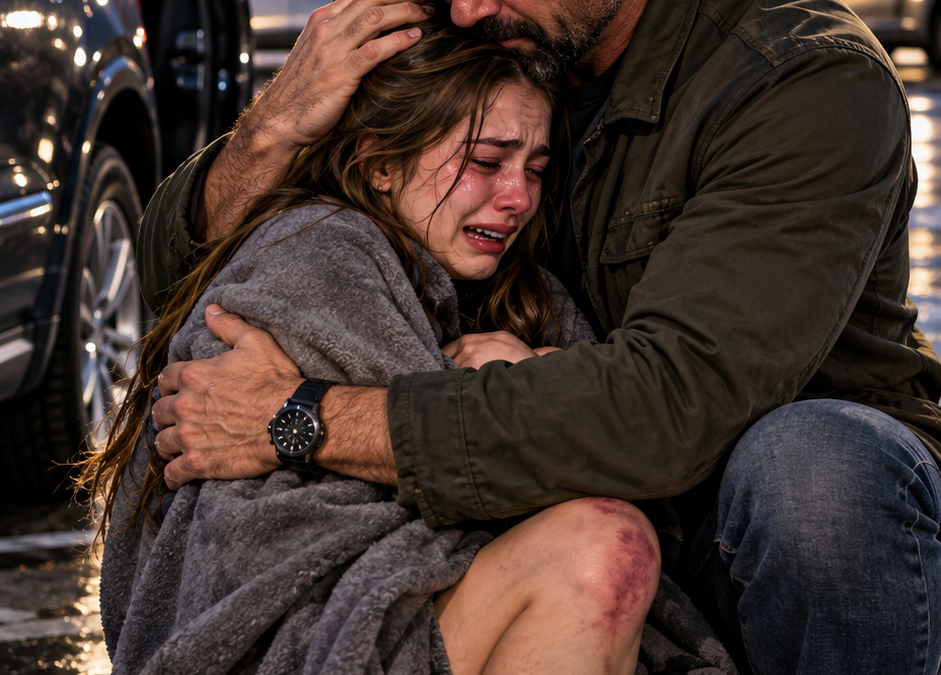
She stumbled forward and threw herself into my arms.
I held her while she cried.
Not the restrained tears of someone embarrassed to be upset in public.
She cried with her entire body, gripping my shirt as though she were afraid that if she let go, something terrible would happen again.
“It’s okay,” I whispered.
She shook her head.
“I should’ve told you.”
“Told me what?”
She couldn’t answer.
I gently guided her toward my truck and opened the passenger door.
She hesitated before sitting.
I noticed the way she held her coat closed.
Then I noticed her hands.
Her knuckles were scraped. There was a bruise forming along one wrist.
I felt something cold move through me.
“Camila. Who did this?”
She stared at the pavement.
“There are five guys.”
I waited.
“They’re seniors.”
Her voice began trembling again.
“They’ve been bothering me since the second week.”
I crouched in front of her.
“What do you mean, bothering you?”
She swallowed.
“Messages. Following me around. Taking my books. Shoving me in the hallway.”
“Did you report it?”
She nodded.
“Twice.”
“To whom?”
“Student conduct. Then somebody in Athletics.”
I took a breath.
“What happened?”
“Nothing.”
Her eyes filled again.
“They said the guys were just joking. They told me not to make things worse.”
I looked at the bruise on her wrist.
“What happened today?”
She began shaking.
For several seconds, she couldn’t speak.
Then she whispered, “They took me into an equipment room behind the athletic building.”
Every muscle in my body tightened.
“They locked the door.”
I held still.
“What did they do?”
She gripped her coat.
“They said it was a tradition. They said freshmen had to learn their place.”
She looked at me with an expression I will remember for the rest of my life.
“Dad, they heated a belt buckle.”
I couldn’t speak.
Camila started crying again.
“They held me down.”
I reached toward her, then stopped when she flinched.
“Sweetheart, are you hurt anywhere else?”
She shook her head, then hesitated.
“I don’t know.”
“Can you show me?”
Her hands trembled as she opened her coat.
When I saw the injury, I felt as though the ground had shifted beneath me.
There was a terrible burn on her skin, surrounded by inflamed tissue. She had tried to cover it, but I could see that she was in considerable pain.
For one moment, I heard nothing.
Not the cars moving through the parking lot.
Not the voices of students walking toward the residence halls.
Not even my daughter’s crying.
I wanted to find the five young men responsible.
I wanted answers.
But Camila was sitting in front of me, injured, frightened, and watching my face to see what I would do next.
So I took off my jacket and gently wrapped it around her shoulders.
“We’re going to the hospital.”
She stared at me.
“Are you mad?”
I swallowed.
“Not at you.”
“They said nobody would believe me.”
“I believe you.”
“They said their parents would make everything go away.”
I held out my hand.
She took it.
“Right now, we’re getting you medical care. Everything else can wait until you’re safe.”
She leaned against me.
And I made myself remember the promise I’d given Lindsay.
My daughter needed her father.
Not a Marine searching for someone to punish.
Not a man so consumed by anger that he forgot the person standing in front of him.
She needed me.
And I wasn’t going anywhere.
The emergency department was busy when we arrived.
A nurse took one look at Camila’s condition and brought her into an examination room.
I remained beside her, answering questions whenever she wanted me to and stepping back when she needed privacy.
When the physician finished examining the burn, his expression was grave.
“Your daughter has a third-degree burn.”
Camila stared at him.
“Is it going to leave a scar?”
He pulled up a chair.
“There’s a significant risk of scarring. We need to address the wound properly and arrange specialist follow-up.”
She looked down at her hands.
“Will it heal?”
“We’re going to give you the best treatment we can. But this is a serious injury.”
I felt my daughter’s hand searching for mine.
I held it.
The physician asked whether she wanted to speak with someone about the assault and explained the options for documenting her injuries.
Camila looked at me.
“What should I do?”
I wanted to tell her exactly what to do.
I wanted to take every decision away from her because she’d already been forced to endure something she never should have experienced.
But I knew that taking control from her again wouldn’t help.
“Sweetheart, I’ll support whatever you decide. Right now, let’s make sure you get the care you need.”
She nodded.
“I want them to know what happened.”
“Okay.”
“And I want someone to take pictures. Before they can say I’m lying.”
My throat tightened.
“Okay.”
The medical team documented her injuries and began treatment.
I remained at her bedside, watching her struggle to answer questions without becoming overwhelmed.
When she finally fell asleep, I stepped into the hallway.
I called our attorney.
Then I contacted the police.
I didn’t raise my voice.
I didn’t threaten anyone.
I gave the officers the information Camila had provided and explained that she had received emergency treatment for an injury caused by an alleged assault on campus.
By the time the police finished taking our preliminary statements, it was nearly midnight.
Camila was exhausted.
I sat beside her hospital bed and listened to her breathe.
For the first time since Lindsay died, I wished desperately that my wife were sitting beside me.
She would have known how to comfort our daughter.
She would have found the words I couldn’t.
Instead, I took Camila’s hand and whispered, “I’m here, baby.”
And I stayed awake until morning.
The following day, I met Dean Charles Whitmore.
I entered his office carrying a folder containing photographs, medical records, screenshots of threatening messages, Camila’s written account, and copies of the complaints she’d previously submitted.
Whitmore’s office was large and expensive.
Framed photographs covered the walls.
In several of them, he stood beside wealthy-looking men at fundraising events, shaking hands in front of buildings bearing family names.
I placed my folder on his desk.
“My daughter was assaulted on your campus.”
He adjusted his glasses.
“Mr. Rivera, we’re deeply concerned about what you’ve described.”
“Then act.”
“Of course. Ashford takes student safety very seriously.”
I opened the folder.
“These are the medical records. These are the messages. And these are the two complaints she submitted before the assault.”
He glanced at the documents.
I watched him carefully.
There was no visible surprise when he read the names.
“You recognize these students,” I said.
He folded his hands.
“I’m familiar with some of the individuals involved.”
“Then you know this didn’t come out of nowhere.”
“Mr. Rivera, there are procedures we must follow.”
“I’m asking you to follow them.”
His expression tightened.
“There are certain complications.”
“What complications?”
He hesitated.
“The young men involved come from extremely prominent families.”
I stared at him.
He continued.
“One father sits on the university board. Another family funded the athletic complex.”
I leaned forward.
“My daughter has a third-degree burn.”
“I understand that you’re upset.”
“She was locked in a room and branded with a heated belt buckle.”
Whitmore looked toward his office door.
Then he lowered his voice.
“My hands are tied.”
I closed the folder.
For a moment, neither of us spoke.
Then I looked him directly in the eye.
“Yours might be.”
He frowned.
“Excuse me?”
“Mine aren’t.”
He leaned back.
“Mr. Rivera, I hope you’re not suggesting—”
“I’m suggesting that you preserve every complaint, message, security recording, and disciplinary record connected to these students. And I’m suggesting that you cooperate fully with the police.”
His face changed.
“This university has legal counsel.”
“Then I suggest you call them.”
I stood.
“I didn’t come here to negotiate the value of my daughter’s safety against the amount of money her attackers’ parents donated.”
Whitmore said nothing.
I took my folder and walked out.
Outside his office, I stopped beside a window overlooking the campus.
Students were crossing the lawn.
Someone was tossing a football.
A group of young women sat laughing beneath a tree.
It looked exactly like the university I’d visited when I helped Camila move into her dormitory.
But somewhere on that campus was an equipment room where five seniors believed they could hurt a nineteen-year-old girl without facing consequences.
And somewhere inside the administration were people who apparently believed the same thing.
I called Elena Park, the attorney I’d contacted from the hospital.
“I met the dean.”
“How did it go?”
“He told me the students’ fathers are major donors.”
She was silent for a moment.
“Did he actually say that?”
“Yes.”
“Write down the conversation. As precisely as you remember it.”
I looked back toward Whitmore’s office.
“Already doing it.”
That was how the investigation began.
Not with threats.
Not with revenge.
With records.
Every message Camila had received.
Every complaint she’d submitted.
Every person who might have witnessed the harassment.
Elena helped us organize the material, preserve the original files, and coordinate with investigators.
By the third day, we learned that Camila wasn’t the first student who had reported being targeted by the same group.
By the fifth day, eleven former and current students had come forward.
Their accounts weren’t identical.
Some described intimidation and threats.
Others reported physical assaults, humiliating initiation rituals, and complaints that had disappeared after being referred to senior administrators.
But certain details appeared again and again.
The equipment room.
The same group of students.
The same assurances that their behavior was merely tradition.
And the same warning that reporting them would only make things worse.
Then a former student contacted Elena.
He said he had a video.
When we met him, his hands were shaking.
“I should’ve given this to somebody a long time ago.”
He passed Elena a storage device.
She arranged for the material to be transferred to investigators and reviewed appropriately.
The recording showed the equipment room.
The belt.
The same seniors.
Then, after the students had finished, an assistant athletics administrator entered.
He wasn’t visibly shocked by what he found.
He was angry.
Not because someone had been hurt.
Because the room hadn’t been cleaned properly.
I watched enough to understand what it showed.
Then I turned away.
I’d already seen what those young men had done to my daughter.
I didn’t need to watch another victim suffer to believe her.
The video changed the investigation.
Search warrants followed. Students were suspended. University employees were placed under investigation. Reporters began appearing outside Ashford’s gates.
By the tenth day, the university’s carefully maintained image had become the subject of national attention.
And the parents of the five seniors finally decided to contact me.
Not to apologize.
Not to ask how Camila was recovering.
They filed a civil lawsuit accusing me of harassment and intimidation.
Their attorney portrayed me as a dangerous former Marine sniper who had supposedly used his military background to retaliate against their sons.
I read the allegations in Elena’s office.
For a long time, I didn’t say anything.
Then I looked at her.
“They’re accusing me of threatening them?”
“Yes.”
“Based on what?”
“That’s a question they’ll have to answer.”
I glanced at the photograph of Lindsay that I kept in my wallet.
I’d made her a promise.
I wasn’t going to jeopardize my daughter’s future by allowing five powerful families to turn me into the person they were claiming I was.
So we prepared our defense.
Three weeks later, I walked into a courtroom with Camila beside me.
She’d insisted on attending.
That morning, I’d asked whether she really wanted to be there.
She looked at me.
“Dad, I’m tired of people being in rooms where decisions about me get made.”
I couldn’t argue with that.
So I held her hand as we entered.
Across the aisle sat five fathers behind a row of expensive attorneys.
Their lead counsel, Martin Kessler, rose and began describing me as an unstable former military sniper who had intimidated his clients.
I sat quietly.
Elena presented the documented record of my conduct.
The messages I’d sent.
The emails I’d written.
My correspondence with the police.
My cooperation with investigators.
No threats.
No unauthorized confrontations.
No evidence that I’d physically harmed anyone.
Then she presented the medical records documenting Camila’s injuries and the materials relevant to the underlying investigation.
The judge reviewed the documents.
He looked toward Kessler.
“Counsel, do you have evidence that Mr. Rivera physically harmed your clients?”
Kessler hesitated.
“No direct evidence, Your Honor.”
The judge removed his glasses.
“Then explain the basis for your allegations.”
Kessler began discussing his clients’ concerns about my military history and the attention the university had received.
The judge listened.
Then he looked toward the records Elena had submitted.
He observed that the materials raised serious questions about the conduct of the students, the university’s handling of prior complaints, and the purpose of the lawsuit.
Finally, he asked Kessler a question.
“Are you sure you want to proceed?”
The courtroom became completely still.
I watched the fathers exchange uneasy glances.
Their attorney requested a recess.
The judge granted fifteen minutes.
As everyone began standing, Camila leaned toward me.
“Dad?”
“Yeah?”
“What’s happening?”
I looked across the courtroom, where the five fathers were gathering around their attorney.
“I think they’re beginning to understand that if they want a trial, they’ll have to answer questions too.”
Elena leaned closer.
“If they continue, we’ll seek appropriate discovery. Relevant communications with the university. Donor relationships. Internal discussions about the prior complaints.”
Camila stared at her.
“Would they have to tell the truth?”
“They would be subject to the rules governing sworn testimony and disclosure.”
My daughter looked across the aisle.
For the first time since the assault, I saw something in her expression that wasn’t fear.
She wasn’t smiling.
She wasn’t celebrating.
She was watching men who had spent their lives making other people feel powerless discover that money couldn’t automatically protect them from being questioned.
But as the courtroom began emptying, Camila touched my arm.
“Dad. Look.”
I followed her gaze.
A woman stood alone near the courtroom doors, holding a cream-colored envelope against her chest.
I recognized her from the photographs I’d seen during the investigation.
Margaret Vale.
The mother of Preston Vale, one of the five seniors.
She looked directly at Camila.
Then she quickly looked away.
And something about the fear on her face told me that whatever was inside that envelope might matter more than anything we’d heard in court that morning.
When the recess ended, Kessler returned to the courtroom with the five fathers behind him.
He looked considerably less confident than he had twenty minutes earlier.
“Your Honor, after consulting with our clients, we intend to voluntarily dismiss the complaint without prejudice.”
Elena stood.
“We request dismissal with prejudice. Mr. Rivera has incurred substantial legal expenses responding to allegations for which the plaintiffs have presented no supporting evidence.”
The attorneys argued over the procedural details.
I barely listened.
My attention remained on Camila, who was watching Margaret Vale two rows behind her husband.
Eventually, the judge dismissed the lawsuit without prejudice, leaving open the possibility of another filing. But he warned Kessler that any renewed action would receive close scrutiny.
Then he said something I would never forget.
“Litigation is not a tool for discouraging lawful cooperation with an investigation.”
The fathers left quickly.
Margaret Vale didn’t.
Elena had arranged for us to avoid the reporters gathered outside the courthouse. We were halfway down a side corridor when a woman’s voice stopped us.
“Mr. Rivera?”
I turned.
Margaret stood several feet away.
Without the expensive clothes and carefully arranged smile I’d seen in photographs, she looked like an ordinary exhausted mother.
Her eyes moved toward Camila.
“I’m sorry.”
My daughter said nothing.
Margaret swallowed.
“I know that isn’t enough.”
Elena stepped forward.
“Mrs. Vale, any communication about this matter should go through counsel.”
“I understand.”
Margaret opened her purse and removed the envelope we’d seen her holding.
“My husband doesn’t know I have these.”
Elena accepted it.
“What are they?”
“Emails. From Ashford.”
I felt my stomach tighten.
Margaret looked toward Camila.
“I knew Preston had been getting into trouble. I thought it was drinking, hazing, and stupid behavior. I knew the university had received complaints.”
Camila’s expression changed.
“You knew?”
Margaret lowered her eyes.
“My husband told me the complaints had been reviewed. He said they were misunderstandings.”
“Did you believe him?”
“Yes.”
“Would it have mattered if you’d known what they were actually doing?”
Margaret’s face crumpled.
“It should have.”
Camila looked away.
For several seconds, nobody spoke.
Then Margaret turned toward Elena.
“My husband received warnings from Ashford last year. He told me yesterday that he knew nothing about the previous complaints.”
“And these emails contradict that?”
She nodded.
“He lied directly to me.”
Margaret left before anyone else could approach us.
We didn’t open the envelope until we reached Elena’s office.
Inside were nine printed emails.
The oldest was fourteen months old.
It had been sent by Associate Dean Walter Keene to Preston’s father, Nathan Vale.
The subject line read: Student Conduct Matter—Confidential.
The message referred to a complaint involving Preston and assured Nathan that the university was containing the matter internally.
Another email suggested that formal escalation would be counterproductive for everyone involved.
A third thanked Nathan for his family’s continued support of Ashford.
Three weeks after that correspondence, the Vale Family Foundation pledged $600,000 toward renovations to the university’s athletic training facility.
I stared at the figure.
Six hundred thousand dollars.
For a moment, I couldn’t think about anything except my daughter sitting in a hospital bed, asking whether the burn would leave a scar.
“Did he pay them to protect his son?”
Elena shook her head.
“We don’t know that. The timing raises questions, but it isn’t proof of an exchange.”
Camila was sitting beside me.
She picked up the oldest email.
“Who’s M.R.?”
I looked at her.
“What?”
She pointed toward a line near the bottom.
The student whose complaint had been handled internally was identified only by initials.
M.R.
Elena leaned forward.
“We’ll ask investigators whether they can identify the student.”
Camila carefully placed the email on the desk.
“Do you think they’re okay?”
I didn’t know how to answer.
I’d spent weeks thinking about what happened to Camila. About the five seniors. About the administrators who’d dismissed her complaints.
But my daughter was thinking about someone whose name we didn’t even know.
Someone who might have walked into an office months earlier, asked for help, and been told that protecting the university was more important.
That evening, we returned to the small furnished apartment I’d rented near Dunmore.
Camila had officially withdrawn from campus housing. Ashford had offered her temporary accommodation in a university guest residence, but she’d refused.
“I don’t want them deciding where I sleep,” she’d told me.
So I found a two-bedroom apartment above a pharmacy, about fifteen minutes from campus.
It wasn’t particularly attractive.
The refrigerator made strange noises, the hallway smelled faintly of old wood, and the bakery next door started preparing bread at an hour I considered unreasonable.
But it was ours.
Camila placed a photograph of Lindsay on the kitchen shelf.
Her textbooks occupied half the living room.
Her ridiculous yellow sunflower mug sat beside my plain coffee cup.
Little by little, she was making the apartment feel like somewhere we belonged.
That night, she stood at the stove preparing grilled cheese sandwiches while I reviewed the emails.
“You’re burning it,” I said.
“I’m creatively browning it.”
Smoke began curling toward the ceiling.
“Camila.”
She turned off the burner.
“It’s fine.”
“It’s black.”
“That’s a subjective interpretation.”
I smiled despite myself.
For a few seconds, we were simply a father and daughter arguing about dinner.
Then she placed the spatula down.
“Dad?”
“Yeah?”
“Do you think Mom would want me to leave Ashford?”
I closed the folder.
“What do you want?”
“I asked what Mom would want.”
I leaned back.
Lindsay had always disliked my habit of answering difficult questions with questions.
I could almost hear her telling me to stop interrogating our daughter over dinner.
“Your mother would want you somewhere you could build a good life. She wouldn’t care what name was written on the entrance.”
Camila stared at the burned sandwich.
“I worked so hard to get there.”
“I know.”
“It feels like leaving means they took it from me.”
I watched her carefully.
“Then don’t decide yet.”
She looked up.
“Everyone keeps asking.”
“Everyone else isn’t the one who has to live with the decision.”
Her eyes filled.
“I don’t even know if I can walk into that building again.”
“Then you don’t have to walk into it tomorrow.”
“What about next semester?”
“We’ll deal with next semester when it comes.”
She sat across from me.
For the first time since the assault, I began to understand how many choices other people were demanding that my daughter make.
Should she return to campus?
Transfer?
Speak publicly?
Testify?
Meet with investigators again?
Continue the lawsuit we’d been considering against Ashford?
Every decision seemed urgent to someone.
But Camila needed time to discover what she actually wanted.
I pushed the folder aside.
“Tonight, you’re going to eat that terrible sandwich.”
She laughed weakly.
“And tomorrow?”
“Tomorrow can wait until tomorrow.”
That became our rule.
One decision at a time.
The following week, we met Brooke Fleming, a former resident adviser who’d worked at Ashford two years earlier.
She arrived at a diner carrying a blue accordion folder.
“I kept everything,” she said as she sat down.
Elena opened her notebook.
“Why?”
Brooke looked embarrassed.
“Because I knew they’d eventually pretend none of it happened.”
Inside were complaint forms, incident reports, emails, and handwritten notes.
Brooke had documented repeated misconduct involving some of the same students who assaulted Camila.
The reports described intimidation, harassment, property damage, and physical confrontations.
Each complaint had been forwarded to the appropriate administrators.
Most had eventually been closed.
“Did anyone explain why?” Elena asked.
Brooke gave a bitter little laugh.
“They always had an explanation.”
She showed us an email from Associate Dean Keene.
He’d instructed her to allow Athletics to handle a particular incident informally, emphasizing the importance of avoiding disproportionate consequences for promising students.
Camila stared at that phrase.
“Promising students.”
Brooke nodded.
“I saw that wording a lot.”
“Why was Athletics involved?” I asked.
Brooke glanced at Elena.
“Because Athletics wasn’t just about sports.”
She explained that fundraising relationships extended throughout the university. Major donors had direct access to administrators. Board members could approach the president about student matters. Important families were treated with particular caution.
“Nobody sent an email saying, ‘Ignore this complaint because his father is rich,'” Brooke told us. “It was more subtle than that.”
“How?”
“You learned which families required special attention. You learned when an ordinary disciplinary matter suddenly became sensitive.”
Camila folded her arms.
“And nobody questioned it?”
“Some of us did.”
Brooke looked down at the folder.
“But after a while, you stopped believing the complaints would lead anywhere.”
On the drive home, Camila was quiet.
I waited until we reached the apartment before asking what she was thinking.
“I thought there was one bad dean,” she said.
“What do you mean?”
“I kept imagining Whitmore sitting behind his desk, deleting complaints because those fathers paid him.”
She looked at me.
“But it wasn’t just him, was it?”
“No.”
“There were people who knew. People who suspected. People who decided it wasn’t their responsibility.”
I thought about Brooke’s folder.
About the eleven students who’d come forward.
About the administrator who’d entered the equipment room and complained that someone hadn’t cleaned up afterward.
Camila hugged her coat closer.
“How do you stop something when everybody has learned to pretend it’s normal?”
I didn’t have an answer.
And for once, I didn’t try to invent one.
By late October, Ashford had appointed an interim dean.
Charles Whitmore was placed on administrative leave. Associate Dean Keene resigned, and three athletic department employees were suspended pending review.
The five seniors remained barred from campus while the criminal investigation continued.
Those developments mattered.
But Camila was discovering that an investigation could move forward while her recovery progressed at an entirely different pace.
She resumed two classes remotely.
Three mornings a week, she sat at our kitchen table with her laptop while I prepared breakfast.
I tried not to hover.
I was spectacularly unsuccessful.
One morning, she looked up from her computer.
“Dad, you’re staring.”
“I’m making eggs.”
“You’ve been holding that egg for thirty seconds.”
I cracked it.
“Problem solved.”
She smiled.
It was becoming easier for her to smile.
Not every day.
Not even most days.
But there were mornings when she forgot to check the lock twice before leaving the apartment.
Afternoons when she could walk through a parking lot without constantly glancing over her shoulder.
Evenings when she complained about assignments rather than the terrible dreams that sometimes woke her during the night.
She also began meeting with Dr. Saira Patel, a counselor recommended by the hospital.
Camila never told me exactly what they discussed.
I never asked.
That required more discipline than I expected.
I’d spent fifteen years in a profession where vigilance could keep people alive.
Parenthood demanded something different.
Sometimes loving my daughter meant noticing when she needed help.
Sometimes it meant allowing a closed door to remain closed.
One rainy Thursday, she returned from counseling and found me reorganizing the kitchen pantry.
She stopped in the doorway.
“Did you alphabetize the soup?”
“I categorized it.”
“Dad.”
“It’s efficient.”
She opened the refrigerator.
“You need a hobby.”
“I have hobbies.”
“Reading police reports isn’t a hobby.”
“I run.”
“You run like somebody’s chasing you.”
I looked at her.
She grinned.
“Dr. Patel says I should try something that has nothing to do with school or the investigation.”
“Sounds reasonable.”
“She thinks you should too.”
“I’m not her patient.”
Camila gave me a look so much like Lindsay’s that I nearly laughed.
That weekend, we drove to Lake Scranton.
Neither of us knew very much about fishing, but we rented two rods and decided to learn.
Camila tangled her line within four minutes.
I spent ten minutes fixing it.
Then mine tangled.
She immediately took a photograph.
“I’m sending this to Uncle Mateo.”
“Absolutely not.”
“Too late.”
We didn’t catch a single fish.
But we spent most of the afternoon laughing.
On the drive home, Camila rested her head against the passenger window.
“I forgot I could have a normal day.”
I kept my eyes on the road.
“Normal’s underrated.”
After a while, she said, “I think I want to go back.”
“To Ashford?”
“Maybe.”
My hands tightened around the steering wheel.
She noticed.
“You hate that idea.”
“No.”
“Dad, you’re gripping the steering wheel like it insulted you.”
I loosened my hands.
“I hate the thought of you being somewhere you don’t feel safe.”
“I know.”
“But it’s your decision.”
She turned toward me.
“Really?”
“Really.”
She studied my face as though searching for a condition I hadn’t mentioned.
There wasn’t one.
If Camila wanted to transfer, I’d help her.
If she wanted to stay, I’d support her.
The men who’d hurt her had already taken too much. I wasn’t going to allow my fear to take her choices away as well.
A few days later, a reporter named Nadia Serrano contacted Elena.
She’d been covering Ashford’s handling of the complaints and wanted to interview Camila.
Her email was unusually respectful.
She offered to meet privately and said she’d continue reporting even if Camila decided she didn’t want to speak.
My daughter read the message several times.
“Do you think I should?”
“I think you should decide what you want from the conversation.”
She sighed.
“You’re getting annoyingly good at saying that.”
Two days later, Camila met Nadia at a café.
She agreed to speak off the record.
I sat at another table, far enough away that I couldn’t hear them.
When the meeting ended, Camila looked thoughtful.
“She asked about Mom.”
That surprised me.
“Why?”
“She said everyone was writing about what happened to me, but nobody was writing about who I was before it.”
“What did you tell her?”
“That Mom used to sing terribly in the car.”
“She did.”
“And that she wanted me to study environmental engineering.”
“She wanted you to study whatever made you happy.”
“She was pretty convinced environmental engineering would make me happy.”
I smiled.
“Your mother had very specific opinions.”
Camila laughed.
Then her expression changed.
“Nadia’s investigating the donations.”
I felt my attention sharpen.
“What did she find?”
“She thinks several major gifts were connected to disciplinary decisions.”
That evening, Elena joined us at the apartment.
We spread copies of the documents across the kitchen table.
The pattern wasn’t simple.
That made it more difficult to dismiss.
Some major gifts had been made shortly before or after serious student complaints were downgraded or resolved informally.
The amounts varied.
Fifty thousand dollars.
One hundred seventy-five thousand.
Six hundred thousand.
One involved Gregory Pike, the father of another senior implicated in Camila’s assault.
His construction company had donated equipment during an expansion of Ashford’s campus.
Two months earlier, his son had faced a disciplinary hearing following an incident in a residence hall.
The university’s records no longer showed a completed hearing.
“That doesn’t automatically mean the donation purchased favorable treatment,” Elena explained.
“But somebody should be able to explain what happened to the complaint,” I said.
“Exactly.”
Camila studied the documents.
“What if there’s no email connecting the donation to the complaint?”
Elena looked at her.
“What do you mean?”
“What if nobody ever writes down an agreement?”
“That would make it harder to prove.”
Camila pointed toward one of Brooke’s old emails.
“What if they didn’t need an agreement?”
I leaned forward.
“Explain.”
She looked between us.
“What if everybody already knew what everybody else wanted?”
I thought about the people in those university photographs.
The trustees.
The donors.
The administrators who attended the same fundraising dinners and congratulated one another on their contributions to higher education.
One parent called a board member.
The board member expressed concern to the president.
The president asked the dean whether a formal punishment was really necessary.
Nobody explicitly ordered anyone to bury a complaint.
But the person responsible for handling it understood the pressure.
Elena studied Camila for a long moment.
“That kind of institutional pattern is difficult to prove legally.”
“I know,” Camila said.
“But maybe that’s what we should be looking for.”
Two days later, we received another call.
This time, it was from Leonard Shaw, Ashford’s former director of advancement operations.
He’d worked at the university for eleven years before retiring the previous spring.
We met him at his home outside Clarks Summit.
Leonard was seventy-one, with narrow shoulders, a hearing aid, and the precise manners of someone who’d spent decades communicating with influential people.
He sat beside a cardboard archive box.
“I kept copies of some of my correspondence,” he told Elena.
“Were you authorized to take these records when you retired?”
He shook his head.
“No.”
Elena closed her notebook.
“Then we need to be careful about how this material is handled.”
“I understand.”
“Why did you keep it?”
Leonard rubbed his hands together.
“Because after thirty-five years working in higher education, I no longer trusted the institution I’d spent my career serving.”
He opened the box.
Inside were printed emails, meeting notes, and a yellow legal pad.
At the top of one page were two words.
Development Sensitivities.
Beneath them was a list of names.
Donors.
Trustees.
Students.
Some were connected by arrows.
Camila stared at it.
“What is that?”
Leonard looked ashamed.
“It was a reference sheet.”
“For what?”
“So the president’s office knew when a disciplinary matter involved an important family.”
I felt my stomach tighten.
“Who instructed you to make this?”
Leonard shook his head.
“Nobody gave me a direct instruction. I kept being asked whether certain families had relationships with the university. Eventually, I made a list so I could answer quickly.”
He looked at Camila.
“I didn’t realize how much damage something like that could do.”
She stared at the names.
“Were the five seniors on it?”
Leonard hesitated.
“Four of them.”
I looked up.
“Four?”
He pointed toward the bottom of the page.
“Preston Vale, Gregory Pike’s son, and two others. Their families had substantial relationships with the university.”
“And the fifth?”
“Evan Mercer.”
“Why wasn’t he listed?”
“His family wasn’t a major donor.”
I frowned.
“But Dean Whitmore told me all five came from prominent families.”
Leonard looked uncomfortable.
“I don’t know why Evan was treated the same way.”
For the first time since we’d started tracing the donor relationships, something didn’t fit.
Four students appeared to be protected by money and influence.
The fifth had apparently received the same protection without either.
We turned Leonard’s information over to the investigators through the appropriate legal process.
Nadia published an article describing the questions raised by Ashford’s donor relationships.
The university denied operating any formal system of preferential treatment.
Technically, that might even have been true.
The documents suggested something less organized and more troubling.
People had learned to anticipate what powerful families wanted without being told directly.
Camila decided not to give an on-record interview yet.
“I don’t want to become evidence for somebody else’s theory,” she told Nadia.
The reporter respected her decision.
Then November arrived.
Cold rain turned to the first wet snow of the season, and Thanksgiving approached.
For the first time since Lindsay died, Camila asked whether we could spend the holiday at our home in Maryland.
“Just us?” I asked.
“And Uncle Mateo.”
“My brother is incapable of having a quiet holiday.”
“He makes good pie.”
“He buys good pie.”
“Still counts.”
We drove south the Tuesday before Thanksgiving.
Our house looked exactly as we’d left it.
Lindsay’s gardening gloves still hung in the mudroom.
Her blue ceramic bowl remained on the table beside the front door.
For two years, Camila and I had avoided moving certain objects because touching them felt like erasing evidence that Lindsay had once been there.
The morning before Thanksgiving, I found Camila sitting on the garage floor beside three boxes labeled with her mother’s name.
She was holding an old photograph.
Lindsay was standing barefoot on a beach, laughing into the camera.
“Where did you find that?”
“In Mom’s things.”
I sat beside her.
She reached into the box and removed a small notebook.
At first, it contained grocery lists and reminders.
Then the entries became more personal.
Appointments.
Medication schedules.
Questions for doctors.
And occasional thoughts Lindsay had written during the final year of her illness.
Camila read silently for several minutes.
Then she handed me the notebook.
“Read this.”
The entry was dated six months before Lindsay died.
Marshall worries that being here now cannot make up for all the years he was gone. I wish he understood that Camila does not need him to make up the past. She needs him to stay when life becomes ordinary again.
I read it twice.
My throat tightened.
For years, I’d carried the belief that every missed birthday and every deployment had created a debt I could never repay.
After Lindsay died, I’d convinced myself that if I remained alert enough, worked hard enough, and anticipated every possible danger, I could somehow compensate for the time we’d lost.
Then Camila was assaulted.
And I’d blamed myself for failing to protect her from something I hadn’t known was happening.
She rested her head against my shoulder.
“You stayed, Dad.”
I stared at the notebook.
“I’m trying.”
“No.”
She lifted her head.
“You stayed.”
Something inside me finally gave way.
I put my arm around her and held her while we sat surrounded by boxes containing the fragments of Lindsay’s life.
For a long time, neither of us spoke.
Then Camila looked at me.
“Maybe this is why you alphabetize soup.”
I laughed.
“Your mother would’ve supported the soup.”
“She absolutely would not.”
Thanksgiving was small.
Mateo arrived with three store-bought pies and enough food for twelve people.
We teased him about his inability to cook.
He teased me about my increasingly organized pantry.
We told stories about Lindsay.
For once, her absence wasn’t the only thing we felt.
Her life was there too.
After dinner, Camila set down her fork.
“I’ve decided something.”
Mateo stopped chewing.
I looked at her.
“I’m going back to Ashford in January.”
I remained quiet.
She folded her hands.
“I’m not asking permission, Dad. But I wanted you to know.”
I smiled.
“I know.”
“I’ll live off campus. I’m only taking three courses, and I’m going to keep seeing Dr. Patel.”
“Sounds like you’ve thought it through.”
“I applied for a part-time position in the environmental research lab.”
“That’s wonderful.”
Her eyes filled.
“I don’t want what happened to be the only thing anyone remembers about my time there.”
I reached across the table and squeezed her hand.
“Then we’ll make sure you have room to build the life you want.”
Three days after Thanksgiving, Elena called.
“Marshall, I need you and Camila back in Pennsylvania.”
“What happened?”
“Leonard Shaw remembered something.”
“About what?”
“The fifth student. Evan Mercer.”
My stomach tightened.
“What about him?”
“His father wasn’t a donor.”
“I know.”
“He was an auditor.”
We returned to Pennsylvania the following morning.
Leonard was waiting in Elena’s office with another folder.
He looked more exhausted than the last time we’d seen him.
“I should’ve remembered sooner.”
He opened the folder.
“Daniel Mercer, Evan’s father, worked for a financial consulting firm Ashford hired four years ago.”
Elena slid a document toward us.
It was an internal audit concerning restricted donations.
Money designated for scholarships, academic programs, and athletic facilities.
Millions of dollars.
“What did he find?” I asked.
Leonard looked at the floor.
“Accounting irregularities.”
Camila leaned forward.
“What kind?”
“Funds transferred between accounts before reporting deadlines. Donor restrictions interpreted very loosely. Questions about how certain expenditures were classified.”
“Was it illegal?”
Elena answered.
“No final finding was made.”
“Why not?”
“Because the audit was never completed.”
Daniel Mercer had left the consulting firm halfway through the review.
Shortly afterward, his son Evan enrolled at Ashford with a university-funded merit scholarship.
Camila frowned.
“Was he qualified?”
“Yes,” Leonard said. “He had excellent academic credentials.”
“Then what’s suspicious?”
Elena turned the scholarship approval toward us.
“It didn’t go through the normal selection committee.”
At the bottom of the document was a signature.
Charles Whitmore.
The dean who’d looked at my daughter’s medical records and told me his hands were tied.
I looked at Elena.
“Why would Whitmore personally approve Evan’s scholarship?”
“We don’t know yet.”
Leonard reached into his folder.
“There’s another email.”
It was four years old.
The sender was University President Harold Vance.
The recipient was Charles Whitmore.
The message was brief.
Daniel Mercer has agreed that further review will not be necessary. Please ensure the family understands that Ashford remembers those who approach sensitive matters constructively.
Whitmore’s reply appeared immediately beneath it.
Understood. I’ll handle the student matter personally.
For several seconds, none of us spoke.
Then Camila looked at me.
“Dad, did they give Evan a scholarship to keep his father quiet?”
I wanted to tell her we’d finally found the answer.
But the evidence didn’t yet establish that.
“We know the timing raises serious questions,” I said. “We don’t know what agreement, if any, was made.”
Elena nodded.
“That’s what investigators need to determine.”
The discovery changed the direction of the inquiry.
Until then, we’d believed Ashford’s administrators were protecting wealthy families because those families provided substantial financial support.
Now there was reason to investigate whether the university had also been protecting someone whose father possessed information about its financial practices.
Elena ensured the relevant materials reached investigators.
A separate examination of the university’s financial records began.
Daniel Mercer was contacted through counsel.
I didn’t approach him.
I didn’t confront Evan.
By then, I’d learned that the most useful thing I could do was preserve evidence, cooperate with investigators, and allow people with the appropriate authority to do their jobs.
When Daniel Mercer eventually agreed to an interview, the investigators obtained additional information about the unfinished audit.
The evidence indicated that concerns about restricted donations had been raised years before Camila arrived at Ashford.
Questions had been left unresolved.
Warning signs had been treated as administrative inconveniences.
And people in positions of authority had allowed those questions to disappear rather than insist on satisfactory answers.
The subsequent independent financial review identified improper transfers and reporting failures involving restricted university funds. The findings were referred to the appropriate authorities for further examination.
The evidence concerning donor influence also expanded.
Investigators could now examine a wider body of correspondence, complaint records, financial documents, and witness accounts.
Some of those records showed direct intervention by senior administrators in student disciplinary matters.
Others revealed a less explicit pattern of preferential treatment.
The two weren’t legally identical, and Elena was careful to remind us of that.
But together, they explained something I’d struggled to understand since the day I entered Whitmore’s office.
The dean hadn’t been dealing with an isolated incident involving five influential students.
He was working inside an institution that had spent years treating certain relationships as more important than enforcing its own rules.
As the inquiry progressed, the university’s board commissioned a broader independent review.
President Vance eventually resigned.
Whitmore’s employment was terminated following the investigation into his handling of student misconduct complaints.
Keene had already resigned, and additional administrative changes followed.
The university announced revisions to its disciplinary procedures, donor-conflict policies, and reporting requirements.
I read every announcement.
But I didn’t mistake announcements for change.
Real change would be measured by what happened the next time a frightened student walked into an administrator’s office and asked for help.
Meanwhile, the criminal proceedings involving the five seniors continued.
The evidence included witness statements, medical documentation, electronic messages, and the recording recovered during our investigation.
The defendants faced charges reflecting their respective alleged roles in the assault and unlawful confinement.
Camila was frightened when she learned that she might have to testify.
That evening, she sat at our kitchen table, turning her sunflower mug between her hands.
“Dad, what if I freeze?”
I sat across from her.
“Then you take the time you need.”
“What if I start crying?”
“You’re allowed to cry.”
“What if their lawyers make me sound like I’m lying?”
I wanted to promise her that wouldn’t happen.
But I couldn’t control what questions the attorneys might ask.
So I told her something I knew was true.
“You don’t have to be perfect to tell the truth.”
She looked at me.
“You believe me?”
“Completely.”
She began crying.
I moved around the table and held her.
“I wish Mom were here.”
I closed my eyes.
“Me too, sweetheart.”
Over the months that followed, the case moved through the courts.
Several of the defendants eventually entered guilty pleas. The student identified as the principal assailant contested the charges and was convicted after trial.
The proceedings did not restore what Camila had lost.
They couldn’t erase the injury or the nights she’d spent waking from nightmares.
But they established responsibility for what had been done to her.
The fathers never refiled their lawsuit against me.
Margaret Vale remained in contact with Elena and cooperated with investigators when asked.
Camila didn’t pursue a personal relationship with her.
She appreciated the evidence Margaret had provided, but she wasn’t responsible for relieving the guilt of someone who had known about prior complaints and remained silent.
One afternoon, several months after the university’s leadership changes, Nadia contacted Camila again.
She wanted to know whether my daughter was finally ready to speak publicly.
Camila thought about it for two days.
Then she agreed.
This time, she insisted on speaking on the record.
She didn’t want the interview to revolve entirely around her injury.
She wanted to talk about what had happened before the assault.
The messages.
The harassment.
The complaints she’d submitted.
The adults who’d told her not to make things worse.
She wanted people to understand that what happened in the equipment room wasn’t the beginning of the story.
There had been opportunities to intervene.
People had ignored them.
When Nadia asked whether Camila felt victorious after the criminal proceedings, my daughter sat quietly for a moment.
Then she answered.
“I wanted to go to college. I wanted to study engineering, make friends, and do something useful with my life. I didn’t want to become somebody whose name people recognized because she was hurt.”
She looked at the reporter.
“I’m glad the people responsible were held accountable. But I would rather none of this had happened.”
I listened from the other side of the room.
My daughter wasn’t speaking like someone who had suddenly become fearless.
She was speaking like someone who had learned that being afraid didn’t mean she had to remain silent.
In January, Camila returned to Ashford.
She lived off campus, continued counseling, and began working in the environmental research lab.
I stayed in Pennsylvania during her transition, giving her the support she wanted while slowly learning not to supervise every detail of her life.
Some mornings, she left for class without saying anything more than, “See you later, Dad.”
The first time that happened, I stood at the kitchen window watching her walk toward her car.
Then I went back inside and made coffee.
I didn’t call to check whether she’d reached campus.
I didn’t send three messages reminding her to be careful.
I let her go.
A few hours later, she sent me a photograph from the laboratory.
She was wearing safety glasses, holding a sample container, and smiling beside two other students.
The message beneath the photograph read:
First day. Didn’t break anything.
I laughed.
Then I forwarded it to Mateo.
By spring, Camila was spending more time with friends.
She joined an environmental research project and began discussing summer internships.
She still had difficult days.
There were places on campus she avoided.
There were moments when unexpected sounds made her tense.
Sometimes, when a particular memory returned, she called me and asked whether I could stay on the phone for a while.
I always answered.
But those moments no longer defined every part of her life.
One afternoon, I arrived at the apartment carrying groceries and found her sitting on the living room floor, surrounded by engineering textbooks.
She looked up.
“Dad, I have news.”
I set the bags on the counter.
“Good news?”
She smiled.
“I got the summer research position.”
For a moment, I simply stared at her.
Then I crossed the room and hugged her.
“I’m proud of you.”
She laughed.
“You’re crushing me.”
“Occupational hazard.”
“Dad!”
I let her go.
Her smile softened.
“Mom would’ve been excited.”
I looked toward Lindsay’s photograph on the kitchen shelf.
“She would’ve been insufferable.”
Camila laughed.
“She would’ve told every person she met.”
“Every single one.”
We ordered dinner that night.
Camila chose the restaurant, complained about the delivery fee, and insisted that we needed dessert because we’d had a difficult year.
I didn’t argue.
Later, after she’d gone to bed, I sat at the kitchen table with Lindsay’s notebook.
I opened it to the page we’d found in the garage.
She needs him to stay when life becomes ordinary again.
I’d spent years believing that being a father meant protecting my daughter from everything that could possibly hurt her.
The night she called me crying from the parking lot, that belief had shattered.
I couldn’t undo what those five seniors had done.
I couldn’t give Camila back the weeks she’d spent being frightened or the ordinary college experiences she’d lost.
I couldn’t erase the scar she would carry.
But I could believe her.
I could stand beside her when powerful people wanted her to stay quiet.
I could help her find the support she needed without taking away her independence.
And when the investigations ended, the reporters moved on, and there were no more court dates circled on our calendar, I could still be there.
The following morning, Camila wandered into the kitchen wearing pajamas and carrying her sunflower mug.
She opened the pantry.
Then she looked at me.
“Dad.”
“What?”
“You alphabetized the soup again.”
I smiled.
“That’s how you know everything’s back to normal.”
She shook her head, laughing.
Then she poured herself some coffee and sat across from me.
Outside, the morning sunlight spilled across the windowsill.
Her textbooks were scattered across the table. A grocery list was stuck to the refrigerator. Someone had left a pair of shoes in the hallway.
Nothing remarkable was happening.
My daughter was home.
She was safe.
And for the first time in longer than I could remember, I wasn’t waiting for the next crisis.
I was simply grateful to be there for an ordinary morning.








