𝗙𝗨𝗟𝗟 𝗦𝗧𝗢𝗥𝗬 The Night Karen Turned My Backyard Into an HOA Amenity
𝗙𝗨𝗟𝗟 𝗦𝗧𝗢𝗥𝗬
Just my property.
The next morning, Karen Whitmore appeared on my front porch.
She did not call first. She never did when she wanted to perform authority.
I saw her through the window before she rang the bell. She stood with a leather folder tucked under one arm, wearing a white blouse, tan slacks, and the expression of someone arriving to correct a subordinate.
I opened the door.
“Daniel,” she said brightly. “We need to talk about the pool situation.”
“No,” I said. “You need to explain why renters from Pine Hollow were in my backyard.”
Her smile thinned. “There seems to have been a misunderstanding.”
“There was trespassing.”
“That’s a strong word.”
“It’s the correct word.”
She glanced past me like she expected to be invited inside. I did not move.
“The renters were under the impression there was a community understanding about recreational access,” she said.
“A community understanding with who?”
“With the neighborhood.”
“My property is not the neighborhood.”
“Daniel, historically, that area has been treated as connected to the broader Pine Hollow amenity zone.”
I stared at her. “Karen, that sentence is nonsense.”
Her jaw tightened.
I stepped onto the porch and closed the door behind me. “The pool is behind my house. Inside my fence. On my recorded parcel. I paid for it. I maintain it. Your HOA has no authority over it.”
“We are not claiming ownership.”
“Then stop sending people to use it.”
She lifted a hand, palm outward, like she was calming a child. “You’re escalating this unnecessarily.”
I laughed once. “Strangers were swimming behind my house.”
“And I’m here to resolve the confusion.”
“Good. Send written notice to every resident and renter that the pool is private property.”
“That may not be the right approach.”
“It is the only approach.”
Her eyes changed then. Not dramatically. Just enough for the polite mask to slip.
“There are expectations in a community,” she said.
“I don’t live in your community.”
“You live adjacent to it.”
“That is not the same thing.”
She smiled again, slower this time. “We’ll see about that.”
I remember the way she said it.
Not angry. Not loud.
Certain.
That was what made it worse.
She turned and walked back to her SUV, leaving me on the porch with my hands curled into fists.
Two days later, they came back.
This time there were five of them.
I heard voices while I was in my office and looked out the side window. A group of renters stood by the gate, one of them holding a printed sheet. Someone reached over the fence, fumbled with the latch, and opened it.
I was outside before they got to the patio.
“Stop right there.”
They froze.
A man in a baseball cap lifted both hands. “We were told we could use the pool.”
“You were told wrong.”
He looked uncomfortable. “The HOA said access was allowed for residents.”
“Who at the HOA?”
“I don’t know. The packet came from the rental manager. It had Pine Hollow information.”
“Show me.”
He hesitated, then handed me the paper.
It was not formal HOA letterhead, but it referenced Pine Hollow community amenities and included a bullet point that made my blood go cold.
Pool access available behind Mercer property line gate. Please respect posted hours.
Posted hours.
My backyard apparently now had posted hours.
I kept the paper.
“You need to leave,” I said. “All of you.”
One woman frowned. “We paid for a rental with pool access.”
“Then your issue is with whoever lied to you.”
The man in the baseball cap looked past me at the water, then back at my face. He must have seen I was not bluffing.
“All right,” he said quietly. “We’re going.”
They left, irritated but not aggressive.
I locked the gate behind them with a new padlock that afternoon.
Then I posted a sign.
PRIVATE PROPERTY. NO TRESPASSING. PRIVATE POOL. NOT AN HOA AMENITY.
I put it directly on the gate at eye level.
Then I checked my existing security camera.
It covered the patio, but not the side gate clearly enough. I adjusted the angle, added a second camera from the garage corner, and enabled continuous recording. I did not want guesses. I wanted dates, faces, timestamps, and movement.
The footage told me the situation was worse than I thought.
Over the next several evenings, I reviewed recordings from the previous week. People had entered my backyard three separate times while I was away. One group had stayed nearly an hour. Another had walked in, looked around, and left. A third had stood at the gate while someone off camera appeared to explain how to open it.
I saved every clip.
Then I printed still photographs with timestamps. I marked the property boundary on a copy of my survey. I made a folder with the rental sheet, my deed, the pool permit, maintenance invoices, and utility bills showing I alone paid for the equipment.
If Karen wanted paperwork, I would give her paperwork.
The next HOA meeting was held in Pine Hollow’s clubhouse, a beige building with decorative shutters, a stone entrance, and the sterile smell of new carpet and lemon cleaner. I walked in ten minutes before the meeting started.
Karen saw me immediately.
Her smile froze.
“Daniel,” she said. “This is a members’ meeting.”
“And I’m here because your members and renters keep trespassing on my property.”
A murmur moved through the room.
The HOA board sat at the front behind folding tables arranged in a line. Karen occupied the center chair, of course. Beside her were three board members I recognized by sight and one attorney I had seen before during earlier boundary arguments.
I did not sit.
When public comment opened, I stepped forward and placed my folder on the table.
“I am not a Pine Hollow member,” I said. “I am the owner of the property west of your subdivision. Over the last week, multiple residents or renters associated with Pine Hollow have entered my private backyard and used my pool without permission. Some of them told me they were informed the pool was available as a community amenity.”
Karen leaned toward her microphone. “That is not an accurate characterization.”
I looked at her. “I have photographs.”
That quieted the room.
I removed the first printed image and held it up. “This is Tuesday at 6:42 p.m. Three renters inside my pool enclosure. This is Thursday at 3:18 p.m. Five people entering through my side gate. This is the rental information sheet one of them gave me, stating pool access is available behind my property line gate.”
The attorney reached for the paper before Karen could stop him.
His expression changed as he read it.
Karen said quickly, “That document was not issued by the board.”
“Then who gave renters directions to my gate?”
“We are investigating a misunderstanding.”
I placed my survey on the table. “There is no misunderstanding about the property line. The pool is here. My parcel surrounds it. Pine Hollow owns no interest in it.”
A man in the audience raised his hand without waiting to be recognized. “I was told there was pool access when my sister rented on Briar Court.”
Someone else said, “The listing mentioned neighborhood pool privileges.”
The attorney turned his head toward Karen.
She kept her face controlled, but I could see color rising at her neck.
“Listings sometimes contain errors,” she said. “That does not mean the HOA authorized trespassing.”
I opened the folder again. “Then the HOA should immediately issue written clarification that my pool is private property and not available to any resident, renter, guest, or contractor.”
“That may require board review,” she said.
“No,” I said. “That requires basic honesty.”
The room reacted softly, shifting in chairs, whispering.
Karen’s eyes hardened. “Mr. Mercer, we are not going to be threatened.”
“I’m not threatening you. I’m documenting you.”
That landed harder than I expected.
The attorney finally spoke. “Mr. Mercer, if you would provide copies of these materials, I’ll review them.”
“I brought copies.”
I slid the folder across the table.
Karen did not touch it.
The attorney did.
I left that meeting thinking the problem might finally be over.
I was wrong.
For about four days, nothing happened. No strangers. No gate activity. No suspicious movement at night. The pool sat quiet under the sun, exactly as it should have.
I upgraded the lock anyway.
I installed a larger sign.
I added another camera aimed directly at the gate from above, high enough that no one could casually turn it away. I also installed a small motion light near the side entrance. I wanted anyone approaching that gate to know they were being recorded.
The sign was impossible to miss.
PRIVATE POOL. NO HOA ACCESS. ENTRY WITHOUT PERMISSION IS TRESPASSING. SECURITY CAMERAS IN USE.
I stood in front of it after mounting it and thought, There. That has to be clear enough for anyone.
But clarity only works on people who care about the truth.
That Saturday, I drove into town to pick up supplies. I was gone less than two hours. When I came back, I knew something was wrong before I even reached the driveway.
There were cars parked along the road.
Too many cars.
Music thumped faintly through the heat.
Then I heard laughter.
My stomach dropped.
I parked, got out slowly, and walked around the side of my house.
My backyard was full of people.
Not three. Not five.
Dozens.
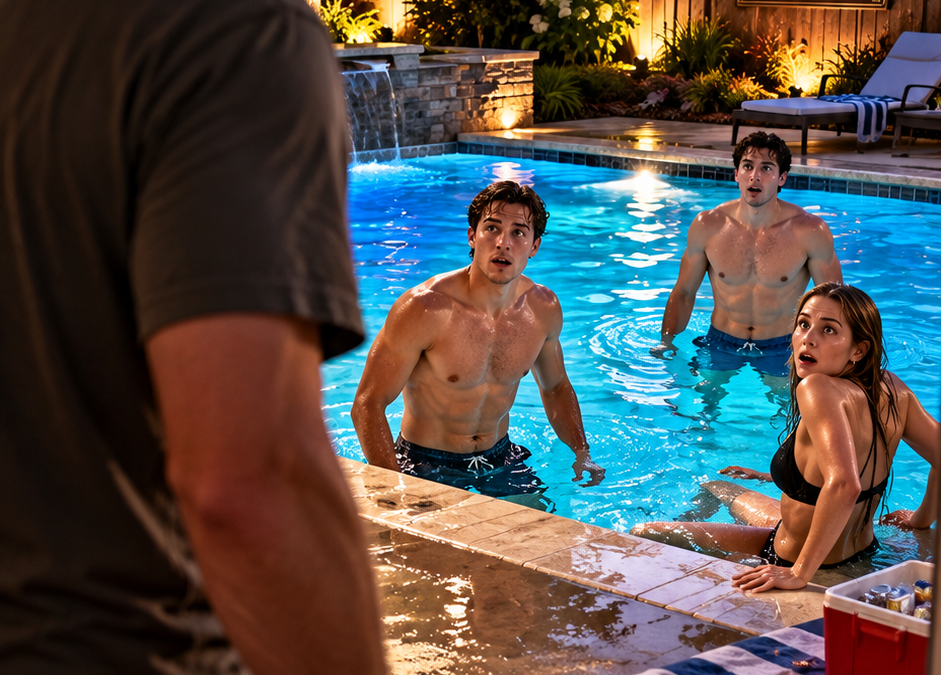
Men and women stood around my pool with drinks in hand. Towels covered my patio chairs. Someone had set a speaker on my outdoor table. A woman I had never seen before was applying sunscreen near my grill. Kids splashed in the shallow end while adults lounged along the edge as if they had rented the place for the afternoon.
For one moment, I could not move.
The sheer nerve of it almost emptied my head.
Then a man near the deep end saw me.
“Hey,” he called casually. “You the owner?”
I looked at the crowd, the wet footprints on my patio, the cooler shoved against my wall, the gate hanging open.
“Yes,” I said. “And all of you are trespassing.”
The music kept playing for another second before someone turned it down.
A woman stood from one of my chairs. “We were told this was approved.”
“By who?”
“Karen,” someone said from the far side.
That name moved through me like a blade.
A few people looked uncomfortable. Others looked annoyed, as if I had interrupted their good time.
A man in swim trunks lifted a hand. “Look, we’re renting through the neighborhood. We were told the pool was part of the access package.”
“It is not.”
“Well, that’s not what we were told.”
“I don’t care what you were told. This is private property.”
A child began crying, probably because the adults suddenly sounded tense. That sound stopped me from shouting what I wanted to shout.
I took a breath.
“This party is over,” I said. “Gather your things and leave now.”
Some did immediately. Others moved slowly, muttering. One man said something about false advertising. Another said he wanted a refund. A woman apologized while trying to collect inflatable toys from the water.
Then Karen arrived.
Of course she did.
She came through the open gate like a mayor arriving at a ribbon cutting.
“What is going on here?” she demanded.
I turned toward her. “That is my question.”
“These people were told they could use the pool today.”
“By you.”
Her eyes flicked toward the others, then back to me. “There has been an unresolved dispute regarding recreational access.”
“There is no dispute. There is trespassing.”
“You cannot invite confusion and then punish residents for relying on established community expectations.”
For a second, I honestly thought I had misheard her.
“I invited confusion?”
“You have resisted every cooperative solution.”
“Karen, I have one solution. Stay off my property.”
She stepped closer, lowering her voice so the others might not hear. “You are embarrassing people.”
“You brought them into my backyard.”
“They believed they were allowed to be here.”
“Because you let them believe that.”
Her mouth formed a hard line. “You should be careful how you accuse people.”
That was the moment something in me changed.
Until then, I had been trying to stop each incident as it happened. I had been reacting. Locking gates. Posting signs. Showing papers. Arguing with renters. Arguing with Karen. Trying to make unreasonable people behave reasonably.
Standing there in the middle of my own hijacked backyard, with strangers dripping pool water across my patio and Karen looking at me like I was the problem, I understood that the next step could not depend on her admitting anything.
I needed evidence so clear that no board, attorney, renter, or neighbor could pretend confusion anymore.
I did not want anyone hurt. I did not want some confrontation by the pool with children present, shouting adults, and people slipping on wet concrete. I did not want to drain the pool or damage my own equipment. I needed a way to document unauthorized use without fighting people one by one.
That night, after the last trespassers left and I had cleaned up cups, wrappers, wet towels, and sunscreen smears from furniture I owned, I sat at my kitchen table with my laptop open and searched for lawful, harmless ways to identify unauthorized pool use.
I found water-system identification dye.
It was designed for tracing leaks, checking flow paths, and confirming whether water had moved from one place to another. It was not corrosive. It was not dangerous when used correctly. It did not permanently stain swimmers. It did not damage pool surfaces when used according to directions. Its whole purpose was visibility.
That mattered to me.
I was not looking for revenge.
I was looking for proof.
Before doing anything, I called my attorney.
His name was Warren Albright, and he had the kind of voice that made panic sound inefficient. I explained everything: the earlier trespasses, the meeting, the signs, the upgraded locks, the pool party, Karen’s statements, the rental sheet, the camera footage.
He was quiet for a moment after I finished.
Then he said, “You need to stop thinking of this as a neighbor dispute.”
“What is it?”
“It is repeated unauthorized entry onto your private property after notice.”
“That’s what I keep saying.”
“And now you need to create a clean record. Not an emotional record. A clean one.”
I told him about the identification dye.
“Is it harmful?” he asked.
“No. It’s for water tracing. I’d follow the label exactly. No damage. No injury. Just visible color change.”
“Do not do anything unsafe,” he said. “Do not create a hazard. Do not lock anyone inside. Do not confront people alone if there is a crowd. Keep your cameras running. Preserve all notices. And call law enforcement if trespassing continues.”
“I want them caught on record.”
“You already have a record,” he said. “But if they return after those signs and locks, the record becomes stronger. Make sure the product is safe for your pool and that you are not creating any risk.”
“I understand.”
“Good. Then document everything. Before, during, after.”
That was what I did.
I photographed the signs. I recorded the locked gate. I saved the product label and instructions. I checked the camera angles again. I made sure the footage showed the entrance, the pool deck, and the warning signs. I did not interfere with the latch in a way that could trap anyone. I did not create any hazard near the water. I did not do anything that would hurt a swimmer.
I simply prepared to prove what kept happening.
For nearly a week, nobody came.
The pool stayed quiet.
The cameras recorded wind moving the gate sign, sunlight crossing the patio, and leaves drifting into the water. Every day after work, I checked the footage with the strange exhaustion of a man waiting for someone else’s bad behavior to confirm he was not crazy.
Then, on the following Sunday afternoon, the motion alert came through my phone.
I was inside the house, reviewing invoices at the kitchen table, when the notification appeared.
Side Gate Motion Detected.
I opened the camera feed.
Three people stood at the gate.
One looked directly at the sign. Another pointed at the lock. The third bent down, reached through a gap near the post, and worked at something I could not immediately see. A few seconds later, the gate opened.
My pulse slowed in a way I recognized.
Real anger does not always speed you up. Sometimes it narrows everything.
They walked in.
Behind them came more people. Six. Eight. Ten. A woman carrying a bag. A man with towels over his shoulder. Two teenagers. Then another couple.
They had not misunderstood.
They had read the warning and entered anyway.
I stayed inside and watched.
The cameras captured everything.
They set bags on my chairs. Someone laughed about the sign. A man gestured toward the house and said something I could not hear. One of them tested the water with his foot, shrugged, and jumped in.
Then another.
Then another.
For a few minutes, they behaved exactly the way the others had—comfortable, entitled, careless in a place that did not belong to them.
Then the dye activated.
It began near the return flow, a thin thread of color spreading through the water like smoke caught under glass. At first, no one noticed. The pool was moving too much, swimmers splashing, sunlight flashing on the surface.
Then the color deepened.
A bright purple bloom curled through the shallow end and drifted outward.
The first swimmer saw it and jerked backward.
“What is that?”
The woman on the steps screamed—not in pain, but shock. She lifted her hands out of the water and stared at them. Purple swirled around her legs.
Another man scrambled toward the ladder. “Why is the water purple?”
Within seconds, everyone was moving.
No one was hurt. No one slipped. No one seemed anything more than startled and embarrassed. But the mood changed instantly. Laughter vanished. People climbed out, staring at the water, their towels, each other.
One of the teenagers pointed toward the camera.
“We’re being recorded.”
That sentence did more than the sign had.
People started grabbing bags.
I stepped outside, phone in my hand, calm by then because the cameras had already done the work.
“Everyone needs to leave my property now.”
A man shouted, “What did you put in the pool?”
“A harmless water identification dye,” I said. “The question is why you entered a clearly marked private property after notice.”
“We were told we could be here!”
“By who?”
No one answered at first.
Then someone said, “Karen said it was still being disputed.”
There it was again.
Still being disputed.
As if repeating a lie often enough could keep it alive.
“Leave,” I said. “Now.”
They did.
Some cursed under their breath. Some looked humiliated. One woman apologized as she passed me and said she had genuinely believed the HOA had resolved it. I told her to take it up with whoever sent her.
Within minutes, the yard was empty.
The pool, however, was spectacular.
Purple water moved under the sun, bright and undeniable. It looked absurd. It looked ridiculous.
Most importantly, it looked documented.
Karen arrived less than fifteen minutes later.
She came through the gate without asking.
That alone was almost perfect.
The camera caught her walking past the sign, stepping onto my patio, and staring at the purple water with her mouth open.
Then she started shouting.
“What did you do?”
I stood near the back door. “Why are you on my property?”
“What did you put in the pool?”
“Why are you on my property?”
“This is outrageous.”
“I agree.”
“You cannot expose residents to unknown chemicals.”
“It was a harmless water identification dye used according to instructions. No one was injured. No one was supposed to be in the pool.”
Her face flushed. “You set this up.”
“I documented trespassing.”
“You humiliated people.”
“You sent people into my backyard.”
“I did no such thing.”
I lifted my phone. “The cameras recorded them saying otherwise.”
That stopped her.
Only for a second, but enough.
“I want a copy of whatever footage you think you have,” she said.
“No. My attorney will provide evidence through the proper channel.”
“You are making a serious mistake.”
“Karen, the serious mistake was walking past a private property sign to complain about what trespassers found in my pool.”
She looked toward the camera mounted under the eave.
For the first time, she seemed to understand that everything she said was being preserved.
Her voice lowered.
“This could still be resolved quietly.”
“It could have been resolved quietly the first time I asked you to tell people my pool was private.”
She swallowed.
Behind the anger, I finally saw fear.
Not fear of me.
Fear of the record.
That was what changed everything.
The next morning, my attorney sent a formal notice to Pine Hollow Estates HOA and its counsel. Attached were copies of my deed, the pool permit, the survey, photographs of the posted warnings, screenshots from the camera footage, and still images showing multiple unauthorized entries. He included the rental sheet referencing access behind my property line gate. He demanded immediate written correction to all residents, renters, rental managers, listing agents, and board members.
He also demanded preservation of all communications relating to the pool.
That phrase did work.
Preservation of communications has a way of making people remember that deleted messages are not as invisible as they hope.
The HOA board called an emergency meeting three days later.
This time, their attorney contacted mine first and asked if I would attend with counsel. I did.
Karen was there, but she no longer sat quite as tall in the center chair.
The room was more crowded than the previous meeting. Word had spread fast. People had heard about the purple pool, though I noticed the story had already mutated depending on who told it. Some thought I had dyed the people. Some thought the pool had malfunctioned. Some thought Karen had authorized a party and been caught. One man whispered that I had “booby-trapped” the water until my attorney calmly corrected him before the meeting started.
“No trap,” Warren said. “No injury. No hazard. Harmless identification dye in a private pool after repeated trespass and posted warnings.”
The man stopped whispering.
The HOA attorney began by acknowledging that there had been “confusion” regarding amenity access.
Warren stood immediately.
“No,” he said. “Before we go further, my client objects to that characterization. There was no confusion after written warning, posted signage, survey documentation, and direct notice to this board. The issue is repeated unauthorized access to private property.”
The HOA attorney adjusted his papers.
“Understood,” he said carefully.
Karen looked like she wanted to interrupt, but another board member leaned toward her and whispered something. She stayed silent.
Then the evidence began.
Warren presented the survey first.
It showed the pool completely inside my parcel. Not touching an easement. Not straddling a line. Not adjacent to HOA common space in any legally meaningful way. Fully private.
Then came the photographs of the signs.
Then the gate footage.
The room was quiet as the video played.
There were the renters entering.
There was the group reading the sign and opening the gate anyway.
There was the pool party.
There was Karen walking in afterward, demanding to know why the water had turned purple.
I did not enjoy watching it in front of people. Not exactly. There was satisfaction in the truth being visible, yes, but also exhaustion. I should not have had to prove that my backyard was mine. I should not have had to sit in a clubhouse while strangers watched footage of other strangers violating the one place where I used to feel completely at peace.
Still, the record mattered.
One board member, a retired accountant named Martin Hale, leaned forward after the footage ended.
“Karen,” he said, “did you tell renters or residents that Mr. Mercer’s pool was available?”
Karen’s hands folded tightly. “I communicated that recreational access was under review.”
“That is not what I asked.”
The room sharpened.
Karen’s expression hardened. “Some rental materials may have included inaccurate language.”
“Who supplied that language?”
“I don’t recall.”
Warren spoke then. “We have a copy of an email from the rental coordinator stating that the pool access note was based on guidance from the HOA president.”
Karen went still.
The HOA attorney turned toward her.
“Karen,” he said quietly, “is there an email we need to review?”
She did not answer quickly enough.
That silence did more damage than any speech could have.
A woman in the audience said, “So we were lied to?”
Another said, “My brother rented a unit because it said pool access.”
Someone else muttered, “This is going to be a mess.”
The board called a closed session, but not before Warren stated our position clearly: the HOA had no right, title, easement, license, agreement, or authority relating to my pool; continued representations otherwise would result in legal action; and any future entry onto my property by residents, renters, guests, or agents would be treated as trespass.
We waited outside while they argued behind closed doors.
I stood near the clubhouse entrance, looking across the manicured common lawn toward the dark line of trees that separated Pine Hollow from my land. My attorney stood beside me, silent for a while.
Finally, I said, “I hate this.”
“I know.”
“It sounds stupid. It’s just a pool.”
“It isn’t just a pool.”
I looked at him.
He shrugged. “People always say that when something personal gets violated. Just a pool. Just a fence. Just a driveway. Just a strip of land. But ownership means you decide who comes in. Privacy means something. Peace means something.”
I looked away because, for some reason, that hit harder than I expected.
He was right.
The pool had never been about luxury. It was about control over one quiet corner of my life. Karen had turned that corner into a community entitlement and then acted offended when I objected.
The closed session lasted forty minutes.
When the doors opened, Karen came out first, pale and furious. She did not look at me.
The board returned to the front table. Martin Hale, not Karen, spoke.
“Based on review of the survey, ownership records, and evidence presented, the board acknowledges that Mr. Mercer’s pool is private property and is not, and has never been, a Pine Hollow Estates amenity.”
The sentence felt like air returning to a room.
He continued.
“The board will issue immediate written notice to all residents, renters, property managers, and listing agents clarifying that no access is permitted. Any prior materials suggesting otherwise must be corrected. The board will also review internal procedures regarding amenity descriptions and external property boundaries.”
Karen sat motionless.
Martin glanced once in her direction, then back at the room.
“Additionally, the board will cooperate with counsel to ensure no further unauthorized access occurs.”
It was not an apology.
Not really.
But it was an admission, and that mattered.
After the meeting, a few residents approached me. One apologized on behalf of her visiting relatives. Another said he had no idea the pool was private and looked genuinely embarrassed. A rental owner asked if I would provide a statement he could use to correct his listing.
I said my attorney would handle communications.
Then Karen walked past me toward the parking lot.
For a moment, I thought she would keep going.
She stopped instead.
“This got out of hand,” she said.
I turned toward her. “No. You pushed it out of hand.”
Her eyes flashed. “You made everyone look foolish.”
“I made the truth visible.”
“That dye stunt was unnecessary.”
“The signs were necessary. The locks were necessary. The meeting was necessary. The survey was necessary. You ignored all of it.”
She had no answer.
I stepped closer, not threatening, just close enough that she had to hear every word.
“Do not send anyone to my property again. Do not imply access. Do not suggest review. Do not call it disputed. There is nothing left to discuss.”
For once, Karen did not tell me we would see.
She got into her SUV and drove away.
The formal notice went out the next day.
Every resident received it.
Every rental owner received it.
Every property manager connected to Pine Hollow received it.
The language was plain: my pool was private property, not an HOA facility, not available for use, and not included in any amenity package. No resident, renter, guest, or agent had permission to enter my backyard, open my gate, use my pool, or represent otherwise.
The rental listings changed within a week.
The pool references disappeared.
The gate stayed locked.
I upgraded it anyway.
I replaced the old latch with a heavier one, installed a keypad lock for service access, added another camera facing outward, and had a contractor reinforce the fence section near the post where people had reached through. I also added a simple line of shrubs inside the fence—not because shrubs stop trespassers, but because I wanted the yard to feel like mine again instead of a crime scene with patio furniture.
The pool itself took a little work to clear.
The dye faded through filtration and treatment, exactly as the instructions said it would. For several days, the water carried a faint lavender tint, like a reminder that absurd things really had happened. Then it cleared completely.
The first evening it looked normal again, I went outside alone.
The sun had already dropped behind the trees, and the patio lights glowed warm against the fence. The water was still, blue again, reflecting the first faint stars above the roofline. I sat in one of the chairs that strangers had used without permission and let the silence settle around me.
For the first time in weeks, there were no voices at the gate.
No motion alerts.
No laughter where there should not have been laughter.
No Karen arriving with a folder and a smile.
Just the pump humming.
Just water.
Just my own breathing slowing down.
I thought about how ridiculous the whole thing would sound to someone hearing only the outline.
An HOA claimed access to a private pool.
The owner used purple dye.
The board backed down.
It almost sounded funny from a distance.
But it had not felt funny while it was happening.
It had felt invasive. It had felt like being slowly erased from my own property by someone else’s confidence. That was Karen’s real talent. She did not need to own something to speak as if she did. She did not need legal authority to create the appearance of authority. She only needed enough people to accept her tone before checking the documents.
That was what made documentation so powerful.
A deed does not care who smiles.
A survey does not care who chairs a board.
A camera does not care who claims there was confusion.
Records do not get embarrassed. They do not soften a fact to preserve someone’s ego. They simply sit there, waiting for the noise to stop.
A few weeks later, I received a letter from the HOA’s attorney. It confirmed, in careful legal language, that Pine Hollow Estates disclaimed any ownership, access right, easement, license, amenity interest, or recreational authority concerning my pool and surrounding yard. It stated that the board had corrected its internal materials and instructed associated property managers not to advertise or imply pool access.
I read it twice.
Then I placed it in the same file as my deed, survey, pool permit, photographs, and printed screenshots.
That file was thicker now than it should have needed to be.
But it was complete.
Summer moved on.
The days stayed hot, but the tension faded. I started swimming again in the mornings. At first, I still glanced toward the gate whenever I heard a car door or a voice beyond the fence. I hated that. I hated that Karen had managed to put suspicion into a place where I used to feel only peace.
But peace came back slowly.
One quiet morning, I slipped into the water just after sunrise. The surface broke around me, cool and clean. Mist lifted faintly from the pool, and the maple leaves stirred in a light breeze. I swam one length, then another, then stopped in the deep end and floated on my back.
Above me, the sky was pale gold.
For the first time all summer, I did not think about Karen.
I did not think about renters, signs, locks, lawyers, meetings, or purple water.
I just floated there, listening to nothing.
That was when I knew the pool was mine again.
Not because the HOA admitted it. Not because the board sent a notice. Not because Karen finally stopped.
It was mine because it had always been mine, and because I had finally forced everyone else to confront what the records had shown from the beginning.
A neighborhood association can make rules for its own property.
It can regulate its own clubhouse, its own sidewalks, its own little patches of grass, and whatever amenities its members actually own.
But it does not become king of everything nearby just because a board president says “community” with enough confidence.
My pool was not an amenity.
It was not a misunderstanding.
It was not under review.
It was behind my house, inside my fence, on my land.
And when Karen tried to turn my privacy into a neighborhood privilege, the truth did not need to shout.
It only needed a survey, a camera, a warning sign, and one pool full of unmistakable purple water.
After that, the gate stayed closed.
The strangers stopped coming.
The HOA stopped talking.
And every evening, when the porch lights touched the clear surface again, my backyard finally became what it had been before Karen ever put her hands on it.
Quiet.
Private.
Mine.
𝗧𝗛𝗘 𝗘𝗡𝗗
The Night Karen Turned My Backyard Into an HOA Amenity
The first time I saw strangers swimming behind my house, I thought I had missed something obvious. By the time I saw the third group walk through my gate like they had been handed permission, I knew someone was using my property as if it belonged to them. And when Karen Whitmore smiled on my porch and told me, “We’ll see about that,” I finally understood this was never going to stop with a polite conversation.
My name is Daniel Mercer, and I built that pool with money I had earned one painful year at a time.
It sat behind my house on the west side of my property, just beyond the covered patio, surrounded by a cedar privacy fence I had put up myself. It was not extravagant in the way rich people use that word. It did not have waterfalls, marble tile, imported stone, or some glowing magazine layout. It was a simple rectangular pool with pale coping, deep blue liner, clean concrete, and enough space for two lounge chairs under the old maple tree near the fence.
But to me, it was one of the best things I had ever built.
After long days working, dealing with contractors, tax notices, weather damage, broken machinery, and every other irritation that comes with owning land, that pool was where my shoulders finally came down from my ears. I could sit outside in the evening with a glass of tea, listen to the pump humming softly, and watch the reflection of the porch lights move across the water. In the summer, I swam before sunrise while the neighborhood still slept. In the fall, I covered it carefully and checked every strap before the first cold snap. I paid for the installation, the maintenance, the chemicals, the electricity, the pump repair, the insurance, and every service visit.
Not one dollar came from the HOA.
Not one board member ever helped me skim leaves, balance chemicals, replace a filter cartridge, or clean storm debris from the shallow end.
It was my pool, inside my fence, on my parcel, behind my house.
That should have been enough.
But if there was one lesson Karen Whitmore seemed determined to teach me, it was that some people will look directly at a property line and treat it like a suggestion if it stands between them and something they want.
Karen was the president of Pine Hollow Estates HOA, which governed the newer subdivision east of my property. I was not part of Pine Hollow. My home predated it by decades. My deed did not reference their covenants. I had never signed their documents, never attended their holiday gatherings, never used their clubhouse, and never had any interest in their arguments over mailbox colors and approved shrub heights.
Still, Karen had a habit of speaking about “the community” as if the word had magical power.
If she called something a community concern, she believed it became her concern.
If she called something a shared amenity, she believed it became shared.
If she called something confusing, she believed confusion gave her permission to push until the other person got tired.
I had already dealt with her over boundary issues before. She had tried to treat parts of my land as neighborhood open space. She had allowed residents to wander trails too close to my fence. She had sent letters implying that Pine Hollow’s “managed area” overlapped with my property, even after I sent back recorded documents showing it did not.
Every time, she acted surprised that I resisted.
“You’re very defensive about land,” she told me once.
“I’m defensive about trespassing,” I said. “There’s a difference.”
She did not like that answer.
So when the pool problem began, I should have recognized her hand in it sooner.
The first incident happened on a Tuesday evening in July. It had been brutally hot all day, the kind of heat that makes asphalt shimmer and keeps every living thing hiding in shade. I came home later than usual after helping a neighbor repair a broken gate. I remember stepping through my kitchen, setting my keys on the counter, and hearing laughter from behind the house.
At first, I smiled without thinking.
Then I froze.
No one was supposed to be back there.
I walked to the sliding glass door and looked out across the patio.
Three people were in my pool.
Two young men stood near the shallow end, talking and laughing. A woman floated on her back, sunglasses on, one arm trailing through the water. A cooler sat open on the concrete. Someone had draped a towel across one of my chairs.
For a few seconds, my mind refused to process it.
It was so outrageous, so physically impossible in the ordinary rules of life, that my first thought was not anger. It was confusion. Had I forgotten inviting someone? Had a friend’s adult children stopped by? Had one of my relatives sent people without asking?
Then one of the young men looked up and saw me standing behind the glass.
He smiled.
Not guilty. Not startled. Smiled.
I opened the sliding door and stepped out.
“Can I help you?”
The floating woman startled and grabbed the pool edge. One of the men straightened.
“Oh,” he said. “Hey. We’re just using the pool.”
“My pool.”
He blinked. “Right. The community pool.”
I stared at him. “This is not a community pool.”
The second man’s smile faded. “Wait. What?”
“You’re in my backyard.”
The woman climbed out quickly, water streaming from her hair. “We were told residents could use it.”
“Residents of what?”
“Pine Hollow,” she said, looking genuinely unsettled now. “We’re renting over on Briar Court. The HOA packet said there was pool access.”
That sentence landed hard.
“What HOA packet?”
The man near the cooler stepped out of the pool slowly. “The rental welcome thing. It said residents had access to neighborhood amenities.”
“Pine Hollow has a clubhouse,” I said. “It has a little playground. It does not have my pool.”
They looked at each other, and for the first time, I saw real embarrassment on their faces.
I walked to the side fence and pointed beyond it. “Your neighborhood is over there. My property line runs behind that fence and along the tree row. This pool is fully inside my private parcel.”
The woman covered herself with a towel. “I’m really sorry. We honestly thought—”
“I believe you,” I said, though my voice was tighter than I wanted. “But you need to leave.”
They gathered their things fast. To their credit, they apologized more than once. One of the men even offered to clean up the deck, but I told him just to take the cooler and go.
I watched them leave through the gate.
The latch clicked behind them.
Then I stood there for a long minute, looking at the disturbed water.
The pool surface slowly calmed, but I didn’t.
I checked the gate immediately. It had not been forced. It was closed, but not locked. That was my fault. I had gotten comfortable. I lived outside the HOA, had fences, had distance, and had never imagined strangers would stroll into my backyard because someone had told them it was an amenity.
I locked it that night.
Then I went inside, pulled my property file from the cabinet, and reviewed my survey until nearly midnight. The pool was clearly within my parcel. The fence was within my parcel. The access gate opened only from my side yard. There was no easement, no shared use agreement, no amenity designation, no maintenance arrangement, no historic community permission, nothing.
Just my property.
The next morning, Karen Whitmore appeared on my front porch.
She did not call first. She never did when she wanted to perform authority.
I saw her through the window before she rang the bell. She stood with a leather folder tucked under one arm, wearing a white blouse, tan slacks, and the expression of someone arriving to correct a subordinate.
I opened the door.
“Daniel,” she said brightly. “We need to talk about the pool situation.”
“No,” I said. “You need to explain why renters from Pine Hollow were in my backyard.”
Her smile thinned. “There seems to have been a misunderstanding.”
“There was trespassing.”
“That’s a strong word.”
“It’s the correct word.”
She glanced past me like she expected to be invited inside. I did not move.
“The renters were under the impression there was a community understanding about recreational access,” she said.
“A community understanding with who?”
“With the neighborhood.”
“My property is not the neighborhood.”
“Daniel, historically, that area has been treated as connected to the broader Pine Hollow amenity zone.”
I stared at her. “Karen, that sentence is nonsense.”
Her jaw tightened.
I stepped onto the porch and closed the door behind me. “The pool is behind my house. Inside my fence. On my recorded parcel. I paid for it. I maintain it. Your HOA has no authority over it.”
“We are not claiming ownership.”
“Then stop sending people to use it.”
She lifted a hand, palm outward, like she was calming a child. “You’re escalating this unnecessarily.”
I laughed once. “Strangers were swimming behind my house.”
“And I’m here to resolve the confusion.”
“Good. Send written notice to every resident and renter that the pool is private property.”
“That may not be the right approach.”
“It is the only approach.”
Her eyes changed then. Not dramatically. Just enough for the polite mask to slip.
“There are expectations in a community,” she said.
“I don’t live in your community.”
“You live adjacent to it.”
“That is not the same thing.”
She smiled again, slower this time. “We’ll see about that.”
I remember the way she said it.
Not angry. Not loud.
Certain.
That was what made it worse.
She turned and walked back to her SUV, leaving me on the porch with my hands curled into fists.
Two days later, they came back.
This time there were five of them.
I heard voices while I was in my office and looked out the side window. A group of renters stood by the gate, one of them holding a printed sheet. Someone reached over the fence, fumbled with the latch, and opened it.
I was outside before they got to the patio.
“Stop right there.”
They froze.
A man in a baseball cap lifted both hands. “We were told we could use the pool.”
“You were told wrong.”
He looked uncomfortable. “The HOA said access was allowed for residents.”
“Who at the HOA?”
“I don’t know. The packet came from the rental manager. It had Pine Hollow information.”
“Show me.”
He hesitated, then handed me the paper.
It was not formal HOA letterhead, but it referenced Pine Hollow community amenities and included a bullet point that made my blood go cold.
Pool access available behind Mercer property line gate. Please respect posted hours.
Posted hours.
My backyard apparently now had posted hours.
I kept the paper.
“You need to leave,” I said. “All of you.”
One woman frowned. “We paid for a rental with pool access.”
“Then your issue is with whoever lied to you.”
The man in the baseball cap looked past me at the water, then back at my face. He must have seen I was not bluffing.
“All right,” he said quietly. “We’re going.”
They left, irritated but not aggressive.
I locked the gate behind them with a new padlock that afternoon.
Then I posted a sign.
PRIVATE PROPERTY. NO TRESPASSING. PRIVATE POOL. NOT AN HOA AMENITY.
I put it directly on the gate at eye level.
Then I checked my existing security camera.
It covered the patio, but not the side gate clearly enough. I adjusted the angle, added a second camera from the garage corner, and enabled continuous recording. I did not want guesses. I wanted dates, faces, timestamps, and movement.
The footage told me the situation was worse than I thought.
Over the next several evenings, I reviewed recordings from the previous week. People had entered my backyard three separate times while I was away. One group had stayed nearly an hour. Another had walked in, looked around, and left. A third had stood at the gate while someone off camera appeared to explain how to open it.
I saved every clip.
Then I printed still photographs with timestamps. I marked the property boundary on a copy of my survey. I made a folder with the rental sheet, my deed, the pool permit, maintenance invoices, and utility bills showing I alone paid for the equipment.
If Karen wanted paperwork, I would give her paperwork.
The next HOA meeting was held in Pine Hollow’s clubhouse, a beige building with decorative shutters, a stone entrance, and the sterile smell of new carpet and lemon cleaner. I walked in ten minutes before the meeting started.
Karen saw me immediately.
Her smile froze.
“Daniel,” she said. “This is a members’ meeting.”
“And I’m here because your members and renters keep trespassing on my property.”
A murmur moved through the room.
The HOA board sat at the front behind folding tables arranged in a line. Karen occupied the center chair, of course. Beside her were three board members I recognized by sight and one attorney I had seen before during earlier boundary arguments.
I did not sit.
When public comment opened, I stepped forward and placed my folder on the table.
“I am not a Pine Hollow member,” I said. “I am the owner of the property west of your subdivision. Over the last week, multiple residents or renters associated with Pine Hollow have entered my private backyard and used my pool without permission. Some of them told me they were informed the pool was available as a community amenity.”
Karen leaned toward her microphone. “That is not an accurate characterization.”
I looked at her. “I have photographs.”
That quieted the room.
I removed the first printed image and held it up. “This is Tuesday at 6:42 p.m. Three renters inside my pool enclosure. This is Thursday at 3:18 p.m. Five people entering through my side gate. This is the rental information sheet one of them gave me, stating pool access is available behind my property line gate.”
The attorney reached for the paper before Karen could stop him.
His expression changed as he read it.
Karen said quickly, “That document was not issued by the board.”
“Then who gave renters directions to my gate?”
“We are investigating a misunderstanding.”
I placed my survey on the table. “There is no misunderstanding about the property line. The pool is here. My parcel surrounds it. Pine Hollow owns no interest in it.”
A man in the audience raised his hand without waiting to be recognized. “I was told there was pool access when my sister rented on Briar Court.”
Someone else said, “The listing mentioned neighborhood pool privileges.”
The attorney turned his head toward Karen.
She kept her face controlled, but I could see color rising at her neck.
“Listings sometimes contain errors,” she said. “That does not mean the HOA authorized trespassing.”
I opened the folder again. “Then the HOA should immediately issue written clarification that my pool is private property and not available to any resident, renter, guest, or contractor.”
“That may require board review,” she said.
“No,” I said. “That requires basic honesty.”
The room reacted softly, shifting in chairs, whispering.
Karen’s eyes hardened. “Mr. Mercer, we are not going to be threatened.”
“I’m not threatening you. I’m documenting you.”
That landed harder than I expected.
The attorney finally spoke. “Mr. Mercer, if you would provide copies of these materials, I’ll review them.”
“I brought copies.”
I slid the folder across the table.
Karen did not touch it.
The attorney did.
I left that meeting thinking the problem might finally be over.
I was wrong.
For about four days, nothing happened. No strangers. No gate activity. No suspicious movement at night. The pool sat quiet under the sun, exactly as it should have.
I upgraded the lock anyway.
I installed a larger sign.
I added another camera aimed directly at the gate from above, high enough that no one could casually turn it away. I also installed a small motion light near the side entrance. I wanted anyone approaching that gate to know they were being recorded.
The sign was impossible to miss.
PRIVATE POOL. NO HOA ACCESS. ENTRY WITHOUT PERMISSION IS TRESPASSING. SECURITY CAMERAS IN USE.
I stood in front of it after mounting it and thought, There. That has to be clear enough for anyone.
But clarity only works on people who care about the truth.
That Saturday, I drove into town to pick up supplies. I was gone less than two hours. When I came back, I knew something was wrong before I even reached the driveway.
There were cars parked along the road.
Too many cars.
Music thumped faintly through the heat.
Then I heard laughter.
My stomach dropped.
I parked, got out slowly, and walked around the side of my house.
My backyard was full of people.
Not three. Not five.
Dozens.
Men and women stood around my pool with drinks in hand. Towels covered my patio chairs. Someone had set a speaker on my outdoor table. A woman I had never seen before was applying sunscreen near my grill. Kids splashed in the shallow end while adults lounged along the edge as if they had rented the place for the afternoon.
For one moment, I could not move.
The sheer nerve of it almost emptied my head.
Then a man near the deep end saw me.
“Hey,” he called casually. “You the owner?”
I looked at the crowd, the wet footprints on my patio, the cooler shoved against my wall, the gate hanging open.
“Yes,” I said. “And all of you are trespassing.”
The music kept playing for another second before someone turned it down.
A woman stood from one of my chairs. “We were told this was approved.”
“By who?”
“Karen,” someone said from the far side.
That name moved through me like a blade.
A few people looked uncomfortable. Others looked annoyed, as if I had interrupted their good time.
A man in swim trunks lifted a hand. “Look, we’re renting through the neighborhood. We were told the pool was part of the access package.”
“It is not.”
“Well, that’s not what we were told.”
“I don’t care what you were told. This is private property.”
A child began crying, probably because the adults suddenly sounded tense. That sound stopped me from shouting what I wanted to shout.
I took a breath.
“This party is over,” I said. “Gather your things and leave now.”
Some did immediately. Others moved slowly, muttering. One man said something about false advertising. Another said he wanted a refund. A woman apologized while trying to collect inflatable toys from the water.
Then Karen arrived.
Of course she did.
She came through the open gate like a mayor arriving at a ribbon cutting.
“What is going on here?” she demanded.
I turned toward her. “That is my question.”
“These people were told they could use the pool today.”
“By you.”
Her eyes flicked toward the others, then back to me. “There has been an unresolved dispute regarding recreational access.”
“There is no dispute. There is trespassing.”
“You cannot invite confusion and then punish residents for relying on established community expectations.”
For a second, I honestly thought I had misheard her.
“I invited confusion?”
“You have resisted every cooperative solution.”
“Karen, I have one solution. Stay off my property.”
She stepped closer, lowering her voice so the others might not hear. “You are embarrassing people.”
“You brought them into my backyard.”
“They believed they were allowed to be here.”
“Because you let them believe that.”
Her mouth formed a hard line. “You should be careful how you accuse people.”
That was the moment something in me changed.
Until then, I had been trying to stop each incident as it happened. I had been reacting. Locking gates. Posting signs. Showing papers. Arguing with renters. Arguing with Karen. Trying to make unreasonable people behave reasonably.
Standing there in the middle of my own hijacked backyard, with strangers dripping pool water across my patio and Karen looking at me like I was the problem, I understood that the next step could not depend on her admitting anything.
I needed evidence so clear that no board, attorney, renter, or neighbor could pretend confusion anymore.
I did not want anyone hurt. I did not want some confrontation by the pool with children present, shouting adults, and people slipping on wet concrete. I did not want to drain the pool or damage my own equipment. I needed a way to document unauthorized use without fighting people one by one.
That night, after the last trespassers left and I had cleaned up cups, wrappers, wet towels, and sunscreen smears from furniture I owned, I sat at my kitchen table with my laptop open and searched for lawful, harmless ways to identify unauthorized pool use.
I found water-system identification dye.
It was designed for tracing leaks, checking flow paths, and confirming whether water had moved from one place to another. It was not corrosive. It was not dangerous when used correctly. It did not permanently stain swimmers. It did not damage pool surfaces when used according to directions. Its whole purpose was visibility.
That mattered to me.
I was not looking for revenge.
I was looking for proof.
Before doing anything, I called my attorney.
His name was Warren Albright, and he had the kind of voice that made panic sound inefficient. I explained everything: the earlier trespasses, the meeting, the signs, the upgraded locks, the pool party, Karen’s statements, the rental sheet, the camera footage.
He was quiet for a moment after I finished.
Then he said, “You need to stop thinking of this as a neighbor dispute.”
“What is it?”
“It is repeated unauthorized entry onto your private property after notice.”
“That’s what I keep saying.”
“And now you need to create a clean record. Not an emotional record. A clean one.”
I told him about the identification dye.
“Is it harmful?” he asked.
“No. It’s for water tracing. I’d follow the label exactly. No damage. No injury. Just visible color change.”
“Do not do anything unsafe,” he said. “Do not create a hazard. Do not lock anyone inside. Do not confront people alone if there is a crowd. Keep your cameras running. Preserve all notices. And call law enforcement if trespassing continues.”
“I want them caught on record.”
“You already have a record,” he said. “But if they return after those signs and locks, the record becomes stronger. Make sure the product is safe for your pool and that you are not creating any risk.”
“I understand.”
“Good. Then document everything. Before, during, after.”
That was what I did.
I photographed the signs. I recorded the locked gate. I saved the product label and instructions. I checked the camera angles again. I made sure the footage showed the entrance, the pool deck, and the warning signs. I did not interfere with the latch in a way that could trap anyone. I did not create any hazard near the water. I did not do anything that would hurt a swimmer.
I simply prepared to prove what kept happening.
For nearly a week, nobody came.
The pool stayed quiet.
The cameras recorded wind moving the gate sign, sunlight crossing the patio, and leaves drifting into the water. Every day after work, I checked the footage with the strange exhaustion of a man waiting for someone else’s bad behavior to confirm he was not crazy.
Then, on the following Sunday afternoon, the motion alert came through my phone.
I was inside the house, reviewing invoices at the kitchen table, when the notification appeared.
Side Gate Motion Detected.
I opened the camera feed.
Three people stood at the gate.
One looked directly at the sign. Another pointed at the lock. The third bent down, reached through a gap near the post, and worked at something I could not immediately see. A few seconds later, the gate opened.
My pulse slowed in a way I recognized.
Real anger does not always speed you up. Sometimes it narrows everything.
They walked in.
Behind them came more people. Six. Eight. Ten. A woman carrying a bag. A man with towels over his shoulder. Two teenagers. Then another couple.
They had not misunderstood.
They had read the warning and entered anyway.
I stayed inside and watched.
The cameras captured everything.
They set bags on my chairs. Someone laughed about the sign. A man gestured toward the house and said something I could not hear. One of them tested the water with his foot, shrugged, and jumped in.
Then another.
Then another.
For a few minutes, they behaved exactly the way the others had—comfortable, entitled, careless in a place that did not belong to them.
Then the dye activated.
It began near the return flow, a thin thread of color spreading through the water like smoke caught under glass. At first, no one noticed. The pool was moving too much, swimmers splashing, sunlight flashing on the surface.
Then the color deepened.
A bright purple bloom curled through the shallow end and drifted outward.
The first swimmer saw it and jerked backward.
“What is that?”
The woman on the steps screamed—not in pain, but shock. She lifted her hands out of the water and stared at them. Purple swirled around her legs.
Another man scrambled toward the ladder. “Why is the water purple?”
Within seconds, everyone was moving.
No one was hurt. No one slipped. No one seemed anything more than startled and embarrassed. But the mood changed instantly. Laughter vanished. People climbed out, staring at the water, their towels, each other.
One of the teenagers pointed toward the camera.
“We’re being recorded.”
That sentence did more than the sign had.
People started grabbing bags.
I stepped outside, phone in my hand, calm by then because the cameras had already done the work.
“Everyone needs to leave my property now.”
A man shouted, “What did you put in the pool?”
“A harmless water identification dye,” I said. “The question is why you entered a clearly marked private property after notice.”
“We were told we could be here!”
“By who?”
No one answered at first.
Then someone said, “Karen said it was still being disputed.”
There it was again.
Still being disputed.
As if repeating a lie often enough could keep it alive.
“Leave,” I said. “Now.”
They did.
Some cursed under their breath. Some looked humiliated. One woman apologized as she passed me and said she had genuinely believed the HOA had resolved it. I told her to take it up with whoever sent her.
Within minutes, the yard was empty.
The pool, however, was spectacular.
Purple water moved under the sun, bright and undeniable. It looked absurd. It looked ridiculous.
Most importantly, it looked documented.
Karen arrived less than fifteen minutes later.
She came through the gate without asking.
That alone was almost perfect.
The camera caught her walking past the sign, stepping onto my patio, and staring at the purple water with her mouth open.
Then she started shouting.
“What did you do?”
I stood near the back door. “Why are you on my property?”
“What did you put in the pool?”
“Why are you on my property?”
“This is outrageous.”
“I agree.”
“You cannot expose residents to unknown chemicals.”
“It was a harmless water identification dye used according to instructions. No one was injured. No one was supposed to be in the pool.”
Her face flushed. “You set this up.”
“I documented trespassing.”
“You humiliated people.”
“You sent people into my backyard.”
“I did no such thing.”
I lifted my phone. “The cameras recorded them saying otherwise.”
That stopped her.
Only for a second, but enough.
“I want a copy of whatever footage you think you have,” she said.
“No. My attorney will provide evidence through the proper channel.”
“You are making a serious mistake.”
“Karen, the serious mistake was walking past a private property sign to complain about what trespassers found in my pool.”
She looked toward the camera mounted under the eave.
For the first time, she seemed to understand that everything she said was being preserved.
Her voice lowered.
“This could still be resolved quietly.”
“It could have been resolved quietly the first time I asked you to tell people my pool was private.”
She swallowed.
Behind the anger, I finally saw fear.
Not fear of me.
Fear of the record.
That was what changed everything.
The next morning, my attorney sent a formal notice to Pine Hollow Estates HOA and its counsel. Attached were copies of my deed, the pool permit, the survey, photographs of the posted warnings, screenshots from the camera footage, and still images showing multiple unauthorized entries. He included the rental sheet referencing access behind my property line gate. He demanded immediate written correction to all residents, renters, rental managers, listing agents, and board members.
He also demanded preservation of all communications relating to the pool.
That phrase did work.
Preservation of communications has a way of making people remember that deleted messages are not as invisible as they hope.
The HOA board called an emergency meeting three days later.
This time, their attorney contacted mine first and asked if I would attend with counsel. I did.
Karen was there, but she no longer sat quite as tall in the center chair.
The room was more crowded than the previous meeting. Word had spread fast. People had heard about the purple pool, though I noticed the story had already mutated depending on who told it. Some thought I had dyed the people. Some thought the pool had malfunctioned. Some thought Karen had authorized a party and been caught. One man whispered that I had “booby-trapped” the water until my attorney calmly corrected him before the meeting started.
“No trap,” Warren said. “No injury. No hazard. Harmless identification dye in a private pool after repeated trespass and posted warnings.”
The man stopped whispering.
The HOA attorney began by acknowledging that there had been “confusion” regarding amenity access.
Warren stood immediately.
“No,” he said. “Before we go further, my client objects to that characterization. There was no confusion after written warning, posted signage, survey documentation, and direct notice to this board. The issue is repeated unauthorized access to private property.”
The HOA attorney adjusted his papers.
“Understood,” he said carefully.
Karen looked like she wanted to interrupt, but another board member leaned toward her and whispered something. She stayed silent.
Then the evidence began.
Warren presented the survey first.
It showed the pool completely inside my parcel. Not touching an easement. Not straddling a line. Not adjacent to HOA common space in any legally meaningful way. Fully private.
Then came the photographs of the signs.
Then the gate footage.
The room was quiet as the video played.
There were the renters entering.
There was the group reading the sign and opening the gate anyway.
There was the pool party.
There was Karen walking in afterward, demanding to know why the water had turned purple.
I did not enjoy watching it in front of people. Not exactly. There was satisfaction in the truth being visible, yes, but also exhaustion. I should not have had to prove that my backyard was mine. I should not have had to sit in a clubhouse while strangers watched footage of other strangers violating the one place where I used to feel completely at peace.
Still, the record mattered.
One board member, a retired accountant named Martin Hale, leaned forward after the footage ended.
“Karen,” he said, “did you tell renters or residents that Mr. Mercer’s pool was available?”
Karen’s hands folded tightly. “I communicated that recreational access was under review.”
“That is not what I asked.”
The room sharpened.
Karen’s expression hardened. “Some rental materials may have included inaccurate language.”
“Who supplied that language?”
“I don’t recall.”
Warren spoke then. “We have a copy of an email from the rental coordinator stating that the pool access note was based on guidance from the HOA president.”
Karen went still.
The HOA attorney turned toward her.
“Karen,” he said quietly, “is there an email we need to review?”
She did not answer quickly enough.
That silence did more damage than any speech could have.
A woman in the audience said, “So we were lied to?”
Another said, “My brother rented a unit because it said pool access.”
Someone else muttered, “This is going to be a mess.”
The board called a closed session, but not before Warren stated our position clearly: the HOA had no right, title, easement, license, agreement, or authority relating to my pool; continued representations otherwise would result in legal action; and any future entry onto my property by residents, renters, guests, or agents would be treated as trespass.
We waited outside while they argued behind closed doors.
I stood near the clubhouse entrance, looking across the manicured common lawn toward the dark line of trees that separated Pine Hollow from my land. My attorney stood beside me, silent for a while.
Finally, I said, “I hate this.”
“I know.”
“It sounds stupid. It’s just a pool.”
“It isn’t just a pool.”
I looked at him.
He shrugged. “People always say that when something personal gets violated. Just a pool. Just a fence. Just a driveway. Just a strip of land. But ownership means you decide who comes in. Privacy means something. Peace means something.”
I looked away because, for some reason, that hit harder than I expected.
He was right.
The pool had never been about luxury. It was about control over one quiet corner of my life. Karen had turned that corner into a community entitlement and then acted offended when I objected.
The closed session lasted forty minutes.
When the doors opened, Karen came out first, pale and furious. She did not look at me.
The board returned to the front table. Martin Hale, not Karen, spoke.
“Based on review of the survey, ownership records, and evidence presented, the board acknowledges that Mr. Mercer’s pool is private property and is not, and has never been, a Pine Hollow Estates amenity.”
The sentence felt like air returning to a room.
He continued.
“The board will issue immediate written notice to all residents, renters, property managers, and listing agents clarifying that no access is permitted. Any prior materials suggesting otherwise must be corrected. The board will also review internal procedures regarding amenity descriptions and external property boundaries.”
Karen sat motionless.
Martin glanced once in her direction, then back at the room.
“Additionally, the board will cooperate with counsel to ensure no further unauthorized access occurs.”
It was not an apology.
Not really.
But it was an admission, and that mattered.
After the meeting, a few residents approached me. One apologized on behalf of her visiting relatives. Another said he had no idea the pool was private and looked genuinely embarrassed. A rental owner asked if I would provide a statement he could use to correct his listing.
I said my attorney would handle communications.
Then Karen walked past me toward the parking lot.
For a moment, I thought she would keep going.
She stopped instead.
“This got out of hand,” she said.
I turned toward her. “No. You pushed it out of hand.”
Her eyes flashed. “You made everyone look foolish.”
“I made the truth visible.”
“That dye stunt was unnecessary.”
“The signs were necessary. The locks were necessary. The meeting was necessary. The survey was necessary. You ignored all of it.”
She had no answer.
I stepped closer, not threatening, just close enough that she had to hear every word.
“Do not send anyone to my property again. Do not imply access. Do not suggest review. Do not call it disputed. There is nothing left to discuss.”
For once, Karen did not tell me we would see.
She got into her SUV and drove away.
The formal notice went out the next day.
Every resident received it.
Every rental owner received it.
Every property manager connected to Pine Hollow received it.
The language was plain: my pool was private property, not an HOA facility, not available for use, and not included in any amenity package. No resident, renter, guest, or agent had permission to enter my backyard, open my gate, use my pool, or represent otherwise.
The rental listings changed within a week.
The pool references disappeared.
The gate stayed locked.
I upgraded it anyway.
I replaced the old latch with a heavier one, installed a keypad lock for service access, added another camera facing outward, and had a contractor reinforce the fence section near the post where people had reached through. I also added a simple line of shrubs inside the fence—not because shrubs stop trespassers, but because I wanted the yard to feel like mine again instead of a crime scene with patio furniture.
The pool itself took a little work to clear.
The dye faded through filtration and treatment, exactly as the instructions said it would. For several days, the water carried a faint lavender tint, like a reminder that absurd things really had happened. Then it cleared completely.
The first evening it looked normal again, I went outside alone.
The sun had already dropped behind the trees, and the patio lights glowed warm against the fence. The water was still, blue again, reflecting the first faint stars above the roofline. I sat in one of the chairs that strangers had used without permission and let the silence settle around me.
For the first time in weeks, there were no voices at the gate.
No motion alerts.
No laughter where there should not have been laughter.
No Karen arriving with a folder and a smile.
Just the pump humming.
Just water.
Just my own breathing slowing down.
I thought about how ridiculous the whole thing would sound to someone hearing only the outline.
An HOA claimed access to a private pool.
The owner used purple dye.
The board backed down.
It almost sounded funny from a distance.
But it had not felt funny while it was happening.
It had felt invasive. It had felt like being slowly erased from my own property by someone else’s confidence. That was Karen’s real talent. She did not need to own something to speak as if she did. She did not need legal authority to create the appearance of authority. She only needed enough people to accept her tone before checking the documents.
That was what made documentation so powerful.
A deed does not care who smiles.
A survey does not care who chairs a board.
A camera does not care who claims there was confusion.
Records do not get embarrassed. They do not soften a fact to preserve someone’s ego. They simply sit there, waiting for the noise to stop.
A few weeks later, I received a letter from the HOA’s attorney. It confirmed, in careful legal language, that Pine Hollow Estates disclaimed any ownership, access right, easement, license, amenity interest, or recreational authority concerning my pool and surrounding yard. It stated that the board had corrected its internal materials and instructed associated property managers not to advertise or imply pool access.
I read it twice.
Then I placed it in the same file as my deed, survey, pool permit, photographs, and printed screenshots.
That file was thicker now than it should have needed to be.
But it was complete.
Summer moved on.
The days stayed hot, but the tension faded. I started swimming again in the mornings. At first, I still glanced toward the gate whenever I heard a car door or a voice beyond the fence. I hated that. I hated that Karen had managed to put suspicion into a place where I used to feel only peace.
But peace came back slowly.
One quiet morning, I slipped into the water just after sunrise. The surface broke around me, cool and clean. Mist lifted faintly from the pool, and the maple leaves stirred in a light breeze. I swam one length, then another, then stopped in the deep end and floated on my back.
Above me, the sky was pale gold.
For the first time all summer, I did not think about Karen.
I did not think about renters, signs, locks, lawyers, meetings, or purple water.
I just floated there, listening to nothing.
That was when I knew the pool was mine again.
Not because the HOA admitted it. Not because the board sent a notice. Not because Karen finally stopped.
It was mine because it had always been mine, and because I had finally forced everyone else to confront what the records had shown from the beginning.
A neighborhood association can make rules for its own property.
It can regulate its own clubhouse, its own sidewalks, its own little patches of grass, and whatever amenities its members actually own.
But it does not become king of everything nearby just because a board president says “community” with enough confidence.
My pool was not an amenity.
It was not a misunderstanding.
It was not under review.
It was behind my house, inside my fence, on my land.
And when Karen tried to turn my privacy into a neighborhood privilege, the truth did not need to shout.
It only needed a survey, a camera, a warning sign, and one pool full of unmistakable purple water.
After that, the gate stayed closed.
The strangers stopped coming.
The HOA stopped talking.
And every evening, when the porch lights touched the clear surface again, my backyard finally became what it had been before Karen ever put her hands on it.
Quiet.
Private.
Mine.








