𝗣𝗔𝗥𝗧 𝟮 The Night I Broke Every Rule for a Dying K9 Changed the Life I Thought Was Over
𝗣𝗔𝗥𝗧 𝟮
Something in my voice answered whatever question he was asking.
He moved.
I put my fingers against the dog.
Fast assessment.
Breathing shallow.
Pulse rapid but losing strength.
Gums pale.
Eyes open but unfocused.
Muscle tone declining.
Not choking.
No obvious trauma.
No visible bleeding.
His body was compensating for something and beginning to lose.
“How long has he been acting strange?”
The man answered immediately.
“Maybe twenty minutes. Slower than normal. Wouldn’t drink.”
“Vomiting?”
“No.”
“Food?”
“Three hours ago.”
“Exercise?”
“Normal walk.”
“Heat exposure?”
“Nothing unusual.”
“Any known cardiac history?”
His expression changed slightly.
“No.”
“Medications?”
“None.”
“Age?”
“Nine.”
Nine.
Older for a working Malinois.
I adjusted the dog’s position.
“What’s his name?”
“Ghost.”
I leaned close.
“Ghost.”
One ear twitched.
Good.
“Stay with me.”
The man looked at me.
“Can you help him?”
There are questions that make every person with medical training angry at God.
Not because of the question.
Because of the answer.
Sometimes you don’t know.
Sometimes you know and wish you didn’t.
“I can keep him with us until we know more.”
I heard myself say us.
I had not used that kind of language in three years.
I did not think about it.
My hands were already working.
There was no medical bag.
No monitoring equipment.
No oxygen.
No medication.
Nothing except basic physiology and the body in front of me.
People imagine surgeons are useless without operating rooms.
Good surgeons understand the operating room is just a controlled version of a much older problem.
A living body is failing.
What can you do with what you have?
I changed his positioning.
Monitored respiratory effort.
Worked to support circulation.
Kept the airway clear.
Watched his color.
Watched his eyes.
Counted.
Reassessed.
Again.
Again.
Again.
The man across from me did not interrupt.
He followed every instruction the first time.
“Keep his head there.”
He did.
“Talk to him.”
“What?”
“Talk to him.”
He bent closer.
“Ghost.”
The dog’s ear moved.
“Come on, buddy.”
The voice changed.
Everything military disappeared from it.
It became simply a man’s voice speaking to someone he loved.
“You’ve done worse than this.”
I looked at him.
He was staring at Ghost.
“Nine deployments,” he whispered.
I said nothing.
“You hear me? Nine.”
Ghost’s breathing hitched.
I adjusted.
“Easy.”
My knees hurt against the pavement.
Somebody from the bar came outside.
Then another.
Traffic slowed.
Phones appeared.
I ignored all of it.
There are moments when the world becomes very small.
One body.
One breath.
One heartbeat.
One decision after another.
That used to be my entire life.
Then it had been taken from me.
For three years, my hands had carried trays instead of scalpels.
Opened ketchup bottles instead of sterile packs.
Wiped tables instead of blood.
But the knowledge had never left.
It was simply homeless.
At minute six, Ghost worsened.
His head dropped.
The man’s face changed.
“Ghost.”
“Keep talking.”
“He’s—”
“I know.”
I changed what I was doing.
Focused.
Waited.
Nothing.
My chest tightened.
Not here.
Not again.
A memory came without permission.
Bright surgical light.
Alarm.
Daniel Reyes on my table.
A machine giving me the wrong information.
Somebody saying the pressure was falling.
My own voice ordering equipment that should have worked.
Metal.
Blood.
Noise.
Then silence.
I forced myself back.
Sidewalk.
Friday night.
Ghost.
Now.
“Olivia!”
Someone behind me.
Gerald.
My boss.
I heard him.
Ignored him.
“Olivia, what the hell are you doing?”
Not now.
I leaned over Ghost.
“Come on.”
I felt for the rhythm.
Weak.
Still present.
“He’s still here.”
The man nodded once.
“Tell me what you need.”
That sentence almost hurt.
Three years earlier, the people around my operating table had asked me the same thing.
Tell me what you need.
I had told them.
The equipment had failed anyway.
“Just keep him steady.”
Minute seven.
Minute eight.
Ghost took a deeper breath.
I froze.
Another.
His eyes focused for half a second.
“Good.”
The man saw it.
“Ghost.”
The dog blinked.
“Again,” I whispered.
Another breath.
Color returning slowly.
Not enough.
But better.
Minute nine.
Pulse stronger.
Minute ten.
Ghost tried to lift his head.
The man made a sound somewhere between laughter and crying.
“Easy, buddy.”
“Don’t let him stand.”
“I’m not.”
Minute eleven.
Ghost raised his head completely.
His eyes found me.
Alert.
Confused.
Alive.
I sat back.
Everything in me went loose at once.
I had been holding my breath without knowing it.
The man put both hands against Ghost’s body.
Forehead down.
For several seconds he said nothing.
Neither did I.
Then Ghost pushed his nose against his wrist.
“Yeah,” he whispered. “I’m here.”
I looked away.
Some moments belong to the people inside them.
I stood.
My legs protested.
My waitress uniform was filthy at the knees.
My hands were shaking now that they were allowed to.
Behind the glass, the entire front section of the bar was looking at us.
The man stood more slowly.
“Olivia.”
I looked at him.
He had read my name tag.
“I’m Marcus.”
I nodded.
“Get him evaluated immediately.”
“I will.”
“Even if he looks normal.”
“I know.”
He studied me.
Not flirtation.
Not simple gratitude.
Recognition.
He looked at my hands.
Then my face.
“What are you?”
The question might have offended someone else.
I understood it.
“A waitress.”
“No.”
I almost smiled.
“Tonight I am.”
Then I walked back into the bar.
The sound hit me first.
Music.
Glasses.
Voices.
Orders being shouted from the kitchen.
The ordinary chaos of a Friday night.
For eleven minutes, the restaurant had continued without me.
Poorly.
But it had continued.
Gerald stood at the end of the bar.
He was fifty-six, narrow-faced, always clean-shaven, and proud of the fact that he had owned the place for fourteen years without ever missing a Friday shift.
He believed consistency was morality.
Schedules were rules.
Rules were order.
Order was survival.
There are worse philosophies.
There are also moments when philosophies reveal their limits.
He stared at my knees.
Then at the door.
“Back office.”
His voice was quiet.
That told me everything.
I followed him.
The bartender, Casey, glanced at me.
She looked worried.
Gerald shut the office door.
“What the hell was that?”
“A medical emergency.”
“It was a dog.”
I looked at him.
“Yes.”
“You walked off the floor.”
“Yes.”
“During peak service.”
“Yes.”
“Without telling anyone.”
“There wasn’t time.”
“Olivia, you had three tables waiting.”
“A dog collapsed.”
“Then the owner calls a vet.”
“He was crashing.”
“You don’t know that.”
“I do.”
Gerald stared.
Something in my tone bothered him.
He did not know why.
“You’ve got some kind of veterinary training now?”
“No.”
“Then why in God’s name are you kneeling on a sidewalk pretending you’re a doctor?”
That sentence landed deeper than he knew.
I said nothing.
He continued.
“Two tables left.”
I waited.
“Kitchen had to remake five orders.”
Still nothing.
“Casey had to cover your section and the bar.”
I understood where we were going.
“Gerald.”
“No. You don’t get to ‘Gerald’ me.”
His voice rose.
“This isn’t the first time I’ve told you I need reliability.”
I almost laughed.
I had not missed a shift in eighteen months.
Never arrived late.
Covered holidays.
Worked doubles.
But people often redefine your entire history around the moment they are angry about.
“I saved his life.”
“You don’t know that.”
“Yes.”
“You aren’t a vet.”
“No.”
“You’re a waitress.”
There it was.
I had heard different versions before.
You are a surgeon.
Stay in your lane.
You are military.
Don’t question procurement.
You are under review.
Don’t discuss maintenance.
You are suspended.
Don’t practice.
Titles becoming cages.
Gerald pointed toward the lockers.
“Get your things.”
For a moment, I thought I had misheard him.
“You’re firing me?”
“You abandoned the floor during the busiest shift of the week.”
“To save a life.”
“A dog.”
I stared at him.
I wanted to be angry.
Instead I became very calm.
That was always worse.
“Okay.”
His face shifted.
He had prepared for a fight.
Maybe tears.
Maybe begging.
“That’s it?”
“What do you want me to say?”
“You could acknowledge what you did.”
“I do.”
“Then?”
“I’d do it again.”
That ended the conversation.
I walked to the locker room.
Opened locker seventeen.
Inside hung my spare apron.
A jacket.
A small bag of toiletries.
And the photograph.
Daniel Reyes.
Twenty-six.
Smiling.
Sunglasses on top of his head.
Three days before the operation.
I took the photo down carefully.
The tape had yellowed at the edges.
Casey appeared in the doorway.
“He really fired you?”
“Yeah.”
“That’s insane.”
I shrugged.
“No, it’s Gerald.”
“Same thing.”
That almost made me laugh.
Her eyes moved toward the photo.
She had seen it before but never asked.
“Who is that?”
“Someone I knew.”
“Military?”
“Yeah.”
“You never talk about before.”
“No.”
She leaned against the frame.
“That guy outside is asking for you.”
“Marcus?”
“I guess.”
“I need to go.”
“Do you want me to say anything to Gerald?”
“No.”
“I could tell him we’re all pissed.”
“Don’t lose your job for me.”
Her mouth tightened.
“You didn’t hesitate.”
“What?”
“Outside.”
I put the photograph in my bag.
“You just went.”
I stopped.
“Sometimes hesitation is the whole difference.”
Then I walked out through the kitchen.
Not the front.
I did not want forty customers watching the fired waitress leave.
Marcus stood near the side exit.
Ghost was beside him.
Sitting now.
Alert.
Looking far better than he had fifteen minutes earlier.
Relief moved through me so strongly I had to look down.
“He’s stable,” Marcus said. “Emergency clinic’s ready for us.”
“Good.”
He looked at my bag.
Then my jacket.
“They fired you.”
It was not a question.
“Yes.”
“Because of Ghost.”
“Because I left my section.”
“To save Ghost.”
“Same sentence depending on who’s telling it.”
His jaw tightened.
“I’ll talk to your manager.”
“Don’t.”
“Olivia—”
“Don’t.”
He stopped.
I appreciated that.
Some men hear boundaries as invitations to negotiate.
Marcus heard one word.
“Okay.”
Ghost stood.
He walked toward me.
Marcus let the leash move.
The dog stopped in front of me.
Looked up.
Then pressed his shoulder against my leg.
I froze.
Working dogs do not offer trust casually.
Especially old ones.
Especially dogs who have lived through enough environments to know how temporary people can be.
I put my hand on his neck.
“You’re okay.”
His eyes stayed on me.
Marcus watched.
“He doesn’t do that.”
“Do what?”
“That.”
I looked up.
“Maybe he’s confused.”
“Ghost is a lot of things. Confused isn’t one of them.”
I removed my hand.
“You need to get him checked.”
Marcus nodded.
Then asked, “What did you do before this?”
I knew the question was coming.
I looked at the dog.
Then at Marcus.
“Medicine.”
“What kind?”
“A long time ago.”
“Military?”
My eyes met his.
He already knew.
People like Marcus recognize pieces.
“I need to go.”
“What’s your last name?”
I hesitated.
“Carter.”
He repeated it once.
“Olivia Carter.”
Like he was committing it to memory.
“Thank you.”
“You don’t owe me anything.”
His eyes dropped toward Ghost.
“I disagree.”
I walked to my car.
Did not look back.
That was Friday.
Saturday morning, I filed for unemployment.
There is something humiliating about describing the end of your job inside a government form.
Reason for termination.
I stared at the box.
Walked off assigned work area.
Technically accurate.
I typed it.
Then deleted it.
Terminated after responding to emergency involving collapsed animal outside workplace.
Too dramatic.
I deleted that too.
Finally:
Discharged for leaving workstation without authorization during shift.
The form accepted it without opinion.
Machines are good that way.
My rent was due in twelve days.
Savings could cover two months if I was careful.
Three if nothing went wrong.
Something always goes wrong.
I applied for jobs.
Hospital receptionist.
Medical records clerk.
Catering assistant.
Hotel breakfast service.
Diner server.
Every application asked about professional licenses.
I clicked no.
That box still hurt.
Three years earlier, I had clicked yes without thinking.
Medical license.
Board certification.
Military surgical credentials.
Trauma experience.
Now the largest verified skill in my civilian resume was eighteen months of restaurant service.
It wasn’t shameful work.
I knew that.
Still, there is a particular grief in being able to do something and being forbidden from doing it.
Not because your hands forgot.
Because someone signed a document.
Sunday, I cleaned my apartment.
Monday, I heard nothing.
Tuesday, I got an email from a hospital receptionist position thanking me for applying and informing me they had chosen candidates with more relevant recent experience.
I laughed.
Nine years in medicine.
Not recent enough to answer phones in a hospital.
Wednesday, a diner two miles away called.
“Can you interview tomorrow?”
“Yes.”
“Ten a.m.?”
“I’ll be there.”
The diner smelled like industrial coffee, syrup, and disinfectant.
It reminded me of a hospital cafeteria.
I sat in my car for four minutes before going inside.
Memory is cruelest when it arrives through smell.
I saw Daniel’s operating room.
The failed machine.
The investigation.
The hearing.
The licensing board.
A man in a suit reading the negligence finding.
My lawyer squeezing my arm as if touch could soften language.
I closed my eyes.
“Breathe.”
I had told hundreds of patients that.
Now I told myself.
Then I went inside.
The manager was kind.
That almost made things harder.
She asked normal questions.
Availability.
Experience.
Reliable transportation.
Conflict resolution.
“Why did you leave your last position?”
I gave the truth without detail.
“There was an emergency outside. I left my section to help. My manager disagreed with the decision.”
She raised an eyebrow.
“Was someone hurt?”
“A dog collapsed.”
“You got fired for helping a dog?”
“I left during Friday rush.”
“Would you do it again?”
“Yes.”
She stared at me.
Then smiled.
“Good.”
I got the job.
Eleven dollars and fifty cents an hour.
Tuesday through Saturday.
Start the next week.
I drove home feeling something close to relief.
Not happiness.
Relief.
The next version of my life had a schedule.
Schedules help.
Friday would mark one week since Ghost collapsed.
I woke early.
Made coffee.
Opened the employee handbook the diner manager had given me.
Uniform policy.
Attendance.
Side work.
Tip pooling.
There was comfort in simple rules when rules were honest.
At 8:17, I heard an engine outside.
I ignored it.
Our street had constant traffic.
Then another.
Then another.
Not delivery trucks.
Heavier.
I looked toward the window.
A black SUV rolled slowly past.
Then stopped.
Another turned into the street behind it.
Then a third.
I stood.
Fourth.
Fifth.
All black.
Tinted glass.
Government plates on some.
No visible markings on others.
I put the coffee cup down.
By vehicle ten, neighbors had begun stepping onto balconies.
By fifteen, someone across the street was filming.
By twenty, I had stopped pretending this had nothing to do with me.
I counted anyway.
Twenty-one.
Twenty-two.
Twenty-three.
The convoy extended around the corner.
Twenty-seven.
Twenty-eight.
Twenty-nine.
Thirty.
After thirty, there were no spaces left.
Vehicles began double-parking.
My brain began doing what it had always done.
Entrances.
Lines of sight.
Number of personnel.
Spacing.
Purpose.
This was not enforcement.
Too ceremonial.
Not tactical.
Too visible.
Not arrest posture.
Doors remained closed.
Nobody rushed the building.
Then came a knock.
Three deliberate strikes.
I stared at the door.
My phone lay on the kitchen table.
I considered calling someone.
Then almost laughed.
Who?
The police?
Hello, thirty military vehicles are outside and someone is knocking politely.
I walked to the door.
Looked through the peephole.
Marcus.
And Ghost.
I opened it.
Ghost was sitting at perfect attention.
His coat looked better.
Eyes bright.
The moment he saw me, his tail struck the floor once.
Just once.
“Hi,” Marcus said.
“Thirty SUVs?”
He glanced over his shoulder.
“Thirty-two, technically.”
I stared.
“That doesn’t improve this.”
“Probably not.”
“What are you doing here?”
His expression changed.
“I found out who you are.”
My stomach tightened.
Not who you were.
Who you are.
“What does that mean?”
“Olivia—”
“What did you do?”
“I made a call.”
“To who?”
A figure stepped into view behind him.
Dress uniform.
Four stars.
My body went completely still.
Admiral Thomas Craig.
I recognized him.
Not personally.
From command briefings.
Ceremonies.
Photographs.
A man whose decisions moved through levels of the Navy far above where surgeons usually had reason to look.
Marcus spoke quietly.
“Can we come in?”
I looked at the hallway.
More uniforms visible near the stairwell.
Not armed tactical posture.
Formal.
Intentional.
I stepped aside.
Ghost entered first.
He walked directly to me and leaned against my left leg.
Same place as outside the bar.
My hand went automatically to his neck.
Marcus noticed.
So did Craig.
The admiral entered carefully.
“Dr. Carter.”
The title struck me harder than anything else.
Nobody had called me that in three years.
I released Ghost and stood straight.
“Sir.”
Craig glanced at the small apartment.
My diner handbook lay open on the kitchen table.
The negligence folder remained in the bottom desk drawer.
Daniel’s photograph sat beside a lamp.
“May we sit?”
“Of course.”
My voice did not sound like mine.
Nobody sat.
Craig looked at me.
“Before anything else, I owe you an apology.”
I stared.
Men with four stars do not often begin that way.
“For what?”
“For an institution I represent failing you.”
Marcus lowered his eyes.
I felt anger arrive slowly.
Old anger.
The dangerous kind because it had waited years to be invited into a room.
“That’s broad.”
“Yes.”
“What exactly are you apologizing for?”
Craig nodded as though he expected the question.
“Daniel Reyes.”
The room disappeared.
Not literally.
But everything inside it became distant.
The refrigerator hum.
Traffic.
Ghost’s breathing.
Marcus.
All of it.
“What did you say?”
“Daniel Reyes.”
My hand gripped the back of a chair.
Craig continued carefully.
“The equipment failure during his operation.”
I stared at him.
“What about it?”
“It was real.”
Something inside my chest moved.
Not relief.
Pain.
“I know.”
“I know you know.”
“No.”
My voice sharpened.
“You don’t get to say it like that.”
Craig accepted it.
“I understand.”
“No, sir, I don’t think you do.”
Marcus looked toward me.
Craig remained still.
“I wrote the fault into my report.”
“Yes.”
“I testified.”
“Yes.”
“I gave maintenance history.”
“Yes.”
“They told me my interpretation was self-protective.”
His jaw tightened.
“I know.”
“They said I mismanaged anesthesia.”
“I know.”
“They said I exceeded field parameters.”
“I know.”
“They took my license.”
“Yes.”
The word nearly broke me.
I stepped away.
Three years had passed and suddenly I was back before the board.
White room.
Water pitcher.
My attorney’s notes.
A panel member asking whether exhaustion had affected my judgment.
I had wanted to stand up and scream.
I hadn’t.
I had answered every question.
Professionally.
Calmly.
Like a fool who believed professionalism guaranteed fairness.
Craig spoke.
“An independent review was conducted eight months after the original proceeding.”
I turned.
“What?”
“The anesthesia delivery unit had a documented maintenance fault.”
I could not breathe.
“The same fault you reported.”
“Eight months after?”
“Yes.”
“And nobody told me.”
“The findings were classified.”
I laughed.
It sounded wrong.
“Of course.”
“Olivia—”
“No, that’s perfect.”
I walked toward the window.
“That’s absolutely perfect.”
Ghost followed.
I stopped.
Pressed both hands against the sill.
“So they proved it.”
“Yes.”
“They knew.”
“Some people did.”
“And my license stayed revoked.”
Craig did not answer.
I turned.
“Why?”
“Because correcting your civilian licensing record would have required disclosure of the classified review.”
“Then declassify enough of it.”
“That should have happened.”
“But it didn’t.”
“No.”
“For three years.”
“No.”
I looked at Marcus.
“How did you find this?”
He took a breath.
“After you saved Ghost, I wanted to know who you were.”
“Why?”
“Because nobody does what you did with no training.”
I looked away.
“I gave your name to Craig.”
The admiral continued.
“Marcus called me from the emergency veterinary hospital Friday night.”
“Why you?”
Marcus answered.
“Ghost is not an ordinary working dog.”
“I gathered that.”
Craig looked toward the dog.
“Ghost completed nine operational deployments with Naval Special Warfare.”
I glanced down.
Ghost sat beside my leg.
“Nine?”
“Yes.”
“He has located eleven explosive devices across four countries.”
I looked at Marcus.
He nodded.
Craig continued.
“He has contributed directly to thirty-one successful operator extractions.”
The number settled over the room.
“And he has received the program’s highest working animal commendation twice.”
Ghost yawned.
I almost laughed.
The most decorated person in the room was unimpressed.
Craig’s expression softened slightly.
“Fewer than six dogs in program history have received it twice.”
I looked at Ghost again.
“You didn’t mention any of that.”
Marcus shrugged.
“Friday wasn’t really the time.”
“No.”
“He was due to retire soon.”
Craig said, “He is irreplaceable in the logistical sense, but that’s not why we’re here.”
His eyes returned to me.
“Marcus asked me to find the woman who saved him.”
I swallowed.
“And you found the disciplinary file.”
“We found everything.”
The word everything frightened me.
Craig stepped toward the kitchen table.
He carried a dark folder.
He placed it beside the diner handbook.
The contrast was almost cruel.
Government seal.
Eleven-fifty an hour.
Two possible lives separated by twelve inches of cheap wood.
“What is that?”
“Your corrected record.”
I did not move.
Craig continued.
“As of this morning, the negligence finding has been formally reversed.”
My hearing narrowed.
“Your medical license has been reinstated.”
I stared at him.
“Effective immediately.”
No response came.
My body seemed to stop cooperating with language.
Craig spoke slowly.
“All conduct findings connected to Daniel Reyes’s death have been amended to reflect the independent technical review.”
I looked at the folder.
“Say it.”
Craig understood.
“Dr. Carter—”
“Say what happened.”
He paused.
Then gave me what nobody had given me in three years.
“Daniel Reyes died during a surgical procedure complicated by failure of an anesthesia delivery system that had a documented maintenance defect.”
My throat closed.
“The defect had been reported before your operation.”
“How long?”
“Eighteen months.”
I closed my eyes.
I had known.
Not the exact period.
But I had known somebody had ignored something.
“Your surgical decisions were reviewed independently.”
I opened my eyes.
“And?”
“No negligence was found.”
Four words.
No negligence was found.
I had once dreamed about hearing them.
In the dream, I always felt free.
Reality was different.
Three years did not disappear.
Daniel did not stand up from the dead.
My apartment did not transform back into an operating room.
My hands still remembered carrying plates.
My bank account still remembered unemployment.
The wrong thing being corrected did not erase what the wrong thing had done.
I walked to the chair.
Sat.
Ghost came closer.
He pressed his head beneath my hand.
I looked at Craig.
“When did you reverse it?”
“Final authority signed at 06:40 this morning.”
“Because I saved Ghost?”
“No.”
That answer mattered.
Craig continued.
“Saving Ghost caused Marcus to ask the question that reopened your file. The evidence reversed the ruling.”
I nodded.
Good.
I did not want charity.
Not even beautiful charity.
I wanted truth.
“Who made the decision to classify the review?”
Craig’s face hardened.
“People no longer serving in those positions.”
“Convenient.”
“Yes.”
“Will anyone be held accountable?”
“There is an administrative review.”
I almost smiled.
“I’ve heard that phrase before.”
“I know.”
“Don’t promise me anything.”
“I won’t.”
That was the correct answer.
I looked again at the folder.
Still could not touch it.
Marcus sat across from me.
“I should tell you something else.”
“What?”
“Ghost isn’t coming back to the unit.”
I looked down.
The dog stared at me.
“Retirement?”
“Medical retirement.”
“Because of Friday?”
“Partly. Age. Cardiac concerns. The emergency clinic found an arrhythmia we hadn’t caught.”
My chest tightened.
“Is he okay?”
“Managed. Good prognosis if he stops pretending he’s three years old.”
Ghost looked offended.
I smiled despite myself.
Marcus continued.
“He needs a home.”
I looked at him.
“No.”
He grinned slightly.
“That was fast.”
“You came here with thirty-two SUVs, a four-star admiral, my medical license, and a retiring war dog. This feels suspiciously coordinated.”
Craig looked toward Marcus.
“I told him the convoy was excessive.”
Marcus shrugged.
“I didn’t bring all of them.”
“How many did you bring?”
“Technically one.”
I looked out the window.
“Then why are there thirty-two?”
Craig answered.
“Several members of Ghost’s previous teams heard where we were going.”
I stared.
“They all came?”
“Apparently.”
Something moved in my chest.
Marcus looked at Ghost.
“People owe that dog their lives.”
Silence.
“And some of them wanted to meet the woman who gave him his.”
I looked toward the window.
Men were standing beside the vehicles.
Some in uniform.
Some in civilian clothes.
Different ages.
Different ranks.
All waiting.
Not crowding the building.
Not demanding anything.
Simply present.
The weight of it overwhelmed me more than applause ever could have.
I turned away.
“I don’t know what to do with this.”
Craig’s voice softened.
“You don’t have to do anything.”
That almost made me cry.
For years, every official interaction had required something from me.
Sign this.
Answer that.
Appeal here.
Explain again.
Provide documentation.
Prove yourself.
Now a four-star admiral was telling me I did not have to perform gratitude correctly.
I looked at the folder.
Then at the diner handbook.
“What happens now?”
“Whatever you decide.”
“My license is actually active?”
“Yes.”
“Hospital privileges?”
“Those would require separate credentialing.”
“Obviously.”
“The board has already transmitted the correction.”
I nodded.
Technical language.
Familiar.
Comforting.
“Military medicine?”
Craig studied me.
“If you want it.”
The answer scared me.
For three years, I had told myself I wanted nothing more than to return.
Now the door had opened.
And I was afraid to step through.
“I don’t know.”
“Then don’t decide today.”
Marcus glanced at the open diner handbook.
“You start there next week?”
“Tuesday.”
“For eleven-fifty an hour?”
“You researched my diner too?”
“No. It’s printed in very large letters.”
I looked.
He was right.
Ghost rested his chin on my knee.
Marcus smiled.
“He seems to have an opinion.”
“I’m not qualified to own a military working dog.”
“You’re qualified to restart his circulation on concrete.”
“That isn’t the same thing.”
“You’ve been vetted.”
“By who?”
Marcus pointed toward the window.
“Approximately thirty-two overly invested professionals.”
I finally laughed.
A real laugh.
Small.
But real.
Ghost’s ears lifted.
The sound surprised even me.
Craig smiled.
Then his expression grew serious again.
“There’s one more thing.”
My laughter stopped.
“Daniel Reyes’s family.”
I straightened.
“What about them?”
“They have never received the corrected finding.”
“Why?”
“Because it was not corrected until today.”
I looked at the folder.
“Do they know you’re reopening it?”
“Not yet.”
Anger returned.
“Then someone needs to tell them before anything becomes public.”
“Agreed.”
“Not a press office.”
“Agreed.”
“Not a lawyer.”
“Agreed.”
I looked directly at Craig.
“They deserve someone who knew him.”
He understood what I was asking before I said it.
“I can arrange that.”
“No.”
He waited.
“I’ll tell them.”
Marcus looked at me.
Craig asked, “Are you sure?”
“No.”
That surprised him.
“But I should.”
He nodded.
“Then we will support whatever you need.”
I stood.
Went to my desk.
Opened the bottom drawer.
The Manila folder was exactly where I had left it.
Negligence ruling.
I brought it to the kitchen.
Placed it beside the new folder.
Old finding.
Corrected finding.
Three years apart.
I opened the old one first.
My name.
Daniel’s.
Professional misconduct.
Negligence.
Failure to respond appropriately to equipment indications.
My hands did not shake.
I had read it too many times.
Then I opened Craig’s folder.
The first page carried the correction.
The words seemed impossible.
Technical malfunction.
Previously documented maintenance defect.
Surgical conduct consistent with accepted emergency standards.
No finding of negligence.
Medical license restored.
I read the page twice.
Then I found Daniel’s name.
Twenty-six.
Third deployment.
I put one finger over it.
Ghost leaned against my leg.
I whispered, “I’m sorry.”
Marcus heard.
“You didn’t kill him.”
I looked at him.
“I know.”
That sentence came more easily than it once would have.
“But I was there.”
Marcus nodded.
He understood the difference.
Craig stepped toward the door.
“We’ll give you some time.”
“Sir.”
He turned.
“Why come in person?”
He looked genuinely surprised by the question.
“Because a letter would have been insulting.”
I held his eyes.
That answer mattered.
He continued.
“Also, thirty-two vehicles look ridiculous if I stay at the office.”
I smiled.
“Fair.”
Marcus whistled softly for Ghost.
The dog did not move.
Marcus tried again.
Ghost remained pressed against me.
“Traitor.”
Ghost looked away.
I laughed.
Marcus unclipped the leash.
Then held it out to me.
“What are you doing?”
“Testing a theory.”
“No.”
“Take it.”
I stared at the leash.
Then at Ghost.
“You can’t just leave him.”
“I’m not.”
“This feels exactly like leaving him.”
“I’m going downstairs.”
“Marcus.”
“I have paperwork.”
“Of course you do.”
“Military. We have paperwork for breathing.”
Ghost sat.
Marcus looked down at him.
“Stay.”
Ghost’s eyes stayed on me.
Marcus stepped into the hallway with Craig.
“Five minutes,” he said.
The door closed.
Ghost and I stood alone.
I looked at him.
“You’ve got manipulative friends.”
He sat.
“Do not look at me like that.”
Head tilt.
“No.”
He stepped closer.
“Absolutely not.”
He pressed his forehead into my thigh.
I closed my eyes.
For three years, I had lived in a body that did not trust good things.
Every improvement felt temporary.
Every kindness came with a hidden form to sign.
Every possibility looked like something that could be taken away after I touched it.
Ghost knew nothing about that.
He simply chose.
I sat on the floor.
He lay beside me.
Not elegantly.
Half across my legs.
Heavy.
Warm.
Alive.
My fingers found the scar near his shoulder.
“You’ve had a rough life too, huh?”
His eyes closed.
I leaned back against the cabinet.
For the first time that morning, I cried.
Quietly.
Not because my license was back.
Not because thirty-two SUVs were outside.
Not even because my name had been cleared.
I cried because three years of holding myself together had suddenly become unnecessary and my body did not know what else to do with the effort.
Ghost stayed.
Dogs do that better than people.
They do not tell you what the pain means.
They do not ask whether you have learned something from it.
They simply remain.
Five minutes later, someone knocked.
I opened the door.
Marcus stood there.
Behind him were several men.
One by one.
No ceremony.
No formation.
Just people.
The first man was older than Marcus.
Gray at the temples.
He looked at Ghost.
Then at me.
“Ma’am.”
“Olivia.”
He nodded.
“Olivia.”
His voice broke slightly.
“That dog found the device that would’ve killed six of us in Helmand.”
Ghost’s tail moved.
The man crouched.
“Hey, old man.”
Ghost licked his chin.
Another stepped forward.
“He pulled me by my vest for twenty yards after I got hit.”
Another.
“He wouldn’t leave my brother.”
Another.
“Found two kids in a collapsed structure.”
Story after story.
Not heroic speeches.
Fragments.
Moments.
Lives that continued because Ghost had done what he was trained to do.
I began to understand the SUVs.
These men had not come because the Navy ordered them.
They had come because Ghost mattered.
Marcus stood at the back.
Finally, one of the men looked at me.
“He chose you.”
I shook my head.
“I gave first aid.”
“No.”
He pointed toward Ghost.
“That’s not what I mean.”
Ghost was lying against my foot.
I looked down.
The man smiled.
“You’ll learn.”
By noon, the street cleared.
Neighbors returned inside.
The convoy became a story people would tell for years.
One woman from downstairs asked whether I had secretly been a general.
I told her no.
She looked disappointed.
Gerald arrived shortly after one.
I saw him from the window.
No convoy now.
Just his car.
He stood on the sidewalk for several minutes.
Then came upstairs.
When he knocked, Ghost stood immediately.
Not aggressive.
Alert.
I opened the door halfway.
Gerald looked terrible.
“Can we talk?”
I looked at Ghost.
Then at Gerald.
“About what?”
“I saw the vehicles.”
“Hard to miss.”
“The news is already—”
“What news?”
He stopped.
That told me enough.
Someone had talked.
Maybe Marcus’s unit.
Maybe a neighbor.
Maybe nobody officially.
Rumors move faster than press releases.
Gerald rubbed his hands together.
“I didn’t know.”
I almost closed the door.
Then waited.
He continued.
“I didn’t know your background.”
“Would it have changed anything?”
He opened his mouth.
Closed it.
That was the question.
Not Did you know I was a surgeon?
Would you have cared about Ghost if I had been nobody?
“I was under pressure.”
“We all were.”
“It was the busiest night we’ve had in months.”
“Yes.”
“People left.”
“Yes.”
“I lost money.”
“Probably.”
His frustration surfaced.
“You act like none of that matters.”
“I didn’t say that.”
“Then you understand.”
“I understand exactly why you fired me.”
He seemed relieved for half a second.
Then I continued.
“I just don’t agree.”
His shoulders dropped.
“I heard who the dog was.”
“Ghost.”
“Yes.”
Not Navy asset.
Not decorated K9.
Ghost.
Gerald looked inside.
The dog was visible behind me.
“Is that him?”
“Yes.”
“He lives here?”
“Looks that way.”
Ghost sat.
Gerald swallowed.
“I want to offer your job back.”
“No.”
Immediate.
He blinked.
“Higher pay.”
“No.”
“Olivia—”
“I start somewhere else Tuesday.”
He stared.
“After all this? You’re going to work at another diner?”
“I haven’t decided.”
“But—”
“Gerald.”
He stopped.
“Ghost’s military record isn’t why I helped him.”
“I know.”
“Do you?”
His face tightened.
“If he had been a stray with no harness, I still would have gone outside.”
Silence.
“If Marcus had been unemployed, I still would have helped.”
He looked down.
“If thirty-two SUVs had never shown up, you would still have thought firing me was correct.”
He said nothing.
“That’s the part you need to think about.”
He looked older than he had a week earlier.
“I’m sorry.”
I believed he meant it.
That did not mean I owed him absolution.
“Thank you.”
“That’s it?”
I almost smiled.
“That’s enough.”
He nodded.
Then turned to leave.
At the stairs he stopped.
“For what it’s worth, Casey quit.”
“What?”
“Saturday.”
“Why?”
“Said she didn’t want to work somewhere compassion was a firing offense.”
I closed my eyes.
That sounded exactly like Casey.
Gerald gave a tired half smile.
“Tell her I said she’s dramatic.”
“I think she knows.”
Then he left.
That afternoon, I called Daniel Reyes’s mother.
Her name was Elena.
We had spoken once after his death.
At the funeral.
She had held my hands and told me Daniel had trusted me.
Six months later, the negligence ruling became public inside the family review process.
She never called again.
I never blamed her.
I stared at her number for ten minutes.
Then dialed.
“Hello?”
“Mrs. Reyes?”
“Yes?”
“This is Olivia Carter.”
Silence.
Not confusion.
Recognition.
“Doctor Carter.”
The title hurt.
“Yes.”
More silence.
“Why are you calling?”
I looked at the corrected report.
“Because they finished a new review.”
Her breathing changed.
“What review?”
“The equipment.”
Another silence.
I forced myself to continue.
“The anesthesia unit malfunctioned.”
Nothing.
“The maintenance fault had been reported before Daniel’s operation.”
Her voice came very quietly.
“How long before?”
“Eighteen months.”
She made a sound.
I closed my eyes.
“The board reversed the negligence finding.”
“Your license?”
“Reinstated.”
I waited.
She cried without speaking.
I let her.
Eventually she said, “Then you didn’t—”
“No.”
I could not say the words for her.
She had to.
“You didn’t kill him.”
“No.”
My voice broke.
“No.”
She began sobbing.
I did too.
“I hated you.”
“I know.”
“They told us you made a mistake.”
“I know.”
“I thought if Daniel had gotten another surgeon—”
“I know.”
“I’m sorry.”
“No.”
I sat down.
“Mrs. Reyes, you do not owe me an apology.”
“I blamed you.”
“You were grieving your son.”
“I blamed you for three years.”
“The report told you to.”
She cried harder.
Ghost put his head on my knee.
I stroked his ears.
Elena eventually asked, “Did he suffer?”
That question.
The one every family asks.
The one clinicians never forget answering.
“No.”
It was true.
“He was deeply anesthetized.”
“Did you stay?”
“Yes.”
“Until when?”
“Until the end.”
Her breath trembled.
“Thank you.”
I had received awards in the military.
Letters.
Commendations.
None had ever meant what those two words meant.
We spoke for forty minutes.
About Daniel.
Not his death.
Him.
He hated bananas.
I knew that.
He sang badly.
I knew that too.
He sent his mother postcards but never wrote enough on them.
I did not know that.
By the end, we were both exhausted.
Before hanging up, Elena said, “Go back.”
“Where?”
“Medicine.”
I said nothing.
“Daniel trusted your hands.”
My eyes closed.
“So should you.”
After the call, I sat on the kitchen floor beside Ghost.
The medical license folder remained open on the table.
I thought about the operating room.
For three years, every time I imagined returning, Daniel was on the table.
Dead.
Equipment failing.
Alarm screaming.
But now another image appeared.
A sidewalk.
Ghost breathing again.
My hands had not only been there when someone died.
They had been there when something came back.
That mattered.
Not as replacement.
Never replacement.
But as proof.
My hands were not cursed.
I had known that intellectually.
Sometimes the body needs different evidence.
The diner called Monday to confirm my start.
I told the manager everything had changed.
Not all of it.
Enough.
She listened.
Then said, “Do you still want the job?”
I looked at Ghost asleep by the window.
“I don’t know.”
“That’s fine.”
“You’re not angry?”
“Olivia, if the United States Navy showed up at my employee’s apartment with thirty SUVs, I’d assume scheduling flexibility was appropriate.”
I laughed.
“Take a week,” she said.
“Figure out what you actually want.”
No one had asked me that in a long time.
What do you want?
Not what can you get.
Not what are you allowed to do.
What do you want?
The answer took longer than I expected.
I did not want a large hospital.
Not yet.
I did not want military deployment.
Maybe never again.
I did not want administrators asking me to explain every gap in my life as though survival required a clean timeline.
I wanted medicine.
But differently.
Craig called two days later.
“I have an idea.”
“That phrase worries me.”
“A consulting role.”
“For what?”
“Operational medicine.”
“No.”
“You haven’t heard it.”
“I’ve heard enough versions.”
“No deployment.”
I waited.
“Training. Case review. Special operations medical readiness. Civilian contract.”
“Hospital privileges?”
“Optional.”
“Patient care?”
“Limited, if you choose.”
“And nobody gets to take my license because someone else’s maintenance department lied?”
A pause.
“We’re trying to improve that process.”
“That was a joke.”
“I know.”
“Admirals shouldn’t answer jokes administratively.”
“Occupational hazard.”
I considered it.
“What about Ghost?”
“Bring him.”
I looked down.
Ghost lifted his head when he heard his name.
“Of course that’s part of the recruitment strategy.”
“Marcus insisted.”
I smiled.
Six months later, my office sat three blocks from the naval base.
Small.
Nothing glamorous.
One consultation room.
One training room.
A desk.
A medical license on the wall.
The corrected one.
Ghost slept underneath the desk most afternoons.
Officially retired.
Unofficially convinced every person entering the office required security screening.
Marcus visited weekly.
Sometimes for actual work.
Sometimes, I suspect, because he missed the dog.
“He’s getting fat,” Marcus said one afternoon.
Ghost opened one eye.
“He is retired.”
“That doesn’t mean unemployed from exercise.”
“We walked four miles this morning.”
“Slowly.”
“You’re welcome to take him.”
Marcus clipped the leash on.
Ghost looked at me.
Did not move.
Marcus sighed.
“This is humiliating.”
“You said he chose me.”
“I regret saying it.”
Ghost finally stood.
I laughed.
On my desk stood Daniel’s photograph.
Not hidden inside a locker anymore.
Beside it was the diner employee handbook.
Eleven-fifty an hour.
Tuesday through Saturday.
I had framed the cover.
People asked why.
I told them because it reminded me of something important.
That survival is not always impressive.
Sometimes survival looks like accepting a job you never imagined needing.
Learning a new schedule.
Carrying plates.
Making rent.
Getting up the next day.
There was dignity in that.
I did not want the restored medical license to turn the waitress version of me into something embarrassing.
She had kept me alive.
She had paid my rent.
She had taught me that usefulness did not belong to one profession.
She had also walked out of a crowded bar without permission because something needed help.
I respected her.
One morning, Craig came into the office.
No convoy.
Just him.
“Disappointing entrance,” I told him.
“I parked legally.”
“Personal growth.”
He looked at the framed diner handbook.
“You actually framed it.”
“Yes.”
“Why?”
“You wouldn’t understand.”
“I’m capable of understanding documents.”
“That’s exactly why you wouldn’t understand.”
He smiled.
Then looked at Daniel’s photograph.
“His mother wrote me.”
I turned.
“What did she say?”
“Thank you.”
“For what?”
“Correcting the record.”
I nodded.
Craig continued.
“She also said the correction was three years late.”
“She’s right.”
“She is.”
No defensiveness.
Good.
I had learned that accountability begins when people stop adding but after an apology.
He sat.
“There’s something else.”
“Always.”
“The maintenance review is complete.”
My body tensed.
“And?”
“Six additional systems with related reporting failures were identified.”
I closed my eyes.
“Any deaths?”
“No confirmed casualties.”
Relief.
“So it mattered.”
“Yes.”
My original report.
Buried three years.
Still useful.
That was all I had wanted.
A warning to become a warning before someone else became a name in a file.
Craig placed a document on my desk.
“This is for you.”
“What?”
“Your original surgical report.”
“I have it.”
“Not this version.”
I opened it.
At the top was a notation.
Validated.
Technical findings confirmed.
I read the words once.
Then again.
It was not an apology.
It was better.
It meant the report itself had been restored to the record as accurate.
The truth was no longer something I carried alone.
“Thank you,” I said.
Craig nodded.
We did not make the moment larger.
It was already large enough.
Ghost rose from beneath the desk.
Walked to the admiral.
Sniffed him.
Then returned to me.
Craig looked offended.
“Nine deployments and no respect for rank.”
“He retired.”
“Apparently.”
Life settled.
Ghost’s heart condition remained manageable.
He slowed.
Not dramatically.
Gradually.
Stairs took longer.
Hot days meant shorter walks.
He still believed squirrels were enemy combatants.
Marcus still visited.
Elena Reyes called on Daniel’s birthday.
The first time, neither of us knew what to say.
Eventually she told me a story about Daniel stealing his brother’s car at sixteen.
I told her about him trying to convince an entire team that instant coffee was better cold.
We laughed.
That felt impossible.
Then necessary.
One year after Ghost collapsed, I drove past the old bar.
Gerald had changed the sign.
Same building.
Different paint.
For one moment, I thought about stopping.
I didn’t.
Closure is overrated when people use it to mean every unfinished thing needs one final scene.
Sometimes a story is over because you no longer need to enter the building.
I kept driving.
Ghost slept in the passenger seat.
At a red light, he woke.
Looked at me.
Then out the window.
“That’s where you ruined my waitressing career.”
He yawned.
“Very insensitive.”
His tail tapped once.
I smiled.
The funny thing is, for years I had believed the worst day of my life was the day Daniel died.
Then I thought it was the day they took my license.
Later, I understood there was no useful ranking.
Pain does not need competition.
One day changed Daniel’s family.
Another changed me.
One Friday night changed Ghost.
And somehow, all of those events ended up meeting on one sidewalk outside an ordinary bar.
If Ghost had collapsed five minutes later, I might not have seen him.
If I had been in the kitchen, someone else might have called a veterinarian and waited.
Maybe Ghost would have survived anyway.
Maybe not.
I stopped asking questions built around alternate lives.
I had spent enough years trapped inside what if.
What if the machine had been repaired?
What if I had noticed sooner?
What if the board believed me?
What if I had signed the false version they offered?
What if.
What if.
What if.
There is no surgery for the past.
Eventually you either live in the life that happened or bleed out inside the one that didn’t.
The life that happened gave me Ghost.
Not as payment.
Nothing pays for Daniel.
Nothing should.
But Ghost became a bridge.
Between the doctor I had been and the woman I had become.
Between guilt and truth.
Between believing my hands only reminded me of death and remembering what else they could do.
Two years after that Friday, Ghost had another episode.
This time at home.
I recognized it instantly.
So did he, I think.
He looked at me with that old working-dog focus.
No panic.
Marcus arrived before the veterinarian.
We sat together on the floor.
Ghost between us.
The episode passed.
Slowly.
Afterward, Marcus rubbed his face.
“He’s getting old.”
“I know.”
“I hate it.”
“I know.”
Ghost rested his head on my leg.
Marcus looked at me.
“Do you ever wish we hadn’t shown up with all those vehicles?”
I laughed.
“Constantly.”
“Seriously.”
I thought.
“No.”
“Even with everything it reopened?”
I looked at Ghost.
“No.”
“Why?”
“Because it didn’t reopen it.”
Marcus waited.
“It was already open.”
That was the truth.
Pain ignored is not pain resolved.
The convoy did not cause the wound.
It turned the lights on.
A year later, Ghost retired from chasing squirrels too.
His hips worsened.
Marcus built a ramp for my porch.
He claimed it took twenty minutes.
It clearly took three hours and two trips to a hardware store.
Ghost used it once.
Then insisted on the stairs.
“Nine deployments,” Marcus muttered. “Defeated by stubbornness.”
“Sounds familiar.”
He looked at me.
“Talking about yourself?”
“Obviously you.”
Those became some of my favorite years.
Not because they were dramatic.
Because they weren’t.
Morning coffee.
Clinic.
Walk.
Ghost sleeping.
Marcus appearing with takeout.
Elena calling sometimes.
Craig sending bureaucratic documents with handwritten notes complaining about bureaucracy.
Ordinary.
The thing I had once wanted so badly.
I eventually returned to surgery in a limited capacity.
The first operation terrified me.
Nobody knew.
I scrubbed in.
Put on gloves.
Walked into the room.
For a second, every sound became Daniel’s room.
Then I looked at the equipment.
Maintenance sticker current.
Backup confirmed.
Every system checked twice.
I had demanded it.
Nobody argued.
The patient was young.
Simple trauma repair.
Nothing extraordinary.
My hands remembered.
That surprised me most.
Not just technique.
Confidence.
The body remembers what it survives.
But it also remembers what it masters.
Afterward, I sat alone in the changing room.
My hands were shaking.
I laughed.
Then cried.
Then washed my face and went home.
Ghost greeted me at the door.
Slowly.
Tail moving.
I knelt beside him.
“I did it.”
He licked my cheek.
“Disgusting.”
He did it again.
I wrapped both arms around his neck.
That night, I placed my old negligence ruling into a box.
Not the trash.
I was not ready for that.
Maybe I never would be.
History does not need to be destroyed to stop controlling you.
I put the corrected finding beside it.
Both true in different ways.
One was what happened to me.
The other was what was true.
There is a difference.
The framed diner handbook stayed on my office wall.
So did my license.
People sometimes assumed the license represented who I really was and the handbook represented the difficult years before I returned to myself.
They were wrong.
Both were me.
The surgeon.
The waitress.
The woman kneeling on concrete.
The woman filling out unemployment forms.
The woman afraid to walk into a diner because it smelled like a hospital.
The woman who called a dead soldier’s mother.
The woman who opened an office.
The woman who still sometimes woke at three in the morning convinced she heard an anesthesia alarm.
Healing did not erase any of them.
It taught them to live in the same body.
One afternoon, a young military physician came to my office after a training session.
She lingered after everyone else left.
“Can I ask you something?”
“Sure.”
“How did you keep practicing after what happened?”
I looked at her.
She knew the story.
Most people in the program eventually did.
“I didn’t.”
She frowned.
“For three years, I didn’t practice.”
“I mean after.”
I understood.
I looked toward Ghost.
He was asleep beneath the window.
“At first, I thought I needed to stop being afraid.”
“And?”
“I never did.”
She looked surprised.
“The first surgery back, I was terrified.”
“But you did it.”
“Yes.”
“How?”
I thought about Daniel.
Ghost.
The bar.
Gerald.
Craig.
All of it.
“Being afraid and being unable are not the same thing.”
She stayed quiet.
I continued.
“People confuse them all the time.”
She nodded slowly.
“Thanks.”
After she left, Ghost lifted his head.
“You hear that?”
He blinked.
“Apparently I’m wise now.”
He went back to sleep.
Typical.
Ghost lived longer than the emergency veterinarian predicted.
Two extra years.
Then another.
Marcus called them stolen time.
I didn’t.
Nothing about those years felt stolen.
They belonged exactly where they landed.
When Ghost finally died, it was not on a sidewalk.
Not in panic.
Not surrounded by strangers.
He was at home.
On his blanket.
Marcus on one side.
Me on the other.
His breathing slowed.
His eyes remained on me.
I had spent years helping people survive.
Sometimes medicine is not about keeping something alive forever.
Sometimes it is about making sure nothing suffers unnecessarily while life completes itself.
I hated that lesson.
I understood it anyway.
I put my hand against Ghost’s neck.
The same place I touched him the night we met.
Marcus whispered, “Good boy.”
Ghost’s eyes moved toward him.
Then back to me.
I said, “You did enough.”
His breathing slowed.
Stopped.
Silence.
Marcus bowed his head.
I closed Ghost’s eyes.
We stayed on the floor a long time.
Nobody moved him immediately.
Nine deployments.
Eleven explosives.
Thirty-one operators.
One waitress.
One apartment.
Thousands of ordinary mornings.
That was his life.
Not only the missions.
Not only the medals.
A life is always larger than the parts institutions know how to record.
We buried his collar beneath a tree behind my office.
Marcus kept his service tags.
I kept the leash.
Craig attended without uniform.
Several men from the original convoy came.
No thirty-two SUVs.
I had threatened all of them.
Afterward, Marcus stood beside me.
“He saved a lot of people.”
“Yes.”
“He saved you too.”
I looked at him.
“That’s a terrible thing to say at a dog memorial.”
“It’s true.”
I looked toward the tree.
Maybe it was.
Not in the dramatic way stories like to use the word saved.
Ghost did not rescue me from a burning building.
He did not cure grief.
He did not undo injustice.
He simply collapsed outside a window at exactly the point in my life when I had begun to believe the part of me that knew how to help was useless.
I knelt.
I worked.
He breathed.
Everything after came because of that.
But I saved something too.
I saved him because a licensing board had taken away permission and failed to take away knowledge.
Because a bar owner had given me a job but did not own my judgment.
Because after three years of being told my instincts could not be trusted, I trusted them anyway.
That was the real turning point.
Not the SUVs.
Not the admiral.
Not the reinstatement letter.
The sidewalk.
I chose myself before anyone else gave me permission to be myself again.
Years later, when people heard the story, they always focused on the convoy.
“Thirty military SUVs?”
“Thirty-two,” Marcus always corrected.
I would glare at him.
They wanted to know what the neighbors thought.
Whether Gerald apologized.
Whether the admiral really arrived in dress uniform.
Whether Ghost was famous.
All true.
All memorable.
But I usually told them the convoy was not the important part.
The important part happened seven days earlier.
A dog fell.
A man knelt beside him.
I saw what was happening.
And despite every document that had told me who I was no longer allowed to be, I walked outside.
That was it.
That was the decision.
Everything else followed.
My license hangs on the wall today.
Daniel Reyes’s photograph sits on my desk.
Ghost’s leash hangs beside it.
And below them, still framed, is the diner handbook.
Eleven dollars and fifty cents an hour.
Tuesday through Saturday.
Sometimes people laugh when they see it.
I don’t.
That handbook reminds me how close I came to building an entire life around the lie other people had written about me.
It also reminds me that there would have been nothing shameful about that life.
I could have served coffee.
Carried plates.
Paid rent.
Gone home.
That would still have been a life worth respecting.
The miracle was not that I became a surgeon again.
The miracle was that when I finally had the choice, I chose medicine because I wanted it.
Not because a uniform demanded it.
Not because an institution defined me by it.
Not because I needed to prove anything.
I went back because my hands still wanted to help.
And because one old Belgian Malinois had reminded me what they were capable of.
Sometimes I still dream about the Friday night.
But Daniel is not there.
Not anymore.
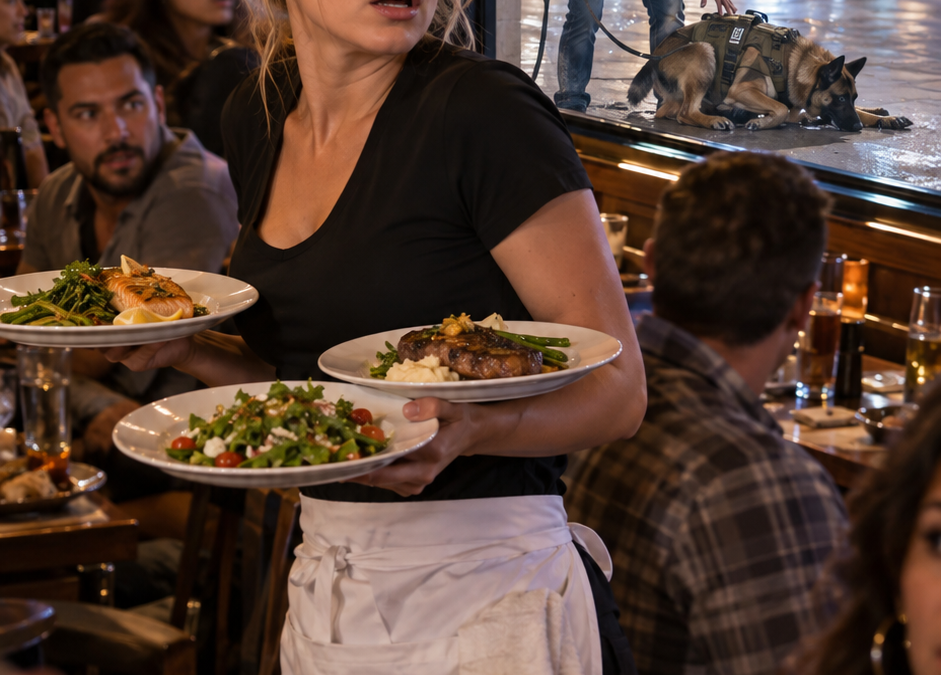
I see the bar window.
Marcus on the sidewalk.
Ghost falling.
Three plates in my hands.
Then the moment between seeing him fall and deciding to move.
It lasts only a second in real life.
In dreams, it stretches.
I think that second became the dividing line between two versions of me.
The woman who believed other people had the authority to decide whether she was still a doctor.
And the woman who understood that a license could regulate practice, but it could not erase knowledge, courage, or responsibility.
I set the plates down.
I walk out.
Every time.
Because that is what actually happened.
When Ghost collapsed, I did not know anyone would clear my name.
I did not know who Marcus was.
I did not know a four-star admiral would stand inside my apartment.
I did not know thirty-two military vehicles would fill my street.
I did not know Daniel’s mother would one day tell me to trust my hands again.
I only knew something living was dying in front of me.
And I knew how to help.
For eleven minutes, that was enough.
In the end, it turned out to be enough for everything.








