𝗣𝗔𝗥𝗧 𝟮 The Navy SEAL’s Daughter Asked Why My Photograph Was Hidden Behind Her Mother’s
𝗣𝗔𝗥𝗧 𝟮
My name came quietly.
There was a warning in it.
But there was something else too.
A request.
Not here.
Not in front of Sophie.
I understood.
I could have asked anyway.
Part of me wanted to.
Fifteen years had passed since that photograph was taken.
Fifteen years since I had watched an injured twenty-something soldier refuse a wheelchair because he believed sitting in one might somehow convince the universe he had surrendered.
Fifteen years since I had told him, repeatedly, that pain was information, not a moral test.
Fifteen years since he left rehabilitation and I assumed I would never see him again.
Now he had kept a photograph I hadn’t even known existed.
Before I could decide what to say, Sophie added, “It’s behind Mommy’s.”
Daniel’s cup stopped halfway to his mouth.
Something inside me tightened.
I knew about Laura Hayes.
I had learned enough from Daniel’s chart to know he was widowed, and the framed photograph on his hospital table made the rest obvious.
Laura stood in bright summer sunlight with one arm around a much younger Sophie.
She had chestnut hair, a wide smile, and the kind of face that looked alive even in a still photograph.
Daniel had positioned the frame where he could see it from the bed.
Sophie glanced toward it.
“Mommy’s picture is in front, and Emily’s is behind it.”
“Soph,” Daniel said quietly.
“What?”
“Enough.”
Her shoulders drew inward.
It happened instantly.
Children hear things adults don’t intend to say.
Daniel wasn’t angry with her.
But Sophie was seven.
Seven-year-olds were very good at assuming that when the air changed, they must have caused it.
I closed the chart.
“Hey.”
Sophie looked at me.
“You didn’t do anything wrong.”
Daniel’s eyes lifted.
I continued before the moment could harden.
“Your dad needs some rest before physical therapy, and I need him cooperative enough that the therapist doesn’t blame me for whatever terrible decisions he makes later.”
“I can hear you,” Daniel said.
“Good. Saves time.”
Sophie smiled.
Small.
Cautious.
But enough.
The tension loosened.
The question did not.
She looked at Daniel again.
“Why do you have Emily’s picture?”
Daniel rubbed his thumb along the rim of the paper cup.
“It was a long time ago.”
Sophie frowned.
“That’s not why.”
I nearly smiled.
Daniel did not.
“We’ll talk about it later.”
“When?”
“Sophie.”
“You always say later when you don’t want to answer.”
Daniel closed his eyes for half a second.
I understood his instinct.
I also understood Sophie’s frustration.
Adults often tell children that honesty matters until children ask honest questions at inconvenient times.
I turned toward the door.
I wanted the answer too.
That was exactly why I refused to take it.
Whatever Daniel had preserved for fifteen years belonged first to him.
And whatever Laura’s photograph had to do with it belonged to this family before it belonged to my curiosity.
My hand touched the door handle.
“Emily?”
I turned.
Sophie stood beside the chair, one hand gripping the strap of her canvas backpack.
“Can I bring the picture tomorrow?”
I looked at Daniel.
He was staring toward the rain-darkened window.
“Ask your dad.”
She turned.
“Can I?”
His jaw tightened.
For several seconds, he gave her no answer.
Then he looked at me.
Not at my rookie stripe.
Not at the chart.
At my face.
“If you want to,” he said.
Sophie brightened.
“Okay.”
I stepped into the corridor without asking anything else.
But as the door closed behind me, I knew tomorrow would be different.
A photograph Daniel had hidden for fifteen years was coming into the room.
And whatever meaning he had kept behind Laura’s picture would have nowhere left to hide.
The next hour gave Daniel something easier to fight.
His own body.
When I returned, Sophie was still there.
Daniel had the incentive spirometer sitting untouched beside him.
I picked it up.
“How about we give your dad something less emotionally complicated to disappoint us with?”
Daniel looked suspicious.
I set the spirometer on his tray.
“Ten good breaths before physical therapy.”
Sophie immediately looked at him.
“You didn’t do them?”
Daniel gave me a dry look.
“Apparently my medical information is public now.”
“Only the part involving homework.”
I placed the device within reach.
I didn’t hand it to him.
Daniel could reach.
Daniel could grip.
Daniel could do the work himself.
That mattered.
He took it reluctantly.
Sophie dragged her chair closer.
“What do I do?”
“Watch the marker. Make sure he doesn’t cheat.”
“I don’t cheat,” Daniel said.
Sophie narrowed her eyes.
“Grandma says you cheat at cards.”
Daniel inhaled through the mouthpiece.
Halfway through, a cough interrupted him.
Sophie giggled.
Daniel glared at her through watering eyes.
Even I laughed.
For five seconds, the room felt ordinary.
Then Sophie said, “Your picture is behind Mommy’s.”
Daniel lowered the spirometer.
“Sophie.”
“It is.”
I watched his face.
He wasn’t embarrassed by the photograph.
Not exactly.
He was afraid of what it might imply.
That distinction mattered.
Sophie kept going.
“I found it when I was looking for my library card.”
Daniel’s shoulders tightened.
“Enough.”
Again, Sophie’s expression changed.
I stepped in.
“Actually, Sophie, I need your help.”
She looked at me warily.
I held out Daniel’s recovery worksheet.
“Your dad has a walking goal today. I need somebody with serious handwriting to record his distance.”
She studied me.
Children know when adults are distracting them.
She also knew I wasn’t mocking her.
After a moment, she accepted the clipboard.
“How far?”
“Twenty yards,” Daniel said.
I looked at the physical therapy plan.
“Twelve.”
“Fifteen.”
“Twelve.”
Daniel leaned against his pillow.
“You negotiate like Supply Command.”
“I’m not negotiating.”
Sophie’s mouth twitched.
Daniel saw it and surrendered.
“Twelve.”
A few minutes later, her grandmother took her downstairs for lunch.
At the door, Sophie stopped.
“I really can bring the picture tomorrow?”
I looked at Daniel.
He exhaled.
“If you want.”
She nodded, apparently satisfied, and left.
The door clicked shut.
Rain whispered against the window.
I began preparing the gait belt for physical therapy.
Daniel watched my hands.
“Thank you.”
“For what?”
“Not answering her.”
I folded the belt.
“It wasn’t my question to answer.”
“She shouldn’t have found the picture.”
I paused.
“But she did.”
His gaze dropped toward the blanket.
“And now she knows I’m in it,” I said.
Nothing.
I met his eyes.
“You don’t owe me an explanation while I’m taking care of you.”
Something in his face loosened slightly.
“But don’t make Sophie think she did something wrong by asking.”
Daniel looked toward the closed door.
For the first time since his daughter entered, he seemed less like a Navy SEAL assessing a problem and more like a father who realized his attempt to protect his child might have hurt her.
After a moment, he picked up the call button.
“When does physical therapy start?”
“Eleven.”
He turned the button once in his palm.
“Then let’s do the twelve yards.”
At eleven, Daniel stood beside the bed with the gait belt around his waist.
Mark Reynolds, the physical therapist, stayed on his injured side.
I managed the IV pole.
Twelve yards of polished hospital floor separated Daniel from a strip of blue tape near the nurses’ station.
Mark pointed toward it.
“First walk. No records today.”
“Twelve yards isn’t a record.”
“Then it shouldn’t bother you.”
Daniel glanced at me.
I gave him nothing.
He placed both hands on the walker.
One step.
Then another.
His body knew discipline.
That was obvious.
What it didn’t know was restraint.
At six yards, a line appeared between his eyebrows.
At eight, his right hand tightened around the walker.
Mark saw it.
“Turn here.”
Daniel continued.
“Daniel.”
“Blue tape.”
“Turn.”
Another step.
His injured leg faltered.
Mark moved instantly.
I pulled the IV pole clear and steadied the gait belt.
Daniel locked both hands around the walker.
“I can make twelve.”
“Not like this,” Mark said.
“I’ve worked through worse.”
I heard that sentence and suddenly saw a younger Daniel Hayes leaning against parallel bars fifteen years earlier, sweat dripping down his temples.
Same words.
Different hallway.
Same stubbornness.
“I believe you,” I said.
Daniel looked at me.
“But this isn’t a selection course. Nobody gives you points for hiding what your leg is doing.”
His jaw tightened.
“I know my body.”
“Then listen to it.”
He stared at the blue tape.
I remembered being nineteen and angry enough to tell him almost the same thing.
Back then I hadn’t known how to soften the message.
Maybe he hadn’t needed it softened.
“Mark set the plan,” I said. “My job is to help you follow it safely. If every session becomes a test of what you can endure, I can’t help you recover.”
Daniel looked at me for several seconds.
Then his hands loosened.
“Chair.”
Mark guided him down.
I cleared the tubing.
Eight yards.
To Daniel, it looked like failure.
To me, it looked like the first smart decision he had made all morning.
When Sophie returned, she picked up the worksheet.
“How far?”
Daniel looked at the number.
“Eight.”
Her forehead wrinkled.
“But you said twelve.”
Daniel took the pen.
He wrote the eight himself.
“Eight was the right number today.”
I looked away before he could catch the expression on my face.
Fifteen years ago, that sentence would have been impossible for him.
Sophie studied the number.
“Can I write tomorrow’s?”
Daniel slid the clipboard toward her.
“Yeah.”
She smiled.
“Can Emily help?”
His eyes moved briefly to my orientation stripe.
Then back to me.
“She already is.”
The next day, Daniel walked ten yards.
Not twelve.
Not twenty.
Ten.
And he stopped himself.
That mattered more to me than the distance.
Sophie walked ahead with her clipboard, pencil clutched like an official scorekeeper.
When Daniel reached eight yards, he slowed.
Tested his injured leg.
Took another step.
Then one more.
“Ten,” Sophie announced.
Daniel looked toward the remaining hallway.
Yesterday, he would have chased the extra distance.
Instead he turned the walker.
“Ten is enough.”
“Good call,” I said.
His eyes met mine.
Something passed there.
Recognition, perhaps.
Not of the nineteen-year-old woman in the old photograph.
Of the lesson itself.
Back in the room, Sophie climbed onto the chair.
“I’m in charge of the numbers now.”
“Then don’t lose my records.”
“I won’t.”
I put the spirometer on the tray.
“And what comes before numbers?”
Sophie pointed.
“Breathing.”
Daniel sighed.
“I’ve created a monster.”
“You agreed to the program.”
He reached for the spirometer without argument.
Sophie watched him closely.
When he needed a break, he took one.
That was new too.
Then helicopter rotors passed somewhere beyond the courtyard.
The sound was distant.
Deep.
Rhythmic.
Daniel’s next breath stalled.
His eyes shifted toward the window.
Everything in his body changed by less than an inch.
But I saw it.
His shoulders.
His hands.
The brief absence in his eyes.
“Daddy?” Sophie said.
He didn’t answer immediately.
I stepped into his line of sight.
“Daniel.”
His eyes found mine.
“Breathe first.”
He exhaled.
Reset his grip.
Inhaled again.
The rotors faded.
Sophie watched him.
Then she looked at me.
“How did you know what to say?”
Daniel’s fingers stopped against the spirometer.
I closed the chart.
“Your dad forgot what he was supposed to be doing for a second.”
Sophie looked unconvinced.
“But he listened to you really fast.”
The room went quiet.
Daniel looked at the recovery sheet.
Sophie followed his gaze.
The photograph had given her one question.
Now Daniel himself had given her another.
I realized that avoiding the truth completely was becoming its own kind of lie.
So I said, “Your dad and I knew each other a long time ago.”
Daniel looked up.
Sophie leaned forward.
“Before you were a nurse?”
“Yes.”
“Before Daddy was a SEAL?”
I thought about it.
“Around the time he was trying very hard to become one.”
Daniel gave a short breath.
“That’s one description.”
Sophie turned toward him.
Daniel lowered the spirometer.
“I got hurt during training.”
“Bad?”
“Bad enough that I needed help.”
She stared at him.
Children tend to believe their parents arrived in the world fully formed.
The idea of Daniel being young, injured, frightened, and dependent clearly did not fit the mythology Sophie had built around him.
“I was doing civilian emergency response work,” I explained. “The program also helped support patients during the early stages of rehabilitation.”
Daniel looked at me.
“You make it sound organized.”
“It was organized.”
“You yelled at me.”
“I spoke loudly because you were unreasonable.”
Sophie smiled.
“Did he try to walk too far then too?”
“Constantly.”
“That’s an exaggeration.”
I looked at him.
“It really isn’t.”
For a moment, we were all smiling.
Then Sophie glanced at the recovery sheet.
“Is that when the picture happened?”
Daniel nodded.
“A few weeks later.”
“Why did you take it?”
“Someone else did,” he said. “I had walked farther that week than I had the week before.”
Sophie’s eyes brightened.
“Like the numbers.”
Daniel looked at the eight and ten written on her sheet.
“Yeah.”
She turned to me.
“Did you know he kept it?”
“No.”
Daniel’s gaze shifted toward me.
“I thought it was gone.”
“Why?”
Daniel was quiet.
I almost intervened.
Then I stopped myself.
His question.
His daughter.
His answer.
“Because people move on,” he finally said.
Sophie’s expression remained serious.
“But you didn’t throw it away.”
“No.”
“Why?”
Daniel rubbed one hand across his jaw.
“Back then, I thought needing help meant I wasn’t strong enough for the life I wanted.”
Sophie looked at his walker.
Daniel noticed.
“I was wrong.”
“Because Emily helped you?”
Daniel considered it.
“Because I finally let people help me.”
Sophie studied him.
“So that’s why you kept her picture?”
“Part of why.”
Then she asked the question neither of us was ready for.
“Why is it behind Mommy’s?”
Daniel went still.
I saw the wall rise again.
“Emily?”
There was a plea in my name.
Not for an answer.
For rescue.
I stepped toward the tray.
“That part isn’t mine.”
Daniel stared at me.
Sophie frowned.
“Why not?”
“Because I didn’t put the picture there.”
Sophie turned to her father.
There was nowhere else for the question to go.
Daniel breathed out.
“I need to explain that better than I can right now.”
Sophie’s face fell.
“Not because you did anything wrong,” he added quickly. “Because I want to get it right.”
She studied him.
“Tomorrow?”
Daniel hesitated.
Then nodded.
“Tomorrow.”
I began toward the door.
“Emily.”
I turned.
Daniel glanced at Sophie.
Then back to me.
“When I talk to her… will you stay?”
That request surprised me more than the photograph had.
For two days, Daniel had tried to keep me outside the meaning of it.
Now he was asking me to remain while he opened it.
“I’ll think about it.”
He nodded.
No pressure.
No argument.
That alone told me how much had changed.
The next morning, Daniel was sitting on the edge of the bed before breakfast.
His walker stood beside him.
Sophie hadn’t arrived yet.
Pale sunlight cut across the floor.
“You’re early,” he said.
“You’re avoiding your breathing exercises.”
“I’m thinking.”
“Those activities can coexist.”
He almost smiled.
I checked his IV.
Then the monitor.
Then the incision dressing.
Finally Daniel said, “About yesterday.”
I waited.
“I shouldn’t have asked you to stay.”
“Why?”
“It puts you in the middle.”
I straightened the blanket.
“I’m already in the middle. Apparently my photograph lives on your nightstand.”
“Behind Laura’s.”
“Yes.”
Silence.
Daniel looked toward the window.
“After she died, I changed almost nothing in that room.”
My hands stopped.
“Her books stayed where she left them. Her picture stayed beside the bed.”
He looked down.
“Your photograph was already there.”
“Laura knew?”
“Yes.”
“What did she think?”
Daniel smiled faintly.
“She thought I was ridiculous.”
“That sounds healthy.”
“She knew where the picture came from. She knew what that time meant.”
I leaned against the counter.
“And she was okay with it?”
Daniel looked at me.
“She never acted like there was something to be okay with.”
That answer told me more about Laura than anything else he could have said.
No jealousy.
No suspicion.
No need to compete with a nineteen-year-old stranger preserved in an old photograph.
“To Laura,” Daniel continued, “it was a picture from a time when somebody helped me get back on my feet.”
“Then why put it behind hers?”
His eyes shifted toward the empty visitor chair.
“After she died, moving her picture felt wrong.”
I waited.
“Moving yours felt wrong too.”
“Why?”
Daniel’s face changed.
Not dramatically.
Just enough for me to see that this question reached someplace he didn’t often visit.
“Because it reminded me of who I was before I understood how to let people help me.”
He rubbed his hands together.
“And after Laura died, I wasn’t very good at that anymore.”
I said nothing.
Grief does strange things to strong people.
It doesn’t always make them collapse.
Sometimes it makes them functional beyond reason.
They get children to school.
Pay bills.
Answer emails.
Cook dinner.
Fix leaking faucets.
Attend parent conferences.
Fold laundry.
Return phone calls.
They survive so efficiently that no one realizes they are disappearing inside the survival.
Daniel stared at his hands.
“Sophie needed me.”
“She did.”
“So I kept moving.”
“That doesn’t mean you were okay.”
“No.”
The word was quiet.
Almost embarrassed.
He looked toward Laura’s photograph.
“Some nights that picture behind hers reminded me that I had been broken before and still became someone afterward.”
My throat tightened.
For fifteen years, I had remembered Daniel as the patient who fought every restriction.
I had never considered that he might remember me too.
Not as a great love.
Not as a lost possibility.
As proof.
That the worst moment in your body does not necessarily become the final definition of your life.
“You could explain that to Sophie,” I said.
Daniel gave me a humorless smile.
“You could explain it better.”
“Probably.”
He narrowed his eyes.
“You enjoy saying that.”
“A little.”
Then I pulled the visitor chair away from the bed and placed it near the window.
“I’ll stay.”
Daniel looked at me.
“But staying and answering are different things.”
He listened.
“If Sophie asks what I remember about your rehabilitation, I’ll answer. If she asks what the emergency-response program was, I’ll explain it.”
“And the picture?”
“That comes from you.”
Daniel looked down.
“What if I say it wrong?”
I thought about Sophie.
The way she watched his face.
The way she had already forgiven him for answers he hadn’t found yet.
“She’ll hear her father trying.”
A knock sounded.
Sophie appeared with her grandmother.
Her backpack hung from one shoulder.
She entered more cautiously than usual.
“Morning,” I said.
She looked directly at Daniel.
“Are we still talking today?”
Daniel’s hand tightened against the mattress.
Then relaxed.
“Yes.”
Sophie touched her backpack.
“I brought the picture.”
Daniel glanced at me.
I stayed by the medication cart.
“Keep it in there for now,” he said.
“Okay.”
He reached for the walker.
“First I owe you a number.”
Sophie immediately grabbed the recovery sheet.
“Ten yesterday.”
“I remember.”
Daniel looked at me.
“Same plan?”
“Mark cleared the same limits. You tell us what the leg gives you.”
Daniel stood carefully.
“Then we listen to the leg.”
I almost stopped breathing.
Fifteen years ago, I had spent weeks trying to teach him that sentence.
Now he said it as if it had always belonged to him.
Sophie walked beside him.
At eleven yards, Daniel stopped.
He tested his balance.
The hallway stretched ahead.
The blue tape was still farther away.
He looked at it.
Then turned the walker.
No challenge.
No anger.
No self-punishment.
Sophie wrote eleven.
That was all.
Back in the room, Daniel drank water.
Sophie settled into the visitor chair.
Her backpack rested between her shoes.
Daniel looked at it.
No one moved.
Finally he said, “Okay, bug.”
Sophie raised her eyes.
“Let me see it.”
She opened the backpack.
The photograph came out inside a clear plastic sleeve.
I had forgotten exactly what it looked like.
Time does that.
It smooths memories into versions that are easier to carry.
The real image was harsher.
A younger Daniel stood outside the rehabilitation building, one forearm resting across crutches.
He looked exhausted.
Thin.
Angry at the world.
Beside him stood a nineteen-year-old version of me.
My hair was pulled back.
There were shadows beneath my eyes.
My emergency-response jacket swallowed my shoulders.
Neither of us was smiling.
We looked like two people who had survived the same difficult afternoon for completely different reasons.
Daniel accepted the photograph.
“This is the one?”
Sophie nodded.
“It was behind Mommy’s.”
“I know.”
She leaned against the bed rail.
“Can I ask now?”
Daniel looked at her.
“Yeah, bug.”
Sophie turned toward me.
Her eyes moved between the woman in the old photograph and the nurse standing beside her father’s medication tray.
“Why is your photo in Daddy’s room?”
My hand stopped.
I looked at Daniel.
For a second he didn’t speak.
Then his fingers settled around the plastic sleeve.
I gave him the smallest nod.
Daniel looked at his daughter.
“Because I kept it.”
Sophie waited.
He took a slow breath.
“When that picture was taken, I was recovering from an injury. I wanted to get back to training more than anything in the world.”
She glanced at the crutches.
“I thought needing help meant I wasn’t strong enough for the life I wanted.”
“Emily helped you?”
“She did.”
Daniel glanced toward me.
“But not the way I wanted.”
Sophie frowned.
“What does that mean?”
“I wanted somebody to tell me I was ready.”
His mouth moved faintly.
“She kept telling me the truth.”
I stared at the medication record.
Daniel continued.
“She didn’t treat me like I was weak. But she didn’t let me pretend I was doing better than I was either.”
Sophie looked at him.
“If I needed to stop, she made me stop.”
“That sounds like now.”
Daniel looked at the walker.
“Yes.”
“If I needed help, she expected me to accept it. If I still had work left to do, she made sure I did the work instead of proving how much pain I could tolerate.”
Sophie looked at the recovery sheet.
Eight.
Ten.
Eleven.
Her handwriting told the story more clearly than we could.
“So that’s why you kept her?”
Daniel shook his head gently.
“I didn’t keep her, Soph.”
I looked up.
“I kept the picture.”
Something about that distinction moved me.
It protected Laura.
It protected me.
Most importantly, it told Sophie the truth.
There was no hidden romance waiting behind the frame.
No secret life.
Just memory.
Meaning.
Gratitude.
“Why?” Sophie asked.
“Because it reminded me of something I needed to learn.”
“To become a SEAL?”
Daniel thought.
“Before I could become one.”
“What?”
He inhaled slowly.
“That accepting help isn’t the same as surrendering.”
Sophie looked again at the younger man in the photograph.
“Did Mommy know?”
“Yes.”
No hesitation.
No shame.
“Was she mad?”
“No.”
Daniel’s thumb moved along the edge of the sleeve.
“Your mom understood it better than I did.”
“What did she think it meant?”
Daniel went quiet.
Then he said, “She thought some people can change the direction of your life without becoming the center of it.”
My fingers tightened around the medication cup.
Laura Hayes had never met me.
Yet fifteen years later, I felt unexpectedly grateful to her.
Sophie looked from the photograph to me.
Then back to Daniel.
“Why was Mommy’s picture in front?”
The room seemed to hold its breath.
Daniel didn’t look at me.
He looked only at his daughter.
“Because your mom was my life.”
Sophie’s eyes softened.
Daniel tapped the old photograph gently.
“This was a reminder of something that helped me live it.”
No one spoke.
Outside the room, wheels rolled softly across tile.
Morning sunlight stretched farther across the floor.
Sophie picked up the photograph.
She walked toward me.
Held it beside my badge.
Studied both versions of my face.
“You look different.”
I smiled.
“It was a long time ago.”
She pointed to the orientation stripe beneath my badge.
“You’re new here.”
“Very.”
“But you still tell him when to stop.”
I glanced at Daniel.
“That’s part of my job.”
Sophie considered that.
Then she carried the photograph back to the bedside.
She didn’t put it behind Laura’s frame.
She placed it beside Daniel’s recovery sheet.
In the open.
In the light.
Daniel looked at it.
Then left it there.
That simple choice affected me more than I expected.
For years, the photograph had apparently existed in a private geography of grief.
Laura in front.
The past behind her.
One life layered over another.
Now it sat beside a worksheet covered in Sophie’s crooked numbers.
Not competing with anything.
Not hiding.
Just existing.
I brought Daniel his medication.
He swallowed the pills.
Then looked toward the walker.
“What’s the goal today?”
I checked the mobility plan.
“We see what the leg gives you.”
Daniel nodded.
“Then that’s what we do.”
Sophie picked up her pencil.
When Daniel stood, I checked his balance.
Then stepped back.
He started walking.
The photograph remained behind in the morning sunlight.
Uncovered.
By lunch, it was still there.
I entered Daniel’s room with his discharge preparation packet.
“Physical therapy cleared the stairs.”
Daniel looked up.
“Two more sessions if everything stays on track.”
I placed the folder on his tray.
“Restrictions?”
“Page three.”
He turned to it.
I wrapped the blood pressure cuff around his arm while he read.
“No driving.”
“Correct.”
“That’s going to make school pickup interesting.”
“The discharge coordinator can help you plan around that.”
Daniel looked up.
“Not you?”
I removed the cuff.
“No.”
Something flickered across his expression.
Then he nodded.
“Right.”
There are boundaries in nursing that matter because patients meet you during moments that can imitate intimacy.
You see fear.
Pain.
Grief.
Bodies stripped of privacy.
Families at their most vulnerable.
Sometimes people mistake being witnessed for belonging.
Sometimes nurses do too.
Daniel and I had known each other before.
That made the boundary even more important.
I could help him recover.
I could not become part of the architecture of his home because our history had resurfaced in a photograph.
When Sophie returned after school, she carried a folded sheet of paper.
“I made a schedule.”
Daniel looked suspicious.
“For what?”
“You.”
She unfolded it.
Three uneven columns.
BREATHING.
WALKING.
REST.
Daniel stared at me.
I raised both hands.
“I had nothing to do with this.”
Sophie pointed at the first box.
“You forget the breathing thing when you’re thinking.”
“I’ve been breathing successfully for a long time.”
“Not the plastic thing, Dad.”
“Right.”
He picked up the spirometer.
By the fifth breath, he needed a pause.
He took one without being told.
Sophie checked a box.
Later, I fastened the gait belt.
Daniel placed both hands on the walker.
“What’s the goal?”
I looked at him.
He corrected himself.
“What does the leg give me?”
“Exactly.”
He shifted his weight.
“Twelve if the movement stays clean.”
“And?”
“Less if it doesn’t.”
“Good.”
Sophie walked beside him.
At eleven yards, Daniel’s stride shortened.
He stopped.
Sophie looked toward the blue tape.
“You can almost make it.”
Daniel checked his balance.
“Almost isn’t the assignment.”
He turned.
I followed silently.
I didn’t need to remind him anymore.
Back in the room, he handed Sophie the clipboard.
“Eleven.”
She wrote it down.
No disappointment.
No argument.
Then she noticed the photograph.
“Are you taking that home?”
Daniel followed her gaze.
“Yeah.”
“Where are you putting it?”
I pretended to be very interested in sorting discharge supplies.
“I don’t know yet.”
Sophie thought about that.
“You could leave it where it was.”
“I could.”
“Or put it somewhere else.”
“I could do that too.”
She accepted the answer.
Most children will accept uncertainty if adults stop pretending uncertainty is dangerous.
Near the end of my shift, the discharge coordinator arrived.
She reviewed transportation.
Follow-up appointments.
Medication timing.
Home safety.
“Who’s managing the recovery schedule?” she asked.
Daniel answered, “I am.”
Then he glanced at Sophie.
“With aggressive oversight.”
Sophie lifted her pencil.
“Very aggressive.”
I closed the chart.
The photograph remained on the table.
Daniel looked at me.
“Tomorrow morning?”
“One more walk?”
“If you’re still my patient.”
“Fair.”
I stepped into the corridor.
Before I reached the nurses’ station, Sophie’s voice followed me.
“Dad. Breathing.”
“I know.”
“You were forgetting.”
“I was reaching for it.”
I glanced back.
Daniel already had the spirometer.
Sophie was marking another box.
Neither of them was looking for me.
That made me strangely happy.
Because good nursing is not making someone dependent on you.
It is helping them become safe without you.
The final morning arrived quietly.
Daniel was dressed before I entered.
Gray sweatpants.
Navy T-shirt.
Discharge bag zipped on the chair.
Walker positioned beside the bed.
Sophie stood in front of him with the recovery sheet tucked beneath one arm.
“Again,” she ordered.
Daniel inhaled slowly through his nose.
Exhaled.
“That was fine.”
“You rushed the end.”
He looked at me.
I checked his posture.
“She’s right.”
Sophie smiled with enormous satisfaction.
Daniel breathed again.
Slower.
No argument.
Morning light filled the room with a soft gray brightness.
I completed the assessment.
“Dizziness?”
“No.”
“Pain?”
“Three.”
Sophie tapped the worksheet.
“Honest three?”
Daniel sighed.
“Honest three.”
I hid a smile.
“Apparently I’m under audit.”
“You are.”
I checked the gait belt.
Daniel waited.
That was what struck me.
He waited.
On the first day, waiting had been an enemy.
A limitation.
Something to conquer.
Now he stood with his hands resting lightly against the walker until I finished checking his balance.
“Whenever you’re ready.”
He looked at Sophie.
“You counting?”
“Always.”
He started.
No blue tape waited at the end of the hall.
Only the nurses’ station.
The elevators.
The ordinary distance between a hospital room and home.
Sophie walked beside him.
“One. Two. Three.”
At eight yards, Daniel slowed.
At ten, he adjusted his grip.
I followed several steps behind.
Close enough to help.
Far enough to leave the decision to him.
“Eleven,” Sophie said.
Daniel stopped.
Tested the leg.
Took one controlled breath.
Continued.
“Twelve.”
Sophie looked back at me.
I gave no signal.
This was Daniel’s decision now.
“Thirteen.”
He stopped.
Checked his balance.
“That’s enough.”
Sophie nodded immediately.
“Okay.”
No disappointment.
No challenge.
They turned together.
Back in the room, Daniel sat while Sophie slid the recovery sheet into his discharge folder.
Her backpack lay open on the visitor chair.
Beside it rested the old photograph.
Sophie picked it up.
For a moment, she stared at the two exhausted young people captured fifteen years earlier.
Then she looked at her father.
“You remember now.”
Daniel’s eyes moved to the photograph.
Then to his daughter.
“Yeah, bug.”
Sophie slipped it into the backpack.
Zipped the pocket.
I said nothing.
The photograph had done what it needed to do.
It no longer required me to explain it.
Daniel no longer needed to hide it.
Sophie no longer needed to solve it.
A transport aide arrived with a wheelchair.
Daniel looked at it.
Then at me.
“Can I walk to the elevator?”
I considered his morning assessment.
“With the walker and an adult beside you.”
Daniel nodded toward Sophie.
“I have someone.”
I looked at the seven-year-old standing beside him like a commanding officer.
“You have a supervisor. You still need an adult.”
He smiled.
“Fair.”
Sophie’s grandmother stepped in from the hallway.
Daniel stood carefully.
He checked the walker.
Settled his weight.
Waited until he was balanced.
Then took the first step.
At the doorway, he stopped.
Looked back at me.
There was no grand speech in his face.
No dramatic promise.
No attempt to turn fifteen years into something they had never been.
Just recognition.
“Call button is somebody else’s problem now.”
I folded my arms.
“Try not to make it theirs.”
“No promises.”
Sophie tugged his shirt.
“Dad.”
Daniel looked down.
“Right. Reasonable promises.”
They moved into the hallway.
Sophie started counting.
“One. Two. Three. Four.”
Daniel walked at the same measured pace.
Near the nurses’ station, his mother-in-law said something to Sophie.
The girl became distracted.
She stopped counting.
Daniel didn’t.
His pace didn’t change.
He didn’t look back for reassurance.
At the elevator, he stopped.
Adjusted the walker.
Waited.
The doors opened.
Daniel stepped inside with Sophie and her grandmother.
He didn’t turn around.
Sophie did.
She raised one hand.
A small wave.
I returned it.
The elevator doors closed.
For a moment, I stood in the quiet they left behind.
Fifteen years earlier, Daniel had walked away from rehabilitation convinced that strength meant earning his old life back.
This time, he left understanding something different.
Strength was not the distance.
It was not thirteen yards instead of twelve.
It was not forcing an injured body past its limits because stopping felt too much like failure.
It was being able to look your daughter in the eyes and tell her you had once needed help.
It was admitting your wife had been the center of your life without pretending nothing meaningful existed before her.
It was allowing an old photograph to be exactly what it was instead of hiding it because grief had made its meaning difficult to explain.
And maybe that was why seeing that photograph again had affected me too.
At nineteen, I had believed helping people meant pushing hard enough to get them through the worst day.
I had been young enough to think recovery moved in straight lines.
Injury.
Treatment.
Rehabilitation.
Return.
I knew better now.
People carry pieces of recovery for years.
Sometimes decades.
A sentence someone said.
A hand that stopped them from falling.
A person who refused to confuse suffering with courage.
A photograph they thought they needed to hide behind another photograph because they didn’t know how to explain that one life could hold gratitude, love, grief, and memory without any of those things betraying the others.
A call light sounded farther down the corridor.
I turned back toward Daniel’s empty room.
The bed needed stripping.
The chart needed closing.
Another patient would need the space before noon.
At the nurses’ station, a new assignment waited beside my name.
I looked down at my badge.
The temporary orientation stripe was still there.
After everything that had happened, I was still the rookie.
The thought made me smile.
I picked up the next chart.
Then I walked toward another door.
Behind me, the elevator carried Daniel and Sophie toward the ground floor.
He no longer needed me to count his steps.
And for the first time in fifteen years, neither of us needed a photograph to prove that helping someone stand had ever mattered.
Have you finished reading the story and want to read it again?
The Navy SEAL’s Daughter Asked Why My Photograph Was Hidden Behind Her Mother’s
The little girl looked at me as if she had seen a ghost.
Her father went still before I understood why.
Then she asked the question that dragged fifteen years of silence into the room.
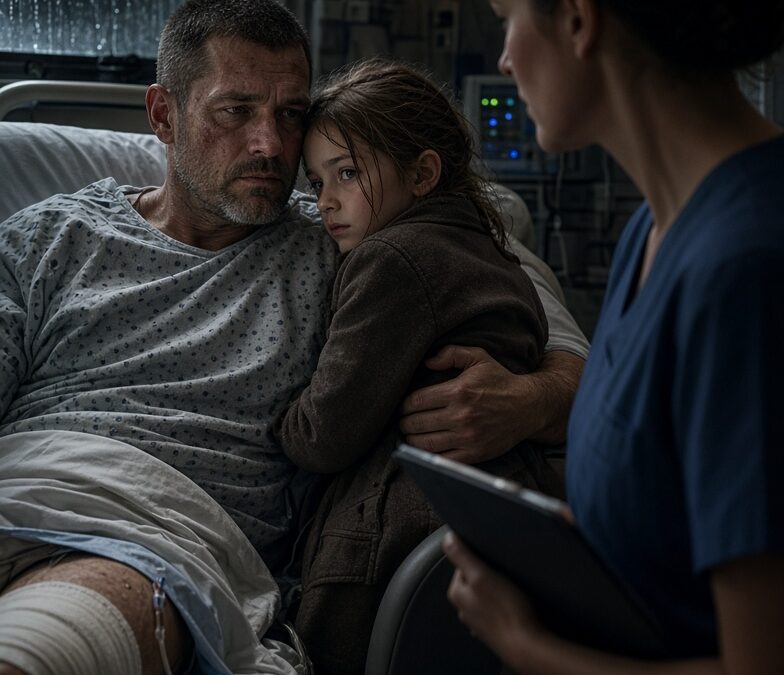
I had been on the recovery unit for eleven days when seven-year-old Sophie Hayes walked into her father’s hospital room and recognized me.
Not my name.
Not my badge.
My face.
She stopped three steps inside the doorway, one small hand still wrapped around her grandmother’s fingers, and stared at me with the blunt, unnerving concentration children have when they know something adults don’t.
Rain tapped against the narrow window behind Daniel Hayes’s bed.
The room smelled faintly of antiseptic, coffee, and the plastic tubing from his IV line. Somewhere down the hall, a medication cart rattled across the tile and disappeared around the nurses’ station.
I was checking the drainage line beneath Daniel’s gown when Sophie whispered, “That’s her.”
Daniel went completely still.
It lasted less than a second.
Most people would have missed it.
I didn’t.
Daniel Hayes was the kind of man who could turn stillness into armor. He had spent the entire morning treating a surgically repaired leg as though it were merely an inconvenience someone had accidentally attached to him. He negotiated pain scores. He questioned mobility restrictions. He had already tried to stand without calling for help once, which was why I had moved the call button directly into his hand and told him that if he ignored it again, I would personally inform physical therapy that Navy SEALs apparently required more supervision than toddlers.
He had almost smiled.
That had been the extent of our familiarity.
Nurse.
Patient.
Nothing more.
At least that was what I had been telling myself.
“Soph,” he said quietly.
She pointed at me.
“The lady in your room.”
Daniel looked at his daughter. “What?”
“At home.”
Sophie frowned as if he were being deliberately difficult.
“The picture.”
My fingers tightened around the edge of the medication chart.
Daniel didn’t answer.
Sophie turned back to me.
“Why is your photo in Daddy’s room?”
For several seconds, the entire room seemed to shrink around us.
I looked at Daniel.
The disciplined calm remained on his face, but now I recognized it for what it was.
Not calm.
Containment.
And suddenly I was nineteen years old again.
Standing outside a rehabilitation building with rain drying on cracked pavement.
Wearing a civilian emergency-response jacket two sizes too large.
Exhausted after a fourteen-hour shift.
Beside me stood a younger Daniel Hayes with one arm balanced across a pair of crutches, jaw clenched because he had walked farther that afternoon than anyone had cleared him to walk.
Someone had called our names.
We had turned.
A camera had flashed.
That was it.
One photograph.
I had never asked for a copy.
I had never seen it afterward.
I had barely allowed myself to think about that part of my life once Daniel finished that phase of rehabilitation and disappeared back into the military world he had fought so hard to reenter.
Fifteen years.
I had assumed the photograph was gone.
Apparently Daniel had made a different choice.
Sophie finally remembered why she had come.
“Dad!”
She released her grandmother’s hand and rushed toward the bed.
Daniel’s expression changed immediately.
Whatever tension had hardened him vanished the moment his daughter reached him.
“Hey, bug.”
He opened one arm.
“Easy. Your old man has a few new rules.”
Sophie climbed onto the visitor chair and leaned carefully across the mattress, wrapping both arms around his shoulders.
Daniel closed his eyes for half a second.
His hand settled against the back of her coat.
I turned away, giving them privacy while checking his tubing again.
But when I looked back, Sophie was watching me over his shoulder.
Daniel noticed.
His hand paused against her coat before he resumed the hug.
That tiny hesitation told me more than any explanation could have.
There was history here.
Not the kind Sophie understood.
Maybe not even the kind Daniel understood.
I finished documenting the drainage output.
My temporary orientation stripe hung beneath my badge, announcing to anyone who cared to look that I was still new to the unit.
Daniel had noticed it within minutes of meeting me that morning.
“You’re new,” he had said.
“To this unit.”
“How new?”
“New enough that you should use the call button instead of testing me by getting out of bed.”
His mouth had twitched.
He had stared at me a moment longer than necessary.
At the time, I thought he was deciding whether we had met.
I had made the same calculation.
Fifteen years had changed both of us.
The lean, furious young man on crutches had become broader through the shoulders, quieter in his movements, and marked by the kind of stillness I associated with people who had spent years learning exactly how much energy not to waste.
But the eyes were the same.
Gray.
Watchful.
Impossible to forget once I had recognized them.
Neither of us had said anything.
Professional distance had been easier.
Until Sophie walked through the door.
She released Daniel and turned toward me.
“It really is you.”
“I don’t think we’ve met,” I said.
“We haven’t.”
“Then how do you know my face?”
Sophie looked at her father as though the answer belonged to him.
He remained silent.
She looked back at me.
“Your picture. It’s beside Daddy’s bed.”
I glanced at Daniel.
“At home?”
He reached for the paper cup on his bedside table.
“It’s an old photograph.”
“I gathered that.”
“Emily.”
My name came quietly.
There was a warning in it.
But there was something else too.
A request.
Not here.
Not in front of Sophie.
I understood.
I could have asked anyway.
Part of me wanted to.
Fifteen years had passed since that photograph was taken.
Fifteen years since I had watched an injured twenty-something soldier refuse a wheelchair because he believed sitting in one might somehow convince the universe he had surrendered.
Fifteen years since I had told him, repeatedly, that pain was information, not a moral test.
Fifteen years since he left rehabilitation and I assumed I would never see him again.
Now he had kept a photograph I hadn’t even known existed.
Before I could decide what to say, Sophie added, “It’s behind Mommy’s.”
Daniel’s cup stopped halfway to his mouth.
Something inside me tightened.
I knew about Laura Hayes.
I had learned enough from Daniel’s chart to know he was widowed, and the framed photograph on his hospital table made the rest obvious.
Laura stood in bright summer sunlight with one arm around a much younger Sophie.
She had chestnut hair, a wide smile, and the kind of face that looked alive even in a still photograph.
Daniel had positioned the frame where he could see it from the bed.
Sophie glanced toward it.
“Mommy’s picture is in front, and Emily’s is behind it.”
“Soph,” Daniel said quietly.
“What?”
“Enough.”
Her shoulders drew inward.
It happened instantly.
Children hear things adults don’t intend to say.
Daniel wasn’t angry with her.
But Sophie was seven.
Seven-year-olds were very good at assuming that when the air changed, they must have caused it.
I closed the chart.
“Hey.”
Sophie looked at me.
“You didn’t do anything wrong.”
Daniel’s eyes lifted.
I continued before the moment could harden.
“Your dad needs some rest before physical therapy, and I need him cooperative enough that the therapist doesn’t blame me for whatever terrible decisions he makes later.”
“I can hear you,” Daniel said.
“Good. Saves time.”
Sophie smiled.
Small.
Cautious.
But enough.
The tension loosened.
The question did not.
She looked at Daniel again.
“Why do you have Emily’s picture?”
Daniel rubbed his thumb along the rim of the paper cup.
“It was a long time ago.”
Sophie frowned.
“That’s not why.”
I nearly smiled.
Daniel did not.
“We’ll talk about it later.”
“When?”
“Sophie.”
“You always say later when you don’t want to answer.”
Daniel closed his eyes for half a second.
I understood his instinct.
I also understood Sophie’s frustration.
Adults often tell children that honesty matters until children ask honest questions at inconvenient times.
I turned toward the door.
I wanted the answer too.
That was exactly why I refused to take it.
Whatever Daniel had preserved for fifteen years belonged first to him.
And whatever Laura’s photograph had to do with it belonged to this family before it belonged to my curiosity.
My hand touched the door handle.
“Emily?”
I turned.
Sophie stood beside the chair, one hand gripping the strap of her canvas backpack.
“Can I bring the picture tomorrow?”
I looked at Daniel.
He was staring toward the rain-darkened window.
“Ask your dad.”
She turned.
“Can I?”
His jaw tightened.
For several seconds, he gave her no answer.
Then he looked at me.
Not at my rookie stripe.
Not at the chart.
At my face.
“If you want to,” he said.
Sophie brightened.
“Okay.”
I stepped into the corridor without asking anything else.
But as the door closed behind me, I knew tomorrow would be different.
A photograph Daniel had hidden for fifteen years was coming into the room.
And whatever meaning he had kept behind Laura’s picture would have nowhere left to hide.
The next hour gave Daniel something easier to fight.
His own body.
When I returned, Sophie was still there.
Daniel had the incentive spirometer sitting untouched beside him.
I picked it up.
“How about we give your dad something less emotionally complicated to disappoint us with?”
Daniel looked suspicious.
I set the spirometer on his tray.
“Ten good breaths before physical therapy.”
Sophie immediately looked at him.
“You didn’t do them?”
Daniel gave me a dry look.
“Apparently my medical information is public now.”
“Only the part involving homework.”
I placed the device within reach.
I didn’t hand it to him.
Daniel could reach.
Daniel could grip.
Daniel could do the work himself.
That mattered.
He took it reluctantly.
Sophie dragged her chair closer.
“What do I do?”
“Watch the marker. Make sure he doesn’t cheat.”
“I don’t cheat,” Daniel said.
Sophie narrowed her eyes.
“Grandma says you cheat at cards.”
Daniel inhaled through the mouthpiece.
Halfway through, a cough interrupted him.
Sophie giggled.
Daniel glared at her through watering eyes.
Even I laughed.
For five seconds, the room felt ordinary.
Then Sophie said, “Your picture is behind Mommy’s.”
Daniel lowered the spirometer.
“Sophie.”
“It is.”
I watched his face.
He wasn’t embarrassed by the photograph.
Not exactly.
He was afraid of what it might imply.
That distinction mattered.
Sophie kept going.
“I found it when I was looking for my library card.”
Daniel’s shoulders tightened.
“Enough.”
Again, Sophie’s expression changed.
I stepped in.
“Actually, Sophie, I need your help.”
She looked at me warily.
I held out Daniel’s recovery worksheet.
“Your dad has a walking goal today. I need somebody with serious handwriting to record his distance.”
She studied me.
Children know when adults are distracting them.
She also knew I wasn’t mocking her.
After a moment, she accepted the clipboard.
“How far?”
“Twenty yards,” Daniel said.
I looked at the physical therapy plan.
“Twelve.”
“Fifteen.”
“Twelve.”
Daniel leaned against his pillow.
“You negotiate like Supply Command.”
“I’m not negotiating.”
Sophie’s mouth twitched.
Daniel saw it and surrendered.
“Twelve.”
A few minutes later, her grandmother took her downstairs for lunch.
At the door, Sophie stopped.
“I really can bring the picture tomorrow?”
I looked at Daniel.
He exhaled.
“If you want.”
She nodded, apparently satisfied, and left.
The door clicked shut.
Rain whispered against the window.
I began preparing the gait belt for physical therapy.
Daniel watched my hands.
“Thank you.”
“For what?”
“Not answering her.”
I folded the belt.
“It wasn’t my question to answer.”
“She shouldn’t have found the picture.”
I paused.
“But she did.”
His gaze dropped toward the blanket.
“And now she knows I’m in it,” I said.
Nothing.
I met his eyes.
“You don’t owe me an explanation while I’m taking care of you.”
Something in his face loosened slightly.
“But don’t make Sophie think she did something wrong by asking.”
Daniel looked toward the closed door.
For the first time since his daughter entered, he seemed less like a Navy SEAL assessing a problem and more like a father who realized his attempt to protect his child might have hurt her.
After a moment, he picked up the call button.
“When does physical therapy start?”
“Eleven.”
He turned the button once in his palm.
“Then let’s do the twelve yards.”
At eleven, Daniel stood beside the bed with the gait belt around his waist.
Mark Reynolds, the physical therapist, stayed on his injured side.
I managed the IV pole.
Twelve yards of polished hospital floor separated Daniel from a strip of blue tape near the nurses’ station.
Mark pointed toward it.
“First walk. No records today.”
“Twelve yards isn’t a record.”
“Then it shouldn’t bother you.”
Daniel glanced at me.
I gave him nothing.
He placed both hands on the walker.
One step.
Then another.
His body knew discipline.
That was obvious.
What it didn’t know was restraint.
At six yards, a line appeared between his eyebrows.
At eight, his right hand tightened around the walker.
Mark saw it.
“Turn here.”
Daniel continued.
“Daniel.”
“Blue tape.”
“Turn.”
Another step.
His injured leg faltered.
Mark moved instantly.
I pulled the IV pole clear and steadied the gait belt.
Daniel locked both hands around the walker.
“I can make twelve.”
“Not like this,” Mark said.
“I’ve worked through worse.”
I heard that sentence and suddenly saw a younger Daniel Hayes leaning against parallel bars fifteen years earlier, sweat dripping down his temples.
Same words.
Different hallway.
Same stubbornness.
“I believe you,” I said.
Daniel looked at me.
“But this isn’t a selection course. Nobody gives you points for hiding what your leg is doing.”
His jaw tightened.
“I know my body.”
“Then listen to it.”
He stared at the blue tape.
I remembered being nineteen and angry enough to tell him almost the same thing.
Back then I hadn’t known how to soften the message.
Maybe he hadn’t needed it softened.
“Mark set the plan,” I said. “My job is to help you follow it safely. If every session becomes a test of what you can endure, I can’t help you recover.”
Daniel looked at me for several seconds.
Then his hands loosened.
“Chair.”
Mark guided him down.
I cleared the tubing.
Eight yards.
To Daniel, it looked like failure.
To me, it looked like the first smart decision he had made all morning.
When Sophie returned, she picked up the worksheet.
“How far?”
Daniel looked at the number.
“Eight.”
Her forehead wrinkled.
“But you said twelve.”
Daniel took the pen.
He wrote the eight himself.
“Eight was the right number today.”
I looked away before he could catch the expression on my face.
Fifteen years ago, that sentence would have been impossible for him.
Sophie studied the number.
“Can I write tomorrow’s?”
Daniel slid the clipboard toward her.
“Yeah.”
She smiled.
“Can Emily help?”
His eyes moved briefly to my orientation stripe.
Then back to me.
“She already is.”
The next day, Daniel walked ten yards.
Not twelve.
Not twenty.
Ten.
And he stopped himself.
That mattered more to me than the distance.
Sophie walked ahead with her clipboard, pencil clutched like an official scorekeeper.
When Daniel reached eight yards, he slowed.
Tested his injured leg.
Took another step.
Then one more.
“Ten,” Sophie announced.
Daniel looked toward the remaining hallway.
Yesterday, he would have chased the extra distance.
Instead he turned the walker.
“Ten is enough.”
“Good call,” I said.
His eyes met mine.
Something passed there.
Recognition, perhaps.
Not of the nineteen-year-old woman in the old photograph.
Of the lesson itself.
Back in the room, Sophie climbed onto the chair.
“I’m in charge of the numbers now.”
“Then don’t lose my records.”
“I won’t.”
I put the spirometer on the tray.
“And what comes before numbers?”
Sophie pointed.
“Breathing.”
Daniel sighed.
“I’ve created a monster.”
“You agreed to the program.”
He reached for the spirometer without argument.
Sophie watched him closely.
When he needed a break, he took one.
That was new too.
Then helicopter rotors passed somewhere beyond the courtyard.
The sound was distant.
Deep.
Rhythmic.
Daniel’s next breath stalled.
His eyes shifted toward the window.
Everything in his body changed by less than an inch.
But I saw it.
His shoulders.
His hands.
The brief absence in his eyes.
“Daddy?” Sophie said.
He didn’t answer immediately.
I stepped into his line of sight.
“Daniel.”
His eyes found mine.
“Breathe first.”
He exhaled.
Reset his grip.
Inhaled again.
The rotors faded.
Sophie watched him.
Then she looked at me.
“How did you know what to say?”
Daniel’s fingers stopped against the spirometer.
I closed the chart.
“Your dad forgot what he was supposed to be doing for a second.”
Sophie looked unconvinced.
“But he listened to you really fast.”
The room went quiet.
Daniel looked at the recovery sheet.
Sophie followed his gaze.
The photograph had given her one question.
Now Daniel himself had given her another.
I realized that avoiding the truth completely was becoming its own kind of lie.
So I said, “Your dad and I knew each other a long time ago.”
Daniel looked up.
Sophie leaned forward.
“Before you were a nurse?”
“Yes.”
“Before Daddy was a SEAL?”
I thought about it.
“Around the time he was trying very hard to become one.”
Daniel gave a short breath.
“That’s one description.”
Sophie turned toward him.
Daniel lowered the spirometer.
“I got hurt during training.”
“Bad?”
“Bad enough that I needed help.”
She stared at him.
Children tend to believe their parents arrived in the world fully formed.
The idea of Daniel being young, injured, frightened, and dependent clearly did not fit the mythology Sophie had built around him.
“I was doing civilian emergency response work,” I explained. “The program also helped support patients during the early stages of rehabilitation.”
Daniel looked at me.
“You make it sound organized.”
“It was organized.”
“You yelled at me.”
“I spoke loudly because you were unreasonable.”
Sophie smiled.
“Did he try to walk too far then too?”
“Constantly.”
“That’s an exaggeration.”
I looked at him.
“It really isn’t.”
For a moment, we were all smiling.
Then Sophie glanced at the recovery sheet.
“Is that when the picture happened?”
Daniel nodded.
“A few weeks later.”
“Why did you take it?”
“Someone else did,” he said. “I had walked farther that week than I had the week before.”
Sophie’s eyes brightened.
“Like the numbers.”
Daniel looked at the eight and ten written on her sheet.
“Yeah.”
She turned to me.
“Did you know he kept it?”
“No.”
Daniel’s gaze shifted toward me.
“I thought it was gone.”
“Why?”
Daniel was quiet.
I almost intervened.
Then I stopped myself.
His question.
His daughter.
His answer.
“Because people move on,” he finally said.
Sophie’s expression remained serious.
“But you didn’t throw it away.”
“No.”
“Why?”
Daniel rubbed one hand across his jaw.
“Back then, I thought needing help meant I wasn’t strong enough for the life I wanted.”
Sophie looked at his walker.
Daniel noticed.
“I was wrong.”
“Because Emily helped you?”
Daniel considered it.
“Because I finally let people help me.”
Sophie studied him.
“So that’s why you kept her picture?”
“Part of why.”
Then she asked the question neither of us was ready for.
“Why is it behind Mommy’s?”
Daniel went still.
I saw the wall rise again.
“Emily?”
There was a plea in my name.
Not for an answer.
For rescue.
I stepped toward the tray.
“That part isn’t mine.”
Daniel stared at me.
Sophie frowned.
“Why not?”
“Because I didn’t put the picture there.”
Sophie turned to her father.
There was nowhere else for the question to go.
Daniel breathed out.
“I need to explain that better than I can right now.”
Sophie’s face fell.
“Not because you did anything wrong,” he added quickly. “Because I want to get it right.”
She studied him.
“Tomorrow?”
Daniel hesitated.
Then nodded.
“Tomorrow.”
I began toward the door.
“Emily.”
I turned.
Daniel glanced at Sophie.
Then back to me.
“When I talk to her… will you stay?”
That request surprised me more than the photograph had.
For two days, Daniel had tried to keep me outside the meaning of it.
Now he was asking me to remain while he opened it.
“I’ll think about it.”
He nodded.
No pressure.
No argument.
That alone told me how much had changed.
The next morning, Daniel was sitting on the edge of the bed before breakfast.
His walker stood beside him.
Sophie hadn’t arrived yet.
Pale sunlight cut across the floor.
“You’re early,” he said.
“You’re avoiding your breathing exercises.”
“I’m thinking.”
“Those activities can coexist.”
He almost smiled.
I checked his IV.
Then the monitor.
Then the incision dressing.
Finally Daniel said, “About yesterday.”
I waited.
“I shouldn’t have asked you to stay.”
“Why?”
“It puts you in the middle.”
I straightened the blanket.
“I’m already in the middle. Apparently my photograph lives on your nightstand.”
“Behind Laura’s.”
“Yes.”
Silence.
Daniel looked toward the window.
“After she died, I changed almost nothing in that room.”
My hands stopped.
“Her books stayed where she left them. Her picture stayed beside the bed.”
He looked down.
“Your photograph was already there.”
“Laura knew?”
“Yes.”
“What did she think?”
Daniel smiled faintly.
“She thought I was ridiculous.”
“That sounds healthy.”
“She knew where the picture came from. She knew what that time meant.”
I leaned against the counter.
“And she was okay with it?”
Daniel looked at me.
“She never acted like there was something to be okay with.”
That answer told me more about Laura than anything else he could have said.
No jealousy.
No suspicion.
No need to compete with a nineteen-year-old stranger preserved in an old photograph.
“To Laura,” Daniel continued, “it was a picture from a time when somebody helped me get back on my feet.”
“Then why put it behind hers?”
His eyes shifted toward the empty visitor chair.
“After she died, moving her picture felt wrong.”
I waited.
“Moving yours felt wrong too.”
“Why?”
Daniel’s face changed.
Not dramatically.
Just enough for me to see that this question reached someplace he didn’t often visit.
“Because it reminded me of who I was before I understood how to let people help me.”
He rubbed his hands together.
“And after Laura died, I wasn’t very good at that anymore.”
I said nothing.
Grief does strange things to strong people.
It doesn’t always make them collapse.
Sometimes it makes them functional beyond reason.
They get children to school.
Pay bills.
Answer emails.
Cook dinner.
Fix leaking faucets.
Attend parent conferences.
Fold laundry.
Return phone calls.
They survive so efficiently that no one realizes they are disappearing inside the survival.
Daniel stared at his hands.
“Sophie needed me.”
“She did.”
“So I kept moving.”
“That doesn’t mean you were okay.”
“No.”
The word was quiet.
Almost embarrassed.
He looked toward Laura’s photograph.
“Some nights that picture behind hers reminded me that I had been broken before and still became someone afterward.”
My throat tightened.
For fifteen years, I had remembered Daniel as the patient who fought every restriction.
I had never considered that he might remember me too.
Not as a great love.
Not as a lost possibility.
As proof.
That the worst moment in your body does not necessarily become the final definition of your life.
“You could explain that to Sophie,” I said.
Daniel gave me a humorless smile.
“You could explain it better.”
“Probably.”
He narrowed his eyes.
“You enjoy saying that.”
“A little.”
Then I pulled the visitor chair away from the bed and placed it near the window.
“I’ll stay.”
Daniel looked at me.
“But staying and answering are different things.”
He listened.
“If Sophie asks what I remember about your rehabilitation, I’ll answer. If she asks what the emergency-response program was, I’ll explain it.”
“And the picture?”
“That comes from you.”
Daniel looked down.
“What if I say it wrong?”
I thought about Sophie.
The way she watched his face.
The way she had already forgiven him for answers he hadn’t found yet.
“She’ll hear her father trying.”
A knock sounded.
Sophie appeared with her grandmother.
Her backpack hung from one shoulder.
She entered more cautiously than usual.
“Morning,” I said.
She looked directly at Daniel.
“Are we still talking today?”
Daniel’s hand tightened against the mattress.
Then relaxed.
“Yes.”
Sophie touched her backpack.
“I brought the picture.”
Daniel glanced at me.
I stayed by the medication cart.
“Keep it in there for now,” he said.
“Okay.”
He reached for the walker.
“First I owe you a number.”
Sophie immediately grabbed the recovery sheet.
“Ten yesterday.”
“I remember.”
Daniel looked at me.
“Same plan?”
“Mark cleared the same limits. You tell us what the leg gives you.”
Daniel stood carefully.
“Then we listen to the leg.”
I almost stopped breathing.
Fifteen years ago, I had spent weeks trying to teach him that sentence.
Now he said it as if it had always belonged to him.
Sophie walked beside him.
At eleven yards, Daniel stopped.
He tested his balance.
The hallway stretched ahead.
The blue tape was still farther away.
He looked at it.
Then turned the walker.
No challenge.
No anger.
No self-punishment.
Sophie wrote eleven.
That was all.
Back in the room, Daniel drank water.
Sophie settled into the visitor chair.
Her backpack rested between her shoes.
Daniel looked at it.
No one moved.
Finally he said, “Okay, bug.”
Sophie raised her eyes.
“Let me see it.”
She opened the backpack.
The photograph came out inside a clear plastic sleeve.
I had forgotten exactly what it looked like.
Time does that.
It smooths memories into versions that are easier to carry.
The real image was harsher.
A younger Daniel stood outside the rehabilitation building, one forearm resting across crutches.
He looked exhausted.
Thin.
Angry at the world.
Beside him stood a nineteen-year-old version of me.
My hair was pulled back.
There were shadows beneath my eyes.
My emergency-response jacket swallowed my shoulders.
Neither of us was smiling.
We looked like two people who had survived the same difficult afternoon for completely different reasons.
Daniel accepted the photograph.
“This is the one?”
Sophie nodded.
“It was behind Mommy’s.”
“I know.”
She leaned against the bed rail.
“Can I ask now?”
Daniel looked at her.
“Yeah, bug.”
Sophie turned toward me.
Her eyes moved between the woman in the old photograph and the nurse standing beside her father’s medication tray.
“Why is your photo in Daddy’s room?”
My hand stopped.
I looked at Daniel.
For a second he didn’t speak.
Then his fingers settled around the plastic sleeve.
I gave him the smallest nod.
Daniel looked at his daughter.
“Because I kept it.”
Sophie waited.
He took a slow breath.
“When that picture was taken, I was recovering from an injury. I wanted to get back to training more than anything in the world.”
She glanced at the crutches.
“I thought needing help meant I wasn’t strong enough for the life I wanted.”
“Emily helped you?”
“She did.”
Daniel glanced toward me.
“But not the way I wanted.”
Sophie frowned.
“What does that mean?”
“I wanted somebody to tell me I was ready.”
His mouth moved faintly.
“She kept telling me the truth.”
I stared at the medication record.
Daniel continued.
“She didn’t treat me like I was weak. But she didn’t let me pretend I was doing better than I was either.”
Sophie looked at him.
“If I needed to stop, she made me stop.”
“That sounds like now.”
Daniel looked at the walker.
“Yes.”
“If I needed help, she expected me to accept it. If I still had work left to do, she made sure I did the work instead of proving how much pain I could tolerate.”
Sophie looked at the recovery sheet.
Eight.
Ten.
Eleven.
Her handwriting told the story more clearly than we could.
“So that’s why you kept her?”
Daniel shook his head gently.
“I didn’t keep her, Soph.”
I looked up.
“I kept the picture.”
Something about that distinction moved me.
It protected Laura.
It protected me.
Most importantly, it told Sophie the truth.
There was no hidden romance waiting behind the frame.
No secret life.
Just memory.
Meaning.
Gratitude.
“Why?” Sophie asked.
“Because it reminded me of something I needed to learn.”
“To become a SEAL?”
Daniel thought.
“Before I could become one.”
“What?”
He inhaled slowly.
“That accepting help isn’t the same as surrendering.”
Sophie looked again at the younger man in the photograph.
“Did Mommy know?”
“Yes.”
No hesitation.
No shame.
“Was she mad?”
“No.”
Daniel’s thumb moved along the edge of the sleeve.
“Your mom understood it better than I did.”
“What did she think it meant?”
Daniel went quiet.
Then he said, “She thought some people can change the direction of your life without becoming the center of it.”
My fingers tightened around the medication cup.
Laura Hayes had never met me.
Yet fifteen years later, I felt unexpectedly grateful to her.
Sophie looked from the photograph to me.
Then back to Daniel.
“Why was Mommy’s picture in front?”
The room seemed to hold its breath.
Daniel didn’t look at me.
He looked only at his daughter.
“Because your mom was my life.”
Sophie’s eyes softened.
Daniel tapped the old photograph gently.
“This was a reminder of something that helped me live it.”
No one spoke.
Outside the room, wheels rolled softly across tile.
Morning sunlight stretched farther across the floor.
Sophie picked up the photograph.
She walked toward me.
Held it beside my badge.
Studied both versions of my face.
“You look different.”
I smiled.
“It was a long time ago.”
She pointed to the orientation stripe beneath my badge.
“You’re new here.”
“Very.”
“But you still tell him when to stop.”
I glanced at Daniel.
“That’s part of my job.”
Sophie considered that.
Then she carried the photograph back to the bedside.
She didn’t put it behind Laura’s frame.
She placed it beside Daniel’s recovery sheet.
In the open.
In the light.
Daniel looked at it.
Then left it there.
That simple choice affected me more than I expected.
For years, the photograph had apparently existed in a private geography of grief.
Laura in front.
The past behind her.
One life layered over another.
Now it sat beside a worksheet covered in Sophie’s crooked numbers.
Not competing with anything.
Not hiding.
Just existing.
I brought Daniel his medication.
He swallowed the pills.
Then looked toward the walker.
“What’s the goal today?”
I checked the mobility plan.
“We see what the leg gives you.”
Daniel nodded.
“Then that’s what we do.”
Sophie picked up her pencil.
When Daniel stood, I checked his balance.
Then stepped back.
He started walking.
The photograph remained behind in the morning sunlight.
Uncovered.
By lunch, it was still there.
I entered Daniel’s room with his discharge preparation packet.
“Physical therapy cleared the stairs.”
Daniel looked up.
“Two more sessions if everything stays on track.”
I placed the folder on his tray.
“Restrictions?”
“Page three.”
He turned to it.
I wrapped the blood pressure cuff around his arm while he read.
“No driving.”
“Correct.”
“That’s going to make school pickup interesting.”
“The discharge coordinator can help you plan around that.”
Daniel looked up.
“Not you?”
I removed the cuff.
“No.”
Something flickered across his expression.
Then he nodded.
“Right.”
There are boundaries in nursing that matter because patients meet you during moments that can imitate intimacy.
You see fear.
Pain.
Grief.
Bodies stripped of privacy.
Families at their most vulnerable.
Sometimes people mistake being witnessed for belonging.
Sometimes nurses do too.
Daniel and I had known each other before.
That made the boundary even more important.
I could help him recover.
I could not become part of the architecture of his home because our history had resurfaced in a photograph.
When Sophie returned after school, she carried a folded sheet of paper.
“I made a schedule.”
Daniel looked suspicious.
“For what?”
“You.”
She unfolded it.
Three uneven columns.
BREATHING.
WALKING.
REST.
Daniel stared at me.
I raised both hands.
“I had nothing to do with this.”
Sophie pointed at the first box.
“You forget the breathing thing when you’re thinking.”
“I’ve been breathing successfully for a long time.”
“Not the plastic thing, Dad.”
“Right.”
He picked up the spirometer.
By the fifth breath, he needed a pause.
He took one without being told.
Sophie checked a box.
Later, I fastened the gait belt.
Daniel placed both hands on the walker.
“What’s the goal?”
I looked at him.
He corrected himself.
“What does the leg give me?”
“Exactly.”
He shifted his weight.
“Twelve if the movement stays clean.”
“And?”
“Less if it doesn’t.”
“Good.”
Sophie walked beside him.
At eleven yards, Daniel’s stride shortened.
He stopped.
Sophie looked toward the blue tape.
“You can almost make it.”
Daniel checked his balance.
“Almost isn’t the assignment.”
He turned.
I followed silently.
I didn’t need to remind him anymore.
Back in the room, he handed Sophie the clipboard.
“Eleven.”
She wrote it down.
No disappointment.
No argument.
Then she noticed the photograph.
“Are you taking that home?”
Daniel followed her gaze.
“Yeah.”
“Where are you putting it?”
I pretended to be very interested in sorting discharge supplies.
“I don’t know yet.”
Sophie thought about that.
“You could leave it where it was.”
“I could.”
“Or put it somewhere else.”
“I could do that too.”
She accepted the answer.
Most children will accept uncertainty if adults stop pretending uncertainty is dangerous.
Near the end of my shift, the discharge coordinator arrived.
She reviewed transportation.
Follow-up appointments.
Medication timing.
Home safety.
“Who’s managing the recovery schedule?” she asked.
Daniel answered, “I am.”
Then he glanced at Sophie.
“With aggressive oversight.”
Sophie lifted her pencil.
“Very aggressive.”
I closed the chart.
The photograph remained on the table.
Daniel looked at me.
“Tomorrow morning?”
“One more walk?”
“If you’re still my patient.”
“Fair.”
I stepped into the corridor.
Before I reached the nurses’ station, Sophie’s voice followed me.
“Dad. Breathing.”
“I know.”
“You were forgetting.”
“I was reaching for it.”
I glanced back.
Daniel already had the spirometer.
Sophie was marking another box.
Neither of them was looking for me.
That made me strangely happy.
Because good nursing is not making someone dependent on you.
It is helping them become safe without you.
The final morning arrived quietly.
Daniel was dressed before I entered.
Gray sweatpants.
Navy T-shirt.
Discharge bag zipped on the chair.
Walker positioned beside the bed.
Sophie stood in front of him with the recovery sheet tucked beneath one arm.
“Again,” she ordered.
Daniel inhaled slowly through his nose.
Exhaled.
“That was fine.”
“You rushed the end.”
He looked at me.
I checked his posture.
“She’s right.”
Sophie smiled with enormous satisfaction.
Daniel breathed again.
Slower.
No argument.
Morning light filled the room with a soft gray brightness.
I completed the assessment.
“Dizziness?”
“No.”
“Pain?”
“Three.”
Sophie tapped the worksheet.
“Honest three?”
Daniel sighed.
“Honest three.”
I hid a smile.
“Apparently I’m under audit.”
“You are.”
I checked the gait belt.
Daniel waited.
That was what struck me.
He waited.
On the first day, waiting had been an enemy.
A limitation.
Something to conquer.
Now he stood with his hands resting lightly against the walker until I finished checking his balance.
“Whenever you’re ready.”
He looked at Sophie.
“You counting?”
“Always.”
He started.
No blue tape waited at the end of the hall.
Only the nurses’ station.
The elevators.
The ordinary distance between a hospital room and home.
Sophie walked beside him.
“One. Two. Three.”
At eight yards, Daniel slowed.
At ten, he adjusted his grip.
I followed several steps behind.
Close enough to help.
Far enough to leave the decision to him.
“Eleven,” Sophie said.
Daniel stopped.
Tested the leg.
Took one controlled breath.
Continued.
“Twelve.”
Sophie looked back at me.
I gave no signal.
This was Daniel’s decision now.
“Thirteen.”
He stopped.
Checked his balance.
“That’s enough.”
Sophie nodded immediately.
“Okay.”
No disappointment.
No challenge.
They turned together.
Back in the room, Daniel sat while Sophie slid the recovery sheet into his discharge folder.
Her backpack lay open on the visitor chair.
Beside it rested the old photograph.
Sophie picked it up.
For a moment, she stared at the two exhausted young people captured fifteen years earlier.
Then she looked at her father.
“You remember now.”
Daniel’s eyes moved to the photograph.
Then to his daughter.
“Yeah, bug.”
Sophie slipped it into the backpack.
Zipped the pocket.
I said nothing.
The photograph had done what it needed to do.
It no longer required me to explain it.
Daniel no longer needed to hide it.
Sophie no longer needed to solve it.
A transport aide arrived with a wheelchair.
Daniel looked at it.
Then at me.
“Can I walk to the elevator?”
I considered his morning assessment.
“With the walker and an adult beside you.”
Daniel nodded toward Sophie.
“I have someone.”
I looked at the seven-year-old standing beside him like a commanding officer.
“You have a supervisor. You still need an adult.”
He smiled.
“Fair.”
Sophie’s grandmother stepped in from the hallway.
Daniel stood carefully.
He checked the walker.
Settled his weight.
Waited until he was balanced.
Then took the first step.
At the doorway, he stopped.
Looked back at me.
There was no grand speech in his face.
No dramatic promise.
No attempt to turn fifteen years into something they had never been.
Just recognition.
“Call button is somebody else’s problem now.”
I folded my arms.
“Try not to make it theirs.”
“No promises.”
Sophie tugged his shirt.
“Dad.”
Daniel looked down.
“Right. Reasonable promises.”
They moved into the hallway.
Sophie started counting.
“One. Two. Three. Four.”
Daniel walked at the same measured pace.
Near the nurses’ station, his mother-in-law said something to Sophie.
The girl became distracted.
She stopped counting.
Daniel didn’t.
His pace didn’t change.
He didn’t look back for reassurance.
At the elevator, he stopped.
Adjusted the walker.
Waited.
The doors opened.
Daniel stepped inside with Sophie and her grandmother.
He didn’t turn around.
Sophie did.
She raised one hand.
A small wave.
I returned it.
The elevator doors closed.
For a moment, I stood in the quiet they left behind.
Fifteen years earlier, Daniel had walked away from rehabilitation convinced that strength meant earning his old life back.
This time, he left understanding something different.
Strength was not the distance.
It was not thirteen yards instead of twelve.
It was not forcing an injured body past its limits because stopping felt too much like failure.
It was being able to look your daughter in the eyes and tell her you had once needed help.
It was admitting your wife had been the center of your life without pretending nothing meaningful existed before her.
It was allowing an old photograph to be exactly what it was instead of hiding it because grief had made its meaning difficult to explain.
And maybe that was why seeing that photograph again had affected me too.
At nineteen, I had believed helping people meant pushing hard enough to get them through the worst day.
I had been young enough to think recovery moved in straight lines.
Injury.
Treatment.
Rehabilitation.
Return.
I knew better now.
People carry pieces of recovery for years.
Sometimes decades.
A sentence someone said.
A hand that stopped them from falling.
A person who refused to confuse suffering with courage.
A photograph they thought they needed to hide behind another photograph because they didn’t know how to explain that one life could hold gratitude, love, grief, and memory without any of those things betraying the others.
A call light sounded farther down the corridor.
I turned back toward Daniel’s empty room.
The bed needed stripping.
The chart needed closing.
Another patient would need the space before noon.
At the nurses’ station, a new assignment waited beside my name.
I looked down at my badge.
The temporary orientation stripe was still there.
After everything that had happened, I was still the rookie.
The thought made me smile.
I picked up the next chart.
Then I walked toward another door.
Behind me, the elevator carried Daniel and Sophie toward the ground floor.
He no longer needed me to count his steps.
And for the first time in fifteen years, neither of us needed a photograph to prove that helping someone stand had ever mattered.








