The Navy SEAL Commander Who Called Me a Desk Jockey Never Asked What I Could See That His Snipers Couldn’t
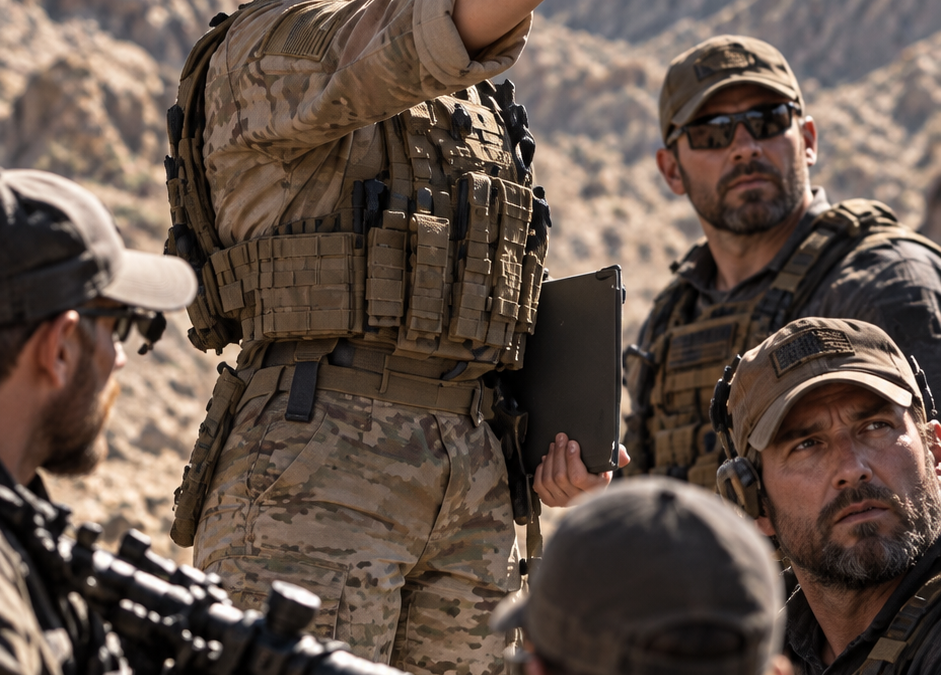
𝗙𝗨𝗟𝗟 𝗦𝗧𝗢𝗥𝗬 The environment amplified everything.
A minor mistake close to the rifle could become a large miss far downrange.
The teams knew that.
They had trained for it.
But that afternoon the canyon had become unpredictable even by Sentinel standards.
The wind near us came from one direction.
Farther downrange, dust suggested something different.
Near the target, vegetation moved another way.
The first shooter missed.
The spotter adjusted.
Second shot.
Miss.
A different shooter tried.
Miss.
The steel remained silent.
The mood shifted gradually.
Professional concentration became irritation.
I saw shoulders tighten.
Voices sharpen.
The men stopped discussing possibilities and started defending conclusions.
That happens in intelligence too.
The longer intelligent people commit to an explanation, the harder it becomes for them to abandon it.
Nobody wants to admit the problem might be the model instead of the data.
Hayes walked behind the line with his arms crossed.
“You’re fighting the wind,” he barked after another miss. “Read it.”
The shooter reset.
I looked toward the canyon.
Something had bothered me for nearly twenty minutes.
The misses were not random.
That was the important part.
If trigger control had been collapsing or equipment had been inconsistent, the errors would have looked different.
Instead, the rounds were being displaced in a pattern.
Not perfectly.
Nothing in mountain wind behaves perfectly.
But enough.
I looked left.
One massive rock face had been exposed to direct sunlight for most of the day.
Above it, the air shimmered violently.
Anyone could see the mirage.
What interested me was what the mirage implied.
Heat.
Movement.
Rising air.
The canyon was producing its own localized circulation.
Near the ground, the spotters had excellent information.
Near the target, they had decent information.
But the bullets were spending part of their flight much higher than either observation point.
There was an entire volume of air between those measurements.
An invisible section of the problem.
My favorite kind.
Another shot missed.
Miller cursed.
The spotter adjusted again.
I studied the heat above the cliff.
Then the target.
Then the cliff again.
The answer suddenly became simple enough that I was annoyed I had not seen it sooner.
“The middle.”
Nobody heard me.
Or I thought nobody did.
I had spoken mostly to myself.
Hayes turned.
“What?”
I hesitated.
For three days, his instruction had been clear.
Observe.
Keep quiet.
Don’t interfere.
Then another shooter began resetting for a shot using essentially the same environmental assumptions that had already failed.
I knew what would happen.
I spoke.
“The updraft in the middle of the canyon is moving the round.”
The line went quiet.
Not completely.
Wind still scraped across stone.
Gear still shifted.
But every human sound stopped.
Hayes turned toward me slowly.
“What did you say, Sergeant?”
My pulse accelerated.
There are moments when you realize you have crossed an invisible line.
Going backward usually looks worse than continuing forward.
I lowered the clipboard.
“The thermal rise over the left rock face. You’re accounting for the wind here and near the target, but not what the bullet is crossing at the top of its path.”
Miller looked at me as if I had started speaking another language.
One of the younger SEALs gave a short laugh.
“The intel sergeant is teaching us ballistics now?”
Another man muttered, “Careful, Miller. Spreadsheet’s got opinions.”
The laughter came easier this time.
I felt the familiar pressure in my chest.
Not fear exactly.
The awareness that I was surrounded by people waiting for me to become embarrassed enough to retreat.
Hayes walked toward me.
“Explain.”
That surprised me.
I pointed toward the heated cliff.
“The rock has been absorbing sunlight all day. Look at the distortion above it.”
“I see mirage.”
“So do I.”
His eyes narrowed.
“But that isn’t just optical distortion. You’ve got rising hot air crossing the middle of the trajectory.”
Miller scoffed.
“Based on what?”
“The pattern of your misses.”
His eyebrows went up.
“Our misses?”
“They’re not random.”
“Now she’s grading them.”
A few men laughed.
I ignored them.
“You’re correcting based on what happens near the gun and near the target. The middle keeps pushing you off the solution you think you have.”
Hayes studied the canyon.
Then me.
“You’re telling me you see something my spotters don’t.”
“I’m telling you they’re measuring different parts of the environment.”
“That wasn’t my question.”
I held his gaze.
“Yes, sir.”
The laughter stopped.
Hayes stepped closer.
“You think you can do better?”
My heartbeat felt enormous.
“I think the model is incomplete.”
He almost smiled.
It wasn’t a friendly expression.
“Nice answer.”
He turned toward the firing line.
A heavy precision rifle rested on the bags.
Then he pointed toward it.
“Prove it.”
Nobody laughed at first.
Maybe they thought he was joking.
Then Miller grinned.
“Oh, this I have to see.”
The younger SEAL shook his head.
“Commander, we should probably get medical standing by before the analyst meets recoil.”
That got them going.
Someone asked whether the rifle came with instructions.
Another offered to find me a cushion.
I remember every word.
Not because they wounded me.
Because of how calm I became.
Something strange happens when humiliation reaches a certain level.
You either collapse under it or stop caring.
I stopped caring.
I handed my clipboard to Miller.
He took it automatically.
“You serious?”
I looked at Hayes.
He was watching me.
Waiting.
Maybe expecting me to explain that identifying a variable did not mean I could physically make the shot.
That would have been reasonable.
My job was intelligence.
Not sniping.
He had designed the challenge to put me back inside the box he understood.
Analyst.
Observer.
Desk.
But there was something Hayes did not know.
My military training had not consisted entirely of keyboards and briefings.
I was not a sniper.
I would never pretend to be.
But intelligence personnel attached to operational units train on more than office procedures.
I understood precision shooting.
More importantly, I understood myself under pressure.
I walked toward the rifle.
The laughter followed me.
Twenty feet.
That was all.
It felt much farther.
I could feel each step in my boots.
Dry dirt.
Loose gravel.
The sun on the back of my neck.
The wind tugging at my uniform.
I reached the firing position and stopped.
For two seconds, I closed my eyes.
Not for drama.
To separate their expectations from my task.
I had learned that trick years earlier during intelligence exercises.
When too many voices competed for attention, reduce the world.
Identify what matters.
Discard what does not.
I opened my eyes.
Rifle.
Target.
Environment.
Breathing.
Nothing else.
I lowered myself behind the weapon.
The jokes faded.
I adjusted into position.
The rifle was heavy.
Hot from repeated use.
It smelled of metal, dust, and propellant.
Behind me, someone shifted.
Nobody spoke.
I checked the optic.
Then the chamber.
Then my position.
The movements were familiar enough to change the atmosphere immediately.
I could feel it happen without looking back.
They had expected awkwardness.
Instead, they saw procedure.
Hayes stood behind my right shoulder.
“Distance is confirmed.”
I acknowledged him.
The spotter started feeding me environmental information.
I listened.
Then I looked beyond it.
That distinction mattered.
Data is not truth by itself.
Data is evidence.
Truth is what you build when the evidence finally makes sense together.
Through the optic, the distant target appeared small and strangely fragile.
Between us lay more than a mile of moving air.
I looked at the target.
Then the canyon.
The heated rock.
The distortion above it.
Dust farther downrange.
Vegetation closer to the steel.
I had no interest in demonstrating that I knew more terminology than the SEALs.
Terminology does not move bullets.
Understanding does.
I made the adjustments I believed the environment required.
The spotter noticed.
“What are you doing?”
I kept working.
“That doesn’t match the wind call.”
“I know.”
“The wind at the target is—”
“She heard you,” Hayes said.
The spotter went quiet.
Something in the commander’s voice had changed.
The amusement was gone.
I settled again.
The world narrowed further.
The reticle.
The target.
The shimmering canyon.
My breathing.
I had spent years making decisions where I never saw the physical result.
That is one of the strangest things about intelligence work.
You identify something.
Recommend something.
Send something upward.
Hours or days later, you may hear that a mission succeeded.
Sometimes you never hear anything.
Your work vanishes into other people’s action.
That day was different.
There would be no distance between analysis and consequence.
If I was wrong, everyone would know immediately.
The thought should have terrified me.
Instead, it steadied me.
For once, there would be no politics.
No interpretation.
No performance review.
No officer deciding whether my analysis sounded convincing.
Only reality.
Either the steel would move.
Or it wouldn’t.
I inhaled.
Slowly exhaled.
My heartbeat seemed impossibly loud.
One beat.
Another.
I found the still point between breaths.
And fired.
The rifle slammed into my shoulder.
The blast rolled across the firing line and bounced off the canyon walls.
Dust erupted around the muzzle.
For an instant, everything in the optic jumped.
Then the picture settled.
I stayed behind the glass.
That was the hardest part.
Not firing.
Waiting.
At that distance, the result did not arrive immediately.
The bullet had to cross the same complicated air I had been studying.
Seconds stretched.
Someone behind me muttered something I couldn’t make out.
Miller spoke louder.
“She’s high.”
I didn’t react.
The spotter tracked through his optic.
“Wait.”
One second.
Then another.
His voice changed.
“Hold on.”
I could feel Hayes standing behind me.
No movement.
No commentary.
The canyon suddenly seemed silent despite the wind.
The spotter leaned closer to his glass.
“Trace is shifting.”
Nobody laughed.
Another second passed.
Then through the optic I saw a small dark mark appear on the distant steel.
For a moment, my brain refused to celebrate.
Visual confirmation first.
Sound later.
That was the physics of distance.
I opened the bolt and made the rifle safe.
Nobody spoke.
Then the faint metallic sound came back across the canyon.
A clean ring.
The spotter remained behind his optic.
“Impact.”
Silence.
He checked again.
“Center.”
The word was almost a whisper.
I stayed still for one more breath.
I wanted to turn around.
I wanted to see Miller’s face.
I wanted to see Hayes.
I wanted, for one petty and very human second, to smile at every man who had laughed at me.
I didn’t.
Because professionalism feels better when you have earned the right to be arrogant.
I stood.
Cleared the firing position.
Set the rifle down safely.
Then brushed dirt from the front of my uniform.
Only after that did I turn around.
I will remember that image for the rest of my life.
Miller held my clipboard against his chest.
His mouth was slightly open.
The younger SEAL who had joked about medical support was staring at the target as though distance itself had betrayed him.
Two men suddenly found the ground fascinating.
The spotter stayed behind his optic longer than necessary.
And Hayes?
Hayes had not moved.
His hands rested on his hips.
His face was unreadable.
But the expression I had seen on my arrival was gone.
No dismissal.
No amusement.
He was looking at me the way I had spent four days looking at the canyon.
As a problem he had misunderstood.
I held out my hand.
Miller looked down.
“What?”
“My clipboard.”
“Oh.”
He handed it over.
I tucked it beneath my arm.
Nobody said anything.
So I did.
“The rising air over that rock face is altering the middle of the flight path. The effect won’t stay constant as the sun moves.”
Hayes looked toward the canyon.
Then at the spotter.
The spotter nodded slowly.
“She called it.”
Hayes looked back at me.
“If the temperature changes?”
“The solution changes.”
“If the wind changes?”
“Same.”
He studied me another second.
Then pointed toward the open position beside the spotter.
“Grab your gear.”
I waited.
“You’re not observing anymore.”
Something inside me loosened.
Not everything.
Four days of humiliation do not disappear in one sentence.
Neither do years of being underestimated.
But I understood what those words meant in that environment.
I had been moved from outside the line to inside it.
I nodded.
“Yes, sir.”
When I returned carrying my equipment, the men shifted aside.
No jokes.
No comments.
Just space.
Hayes pointed at Miller.
“On the rifle.”
Then at me.
“Collins calls environment.”
Miller looked at me.
I could almost see his pride fighting his professionalism.
Professionalism won.
He lowered himself behind the rifle.
I set up beside him.
“You ready, desk jockey?”
The words sounded different now.
Almost careful.
“Are you?”
His mouth twitched.
“Don’t make me look bad.”
“If you need my help for that, we have larger problems.”
He laughed once.
Short.
Then settled.
I studied the canyon.
The afternoon had started changing.
Shadows stretched farther across the rocks.
The surface temperature that had produced the strong rising air earlier was beginning to fall.
The environment that had made my previous solution work was already disappearing.
That was the lesson Hayes wanted his men to learn, whether he realized it or not.
The answer is never permanent.
Only the method is.
I gave Miller a revised call.
He questioned it.
I expected that.
“Trust what you’re seeing down here,” I told him, “and you’ll miss what’s happening farther out.”
“That’s supposed to reassure me?”
“No.”
I adjusted the scope beside me.
“The steel will.”
Miller grunted.
He fired.
We waited.
Impact.
Not perfect.
But solid.
Miller exhaled and looked over.
“Okay.”
“Okay what?”
“Good call.”
I raised an eyebrow.
“That physically hurt you, didn’t it?”
“More than you know.”
I almost smiled.
Over the next several hours, shooter after shooter rotated through.
I stayed beside the spotting equipment.
The sun dropped.
Temperatures changed.
The air became denser.
Wind patterns shifted.
The men adapted.
More importantly, they started asking questions.
Not politely at first.
SEALs apparently believed every question should sound like a challenge.
“What are you seeing?”
“Why’d you change that?”
“Where’s the shift?”
“You sure?”
I answered.
Sometimes I was.
Sometimes I told them I needed another moment.
Once, I made the wrong call and corrected it immediately.
No one laughed.
That might have mattered more than the hit.
Respect built on perfection is fragile.
Respect built on competence can survive mistakes.
By late afternoon, the firing line no longer felt divided between operators and the analyst.
It became what good military teams are supposed to become.
Different functions solving one problem.
The shooters brought years of physical skill and discipline I could not duplicate.
I brought a way of processing information they had not been using.
Neither replaced the other.
Together, we became better.
When darkness finally approached, Hayes called the range cold.
Weapons were cleared.
Gear disappeared into cases.
The mountain temperature dropped with brutal speed.
Sweat cooled beneath my uniform and made me shiver.
I was folding my tripod when something struck me between the shoulder blades.
I lurched forward.
“What the—”
Miller stood behind me.
His enormous hand had apparently been attempting a friendly pat.
“You trying to injure me?”
“I barely touched you.”
“You nearly launched me into another time zone.”
He held out a battered thermos.
“Coffee.”
I looked at it suspiciously.
“How long has that been in there?”
“Long enough to kill whatever bacteria got in.”
“That isn’t reassuring.”
“It’s hot.”
That was enough.
I took it.
The coffee tasted exactly like something brewed in a container that had once stored engine parts.
I swallowed anyway.
Miller watched me.
“Well?”
“It’s terrible.”
“Yeah.”
“Thank you.”
He nodded.
Then became awkward.
I had seen enormous, heavily armed men kick doors with more comfort than Miller displayed trying to have a sincere conversation.
Finally, he said, “You know I was giving you a hard time.”
“I noticed.”
“Wasn’t personal.”
“It usually isn’t.”
He frowned.
I let him sit with that.
Then he looked toward the dark canyon.
“I’ve worked with good shooters.”
“I know.”
“Really good.”
“I know.”
“I’ve never seen somebody read the environment the way you did today.”
I said nothing.
He rubbed the back of his neck.
“You’re weird, Collins.”
I laughed.
“That your apology?”
“Absolutely not.”
“Compliment?”
“Highest available.”
I handed back the thermos.
“Then I accept.”
He took it.
Started walking away.
Then turned.
“Hey, Sergeant.”
“What?”
“Desk jockey’s retired.”
“That’s disappointing. I was getting attached to it.”
“Don’t worry. We’ll find something worse.”
He walked toward camp.
I stood there smiling despite myself.
Then a voice came from behind me.
“You didn’t just read the wind.”
I turned.
Hayes stood a few yards away.
Without the firing line around him, he looked different.
Still severe.
Still intimidating.
But tired.
Human.
“Sir?”
He walked beside me and faced the canyon.
For a few seconds, neither of us spoke.
Then he said, “You were watching my men.”
“I was assigned to observe.”
“That isn’t what I mean.”
I waited.
“You saw them getting frustrated.”
“Yes.”
“You saw them locking onto the same solution.”
“Yes.”
“And you waited.”
“I was told to keep my mouth shut.”
That nearly made him smile.
“Fair.”
The wind moved between us.
Hayes looked out into the darkness.
“You know what the dangerous part of experience is?”
I had several answers.
I chose silence.
He continued.
“Eventually you start thinking experience makes you immune to blind spots.”
He looked at me.
“My men have been doing this a long time.”
“I know.”
“So have I.”
I nodded.
“We trust what we know because what we know kept us alive.”
“That makes sense.”
“Until it doesn’t.”
There it was.
The sentence beneath the entire day.
I shifted the pack on my shoulder.
Hayes glanced toward me.
“I looked at your file before you arrived.”
That surprised me less than he probably expected.
“And?”
“Army Intelligence. Strong evaluations. Technical schools. Commendations.”
He paused.
“Nothing in there told me I was getting what I got today.”
“My file tells you what jobs I held.”
“Apparently.”
“Not necessarily how I think.”
His eyes moved toward me.
“That’s a convenient explanation.”
“It’s also true.”
He nodded slowly.
“When command told me they were attaching an intelligence analyst to the sniper element, I argued against it.”
I looked at him.
He did not avoid the admission.
“I told them I needed shooters and spotters, not somebody taking notes behind the line.”
“I gathered that.”
“I told them you would slow the detachment down.”
The words should have angered me.
Instead, they felt strangely distant.
Maybe because I had already lived through their consequence.
Hayes continued.
“I saw the intelligence insignia. I saw your assignment history. I decided what you were before you had a chance to show me.”
There are sentences people say because they want forgiveness.
Hayes was not asking for forgiveness.
He was conducting an after-action review on himself.
That made it more valuable.
“I was wrong.”
Three words.
No ceremony.
No dramatic apology.
But from him, they carried weight.
I looked back toward the canyon.
“Thank you, sir.”
“For admitting it?”
“For saying it.”
Hayes breathed out.
“You’ve had to hear the opposite a lot.”
It wasn’t really a question.
I could have lied.
“Yes.”
He waited.
I realized he expected more.
So I gave him some.
“My first assignment, an officer asked if I was lost when I walked into the operations room.”
Hayes frowned.
“Second assignment, someone assumed I was the administrative clerk.”
I smiled without humor.
“Third assignment, a captain spent an entire briefing directing technical questions to a male specialist sitting beside me. I had written the assessment he was asking about.”
Hayes looked down.
“What did you do?”
“Answered every question anyway.”
“And him?”
“Eventually he started looking at me.”
Hayes almost smiled.
“Sounds familiar.”
“Very.”
The wind sharpened.
I pulled my collar higher.
Hayes stared at the ground.
“You should’ve said something sooner.”
That irritated me.
“Would you have listened?”
He looked at me.
I didn’t soften the question.
“Day one. If I had walked onto your range and told you your teams were overlooking environmental behavior, would you have listened?”
Hayes took his time.
“No.”
“Day two?”
“No.”
“Yesterday?”
His jaw moved.
“Probably not.”
“So when exactly should I have said something?”
That landed.
He nodded.
“Point taken.”
I thought the conversation was finished.
Then he said, “Tomorrow we move higher.”
“How high?”
“Nine thousand feet.”
I groaned.
“That sounds healthy.”
“It isn’t.”
The corner of his mouth moved.
“High-angle training. More complex terrain. Multiple teams.”
He turned toward me.
“I want you running the master environmental picture.”
I stared at him.
“For all three teams?”
“All three.”
“That’s a significant change from ‘stand in the back.’”
“I contain multitudes.”
I laughed before I could stop myself.
Hayes looked mildly offended.
Then his expression became serious.
“I mean it, Collins.”
I straightened.
“Yes, sir.”
“I don’t care what patch is on somebody’s shoulder tomorrow. If your analysis says the environment changed, you speak.”
“Understood.”
“If one of my men tells you to stay in your lane—”
“I’ll remind him you moved the lane.”
That got the smile.
Small.
Brief.
But real.
“Exactly.”
He started toward camp.
After several steps, he stopped.
“Collins.”
“Sir?”
“Keep the clipboard.”
I looked down at it.
“Why?”
He glanced toward the barracks where Miller and the others had disappeared.
“Because those animals need supervision.”
Then he walked away.
I stayed at the firing line for another minute.
The canyon was almost completely dark.
Hours earlier, I had stood in the same place listening to men laugh because they thought I was somewhere I did not belong.
Now those same men had used my calls to finish the training day.
The obvious version of that story would be that one impossible shot changed everything.
It didn’t.
One shot does not erase prejudice.
One good day does not transform a culture.
One commander admitting he was wrong does not repair every room where someone like me walks in and has to prove herself before being treated as competent.
What changed that afternoon was smaller.
And more important.
They stopped assuming.
That was enough.
The next morning, we moved before sunrise.
Cold darkness covered Camp Sentinel while trucks carried equipment higher into the mountains.
I sat between Miller and Luke in the back of one vehicle.
Miller handed me a coffee without being asked.
I smelled it.
“Still battery acid?”
“Fresh batch.”
“That does not answer the question.”
“It does if you know how I make coffee.”
Luke leaned forward.
“You two always like this?”
“Since yesterday,” I said.
Miller nodded solemnly.
“We’ve been through a lot.”
I rolled my eyes.
The truck climbed.
As the elevation increased, conversation faded.
Everyone became more serious.
The terrain above us looked harsher than the previous range.
Deeper valleys.
Steeper slopes.
Snow still clung to shaded cuts despite the heat lower down.
The wind behaved differently there.
I could feel it before we unloaded.
One current moved along the ridge.
Another rose from below.
Cloud shadows moved quickly over distant rock.
Hayes gathered the teams.
“Listen up.”
Everyone turned.
He pointed toward me.
“Collins owns environmental calls.”
Nobody laughed.
“If she tells you conditions changed, they changed until proven otherwise.”
Miller raised a hand.
Hayes glared.
“What?”
“Can we still mock her personally?”
Several men laughed.
Hayes looked at me.
“Your call.”
I pretended to consider it.
“Allowed, sir. Within reason.”
Miller nodded.
“Excellent leadership.”
The tension broke.
Then training started.
That day challenged me more than the previous one.
Good.
I needed it.
The worst thing that could have happened after my shot was for everyone—including me—to believe I had become infallible.
I hadn’t.
The mountains corrected that quickly.
Conditions shifted faster than expected.
One early call was wrong.
A round missed.
I felt the entire team look toward me.
The old fear returned instantly.
There.
They’ll realize yesterday was luck.
That voice had lived in me longer than I wanted to admit.
I pushed it aside.
“Correction,” I said.
I gave a revised assessment.
The next shot connected.
Nobody commented on the miss.
We moved forward.
That experience taught me something the perfect shot could not.
They were trusting me now.
Not because I never made mistakes.
Because I recognized them.
By midday, the three sniper teams were passing information through me.
I built a shared picture from their observations.
One team saw what was happening along a ridge.
Another saw changes in a valley.
A third had visibility on terrain neither of the others could read.
Piece by piece, the problem became coherent.
That was my world.
Not rifles.
Not heroics.
Information.
The rifle had only forced them to see what information could do.
Late in the afternoon, Hayes stood beside me as I updated the teams.
“You happier out here than behind your desk?” he asked.
I thought about it.
“No.”
He looked surprised.
“No?”
“I like my desk.”
Miller, listening nearby, laughed.
I continued.
“I also like this.”
Hayes folded his arms.
“So which one are you?”
“Both.”
That answer seemed to bother him for a second.
Then he understood.
People like neat categories.
Shooter.
Analyst.
Operator.
Support.
Strong.
Weak.
Field.
Desk.
The military relies on categories because large organizations need order.
But people do not fit them cleanly.
That had been Hayes’s mistake.
It had been Miller’s.
Sometimes it had been mine too.
I had spent so many years defending intelligence work that I occasionally acted as though physical operational competence belonged to some separate species of soldier.
It didn’t.
We all had primary jobs.
We also had histories, training, abilities, and ways of thinking that did not fit inside a personnel code.
“You know,” Hayes said, “the first day I thought you looked out of place.”
“I noticed.”
“Today?”
I waited.
He looked toward the range.
“You look busy.”
I laughed.
“That might be the nicest thing you’ve said to me.”
“Don’t spread it around.”
By the end of the exercise, nobody called me comms girl anymore.
Miller did occasionally call me Spreadsheet.
But only after I started calling him Refrigerator.
Fair trade.
On our final evening at Camp Sentinel, the teams gathered outside the mess area.
Nothing formal.
No speeches.
Just tired people eating from disposable trays while cold mountain air moved through camp.
I sat at the end of a table, reviewing the next morning’s departure schedule.
Miller dropped into the seat across from me.
“You’re doing paperwork.”
“Yes.”
He shook his head.
“After everything, you really are a desk jockey.”
“I never said I wasn’t.”
Luke laughed.
Hayes approached with a mug.
The conversation lowered automatically.
He hated that.
“Relax. I’m drinking coffee, not conducting an inspection.”
He looked at me.
“Collins.”
“Sir.”
He handed me a folded sheet.
I opened it.
It was an after-action recommendation.
My attachment to the exercise had officially been observational.
Hayes had rewritten the evaluation.
He described my role as operationally integrated analytical support.
There were comments about environmental assessment.
Team coordination.
Decision-making under pressure.
At the bottom, one line caught me.
Recommended for future joint precision-overwatch support assignments.
I looked up.
Hayes took a drink.
“Problem?”
“No, sir.”
“You’re making a face.”
“I’m thinking.”
“Dangerous habit.”
Miller nodded.
“We’ve learned that.”
I looked back at the page.
“This follows me.”
“Yes.”
That was when I understood what Hayes had actually done.
The shot mattered to the men who witnessed it.
The recommendation would matter in rooms I had not entered yet.
He had taken what happened at Sentinel and put it into the language the institution understood.
Evidence.
I folded the paper carefully.
“Thank you.”
Hayes nodded once.
“Earned.”
That word stayed with me longer than praise would have.
Earned.
Not given.
Not allowed.
Not granted because somebody wanted to be progressive or generous.
Earned.
Later that night, I walked alone past the dark firing range.
The targets were invisible.
The canyon looked enormous beneath the stars.
I thought about the moment before the shot.
The laughter.
The weight of the rifle.
Hayes behind me.
Miller waiting for failure.
My own heart pounding hard enough to make me question whether I could hold still.
People later told the story differently.
Military stories grow in the telling.
By the time the exercise ended, somebody claimed the shot had been nearly two kilometers.
Someone else claimed Hayes had challenged me in front of an entire battalion.
Miller insisted I had turned around afterward and asked whether anyone else needed a lesson.
I absolutely did not.
That version sounded better, apparently.
But the truth mattered more to me.
The truth was that I had been afraid.
My hands were steady, but I was afraid.
I knew exactly what failure would mean in that moment.
Not officially.
Nobody would have punished me for missing.
But socially?
A miss would have become evidence.
See?
Analyst.
Desk jockey.
Doesn’t belong.
That was unfair.
It was also real.
The men could miss repeatedly and remain snipers.
I had one shot to remain credible.
That is the exhausting thing about being underestimated.
Success becomes proof that you might belong.
Failure becomes proof that they were right all along.
I wish I could say I defeated that dynamic at Camp Sentinel.
I didn’t.
I simply refused to let it choose what I did.
The shot landed because I trusted what I saw.
The rest changed because other people finally became willing to see me.
There is a difference.
The next morning, we loaded the trucks before sunrise.
Miller threw his pack into the vehicle beside mine.
“You going back to the climate-controlled cave?”
“Eventually.”
“Shame.”
“You’ll survive.”
“Debatable.”
Luke climbed in.
Hayes stood outside checking the convoy.
As the engine started, he looked toward me.
“Collins.”
I leaned toward the opening.
“Yes, sir?”
He pointed at my clipboard.
“You got that?”
I held it up.
He nodded.
“Good.”
Then he walked toward the lead vehicle.
The truck rolled forward.
Camp Sentinel disappeared behind us gradually.
Barracks.
Ranges.
Dust.
Mountain walls.
All of it fading into the morning.
I looked down at the clipboard in my hands.
Four days earlier, it had been evidence of everything they thought I was.
The analyst.
The observer.
The woman standing behind the line while the real professionals worked.
Now Miller tapped it with one thick finger.
“Careful with that.”
“Why?”
“Dangerous weapon.”
I laughed.
For once, he was right.
Because the most important thing I carried out of Sentinel was not the memory of pulling a trigger.
It was the certainty that I never had to become somebody else to justify the soldier I already was.
I did not need to stop being an analyst.
I did not need broader shoulders.
A louder voice.
A different gender.
A different patch.
I did not have to imitate the men who had doubted me.
What I brought to that range was exactly what I had always brought to intelligence work.
Patience.
Pattern recognition.
Discipline.
The willingness to question a conclusion everybody else had already accepted.
Those things looked unimpressive beside rifles and tactical gear.
Until they mattered.
And when they mattered, they mattered completely.
For years afterward, whenever someone looked at my record and saw intelligence before they saw soldier, I remembered Hayes’s face after the steel rang.
Not because I enjoyed proving him wrong.
Though, if I am being fair, I enjoyed it a little.
I remembered it because recognition is a strange thing.
You can spend years asking people to see you differently.
Sometimes they will.
Sometimes they will not.
Eventually, you learn that the more important task is seeing yourself clearly enough that their doubt does not become your definition.
At Camp Sentinel, a dozen men believed they already knew what I was capable of before I had done anything.
For three days, I let them believe it.
On the fourth, the canyon gave me a problem they had not solved.
I saw something.
I said something.
And when Commander Hayes challenged me to stand behind my judgment, I did.
The rifle was heavy.
The distance was unforgiving.
The whole firing line expected me to fail.
None of that changed what the environment was doing.
None of that changed the answer.
That was the part Hayes understood by the end.
Reality does not care who looks impressive.
The mountain did not care that Miller was stronger than I was.
The wind did not care that Hayes outranked me.
The target did not care that I was a woman from Army Intelligence surrounded by Navy SEALs.
And the truth certainly did not care that somebody had called me a desk jockey.
It was simply there.
Waiting for someone willing to see it.
That morning, as Camp Sentinel vanished behind the truck, I realized something else.
I had spent years thinking belonging was a place somebody else allowed you to enter.
A seat at the table.
A position on the firing line.
A commander saying, You’re one of us now.
But that was never quite right.
Belonging started earlier.
It started the moment I stopped apologizing, even silently, for being where my orders and my abilities had put me.
Hayes had not made me belong when he moved me onto the line.
Miller had not made me belong when he handed me coffee.
The team had not made me belong when they started asking for my calls.
Those things mattered.
Respect matters.
Recognition matters.
But I had belonged before any of them knew it.
The only person who had still been waiting for proof was me.
And somewhere in that canyon, between the laughter before the shot and the metallic ring that came back across more than a mile of empty air, I finally stopped waiting.
I was Sergeant Emma Collins.
Army Intelligence.
Analyst.
Soldier.
And when the situation demanded it, I could step out from behind the desk, stand inside somebody else’s world, and trust the skills I had spent years building.
I did not need to become a Navy SEAL.
I did not need to become a sniper.
I only needed to be good at what I was.
The mountain had taken care of the rest.
Have you finished reading the story and want to read it again?
The Navy SEAL Commander Who Called Me a Desk Jockey Never Asked What I Could See That His Snipers Couldn’t
The first time Commander Hayes looked at me, he saw a desk.
Not a soldier.
Not an intelligence sergeant with nine years of training behind her, and certainly not someone he wanted anywhere near his firing line.
A desk.
A computer.
A stack of classified reports.
That was the box he put me in before I had even dropped my duffel bag into the red dirt of Camp Sentinel.
For the first three days, I let him keep me there.
My name is Sergeant Emma Collins, United States Army Intelligence.
According to my official job description, I analyzed information.
That sounded harmless when reduced to a line on a personnel file.
People imagined screens glowing in climate-controlled rooms. Headsets. Maps. Intercepted radio traffic. Rows of numbers moving across monitors while someone like me sat comfortably behind a desk hundreds of miles from anything dangerous.
Some of that was true.
I had spent thousands of hours looking at screens.
I had also learned that a number could kill somebody if you interpreted it incorrectly.
A radio transmission could look meaningless until you noticed one word repeated at the wrong interval.
A weather pattern could appear irrelevant until it changed the route of an aircraft.
A heat signature could be dismissed as machinery until you realized the machinery had moved three kilometers overnight.
Intelligence taught me to mistrust the obvious.
More importantly, it taught me to look at everything other people had already decided did not matter.
That was how I survived in my profession.
At Camp Sentinel, it was also how I ended up lying behind a sniper rifle while a group of Navy SEALs waited for me to humiliate myself.
But I am getting ahead of myself.
Camp Sentinel sat high in a jagged mountain range where the air seemed determined to punish anyone foolish enough to breathe it.
The sun was relentless during the day.
The cold became vicious after dark.
Wind moved through the canyons in directions that made no intuitive sense, colliding with rock walls, rising from sun-baked slopes, dropping suddenly through narrow cuts.
Even walking uphill with full gear reminded you that the air at altitude contained less of what your body wanted.
The place had been designed for difficult training.
Everything about it encouraged mistakes.
That was why the SEAL detachment loved it.
They arrived before my unit.
By the time our transport truck rolled into camp, they had already claimed an area near the barracks and arranged their equipment with the kind of precision that told you nobody needed to discuss where anything belonged.
Rifles.
Packs.
Optics.
Cases.
Every piece placed exactly where somebody expected to find it.
The men moved with the same efficiency.
No wasted gestures.
No uncertainty.
They carried that particular confidence common to people who have repeatedly entered situations where hesitation can cost lives.
I understood why others found them intimidating.
I also understood that confidence, when left unchallenged long enough, could become blindness.
Commander Hayes stood at the center of them.
He was older than most of the team, probably somewhere in his forties, though hard years made exact guesses difficult.
Salt-and-pepper hair.
Broad shoulders.
Slate-colored eyes.
He had the kind of face that looked permanently carved into disapproval.
When he turned those eyes toward me, they dropped immediately to the intelligence insignia on my uniform.
I watched him make his decision.
It took less than two seconds.
“Collins?”
“Yes, sir.”
His gaze moved to my duffel.
Then back to me.
“Comm tent is half a mile down the ridge.”
I waited.
He pointed vaguely.
“Try not to get lost. We’re running live-fire training today, and I don’t need anybody wandering into the wrong place.”
A few men behind him laughed.
Not loudly.
They didn’t need to.
The message landed.
I felt heat creep into my face.
I hated that reaction.
I had always hated it.
Anger I could hide.
Embarrassment betrayed you through your skin.
“With respect, Commander, my orders have me attached to your sniper overwatch teams for observation and integration.”
That made him look at me properly.
“Integration?”
“Yes, sir.”
“To do what?”
“Understand operational flow from the ground level. Identify how intelligence products can better support the teams actually using them.”
He stared at me for a moment.
“Observe.”
“Yes, sir.”
“Meaning you stand in the back.”
I said nothing.
“You listen.”
I held his eyes.
“And you don’t touch anything.”
Someone behind him chuckled again.
Hayes turned away.
“Welcome to Sentinel.”
That was my introduction.
For three days, I did exactly what he ordered.
I stood in the back.
I listened.
I touched nothing.
And I learned everything I could.
The sniper teams worked from morning until the light made continued training pointless.
They studied terrain.
Temperature.
Elevation.
Wind.
Pressure.
They checked equipment so often that the ritual itself became almost meditative.
They argued about tiny environmental differences most people would never notice.
I respected them immediately.
That part matters.
This was never a story about incompetent operators being rescued by a brilliant analyst.
They were extremely good.
That was precisely why their mistake interested me.
Poorly trained people miss for hundreds of reasons.
Highly trained people usually miss for one or two.
The smaller the number of possible errors, the more revealing those errors become.
So I watched.
I watched the shooters.
I watched their spotters.
I watched how dust moved when the wind crossed the firing line.
I watched the mirage above distant rock.
I watched shadows crawl across the canyon walls as the sun shifted.
I listened to what they discussed before each shot.
And I listened even more carefully to what they did not discuss.
No one asked my opinion.
That was fine.
At first.
Miller was one of the team’s strongest shooters.
He looked like someone had constructed him specifically to carry heavy objects uphill and complain about nothing.
He was large enough to make most rifles look small.
He also seemed personally offended by my existence.
On the second morning, he saw me writing on my clipboard and said, “You grading us, Sergeant?”
I looked up.
“Observing.”
“That’s dangerous.”
“How?”
“Give an analyst enough paper and eventually she invents a problem.”
A few men laughed.
I smiled faintly.
“Give an operator enough confidence and eventually he stops noticing one.”
That earned me silence.
Miller stared at me.
Then laughed harder than anyone else.
“Okay, desk jockey.”
The nickname spread.
Desk jockey.
Comms girl.
Spreadsheet.
Weather lady.
None of it was especially vicious.
That almost made it worse.
Cruelty can be confronted.
Casual dismissal is harder because everybody involved can pretend it means nothing.
I had lived with versions of it my entire career.
Some men believed women were fragile.
Others were more sophisticated about their doubt.
They never said I was incapable.
They simply assumed someone else would be more capable until I proved otherwise.
Every new assignment required another audition.
Every room began at zero.
Sometimes below zero.
I had learned not to waste energy resenting that.
Resentment is expensive.
Observation costs almost nothing.
So I watched them shoot.
On the fourth day, the training moved to extreme distance.
The target sat more than a mile down the canyon.
Even through quality optics it looked insignificant against the rock.
That was the point.
At that range, small errors did not remain small.
The environment amplified everything.
A minor mistake close to the rifle could become a large miss far downrange.
The teams knew that.
They had trained for it.
But that afternoon the canyon had become unpredictable even by Sentinel standards.
The wind near us came from one direction.
Farther downrange, dust suggested something different.
Near the target, vegetation moved another way.
The first shooter missed.
The spotter adjusted.
Second shot.
Miss.
A different shooter tried.
Miss.
The steel remained silent.
The mood shifted gradually.
Professional concentration became irritation.
I saw shoulders tighten.
Voices sharpen.
The men stopped discussing possibilities and started defending conclusions.
That happens in intelligence too.
The longer intelligent people commit to an explanation, the harder it becomes for them to abandon it.
Nobody wants to admit the problem might be the model instead of the data.
Hayes walked behind the line with his arms crossed.
“You’re fighting the wind,” he barked after another miss. “Read it.”
The shooter reset.
I looked toward the canyon.
Something had bothered me for nearly twenty minutes.
The misses were not random.
That was the important part.
If trigger control had been collapsing or equipment had been inconsistent, the errors would have looked different.
Instead, the rounds were being displaced in a pattern.
Not perfectly.
Nothing in mountain wind behaves perfectly.
But enough.
I looked left.
One massive rock face had been exposed to direct sunlight for most of the day.
Above it, the air shimmered violently.
Anyone could see the mirage.
What interested me was what the mirage implied.
Heat.
Movement.
Rising air.
The canyon was producing its own localized circulation.
Near the ground, the spotters had excellent information.
Near the target, they had decent information.
But the bullets were spending part of their flight much higher than either observation point.
There was an entire volume of air between those measurements.
An invisible section of the problem.
My favorite kind.
Another shot missed.
Miller cursed.
The spotter adjusted again.
I studied the heat above the cliff.
Then the target.
Then the cliff again.
The answer suddenly became simple enough that I was annoyed I had not seen it sooner.
“The middle.”
Nobody heard me.
Or I thought nobody did.
I had spoken mostly to myself.
Hayes turned.
“What?”
I hesitated.
For three days, his instruction had been clear.
Observe.
Keep quiet.
Don’t interfere.
Then another shooter began resetting for a shot using essentially the same environmental assumptions that had already failed.
I knew what would happen.
I spoke.
“The updraft in the middle of the canyon is moving the round.”
The line went quiet.
Not completely.
Wind still scraped across stone.
Gear still shifted.
But every human sound stopped.
Hayes turned toward me slowly.
“What did you say, Sergeant?”
My pulse accelerated.
There are moments when you realize you have crossed an invisible line.
Going backward usually looks worse than continuing forward.
I lowered the clipboard.
“The thermal rise over the left rock face. You’re accounting for the wind here and near the target, but not what the bullet is crossing at the top of its path.”
Miller looked at me as if I had started speaking another language.
One of the younger SEALs gave a short laugh.
“The intel sergeant is teaching us ballistics now?”
Another man muttered, “Careful, Miller. Spreadsheet’s got opinions.”
The laughter came easier this time.
I felt the familiar pressure in my chest.
Not fear exactly.
The awareness that I was surrounded by people waiting for me to become embarrassed enough to retreat.
Hayes walked toward me.
“Explain.”
That surprised me.
I pointed toward the heated cliff.
“The rock has been absorbing sunlight all day. Look at the distortion above it.”
“I see mirage.”
“So do I.”
His eyes narrowed.
“But that isn’t just optical distortion. You’ve got rising hot air crossing the middle of the trajectory.”
Miller scoffed.
“Based on what?”
“The pattern of your misses.”
His eyebrows went up.
“Our misses?”
“They’re not random.”
“Now she’s grading them.”
A few men laughed.
I ignored them.
“You’re correcting based on what happens near the gun and near the target. The middle keeps pushing you off the solution you think you have.”
Hayes studied the canyon.
Then me.
“You’re telling me you see something my spotters don’t.”
“I’m telling you they’re measuring different parts of the environment.”
“That wasn’t my question.”
I held his gaze.
“Yes, sir.”
The laughter stopped.
Hayes stepped closer.
“You think you can do better?”
My heartbeat felt enormous.
“I think the model is incomplete.”
He almost smiled.
It wasn’t a friendly expression.
“Nice answer.”
He turned toward the firing line.
A heavy precision rifle rested on the bags.
Then he pointed toward it.
“Prove it.”
Nobody laughed at first.
Maybe they thought he was joking.
Then Miller grinned.
“Oh, this I have to see.”
The younger SEAL shook his head.
“Commander, we should probably get medical standing by before the analyst meets recoil.”
That got them going.
Someone asked whether the rifle came with instructions.
Another offered to find me a cushion.
I remember every word.
Not because they wounded me.
Because of how calm I became.
Something strange happens when humiliation reaches a certain level.
You either collapse under it or stop caring.
I stopped caring.
I handed my clipboard to Miller.
He took it automatically.
“You serious?”
I looked at Hayes.
He was watching me.
Waiting.
Maybe expecting me to explain that identifying a variable did not mean I could physically make the shot.
That would have been reasonable.
My job was intelligence.
Not sniping.
He had designed the challenge to put me back inside the box he understood.
Analyst.
Observer.
Desk.
But there was something Hayes did not know.
My military training had not consisted entirely of keyboards and briefings.
I was not a sniper.
I would never pretend to be.
But intelligence personnel attached to operational units train on more than office procedures.
I understood precision shooting.
More importantly, I understood myself under pressure.
I walked toward the rifle.
The laughter followed me.
Twenty feet.
That was all.
It felt much farther.
I could feel each step in my boots.
Dry dirt.
Loose gravel.
The sun on the back of my neck.
The wind tugging at my uniform.
I reached the firing position and stopped.
For two seconds, I closed my eyes.
Not for drama.
To separate their expectations from my task.
I had learned that trick years earlier during intelligence exercises.
When too many voices competed for attention, reduce the world.
Identify what matters.
Discard what does not.
I opened my eyes.
Rifle.
Target.
Environment.
Breathing.
Nothing else.
I lowered myself behind the weapon.
The jokes faded.
I adjusted into position.
The rifle was heavy.
Hot from repeated use.
It smelled of metal, dust, and propellant.
Behind me, someone shifted.
Nobody spoke.
I checked the optic.
Then the chamber.
Then my position.
The movements were familiar enough to change the atmosphere immediately.
I could feel it happen without looking back.
They had expected awkwardness.
Instead, they saw procedure.
Hayes stood behind my right shoulder.
“Distance is confirmed.”
I acknowledged him.
The spotter started feeding me environmental information.
I listened.
Then I looked beyond it.
That distinction mattered.
Data is not truth by itself.
Data is evidence.
Truth is what you build when the evidence finally makes sense together.
Through the optic, the distant target appeared small and strangely fragile.
Between us lay more than a mile of moving air.
I looked at the target.
Then the canyon.
The heated rock.
The distortion above it.
Dust farther downrange.
Vegetation closer to the steel.
I had no interest in demonstrating that I knew more terminology than the SEALs.
Terminology does not move bullets.
Understanding does.
I made the adjustments I believed the environment required.
The spotter noticed.
“What are you doing?”
I kept working.
“That doesn’t match the wind call.”
“I know.”
“The wind at the target is—”
“She heard you,” Hayes said.
The spotter went quiet.
Something in the commander’s voice had changed.
The amusement was gone.
I settled again.
The world narrowed further.
The reticle.
The target.
The shimmering canyon.
My breathing.
I had spent years making decisions where I never saw the physical result.
That is one of the strangest things about intelligence work.
You identify something.
Recommend something.
Send something upward.
Hours or days later, you may hear that a mission succeeded.
Sometimes you never hear anything.
Your work vanishes into other people’s action.
That day was different.
There would be no distance between analysis and consequence.
If I was wrong, everyone would know immediately.
The thought should have terrified me.
Instead, it steadied me.
For once, there would be no politics.
No interpretation.
No performance review.
No officer deciding whether my analysis sounded convincing.
Only reality.
Either the steel would move.
Or it wouldn’t.
I inhaled.
Slowly exhaled.
My heartbeat seemed impossibly loud.
One beat.
Another.
I found the still point between breaths.
And fired.
The rifle slammed into my shoulder.
The blast rolled across the firing line and bounced off the canyon walls.
Dust erupted around the muzzle.
For an instant, everything in the optic jumped.
Then the picture settled.
I stayed behind the glass.
That was the hardest part.
Not firing.
Waiting.
At that distance, the result did not arrive immediately.
The bullet had to cross the same complicated air I had been studying.
Seconds stretched.
Someone behind me muttered something I couldn’t make out.
Miller spoke louder.
“She’s high.”
I didn’t react.
The spotter tracked through his optic.
“Wait.”
One second.
Then another.
His voice changed.
“Hold on.”
I could feel Hayes standing behind me.
No movement.
No commentary.
The canyon suddenly seemed silent despite the wind.
The spotter leaned closer to his glass.
“Trace is shifting.”
Nobody laughed.
Another second passed.
Then through the optic I saw a small dark mark appear on the distant steel.
For a moment, my brain refused to celebrate.
Visual confirmation first.
Sound later.
That was the physics of distance.
I opened the bolt and made the rifle safe.
Nobody spoke.
Then the faint metallic sound came back across the canyon.
A clean ring.
The spotter remained behind his optic.
“Impact.”
Silence.
He checked again.
“Center.”
The word was almost a whisper.
I stayed still for one more breath.
I wanted to turn around.
I wanted to see Miller’s face.
I wanted to see Hayes.
I wanted, for one petty and very human second, to smile at every man who had laughed at me.
I didn’t.
Because professionalism feels better when you have earned the right to be arrogant.
I stood.
Cleared the firing position.
Set the rifle down safely.
Then brushed dirt from the front of my uniform.
Only after that did I turn around.
I will remember that image for the rest of my life.
Miller held my clipboard against his chest.
His mouth was slightly open.
The younger SEAL who had joked about medical support was staring at the target as though distance itself had betrayed him.
Two men suddenly found the ground fascinating.
The spotter stayed behind his optic longer than necessary.
And Hayes?
Hayes had not moved.
His hands rested on his hips.
His face was unreadable.
But the expression I had seen on my arrival was gone.
No dismissal.
No amusement.
He was looking at me the way I had spent four days looking at the canyon.
As a problem he had misunderstood.
I held out my hand.
Miller looked down.
“What?”
“My clipboard.”
“Oh.”
He handed it over.
I tucked it beneath my arm.
Nobody said anything.
So I did.
“The rising air over that rock face is altering the middle of the flight path. The effect won’t stay constant as the sun moves.”
Hayes looked toward the canyon.
Then at the spotter.
The spotter nodded slowly.
“She called it.”
Hayes looked back at me.
“If the temperature changes?”
“The solution changes.”
“If the wind changes?”
“Same.”
He studied me another second.
Then pointed toward the open position beside the spotter.
“Grab your gear.”
I waited.
“You’re not observing anymore.”
Something inside me loosened.
Not everything.
Four days of humiliation do not disappear in one sentence.
Neither do years of being underestimated.
But I understood what those words meant in that environment.
I had been moved from outside the line to inside it.
I nodded.
“Yes, sir.”
When I returned carrying my equipment, the men shifted aside.
No jokes.
No comments.
Just space.
Hayes pointed at Miller.
“On the rifle.”
Then at me.
“Collins calls environment.”
Miller looked at me.
I could almost see his pride fighting his professionalism.
Professionalism won.
He lowered himself behind the rifle.
I set up beside him.
“You ready, desk jockey?”
The words sounded different now.
Almost careful.
“Are you?”
His mouth twitched.
“Don’t make me look bad.”
“If you need my help for that, we have larger problems.”
He laughed once.
Short.
Then settled.
I studied the canyon.
The afternoon had started changing.
Shadows stretched farther across the rocks.
The surface temperature that had produced the strong rising air earlier was beginning to fall.
The environment that had made my previous solution work was already disappearing.
That was the lesson Hayes wanted his men to learn, whether he realized it or not.
The answer is never permanent.
Only the method is.
I gave Miller a revised call.
He questioned it.
I expected that.
“Trust what you’re seeing down here,” I told him, “and you’ll miss what’s happening farther out.”
“That’s supposed to reassure me?”
“No.”
I adjusted the scope beside me.
“The steel will.”
Miller grunted.
He fired.
We waited.
Impact.
Not perfect.
But solid.
Miller exhaled and looked over.
“Okay.”
“Okay what?”
“Good call.”
I raised an eyebrow.
“That physically hurt you, didn’t it?”
“More than you know.”
I almost smiled.
Over the next several hours, shooter after shooter rotated through.
I stayed beside the spotting equipment.
The sun dropped.
Temperatures changed.
The air became denser.
Wind patterns shifted.
The men adapted.
More importantly, they started asking questions.
Not politely at first.
SEALs apparently believed every question should sound like a challenge.
“What are you seeing?”
“Why’d you change that?”
“Where’s the shift?”
“You sure?”
I answered.
Sometimes I was.
Sometimes I told them I needed another moment.
Once, I made the wrong call and corrected it immediately.
No one laughed.
That might have mattered more than the hit.
Respect built on perfection is fragile.
Respect built on competence can survive mistakes.
By late afternoon, the firing line no longer felt divided between operators and the analyst.
It became what good military teams are supposed to become.
Different functions solving one problem.
The shooters brought years of physical skill and discipline I could not duplicate.
I brought a way of processing information they had not been using.
Neither replaced the other.
Together, we became better.
When darkness finally approached, Hayes called the range cold.
Weapons were cleared.
Gear disappeared into cases.
The mountain temperature dropped with brutal speed.
Sweat cooled beneath my uniform and made me shiver.
I was folding my tripod when something struck me between the shoulder blades.
I lurched forward.
“What the—”
Miller stood behind me.
His enormous hand had apparently been attempting a friendly pat.
“You trying to injure me?”
“I barely touched you.”
“You nearly launched me into another time zone.”
He held out a battered thermos.
“Coffee.”
I looked at it suspiciously.
“How long has that been in there?”
“Long enough to kill whatever bacteria got in.”
“That isn’t reassuring.”
“It’s hot.”
That was enough.
I took it.
The coffee tasted exactly like something brewed in a container that had once stored engine parts.
I swallowed anyway.
Miller watched me.
“Well?”
“It’s terrible.”
“Yeah.”
“Thank you.”
He nodded.
Then became awkward.
I had seen enormous, heavily armed men kick doors with more comfort than Miller displayed trying to have a sincere conversation.
Finally, he said, “You know I was giving you a hard time.”
“I noticed.”
“Wasn’t personal.”
“It usually isn’t.”
He frowned.
I let him sit with that.
Then he looked toward the dark canyon.
“I’ve worked with good shooters.”
“I know.”
“Really good.”
“I know.”
“I’ve never seen somebody read the environment the way you did today.”
I said nothing.
He rubbed the back of his neck.
“You’re weird, Collins.”
I laughed.
“That your apology?”
“Absolutely not.”
“Compliment?”
“Highest available.”
I handed back the thermos.
“Then I accept.”
He took it.
Started walking away.
Then turned.
“Hey, Sergeant.”
“What?”
“Desk jockey’s retired.”
“That’s disappointing. I was getting attached to it.”
“Don’t worry. We’ll find something worse.”
He walked toward camp.
I stood there smiling despite myself.
Then a voice came from behind me.
“You didn’t just read the wind.”
I turned.
Hayes stood a few yards away.
Without the firing line around him, he looked different.
Still severe.
Still intimidating.
But tired.
Human.
“Sir?”
He walked beside me and faced the canyon.
For a few seconds, neither of us spoke.
Then he said, “You were watching my men.”
“I was assigned to observe.”
“That isn’t what I mean.”
I waited.
“You saw them getting frustrated.”
“Yes.”
“You saw them locking onto the same solution.”
“Yes.”
“And you waited.”
“I was told to keep my mouth shut.”
That nearly made him smile.
“Fair.”
The wind moved between us.
Hayes looked out into the darkness.
“You know what the dangerous part of experience is?”
I had several answers.
I chose silence.
He continued.
“Eventually you start thinking experience makes you immune to blind spots.”
He looked at me.
“My men have been doing this a long time.”
“I know.”
“So have I.”
I nodded.
“We trust what we know because what we know kept us alive.”
“That makes sense.”
“Until it doesn’t.”
There it was.
The sentence beneath the entire day.
I shifted the pack on my shoulder.
Hayes glanced toward me.
“I looked at your file before you arrived.”
That surprised me less than he probably expected.
“And?”
“Army Intelligence. Strong evaluations. Technical schools. Commendations.”
He paused.
“Nothing in there told me I was getting what I got today.”
“My file tells you what jobs I held.”
“Apparently.”
“Not necessarily how I think.”
His eyes moved toward me.
“That’s a convenient explanation.”
“It’s also true.”
He nodded slowly.
“When command told me they were attaching an intelligence analyst to the sniper element, I argued against it.”
I looked at him.
He did not avoid the admission.
“I told them I needed shooters and spotters, not somebody taking notes behind the line.”
“I gathered that.”
“I told them you would slow the detachment down.”
The words should have angered me.
Instead, they felt strangely distant.
Maybe because I had already lived through their consequence.
Hayes continued.
“I saw the intelligence insignia. I saw your assignment history. I decided what you were before you had a chance to show me.”
There are sentences people say because they want forgiveness.
Hayes was not asking for forgiveness.
He was conducting an after-action review on himself.
That made it more valuable.
“I was wrong.”
Three words.
No ceremony.
No dramatic apology.
But from him, they carried weight.
I looked back toward the canyon.
“Thank you, sir.”
“For admitting it?”
“For saying it.”
Hayes breathed out.
“You’ve had to hear the opposite a lot.”
It wasn’t really a question.
I could have lied.
“Yes.”
He waited.
I realized he expected more.
So I gave him some.
“My first assignment, an officer asked if I was lost when I walked into the operations room.”
Hayes frowned.
“Second assignment, someone assumed I was the administrative clerk.”
I smiled without humor.
“Third assignment, a captain spent an entire briefing directing technical questions to a male specialist sitting beside me. I had written the assessment he was asking about.”
Hayes looked down.
“What did you do?”
“Answered every question anyway.”
“And him?”
“Eventually he started looking at me.”
Hayes almost smiled.
“Sounds familiar.”
“Very.”
The wind sharpened.
I pulled my collar higher.
Hayes stared at the ground.
“You should’ve said something sooner.”
That irritated me.
“Would you have listened?”
He looked at me.
I didn’t soften the question.
“Day one. If I had walked onto your range and told you your teams were overlooking environmental behavior, would you have listened?”
Hayes took his time.
“No.”
“Day two?”
“No.”
“Yesterday?”
His jaw moved.
“Probably not.”
“So when exactly should I have said something?”
That landed.
He nodded.
“Point taken.”
I thought the conversation was finished.
Then he said, “Tomorrow we move higher.”
“How high?”
“Nine thousand feet.”
I groaned.
“That sounds healthy.”
“It isn’t.”
The corner of his mouth moved.
“High-angle training. More complex terrain. Multiple teams.”
He turned toward me.
“I want you running the master environmental picture.”
I stared at him.
“For all three teams?”
“All three.”
“That’s a significant change from ‘stand in the back.’”
“I contain multitudes.”
I laughed before I could stop myself.
Hayes looked mildly offended.
Then his expression became serious.
“I mean it, Collins.”
I straightened.
“Yes, sir.”
“I don’t care what patch is on somebody’s shoulder tomorrow. If your analysis says the environment changed, you speak.”
“Understood.”
“If one of my men tells you to stay in your lane—”
“I’ll remind him you moved the lane.”
That got the smile.
Small.
Brief.
But real.
“Exactly.”
He started toward camp.
After several steps, he stopped.
“Collins.”
“Sir?”
“Keep the clipboard.”
I looked down at it.
“Why?”
He glanced toward the barracks where Miller and the others had disappeared.
“Because those animals need supervision.”
Then he walked away.
I stayed at the firing line for another minute.
The canyon was almost completely dark.
Hours earlier, I had stood in the same place listening to men laugh because they thought I was somewhere I did not belong.
Now those same men had used my calls to finish the training day.
The obvious version of that story would be that one impossible shot changed everything.
It didn’t.
One shot does not erase prejudice.
One good day does not transform a culture.
One commander admitting he was wrong does not repair every room where someone like me walks in and has to prove herself before being treated as competent.
What changed that afternoon was smaller.
And more important.
They stopped assuming.
That was enough.
The next morning, we moved before sunrise.
Cold darkness covered Camp Sentinel while trucks carried equipment higher into the mountains.
I sat between Miller and Luke in the back of one vehicle.
Miller handed me a coffee without being asked.
I smelled it.
“Still battery acid?”
“Fresh batch.”
“That does not answer the question.”
“It does if you know how I make coffee.”
Luke leaned forward.
“You two always like this?”
“Since yesterday,” I said.
Miller nodded solemnly.
“We’ve been through a lot.”
I rolled my eyes.
The truck climbed.
As the elevation increased, conversation faded.
Everyone became more serious.
The terrain above us looked harsher than the previous range.
Deeper valleys.
Steeper slopes.
Snow still clung to shaded cuts despite the heat lower down.
The wind behaved differently there.
I could feel it before we unloaded.
One current moved along the ridge.
Another rose from below.
Cloud shadows moved quickly over distant rock.
Hayes gathered the teams.
“Listen up.”
Everyone turned.
He pointed toward me.
“Collins owns environmental calls.”
Nobody laughed.
“If she tells you conditions changed, they changed until proven otherwise.”
Miller raised a hand.
Hayes glared.
“What?”
“Can we still mock her personally?”
Several men laughed.
Hayes looked at me.
“Your call.”
I pretended to consider it.
“Allowed, sir. Within reason.”
Miller nodded.
“Excellent leadership.”
The tension broke.
Then training started.
That day challenged me more than the previous one.
Good.
I needed it.
The worst thing that could have happened after my shot was for everyone—including me—to believe I had become infallible.
I hadn’t.
The mountains corrected that quickly.
Conditions shifted faster than expected.
One early call was wrong.
A round missed.
I felt the entire team look toward me.
The old fear returned instantly.
There.
They’ll realize yesterday was luck.
That voice had lived in me longer than I wanted to admit.
I pushed it aside.
“Correction,” I said.
I gave a revised assessment.
The next shot connected.
Nobody commented on the miss.
We moved forward.
That experience taught me something the perfect shot could not.
They were trusting me now.
Not because I never made mistakes.
Because I recognized them.
By midday, the three sniper teams were passing information through me.
I built a shared picture from their observations.
One team saw what was happening along a ridge.
Another saw changes in a valley.
A third had visibility on terrain neither of the others could read.
Piece by piece, the problem became coherent.
That was my world.
Not rifles.
Not heroics.
Information.
The rifle had only forced them to see what information could do.
Late in the afternoon, Hayes stood beside me as I updated the teams.
“You happier out here than behind your desk?” he asked.
I thought about it.
“No.”
He looked surprised.
“No?”
“I like my desk.”
Miller, listening nearby, laughed.
I continued.
“I also like this.”
Hayes folded his arms.
“So which one are you?”
“Both.”
That answer seemed to bother him for a second.
Then he understood.
People like neat categories.
Shooter.
Analyst.
Operator.
Support.
Strong.
Weak.
Field.
Desk.
The military relies on categories because large organizations need order.
But people do not fit them cleanly.
That had been Hayes’s mistake.
It had been Miller’s.
Sometimes it had been mine too.
I had spent so many years defending intelligence work that I occasionally acted as though physical operational competence belonged to some separate species of soldier.
It didn’t.
We all had primary jobs.
We also had histories, training, abilities, and ways of thinking that did not fit inside a personnel code.
“You know,” Hayes said, “the first day I thought you looked out of place.”
“I noticed.”
“Today?”
I waited.
He looked toward the range.
“You look busy.”
I laughed.
“That might be the nicest thing you’ve said to me.”
“Don’t spread it around.”
By the end of the exercise, nobody called me comms girl anymore.
Miller did occasionally call me Spreadsheet.
But only after I started calling him Refrigerator.
Fair trade.
On our final evening at Camp Sentinel, the teams gathered outside the mess area.
Nothing formal.
No speeches.
Just tired people eating from disposable trays while cold mountain air moved through camp.
I sat at the end of a table, reviewing the next morning’s departure schedule.
Miller dropped into the seat across from me.
“You’re doing paperwork.”
“Yes.”
He shook his head.
“After everything, you really are a desk jockey.”
“I never said I wasn’t.”
Luke laughed.
Hayes approached with a mug.
The conversation lowered automatically.
He hated that.
“Relax. I’m drinking coffee, not conducting an inspection.”
He looked at me.
“Collins.”
“Sir.”
He handed me a folded sheet.
I opened it.
It was an after-action recommendation.
My attachment to the exercise had officially been observational.
Hayes had rewritten the evaluation.
He described my role as operationally integrated analytical support.
There were comments about environmental assessment.
Team coordination.
Decision-making under pressure.
At the bottom, one line caught me.
Recommended for future joint precision-overwatch support assignments.
I looked up.
Hayes took a drink.
“Problem?”
“No, sir.”
“You’re making a face.”
“I’m thinking.”
“Dangerous habit.”
Miller nodded.
“We’ve learned that.”
I looked back at the page.
“This follows me.”
“Yes.”
That was when I understood what Hayes had actually done.
The shot mattered to the men who witnessed it.
The recommendation would matter in rooms I had not entered yet.
He had taken what happened at Sentinel and put it into the language the institution understood.
Evidence.
I folded the paper carefully.
“Thank you.”
Hayes nodded once.
“Earned.”
That word stayed with me longer than praise would have.
Earned.
Not given.
Not allowed.
Not granted because somebody wanted to be progressive or generous.
Earned.
Later that night, I walked alone past the dark firing range.
The targets were invisible.
The canyon looked enormous beneath the stars.
I thought about the moment before the shot.
The laughter.
The weight of the rifle.
Hayes behind me.
Miller waiting for failure.
My own heart pounding hard enough to make me question whether I could hold still.
People later told the story differently.
Military stories grow in the telling.
By the time the exercise ended, somebody claimed the shot had been nearly two kilometers.
Someone else claimed Hayes had challenged me in front of an entire battalion.
Miller insisted I had turned around afterward and asked whether anyone else needed a lesson.
I absolutely did not.
That version sounded better, apparently.
But the truth mattered more to me.
The truth was that I had been afraid.
My hands were steady, but I was afraid.
I knew exactly what failure would mean in that moment.
Not officially.
Nobody would have punished me for missing.
But socially?
A miss would have become evidence.
See?
Analyst.
Desk jockey.
Doesn’t belong.
That was unfair.
It was also real.
The men could miss repeatedly and remain snipers.
I had one shot to remain credible.
That is the exhausting thing about being underestimated.
Success becomes proof that you might belong.
Failure becomes proof that they were right all along.
I wish I could say I defeated that dynamic at Camp Sentinel.
I didn’t.
I simply refused to let it choose what I did.
The shot landed because I trusted what I saw.
The rest changed because other people finally became willing to see me.
There is a difference.
The next morning, we loaded the trucks before sunrise.
Miller threw his pack into the vehicle beside mine.
“You going back to the climate-controlled cave?”
“Eventually.”
“Shame.”
“You’ll survive.”
“Debatable.”
Luke climbed in.
Hayes stood outside checking the convoy.
As the engine started, he looked toward me.
“Collins.”
I leaned toward the opening.
“Yes, sir?”
He pointed at my clipboard.
“You got that?”
I held it up.
He nodded.
“Good.”
Then he walked toward the lead vehicle.
The truck rolled forward.
Camp Sentinel disappeared behind us gradually.
Barracks.
Ranges.
Dust.
Mountain walls.
All of it fading into the morning.
I looked down at the clipboard in my hands.
Four days earlier, it had been evidence of everything they thought I was.
The analyst.
The observer.
The woman standing behind the line while the real professionals worked.
Now Miller tapped it with one thick finger.
“Careful with that.”
“Why?”
“Dangerous weapon.”
I laughed.
For once, he was right.
Because the most important thing I carried out of Sentinel was not the memory of pulling a trigger.
It was the certainty that I never had to become somebody else to justify the soldier I already was.
I did not need to stop being an analyst.
I did not need broader shoulders.
A louder voice.
A different gender.
A different patch.
I did not have to imitate the men who had doubted me.
What I brought to that range was exactly what I had always brought to intelligence work.
Patience.
Pattern recognition.
Discipline.
The willingness to question a conclusion everybody else had already accepted.
Those things looked unimpressive beside rifles and tactical gear.
Until they mattered.
And when they mattered, they mattered completely.
For years afterward, whenever someone looked at my record and saw intelligence before they saw soldier, I remembered Hayes’s face after the steel rang.
Not because I enjoyed proving him wrong.
Though, if I am being fair, I enjoyed it a little.
I remembered it because recognition is a strange thing.
You can spend years asking people to see you differently.
Sometimes they will.
Sometimes they will not.
Eventually, you learn that the more important task is seeing yourself clearly enough that their doubt does not become your definition.
At Camp Sentinel, a dozen men believed they already knew what I was capable of before I had done anything.
For three days, I let them believe it.
On the fourth, the canyon gave me a problem they had not solved.
I saw something.
I said something.
And when Commander Hayes challenged me to stand behind my judgment, I did.
The rifle was heavy.
The distance was unforgiving.
The whole firing line expected me to fail.
None of that changed what the environment was doing.
None of that changed the answer.
That was the part Hayes understood by the end.
Reality does not care who looks impressive.
The mountain did not care that Miller was stronger than I was.
The wind did not care that Hayes outranked me.
The target did not care that I was a woman from Army Intelligence surrounded by Navy SEALs.
And the truth certainly did not care that somebody had called me a desk jockey.
It was simply there.
Waiting for someone willing to see it.
That morning, as Camp Sentinel vanished behind the truck, I realized something else.
I had spent years thinking belonging was a place somebody else allowed you to enter.
A seat at the table.
A position on the firing line.
A commander saying, You’re one of us now.
But that was never quite right.
Belonging started earlier.
It started the moment I stopped apologizing, even silently, for being where my orders and my abilities had put me.
Hayes had not made me belong when he moved me onto the line.
Miller had not made me belong when he handed me coffee.
The team had not made me belong when they started asking for my calls.
Those things mattered.
Respect matters.
Recognition matters.
But I had belonged before any of them knew it.
The only person who had still been waiting for proof was me.
And somewhere in that canyon, between the laughter before the shot and the metallic ring that came back across more than a mile of empty air, I finally stopped waiting.
I was Sergeant Emma Collins.
Army Intelligence.
Analyst.
Soldier.
And when the situation demanded it, I could step out from behind the desk, stand inside somebody else’s world, and trust the skills I had spent years building.
I did not need to become a Navy SEAL.
I did not need to become a sniper.
I only needed to be good at what I was.
The mountain had taken care of the rest.








