𝗣𝗔𝗥𝗧 𝟮 The Navy SEAL Chose My Corner Booth for a Reason Neither of Us Was Ready to Admit
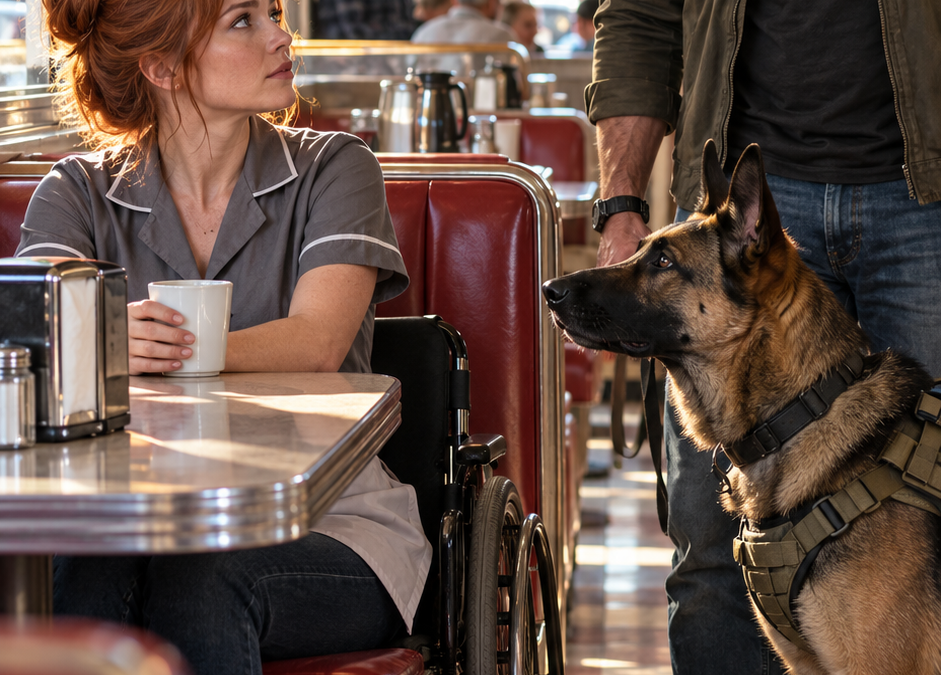
𝗣𝗔𝗥𝗧 𝟮
They were correct.
I hated hearing it anyway.
Gratitude and grief can occupy the same body.
That was something nobody warned me about.
I never regretted covering my teammate.
I would make the same decision again.
But I could believe that and still miss running.
I could be proud of what I had done and still resent the chair.
I could understand that surviving was a gift and still wake at two in the morning furious that my legs existed below me without belonging to me in any useful way.
For two years after discharge, my life became whatever came next.
Whatever apartment worked.
Whatever rehabilitation appointment.
Whatever adaptive equipment insurance approved.
Whatever job someone thought a wheelchair user could manage without inconvenience.
People became painfully kind.
That was sometimes worse than cruelty.
They lowered their voices.
Moved things I had not asked them to move.
Grabbed the handles of my chair without permission.
Called me inspiring for buying groceries.
I learned to stop explaining.
Explanation gave strangers more material to pity me with.
Miller’s Diner came into my life almost by accident.
The owner, Frank Miller, needed an experienced server.
I needed money.
He glanced at my chair during the interview exactly once.
Then he said, “Can you carry plates?”
“Yes.”
“Can you remember orders?”
“Yes.”
“Can you deal with idiots before coffee?”
“I spent seven years in the Navy.”
He laughed.
“You start Monday.”
That was the closest thing to kindness I trusted.
No speech.
No concern.
Just work.
During my first week, another waitress hovered beside me every time I transferred a tray.
By Friday, I had enough.
“Two rules.”
She blinked.
“What?”
“Do not hover.”
“Okay.”
“And don’t lower your voice when you talk to me.”
She went red.
“I wasn’t—”
“You were.”
“I was trying to be respectful.”
“Then treat me normally.”
She nodded.
That was the end of it.
Within a month, I was training new staff.
Within six, regulars stopped offering to move chairs unless they were actually in my way.
Within a year, most of them forgot to be impressed when I carried three plates while steering with one hand.
That was exactly what I wanted.
I became Olivia again.
Not the disabled veteran.
Not the woman who sacrificed her legs.
Not the inspirational former medic.
Just Olivia.
The waitress who knew your coffee order.
Twice a month, I also volunteered at the VA recovery wing where I had once done part of my own rehabilitation.
Nobody at the diner knew.
I preferred it that way.
At the VA, I sat with people who had recently discovered that their lives had split into before and after.
Some were missing limbs.
Some had traumatic brain injuries.
Some looked physically untouched and had not slept properly in two years.
I rarely gave advice.
Advice is overrated.
Mostly, I listened.
Sometimes I helped a family understand that anger was not ingratitude.
Sometimes I showed a newly injured woman how to transfer without asking her husband for help.
Sometimes I sat beside someone while he said the same sentence five times because his brain could not move beyond it yet.
I knew those rooms.
I knew what panic looked like before it became obvious.
I knew what shame looked like after.
I knew the humiliation of having your body behave in public like it belonged to somebody else.
That knowledge mattered on the Tuesday Mason walked into Miller’s.
The morning had been quiet.
Rain struck the front windows in steady gray lines.
Half the tables were empty.
An older couple shared pancakes near the counter.
A mother sat near the window with a toddler dropping cereal pieces one by one onto the floor.
Two construction workers argued softly about a college football game.
I had finished most of the breakfast rush and was sitting in my booth with coffee cooling in front of me.
The chair was locked.
My back was to the wall.
Everything was normal.
The bell above the front door rang at 9:40.
I looked up automatically.
The man standing in the doorway was soaked through.
Rain ran from his jacket onto the floor around his boots.
He was tall.
Broad.
Maybe late thirties.
There was a pale scar cutting through his left eyebrow.
His posture told me more than his clothes did.
Weight slightly forward.
Shoulders too tight.
Eyes moving before his head.
Door.
Counter.
Windows.
Rear hallway.
People.
Hands.
Distances.
Threat assessment.
He wasn’t searching for breakfast.
He was clearing the room with his eyes.
I knew that rhythm.
I had lived inside it.
Beside him stood a Belgian Malinois wearing a black tactical harness.
The dog was magnificent.
Dark mask.
Lean muscle.
Completely controlled.
A long strip of scar tissue ran along his ribs.
I knew that wound too.
Shrapnel.
Or something close to it.
The dog leaned almost imperceptibly into the man’s right leg.
Not affection.
Contact.
A check-in.
The man started across the diner.
There were at least twelve open tables.
He passed all of them.
A two-top beside the entrance.
Empty booth near the window.
Corner near the kitchen.
Counter seats.
He kept coming toward me.
I watched him approach.
His gait was uneven.
Right leg.
Old injury.
Probably pain increasing in cold weather.
He stopped at my table.
Up close, he looked worse.
Gray undertone to the skin.
Darkness beneath his eyes.
Several days of stubble.
He smelled faintly of rain, burnt coffee, and that sour-metallic edge adrenaline leaves when the body has been running too hard for too long.
He held a paper cup in one hand.
His grip was tight enough to deform it.
“Can I sit here?”
I looked around.
Then back at him.
“There’s a whole room.”
“I know.”
He did not smile.
Did not explain.
His eyes flicked toward the wall behind me.
Then the door.
That was when I understood.
He wanted my seat for exactly the same reason I did.
Not because it was convenient.
Because nothing could come from behind us.
I recognized the need before I knew his name.
“Fine.”
I shifted my coffee.
“Knock yourself out.”
He sat across from me.
Slowly.
His right leg resisted the movement.
The Malinois stayed beside him.
“Brutus.”
The dog’s ears twitched.
“Down.”
Brutus began lowering himself beneath the table.
Perfect obedience.
Smooth.
Automatic.
Halfway down, he stopped.
His head turned.
Toward me.
The man noticed immediately.
“Brutus. Down.”
The dog rose.
Stepped out from beneath the table.
I watched him.
The diner’s background noise seemed to recede.
Brutus moved one pace into the aisle.
Then another.
His eyes fixed on my chair.
“Brutus, heel.”
The command sharpened.
The dog ignored it.
I frowned.
The man’s grip on the leash tightened.
“Brutus.”
Nothing.
A few customers had begun watching.
I hated that.
Public curiosity was one of the things I had become least tolerant of after my injury.
People believed staring became acceptable if concern was involved.
Brutus planted his paws.
The man pulled gently.
Then harder.
The dog lowered his center of gravity.
Seventy pounds of refusal.
“What is he doing?”
I asked.
The man looked horrified.
“I don’t know.”
His voice cracked.
“He doesn’t do this.”
“Clearly.”
“He’s trained.”
Brutus took another step toward me.
The leash tightened.
“He doesn’t break command.”
The man’s breathing had changed.
That interested me more than the dog.
Shorter inhale.
Reduced exhale.
Shoulders rising.
Fingers trembling.
The physical pattern was familiar.
I had seen it in hospital rooms.
Elevators.
Parking lots.
Once in the produce aisle of a grocery store.
Panic beginning before the person experiencing it was willing to admit what was happening.
Brutus moved closer.
“Get him under control.”
I said it more sharply than necessary.
The man flinched.
“I’m trying.”
His free hand shook violently.
Not subtly anymore.
A visible tremor.
His face had lost what little color remained.
I stopped watching the dog.
Started watching him.
“Mister.”
He did not answer.
Brutus reached my wheelchair.
He lowered his head.
Then, without warning, rested the full weight of his chin across my thighs.
My body could not feel the pressure normally.
That part of sensation had never returned properly.
But I saw his position.
Felt a distant electrical buzz somewhere deep through damaged nerves.
My first reaction was anger.
Not at Brutus.
At the room.
Every conversation had stopped.
People were staring.
Again.
Always staring.
The man dropped to one knee beside my chair.
“Brutus, off.”
The command came too fast.
“Off.”
He grabbed the dog’s collar.
Brutus stayed.
“Brutus.”
The dog’s body relaxed even more against me.
Not aggression.
Not stubbornness.
Purpose.
The man pulled again.
His coffee slipped from his hand.
The cup hit the table.
Dark liquid spilled everywhere.
He did not notice.
“Stop.”
I said.
He kept pulling.
“Stop pulling him.”
He looked up.
His eyes were wide.
Unfocused.
“I’m sorry.”
His breathing came in broken bursts.
“I don’t know what he’s doing.”
Brutus made a low sound.
Not a growl.
More like a sigh.
The dog pressed harder across my lap.
The man froze.
His forehead dropped against the metal rim of my wheel.
“He won’t move.”
The words were barely audible.
I looked at Brutus.
Then at the man.
Then at his hands.
Shaking.
His breathing.
Rapid.
Skin.
Pale.
Sweat at the temple despite the cold.
I knew what I was seeing.
“He’s a medical alert dog?”
The man swallowed.
“Dual-trained.”
“For what?”
He squeezed his eyes shut.
“Neurological events.”
“Anything else?”
“Panic.”
There it was.
Brutus whined quietly.
I looked down at him.
His eyes were closed.
His breathing was slow.
Deliberate.
He wasn’t reacting to me.
He was working.
I looked at the man.
“Whose panic?”
His eyes opened.
“What?”
“Mine or yours?”
He stared at me.
A tear slid from the corner of his eye.
He turned his face away.
That answered everything.
For one second, I became painfully aware of the whole diner watching us.
My old instinct rose.
End this.
Get away.
Do not become a spectacle.
I had spent four years avoiding scenes exactly like this.
Then I looked at him again.
A large man kneeling beside my wheelchair.
Dress and posture that screamed competence.
Hands shaking so badly he could barely control them.
Trying desperately to hide what every person in the room could now see.
I knew that humiliation.
Not his exact version.
But enough.
“Hey.”
He didn’t respond.
I sharpened my voice.
“Look at me.”
His eyes found mine.
Barely.
“Not the room.”
His breathing hitched.
“Not the dog.”
I leaned slightly forward.
“My face.”
He tried.
His pupils were wide.
He was not fully in the diner anymore.
Part of him was somewhere else.
Some other morning.
Some other room.
Some sound or smell or memory he had not meant to revisit.
“Inhale.”
He did.
Too fast.
“No.”
I held up four fingers.
“Four seconds.”
He swallowed.
“Do it now.”
My voice had changed.
The waitress was gone.
The medic had returned.
“One.”
He inhaled.
“Two.”
His chest expanded.
“Three.”
Brutus remained against me.
“Four.”
“Hold.”
The man trembled.
“Now out.”
His exhale collapsed halfway.
“Again.”
He looked embarrassed.
“I can’t.”
“Yes, you can.”
“I—”
“Again.”
Something in the old command voice reached him.
He obeyed.
Four seconds in.
Pause.
Long exhale.
Again.
The diner stayed silent.
I stopped caring.
Third cycle.
Then fourth.
The tremor in his hands began decreasing.
His shoulders lowered.
Color slowly returned.
He blinked hard.
Looked around.
The expression that came over his face was devastating.
Recognition.
Then shame.
He realized where he was.
Realized everyone had seen.
He looked down.
“God.”
“You’re back.”
I kept my voice quieter now.
He stared at the coffee spreading over the table.
Then at Brutus.
Then me.
“I’m sorry.”
“You said that.”
“I need to get him off you.”
His hand moved toward the harness.
“Leave him.”
He stopped.
“What?”
“He’s doing his job.”
“He’s on you.”
“I noticed.”
“I don’t understand.”
“I do.”
That got his attention.
I nodded toward my chair.
“Brutus needed an anchor.”
He stared at me.
“He wasn’t alerting to you?”
“No.”
I looked down at the dog.
“He was trying to interrupt you.”
“How?”
“You were escalating. He couldn’t get you to ground.”
I tapped the wheelchair frame.
“So he found seventy pounds of dog, a metal chair, and a woman who wasn’t moving.”
The man’s mouth opened.
Closed.
I almost smiled.
“He used me as furniture.”
Brutus opened one eye.
“Highly trained furniture.”
The man actually made a sound.
Not quite a laugh.
Close.
A few conversations around the diner began resuming.
That helped.
Noise returning.
Normalcy rebuilding itself.
The man looked at Brutus.
“You’ve never done that.”
Brutus ignored him.
“What’s your name?”
I asked.
“Mason.”
“Last name?”
“Reed.”
“Mason Reed.”
He nodded.
“Mason, can you stand?”
His jaw tightened.
“Yes.”
“That wasn’t a challenge.”
“I know.”
“Can you?”
He tested his right leg.
Slowly rose.
Unsteady.
I unlocked my wheels.
“We’re moving.”
He looked confused.
“Where?”
“Somewhere without an audience.”
I pointed toward the rear hallway.
“Grab the leash.”
He reached for Brutus.
“Don’t pull.”
Mason nodded.
I moved away from the booth.
Brutus immediately lifted his head from my lap.
Then stood.
Without command, he fell into position beside my right wheel.
I looked at him.
“Traitor.”
Mason followed.
The hallway near the restrooms was quieter.
A narrow window at the end looked across the parking lot.
Rain slid down the glass.
I stopped beside it.
Brutus sat between us.
Mason leaned against the wall.
The adrenaline crash had started.
I knew that too.
“What happened?”
I asked.
He stared at the floor.
“Nothing.”
I waited.
He looked at me.
“You just watched me fall apart.”
“That doesn’t answer the question.”
“There wasn’t an event.”
“There usually doesn’t have to be.”
He rubbed both hands over his face.
“Rain.”
I waited.
“Sometimes it’s rain.”
“Why?”
His jaw moved.
For several seconds, I thought he wouldn’t answer.
Then he looked toward the window.
“Bad night.”
“Deployment?”
“Yes.”
“You don’t have to tell me.”
His eyes moved back to mine.
“Military?”
I nodded.
“Navy.”
His eyes dropped toward my chair.
I saw the question.
“Combat medic.”
Understanding settled over him.
“How long?”
“Seven years.”
“Forward?”
“Yes.”
That changed the way he looked at me.
Not because he respected me more.
Because he finally understood why I had recognized him.
“You knew.”
“Pretty quickly.”
“About what?”
“Your panic.”
He looked away.
“Great.”
“It’s not an insult.”
“I didn’t say it was.”
“You reacted like it was.”
His mouth tightened.
I knew I was pushing.
I didn’t care.
People had been careful with me for four years.
Carefulness is sometimes another form of distance.
“How long have you been having them?”
“Panic attacks?”
“Yes.”
He shook his head.
“I don’t like that term.”
“Your nervous system doesn’t care what you call them.”
That brought his eyes back.
“Three years.”
“Treatment?”
“Yes.”
“Consistent?”
He hesitated.
“No.”
“Medication?”
“Sometimes.”
“Therapy?”
Another hesitation.
“Used to.”
“Why’d you stop?”
His face closed.
“Because I got tired of talking.”
I understood that more than I wanted to.
Brutus settled against his boot.
Mason looked down.
“He was supposed to be mine after we both got out.”
“What did he do?”
“Explosive detection.”
I looked at Brutus’s ribs.
“Shrapnel?”
Mason nodded.
“Second deployment together.”
“How bad?”
“Bad.”
His voice softened.
“They were going to remove him from work anyway. Behavioral issues afterward.”
“What kind?”
“Hypervigilance. Startle response. Wouldn’t settle without me.”
He gave a humorless smile.
“They called it separation anxiety.”
“Accurate?”
“Yes.”
“Ironic.”
“You noticed.”
“You got a traumatized dog to help with your trauma.”
Mason looked down at Brutus.
“Pretty much.”
Brutus yawned.
I smiled.
“He’s handling it better.”
Mason laughed.
This time it was real.
Small.
Tired.
But real.
The sound changed something between us.
I had spent the previous twenty minutes treating him like a patient.
Suddenly, he was just a man standing beside me.
A damaged man.
But I had long ago stopped believing damage made a person unusual.
“Why my booth?”
I asked.
He looked embarrassed.
“The wall.”
“I figured.”
“Crowded rooms are easier if I can see the door.”
“Same.”
His eyes moved toward me.
“Really?”
I raised an eyebrow.
“Do you think combat medicine turned me into someone who likes surprise entrances?”
“Fair.”
We were quiet for a moment.
Rain hit the glass.
Brutus’s breathing was the steadiest sound in the hallway.
Mason nodded toward my chair.
“You don’t have to answer this.”
“That usually means you’re about to ask.”
“What happened?”
I could have shut him down.
Normally, I would have.
Instead, perhaps because I had just watched his body betray him in front of thirty strangers, the question felt different.
Not curiosity.
Recognition.
“Ambush.”
He didn’t move.
“Teammate went down.”
I looked at my hands.
“He was exposed.”
“You went out.”
“Yes.”
Mason’s face changed.
“You covered him.”
I looked up.
“How did you know?”
“Because you’re a medic.”
Simple.
That answer hurt more than pity ever had.
I nodded.
“Impact damaged my spine.”
“Did he make it?”
“Yes.”
Mason closed his eyes briefly.
“Good.”
“Yeah.”
“Do you regret it?”
The question was direct.
That was why I liked it.
“No.”
I answered immediately.
Then added:
“I regret losing my legs.”
He looked at me.
“People think those answers can’t exist together.”
“They can.”
“I know.”
His voice said he did.
I looked toward the diner.
“Four years.”
“Since the injury?”
“Yes.”
“How long until you could say that?”
“Say what?”
“That you don’t regret it and still hate what it cost.”
I thought.
“Longer than it should’ve taken.”
Mason nodded.
“People kept telling me I was lucky.”
He laughed softly.
“People love that word.”
“They mean well.”
“They usually do.”
“Doesn’t make it useful.”
“No.”
Brutus shifted closer to my front caster.
Mason watched him.
“What do you do with it?”
“With what?”
“All of it.”
There was no need to ask what he meant.
Grief.
Anger.
Memory.
The life before.
The body after.
I looked at Brutus.
“I stopped trying to carry it all at once.”
Mason stayed quiet.
“For a long time, I thought accepting what happened meant liking the life that came after.”
He watched me.
“It doesn’t.”
“No.”
“It means admitting this is the life I have.”
I tapped my wheel.
“Then figuring out what deserves space inside it.”
He looked toward the rain.
“And the rest?”
“Some days it comes anyway.”
That was the most honest answer I had.
“You don’t beat it?”
“No.”
“You don’t control it?”
“Sometimes.”
I smiled without humor.
“Sometimes it controls breakfast.”
That made him look at me.
Then laugh again.
I nodded toward Brutus.
“You find anchors.”
His expression shifted.
“What?”
“Things heavier than the moment.”
I gestured between him and the dog.
“Apparently yours has teeth.”
Mason looked down.
Brutus’s tail tapped once against the floor.
I continued.
“Routine. People. Work. Something that proves the worst memory isn’t the only thing happening right now.”
“You say that at the VA?”
I stared at him.
He caught it.
“You volunteer.”
“How did you know?”
“The breathing exercise.”
“Could’ve been training.”
“The way you watched me after.”
I didn’t answer.
He nodded.
“VA?”
“Twice a month.”
“Why?”
“Because people helped me when I was angry enough to hate them for it.”
He absorbed that.
Then:
“Can I come back tomorrow?”
The question surprised me.
“To the diner?”
“Yes.”
“There are many restaurants in Austin.”
“I noticed.”
“And many tables here.”
“I noticed those too.”
I looked at him for several seconds.
He stood straighter now.
Still exhausted.
Still wet.
Still carrying whatever had followed him through the door.
But his eyes were present.
Brutus sat between us as if he had already made the decision for everyone.
“Same time?”
Mason asked.
I shrugged.
“The corner booth happens to be free around nine-forty.”
His mouth lifted.
“Good to know.”
The next morning, the bell above the door rang at exactly 9:40.
Brutus entered first.
Mason barely had time to clear the doorway before the dog crossed the diner.
Straight toward me.
No hesitation.
No scanning.
No interest in any of the other tables.
He reached my wheelchair and sat against the right side.
I looked down.
“You have terrible boundaries.”
Mason stopped beside the booth.
“He remembers you.”
“Unfortunately.”
Brutus leaned against my wheel.
I looked at Mason.
“Can I sit here?”
I glanced around the mostly empty diner.
“There’s a whole room.”
“I know.”
This time, when he sat down, both of us smiled.
That became the beginning.
Not of some miraculous cure.
Nothing that clean happened.
Mason still had bad mornings.
Some days he arrived with his jaw clenched so tightly I could see the muscle jumping.
Sometimes rain made him restless.
Once, a dropped tray behind him triggered such a violent reaction that he was halfway standing before he understood where he was.
Brutus intervened before I did.
Pressed into his knees.
Forced his attention downward.
Mason breathed.
Stayed.
That mattered.
He used to leave.
I learned that later.
Any sign of panic in public and he disappeared.
Parking lot.
Car.
Home.
Isolation.
Brutus had been trained to interrupt the attacks.
But Mason had become skilled at avoiding situations where the dog needed to.
Avoidance feels like control until the world becomes very small.
The diner slowly became one of the places where he practiced staying.
At first, he sat only in my booth.
Then one morning a family had taken it before we arrived.
I was irritated.
Mason stopped near the entrance.
I saw the tension rise in him.
I expected him to leave.
Instead, he looked at me.
“There’s a whole room.”
I stared at him.
“You’ve been waiting two months to say that.”
“Yes.”
“Terrible person.”
“Where do we sit?”
We chose a table near the wall.
Not perfect.
But acceptable.
Brutus settled between us.
Mason stayed through breakfast.
That was progress.
My own progress looked different.
For years, I had insisted I did not need anyone to help with the chair.
Usually true.
But the insistence had become rigid.
One afternoon, the front caster caught in a cracked section of sidewalk outside the diner.
I could have freed it myself.
Eventually.
Mason was beside me.
“Want help?”
My immediate answer came automatically.
“No.”
He nodded.
Did not touch the chair.
Waited.
I struggled with the caster.
Rainwater had collected in the crack.
My palms slipped on the push rims.
He still did not move.
After thirty seconds, I looked at him.
“You’re enjoying this.”
“A little.”
“You’re awful.”
“Probably.”
I exhaled.
“Fine.”
“Fine what?”
“Help.”
“With?”
I stared at him.
He smiled.
I understood what he was doing.
Making me say it.
“Lift the front frame half an inch.”
He did exactly that.
No grabbing handles.
No pushing without permission.
The caster cleared.
He stepped back.
“Better?”
“Yes.”
“No inspirational speech?”
“Don’t ruin it.”
We learned each other’s rules.
Do not touch my chair without asking.
Do not answer questions for me.
Do not call Mason calm when he is clearly not calm.
Do not tell him to relax.
Do not pull Brutus away while he’s working.
Do not pity either of us before coffee.
Especially not before coffee.
The other waitresses noticed.
Of course they did.
People notice routines.
Mason became the man who arrived Tuesdays and Thursdays at 9:40.
Sometimes Saturday.
Brutus became so familiar that regulars stopped staring at the tactical harness.
Frank kept a water bowl behind the counter.
He claimed it was only because Brutus improved tips.
Nobody believed him.
Three months after we met, Mason came into the diner without Brutus.
I knew something was wrong immediately.
“Where is he?”
“Vet.”
My stomach tightened.
“What happened?”
“Nothing serious.”
I waited.
“Mason.”
“Dental procedure.”
I stared.
“That’s it?”
“Yes.”
“You walked in looking like somebody died.”
His jaw tightened.
“He’s never been under anesthesia since the shrapnel surgery.”
There it was.
Not the dog.
The memory.
“Sit.”
He did.
His hands were already shaking.
Not full panic.
Close.
I poured coffee.
Set it down.
“Four.”
He rolled his eyes.
“Don’t.”
“Then breathe correctly without me.”
He inhaled slowly.
I watched.
“Show-off.”
He smiled faintly.
Brutus was fine.
Mason knew rationally he would probably be fine.
The body does not always consult rational thought before remembering terror.
That afternoon, the vet called.
Procedure successful.
Mason’s shoulders dropped two full inches.
The next morning, Brutus entered the diner wearing a ridiculous soft recovery collar.
I laughed so hard I had to put down my coffee.
Mason looked offended on the dog’s behalf.
“Don’t.”
“He looks humiliated.”
“He is.”
Brutus glared at us.
“Tier one.”
I said.
Mason covered his face.
Months passed.
Mason eventually returned to consistent therapy.
He never credited me.
I never asked him to.
He told me one morning as casually as if discussing weather.
“Appointment today.”
“For?”
He gave me a look.
“Oh.”
I nodded.
“Good.”
“That’s it?”
“What do you want? Balloons?”
“I expected judgment.”
“For getting treatment?”
“For stopping before.”
I shook my head.
“People stop treatment for lots of reasons.”
“Bad reasons.”
“Sometimes.”
I looked at him.
“Starting again matters more.”
He stayed quiet.
Then Brutus put a paw on his boot.
Mason smiled.
“You two are exhausting.”
My own life changed more slowly.
I started telling people I had served.
Not everyone.
But I stopped treating the information like a classified document.
When one of the regulars asked how I knew so much about field medicine, I answered.
When a young Marine recognized a tattoo on my forearm and asked whether I had been attached forward, I said yes.
The world did not collapse.
People looked at me differently for a few days.
Then breakfast resumed.
That surprised me.
I had spent years believing that if people knew the story of my chair, I would become nothing but the story.
Some did react badly.
One woman grabbed my hand and called me a hero while crying harder than I was.
I survived.
An older man thanked me for my service, then asked for ketchup.
That was better.
I kept volunteering at the VA.
Eventually, Mason came with me.
Not because I asked.
He volunteered to bring Brutus for one afternoon session involving recently discharged operators with mobility and trauma issues.
Brutus stole the room.
Of course he did.
A twenty-three-year-old Marine with a new prosthetic refused to speak to anyone for the first hour.
Brutus sat beside him.
Ten minutes later, the Marine’s hand was buried in the dog’s fur.
Mason watched from across the room.
I saw his face change.
“You okay?”
“Yes.”
“That looked like a lie.”
He looked at me.
“It’s weird.”
“What?”
“Seeing him help someone else.”
“Bad weird?”
“No.”
He watched Brutus.
“Feels like the things that hurt us got turned into something useful.”
I understood.
That sentence stayed with me.
The chair.
Brutus’s scar.
Mason’s panic.
My injury.
None of those things became good.
I never liked the phrase everything happens for a reason.
Some things happen because war is violent.
Because somebody shoots.
Because metal tears.
Because bodies break.
Meaning comes later, if it comes at all.
We make it.
That afternoon, I watched a wounded Marine talk to Mason because Brutus gave him an excuse to begin.
I understood what Mason meant.
Pain did not become valuable.
But we could choose what we built around it.
Almost a year after the Tuesday we met, Mason had one of his worst attacks.
We were not at the diner.
We were at a veterans’ fundraiser.
Too many people.
Too much noise.
A balloon burst behind us.
The sound was sharp.
Mason went completely still.
That was always worse than shaking.
Brutus reacted immediately.
Pressed against him.
Mason’s eyes went somewhere far away.
I moved in front of him.
“Mason.”
Nothing.
“Look at me.”
His breathing stopped for a second.
Then surged.
Someone nearby asked whether they should call an ambulance.
“No.”
I said.
Mason looked at me.
Barely.
“Four.”
He inhaled.
Failed.
Again.
I stayed.
Brutus pressed against his legs.
People stared.
A year earlier, that would have bothered me almost as much as him.
This time, I did not care.
“Again.”
He breathed.
By the fifth cycle, his eyes cleared.
He looked around.
Saw the crowd.
Shame hit him.
I recognized it.
Before he could speak, I said:
“Don’t apologize.”
His jaw tightened.
“I hate this.”
“I know.”
“I hate people seeing.”
“I know.”
He looked at my chair.
Then at me.
Something passed between us.
Shared humiliation.
Shared survival.
“I want to leave.”
“You can.”
He looked toward the exit.
Then at Brutus.
Then at me.
“But?”
I asked.
He exhaled.
“I don’t want the attack deciding.”
That was new.
“What do you want?”
“To stay five minutes.”
“Then stay five.”
We did.
Five became ten.
Then he chose to leave.
Not escape.
Leave.
There is a difference.
On the drive home, Mason said:
“You know what Brutus did the first day?”
“Destroyed my personal space?”
“Besides that.”
I smiled.
“What?”
“He picked you.”
I looked at him.
“He picked my wheelchair.”
“No.”
“Mason.”
“I’ve watched him around hundreds of people.”
He glanced at me.
“He knew.”
“Knew what?”
“You weren’t afraid of me.”
I laughed.
“I was annoyed by you.”
“Exactly.”
“That doesn’t prove anything.”
“It proves enough.”
We were quiet.
Then he added:
“I think he knew you were an anchor before either of us did.”
I looked out the window.
I did not answer because I wasn’t ready to.
A few weeks later, Mason came into Miller’s carrying something under one arm.
A framed photograph.
He placed it on my table.
It showed a team overseas.
Mason younger.
Cleaner face.
No gray.
Brutus standing beside him in working gear.
Another man crouched on the opposite side.
“Who is he?”
I asked.
Mason’s face changed.
“Evan.”
The name carried weight.
“He was killed?”
Mason nodded.
“The rainy night?”
He looked surprised.
I had never asked for details.
He had never offered them.
I had simply listened enough to connect what little I knew.
“Yes.”
He sat.
Brutus settled beneath the table.
Mason looked at the photograph.
“We were pinned.”
I waited.
“Evan went down.”
His fingers tightened against the frame.
“Brutus alerted on the secondary device.”
He swallowed.
“If he hadn’t…”
“You’d be dead.”
“Probably.”
Rain began lightly against the windows.
The timing felt cruel.
Mason continued.
“I couldn’t get to Evan.”
There it was.
The center of the wound.
“He was alive.”
My chest tightened.
“He was calling.”
Mason stared at the picture.
“And I couldn’t reach him without setting off the device Brutus found.”
I knew that choice.
Not his exact choice.
But its shape.
“You stayed.”
“I had orders.”
“You stayed alive.”
“He didn’t.”
His voice broke.
Four years of my own memories rose inside me.
The man I had crossed open ground to reach.
The impact.
The chair.
The question everybody asked.
Would you do it again?
I looked at Mason.
“You think surviving meant you chose yourself over him.”
He did not answer.
“That isn’t what happened.”
“You weren’t there.”
“No.”
“Then don’t tell me what happened.”
I let the sharpness pass.
He was allowed to be angry.
“I won’t.”
Silence.
Brutus’s nose rested on Mason’s boot.
Then I said:
“But I know what it is to build your entire identity around the one decision you made in a few seconds.”
His eyes lifted.
“I went out.”
“Yes.”
“You didn’t.”
He flinched.
I let the sentence sit.
Then:
“And both of us lost something.”
He stared.
“You think yours makes mine easier?”
“No.”
“I think both of us have spent years punishing ourselves for surviving the version of the choice we were given.”
He looked away.
I continued.
“You had a device between you and him.”
His jaw tightened.
“You couldn’t remove reality by wanting it harder.”
A tear ran down his face.
“I heard him.”
“I know.”
“I still hear him.”
“I know.”
He closed his eyes.
Brutus stood.
Moved beside Mason.
This time, he did not need my wheelchair.
He leaned directly into Mason’s legs.
Mason put one hand against the dog’s neck.
I watched the two of them.
And finally understood something.
Brutus had never broken command in the diner.
Not really.
He had followed a priority deeper than obedience.
Mason’s body had been escalating.
The dog had recognized it.
When Mason resisted grounding, Brutus found the strongest stable object nearby.
Me.
The chair.
The wall.
Everything Brutus had done was an attempt to keep his partner present.
Months later, Mason would tell me he thought the dog had somehow chosen me because Brutus recognized another injured person.
Maybe.
Animals understand things we reduce too quickly into explanations.
What I knew for certain was simpler.
That dog forced two people who preferred isolation into the same moment.
And neither of us managed to escape.
A year and a half after Mason first entered Miller’s, the corner booth was no longer exclusively mine.
Some mornings, he arrived first.
I hated that.
He would order my coffee before I came in.
I hated that too.
Brutus had become so comfortable beside my chair that Frank finally placed a small mat near the booth.
“Health code.”
He said.
“Liar.”
“Customers like him.”
“He scares delivery drivers.”
“Also useful.”
Mason laughed.
I did too.
One rainy Tuesday, exactly two years after the morning we met, I sat in the corner booth watching water slide down the windows.
The diner was half full.
The bell rang at 9:40.
Mason entered.
No uniform.
No dramatic entrance.
Dry jacket this time.
Brutus at his side.
The dog was older.
Gray beginning around the muzzle.
Still working.
Still watching Mason.
They crossed the diner.
Mason stopped at the booth.
“Can I sit here?”
I looked around.
“There’s a whole room.”
“I know.”
He sat.
Brutus moved toward my chair.
For a second, I expected him to lay his head across my lap the way he had that first morning.
He didn’t.
He sniffed my hand.
Then settled between us.
No alert.
No emergency.
No one breaking apart.
Just a dog lying beneath a diner table while rain fell outside.
I looked at Mason.
“You realize he ruined my Tuesday two years ago.”
“He improved it.”
“Debatable.”
“You’re impossible.”
“So I’ve heard.”
He poured coffee from the pot.
His hands were steady.
That mattered.
Not because they would always be steady.
We both knew better.
Healing is not a permanent state.
There would be other bad days.
Other sounds.
Other memories.
Other moments when the floor shifted unexpectedly.
But Mason no longer measured recovery by whether he ever panicked.
He measured it by what happened afterward.
Could he stay?
Could he ask for help?
Could he return?
I had learned something similar.
I stopped measuring my life against the body I had before.
That comparison had no finish line.
I could spend fifty years proving that my present life was smaller than the one I lost.
I would always win.
Instead, I learned to ask different questions.
Was I useful?
Was I honest?
Was I connected to people I cared about?
Could I still make choices?
Was I building something instead of only mourning what collapsed?
Most days, the answers were yes.
Not every day.
Enough days.
Brutus lifted his head.
Looked at Mason.
Then at me.
I reached down and scratched behind his ears.
“You know something?”
Mason asked.
“What?”
“I’ve never seen him do that again.”
“Do what?”
“Break a command.”
I looked at Brutus.
“He didn’t break it.”
Mason smiled.
“I know.”
That was the truth we had both come to understand.
Brutus had not failed his training.
He had used it.
He recognized a man sliding toward a place he could not reach alone.
He found an anchor.
Unfortunately for me, the anchor had been my wheelchair.
For a long time, I thought that moment was about Mason.
Then I thought it was about Brutus.
Eventually, I realized it had been about all three of us.
Mason needed something solid enough to interrupt his panic.
Brutus needed someone who would not push him away while he worked.
And I needed proof that being still did not mean I had stopped being useful.
For four years, I had treated the chair as evidence of everything I lost.
Speed.
Deployment.
Independence in the form I once understood it.
That Tuesday, for the first time, the chair became something else.
Stability.
An anchor.
A place a dog trusted enough to use when his partner was drowning inside his own mind.
It did not erase what the chair cost me.
I would never pretend that.
But it gave the object another meaning.
Maybe that was what healing kept doing.
Not replacing the old meaning.
Adding another.
The mission that injured me would always be the day I lost my legs.
It was also the day another man went home alive.
Mason’s worst deployment would always be the night Evan died.
It was also the night Brutus saved Mason from a secondary device.
Brutus’s shrapnel scar would always mark the day he was injured.
It also marked the beginning of the bond that eventually brought him home with Mason.
Two truths.
Same wound.
That became enough.
The diner filled around us.
Plates moved.
Coffee poured.
People laughed.
Nobody stared.
Mason ate breakfast.
Brutus slept beneath the table.
I watched the rain.
Ordinary Tuesday.
Exactly the kind of morning I once believed I had lost forever.
Then Mason looked at me.
“You volunteering at the VA Thursday?”
“Yes.”
“Need help?”
“With what?”
He smiled.
“Nothing.”
“Correct answer.”
Brutus’s tail thumped once.
I looked down at him.
Two years earlier, he had stopped an entire diner because one trained dog understood something thirty people did not.
The man across from me was in trouble.
And sometimes the person who looks strongest is simply the person who has become best at hiding how much effort standing still requires.
I had been doing the same thing.
So had Mason.
Brutus saw through both of us.
Maybe dogs are better at that than people.
Or maybe people spend too much time believing what others perform.
I finished my coffee.
Unlocked my wheels.
Mason stood.
Brutus rose with him.
The dog looked at me.
I tapped the side of my chair.
“Come on, hero.”
He moved to my right side.
Mason took the left.
We crossed the diner together.
No audience.
No emergency.
No dramatic rescue.
Just three damaged bodies moving through an ordinary room without pretending damage was the only thing they contained.
For years, I believed surviving meant learning how to carry everything alone.
I was wrong.
Sometimes surviving means recognizing the moment another person needs an anchor.
Sometimes it means allowing yourself to become one.
And sometimes it means admitting that when your own floor finally gives way, you are allowed to reach for something solid too.
Have you finished reading the story and want to read it again?
The Navy SEAL Chose My Corner Booth for a Reason Neither of Us Was Ready to Admit
He walked past a dozen empty tables and stopped at mine.
His K9 had obeyed every command for three years, until the dog saw my wheelchair.
What happened next forced both of us to face the wounds we had become very good at hiding.
My name is Olivia Hart, and for fourteen months, the corner booth at Miller’s Diner had belonged to me.
Not officially.
There was no RESERVED sign.
Nobody had written my name on the table.
The owner had never promised it to me.
It simply became mine in the quiet way certain places attach themselves to people.
Every morning I worked, I sat there before my shift.
Back against the wall.
Front door in clear view.
Kitchen entrance to my left.
Restrooms and rear exit reflected faintly in the chrome napkin dispenser if I angled it correctly.
My wheelchair locked beside the edge of the booth so the table never shifted when I reached for my coffee.
Most people assumed I chose the corner because maneuvering a chair through a crowded diner was easier from there.
I let them think that.
The real reason had nothing to do with accessibility.
I liked seeing the exits.
I liked knowing no one could approach from behind me.
I liked walls.
Four years in a wheelchair had changed many things about my life.
It had not changed that.
Before Miller’s, before the chair, before strangers learned to tilt their heads when they spoke to me, I had spent seven years as a Navy combat medic attached forward with special operations units.
People hear medic and imagine someone waiting somewhere safe for injured men to be brought back.
That had never been my job.
I moved with the teams.
A medical bag on my back.
Weapon across my chest.
Tourniquets where I could reach them without looking.
I learned early that there are places where the difference between a medic and everybody else is simply that when something terrible happens, everybody turns toward you.
I had loved that responsibility.
That was difficult for civilians to understand.
They assumed dangerous work must have been something I endured.
It wasn’t.
I was good at it.
More than good.
I knew who I was when I was working.
The decisions were hard, but they were clear.
Airway.
Bleeding.
Breathing.
Movement.
Time.
There was no room for self-pity while somebody else was dying.
That suited me.
Six deployments came and went.
I treated blast injuries.
Gunshot wounds.
Crush injuries.
Burns.
Heat casualties.
A working dog with a punctured flank.
A young operator who kept apologizing because he had bled on my gloves.
I made mistakes.
Every medic does.
But never one that became the story people remembered about me.
Then came my seventh deployment.
There are moments that divide your life so completely that eventually you stop thinking in years.
You think in before and after.
Before the ambush.
After the ambush.
Before the spinal injury.
After the spinal injury.
Before I could run.
After I could not.
We had been moving through terrain that intelligence had described as clear.
It wasn’t.
The first burst came from our left.
Then another.
A man went down in open ground.
I saw him.
I saw the position of the shooters.
I saw the distance.
I knew exactly what could happen if I moved.
And I moved anyway.
That decision took less than a second.
Some people later called it brave.
I never did.
Bravery implies deliberation.
I didn’t deliberate.
He was bleeding.
I was the medic.
That was enough.
I reached him.
Got over him.
Started working.
The next impact hit before I heard it.
I remember pressure.
Light.
Then the sensation of the ground disappearing.
I woke much later.
My teammate survived.
I did too.
Technically.
A fragment had damaged my spine badly enough that my legs never returned to useful function.
There were surgeries.
Rehabilitation.
Optimistic doctors.
Realistic doctors.
Military evaluations.
Civilian evaluations.
Words like incomplete injury and neurological plateau.
Eventually, everybody stopped talking about whether I would walk again.
The Navy told me I was no longer deployable.
That sentence was delivered with the gentle professionalism institutions use when ending someone’s identity.
They offered transition support.
Benefits.
Rehabilitation.
Vocational counseling.
Nobody could offer me the one thing I actually wanted.
My old body.
People kept telling me I was lucky to be alive.
They were correct.
I hated hearing it anyway.
Gratitude and grief can occupy the same body.
That was something nobody warned me about.
I never regretted covering my teammate.
I would make the same decision again.
But I could believe that and still miss running.
I could be proud of what I had done and still resent the chair.
I could understand that surviving was a gift and still wake at two in the morning furious that my legs existed below me without belonging to me in any useful way.
For two years after discharge, my life became whatever came next.
Whatever apartment worked.
Whatever rehabilitation appointment.
Whatever adaptive equipment insurance approved.
Whatever job someone thought a wheelchair user could manage without inconvenience.
People became painfully kind.
That was sometimes worse than cruelty.
They lowered their voices.
Moved things I had not asked them to move.
Grabbed the handles of my chair without permission.
Called me inspiring for buying groceries.
I learned to stop explaining.
Explanation gave strangers more material to pity me with.
Miller’s Diner came into my life almost by accident.
The owner, Frank Miller, needed an experienced server.
I needed money.
He glanced at my chair during the interview exactly once.
Then he said, “Can you carry plates?”
“Yes.”
“Can you remember orders?”
“Yes.”
“Can you deal with idiots before coffee?”
“I spent seven years in the Navy.”
He laughed.
“You start Monday.”
That was the closest thing to kindness I trusted.
No speech.
No concern.
Just work.
During my first week, another waitress hovered beside me every time I transferred a tray.
By Friday, I had enough.
“Two rules.”
She blinked.
“What?”
“Do not hover.”
“Okay.”
“And don’t lower your voice when you talk to me.”
She went red.
“I wasn’t—”
“You were.”
“I was trying to be respectful.”
“Then treat me normally.”
She nodded.
That was the end of it.
Within a month, I was training new staff.
Within six, regulars stopped offering to move chairs unless they were actually in my way.
Within a year, most of them forgot to be impressed when I carried three plates while steering with one hand.
That was exactly what I wanted.
I became Olivia again.
Not the disabled veteran.
Not the woman who sacrificed her legs.
Not the inspirational former medic.
Just Olivia.
The waitress who knew your coffee order.
Twice a month, I also volunteered at the VA recovery wing where I had once done part of my own rehabilitation.
Nobody at the diner knew.
I preferred it that way.
At the VA, I sat with people who had recently discovered that their lives had split into before and after.
Some were missing limbs.
Some had traumatic brain injuries.
Some looked physically untouched and had not slept properly in two years.
I rarely gave advice.
Advice is overrated.
Mostly, I listened.
Sometimes I helped a family understand that anger was not ingratitude.
Sometimes I showed a newly injured woman how to transfer without asking her husband for help.
Sometimes I sat beside someone while he said the same sentence five times because his brain could not move beyond it yet.
I knew those rooms.
I knew what panic looked like before it became obvious.
I knew what shame looked like after.
I knew the humiliation of having your body behave in public like it belonged to somebody else.
That knowledge mattered on the Tuesday Mason walked into Miller’s.
The morning had been quiet.
Rain struck the front windows in steady gray lines.
Half the tables were empty.
An older couple shared pancakes near the counter.
A mother sat near the window with a toddler dropping cereal pieces one by one onto the floor.
Two construction workers argued softly about a college football game.
I had finished most of the breakfast rush and was sitting in my booth with coffee cooling in front of me.
The chair was locked.
My back was to the wall.
Everything was normal.
The bell above the front door rang at 9:40.
I looked up automatically.
The man standing in the doorway was soaked through.
Rain ran from his jacket onto the floor around his boots.
He was tall.
Broad.
Maybe late thirties.
There was a pale scar cutting through his left eyebrow.
His posture told me more than his clothes did.
Weight slightly forward.
Shoulders too tight.
Eyes moving before his head.
Door.
Counter.
Windows.
Rear hallway.
People.
Hands.
Distances.
Threat assessment.
He wasn’t searching for breakfast.
He was clearing the room with his eyes.
I knew that rhythm.
I had lived inside it.
Beside him stood a Belgian Malinois wearing a black tactical harness.
The dog was magnificent.
Dark mask.
Lean muscle.
Completely controlled.
A long strip of scar tissue ran along his ribs.
I knew that wound too.
Shrapnel.
Or something close to it.
The dog leaned almost imperceptibly into the man’s right leg.
Not affection.
Contact.
A check-in.
The man started across the diner.
There were at least twelve open tables.
He passed all of them.
A two-top beside the entrance.
Empty booth near the window.
Corner near the kitchen.
Counter seats.
He kept coming toward me.
I watched him approach.
His gait was uneven.
Right leg.
Old injury.
Probably pain increasing in cold weather.
He stopped at my table.
Up close, he looked worse.
Gray undertone to the skin.
Darkness beneath his eyes.
Several days of stubble.
He smelled faintly of rain, burnt coffee, and that sour-metallic edge adrenaline leaves when the body has been running too hard for too long.
He held a paper cup in one hand.
His grip was tight enough to deform it.
“Can I sit here?”
I looked around.
Then back at him.
“There’s a whole room.”
“I know.”
He did not smile.
Did not explain.
His eyes flicked toward the wall behind me.
Then the door.
That was when I understood.
He wanted my seat for exactly the same reason I did.
Not because it was convenient.
Because nothing could come from behind us.
I recognized the need before I knew his name.
“Fine.”
I shifted my coffee.
“Knock yourself out.”
He sat across from me.
Slowly.
His right leg resisted the movement.
The Malinois stayed beside him.
“Brutus.”
The dog’s ears twitched.
“Down.”
Brutus began lowering himself beneath the table.
Perfect obedience.
Smooth.
Automatic.
Halfway down, he stopped.
His head turned.
Toward me.
The man noticed immediately.
“Brutus. Down.”
The dog rose.
Stepped out from beneath the table.
I watched him.
The diner’s background noise seemed to recede.
Brutus moved one pace into the aisle.
Then another.
His eyes fixed on my chair.
“Brutus, heel.”
The command sharpened.
The dog ignored it.
I frowned.
The man’s grip on the leash tightened.
“Brutus.”
Nothing.
A few customers had begun watching.
I hated that.
Public curiosity was one of the things I had become least tolerant of after my injury.
People believed staring became acceptable if concern was involved.
Brutus planted his paws.
The man pulled gently.
Then harder.
The dog lowered his center of gravity.
Seventy pounds of refusal.
“What is he doing?”
I asked.
The man looked horrified.
“I don’t know.”
His voice cracked.
“He doesn’t do this.”
“Clearly.”
“He’s trained.”
Brutus took another step toward me.
The leash tightened.
“He doesn’t break command.”
The man’s breathing had changed.
That interested me more than the dog.
Shorter inhale.
Reduced exhale.
Shoulders rising.
Fingers trembling.
The physical pattern was familiar.
I had seen it in hospital rooms.
Elevators.
Parking lots.
Once in the produce aisle of a grocery store.
Panic beginning before the person experiencing it was willing to admit what was happening.
Brutus moved closer.
“Get him under control.”
I said it more sharply than necessary.
The man flinched.
“I’m trying.”
His free hand shook violently.
Not subtly anymore.
A visible tremor.
His face had lost what little color remained.
I stopped watching the dog.
Started watching him.
“Mister.”
He did not answer.
Brutus reached my wheelchair.
He lowered his head.
Then, without warning, rested the full weight of his chin across my thighs.
My body could not feel the pressure normally.
That part of sensation had never returned properly.
But I saw his position.
Felt a distant electrical buzz somewhere deep through damaged nerves.
My first reaction was anger.
Not at Brutus.
At the room.
Every conversation had stopped.
People were staring.
Again.
Always staring.
The man dropped to one knee beside my chair.
“Brutus, off.”
The command came too fast.
“Off.”
He grabbed the dog’s collar.
Brutus stayed.
“Brutus.”
The dog’s body relaxed even more against me.
Not aggression.
Not stubbornness.
Purpose.
The man pulled again.
His coffee slipped from his hand.
The cup hit the table.
Dark liquid spilled everywhere.
He did not notice.
“Stop.”
I said.
He kept pulling.
“Stop pulling him.”
He looked up.
His eyes were wide.
Unfocused.
“I’m sorry.”
His breathing came in broken bursts.
“I don’t know what he’s doing.”
Brutus made a low sound.
Not a growl.
More like a sigh.
The dog pressed harder across my lap.
The man froze.
His forehead dropped against the metal rim of my wheel.
“He won’t move.”
The words were barely audible.
I looked at Brutus.
Then at the man.
Then at his hands.
Shaking.
His breathing.
Rapid.
Skin.
Pale.
Sweat at the temple despite the cold.
I knew what I was seeing.
“He’s a medical alert dog?”
The man swallowed.
“Dual-trained.”
“For what?”
He squeezed his eyes shut.
“Neurological events.”
“Anything else?”
“Panic.”
There it was.
Brutus whined quietly.
I looked down at him.
His eyes were closed.
His breathing was slow.
Deliberate.
He wasn’t reacting to me.
He was working.
I looked at the man.
“Whose panic?”
His eyes opened.
“What?”
“Mine or yours?”
He stared at me.
A tear slid from the corner of his eye.
He turned his face away.
That answered everything.
For one second, I became painfully aware of the whole diner watching us.
My old instinct rose.
End this.
Get away.
Do not become a spectacle.
I had spent four years avoiding scenes exactly like this.
Then I looked at him again.
A large man kneeling beside my wheelchair.
Dress and posture that screamed competence.
Hands shaking so badly he could barely control them.
Trying desperately to hide what every person in the room could now see.
I knew that humiliation.
Not his exact version.
But enough.
“Hey.”
He didn’t respond.
I sharpened my voice.
“Look at me.”
His eyes found mine.
Barely.
“Not the room.”
His breathing hitched.
“Not the dog.”
I leaned slightly forward.
“My face.”
He tried.
His pupils were wide.
He was not fully in the diner anymore.
Part of him was somewhere else.
Some other morning.
Some other room.
Some sound or smell or memory he had not meant to revisit.
“Inhale.”
He did.
Too fast.
“No.”
I held up four fingers.
“Four seconds.”
He swallowed.
“Do it now.”
My voice had changed.
The waitress was gone.
The medic had returned.
“One.”
He inhaled.
“Two.”
His chest expanded.
“Three.”
Brutus remained against me.
“Four.”
“Hold.”
The man trembled.
“Now out.”
His exhale collapsed halfway.
“Again.”
He looked embarrassed.
“I can’t.”
“Yes, you can.”
“I—”
“Again.”
Something in the old command voice reached him.
He obeyed.
Four seconds in.
Pause.
Long exhale.
Again.
The diner stayed silent.
I stopped caring.
Third cycle.
Then fourth.
The tremor in his hands began decreasing.
His shoulders lowered.
Color slowly returned.
He blinked hard.
Looked around.
The expression that came over his face was devastating.
Recognition.
Then shame.
He realized where he was.
Realized everyone had seen.
He looked down.
“God.”
“You’re back.”
I kept my voice quieter now.
He stared at the coffee spreading over the table.
Then at Brutus.
Then me.
“I’m sorry.”
“You said that.”
“I need to get him off you.”
His hand moved toward the harness.
“Leave him.”
He stopped.
“What?”
“He’s doing his job.”
“He’s on you.”
“I noticed.”
“I don’t understand.”
“I do.”
That got his attention.
I nodded toward my chair.
“Brutus needed an anchor.”
He stared at me.
“He wasn’t alerting to you?”
“No.”
I looked down at the dog.
“He was trying to interrupt you.”
“How?”
“You were escalating. He couldn’t get you to ground.”
I tapped the wheelchair frame.
“So he found seventy pounds of dog, a metal chair, and a woman who wasn’t moving.”
The man’s mouth opened.
Closed.
I almost smiled.
“He used me as furniture.”
Brutus opened one eye.
“Highly trained furniture.”
The man actually made a sound.
Not quite a laugh.
Close.
A few conversations around the diner began resuming.
That helped.
Noise returning.
Normalcy rebuilding itself.
The man looked at Brutus.
“You’ve never done that.”
Brutus ignored him.
“What’s your name?”
I asked.
“Mason.”
“Last name?”
“Reed.”
“Mason Reed.”
He nodded.
“Mason, can you stand?”
His jaw tightened.
“Yes.”
“That wasn’t a challenge.”
“I know.”
“Can you?”
He tested his right leg.
Slowly rose.
Unsteady.
I unlocked my wheels.
“We’re moving.”
He looked confused.
“Where?”
“Somewhere without an audience.”
I pointed toward the rear hallway.
“Grab the leash.”
He reached for Brutus.
“Don’t pull.”
Mason nodded.
I moved away from the booth.
Brutus immediately lifted his head from my lap.
Then stood.
Without command, he fell into position beside my right wheel.
I looked at him.
“Traitor.”
Mason followed.
The hallway near the restrooms was quieter.
A narrow window at the end looked across the parking lot.
Rain slid down the glass.
I stopped beside it.
Brutus sat between us.
Mason leaned against the wall.
The adrenaline crash had started.
I knew that too.
“What happened?”
I asked.
He stared at the floor.
“Nothing.”
I waited.
He looked at me.
“You just watched me fall apart.”
“That doesn’t answer the question.”
“There wasn’t an event.”
“There usually doesn’t have to be.”
He rubbed both hands over his face.
“Rain.”
I waited.
“Sometimes it’s rain.”
“Why?”
His jaw moved.
For several seconds, I thought he wouldn’t answer.
Then he looked toward the window.
“Bad night.”
“Deployment?”
“Yes.”
“You don’t have to tell me.”
His eyes moved back to mine.
“Military?”
I nodded.
“Navy.”
His eyes dropped toward my chair.
I saw the question.
“Combat medic.”
Understanding settled over him.
“How long?”
“Seven years.”
“Forward?”
“Yes.”
That changed the way he looked at me.
Not because he respected me more.
Because he finally understood why I had recognized him.
“You knew.”
“Pretty quickly.”
“About what?”
“Your panic.”
He looked away.
“Great.”
“It’s not an insult.”
“I didn’t say it was.”
“You reacted like it was.”
His mouth tightened.
I knew I was pushing.
I didn’t care.
People had been careful with me for four years.
Carefulness is sometimes another form of distance.
“How long have you been having them?”
“Panic attacks?”
“Yes.”
He shook his head.
“I don’t like that term.”
“Your nervous system doesn’t care what you call them.”
That brought his eyes back.
“Three years.”
“Treatment?”
“Yes.”
“Consistent?”
He hesitated.
“No.”
“Medication?”
“Sometimes.”
“Therapy?”
Another hesitation.
“Used to.”
“Why’d you stop?”
His face closed.
“Because I got tired of talking.”
I understood that more than I wanted to.
Brutus settled against his boot.
Mason looked down.
“He was supposed to be mine after we both got out.”
“What did he do?”
“Explosive detection.”
I looked at Brutus’s ribs.
“Shrapnel?”
Mason nodded.
“Second deployment together.”
“How bad?”
“Bad.”
His voice softened.
“They were going to remove him from work anyway. Behavioral issues afterward.”
“What kind?”
“Hypervigilance. Startle response. Wouldn’t settle without me.”
He gave a humorless smile.
“They called it separation anxiety.”
“Accurate?”
“Yes.”
“Ironic.”
“You noticed.”
“You got a traumatized dog to help with your trauma.”
Mason looked down at Brutus.
“Pretty much.”
Brutus yawned.
I smiled.
“He’s handling it better.”
Mason laughed.
This time it was real.
Small.
Tired.
But real.
The sound changed something between us.
I had spent the previous twenty minutes treating him like a patient.
Suddenly, he was just a man standing beside me.
A damaged man.
But I had long ago stopped believing damage made a person unusual.
“Why my booth?”
I asked.
He looked embarrassed.
“The wall.”
“I figured.”
“Crowded rooms are easier if I can see the door.”
“Same.”
His eyes moved toward me.
“Really?”
I raised an eyebrow.
“Do you think combat medicine turned me into someone who likes surprise entrances?”
“Fair.”
We were quiet for a moment.
Rain hit the glass.
Brutus’s breathing was the steadiest sound in the hallway.
Mason nodded toward my chair.
“You don’t have to answer this.”
“That usually means you’re about to ask.”
“What happened?”
I could have shut him down.
Normally, I would have.
Instead, perhaps because I had just watched his body betray him in front of thirty strangers, the question felt different.
Not curiosity.
Recognition.
“Ambush.”
He didn’t move.
“Teammate went down.”
I looked at my hands.
“He was exposed.”
“You went out.”
“Yes.”
Mason’s face changed.
“You covered him.”
I looked up.
“How did you know?”
“Because you’re a medic.”
Simple.
That answer hurt more than pity ever had.
I nodded.
“Impact damaged my spine.”
“Did he make it?”
“Yes.”
Mason closed his eyes briefly.
“Good.”
“Yeah.”
“Do you regret it?”
The question was direct.
That was why I liked it.
“No.”
I answered immediately.
Then added:
“I regret losing my legs.”
He looked at me.
“People think those answers can’t exist together.”
“They can.”
“I know.”
His voice said he did.
I looked toward the diner.
“Four years.”
“Since the injury?”
“Yes.”
“How long until you could say that?”
“Say what?”
“That you don’t regret it and still hate what it cost.”
I thought.
“Longer than it should’ve taken.”
Mason nodded.
“People kept telling me I was lucky.”
He laughed softly.
“People love that word.”
“They mean well.”
“They usually do.”
“Doesn’t make it useful.”
“No.”
Brutus shifted closer to my front caster.
Mason watched him.
“What do you do with it?”
“With what?”
“All of it.”
There was no need to ask what he meant.
Grief.
Anger.
Memory.
The life before.
The body after.
I looked at Brutus.
“I stopped trying to carry it all at once.”
Mason stayed quiet.
“For a long time, I thought accepting what happened meant liking the life that came after.”
He watched me.
“It doesn’t.”
“No.”
“It means admitting this is the life I have.”
I tapped my wheel.
“Then figuring out what deserves space inside it.”
He looked toward the rain.
“And the rest?”
“Some days it comes anyway.”
That was the most honest answer I had.
“You don’t beat it?”
“No.”
“You don’t control it?”
“Sometimes.”
I smiled without humor.
“Sometimes it controls breakfast.”
That made him look at me.
Then laugh again.
I nodded toward Brutus.
“You find anchors.”
His expression shifted.
“What?”
“Things heavier than the moment.”
I gestured between him and the dog.
“Apparently yours has teeth.”
Mason looked down.
Brutus’s tail tapped once against the floor.
I continued.
“Routine. People. Work. Something that proves the worst memory isn’t the only thing happening right now.”
“You say that at the VA?”
I stared at him.
He caught it.
“You volunteer.”
“How did you know?”
“The breathing exercise.”
“Could’ve been training.”
“The way you watched me after.”
I didn’t answer.
He nodded.
“VA?”
“Twice a month.”
“Why?”
“Because people helped me when I was angry enough to hate them for it.”
He absorbed that.
Then:
“Can I come back tomorrow?”
The question surprised me.
“To the diner?”
“Yes.”
“There are many restaurants in Austin.”
“I noticed.”
“And many tables here.”
“I noticed those too.”
I looked at him for several seconds.
He stood straighter now.
Still exhausted.
Still wet.
Still carrying whatever had followed him through the door.
But his eyes were present.
Brutus sat between us as if he had already made the decision for everyone.
“Same time?”
Mason asked.
I shrugged.
“The corner booth happens to be free around nine-forty.”
His mouth lifted.
“Good to know.”
The next morning, the bell above the door rang at exactly 9:40.
Brutus entered first.
Mason barely had time to clear the doorway before the dog crossed the diner.
Straight toward me.
No hesitation.
No scanning.
No interest in any of the other tables.
He reached my wheelchair and sat against the right side.
I looked down.
“You have terrible boundaries.”
Mason stopped beside the booth.
“He remembers you.”
“Unfortunately.”
Brutus leaned against my wheel.
I looked at Mason.
“Can I sit here?”
I glanced around the mostly empty diner.
“There’s a whole room.”
“I know.”
This time, when he sat down, both of us smiled.
That became the beginning.
Not of some miraculous cure.
Nothing that clean happened.
Mason still had bad mornings.
Some days he arrived with his jaw clenched so tightly I could see the muscle jumping.
Sometimes rain made him restless.
Once, a dropped tray behind him triggered such a violent reaction that he was halfway standing before he understood where he was.
Brutus intervened before I did.
Pressed into his knees.
Forced his attention downward.
Mason breathed.
Stayed.
That mattered.
He used to leave.
I learned that later.
Any sign of panic in public and he disappeared.
Parking lot.
Car.
Home.
Isolation.
Brutus had been trained to interrupt the attacks.
But Mason had become skilled at avoiding situations where the dog needed to.
Avoidance feels like control until the world becomes very small.
The diner slowly became one of the places where he practiced staying.
At first, he sat only in my booth.
Then one morning a family had taken it before we arrived.
I was irritated.
Mason stopped near the entrance.
I saw the tension rise in him.
I expected him to leave.
Instead, he looked at me.
“There’s a whole room.”
I stared at him.
“You’ve been waiting two months to say that.”
“Yes.”
“Terrible person.”
“Where do we sit?”
We chose a table near the wall.
Not perfect.
But acceptable.
Brutus settled between us.
Mason stayed through breakfast.
That was progress.
My own progress looked different.
For years, I had insisted I did not need anyone to help with the chair.
Usually true.
But the insistence had become rigid.
One afternoon, the front caster caught in a cracked section of sidewalk outside the diner.
I could have freed it myself.
Eventually.
Mason was beside me.
“Want help?”
My immediate answer came automatically.
“No.”
He nodded.
Did not touch the chair.
Waited.
I struggled with the caster.
Rainwater had collected in the crack.
My palms slipped on the push rims.
He still did not move.
After thirty seconds, I looked at him.
“You’re enjoying this.”
“A little.”
“You’re awful.”
“Probably.”
I exhaled.
“Fine.”
“Fine what?”
“Help.”
“With?”
I stared at him.
He smiled.
I understood what he was doing.
Making me say it.
“Lift the front frame half an inch.”
He did exactly that.
No grabbing handles.
No pushing without permission.
The caster cleared.
He stepped back.
“Better?”
“Yes.”
“No inspirational speech?”
“Don’t ruin it.”
We learned each other’s rules.
Do not touch my chair without asking.
Do not answer questions for me.
Do not call Mason calm when he is clearly not calm.
Do not tell him to relax.
Do not pull Brutus away while he’s working.
Do not pity either of us before coffee.
Especially not before coffee.
The other waitresses noticed.
Of course they did.
People notice routines.
Mason became the man who arrived Tuesdays and Thursdays at 9:40.
Sometimes Saturday.
Brutus became so familiar that regulars stopped staring at the tactical harness.
Frank kept a water bowl behind the counter.
He claimed it was only because Brutus improved tips.
Nobody believed him.
Three months after we met, Mason came into the diner without Brutus.
I knew something was wrong immediately.
“Where is he?”
“Vet.”
My stomach tightened.
“What happened?”
“Nothing serious.”
I waited.
“Mason.”
“Dental procedure.”
I stared.
“That’s it?”
“Yes.”
“You walked in looking like somebody died.”
His jaw tightened.
“He’s never been under anesthesia since the shrapnel surgery.”
There it was.
Not the dog.
The memory.
“Sit.”
He did.
His hands were already shaking.
Not full panic.
Close.
I poured coffee.
Set it down.
“Four.”
He rolled his eyes.
“Don’t.”
“Then breathe correctly without me.”
He inhaled slowly.
I watched.
“Show-off.”
He smiled faintly.
Brutus was fine.
Mason knew rationally he would probably be fine.
The body does not always consult rational thought before remembering terror.
That afternoon, the vet called.
Procedure successful.
Mason’s shoulders dropped two full inches.
The next morning, Brutus entered the diner wearing a ridiculous soft recovery collar.
I laughed so hard I had to put down my coffee.
Mason looked offended on the dog’s behalf.
“Don’t.”
“He looks humiliated.”
“He is.”
Brutus glared at us.
“Tier one.”
I said.
Mason covered his face.
Months passed.
Mason eventually returned to consistent therapy.
He never credited me.
I never asked him to.
He told me one morning as casually as if discussing weather.
“Appointment today.”
“For?”
He gave me a look.
“Oh.”
I nodded.
“Good.”
“That’s it?”
“What do you want? Balloons?”
“I expected judgment.”
“For getting treatment?”
“For stopping before.”
I shook my head.
“People stop treatment for lots of reasons.”
“Bad reasons.”
“Sometimes.”
I looked at him.
“Starting again matters more.”
He stayed quiet.
Then Brutus put a paw on his boot.
Mason smiled.
“You two are exhausting.”
My own life changed more slowly.
I started telling people I had served.
Not everyone.
But I stopped treating the information like a classified document.
When one of the regulars asked how I knew so much about field medicine, I answered.
When a young Marine recognized a tattoo on my forearm and asked whether I had been attached forward, I said yes.
The world did not collapse.
People looked at me differently for a few days.
Then breakfast resumed.
That surprised me.
I had spent years believing that if people knew the story of my chair, I would become nothing but the story.
Some did react badly.
One woman grabbed my hand and called me a hero while crying harder than I was.
I survived.
An older man thanked me for my service, then asked for ketchup.
That was better.
I kept volunteering at the VA.
Eventually, Mason came with me.
Not because I asked.
He volunteered to bring Brutus for one afternoon session involving recently discharged operators with mobility and trauma issues.
Brutus stole the room.
Of course he did.
A twenty-three-year-old Marine with a new prosthetic refused to speak to anyone for the first hour.
Brutus sat beside him.
Ten minutes later, the Marine’s hand was buried in the dog’s fur.
Mason watched from across the room.
I saw his face change.
“You okay?”
“Yes.”
“That looked like a lie.”
He looked at me.
“It’s weird.”
“What?”
“Seeing him help someone else.”
“Bad weird?”
“No.”
He watched Brutus.
“Feels like the things that hurt us got turned into something useful.”
I understood.
That sentence stayed with me.
The chair.
Brutus’s scar.
Mason’s panic.
My injury.
None of those things became good.
I never liked the phrase everything happens for a reason.
Some things happen because war is violent.
Because somebody shoots.
Because metal tears.
Because bodies break.
Meaning comes later, if it comes at all.
We make it.
That afternoon, I watched a wounded Marine talk to Mason because Brutus gave him an excuse to begin.
I understood what Mason meant.
Pain did not become valuable.
But we could choose what we built around it.
Almost a year after the Tuesday we met, Mason had one of his worst attacks.
We were not at the diner.
We were at a veterans’ fundraiser.
Too many people.
Too much noise.
A balloon burst behind us.
The sound was sharp.
Mason went completely still.
That was always worse than shaking.
Brutus reacted immediately.
Pressed against him.
Mason’s eyes went somewhere far away.
I moved in front of him.
“Mason.”
Nothing.
“Look at me.”
His breathing stopped for a second.
Then surged.
Someone nearby asked whether they should call an ambulance.
“No.”
I said.
Mason looked at me.
Barely.
“Four.”
He inhaled.
Failed.
Again.
I stayed.
Brutus pressed against his legs.
People stared.
A year earlier, that would have bothered me almost as much as him.
This time, I did not care.
“Again.”
He breathed.
By the fifth cycle, his eyes cleared.
He looked around.
Saw the crowd.
Shame hit him.
I recognized it.
Before he could speak, I said:
“Don’t apologize.”
His jaw tightened.
“I hate this.”
“I know.”
“I hate people seeing.”
“I know.”
He looked at my chair.
Then at me.
Something passed between us.
Shared humiliation.
Shared survival.
“I want to leave.”
“You can.”
He looked toward the exit.
Then at Brutus.
Then at me.
“But?”
I asked.
He exhaled.
“I don’t want the attack deciding.”
That was new.
“What do you want?”
“To stay five minutes.”
“Then stay five.”
We did.
Five became ten.
Then he chose to leave.
Not escape.
Leave.
There is a difference.
On the drive home, Mason said:
“You know what Brutus did the first day?”
“Destroyed my personal space?”
“Besides that.”
I smiled.
“What?”
“He picked you.”
I looked at him.
“He picked my wheelchair.”
“No.”
“Mason.”
“I’ve watched him around hundreds of people.”
He glanced at me.
“He knew.”
“Knew what?”
“You weren’t afraid of me.”
I laughed.
“I was annoyed by you.”
“Exactly.”
“That doesn’t prove anything.”
“It proves enough.”
We were quiet.
Then he added:
“I think he knew you were an anchor before either of us did.”
I looked out the window.
I did not answer because I wasn’t ready to.
A few weeks later, Mason came into Miller’s carrying something under one arm.
A framed photograph.
He placed it on my table.
It showed a team overseas.
Mason younger.
Cleaner face.
No gray.
Brutus standing beside him in working gear.
Another man crouched on the opposite side.
“Who is he?”
I asked.
Mason’s face changed.
“Evan.”
The name carried weight.
“He was killed?”
Mason nodded.
“The rainy night?”
He looked surprised.
I had never asked for details.
He had never offered them.
I had simply listened enough to connect what little I knew.
“Yes.”
He sat.
Brutus settled beneath the table.
Mason looked at the photograph.
“We were pinned.”
I waited.
“Evan went down.”
His fingers tightened against the frame.
“Brutus alerted on the secondary device.”
He swallowed.
“If he hadn’t…”
“You’d be dead.”
“Probably.”
Rain began lightly against the windows.
The timing felt cruel.
Mason continued.
“I couldn’t get to Evan.”
There it was.
The center of the wound.
“He was alive.”
My chest tightened.
“He was calling.”
Mason stared at the picture.
“And I couldn’t reach him without setting off the device Brutus found.”
I knew that choice.
Not his exact choice.
But its shape.
“You stayed.”
“I had orders.”
“You stayed alive.”
“He didn’t.”
His voice broke.
Four years of my own memories rose inside me.
The man I had crossed open ground to reach.
The impact.
The chair.
The question everybody asked.
Would you do it again?
I looked at Mason.
“You think surviving meant you chose yourself over him.”
He did not answer.
“That isn’t what happened.”
“You weren’t there.”
“No.”
“Then don’t tell me what happened.”
I let the sharpness pass.
He was allowed to be angry.
“I won’t.”
Silence.
Brutus’s nose rested on Mason’s boot.
Then I said:
“But I know what it is to build your entire identity around the one decision you made in a few seconds.”
His eyes lifted.
“I went out.”
“Yes.”
“You didn’t.”
He flinched.
I let the sentence sit.
Then:
“And both of us lost something.”
He stared.
“You think yours makes mine easier?”
“No.”
“I think both of us have spent years punishing ourselves for surviving the version of the choice we were given.”
He looked away.
I continued.
“You had a device between you and him.”
His jaw tightened.
“You couldn’t remove reality by wanting it harder.”
A tear ran down his face.
“I heard him.”
“I know.”
“I still hear him.”
“I know.”
He closed his eyes.
Brutus stood.
Moved beside Mason.
This time, he did not need my wheelchair.
He leaned directly into Mason’s legs.
Mason put one hand against the dog’s neck.
I watched the two of them.
And finally understood something.
Brutus had never broken command in the diner.
Not really.
He had followed a priority deeper than obedience.
Mason’s body had been escalating.
The dog had recognized it.
When Mason resisted grounding, Brutus found the strongest stable object nearby.
Me.
The chair.
The wall.
Everything Brutus had done was an attempt to keep his partner present.
Months later, Mason would tell me he thought the dog had somehow chosen me because Brutus recognized another injured person.
Maybe.
Animals understand things we reduce too quickly into explanations.
What I knew for certain was simpler.
That dog forced two people who preferred isolation into the same moment.
And neither of us managed to escape.
A year and a half after Mason first entered Miller’s, the corner booth was no longer exclusively mine.
Some mornings, he arrived first.
I hated that.
He would order my coffee before I came in.
I hated that too.
Brutus had become so comfortable beside my chair that Frank finally placed a small mat near the booth.
“Health code.”
He said.
“Liar.”
“Customers like him.”
“He scares delivery drivers.”
“Also useful.”
Mason laughed.
I did too.
One rainy Tuesday, exactly two years after the morning we met, I sat in the corner booth watching water slide down the windows.
The diner was half full.
The bell rang at 9:40.
Mason entered.
No uniform.
No dramatic entrance.
Dry jacket this time.
Brutus at his side.
The dog was older.
Gray beginning around the muzzle.
Still working.
Still watching Mason.
They crossed the diner.
Mason stopped at the booth.
“Can I sit here?”
I looked around.
“There’s a whole room.”
“I know.”
He sat.
Brutus moved toward my chair.
For a second, I expected him to lay his head across my lap the way he had that first morning.
He didn’t.
He sniffed my hand.
Then settled between us.
No alert.
No emergency.
No one breaking apart.
Just a dog lying beneath a diner table while rain fell outside.
I looked at Mason.
“You realize he ruined my Tuesday two years ago.”
“He improved it.”
“Debatable.”
“You’re impossible.”
“So I’ve heard.”
He poured coffee from the pot.
His hands were steady.
That mattered.
Not because they would always be steady.
We both knew better.
Healing is not a permanent state.
There would be other bad days.
Other sounds.
Other memories.
Other moments when the floor shifted unexpectedly.
But Mason no longer measured recovery by whether he ever panicked.
He measured it by what happened afterward.
Could he stay?
Could he ask for help?
Could he return?
I had learned something similar.
I stopped measuring my life against the body I had before.
That comparison had no finish line.
I could spend fifty years proving that my present life was smaller than the one I lost.
I would always win.
Instead, I learned to ask different questions.
Was I useful?
Was I honest?
Was I connected to people I cared about?
Could I still make choices?
Was I building something instead of only mourning what collapsed?
Most days, the answers were yes.
Not every day.
Enough days.
Brutus lifted his head.
Looked at Mason.
Then at me.
I reached down and scratched behind his ears.
“You know something?”
Mason asked.
“What?”
“I’ve never seen him do that again.”
“Do what?”
“Break a command.”
I looked at Brutus.
“He didn’t break it.”
Mason smiled.
“I know.”
That was the truth we had both come to understand.
Brutus had not failed his training.
He had used it.
He recognized a man sliding toward a place he could not reach alone.
He found an anchor.
Unfortunately for me, the anchor had been my wheelchair.
For a long time, I thought that moment was about Mason.
Then I thought it was about Brutus.
Eventually, I realized it had been about all three of us.
Mason needed something solid enough to interrupt his panic.
Brutus needed someone who would not push him away while he worked.
And I needed proof that being still did not mean I had stopped being useful.
For four years, I had treated the chair as evidence of everything I lost.
Speed.
Deployment.
Independence in the form I once understood it.
That Tuesday, for the first time, the chair became something else.
Stability.
An anchor.
A place a dog trusted enough to use when his partner was drowning inside his own mind.
It did not erase what the chair cost me.
I would never pretend that.
But it gave the object another meaning.
Maybe that was what healing kept doing.
Not replacing the old meaning.
Adding another.
The mission that injured me would always be the day I lost my legs.
It was also the day another man went home alive.
Mason’s worst deployment would always be the night Evan died.
It was also the night Brutus saved Mason from a secondary device.
Brutus’s shrapnel scar would always mark the day he was injured.
It also marked the beginning of the bond that eventually brought him home with Mason.
Two truths.
Same wound.
That became enough.
The diner filled around us.
Plates moved.
Coffee poured.
People laughed.
Nobody stared.
Mason ate breakfast.
Brutus slept beneath the table.
I watched the rain.
Ordinary Tuesday.
Exactly the kind of morning I once believed I had lost forever.
Then Mason looked at me.
“You volunteering at the VA Thursday?”
“Yes.”
“Need help?”
“With what?”
He smiled.
“Nothing.”
“Correct answer.”
Brutus’s tail thumped once.
I looked down at him.
Two years earlier, he had stopped an entire diner because one trained dog understood something thirty people did not.
The man across from me was in trouble.
And sometimes the person who looks strongest is simply the person who has become best at hiding how much effort standing still requires.
I had been doing the same thing.
So had Mason.
Brutus saw through both of us.
Maybe dogs are better at that than people.
Or maybe people spend too much time believing what others perform.
I finished my coffee.
Unlocked my wheels.
Mason stood.
Brutus rose with him.
The dog looked at me.
I tapped the side of my chair.
“Come on, hero.”
He moved to my right side.
Mason took the left.
We crossed the diner together.
No audience.
No emergency.
No dramatic rescue.
Just three damaged bodies moving through an ordinary room without pretending damage was the only thing they contained.
For years, I believed surviving meant learning how to carry everything alone.
I was wrong.
Sometimes surviving means recognizing the moment another person needs an anchor.
Sometimes it means allowing yourself to become one.
And sometimes it means admitting that when your own floor finally gives way, you are allowed to reach for something solid too.








