𝗙𝗨𝗟𝗟 𝗦𝗧𝗢𝗥𝗬 The Navy Captain’s K9 Locked Eyes With Me Before Anyone Understood What He Was Trying to Say
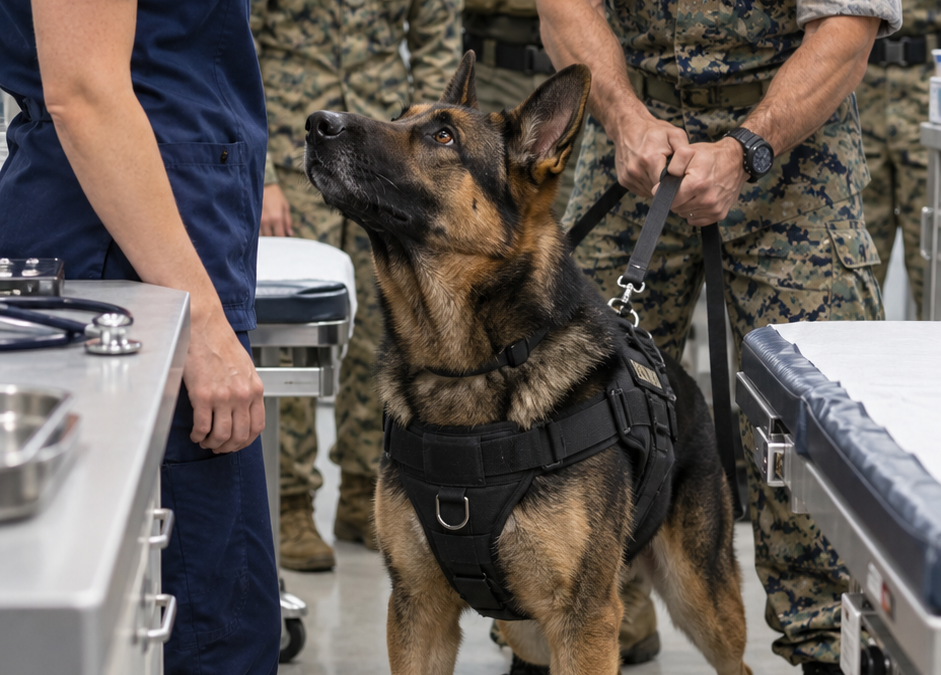
𝗣𝗔𝗥𝗧 𝟮
Then I turned my body slightly sideways.
Daniel frowned.
“You giving me orders about my K9 now, Nurse Bennett?”
“No.”
I kept my eyes on Atlas.
“I’m asking you not to answer a question he hasn’t finished asking.”
Silence.
Daniel had probably heard plenty of people tell him what his dog was doing.
Aggression.
Refusal.
Failure to comply.
Behavioral instability.
I wasn’t interested in naming Atlas’s behavior yet.
Naming something too early has a way of making people stop looking.
Atlas inhaled.
One controlled breath.
Then another.
His nose lifted toward me.
One paw moved forward.
Daniel felt it through the leash.
His grip tightened.
I lifted two fingers.
Not toward Atlas.
Toward Daniel.
“Stop.”
He froze.
Atlas stopped too.
The dog simply stood there, watching me.
The million-dollar joke still hung in the room.
Nobody was smiling anymore.
I hadn’t calmed Atlas.
I hadn’t touched him.
I hadn’t accepted Daniel’s challenge.
But I had already learned one thing.
Every time Atlas tried to gather information, Daniel interrupted him.
And every interruption made the dog work harder.
Daniel’s fingers tightened again.
Atlas shifted forward.
The leash snapped straight.
“Don’t pull him back,” I said.
Daniel stared at me.
“He’s eighty pounds of military training and bad decisions right now.”
“No.”
My voice stayed quiet.
“He’s eighty pounds of information you keep interrupting.”
One handler looked at the floor.
Daniel’s expression hardened.
Atlas’s breathing shortened.
His eyes moved between us now.
I took another slow step sideways.
Atlas followed with his head.
Daniel turned automatically.
The leash tightened again.
Atlas stiffened.
I stopped.
“There.”
Daniel looked irritated.
“There what?”
“You’re making the choice for him before he makes it.”
“He’s a working dog.”
“I know.”
“He doesn’t get unlimited choices.”
“I didn’t say he did.”
“Then what are you saying?”
I pointed toward the open floor.
“Give him six feet.”
“Absolutely not.”
I nodded once.
“Then we’re done.”
Daniel stared at me.
I reached for the tray.
Not dramatically.
I genuinely intended to stop.
If the only version of cooperation Daniel would accept involved Atlas being restrained into stillness, then I wasn’t going to pretend I could safely examine him.
“Wait.”
Daniel said it before I touched the tray.
I turned.
Atlas looked at me too.
Daniel’s jaw moved.
“Six feet.”
“Loose line.”
“You stay where he can see you.”
“That was already the plan.”
For the first time, Daniel obeyed because he had decided to.
He stepped backward.
Then he fed leash slowly through his hand.
Atlas’s body changed almost immediately.
His front legs softened.
His tail remained low, but it stopped holding that hard, fixed line behind him.
His mouth opened slightly.
One breath came easier.
Then another.
I did not praise him.
I did not move toward him.
I just watched.
Daniel watched me watching him.
“That’s supposed to impress me?”
“No.”
I lowered myself halfway toward a crouch.
Stopped.
Atlas’s ears came forward.
“I need you to do one more thing.”
Daniel gave me a humorless look.
“You’re getting expensive, Nurse Bennett.”
“Stop talking to him.”
That erased the last trace of amusement from his face.
He had been murmuring almost continuously since I walked in.
“Atlas.”
“Heel.”
“Easy.”
“Stay.”
“Here.”
Small commands.
Small corrections.
Tiny attempts to keep control from escaping.
“He responds to voice commands,” Daniel said.
“I know.”
“Then why would I stop using them?”
“Because right now every command is asking him to ignore what he has already decided matters.”
Daniel stared at me.
Atlas turned toward him.
The dog studied his captain’s face.
Daniel’s hand tightened around the leash by reflex.
“Loose,” I said.
His fingers relaxed.
Atlas looked back at me.
Then he moved one front paw.
One step.
Not a lunge.
Not a charge.
Just a careful placement of weight onto open floor.
Nobody laughed.
Daniel’s fingers twitched.
He didn’t shorten the leash.
Atlas moved until he reached the end of the loose radius Daniel had finally given him.
I lowered myself onto one knee.
Hands on my thighs.
No food.
No invitation.
No “good boy.”
Daniel looked from me to Atlas.
“What now?”
“Now you decide whether you want control more than you want an answer.”
He said nothing.
Atlas stood between us.
Daniel looked down at the leash.
Then opened his fingers another inch.
“All right,” I said.
And did nothing.
That was the hardest thing for people to understand.
Sometimes the most useful action is the decision not to create one.
Atlas stared at me.
One of the handlers shifted near the door.
Atlas’s ear flicked.
I raised two fingers.
“Stay.”
The handler stopped.
Daniel glanced at him and nodded.
The doorway remained clear.
Atlas took one step.
Then another.
The leash slid through Daniel’s hand.
No resistance.
I didn’t say Atlas’s name.
I didn’t offer my palm.
I didn’t reach for his collar.
When he stopped, I let him stop.
When he looked at Daniel, I let him look.
Daniel’s hand started to close.
Then he caught himself.
He looked at me.
I gave him nothing.
No encouragement.
No permission.
No reassurance.
That choice had to belong to him.
Daniel opened his hand again.
Atlas crossed the remaining distance.
He came straight toward me.
Not fast.
Not cautiously enough to look fearful.
Deliberately.
He stopped so close his shoulder nearly touched my knee.
I stayed still.
His nose moved near the pocket of my scrub top.
His breathing had slowed.
Then Atlas did the one thing nobody in the room had expected.
He lowered his head.
And pressed the side of it against my knee.
The room went completely silent.
The leash lay in a soft curve across the floor.
I could feel the warmth of Atlas’s skull through my scrubs.
I still didn’t touch him.
Daniel stared at us.
Not at me first.
At the leash.
Then Atlas.
A dog he had been physically managing every second since entering the clinic had crossed an open room voluntarily for a stranger who had never once asked him to come.
I moved one hand.
Slowly.
But not toward Atlas.
I placed it flat against my own thigh.
The choice to stay remained his.
He stayed.
Daniel took one step forward.
Atlas’s head lifted immediately.
His body hardened beneath the harness.
Daniel stopped.
I looked up.
“Stay there.”
A few minutes earlier, he might have reminded me of his rank.
Or that Atlas was his K9.
Or that I was a civilian nurse in a military clinic.
This time he simply stopped.
The leash stayed loose.
I shifted my knee away slightly so Atlas wasn’t trapped by contact.
He adjusted.
Then leaned against me again.
One handler reached quietly toward the exam equipment.
Daniel lifted one hand.
“Not yet.”
I looked at him.
That mattered.
Daniel wasn’t surrendering command.
He wasn’t handing Atlas over.
He was protecting the space Atlas had finally trusted enough to enter.
“We can work with this,” I said.
Daniel nodded.
I reached for the exam kit.
I took out only the stethoscope.
Nothing else.
Atlas watched it.
I let it hang where he could see it.
Then I touched the chest piece to my own arm.
I placed it on the floor.
Atlas lowered his nose.
Sniffed it.
Looked at Daniel.
Daniel almost spoke.
I looked up.
He closed his mouth.
The leash stayed slack.
Only then did I pick up the stethoscope again.
I brought it slowly toward Atlas’s shoulder.
Stopped before touching.
Atlas remained still.
I touched him for less than a second.
Then removed it.
His ears moved.
Nothing else.
The second contact lasted longer.
Then I slid the chest piece behind his front leg.
His heart beat fast beneath the skin.
Not dangerously so.
But elevated.
Daniel’s shoulders finally lowered.
Only slightly.
That was enough for me to notice.
I listened.
And something else became clearer.
Every time Daniel leaned toward us, Atlas’s breathing changed.
Every time Daniel’s fingers started closing around the leash, Atlas’s eyes snapped toward him.
When Daniel relaxed, Atlas returned his attention to me.
I removed the stethoscope.
“Captain.”
Daniel looked at me.
“Step back once.”
He hesitated.
Then took one pace backward.
Atlas immediately turned to follow him.
I watched.
Daniel moved another half step without being asked.
Atlas stood.
The leash remained loose.
But the shepherd repositioned himself between Daniel and me.
Not blocking me.
Watching him.
Daniel began, “Atlas—”
I lifted my hand.
He stopped speaking.
Atlas stayed focused on Daniel’s chest.
I rose slowly.
No sudden shift.
Plenty of room.
I could have continued the examination.
Instead, I closed the kit.
Daniel frowned.
“Why are you stopping? He’s letting you examine him.”
“Because he isn’t worried about me.”
Daniel’s face tightened.
“Then what is he worried about?”
I didn’t answer yet.
I moved two steps sideways.
Atlas let me go.
He didn’t follow.
Daniel shifted toward the exam table.
Atlas moved with him.
Same angle.
Same vigilance.
I stepped farther away.
Atlas walked directly back to Daniel and pressed himself against his leg.
Daniel looked down.
His hand hovered above the harness.
Then stopped.
“He’s been doing that since we got back,” he said.
It was the first sentence he had spoken all morning that didn’t sound like a challenge.
I latched the case.
“Then I don’t finish this by pretending he’s the only patient in the room.”
Daniel looked at me.
His expression shut down.
“I’m not your patient.”
“I know.”
“Then don’t analyze me.”
“I’m not.”
I pointed at Atlas.
“I’m reading him.”
“He’s trained to monitor me.”
“Exactly.”
Daniel’s jaw tightened.
“And right now he thinks that job never ends.”
Silence.
Atlas leaned harder against his leg.
Daniel looked down.
Something flickered in his face.
I didn’t know where they had been.
I didn’t know what had happened before they returned.
I didn’t know what Daniel had seen, lost, endured, or refused to discuss.
I wasn’t going to invent a diagnosis because a dog watched him closely.
But I could observe what was in front of me.
Daniel was constantly controlling Atlas.
Atlas was constantly checking Daniel.
Neither of them was resting.
That much was obvious.
I pulled the rolling stool over.
“Sit.”
Daniel looked at me.
For one second, I thought the rank conversation was finally coming.
Instead he glanced at Atlas.
Then sat.
I took the stool opposite him.
Space remained open between us.
Atlas stayed beside Daniel.
Ten seconds.
Twenty.
Nobody spoke.
I shifted one foot.
Atlas looked at me.
Then back at Daniel.
He didn’t move.
Daniel exhaled.
“So he’s fine now.”
I reached toward the exam kit.
Stopped.
“Take one slow breath.”
His eyes hardened.
“You said this wasn’t about treating me.”
“It isn’t.”
“Then why are you telling me how to breathe?”
“Because I want to see what happens.”
Daniel stared at me.
Then inhaled.
Halfway through, his shoulders locked.
The breath came out too quickly.
Atlas stood instantly.
His nose touched Daniel’s wrist.
Daniel pushed him away gently.
“I’m fine, buddy.”
Atlas returned.
Daniel pushed again.
My hand closed over the exam kit.
“Don’t.”
Daniel looked at me.
“He needs to learn he doesn’t have to monitor me every second.”
I shook my head.
“Then stop telling him he’s wrong every time he notices you.”
That hit him.
I saw it.
Atlas touched Daniel’s wrist again.
Third time.
Daniel’s hand lifted.
Stopped.
Then lowered.
Instead of pushing the dog away, he turned his palms upward.
Atlas stepped closer.
Daniel rested both hands against the shepherd’s chest.
And something almost imperceptible changed.
Atlas’s breathing eased first.
Daniel’s followed.
No command passed between them.
No correction.
No leash pressure.
Just contact.
I picked up the stethoscope.
Then held it toward Daniel.
He stared at it.
“What exactly am I supposed to do with that?”
I placed it in his open hand.
“Nothing yet.”
I moved my stool farther away.
Daniel watched me.
Atlas stayed against his knee.
I nodded toward the dog’s shoulder.
Daniel slowly let the chest piece appear beside his hand.
Atlas sniffed it.
Daniel waited.
The dog didn’t move.
Daniel touched the metal lightly to his shoulder.
Removed it.
Atlas looked up at him.
No recoil.
Daniel tried again.
Longer.
Atlas accepted it.
Something softened in Daniel’s face.
I gave him no praise.
That would have made the moment about me again.
Instead I opened the kit and pushed the remaining basic instruments within reach.
Daniel stared at them.
“You’re making me help with his exam.”
“I’m making sure he doesn’t have to choose between trusting me and watching you.”
Daniel looked down at Atlas.
The dog leaned into his leg.
I moved closer.
This time Daniel shifted his stool sideways on his own.
He created space for me beside them instead of keeping me across from him.
I sat.
Daniel kept one hand against Atlas.
I resumed the examination.
Yesterday’s hypothetical version of this scene would have been about whether I could control his dog.
Now Daniel was changing his own behavior so Atlas didn’t have to control the room.
I listened to the shepherd’s heart again.
Steadier.
Checked his gums.
His eyes.
His breathing.
Ran my hands carefully along his neck and shoulders.
Each time Atlas looked at Daniel, Daniel let him.
No “easy.”
No “stay.”
No pushing his nose away.
Just presence.
When I finished one section of the exam, Daniel asked quietly, “What do we do after?”
I closed the stethoscope into my palm.
The question mattered because of the pronoun.
We.
Not what do you do to him.
“What do you want me to fix?” I asked.
Daniel frowned.
“You saw him when we came in.”
“I did.”
“Then you know this isn’t working.”
Atlas moved closer to his knee.
Daniel looked down.
“He walked to you when he wouldn’t let anyone near him.”
I waited.
“Maybe that’s the answer.”
“What answer?”
Daniel hesitated.
Then said it.
“You take him.”
The handler near the doorway looked up.
I didn’t.
I closed the exam kit.
“No.”
Daniel stared at me.
“You’re the first person he’s chosen to approach in weeks.”
“That doesn’t make him mine.”
“I’m not talking about ownership.”
“Neither am I.”
I stood.
Placed the kit on the counter.
Atlas watched me leave.
Then immediately checked Daniel.
“You think he needs someone calmer?” I asked.
Daniel’s jaw tightened.
“Someone he doesn’t have to watch.”
There it was.
The sentence underneath all the others.
“Would that be so bad?” he asked.
“For you?”
His expression changed.
I finished the thought.
“Probably not.”
“Careful.”
“For Atlas?”
I held his gaze.
“Yes.”
Silence.
I walked toward the doorway.
Stopped beside the handler.
“If I take over every time Atlas reacts to you, he learns that being near you is the problem we’re trying to remove.”
Daniel’s hand slipped from Atlas’s chest.
The shepherd looked up immediately.
Daniel saw it.
Slowly, he put his hand back.
Atlas settled.
“I can finish today’s exam and send you home,” I said.
The clinic door stood open.
Daniel could leave.
I had no authority to force him into anything else.
“Or?” he asked.
“Or you come back tomorrow morning.”
His eyes narrowed.
“No audience. No challenge. No million dollars.”
Daniel leaned back slightly.
“And what exactly happens tomorrow?”
“You work with him.”
“And you?”
“I help you read what happens.”
Daniel gave a dry laugh.
“You want a K9 captain taking handling lessons from an ER nurse?”
I stepped aside from the doorway.
“I want you to decide whether being his captain matters more than looking like one.”
For one second, his eyes turned cold.
I had crossed close to the edge of his pride.
I knew it.
But pride was already costing Atlas something.
So I didn’t soften it.
The room stayed quiet.
Atlas pressed against Daniel’s knee.
Daniel looked at him.
Long enough that everyone else stopped mattering.
Then he unclipped the short control tab from Atlas’s harness.
He handed it to the handler.
“Cancel tomorrow’s unit evaluation.”
The handler hesitated.
“Sir, that takes him off rotation until you clear him again.”
“I know.”
There was no anger in Daniel’s answer.
That made it heavier.
The evaluation mattered.
Passing would have put Atlas back into duty status.
Canceling it had consequences.
Daniel took the regular leash himself.
“Seven tomorrow morning.”
I nodded.
“Seven.”
He started for the hallway.
Atlas moved beside him.
At the doorway, the dog stopped.
Looked back at me.
I didn’t call him.
Daniel didn’t pull.
He waited.
Atlas turned toward him on his own.
Then they walked out together.
The clinic stayed silent for several seconds after they were gone.
One handler finally looked at me.
“What did you do?”
I started putting equipment away.
“Nothing.”
He laughed once.
“That wasn’t nothing.”
“No.”
I closed the kit.
“But it wasn’t magic either.”
Atlas had not chosen me because I possessed some mysterious gift.
He had chosen the only person in the room who was not demanding anything from him.
There is a difference.
And I suspected Daniel needed to understand it before the next morning.
At seven the following day, he arrived alone.
No handlers.
No soldiers.
No audience.
Atlas walked at his left side.
The leash hung loose.
Daniel’s uniform was immaculate.
His face looked less so.
He had the expression of someone who had spent the night reviewing every mistake he had made and had not enjoyed the process.
I placed the closed exam kit on the counter.
“You can still reschedule the evaluation,” I said.
Daniel looked at Atlas.
“I know.”
“And you can still walk out.”
His hand tightened once.
Then he noticed.
Opened it.
“I know that too.”
I moved several feet away.
“Then don’t show me what he can do.”
Daniel frowned.
“Let him choose what he needs.”
He took one slow breath.
Atlas looked up at him immediately.
Daniel’s shoulders tightened.
Atlas stood taller.
Moved closer.
Daniel’s hand started toward the harness.
Control arriving before information.
Again.
I stepped forward and touched his wrist lightly.
“Not this time.”
Daniel looked at my hand.
Then Atlas.
He lowered his arm.
I released him and moved away.
Atlas stood between us.
His breathing picked up.
Attention shifting from Daniel to me.
I did not kneel.
Did not call.
Did not offer him anything.
I opened space.
Atlas took one step toward me.
Daniel’s fingers closed.
Leather straightened.
Atlas stopped.
I said nothing.
Daniel looked down at the leash.
The answer was visible.
He opened his hand.
The leash dropped loose.
Atlas moved.
Straight toward me.
Just like yesterday.
He settled against my leg.
I still didn’t touch him.
I looked at Daniel.
Atlas did too.
Daniel stood across the clinic.
The open door behind him.
Leash still in his hand.
He could call Atlas.
He could end the uncertainty.
Instead, he walked toward us without saying a word.
Halfway across the room, Atlas stiffened.
Daniel stopped instantly.
That was new.
Yesterday he would have kept moving until Atlas adjusted.
Today he adjusted.
Daniel lowered himself onto one knee.
No command.
No reaching.
No expectation.
Atlas watched him.
I stepped away.
One pace.
Atlas could follow me.
Nothing prevented him.
He looked at me.
Then Daniel.
His captain waited.
No challenge in his face.
No instruction.
Atlas left me.
He crossed the floor.
Straight to Daniel.
When the dog reached him, Daniel did not grab the harness.
Atlas pressed his shoulder against Daniel’s chest.
Only then did Daniel place one hand against his side.
The dog settled.
I stayed several feet away.
Daniel looked up.
And for the first time since meeting him, the old smirk returned without armor behind it.
“So where do you want the million sent?”
I looked at Atlas.
“Keep it.”
Daniel waited.
I picked up the exam kit.
“You finally calmed him.”
The humor disappeared.
He looked down.
“No.”
The answer surprised me.
I paused.
Daniel ran one hand slowly along Atlas’s ribs.
“He calmed himself.”
I nodded.
“Better.”
Atlas looked up to check him.
Daniel didn’t push him away.
Didn’t tighten the leash.
His hand remained exactly where Atlas had come to find it.
For a few seconds, I let them stay that way.
Then I turned toward the counter.
Behind me, leather moved softly over tile.
I looked back.
Daniel had stood.
But he hadn’t shortened the leash before moving.
He waited.
Atlas rose when he was ready and settled at Daniel’s left side.
“Can we finish the exam?” Daniel asked.
“If he wants space, we give it.”
Daniel nodded.
No joke.
No argument.
He walked toward the exam area.
This time he positioned himself beside Atlas rather than handing me the leash.
I approached with the stethoscope.
Atlas watched me.
Then checked Daniel.
Daniel’s hand started toward the harness.
Stopped halfway.
He lowered it against his own thigh.
Atlas stayed where he was.
I listened to his heart.
Checked his breathing.
Moved along his shoulders.
Legs.
Paws.
When Atlas shifted once, I stopped.
Daniel stopped too.
Neither of us tried to force the next second.
Atlas relaxed.
I continued.
What had been impossible the day before ended without one repeated command.
Not once did the leash snap tight.
When I closed the kit, Daniel looked at me.
“Well?”
“He’s medically clear.”
Relief crossed his face.
Then disappeared behind thought.
“The evaluation stays canceled.”
“That’s your decision.”
“It is.”
He clipped the leash properly to Atlas’s harness.
“I want to rebuild his routine before I ask him to prove anything again.”
That sentence meant more than passing a medical examination ever could.
“Start smaller.”
Daniel waited.
Not defensive.
Listening.
“Ten minutes on a familiar route. No performance standard.”
He nodded.
“If he checks you, let him.”
Another nod.
“If he needs distance, give it.”
“Anything else?”
“Stop turning every reaction into a correction.”
Daniel looked down at Atlas.
“That one may take work.”
“Yes.”
A faint smile.
“At least you’re consistent.”
“So is he.”
Daniel opened the clinic door.
Then stopped instead of walking through first.
Atlas looked into the hallway.
Daniel waited.
Leash slack.
Eventually the dog stepped forward.
Daniel matched him.
Before following, he looked back.
“Seven tomorrow?”
The question carried none of the mockery from our first meeting.
I almost said yes.
Then stopped.
“No.”
Daniel’s brow tightened.
“No?”
I put Atlas’s chart on the counter.
“Not tomorrow.”
“I thought you said we keep working.”
“We do.”
I walked toward them.
Stopped a few feet away.
“But not with me standing between you every morning.”
Daniel glanced at the corridor.
Then back at me.
He could have argued.
Instead he waited.
I nodded toward the hallway.
“Take him on the route we discussed.”
“Just us.”
“Just you and him.”
Daniel looked down.
Atlas looked back.
“And if he starts checking me again?”
“Let him.”
“That’s it?”
“That’s it.”
Daniel didn’t seem convinced.
So I added, “You spent weeks trying to convince him not to notice you.”
His eyes came back to mine.
“What if he notices something I don’t want him to?”
That was the first completely honest question he had asked me.
Not about Atlas.
About himself.
I answered carefully.
“Then maybe your job isn’t to punish the notice.”
His jaw tightened.
I continued.
“You don’t have to explain it to him. You don’t have to make it dramatic. You don’t even have to know exactly what he noticed.”
Atlas shifted closer.
“You just stop teaching him that checking on you is a mistake.”
Daniel looked down at the dog.
Something tired crossed his face.
For the first time, I wondered how many times Atlas had nudged his hand in the dark.
How many times Daniel had said, I’m fine.
How many times the dog had been right enough to keep asking.
I didn’t ask.
Some questions belong to patients.
Some belong to families.
Some belong to the quiet room people eventually make inside themselves when they become ready to answer.
Daniel nodded.
“All right.”
He turned toward the corridor.
Atlas moved with him.
Then paused.
Looked back at me.
The old version of this moment would have made everyone act.
Daniel would have tightened the leash.
A handler would have called.
I might have crouched.
Someone would have decided where Atlas belonged.
I did nothing.
I picked up the chart.
Daniel didn’t call him.
Atlas stood between us for one quiet second.
Then turned.
Walked to Daniel.
Fell into step beside him.
Daniel adjusted his pace to the dog.
Not the other way around.
I watched them move toward the far end of the hall.
A young handler approached from the opposite direction.
His hand automatically reached toward Atlas’s leash.
Daniel moved his arm gently between them.
“I’ve got him.”
The handler stopped.
Daniel didn’t explain.
He kept walking.
Atlas stayed beside him.
The leash curved loosely between them.
When they reached the corner, Daniel glanced back.
I gave him a small nod.
Then turned away before either of us could make the moment more important than it needed to be.
The next morning, I saw them outside through the clinic window.
Daniel hadn’t scheduled an appointment.
He wasn’t supposed to be reporting to me.
That was the point.
They crossed the path beside the medical building just after sunrise.
Atlas walked beside him.
Not locked into a rigid heel.
Not wandering.
Daniel’s arm moved naturally with the leash.
Halfway down the path, a vehicle door slammed somewhere beyond the parking area.
Atlas’s head snapped toward the sound.
Daniel stopped.
I expected the old reflex.
The shortened leash.
The immediate command.
Instead, Daniel looked down.
Atlas turned toward him.
For a second, they simply stood there.
Then Daniel lowered one hand.
Atlas touched it with his nose.
Daniel didn’t push him away.
They continued walking.
I stepped away from the window.
That should have been the end of it.
But two days later Daniel returned to the clinic.
Atlas wasn’t with him.
I was restocking a supply cabinet when his shadow fell across the open door.
I looked over my shoulder.
“Where’s my patient?”
Daniel leaned against the frame.
“With his actual veterinary team doing his follow-up.”
“Good.”
“You sound disappointed.”
“I’m devastated.”
A smile touched his mouth.
He had changed in subtle ways.
Not softened.
Daniel Mercer was not suddenly easy.
I doubted easy had ever been one of his ambitions.
But the constant tension I had first noticed around his eyes had shifted.
He wasn’t scanning the room before every sentence.
His hands were empty.
Relaxed.
I closed the cabinet.
“What do you need?”
“I wanted to ask something.”
I waited.
He looked toward the hallway.
“Yesterday morning Atlas woke me before my alarm.”
“That doesn’t sound unusual.”
“It wasn’t.”
Daniel rubbed the back of his neck.
“But normally I send him back down.”
“And yesterday?”
“I didn’t.”
I said nothing.
“He put his head on the mattress.”
Daniel smiled faintly.
“And?”
“I let him.”
“That’s a dramatic breakthrough.”
“I knew you’d be supportive.”
I folded my arms.
“What happened?”
Daniel looked at the floor.
“For a few minutes, nothing.”
The humor left his face.
“Then I realized my heart was racing.”
I stayed quiet.
“I hadn’t noticed.”
“But Atlas had.”
“Yes.”
“And what did you do?”
Daniel took a breath.
“I sat there.”
“That’s all?”
“No.”
His gaze lifted.
“I put my hand on him.”
I nodded.
“And eventually?”
“It passed.”
There was no triumph in the statement.
Just recognition.
“I kept thinking about what you said.”
“Which part?”
“That I was teaching him he was wrong every time he noticed me.”
Daniel’s mouth tightened.
“I think I’ve been doing that for a while.”
The admission cost him something.
I could see that.
“Why?”
He gave a short laugh without humor.
“Because he’s supposed to work.”
“So are you.”
“That’s not the same.”
“Maybe not.”
He looked at me.
I wasn’t going to force the comparison.
Daniel did it himself.
“When we got back, everybody wanted to know whether Atlas was ready to return.”
I waited.
“Nobody asked him.”
His eyes shifted toward the window.
“And I was so focused on getting him back on rotation that every time he watched me, I treated it like distraction.”
I thought about the first day.
The constant heel.
Stay.
Easy.
Here.
Not because Atlas lacked training.
Because Daniel didn’t know what to do with behavior that didn’t fit the training picture he expected.
“He wasn’t refusing to work,” I said.
Daniel shook his head.
“No.”
“He was working all the time.”
Daniel looked at me.
“On me.”
“Yes.”
Silence settled.
For the first time, I understood why he had offered me a million dollars.
Not because he was cruel.
Not even because he thought I was incompetent.
The joke had created distance from a problem he couldn’t solve.
If Atlas was difficult, somebody else could fix the dog.
If the nurse failed, Daniel could laugh.
If I succeeded, maybe Daniel could hand me whatever mysterious ability Atlas wanted and walk away relieved.
Instead, I had refused the bargain.
Because Atlas had never asked for me.
He had asked for space.
Then he had asked Daniel to pay attention.
“What happens now?” Daniel asked.
“With Atlas?”
“With both of us.”
I leaned against the counter.
“You keep his world smaller for a while.”
“No evaluation.”
“Not yet.”
“Familiar routes.”
“Yes.”
“Let him check me.”
“Yes.”
Daniel nodded.
“And me?”
“That’s outside what I can treat.”
“I figured.”
“But you already know that pretending nothing is happening doesn’t make Atlas believe nothing is happening.”
Daniel gave me a long look.
“That sentence sounds suspiciously applicable to humans.”
“I’m an ER nurse. Occasionally I notice humans too.”
He smiled.
Then grew serious.
“I’ve got resources.”
“Use them.”
No lecture.
No diagnosis.
No grand revelation.
Just two words.
Daniel nodded.
“I will.”
He turned toward the door.
Then stopped.
“For the record?”
“Yes?”
“The million-dollar offer was hypothetical.”
“I assumed.”
“I don’t have a million dollars.”
“Good.”
He looked confused.
“Why good?”
“Because I’d have charged you interest.”
Daniel laughed.
Actually laughed.
Then walked out.
Two weeks later, Atlas returned for a brief clinic follow-up.
This time Daniel brought one handler.
The difference was obvious before they crossed the threshold.
Daniel entered first.
Atlas came beside him.
The leash was loose.
He looked at me.
Then Atlas.
No command.
Atlas saw me and stopped.
His ears came forward.
The handler glanced at Daniel.
Daniel did nothing.
Atlas walked toward me.
Slowly.
The memory of his head against my knee returned so clearly I could almost feel it.
I stood still.
He came close enough to sniff my scrub pocket.
Then looked over his shoulder.
Daniel was waiting.
Atlas turned back to me.
I lowered my hand.
He sniffed once.
That was all.
Then he walked back to Daniel.
No one had to choose for him.
I crouched beside the exam table.
“How’s the routine?”
Daniel answered, “Boring.”
The handler beside him smiled.
“That means good.”
Daniel ignored him.
“Short walks. Familiar training. No evaluation yet.”
“And the checking?”
“He still does it.”
“What do you do?”
Daniel looked down as Atlas leaned lightly against his thigh.
“I let him.”
“And?”
“Sometimes I check myself too.”
There was enough in that sentence.
I didn’t ask for more.
We started the exam.
Atlas let me listen to his heart.
He tolerated the usual checks without difficulty.
When he needed a break, Daniel saw it before I did.
“Hold on,” he said.
I stopped.
Atlas stepped backward.
Shook once.
Daniel gave him room.
Thirty seconds later, Atlas returned.
Daniel looked at me.
“That?”
“That.”
Something like pride crossed his face.
But it was different now.
Not pride in control.
Pride in recognition.
We finished.
I closed the chart.
“Medically, he’s doing well.”
Daniel nodded.
The handler asked, “Think he’s ready for the evaluation?”
Daniel answered before I could.
“No.”
The young man looked surprised.
Daniel scratched once beneath Atlas’s harness.
“He’ll do it when the routine tells me he’s ready, not because the calendar does.”
I looked at him.
Daniel caught it.
“What?”
“Nothing.”
“That was a look.”
“It was an observation.”
“That sounds worse.”
I smiled.
“You’ve become expensive to argue with.”
Atlas looked between us.
Daniel rested one hand against the dog.
“Apparently I had a good nurse.”
“You had a stubborn dog.”
“That too.”
The handler excused himself to answer a call outside.
For a few seconds, Daniel and I were alone.
Atlas settled between us.
Daniel looked down.
“You know what bothered me most?”
“About what?”
“The first day.”
I waited.
“He walked to you.”
His tone carried no resentment now.
But I remembered it.
The confusion.
The small injury to his pride.
“I thought it meant he trusted you more.”
“He didn’t know me.”
“I know that now.”
Daniel rubbed Atlas’s shoulder.
“He walked to the person who wasn’t asking anything from him.”
“Yes.”
“And then he came back.”
I nodded.
“That was the part you needed to notice.”
Daniel was quiet.
“I nearly gave him away.”
“I know.”
That sentence held more weight than the joke ever had.
He had been prepared to interpret Atlas’s distress as evidence that their partnership had failed.
Maybe because that answer was easier than considering that Atlas’s behavior was still tied to him.
“I thought he needed distance from me.”
“He needed a different version of being close to you.”
Daniel looked down at the shepherd.
“That sounds obvious now.”
“Most useful things do afterward.”
He smiled faintly.
The handler returned.
Daniel clipped the leash.
He opened the door.
Atlas waited.
Daniel waited too.
No one noticed except me.
Then Atlas stepped into the corridor.
Daniel followed.
Three weeks after our first meeting, the evaluation was rescheduled.
I didn’t attend.
That was deliberate.
Daniel had asked if I wanted to watch.
I told him no.
“Why?”
“Because I’m not part of the test.”
“You started this.”
“No.”
I pointed toward Atlas.
“He did.”
Daniel had stared at me.
Then nodded.
On evaluation morning, I worked my regular shift.
No checking the clock.
No hovering near the training area.
No asking passing handlers whether they had heard anything.
At least, that was what I told myself.
At 10:14, I was entering medication documentation when someone placed a folded piece of paper beside my keyboard.
I looked up.
Daniel.
Atlas sat beside him.
The leash was loose.
I looked at the paper.
“What is that?”
“Medical record.”
“No, it isn’t.”
“Performance documentation.”
“Also not mine.”
Daniel pushed it closer.
I opened it.
Evaluation results.
Clear.
My eyes moved once over the page.
Then I folded it again.
“Congratulations.”
Daniel nodded toward Atlas.
“Tell him.”
I looked at the shepherd.
“Congratulations.”
Atlas yawned.
Daniel looked offended.
“That’s the response I got too.”
I handed the paper back.
“So he’s returning?”
“Gradually.”
“Good.”
“No immediate full rotation.”
“Better.”
Daniel slipped the paper into his pocket.
There was no bragging.
No victory speech.
He had wanted the evaluation desperately the first day.
Now passing it looked almost secondary.
“What changed?” I asked.
Daniel understood what I meant.
He looked down at Atlas.
“The goal.”
“From?”
“Getting him cleared.”
“To?”
“Making sure I deserved what he was trying to give me.”
I didn’t answer immediately.
Daniel’s hand rested loosely beside Atlas’s shoulder.
The dog leaned into it.
“What was he trying to give you?”
Daniel thought.
“A warning, maybe.”
He shook his head.
“No.”
“A check.”
He looked at me.
“Like you said. Information.”
Atlas raised his head.
Daniel smiled faintly.
“And probably patience.”
“That one sounds expensive.”
“Still not paying you a million.”
“I’ve moved on.”
He glanced at my badge.
“You working ER tonight?”
“Yes.”
“Try not to diagnose any more captains.”
“I never diagnosed you.”
“You told me my dog was smarter than me.”
“I never said that either.”
“You implied it.”
“Atlas implied it.”
Daniel laughed.
Then the clinic doors opened farther down the corridor.
A stretcher came through.
Two medics pushing fast.
Someone called my name.
My attention shifted instantly.
Daniel saw it.
“Go.”
I started toward the stretcher.
Halfway there, I looked back.
Atlas stood.
Not because Daniel commanded him.
Because Daniel did.
Daniel shortened the leash only enough for safety.
Not control.
Atlas looked up.
Daniel looked down.
One silent exchange.
Then they turned toward the opposite exit.
I went back to work.
Months passed.
Base clinics have their own rhythm.
People arrive frightened.
Or bleeding.
Or pretending not to hurt.
They leave patched, stabilized, referred, cleared, delayed, or told to return.
Some faces disappear from your memory almost immediately.
Others stay because of something small.
A sentence.
A hand.
A look across a room.
I saw Daniel occasionally.
Sometimes with Atlas.
Sometimes alone.
Neither needed me anymore.
That was exactly how I wanted it.
One cold morning, I found them outside the medical building after an overnight shift.
The sky was just beginning to lighten.
Atlas sat beside Daniel on a low concrete wall.
No working harness.
Just a plain leash.
Daniel held a paper cup of coffee.
I stopped.
“Off duty?”
“Both of us.”
Atlas recognized me.
His tail moved once against the pavement.
I walked closer.
He stayed where he was.
No need to cross the distance anymore.
I crouched and let him decide.
He sniffed my hand.
Then leaned briefly into my palm.
I scratched behind one ear.
Daniel watched.
“Still think he chose you?”
I looked up.
“He did.”
Daniel raised an eyebrow.
“That contradicts everything you told me.”
“No.”
I stood.
“He chose me that day.”
“Why?”
“Because you weren’t listening.”
Daniel looked down at Atlas.
The answer didn’t offend him anymore.
I continued.
“Then when you started listening, he chose you again.”
Atlas rested his head against Daniel’s knee.
Daniel looked at him for a long moment.
“I spent years thinking trust meant he did what I asked.”
“That’s obedience.”
Daniel looked up.
“Trust is different?”
“Yes.”
“How?”
I considered it.
“Trust is what happens when he can tell you something you didn’t ask to hear.”
Daniel’s eyes moved back to Atlas.
The shepherd had closed his eyes.
Completely relaxed.
Daniel’s hand settled against the dog’s neck.
No harness.
No correction.
No instruction.
Just contact.
The first morning I met them, Atlas had carried tension for both of them.
Every command Daniel gave tightened something.
Every pull on the leash told Atlas that whatever he had noticed needed to be suppressed.
And the harder Daniel tried to make him look controlled, the harder Atlas worked to monitor the man holding the leash.
A million dollars would never have solved that.
Neither would a quieter nurse.
Or a different handler.
Or a harsher correction.
Because Atlas had never been asking Daniel to control him.
He had been asking Daniel to hear him.
Daniel finished his coffee and stood.
“You heading home?”
“As soon as I convince myself the charting is actually finished.”
“That never happens.”
“I know.”
Atlas stood beside him.
Daniel looked toward the parking lot.
Then back at me.
“For what it’s worth, I’m glad you didn’t take him.”
“So am I.”
“I was serious that day.”
“I know.”
“I would have handed him over.”
“I know.”
His expression tightened with something like regret.
“He deserved better than that.”
I shook my head.
“He deserved what you eventually gave him.”
Daniel looked at me.
“A chance to stay.”
“No.”
I glanced at Atlas.
“A chance to be heard.”
Daniel was quiet.
Then he nodded.
Atlas stepped toward the parking lot.
Daniel followed.
The leash remained loose between them.
Halfway across the pavement, Atlas stopped.
His head lifted toward a distant sound.
Daniel stopped too.
He didn’t pull.
Didn’t command.
He waited.
Atlas looked back at him.
Daniel lowered his hand.
The shepherd touched it once with his nose.
Then turned forward.
They kept walking.
I watched until they reached the edge of the lot.
Not because I was worried.
Because I remembered the first time Atlas crossed a room toward me while everyone else held their breath.
Back then Daniel had believed the miracle was that I could calm his dog.
He had been wrong.
I had never calmed Atlas.
I had only stopped interrupting him long enough for him to make himself understood.
And in the end, the person Atlas had been trying hardest to reach had never been me at all.
Have you finished reading the story and want to read it again?
The Navy Captain’s K9 Locked Eyes With Me Before Anyone Understood What He Was Trying to Say
Atlas never lunged at me.
He was trying to tell us something.
And the moment I understood why, the million-dollar joke stopped being funny.
“I’ll pay you a million dollars if you can calm him.”
Captain Daniel Mercer’s voice carried across the base medical clinic just as Atlas hit the end of his leash hard enough to stop every person in the room.
The German Shepherd stood between two exam tables with his paws spread against the polished floor, black working harness tight across his shoulders, chest rising in short, hard bursts.
He wasn’t barking.
That bothered me more than barking would have.
A barking dog is giving you sound.
Atlas was giving us silence, tension, posture, breath, and eyes.
And everyone in the room seemed determined to answer him before they had bothered to understand the question.
One military handler had backed against the wall.
Another stood beside Daniel with his hands low and visible.
Daniel gripped the leash with both hands. His jaw was set, and every muscle in his forearms showed beneath his rolled sleeves.
Atlas leaned forward.
Daniel pulled back.
The leather went tight between them.
Atlas stiffened more.
I had entered less than a minute earlier to prepare the room for his required examination.
Apparently, my arrival had also made me entertainment.
A couple of soldiers near the doorway laughed at Daniel’s million-dollar offer.
I didn’t.
I was wearing Navy-blue scrubs, my civilian identification clipped beside my nursing badge, blonde hair twisted into the kind of practical knot I could redo with one hand between patients.
Nothing about me looked impressive.
That was fine.
Dogs rarely cared about impressive.
People did.
That was usually the problem.
I set the stainless steel tray on the counter as quietly as I could.
“Captain,” one handler warned, “keep him facing you.”
Daniel shortened the leash.
Only an inch.
Atlas noticed.
His shoulders rose.
His mouth closed.
His ears shifted backward for half a second.
I watched Daniel’s white knuckles.
Then Atlas’s front paws.
Then the fixed line of his stare.
He wasn’t looking at the exit anymore.
He wasn’t watching the handlers.
He was watching me.
I stepped sideways.
Not forward.
Atlas’s head followed me immediately.
Daniel saw it too.
“Careful,” he said.
I stopped.
“I can see him.”
“He’s not a hospital pet.”
“I can see that too.”
There was no reason to challenge him.
No reason to prove I wasn’t frightened.
Fear wasn’t useful information unless I knew what I was afraid of.
And right then Atlas had given me no reason to believe he wanted to hurt me.
He was overwhelmed.
There was a difference.
A large one.
He had been brought in because no one could complete the examination while he remained this agitated.
Daniel needed him medically cleared.
The handlers needed the room safe.
I needed both.
What I did not need was another person forcing Atlas to perform calmness while every signal in his body said he didn’t feel safe enough to offer it.
Daniel pulled the leash again.
“Atlas. Heel.”
Atlas moved half a step toward him.
His body obeyed.
His attention didn’t.
His eyes remained on me.
One of the handlers murmured, “That’s new.”
Daniel looked over.
“What is?”
“He usually ignores strangers when he’s like this.”
I heard it.
I didn’t react.
I removed the stethoscope from around my neck and placed it on the counter.
Metal clicked softly against laminate.
Atlas’s ears moved.
I slid a rolling stool backward.
Then another.
I opened a wide path of empty floor between Atlas and me.
No reaching.
No baby voice.
No hand offered beneath his nose.
No food.
No command.
Daniel watched me rearrange the room.
“Planning to calm him from across the county?”
A few soldiers laughed again.
I looked at him.
“I’m planning not to make him worse.”
The laughter ended.
Daniel’s expression changed.
Only slightly.
“We know this dog.”
“Then you know what he needs right now.”
His eyes narrowed.
He glanced down at Atlas.
The dog was still rigid, but the direction of his tension had changed.
Before I entered, he had apparently been scanning everything.
Now he was watching one thing.
Me.
Daniel prepared to shorten the leash again.
“Don’t.”
His hands stopped.
He looked at me.
Maybe he was more surprised that he had obeyed than I was.
I lowered my hands where Atlas could see them.
Then I turned my body slightly sideways.
Daniel frowned.
“You giving me orders about my K9 now, Nurse Bennett?”
“No.”
I kept my eyes on Atlas.
“I’m asking you not to answer a question he hasn’t finished asking.”
Silence.
Daniel had probably heard plenty of people tell him what his dog was doing.
Aggression.
Refusal.
Failure to comply.
Behavioral instability.
I wasn’t interested in naming Atlas’s behavior yet.
Naming something too early has a way of making people stop looking.
Atlas inhaled.
One controlled breath.
Then another.
His nose lifted toward me.
One paw moved forward.
Daniel felt it through the leash.
His grip tightened.
I lifted two fingers.
Not toward Atlas.
Toward Daniel.
“Stop.”
He froze.
Atlas stopped too.
The dog simply stood there, watching me.
The million-dollar joke still hung in the room.
Nobody was smiling anymore.
I hadn’t calmed Atlas.
I hadn’t touched him.
I hadn’t accepted Daniel’s challenge.
But I had already learned one thing.
Every time Atlas tried to gather information, Daniel interrupted him.
And every interruption made the dog work harder.
Daniel’s fingers tightened again.
Atlas shifted forward.
The leash snapped straight.
“Don’t pull him back,” I said.
Daniel stared at me.
“He’s eighty pounds of military training and bad decisions right now.”
“No.”
My voice stayed quiet.
“He’s eighty pounds of information you keep interrupting.”
One handler looked at the floor.
Daniel’s expression hardened.
Atlas’s breathing shortened.
His eyes moved between us now.
I took another slow step sideways.
Atlas followed with his head.
Daniel turned automatically.
The leash tightened again.
Atlas stiffened.
I stopped.
“There.”
Daniel looked irritated.
“There what?”
“You’re making the choice for him before he makes it.”
“He’s a working dog.”
“I know.”
“He doesn’t get unlimited choices.”
“I didn’t say he did.”
“Then what are you saying?”
I pointed toward the open floor.
“Give him six feet.”
“Absolutely not.”
I nodded once.
“Then we’re done.”
Daniel stared at me.
I reached for the tray.
Not dramatically.
I genuinely intended to stop.
If the only version of cooperation Daniel would accept involved Atlas being restrained into stillness, then I wasn’t going to pretend I could safely examine him.
“Wait.”
Daniel said it before I touched the tray.
I turned.
Atlas looked at me too.
Daniel’s jaw moved.
“Six feet.”
“Loose line.”
“You stay where he can see you.”
“That was already the plan.”
For the first time, Daniel obeyed because he had decided to.
He stepped backward.
Then he fed leash slowly through his hand.
Atlas’s body changed almost immediately.
His front legs softened.
His tail remained low, but it stopped holding that hard, fixed line behind him.
His mouth opened slightly.
One breath came easier.
Then another.
I did not praise him.
I did not move toward him.
I just watched.
Daniel watched me watching him.
“That’s supposed to impress me?”
“No.”
I lowered myself halfway toward a crouch.
Stopped.
Atlas’s ears came forward.
“I need you to do one more thing.”
Daniel gave me a humorless look.
“You’re getting expensive, Nurse Bennett.”
“Stop talking to him.”
That erased the last trace of amusement from his face.
He had been murmuring almost continuously since I walked in.
“Atlas.”
“Heel.”
“Easy.”
“Stay.”
“Here.”
Small commands.
Small corrections.
Tiny attempts to keep control from escaping.
“He responds to voice commands,” Daniel said.
“I know.”
“Then why would I stop using them?”
“Because right now every command is asking him to ignore what he has already decided matters.”
Daniel stared at me.
Atlas turned toward him.
The dog studied his captain’s face.
Daniel’s hand tightened around the leash by reflex.
“Loose,” I said.
His fingers relaxed.
Atlas looked back at me.
Then he moved one front paw.
One step.
Not a lunge.
Not a charge.
Just a careful placement of weight onto open floor.
Nobody laughed.
Daniel’s fingers twitched.
He didn’t shorten the leash.
Atlas moved until he reached the end of the loose radius Daniel had finally given him.
I lowered myself onto one knee.
Hands on my thighs.
No food.
No invitation.
No “good boy.”
Daniel looked from me to Atlas.
“What now?”
“Now you decide whether you want control more than you want an answer.”
He said nothing.
Atlas stood between us.
Daniel looked down at the leash.
Then opened his fingers another inch.
“All right,” I said.
And did nothing.
That was the hardest thing for people to understand.
Sometimes the most useful action is the decision not to create one.
Atlas stared at me.
One of the handlers shifted near the door.
Atlas’s ear flicked.
I raised two fingers.
“Stay.”
The handler stopped.
Daniel glanced at him and nodded.
The doorway remained clear.
Atlas took one step.
Then another.
The leash slid through Daniel’s hand.
No resistance.
I didn’t say Atlas’s name.
I didn’t offer my palm.
I didn’t reach for his collar.
When he stopped, I let him stop.
When he looked at Daniel, I let him look.
Daniel’s hand started to close.
Then he caught himself.
He looked at me.
I gave him nothing.
No encouragement.
No permission.
No reassurance.
That choice had to belong to him.
Daniel opened his hand again.
Atlas crossed the remaining distance.
He came straight toward me.
Not fast.
Not cautiously enough to look fearful.
Deliberately.
He stopped so close his shoulder nearly touched my knee.
I stayed still.
His nose moved near the pocket of my scrub top.
His breathing had slowed.
Then Atlas did the one thing nobody in the room had expected.
He lowered his head.
And pressed the side of it against my knee.
The room went completely silent.
The leash lay in a soft curve across the floor.
I could feel the warmth of Atlas’s skull through my scrubs.
I still didn’t touch him.
Daniel stared at us.
Not at me first.
At the leash.
Then Atlas.
A dog he had been physically managing every second since entering the clinic had crossed an open room voluntarily for a stranger who had never once asked him to come.
I moved one hand.
Slowly.
But not toward Atlas.
I placed it flat against my own thigh.
The choice to stay remained his.
He stayed.
Daniel took one step forward.
Atlas’s head lifted immediately.
His body hardened beneath the harness.
Daniel stopped.
I looked up.
“Stay there.”
A few minutes earlier, he might have reminded me of his rank.
Or that Atlas was his K9.
Or that I was a civilian nurse in a military clinic.
This time he simply stopped.
The leash stayed loose.
I shifted my knee away slightly so Atlas wasn’t trapped by contact.
He adjusted.
Then leaned against me again.
One handler reached quietly toward the exam equipment.
Daniel lifted one hand.
“Not yet.”
I looked at him.
That mattered.
Daniel wasn’t surrendering command.
He wasn’t handing Atlas over.
He was protecting the space Atlas had finally trusted enough to enter.
“We can work with this,” I said.
Daniel nodded.
I reached for the exam kit.
I took out only the stethoscope.
Nothing else.
Atlas watched it.
I let it hang where he could see it.
Then I touched the chest piece to my own arm.
I placed it on the floor.
Atlas lowered his nose.
Sniffed it.
Looked at Daniel.
Daniel almost spoke.
I looked up.
He closed his mouth.
The leash stayed slack.
Only then did I pick up the stethoscope again.
I brought it slowly toward Atlas’s shoulder.
Stopped before touching.
Atlas remained still.
I touched him for less than a second.
Then removed it.
His ears moved.
Nothing else.
The second contact lasted longer.
Then I slid the chest piece behind his front leg.
His heart beat fast beneath the skin.
Not dangerously so.
But elevated.
Daniel’s shoulders finally lowered.
Only slightly.
That was enough for me to notice.
I listened.
And something else became clearer.
Every time Daniel leaned toward us, Atlas’s breathing changed.
Every time Daniel’s fingers started closing around the leash, Atlas’s eyes snapped toward him.
When Daniel relaxed, Atlas returned his attention to me.
I removed the stethoscope.
“Captain.”
Daniel looked at me.
“Step back once.”
He hesitated.
Then took one pace backward.
Atlas immediately turned to follow him.
I watched.
Daniel moved another half step without being asked.
Atlas stood.
The leash remained loose.
But the shepherd repositioned himself between Daniel and me.
Not blocking me.
Watching him.
Daniel began, “Atlas—”
I lifted my hand.
He stopped speaking.
Atlas stayed focused on Daniel’s chest.
I rose slowly.
No sudden shift.
Plenty of room.
I could have continued the examination.
Instead, I closed the kit.
Daniel frowned.
“Why are you stopping? He’s letting you examine him.”
“Because he isn’t worried about me.”
Daniel’s face tightened.
“Then what is he worried about?”
I didn’t answer yet.
I moved two steps sideways.
Atlas let me go.
He didn’t follow.
Daniel shifted toward the exam table.
Atlas moved with him.
Same angle.
Same vigilance.
I stepped farther away.
Atlas walked directly back to Daniel and pressed himself against his leg.
Daniel looked down.
His hand hovered above the harness.
Then stopped.
“He’s been doing that since we got back,” he said.
It was the first sentence he had spoken all morning that didn’t sound like a challenge.
I latched the case.
“Then I don’t finish this by pretending he’s the only patient in the room.”
Daniel looked at me.
His expression shut down.
“I’m not your patient.”
“I know.”
“Then don’t analyze me.”
“I’m not.”
I pointed at Atlas.
“I’m reading him.”
“He’s trained to monitor me.”
“Exactly.”
Daniel’s jaw tightened.
“And right now he thinks that job never ends.”
Silence.
Atlas leaned harder against his leg.
Daniel looked down.
Something flickered in his face.
I didn’t know where they had been.
I didn’t know what had happened before they returned.
I didn’t know what Daniel had seen, lost, endured, or refused to discuss.
I wasn’t going to invent a diagnosis because a dog watched him closely.
But I could observe what was in front of me.
Daniel was constantly controlling Atlas.
Atlas was constantly checking Daniel.
Neither of them was resting.
That much was obvious.
I pulled the rolling stool over.
“Sit.”
Daniel looked at me.
For one second, I thought the rank conversation was finally coming.
Instead he glanced at Atlas.
Then sat.
I took the stool opposite him.
Space remained open between us.
Atlas stayed beside Daniel.
Ten seconds.
Twenty.
Nobody spoke.
I shifted one foot.
Atlas looked at me.
Then back at Daniel.
He didn’t move.
Daniel exhaled.
“So he’s fine now.”
I reached toward the exam kit.
Stopped.
“Take one slow breath.”
His eyes hardened.
“You said this wasn’t about treating me.”
“It isn’t.”
“Then why are you telling me how to breathe?”
“Because I want to see what happens.”
Daniel stared at me.
Then inhaled.
Halfway through, his shoulders locked.
The breath came out too quickly.
Atlas stood instantly.
His nose touched Daniel’s wrist.
Daniel pushed him away gently.
“I’m fine, buddy.”
Atlas returned.
Daniel pushed again.
My hand closed over the exam kit.
“Don’t.”
Daniel looked at me.
“He needs to learn he doesn’t have to monitor me every second.”
I shook my head.
“Then stop telling him he’s wrong every time he notices you.”
That hit him.
I saw it.
Atlas touched Daniel’s wrist again.
Third time.
Daniel’s hand lifted.
Stopped.
Then lowered.
Instead of pushing the dog away, he turned his palms upward.
Atlas stepped closer.
Daniel rested both hands against the shepherd’s chest.
And something almost imperceptible changed.
Atlas’s breathing eased first.
Daniel’s followed.
No command passed between them.
No correction.
No leash pressure.
Just contact.
I picked up the stethoscope.
Then held it toward Daniel.
He stared at it.
“What exactly am I supposed to do with that?”
I placed it in his open hand.
“Nothing yet.”
I moved my stool farther away.
Daniel watched me.
Atlas stayed against his knee.
I nodded toward the dog’s shoulder.
Daniel slowly let the chest piece appear beside his hand.
Atlas sniffed it.
Daniel waited.
The dog didn’t move.
Daniel touched the metal lightly to his shoulder.
Removed it.
Atlas looked up at him.
No recoil.
Daniel tried again.
Longer.
Atlas accepted it.
Something softened in Daniel’s face.
I gave him no praise.
That would have made the moment about me again.
Instead I opened the kit and pushed the remaining basic instruments within reach.
Daniel stared at them.
“You’re making me help with his exam.”
“I’m making sure he doesn’t have to choose between trusting me and watching you.”
Daniel looked down at Atlas.
The dog leaned into his leg.
I moved closer.
This time Daniel shifted his stool sideways on his own.
He created space for me beside them instead of keeping me across from him.
I sat.
Daniel kept one hand against Atlas.
I resumed the examination.
Yesterday’s hypothetical version of this scene would have been about whether I could control his dog.
Now Daniel was changing his own behavior so Atlas didn’t have to control the room.
I listened to the shepherd’s heart again.
Steadier.
Checked his gums.
His eyes.
His breathing.
Ran my hands carefully along his neck and shoulders.
Each time Atlas looked at Daniel, Daniel let him.
No “easy.”
No “stay.”
No pushing his nose away.
Just presence.
When I finished one section of the exam, Daniel asked quietly, “What do we do after?”
I closed the stethoscope into my palm.
The question mattered because of the pronoun.
We.
Not what do you do to him.
“What do you want me to fix?” I asked.
Daniel frowned.
“You saw him when we came in.”
“I did.”
“Then you know this isn’t working.”
Atlas moved closer to his knee.
Daniel looked down.
“He walked to you when he wouldn’t let anyone near him.”
I waited.
“Maybe that’s the answer.”
“What answer?”
Daniel hesitated.
Then said it.
“You take him.”
The handler near the doorway looked up.
I didn’t.
I closed the exam kit.
“No.”
Daniel stared at me.
“You’re the first person he’s chosen to approach in weeks.”
“That doesn’t make him mine.”
“I’m not talking about ownership.”
“Neither am I.”
I stood.
Placed the kit on the counter.
Atlas watched me leave.
Then immediately checked Daniel.
“You think he needs someone calmer?” I asked.
Daniel’s jaw tightened.
“Someone he doesn’t have to watch.”
There it was.
The sentence underneath all the others.
“Would that be so bad?” he asked.
“For you?”
His expression changed.
I finished the thought.
“Probably not.”
“Careful.”
“For Atlas?”
I held his gaze.
“Yes.”
Silence.
I walked toward the doorway.
Stopped beside the handler.
“If I take over every time Atlas reacts to you, he learns that being near you is the problem we’re trying to remove.”
Daniel’s hand slipped from Atlas’s chest.
The shepherd looked up immediately.
Daniel saw it.
Slowly, he put his hand back.
Atlas settled.
“I can finish today’s exam and send you home,” I said.
The clinic door stood open.
Daniel could leave.
I had no authority to force him into anything else.
“Or?” he asked.
“Or you come back tomorrow morning.”
His eyes narrowed.
“No audience. No challenge. No million dollars.”
Daniel leaned back slightly.
“And what exactly happens tomorrow?”
“You work with him.”
“And you?”
“I help you read what happens.”
Daniel gave a dry laugh.
“You want a K9 captain taking handling lessons from an ER nurse?”
I stepped aside from the doorway.
“I want you to decide whether being his captain matters more than looking like one.”
For one second, his eyes turned cold.
I had crossed close to the edge of his pride.
I knew it.
But pride was already costing Atlas something.
So I didn’t soften it.
The room stayed quiet.
Atlas pressed against Daniel’s knee.
Daniel looked at him.
Long enough that everyone else stopped mattering.
Then he unclipped the short control tab from Atlas’s harness.
He handed it to the handler.
“Cancel tomorrow’s unit evaluation.”
The handler hesitated.
“Sir, that takes him off rotation until you clear him again.”
“I know.”
There was no anger in Daniel’s answer.
That made it heavier.
The evaluation mattered.
Passing would have put Atlas back into duty status.
Canceling it had consequences.
Daniel took the regular leash himself.
“Seven tomorrow morning.”
I nodded.
“Seven.”
He started for the hallway.
Atlas moved beside him.
At the doorway, the dog stopped.
Looked back at me.
I didn’t call him.
Daniel didn’t pull.
He waited.
Atlas turned toward him on his own.
Then they walked out together.
The clinic stayed silent for several seconds after they were gone.
One handler finally looked at me.
“What did you do?”
I started putting equipment away.
“Nothing.”
He laughed once.
“That wasn’t nothing.”
“No.”
I closed the kit.
“But it wasn’t magic either.”
Atlas had not chosen me because I possessed some mysterious gift.
He had chosen the only person in the room who was not demanding anything from him.
There is a difference.
And I suspected Daniel needed to understand it before the next morning.
At seven the following day, he arrived alone.
No handlers.
No soldiers.
No audience.
Atlas walked at his left side.
The leash hung loose.
Daniel’s uniform was immaculate.
His face looked less so.
He had the expression of someone who had spent the night reviewing every mistake he had made and had not enjoyed the process.
I placed the closed exam kit on the counter.
“You can still reschedule the evaluation,” I said.
Daniel looked at Atlas.
“I know.”
“And you can still walk out.”
His hand tightened once.
Then he noticed.
Opened it.
“I know that too.”
I moved several feet away.
“Then don’t show me what he can do.”
Daniel frowned.
“Let him choose what he needs.”
He took one slow breath.
Atlas looked up at him immediately.
Daniel’s shoulders tightened.
Atlas stood taller.
Moved closer.
Daniel’s hand started toward the harness.
Control arriving before information.
Again.
I stepped forward and touched his wrist lightly.
“Not this time.”
Daniel looked at my hand.
Then Atlas.
He lowered his arm.
I released him and moved away.
Atlas stood between us.
His breathing picked up.
Attention shifting from Daniel to me.
I did not kneel.
Did not call.
Did not offer him anything.
I opened space.
Atlas took one step toward me.
Daniel’s fingers closed.
Leather straightened.
Atlas stopped.
I said nothing.
Daniel looked down at the leash.
The answer was visible.
He opened his hand.
The leash dropped loose.
Atlas moved.
Straight toward me.
Just like yesterday.
He settled against my leg.
I still didn’t touch him.
I looked at Daniel.
Atlas did too.
Daniel stood across the clinic.
The open door behind him.
Leash still in his hand.
He could call Atlas.
He could end the uncertainty.
Instead, he walked toward us without saying a word.
Halfway across the room, Atlas stiffened.
Daniel stopped instantly.
That was new.
Yesterday he would have kept moving until Atlas adjusted.
Today he adjusted.
Daniel lowered himself onto one knee.
No command.
No reaching.
No expectation.
Atlas watched him.
I stepped away.
One pace.
Atlas could follow me.
Nothing prevented him.
He looked at me.
Then Daniel.
His captain waited.
No challenge in his face.
No instruction.
Atlas left me.
He crossed the floor.
Straight to Daniel.
When the dog reached him, Daniel did not grab the harness.
Atlas pressed his shoulder against Daniel’s chest.
Only then did Daniel place one hand against his side.
The dog settled.
I stayed several feet away.
Daniel looked up.
And for the first time since meeting him, the old smirk returned without armor behind it.
“So where do you want the million sent?”
I looked at Atlas.
“Keep it.”
Daniel waited.
I picked up the exam kit.
“You finally calmed him.”
The humor disappeared.
He looked down.
“No.”
The answer surprised me.
I paused.
Daniel ran one hand slowly along Atlas’s ribs.
“He calmed himself.”
I nodded.
“Better.”
Atlas looked up to check him.
Daniel didn’t push him away.
Didn’t tighten the leash.
His hand remained exactly where Atlas had come to find it.
For a few seconds, I let them stay that way.
Then I turned toward the counter.
Behind me, leather moved softly over tile.
I looked back.
Daniel had stood.
But he hadn’t shortened the leash before moving.
He waited.
Atlas rose when he was ready and settled at Daniel’s left side.
“Can we finish the exam?” Daniel asked.
“If he wants space, we give it.”
Daniel nodded.
No joke.
No argument.
He walked toward the exam area.
This time he positioned himself beside Atlas rather than handing me the leash.
I approached with the stethoscope.
Atlas watched me.
Then checked Daniel.
Daniel’s hand started toward the harness.
Stopped halfway.
He lowered it against his own thigh.
Atlas stayed where he was.
I listened to his heart.
Checked his breathing.
Moved along his shoulders.
Legs.
Paws.
When Atlas shifted once, I stopped.
Daniel stopped too.
Neither of us tried to force the next second.
Atlas relaxed.
I continued.
What had been impossible the day before ended without one repeated command.
Not once did the leash snap tight.
When I closed the kit, Daniel looked at me.
“Well?”
“He’s medically clear.”
Relief crossed his face.
Then disappeared behind thought.
“The evaluation stays canceled.”
“That’s your decision.”
“It is.”
He clipped the leash properly to Atlas’s harness.
“I want to rebuild his routine before I ask him to prove anything again.”
That sentence meant more than passing a medical examination ever could.
“Start smaller.”
Daniel waited.
Not defensive.
Listening.
“Ten minutes on a familiar route. No performance standard.”
He nodded.
“If he checks you, let him.”
Another nod.
“If he needs distance, give it.”
“Anything else?”
“Stop turning every reaction into a correction.”
Daniel looked down at Atlas.
“That one may take work.”
“Yes.”
A faint smile.
“At least you’re consistent.”
“So is he.”
Daniel opened the clinic door.
Then stopped instead of walking through first.
Atlas looked into the hallway.
Daniel waited.
Leash slack.
Eventually the dog stepped forward.
Daniel matched him.
Before following, he looked back.
“Seven tomorrow?”
The question carried none of the mockery from our first meeting.
I almost said yes.
Then stopped.
“No.”
Daniel’s brow tightened.
“No?”
I put Atlas’s chart on the counter.
“Not tomorrow.”
“I thought you said we keep working.”
“We do.”
I walked toward them.
Stopped a few feet away.
“But not with me standing between you every morning.”
Daniel glanced at the corridor.
Then back at me.
He could have argued.
Instead he waited.
I nodded toward the hallway.
“Take him on the route we discussed.”
“Just us.”
“Just you and him.”
Daniel looked down.
Atlas looked back.
“And if he starts checking me again?”
“Let him.”
“That’s it?”
“That’s it.”
Daniel didn’t seem convinced.
So I added, “You spent weeks trying to convince him not to notice you.”
His eyes came back to mine.
“What if he notices something I don’t want him to?”
That was the first completely honest question he had asked me.
Not about Atlas.
About himself.
I answered carefully.
“Then maybe your job isn’t to punish the notice.”
His jaw tightened.
I continued.
“You don’t have to explain it to him. You don’t have to make it dramatic. You don’t even have to know exactly what he noticed.”
Atlas shifted closer.
“You just stop teaching him that checking on you is a mistake.”
Daniel looked down at the dog.
Something tired crossed his face.
For the first time, I wondered how many times Atlas had nudged his hand in the dark.
How many times Daniel had said, I’m fine.
How many times the dog had been right enough to keep asking.
I didn’t ask.
Some questions belong to patients.
Some belong to families.
Some belong to the quiet room people eventually make inside themselves when they become ready to answer.
Daniel nodded.
“All right.”
He turned toward the corridor.
Atlas moved with him.
Then paused.
Looked back at me.
The old version of this moment would have made everyone act.
Daniel would have tightened the leash.
A handler would have called.
I might have crouched.
Someone would have decided where Atlas belonged.
I did nothing.
I picked up the chart.
Daniel didn’t call him.
Atlas stood between us for one quiet second.
Then turned.
Walked to Daniel.
Fell into step beside him.
Daniel adjusted his pace to the dog.
Not the other way around.
I watched them move toward the far end of the hall.
A young handler approached from the opposite direction.
His hand automatically reached toward Atlas’s leash.
Daniel moved his arm gently between them.
“I’ve got him.”
The handler stopped.
Daniel didn’t explain.
He kept walking.
Atlas stayed beside him.
The leash curved loosely between them.
When they reached the corner, Daniel glanced back.
I gave him a small nod.
Then turned away before either of us could make the moment more important than it needed to be.
The next morning, I saw them outside through the clinic window.
Daniel hadn’t scheduled an appointment.
He wasn’t supposed to be reporting to me.
That was the point.
They crossed the path beside the medical building just after sunrise.
Atlas walked beside him.
Not locked into a rigid heel.
Not wandering.
Daniel’s arm moved naturally with the leash.
Halfway down the path, a vehicle door slammed somewhere beyond the parking area.
Atlas’s head snapped toward the sound.
Daniel stopped.
I expected the old reflex.
The shortened leash.
The immediate command.
Instead, Daniel looked down.
Atlas turned toward him.
For a second, they simply stood there.
Then Daniel lowered one hand.
Atlas touched it with his nose.
Daniel didn’t push him away.
They continued walking.
I stepped away from the window.
That should have been the end of it.
But two days later Daniel returned to the clinic.
Atlas wasn’t with him.
I was restocking a supply cabinet when his shadow fell across the open door.
I looked over my shoulder.
“Where’s my patient?”
Daniel leaned against the frame.
“With his actual veterinary team doing his follow-up.”
“Good.”
“You sound disappointed.”
“I’m devastated.”
A smile touched his mouth.
He had changed in subtle ways.
Not softened.
Daniel Mercer was not suddenly easy.
I doubted easy had ever been one of his ambitions.
But the constant tension I had first noticed around his eyes had shifted.
He wasn’t scanning the room before every sentence.
His hands were empty.
Relaxed.
I closed the cabinet.
“What do you need?”
“I wanted to ask something.”
I waited.
He looked toward the hallway.
“Yesterday morning Atlas woke me before my alarm.”
“That doesn’t sound unusual.”
“It wasn’t.”
Daniel rubbed the back of his neck.
“But normally I send him back down.”
“And yesterday?”
“I didn’t.”
I said nothing.
“He put his head on the mattress.”
Daniel smiled faintly.
“And?”
“I let him.”
“That’s a dramatic breakthrough.”
“I knew you’d be supportive.”
I folded my arms.
“What happened?”
Daniel looked at the floor.
“For a few minutes, nothing.”
The humor left his face.
“Then I realized my heart was racing.”
I stayed quiet.
“I hadn’t noticed.”
“But Atlas had.”
“Yes.”
“And what did you do?”
Daniel took a breath.
“I sat there.”
“That’s all?”
“No.”
His gaze lifted.
“I put my hand on him.”
I nodded.
“And eventually?”
“It passed.”
There was no triumph in the statement.
Just recognition.
“I kept thinking about what you said.”
“Which part?”
“That I was teaching him he was wrong every time he noticed me.”
Daniel’s mouth tightened.
“I think I’ve been doing that for a while.”
The admission cost him something.
I could see that.
“Why?”
He gave a short laugh without humor.
“Because he’s supposed to work.”
“So are you.”
“That’s not the same.”
“Maybe not.”
He looked at me.
I wasn’t going to force the comparison.
Daniel did it himself.
“When we got back, everybody wanted to know whether Atlas was ready to return.”
I waited.
“Nobody asked him.”
His eyes shifted toward the window.
“And I was so focused on getting him back on rotation that every time he watched me, I treated it like distraction.”
I thought about the first day.
The constant heel.
Stay.
Easy.
Here.
Not because Atlas lacked training.
Because Daniel didn’t know what to do with behavior that didn’t fit the training picture he expected.
“He wasn’t refusing to work,” I said.
Daniel shook his head.
“No.”
“He was working all the time.”
Daniel looked at me.
“On me.”
“Yes.”
Silence settled.
For the first time, I understood why he had offered me a million dollars.
Not because he was cruel.
Not even because he thought I was incompetent.
The joke had created distance from a problem he couldn’t solve.
If Atlas was difficult, somebody else could fix the dog.
If the nurse failed, Daniel could laugh.
If I succeeded, maybe Daniel could hand me whatever mysterious ability Atlas wanted and walk away relieved.
Instead, I had refused the bargain.
Because Atlas had never asked for me.
He had asked for space.
Then he had asked Daniel to pay attention.
“What happens now?” Daniel asked.
“With Atlas?”
“With both of us.”
I leaned against the counter.
“You keep his world smaller for a while.”
“No evaluation.”
“Not yet.”
“Familiar routes.”
“Yes.”
“Let him check me.”
“Yes.”
Daniel nodded.
“And me?”
“That’s outside what I can treat.”
“I figured.”
“But you already know that pretending nothing is happening doesn’t make Atlas believe nothing is happening.”
Daniel gave me a long look.
“That sentence sounds suspiciously applicable to humans.”
“I’m an ER nurse. Occasionally I notice humans too.”
He smiled.
Then grew serious.
“I’ve got resources.”
“Use them.”
No lecture.
No diagnosis.
No grand revelation.
Just two words.
Daniel nodded.
“I will.”
He turned toward the door.
Then stopped.
“For the record?”
“Yes?”
“The million-dollar offer was hypothetical.”
“I assumed.”
“I don’t have a million dollars.”
“Good.”
He looked confused.
“Why good?”
“Because I’d have charged you interest.”
Daniel laughed.
Actually laughed.
Then walked out.
Two weeks later, Atlas returned for a brief clinic follow-up.
This time Daniel brought one handler.
The difference was obvious before they crossed the threshold.
Daniel entered first.
Atlas came beside him.
The leash was loose.
He looked at me.
Then Atlas.
No command.
Atlas saw me and stopped.
His ears came forward.
The handler glanced at Daniel.
Daniel did nothing.
Atlas walked toward me.
Slowly.
The memory of his head against my knee returned so clearly I could almost feel it.
I stood still.
He came close enough to sniff my scrub pocket.
Then looked over his shoulder.
Daniel was waiting.
Atlas turned back to me.
I lowered my hand.
He sniffed once.
That was all.
Then he walked back to Daniel.
No one had to choose for him.
I crouched beside the exam table.
“How’s the routine?”
Daniel answered, “Boring.”
The handler beside him smiled.
“That means good.”
Daniel ignored him.
“Short walks. Familiar training. No evaluation yet.”
“And the checking?”
“He still does it.”
“What do you do?”
Daniel looked down as Atlas leaned lightly against his thigh.
“I let him.”
“And?”
“Sometimes I check myself too.”
There was enough in that sentence.
I didn’t ask for more.
We started the exam.
Atlas let me listen to his heart.
He tolerated the usual checks without difficulty.
When he needed a break, Daniel saw it before I did.
“Hold on,” he said.
I stopped.
Atlas stepped backward.
Shook once.
Daniel gave him room.
Thirty seconds later, Atlas returned.
Daniel looked at me.
“That?”
“That.”
Something like pride crossed his face.
But it was different now.
Not pride in control.
Pride in recognition.
We finished.
I closed the chart.
“Medically, he’s doing well.”
Daniel nodded.
The handler asked, “Think he’s ready for the evaluation?”
Daniel answered before I could.
“No.”
The young man looked surprised.
Daniel scratched once beneath Atlas’s harness.
“He’ll do it when the routine tells me he’s ready, not because the calendar does.”
I looked at him.
Daniel caught it.
“What?”
“Nothing.”
“That was a look.”
“It was an observation.”
“That sounds worse.”
I smiled.
“You’ve become expensive to argue with.”
Atlas looked between us.
Daniel rested one hand against the dog.
“Apparently I had a good nurse.”
“You had a stubborn dog.”
“That too.”
The handler excused himself to answer a call outside.
For a few seconds, Daniel and I were alone.
Atlas settled between us.
Daniel looked down.
“You know what bothered me most?”
“About what?”
“The first day.”
I waited.
“He walked to you.”
His tone carried no resentment now.
But I remembered it.
The confusion.
The small injury to his pride.
“I thought it meant he trusted you more.”
“He didn’t know me.”
“I know that now.”
Daniel rubbed Atlas’s shoulder.
“He walked to the person who wasn’t asking anything from him.”
“Yes.”
“And then he came back.”
I nodded.
“That was the part you needed to notice.”
Daniel was quiet.
“I nearly gave him away.”
“I know.”
That sentence held more weight than the joke ever had.
He had been prepared to interpret Atlas’s distress as evidence that their partnership had failed.
Maybe because that answer was easier than considering that Atlas’s behavior was still tied to him.
“I thought he needed distance from me.”
“He needed a different version of being close to you.”
Daniel looked down at the shepherd.
“That sounds obvious now.”
“Most useful things do afterward.”
He smiled faintly.
The handler returned.
Daniel clipped the leash.
He opened the door.
Atlas waited.
Daniel waited too.
No one noticed except me.
Then Atlas stepped into the corridor.
Daniel followed.
Three weeks after our first meeting, the evaluation was rescheduled.
I didn’t attend.
That was deliberate.
Daniel had asked if I wanted to watch.
I told him no.
“Why?”
“Because I’m not part of the test.”
“You started this.”
“No.”
I pointed toward Atlas.
“He did.”
Daniel had stared at me.
Then nodded.
On evaluation morning, I worked my regular shift.
No checking the clock.
No hovering near the training area.
No asking passing handlers whether they had heard anything.
At least, that was what I told myself.
At 10:14, I was entering medication documentation when someone placed a folded piece of paper beside my keyboard.
I looked up.
Daniel.
Atlas sat beside him.
The leash was loose.
I looked at the paper.
“What is that?”
“Medical record.”
“No, it isn’t.”
“Performance documentation.”
“Also not mine.”
Daniel pushed it closer.
I opened it.
Evaluation results.
Clear.
My eyes moved once over the page.
Then I folded it again.
“Congratulations.”
Daniel nodded toward Atlas.
“Tell him.”
I looked at the shepherd.
“Congratulations.”
Atlas yawned.
Daniel looked offended.
“That’s the response I got too.”
I handed the paper back.
“So he’s returning?”
“Gradually.”
“Good.”
“No immediate full rotation.”
“Better.”
Daniel slipped the paper into his pocket.
There was no bragging.
No victory speech.
He had wanted the evaluation desperately the first day.
Now passing it looked almost secondary.
“What changed?” I asked.
Daniel understood what I meant.
He looked down at Atlas.
“The goal.”
“From?”
“Getting him cleared.”
“To?”
“Making sure I deserved what he was trying to give me.”
I didn’t answer immediately.
Daniel’s hand rested loosely beside Atlas’s shoulder.
The dog leaned into it.
“What was he trying to give you?”
Daniel thought.
“A warning, maybe.”
He shook his head.
“No.”
“A check.”
He looked at me.
“Like you said. Information.”
Atlas raised his head.
Daniel smiled faintly.
“And probably patience.”
“That one sounds expensive.”
“Still not paying you a million.”
“I’ve moved on.”
He glanced at my badge.
“You working ER tonight?”
“Yes.”
“Try not to diagnose any more captains.”
“I never diagnosed you.”
“You told me my dog was smarter than me.”
“I never said that either.”
“You implied it.”
“Atlas implied it.”
Daniel laughed.
Then the clinic doors opened farther down the corridor.
A stretcher came through.
Two medics pushing fast.
Someone called my name.
My attention shifted instantly.
Daniel saw it.
“Go.”
I started toward the stretcher.
Halfway there, I looked back.
Atlas stood.
Not because Daniel commanded him.
Because Daniel did.
Daniel shortened the leash only enough for safety.
Not control.
Atlas looked up.
Daniel looked down.
One silent exchange.
Then they turned toward the opposite exit.
I went back to work.
Months passed.
Base clinics have their own rhythm.
People arrive frightened.
Or bleeding.
Or pretending not to hurt.
They leave patched, stabilized, referred, cleared, delayed, or told to return.
Some faces disappear from your memory almost immediately.
Others stay because of something small.
A sentence.
A hand.
A look across a room.
I saw Daniel occasionally.
Sometimes with Atlas.
Sometimes alone.
Neither needed me anymore.
That was exactly how I wanted it.
One cold morning, I found them outside the medical building after an overnight shift.
The sky was just beginning to lighten.
Atlas sat beside Daniel on a low concrete wall.
No working harness.
Just a plain leash.
Daniel held a paper cup of coffee.
I stopped.
“Off duty?”
“Both of us.”
Atlas recognized me.
His tail moved once against the pavement.
I walked closer.
He stayed where he was.
No need to cross the distance anymore.
I crouched and let him decide.
He sniffed my hand.
Then leaned briefly into my palm.
I scratched behind one ear.
Daniel watched.
“Still think he chose you?”
I looked up.
“He did.”
Daniel raised an eyebrow.
“That contradicts everything you told me.”
“No.”
I stood.
“He chose me that day.”
“Why?”
“Because you weren’t listening.”
Daniel looked down at Atlas.
The answer didn’t offend him anymore.
I continued.
“Then when you started listening, he chose you again.”
Atlas rested his head against Daniel’s knee.
Daniel looked at him for a long moment.
“I spent years thinking trust meant he did what I asked.”
“That’s obedience.”
Daniel looked up.
“Trust is different?”
“Yes.”
“How?”
I considered it.
“Trust is what happens when he can tell you something you didn’t ask to hear.”
Daniel’s eyes moved back to Atlas.
The shepherd had closed his eyes.
Completely relaxed.
Daniel’s hand settled against the dog’s neck.
No harness.
No correction.
No instruction.
Just contact.
The first morning I met them, Atlas had carried tension for both of them.
Every command Daniel gave tightened something.
Every pull on the leash told Atlas that whatever he had noticed needed to be suppressed.
And the harder Daniel tried to make him look controlled, the harder Atlas worked to monitor the man holding the leash.
A million dollars would never have solved that.
Neither would a quieter nurse.
Or a different handler.
Or a harsher correction.
Because Atlas had never been asking Daniel to control him.
He had been asking Daniel to hear him.
Daniel finished his coffee and stood.
“You heading home?”
“As soon as I convince myself the charting is actually finished.”
“That never happens.”
“I know.”
Atlas stood beside him.
Daniel looked toward the parking lot.
Then back at me.
“For what it’s worth, I’m glad you didn’t take him.”
“So am I.”
“I was serious that day.”
“I know.”
“I would have handed him over.”
“I know.”
His expression tightened with something like regret.
“He deserved better than that.”
I shook my head.
“He deserved what you eventually gave him.”
Daniel looked at me.
“A chance to stay.”
“No.”
I glanced at Atlas.
“A chance to be heard.”
Daniel was quiet.
Then he nodded.
Atlas stepped toward the parking lot.
Daniel followed.
The leash remained loose between them.
Halfway across the pavement, Atlas stopped.
His head lifted toward a distant sound.
Daniel stopped too.
He didn’t pull.
Didn’t command.
He waited.
Atlas looked back at him.
Daniel lowered his hand.
The shepherd touched it once with his nose.
Then turned forward.
They kept walking.
I watched until they reached the edge of the lot.
Not because I was worried.
Because I remembered the first time Atlas crossed a room toward me while everyone else held their breath.
Back then Daniel had believed the miracle was that I could calm his dog.
He had been wrong.
I had never calmed Atlas.
I had only stopped interrupting him long enough for him to make himself understood.
And in the end, the person Atlas had been trying hardest to reach had never been me at all.








