𝗣𝗔𝗥𝗧 𝟮 The Mother Dog Refused to Leave the Storm Drain—Then We Realized She Was Trying to Lead Us Back
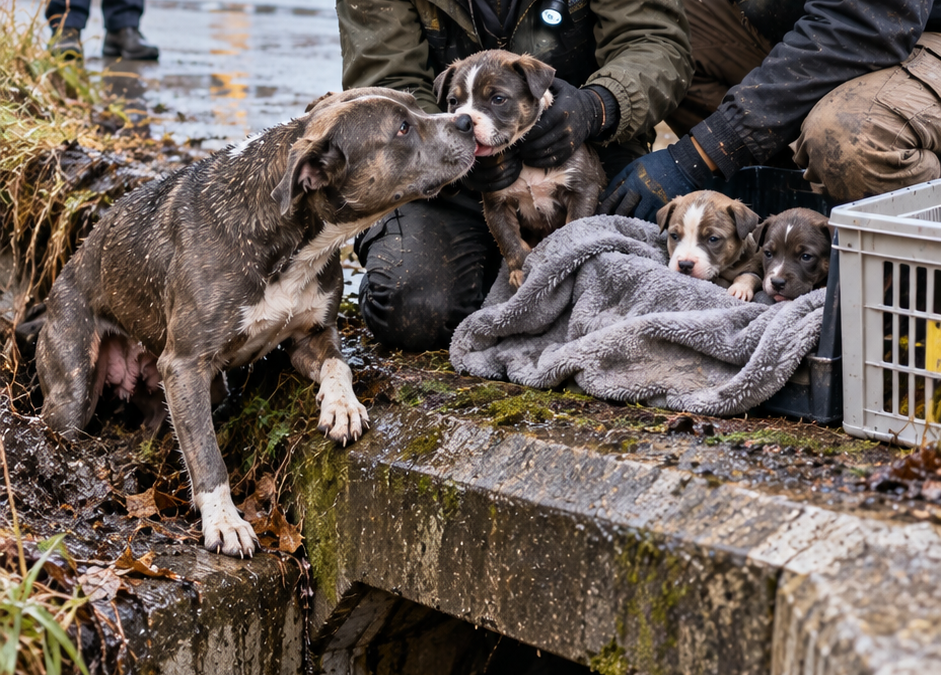
𝗣𝗔𝗥𝗧 𝟮
The dog didn’t approach.
She didn’t bark.
Her body was tense, but there was no obvious aggression.
I lowered myself slightly.
“Hey, Mama.”
Her ears shifted.
“We’ve got them.”
One of the puppies cried from inside the truck.
The mother’s head snapped toward the sound.
She took three quick steps.
Stopped.
The puppy cried again.
She moved closer.
“That’s it.”
I turned sideways so I would appear less threatening.
“They’re okay.”
She came within perhaps ten feet of the vehicle.
Then stopped.
I expected her to continue.
Instead, she looked over her shoulder.
At the storm drain.
Then back at us.
Daniel opened the side door of the rescue vehicle.
One puppy was visible inside a blanket.
The mother saw it.
Her entire body shifted forward.
Then she turned around.
Walked back toward the drain.
Stopped beside the opening.
Looked down.
I frowned.
Daniel said, “Give her a minute.”
We did.
She returned toward the vehicle.
Stopped.
Looked inside.
Then turned again.
Same movement.
Same drain.
Again.
At first, I thought she was confused.
She had been living outdoors.
Her puppies had suddenly been taken by strangers.
Stress can produce strange behavior.
Daniel crouched and held out a piece of food.
“Come on, girl.”
The mother glanced at it.
No interest.
He tossed it gently closer.
Nothing.
She paced toward the truck.
Then back.
Truck.
Drain.
Truck.
Drain.
I watched her eyes.
Every time she faced us, she wasn’t looking for an escape route.
She was checking whether we were watching.
Then she’d turn toward the hole.
“Daniel.”
“Yeah?”
“I don’t think she’s afraid.”
“Neither do I.”
“I think she’s showing us something.”
Daniel watched the dog.
She returned to the edge.
Her front paws stopped only inches from the opening.
She looked down.
Then looked directly at me.
There are moments in rescue work when communication feels almost embarrassingly obvious.
No language.
No command.
Just attention.
The dog stared at me.
Then at the tunnel.
Then back at me.
“I think there’s something else down there.”
Daniel exhaled.
“We checked the immediate chamber.”
“Not the whole tunnel.”
“The puppies were near the entrance.”
“I know.”
He looked at the mother.
She didn’t move.
I said, “She’s not leaving.”
“Could be stress.”
“Could be.”
Another puppy cried.
The mother took one step toward the truck.
Then stopped herself and returned to the grate.
That decided it for me.
“No.”
Daniel glanced at me.
“That’s not stress.”
For several seconds, he studied her.
Then nodded.
“I’ll go back down.”
I caught his arm.
“Together.”
He was about to answer when both of us heard it.
A sound from below.
So faint I initially thought I imagined it.
Not a puppy.
Not the high whining we had heard earlier.
Something rougher.
A broken breath.
Then silence.
Daniel aimed his flashlight down.
“Did you hear that?”
“Yes.”
Again.
A strained, rasping inhalation.
Farther inside.
My stomach tightened.
“There’s something alive down there.”
Daniel was already putting on his gloves.
We descended.
The mother remained above.
As my boots touched the concrete floor, I looked up.
Her face appeared at the opening.
Watching.
“Okay,” I whispered. “We’re listening now.”
The tunnel narrowed several feet beyond where we had found the puppies.
Daniel went first.
I followed.
The beam from our lights moved over damp concrete.
The air became heavier.
There were old branches washed into corners.
Plastic bags.
Broken bottles.
A rusted piece of metal.
We moved carefully.
“Sounded like it came from farther left,” Daniel said.
“I heard the same.”
Twenty feet.
Thirty.
Nothing.
I began to wonder if the sound had traveled strangely through the tunnel.
Then Daniel stopped.
His hand came up.
“Listen.”
We waited.
Breathing.
Definitely breathing.
Slow.
Raspy.
Weak.
“Over there.”
The right wall had partially collapsed at some point, leaving a recessed space behind a slab of concrete.
From our angle near the entrance, the cavity would have been almost invisible.
Daniel crouched.
Moved his flashlight.
Something reflected the light.
Eyes.
My heart seemed to stop.
A dog lay inside the cavity.
Another female.
Smaller than the mother outside.
Her coat was pale gray, almost washed of color beneath the dirt.
She lay on one side with her head flat against the ground.
At first glance, she looked dead.
Then one ear moved.
“Emily.”
“I see her.”
Daniel lowered his voice.
“Easy, girl.”
The dog raised her head.
Barely.
Her eyes found us.
I have seen exhaustion in animals many times.
This was beyond ordinary weakness.
She looked like a dog who had been conserving every ounce of energy for breathing.
Daniel whispered, “How did we miss her?”
“The angle.”
I knew that was true.
It didn’t make me feel better.
The mother had known.
While we celebrated finding three puppies, another dog had been lying thirty feet deeper in darkness.
Waiting.
I crouched several feet away.
“Hey.”
The gray dog’s eyes stayed on me.
“I’m Emily.”
Daniel said quietly, “I don’t think introductions are high on her priorities.”
“Let me have my process.”
He almost smiled.
I extended my hand.
Palm up.
The dog sniffed.
Her nose moved once.
No growling.
No attempt to crawl away.
“Can you stand?”
She tried.
One front leg shifted.
Her rear body did not follow.
She stopped.
“Don’t.”
I moved closer.
“That’s enough.”
Daniel examined the space around her.
“No obvious trap.”
I gently touched her shoulder.
She flinched but didn’t resist.
Her body was painfully thin.
Even through her coat, I could feel bones.
Then I noticed one hind leg.
It sat at an unnatural angle.
Not freshly broken.
Something older.
The muscle around it was severely wasted.
“Daniel.”
“I see it.”
“Old injury?”
“Looks like it.”
That explained why she had remained deeper inside.
Maybe she could walk.
Maybe not far.
Maybe the puppies and their mother had stayed near the entrance because food was easier to reach there.
Maybe this dog simply couldn’t keep up.
We would never know exactly how their lives underground had developed.
But one thing was clear.
The mother outside had refused to leave while this dog remained below.
I slid one arm beneath the gray dog’s chest.
She stiffened.
“It’s okay.”
Daniel supported her hips.
When we lifted, she was terrifyingly light.
Her head fell against my arm.
Then, unexpectedly, her tail moved.
Once.
Barely an inch.
I looked down.
“You want out of here, don’t you?”
Another tiny movement.
Daniel said, “That’s a yes.”
We carried her slowly.
Every few feet, we stopped.
The tunnel was too narrow to move quickly.
Her breathing stayed shallow.
When we reached the chamber beneath the opening, I looked up.
The mother was still there.
The moment she saw what we were carrying, her body changed.
She whined.
The first sound I’d heard her make.
“She knows her.”
“No question.”
We passed the gray dog up carefully.
As soon as I climbed out, the mother rushed forward.
One of our volunteers stepped back.
“Give her room.”
The mother sniffed the gray dog’s head.
Her neck.
Her face.
Then the injured leg.
She licked her ear.
The gray dog lifted her nose toward her.
The mother released a breath that sounded almost like a sigh.
Then she looked at me.
I know people warn against assigning complex human emotions to animals.
They’re right.
We should be careful.
But I also know what attention looks like.
The mother looked directly into my eyes.
Not past me.
Not around me.
At me.
And whatever word you choose for that moment, I understood one thing.
We had finally done what she had been asking us to do.
“Okay,” I whispered.
“You can go now.”
I opened the rescue vehicle.
The difference was immediate.
No pacing.
No hesitation.
The mother climbed inside.
Just like that.
She went directly to the injured female and lay down beside her.
Three puppies began crawling across the blankets toward both adult dogs.
The smallest tucked itself between them.
The gray puppy climbed over its mother’s front leg and collapsed against the other dog’s side.
Within minutes, they formed one tangled pile of fur, ribs, paws, blankets, and exhausted breathing.
Daniel stood beside me.
For a while, neither of us spoke.
Then he said, “I almost closed the grate.”
“Me too.”
He looked toward the mother.
“But she didn’t quit.”
I nodded.
“No.”
Daniel shut the vehicle door gently.
“Good thing one of us was paying attention.”
“She was.”
He looked at me.
I pointed through the window.
“Not me.”
Daniel smiled faintly.
“Fair.”
We drove straight to the shelter clinic.
I sat in the back with the dogs.
The mother kept her body touching the injured female the entire trip.
If the vehicle turned sharply, she adjusted herself to remain against her.
The puppies slept through most of the ride.
I spent the journey wondering about their history.
Had the adult females belonged to the same household?
Were they sisters?
Mother and grown daughter?
Simply bonded strays?
Had someone abandoned them together?
Had one followed the other underground?
There was no way to know yet.
But blood wasn’t important to what I had witnessed.
The mother had known another member of her family was missing.
That was enough.
Dr. Marcus Reed was waiting when we arrived.
Marcus was in his mid-fifties, broad-shouldered, with permanently rolled-up sleeves and a calmness that made frightened animals easier to handle.
He examined the puppies first.
“Underweight,” he said.
“Dehydrated.”
“Temperature?”
“Low, but improving.”
“Anything critical?”
“Not yet.”
Those last two words were typical of Marcus.
He never gave false reassurance.
“Feed carefully. Warm them slowly. Monitor.”
Then he examined the mother.
Her condition was poor but not catastrophic.
Malnutrition.
Minor skin irritation.
Worn paw pads.
A few scars.
Exhaustion.
“She’s nursing three puppies in that condition,” Marcus said, shaking his head. “No wonder she’s thin.”
I stroked her shoulder.
She watched him but stayed calm.
“What about the other one?”
Marcus moved to the gray female.
He spent longer with her.
When he manipulated the injured leg gently, she turned her head away.
“Old fracture.”
“How old?”
“Months at least. Possibly much longer.”
“Can it be fixed?”
“Not in the sense of making the leg new.”
He continued examining.
“It healed poorly. There’s significant muscle loss.”
“Is she in pain?”
“Yes.”
That one word hurt.
“But?”
“We can manage pain. Physical therapy may improve her mobility substantially. We’ll need imaging.”
Daniel stood near the doorway.
“So that’s why she stayed behind.”
Marcus looked up.
“What?”
I explained what had happened.
The puppies near the entrance.
The mother refusing the vehicle.
Repeatedly looking at the drain.
The hidden cavity.
The injured dog.
Marcus listened.
When I finished, he looked toward the mother.
She was watching the gray dog across the room.
“She knew.”
I nodded.
“That’s what I think.”
Marcus removed his gloves.
“She certainly knew this dog hadn’t come out.”
Daniel said quietly, “And we nearly left without her.”
Marcus looked at both of us.
“But you didn’t.”
Those words should have comforted me.
They didn’t.
Not entirely.
Because I knew how close we had come.
That afternoon, while completing the rescue report, I kept seeing the mother’s eyes.
Truck.
Drain.
Me.
Drain again.
How many times do animals communicate clearly only for humans to dismiss the behavior because it doesn’t fit our expectations?
We want them to speak in ways convenient for us.
Come when called.
Move toward safety.
Accept food.
Let us touch them.
But sometimes refusal is the message.
That became the first lesson Audrey taught me.
Yes.
I named her Audrey.
Normally, I tried not to name rescue animals immediately.
Names create attachment.
Attachment is difficult in a job where success often means saying goodbye.
But the shelter needed names for medical records.
“Mother pit bull” sounded too clinical for a dog who had just outstubborned an entire rescue team.
My grandmother’s name had been Audrey.
She had been one of the most patient people I’d ever known.
The kind who would wait through a child’s tantrum without raising her voice.
The kind who would sit beside someone who was grieving and not fill the silence just because silence made other people uncomfortable.
The mother’s patience reminded me of her.
So she became Audrey.
I named the gray dog Frances.
When I was young, I’d loved books by a writer named Frances whose stories were always about people surviving hard places without becoming hard themselves.
The name seemed appropriate.
Daniel mocked me.
“You know you’re going to get attached.”
“I’m already attached.”
“That’s the problem.”
“Thank you, Daniel.”
“Just making sure you’re aware.”
The three puppies received temporary names from volunteers.
Scout.
Milo.
Pepper.
Over the next several days, our clinic revolved around feeding schedules, fluids, monitoring, medication, cleaning, and sleep.
Audrey ate better when Frances was nearby.
Frances slept more deeply when Audrey touched her.
The puppies seemed equally willing to crawl across both adults.
That complicated our assumptions about who was biologically related to whom.
Marcus said, “Could be Audrey’s litter. Could be mixed caregiving. Female dogs sometimes help one another.”
Daniel shrugged.
“They know what they are.”
“What?”
“Family.”
Marcus looked at him.
“That’s scientifically imprecise.”
Daniel took a drink of coffee.
“Survive.”
I laughed.
Frances’s recovery worried us most.
The first time Marcus tried to help her stand, she immediately shifted her weight off the damaged hind leg.
Her body shook.
“Easy.”
He supported her belly with a sling.
One step.
Then another.
Frances stopped.
Looked back at Audrey.
Audrey stood several feet away.
Watching.
Frances took a third step.
Audrey’s tail moved.
I whispered, “Come on.”
Frances managed five steps before lying down.
Five.
It felt like a mile.
Audrey went directly to her and licked her face.
From then on, physical therapy became part of every day.
Small movements.
Gentle massage.
Supported standing.
Short distances.
Rest.
Pain management.
Repeat.
Some days Frances improved.
Some days she seemed worse.
Recovery is rarely a straight line.
That’s something people forget.
They want before and after.
Broken animal.
Healthy animal.
Dark tunnel.
Sunny backyard.
Real healing happens in the messy space between.
On the tenth day, Frances refused to stand.
I worried something had changed.
Marcus examined her.
“No new injury.”
“Then why?”
“She’s tired.”
“She walked yesterday.”
“And today she’s tired.”
I hated that answer.
“Shouldn’t she keep pushing?”
Marcus looked at me.
“Would you tell a human recovering from years of pain that one bad day means they aren’t trying?”
“No.”
“Then don’t do it to her.”
I sat beside Frances.
“Sorry.”
She looked at me.
Audrey lay on her other side.
Marcus added, “Healing includes rest.”
I learned that lesson too.
The puppies recovered much faster.
Youth is unfairly efficient that way.
Within two weeks, they transformed from trembling little bodies into noisy troublemakers.
Scout learned how to climb halfway out of his pen.
Milo became obsessed with shoelaces.
Pepper discovered barking and immediately decided the entire shelter needed to hear her opinions.
Audrey seemed almost amused by them.
When they wrestled too close to Frances, however, she would gently reposition herself between them.
Not aggressive.
Just enough.
Daniel watched once.
“Still managing everybody.”
“That’s Audrey.”
One afternoon, Pepper climbed onto Frances’s back while she slept.
Frances lifted her head.
Audrey looked over.
I expected intervention.
Instead, Frances sighed and went back to sleep.
Pepper stayed there.
I took a photograph.
That image later became one of my favorites from the entire case.
Not because it was dramatic.
Because it was ordinary.
A puppy sleeping on a dog who had been lying forgotten beneath a road only weeks earlier.
Ordinary is sometimes the best outcome rescue can produce.
As the puppies became adoptable, applications arrived quickly.
Puppies are easy to place compared with adult pit bull-type dogs.
Especially adult dogs with medical history.
I knew what was coming.
Scout left first.
His new family had two teenagers and a fenced yard.
On adoption day, Audrey sniffed him thoroughly before he left.
He licked her chin.
Then walked away with his new family as if he’d been waiting his whole life for them.
I cried in the supply room afterward.
Daniel found me.
“One down.”
“Don’t.”
“Good placement?”
“Yes.”
“Then why are you crying?”
“Because I’m emotionally healthy.”
He stared.
“That’s not what that looks like.”
Milo left three days later.
Pepper went the following weekend.
Each adoption was bittersweet.
Audrey searched for the puppies briefly afterward but never became distressed.
Maybe she understood in whatever way dogs understand change.
Frances seemed less concerned.
Her world centered on Audrey.
Once the puppies were gone, the relationship between the two adult dogs became even clearer.
They slept touching.
Always.
If there were two beds, they chose one.
If Audrey went outside, Frances watched the door until she returned.
If Frances had therapy, Audrey waited nearby.
During walks, Audrey naturally adjusted her speed to Frances’s uneven gait.
No one trained her to do it.
Frances would take a few steps.
Audrey would pause.
Frances caught up.
They moved again.
Watching them felt like seeing the storm drain rescue replayed in gentler form.
Audrey still refused to leave Frances behind.
Only now nobody was trapped underground.
Months passed.
Frances gained weight.
Her coat changed from dull gray to a soft silver-brown.
Her muscles strengthened.
The damaged leg would never be perfect.
Marcus was honest about that.
“She may always limp.”
“Will she always hurt?”
“Not necessarily. Manageable discomfort is different from uncontrolled pain.”
Physical therapy helped tremendously.
We used low platforms.
Gentle resistance.
Short incline walks.
Eventually, water therapy.
Frances hated the water at first.
The first session lasted approximately forty seconds before she looked at me with such betrayal that even Marcus laughed.
“She’s filing a complaint.”
“Against you.”
“You’re holding her.”
“Medical orders.”
“Coward.”
By the fourth session, she tolerated it.
By the sixth, she began using the injured leg more.
Then came the morning I’ll never forget.
I was carrying clean blankets across the exercise yard when I heard Daniel call my name.
“Emily!”
I turned.
Frances was at the far end of the yard with Audrey.
Daniel stood near the gate.
“What?”
“Watch.”
Audrey moved forward.
Frances followed.
Walking.
Then Audrey picked up speed.
Frances did too.
Three steps.
Four.
Five.
For a few seconds, Frances wasn’t walking.
She was running.
Not fast.
Not gracefully.
But running.
Her ears went back.
Her mouth opened.
Audrey stayed beside her.
I dropped the blankets.
“She’s running.”
Daniel smiled.
“Technically.”
“Don’t ruin this.”
Frances slowed after maybe fifteen feet.
She stopped.
I expected her to lie down.
Instead, she turned around and ran back.
That was when I started crying.
Daniel glanced at me.
“Here we go.”
“Shut up.”
Frances reached me.
I crouched.
She leaned against my legs.
“Oh, look at you.”
Audrey followed.
I put one arm around each dog.
“Look at you.”
That afternoon, Marcus pretended not to be impressed.
“Controlled bursts only.”
“She ran.”
“I saw.”
“You’re smiling.”
“I have facial muscles.”
“You’re proud.”
“Don’t make this weird.”
Everyone had their own way of caring.
By then, both dogs were medically ready for adoption.
And that created the next problem.
We decided quickly that Audrey and Frances should remain together.
Technically, they could survive apart.
Most animals do.
But survival is not always the standard we should use when deciding what is best.
Marcus was the first to say it directly.
“You can’t separate them.”
I looked at him.
“You realize that makes placement harder.”
“I didn’t say easier.”
Daniel nodded.
“They came in together.”
“Yes.”
“They leave together.”
I agreed.
So did the shelter director.
We posted them as a bonded pair.
Audrey: adult female pit bull mix, calm, affectionate, maternal, gentle.
Frances: adult female pit bull mix, affectionate, improving mobility, permanent limp possible.
Must be adopted together.
People showed interest.
Then hesitated.
“Two dogs?”
“Yes.”
“Both that size?”
“Yes.”
“Could we take Audrey?”
“No.”
“What about Frances alone? She seems sweet.”
“No.”
Sometimes people became frustrated.
I understood.
Two adult dogs are a significant commitment.
Two dogs with rescue history and one with ongoing medical considerations are more.
We waited.
Audrey and Frances waited too, although they had no idea what we were waiting for.
Weeks became months.
They became shelter favorites.
Volunteers took them on walks.
Staff ate lunch beside them.
Children visiting with parents sat near their kennel and asked why Frances walked funny.
“She hurt her leg a long time ago,” we’d explain.
“Does it still hurt?”
“Sometimes.”
“Why doesn’t Audrey leave her?”
“Because they’re friends.”
Children usually accepted that explanation more easily than adults.
Then, one Sunday afternoon, Rachel Donahue walked into the shelter.
She was in her early forties.
Medium height.
Dark hair pulled loosely behind her head.
She wore jeans and a sweater and carried no expectation of finding a specific breed.
“I’d like to adopt,” she told the front-desk volunteer.
“What type of dog?”
Rachel thought about it.
“One who needs a home.”
That’s the kind of answer that gets our attention.
The volunteer called me.
I met Rachel near the adoption area.
We talked.
She was a librarian.
She had grown up on a farm with dogs, horses, and barn cats.
She had lived alone for two years after her mother, whom she’d been caring for, died.
“I waited before adopting,” she explained. “I wasn’t sure whether I wanted a dog because I genuinely wanted one or because the house was too quiet.”
“What changed?”
“The house is still quiet.”
She smiled.
“But now I think quiet and lonely aren’t the same thing.”
I liked her immediately.
That wasn’t enough.
Adoption decisions can’t be based entirely on liking someone.
So I asked questions.
Work schedule.
Housing.
Yard.
Experience.
Veterinary plan.
Financial ability.
Travel.
Support network.
She answered carefully.
Then she said, “The volunteer mentioned you have a bonded pair.”
My heart shifted.
“Yes.”
“Can I meet them?”
“Absolutely.”
I brought Audrey and Frances into the enclosed yard.
Rachel didn’t rush toward them.
That mattered.
She sat directly on the grass.
No concern about her jeans.
No calling.
No clapping her hands.
No exaggerated baby voice.
She waited.
Frances approached first.
That surprised me.
Usually Audrey investigated strangers before Frances.
Frances limped across the yard.
Rachel held out one hand.
“Hi.”
Frances sniffed.
Rachel did not touch her.
Frances stepped closer.
Only then did Rachel scratch gently beneath her chin.
Audrey had followed.
She stood behind Frances.
Watching.
Rachel smiled.
“You’re checking me out too?”
Audrey sniffed Rachel’s shoulder.
Then sat beside Frances.
Within ten minutes, Frances was lying near Rachel’s leg.
Audrey remained upright.
Alert.
Rachel looked at me.
“She’s protecting her.”
“Sometimes.”
“Or watching.”
“Always.”
Rachel stroked Frances’s shoulder.
“What’s the leg situation?”
I explained.
Old fracture.
Improper healing.
Therapy.
Improved strength.
Potential future arthritis.
Possible medication.
Rachel listened to all of it.
No flinch.
No attempt to minimize.
“What would continuing therapy look like?”
That was the right question.
Not “Will this become expensive?”
Not “Can I skip it?”
What would she need?
We talked another hour.
Daniel passed the yard twice.
The second time, I caught his eye.
He raised one eyebrow.
Later, I found him near the supply room.
“What do you think?”
He glanced through the window.
Rachel was now sitting cross-legged.
Frances had her head on Rachel’s thigh.
Audrey had finally lain down on the other side.
Daniel took a sip of coffee.
“I think we’re irrelevant.”
“What?”
“They’ve already chosen.”
I smiled.
“That’s not our entire adoption process.”
“Unfortunately.”
Rachel came back twice.
Then again.
We did the home assessment.
Her house had a fenced backyard.
Few stairs.
Plenty of space.
She had already spoken with her veterinarian about Frances’s mobility before the adoption was even approved.
She ordered nonslip rugs after we mentioned hardwood floors could be difficult.
She bought two beds.
Then called and asked if she should return one because she noticed Audrey and Frances always slept together.
I laughed.
“Keep both.”
“Think they’ll use them?”
“No.”
“That’s what I thought.”
The adoption was approved.
On their final morning at the shelter, I expected to be a mess.
Instead, I felt strangely calm.
Maybe because we’d waited long enough to know this wasn’t merely a hopeful placement.
It was the right one.
I packed Frances’s medication.
Therapy instructions.
Records.
Food schedule.
Harness.
I gave Rachel more information than any human could reasonably remember.
She listened to all of it.
Finally Daniel said, “Emily.”
“What?”
“Let the woman leave.”
“I’m almost finished.”
“You’ve been almost finished for twenty minutes.”
Rachel laughed.
“It’s okay.”
Daniel pointed toward the dogs.
“They’re ready.”
He was right.
Audrey stood near Rachel.
Frances beside her.
I crouched.
“Okay, girls.”
Audrey looked at me.
“This is the good part.”
Frances pressed her nose against my hand.
“No more drains.”
I rubbed her neck.
“No more hiding.”
Audrey leaned into me.
I swallowed.
“You keep looking after her.”
Daniel said behind me, “As if she needs instructions.”
I laughed.
“True.”
Rachel loaded Frances first.
Audrey watched until Frances was settled.
Then Audrey climbed into the vehicle without hesitation.
The same way she had climbed into our rescue van only after we carried Frances from underground.
That nearly broke me.
Same dog.
Same decision.
Where Frances goes, I go.
Rachel closed the door.
Before getting into the driver’s seat, she hugged me.
“Thank you.”
I shook my head.
“You should thank Audrey.”
Rachel glanced at the dog through the window.
“Why?”
“Because we almost stopped.”
She looked back at me.
I told her exactly how close we’d come to leaving the drain after finding the puppies.
How Audrey kept turning back.
How she refused the truck.
How one faint breath changed the operation.
Rachel’s eyes filled.
“She brought you back.”
“Yes.”
“Then I will thank her.”
She drove away.
Audrey and Frances did not look back.
And surprisingly, I was glad.
Some people think adopted animals should turn toward rescuers one final time.
A cinematic goodbye.
I don’t.
The best departures are the ones where they are already moving toward the next safe place.
That evening, I completed the final case report.
Most reports are dry.
They have to be.
Time.
Location.
Animal count.
Condition.
Actions taken.
Medical findings.
Disposition.
Facts.
But at the bottom, beneath my formal notes, I added one sentence.
I had never written anything like it in an official report before.
If an animal refuses to follow after an apparent rescue, don’t rush to assume fear or defiance. It may be trying to show you who is still missing.
Two days later, Daniel was reading paperwork beside me.
He reached that line.
Stopped.
Looked at me.
I waited.
He said nothing.
Just nodded once.
Then picked up his coffee.
That was Daniel’s version of a speech.
I smiled.
Months later, Rachel sent us the first photograph.
Audrey and Frances in the backyard.
Sunlight.
Green grass.
Frances standing with weight on all four legs.
Audrey beside her.
The message read:
Frances ran today. Audrey ran with her.
I stared at the photo for a long time.
Daniel saw it.
“Good?”
I turned the phone toward him.
He smiled.
“Very.”
More photos followed.
Audrey asleep on a couch.
Frances lying in a ridiculous position across both dog beds.
The two of them at a lake.
Frances wearing a life jacket and looking deeply offended.
Audrey sitting beside Rachel while she read on the porch.
Then one photograph arrived that took me straight back to that abandoned road.
Frances was running across the yard.
Not merely trotting.
Running.
Her bad leg was still imperfect.
It always would be.
But she was moving fast enough that her ears had lifted in the wind.
In the background, Audrey watched.
That look.
I knew that look.
The first time I had seen it, Audrey was standing beside a storm drain.
Tense.
Terrified.
Refusing to leave because someone she loved was still in the darkness.
In Rachel’s photograph, Audrey wore the same intensity.
But there was no fear.
Only attention.
Frances was safe.
Audrey knew it.
I printed the photo.
It stayed on the wall near my desk.
Over the years, I’ve participated in rescues more dramatic than that morning.
Animals pulled from fires.
Dogs removed from severe neglect.
Cats found trapped inside walls.
Wildlife tangled in fencing.
There are calls that attract news crews.
Calls people remember because the danger is obvious.
But Audrey and Frances changed me more than most.
Because what nearly went wrong that morning wasn’t equipment failure.
It wasn’t lack of experience.
It wasn’t cruelty.
It was assumption.
We found what we expected to find.
Puppies.
We rescued them.
We were ready to declare success.
Audrey knew our success was incomplete.
And because she couldn’t speak, she did the only thing available.
She refused.
Again.
And again.
And again.
Until we paid attention.
That taught me something I have carried into every rescue since.
An animal’s behavior is information.
Fear is information.
Silence is information.
Refusal is information.
The direction of their eyes is information.
The place they keep returning to is information.
Our job is not simply to make an animal do what seems safest.
Sometimes our job is to ask why safety, as we understand it, isn’t enough.
Years later, new rescuers sometimes ride with me.
They ask the same questions I once asked Daniel.
How do you know when a dog is aggressive?
How do you know when to stop?
How do you know whether an animal is trying to lead you somewhere?
The truthful answer is that you don’t always know.
Experience is not magic.
It doesn’t turn uncertainty into certainty.
It teaches you when uncertainty deserves another look.
That’s different.
I tell them about Audrey.
Not every detail.
Just enough.
“Three puppies came out,” I say.
“The mother wouldn’t get in the truck.”
“What did you do?”
“We watched.”
“And?”
“We realized she kept looking at the drain.”
“Was there another puppy?”
“No.”
I usually stop there.
They always ask.
“What was there?”
“Another dog.”
Then I explain Frances.
The injury.
The hidden cavity.
The mother’s refusal to leave.
And I tell them the most important part.
“We almost stopped looking.”
That matters more than making ourselves sound heroic.
Rescuers are not heroes because we never miss anything.
Good rescuers become better because they remember how close they once came to missing something that mattered.
Daniel and I talked about it once, years after the case.
We had finished a late call and were sitting in the truck eating terrible gas-station sandwiches.
He said, “You know what bothers me about Audrey?”
“What?”
“If she had been more frightened, we would’ve misunderstood her.”
I knew exactly what he meant.
If Audrey had run away from the drain, we’d have assumed she was a stray.
If she’d barked aggressively, we might have focused on containing her.
If she’d hidden, we might never have linked her behavior to the tunnel.
Instead, she remained visible.
Insistent.
“Maybe,” I said.
Daniel took another bite.
“Or maybe she would’ve found another way.”
I smiled.
“You really believe that?”
He looked out the windshield.
“She found a way the first time.”
That was true.
I sometimes think about the elderly woman who made the original call.
She heard a faint whimper most people would have ignored.
The puppies survived because she stopped walking.
Frances survived because Audrey refused to move on.
The entire rescue was built on small acts of attention.
Someone listened.
Someone looked.
Someone waited.
Someone checked again.
None of those acts sounded dramatic.
Together, they saved five dogs.
That is how rescue often works.
Not one giant heroic act.
A sequence of people—and sometimes animals—refusing to ignore the next small thing.
Rachel still sends updates.
Audrey grew older.
Her muzzle whitened.
Frances’s limp became more noticeable in cold weather, but medication helped.
They remained inseparable.
Rachel once wrote:
I bought them separate beds again. They still sleep on one.
I replied:
Stop wasting your money.
She sent a laughing emoji and a photo of both dogs squeezed onto a bed designed for one.
Another winter, Rachel told me Frances had started slowing down.
My chest tightened when I read it.
That’s the other side of rescue.
We save animals knowing time keeps moving.
We don’t get forever.
We get more.
More mornings.
More grass.
More blankets.
More meals.
More years, if we’re lucky.
And perhaps that’s enough.
One afternoon, Rachel visited the shelter with Audrey and Frances.
By then Frances moved carefully.
Audrey was gray around the face.
But the moment they entered the courtyard, something inside me returned to that dawn rescue.
I crouched.
“Well, look who remembered us.”
Frances came directly toward me.
Audrey followed.
Of course she did.
I touched both their faces.
Rachel laughed.
“They knew where we were going ten minutes before we arrived.”
Daniel stepped outside.
Audrey’s tail moved.
“Still bossing everyone around?” he asked.
Rachel smiled.
“Absolutely.”
Frances leaned into my leg.
I rubbed her side.
“You know, you caused a lot of trouble.”
Rachel said, “Her?”
I pointed toward Audrey.
“That one.”
Audrey looked completely unrepentant.
“Wouldn’t get in the truck.”
Daniel crouched.
“Best refusal I’ve ever seen.”
We sat in the yard for almost an hour.
At one point, Frances wandered toward the fence.
Audrey immediately stood.
Followed.
Even after all those years.
I looked at Rachel.
“She still does that?”
“Always.”
“Does Frances ever go anywhere without her?”
Rachel thought.
“Only if Audrey is asleep.”
We laughed.
But something about that answer stayed with me.
Audrey’s vigilance had softened.
It was no longer desperate.
She didn’t fear losing Frances every second.
But care had become habit.
A beautiful one.
When they left that day, I watched until Rachel’s vehicle disappeared.
Daniel stood beside me.
“You going to cry?”
“No.”
“You’re crying.”
“It’s windy.”
“There is no wind.”
“I don’t like you.”
“I’ve known that for years.”
I laughed through the tears.
That evening, I looked again at the note from my original report.
If an animal refuses to follow after an apparent rescue, don’t rush.
The sentence felt too narrow now.
The real lesson was larger.
Don’t rush past behavior you don’t understand.
Don’t assume resistance means disobedience.
Don’t assume silence means nothing is being said.
Don’t assume the first answer is the whole answer.
And never confuse finding some of the vulnerable with finding all of them.
Audrey taught me that.
Frances confirmed it.
Even now, when I’m working a scene and an animal keeps looking somewhere, I follow the eyes.
When a dog refuses to move, I ask why.
When a mother won’t leave, I check again.
Sometimes there’s nothing.
Sometimes fear really is just fear.
Sometimes exhaustion is simply exhaustion.
But once in a while, there is another breath somewhere in the darkness.
One more animal.
One more life.
One more reason not to hurry.
Tonight, the photograph Rachel sent most recently is on my desk.
Audrey and Frances are lying beneath a tree.
Frances has no bandage.
No concrete tunnel.
No dirty water.
No broken drainage chamber.
Just grass.
Sunlight.
A house behind them.
Audrey’s head rests across Frances’s back.
Frances is asleep.
Audrey is awake.
Watching.
The first time I saw that gaze, it was fixed on a storm drain because someone she loved had been left behind.
Now there is nothing left to guard against.
Nothing waiting underground.
Nobody missing.
She watches because Frances is there.
Not because Frances needs rescuing.
Just because love sometimes keeps the same posture even after danger is gone.
My name is Emily Carter.
I’ve spent years learning that rescue is less about being the strongest person in a crisis and more about being willing to notice what others might miss.
That morning, Daniel and I pulled three puppies from an abandoned drainage system.
We thought we’d finished.
Audrey knew better.
She couldn’t tell us in words.
So she waited beside the opening.
She looked at us.
Then at the darkness.
Back at us.
Back at the darkness.
Again.
And again.
Until we finally understood.
Somewhere below us, Frances was still breathing.
And because Audrey refused to leave without her, we heard that breath.
We went back.
We carried Frances into the morning light.
Only then did Audrey climb into the rescue vehicle.
Only then did she lie down.
Only then did she allow herself to rest.
I’ve never forgotten that.
Because sometimes the animal refusing to be rescued isn’t refusing rescue at all.
Sometimes she’s simply telling you that the rescue isn’t finished yet.
Have you finished reading the story and want to read it again?
The Mother Dog Refused to Leave the Storm Drain—Then We Realized She Was Trying to Lead Us Back
By the time we pulled three shivering pit bull puppies out of the abandoned storm drain, wrapped them in warm blankets, and placed them safely inside our rescue vehicle, I thought the hardest part of the morning was over.
Their exhausted mother should have followed them immediately, but instead she kept walking toward us, stopping, and turning back toward the dark opening beneath the road as though she were begging us to look one more time.
I came dangerously close to dismissing it as stress—until a faint sound rose from somewhere deeper underground, and I realized the dog had been trying to tell us something from the moment we arrived.
My name is Emily Carter.
At the time, I had been working in animal rescue for four years, which was long enough to know better than to assume an operation was finished simply because the obvious animals had been removed.
Still, we make mistakes.
Not because we don’t care.
Sometimes because we’re tired.
Sometimes because danger forces us to move quickly.
Sometimes because the thing we’re looking for is hidden just beyond the reach of the flashlight.
That morning, I nearly made one of those mistakes.
The call came shortly after six.
My partner, Daniel Morgan, and I had been on overnight duty.
Daniel was nine years older than me and had spent enough years in rescue work to develop the kind of calm I envied.
He almost never raised his voice.
He didn’t need to.
When Daniel looked at you and said, “Slow down,” you slowed down.
When he said, “Something isn’t right,” you checked again.
He had an irritating ability to remain patient even when everyone around him was in a hurry.
I had learned a lot from him.
That morning, however, it was my turn to notice something first.
The dispatcher told us an elderly woman had been taking her usual morning walk when she heard what sounded like tiny cries coming from beneath the ground near an abandoned stretch of road.
At first, she thought it might be birds.
Then she stopped.
Listened.
The sound came again.
Whimpering.
She followed it to an old drainage access hidden beneath dry grass and called us.
Daniel hung up the radio.
“Puppies?”
“Maybe.”
I grabbed my gloves.
“Or kittens.”
“Could be.”
I hated underground calls.
Not because I was afraid of small spaces exactly.
I’d crawled through culverts, basement gaps, drainage channels, abandoned crawlspaces, and half-collapsed sheds.
The problem with underground spaces is uncertainty.
Water.
Broken concrete.
Snakes.
Rusting metal.
Sudden drops.
Animals that have no escape and therefore no reason to trust you.
You never know what the light is going to find.
Daniel noticed me checking my flashlight twice.
“Nervous?”
“No.”
“That’s why you checked the batteries three times?”
“Twice.”
“Comforting.”
I gave him a look.
He smiled.
“Let’s go.”
The road was outside the busier part of town.
Decades earlier, warehouses had operated nearby, but most had closed.
The pavement was cracked.
Weeds had pushed through the shoulder.
An old drainage system ran beneath the road and emptied farther downhill.
The woman who called us was waiting beside the access point in a blue coat.
She waved as soon as she saw the truck.
“Over here!”
Daniel parked.
We stepped out.
“I’m Mrs. Palmer,” she said. “I heard them right here.”
She pointed toward a heavy iron grate almost completely hidden beneath dry grass.
“You opened it?”
“No. I didn’t want to hurt anything.”
“Good.”
Daniel crouched.
We listened.
Nothing.
Then—
a tiny sound.
A whine.
Then another.
My eyes met Daniel’s.
“Puppies.”
“Sounds like it.”
We cleared the grass.
The grate was old and heavier than expected.
Together, we lifted it enough to expose a narrow concrete chamber below.
The smell came first.
Wet dirt.
Stagnant water.
Animal waste.
Daniel aimed his flashlight downward.
“About six feet.”
There were metal rungs built into one side.
He checked them.
“Rusty, but they should hold.”
“I’ll go.”
Daniel shook his head.
“I’m heavier.”
“That doesn’t make sense.”
“It means if the rung survives me, it’ll survive you.”
“That may be the least scientific safety procedure I’ve ever heard.”
“Yet you understood it.”
He clipped a second light to his vest and lowered himself down.
I stayed above, watching.
“Anything?”
“Wait.”
His flashlight moved.
Concrete.
Mud.
Trash.
Then stopped.
Daniel’s voice changed.
“I’ve got them.”
“How many?”
“Three.”
I knelt beside the opening.
“Condition?”
“Alive.”
That was the word that mattered.
“Can you reach them?”
“Yeah.”
I descended after him.
The chamber was larger than it looked from above but still cramped.
A tunnel extended beneath the road.
Water had once flowed through it regularly, but now only shallow runoff remained along one side.
Daniel crouched near the wall.
Three puppies were pressed against one another.
Pit bull mixes.
Maybe six or seven weeks old.
One tan.
One white with dark patches.
One mostly gray.
All three were underweight.
Their coats were filthy.
Their bodies trembled.
But when Daniel reached toward them, the gray one tried weakly to crawl over its siblings.
“That’s right,” Daniel murmured. “You’ve still got some fight.”
I wrapped the smallest puppy in a towel.
Its body felt cold.
Too cold.
“We need to get them warm.”
Daniel nodded.
“We take them one at a time.”
Outside, another member of our unit had arrived to help.
I passed the first puppy up.
Then the second.
Then the third.
Each disappeared into waiting hands and warm blankets.
When I climbed back out, I heard a low sound behind us.
Not a growl exactly.
I turned.
A female pit bull stood twenty feet away.
She was thin.
Very thin.
Her ribs showed clearly along both sides.
Her nipples were enlarged from nursing.
Her coat was dusty brown.
She watched the rescue vehicle.
Then looked at the drain.
Daniel came up behind me.
“Mom.”
“Looks like it.”
The dog didn’t approach.
She didn’t bark.
Her body was tense, but there was no obvious aggression.
I lowered myself slightly.
“Hey, Mama.”
Her ears shifted.
“We’ve got them.”
One of the puppies cried from inside the truck.
The mother’s head snapped toward the sound.
She took three quick steps.
Stopped.
The puppy cried again.
She moved closer.
“That’s it.”
I turned sideways so I would appear less threatening.
“They’re okay.”
She came within perhaps ten feet of the vehicle.
Then stopped.
I expected her to continue.
Instead, she looked over her shoulder.
At the storm drain.
Then back at us.
Daniel opened the side door of the rescue vehicle.
One puppy was visible inside a blanket.
The mother saw it.
Her entire body shifted forward.
Then she turned around.
Walked back toward the drain.
Stopped beside the opening.
Looked down.
I frowned.
Daniel said, “Give her a minute.”
We did.
She returned toward the vehicle.
Stopped.
Looked inside.
Then turned again.
Same movement.
Same drain.
Again.
At first, I thought she was confused.
She had been living outdoors.
Her puppies had suddenly been taken by strangers.
Stress can produce strange behavior.
Daniel crouched and held out a piece of food.
“Come on, girl.”
The mother glanced at it.
No interest.
He tossed it gently closer.
Nothing.
She paced toward the truck.
Then back.
Truck.
Drain.
Truck.
Drain.
I watched her eyes.
Every time she faced us, she wasn’t looking for an escape route.
She was checking whether we were watching.
Then she’d turn toward the hole.
“Daniel.”
“Yeah?”
“I don’t think she’s afraid.”
“Neither do I.”
“I think she’s showing us something.”
Daniel watched the dog.
She returned to the edge.
Her front paws stopped only inches from the opening.
She looked down.
Then looked directly at me.
There are moments in rescue work when communication feels almost embarrassingly obvious.
No language.
No command.
Just attention.
The dog stared at me.
Then at the tunnel.
Then back at me.
“I think there’s something else down there.”
Daniel exhaled.
“We checked the immediate chamber.”
“Not the whole tunnel.”
“The puppies were near the entrance.”
“I know.”
He looked at the mother.
She didn’t move.
I said, “She’s not leaving.”
“Could be stress.”
“Could be.”
Another puppy cried.
The mother took one step toward the truck.
Then stopped herself and returned to the grate.
That decided it for me.
“No.”
Daniel glanced at me.
“That’s not stress.”
For several seconds, he studied her.
Then nodded.
“I’ll go back down.”
I caught his arm.
“Together.”
He was about to answer when both of us heard it.
A sound from below.
So faint I initially thought I imagined it.
Not a puppy.
Not the high whining we had heard earlier.
Something rougher.
A broken breath.
Then silence.
Daniel aimed his flashlight down.
“Did you hear that?”
“Yes.”
Again.
A strained, rasping inhalation.
Farther inside.
My stomach tightened.
“There’s something alive down there.”
Daniel was already putting on his gloves.
We descended.
The mother remained above.
As my boots touched the concrete floor, I looked up.
Her face appeared at the opening.
Watching.
“Okay,” I whispered. “We’re listening now.”
The tunnel narrowed several feet beyond where we had found the puppies.
Daniel went first.
I followed.
The beam from our lights moved over damp concrete.
The air became heavier.
There were old branches washed into corners.
Plastic bags.
Broken bottles.
A rusted piece of metal.
We moved carefully.
“Sounded like it came from farther left,” Daniel said.
“I heard the same.”
Twenty feet.
Thirty.
Nothing.
I began to wonder if the sound had traveled strangely through the tunnel.
Then Daniel stopped.
His hand came up.
“Listen.”
We waited.
Breathing.
Definitely breathing.
Slow.
Raspy.
Weak.
“Over there.”
The right wall had partially collapsed at some point, leaving a recessed space behind a slab of concrete.
From our angle near the entrance, the cavity would have been almost invisible.
Daniel crouched.
Moved his flashlight.
Something reflected the light.
Eyes.
My heart seemed to stop.
A dog lay inside the cavity.
Another female.
Smaller than the mother outside.
Her coat was pale gray, almost washed of color beneath the dirt.
She lay on one side with her head flat against the ground.
At first glance, she looked dead.
Then one ear moved.
“Emily.”
“I see her.”
Daniel lowered his voice.
“Easy, girl.”
The dog raised her head.
Barely.
Her eyes found us.
I have seen exhaustion in animals many times.
This was beyond ordinary weakness.
She looked like a dog who had been conserving every ounce of energy for breathing.
Daniel whispered, “How did we miss her?”
“The angle.”
I knew that was true.
It didn’t make me feel better.
The mother had known.
While we celebrated finding three puppies, another dog had been lying thirty feet deeper in darkness.
Waiting.
I crouched several feet away.
“Hey.”
The gray dog’s eyes stayed on me.
“I’m Emily.”
Daniel said quietly, “I don’t think introductions are high on her priorities.”
“Let me have my process.”
He almost smiled.
I extended my hand.
Palm up.
The dog sniffed.
Her nose moved once.
No growling.
No attempt to crawl away.
“Can you stand?”
She tried.
One front leg shifted.
Her rear body did not follow.
She stopped.
“Don’t.”
I moved closer.
“That’s enough.”
Daniel examined the space around her.
“No obvious trap.”
I gently touched her shoulder.
She flinched but didn’t resist.
Her body was painfully thin.
Even through her coat, I could feel bones.
Then I noticed one hind leg.
It sat at an unnatural angle.
Not freshly broken.
Something older.
The muscle around it was severely wasted.
“Daniel.”
“I see it.”
“Old injury?”
“Looks like it.”
That explained why she had remained deeper inside.
Maybe she could walk.
Maybe not far.
Maybe the puppies and their mother had stayed near the entrance because food was easier to reach there.
Maybe this dog simply couldn’t keep up.
We would never know exactly how their lives underground had developed.
But one thing was clear.
The mother outside had refused to leave while this dog remained below.
I slid one arm beneath the gray dog’s chest.
She stiffened.
“It’s okay.”
Daniel supported her hips.
When we lifted, she was terrifyingly light.
Her head fell against my arm.
Then, unexpectedly, her tail moved.
Once.
Barely an inch.
I looked down.
“You want out of here, don’t you?”
Another tiny movement.
Daniel said, “That’s a yes.”
We carried her slowly.
Every few feet, we stopped.
The tunnel was too narrow to move quickly.
Her breathing stayed shallow.
When we reached the chamber beneath the opening, I looked up.
The mother was still there.
The moment she saw what we were carrying, her body changed.
She whined.
The first sound I’d heard her make.
“She knows her.”
“No question.”
We passed the gray dog up carefully.
As soon as I climbed out, the mother rushed forward.
One of our volunteers stepped back.
“Give her room.”
The mother sniffed the gray dog’s head.
Her neck.
Her face.
Then the injured leg.
She licked her ear.
The gray dog lifted her nose toward her.
The mother released a breath that sounded almost like a sigh.
Then she looked at me.
I know people warn against assigning complex human emotions to animals.
They’re right.
We should be careful.
But I also know what attention looks like.
The mother looked directly into my eyes.
Not past me.
Not around me.
At me.
And whatever word you choose for that moment, I understood one thing.
We had finally done what she had been asking us to do.
“Okay,” I whispered.
“You can go now.”
I opened the rescue vehicle.
The difference was immediate.
No pacing.
No hesitation.
The mother climbed inside.
Just like that.
She went directly to the injured female and lay down beside her.
Three puppies began crawling across the blankets toward both adult dogs.
The smallest tucked itself between them.
The gray puppy climbed over its mother’s front leg and collapsed against the other dog’s side.
Within minutes, they formed one tangled pile of fur, ribs, paws, blankets, and exhausted breathing.
Daniel stood beside me.
For a while, neither of us spoke.
Then he said, “I almost closed the grate.”
“Me too.”
He looked toward the mother.
“But she didn’t quit.”
I nodded.
“No.”
Daniel shut the vehicle door gently.
“Good thing one of us was paying attention.”
“She was.”
He looked at me.
I pointed through the window.
“Not me.”
Daniel smiled faintly.
“Fair.”
We drove straight to the shelter clinic.
I sat in the back with the dogs.
The mother kept her body touching the injured female the entire trip.
If the vehicle turned sharply, she adjusted herself to remain against her.
The puppies slept through most of the ride.
I spent the journey wondering about their history.
Had the adult females belonged to the same household?
Were they sisters?
Mother and grown daughter?
Simply bonded strays?
Had someone abandoned them together?
Had one followed the other underground?
There was no way to know yet.
But blood wasn’t important to what I had witnessed.
The mother had known another member of her family was missing.
That was enough.
Dr. Marcus Reed was waiting when we arrived.
Marcus was in his mid-fifties, broad-shouldered, with permanently rolled-up sleeves and a calmness that made frightened animals easier to handle.
He examined the puppies first.
“Underweight,” he said.
“Dehydrated.”
“Temperature?”
“Low, but improving.”
“Anything critical?”
“Not yet.”
Those last two words were typical of Marcus.
He never gave false reassurance.
“Feed carefully. Warm them slowly. Monitor.”
Then he examined the mother.
Her condition was poor but not catastrophic.
Malnutrition.
Minor skin irritation.
Worn paw pads.
A few scars.
Exhaustion.
“She’s nursing three puppies in that condition,” Marcus said, shaking his head. “No wonder she’s thin.”
I stroked her shoulder.
She watched him but stayed calm.
“What about the other one?”
Marcus moved to the gray female.
He spent longer with her.
When he manipulated the injured leg gently, she turned her head away.
“Old fracture.”
“How old?”
“Months at least. Possibly much longer.”
“Can it be fixed?”
“Not in the sense of making the leg new.”
He continued examining.
“It healed poorly. There’s significant muscle loss.”
“Is she in pain?”
“Yes.”
That one word hurt.
“But?”
“We can manage pain. Physical therapy may improve her mobility substantially. We’ll need imaging.”
Daniel stood near the doorway.
“So that’s why she stayed behind.”
Marcus looked up.
“What?”
I explained what had happened.
The puppies near the entrance.
The mother refusing the vehicle.
Repeatedly looking at the drain.
The hidden cavity.
The injured dog.
Marcus listened.
When I finished, he looked toward the mother.
She was watching the gray dog across the room.
“She knew.”
I nodded.
“That’s what I think.”
Marcus removed his gloves.
“She certainly knew this dog hadn’t come out.”
Daniel said quietly, “And we nearly left without her.”
Marcus looked at both of us.
“But you didn’t.”
Those words should have comforted me.
They didn’t.
Not entirely.
Because I knew how close we had come.
That afternoon, while completing the rescue report, I kept seeing the mother’s eyes.
Truck.
Drain.
Me.
Drain again.
How many times do animals communicate clearly only for humans to dismiss the behavior because it doesn’t fit our expectations?
We want them to speak in ways convenient for us.
Come when called.
Move toward safety.
Accept food.
Let us touch them.
But sometimes refusal is the message.
That became the first lesson Audrey taught me.
Yes.
I named her Audrey.
Normally, I tried not to name rescue animals immediately.
Names create attachment.
Attachment is difficult in a job where success often means saying goodbye.
But the shelter needed names for medical records.
“Mother pit bull” sounded too clinical for a dog who had just outstubborned an entire rescue team.
My grandmother’s name had been Audrey.
She had been one of the most patient people I’d ever known.
The kind who would wait through a child’s tantrum without raising her voice.
The kind who would sit beside someone who was grieving and not fill the silence just because silence made other people uncomfortable.
The mother’s patience reminded me of her.
So she became Audrey.
I named the gray dog Frances.
When I was young, I’d loved books by a writer named Frances whose stories were always about people surviving hard places without becoming hard themselves.
The name seemed appropriate.
Daniel mocked me.
“You know you’re going to get attached.”
“I’m already attached.”
“That’s the problem.”
“Thank you, Daniel.”
“Just making sure you’re aware.”
The three puppies received temporary names from volunteers.
Scout.
Milo.
Pepper.
Over the next several days, our clinic revolved around feeding schedules, fluids, monitoring, medication, cleaning, and sleep.
Audrey ate better when Frances was nearby.
Frances slept more deeply when Audrey touched her.
The puppies seemed equally willing to crawl across both adults.
That complicated our assumptions about who was biologically related to whom.
Marcus said, “Could be Audrey’s litter. Could be mixed caregiving. Female dogs sometimes help one another.”
Daniel shrugged.
“They know what they are.”
“What?”
“Family.”
Marcus looked at him.
“That’s scientifically imprecise.”
Daniel took a drink of coffee.
“Survive.”
I laughed.
Frances’s recovery worried us most.
The first time Marcus tried to help her stand, she immediately shifted her weight off the damaged hind leg.
Her body shook.
“Easy.”
He supported her belly with a sling.
One step.
Then another.
Frances stopped.
Looked back at Audrey.
Audrey stood several feet away.
Watching.
Frances took a third step.
Audrey’s tail moved.
I whispered, “Come on.”
Frances managed five steps before lying down.
Five.
It felt like a mile.
Audrey went directly to her and licked her face.
From then on, physical therapy became part of every day.
Small movements.
Gentle massage.
Supported standing.
Short distances.
Rest.
Pain management.
Repeat.
Some days Frances improved.
Some days she seemed worse.
Recovery is rarely a straight line.
That’s something people forget.
They want before and after.
Broken animal.
Healthy animal.
Dark tunnel.
Sunny backyard.
Real healing happens in the messy space between.
On the tenth day, Frances refused to stand.
I worried something had changed.
Marcus examined her.
“No new injury.”
“Then why?”
“She’s tired.”
“She walked yesterday.”
“And today she’s tired.”
I hated that answer.
“Shouldn’t she keep pushing?”
Marcus looked at me.
“Would you tell a human recovering from years of pain that one bad day means they aren’t trying?”
“No.”
“Then don’t do it to her.”
I sat beside Frances.
“Sorry.”
She looked at me.
Audrey lay on her other side.
Marcus added, “Healing includes rest.”
I learned that lesson too.
The puppies recovered much faster.
Youth is unfairly efficient that way.
Within two weeks, they transformed from trembling little bodies into noisy troublemakers.
Scout learned how to climb halfway out of his pen.
Milo became obsessed with shoelaces.
Pepper discovered barking and immediately decided the entire shelter needed to hear her opinions.
Audrey seemed almost amused by them.
When they wrestled too close to Frances, however, she would gently reposition herself between them.
Not aggressive.
Just enough.
Daniel watched once.
“Still managing everybody.”
“That’s Audrey.”
One afternoon, Pepper climbed onto Frances’s back while she slept.
Frances lifted her head.
Audrey looked over.
I expected intervention.
Instead, Frances sighed and went back to sleep.
Pepper stayed there.
I took a photograph.
That image later became one of my favorites from the entire case.
Not because it was dramatic.
Because it was ordinary.
A puppy sleeping on a dog who had been lying forgotten beneath a road only weeks earlier.
Ordinary is sometimes the best outcome rescue can produce.
As the puppies became adoptable, applications arrived quickly.
Puppies are easy to place compared with adult pit bull-type dogs.
Especially adult dogs with medical history.
I knew what was coming.
Scout left first.
His new family had two teenagers and a fenced yard.
On adoption day, Audrey sniffed him thoroughly before he left.
He licked her chin.
Then walked away with his new family as if he’d been waiting his whole life for them.
I cried in the supply room afterward.
Daniel found me.
“One down.”
“Don’t.”
“Good placement?”
“Yes.”
“Then why are you crying?”
“Because I’m emotionally healthy.”
He stared.
“That’s not what that looks like.”
Milo left three days later.
Pepper went the following weekend.
Each adoption was bittersweet.
Audrey searched for the puppies briefly afterward but never became distressed.
Maybe she understood in whatever way dogs understand change.
Frances seemed less concerned.
Her world centered on Audrey.
Once the puppies were gone, the relationship between the two adult dogs became even clearer.
They slept touching.
Always.
If there were two beds, they chose one.
If Audrey went outside, Frances watched the door until she returned.
If Frances had therapy, Audrey waited nearby.
During walks, Audrey naturally adjusted her speed to Frances’s uneven gait.
No one trained her to do it.
Frances would take a few steps.
Audrey would pause.
Frances caught up.
They moved again.
Watching them felt like seeing the storm drain rescue replayed in gentler form.
Audrey still refused to leave Frances behind.
Only now nobody was trapped underground.
Months passed.
Frances gained weight.
Her coat changed from dull gray to a soft silver-brown.
Her muscles strengthened.
The damaged leg would never be perfect.
Marcus was honest about that.
“She may always limp.”
“Will she always hurt?”
“Not necessarily. Manageable discomfort is different from uncontrolled pain.”
Physical therapy helped tremendously.
We used low platforms.
Gentle resistance.
Short incline walks.
Eventually, water therapy.
Frances hated the water at first.
The first session lasted approximately forty seconds before she looked at me with such betrayal that even Marcus laughed.
“She’s filing a complaint.”
“Against you.”
“You’re holding her.”
“Medical orders.”
“Coward.”
By the fourth session, she tolerated it.
By the sixth, she began using the injured leg more.
Then came the morning I’ll never forget.
I was carrying clean blankets across the exercise yard when I heard Daniel call my name.
“Emily!”
I turned.
Frances was at the far end of the yard with Audrey.
Daniel stood near the gate.
“What?”
“Watch.”
Audrey moved forward.
Frances followed.
Walking.
Then Audrey picked up speed.
Frances did too.
Three steps.
Four.
Five.
For a few seconds, Frances wasn’t walking.
She was running.
Not fast.
Not gracefully.
But running.
Her ears went back.
Her mouth opened.
Audrey stayed beside her.
I dropped the blankets.
“She’s running.”
Daniel smiled.
“Technically.”
“Don’t ruin this.”
Frances slowed after maybe fifteen feet.
She stopped.
I expected her to lie down.
Instead, she turned around and ran back.
That was when I started crying.
Daniel glanced at me.
“Here we go.”
“Shut up.”
Frances reached me.
I crouched.
She leaned against my legs.
“Oh, look at you.”
Audrey followed.
I put one arm around each dog.
“Look at you.”
That afternoon, Marcus pretended not to be impressed.
“Controlled bursts only.”
“She ran.”
“I saw.”
“You’re smiling.”
“I have facial muscles.”
“You’re proud.”
“Don’t make this weird.”
Everyone had their own way of caring.
By then, both dogs were medically ready for adoption.
And that created the next problem.
We decided quickly that Audrey and Frances should remain together.
Technically, they could survive apart.
Most animals do.
But survival is not always the standard we should use when deciding what is best.
Marcus was the first to say it directly.
“You can’t separate them.”
I looked at him.
“You realize that makes placement harder.”
“I didn’t say easier.”
Daniel nodded.
“They came in together.”
“Yes.”
“They leave together.”
I agreed.
So did the shelter director.
We posted them as a bonded pair.
Audrey: adult female pit bull mix, calm, affectionate, maternal, gentle.
Frances: adult female pit bull mix, affectionate, improving mobility, permanent limp possible.
Must be adopted together.
People showed interest.
Then hesitated.
“Two dogs?”
“Yes.”
“Both that size?”
“Yes.”
“Could we take Audrey?”
“No.”
“What about Frances alone? She seems sweet.”
“No.”
Sometimes people became frustrated.
I understood.
Two adult dogs are a significant commitment.
Two dogs with rescue history and one with ongoing medical considerations are more.
We waited.
Audrey and Frances waited too, although they had no idea what we were waiting for.
Weeks became months.
They became shelter favorites.
Volunteers took them on walks.
Staff ate lunch beside them.
Children visiting with parents sat near their kennel and asked why Frances walked funny.
“She hurt her leg a long time ago,” we’d explain.
“Does it still hurt?”
“Sometimes.”
“Why doesn’t Audrey leave her?”
“Because they’re friends.”
Children usually accepted that explanation more easily than adults.
Then, one Sunday afternoon, Rachel Donahue walked into the shelter.
She was in her early forties.
Medium height.
Dark hair pulled loosely behind her head.
She wore jeans and a sweater and carried no expectation of finding a specific breed.
“I’d like to adopt,” she told the front-desk volunteer.
“What type of dog?”
Rachel thought about it.
“One who needs a home.”
That’s the kind of answer that gets our attention.
The volunteer called me.
I met Rachel near the adoption area.
We talked.
She was a librarian.
She had grown up on a farm with dogs, horses, and barn cats.
She had lived alone for two years after her mother, whom she’d been caring for, died.
“I waited before adopting,” she explained. “I wasn’t sure whether I wanted a dog because I genuinely wanted one or because the house was too quiet.”
“What changed?”
“The house is still quiet.”
She smiled.
“But now I think quiet and lonely aren’t the same thing.”
I liked her immediately.
That wasn’t enough.
Adoption decisions can’t be based entirely on liking someone.
So I asked questions.
Work schedule.
Housing.
Yard.
Experience.
Veterinary plan.
Financial ability.
Travel.
Support network.
She answered carefully.
Then she said, “The volunteer mentioned you have a bonded pair.”
My heart shifted.
“Yes.”
“Can I meet them?”
“Absolutely.”
I brought Audrey and Frances into the enclosed yard.
Rachel didn’t rush toward them.
That mattered.
She sat directly on the grass.
No concern about her jeans.
No calling.
No clapping her hands.
No exaggerated baby voice.
She waited.
Frances approached first.
That surprised me.
Usually Audrey investigated strangers before Frances.
Frances limped across the yard.
Rachel held out one hand.
“Hi.”
Frances sniffed.
Rachel did not touch her.
Frances stepped closer.
Only then did Rachel scratch gently beneath her chin.
Audrey had followed.
She stood behind Frances.
Watching.
Rachel smiled.
“You’re checking me out too?”
Audrey sniffed Rachel’s shoulder.
Then sat beside Frances.
Within ten minutes, Frances was lying near Rachel’s leg.
Audrey remained upright.
Alert.
Rachel looked at me.
“She’s protecting her.”
“Sometimes.”
“Or watching.”
“Always.”
Rachel stroked Frances’s shoulder.
“What’s the leg situation?”
I explained.
Old fracture.
Improper healing.
Therapy.
Improved strength.
Potential future arthritis.
Possible medication.
Rachel listened to all of it.
No flinch.
No attempt to minimize.
“What would continuing therapy look like?”
That was the right question.
Not “Will this become expensive?”
Not “Can I skip it?”
What would she need?
We talked another hour.
Daniel passed the yard twice.
The second time, I caught his eye.
He raised one eyebrow.
Later, I found him near the supply room.
“What do you think?”
He glanced through the window.
Rachel was now sitting cross-legged.
Frances had her head on Rachel’s thigh.
Audrey had finally lain down on the other side.
Daniel took a sip of coffee.
“I think we’re irrelevant.”
“What?”
“They’ve already chosen.”
I smiled.
“That’s not our entire adoption process.”
“Unfortunately.”
Rachel came back twice.
Then again.
We did the home assessment.
Her house had a fenced backyard.
Few stairs.
Plenty of space.
She had already spoken with her veterinarian about Frances’s mobility before the adoption was even approved.
She ordered nonslip rugs after we mentioned hardwood floors could be difficult.
She bought two beds.
Then called and asked if she should return one because she noticed Audrey and Frances always slept together.
I laughed.
“Keep both.”
“Think they’ll use them?”
“No.”
“That’s what I thought.”
The adoption was approved.
On their final morning at the shelter, I expected to be a mess.
Instead, I felt strangely calm.
Maybe because we’d waited long enough to know this wasn’t merely a hopeful placement.
It was the right one.
I packed Frances’s medication.
Therapy instructions.
Records.
Food schedule.
Harness.
I gave Rachel more information than any human could reasonably remember.
She listened to all of it.
Finally Daniel said, “Emily.”
“What?”
“Let the woman leave.”
“I’m almost finished.”
“You’ve been almost finished for twenty minutes.”
Rachel laughed.
“It’s okay.”
Daniel pointed toward the dogs.
“They’re ready.”
He was right.
Audrey stood near Rachel.
Frances beside her.
I crouched.
“Okay, girls.”
Audrey looked at me.
“This is the good part.”
Frances pressed her nose against my hand.
“No more drains.”
I rubbed her neck.
“No more hiding.”
Audrey leaned into me.
I swallowed.
“You keep looking after her.”
Daniel said behind me, “As if she needs instructions.”
I laughed.
“True.”
Rachel loaded Frances first.
Audrey watched until Frances was settled.
Then Audrey climbed into the vehicle without hesitation.
The same way she had climbed into our rescue van only after we carried Frances from underground.
That nearly broke me.
Same dog.
Same decision.
Where Frances goes, I go.
Rachel closed the door.
Before getting into the driver’s seat, she hugged me.
“Thank you.”
I shook my head.
“You should thank Audrey.”
Rachel glanced at the dog through the window.
“Why?”
“Because we almost stopped.”
She looked back at me.
I told her exactly how close we’d come to leaving the drain after finding the puppies.
How Audrey kept turning back.
How she refused the truck.
How one faint breath changed the operation.
Rachel’s eyes filled.
“She brought you back.”
“Yes.”
“Then I will thank her.”
She drove away.
Audrey and Frances did not look back.
And surprisingly, I was glad.
Some people think adopted animals should turn toward rescuers one final time.
A cinematic goodbye.
I don’t.
The best departures are the ones where they are already moving toward the next safe place.
That evening, I completed the final case report.
Most reports are dry.
They have to be.
Time.
Location.
Animal count.
Condition.
Actions taken.
Medical findings.
Disposition.
Facts.
But at the bottom, beneath my formal notes, I added one sentence.
I had never written anything like it in an official report before.
If an animal refuses to follow after an apparent rescue, don’t rush to assume fear or defiance. It may be trying to show you who is still missing.
Two days later, Daniel was reading paperwork beside me.
He reached that line.
Stopped.
Looked at me.
I waited.
He said nothing.
Just nodded once.
Then picked up his coffee.
That was Daniel’s version of a speech.
I smiled.
Months later, Rachel sent us the first photograph.
Audrey and Frances in the backyard.
Sunlight.
Green grass.
Frances standing with weight on all four legs.
Audrey beside her.
The message read:
Frances ran today. Audrey ran with her.
I stared at the photo for a long time.
Daniel saw it.
“Good?”
I turned the phone toward him.
He smiled.
“Very.”
More photos followed.
Audrey asleep on a couch.
Frances lying in a ridiculous position across both dog beds.
The two of them at a lake.
Frances wearing a life jacket and looking deeply offended.
Audrey sitting beside Rachel while she read on the porch.
Then one photograph arrived that took me straight back to that abandoned road.
Frances was running across the yard.
Not merely trotting.
Running.
Her bad leg was still imperfect.
It always would be.
But she was moving fast enough that her ears had lifted in the wind.
In the background, Audrey watched.
That look.
I knew that look.
The first time I had seen it, Audrey was standing beside a storm drain.
Tense.
Terrified.
Refusing to leave because someone she loved was still in the darkness.
In Rachel’s photograph, Audrey wore the same intensity.
But there was no fear.
Only attention.
Frances was safe.
Audrey knew it.
I printed the photo.
It stayed on the wall near my desk.
Over the years, I’ve participated in rescues more dramatic than that morning.
Animals pulled from fires.
Dogs removed from severe neglect.
Cats found trapped inside walls.
Wildlife tangled in fencing.
There are calls that attract news crews.
Calls people remember because the danger is obvious.
But Audrey and Frances changed me more than most.
Because what nearly went wrong that morning wasn’t equipment failure.
It wasn’t lack of experience.
It wasn’t cruelty.
It was assumption.
We found what we expected to find.
Puppies.
We rescued them.
We were ready to declare success.
Audrey knew our success was incomplete.
And because she couldn’t speak, she did the only thing available.
She refused.
Again.
And again.
And again.
Until we paid attention.
That taught me something I have carried into every rescue since.
An animal’s behavior is information.
Fear is information.
Silence is information.
Refusal is information.
The direction of their eyes is information.
The place they keep returning to is information.
Our job is not simply to make an animal do what seems safest.
Sometimes our job is to ask why safety, as we understand it, isn’t enough.
Years later, new rescuers sometimes ride with me.
They ask the same questions I once asked Daniel.
How do you know when a dog is aggressive?
How do you know when to stop?
How do you know whether an animal is trying to lead you somewhere?
The truthful answer is that you don’t always know.
Experience is not magic.
It doesn’t turn uncertainty into certainty.
It teaches you when uncertainty deserves another look.
That’s different.
I tell them about Audrey.
Not every detail.
Just enough.
“Three puppies came out,” I say.
“The mother wouldn’t get in the truck.”
“What did you do?”
“We watched.”
“And?”
“We realized she kept looking at the drain.”
“Was there another puppy?”
“No.”
I usually stop there.
They always ask.
“What was there?”
“Another dog.”
Then I explain Frances.
The injury.
The hidden cavity.
The mother’s refusal to leave.
And I tell them the most important part.
“We almost stopped looking.”
That matters more than making ourselves sound heroic.
Rescuers are not heroes because we never miss anything.
Good rescuers become better because they remember how close they once came to missing something that mattered.
Daniel and I talked about it once, years after the case.
We had finished a late call and were sitting in the truck eating terrible gas-station sandwiches.
He said, “You know what bothers me about Audrey?”
“What?”
“If she had been more frightened, we would’ve misunderstood her.”
I knew exactly what he meant.
If Audrey had run away from the drain, we’d have assumed she was a stray.
If she’d barked aggressively, we might have focused on containing her.
If she’d hidden, we might never have linked her behavior to the tunnel.
Instead, she remained visible.
Insistent.
“Maybe,” I said.
Daniel took another bite.
“Or maybe she would’ve found another way.”
I smiled.
“You really believe that?”
He looked out the windshield.
“She found a way the first time.”
That was true.
I sometimes think about the elderly woman who made the original call.
She heard a faint whimper most people would have ignored.
The puppies survived because she stopped walking.
Frances survived because Audrey refused to move on.
The entire rescue was built on small acts of attention.
Someone listened.
Someone looked.
Someone waited.
Someone checked again.
None of those acts sounded dramatic.
Together, they saved five dogs.
That is how rescue often works.
Not one giant heroic act.
A sequence of people—and sometimes animals—refusing to ignore the next small thing.
Rachel still sends updates.
Audrey grew older.
Her muzzle whitened.
Frances’s limp became more noticeable in cold weather, but medication helped.
They remained inseparable.
Rachel once wrote:
I bought them separate beds again. They still sleep on one.
I replied:
Stop wasting your money.
She sent a laughing emoji and a photo of both dogs squeezed onto a bed designed for one.
Another winter, Rachel told me Frances had started slowing down.
My chest tightened when I read it.
That’s the other side of rescue.
We save animals knowing time keeps moving.
We don’t get forever.
We get more.
More mornings.
More grass.
More blankets.
More meals.
More years, if we’re lucky.
And perhaps that’s enough.
One afternoon, Rachel visited the shelter with Audrey and Frances.
By then Frances moved carefully.
Audrey was gray around the face.
But the moment they entered the courtyard, something inside me returned to that dawn rescue.
I crouched.
“Well, look who remembered us.”
Frances came directly toward me.
Audrey followed.
Of course she did.
I touched both their faces.
Rachel laughed.
“They knew where we were going ten minutes before we arrived.”
Daniel stepped outside.
Audrey’s tail moved.
“Still bossing everyone around?” he asked.
Rachel smiled.
“Absolutely.”
Frances leaned into my leg.
I rubbed her side.
“You know, you caused a lot of trouble.”
Rachel said, “Her?”
I pointed toward Audrey.
“That one.”
Audrey looked completely unrepentant.
“Wouldn’t get in the truck.”
Daniel crouched.
“Best refusal I’ve ever seen.”
We sat in the yard for almost an hour.
At one point, Frances wandered toward the fence.
Audrey immediately stood.
Followed.
Even after all those years.
I looked at Rachel.
“She still does that?”
“Always.”
“Does Frances ever go anywhere without her?”
Rachel thought.
“Only if Audrey is asleep.”
We laughed.
But something about that answer stayed with me.
Audrey’s vigilance had softened.
It was no longer desperate.
She didn’t fear losing Frances every second.
But care had become habit.
A beautiful one.
When they left that day, I watched until Rachel’s vehicle disappeared.
Daniel stood beside me.
“You going to cry?”
“No.”
“You’re crying.”
“It’s windy.”
“There is no wind.”
“I don’t like you.”
“I’ve known that for years.”
I laughed through the tears.
That evening, I looked again at the note from my original report.
If an animal refuses to follow after an apparent rescue, don’t rush.
The sentence felt too narrow now.
The real lesson was larger.
Don’t rush past behavior you don’t understand.
Don’t assume resistance means disobedience.
Don’t assume silence means nothing is being said.
Don’t assume the first answer is the whole answer.
And never confuse finding some of the vulnerable with finding all of them.
Audrey taught me that.
Frances confirmed it.
Even now, when I’m working a scene and an animal keeps looking somewhere, I follow the eyes.
When a dog refuses to move, I ask why.
When a mother won’t leave, I check again.
Sometimes there’s nothing.
Sometimes fear really is just fear.
Sometimes exhaustion is simply exhaustion.
But once in a while, there is another breath somewhere in the darkness.
One more animal.
One more life.
One more reason not to hurry.
Tonight, the photograph Rachel sent most recently is on my desk.
Audrey and Frances are lying beneath a tree.
Frances has no bandage.
No concrete tunnel.
No dirty water.
No broken drainage chamber.
Just grass.
Sunlight.
A house behind them.
Audrey’s head rests across Frances’s back.
Frances is asleep.
Audrey is awake.
Watching.
The first time I saw that gaze, it was fixed on a storm drain because someone she loved had been left behind.
Now there is nothing left to guard against.
Nothing waiting underground.
Nobody missing.
She watches because Frances is there.
Not because Frances needs rescuing.
Just because love sometimes keeps the same posture even after danger is gone.
My name is Emily Carter.
I’ve spent years learning that rescue is less about being the strongest person in a crisis and more about being willing to notice what others might miss.
That morning, Daniel and I pulled three puppies from an abandoned drainage system.
We thought we’d finished.
Audrey knew better.
She couldn’t tell us in words.
So she waited beside the opening.
She looked at us.
Then at the darkness.
Back at us.
Back at the darkness.
Again.
And again.
Until we finally understood.
Somewhere below us, Frances was still breathing.
And because Audrey refused to leave without her, we heard that breath.
We went back.
We carried Frances into the morning light.
Only then did Audrey climb into the rescue vehicle.
Only then did she lie down.
Only then did she allow herself to rest.
I’ve never forgotten that.
Because sometimes the animal refusing to be rescued isn’t refusing rescue at all.
Sometimes she’s simply telling you that the rescue isn’t finished yet.








