𝗙𝗨𝗟𝗟 𝗦𝗧𝗢𝗥𝗬 The Most Dangerous K9 on the Base Knew the Secret Command They Buried With My Name
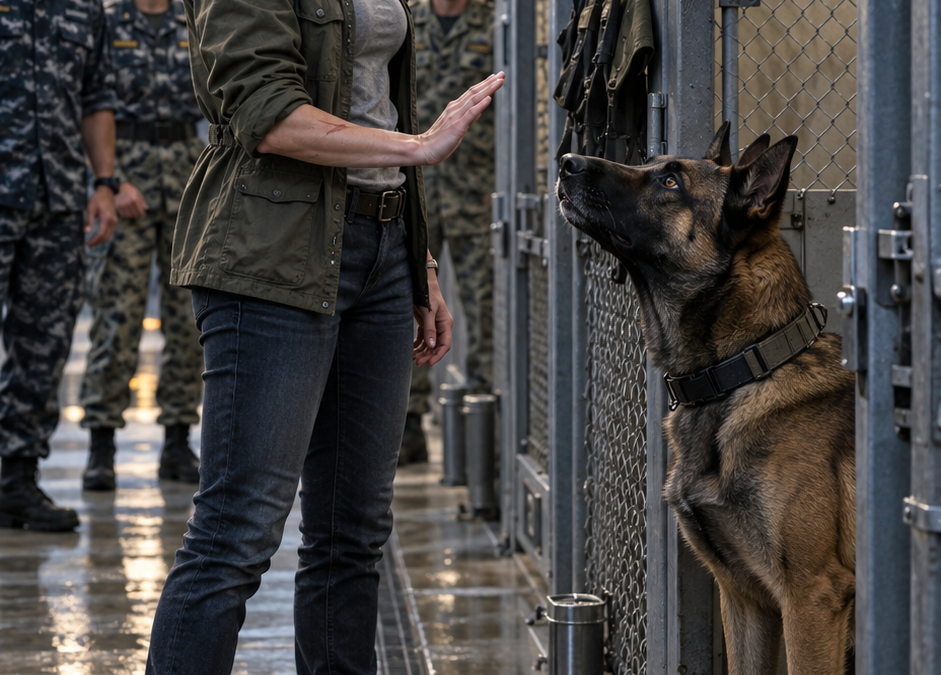
𝗣𝗔𝗥𝗧 𝟮
The report said I had exercised poor handler judgment.
It said I had failed to stop the evolution after observing changes in Atlas’s stress response.
It said no verified equipment defect had been reported before training.
That sentence almost made me laugh when I first read it.
Almost.
I had written the report myself.
My signature had been on it.
Somehow, four days later, it had become invisible.
The official paperwork took six weeks to construct.
My career took two hours to dismantle.
I sat in a conference room under fluorescent lights while three people explained why accepting an administrative discharge would be better than fighting.
They used careful language.
No one said scapegoat.
No one said Hargrove had protected himself.
No one said the program was classified enough to make outside review difficult.
They talked about institutional confidence.
Command climate.
Judgment.
Operational trust.
Words powerful people use when they need to destroy a person without admitting they are doing it.
I looked through the glass wall and saw Hargrove standing in the hallway.
He met my eyes once.
No smile.
No apology.
Just certainty.
He knew exactly what was happening.
So did I.
I could fight.
I could spend years appealing through people connected to the same system that had already decided which truth was useful.
I could force classified material into proceedings that would never be fully open.
I could make every commander who had protected the program choose whether protecting me was worth exposing themselves.
Or I could sign.
I signed.
People later assumed that meant I had surrendered.
The truth was uglier.
I was tired.
Atlas was dead.
The program I had helped build had become the weapon used to remove me.
Something inside me stopped believing that proving the truth would make anyone care.
I drove four hours after leaving the facility.
No destination.
No plan.
My uniforms were in the back of the truck.
My medical kit was there too.
So were nine years of photographs I could not bring myself to look at.
By midnight, I had crossed into another state.
Two years later, I was carrying biscuits to table six at Miller’s Diner.
Nobody knew me.
That was exactly what I wanted.
At least, that was what I told myself.
The problem with buried things is that sometimes they keep breathing.
Three months after I started at Miller’s, I learned we had a supply contract with Hargrove Private K9 Training Solutions.
The name stopped me cold.
I was standing beside the freezer when my manager handed me a clipboard.
“Hargrove order doubled this week. Can you check the inventory?”
I stared at the name.
Hargrove.
He had left government service eighteen months after my discharge.
Officially, it was retirement.
Then he opened a private facility under contract with the Navy.
Same world.
Different sign on the gate.
I asked questions without sounding like I was asking questions.
Who delivered their orders?
How often?
What time?
Which entrance?
The answers came easily because nobody knew they mattered.
Within a month, I volunteered to take the Tuesday and Thursday delivery route.
The first time I drove through Hargrove’s gate, I thought I might throw up.
My hands stayed steady anyway.
That was another thing training had left behind.
The body could be terrified while the hands still did their job.
No one recognized me.
Three years changed a person.
I wore my hair differently.
I had lost weight.
My badge said Liv instead of Olivia.
And the people loading crates from a diner truck did not waste attention on the woman driving it.
Hargrove saw me once during the first month.
He walked across the yard fifty feet away.
I turned slightly.
Not enough to look suspicious.
Just enough to put the truck between us.
He never looked twice.
After that, I understood something important.
Being invisible could be useful.
So I watched.
Not obviously.
Never obviously.
Six months of deliveries.
Two mornings a week.
Same route.
Same loading bay.
Same supply buildings.
I noticed the dogs first.
Of course I did.
Some were too thin.
Not neglected enough for a casual visitor to complain.
Just wrong.
Muscle loss along the rear quarters.
Poor coat condition.
A kind of guarded movement I knew from dogs that had learned people were unpredictable.
I started remembering kennel numbers.
Handler names.
Shift changes.
Veterinary pickups.
I noticed one dog disappeared after limping badly on a Thursday.
The next Tuesday, his kennel card was gone.
No transfer notice.
No treatment notation.
Another animal showed a burn-like abrasion around the neck inconsistent with ordinary training collars.
I heard a handler say the dog had “hit the fence wrong.”
His voice told me he did not believe his own explanation.
Then I noticed the paperwork.
Clipboards left on carts.
Incident summaries visible when I dropped food into the office kitchen.
Dates that did not align.
Injury reports with no corresponding vet visit.
Vet entries with no incident report.
A replacement handler once mentioned two employees who had left suddenly.
When I asked casually what happened, he looked toward the director’s office before answering.
That mattered more than the answer.
Over six months, I built a picture.
Hargrove had not changed.
He had simply built a place where fewer people could challenge him.
What I did not have was proof strong enough to survive him.
I had learned that lesson once.
Suspicion was not enough.
Memory was not enough.
Even truth was not enough if the wrong person controlled the paperwork.
I needed something that could not be edited after the fact.
Something outside his building.
Something he could not make disappear.
For three weeks, I knew I was close.
Then came Tuesday.
The day everything cracked open.
I arrived shortly after seven in the morning.
Gray sky.
Cold wind.
The facility smelled like wet dirt, disinfectant, metal fencing, and dog.
I backed the diner van toward the supply entrance and started unloading.
Coffee concentrate.
Dry goods.
Cleaning supplies.
Boxes of packaged food.
I was carrying a metal bucket around the rear of a storage shed when I heard voices.
Hargrove.
I knew his voice before I consciously recognized it.
Time does not erase certain sounds.
It only teaches your body to react before your mind catches up.
I stopped.
A younger man answered him.
Danny Reeves.
I knew Danny casually from deliveries.
Twenty-four.
Quiet.
Worked too hard.
Always looked as if he had not slept enough.
I had seen him with three different dogs.
He was gentle when no supervisor was watching.
The first sentence I heard was Danny saying, “We can’t write another one that way.”
Hargrove answered, “You can write it however I tell you to write it.”
My body went still.
Danny lowered his voice.
“The dog died.”
A pause.
Then Hargrove.
“The dog experienced an acute medical event following standard training.”
“That’s not what happened.”
“What happened is whatever survives review.”
There it was.
Not just misconduct.
Method.
The same method.
The same language.
The same man.
Danny spoke again.
“The cooling system failed.”
“I know.”
“You knew before the session.”
Another pause.
My heart started pounding.
Hargrove’s voice stayed calm.
“Careful.”
“I saw the maintenance request.”
“You saw a preliminary note.”
“It had your initials.”
“You are confusing information with authority.”
I remembered a conference room.
Fluorescent lights.
My equipment report disappearing.
Atlas going quiet in my arms.
I moved closer to the corner of the shed.
Danny sounded sick.
“What about Marcus?”
“Marcus resigned.”
“He started asking about the logs.”
“He resigned.”
“And now his files are gone.”
“Danny.”
Hargrove said his name softly.
The same way he had once said mine when warning me not to push a safety concern in front of visiting officers.
“You are young enough to still think every truth needs a witness.”
My fingers tightened around the metal handle.
Danny answered, “Maybe this one does.”
I should have backed away then.
Instead, my boot clipped the second bucket behind me.
Metal hit concrete.
The sound cracked through the morning.
Silence.
I closed my eyes once.
Four seconds.
Then footsteps.
Slow.
Controlled.
Hargrove stepped around the shed.
Fifteen years earlier, he had been leaner.
The face was softer now.
More comfortable.
But the eyes were unchanged.
Gray.
Flat.
Always measuring what another person could cost him.
Danny stood behind him.
His face went pale when he saw me.
Hargrove looked at the bucket.
Then at me.
“What did you hear?”
Not good morning.
Not what are you doing here.
What did you hear?
I bent down slowly and picked up the bucket.
“Nothing.”
His gaze stayed on my face.
“I was making a delivery.”
“What did you hear?”
“I told you.”
I stood.
“Nothing.”
He studied me.
I let my expression stay mildly confused.
A waitress delivering supplies.
No threat.
No history.
No reason for him to look deeper.
For six months, I had trained myself to be forgettable.
I needed it to work one more time.
Behind him, Danny’s eyes met mine.
His warning lasted maybe a second.
Go.
That was all I needed.
I gave the smallest acknowledgment.
Then I said, “I’ve got another stop before lunch prep. If you want the invoice signed, it’s in the front office.”
Hargrove continued staring.
Then he nodded.
“Of course.”
I walked away.
Not fast.
Fast would tell him I was afraid.
I reached the van.
Opened the driver’s door.
Put one foot inside.
A voice behind me said, “Liv.”
Danny.
I turned.
He came around the passenger side, breathing hard.
“Drive.”
“What?”
“Leave.”
His eyes kept moving toward the buildings.
“Don’t come back.”
I stepped closer.
“What happened to Marcus?”
Danny looked at me.
That was when he understood I had heard far more than I admitted.
His face changed.
“You need to leave.”
“How long have they been changing the logs?”
“I’m serious.”
“So am I.”
“Six months that I know.”
“Deaths?”
His jaw tightened.
“Four in eighteen months.”
My stomach dropped.
Danny swallowed.
“The one last week should never have happened.”
“What failed?”
“Ventilation and cooling in one of the transport trainers.”
“Reported?”
“Twice.”
“Hargrove?”
“Knew.”
I looked toward the main building.
Danny lowered his voice further.
“There’s more.”
“What?”
He hesitated.
Then something in him broke loose.
Maybe he had been waiting months for someone to ask the question without fear.
“Some of the dogs aren’t supposed to be here.”
I stared at him.
“What does that mean?”
“Breeding records.”
“What breeding records?”
“Old Navy program.”
My pulse changed.
“Which program?”
“I don’t know. Files are restricted.”
“Identification prefix?”
He frowned.
“What?”
“The ear tattoos. What prefix?”
Danny looked startled that I knew to ask.
Then he told me.
Two letters.
My program.
My cohort.
The world narrowed.
“That lineage was retired three years ago.”
Danny nodded.
“I know what the paperwork says.”
“How many?”
“Two that I’ve seen.”
“Where?”
“One is kennel seven.”
My hand came off the van door.
“Show me.”
“No.”
“Danny.”
“No. You don’t understand.”
I looked straight at him.
“You have no idea what I understand.”
His face shifted.
He was about to ask why.
Then Hargrove appeared at the end of the building.
Two handlers walked beside him.
Nobody hurried.
That made it worse.
Hargrove approached with his hands relaxed at his sides.
“Problem?”
Danny stepped away from me.
“No, sir.”
Hargrove looked at my open van door.
“You haven’t left.”
“I was about to.”
His eyes moved to Danny.
Then back to me.
I saw the moment he decided.
Maybe something in my face reminded him.
Maybe Danny standing beside me was enough.
Maybe Hargrove had survived too long by assuming every loose end was dangerous.
He turned slightly.
“Bring her to kennel seven.”
Danny stared at him.
“What?”
The two handlers moved before I did.
One took my right arm.
The other took my left.
My shoulder flared with pain.
“Hey.”
I twisted enough to reduce the pressure.
Not to fight.
Not yet.
Danny stepped forward.
“Sir, what are you doing?”
Hargrove looked at him.
That old look.
The one that had silenced dozens of people before him.
Danny stopped.
Hargrove returned his attention to me.
“There seems to be confusion about what you heard.”
I said, “Let go of me.”
He ignored it.
“Once we resolve that, you can leave.”
“You’re assaulting a delivery driver in front of employees.”
His mouth tightened slightly.
“You wandered into a restricted training area.”
“I’m standing next to my truck.”
“Not anymore.”
The handlers pulled me forward.
I could have made the next thirty seconds very different.
People hear Navy SEAL and imagine there is no situation where a former operator allows two men to grab her.
That is fantasy.
Training is not about proving you can fight.
Training is about recognizing when fighting improves your odds.
Two men.
Open yard.
Cameras controlled by Hargrove.
Unknown number of armed personnel.
My bad shoulder.
No clear exit.
Struggling would give them an excuse to hurt me and a story about why.
So I walked.
I memorized.
Gate distance.
Fence height.
Camera angle.
Keypad positions.
Vehicle locations.
Number of people watching.
One of the handlers squeezed my left arm too hard.
I looked at him.
“Ease up.”
He did.
That told me something too.
Neither man wanted to be doing this.
They were obeying.
That did not make them innocent.
But fear and cruelty are not the same thing.
Kennel seven sat at the far end of the building.
Separated from the others.
I heard the dog before we reached it.
Not barking.
A low, continuous sound.
Threat.
Stress.
Exhaustion.
A dog who had been pushed into fight response so often that fight was no longer a response.
It was home.
The handler beside me muttered, “Jesus.”
I looked at him.
He immediately looked away.
“What dog is this?”
No answer.
Hargrove followed behind us.
The gate to kennel seven was heavy steel mesh reinforced at the lower half.
The lock was external.
There was a red warning placard.
AGGRESSIVE—AUTHORIZED HANDLERS ONLY.
One man unlocked it.
The sound inside grew louder.
I caught my first full view of the Malinois.
Male.
Maybe five years old.
Underweight.
Coat dull.
Nails overgrown.
Scarring along the muzzle.
One ear nicked.
His pupils were wide.
He moved in short, explosive lines along the rear of the enclosure.
No resting pattern.
No curiosity.
No stable engagement.
Only threat calculation.
I had seen dogs like that after combat.
But those dogs had usually become that way because the world had actually tried to kill them.
This dog had learned it inside a training facility.
Hargrove stepped closer.
His face remained calm.
That was the part I hated most.
If he had screamed, I could have understood him as a violent man.
Instead, he treated violence like administration.
“Open it.”
The handler hesitated.
“Sir.”
“Open it.”
“That dog hasn’t been cleared for contact.”
“I know.”
“He put Carter in the hospital.”
Hargrove looked at him.
“Open the gate.”
The latch moved.
My heart slowed.
That happens sometimes when danger becomes real.
The fear before danger is noisy.
Once the moment arrives, training takes over.
The gate opened just wide enough.
The man holding my right arm shoved.
I stumbled inside.
The gate slammed shut.
Metal locked behind me.
Outside, one handler stepped back.
Danny had followed.
He stood twenty feet away, face white.
“Hargrove!”
The director ignored him.
I looked at Hargrove through the mesh.
For the first time, I let him see that I was no longer pretending to be confused.
“You remember me now?”
Something flickered in his eyes.
Not recognition.
Not yet.
Suspicion.
“What did you say?”
I stood slowly.
“You really should have checked before putting me in here.”
The Malinois hit the floor behind me at speed.
Claws scraped concrete.
One of the handlers shouted.
I turned.
The dog launched.
Everything inside me became still.
Right hand raised.
Palm angle.
Shoulders lowered.
Weight slightly forward, but not threatening.
Then I spoke the first command.
Two words.
A cadence no ordinary handler would know.
A sequence built into dogs from a program Hargrove had helped bury.
The Malinois stopped.
Not slowed.
Stopped.
Four feet from me.
His front paws skidded.
His body dropped lower.
Ears shifted.
The growl cut off.
Silence hit the kennel.
One of the handlers whispered, “What the hell?”
I did not look away from the dog.
Second command.
Lower.
Slower.
My hand changed position.
The Malinois blinked.
His breathing remained fast, but the focus changed.
Not threat.
Recognition.
Confusion.
He knew the pattern.
Somewhere beneath whatever Hargrove’s facility had done to him, years of original conditioning were still alive.
I lowered myself carefully to one knee.
The concrete was cold through my pants.
“Easy.”
Not a classified word.
Just mine.
The dog stayed still.
I let him choose.
That was one of the first things our program taught us.
A command could interrupt behavior.
It could not create trust by itself.
Trust happened in the seconds after.
You gave space.
You let the animal discover that obedience was not followed by punishment.
The Malinois took one step.
Stopped.
Another.
His nose moved.
He smelled my hand.
Then my wrist.
Then my sleeve.
His breathing slowed.
I saw the tattoo when his left ear shifted.
Tiny.
Dark ink.
Two-letter prefix.
Three-number sequence.
My cohort.
I forgot Hargrove.
Forgot the men outside.
Forgot the gate.
For one second, I was back three years earlier inside the program kennel.
Dogs moving through training lanes.
Atlas alive.
Handlers laughing.
My own younger voice calling commands across the concrete.
I stared at the number.
The lineage that had supposedly been retired after Atlas died was standing in front of me.
Alive.
Abused.
Hidden.
I touched the edge of the dog’s ear.
He flinched, but did not retreat.
“No.”
My voice barely came out.
“No, no, no.”
The dog looked at me.
I raised my eyes to Hargrove.
His face had finally changed.
He knew exactly what I had seen.
I stood slowly.
“What is his name?”
No answer.
I looked toward the younger handler.
“What is his name?”
The man swallowed.
“Rook.”
“Program name?”
He looked at Hargrove.
“Don’t.”
Hargrove’s voice sharpened.
That was all the confirmation I needed.
I looked at Danny.
He was holding his phone low against his leg.
Recording.
Good.
Very good.
I turned back to Hargrove.
“You kept the line.”
His jaw tightened.
“You have no idea what you’re talking about.”
“You took second-cohort dogs after the program was officially closed.”
“Nonsense.”
“The tattoo says otherwise.”
“Those markings are internal identification.”
I almost laughed.
“I designed the prefix system.”
That landed.
One of the handlers looked at me differently.
Danny lowered his phone slightly.
Hargrove stared.
Then recognition arrived.
Slowly.
I watched him search my face.
Hair different.
Older.
No uniform.
Then he found the eyes.
“Olivia.”
My name sounded filthy in his mouth.
I stood inside kennel seven with Rook at my side.
“There you are.”
The handler nearest Hargrove whispered, “You know her?”
Hargrove did not answer.
I did.
“He ended my career.”
Hargrove’s face hardened.
“You ended your own career.”
Rook’s ears moved at the tension in my voice.
I rested my hand against his shoulder.
“No.”
I looked at the dog beside me.
“You just finally made the mistake of keeping the evidence alive.”
Danny lifted his phone.
“Hargrove.”
The director turned.
Danny’s hands were shaking.
But the phone stayed up.
“I recorded everything.”
Hargrove’s face emptied.
Danny swallowed.
“The conversation behind the shed.”
That surprised me.
Good kid.
“And you putting her in there.”
Hargrove took one step toward him.
“Give me the phone.”
“No.”
The word came out weak.
Danny said it again.
“No.”
“Danny.”
“No.”
His voice steadied.
“The video already uploaded.”
Hargrove stopped.
Danny held the phone tighter.
“I sent it off-site.”
“To who?”
Danny breathed through his nose.
“Someone who told me months ago to contact him if things got bad.”
Hargrove’s eyes narrowed.
“Who?”
“NCIS.”
The handlers looked at each other.
For the first time since they grabbed me, both men seemed to understand that obedience was not going to protect them.
Hargrove’s authority had always depended on isolation.
Each employee believed he was alone.
Each incident happened behind a door.
Each report could be rewritten.
Each frightened person thought everyone else would side with him.
A phone in Danny’s hand changed the geometry of power.
Hargrove pointed at him.
“You have no idea what you’ve done.”
Danny looked sick.
“Yes, I do.”
“Unlock this gate,” I said.
Nobody moved.
I looked at the handler with the keys.
“Now.”
His eyes went to Hargrove.
Then to Danny’s phone.
Then to Rook sitting beside me.
Finally, he unlocked kennel seven.
I did not step out.
Hargrove frowned.
“What are you waiting for?”
I looked down at Rook.
The dog’s body stiffened as the gate moved.
He expected separation.
Maybe pain.
Maybe another handler entering.
I understood that posture.
I had worn my own version of it for three years.
I crouched.
“Rook.”
His ears lifted.
I gave the second portion of the command sequence.
Not restraint.
Affiliation.
His muscles softened.
I held out my hand.
He stepped toward me.
Only then did I walk out.
Rook followed.
One handler backed away quickly.
“Keep that thing—”
“Don’t call him that.”
The words came out harder than I intended.
The man shut his mouth.
Rook stayed at my left side as though he had worked there for years.
I could feel the heat of his body against my leg.
His ribs were too easy to count.
My anger became something colder.
Not just for me anymore.
For Atlas.
For Rook.
For every dog whose injury had become a line in a report.
For every twenty-four-year-old handler who learned that keeping a job required lying.
For every person Hargrove had convinced that his version would always win.
Danny lowered the phone.
“They’re coming.”
“How long?”
“I don’t know.”
Hargrove laughed once.
“You think a phone call destroys fifteen years of contracts?”
I looked at him.
“No.”
I glanced down at Rook’s tattoo.
“But records do.”
His expression changed again.
I continued.
“You falsified incident reports.”
“You can’t prove that.”
“Danny can.”
Danny looked at me.
“You retained classified breeding lines after termination.”
Silence.
“You continued restricted command conditioning without oversight.”
One handler stared at Hargrove.
“You told us these dogs were commercially bred.”
Hargrove snapped, “Shut up.”
I almost smiled.
There it was.
The first crack.
“You knowingly operated failed cooling equipment.”
Danny said it this time.
Hargrove turned.
“You signed the maintenance request.”
The handler with the keys looked at Danny.
“You have that?”
“I photographed it.”
Hargrove took a step toward him.
Rook moved before I did.
One silent step forward.
Head lowered.
I gave a tiny hand signal.
He stopped.
Every man in the yard saw it.
Hargrove looked at the dog.
Then at me.
I said quietly, “I wouldn’t.”
He stopped.
Base security arrived twenty-two minutes later.
I know because Danny checked the time three times.
Those twenty-two minutes felt longer than the three years before them.
Nobody left.
Nobody spoke much.
Hargrove went into his office once.
Security stopped him from taking a laptop when they arrived.
Two NCIS investigators followed roughly twenty minutes later.
The older one walked directly to Danny.
“You Reeves?”
“Yes.”
“You sent the message?”
Danny nodded.
Then the investigator looked at me.
“Olivia Hart?”
I hesitated.
He corrected himself.
“Petty Officer Hart.”
That title hit me harder than I expected.
I had not heard it addressed to me in three years.
“I’m not active.”
“I know.”
His eyes moved to Rook.
“I also know this morning just became more complicated.”
The facility was locked down.
Handlers were separated.
Phones collected.
Computers secured.
Veterinary staff called.
Kennel records copied before Hargrove could touch them.
Rook refused to leave my side.
The investigators tried to move him to a veterinary transport crate.
He growled.
Not violently.
Warning.
I said, “Let me do it.”
They hesitated.
One of the base K9 officers asked, “You qualified?”
I looked at him.
The older NCIS investigator answered for me.
“She wrote part of the qualification standard.”
The officer stared.
I wished the ground would open.
That had always been the strange thing about disgrace.
You spend years wanting somebody to say your real history out loud.
Then when they finally do, part of you wants to hide.
I walked Rook to the vehicle.
Used the old sequence.
He entered without resistance.
Before the door closed, he looked back at me.
That nearly broke me.
“Where is he going?”
“Base veterinary clinic.”
“Euthanasia?”
The officer shook his head.
“Not unless medical assessment leaves no alternative.”
I stepped closer.
“There is an alternative.”
He looked at me.
I said, “Call me before anyone makes that decision.”
He studied my face.
Then nodded.
“I will.”
Hargrove was escorted from the property two hours later.
No handcuffs.
Not yet.
No shouting.
No cinematic speech.
Just a man walking between two investigators toward a vehicle while employees avoided his eyes.
He looked at me once.
Three years earlier, he had watched me walk out with my career in a cardboard box.
Now I watched him leave his own facility.
I expected satisfaction.
Instead, I felt tired.
Justice rarely arrives feeling the way revenge fantasies promise.
Sometimes it simply creates room to breathe.
The investigation lasted months.
My part began with nine hours of interviews over two days.
I told them everything.
Atlas.
The equipment warning.
The report I filed.
The discharge.
The private facility.
Six months of deliveries.
The dogs.
The missing records.
Tuesday morning.
Kennel seven.
They recovered my original maintenance report from an archived server backup.
Hargrove had not destroyed it.
He had buried it.
There is a difference.
Destroyed evidence can become an argument.
Buried evidence can become a map.
Once investigators found that file, they found others.
Emails.
Scheduling notes.
Messages between Hargrove and an administrator discussing how delays would affect contract performance.
A message sent two days before Atlas died read:
Proceed. We cannot show another postponement before review.
Another read:
Handler concerns can be addressed after metrics are complete.
My concern.
Atlas’s life.
Reduced to handler concerns.
I sat in a conference room when the investigator showed me.
For a long time, I said nothing.
Then I asked, “Why didn’t anybody find this three years ago?”
He gave me the only answer that mattered.
“Because they stopped looking when they found a version that was convenient.”
I cried in the parking lot afterward.
Not because I was surprised.
Because I had spent three years wondering whether I had remembered something wrong.
That is what institutional betrayal does.
It does not only change how others see you.
Eventually, it infects your own memory.
Maybe I should have stopped the exercise.
Maybe I should have physically removed Atlas.
Maybe I did miss something.
Maybe Hargrove was right.
Maybe I deserved it.
The email killed that voice.
Not completely.
But enough.
Eleven weeks after the investigation began, the Navy formally reviewed my discharge.
Three independent reviewers examined the original incident.
They found the same conclusion.
Atlas died because of preventable equipment failure compounded by an improperly accelerated training schedule.
My pre-exercise warning had been valid.
My actions during the emergency had been appropriate.
The finding against me was reversed.
My service record was corrected.
A commendation that had been quietly withheld during the original investigation was restored.
I received notice by mail.
One envelope.
A few pages.
Three years of shame rewritten in black ink.
I sat at my kitchen table reading the words again and again.
RECORD CORRECTED.
FINDING VACATED.
SERVICE CHARACTERIZATION AMENDED.
I thought I would feel triumphant.
Instead, I put my head down on the table and cried for Atlas.
That was the truth of it.
Clearing my name did not bring him back.
It did not return three years.
It did not undo the moment I carried my uniforms into storage.
It did not erase the mornings I woke convinced the thing I had loved most had rejected me.
But it gave the blame back to the place where it belonged.
Sometimes that is enough to start healing.
Danny cooperated fully.
So did the two handlers who had dragged me to kennel seven.
They admitted what happened.
They handed over incident logs.
One showed investigators a hidden backup of veterinary notes.
Another described being ordered to change dates.
Neither man escaped consequences entirely.
They should not have.
Following orders does not erase what your hands do.
But investigators distinguished between the people who built the system and the people who eventually helped expose it.
Danny had been terrified.
He recorded anyway.
I never forgot that.
Rook spent four months in rehabilitation.
His medical report was ugly.
Chronic underfeeding.
Untreated soft-tissue injuries.
Stress-induced gastrointestinal problems.
Scarring consistent with repeated aversive restraint.
No irreversible neurological damage.
That last sentence became the one I held onto.
No irreversible neurological damage.
He was not broken.
He was hurt.
There is a difference.
People confuse those things too often.
I visited him the first week.
The veterinary behaviorist warned me.
“He may not respond the same way outside the facility.”
“That’s fine.”
“He may associate you with the kennel event.”
“That’s fine.”
“He may regress.”
“That’s fine.”
She studied me.
“You keep saying that.”
“Because none of those things change what he deserves.”
The door opened.
Rook came into the room.
He saw me.
Stopped.
For one second, I wondered if everything in kennel seven had been survival response.
Then his ears lifted.
His body changed.
Not dramatically.
Just enough.
He walked toward me.
Slowly.
I crouched.
He put his nose against my hand.
Then leaned his head into my chest.
I had been holding myself together for months.
That dog destroyed every defense in three seconds.
I wrapped both arms around him.
Carefully because of my shoulder.
Carefully because of his ribs.
And I cried into the fur behind his ears.
“I’m sorry.”
He stayed still.
“For all of it.”
I do not know whether I meant him.
Atlas.
Myself.
Probably all three.
The behaviorist waited until I finished.
Then she said, “I think he remembers you.”
I looked at her.
“He never knew me.”
She shook her head.
“Maybe not you.”
She touched her own chest.
“What you represent.”
That was the thing about those old commands.
We had built them to mean more than sit.
More than stop.
They meant:
You are inside the circle.
You are not alone.
The person giving this command belongs to the same chain of trust.
Maybe Rook had remembered that.
Maybe I had too.
Four months later, he was cleared for placement.
Not return to operational service.
That part of his life was over.
I understood.
The veterinarian called me personally.
“We need to discuss long-term placement.”
I already knew.
“I’ll take him.”
“You haven’t heard the conditions.”
“I’ll take him.”
“Olivia.”
“I said yes.”
She laughed softly.
“All right.”
I renamed him Seven.
Some people thought that was strange.
Why name a dog after the cage where somebody tried to kill you?
Because kennel seven was not where either of us died.
It was where the truth stopped obeying Hargrove.
It was where Rook became mine.
It was where I became mine again.
Seven was the first honest thing that place ever gave us.
So I kept the number.
Six months after my record was corrected, I was offered a civilian contract with the Navy’s working-dog oversight division.
The position had not existed before Hargrove.
Now it did.
Independent welfare inspections.
Training protocol review.
Anonymous handler reporting channels.
Cross-facility medical audit procedures.
And oversight of restricted command systems descended from the program I had helped build.
I stared at the offer for two days.
Part of me wanted nothing to do with the Navy again.
Another part knew exactly why I needed to go back.
Not to reclaim the old life.
That life was gone.
I did not want it back.
I wanted the next young handler who wrote a safety report to know somebody outside the chain could read it.
I wanted the next Atlas to have a better chance.
I wanted the next Danny Reeves to have somewhere to send the truth before he had to film a woman being thrown into a kennel.
So I accepted.
Danny joined the program months later as a junior compliance consultant.
The first time we worked together, he looked uncomfortable.
“What?”
I asked.
He shrugged.
“I keep thinking about that morning.”
“So do I.”
“I should’ve stopped them sooner.”
“You sent the message.”
“After they put you in.”
“You were twenty-four.”
“That’s not an excuse.”
“No.”
He looked surprised.
I continued.
“But courage isn’t the absence of delay.”
He waited.
“Sometimes courage is the moment you finally stop obeying fear.”
Danny looked down.
“You really believe that?”
I looked at Seven sleeping beneath my desk.
“Yes.”
I had to.
Because if courage required perfection, none of us would qualify.
Not Danny.
Not me.
Not the men who eventually told investigators the truth.
Maybe not even institutions.
The question was what happened after you knew better.
That was the part that mattered.
Hargrove eventually lost his contracts, his facility, and the authority he had spent years treating as permanent.
Criminal and administrative proceedings followed from the investigation.
I did not attend every hearing.
I did not need to.
There had been a time when I imagined standing in front of him after my name was cleared.
I thought I would tell him everything he took.
My career.
My trust.
My sleep.
Three years.
Atlas.
Then I realized Hargrove already knew.
People like him do not need their victims to explain the damage.
They count on the damage.
That is how control works.
So when I did see him one final time outside a review hearing, I said nothing.
He looked older.
Smaller somehow.
He stared at Seven beside me.
Seven stared back.
No growl.
No fear.
No reaction at all.
That felt more powerful than anything I could have said.
Hargrove had once controlled every part of that dog’s world.
Now he was irrelevant to him.
We walked past.
My life after that did not become perfect.
That would be a lie.
Vindication does not cure trauma.
Seven still woke suddenly at certain sounds.
Metal striking concrete was bad.
Raised male voices were worse.
For the first year, he refused to enter narrow transport crates unless I went through the sequence slowly.
I had nightmares too.
Sometimes about Atlas.
Sometimes about kennel seven.
Sometimes about nothing I could remember after waking except the feeling of being trapped behind steel.
Seven would usually be beside the bed when I opened my eyes.
Not trained service behavior.
He just knew.
Dogs often know.
I kept working occasional shifts at Miller’s for several months after taking the Navy contract.
Tom finally laughed one afternoon.
“You know you don’t have to do both jobs.”
“I know.”
“You’re working six days a week.”
“I know.”
“You hate my coffee.”
“I do not hate your coffee.”
“You bring your own.”
“That proves nothing.”
He smiled.
“Why are you still here?”
I looked around the diner.
Same counter.
Same pie case.
Same bell above the door.
The place where nobody had known who I was.
Once, that anonymity had felt like hiding.
Now it felt different.
Miller’s had given me a life when I needed one.
It had given me enough quiet to survive until I was ready to stop surviving.
“I like it here.”
Tom nodded.
“Then stay whenever you want.”
So I did.
Some mornings, I worked inspections with Seven beside me.
Some Saturdays, I poured coffee at Miller’s.
The uniforms were different.
The woman wearing them was finally the same person.
That was the part I had struggled to understand.
For years, I divided myself into before and after.
Before Atlas.
After Atlas.
Before Hargrove.
After Hargrove.
SEAL medic.
Waitress.
Disgraced.
Cleared.
Operator.
Civilian.
As if only one version could exist at a time.
Seven never cared.
To him, I was the hand that gave the command.
The person who waited after.
The person who came back.
Maybe identity was simpler than I had made it.
One year after kennel seven, I returned to the old Hargrove property.
The Navy had terminated the private contract and transferred control of the grounds during the investigation.
The sign was gone.
So was Hargrove’s name.
The kennels had been renovated.
New drainage.
New cooling.
Transparent records system.
Cameras monitored by two separate offices.
Anonymous welfare reporting posted on every staff board.
The old kennel seven still existed physically.
They offered to renumber it.
I said no.
A junior handler asked why.
I stood outside the gate.
Seven was beside me.
He recognized the place immediately.
His body went rigid.
I put my hand near his shoulder.
Not on him.
Near.
Letting him choose.
He breathed.
Once.
Twice.
Then he leaned into my leg.
“Because numbers aren’t guilty,” I said.
The handler looked confused.
I smiled.
“It matters what we do inside them.”
Seven walked through the gate voluntarily.
I followed.
For the first time, the door stayed open.
He sniffed the concrete.
The corners.
The drain.
The new water bowl.
Then he turned around.
I crouched.
He came to me.
I gave the old command.
Quietly.
Same cadence.
Same hand position.
He sat.
Calm.
Not because he had been defeated.
Because he trusted what came next.
I touched the scar behind his ear.
“You ready?”
His ears lifted.
We walked out together.
No one closed the gate behind us.
That afternoon, I drove back to Miller’s.
Tom had left a coffee at my usual seat.
Black.
No sugar.
Seven settled under the counter.
A sailor two stools down looked at him.
“Beautiful dog.”
“He is.”
“Working dog?”
“Retired.”
The sailor nodded toward the small scars on Seven’s muzzle.
“Looks like he’s seen some things.”
I looked down.
“Yeah.”
The man glanced at me.
“So have you.”
It was not really a question.
A year earlier, I would have smiled and changed the subject.
Instead, I said, “Yeah.”
That was enough.
I did not owe every stranger the story.
Healing did not mean explaining yourself to everyone.
It meant no longer being afraid of the truth when someone saw the outline of it.
Seven rested his head on my boot.
I thought about the morning Hargrove ordered me into kennel seven.
He believed he was repeating the thing that had worked three years earlier.
Isolate the problem.
Control the witnesses.
Write the report.
Make the truth belong to whoever had the most authority.
He almost succeeded the first time.
He failed the second because too many things had changed.
Danny had found his courage.
The evidence had survived.
I had stopped believing silence was safety.
And inside the cage Hargrove chose as my grave was a dog carrying the one piece of history he could not rewrite.
A command.
Two words.
A hand raised at the exact angle.
Trust buried deeper than fear.
That was what stopped Seven in mid-lunge.
Not magic.
Not dominance.
Memory.
He remembered what Hargrove had spent three years trying to erase.
So did I.
Atlas mattered.
My warning mattered.
The missing records mattered.
Danny’s fear mattered.
Seven’s suffering mattered.
My name mattered.
Truth mattered even when authority said it did not.
Especially then.
I used to think the worst thing Hargrove did was destroy my career.
I was wrong.
The worst thing he did was make me believe that losing the career meant losing the person I had been inside it.
He made me believe the medic disappeared when the uniform came off.
That the handler disappeared when the program closed.
That the woman who knew how to walk into danger and remain steady had somehow been reduced to someone who carried plates and avoided eye contact.
There was never anything wrong with carrying plates.
There was never anything lesser about the life I built afterward.
The lie was believing one life canceled the other.
It did not.
I was a waitress.
I was a medic.
I was a handler.
I was the woman they blamed.
I was the woman whose record was cleared.
I was the person who had failed to save Atlas.
I was also the person who saved Seven.
All of those truths could live in the same body.
Even the painful ones.
Especially the painful ones.
Seven is older now.
Gray beginning around his muzzle.
He sleeps more.
Runs less.
Still watches me whenever I enter a room.
Sometimes I use the old classified sequence during training demonstrations.
Never for spectacle.
Only to teach.
I tell young handlers what it was designed for.
Not control.
Continuity.
A dog must know that trust can survive when one person disappears.
Then I tell them the lesson I learned later.
The same thing is true of people.
A career can disappear.
A reputation can be stolen.
A report can lie.
A powerful person can convince a room that his version is the only version.
But if the truth survives somewhere—in a file, a witness, a frightened young handler’s phone, a tattoo inside a dog’s ear—it can still come home.
Mine did.
It came back on four paws.
It came charging across a concrete kennel floor with every reason in the world not to trust another human being.
I raised my hand.
I gave the command.
And when Seven stopped, I thought I was saving myself from the dog.
I understand now that he was saving me from something else.
The belief that Karl Hargrove had succeeded.
He hadn’t.
Not really.
He had taken three years from me.
He had taken far more from the dogs under his care.
He had hurt people who were too afraid to challenge him.
Those things mattered.
Consequences mattered.
But he never owned the ending.
The morning I walked out of kennel seven, Seven walked beside me.
The gate was open.
Danny was still holding the phone that carried the truth outside those walls.
Security vehicles were coming through the entrance.
And for the first time in three years, I did not feel like the woman who had been forced out.
I felt like the woman who had come back.
Not for revenge.
Not to recover the exact life I lost.
To make sure the next truth was harder to bury.
That became my work.
Seven became my family.
And kennel seven became the place where the lie finally ran out of room.
Have you finished reading the story and want to read it again?
The Most Dangerous K9 on the Base Knew the Secret Command They Buried With My Name
They thought kennel seven would erase the only witness.
They had already erased my career once.
What they didn’t know was that the dog behind that steel gate belonged to a past they had never truly buried.
For two years, I let people believe I was just Olivia Hart, the waitress who worked breakfast and lunch at a diner outside a naval base.
That was the version of me that caused the least trouble.
I poured coffee.
I remembered which sailors wanted eggs over easy and which civilian mechanics wanted their bacon nearly burned.
I carried plates with my right hand because the left still stiffened when the weather changed.
If somebody noticed the way I automatically faced the entrance whenever I sat down, I smiled and blamed habit.
If a customer asked about the faint scars around my shoulder, I said I had been in an accident.
That answer usually ended the conversation.
People prefer ordinary explanations.
An accident was ordinary.
The truth was not.
Before I wore a diner apron, I spent nine years as a Navy SEAL combat medic and military working-dog handler.
My job had never been glamorous.
It was blood, mud, broken equipment, frightened animals, wounded men, bad radio signals, and decisions that had to be correct before there was time to know whether they were.
I learned how to keep a teammate breathing with one hand while controlling a working dog with the other.
I learned how to stop arterial bleeding in darkness.
I learned how to recognize shock before a man admitted he was hurt.
I learned how dogs communicated pain long before they made a sound.
And eventually, I became part of a classified battlefield K9 program built around a problem most people outside that world never thought about.
A military dog could be perfectly trained and still become a liability if only one handler could control it.
Handlers got hurt.
Handlers got separated.
Handlers died.
A dog that refused every command except the voice of one person might protect that person beautifully in training and become dangerous when the situation collapsed in the field.
So three of us spent years helping develop an emergency command sequence.
Not a trick.
Not a standard obedience command.
A deep override built through repetition, cadence, posture, hand position, scent exposure, and trust.
It was meant for the worst possible day.
The moment a dog had lost its handler, entered uncontrolled defensive drive, and needed to recognize someone else as part of the same operational circle.
Only a handful of people were ever taught the complete sequence.
I was one of them.
Three years before I started serving pancakes and black coffee, I believed that program was the most meaningful thing I had ever done.
Then a dog died.
And everything with my name on it became something I wanted to burn.
His name was Atlas.
He was young.
Too young for the exercise they put him through that Tuesday morning.
He was not technically my dog.
His primary handler had torn a ligament during training and was on restricted duty, so I had been asked to supervise Atlas temporarily.
Four days before the exercise, I inspected the containment and extraction equipment and found wear in one of the restraint assemblies.
It was not dramatic.
No broken steel.
No obvious snapped line.
Just a problem beginning.
The kind you noticed only when you understood that equipment rarely failed all at once.
It warned you.
A fraying point.
A warped bracket.
A gate that did not seat properly.
I wrote the report.
I flagged the equipment.
I signed it.
I handed it to the administrator responsible for maintenance scheduling.
The exercise should have been delayed.
Instead, Director Karl Hargrove pushed it forward.
He wanted performance numbers finished before a review team arrived.
He wanted dogs cleared.
He wanted paperwork that showed his facility moving faster than the others.
Most of all, he wanted no delay attached to his name.
Atlas died before noon.
I still remembered the sound he made.
That was what came back most often.
Not the blood.
Not the shouting.
Not the men pulling equipment apart.
The sound.
One sharp cry from an animal that trusted us.
Then silence.
I spent the next six weeks waiting for the investigation to confirm what I already knew.
Equipment failure.
Maintenance negligence.
A training schedule pushed against written safety concerns.
Instead, Hargrove built another version of the story.
A cleaner version.
A version that required one expendable person.
Me.
The report said I had exercised poor handler judgment.
It said I had failed to stop the evolution after observing changes in Atlas’s stress response.
It said no verified equipment defect had been reported before training.
That sentence almost made me laugh when I first read it.
Almost.
I had written the report myself.
My signature had been on it.
Somehow, four days later, it had become invisible.
The official paperwork took six weeks to construct.
My career took two hours to dismantle.
I sat in a conference room under fluorescent lights while three people explained why accepting an administrative discharge would be better than fighting.
They used careful language.
No one said scapegoat.
No one said Hargrove had protected himself.
No one said the program was classified enough to make outside review difficult.
They talked about institutional confidence.
Command climate.
Judgment.
Operational trust.
Words powerful people use when they need to destroy a person without admitting they are doing it.
I looked through the glass wall and saw Hargrove standing in the hallway.
He met my eyes once.
No smile.
No apology.
Just certainty.
He knew exactly what was happening.
So did I.
I could fight.
I could spend years appealing through people connected to the same system that had already decided which truth was useful.
I could force classified material into proceedings that would never be fully open.
I could make every commander who had protected the program choose whether protecting me was worth exposing themselves.
Or I could sign.
I signed.
People later assumed that meant I had surrendered.
The truth was uglier.
I was tired.
Atlas was dead.
The program I had helped build had become the weapon used to remove me.
Something inside me stopped believing that proving the truth would make anyone care.
I drove four hours after leaving the facility.
No destination.
No plan.
My uniforms were in the back of the truck.
My medical kit was there too.
So were nine years of photographs I could not bring myself to look at.
By midnight, I had crossed into another state.
Two years later, I was carrying biscuits to table six at Miller’s Diner.
Nobody knew me.
That was exactly what I wanted.
At least, that was what I told myself.
The problem with buried things is that sometimes they keep breathing.
Three months after I started at Miller’s, I learned we had a supply contract with Hargrove Private K9 Training Solutions.
The name stopped me cold.
I was standing beside the freezer when my manager handed me a clipboard.
“Hargrove order doubled this week. Can you check the inventory?”
I stared at the name.
Hargrove.
He had left government service eighteen months after my discharge.
Officially, it was retirement.
Then he opened a private facility under contract with the Navy.
Same world.
Different sign on the gate.
I asked questions without sounding like I was asking questions.
Who delivered their orders?
How often?
What time?
Which entrance?
The answers came easily because nobody knew they mattered.
Within a month, I volunteered to take the Tuesday and Thursday delivery route.
The first time I drove through Hargrove’s gate, I thought I might throw up.
My hands stayed steady anyway.
That was another thing training had left behind.
The body could be terrified while the hands still did their job.
No one recognized me.
Three years changed a person.
I wore my hair differently.
I had lost weight.
My badge said Liv instead of Olivia.
And the people loading crates from a diner truck did not waste attention on the woman driving it.
Hargrove saw me once during the first month.
He walked across the yard fifty feet away.
I turned slightly.
Not enough to look suspicious.
Just enough to put the truck between us.
He never looked twice.
After that, I understood something important.
Being invisible could be useful.
So I watched.
Not obviously.
Never obviously.
Six months of deliveries.
Two mornings a week.
Same route.
Same loading bay.
Same supply buildings.
I noticed the dogs first.
Of course I did.
Some were too thin.
Not neglected enough for a casual visitor to complain.
Just wrong.
Muscle loss along the rear quarters.
Poor coat condition.
A kind of guarded movement I knew from dogs that had learned people were unpredictable.
I started remembering kennel numbers.
Handler names.
Shift changes.
Veterinary pickups.
I noticed one dog disappeared after limping badly on a Thursday.
The next Tuesday, his kennel card was gone.
No transfer notice.
No treatment notation.
Another animal showed a burn-like abrasion around the neck inconsistent with ordinary training collars.
I heard a handler say the dog had “hit the fence wrong.”
His voice told me he did not believe his own explanation.
Then I noticed the paperwork.
Clipboards left on carts.
Incident summaries visible when I dropped food into the office kitchen.
Dates that did not align.
Injury reports with no corresponding vet visit.
Vet entries with no incident report.
A replacement handler once mentioned two employees who had left suddenly.
When I asked casually what happened, he looked toward the director’s office before answering.
That mattered more than the answer.
Over six months, I built a picture.
Hargrove had not changed.
He had simply built a place where fewer people could challenge him.
What I did not have was proof strong enough to survive him.
I had learned that lesson once.
Suspicion was not enough.
Memory was not enough.
Even truth was not enough if the wrong person controlled the paperwork.
I needed something that could not be edited after the fact.
Something outside his building.
Something he could not make disappear.
For three weeks, I knew I was close.
Then came Tuesday.
The day everything cracked open.
I arrived shortly after seven in the morning.
Gray sky.
Cold wind.
The facility smelled like wet dirt, disinfectant, metal fencing, and dog.
I backed the diner van toward the supply entrance and started unloading.
Coffee concentrate.
Dry goods.
Cleaning supplies.
Boxes of packaged food.
I was carrying a metal bucket around the rear of a storage shed when I heard voices.
Hargrove.
I knew his voice before I consciously recognized it.
Time does not erase certain sounds.
It only teaches your body to react before your mind catches up.
I stopped.
A younger man answered him.
Danny Reeves.
I knew Danny casually from deliveries.
Twenty-four.
Quiet.
Worked too hard.
Always looked as if he had not slept enough.
I had seen him with three different dogs.
He was gentle when no supervisor was watching.
The first sentence I heard was Danny saying, “We can’t write another one that way.”
Hargrove answered, “You can write it however I tell you to write it.”
My body went still.
Danny lowered his voice.
“The dog died.”
A pause.
Then Hargrove.
“The dog experienced an acute medical event following standard training.”
“That’s not what happened.”
“What happened is whatever survives review.”
There it was.
Not just misconduct.
Method.
The same method.
The same language.
The same man.
Danny spoke again.
“The cooling system failed.”
“I know.”
“You knew before the session.”
Another pause.
My heart started pounding.
Hargrove’s voice stayed calm.
“Careful.”
“I saw the maintenance request.”
“You saw a preliminary note.”
“It had your initials.”
“You are confusing information with authority.”
I remembered a conference room.
Fluorescent lights.
My equipment report disappearing.
Atlas going quiet in my arms.
I moved closer to the corner of the shed.
Danny sounded sick.
“What about Marcus?”
“Marcus resigned.”
“He started asking about the logs.”
“He resigned.”
“And now his files are gone.”
“Danny.”
Hargrove said his name softly.
The same way he had once said mine when warning me not to push a safety concern in front of visiting officers.
“You are young enough to still think every truth needs a witness.”
My fingers tightened around the metal handle.
Danny answered, “Maybe this one does.”
I should have backed away then.
Instead, my boot clipped the second bucket behind me.
Metal hit concrete.
The sound cracked through the morning.
Silence.
I closed my eyes once.
Four seconds.
Then footsteps.
Slow.
Controlled.
Hargrove stepped around the shed.
Fifteen years earlier, he had been leaner.
The face was softer now.
More comfortable.
But the eyes were unchanged.
Gray.
Flat.
Always measuring what another person could cost him.
Danny stood behind him.
His face went pale when he saw me.
Hargrove looked at the bucket.
Then at me.
“What did you hear?”
Not good morning.
Not what are you doing here.
What did you hear?
I bent down slowly and picked up the bucket.
“Nothing.”
His gaze stayed on my face.
“I was making a delivery.”
“What did you hear?”
“I told you.”
I stood.
“Nothing.”
He studied me.
I let my expression stay mildly confused.
A waitress delivering supplies.
No threat.
No history.
No reason for him to look deeper.
For six months, I had trained myself to be forgettable.
I needed it to work one more time.
Behind him, Danny’s eyes met mine.
His warning lasted maybe a second.
Go.
That was all I needed.
I gave the smallest acknowledgment.
Then I said, “I’ve got another stop before lunch prep. If you want the invoice signed, it’s in the front office.”
Hargrove continued staring.
Then he nodded.
“Of course.”
I walked away.
Not fast.
Fast would tell him I was afraid.
I reached the van.
Opened the driver’s door.
Put one foot inside.
A voice behind me said, “Liv.”
Danny.
I turned.
He came around the passenger side, breathing hard.
“Drive.”
“What?”
“Leave.”
His eyes kept moving toward the buildings.
“Don’t come back.”
I stepped closer.
“What happened to Marcus?”
Danny looked at me.
That was when he understood I had heard far more than I admitted.
His face changed.
“You need to leave.”
“How long have they been changing the logs?”
“I’m serious.”
“So am I.”
“Six months that I know.”
“Deaths?”
His jaw tightened.
“Four in eighteen months.”
My stomach dropped.
Danny swallowed.
“The one last week should never have happened.”
“What failed?”
“Ventilation and cooling in one of the transport trainers.”
“Reported?”
“Twice.”
“Hargrove?”
“Knew.”
I looked toward the main building.
Danny lowered his voice further.
“There’s more.”
“What?”
He hesitated.
Then something in him broke loose.
Maybe he had been waiting months for someone to ask the question without fear.
“Some of the dogs aren’t supposed to be here.”
I stared at him.
“What does that mean?”
“Breeding records.”
“What breeding records?”
“Old Navy program.”
My pulse changed.
“Which program?”
“I don’t know. Files are restricted.”
“Identification prefix?”
He frowned.
“What?”
“The ear tattoos. What prefix?”
Danny looked startled that I knew to ask.
Then he told me.
Two letters.
My program.
My cohort.
The world narrowed.
“That lineage was retired three years ago.”
Danny nodded.
“I know what the paperwork says.”
“How many?”
“Two that I’ve seen.”
“Where?”
“One is kennel seven.”
My hand came off the van door.
“Show me.”
“No.”
“Danny.”
“No. You don’t understand.”
I looked straight at him.
“You have no idea what I understand.”
His face shifted.
He was about to ask why.
Then Hargrove appeared at the end of the building.
Two handlers walked beside him.
Nobody hurried.
That made it worse.
Hargrove approached with his hands relaxed at his sides.
“Problem?”
Danny stepped away from me.
“No, sir.”
Hargrove looked at my open van door.
“You haven’t left.”
“I was about to.”
His eyes moved to Danny.
Then back to me.
I saw the moment he decided.
Maybe something in my face reminded him.
Maybe Danny standing beside me was enough.
Maybe Hargrove had survived too long by assuming every loose end was dangerous.
He turned slightly.
“Bring her to kennel seven.”
Danny stared at him.
“What?”
The two handlers moved before I did.
One took my right arm.
The other took my left.
My shoulder flared with pain.
“Hey.”
I twisted enough to reduce the pressure.
Not to fight.
Not yet.
Danny stepped forward.
“Sir, what are you doing?”
Hargrove looked at him.
That old look.
The one that had silenced dozens of people before him.
Danny stopped.
Hargrove returned his attention to me.
“There seems to be confusion about what you heard.”
I said, “Let go of me.”
He ignored it.
“Once we resolve that, you can leave.”
“You’re assaulting a delivery driver in front of employees.”
His mouth tightened slightly.
“You wandered into a restricted training area.”
“I’m standing next to my truck.”
“Not anymore.”
The handlers pulled me forward.
I could have made the next thirty seconds very different.
People hear Navy SEAL and imagine there is no situation where a former operator allows two men to grab her.
That is fantasy.
Training is not about proving you can fight.
Training is about recognizing when fighting improves your odds.
Two men.
Open yard.
Cameras controlled by Hargrove.
Unknown number of armed personnel.
My bad shoulder.
No clear exit.
Struggling would give them an excuse to hurt me and a story about why.
So I walked.
I memorized.
Gate distance.
Fence height.
Camera angle.
Keypad positions.
Vehicle locations.
Number of people watching.
One of the handlers squeezed my left arm too hard.
I looked at him.
“Ease up.”
He did.
That told me something too.
Neither man wanted to be doing this.
They were obeying.
That did not make them innocent.
But fear and cruelty are not the same thing.
Kennel seven sat at the far end of the building.
Separated from the others.
I heard the dog before we reached it.
Not barking.
A low, continuous sound.
Threat.
Stress.
Exhaustion.
A dog who had been pushed into fight response so often that fight was no longer a response.
It was home.
The handler beside me muttered, “Jesus.”
I looked at him.
He immediately looked away.
“What dog is this?”
No answer.
Hargrove followed behind us.
The gate to kennel seven was heavy steel mesh reinforced at the lower half.
The lock was external.
There was a red warning placard.
AGGRESSIVE—AUTHORIZED HANDLERS ONLY.
One man unlocked it.
The sound inside grew louder.
I caught my first full view of the Malinois.
Male.
Maybe five years old.
Underweight.
Coat dull.
Nails overgrown.
Scarring along the muzzle.
One ear nicked.
His pupils were wide.
He moved in short, explosive lines along the rear of the enclosure.
No resting pattern.
No curiosity.
No stable engagement.
Only threat calculation.
I had seen dogs like that after combat.
But those dogs had usually become that way because the world had actually tried to kill them.
This dog had learned it inside a training facility.
Hargrove stepped closer.
His face remained calm.
That was the part I hated most.
If he had screamed, I could have understood him as a violent man.
Instead, he treated violence like administration.
“Open it.”
The handler hesitated.
“Sir.”
“Open it.”
“That dog hasn’t been cleared for contact.”
“I know.”
“He put Carter in the hospital.”
Hargrove looked at him.
“Open the gate.”
The latch moved.
My heart slowed.
That happens sometimes when danger becomes real.
The fear before danger is noisy.
Once the moment arrives, training takes over.
The gate opened just wide enough.
The man holding my right arm shoved.
I stumbled inside.
The gate slammed shut.
Metal locked behind me.
Outside, one handler stepped back.
Danny had followed.
He stood twenty feet away, face white.
“Hargrove!”
The director ignored him.
I looked at Hargrove through the mesh.
For the first time, I let him see that I was no longer pretending to be confused.
“You remember me now?”
Something flickered in his eyes.
Not recognition.
Not yet.
Suspicion.
“What did you say?”
I stood slowly.
“You really should have checked before putting me in here.”
The Malinois hit the floor behind me at speed.
Claws scraped concrete.
One of the handlers shouted.
I turned.
The dog launched.
Everything inside me became still.
Right hand raised.
Palm angle.
Shoulders lowered.
Weight slightly forward, but not threatening.
Then I spoke the first command.
Two words.
A cadence no ordinary handler would know.
A sequence built into dogs from a program Hargrove had helped bury.
The Malinois stopped.
Not slowed.
Stopped.
Four feet from me.
His front paws skidded.
His body dropped lower.
Ears shifted.
The growl cut off.
Silence hit the kennel.
One of the handlers whispered, “What the hell?”
I did not look away from the dog.
Second command.
Lower.
Slower.
My hand changed position.
The Malinois blinked.
His breathing remained fast, but the focus changed.
Not threat.
Recognition.
Confusion.
He knew the pattern.
Somewhere beneath whatever Hargrove’s facility had done to him, years of original conditioning were still alive.
I lowered myself carefully to one knee.
The concrete was cold through my pants.
“Easy.”
Not a classified word.
Just mine.
The dog stayed still.
I let him choose.
That was one of the first things our program taught us.
A command could interrupt behavior.
It could not create trust by itself.
Trust happened in the seconds after.
You gave space.
You let the animal discover that obedience was not followed by punishment.
The Malinois took one step.
Stopped.
Another.
His nose moved.
He smelled my hand.
Then my wrist.
Then my sleeve.
His breathing slowed.
I saw the tattoo when his left ear shifted.
Tiny.
Dark ink.
Two-letter prefix.
Three-number sequence.
My cohort.
I forgot Hargrove.
Forgot the men outside.
Forgot the gate.
For one second, I was back three years earlier inside the program kennel.
Dogs moving through training lanes.
Atlas alive.
Handlers laughing.
My own younger voice calling commands across the concrete.
I stared at the number.
The lineage that had supposedly been retired after Atlas died was standing in front of me.
Alive.
Abused.
Hidden.
I touched the edge of the dog’s ear.
He flinched, but did not retreat.
“No.”
My voice barely came out.
“No, no, no.”
The dog looked at me.
I raised my eyes to Hargrove.
His face had finally changed.
He knew exactly what I had seen.
I stood slowly.
“What is his name?”
No answer.
I looked toward the younger handler.
“What is his name?”
The man swallowed.
“Rook.”
“Program name?”
He looked at Hargrove.
“Don’t.”
Hargrove’s voice sharpened.
That was all the confirmation I needed.
I looked at Danny.
He was holding his phone low against his leg.
Recording.
Good.
Very good.
I turned back to Hargrove.
“You kept the line.”
His jaw tightened.
“You have no idea what you’re talking about.”
“You took second-cohort dogs after the program was officially closed.”
“Nonsense.”
“The tattoo says otherwise.”
“Those markings are internal identification.”
I almost laughed.
“I designed the prefix system.”
That landed.
One of the handlers looked at me differently.
Danny lowered his phone slightly.
Hargrove stared.
Then recognition arrived.
Slowly.
I watched him search my face.
Hair different.
Older.
No uniform.
Then he found the eyes.
“Olivia.”
My name sounded filthy in his mouth.
I stood inside kennel seven with Rook at my side.
“There you are.”
The handler nearest Hargrove whispered, “You know her?”
Hargrove did not answer.
I did.
“He ended my career.”
Hargrove’s face hardened.
“You ended your own career.”
Rook’s ears moved at the tension in my voice.
I rested my hand against his shoulder.
“No.”
I looked at the dog beside me.
“You just finally made the mistake of keeping the evidence alive.”
Danny lifted his phone.
“Hargrove.”
The director turned.
Danny’s hands were shaking.
But the phone stayed up.
“I recorded everything.”
Hargrove’s face emptied.
Danny swallowed.
“The conversation behind the shed.”
That surprised me.
Good kid.
“And you putting her in there.”
Hargrove took one step toward him.
“Give me the phone.”
“No.”
The word came out weak.
Danny said it again.
“No.”
“Danny.”
“No.”
His voice steadied.
“The video already uploaded.”
Hargrove stopped.
Danny held the phone tighter.
“I sent it off-site.”
“To who?”
Danny breathed through his nose.
“Someone who told me months ago to contact him if things got bad.”
Hargrove’s eyes narrowed.
“Who?”
“NCIS.”
The handlers looked at each other.
For the first time since they grabbed me, both men seemed to understand that obedience was not going to protect them.
Hargrove’s authority had always depended on isolation.
Each employee believed he was alone.
Each incident happened behind a door.
Each report could be rewritten.
Each frightened person thought everyone else would side with him.
A phone in Danny’s hand changed the geometry of power.
Hargrove pointed at him.
“You have no idea what you’ve done.”
Danny looked sick.
“Yes, I do.”
“Unlock this gate,” I said.
Nobody moved.
I looked at the handler with the keys.
“Now.”
His eyes went to Hargrove.
Then to Danny’s phone.
Then to Rook sitting beside me.
Finally, he unlocked kennel seven.
I did not step out.
Hargrove frowned.
“What are you waiting for?”
I looked down at Rook.
The dog’s body stiffened as the gate moved.
He expected separation.
Maybe pain.
Maybe another handler entering.
I understood that posture.
I had worn my own version of it for three years.
I crouched.
“Rook.”
His ears lifted.
I gave the second portion of the command sequence.
Not restraint.
Affiliation.
His muscles softened.
I held out my hand.
He stepped toward me.
Only then did I walk out.
Rook followed.
One handler backed away quickly.
“Keep that thing—”
“Don’t call him that.”
The words came out harder than I intended.
The man shut his mouth.
Rook stayed at my left side as though he had worked there for years.
I could feel the heat of his body against my leg.
His ribs were too easy to count.
My anger became something colder.
Not just for me anymore.
For Atlas.
For Rook.
For every dog whose injury had become a line in a report.
For every twenty-four-year-old handler who learned that keeping a job required lying.
For every person Hargrove had convinced that his version would always win.
Danny lowered the phone.
“They’re coming.”
“How long?”
“I don’t know.”
Hargrove laughed once.
“You think a phone call destroys fifteen years of contracts?”
I looked at him.
“No.”
I glanced down at Rook’s tattoo.
“But records do.”
His expression changed again.
I continued.
“You falsified incident reports.”
“You can’t prove that.”
“Danny can.”
Danny looked at me.
“You retained classified breeding lines after termination.”
Silence.
“You continued restricted command conditioning without oversight.”
One handler stared at Hargrove.
“You told us these dogs were commercially bred.”
Hargrove snapped, “Shut up.”
I almost smiled.
There it was.
The first crack.
“You knowingly operated failed cooling equipment.”
Danny said it this time.
Hargrove turned.
“You signed the maintenance request.”
The handler with the keys looked at Danny.
“You have that?”
“I photographed it.”
Hargrove took a step toward him.
Rook moved before I did.
One silent step forward.
Head lowered.
I gave a tiny hand signal.
He stopped.
Every man in the yard saw it.
Hargrove looked at the dog.
Then at me.
I said quietly, “I wouldn’t.”
He stopped.
Base security arrived twenty-two minutes later.
I know because Danny checked the time three times.
Those twenty-two minutes felt longer than the three years before them.
Nobody left.
Nobody spoke much.
Hargrove went into his office once.
Security stopped him from taking a laptop when they arrived.
Two NCIS investigators followed roughly twenty minutes later.
The older one walked directly to Danny.
“You Reeves?”
“Yes.”
“You sent the message?”
Danny nodded.
Then the investigator looked at me.
“Olivia Hart?”
I hesitated.
He corrected himself.
“Petty Officer Hart.”
That title hit me harder than I expected.
I had not heard it addressed to me in three years.
“I’m not active.”
“I know.”
His eyes moved to Rook.
“I also know this morning just became more complicated.”
The facility was locked down.
Handlers were separated.
Phones collected.
Computers secured.
Veterinary staff called.
Kennel records copied before Hargrove could touch them.
Rook refused to leave my side.
The investigators tried to move him to a veterinary transport crate.
He growled.
Not violently.
Warning.
I said, “Let me do it.”
They hesitated.
One of the base K9 officers asked, “You qualified?”
I looked at him.
The older NCIS investigator answered for me.
“She wrote part of the qualification standard.”
The officer stared.
I wished the ground would open.
That had always been the strange thing about disgrace.
You spend years wanting somebody to say your real history out loud.
Then when they finally do, part of you wants to hide.
I walked Rook to the vehicle.
Used the old sequence.
He entered without resistance.
Before the door closed, he looked back at me.
That nearly broke me.
“Where is he going?”
“Base veterinary clinic.”
“Euthanasia?”
The officer shook his head.
“Not unless medical assessment leaves no alternative.”
I stepped closer.
“There is an alternative.”
He looked at me.
I said, “Call me before anyone makes that decision.”
He studied my face.
Then nodded.
“I will.”
Hargrove was escorted from the property two hours later.
No handcuffs.
Not yet.
No shouting.
No cinematic speech.
Just a man walking between two investigators toward a vehicle while employees avoided his eyes.
He looked at me once.
Three years earlier, he had watched me walk out with my career in a cardboard box.
Now I watched him leave his own facility.
I expected satisfaction.
Instead, I felt tired.
Justice rarely arrives feeling the way revenge fantasies promise.
Sometimes it simply creates room to breathe.
The investigation lasted months.
My part began with nine hours of interviews over two days.
I told them everything.
Atlas.
The equipment warning.
The report I filed.
The discharge.
The private facility.
Six months of deliveries.
The dogs.
The missing records.
Tuesday morning.
Kennel seven.
They recovered my original maintenance report from an archived server backup.
Hargrove had not destroyed it.
He had buried it.
There is a difference.
Destroyed evidence can become an argument.
Buried evidence can become a map.
Once investigators found that file, they found others.
Emails.
Scheduling notes.
Messages between Hargrove and an administrator discussing how delays would affect contract performance.
A message sent two days before Atlas died read:
Proceed. We cannot show another postponement before review.
Another read:
Handler concerns can be addressed after metrics are complete.
My concern.
Atlas’s life.
Reduced to handler concerns.
I sat in a conference room when the investigator showed me.
For a long time, I said nothing.
Then I asked, “Why didn’t anybody find this three years ago?”
He gave me the only answer that mattered.
“Because they stopped looking when they found a version that was convenient.”
I cried in the parking lot afterward.
Not because I was surprised.
Because I had spent three years wondering whether I had remembered something wrong.
That is what institutional betrayal does.
It does not only change how others see you.
Eventually, it infects your own memory.
Maybe I should have stopped the exercise.
Maybe I should have physically removed Atlas.
Maybe I did miss something.
Maybe Hargrove was right.
Maybe I deserved it.
The email killed that voice.
Not completely.
But enough.
Eleven weeks after the investigation began, the Navy formally reviewed my discharge.
Three independent reviewers examined the original incident.
They found the same conclusion.
Atlas died because of preventable equipment failure compounded by an improperly accelerated training schedule.
My pre-exercise warning had been valid.
My actions during the emergency had been appropriate.
The finding against me was reversed.
My service record was corrected.
A commendation that had been quietly withheld during the original investigation was restored.
I received notice by mail.
One envelope.
A few pages.
Three years of shame rewritten in black ink.
I sat at my kitchen table reading the words again and again.
RECORD CORRECTED.
FINDING VACATED.
SERVICE CHARACTERIZATION AMENDED.
I thought I would feel triumphant.
Instead, I put my head down on the table and cried for Atlas.
That was the truth of it.
Clearing my name did not bring him back.
It did not return three years.
It did not undo the moment I carried my uniforms into storage.
It did not erase the mornings I woke convinced the thing I had loved most had rejected me.
But it gave the blame back to the place where it belonged.
Sometimes that is enough to start healing.
Danny cooperated fully.
So did the two handlers who had dragged me to kennel seven.
They admitted what happened.
They handed over incident logs.
One showed investigators a hidden backup of veterinary notes.
Another described being ordered to change dates.
Neither man escaped consequences entirely.
They should not have.
Following orders does not erase what your hands do.
But investigators distinguished between the people who built the system and the people who eventually helped expose it.
Danny had been terrified.
He recorded anyway.
I never forgot that.
Rook spent four months in rehabilitation.
His medical report was ugly.
Chronic underfeeding.
Untreated soft-tissue injuries.
Stress-induced gastrointestinal problems.
Scarring consistent with repeated aversive restraint.
No irreversible neurological damage.
That last sentence became the one I held onto.
No irreversible neurological damage.
He was not broken.
He was hurt.
There is a difference.
People confuse those things too often.
I visited him the first week.
The veterinary behaviorist warned me.
“He may not respond the same way outside the facility.”
“That’s fine.”
“He may associate you with the kennel event.”
“That’s fine.”
“He may regress.”
“That’s fine.”
She studied me.
“You keep saying that.”
“Because none of those things change what he deserves.”
The door opened.
Rook came into the room.
He saw me.
Stopped.
For one second, I wondered if everything in kennel seven had been survival response.
Then his ears lifted.
His body changed.
Not dramatically.
Just enough.
He walked toward me.
Slowly.
I crouched.
He put his nose against my hand.
Then leaned his head into my chest.
I had been holding myself together for months.
That dog destroyed every defense in three seconds.
I wrapped both arms around him.
Carefully because of my shoulder.
Carefully because of his ribs.
And I cried into the fur behind his ears.
“I’m sorry.”
He stayed still.
“For all of it.”
I do not know whether I meant him.
Atlas.
Myself.
Probably all three.
The behaviorist waited until I finished.
Then she said, “I think he remembers you.”
I looked at her.
“He never knew me.”
She shook her head.
“Maybe not you.”
She touched her own chest.
“What you represent.”
That was the thing about those old commands.
We had built them to mean more than sit.
More than stop.
They meant:
You are inside the circle.
You are not alone.
The person giving this command belongs to the same chain of trust.
Maybe Rook had remembered that.
Maybe I had too.
Four months later, he was cleared for placement.
Not return to operational service.
That part of his life was over.
I understood.
The veterinarian called me personally.
“We need to discuss long-term placement.”
I already knew.
“I’ll take him.”
“You haven’t heard the conditions.”
“I’ll take him.”
“Olivia.”
“I said yes.”
She laughed softly.
“All right.”
I renamed him Seven.
Some people thought that was strange.
Why name a dog after the cage where somebody tried to kill you?
Because kennel seven was not where either of us died.
It was where the truth stopped obeying Hargrove.
It was where Rook became mine.
It was where I became mine again.
Seven was the first honest thing that place ever gave us.
So I kept the number.
Six months after my record was corrected, I was offered a civilian contract with the Navy’s working-dog oversight division.
The position had not existed before Hargrove.
Now it did.
Independent welfare inspections.
Training protocol review.
Anonymous handler reporting channels.
Cross-facility medical audit procedures.
And oversight of restricted command systems descended from the program I had helped build.
I stared at the offer for two days.
Part of me wanted nothing to do with the Navy again.
Another part knew exactly why I needed to go back.
Not to reclaim the old life.
That life was gone.
I did not want it back.
I wanted the next young handler who wrote a safety report to know somebody outside the chain could read it.
I wanted the next Atlas to have a better chance.
I wanted the next Danny Reeves to have somewhere to send the truth before he had to film a woman being thrown into a kennel.
So I accepted.
Danny joined the program months later as a junior compliance consultant.
The first time we worked together, he looked uncomfortable.
“What?”
I asked.
He shrugged.
“I keep thinking about that morning.”
“So do I.”
“I should’ve stopped them sooner.”
“You sent the message.”
“After they put you in.”
“You were twenty-four.”
“That’s not an excuse.”
“No.”
He looked surprised.
I continued.
“But courage isn’t the absence of delay.”
He waited.
“Sometimes courage is the moment you finally stop obeying fear.”
Danny looked down.
“You really believe that?”
I looked at Seven sleeping beneath my desk.
“Yes.”
I had to.
Because if courage required perfection, none of us would qualify.
Not Danny.
Not me.
Not the men who eventually told investigators the truth.
Maybe not even institutions.
The question was what happened after you knew better.
That was the part that mattered.
Hargrove eventually lost his contracts, his facility, and the authority he had spent years treating as permanent.
Criminal and administrative proceedings followed from the investigation.
I did not attend every hearing.
I did not need to.
There had been a time when I imagined standing in front of him after my name was cleared.
I thought I would tell him everything he took.
My career.
My trust.
My sleep.
Three years.
Atlas.
Then I realized Hargrove already knew.
People like him do not need their victims to explain the damage.
They count on the damage.
That is how control works.
So when I did see him one final time outside a review hearing, I said nothing.
He looked older.
Smaller somehow.
He stared at Seven beside me.
Seven stared back.
No growl.
No fear.
No reaction at all.
That felt more powerful than anything I could have said.
Hargrove had once controlled every part of that dog’s world.
Now he was irrelevant to him.
We walked past.
My life after that did not become perfect.
That would be a lie.
Vindication does not cure trauma.
Seven still woke suddenly at certain sounds.
Metal striking concrete was bad.
Raised male voices were worse.
For the first year, he refused to enter narrow transport crates unless I went through the sequence slowly.
I had nightmares too.
Sometimes about Atlas.
Sometimes about kennel seven.
Sometimes about nothing I could remember after waking except the feeling of being trapped behind steel.
Seven would usually be beside the bed when I opened my eyes.
Not trained service behavior.
He just knew.
Dogs often know.
I kept working occasional shifts at Miller’s for several months after taking the Navy contract.
Tom finally laughed one afternoon.
“You know you don’t have to do both jobs.”
“I know.”
“You’re working six days a week.”
“I know.”
“You hate my coffee.”
“I do not hate your coffee.”
“You bring your own.”
“That proves nothing.”
He smiled.
“Why are you still here?”
I looked around the diner.
Same counter.
Same pie case.
Same bell above the door.
The place where nobody had known who I was.
Once, that anonymity had felt like hiding.
Now it felt different.
Miller’s had given me a life when I needed one.
It had given me enough quiet to survive until I was ready to stop surviving.
“I like it here.”
Tom nodded.
“Then stay whenever you want.”
So I did.
Some mornings, I worked inspections with Seven beside me.
Some Saturdays, I poured coffee at Miller’s.
The uniforms were different.
The woman wearing them was finally the same person.
That was the part I had struggled to understand.
For years, I divided myself into before and after.
Before Atlas.
After Atlas.
Before Hargrove.
After Hargrove.
SEAL medic.
Waitress.
Disgraced.
Cleared.
Operator.
Civilian.
As if only one version could exist at a time.
Seven never cared.
To him, I was the hand that gave the command.
The person who waited after.
The person who came back.
Maybe identity was simpler than I had made it.
One year after kennel seven, I returned to the old Hargrove property.
The Navy had terminated the private contract and transferred control of the grounds during the investigation.
The sign was gone.
So was Hargrove’s name.
The kennels had been renovated.
New drainage.
New cooling.
Transparent records system.
Cameras monitored by two separate offices.
Anonymous welfare reporting posted on every staff board.
The old kennel seven still existed physically.
They offered to renumber it.
I said no.
A junior handler asked why.
I stood outside the gate.
Seven was beside me.
He recognized the place immediately.
His body went rigid.
I put my hand near his shoulder.
Not on him.
Near.
Letting him choose.
He breathed.
Once.
Twice.
Then he leaned into my leg.
“Because numbers aren’t guilty,” I said.
The handler looked confused.
I smiled.
“It matters what we do inside them.”
Seven walked through the gate voluntarily.
I followed.
For the first time, the door stayed open.
He sniffed the concrete.
The corners.
The drain.
The new water bowl.
Then he turned around.
I crouched.
He came to me.
I gave the old command.
Quietly.
Same cadence.
Same hand position.
He sat.
Calm.
Not because he had been defeated.
Because he trusted what came next.
I touched the scar behind his ear.
“You ready?”
His ears lifted.
We walked out together.
No one closed the gate behind us.
That afternoon, I drove back to Miller’s.
Tom had left a coffee at my usual seat.
Black.
No sugar.
Seven settled under the counter.
A sailor two stools down looked at him.
“Beautiful dog.”
“He is.”
“Working dog?”
“Retired.”
The sailor nodded toward the small scars on Seven’s muzzle.
“Looks like he’s seen some things.”
I looked down.
“Yeah.”
The man glanced at me.
“So have you.”
It was not really a question.
A year earlier, I would have smiled and changed the subject.
Instead, I said, “Yeah.”
That was enough.
I did not owe every stranger the story.
Healing did not mean explaining yourself to everyone.
It meant no longer being afraid of the truth when someone saw the outline of it.
Seven rested his head on my boot.
I thought about the morning Hargrove ordered me into kennel seven.
He believed he was repeating the thing that had worked three years earlier.
Isolate the problem.
Control the witnesses.
Write the report.
Make the truth belong to whoever had the most authority.
He almost succeeded the first time.
He failed the second because too many things had changed.
Danny had found his courage.
The evidence had survived.
I had stopped believing silence was safety.
And inside the cage Hargrove chose as my grave was a dog carrying the one piece of history he could not rewrite.
A command.
Two words.
A hand raised at the exact angle.
Trust buried deeper than fear.
That was what stopped Seven in mid-lunge.
Not magic.
Not dominance.
Memory.
He remembered what Hargrove had spent three years trying to erase.
So did I.
Atlas mattered.
My warning mattered.
The missing records mattered.
Danny’s fear mattered.
Seven’s suffering mattered.
My name mattered.
Truth mattered even when authority said it did not.
Especially then.
I used to think the worst thing Hargrove did was destroy my career.
I was wrong.
The worst thing he did was make me believe that losing the career meant losing the person I had been inside it.
He made me believe the medic disappeared when the uniform came off.
That the handler disappeared when the program closed.
That the woman who knew how to walk into danger and remain steady had somehow been reduced to someone who carried plates and avoided eye contact.
There was never anything wrong with carrying plates.
There was never anything lesser about the life I built afterward.
The lie was believing one life canceled the other.
It did not.
I was a waitress.
I was a medic.
I was a handler.
I was the woman they blamed.
I was the woman whose record was cleared.
I was the person who had failed to save Atlas.
I was also the person who saved Seven.
All of those truths could live in the same body.
Even the painful ones.
Especially the painful ones.
Seven is older now.
Gray beginning around his muzzle.
He sleeps more.
Runs less.
Still watches me whenever I enter a room.
Sometimes I use the old classified sequence during training demonstrations.
Never for spectacle.
Only to teach.
I tell young handlers what it was designed for.
Not control.
Continuity.
A dog must know that trust can survive when one person disappears.
Then I tell them the lesson I learned later.
The same thing is true of people.
A career can disappear.
A reputation can be stolen.
A report can lie.
A powerful person can convince a room that his version is the only version.
But if the truth survives somewhere—in a file, a witness, a frightened young handler’s phone, a tattoo inside a dog’s ear—it can still come home.
Mine did.
It came back on four paws.
It came charging across a concrete kennel floor with every reason in the world not to trust another human being.
I raised my hand.
I gave the command.
And when Seven stopped, I thought I was saving myself from the dog.
I understand now that he was saving me from something else.
The belief that Karl Hargrove had succeeded.
He hadn’t.
Not really.
He had taken three years from me.
He had taken far more from the dogs under his care.
He had hurt people who were too afraid to challenge him.
Those things mattered.
Consequences mattered.
But he never owned the ending.
The morning I walked out of kennel seven, Seven walked beside me.
The gate was open.
Danny was still holding the phone that carried the truth outside those walls.
Security vehicles were coming through the entrance.
And for the first time in three years, I did not feel like the woman who had been forced out.
I felt like the woman who had come back.
Not for revenge.
Not to recover the exact life I lost.
To make sure the next truth was harder to bury.
That became my work.
Seven became my family.
And kennel seven became the place where the lie finally ran out of room.








