𝗙𝗨𝗟𝗟 𝗦𝗧𝗢𝗥𝗬 The Morning They Closed My Road, I Finally Read the Map They Had Ignored
𝗙𝗨𝗟𝗟 𝗦𝗧𝗢𝗥𝗬
That road was the only practical connection between my property and the county highway. Behind my land was steep wooded terrain cut by a ravine. To the west, a creek and wetlands made vehicle passage impossible without permits and bridge work that would take years. To the south was Briar Crest itself, fenced, gated, and guarded. The gravel road was not a luxury.
It was the artery.
The letter continued with threats.
Any continued use may be treated as trespass. The HOA reserves all rights and remedies, including installation of physical barriers, pursuit of injunctive relief, and recovery of associated legal costs.
At the bottom, Linda had signed her name in blue ink.
I stood there for a long moment, listening to nothing but leaves scraping across gravel.
Then I laughed once.
Not because it was funny.
Because the alternative was throwing the letter into the ditch and driving straight to Linda’s office with a temper hot enough to cost me money.
I folded the letter carefully, put it back in the envelope, and walked to the house.
My kitchen table became a document table before breakfast.
I pulled out deeds, maps, old closing files, title insurance papers, survey records, and a battered folder my father had labeled ACCESS in black marker. My father labeled everything in capital letters as if the words needed to be ready for court.
For years, I had teased him about it.
That morning, I silently apologized.
The access road had always been tied to a recorded easement. At least, that was what I had always understood. The neighboring parcel owner, a quiet man named Arthur Bell, had never objected to my use. His father had known mine. Their agreement had gone back decades, partly written, partly lived.
But lived agreements become dangerous when land changes hands.
I found the recorded easement in the old closing packet.
It granted ingress and egress over the gravel road for the benefit of my parcel.
I read it slowly, then read it again.
The language was not perfect. Old documents rarely are. But it existed. It named my parcel. It described the road corridor. It allowed access to and from the county highway.
So why would Linda send a letter pretending I had no right?
The answer came before noon.
I was standing in the barn office, on hold with the county recorder, when a white SUV rolled through my open front gate and stopped near the equipment shed.
Linda Reynolds stepped out.
She was dressed like she had come from a board meeting, not a gravel drive: navy slacks, cream blouse, gold watch, folder tucked under one arm. Behind her, the SUV idled with its hazard lights blinking like she was conducting official business.
I stepped out of the barn office.
“Linda.”
“Mr. Harlan,” she said. “I’m glad I caught you.”
“You caught me on my property, so that was not difficult.”
Her polite smile held.
“I assume you received the notice.”
“I did.”
“Good. Then I trust there won’t be any confusion going forward.”
“That depends on whether you can explain why your letter ignores my recorded easement.”
Her smile thinned.
She opened the folder.
“The HOA purchased the adjoining road parcel from Mr. Bell. The transaction is recorded. The road is now private HOA-controlled property.”
“I understand you bought the road.”
“Then you understand that your continued use is unauthorized.”
“No. I understand you bought land that was already burdened by an access easement.”
She looked at me the way people look at dogs that refuse simple commands.
“Mr. Harlan, our counsel has reviewed the purchase agreement.”
“I’m sure he has.”
“The deed transferred ownership to Briar Crest Estates Homeowners Association.”
“I’m not disputing ownership.”
“Then what are you disputing?”
“The fantasy that ownership erased my access rights.”
She inhaled slowly through her nose.
“The association’s position is that any prior informal arrangement between you and Mr. Bell did not survive transfer.”
I walked back into the barn office, picked up the copy of the easement, and returned.
“This is not informal.”
I handed it to her.
She did not take it immediately. That told me she already knew it existed.
Finally, she accepted the paper, glanced at it, and closed the folder slightly over it as if hiding it from the air.
“This document is old.”
“So is the road.”
“It may not reflect current ownership.”
“That is not how easements work.”
Her eyes sharpened.
“You are not an attorney.”
“No, but I can read.”
Her smile vanished for the first time.
“The HOA acquired the road to manage safety, maintenance, and access control. Your vehicles create dust, noise, and liability exposure. The road runs through land now owned by the association.”
“And my easement runs with my parcel.”
“That will need to be reviewed.”
“You should have reviewed it before you taped a threat to my mailbox.”
Linda lifted her chin.
“I came here as a courtesy.”
“No. You came here to see whether I would fold.”
The silence between us changed shape.
She looked toward the gravel road, then back at me.
“You should begin looking for another route.”
“There is no other route.”
“That is unfortunate.”
The way she said it made my stomach go cold.
Not because she sounded cruel.
Because she sounded prepared.
“You know there’s no other route,” I said.
She did not answer quickly enough.
Then she said, “The association cannot be responsible for your lack of independent access planning.”
“My property has legal access.”
“That is your interpretation.”
“No. That is the recorded document sitting in your hand.”
She slipped the easement copy into her folder as if it belonged to her.
“I’ll have counsel respond.”
“Leave the copy.”
She paused.
“It was provided to me.”
“It was shown to you. Leave it.”
For a moment, I thought she might refuse.
Then she removed the paper and handed it back.
Her fingers were cold when they brushed mine.
“The HOA will protect its property interests,” she said.
“So will I.”
She walked back to her SUV.
Before getting in, she turned.
“I would advise you not to escalate this.”
I looked at the letter still folded in my jacket pocket.
“Linda, you blocked my only road and called it a courtesy. We’re already past advice.”
She drove away without another word.
I watched her SUV until it reached the bend near the cottonwoods and disappeared.
Then I went back inside and called an attorney.
His name was Martin Ellis, and he had handled two boundary disputes for families I trusted. He was not flashy, not cheap, and not impressed by dramatic stories unless the documents supported them.
When I finished explaining, he asked for the easement, the HOA letter, the road purchase record, my deed, and any correspondence from Briar Crest.
I emailed everything within the hour.
He called back that evening.
“The easement helps you,” he said.
“That’s good.”
“It is not the whole picture.”
My hand tightened around the phone.
“What does that mean?”
“It means the HOA may challenge scope, maintenance obligations, or exact location depending on how aggressive they want to be. But their position that buying the road automatically eliminates your access is weak.”
“Weak enough to stop them?”
“With a court order, likely. Without one, they may try to physically interfere first and argue later.”
I looked out the kitchen window toward the access road.
“You think they’ll block it?”
“I think they bought the road for a reason.”
That sentence stayed with me.
After we hung up, I sat at the kitchen table long after dark, surrounded by maps.
I should have been focused only on defending my access.
Instead, something else began to bother me.
The timing.
Briar Crest had been expanding again. For months, surveyors had been working near the south side of the development. A large sign had gone up near the highway announcing “Briar Crest Phase III: Elevated Living, Modern Access, Mountain Convenience.”
The phrase modern access appeared in large silver letters.
A week earlier, I had seen equipment staged near an old county bridge just east of my property. It was a small bridge, not much to look at, crossing a narrow creek where the county road dipped low before climbing toward Briar Crest’s construction area.
For most people, that bridge was just part of the landscape.
For construction crews, it was critical.
It was the only bridge in that section rated for the kind of concrete mixers, equipment haulers, and heavy utility trucks needed for the Phase III site without taking a long detour through steep switchbacks on the far side of the valley.
I pulled the county map closer.
The bridge sat beside a small triangular parcel that had been ignored for years. A leftover piece of land, wedged between the county right-of-way, the creek, and the edge of an old pasture. It was too small for a house, too awkward for farming, and too easy to overlook.
But the map showed something important.
The bridge approach, staging shoulder, and turn radius used by heavy trucks depended on that little parcel.
I stared at it.
Then I checked the ownership.
The parcel belonged to a man named Roy Whitaker.
I knew Roy slightly. He lived two towns over and had inherited scattered land from an uncle. Years ago, he had leased pasture near my father. He was not sentimental about property he did not use.
I kept reading.
The triangular parcel had direct frontage near the county bridge. It was outside Briar Crest. It was outside the road parcel the HOA had purchased. It touched land connected to public access. It had no house, no building, and no obvious value.
Unless someone needed that bridge approach.
I leaned back in my chair.
For the first time all day, my anger cooled into something sharper.
Linda had bought the road to control my movement.
But Briar Crest needed movement too.
They needed concrete trucks to reach Phase III. They needed utility crews. They needed excavators, framing deliveries, septic contractors, paving equipment, and emergency access improvements.
And the route they intended to use depended on a piece of land they did not own.
I looked at my father’s old ACCESS folder.
Then I looked back at the triangular parcel.
“No,” I said quietly. “You don’t get to be the only one who reads maps.”
The next morning, I called Roy Whitaker.
He answered on the fourth ring with a suspicious “Yeah?”
“Roy, this is Tom Harlan.”
There was a pause.
“Harlan from the north pasture place?”
“That’s right.”
“Haven’t heard your name in a while. Your dad still around?”
“He passed three years ago.”
Another pause, softer this time.
“Sorry to hear that. He was a straight shooter.”
“He tried to be.”
“What can I do for you?”
“I’m calling about that small parcel you own near County Bridge 12.”
Roy laughed once.
“That useless little triangle?”
“That’s the one.”
“What about it?”
“I’d like to buy it.”
Silence.
Then, “Why?”
I respected the question.
“Because it connects to access issues near my land.”
“That HOA bothering you?”
I smiled despite myself.
“What makes you ask?”
“Because nobody cares about weird little strips of land until developers start acting clever.”
I did not answer.
Roy chuckled.
“Thought so.”
“Are you willing to sell?”
“I’d sell it if the price was fair and the paperwork was clean. I don’t use it. Taxes are annoying. But if Briar Crest wants it, I’m not giving it away.”
“They haven’t contacted you?”
“Nope.”
That surprised me.
“They may not realize they need it.”
“Then they’re dumber than they look.”
I liked Roy more in that moment than I ever had.
We talked for nearly forty minutes.
He told me what he knew about the parcel. It had been carved off during an old road adjustment. His uncle had kept it because nobody else wanted to pay for a survey correction. The county maintained the bridge itself, but the shoulder and part of the approach area outside the right-of-way sat on private land.
“People have crossed near it forever,” Roy said. “But heavy construction staging? That’s a different animal.”
“Do you have any recorded access agreements?”
“Not with Briar Crest.”
“Any easements?”
“County has what the county has. Everyone else can ask.”
By the end of the call, I made an offer.
Not insulting.
Not reckless.
Enough that Roy knew I understood the parcel’s sudden importance.
He did not accept immediately. He said he wanted his niece, who handled his paperwork, to look it over. I told him that was fine, but the offer was good for forty-eight hours.
He laughed again.
“You sound like your dad.”
“I’ll take that as a compliment.”
“You should.”
Two days later, Roy accepted.
The closing happened quickly because small cash land deals can move fast when both sides are motivated and nobody is pretending the property has a mansion hidden under the weeds. My attorney reviewed the title. The deed was drafted. The county documents were recorded.
By Friday afternoon, the triangular bridge parcel was mine.
I did not announce it.
I did not call Linda.
I did not block the bridge, park equipment across the shoulder, install a chain, or tape a letter to anyone’s mailbox.
I simply put the recorded deed into a folder, drove to the parcel, and stood beside the bridge for twenty minutes.
The creek below was low, moving over stones in thin sheets of cold water. The county bridge was made of concrete and steel, practical and ugly. On the far side, the road widened slightly where heavy trucks had clearly been expected to swing toward the Briar Crest construction entrance.
I looked at the tire marks already visible in the dirt.
Then I looked at the parcel boundary markers.
The HOA had bought a road.
They had not bought the problem.
That weekend, I continued using my own access road.
Carefully.
I documented every trip.
I took video from my dashboard showing the route, the lack of obstruction, and the historic use. My attorney filed a formal letter rejecting the HOA’s claim that my access had been extinguished and demanding written assurance that they would not interfere.
Linda did not answer directly.
Her attorney did.
The letter was polished, dense, and arrogant. It claimed the HOA disputed the scope and validity of my easement. It warned that continued use could result in legal action. It invited me to propose “reasonable alternative access arrangements.”
I read that phrase at my kitchen table.
Reasonable alternative access arrangements.
Again, there was no alternative access.
That was the point.
They did not want a negotiation. They wanted pressure. They wanted me to pay, relocate, sell, or accept whatever terms made my property easier for their plans.
Martin Ellis read the letter and said, “They’re setting up leverage.”
“So are we.”
He paused.
“What did you do?”
“I bought the Whitaker bridge parcel.”
Silence.
Then he said, very slowly, “You bought the parcel beside County Bridge 12?”
“Yes.”
“Recorded?”
“Yesterday.”
Another silence.
Then he laughed under his breath.
“Tom.”
“What?”
“That is either brilliant or the beginning of a very expensive month.”
“Can it be both?”
“It usually is.”
I told him I was not planning to block anyone unlawfully. I did not want to interfere with county road use or emergency services. I simply wanted my property rights respected the same way the HOA claimed theirs should be.
“That distinction matters,” he said.
“I know.”
“Do not put up barriers without talking to me.”
“I won’t.”
“Do not threaten truck drivers.”
“I won’t.”
“Do not get into a screaming match with Linda Reynolds on video.”
“I’ll try.”
“I mean it.”
“So do I.”
He sighed.
“Send me the deed.”
I did.
Monday morning came cold and bright.
I was repairing a gate hinge near the lower pasture when I heard the first heavy truck.
The sound carried up the road before the vehicle appeared: deep diesel, air brakes, the clatter of an empty concrete mixer bouncing over patched asphalt. A second truck followed behind it. Then a flatbed carrying equipment. Then two white pickups with company logos on the doors.
They were headed toward County Bridge 12.
I wiped my hands on a rag and walked to my truck.
By the time I reached the bridge parcel, the first concrete mixer had slowed to a stop near the approach. The driver leaned out his window, looking confused. Ahead of him, one of my newly placed boundary stakes stood clearly along the edge of my parcel, marked with orange ribbon.
I had not blocked the county bridge.
I had not blocked the public lane.
But I had marked the private shoulder and staging area they needed to swing wide into the construction route.
Without it, the mixer could not make the turn safely.
The driver looked at the stake, then at the narrow angle, then at me.
“You the property owner?” he called.
“Yes.”
“We’re supposed to access Briar Crest Phase III through here.”
“Who gave you permission to use this shoulder?”
He blinked.
“The route packet shows this as the construction access.”
“That wasn’t my question.”
He looked down at papers clipped to his dashboard.
“I just follow the route.”
“I understand. You may want to call your dispatcher before proceeding.”
The second truck stopped behind him. Then the flatbed. Within minutes, the small road near the bridge was lined with construction vehicles that had nowhere to go without crossing the very piece of land the HOA had not bothered to secure.
I stood beside my truck with the recorded deed folder under my arm.
I felt no joy.
That surprised me.
I had imagined, during angry moments, that I would feel satisfaction when their plan turned back on them. But standing there, watching drivers caught in someone else’s arrogance, I mostly felt tired.
This could have been avoided.
All of it.
The blocked road letter. The threats. The rush to buy land. The legal fees. The trucks sitting idle beside a county bridge because the people giving orders had confused control with competence.
A white SUV came fast down the road from Briar Crest.
Linda Reynolds stepped out before it fully settled.
Her face was flushed, and for once, her polished calm had cracked around the edges.
“What is going on?” she demanded.
I looked at the line of trucks.
“That seems like a question for your construction manager.”
She strode toward me.
“Why are these trucks stopped?”
“Because they don’t have permission to use my property.”
Her eyes narrowed.
“Your property?”
I opened the folder and removed the deed.
“The bridge parcel.”
She stared at the paper.
For a moment, she did not understand.
Then she did.
I saw it happen.
The blood drained slightly from her face, and her eyes moved from the deed to the shoulder beside the bridge, then to the boundary stakes, then to the line of trucks.
“No,” she said.
It was quiet. Almost involuntary.
“Yes,” I said.
“That parcel belongs to Whitaker.”
“It did.”
“When did you—”
“Recently.”
Her mouth tightened.
“This is obstruction.”
“No. This is ownership.”
“You purchased this parcel to interfere with an approved construction route.”
“I purchased property that was available for sale.”
“You knew the HOA needed this route.”
“I knew the HOA was suddenly interested in controlling access. It inspired me to pay attention.”
The concrete driver looked out his window and then wisely looked straight ahead.
Linda lowered her voice.
“You are creating a serious problem.”
“You created the problem when you tried to landlock me.”
“We did no such thing.”
I reached into my jacket and pulled out the letter from my mailbox.
“You demanded that I stop using my only access road immediately.”
“The HOA acquired that road legally.”
“And I acquired this parcel legally.”
“That is not the same.”
“No. It’s exactly the same logic. You bought property and claimed control. So did I.”
Her eyes flashed.
“The road purchase was part of a broader safety and maintenance plan.”
“My parcel purchase is part of my broader plan not to be bullied by a committee with a folder.”
One of the pickup doors opened behind her.
A construction manager stepped out, phone pressed to his ear.
“Ms. Reynolds,” he said carefully, “we have concrete scheduled. If we can’t get across now, we’re going to lose the pour window.”
Linda turned on him.
“Find a way around.”
He glanced toward the road.
“With those mixers? Not safely. The alternate route adds ninety minutes and has a grade issue. Also, the flatbed can’t make the upper switchback.”
“That is not acceptable.”
“I understand, but we need authorization for this shoulder.”
Linda looked back at me.
“The county bridge is public.”
“The bridge is public. My parcel beside it is not.”
“The trucks only need to swing through the edge.”
“Then they need permission.”
“This is absurd.”
“No, Linda. Absurd is telling a man to find a road that doesn’t exist while your own project depends on land you forgot to secure.”
She stepped closer.
“You are retaliating.”
“I am responding.”
“You are intentionally harming the HOA.”
“I am protecting property I legally own.”
“You don’t even need this parcel.”
“That sounds familiar.”
Her face hardened.
Then she said the sentence I had been expecting.
“I’m calling the sheriff.”
I nodded.
“That’s probably best.”
She seemed disappointed that I did not flinch.
The next twenty minutes were a strange kind of theater.
Drivers waited.
The construction manager paced.
Linda made calls.
A Briar Crest board member arrived in another SUV and immediately began taking photos of my boundary stakes as if orange ribbon were evidence of a crime.
I stood by my truck and called Martin Ellis.
He answered quickly.
“Tell me you are not in handcuffs.”
“Not yet.”
He sighed. “What happened?”
“Construction trucks tried to use the bridge parcel. I told them they needed permission. Linda called the sheriff.”
“Did you block the county road?”
“No.”
“Did you block the bridge itself?”
“No.”
“Did you threaten anyone?”
“No.”
“Did you put anything physical across the lane of travel?”
“No.”
“Good. Put me on speaker if the deputy wants to talk.”
“Understood.”
When the sheriff’s cruiser arrived, the situation had already attracted an audience.
Two homeowners from Briar Crest had parked near the far entrance. A utility subcontractor sat on a tailgate eating something from a foil wrapper. The concrete truck engines rumbled in a line, burning money by the minute.
Deputy Carla Mendez stepped out of the cruiser.
I knew her by sight. She had responded years earlier when cattle from a neighboring ranch got loose after a storm. She was calm, direct, and not easily impressed.
She looked at the trucks, the bridge, Linda, me, and the boundary stakes.
“Who called?”
Linda stepped forward immediately.
“I did. This man is obstructing a lawful construction route.”
Mendez looked at me.
“Mr. Harlan?”
“Yes, Deputy.”
Linda said, “He purchased a small parcel beside the county bridge for the sole purpose of blocking HOA construction access.”
Mendez held up one hand.
“One at a time.”
Linda took a breath, visibly forcing herself into meeting-room composure.
“The HOA has an approved construction project in Briar Crest. These trucks are scheduled to cross County Bridge 12 and access the Phase III site through the established construction route. Mr. Harlan is interfering.”
Mendez turned to me.
“Your version?”
“The county bridge is open. The public lane is open. I have not blocked either. The trucks need to use my private parcel beside the bridge to make the turn and stage equipment. They do not have permission.”
Mendez looked at the shoulder.
“Is that your parcel?”
I handed her the deed.
“Yes.”
She read the first page, then the legal description, then looked toward the boundary stakes.
“This was recorded last week?”
“Yes.”
Linda interrupted.
“He bought it after the HOA purchased the access road near his property. This is retaliation.”
Mendez glanced at her.
“Retaliation is not usually my first question in a property dispute. Ownership is.”
Linda’s mouth tightened.
Mendez turned back to me.
“Are you preventing travel on the county bridge?”
“No.”
“Are you preventing vehicles from using the public road?”
“No.”
“Are you saying they cannot enter the private parcel without permission?”
“Yes.”
She nodded slowly.
The construction manager approached.
“Deputy, with respect, the trucks can’t make the turn without using that shoulder.”
Mendez looked at him.
“Do you have written permission from the owner?”
He hesitated.
“Our route packet—”
“That is not what I asked.”
He looked at Linda.
Linda opened her folder.
“We have project approvals.”
Mendez’s eyes shifted to the folder with the weariness of a deputy who had seen many folders used as smoke.
“Do you have written permission from the current parcel owner?”
Linda did not answer.
I felt the moment settle.
It was not dramatic. No music swelled. No one gasped.
But every person there understood it.
The HOA had done to itself what it tried to do to me.
It had assumed control was the same as right.
Linda recovered enough to say, “This is a civil matter.”
Mendez nodded.
“It sounds like one.”
“Then he cannot stop approved construction.”
Mendez looked at her evenly.
“That is not what civil matter means.”
Linda flushed.
Mendez continued, “I’m not going to order a private landowner to allow construction vehicles onto his parcel without documentation. I’m also not going to adjudicate easements or development approvals on the roadside. If you have a court order, show me.”
Linda looked at her folder.
No order.
Mendez turned to the construction manager.
“Do not enter the marked private parcel unless you have permission or legal authority. Keep the county road clear. If these trucks are creating a traffic hazard, move them.”
The manager rubbed his forehead.
“Yes, Deputy.”
Linda stepped closer to Mendez.
“Deputy, the HOA will suffer substantial financial losses if this pour is delayed.”
Mendez said, “That may be something to discuss with your attorney.”
“It is unreasonable for one man to hold up an entire community project.”
Mendez looked from Linda to me, then back again.
“I was told there’s also a dispute about his access road.”
Linda stiffened.
“That is unrelated.”
I laughed once under my breath.
Mendez noticed but did not react.
Linda said, “The HOA legally purchased a private road and is enforcing its rights.”
Mendez’s face stayed neutral.
“So both sides are enforcing property rights.”
Linda did not like that framing.
“This is different.”
Mendez waited.
Linda had no clean explanation.
The deputy handed my deed back to me.
“Mr. Harlan, I suggest you stay calm and continue working through counsel.”
“I intend to.”
She looked at Linda.
“Same advice.”
Linda’s jaw clenched.
Mendez returned to her cruiser but did not leave immediately. She stayed while the construction manager made a series of painful phone calls.
The first concrete mixer backed up slowly, air brakes sighing. The second followed. The flatbed driver had to make a careful three-point maneuver to avoid touching the marked shoulder. It took nearly half an hour to clear the road.
Linda stood beside her SUV, watching the trucks leave.
I did not speak.
I did not gloat.
I did not need to.
The road did that for me.
When the last truck disappeared toward the highway, Linda turned toward me with a look I will never forget. Not rage exactly. Rage is simple. This was worse. It was the expression of a person forced to experience the rules she had tried to use against someone else.
“You planned this,” she said.
“I read the map.”
“You bought that parcel to create leverage.”
“You bought my access road to create leverage.”
“The HOA had legitimate concerns.”
“So did I.”
“This could have been handled cooperatively.”
That one almost broke my restraint.
“Linda, you taped a letter to my mailbox ordering me to stop using the only road to my home.”
Her lips pressed together.
“You could have contacted the board.”
“You could have contacted me before buying the road.”
She looked away.
For the first time, the folder under her arm seemed heavy.
I stepped closer, not enough to threaten her, only enough to make sure she heard me.
“I’m not trying to trap anyone. I’m protecting property I legally own. That is the exact principle you claimed to believe in when you bought the road.”
She said nothing.
“Now we can either keep paying lawyers to prove obvious things, or the HOA can sit down and resolve both access issues properly.”
Her eyes returned to mine.
“What do you want?”
I had been waiting for that question.
Not because I wanted to punish her.
Because it was the first honest question she had asked.
“I want written recognition of my easement over the access road,” I said. “No gates. No barriers. No threats. No interference with normal residential, agricultural, maintenance, delivery, and emergency use.”
“That road now belongs to the HOA.”
“Then the HOA owns land subject to my access rights.”
She swallowed.
I continued.
“I want the mailbox letter withdrawn in writing. I want confirmation that your board will not instruct guards, contractors, or residents to obstruct me. I want road maintenance terms clarified so we are not fighting every time gravel gets thin. And if Briar Crest wants temporary construction access over my bridge parcel, we can discuss a license agreement with insurance, time limits, route restrictions, restoration obligations, and compensation.”
Linda gave a short, humorless laugh.
“Compensation.”
“Yes.”
“For a strip of dirt?”
“For property you need.”
Her face hardened again.
“You are being opportunistic.”
“No. I am being educated by your example.”
That landed.
She looked toward Deputy Mendez’s cruiser, still parked nearby, then back to me.
“I need to speak with counsel.”
“So do I.”
“This will not be resolved today.”
“No. But today it became honest.”
Linda got into her SUV and slammed the door harder than necessary.
After she left, Deputy Mendez pulled up beside me.
“You all done for now?”
“I think so.”
She nodded toward the bridge parcel.
“Interesting week?”
“You could say that.”
“I’m not giving legal advice,” she said. “But people get themselves into trouble when they mistake paperwork for permission.”
I looked down the road Linda had taken.
“That seems to be going around.”
Mendez almost smiled.
“Keep your attorney involved.”
“I will.”
She drove away.
The bridge grew quiet again.
The creek moved under the concrete span. A few leaves spun in a shallow eddy below. The orange ribbons on my boundary stakes flickered in the wind.
I stood there until the last echo of diesel faded.
That night, I slept better than I had in weeks.
The fight was not over. I knew that. Property disputes do not end because one roadside confrontation goes your way. They end through records, signatures, court orders, settlements, or exhaustion. Sometimes all four.
But something fundamental had changed.
The HOA no longer had a clean story.
Before the bridge, they were the organized association enforcing road ownership against one stubborn outsider. After the bridge, they were the association that bought a road to squeeze a man’s access while forgetting their own construction project depended on land they had not secured.
That difference mattered.
Martin called the next morning.
“I heard from their counsel,” he said.
“I bet you did.”
“They want to discuss a global access resolution.”
“Global sounds expensive.”
“It means they are suddenly interested in solving both problems at once.”
“Good.”
“They also allege you acted in bad faith by acquiring the bridge parcel.”
“Did you ask whether buying a road to block my access was good faith?”
“I phrased it more professionally.”
“I’m sure you did.”
He cleared his throat.
“They are willing to withdraw the immediate trespass demand while discussions proceed.”
I leaned back in my chair.
“Say that again.”
“They are willing to withdraw the immediate trespass demand.”
“No. They are willing to admit their threat didn’t work.”
“Again, I phrased it more professionally.”
I smiled for the first time in days.
“What happens now?”
“Now we draft terms. You should be reasonable, but not weak.”
“That’s the plan.”
“Then we start with recognition of your easement.”
“Yes.”
“Then maintenance.”
“Yes.”
“Then noninterference.”
“Yes.”
“Then temporary construction access over the bridge parcel, if you are willing.”
“For the right terms.”
“Insurance, indemnity, schedule limits, weight restrictions, repair obligations, and compensation.”
“And written acknowledgment that permission is temporary and does not create permanent rights.”
“Already on my list.”
The first formal meeting happened six days later in a conference room at a title company.
Linda was there.
So were two HOA board members, their attorney, my attorney, a project manager, and a civil engineer who looked like he wished he had chosen a different profession.
No one raised their voice.
That was how I knew the bridge had done its job.
Linda’s attorney began by saying the HOA wanted to avoid unnecessary litigation and preserve neighborhood relationships.
Martin responded that neighborhood relationships usually benefited from not landlocking people.
The HOA attorney did not enjoy that.
We spent three hours going through documents.
The road deed.
My easement.
The HOA purchase agreement.
Historic maintenance records.
The bridge parcel deed.
Construction route diagrams.
Insurance requirements.
County bridge limitations.
The engineer confirmed what I already knew: without access over my small parcel near the bridge, the Phase III construction route would require a major detour, delay, and redesign. Heavy trucks could not safely use the planned turn without crossing the private shoulder.
Linda sat very still when he said that.
Martin slid a proposed agreement across the table.
It was direct.
The HOA would acknowledge my continuing easement over the access road. They would withdraw the mailbox notice. They would agree not to gate, block, narrow, harass, or otherwise interfere with my use. We would establish shared maintenance procedures based on actual use and documented costs.
In a separate temporary license, I would allow limited construction vehicles to use the bridge parcel under strict conditions. The license would expire automatically. The HOA would pay a fee. Contractors would carry insurance. Any damage would be repaired. No permanent easement would be created. No storage, staging, or expansion beyond the defined path.
Linda read silently.
Her attorney whispered to her twice.
Finally, she looked up.
“This is a lot of money for temporary access.”
I said, “It is less than redesigning your route.”
Her attorney gave her a look that told her not to argue that point.
One of the board members, a man named Peter Wallace, rubbed his forehead.
“We should have identified this earlier,” he muttered.
Linda turned sharply toward him.
He looked back at her.
“We should have.”
That small fracture in the room told me more than any apology could have.
The board had followed Linda into a strategy. Now the cost was visible.
By the end of the meeting, nothing was signed, but the framework was there.
Two weeks later, it became official.
The HOA recorded a written acknowledgment of my access easement. The mailbox notice was withdrawn in a formal letter. They agreed that my use of the road could not be treated as trespass as long as it stayed within the easement’s scope. We established maintenance terms that were boring, fair, and enforceable.
The temporary bridge parcel license was signed the same day.
The fee was substantial but not outrageous. The insurance provisions were strict. The route was marked. The time window was limited. The HOA had to restore the shoulder when construction ended. The agreement stated, in language even Linda could not bend, that no permanent access right was being granted.
When the first construction trucks returned, they crossed legally.
That mattered to me.
Some people thought I wanted to stop them forever.
I did not.
I wanted them to ask.
I wanted them to learn that ownership did not become selfish simply because someone else needed what you had. I wanted them to understand that a man protecting his access was not an obstacle to progress. He was a person with rights, history, and a home at the end of the road.
The day after the agreements were recorded, I drove the access road from my gate to the county highway.
No guard stopped me.
No letter waited on my mailbox.
No SUV followed me.
At the bend near the cottonwoods, I slowed.
The gravel looked the same as it always had. Dust rose behind the truck. Sunlight broke through the trees in narrow bands. The ditch grass leaned in the wind.
It was strange how ordinary it felt.
A week earlier, that same stretch of road had carried the full weight of my fear. I had imagined gates, lawsuits, emergency vehicles delayed, deliveries refused, my home turned into a place I could technically own but not practically reach.
Now it was just a road again.
That was the victory.
Not humiliation.
Not revenge.
Just the restoration of something that should never have been threatened.
A month later, I saw Linda Reynolds near the bridge.
She was standing with the project manager, reviewing the marked temporary route. Trucks were moving through slowly, exactly within the agreed path. A worker was spraying water to keep dust down. Another was checking the edge of the shoulder after each heavy vehicle.
Linda saw my truck and looked away first.
I parked near my boundary line and stepped out.
The project manager walked over.
“Everything’s staying within the route,” he said quickly.
“I can see that.”
“We’ll send the weekly inspection photos Friday.”
“Good.”
Linda approached after a moment.
“Mr. Harlan.”
“Linda.”
Her voice was controlled but quieter than usual.
“The board approved the maintenance payment schedule.”
“I saw the email.”
“And the withdrawal letter was recorded with the agreement.”
“Yes.”
She looked toward the bridge.
“I still believe this could have been handled differently.”
“So do I.”
That answer made her pause.
For a second, I thought she might defend herself again.
Instead, she said, “The board should have spoken with you before sending the notice.”
It was not much.
But it was more than I had expected.
“Yes,” I said. “You should have.”
She nodded once.
Then she went back to the project manager.
I stood beside the bridge and watched a concrete truck move slowly across the turn, its tires staying precisely inside the temporary access line.
No shouting.
No sheriff.
No threats.
Just permission, written down.
That was all it had ever needed.
When I got home, I put the signed agreements in my father’s ACCESS folder.
The folder was thicker now.
I ran my hand over the black marker letters he had written years earlier and felt the ache of missing him rise without warning.
He would have liked the bridge parcel.
He would have stood at the kitchen table, studied the map, tapped that little triangle with one calloused finger, and said, “That’s where they forgot to look.”
Then he would have told me not to get cocky, because land fights are never won by pride. They are won by patience, records, and knowing exactly where the lines are.
He would have been right.
The HOA had tried to box me in with a road purchase. They had assumed that because they had money, lawyers, meetings, and a polished president with a folder, I would accept their version of reality. They thought a letter on my mailbox could erase decades of access. They thought pressure could replace permission.
But property has a memory if you know how to read it.
The old easement remembered.
The county maps remembered.
The little bridge parcel remembered.
And when Linda Reynolds tried to close the only road to my home, every overlooked line on those maps became louder than her threats.
I still use that gravel road.
Every morning, when my tires roll over the same worn track my father used, I think about how close they came to making me fight just to reach my own front gate. I think about the letter taped to the mailbox, the trucks stopped at the bridge, the deputy asking one simple question nobody from the HOA could answer.
Do you have written permission from the current owner?
That question ended the performance.
It did not end the tension between me and Briar Crest. I doubt anything ever will. They still prefer manicured entrances and controlled views. I still prefer fences that mean what they say and roads that honor the records beneath them.
But they do not threaten my access anymore.
And every time their construction trucks cross that bridge under the temporary license, they pass over a lesson written into the land itself.
You can buy a road.
You can send a letter.
You can arrive with a folder full of confidence and call it authority.
But if you forget to check the map carefully enough, the man you tried to trap may already be standing on the one piece of ground you need most.
𝗧𝗛𝗘 𝗘𝗡𝗗
The Morning They Closed My Road, I Finally Read the Map They Had Ignored
The letter on my mailbox was not a warning.
It was a declaration that someone else had decided where I was allowed to exist.
By sunset, I understood the HOA had bought a road to trap me, but they had forgotten that roads are not the only things that decide who gets through.
For years, my property had one simple way in and one simple way out.
A narrow gravel access road ran from my front gate through a neighboring strip of land, curved past a line of cottonwoods, crossed a shallow drainage ditch, and connected to the county highway. It was not pretty. It was not wide. In winter, the ditches filled with gray slush, and in summer, dust rose behind every truck like smoke from a slow fire.
But it worked.
My father had used that road when he still owned the place. My mother had driven it every Sunday morning to church. Hay trucks had used it. Delivery vans had used it. The electric company had used it when storms knocked branches across the lower power line. For more than twenty years, nobody questioned whether I had the right to travel it.
That was the dangerous thing about familiar roads.
You stop thinking of them as something that can be taken.
My land sat just beyond the northern edge of a gated HOA community called Briar Crest Estates. When I bought the property from my parents, Briar Crest was still only a handful of expensive houses scattered across old pasture. Over time, it grew teeth.
First came the stone entrance sign.
Then the decorative streetlamps.
Then the guard kiosk.
Then the committees.
Then the rules.
Then the people who thought any land they could see from their breakfast nook was somehow their concern.
I was not part of the HOA. My deed was separate. My taxes were separate. My road maintenance, fencing, drainage, and access were my responsibility. I had never signed their covenants, never attended their meetings, and never paid their dues. That fact bothered them more than it should have.
To them, I was a loose tooth in their perfect smile.
My property sat where their development wanted to expand. My tree line interrupted their “southern view corridor.” My gravel trucks occasionally passed near their entrance. My old barn was visible from two of their most expensive homes, and one board member once told me, with a straight face, that the weathered tin roof created “visual friction.”
I told him my barn had been there since 1958 and had survived three hailstorms, two recessions, and at least one man with a clipboard who thought too highly of himself.
After that, the HOA stopped sending friendly suggestions.
For a while, the conflict stayed small.
They complained about dust.
I watered the road when heavy trucks came through.
They complained about my cattle fence.
I sent them the recorded boundary survey.
They complained about headlights from my truck before dawn.
I told them ranch work was not scheduled around their bedroom curtains.
Then they began using words like “community integration,” “access optimization,” and “future infrastructure alignment.” Those phrases showed up in their newsletters and planning documents long before I understood what they were preparing.
The first real warning came on a Tuesday morning in late October.
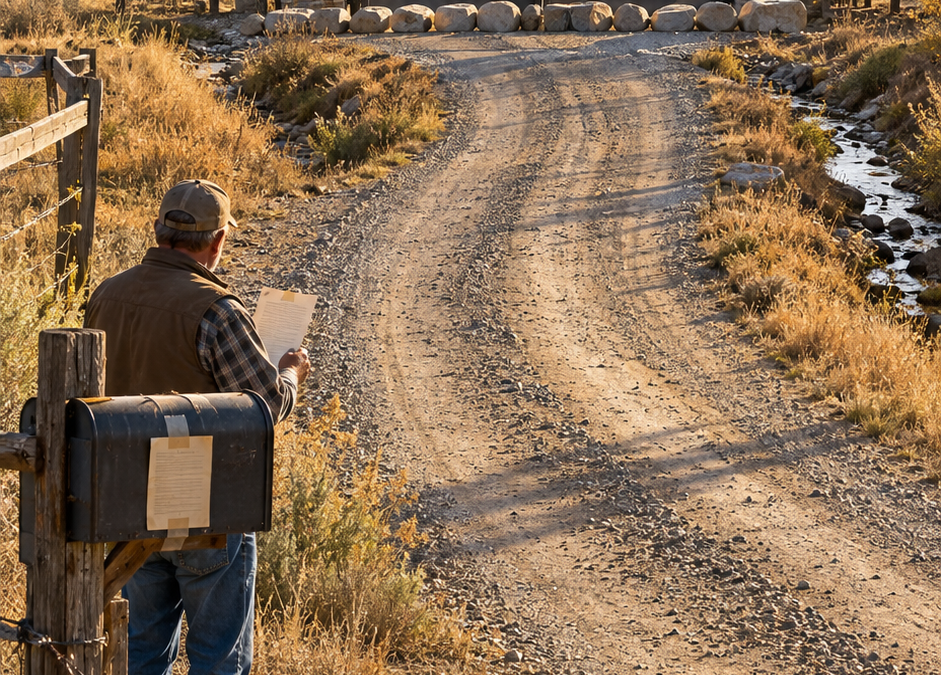
I found the letter taped to my mailbox.
Not inside it.
Taped to the outside like a public notice, angled so I could not possibly miss it.
The envelope was thick, cream-colored, and sealed with the Briar Crest Estates logo. My name was printed in bold block letters across the front.
I stood there beside the road with one hand on the mailbox door, feeling the wind move through the dry weeds along the ditch.
Something about the placement of that letter made my jaw tighten before I even opened it.
People tape letters to mailboxes when they want a message to feel official, immediate, and a little humiliating. They want anyone driving by to know there is trouble. They want you to feel watched before you even read the words.
I tore it open.
The letter was signed by Linda Reynolds, president of the Briar Crest Homeowners Association.
I knew Linda.
Everyone near Briar Crest knew Linda.
She was the kind of woman who could turn a committee agenda into a weapon. Late fifties, silver hair cut into a perfect bob, expensive jackets in soft colors, and eyes that never warmed even when her mouth smiled. She had a voice trained for public meetings: calm, polished, and sharp enough to cut paper.
The letter began with fake courtesy.
Dear Mr. Harlan,
Please be advised that the private roadway previously used for access along the eastern boundary of your property has been legally acquired by Briar Crest Estates Homeowners Association through a recorded purchase transaction finalized on October 14.
Effective immediately, unauthorized use of this road is prohibited.
My eyes slowed.
I read the next sentence twice.
You are hereby instructed to cease all vehicular traffic across the HOA-controlled roadway and to secure alternative access to your property.
Secure alternative access.
There was no alternative access.
That road was the only practical connection between my property and the county highway. Behind my land was steep wooded terrain cut by a ravine. To the west, a creek and wetlands made vehicle passage impossible without permits and bridge work that would take years. To the south was Briar Crest itself, fenced, gated, and guarded. The gravel road was not a luxury.
It was the artery.
The letter continued with threats.
Any continued use may be treated as trespass. The HOA reserves all rights and remedies, including installation of physical barriers, pursuit of injunctive relief, and recovery of associated legal costs.
At the bottom, Linda had signed her name in blue ink.
I stood there for a long moment, listening to nothing but leaves scraping across gravel.
Then I laughed once.
Not because it was funny.
Because the alternative was throwing the letter into the ditch and driving straight to Linda’s office with a temper hot enough to cost me money.
I folded the letter carefully, put it back in the envelope, and walked to the house.
My kitchen table became a document table before breakfast.
I pulled out deeds, maps, old closing files, title insurance papers, survey records, and a battered folder my father had labeled ACCESS in black marker. My father labeled everything in capital letters as if the words needed to be ready for court.
For years, I had teased him about it.
That morning, I silently apologized.
The access road had always been tied to a recorded easement. At least, that was what I had always understood. The neighboring parcel owner, a quiet man named Arthur Bell, had never objected to my use. His father had known mine. Their agreement had gone back decades, partly written, partly lived.
But lived agreements become dangerous when land changes hands.
I found the recorded easement in the old closing packet.
It granted ingress and egress over the gravel road for the benefit of my parcel.
I read it slowly, then read it again.
The language was not perfect. Old documents rarely are. But it existed. It named my parcel. It described the road corridor. It allowed access to and from the county highway.
So why would Linda send a letter pretending I had no right?
The answer came before noon.
I was standing in the barn office, on hold with the county recorder, when a white SUV rolled through my open front gate and stopped near the equipment shed.
Linda Reynolds stepped out.
She was dressed like she had come from a board meeting, not a gravel drive: navy slacks, cream blouse, gold watch, folder tucked under one arm. Behind her, the SUV idled with its hazard lights blinking like she was conducting official business.
I stepped out of the barn office.
“Linda.”
“Mr. Harlan,” she said. “I’m glad I caught you.”
“You caught me on my property, so that was not difficult.”
Her polite smile held.
“I assume you received the notice.”
“I did.”
“Good. Then I trust there won’t be any confusion going forward.”
“That depends on whether you can explain why your letter ignores my recorded easement.”
Her smile thinned.
She opened the folder.
“The HOA purchased the adjoining road parcel from Mr. Bell. The transaction is recorded. The road is now private HOA-controlled property.”
“I understand you bought the road.”
“Then you understand that your continued use is unauthorized.”
“No. I understand you bought land that was already burdened by an access easement.”
She looked at me the way people look at dogs that refuse simple commands.
“Mr. Harlan, our counsel has reviewed the purchase agreement.”
“I’m sure he has.”
“The deed transferred ownership to Briar Crest Estates Homeowners Association.”
“I’m not disputing ownership.”
“Then what are you disputing?”
“The fantasy that ownership erased my access rights.”
She inhaled slowly through her nose.
“The association’s position is that any prior informal arrangement between you and Mr. Bell did not survive transfer.”
I walked back into the barn office, picked up the copy of the easement, and returned.
“This is not informal.”
I handed it to her.
She did not take it immediately. That told me she already knew it existed.
Finally, she accepted the paper, glanced at it, and closed the folder slightly over it as if hiding it from the air.
“This document is old.”
“So is the road.”
“It may not reflect current ownership.”
“That is not how easements work.”
Her eyes sharpened.
“You are not an attorney.”
“No, but I can read.”
Her smile vanished for the first time.
“The HOA acquired the road to manage safety, maintenance, and access control. Your vehicles create dust, noise, and liability exposure. The road runs through land now owned by the association.”
“And my easement runs with my parcel.”
“That will need to be reviewed.”
“You should have reviewed it before you taped a threat to my mailbox.”
Linda lifted her chin.
“I came here as a courtesy.”
“No. You came here to see whether I would fold.”
The silence between us changed shape.
She looked toward the gravel road, then back at me.
“You should begin looking for another route.”
“There is no other route.”
“That is unfortunate.”
The way she said it made my stomach go cold.
Not because she sounded cruel.
Because she sounded prepared.
“You know there’s no other route,” I said.
She did not answer quickly enough.
Then she said, “The association cannot be responsible for your lack of independent access planning.”
“My property has legal access.”
“That is your interpretation.”
“No. That is the recorded document sitting in your hand.”
She slipped the easement copy into her folder as if it belonged to her.
“I’ll have counsel respond.”
“Leave the copy.”
She paused.
“It was provided to me.”
“It was shown to you. Leave it.”
For a moment, I thought she might refuse.
Then she removed the paper and handed it back.
Her fingers were cold when they brushed mine.
“The HOA will protect its property interests,” she said.
“So will I.”
She walked back to her SUV.
Before getting in, she turned.
“I would advise you not to escalate this.”
I looked at the letter still folded in my jacket pocket.
“Linda, you blocked my only road and called it a courtesy. We’re already past advice.”
She drove away without another word.
I watched her SUV until it reached the bend near the cottonwoods and disappeared.
Then I went back inside and called an attorney.
His name was Martin Ellis, and he had handled two boundary disputes for families I trusted. He was not flashy, not cheap, and not impressed by dramatic stories unless the documents supported them.
When I finished explaining, he asked for the easement, the HOA letter, the road purchase record, my deed, and any correspondence from Briar Crest.
I emailed everything within the hour.
He called back that evening.
“The easement helps you,” he said.
“That’s good.”
“It is not the whole picture.”
My hand tightened around the phone.
“What does that mean?”
“It means the HOA may challenge scope, maintenance obligations, or exact location depending on how aggressive they want to be. But their position that buying the road automatically eliminates your access is weak.”
“Weak enough to stop them?”
“With a court order, likely. Without one, they may try to physically interfere first and argue later.”
I looked out the kitchen window toward the access road.
“You think they’ll block it?”
“I think they bought the road for a reason.”
That sentence stayed with me.
After we hung up, I sat at the kitchen table long after dark, surrounded by maps.
I should have been focused only on defending my access.
Instead, something else began to bother me.
The timing.
Briar Crest had been expanding again. For months, surveyors had been working near the south side of the development. A large sign had gone up near the highway announcing “Briar Crest Phase III: Elevated Living, Modern Access, Mountain Convenience.”
The phrase modern access appeared in large silver letters.
A week earlier, I had seen equipment staged near an old county bridge just east of my property. It was a small bridge, not much to look at, crossing a narrow creek where the county road dipped low before climbing toward Briar Crest’s construction area.
For most people, that bridge was just part of the landscape.
For construction crews, it was critical.
It was the only bridge in that section rated for the kind of concrete mixers, equipment haulers, and heavy utility trucks needed for the Phase III site without taking a long detour through steep switchbacks on the far side of the valley.
I pulled the county map closer.
The bridge sat beside a small triangular parcel that had been ignored for years. A leftover piece of land, wedged between the county right-of-way, the creek, and the edge of an old pasture. It was too small for a house, too awkward for farming, and too easy to overlook.
But the map showed something important.
The bridge approach, staging shoulder, and turn radius used by heavy trucks depended on that little parcel.
I stared at it.
Then I checked the ownership.
The parcel belonged to a man named Roy Whitaker.
I knew Roy slightly. He lived two towns over and had inherited scattered land from an uncle. Years ago, he had leased pasture near my father. He was not sentimental about property he did not use.
I kept reading.
The triangular parcel had direct frontage near the county bridge. It was outside Briar Crest. It was outside the road parcel the HOA had purchased. It touched land connected to public access. It had no house, no building, and no obvious value.
Unless someone needed that bridge approach.
I leaned back in my chair.
For the first time all day, my anger cooled into something sharper.
Linda had bought the road to control my movement.
But Briar Crest needed movement too.
They needed concrete trucks to reach Phase III. They needed utility crews. They needed excavators, framing deliveries, septic contractors, paving equipment, and emergency access improvements.
And the route they intended to use depended on a piece of land they did not own.
I looked at my father’s old ACCESS folder.
Then I looked back at the triangular parcel.
“No,” I said quietly. “You don’t get to be the only one who reads maps.”
The next morning, I called Roy Whitaker.
He answered on the fourth ring with a suspicious “Yeah?”
“Roy, this is Tom Harlan.”
There was a pause.
“Harlan from the north pasture place?”
“That’s right.”
“Haven’t heard your name in a while. Your dad still around?”
“He passed three years ago.”
Another pause, softer this time.
“Sorry to hear that. He was a straight shooter.”
“He tried to be.”
“What can I do for you?”
“I’m calling about that small parcel you own near County Bridge 12.”
Roy laughed once.
“That useless little triangle?”
“That’s the one.”
“What about it?”
“I’d like to buy it.”
Silence.
Then, “Why?”
I respected the question.
“Because it connects to access issues near my land.”
“That HOA bothering you?”
I smiled despite myself.
“What makes you ask?”
“Because nobody cares about weird little strips of land until developers start acting clever.”
I did not answer.
Roy chuckled.
“Thought so.”
“Are you willing to sell?”
“I’d sell it if the price was fair and the paperwork was clean. I don’t use it. Taxes are annoying. But if Briar Crest wants it, I’m not giving it away.”
“They haven’t contacted you?”
“Nope.”
That surprised me.
“They may not realize they need it.”
“Then they’re dumber than they look.”
I liked Roy more in that moment than I ever had.
We talked for nearly forty minutes.
He told me what he knew about the parcel. It had been carved off during an old road adjustment. His uncle had kept it because nobody else wanted to pay for a survey correction. The county maintained the bridge itself, but the shoulder and part of the approach area outside the right-of-way sat on private land.
“People have crossed near it forever,” Roy said. “But heavy construction staging? That’s a different animal.”
“Do you have any recorded access agreements?”
“Not with Briar Crest.”
“Any easements?”
“County has what the county has. Everyone else can ask.”
By the end of the call, I made an offer.
Not insulting.
Not reckless.
Enough that Roy knew I understood the parcel’s sudden importance.
He did not accept immediately. He said he wanted his niece, who handled his paperwork, to look it over. I told him that was fine, but the offer was good for forty-eight hours.
He laughed again.
“You sound like your dad.”
“I’ll take that as a compliment.”
“You should.”
Two days later, Roy accepted.
The closing happened quickly because small cash land deals can move fast when both sides are motivated and nobody is pretending the property has a mansion hidden under the weeds. My attorney reviewed the title. The deed was drafted. The county documents were recorded.
By Friday afternoon, the triangular bridge parcel was mine.
I did not announce it.
I did not call Linda.
I did not block the bridge, park equipment across the shoulder, install a chain, or tape a letter to anyone’s mailbox.
I simply put the recorded deed into a folder, drove to the parcel, and stood beside the bridge for twenty minutes.
The creek below was low, moving over stones in thin sheets of cold water. The county bridge was made of concrete and steel, practical and ugly. On the far side, the road widened slightly where heavy trucks had clearly been expected to swing toward the Briar Crest construction entrance.
I looked at the tire marks already visible in the dirt.
Then I looked at the parcel boundary markers.
The HOA had bought a road.
They had not bought the problem.
That weekend, I continued using my own access road.
Carefully.
I documented every trip.
I took video from my dashboard showing the route, the lack of obstruction, and the historic use. My attorney filed a formal letter rejecting the HOA’s claim that my access had been extinguished and demanding written assurance that they would not interfere.
Linda did not answer directly.
Her attorney did.
The letter was polished, dense, and arrogant. It claimed the HOA disputed the scope and validity of my easement. It warned that continued use could result in legal action. It invited me to propose “reasonable alternative access arrangements.”
I read that phrase at my kitchen table.
Reasonable alternative access arrangements.
Again, there was no alternative access.
That was the point.
They did not want a negotiation. They wanted pressure. They wanted me to pay, relocate, sell, or accept whatever terms made my property easier for their plans.
Martin Ellis read the letter and said, “They’re setting up leverage.”
“So are we.”
He paused.
“What did you do?”
“I bought the Whitaker bridge parcel.”
Silence.
Then he said, very slowly, “You bought the parcel beside County Bridge 12?”
“Yes.”
“Recorded?”
“Yesterday.”
Another silence.
Then he laughed under his breath.
“Tom.”
“What?”
“That is either brilliant or the beginning of a very expensive month.”
“Can it be both?”
“It usually is.”
I told him I was not planning to block anyone unlawfully. I did not want to interfere with county road use or emergency services. I simply wanted my property rights respected the same way the HOA claimed theirs should be.
“That distinction matters,” he said.
“I know.”
“Do not put up barriers without talking to me.”
“I won’t.”
“Do not threaten truck drivers.”
“I won’t.”
“Do not get into a screaming match with Linda Reynolds on video.”
“I’ll try.”
“I mean it.”
“So do I.”
He sighed.
“Send me the deed.”
I did.
Monday morning came cold and bright.
I was repairing a gate hinge near the lower pasture when I heard the first heavy truck.
The sound carried up the road before the vehicle appeared: deep diesel, air brakes, the clatter of an empty concrete mixer bouncing over patched asphalt. A second truck followed behind it. Then a flatbed carrying equipment. Then two white pickups with company logos on the doors.
They were headed toward County Bridge 12.
I wiped my hands on a rag and walked to my truck.
By the time I reached the bridge parcel, the first concrete mixer had slowed to a stop near the approach. The driver leaned out his window, looking confused. Ahead of him, one of my newly placed boundary stakes stood clearly along the edge of my parcel, marked with orange ribbon.
I had not blocked the county bridge.
I had not blocked the public lane.
But I had marked the private shoulder and staging area they needed to swing wide into the construction route.
Without it, the mixer could not make the turn safely.
The driver looked at the stake, then at the narrow angle, then at me.
“You the property owner?” he called.
“Yes.”
“We’re supposed to access Briar Crest Phase III through here.”
“Who gave you permission to use this shoulder?”
He blinked.
“The route packet shows this as the construction access.”
“That wasn’t my question.”
He looked down at papers clipped to his dashboard.
“I just follow the route.”
“I understand. You may want to call your dispatcher before proceeding.”
The second truck stopped behind him. Then the flatbed. Within minutes, the small road near the bridge was lined with construction vehicles that had nowhere to go without crossing the very piece of land the HOA had not bothered to secure.
I stood beside my truck with the recorded deed folder under my arm.
I felt no joy.
That surprised me.
I had imagined, during angry moments, that I would feel satisfaction when their plan turned back on them. But standing there, watching drivers caught in someone else’s arrogance, I mostly felt tired.
This could have been avoided.
All of it.
The blocked road letter. The threats. The rush to buy land. The legal fees. The trucks sitting idle beside a county bridge because the people giving orders had confused control with competence.
A white SUV came fast down the road from Briar Crest.
Linda Reynolds stepped out before it fully settled.
Her face was flushed, and for once, her polished calm had cracked around the edges.
“What is going on?” she demanded.
I looked at the line of trucks.
“That seems like a question for your construction manager.”
She strode toward me.
“Why are these trucks stopped?”
“Because they don’t have permission to use my property.”
Her eyes narrowed.
“Your property?”
I opened the folder and removed the deed.
“The bridge parcel.”
She stared at the paper.
For a moment, she did not understand.
Then she did.
I saw it happen.
The blood drained slightly from her face, and her eyes moved from the deed to the shoulder beside the bridge, then to the boundary stakes, then to the line of trucks.
“No,” she said.
It was quiet. Almost involuntary.
“Yes,” I said.
“That parcel belongs to Whitaker.”
“It did.”
“When did you—”
“Recently.”
Her mouth tightened.
“This is obstruction.”
“No. This is ownership.”
“You purchased this parcel to interfere with an approved construction route.”
“I purchased property that was available for sale.”
“You knew the HOA needed this route.”
“I knew the HOA was suddenly interested in controlling access. It inspired me to pay attention.”
The concrete driver looked out his window and then wisely looked straight ahead.
Linda lowered her voice.
“You are creating a serious problem.”
“You created the problem when you tried to landlock me.”
“We did no such thing.”
I reached into my jacket and pulled out the letter from my mailbox.
“You demanded that I stop using my only access road immediately.”
“The HOA acquired that road legally.”
“And I acquired this parcel legally.”
“That is not the same.”
“No. It’s exactly the same logic. You bought property and claimed control. So did I.”
Her eyes flashed.
“The road purchase was part of a broader safety and maintenance plan.”
“My parcel purchase is part of my broader plan not to be bullied by a committee with a folder.”
One of the pickup doors opened behind her.
A construction manager stepped out, phone pressed to his ear.
“Ms. Reynolds,” he said carefully, “we have concrete scheduled. If we can’t get across now, we’re going to lose the pour window.”
Linda turned on him.
“Find a way around.”
He glanced toward the road.
“With those mixers? Not safely. The alternate route adds ninety minutes and has a grade issue. Also, the flatbed can’t make the upper switchback.”
“That is not acceptable.”
“I understand, but we need authorization for this shoulder.”
Linda looked back at me.
“The county bridge is public.”
“The bridge is public. My parcel beside it is not.”
“The trucks only need to swing through the edge.”
“Then they need permission.”
“This is absurd.”
“No, Linda. Absurd is telling a man to find a road that doesn’t exist while your own project depends on land you forgot to secure.”
She stepped closer.
“You are retaliating.”
“I am responding.”
“You are intentionally harming the HOA.”
“I am protecting property I legally own.”
“You don’t even need this parcel.”
“That sounds familiar.”
Her face hardened.
Then she said the sentence I had been expecting.
“I’m calling the sheriff.”
I nodded.
“That’s probably best.”
She seemed disappointed that I did not flinch.
The next twenty minutes were a strange kind of theater.
Drivers waited.
The construction manager paced.
Linda made calls.
A Briar Crest board member arrived in another SUV and immediately began taking photos of my boundary stakes as if orange ribbon were evidence of a crime.
I stood by my truck and called Martin Ellis.
He answered quickly.
“Tell me you are not in handcuffs.”
“Not yet.”
He sighed. “What happened?”
“Construction trucks tried to use the bridge parcel. I told them they needed permission. Linda called the sheriff.”
“Did you block the county road?”
“No.”
“Did you block the bridge itself?”
“No.”
“Did you threaten anyone?”
“No.”
“Did you put anything physical across the lane of travel?”
“No.”
“Good. Put me on speaker if the deputy wants to talk.”
“Understood.”
When the sheriff’s cruiser arrived, the situation had already attracted an audience.
Two homeowners from Briar Crest had parked near the far entrance. A utility subcontractor sat on a tailgate eating something from a foil wrapper. The concrete truck engines rumbled in a line, burning money by the minute.
Deputy Carla Mendez stepped out of the cruiser.
I knew her by sight. She had responded years earlier when cattle from a neighboring ranch got loose after a storm. She was calm, direct, and not easily impressed.
She looked at the trucks, the bridge, Linda, me, and the boundary stakes.
“Who called?”
Linda stepped forward immediately.
“I did. This man is obstructing a lawful construction route.”
Mendez looked at me.
“Mr. Harlan?”
“Yes, Deputy.”
Linda said, “He purchased a small parcel beside the county bridge for the sole purpose of blocking HOA construction access.”
Mendez held up one hand.
“One at a time.”
Linda took a breath, visibly forcing herself into meeting-room composure.
“The HOA has an approved construction project in Briar Crest. These trucks are scheduled to cross County Bridge 12 and access the Phase III site through the established construction route. Mr. Harlan is interfering.”
Mendez turned to me.
“Your version?”
“The county bridge is open. The public lane is open. I have not blocked either. The trucks need to use my private parcel beside the bridge to make the turn and stage equipment. They do not have permission.”
Mendez looked at the shoulder.
“Is that your parcel?”
I handed her the deed.
“Yes.”
She read the first page, then the legal description, then looked toward the boundary stakes.
“This was recorded last week?”
“Yes.”
Linda interrupted.
“He bought it after the HOA purchased the access road near his property. This is retaliation.”
Mendez glanced at her.
“Retaliation is not usually my first question in a property dispute. Ownership is.”
Linda’s mouth tightened.
Mendez turned back to me.
“Are you preventing travel on the county bridge?”
“No.”
“Are you preventing vehicles from using the public road?”
“No.”
“Are you saying they cannot enter the private parcel without permission?”
“Yes.”
She nodded slowly.
The construction manager approached.
“Deputy, with respect, the trucks can’t make the turn without using that shoulder.”
Mendez looked at him.
“Do you have written permission from the owner?”
He hesitated.
“Our route packet—”
“That is not what I asked.”
He looked at Linda.
Linda opened her folder.
“We have project approvals.”
Mendez’s eyes shifted to the folder with the weariness of a deputy who had seen many folders used as smoke.
“Do you have written permission from the current parcel owner?”
Linda did not answer.
I felt the moment settle.
It was not dramatic. No music swelled. No one gasped.
But every person there understood it.
The HOA had done to itself what it tried to do to me.
It had assumed control was the same as right.
Linda recovered enough to say, “This is a civil matter.”
Mendez nodded.
“It sounds like one.”
“Then he cannot stop approved construction.”
Mendez looked at her evenly.
“That is not what civil matter means.”
Linda flushed.
Mendez continued, “I’m not going to order a private landowner to allow construction vehicles onto his parcel without documentation. I’m also not going to adjudicate easements or development approvals on the roadside. If you have a court order, show me.”
Linda looked at her folder.
No order.
Mendez turned to the construction manager.
“Do not enter the marked private parcel unless you have permission or legal authority. Keep the county road clear. If these trucks are creating a traffic hazard, move them.”
The manager rubbed his forehead.
“Yes, Deputy.”
Linda stepped closer to Mendez.
“Deputy, the HOA will suffer substantial financial losses if this pour is delayed.”
Mendez said, “That may be something to discuss with your attorney.”
“It is unreasonable for one man to hold up an entire community project.”
Mendez looked from Linda to me, then back again.
“I was told there’s also a dispute about his access road.”
Linda stiffened.
“That is unrelated.”
I laughed once under my breath.
Mendez noticed but did not react.
Linda said, “The HOA legally purchased a private road and is enforcing its rights.”
Mendez’s face stayed neutral.
“So both sides are enforcing property rights.”
Linda did not like that framing.
“This is different.”
Mendez waited.
Linda had no clean explanation.
The deputy handed my deed back to me.
“Mr. Harlan, I suggest you stay calm and continue working through counsel.”
“I intend to.”
She looked at Linda.
“Same advice.”
Linda’s jaw clenched.
Mendez returned to her cruiser but did not leave immediately. She stayed while the construction manager made a series of painful phone calls.
The first concrete mixer backed up slowly, air brakes sighing. The second followed. The flatbed driver had to make a careful three-point maneuver to avoid touching the marked shoulder. It took nearly half an hour to clear the road.
Linda stood beside her SUV, watching the trucks leave.
I did not speak.
I did not gloat.
I did not need to.
The road did that for me.
When the last truck disappeared toward the highway, Linda turned toward me with a look I will never forget. Not rage exactly. Rage is simple. This was worse. It was the expression of a person forced to experience the rules she had tried to use against someone else.
“You planned this,” she said.
“I read the map.”
“You bought that parcel to create leverage.”
“You bought my access road to create leverage.”
“The HOA had legitimate concerns.”
“So did I.”
“This could have been handled cooperatively.”
That one almost broke my restraint.
“Linda, you taped a letter to my mailbox ordering me to stop using the only road to my home.”
Her lips pressed together.
“You could have contacted the board.”
“You could have contacted me before buying the road.”
She looked away.
For the first time, the folder under her arm seemed heavy.
I stepped closer, not enough to threaten her, only enough to make sure she heard me.
“I’m not trying to trap anyone. I’m protecting property I legally own. That is the exact principle you claimed to believe in when you bought the road.”
She said nothing.
“Now we can either keep paying lawyers to prove obvious things, or the HOA can sit down and resolve both access issues properly.”
Her eyes returned to mine.
“What do you want?”
I had been waiting for that question.
Not because I wanted to punish her.
Because it was the first honest question she had asked.
“I want written recognition of my easement over the access road,” I said. “No gates. No barriers. No threats. No interference with normal residential, agricultural, maintenance, delivery, and emergency use.”
“That road now belongs to the HOA.”
“Then the HOA owns land subject to my access rights.”
She swallowed.
I continued.
“I want the mailbox letter withdrawn in writing. I want confirmation that your board will not instruct guards, contractors, or residents to obstruct me. I want road maintenance terms clarified so we are not fighting every time gravel gets thin. And if Briar Crest wants temporary construction access over my bridge parcel, we can discuss a license agreement with insurance, time limits, route restrictions, restoration obligations, and compensation.”
Linda gave a short, humorless laugh.
“Compensation.”
“Yes.”
“For a strip of dirt?”
“For property you need.”
Her face hardened again.
“You are being opportunistic.”
“No. I am being educated by your example.”
That landed.
She looked toward Deputy Mendez’s cruiser, still parked nearby, then back to me.
“I need to speak with counsel.”
“So do I.”
“This will not be resolved today.”
“No. But today it became honest.”
Linda got into her SUV and slammed the door harder than necessary.
After she left, Deputy Mendez pulled up beside me.
“You all done for now?”
“I think so.”
She nodded toward the bridge parcel.
“Interesting week?”
“You could say that.”
“I’m not giving legal advice,” she said. “But people get themselves into trouble when they mistake paperwork for permission.”
I looked down the road Linda had taken.
“That seems to be going around.”
Mendez almost smiled.
“Keep your attorney involved.”
“I will.”
She drove away.
The bridge grew quiet again.
The creek moved under the concrete span. A few leaves spun in a shallow eddy below. The orange ribbons on my boundary stakes flickered in the wind.
I stood there until the last echo of diesel faded.
That night, I slept better than I had in weeks.
The fight was not over. I knew that. Property disputes do not end because one roadside confrontation goes your way. They end through records, signatures, court orders, settlements, or exhaustion. Sometimes all four.
But something fundamental had changed.
The HOA no longer had a clean story.
Before the bridge, they were the organized association enforcing road ownership against one stubborn outsider. After the bridge, they were the association that bought a road to squeeze a man’s access while forgetting their own construction project depended on land they had not secured.
That difference mattered.
Martin called the next morning.
“I heard from their counsel,” he said.
“I bet you did.”
“They want to discuss a global access resolution.”
“Global sounds expensive.”
“It means they are suddenly interested in solving both problems at once.”
“Good.”
“They also allege you acted in bad faith by acquiring the bridge parcel.”
“Did you ask whether buying a road to block my access was good faith?”
“I phrased it more professionally.”
“I’m sure you did.”
He cleared his throat.
“They are willing to withdraw the immediate trespass demand while discussions proceed.”
I leaned back in my chair.
“Say that again.”
“They are willing to withdraw the immediate trespass demand.”
“No. They are willing to admit their threat didn’t work.”
“Again, I phrased it more professionally.”
I smiled for the first time in days.
“What happens now?”
“Now we draft terms. You should be reasonable, but not weak.”
“That’s the plan.”
“Then we start with recognition of your easement.”
“Yes.”
“Then maintenance.”
“Yes.”
“Then noninterference.”
“Yes.”
“Then temporary construction access over the bridge parcel, if you are willing.”
“For the right terms.”
“Insurance, indemnity, schedule limits, weight restrictions, repair obligations, and compensation.”
“And written acknowledgment that permission is temporary and does not create permanent rights.”
“Already on my list.”
The first formal meeting happened six days later in a conference room at a title company.
Linda was there.
So were two HOA board members, their attorney, my attorney, a project manager, and a civil engineer who looked like he wished he had chosen a different profession.
No one raised their voice.
That was how I knew the bridge had done its job.
Linda’s attorney began by saying the HOA wanted to avoid unnecessary litigation and preserve neighborhood relationships.
Martin responded that neighborhood relationships usually benefited from not landlocking people.
The HOA attorney did not enjoy that.
We spent three hours going through documents.
The road deed.
My easement.
The HOA purchase agreement.
Historic maintenance records.
The bridge parcel deed.
Construction route diagrams.
Insurance requirements.
County bridge limitations.
The engineer confirmed what I already knew: without access over my small parcel near the bridge, the Phase III construction route would require a major detour, delay, and redesign. Heavy trucks could not safely use the planned turn without crossing the private shoulder.
Linda sat very still when he said that.
Martin slid a proposed agreement across the table.
It was direct.
The HOA would acknowledge my continuing easement over the access road. They would withdraw the mailbox notice. They would agree not to gate, block, narrow, harass, or otherwise interfere with my use. We would establish shared maintenance procedures based on actual use and documented costs.
In a separate temporary license, I would allow limited construction vehicles to use the bridge parcel under strict conditions. The license would expire automatically. The HOA would pay a fee. Contractors would carry insurance. Any damage would be repaired. No permanent easement would be created. No storage, staging, or expansion beyond the defined path.
Linda read silently.
Her attorney whispered to her twice.
Finally, she looked up.
“This is a lot of money for temporary access.”
I said, “It is less than redesigning your route.”
Her attorney gave her a look that told her not to argue that point.
One of the board members, a man named Peter Wallace, rubbed his forehead.
“We should have identified this earlier,” he muttered.
Linda turned sharply toward him.
He looked back at her.
“We should have.”
That small fracture in the room told me more than any apology could have.
The board had followed Linda into a strategy. Now the cost was visible.
By the end of the meeting, nothing was signed, but the framework was there.
Two weeks later, it became official.
The HOA recorded a written acknowledgment of my access easement. The mailbox notice was withdrawn in a formal letter. They agreed that my use of the road could not be treated as trespass as long as it stayed within the easement’s scope. We established maintenance terms that were boring, fair, and enforceable.
The temporary bridge parcel license was signed the same day.
The fee was substantial but not outrageous. The insurance provisions were strict. The route was marked. The time window was limited. The HOA had to restore the shoulder when construction ended. The agreement stated, in language even Linda could not bend, that no permanent access right was being granted.
When the first construction trucks returned, they crossed legally.
That mattered to me.
Some people thought I wanted to stop them forever.
I did not.
I wanted them to ask.
I wanted them to learn that ownership did not become selfish simply because someone else needed what you had. I wanted them to understand that a man protecting his access was not an obstacle to progress. He was a person with rights, history, and a home at the end of the road.
The day after the agreements were recorded, I drove the access road from my gate to the county highway.
No guard stopped me.
No letter waited on my mailbox.
No SUV followed me.
At the bend near the cottonwoods, I slowed.
The gravel looked the same as it always had. Dust rose behind the truck. Sunlight broke through the trees in narrow bands. The ditch grass leaned in the wind.
It was strange how ordinary it felt.
A week earlier, that same stretch of road had carried the full weight of my fear. I had imagined gates, lawsuits, emergency vehicles delayed, deliveries refused, my home turned into a place I could technically own but not practically reach.
Now it was just a road again.
That was the victory.
Not humiliation.
Not revenge.
Just the restoration of something that should never have been threatened.
A month later, I saw Linda Reynolds near the bridge.
She was standing with the project manager, reviewing the marked temporary route. Trucks were moving through slowly, exactly within the agreed path. A worker was spraying water to keep dust down. Another was checking the edge of the shoulder after each heavy vehicle.
Linda saw my truck and looked away first.
I parked near my boundary line and stepped out.
The project manager walked over.
“Everything’s staying within the route,” he said quickly.
“I can see that.”
“We’ll send the weekly inspection photos Friday.”
“Good.”
Linda approached after a moment.
“Mr. Harlan.”
“Linda.”
Her voice was controlled but quieter than usual.
“The board approved the maintenance payment schedule.”
“I saw the email.”
“And the withdrawal letter was recorded with the agreement.”
“Yes.”
She looked toward the bridge.
“I still believe this could have been handled differently.”
“So do I.”
That answer made her pause.
For a second, I thought she might defend herself again.
Instead, she said, “The board should have spoken with you before sending the notice.”
It was not much.
But it was more than I had expected.
“Yes,” I said. “You should have.”
She nodded once.
Then she went back to the project manager.
I stood beside the bridge and watched a concrete truck move slowly across the turn, its tires staying precisely inside the temporary access line.
No shouting.
No sheriff.
No threats.
Just permission, written down.
That was all it had ever needed.
When I got home, I put the signed agreements in my father’s ACCESS folder.
The folder was thicker now.
I ran my hand over the black marker letters he had written years earlier and felt the ache of missing him rise without warning.
He would have liked the bridge parcel.
He would have stood at the kitchen table, studied the map, tapped that little triangle with one calloused finger, and said, “That’s where they forgot to look.”
Then he would have told me not to get cocky, because land fights are never won by pride. They are won by patience, records, and knowing exactly where the lines are.
He would have been right.
The HOA had tried to box me in with a road purchase. They had assumed that because they had money, lawyers, meetings, and a polished president with a folder, I would accept their version of reality. They thought a letter on my mailbox could erase decades of access. They thought pressure could replace permission.
But property has a memory if you know how to read it.
The old easement remembered.
The county maps remembered.
The little bridge parcel remembered.
And when Linda Reynolds tried to close the only road to my home, every overlooked line on those maps became louder than her threats.
I still use that gravel road.
Every morning, when my tires roll over the same worn track my father used, I think about how close they came to making me fight just to reach my own front gate. I think about the letter taped to the mailbox, the trucks stopped at the bridge, the deputy asking one simple question nobody from the HOA could answer.
Do you have written permission from the current owner?
That question ended the performance.
It did not end the tension between me and Briar Crest. I doubt anything ever will. They still prefer manicured entrances and controlled views. I still prefer fences that mean what they say and roads that honor the records beneath them.
But they do not threaten my access anymore.
And every time their construction trucks cross that bridge under the temporary license, they pass over a lesson written into the land itself.
You can buy a road.
You can send a letter.
You can arrive with a folder full of confidence and call it authority.
But if you forget to check the map carefully enough, the man you tried to trap may already be standing on the one piece of ground you need most.








