𝗙𝗨𝗟𝗟 𝗦𝗧𝗢𝗥𝗬 The Morning the Bulldozers Crossed My Fence, Karen Finally Learned What My Deed Was Worth
𝗙𝗨𝗟𝗟 𝗦𝗧𝗢𝗥𝗬
I listened.
That was why, when the bulldozers came, I was ready in the only way a person can be ready for something that still feels impossible.
The morning it happened, I woke before dawn because of the sound.
At first, I thought thunder was rolling over the ridge.
Then I realized the rhythm was wrong.
Thunder moves across the sky. This sound came from the ground. Deep engines. Metal tracks grinding against stone. Backup alarms cutting through the cold morning air.
I sat up in bed.
For two seconds, I simply listened.
Then I was on my feet.
I pulled on jeans, boots, and a jacket, grabbed my keys, and stepped onto the porch. The air smelled like diesel. That told me everything I needed to know.
The ridge road was still dark when I drove up.
My headlights bounced across the fence line, catching dust in the air long before I reached the top. The closer I got, the louder the machinery became. By the final bend, my hands were tight on the steering wheel.
When the ridge opened in front of me, I saw them.
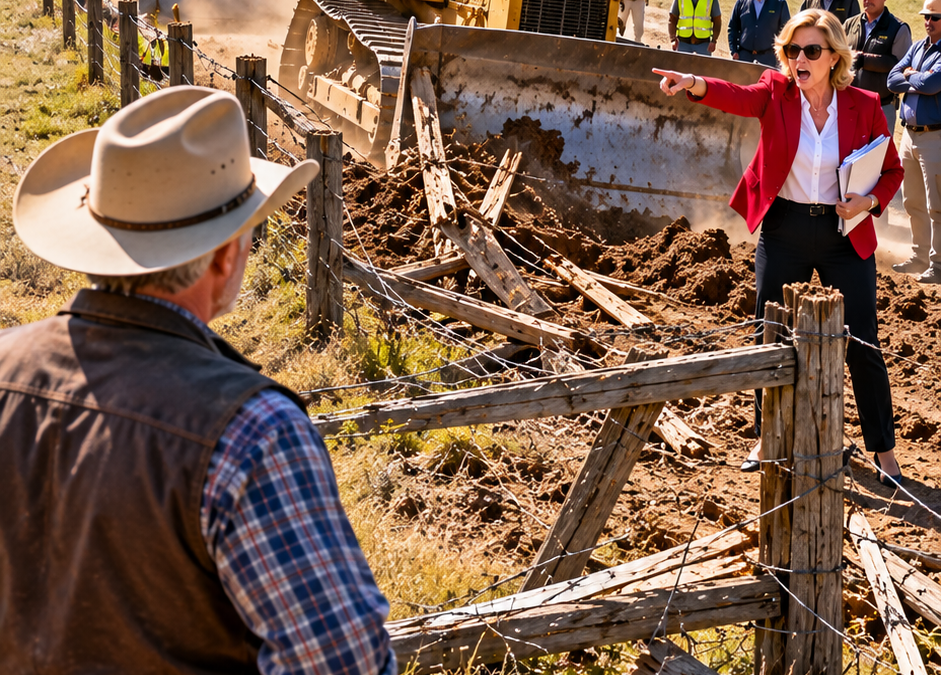
Two bulldozers were already inside my ranch boundary.
A third machine sat near the old fence, its blade lifted but ready. Fresh track marks scarred the ground where grass had been intact the night before. Survey stakes with orange ribbon marked a line straight across the ridge, cutting through my pasture as if the land had been measured by someone who had never touched a deed.
Several men in hard hats stood near a white pickup.
Behind them, wearing a gray coat and holding a clipboard, stood Karen Whitmore.
For a moment, I did not move.
There are kinds of anger that make a man shout.
This was not that.
This was the kind that went cold.
I parked my truck at the edge of the track marks and stepped out.
The nearest bulldozer kept moving.
I raised one arm and shouted, “Shut it down.”
The operator looked toward the white pickup.
Karen did not tell him to stop.
The bulldozer continued forward, blade scraping low shrubs from the slope.
I walked toward Karen.
“What are you doing on my ranch?”
She turned as if she had been expecting me.
“Good morning, Mr. Hale.”
“Answer the question.”
Her eyes flicked toward the bulldozers.
“The HOA has approved construction within the development area.”
“This is not the development area.”
“Our records indicate otherwise.”
“Your records are wrong.”
She smiled.
It was not a friendly smile. It was the small, controlled smile of a person who believed the outcome had already been decided elsewhere.
“I understand this may be difficult for you,” she said. “But this land is part of the planned Ridgeview corridor.”
“No, Karen. It’s part of my ranch.”
“The board has reviewed the project boundaries.”
“Then show me the deed.”
She tilted her head slightly.
“I don’t think you understand the rules.”
That sentence stayed with me.
Not because it was clever.
Because it revealed everything.
Karen did not say I misunderstood the deed. She did not say I misunderstood the boundary. She said I did not understand the rules, as if HOA rules could reach out past their own property line, climb over my fence, and drag fourteen hundred acres into her jurisdiction because she had a clipboard.
I walked back to my truck, opened the passenger door, and pulled out the folder I kept behind the seat.
The folder was thick, old, and ugly. It contained copies of my deed, the latest boundary survey, county parcel maps, tax records, and correspondence from every prior dispute with Silver Pines. My father would have approved. He had believed records belonged wherever trouble might find you.
I returned to Karen and opened the deed.
“This is the recorded property description,” I said. “Fourteen hundred acres. The ridge, the north pasture, the creek bottom, and the fence line your machines just crossed are all inside my parcel.”
She glanced at the page for less than two seconds.
Then she looked past me and lifted one hand toward the crew.
“Continue staging,” she called.
The nearest foreman nodded.
Something in me hardened.
This was not a misunderstanding.
A misunderstanding pauses when a deed appears. A mistake stops to compare records. An honest person says, “Let’s verify this before we damage anything else.”
Karen had seen the deed and told them to keep working.
I stepped closer.
“If that blade moves another foot, you are knowingly trespassing.”
Her expression cooled.
“Mr. Hale, threatening contractors will not help you.”
“I’m warning them. There’s a difference.”
She looked toward the foreman.
“Proceed according to the approved plan.”
I pulled out my phone.
Then I called the sheriff’s office.
While it rang, I began recording.
I filmed the bulldozers, the ridge, the fence, the survey stakes, the track marks, Karen, the crew trucks, and the license plates. I stated the time, location, and what was happening. I recorded myself telling Karen that the land was private property and that she had been shown the deed.
She turned away as soon as she realized I was filming.
That told me she knew enough to be careful.
The dispatcher answered.
“Sheriff’s Office.”
“This is Thomas Hale. I have bulldozers actively crossing my ranch without permission near the north ridge. HOA representatives are on site claiming they own the land. I have deed and survey records showing they do not. I need deputies here now.”
“Is anyone armed?”
“No.”
“Is anyone threatening violence?”
“No. But machines are damaging private property.”
“Stay clear of the equipment. Deputies are en route.”
I ended the call.
Karen watched me with irritation, not fear.
“You’re escalating a civil issue,” she said.
“No. You brought bulldozers across a fence line.”
“The HOA has lawful authority.”
“Then show it.”
“You have been shown the development map before.”
“A map is not a deed.”
“It reflects the development boundary.”
“Then it should match county records.”
For the first time, something flickered in her face.
Not doubt.
Annoyance that I had said the one thing she did not want the morning to become about.
County records.
The bulldozers kept moving for another several minutes.
Each minute felt like an insult carved into the ground.
The machines scraped through brush near the ridge trail, flattened a section of native grass, and pushed soil into a low berm where no berm had existed that morning. I forced myself not to step in front of them. Denise’s voice stayed in my head.
Document first.
Do not give them a picture of you losing control.
So I recorded.
I recorded Karen telling the foreman the HOA had approved the work.
I recorded the foreman saying he had been given maps and authorization.
I recorded the orange stakes.
I recorded the old fence behind them, still standing, ignored but not defeated.
The deputies arrived faster than I expected.
Two sheriff’s vehicles came up the ridge road with lights on but no sirens. Deputies Miller and Alvarez stepped out, both scanning the scene before speaking.
Deputy Miller was older, broad-shouldered, with a gray mustache and the exhausted eyes of a man who had spent too many years listening to people lie badly. Deputy Alvarez was younger, quieter, and immediately began taking photographs.
Miller walked toward me first.
“You Mr. Hale?”
“Yes.”
“You called this in?”
“I did.”
He looked toward the bulldozers.
“Those machines on your land?”
“Yes.”
“Documents?”
I handed him the folder.
He did not skim like Karen had. He read the deed description, studied the survey, and looked at the county parcel map.
Then he asked, “Where’s the boundary marker?”
I pointed toward the old fence line.
“There. Iron pin is near the cedar brace. Survey notes are marked.”
He turned to Alvarez.
“Let’s verify.”
Karen approached quickly.
“Deputy, I’m Karen Whitmore, president of Silver Pines HOA. This is an authorized construction site.”
Miller looked at her.
“Good morning, ma’am. We’ll need to see your property documents.”
She handed him a packet.
“This is the HOA-approved development map and construction authorization.”
Miller took it.
“What deed or recorded easement shows ownership or access rights to this specific ground?”
Karen’s smile tightened.
“The map shows the corridor is within the development area.”
“That wasn’t my question.”
“The HOA board approved the corridor.”
“That also wasn’t my question.”
Deputy Alvarez had walked to the fence and crouched near the boundary marker. He compared it against my survey and took photographs.
The machines finally began to slow as the foreman noticed deputies were now involved.
Miller looked at Karen’s map.
Then at my county parcel map.
Then back at Karen’s.
His eyes narrowed.
“Ma’am, where did this map come from?”
Karen’s voice remained controlled.
“It was prepared for the Ridgeview Recreation Corridor project.”
“By whom?”
“Our planning consultant.”
“Do you have the consultant’s name?”
“It should be in the project file.”
He turned the page.
“This boundary line does not match the county record.”
Karen’s face changed by a fraction.
“The map reflects updated development planning.”
“Planning does not move a property line.”
“I’m sure there may be technical differences.”
Miller looked up.
“These are not technical differences. This map shows the HOA boundary extending across Mr. Hale’s ranch.”
I stepped closer.
“Exactly.”
Karen turned sharply toward me.
“Please let the deputy review the documents.”
I almost laughed.
She had ignored my deed ten minutes earlier. Now she wanted document discipline.
Deputy Alvarez returned from the fence.
“The marker matches Hale’s survey,” he said. “Machines crossed the line by several hundred feet at least.”
Miller’s expression darkened.
He turned toward the foreman and raised his voice.
“Shut down the equipment.”
The foreman looked at Karen.
Miller’s voice grew harder.
“Now.”
The foreman raised his arm and signaled the operators.
One by one, the bulldozers stopped.
First the nearest machine.
Then the one near the ridge trail.
Then the third by the stakes.
The engines idled for a few seconds, then died.
The sudden silence hit me so hard I had to take a breath.
For the first time that morning, the ranch sounded like itself again.
Wind moved through grass.
A bird called somewhere near the creek.
Dust settled slowly around the machines that had no right to be there.
Karen did not speak.
Deputy Miller walked closer to her, holding her map in one hand and my county map in the other.
“Ma’am, this is a serious problem.”
She lifted her chin.
“The HOA acted on professional materials.”
“Professional materials that appear to show altered boundary lines.”
Her eyes sharpened.
“Altered is a loaded word.”
“It’s an accurate concern.”
“No one altered anything.”
“Then explain why your map moves the boundary.”
“I’m not a surveyor.”
“Who gave this to the contractor?”
She hesitated.
The foreman answered before she could.
“She did.”
Karen turned toward him.
He looked uncomfortable but not willing to take blame for her.
“You provided the maps?” Miller asked him.
The foreman nodded.
“Ms. Whitmore sent the site packet. Our contract was with the HOA. We were told the corridor was approved and cleared.”
“Did you independently verify ownership?”
“We verified access through the project documents.”
“That is not the same thing.”
“No, sir.”
Karen stepped in.
“The contractor had no reason to doubt HOA authorization.”
Miller looked at her.
“That makes the authorization the issue.”
The words landed hard.
Karen stepped away, phone already in her hand.
“You’re making this far more complicated than necessary,” she said.
I watched her walk toward her SUV.
She spoke quietly at first, then with more urgency.
“Yes. They’re stopping the work… No, the deputies are here… I need you to come now… Bring the federal file… Yes, now.”
Federal file.
I looked at Deputy Miller.
He had heard it too.
Karen ended the call and returned with some of her confidence restored.
“Additional authorities are on the way,” she said.
Miller looked unimpressed.
“What authorities?”
“You’ll see.”
The way she said it made clear she believed help was coming.
Maybe she had called someone connected to the project funding. Maybe a federal compliance office had some connection to the corridor. Maybe she thought a higher authority would override the county deputies and bless the map she had handed to the bulldozer crew.
I did not know.
For twenty minutes, we waited.
Deputy Alvarez photographed everything. He measured approximate intrusion points. He recorded the position of each bulldozer. He took pictures of the old fence, the iron marker, the displaced soil, the blade cuts, the orange stakes, and the project maps.
The foreman gathered his crew near their trucks.
Nobody looked relaxed anymore.
Karen kept checking the road.
Then two unfamiliar vehicles appeared at the lower gate.
They were dark SUVs with government plates.
They rolled up the ridge road slowly, throwing dust behind them. When they stopped, three people stepped out: two men and one woman, all in field jackets with federal identification clipped where everyone could see it.
Karen’s expression changed immediately.
Relief.
Triumph, almost.
She walked toward them before anyone else could speak.
“Thank you for coming so quickly,” she said.
The lead agent was a tall man in his fifties with close-cropped hair and a weathered face. He did not return her smile.
“Who is Ms. Whitmore?”
“I am.”
“I’m Special Agent Daniel Ross with the Federal Infrastructure Fraud and Compliance Unit. This is Agent Patel and Inspector Granger.”
The name of the unit made Karen blink.
I felt the air shift again.
This was not the kind of help she thought she had called.
Deputy Miller stepped forward.
“Agent Ross. Deputy Miller, county sheriff’s office.”
Ross shook his hand.
“What do we have?”
Miller gave a concise summary.
Private ranch.
HOA project.
Bulldozers crossed boundary.
HOA map conflicts with county records.
Possible altered survey or project boundary documentation.
Federal file mentioned by HOA president.
Ross listened without interrupting.
Then he turned to Karen.
“I need every document you have related to this construction authorization.”
Karen recovered some of her composure.
“Of course. The Ridgeview corridor has been part of the approved development plan. There may be some local confusion regarding boundary interpretation.”
Ross held out his hand.
“The documents.”
She handed him the packet.
He read silently.
Agent Patel photographed the pages before he even turned them. Inspector Granger began looking at the survey stakes and the bulldozer tracks.
Ross stopped on the map.
His expression did not change, but something in his stillness became dangerous.
“Who authorized this survey revision?” he asked.
Karen stared at him.
“I’m sorry?”
“This project map shows a boundary line that does not match county records or the recorded survey provided by Mr. Hale. Who authorized the revised boundary?”
Karen’s mouth opened.
No answer came.
The ridge, already quiet, seemed to get quieter.
Ross repeated the question.
“Who authorized the altered survey?”
Karen’s voice lost its polish.
“I don’t know that it was altered.”
Ross turned the page toward her.
“Was this submitted as part of a federally supported project file?”
Karen looked toward one of the board members who had arrived in a separate car during the wait. He suddenly found something fascinating on the ground.
“The project included federal infrastructure coordination,” Karen said carefully.
“That is not what I asked.”
Her fingers tightened around her clipboard.
“Our consultant prepared the submission materials.”
“Name.”
“I would have to check.”
“Check now.”
She took out her phone.
Ross turned to the foreman.
“Who ordered your equipment onto this land?”
The foreman pointed toward Karen.
“Silver Pines HOA hired us. Ms. Whitmore was our project contact. She gave us the maps and authorization packet. We believed the HOA controlled the site.”
“Did you receive a right-of-entry document signed by Mr. Hale?”
“No.”
“Any deed?”
“No.”
“Recorded easement?”
“No.”
“Court order?”
“No.”
Ross looked toward the bulldozers.
“Then your belief was based entirely on the HOA packet.”
“Yes, sir.”
Karen cut in.
“The contractor acted in good faith.”
Ross turned back to her.
“We are not discussing the contractor’s intent right now. We are discussing the origin and use of a map that appears to have moved a private property boundary.”
That was the moment Karen finally understood.
This was no longer an HOA dispute.
She had started the morning treating my ranch like a paperwork inconvenience. Now federal agents were photographing the same paperwork she had relied on.
Agent Patel approached me.
“Mr. Hale, do you have your original deed and survey copies?”
“Yes.”
“May we scan or photograph them?”
“Yes.”
I handed over the folder.
Patel handled the documents carefully. That small act affected me more than I expected. After watching Karen glance at my deed like it was an old receipt, seeing someone treat it as evidence made my throat tighten.
Inspector Granger called from near the fence.
“Agent Ross.”
Ross walked over.
So did Miller, Alvarez, Karen, the foreman, and I.
Granger pointed to the iron boundary marker near the cedar brace.
“Original marker appears intact. Matches Hale survey references. Bulldozer tracks cross from this point into the private parcel. Stakes for the project line are set inside Hale land.”
Ross looked down at the marker.
Then across the bulldozer tracks.
“How far?”
Granger checked his tablet.
“Preliminary estimate, several hundred feet beyond the recorded boundary.”
Ross said nothing for a moment.
Then he looked at Karen.
“Who placed those stakes?”
Karen’s voice was quieter now.
“The project team.”
“Under whose direction?”
“The HOA coordinated site preparation.”
“Were you present when the stakes were placed?”
She hesitated.
“Yes.”
“Did anyone compare the staking to county records?”
“Our consultant—”
“Name.”
She looked down at her phone.
“I’m still trying to reach him.”
Ross’s patience thinned.
“Ms. Whitmore, you contacted our office liaison this morning claiming a county-level obstruction was interfering with a federally supported access project. You requested immediate review. We came because you represented this as a jurisdictional dispute affecting project continuity.”
Karen swallowed.
“That is correct.”
“What you have presented so far is an active construction trespass on private ranch land using project documents that conflict with recorded property boundaries.”
No one spoke.
Ross continued.
“If federal funds, approvals, or submissions were supported by knowingly inaccurate boundary materials, that is not a neighborhood disagreement.”
Karen’s face went pale.
“I did not knowingly submit false information.”
“Then we will determine who did.”
That sentence changed everything.
The deputies were no longer just stopping machines. The agents were preserving evidence. The contractor was no longer eager to continue. The board member who had arrived earlier stepped farther away from Karen, as if physical distance might become legal distance.
Agent Patel asked the contractor for the full work packet.
The foreman handed it over without hesitation.
Karen objected.
“That contains HOA project materials.”
Patel looked at Ross.
Ross looked at Karen.
“Do you want to withhold documents related to an active boundary dispute involving potential federal project misrepresentation?”
Karen closed her mouth.
The foreman handed over the packet.
Patel photographed it page by page.
Deputy Alvarez continued documenting property damage. He took my statement, then the foreman’s, then Mark Ellis, the board member who had suddenly become very quiet. Miller instructed the crew that the equipment would be removed only under supervision and only by the route that minimized additional damage.
Karen tried one last time to regain control.
“The HOA has invested over a million dollars in this project,” she said.
Ross looked at her.
“That may become relevant.”
She blinked.
Not in the way she wanted.
I turned away because I did not trust my expression.
A million-dollar project had crossed my fence that morning like cost could become permission. Karen had believed expense gave the HOA momentum. Ross had just reminded her that money also created records. Contracts. Submissions. Authorizations. Emails. Invoices. Maps.
Every document she thought made the project untouchable had become something investigators wanted to see.
By midafternoon, the bulldozers were ordered off my land.
Not “paused.”
Not “temporarily relocated.”
Ordered off.
The operators restarted the machines one at a time under the deputies’ direction. They reversed carefully along the same tracks when possible, avoiding further damage beyond what had already been done. The engines sounded different leaving than they had entering. Less like conquest. More like retreat.
Karen stood near her SUV, phone pressed to her ear, speaking in short, tense sentences.
I caught fragments.
“No, do not delete anything.”
“I said preserve the files.”
“Who approved the final boundary layer?”
“Send me the original consultant draft.”
“No, not the presentation version.”
The phrase presentation version told me more than she probably realized.
There had been versions.
There had been drafts.
There had been a point where lines changed from one map to another.
Federal agents love versions.
Denise Carter arrived before sunset.
I had called her earlier, and she came straight from a court hearing, still wearing a dark suit and boots she must have changed into in her car. She stepped out, took in the bulldozer tracks, the agents, the deputies, Karen, and me, then said only one thing.
“Well, they certainly committed to being wrong.”
I almost laughed.
Almost.
Denise spoke with Deputy Miller first, then Agent Ross. She reviewed the documents, looked at the altered map, and walked the damaged ground with me.
Her expression grew colder with every step.
“They crossed the fence by hundreds of feet,” she said.
“Yes.”
“They scraped topsoil here.”
“Yes.”
“Damaged native grass.”
“Yes.”
“Cut into the drainage swale.”
“Yes.”
“Moved soil near the ridge trail.”
“Yes.”
“And she was here?”
“Directing them.”
Denise looked toward Karen.
“Good.”
It was not a kind good.
It was the kind lawyers say when someone has made proof easy.
Agent Ross eventually approached me.
“Mr. Hale.”
“Yes.”
He handed me a card.
“We’ll be reviewing the project file, communications, submitted boundary materials, and any federal-related documents connected to this corridor. Deputy Miller will handle local trespass and damage documentation. Your attorney can coordinate records requests through our office.”
I took the card.
“Am I allowed to repair the damage?”
“Document thoroughly first. Coordinate with the sheriff and your attorney before disturbing key areas. Some portions may need additional inspection.”
I looked across the scarred ground.
“That might take time.”
“It usually does.”
Karen was watching us.
Ross lowered his voice slightly.
“I know this is your land. I also know seeing it treated like this is not easy. But the evidence is strong because you called early, preserved documents, and recorded what happened.”
I nodded.
“Thank you.”
He gave a brief nod and walked away.
By sunset, the ranch was quiet again.
The bulldozers were gone.
The crew trucks were gone.
The federal SUVs remained a while longer, then left with copies, photographs, statements, and a chain of questions Karen could no longer control. The deputies were the last official vehicles to leave.
Before Deputy Miller drove off, he looked at the torn ridge and shook his head.
“You did the right thing calling when you did.”
“I wish I hadn’t needed to.”
“Most people do.”
Then he left.
Only Karen’s SUV remained.
She stood beside it alone now. The board member had left. The contractors had left. The agents had left. The deputies had left. The morning’s confidence had drained out of her until she looked smaller than she had any right to look after what she had done.
I walked toward her.
Denise stayed a few steps behind me.
Karen looked up.
For once, she did not speak first.
“You told them to keep working after I showed you the deed,” I said.
Her mouth tightened.
“I relied on the project documents.”
“No. You ignored the document that mattered.”
“The HOA did not intend—”
“Do not talk to me about intent while standing beside the damage.”
She swallowed.
“The situation will be reviewed.”
“Yes,” Denise said from behind me. “It will.”
Karen looked at her.
Denise smiled without warmth.
“I’m Denise Carter, Mr. Hale’s counsel. You and I will be communicating in writing from now on. Preserve every document, email, text, draft map, consultant file, board note, contract, invoice, and authorization related to the Ridgeview corridor.”
Karen’s face went rigid.
“Of course.”
“Good. Because if anything disappears after today, that will create a separate problem.”
Karen looked at me again.
“Mr. Hale, this project was meant to benefit the community.”
“My ranch is not your community.”
“It borders us.”
“It predates you.”
She had no answer to that.
Finally, she got into her SUV and drove down the ridge road.
I watched until she disappeared beyond the gate.
Then I turned back to the land.
The damage looked worse without people around it.
In the morning, the machines had been the obvious threat. Now that they were gone, what remained felt more intimate. Torn grass. Exposed soil. Broken brush. Track marks pressed deep into ground that had held steady for decades. A scraped section near the ridge trail where my father once rode fence on horseback.
I crouched and touched the soil.
It was still warm from the machinery.
That nearly undid me.
Denise stood quietly beside me.
For once, she did not offer legal analysis.
She understood that before land becomes evidence, it is still land.
And before damage becomes a claim, it is still a wound.
The days that followed were a blur of documentation.
Surveyors came.
Soil specialists came.
The sheriff’s office returned.
Federal investigators requested records.
Denise filed formal notices demanding preservation of all HOA and contractor materials. She obtained copies of the project packet, insurance documents, contractor agreements, internal authorizations, and communication logs.
What emerged was ugly.
The original development documents had never included my ridge.
Early concept maps showed the Ridgeview corridor stopping at the HOA boundary, then curving back toward land the association actually controlled. Later maps began showing a straighter line. At first, the line was labeled “proposed future connection.” Then “preferred corridor.” Then “approved corridor.” Finally, in the packet handed to the contractor, the line crossed my ranch as if the boundary had moved to accommodate it.
The county parcel layer had been faded, stretched, and relabeled in the presentation map.
Not enough to look obvious to a homeowner glancing at a board meeting slide.
Enough to put bulldozers hundreds of feet inside my property.
Karen claimed she had relied on consultants.
The consultants claimed the HOA had supplied the boundary assumptions.
The contractor claimed he had relied on both.
The board claimed it had approved the project based on materials Karen presented.
Everyone suddenly had passive verbs.
Mistakes were made.
Documents were prepared.
Boundaries were understood.
Maps were circulated.
No one seemed eager to say the only active sentence that mattered.
Someone moved the line.
The federal review froze the Ridgeview project entirely.
No more grading.
No more staking.
No more contractor mobilization.
No funding reimbursement.
No progress meetings except the kind involving lawyers, investigators, and uncomfortable board members who now wanted to know exactly what they had voted for.
Silver Pines residents learned the story in pieces.
At first, Karen tried to control it.
She sent a short email saying construction had been paused due to “external boundary clarification issues.” That lasted less than two days. People had seen the deputies. They had seen the federal vehicles. Contractors talk. Board members talk. Neighbors talk even more.
By the end of the week, everyone knew the bulldozers had crossed onto my ranch.
By the end of the month, everyone knew the HOA map did not match county records.
At the next HOA meeting, I heard the room was packed.
I did not go.
Denise advised against it, and frankly, I had no interest in standing in a clubhouse while people debated how upset they should be that their walking trail had been delayed by my insistence on owning my land.
But one resident, a man named Paul Drayton, called me afterward.
He lived near the boundary and had once apologized after his kids climbed my fence to retrieve a soccer ball. I had always liked him.
“Tom,” he said, “you should know it was bad.”
“How bad?”
“Bad enough that Karen didn’t finish the meeting.”
That surprised me.
Paul said residents demanded to see the maps. They asked who approved the contractor packet. They asked whether federal funds were at risk. They asked whether the HOA’s insurance would cover trespass and restoration. They asked why no one contacted me before construction began.
“What did Karen say?”
“She said the board had acted in good faith based on available information.”
“And?”
“And someone asked why your deed wasn’t considered available information.”
I smiled for the first time that day.
Paul continued.
“Then a board member admitted they never reviewed the county parcel records directly. They relied on the project presentation.”
There it was again.
Presentation.
A pretty word for the version meant to persuade rather than prove.
“What happens now?” I asked.
“They voted to suspend Karen’s authority over the project pending investigation.”
I looked out my kitchen window toward the ridge.
“That won’t fix the ground.”
“No,” Paul said quietly. “It won’t.”
The restoration took months.
Not the legal restoration. That would take longer.
The physical restoration.
Under supervision, the damaged sections were assessed, stabilized, and repaired. Soil was returned where possible. The drainage swale was reshaped. Native grass seed was spread. Temporary erosion controls went in before the first heavy rain. The broken brush along the ridge trail was cleared by hand because I refused to allow more heavy equipment across the damaged area unless absolutely necessary.
The HOA paid for the restoration through its insurer and project funds, though it did so without admitting everything Denise wanted admitted. That was how settlements often worked. Money moved. Words stayed careful.
Karen resigned as HOA president before winter.
Her resignation letter mentioned health, family priorities, and the need for new leadership during a complex project review. It did not mention bulldozers. It did not mention the altered boundary map. It did not mention standing on my ridge and telling a crew to keep working after being shown a deed.
But everyone knew.
The federal review continued beyond her resignation.
I was not told every detail. Investigations do not unfold for the satisfaction of the injured party. Agent Ross checked in when he could. Denise received formal updates. Records were requested. Interviews were conducted. Project submissions were compared against county data. The question of who altered what, who knew, and when they knew it became the center of something much larger than Karen’s pride.
What I knew for certain was enough.
The Ridgeview Recreation Corridor was frozen indefinitely.
The HOA had to withdraw all claims to the ridge.
A recorded boundary acknowledgment was filed, confirming that Silver Pines held no ownership, easement, right-of-entry, or construction authority over my ranch.
The contractor issued a written statement that no further work would occur on my land without direct written authorization from me or a court order.
The sheriff’s office completed its incident report.
Denise built the civil claim.
And my deed, the same deed Karen had glanced at before ordering men to continue, became the document everything else revolved around.
One evening in early spring, I walked the ridge alone.
The grass had begun to return in thin green lines across the scarred soil. The repaired swale held. The fence stood straighter than before because I had rebuilt the damaged section myself. Not because it was cheaper. It was not. I rebuilt it because I needed my hands on that boundary.
A man can pay someone else to restore a fence.
But sometimes he has to set the posts himself to believe the line is real again.
I stopped near the iron marker where Deputy Alvarez had taken his first photographs.
It was still there, dull and stubborn, half-buried beside the cedar brace.
That marker had no voice.
It had not shouted when the bulldozers crossed.
It had not argued with Karen’s map.
It had not explained itself to deputies or agents.
It had simply remained exactly where it had always been.
There was a lesson in that.
Truth does not become stronger because someone believes it.
It also does not disappear because someone powerful ignores it.
It waits.
In records.
In markers.
In old fences.
In deeds kept behind truck seats by people whose fathers taught them that paper is only boring until somebody tries to take what it proves.
I thought about Karen standing on that ridge with her clipboard.
I thought about the way she smiled when she told me I did not understand the rules.
Maybe, in one narrow sense, she had been right.
I did not understand her rules.
I did not understand the rule that said a neighborhood’s desire could outweigh a family’s deed.
I did not understand the rule that said a planning map could replace a property boundary.
I did not understand the rule that said machines could cross a fence first and ask questions later.
I understood older rules.
Do not cross a man’s fence without permission.
Do not move a line because it stands in the way of money.
Do not call land empty because you have not bothered to learn who has buried memory in it.
Do not mistake silence for weakness.
The valley below was quiet that evening.
Silver Pines looked small from the ridge, its roofs catching the last sunlight. From a distance, the neighborhood was almost beautiful. That was the strange thing. Beauty and arrogance can stand close together. A place can be lovely and still be run by people who forget where their authority ends.
I did not hate the residents.
Some had been lied to. Some had been careless. Some had trusted Karen because confidence is easier to believe than a boundary description. A few sent apologies after the truth came out. One family near the edge of the development brought a basket of homemade bread and a note that simply said, We should have asked more questions.
I appreciated that.
But apologies did not change what happened.
Heavy machinery had crossed my ranch.
The ground remembered.
So did I.
Before heading back, I took one last photograph of the ridge. Not for evidence this time. For myself.
The fence line stood against the sky.
The grass was coming back.
The bulldozers were gone.
The ranch was quiet.
Months earlier, Karen had started the morning believing she could erase fourteen hundred acres with paperwork and machinery. By sunset, every machine, map, authorization, and altered line had become evidence. Her own project file brought deputies to my boundary and federal agents to her door.
That was the part she never understood.
Paper can lie.
Maps can be changed.
Titles can impress people who do not know better.
But land has a longer memory than any board president.
And when the truth is written in the deed, set in the survey, marked in iron, and defended before the blade cuts too deep, even the loudest machine eventually has to shut down.
That morning, the bulldozers came across my ranch like the HOA already owned it.
By nightfall, they were gone.
And the fourteen hundred acres Karen tried to redraw were still exactly what they had always been.
Mine.
𝗧𝗛𝗘 𝗘𝗡𝗗
The Morning the Bulldozers Crossed My Fence, Karen Finally Learned What My Deed Was Worth
I woke up to the sound of my ranch being torn open.
By the time I reached the ridge, bulldozers were already crawling across land my family had protected for generations.
And standing behind them, smiling like the machines were proof of her authority, was the HOA president who thought a changed map could erase fourteen hundred acres.
My name is Thomas Hale, and before that morning, I thought I understood how far Karen Whitmore was willing to go.
I was wrong.
For most of my life, the ranch had been the one place where the world still made sense. Fourteen hundred acres of pasture, timber, creek bottom, rock ridge, and wind-scoured high ground had passed through my family like a stubborn inheritance nobody ever got rich from but nobody could bear to abandon. My grandfather had bought the first section when the valley road was still dirt. My father had added the north grazing tract after a hard winter nearly took the cattle herd. By the time the land came to me, every acre carried a story older than any neighborhood map.
There were places on that ranch where I could still see my father’s hands.
A gate hung straight because he had set the post. A water line crossed the lower field because he had dug the trench himself when he was younger than I was now. The cedar fence near the ridge leaned a little, but the wire still held because my grandfather had built it with the kind of patience modern people mistake for slowness. Near the south pasture, my mother had planted a row of cottonwoods that had outlived her by twelve years.
The ranch was not perfect.
It was work. It was taxes, repairs, drought, mud, late-night calls about loose cattle, and bills that arrived whether the market was good or not. But it was ours. That word mattered to me more than anything Karen ever printed on HOA letterhead.
The trouble started when the development appeared on the far side of the valley.
At first, it was just survey flags in the brush and a temporary sign by the highway. Then came grading crews. Then paved roads. Then stone entrance columns. Then rows of houses with enormous windows facing the open land my family had never sold. The development was called Silver Pines, though most of the pine trees had been removed to build it.
I did not fight the neighborhood when it came.
The land they built on had belonged to someone else. That owner had every right to sell. People had every right to buy. I had no interest in telling strangers where to live. All I wanted was for them to understand where their property ended and mine began.
That simple concept seemed to irritate Silver Pines from the beginning.
The homeowners liked the ranch as scenery. They liked watching horses in the distance, deer at sunset, and hawks circling over the ridge. They liked telling visitors they lived beside “open country.” But the moment open country behaved like private land instead of a community amenity, the complaints started.
Dust from my trucks.
Noise from my tractor.
Cattle too close to the fence.
Old equipment visible from their walking trail.
Grass “too natural” along the boundary.
A barn roof that did not match their architectural palette.
The letters came from Karen Whitmore.
She had become HOA president during the second year of Silver Pines, and she took to the role like it had been waiting for her since birth. Karen was not loud in the beginning. Loud people can be dismissed as emotional. Karen preferred to sound official. She used calm phrases, clipped sentences, and polite threats dressed in board-approved language.
Community standards.
Development continuity.
Boundary consistency.
Resident expectations.
Shared visual impact.
Every letter sounded like it had been dipped in authority before being mailed.
I answered the first few politely.
I sent copies of my deed. I sent the survey. I explained that my ranch was outside the HOA. I pointed out that I had never signed their covenants, never joined their association, and never agreed to have my pasture judged by their landscaping committee.
Karen always replied the same way.
The board would review.
The association reserved its rights.
The community expected cooperation.
That word—cooperation—became her favorite tool. In Karen’s mouth, cooperation did not mean two sides working together. It meant one side surrendering quietly while she called it peace.
For a while, the tension stayed irritating but manageable.
Then Silver Pines announced its expansion project.
The HOA called it the Ridgeview Recreation Corridor. They planned a network of walking paths, overlooks, picnic shelters, and a private access road connecting the upper neighborhood to a planned recreation center near the ridge. The renderings were beautiful in the way renderings always are. Clean lines. Golden sunlight. Families smiling on benches. Children pointing toward mountain views. No mud, no fences, no weeds, no property owners saying no.
One drawing caught my attention immediately.
It showed a wide trail and maintenance road crossing the ridge above my north pasture.
My ridge.
I called Karen the same day.
“That route crosses my ranch,” I told her.
She gave a soft laugh, the kind people use when they want to sound patient.
“Mr. Hale, the corridor is within the development planning area.”
“No. It is within my property.”
“The map reflects the association’s understanding of the boundary.”
“Your understanding is wrong.”
“Our consultants reviewed the area.”
“Then your consultants need better records.”
There was a pause.
“Perhaps we should discuss this in person.”
“We can discuss it after you send me the deed showing the HOA owns any part of my ridge.”
She did not send a deed.
Instead, she sent a letter.
It stated that the Ridgeview Recreation Corridor had been approved by the HOA board and that construction activities would begin “within designated development lands” in the coming weeks. It did not mention my ranch by name. It did not include a legal description. It did not attach a recorded deed, easement, or purchase agreement.
I forwarded the letter to my attorney, Denise Carter.
She called me back that afternoon.
“Do not ignore this,” she said.
“I wasn’t planning to.”
“Do you have your full deed packet and most recent survey?”
“Yes.”
“Keep copies in your truck.”
“I already do.”
“Good. If they step across the boundary, document everything before you argue.”
“That sounds backwards.”
“It is not. People can deny an argument. They have a harder time denying photographs, time stamps, and documents.”
I listened.
That was why, when the bulldozers came, I was ready in the only way a person can be ready for something that still feels impossible.
The morning it happened, I woke before dawn because of the sound.
At first, I thought thunder was rolling over the ridge.
Then I realized the rhythm was wrong.
Thunder moves across the sky. This sound came from the ground. Deep engines. Metal tracks grinding against stone. Backup alarms cutting through the cold morning air.
I sat up in bed.
For two seconds, I simply listened.
Then I was on my feet.
I pulled on jeans, boots, and a jacket, grabbed my keys, and stepped onto the porch. The air smelled like diesel. That told me everything I needed to know.
The ridge road was still dark when I drove up.
My headlights bounced across the fence line, catching dust in the air long before I reached the top. The closer I got, the louder the machinery became. By the final bend, my hands were tight on the steering wheel.
When the ridge opened in front of me, I saw them.
Two bulldozers were already inside my ranch boundary.
A third machine sat near the old fence, its blade lifted but ready. Fresh track marks scarred the ground where grass had been intact the night before. Survey stakes with orange ribbon marked a line straight across the ridge, cutting through my pasture as if the land had been measured by someone who had never touched a deed.
Several men in hard hats stood near a white pickup.
Behind them, wearing a gray coat and holding a clipboard, stood Karen Whitmore.
For a moment, I did not move.
There are kinds of anger that make a man shout.
This was not that.
This was the kind that went cold.
I parked my truck at the edge of the track marks and stepped out.
The nearest bulldozer kept moving.
I raised one arm and shouted, “Shut it down.”
The operator looked toward the white pickup.
Karen did not tell him to stop.
The bulldozer continued forward, blade scraping low shrubs from the slope.
I walked toward Karen.
“What are you doing on my ranch?”
She turned as if she had been expecting me.
“Good morning, Mr. Hale.”
“Answer the question.”
Her eyes flicked toward the bulldozers.
“The HOA has approved construction within the development area.”
“This is not the development area.”
“Our records indicate otherwise.”
“Your records are wrong.”
She smiled.
It was not a friendly smile. It was the small, controlled smile of a person who believed the outcome had already been decided elsewhere.
“I understand this may be difficult for you,” she said. “But this land is part of the planned Ridgeview corridor.”
“No, Karen. It’s part of my ranch.”
“The board has reviewed the project boundaries.”
“Then show me the deed.”
She tilted her head slightly.
“I don’t think you understand the rules.”
That sentence stayed with me.
Not because it was clever.
Because it revealed everything.
Karen did not say I misunderstood the deed. She did not say I misunderstood the boundary. She said I did not understand the rules, as if HOA rules could reach out past their own property line, climb over my fence, and drag fourteen hundred acres into her jurisdiction because she had a clipboard.
I walked back to my truck, opened the passenger door, and pulled out the folder I kept behind the seat.
The folder was thick, old, and ugly. It contained copies of my deed, the latest boundary survey, county parcel maps, tax records, and correspondence from every prior dispute with Silver Pines. My father would have approved. He had believed records belonged wherever trouble might find you.
I returned to Karen and opened the deed.
“This is the recorded property description,” I said. “Fourteen hundred acres. The ridge, the north pasture, the creek bottom, and the fence line your machines just crossed are all inside my parcel.”
She glanced at the page for less than two seconds.
Then she looked past me and lifted one hand toward the crew.
“Continue staging,” she called.
The nearest foreman nodded.
Something in me hardened.
This was not a misunderstanding.
A misunderstanding pauses when a deed appears. A mistake stops to compare records. An honest person says, “Let’s verify this before we damage anything else.”
Karen had seen the deed and told them to keep working.
I stepped closer.
“If that blade moves another foot, you are knowingly trespassing.”
Her expression cooled.
“Mr. Hale, threatening contractors will not help you.”
“I’m warning them. There’s a difference.”
She looked toward the foreman.
“Proceed according to the approved plan.”
I pulled out my phone.
Then I called the sheriff’s office.
While it rang, I began recording.
I filmed the bulldozers, the ridge, the fence, the survey stakes, the track marks, Karen, the crew trucks, and the license plates. I stated the time, location, and what was happening. I recorded myself telling Karen that the land was private property and that she had been shown the deed.
She turned away as soon as she realized I was filming.
That told me she knew enough to be careful.
The dispatcher answered.
“Sheriff’s Office.”
“This is Thomas Hale. I have bulldozers actively crossing my ranch without permission near the north ridge. HOA representatives are on site claiming they own the land. I have deed and survey records showing they do not. I need deputies here now.”
“Is anyone armed?”
“No.”
“Is anyone threatening violence?”
“No. But machines are damaging private property.”
“Stay clear of the equipment. Deputies are en route.”
I ended the call.
Karen watched me with irritation, not fear.
“You’re escalating a civil issue,” she said.
“No. You brought bulldozers across a fence line.”
“The HOA has lawful authority.”
“Then show it.”
“You have been shown the development map before.”
“A map is not a deed.”
“It reflects the development boundary.”
“Then it should match county records.”
For the first time, something flickered in her face.
Not doubt.
Annoyance that I had said the one thing she did not want the morning to become about.
County records.
The bulldozers kept moving for another several minutes.
Each minute felt like an insult carved into the ground.
The machines scraped through brush near the ridge trail, flattened a section of native grass, and pushed soil into a low berm where no berm had existed that morning. I forced myself not to step in front of them. Denise’s voice stayed in my head.
Document first.
Do not give them a picture of you losing control.
So I recorded.
I recorded Karen telling the foreman the HOA had approved the work.
I recorded the foreman saying he had been given maps and authorization.
I recorded the orange stakes.
I recorded the old fence behind them, still standing, ignored but not defeated.
The deputies arrived faster than I expected.
Two sheriff’s vehicles came up the ridge road with lights on but no sirens. Deputies Miller and Alvarez stepped out, both scanning the scene before speaking.
Deputy Miller was older, broad-shouldered, with a gray mustache and the exhausted eyes of a man who had spent too many years listening to people lie badly. Deputy Alvarez was younger, quieter, and immediately began taking photographs.
Miller walked toward me first.
“You Mr. Hale?”
“Yes.”
“You called this in?”
“I did.”
He looked toward the bulldozers.
“Those machines on your land?”
“Yes.”
“Documents?”
I handed him the folder.
He did not skim like Karen had. He read the deed description, studied the survey, and looked at the county parcel map.
Then he asked, “Where’s the boundary marker?”
I pointed toward the old fence line.
“There. Iron pin is near the cedar brace. Survey notes are marked.”
He turned to Alvarez.
“Let’s verify.”
Karen approached quickly.
“Deputy, I’m Karen Whitmore, president of Silver Pines HOA. This is an authorized construction site.”
Miller looked at her.
“Good morning, ma’am. We’ll need to see your property documents.”
She handed him a packet.
“This is the HOA-approved development map and construction authorization.”
Miller took it.
“What deed or recorded easement shows ownership or access rights to this specific ground?”
Karen’s smile tightened.
“The map shows the corridor is within the development area.”
“That wasn’t my question.”
“The HOA board approved the corridor.”
“That also wasn’t my question.”
Deputy Alvarez had walked to the fence and crouched near the boundary marker. He compared it against my survey and took photographs.
The machines finally began to slow as the foreman noticed deputies were now involved.
Miller looked at Karen’s map.
Then at my county parcel map.
Then back at Karen’s.
His eyes narrowed.
“Ma’am, where did this map come from?”
Karen’s voice remained controlled.
“It was prepared for the Ridgeview Recreation Corridor project.”
“By whom?”
“Our planning consultant.”
“Do you have the consultant’s name?”
“It should be in the project file.”
He turned the page.
“This boundary line does not match the county record.”
Karen’s face changed by a fraction.
“The map reflects updated development planning.”
“Planning does not move a property line.”
“I’m sure there may be technical differences.”
Miller looked up.
“These are not technical differences. This map shows the HOA boundary extending across Mr. Hale’s ranch.”
I stepped closer.
“Exactly.”
Karen turned sharply toward me.
“Please let the deputy review the documents.”
I almost laughed.
She had ignored my deed ten minutes earlier. Now she wanted document discipline.
Deputy Alvarez returned from the fence.
“The marker matches Hale’s survey,” he said. “Machines crossed the line by several hundred feet at least.”
Miller’s expression darkened.
He turned toward the foreman and raised his voice.
“Shut down the equipment.”
The foreman looked at Karen.
Miller’s voice grew harder.
“Now.”
The foreman raised his arm and signaled the operators.
One by one, the bulldozers stopped.
First the nearest machine.
Then the one near the ridge trail.
Then the third by the stakes.
The engines idled for a few seconds, then died.
The sudden silence hit me so hard I had to take a breath.
For the first time that morning, the ranch sounded like itself again.
Wind moved through grass.
A bird called somewhere near the creek.
Dust settled slowly around the machines that had no right to be there.
Karen did not speak.
Deputy Miller walked closer to her, holding her map in one hand and my county map in the other.
“Ma’am, this is a serious problem.”
She lifted her chin.
“The HOA acted on professional materials.”
“Professional materials that appear to show altered boundary lines.”
Her eyes sharpened.
“Altered is a loaded word.”
“It’s an accurate concern.”
“No one altered anything.”
“Then explain why your map moves the boundary.”
“I’m not a surveyor.”
“Who gave this to the contractor?”
She hesitated.
The foreman answered before she could.
“She did.”
Karen turned toward him.
He looked uncomfortable but not willing to take blame for her.
“You provided the maps?” Miller asked him.
The foreman nodded.
“Ms. Whitmore sent the site packet. Our contract was with the HOA. We were told the corridor was approved and cleared.”
“Did you independently verify ownership?”
“We verified access through the project documents.”
“That is not the same thing.”
“No, sir.”
Karen stepped in.
“The contractor had no reason to doubt HOA authorization.”
Miller looked at her.
“That makes the authorization the issue.”
The words landed hard.
Karen stepped away, phone already in her hand.
“You’re making this far more complicated than necessary,” she said.
I watched her walk toward her SUV.
She spoke quietly at first, then with more urgency.
“Yes. They’re stopping the work… No, the deputies are here… I need you to come now… Bring the federal file… Yes, now.”
Federal file.
I looked at Deputy Miller.
He had heard it too.
Karen ended the call and returned with some of her confidence restored.
“Additional authorities are on the way,” she said.
Miller looked unimpressed.
“What authorities?”
“You’ll see.”
The way she said it made clear she believed help was coming.
Maybe she had called someone connected to the project funding. Maybe a federal compliance office had some connection to the corridor. Maybe she thought a higher authority would override the county deputies and bless the map she had handed to the bulldozer crew.
I did not know.
For twenty minutes, we waited.
Deputy Alvarez photographed everything. He measured approximate intrusion points. He recorded the position of each bulldozer. He took pictures of the old fence, the iron marker, the displaced soil, the blade cuts, the orange stakes, and the project maps.
The foreman gathered his crew near their trucks.
Nobody looked relaxed anymore.
Karen kept checking the road.
Then two unfamiliar vehicles appeared at the lower gate.
They were dark SUVs with government plates.
They rolled up the ridge road slowly, throwing dust behind them. When they stopped, three people stepped out: two men and one woman, all in field jackets with federal identification clipped where everyone could see it.
Karen’s expression changed immediately.
Relief.
Triumph, almost.
She walked toward them before anyone else could speak.
“Thank you for coming so quickly,” she said.
The lead agent was a tall man in his fifties with close-cropped hair and a weathered face. He did not return her smile.
“Who is Ms. Whitmore?”
“I am.”
“I’m Special Agent Daniel Ross with the Federal Infrastructure Fraud and Compliance Unit. This is Agent Patel and Inspector Granger.”
The name of the unit made Karen blink.
I felt the air shift again.
This was not the kind of help she thought she had called.
Deputy Miller stepped forward.
“Agent Ross. Deputy Miller, county sheriff’s office.”
Ross shook his hand.
“What do we have?”
Miller gave a concise summary.
Private ranch.
HOA project.
Bulldozers crossed boundary.
HOA map conflicts with county records.
Possible altered survey or project boundary documentation.
Federal file mentioned by HOA president.
Ross listened without interrupting.
Then he turned to Karen.
“I need every document you have related to this construction authorization.”
Karen recovered some of her composure.
“Of course. The Ridgeview corridor has been part of the approved development plan. There may be some local confusion regarding boundary interpretation.”
Ross held out his hand.
“The documents.”
She handed him the packet.
He read silently.
Agent Patel photographed the pages before he even turned them. Inspector Granger began looking at the survey stakes and the bulldozer tracks.
Ross stopped on the map.
His expression did not change, but something in his stillness became dangerous.
“Who authorized this survey revision?” he asked.
Karen stared at him.
“I’m sorry?”
“This project map shows a boundary line that does not match county records or the recorded survey provided by Mr. Hale. Who authorized the revised boundary?”
Karen’s mouth opened.
No answer came.
The ridge, already quiet, seemed to get quieter.
Ross repeated the question.
“Who authorized the altered survey?”
Karen’s voice lost its polish.
“I don’t know that it was altered.”
Ross turned the page toward her.
“Was this submitted as part of a federally supported project file?”
Karen looked toward one of the board members who had arrived in a separate car during the wait. He suddenly found something fascinating on the ground.
“The project included federal infrastructure coordination,” Karen said carefully.
“That is not what I asked.”
Her fingers tightened around her clipboard.
“Our consultant prepared the submission materials.”
“Name.”
“I would have to check.”
“Check now.”
She took out her phone.
Ross turned to the foreman.
“Who ordered your equipment onto this land?”
The foreman pointed toward Karen.
“Silver Pines HOA hired us. Ms. Whitmore was our project contact. She gave us the maps and authorization packet. We believed the HOA controlled the site.”
“Did you receive a right-of-entry document signed by Mr. Hale?”
“No.”
“Any deed?”
“No.”
“Recorded easement?”
“No.”
“Court order?”
“No.”
Ross looked toward the bulldozers.
“Then your belief was based entirely on the HOA packet.”
“Yes, sir.”
Karen cut in.
“The contractor acted in good faith.”
Ross turned back to her.
“We are not discussing the contractor’s intent right now. We are discussing the origin and use of a map that appears to have moved a private property boundary.”
That was the moment Karen finally understood.
This was no longer an HOA dispute.
She had started the morning treating my ranch like a paperwork inconvenience. Now federal agents were photographing the same paperwork she had relied on.
Agent Patel approached me.
“Mr. Hale, do you have your original deed and survey copies?”
“Yes.”
“May we scan or photograph them?”
“Yes.”
I handed over the folder.
Patel handled the documents carefully. That small act affected me more than I expected. After watching Karen glance at my deed like it was an old receipt, seeing someone treat it as evidence made my throat tighten.
Inspector Granger called from near the fence.
“Agent Ross.”
Ross walked over.
So did Miller, Alvarez, Karen, the foreman, and I.
Granger pointed to the iron boundary marker near the cedar brace.
“Original marker appears intact. Matches Hale survey references. Bulldozer tracks cross from this point into the private parcel. Stakes for the project line are set inside Hale land.”
Ross looked down at the marker.
Then across the bulldozer tracks.
“How far?”
Granger checked his tablet.
“Preliminary estimate, several hundred feet beyond the recorded boundary.”
Ross said nothing for a moment.
Then he looked at Karen.
“Who placed those stakes?”
Karen’s voice was quieter now.
“The project team.”
“Under whose direction?”
“The HOA coordinated site preparation.”
“Were you present when the stakes were placed?”
She hesitated.
“Yes.”
“Did anyone compare the staking to county records?”
“Our consultant—”
“Name.”
She looked down at her phone.
“I’m still trying to reach him.”
Ross’s patience thinned.
“Ms. Whitmore, you contacted our office liaison this morning claiming a county-level obstruction was interfering with a federally supported access project. You requested immediate review. We came because you represented this as a jurisdictional dispute affecting project continuity.”
Karen swallowed.
“That is correct.”
“What you have presented so far is an active construction trespass on private ranch land using project documents that conflict with recorded property boundaries.”
No one spoke.
Ross continued.
“If federal funds, approvals, or submissions were supported by knowingly inaccurate boundary materials, that is not a neighborhood disagreement.”
Karen’s face went pale.
“I did not knowingly submit false information.”
“Then we will determine who did.”
That sentence changed everything.
The deputies were no longer just stopping machines. The agents were preserving evidence. The contractor was no longer eager to continue. The board member who had arrived earlier stepped farther away from Karen, as if physical distance might become legal distance.
Agent Patel asked the contractor for the full work packet.
The foreman handed it over without hesitation.
Karen objected.
“That contains HOA project materials.”
Patel looked at Ross.
Ross looked at Karen.
“Do you want to withhold documents related to an active boundary dispute involving potential federal project misrepresentation?”
Karen closed her mouth.
The foreman handed over the packet.
Patel photographed it page by page.
Deputy Alvarez continued documenting property damage. He took my statement, then the foreman’s, then Mark Ellis, the board member who had suddenly become very quiet. Miller instructed the crew that the equipment would be removed only under supervision and only by the route that minimized additional damage.
Karen tried one last time to regain control.
“The HOA has invested over a million dollars in this project,” she said.
Ross looked at her.
“That may become relevant.”
She blinked.
Not in the way she wanted.
I turned away because I did not trust my expression.
A million-dollar project had crossed my fence that morning like cost could become permission. Karen had believed expense gave the HOA momentum. Ross had just reminded her that money also created records. Contracts. Submissions. Authorizations. Emails. Invoices. Maps.
Every document she thought made the project untouchable had become something investigators wanted to see.
By midafternoon, the bulldozers were ordered off my land.
Not “paused.”
Not “temporarily relocated.”
Ordered off.
The operators restarted the machines one at a time under the deputies’ direction. They reversed carefully along the same tracks when possible, avoiding further damage beyond what had already been done. The engines sounded different leaving than they had entering. Less like conquest. More like retreat.
Karen stood near her SUV, phone pressed to her ear, speaking in short, tense sentences.
I caught fragments.
“No, do not delete anything.”
“I said preserve the files.”
“Who approved the final boundary layer?”
“Send me the original consultant draft.”
“No, not the presentation version.”
The phrase presentation version told me more than she probably realized.
There had been versions.
There had been drafts.
There had been a point where lines changed from one map to another.
Federal agents love versions.
Denise Carter arrived before sunset.
I had called her earlier, and she came straight from a court hearing, still wearing a dark suit and boots she must have changed into in her car. She stepped out, took in the bulldozer tracks, the agents, the deputies, Karen, and me, then said only one thing.
“Well, they certainly committed to being wrong.”
I almost laughed.
Almost.
Denise spoke with Deputy Miller first, then Agent Ross. She reviewed the documents, looked at the altered map, and walked the damaged ground with me.
Her expression grew colder with every step.
“They crossed the fence by hundreds of feet,” she said.
“Yes.”
“They scraped topsoil here.”
“Yes.”
“Damaged native grass.”
“Yes.”
“Cut into the drainage swale.”
“Yes.”
“Moved soil near the ridge trail.”
“Yes.”
“And she was here?”
“Directing them.”
Denise looked toward Karen.
“Good.”
It was not a kind good.
It was the kind lawyers say when someone has made proof easy.
Agent Ross eventually approached me.
“Mr. Hale.”
“Yes.”
He handed me a card.
“We’ll be reviewing the project file, communications, submitted boundary materials, and any federal-related documents connected to this corridor. Deputy Miller will handle local trespass and damage documentation. Your attorney can coordinate records requests through our office.”
I took the card.
“Am I allowed to repair the damage?”
“Document thoroughly first. Coordinate with the sheriff and your attorney before disturbing key areas. Some portions may need additional inspection.”
I looked across the scarred ground.
“That might take time.”
“It usually does.”
Karen was watching us.
Ross lowered his voice slightly.
“I know this is your land. I also know seeing it treated like this is not easy. But the evidence is strong because you called early, preserved documents, and recorded what happened.”
I nodded.
“Thank you.”
He gave a brief nod and walked away.
By sunset, the ranch was quiet again.
The bulldozers were gone.
The crew trucks were gone.
The federal SUVs remained a while longer, then left with copies, photographs, statements, and a chain of questions Karen could no longer control. The deputies were the last official vehicles to leave.
Before Deputy Miller drove off, he looked at the torn ridge and shook his head.
“You did the right thing calling when you did.”
“I wish I hadn’t needed to.”
“Most people do.”
Then he left.
Only Karen’s SUV remained.
She stood beside it alone now. The board member had left. The contractors had left. The agents had left. The deputies had left. The morning’s confidence had drained out of her until she looked smaller than she had any right to look after what she had done.
I walked toward her.
Denise stayed a few steps behind me.
Karen looked up.
For once, she did not speak first.
“You told them to keep working after I showed you the deed,” I said.
Her mouth tightened.
“I relied on the project documents.”
“No. You ignored the document that mattered.”
“The HOA did not intend—”
“Do not talk to me about intent while standing beside the damage.”
She swallowed.
“The situation will be reviewed.”
“Yes,” Denise said from behind me. “It will.”
Karen looked at her.
Denise smiled without warmth.
“I’m Denise Carter, Mr. Hale’s counsel. You and I will be communicating in writing from now on. Preserve every document, email, text, draft map, consultant file, board note, contract, invoice, and authorization related to the Ridgeview corridor.”
Karen’s face went rigid.
“Of course.”
“Good. Because if anything disappears after today, that will create a separate problem.”
Karen looked at me again.
“Mr. Hale, this project was meant to benefit the community.”
“My ranch is not your community.”
“It borders us.”
“It predates you.”
She had no answer to that.
Finally, she got into her SUV and drove down the ridge road.
I watched until she disappeared beyond the gate.
Then I turned back to the land.
The damage looked worse without people around it.
In the morning, the machines had been the obvious threat. Now that they were gone, what remained felt more intimate. Torn grass. Exposed soil. Broken brush. Track marks pressed deep into ground that had held steady for decades. A scraped section near the ridge trail where my father once rode fence on horseback.
I crouched and touched the soil.
It was still warm from the machinery.
That nearly undid me.
Denise stood quietly beside me.
For once, she did not offer legal analysis.
She understood that before land becomes evidence, it is still land.
And before damage becomes a claim, it is still a wound.
The days that followed were a blur of documentation.
Surveyors came.
Soil specialists came.
The sheriff’s office returned.
Federal investigators requested records.
Denise filed formal notices demanding preservation of all HOA and contractor materials. She obtained copies of the project packet, insurance documents, contractor agreements, internal authorizations, and communication logs.
What emerged was ugly.
The original development documents had never included my ridge.
Early concept maps showed the Ridgeview corridor stopping at the HOA boundary, then curving back toward land the association actually controlled. Later maps began showing a straighter line. At first, the line was labeled “proposed future connection.” Then “preferred corridor.” Then “approved corridor.” Finally, in the packet handed to the contractor, the line crossed my ranch as if the boundary had moved to accommodate it.
The county parcel layer had been faded, stretched, and relabeled in the presentation map.
Not enough to look obvious to a homeowner glancing at a board meeting slide.
Enough to put bulldozers hundreds of feet inside my property.
Karen claimed she had relied on consultants.
The consultants claimed the HOA had supplied the boundary assumptions.
The contractor claimed he had relied on both.
The board claimed it had approved the project based on materials Karen presented.
Everyone suddenly had passive verbs.
Mistakes were made.
Documents were prepared.
Boundaries were understood.
Maps were circulated.
No one seemed eager to say the only active sentence that mattered.
Someone moved the line.
The federal review froze the Ridgeview project entirely.
No more grading.
No more staking.
No more contractor mobilization.
No funding reimbursement.
No progress meetings except the kind involving lawyers, investigators, and uncomfortable board members who now wanted to know exactly what they had voted for.
Silver Pines residents learned the story in pieces.
At first, Karen tried to control it.
She sent a short email saying construction had been paused due to “external boundary clarification issues.” That lasted less than two days. People had seen the deputies. They had seen the federal vehicles. Contractors talk. Board members talk. Neighbors talk even more.
By the end of the week, everyone knew the bulldozers had crossed onto my ranch.
By the end of the month, everyone knew the HOA map did not match county records.
At the next HOA meeting, I heard the room was packed.
I did not go.
Denise advised against it, and frankly, I had no interest in standing in a clubhouse while people debated how upset they should be that their walking trail had been delayed by my insistence on owning my land.
But one resident, a man named Paul Drayton, called me afterward.
He lived near the boundary and had once apologized after his kids climbed my fence to retrieve a soccer ball. I had always liked him.
“Tom,” he said, “you should know it was bad.”
“How bad?”
“Bad enough that Karen didn’t finish the meeting.”
That surprised me.
Paul said residents demanded to see the maps. They asked who approved the contractor packet. They asked whether federal funds were at risk. They asked whether the HOA’s insurance would cover trespass and restoration. They asked why no one contacted me before construction began.
“What did Karen say?”
“She said the board had acted in good faith based on available information.”
“And?”
“And someone asked why your deed wasn’t considered available information.”
I smiled for the first time that day.
Paul continued.
“Then a board member admitted they never reviewed the county parcel records directly. They relied on the project presentation.”
There it was again.
Presentation.
A pretty word for the version meant to persuade rather than prove.
“What happens now?” I asked.
“They voted to suspend Karen’s authority over the project pending investigation.”
I looked out my kitchen window toward the ridge.
“That won’t fix the ground.”
“No,” Paul said quietly. “It won’t.”
The restoration took months.
Not the legal restoration. That would take longer.
The physical restoration.
Under supervision, the damaged sections were assessed, stabilized, and repaired. Soil was returned where possible. The drainage swale was reshaped. Native grass seed was spread. Temporary erosion controls went in before the first heavy rain. The broken brush along the ridge trail was cleared by hand because I refused to allow more heavy equipment across the damaged area unless absolutely necessary.
The HOA paid for the restoration through its insurer and project funds, though it did so without admitting everything Denise wanted admitted. That was how settlements often worked. Money moved. Words stayed careful.
Karen resigned as HOA president before winter.
Her resignation letter mentioned health, family priorities, and the need for new leadership during a complex project review. It did not mention bulldozers. It did not mention the altered boundary map. It did not mention standing on my ridge and telling a crew to keep working after being shown a deed.
But everyone knew.
The federal review continued beyond her resignation.
I was not told every detail. Investigations do not unfold for the satisfaction of the injured party. Agent Ross checked in when he could. Denise received formal updates. Records were requested. Interviews were conducted. Project submissions were compared against county data. The question of who altered what, who knew, and when they knew it became the center of something much larger than Karen’s pride.
What I knew for certain was enough.
The Ridgeview Recreation Corridor was frozen indefinitely.
The HOA had to withdraw all claims to the ridge.
A recorded boundary acknowledgment was filed, confirming that Silver Pines held no ownership, easement, right-of-entry, or construction authority over my ranch.
The contractor issued a written statement that no further work would occur on my land without direct written authorization from me or a court order.
The sheriff’s office completed its incident report.
Denise built the civil claim.
And my deed, the same deed Karen had glanced at before ordering men to continue, became the document everything else revolved around.
One evening in early spring, I walked the ridge alone.
The grass had begun to return in thin green lines across the scarred soil. The repaired swale held. The fence stood straighter than before because I had rebuilt the damaged section myself. Not because it was cheaper. It was not. I rebuilt it because I needed my hands on that boundary.
A man can pay someone else to restore a fence.
But sometimes he has to set the posts himself to believe the line is real again.
I stopped near the iron marker where Deputy Alvarez had taken his first photographs.
It was still there, dull and stubborn, half-buried beside the cedar brace.
That marker had no voice.
It had not shouted when the bulldozers crossed.
It had not argued with Karen’s map.
It had not explained itself to deputies or agents.
It had simply remained exactly where it had always been.
There was a lesson in that.
Truth does not become stronger because someone believes it.
It also does not disappear because someone powerful ignores it.
It waits.
In records.
In markers.
In old fences.
In deeds kept behind truck seats by people whose fathers taught them that paper is only boring until somebody tries to take what it proves.
I thought about Karen standing on that ridge with her clipboard.
I thought about the way she smiled when she told me I did not understand the rules.
Maybe, in one narrow sense, she had been right.
I did not understand her rules.
I did not understand the rule that said a neighborhood’s desire could outweigh a family’s deed.
I did not understand the rule that said a planning map could replace a property boundary.
I did not understand the rule that said machines could cross a fence first and ask questions later.
I understood older rules.
Do not cross a man’s fence without permission.
Do not move a line because it stands in the way of money.
Do not call land empty because you have not bothered to learn who has buried memory in it.
Do not mistake silence for weakness.
The valley below was quiet that evening.
Silver Pines looked small from the ridge, its roofs catching the last sunlight. From a distance, the neighborhood was almost beautiful. That was the strange thing. Beauty and arrogance can stand close together. A place can be lovely and still be run by people who forget where their authority ends.
I did not hate the residents.
Some had been lied to. Some had been careless. Some had trusted Karen because confidence is easier to believe than a boundary description. A few sent apologies after the truth came out. One family near the edge of the development brought a basket of homemade bread and a note that simply said, We should have asked more questions.
I appreciated that.
But apologies did not change what happened.
Heavy machinery had crossed my ranch.
The ground remembered.
So did I.
Before heading back, I took one last photograph of the ridge. Not for evidence this time. For myself.
The fence line stood against the sky.
The grass was coming back.
The bulldozers were gone.
The ranch was quiet.
Months earlier, Karen had started the morning believing she could erase fourteen hundred acres with paperwork and machinery. By sunset, every machine, map, authorization, and altered line had become evidence. Her own project file brought deputies to my boundary and federal agents to her door.
That was the part she never understood.
Paper can lie.
Maps can be changed.
Titles can impress people who do not know better.
But land has a longer memory than any board president.
And when the truth is written in the deed, set in the survey, marked in iron, and defended before the blade cuts too deep, even the loudest machine eventually has to shut down.
That morning, the bulldozers came across my ranch like the HOA already owned it.
By nightfall, they were gone.
And the fourteen hundred acres Karen tried to redraw were still exactly what they had always been.
Mine.








