𝗙𝗨𝗟𝗟 𝗦𝗧𝗢𝗥𝗬 The Morning Karen Claimed the Bridge My Father Had Spent a Lifetime Keeping Alive
𝗙𝗨𝗟𝗟 𝗦𝗧𝗢𝗥𝗬
Karen’s mouth tightened.
“Matthew, hostility is not going to help.”
“Neither is trespassing.”
She took a step toward the bridge and pointed to it as if presenting evidence in court.
“This bridge has always been understood as part of the neighborhood access system.”
“No,” I said. “It has always been understood as my family’s bridge.”
“The HOA has maps showing otherwise.”
“Then your maps are wrong.”
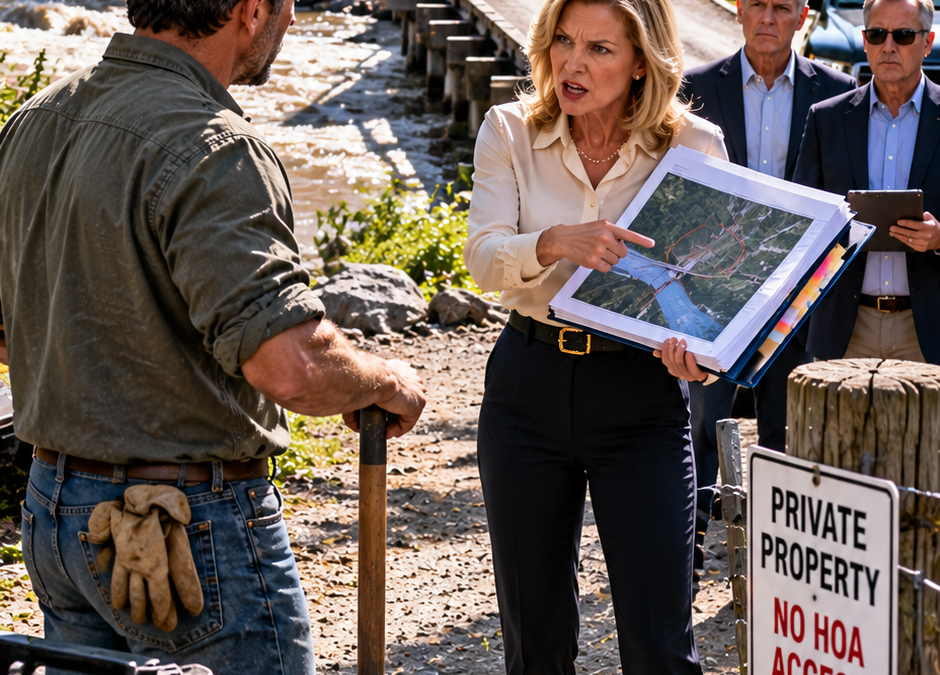
She pulled one from the folder and spread it across the hood of her SUV. The board members gathered around her like students around a teacher. I walked over slowly, already tired of the performance.
The map showed Pine Ridge Estates in neat lines and blocks. Common areas were shaded green. Private lots were outlined in black. A thick blue line marked the river. Then, across the section where my bridge sat, someone had drawn an access corridor that bent just far enough to make the bridge appear tied to HOA land.
I leaned closer.
There it was.
The error.
Or the lie.
The boundary line was wrong.
It pushed the HOA’s western edge deep beyond where the county records placed it. It swallowed part of my lower field, a slice of the riverbank, and the entire bridge crossing.
I looked at Karen.
“Where did this map come from?”
“The HOA planning file.”
“That is not what I asked.”
“It is the association’s map.”
“Created by who?”
She hesitated just long enough for me to notice.
“It was prepared for internal use.”
I nodded. “So the HOA made a map that gives itself my bridge.”
Karen’s face hardened. “That is a childish way to describe it.”
“It is an accurate way to describe it.”
She tapped one manicured fingernail on the paper. “The bridge is within the community access corridor.”
“Not according to the county.”
“The county records may not reflect longstanding use.”
“The county records reflect ownership.”
“Ownership can be complicated.”
“Not today.”
I walked to my truck, opened the door, and pulled out the property folder I kept behind the seat. My father had started that habit. I had continued it. Deeds, survey copies, emergency contacts, inspection references. Not everything, but enough.
Karen watched me with an expression halfway between irritation and amusement.
I returned with my recorded survey and unfolded it on the hood next to her HOA map.
“This is the county-recognized survey,” I said. “This is the deeded boundary. The bridge is inside my parcel.”
Karen barely glanced at it.
“That survey is old.”
“It is recorded.”
“Older documents can be incomplete.”
“Then show me a newer recorded deed transferring the bridge to the HOA.”
She smiled again, but it was thinner now.
“We don’t need a deed to recognize community property.”
I stared at her for a long moment.
That was my first real clue that this was not just another Karen misunderstanding. She was not confused. She had decided a story was more useful than a fact.
“You are claiming ownership of a bridge without a deed,” I said.
“We are recognizing historic community use.”
“You are claiming ownership without a deed.”
Phil shifted uncomfortably.
Karen snapped the folder closed halfway, then reopened it as if the motion helped her regain control.
“The HOA has maintenance responsibilities for the bridge.”
That one almost made me laugh.
“Show me one invoice.”
She blinked. “Excuse me?”
“One maintenance invoice. One inspection bill. One receipt for lumber, gravel, steel, labor, welding, bolts, paint, engineering, anything. If the HOA has maintenance responsibility, show me where it ever paid.”
Karen looked toward Phil.
Phil began scrolling through his tablet.
I already knew what he would find.
Nothing.
Because there was nothing.
My father had taught me too well for that.
The truth was sitting in file boxes at my house, sorted by year in a cabinet most people would have found obsessive. I had receipts from contractors who were now retired or dead. I had handwritten notes from my father attached to invoices. I had county inspection reports stamped and dated. I had photographs of the bridge before and after major repairs. I had bank records, canceled checks, and letters from engineers.
Thirty-eight years of paper.
Thirty-eight years of proof.
Karen had no idea.
Phil cleared his throat. “I don’t have those records on hand.”
“Because they don’t exist.”
Karen lifted her chin. “This conversation is becoming unproductive.”
“It became unproductive when you claimed my bridge.”
“I am going to have this resolved properly,” she said.
“Good. Bring the deed.”
She looked at me with cold satisfaction.
“I’ll call the sheriff.”
That told me exactly what she expected.
She thought a uniform would settle the matter in her favor. She thought the sheriff would arrive, see her folder, hear the words “HOA property,” and tell me to stop obstructing the community. She thought authority worked the way she did: confidence first, facts later.
“Call him,” I said.
Her eyes narrowed, as if my agreement irritated her.
Then she turned away and made the call.
While we waited, the board members stood near Karen’s SUV whispering among themselves. I stayed by the bridge. The river moved under it, dark and restless from the rain. A red leaf spun in an eddy near the eastern bank and disappeared beneath the current.
I looked at the steel support beneath the near corner and remembered my father crawling under there in 1994 after a spring flood. He had been soaked to the waist, cursing at a bent bracket while I stood nearby holding a flashlight. I remembered the way his hands looked on that bridge—scarred, swollen at the knuckles, always steady. He believed things lasted only when someone cared enough to maintain them.
Karen believed things became hers when she announced them.
Those two worlds were finally about to collide.
Sheriff Brooks arrived twenty minutes later.
His SUV came slowly down the lane and stopped near the river. Brooks had been sheriff for eight years by then, and I had known him casually since high school. Not well enough to call him a friend, but well enough to trust that he did not like theatrics.
He stepped out wearing his tan uniform, hat low against the morning glare.
“Morning,” he said, looking from Karen to me. “What seems to be the issue?”
Karen moved first.
“Sheriff, thank you for coming. We have an ongoing access dispute involving HOA property. Mr. Hale is interfering with the association’s bridge.”
I almost admired how easily she said it.
The association’s bridge.
Brooks looked toward the structure, then back at her.
“This bridge?”
“Yes.”
He turned to me. “Matthew?”
“It’s my family’s bridge,” I said. “Always has been.”
Karen immediately held up her folder. “The HOA map clearly includes it in the community access corridor.”
Brooks accepted the map and studied it without expression.
Karen continued speaking while he read.
“Residents have used this bridge for years. The association has always considered it part of the neighborhood’s access system. Mr. Hale is now attempting to restrict community use and deny HOA ownership.”
Brooks looked up. “You have a deed showing HOA ownership?”
Karen paused.
“The map reflects the association’s understanding.”
“That’s not what I asked.”
Her smile faltered.
Brooks turned to me. “You have documents?”
“Yes.”
I handed him my survey first.
He unfolded it across the hood of his SUV, weighing one corner down with his radio. I gave him the original deed copy next. He compared the parcel description, then looked back at Karen’s map. He said nothing for a while.
That silence felt better than any speech.
Karen tried to fill it.
“As you can see, Sheriff, there is a long-established pattern of community use.”
Brooks raised one finger without looking up.
She stopped.
He traced the boundary line on my survey, then compared it to the HOA map. Finally, he looked at Karen.
“Where did this HOA map come from?”
“The association’s planning file.”
“Was it recorded with the county?”
“I don’t believe that specific version was recorded.”
“Was it prepared by a licensed surveyor?”
Karen hesitated. “It was prepared for association use.”
“So no?”
Phil answered quietly, “Not that I know of.”
Brooks folded the HOA map halfway and looked at my survey again.
“The county-recognized line places this bridge inside Mr. Hale’s parcel.”
Karen’s face tightened. “There are historic-use considerations.”
“Maybe for access,” Brooks said. “Not ownership.”
That one sentence shifted the whole morning.
Karen looked as if someone had slapped the folder out of her hands.
Brooks continued, calm and plain.
“An access agreement, if one exists, might allow certain people to cross. Community use might raise questions about permission, habit, or easement depending on documents and history. But using something does not automatically mean owning it.”
I watched Karen’s eyes move quickly from Brooks to the bridge to the map.
She understood the distinction now.
She hated it.
Brooks asked, “Do you have a deed transferring the bridge to the HOA?”
“No.”
“A bill of sale?”
“No.”
“A written transfer agreement?”
“No.”
“An easement document describing bridge maintenance and ownership?”
“We are still reviewing files.”
“That means no for today.”
Karen inhaled sharply. “Sheriff, the association has operated for years under the belief—”
“Belief is not a deed.”
I could have hugged him for that if the situation had been less tense.
Then I opened the second folder.
Karen had not seen that one yet.
“Sheriff,” I said, “there’s more.”
Brooks looked over.
I placed the folder on the hood and opened it.
The first invoice was dated 1988.
The paper had yellowed at the edges, but my father’s name was clear at the top. Hale Family Farm. Bridge deck repair. Replacement planks. Labor. Materials. Payment received.
Brooks leaned closer.
I set the next document beside it.
- Structural reinforcement after flood damage.
Then 2001. County safety inspection, paid by my father.
Then 2010. Replacement steel supports.
Then 2016. Guardrail repair.
Then 2021. Approach grading and surface reinforcement.
Then 2024. Inspection and maintenance check, paid by me.
One by one, the years lined up across the hood of the sheriff’s SUV.
Thirty-eight years of maintenance.
Thirty-eight years of ownership behaving like ownership.
Karen’s face changed slowly as each document appeared.
Not all at once. Not dramatically.
But her confidence began draining from the edges.
“These are private invoices,” she said.
“Yes,” I replied. “Because it is a private bridge.”
Brooks picked up the 2001 inspection report. “This one references the Hale bridge.”
“My father paid for that inspection after heavy spring flooding,” I said.
He looked at another. “And this structural repair?”
“Complete reinforcement on the north span. We paid for steel, welding, and labor.”
Brooks turned to Karen. “Do you have any HOA maintenance records?”
Karen looked at Phil.
Phil was scrolling again, faster this time.
“We may need to access archived files,” he said.
I almost felt sorry for him.
Almost.
Karen took the tablet from him and began flipping through pages herself. Her fingers moved with growing impatience. She opened documents, closed them, opened others. Board minutes. Budget summaries. Common area expenses. Road maintenance. Landscaping. Signage. Clubhouse repairs.
Nothing for the bridge.
Nothing from 1988.
Nothing from 1994.
Nothing from 2001.
Nothing from 2010.
Nothing at all.
The bridge she claimed her HOA owned had never cost her HOA a cent.
Brooks let her search.
That was the kindest cruelty he could have offered: time enough to prove she had nothing.
Finally, he said, “Mrs. Whitmore.”
Karen looked up.
“Unless you have documentation I haven’t seen, this appears to be Mr. Hale’s bridge on Mr. Hale’s property.”
Her voice was tight. “The HOA still has residents who rely on this crossing.”
“That may be a separate civil issue regarding access, if there is any documented right. But I am not seeing ownership.”
She stiffened. “So you’re taking his side.”
Brooks’s expression hardened for the first time.
“I’m looking at documents.”
That shut her down.
A vehicle came slowly along the Pine Ridge side of the road and stopped near the east approach. An older man stepped out. I recognized him immediately, though I had not spoken to him in months.
His name was Earl Patterson.
He was one of the first residents of Pine Ridge, a widower in his late seventies who still drove an old green pickup and wore the same brown cap every time I saw him. My father had liked Earl. Said he was one of the few men in the subdivision who understood that a handshake did not replace a property record, but it still ought to mean something.
Earl walked toward us slowly, leaning on a cane.
“What’s all this?” he asked.
Karen answered before anyone else.
“Earl, we’re resolving a bridge ownership issue.”
He frowned. “What ownership issue?”
“The HOA has been reviewing its rights to the bridge.”
Earl looked at her as if she had started speaking another language.
“What rights?”
Karen’s mouth tightened. “The community has used this bridge for years.”
Earl snorted.
“Used it because Matthew’s daddy let us.”
The air went still.
Karen turned slowly. “That is not the full history.”
Earl pointed his cane toward the bridge.
“I was here when John Hale rebuilt that thing after the ’94 flood. I watched him and his boy work on it half the summer. HOA didn’t do a blessed thing but complain about mud on the road.”
I felt something move in my chest when he said my father’s name.
John Hale.
For a moment, I was sixteen again, standing beside the river with a flashlight in my hand, listening to my father tell me to hold it steady.
Karen tried to recover. “Mr. Patterson, informal memories are not necessarily legally controlling.”
Earl looked at Sheriff Brooks. “You need legal? Ask her for the bills. The Hales paid. Everybody knew it.”
Brooks nodded slightly. “Mr. Hale has provided maintenance records.”
“Course he has,” Earl said. “His daddy saved everything. Had boxes of receipts going back to when Reagan was president.”
Despite everything, I smiled.
Karen did not.
Earl turned toward her fully now, and his voice sharpened in a way I had never heard before.
“Karen, I don’t know what you’ve been telling people, but this bridge was never ours. We crossed because John Hale was decent. That doesn’t make it yours.”
One of the board members looked down at the ground.
Phil stopped scrolling.
Karen’s face flushed, but she could not dismiss Earl the way she dismissed me. He was not an outsider. He was one of her own residents. An original homeowner. Someone who had been there long before her presidency, her folders, and her invented access corridor.
“Thank you, Earl,” I said quietly.
He nodded once. “Your father was a good man.”
That nearly broke me harder than the argument had.
Karen gathered her papers with stiff movements.
“This matter is not finished,” she said.
Brooks looked at her. “Maybe not civilly. But as far as today goes, no one is taking control of this bridge based on an HOA map.”
She glared at him, then at me.
“You are creating unnecessary conflict with the community.”
“No,” I said. “I am ending a lie before it becomes policy.”
Her lips parted, but no answer came.
That was the first time I had ever seen Karen Whitmore run out of words.
She left ten minutes later with her board members following behind her like people leaving a meeting that had gone much worse than expected. Phil carried the map rolled under one arm, but it looked different now. Less like evidence. More like paper.
Sheriff Brooks stayed a few minutes after they left.
He handed back my deed and survey carefully.
“You may want to speak with your attorney,” he said. “If there’s any access arrangement, get it clarified in writing. If there isn’t, decide what you want to allow and what you don’t.”
“I will.”
He nodded toward the bridge. “You planning to close it?”
I looked at the structure, the river moving beneath it, the tire marks across the planks from years of use.
“I don’t know yet.”
Brooks understood that better than most would have.
“Generosity gets complicated when people start calling it entitlement.”
“Yes, it does.”
He handed me the last invoice.
“Good thing your father kept records.”
I looked down at the paper in my hand.
“Yeah,” I said. “It is.”
After he left, Earl remained by the bridge with me for a while.
The morning had warmed, and sunlight moved across the water in broken silver pieces. Neither of us spoke for almost a minute.
Finally, Earl said, “John would have hated that.”
“He would have handled it better than I did.”
“No,” Earl said. “He would have scared her worse.”
I laughed then.
A real laugh.
The kind that escapes before grief can stop it.
Earl smiled faintly. “He had a way of getting quiet that made a man rethink his plans.”
“He did.”
“He told me once he kept every bridge receipt because someday somebody would claim they paid for what they only used.”
I looked at him.
“He said that?”
Earl nodded. “Standing right over there. Must have been after the 2001 inspection. I told him he was too suspicious.”
“What did he say?”
“He said, ‘Suspicious is what lazy people call prepared.’”
That sounded exactly like my father.
For a while, I could not speak.
The whole morning had been anger, documents, accusations, and legal lines. But beneath all of it was the quieter ache of realizing my father had protected me long after he was gone. Not with money. Not with some dramatic final letter. With boxes of receipts. With organized folders. With stubborn discipline. With the belief that a man should know what was his and be able to prove it when someone came smiling with a false map.
“I miss him,” I said.
Earl looked at the bridge. “So do I.”
The next week, my attorney sent a formal letter to the HOA.
It did not rant. It did not insult. It did not use the kind of language I had used in my head a hundred times since Karen first pointed at the bridge. It simply stated the facts.
The bridge was located within my recorded parcel.
No deed transferred it to Pine Ridge Estates HOA.
No agreement granted HOA ownership.
No maintenance records showed HOA financial responsibility.
My family possessed thirty-eight years of repair, inspection, and maintenance documents.
Any further claim of ownership by the HOA would require legal proof, not internal maps or assumptions based on permissive use.
The letter also addressed access.
That part was harder.
My first instinct had been to close the bridge completely. Put up a gate. Lock it. End the problem permanently.
But I kept hearing my father’s voice.
Generosity was not the mistake, he would have said. Failing to define it was.
So instead of closing the bridge to everyone, I changed the terms.
Residents who had historically used the crossing for specific practical reasons could request written permission. Emergency access would remain available. Any access was revocable, limited, and did not create ownership, control, maintenance responsibility, or HOA authority. Commercial use, signage, modifications, improvements, or representation of the bridge as an HOA asset were strictly prohibited.
In other words, neighborliness could continue.
Karen’s fiction could not.
The HOA attorney responded two weeks later.
The letter was careful. Very careful.
It did not admit Karen had lied. It did not apologize for the confrontation. It did not say the HOA had tried to claim something it did not own.
But it acknowledged that Pine Ridge Estates had no recorded ownership interest in the bridge.
I read that sentence three times.
No recorded ownership interest.
It was as close to surrender as lawyers often get.
The board also agreed to remove any internal references identifying the bridge as HOA property and to correct any maps used for planning or resident information. Future communications would describe the bridge, if necessary, only as a private crossing outside HOA ownership.
Karen did not sign the letter.
The HOA attorney did.
That told me enough.
For about a month, I heard nothing from her.
Then, at a county meeting about rural access roads, I saw her across the room. She noticed me almost immediately. For a moment, I thought she might come over and attempt some polished version of an explanation.
She did not.
She looked away.
That was fine with me.
I was not waiting for an apology. People like Karen do not apologize when facts defeat them. They revise the story until they can live inside it. I had no interest in her private version.
I had the public record.
I had the deed.
I had the survey.
I had the invoices.
I had Sheriff Brooks’s notes.
I had Earl Patterson’s statement, which he insisted on writing after the incident. It was only one page, signed in shaky handwriting, but it meant more to me than some official documents.
He wrote that my father had maintained the bridge for decades. That residents crossed by permission. That the HOA had never owned it. That “everyone who had lived here long enough knew it belonged to the Hale family.”
I placed his statement in the bridge file.
Then I made copies of everything.
One set went to my attorney.
One stayed in the house.
One went into a waterproof storage box in the barn.
My wife teased me gently when she saw the new labels.
“Bridge War File?” she read aloud.
“That’s temporary.”
“Does Karen know she has a file named after her defeat?”
“I hope not. She’d probably claim ownership of the folder.”
Allison laughed, and for the first time in weeks, the bridge felt less like a battlefield and more like part of our life again.
Still, something had changed.
I became more careful. I posted a small sign near each approach: Private Bridge. Use by Permission Only. No HOA Ownership or Maintenance Responsibility. It was not pretty, but it was clear. I installed a trail camera facing the eastern side, not because I wanted to spy on neighbors, but because I had learned that clarity without documentation was only half a defense.
A few residents contacted me properly afterward.
One older couple asked if they could keep using the bridge during flood season because the lower crossing made them nervous. I gave them written permission. A delivery driver asked if he could cross twice during a road closure. I allowed it. Earl kept crossing occasionally in his green pickup, always raising two fingers from the steering wheel when he passed.
Life settled.
But every time I walked across that bridge, I noticed things differently.
The heavy boards beneath my boots.
The rails my father had replaced after the ice storm.
The steel supports from the 2010 repair.
The bolts I had helped tighten.
The slope of the approach where we had added gravel three summers ago.
A person who has not paid for maintenance does not see those things. They see convenience. They see access. They see a line on a map and assume the structure exists for them.
But when your family has kept something standing for thirty-eight years, you see every layer of labor holding it together.
One evening in late fall, I walked down to the river alone.
The air had gone cold enough that my breath showed faintly. Leaves covered the banks, and the water moved dark under the bridge. I stood at the center, one hand on the rail, and listened.
The river sounded the same as it had when I was a child.
That surprised me somehow.
So much around it had changed. The subdivision. The HOA. Karen’s false claim. The sheriff’s visit. The attorney letters. The signs. The cameras. The file boxes. Yet beneath the bridge, the river kept moving the way it always had, indifferent to arrogance, paperwork, and human stupidity.
I thought about my father again.
I thought about all the times I had rolled my eyes when he insisted on saving receipts. When he labeled folders by year. When he wrote notes in the margins of inspection reports. When he told me never to rely on memory if paper could preserve the truth.
Back then, I thought he was being excessive.
Now I understood he was leaving me armor.
Not flashy armor. Not dramatic. Just quiet, practical protection built one invoice at a time.
Karen had walked onto my land with a folder full of assumptions.
My father had answered her with thirty-eight years of facts.
That was the part I kept coming back to.
The confrontation had not been won by anger, though I had plenty of it. It had not been won by shouting, though I wanted to shout. It had not even been won by Sheriff Brooks, though his calm refusal to accept Karen’s map as gospel mattered more than he probably knew.
It was won years before Karen arrived.
Won when my father kept the 1988 invoice.
Won when he paid for the 1994 structural repair and filed the receipt.
Won when he saved the 2001 county inspection.
Won when he documented the steel supports in 2010.
Won when I continued the habit because some part of me still heard him saying, People forget who pays for things. So you don’t forget.
Karen forgot.
Or pretended to.
It did not matter which.
The records remembered.
By winter, the HOA had corrected its maps. At least, that was what their attorney claimed. I never trusted internal HOA maps again, but I did receive a copy of the updated version showing the bridge outside their boundary. The access corridor disappeared. The green shading stopped where it should have stopped all along.
I framed nothing.
I celebrated nothing.
I simply placed the corrected map in the file with the rest.
Then, on the first clear morning after a week of rain, I drove my truck across the bridge.
Slowly.
Not because I was afraid of it, but because I wanted to feel every board beneath the tires. The river was high, rushing below, brown and cold. Sunlight flashed through bare branches. On the far side, I stopped, stepped out, and looked back.
It was just a bridge to most people.
A crossing.
A convenience.
A shortcut.
To Karen, it had been an opportunity: something useful enough to claim, old enough to blur, generous enough to exploit.
To me, it was my father’s hands. My grandfather’s land. My family’s burden and my family’s proof. It was thirty-eight years of repairs no HOA had paid for and three generations of responsibility no map could erase.
Karen had claimed my private bridge as if repetition could make it true.
Then the sheriff asked for deeds, transfers, invoices, and maintenance records.
Every document led back to my family.
Every repair told the same story.
Every inspection, every payment, every witness, every old receipt proved what I had known before she ever opened her folder.
Using a bridge does not make you its owner.
Calling something community property does not make it yours.
And when someone tries to turn generosity into a land grab, the quietest answer can be the strongest one.
A deed.
A survey.
A sheriff willing to read them.
And thirty-eight years of records waiting in a folder my father told me never to throw away.
The bridge is still there.
The river still runs beneath it.
Earl still waves when he crosses with permission.
And every time my tires touch those boards, I remember the morning Karen Whitmore pointed at my bridge and called it hers.
She had a map.
I had the truth.
And the truth had receipts.
𝗧𝗛𝗘 𝗘𝗡𝗗
The Morning Karen Claimed the Bridge My Father Had Spent a Lifetime Keeping Alive
Karen Whitmore did not come to my bridge looking for the truth. She came with a folder, a map, and the calm confidence of someone who believed saying something loudly enough could make it belong to her. What she did not know was that my father had taught me to save every receipt, every inspection, and every scrap of paper tied to that bridge for thirty-eight years.
My name is Matthew Hale, and that bridge had been part of my family’s land long before Karen Whitmore ever learned how to spell HOA.
It crossed a narrow river behind my property, connecting the upper pasture to the old timber road that ran along the ridge. It was not beautiful in the way people use that word when they are trying to sell something. It did not have stone towers, decorative railings, or lights glowing along the sides. It was a practical bridge, built from steel supports, heavy planks, and the kind of necessity that makes a family solve problems with their own hands because no one else is coming to help.
But to me, it was one of the most important structures on the property.
My grandfather laid the first crossing there before I was born, when it was nothing more than a reinforced farm bridge wide enough for a truck, a tractor, and a man with more faith than caution. My father rebuilt it twice. Once after a flood twisted part of the decking loose, and again after the county inspector told him the support beams needed to be replaced before winter. I remembered standing beside him when I was sixteen, watching sparks fall from a welder’s torch while he worked late into the evening.
“People forget who pays for things,” he told me that night, wiping sweat from his face with a rag so black with grease it barely counted as cloth anymore. “So you don’t forget. You keep records.”
At sixteen, I thought he meant receipts.
At fifty-four, I understood he meant protection.
For thirty-eight years, my family paid for that bridge. Every major repair. Every inspection. Every replacement support. Every resurfacing. Every load of gravel placed at the approaches. Every safety rail repaired after a storm knocked a tree across it. We paid because it was ours. We maintained it because we used it. And, because my father was the sort of man who believed being neighborly mattered, we allowed certain residents from the nearby road to cross it when weather made the lower crossing dangerous.
That was the mistake generous people often make.
They believe kindness will be remembered as kindness.
People like Karen remember it as weakness.
Pine Ridge Estates was built east of my land twenty years after my father’s first major bridge repair. At the beginning, the neighborhood was small: a few large houses, a private road, and families who mostly kept to themselves. Back then, everyone understood the bridge belonged to us. If someone needed to cross it, they asked. If a delivery truck got turned around and used it by mistake, nobody made a federal case out of it. If a storm washed out the lower road, my father let people pass through until the county repaired the culvert.
He never charged anyone.
He never put up a gate.
He never acted like helping a neighbor required applause.
But he also never gave the bridge away.
After he died, I kept the same arrangement. I did not mind occasional use. A few older homeowners knew me by name and waved when they crossed. One brought homemade peach preserves every summer and left them on my porch with a note that said, “For bridge gratitude.” I thought that was sweet. My wife, Allison, used to laugh and say we had the only toll bridge in the county that accepted jam.
Then Karen became HOA president.
That was when ordinary neighborliness turned into “community use.”
And “community use” became, in Karen’s mouth, “community property.”
I first heard something was wrong when a contractor called and asked where the HOA wanted new signage installed near “their bridge.”
I thought he had the wrong number.
“What bridge?” I asked.
“The bridge behind Pine Ridge,” he said. “The association wants new access signs.”
“That bridge belongs to me.”
There was a pause.
“Oh,” he said carefully. “I was told it was HOA property.”
“Who told you that?”
Another pause.
“President Whitmore.”
I told him not to install anything on my land. He sounded relieved to get off the phone.
Two days later, Karen arrived.
I was near the bridge that morning, clearing branches from the western approach after a hard rain. The river was still high, moving brown and fast beneath the beams. Water slapped against the rocks along the bank, and the air smelled like mud, leaves, and wet wood. I had a chainsaw in the back of my truck and a shovel leaning against the guardrail.
Then I saw Karen’s SUV coming down the lane.
Behind it were two more vehicles.
She parked as if she were arriving for an inspection she had authority to conduct. Three HOA board members climbed out behind her. One of them, a narrow-faced man named Phil Barrett, carried a tablet. Another held a rolled-up map. Karen stepped onto the gravel wearing dark slacks, a cream-colored blouse, and polished boots that looked expensive enough to make the mud feel insulted.
“Matthew,” she said, smiling.
I rested both hands on the shovel handle. “Karen.”
“We need to discuss the bridge.”
“No,” I said. “You need to explain why contractors think your HOA owns it.”
Her smile did not move, but something behind her eyes sharpened.
“That is actually why we’re here.”
“I’m listening.”
She opened her folder and pulled out several papers with colored tabs. I had seen Karen’s folders before. They were part prop, part weapon. She liked to produce paper as if the act itself settled the dispute.
“The board has reviewed the matter,” she said. “It is our position that the bridge functions as part of Pine Ridge community access.”
“Functions as,” I repeated.
“Yes.”
“That is not ownership.”
She tilted her head with the patronizing patience of someone who had rehearsed this in front of a mirror.
“For years, neighborhood residents have used this bridge.”
“Some have crossed it with permission.”
“That continuous use establishes a community interest.”
“No, it doesn’t.”
Phil Barrett looked up from his tablet. “There may be an implied access doctrine involved.”
I looked at him. “Are you an attorney?”
He blinked. “No.”
“Then don’t invent legal doctrines beside my river.”
Karen’s mouth tightened.
“Matthew, hostility is not going to help.”
“Neither is trespassing.”
She took a step toward the bridge and pointed to it as if presenting evidence in court.
“This bridge has always been understood as part of the neighborhood access system.”
“No,” I said. “It has always been understood as my family’s bridge.”
“The HOA has maps showing otherwise.”
“Then your maps are wrong.”
She pulled one from the folder and spread it across the hood of her SUV. The board members gathered around her like students around a teacher. I walked over slowly, already tired of the performance.
The map showed Pine Ridge Estates in neat lines and blocks. Common areas were shaded green. Private lots were outlined in black. A thick blue line marked the river. Then, across the section where my bridge sat, someone had drawn an access corridor that bent just far enough to make the bridge appear tied to HOA land.
I leaned closer.
There it was.
The error.
Or the lie.
The boundary line was wrong.
It pushed the HOA’s western edge deep beyond where the county records placed it. It swallowed part of my lower field, a slice of the riverbank, and the entire bridge crossing.
I looked at Karen.
“Where did this map come from?”
“The HOA planning file.”
“That is not what I asked.”
“It is the association’s map.”
“Created by who?”
She hesitated just long enough for me to notice.
“It was prepared for internal use.”
I nodded. “So the HOA made a map that gives itself my bridge.”
Karen’s face hardened. “That is a childish way to describe it.”
“It is an accurate way to describe it.”
She tapped one manicured fingernail on the paper. “The bridge is within the community access corridor.”
“Not according to the county.”
“The county records may not reflect longstanding use.”
“The county records reflect ownership.”
“Ownership can be complicated.”
“Not today.”
I walked to my truck, opened the door, and pulled out the property folder I kept behind the seat. My father had started that habit. I had continued it. Deeds, survey copies, emergency contacts, inspection references. Not everything, but enough.
Karen watched me with an expression halfway between irritation and amusement.
I returned with my recorded survey and unfolded it on the hood next to her HOA map.
“This is the county-recognized survey,” I said. “This is the deeded boundary. The bridge is inside my parcel.”
Karen barely glanced at it.
“That survey is old.”
“It is recorded.”
“Older documents can be incomplete.”
“Then show me a newer recorded deed transferring the bridge to the HOA.”
She smiled again, but it was thinner now.
“We don’t need a deed to recognize community property.”
I stared at her for a long moment.
That was my first real clue that this was not just another Karen misunderstanding. She was not confused. She had decided a story was more useful than a fact.
“You are claiming ownership of a bridge without a deed,” I said.
“We are recognizing historic community use.”
“You are claiming ownership without a deed.”
Phil shifted uncomfortably.
Karen snapped the folder closed halfway, then reopened it as if the motion helped her regain control.
“The HOA has maintenance responsibilities for the bridge.”
That one almost made me laugh.
“Show me one invoice.”
She blinked. “Excuse me?”
“One maintenance invoice. One inspection bill. One receipt for lumber, gravel, steel, labor, welding, bolts, paint, engineering, anything. If the HOA has maintenance responsibility, show me where it ever paid.”
Karen looked toward Phil.
Phil began scrolling through his tablet.
I already knew what he would find.
Nothing.
Because there was nothing.
My father had taught me too well for that.
The truth was sitting in file boxes at my house, sorted by year in a cabinet most people would have found obsessive. I had receipts from contractors who were now retired or dead. I had handwritten notes from my father attached to invoices. I had county inspection reports stamped and dated. I had photographs of the bridge before and after major repairs. I had bank records, canceled checks, and letters from engineers.
Thirty-eight years of paper.
Thirty-eight years of proof.
Karen had no idea.
Phil cleared his throat. “I don’t have those records on hand.”
“Because they don’t exist.”
Karen lifted her chin. “This conversation is becoming unproductive.”
“It became unproductive when you claimed my bridge.”
“I am going to have this resolved properly,” she said.
“Good. Bring the deed.”
She looked at me with cold satisfaction.
“I’ll call the sheriff.”
That told me exactly what she expected.
She thought a uniform would settle the matter in her favor. She thought the sheriff would arrive, see her folder, hear the words “HOA property,” and tell me to stop obstructing the community. She thought authority worked the way she did: confidence first, facts later.
“Call him,” I said.
Her eyes narrowed, as if my agreement irritated her.
Then she turned away and made the call.
While we waited, the board members stood near Karen’s SUV whispering among themselves. I stayed by the bridge. The river moved under it, dark and restless from the rain. A red leaf spun in an eddy near the eastern bank and disappeared beneath the current.
I looked at the steel support beneath the near corner and remembered my father crawling under there in 1994 after a spring flood. He had been soaked to the waist, cursing at a bent bracket while I stood nearby holding a flashlight. I remembered the way his hands looked on that bridge—scarred, swollen at the knuckles, always steady. He believed things lasted only when someone cared enough to maintain them.
Karen believed things became hers when she announced them.
Those two worlds were finally about to collide.
Sheriff Brooks arrived twenty minutes later.
His SUV came slowly down the lane and stopped near the river. Brooks had been sheriff for eight years by then, and I had known him casually since high school. Not well enough to call him a friend, but well enough to trust that he did not like theatrics.
He stepped out wearing his tan uniform, hat low against the morning glare.
“Morning,” he said, looking from Karen to me. “What seems to be the issue?”
Karen moved first.
“Sheriff, thank you for coming. We have an ongoing access dispute involving HOA property. Mr. Hale is interfering with the association’s bridge.”
I almost admired how easily she said it.
The association’s bridge.
Brooks looked toward the structure, then back at her.
“This bridge?”
“Yes.”
He turned to me. “Matthew?”
“It’s my family’s bridge,” I said. “Always has been.”
Karen immediately held up her folder. “The HOA map clearly includes it in the community access corridor.”
Brooks accepted the map and studied it without expression.
Karen continued speaking while he read.
“Residents have used this bridge for years. The association has always considered it part of the neighborhood’s access system. Mr. Hale is now attempting to restrict community use and deny HOA ownership.”
Brooks looked up. “You have a deed showing HOA ownership?”
Karen paused.
“The map reflects the association’s understanding.”
“That’s not what I asked.”
Her smile faltered.
Brooks turned to me. “You have documents?”
“Yes.”
I handed him my survey first.
He unfolded it across the hood of his SUV, weighing one corner down with his radio. I gave him the original deed copy next. He compared the parcel description, then looked back at Karen’s map. He said nothing for a while.
That silence felt better than any speech.
Karen tried to fill it.
“As you can see, Sheriff, there is a long-established pattern of community use.”
Brooks raised one finger without looking up.
She stopped.
He traced the boundary line on my survey, then compared it to the HOA map. Finally, he looked at Karen.
“Where did this HOA map come from?”
“The association’s planning file.”
“Was it recorded with the county?”
“I don’t believe that specific version was recorded.”
“Was it prepared by a licensed surveyor?”
Karen hesitated. “It was prepared for association use.”
“So no?”
Phil answered quietly, “Not that I know of.”
Brooks folded the HOA map halfway and looked at my survey again.
“The county-recognized line places this bridge inside Mr. Hale’s parcel.”
Karen’s face tightened. “There are historic-use considerations.”
“Maybe for access,” Brooks said. “Not ownership.”
That one sentence shifted the whole morning.
Karen looked as if someone had slapped the folder out of her hands.
Brooks continued, calm and plain.
“An access agreement, if one exists, might allow certain people to cross. Community use might raise questions about permission, habit, or easement depending on documents and history. But using something does not automatically mean owning it.”
I watched Karen’s eyes move quickly from Brooks to the bridge to the map.
She understood the distinction now.
She hated it.
Brooks asked, “Do you have a deed transferring the bridge to the HOA?”
“No.”
“A bill of sale?”
“No.”
“A written transfer agreement?”
“No.”
“An easement document describing bridge maintenance and ownership?”
“We are still reviewing files.”
“That means no for today.”
Karen inhaled sharply. “Sheriff, the association has operated for years under the belief—”
“Belief is not a deed.”
I could have hugged him for that if the situation had been less tense.
Then I opened the second folder.
Karen had not seen that one yet.
“Sheriff,” I said, “there’s more.”
Brooks looked over.
I placed the folder on the hood and opened it.
The first invoice was dated 1988.
The paper had yellowed at the edges, but my father’s name was clear at the top. Hale Family Farm. Bridge deck repair. Replacement planks. Labor. Materials. Payment received.
Brooks leaned closer.
I set the next document beside it.
- Structural reinforcement after flood damage.
Then 2001. County safety inspection, paid by my father.
Then 2010. Replacement steel supports.
Then 2016. Guardrail repair.
Then 2021. Approach grading and surface reinforcement.
Then 2024. Inspection and maintenance check, paid by me.
One by one, the years lined up across the hood of the sheriff’s SUV.
Thirty-eight years of maintenance.
Thirty-eight years of ownership behaving like ownership.
Karen’s face changed slowly as each document appeared.
Not all at once. Not dramatically.
But her confidence began draining from the edges.
“These are private invoices,” she said.
“Yes,” I replied. “Because it is a private bridge.”
Brooks picked up the 2001 inspection report. “This one references the Hale bridge.”
“My father paid for that inspection after heavy spring flooding,” I said.
He looked at another. “And this structural repair?”
“Complete reinforcement on the north span. We paid for steel, welding, and labor.”
Brooks turned to Karen. “Do you have any HOA maintenance records?”
Karen looked at Phil.
Phil was scrolling again, faster this time.
“We may need to access archived files,” he said.
I almost felt sorry for him.
Almost.
Karen took the tablet from him and began flipping through pages herself. Her fingers moved with growing impatience. She opened documents, closed them, opened others. Board minutes. Budget summaries. Common area expenses. Road maintenance. Landscaping. Signage. Clubhouse repairs.
Nothing for the bridge.
Nothing from 1988.
Nothing from 1994.
Nothing from 2001.
Nothing from 2010.
Nothing at all.
The bridge she claimed her HOA owned had never cost her HOA a cent.
Brooks let her search.
That was the kindest cruelty he could have offered: time enough to prove she had nothing.
Finally, he said, “Mrs. Whitmore.”
Karen looked up.
“Unless you have documentation I haven’t seen, this appears to be Mr. Hale’s bridge on Mr. Hale’s property.”
Her voice was tight. “The HOA still has residents who rely on this crossing.”
“That may be a separate civil issue regarding access, if there is any documented right. But I am not seeing ownership.”
She stiffened. “So you’re taking his side.”
Brooks’s expression hardened for the first time.
“I’m looking at documents.”
That shut her down.
A vehicle came slowly along the Pine Ridge side of the road and stopped near the east approach. An older man stepped out. I recognized him immediately, though I had not spoken to him in months.
His name was Earl Patterson.
He was one of the first residents of Pine Ridge, a widower in his late seventies who still drove an old green pickup and wore the same brown cap every time I saw him. My father had liked Earl. Said he was one of the few men in the subdivision who understood that a handshake did not replace a property record, but it still ought to mean something.
Earl walked toward us slowly, leaning on a cane.
“What’s all this?” he asked.
Karen answered before anyone else.
“Earl, we’re resolving a bridge ownership issue.”
He frowned. “What ownership issue?”
“The HOA has been reviewing its rights to the bridge.”
Earl looked at her as if she had started speaking another language.
“What rights?”
Karen’s mouth tightened. “The community has used this bridge for years.”
Earl snorted.
“Used it because Matthew’s daddy let us.”
The air went still.
Karen turned slowly. “That is not the full history.”
Earl pointed his cane toward the bridge.
“I was here when John Hale rebuilt that thing after the ’94 flood. I watched him and his boy work on it half the summer. HOA didn’t do a blessed thing but complain about mud on the road.”
I felt something move in my chest when he said my father’s name.
John Hale.
For a moment, I was sixteen again, standing beside the river with a flashlight in my hand, listening to my father tell me to hold it steady.
Karen tried to recover. “Mr. Patterson, informal memories are not necessarily legally controlling.”
Earl looked at Sheriff Brooks. “You need legal? Ask her for the bills. The Hales paid. Everybody knew it.”
Brooks nodded slightly. “Mr. Hale has provided maintenance records.”
“Course he has,” Earl said. “His daddy saved everything. Had boxes of receipts going back to when Reagan was president.”
Despite everything, I smiled.
Karen did not.
Earl turned toward her fully now, and his voice sharpened in a way I had never heard before.
“Karen, I don’t know what you’ve been telling people, but this bridge was never ours. We crossed because John Hale was decent. That doesn’t make it yours.”
One of the board members looked down at the ground.
Phil stopped scrolling.
Karen’s face flushed, but she could not dismiss Earl the way she dismissed me. He was not an outsider. He was one of her own residents. An original homeowner. Someone who had been there long before her presidency, her folders, and her invented access corridor.
“Thank you, Earl,” I said quietly.
He nodded once. “Your father was a good man.”
That nearly broke me harder than the argument had.
Karen gathered her papers with stiff movements.
“This matter is not finished,” she said.
Brooks looked at her. “Maybe not civilly. But as far as today goes, no one is taking control of this bridge based on an HOA map.”
She glared at him, then at me.
“You are creating unnecessary conflict with the community.”
“No,” I said. “I am ending a lie before it becomes policy.”
Her lips parted, but no answer came.
That was the first time I had ever seen Karen Whitmore run out of words.
She left ten minutes later with her board members following behind her like people leaving a meeting that had gone much worse than expected. Phil carried the map rolled under one arm, but it looked different now. Less like evidence. More like paper.
Sheriff Brooks stayed a few minutes after they left.
He handed back my deed and survey carefully.
“You may want to speak with your attorney,” he said. “If there’s any access arrangement, get it clarified in writing. If there isn’t, decide what you want to allow and what you don’t.”
“I will.”
He nodded toward the bridge. “You planning to close it?”
I looked at the structure, the river moving beneath it, the tire marks across the planks from years of use.
“I don’t know yet.”
Brooks understood that better than most would have.
“Generosity gets complicated when people start calling it entitlement.”
“Yes, it does.”
He handed me the last invoice.
“Good thing your father kept records.”
I looked down at the paper in my hand.
“Yeah,” I said. “It is.”
After he left, Earl remained by the bridge with me for a while.
The morning had warmed, and sunlight moved across the water in broken silver pieces. Neither of us spoke for almost a minute.
Finally, Earl said, “John would have hated that.”
“He would have handled it better than I did.”
“No,” Earl said. “He would have scared her worse.”
I laughed then.
A real laugh.
The kind that escapes before grief can stop it.
Earl smiled faintly. “He had a way of getting quiet that made a man rethink his plans.”
“He did.”
“He told me once he kept every bridge receipt because someday somebody would claim they paid for what they only used.”
I looked at him.
“He said that?”
Earl nodded. “Standing right over there. Must have been after the 2001 inspection. I told him he was too suspicious.”
“What did he say?”
“He said, ‘Suspicious is what lazy people call prepared.’”
That sounded exactly like my father.
For a while, I could not speak.
The whole morning had been anger, documents, accusations, and legal lines. But beneath all of it was the quieter ache of realizing my father had protected me long after he was gone. Not with money. Not with some dramatic final letter. With boxes of receipts. With organized folders. With stubborn discipline. With the belief that a man should know what was his and be able to prove it when someone came smiling with a false map.
“I miss him,” I said.
Earl looked at the bridge. “So do I.”
The next week, my attorney sent a formal letter to the HOA.
It did not rant. It did not insult. It did not use the kind of language I had used in my head a hundred times since Karen first pointed at the bridge. It simply stated the facts.
The bridge was located within my recorded parcel.
No deed transferred it to Pine Ridge Estates HOA.
No agreement granted HOA ownership.
No maintenance records showed HOA financial responsibility.
My family possessed thirty-eight years of repair, inspection, and maintenance documents.
Any further claim of ownership by the HOA would require legal proof, not internal maps or assumptions based on permissive use.
The letter also addressed access.
That part was harder.
My first instinct had been to close the bridge completely. Put up a gate. Lock it. End the problem permanently.
But I kept hearing my father’s voice.
Generosity was not the mistake, he would have said. Failing to define it was.
So instead of closing the bridge to everyone, I changed the terms.
Residents who had historically used the crossing for specific practical reasons could request written permission. Emergency access would remain available. Any access was revocable, limited, and did not create ownership, control, maintenance responsibility, or HOA authority. Commercial use, signage, modifications, improvements, or representation of the bridge as an HOA asset were strictly prohibited.
In other words, neighborliness could continue.
Karen’s fiction could not.
The HOA attorney responded two weeks later.
The letter was careful. Very careful.
It did not admit Karen had lied. It did not apologize for the confrontation. It did not say the HOA had tried to claim something it did not own.
But it acknowledged that Pine Ridge Estates had no recorded ownership interest in the bridge.
I read that sentence three times.
No recorded ownership interest.
It was as close to surrender as lawyers often get.
The board also agreed to remove any internal references identifying the bridge as HOA property and to correct any maps used for planning or resident information. Future communications would describe the bridge, if necessary, only as a private crossing outside HOA ownership.
Karen did not sign the letter.
The HOA attorney did.
That told me enough.
For about a month, I heard nothing from her.
Then, at a county meeting about rural access roads, I saw her across the room. She noticed me almost immediately. For a moment, I thought she might come over and attempt some polished version of an explanation.
She did not.
She looked away.
That was fine with me.
I was not waiting for an apology. People like Karen do not apologize when facts defeat them. They revise the story until they can live inside it. I had no interest in her private version.
I had the public record.
I had the deed.
I had the survey.
I had the invoices.
I had Sheriff Brooks’s notes.
I had Earl Patterson’s statement, which he insisted on writing after the incident. It was only one page, signed in shaky handwriting, but it meant more to me than some official documents.
He wrote that my father had maintained the bridge for decades. That residents crossed by permission. That the HOA had never owned it. That “everyone who had lived here long enough knew it belonged to the Hale family.”
I placed his statement in the bridge file.
Then I made copies of everything.
One set went to my attorney.
One stayed in the house.
One went into a waterproof storage box in the barn.
My wife teased me gently when she saw the new labels.
“Bridge War File?” she read aloud.
“That’s temporary.”
“Does Karen know she has a file named after her defeat?”
“I hope not. She’d probably claim ownership of the folder.”
Allison laughed, and for the first time in weeks, the bridge felt less like a battlefield and more like part of our life again.
Still, something had changed.
I became more careful. I posted a small sign near each approach: Private Bridge. Use by Permission Only. No HOA Ownership or Maintenance Responsibility. It was not pretty, but it was clear. I installed a trail camera facing the eastern side, not because I wanted to spy on neighbors, but because I had learned that clarity without documentation was only half a defense.
A few residents contacted me properly afterward.
One older couple asked if they could keep using the bridge during flood season because the lower crossing made them nervous. I gave them written permission. A delivery driver asked if he could cross twice during a road closure. I allowed it. Earl kept crossing occasionally in his green pickup, always raising two fingers from the steering wheel when he passed.
Life settled.
But every time I walked across that bridge, I noticed things differently.
The heavy boards beneath my boots.
The rails my father had replaced after the ice storm.
The steel supports from the 2010 repair.
The bolts I had helped tighten.
The slope of the approach where we had added gravel three summers ago.
A person who has not paid for maintenance does not see those things. They see convenience. They see access. They see a line on a map and assume the structure exists for them.
But when your family has kept something standing for thirty-eight years, you see every layer of labor holding it together.
One evening in late fall, I walked down to the river alone.
The air had gone cold enough that my breath showed faintly. Leaves covered the banks, and the water moved dark under the bridge. I stood at the center, one hand on the rail, and listened.
The river sounded the same as it had when I was a child.
That surprised me somehow.
So much around it had changed. The subdivision. The HOA. Karen’s false claim. The sheriff’s visit. The attorney letters. The signs. The cameras. The file boxes. Yet beneath the bridge, the river kept moving the way it always had, indifferent to arrogance, paperwork, and human stupidity.
I thought about my father again.
I thought about all the times I had rolled my eyes when he insisted on saving receipts. When he labeled folders by year. When he wrote notes in the margins of inspection reports. When he told me never to rely on memory if paper could preserve the truth.
Back then, I thought he was being excessive.
Now I understood he was leaving me armor.
Not flashy armor. Not dramatic. Just quiet, practical protection built one invoice at a time.
Karen had walked onto my land with a folder full of assumptions.
My father had answered her with thirty-eight years of facts.
That was the part I kept coming back to.
The confrontation had not been won by anger, though I had plenty of it. It had not been won by shouting, though I wanted to shout. It had not even been won by Sheriff Brooks, though his calm refusal to accept Karen’s map as gospel mattered more than he probably knew.
It was won years before Karen arrived.
Won when my father kept the 1988 invoice.
Won when he paid for the 1994 structural repair and filed the receipt.
Won when he saved the 2001 county inspection.
Won when he documented the steel supports in 2010.
Won when I continued the habit because some part of me still heard him saying, People forget who pays for things. So you don’t forget.
Karen forgot.
Or pretended to.
It did not matter which.
The records remembered.
By winter, the HOA had corrected its maps. At least, that was what their attorney claimed. I never trusted internal HOA maps again, but I did receive a copy of the updated version showing the bridge outside their boundary. The access corridor disappeared. The green shading stopped where it should have stopped all along.
I framed nothing.
I celebrated nothing.
I simply placed the corrected map in the file with the rest.
Then, on the first clear morning after a week of rain, I drove my truck across the bridge.
Slowly.
Not because I was afraid of it, but because I wanted to feel every board beneath the tires. The river was high, rushing below, brown and cold. Sunlight flashed through bare branches. On the far side, I stopped, stepped out, and looked back.
It was just a bridge to most people.
A crossing.
A convenience.
A shortcut.
To Karen, it had been an opportunity: something useful enough to claim, old enough to blur, generous enough to exploit.
To me, it was my father’s hands. My grandfather’s land. My family’s burden and my family’s proof. It was thirty-eight years of repairs no HOA had paid for and three generations of responsibility no map could erase.
Karen had claimed my private bridge as if repetition could make it true.
Then the sheriff asked for deeds, transfers, invoices, and maintenance records.
Every document led back to my family.
Every repair told the same story.
Every inspection, every payment, every witness, every old receipt proved what I had known before she ever opened her folder.
Using a bridge does not make you its owner.
Calling something community property does not make it yours.
And when someone tries to turn generosity into a land grab, the quietest answer can be the strongest one.
A deed.
A survey.
A sheriff willing to read them.
And thirty-eight years of records waiting in a folder my father told me never to throw away.
The bridge is still there.
The river still runs beneath it.
Earl still waves when he crosses with permission.
And every time my tires touch those boards, I remember the morning Karen Whitmore pointed at my bridge and called it hers.
She had a map.
I had the truth.
And the truth had receipts.








